

- Industry Size (2026)
- USD 88.2 Bn
- Forecast (2036)
- USD 143.6 Bn
- CAGR (2026 to 2036)
- 5.0%
Air Transport MRO Market Forecast and Outlook 2026 to 2036
The air transport MRO market is projected to be valued at USD 88.2 billion in 2026. As per FMI's projection, the industry is predicted to record a value of USD 143.6 billion by 2036 while advancing at a CAGR of 5.0% over the forecast period.
The expansion of the air transport MRO market is anchored by the dual forces of a steadily recovering global passenger traffic and an aging global aircraft fleet requiring more intensive upkeep. The MRO sector is essential for ensuring airworthiness, operational safety, and regulatory compliance, forming a critical and non-discretionary cost center for airlines and operators worldwide.
Quick Stats for Air Transport MRO Market
- Air Transport MRO Market Value (2026): USD 88.2 billion
- Air Transport MRO Market Forecast Value (2036): USD 143.6 billion
- Air Transport MRO Market Forecast CAGR: 5.0%
- Leading Application in Air Transport MRO Market: Airframe (33.3%)
- Leading Aircraft Type in Air Transport MRO Market: Narrow Body Aircraft (39.0%)
- Key Growth Countries in Air Transport MRO Market: South Korea, UK, USA, Japan
- Key Players in Air Transport MRO Market: Lufthansa Technik, ST Engineering, AAR Corporation, Airbus MRO Services, Boeing Global Services
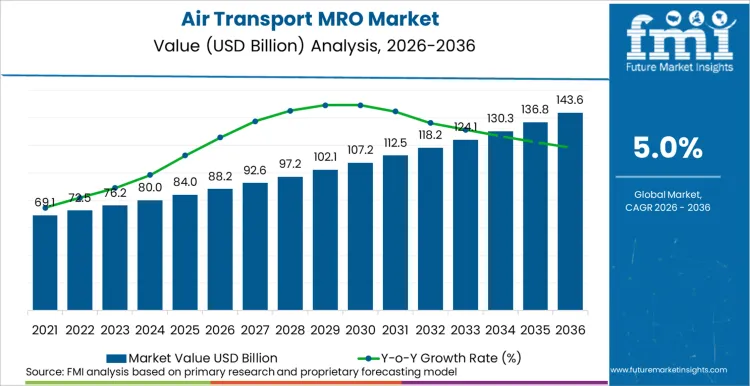
Demand dynamics are heavily influenced by fleet composition, utilization rates, and stringent aviation safety regulations mandated by bodies like the FAA and EASA. The North American market remains mature, driven by a large, aging fleet and high utilization rates. The Asia Pacific region, led by South Korea and emerging Southeast Asian economies, is witnessing robust growth fueled by rapid fleet expansion and the establishment of new aviation hubs.
The convergence of older aircraft reaching heavy maintenance check milestones, the integration of new digital maintenance technologies, and pressures to enhance operational efficiency is compelling the industry to modernize MRO practices.
Technological and strategic trends are coalescing around predictive analytics and shifts in airline outsourcing strategies. Innovations focus on using IoT sensors and AI-driven data analysis to transition from scheduled maintenance to condition-based monitoring, aiming to reduce unscheduled ground time.
Airline companies are partnering with OEMs for integrated service packages, while independent MROs are specializing in niche components or older aircraft models. The competitive landscape is characterized by consolidation, technological investment, and a strategic push to capture market share in high-growth regions.
Air Transport MRO Market Key Takeaways
| Metric | Value |
|---|---|
| Market Value (2026) | USD 88.2 billion |
| Market Forecast Value (2036) | USD 143.6 billion |
| Forecast CAGR 2026 to 2036 | 5.0% |
Source: Future Market Insights - analysis driven by proprietary forecasting models and primary research
Why is the Air Transport MRO Market a Critical and Stable Growth Sector?
Demand for MRO services is fundamentally non-cyclical over the long term, driven by mandated safety checks and the physical degradation of aircraft. As per FMI's opinion, this creates a stable market foundation even amid fluctuating airline profits.
The current growth phase is propelled by the need to support both returning pre-pandemic fleet utilization and integrate new-generation, fuel-efficient aircraft like the A320neo and 737 MAX, which require specialized technical support.
Sustainability mandates are also becoming a driver, with MRO services offering services for fuel-saving modifications, such as winglet retrofits, and managing the complex maintenance profiles of sustainable aviation fuel and future hydrogen-ready components.
| Macro Trend Impacting Aviation | Impact on Air Transport MRO Market |
|---|---|
| Global Fleet Expansion & Aging | A growing global fleet directly increases the MRO addressable market. Simultaneously, an increasing number of older aircraft (15+ years) entering heavier, more frequent D-checks drives high-value airframe and component overhaul work. |
| Rising Operational Costs & Efficiency Focus | High fuel and labor costs pressure airlines to maximize aircraft utilization and time-on-wing. This drives demand for reliable, efficient MRO services that minimize aircraft ground time (AOG) and support fuel efficiency through engine performance restoration. |
| Digital Transformation & Predictive Maintenance | Adoption of AI, IoT , and big data analytics enables predictive maintenance, reducing unexpected failures. This shifts MRO revenue streams from reactive repairs to data-driven service contracts and requires significant investment in new digital tools and skilled personnel. |
| Sustainability & Regulatory Compliance | Stricter emissions (e.g., CORSIA) and noise regulations necessitate modifications and upgrades. MROs are critical for executing retrofits (e.g., hush kits, efficiency mods) and ensuring compliance, creating a new service line focused on environmental upgrades. |
| Supply Chain Volatility & Parts Availability | Global supply chain disruptions for critical parts (e.g., engines, semiconductors) lead to longer repair turnaround times. This increases demand for advanced parts inventory management, repair pooling, and advanced component repair capabilities within MROs. |
| Labor Market Dynamics & Skills Shortage | An aging skilled workforce (engineers, technicians) and competition for talent create wage inflation and capacity constraints. MROs must invest in training, automation, and global resource sharing to maintain service delivery. |
Source: Future Market Insights (FMI) analysis, based on proprietary forecasting model and primary research
Segment Analysis: Which Maintenance Area and Fleet Segment Are Dominant?
The market structure underscores the heavy cost and labor intensity of structural maintenance and the operational dominance of single-aisle aircraft in global fleets.
Why Does Airframe Maintenance Command the Highest Value Share?
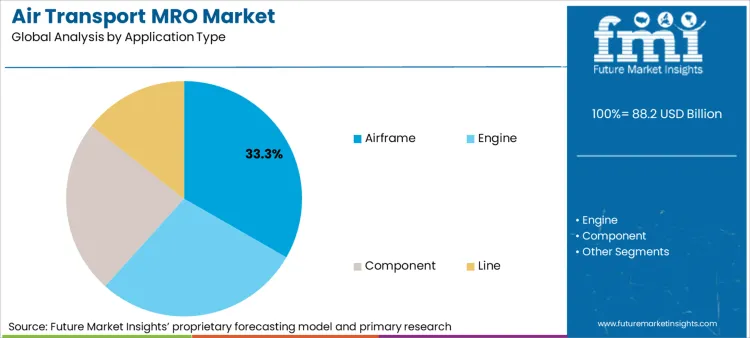
The airframe segment holds a 33.3% share, representing the largest application segment. This involves heavy structural inspections, modifications, and repairs during designated C and D checks.
As per FMI's estimates, this segment commands significant value due to the extensive labor hours, required hangar space, and long duration of these checks, which can take weeks or months.
The large installed base of aging narrow-body and wide-body aircraft mandated to undergo these intensive inspections at regular intervals, ensuring continued airworthiness, sustains growth.
How does the Prevalence of Narrow-Body Aircraft Drive MRO Demand?
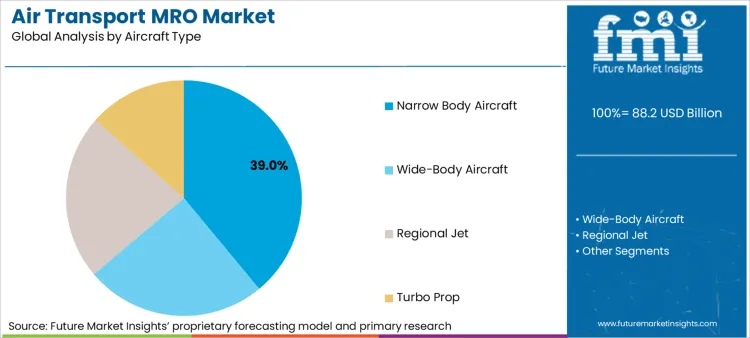
Narrow-body aircraft hold a 39.0% share, representing the largest aircraft type segment. This dominance mirrors their role as the workhorses of global short and medium-haul fleets, operated in high-cycles that accelerate wear and tear.
Their sheer numbers, led by models like the A320 and 737 families, generate the highest volume of routine line and base maintenance events. FMI's analysis indicates that ongoing massive deliveries of next-generation narrow-bodies will gradually shift MRO work from heavy airframe checks towards engine overhaul and advanced component support for these newer, more technically complex aircraft.
What is the Strategic and High-Value Role of Engine MRO?
The engine segment, while second in share, represents the most technologically intensive and high-value niche. Engine maintenance, repair, and overhaul are governed by strict performance restoration requirements to ensure fuel efficiency and thrust.
This segment is characterized by long-term, power-by-the-hour contracts offered by OEMs and large independent shops, providing stable revenue streams. The adoption of new-generation, high-bypass-ratio engines, which are more efficient but have novel maintenance needs, is a key growth driver within this segment.
Market Dynamics
How is the Shift towards Power-by-the-Hour Models Transforming the Industry?
A major trend is the accelerated shift from transactional service contracts to long-term, fleet-wide comprehensive service agreements, often termed power-by-the-hour. These agreements transfer maintenance cost risk from the airline to the MRO provider, offering airlines predictable operating expenses.
For MROs, they ensure fleet-wide fleet management visibility and stable, recurring revenue. As per FMI's opinion, this trend is intensifying competition among major OEMs and large independent MROs to secure these long-term partnerships, reshaping commercial relationships.
Do Labor Shortages and Capacity Constraints Restrain Market Potential?
The most significant operational restraint is the acute global shortage of certified aircraft mechanics and engineers. This human capital gap limits the industry's ability to expand capacity to meet growing demand, leading to longer wait times for maintenance slots and potential upward pressure on labor rates.
Hangar space for wide-body aircraft is a constrained resource in key regions. Overcoming this requires substantial investment in training facilities, apprenticeship programs, and the adoption of automation and remote inspection technologies to augment workforce productivity.
How does Fleet Modernization Create a Dual-Phase Opportunity?
The large-scale modernization of airline fleets with new-generation aircraft presents a complex, dual-phase opportunity. In the short term, it reduces demand for heavy airframe checks on retired older models.
As per FMI's projection, it creates a long-term opportunity centered on sophisticated engine MRO, composite material repair, and digital avionics support for which specialized skills and equipment are required. MRO providers that invest early in capabilities for newer platforms like the A350, 787, and 737 MAX are positioning themselves for the next wave of demand.
Regional Analysis: How do Fleet Demographics and Airline Strategies Shape Regional Hubs?
Air transport MRO demand and specialization vary significantly by region, dictated by the home-based fleet's age, size, and the strategic focus of local carriers.
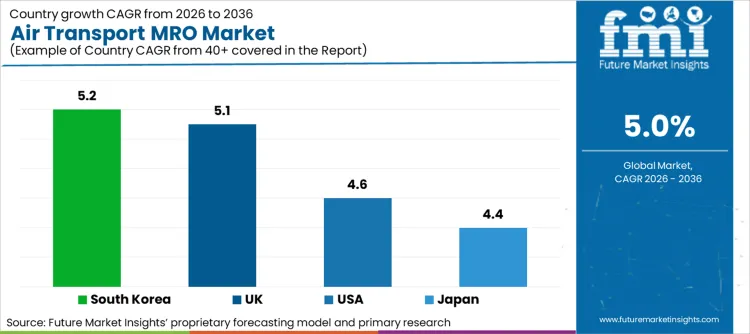
| Country | CAGR (2026-2036) |
|---|---|
| South Korea | 5.2% |
| UK | 5.1% |
| USA | 4.6% |
| Japan | 4.4% |
Source: Future Market Insights’ proprietary forecasting model and primary research
What Factors Underpin Steady MRO Demand in the USA?
The market in the USA is projected to record a CAGR of 4.6%. As per FMI's estimates, the world’s largest commercial fleet, a high proportion of which is aging and requires sustained heavy maintenance, influences growth.
The presence of major airline hubs and the headquarters of OEMs like Boeing also supports a dense network of technical service centers. Demand is robust for both legacy fleet support and new-generation aircraft services, with a strong focus on component and engine MRO.
How is the UK Maintaining its Status as a European MRO Hub?
Demand in the UK is estimated to expand at a CAGR of 5.1%. The market is supported by the presence of major global MRO players and a strong base for wide-body aircraft maintenance, serving long-haul operators.
The UK's strengths lie in specialized engine overhaul, particularly for Rolls-Royce engines, and complex VIP/completion center work. As per FMI's opinion, its technical expertise and strategic location continue to attract third-party maintenance business from European and international carriers.
Why is South Korea an Emerging High-Growth MRO Market?
The industry in South Korea is likely to rise at the highest CAGR of 5.2%. Growth is propelled by the rapid expansion of national carriers and their modernizing fleets. Significant investments are being made in expanding local MRO capabilities to reduce reliance on overseas service centers and capture more of the maintenance spend from the growing in-country fleet. Government support for developing the aerospace sector further bolsters this trend.
How is Japan's Market Characterized by Technical Precision and an Aging Fleet?
The scope for air transport MRO in Japan is likely to increase at a CAGR of 4.4%. The primary growth propeller is the meticulous maintenance requirements of a domestic fleet that includes a significant number of older aircraft kept in service with high dispatch reliability.
The market is characterized by high-quality, precision component repair and modification work. Japanese carriers' early adoption of new technologies drives demand for specialized MRO support for advanced systems.
What Defines the Competitive Landscape for Air Transport MRO?
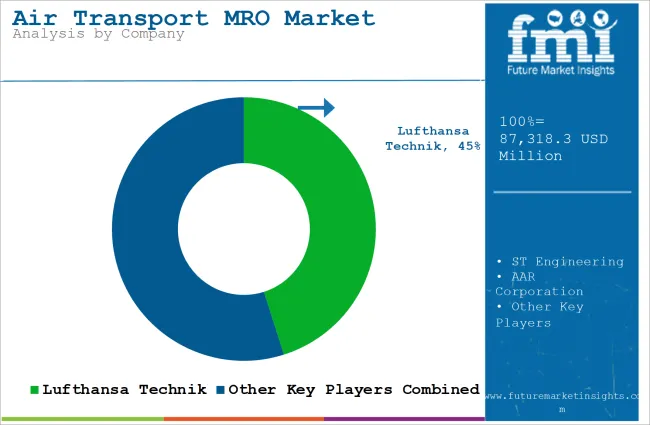
The competitive landscape is defined by a three-tier structure: OEM-backed service organizations, large independent MRO networks, and niche component specialists. Competition hinges on technical capability, global network reach, turnaround time, and cost efficiency.
As per FMI's observation, a key battleground is the securing of long-term service agreements for new-generation aircraft, where OEMs have a natural advantage. Independent MROs compete through operational flexibility, cost competitiveness on older aircraft types, and by developing centers of excellence for specific components or services. Technological capability in data analytics and predictive maintenance is becoming a critical differentiator for winning new business.
Key Players
- Lufthansa Technik
- ST Engineering
- AAR Corporation
- Airbus MRO Services
- Boeing Global Services
Scope of Report
| Items | Values |
|---|---|
| Quantitative Units | USD Billion |
| Application Type Segments | Airframe; Engine; Component; Line |
| Aircraft Type Segments | Narrow Body Aircraft; Wide-Body Aircraft; Regional Jet; Turbo Prop |
| Regions Covered | North America, Europe, Asia Pacific, Latin America, Middle East & Africa |
| Key Countries | USA, UK, Japan, South Korea |
| Key Companies Profiled | Lufthansa Technik , ST Engineering, AAR Corporation, Airbus MRO Services, Boeing Global Services |
Source: Future Market Insights analysis, supported by a proprietary forecasting model and primary research
Air Transport MRO Market by Segment
By Application Type:
- Airframe
- Engine
- Component
- Line
By Aircraft Type:
- Narrow Body Aircraft
- Wide-Body Aircraft
- Regional Jet
- Turbo Prop
By Region:
- North America
- Latin America
- Western Europe
- Eastern Europe
- East Asia
- South Asia
- Middle East and Africa
Bibliography
- Federal Aviation Administration. (2023). Advisory Circular: Maintenance Resource Management Training. FAA.
- International Civil Aviation Organization. (2024). Safety Management Manual (Doc 9859). ICAO.
- Journal of Air Transport Management. (2024). Economic impacts of predictive maintenance on airline operations. Elsevier.
- National Aeronautics and Space Administration. (2023). Aviation Maintenance Human Factors Research. NASA Technical Memorandum.
- Transportation Research Board. (2024). Critical Issues in Aviation and the Environment. TRB Special Report.
Frequently Asked Questions
How big is the air transport MRO market in 2026?
As per FMI's projection, the air transport MRO market is valued at USD 88.2 billion in 2026.
What will be the size of the air transport MRO market in 2036?
The market size for air transport MRO is projected to reach USD 143.6 billion by 2036.
How fast will the air transport MRO market grow?
Demand for air transport MRO services is projected to grow at a 5.0% CAGR between 2026 and 2036.
Which application segment holds the largest market share?
The airframe maintenance segment is expected to account for a 33.3% share of the market in 2026.
Which aircraft type generates the highest MRO demand?
Narrow-body aircraft are expected to represent a 39.0% share in the air transport MRO market in 2026.
Preview the report firsthand - request a free sample
Get SampleGet the brochure for pricing and purchase details.
Get PDFTable of Content
- Executive Summary
- Global Market Outlook
- Demand-side Trends
- Supply-side Trends
- Technology Roadmap Analysis
- Analysis and Recommendations
- Market Overview
- Market Coverage / Taxonomy
- Market Definition / Scope / Limitations
- Research Methodology
- Chapter Orientation
- Analytical Lens and Working Hypotheses
- Market Structure, Signals, and Trend Drivers
- Benchmarking and Cross-market Comparability
- Market Sizing, Forecasting, and Opportunity Mapping
- Research Design and Evidence Framework
- Desk Research Programme (Secondary Evidence)
- Company Annual and Sustainability Reports
- Peer-reviewed Journals and Academic Literature
- Corporate Websites, Product Literature, and Technical Notes
- Earnings Decks and Investor Briefings
- Statutory Filings and Regulatory Disclosures
- Technical White Papers and Standards Notes
- Trade Journals, Industry Magazines, and Analyst Briefs
- Conference Proceedings, Webinars, and Seminar Materials
- Government Statistics Portals and Public Data Releases
- Press Releases and Reputable Media Coverage
- Specialist Newsletters and Curated Briefings
- Sector Databases and Reference Repositories
- Roots Internal Knowledge Base and Historical Datasets
- Subscription Datasets and Paid Sources
- Social Channels, Communities, and Digital Listening Inputs
- Additional Desk Sources
- Expert Input and Fieldwork (Primary Evidence)
- Primary Modes
- Qualitative Interviews and Expert Elicitation
- Quantitative Surveys and Structured Data Capture
- Blended A7oach
- Why Primary Evidence is Used
- Field Techniques
- Interviews
- Surveys
- Focus Groups
- Observational and In-context Research
- Social and Community Interactions
- Stakeholder Universe Engaged
- C-suite Leaders
- Board Members
- Presidents and Vice Presidents
- R&D and Innovation Heads
- Technical Specialists
- Domain Subject-matter Experts
- Scientists
- Physicians and Other Healthcare Professionals
- Governance, Ethics, and Data Stewardship
- Research Ethics
- Data Integrity and Handling
- Primary Modes
- Tooling, Models, and Reference Databases
- Desk Research Programme (Secondary Evidence)
- Data Engineering and Model Build
- Data Acquisition and Ingestion
- Cleaning, Normalisation, and Verification
- Synthesis, Triangulation, and Analysis
- Quality Assurance and Audit Trail
- Market Background
- Market Dynamics
- Drivers
- Restraints
- Opportunity
- Trends
- Scenario Forecast
- Demand in Optimistic Scenario
- Demand in Likely Scenario
- Demand in Conservative Scenario
- Opportunity Map Analysis
- Product Life Cycle Analysis
- Supply Chain Analysis
- Investment Feasibility Matrix
- Value Chain Analysis
- PESTLE and Porter’s Analysis
- Regulatory Landscape
- Regional Parent Market Outlook
- Production and Consumption Statistics
- Import and Export Statistics
- Market Dynamics
- Global Market Analysis 2021 to 2025 and Forecast, 2026 to 2036
- Historical Market Size Value (USD Million) Analysis, 2021 to 2025
- Current and Future Market Size Value (USD Million) Projections, 2026 to 2036
- Y-o-Y Growth Trend Analysis
- Absolute $ Opportunity Analysis
- Global Market Pricing Analysis 2021 to 2025 and Forecast 2026 to 2036
- Global Market Analysis 2021 to 2025 and Forecast 2026 to 2036, By Application Type
- Introduction / Key Findings
- Historical Market Size Value (USD Million) Analysis By Application Type , 2021 to 2025
- Current and Future Market Size Value (USD Million) Analysis and Forecast By Application Type , 2026 to 2036
- Airframe
- Engine
- Component
- Line
- Airframe
- Y-o-Y Growth Trend Analysis By Application Type , 2021 to 2025
- Absolute $ Opportunity Analysis By Application Type , 2026 to 2036
- Global Market Analysis 2021 to 2025 and Forecast 2026 to 2036, By Aircraft Type
- Introduction / Key Findings
- Historical Market Size Value (USD Million) Analysis By Aircraft Type, 2021 to 2025
- Current and Future Market Size Value (USD Million) Analysis and Forecast By Aircraft Type, 2026 to 2036
- Narrow Body Aircraft
- Wide-Body Aircraft
- Regional Jet
- Turbo Prop
- Narrow Body Aircraft
- Y-o-Y Growth Trend Analysis By Aircraft Type, 2021 to 2025
- Absolute $ Opportunity Analysis By Aircraft Type, 2026 to 2036
- Global Market Analysis 2021 to 2025 and Forecast 2026 to 2036, By Region
- Introduction
- Historical Market Size Value (USD Million) Analysis By Region, 2021 to 2025
- Current Market Size Value (USD Million) Analysis and Forecast By Region, 2026 to 2036
- North America
- Latin America
- Western Europe
- Eastern Europe
- East Asia
- South Asia and Pacific
- Middle East & Africa
- Market Attractiveness Analysis By Region
- North America Market Analysis 2021 to 2025 and Forecast 2026 to 2036, By Country
- Historical Market Size Value (USD Million) Trend Analysis By Market Taxonomy, 2021 to 2025
- Market Size Value (USD Million) Forecast By Market Taxonomy, 2026 to 2036
- By Country
- USA
- Canada
- Mexico
- By Application Type
- By Aircraft Type
- By Country
- Market Attractiveness Analysis
- By Country
- By Application Type
- By Aircraft Type
- Key Takeaways
- Latin America Market Analysis 2021 to 2025 and Forecast 2026 to 2036, By Country
- Historical Market Size Value (USD Million) Trend Analysis By Market Taxonomy, 2021 to 2025
- Market Size Value (USD Million) Forecast By Market Taxonomy, 2026 to 2036
- By Country
- Brazil
- Chile
- Rest of Latin America
- By Application Type
- By Aircraft Type
- By Country
- Market Attractiveness Analysis
- By Country
- By Application Type
- By Aircraft Type
- Key Takeaways
- Western Europe Market Analysis 2021 to 2025 and Forecast 2026 to 2036, By Country
- Historical Market Size Value (USD Million) Trend Analysis By Market Taxonomy, 2021 to 2025
- Market Size Value (USD Million) Forecast By Market Taxonomy, 2026 to 2036
- By Country
- Germany
- UK
- Italy
- Spain
- France
- Nordic
- BENELUX
- Rest of Western Europe
- By Application Type
- By Aircraft Type
- By Country
- Market Attractiveness Analysis
- By Country
- By Application Type
- By Aircraft Type
- Key Takeaways
- Eastern Europe Market Analysis 2021 to 2025 and Forecast 2026 to 2036, By Country
- Historical Market Size Value (USD Million) Trend Analysis By Market Taxonomy, 2021 to 2025
- Market Size Value (USD Million) Forecast By Market Taxonomy, 2026 to 2036
- By Country
- Russia
- Poland
- Hungary
- Balkan & Baltic
- Rest of Eastern Europe
- By Application Type
- By Aircraft Type
- By Country
- Market Attractiveness Analysis
- By Country
- By Application Type
- By Aircraft Type
- Key Takeaways
- East Asia Market Analysis 2021 to 2025 and Forecast 2026 to 2036, By Country
- Historical Market Size Value (USD Million) Trend Analysis By Market Taxonomy, 2021 to 2025
- Market Size Value (USD Million) Forecast By Market Taxonomy, 2026 to 2036
- By Country
- China
- Japan
- South Korea
- By Application Type
- By Aircraft Type
- By Country
- Market Attractiveness Analysis
- By Country
- By Application Type
- By Aircraft Type
- Key Takeaways
- South Asia and Pacific Market Analysis 2021 to 2025 and Forecast 2026 to 2036, By Country
- Historical Market Size Value (USD Million) Trend Analysis By Market Taxonomy, 2021 to 2025
- Market Size Value (USD Million) Forecast By Market Taxonomy, 2026 to 2036
- By Country
- India
- ASEAN
- Australia & New Zealand
- Rest of South Asia and Pacific
- By Application Type
- By Aircraft Type
- By Country
- Market Attractiveness Analysis
- By Country
- By Application Type
- By Aircraft Type
- Key Takeaways
- Middle East & Africa Market Analysis 2021 to 2025 and Forecast 2026 to 2036, By Country
- Historical Market Size Value (USD Million) Trend Analysis By Market Taxonomy, 2021 to 2025
- Market Size Value (USD Million) Forecast By Market Taxonomy, 2026 to 2036
- By Country
- Kingdom of Saudi Arabia
- Other GCC Countries
- Turkiye
- South Africa
- Other African Union
- Rest of Middle East & Africa
- By Application Type
- By Aircraft Type
- By Country
- Market Attractiveness Analysis
- By Country
- By Application Type
- By Aircraft Type
- Key Takeaways
- Key Countries Market Analysis
- USA
- Pricing Analysis
- Market Share Analysis, 2025
- By Application Type
- By Aircraft Type
- Canada
- Pricing Analysis
- Market Share Analysis, 2025
- By Application Type
- By Aircraft Type
- Mexico
- Pricing Analysis
- Market Share Analysis, 2025
- By Application Type
- By Aircraft Type
- Brazil
- Pricing Analysis
- Market Share Analysis, 2025
- By Application Type
- By Aircraft Type
- Chile
- Pricing Analysis
- Market Share Analysis, 2025
- By Application Type
- By Aircraft Type
- Germany
- Pricing Analysis
- Market Share Analysis, 2025
- By Application Type
- By Aircraft Type
- UK
- Pricing Analysis
- Market Share Analysis, 2025
- By Application Type
- By Aircraft Type
- Italy
- Pricing Analysis
- Market Share Analysis, 2025
- By Application Type
- By Aircraft Type
- Spain
- Pricing Analysis
- Market Share Analysis, 2025
- By Application Type
- By Aircraft Type
- France
- Pricing Analysis
- Market Share Analysis, 2025
- By Application Type
- By Aircraft Type
- India
- Pricing Analysis
- Market Share Analysis, 2025
- By Application Type
- By Aircraft Type
- ASEAN
- Pricing Analysis
- Market Share Analysis, 2025
- By Application Type
- By Aircraft Type
- Australia & New Zealand
- Pricing Analysis
- Market Share Analysis, 2025
- By Application Type
- By Aircraft Type
- China
- Pricing Analysis
- Market Share Analysis, 2025
- By Application Type
- By Aircraft Type
- Japan
- Pricing Analysis
- Market Share Analysis, 2025
- By Application Type
- By Aircraft Type
- South Korea
- Pricing Analysis
- Market Share Analysis, 2025
- By Application Type
- By Aircraft Type
- Russia
- Pricing Analysis
- Market Share Analysis, 2025
- By Application Type
- By Aircraft Type
- Poland
- Pricing Analysis
- Market Share Analysis, 2025
- By Application Type
- By Aircraft Type
- Hungary
- Pricing Analysis
- Market Share Analysis, 2025
- By Application Type
- By Aircraft Type
- Kingdom of Saudi Arabia
- Pricing Analysis
- Market Share Analysis, 2025
- By Application Type
- By Aircraft Type
- Turkiye
- Pricing Analysis
- Market Share Analysis, 2025
- By Application Type
- By Aircraft Type
- South Africa
- Pricing Analysis
- Market Share Analysis, 2025
- By Application Type
- By Aircraft Type
- USA
- Market Structure Analysis
- Competition Dashboard
- Competition Benchmarking
- Market Share Analysis of Top Players
- By Regional
- By Application Type
- By Aircraft Type
- Competition Analysis
- Competition Deep Dive
- Lufthansa Technik
- Overview
- Product Portfolio
- Profitability by Market Segments (Product/Age /Sales Channel/Region)
- Sales Footprint
- Strategy Overview
- Marketing Strategy
- Product Strategy
- Channel Strategy
- ST Engineering
- AAR Corporation
- Airbus MRO Services
- Boeing Global Services
- Lufthansa Technik
- Competition Deep Dive
- Assumptions & Acronyms Used


