

- Market Size (2026)
- USD 337.6 Bn
- Forecast (2036)
- USD 2367.0 Bn
- CAGR (2026 to 2036)
- 21.5%
How big is Hybrid Vehicles Market in 2026?
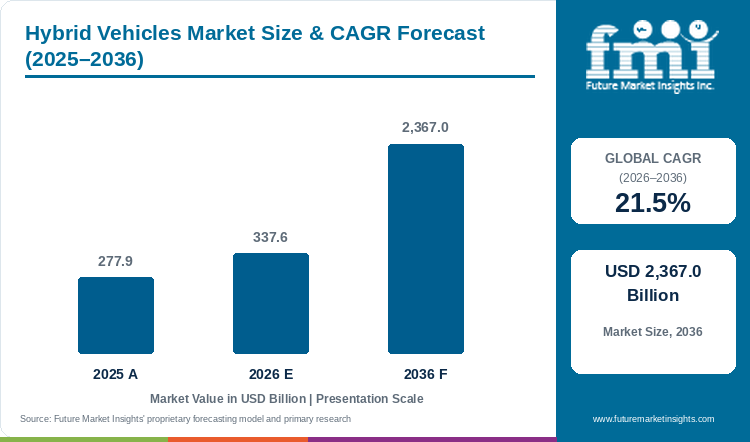
The hybrid vehicles market is estimated at USD 277.9 billion in 2025 and is projected to reach USD 337.6 billion in 2026. Sales of hybrid vehicles are forecast to grow at a 21.5% CAGR and reach USD 2,367.0 billion by 2036.
Hybrid vehicles market share in new car sales is widening, as buyers without home chargers pick petrol-electric models. For the hybrid vehicles market, an estimated USD 277.9 billion in 2025 is expected to increase, reaching USD 337.6 billion in 2026, and a 21.5% CAGR through 2036 is projected to raise sales of hybrid vehicles to USD 2,367.0 billion by 2036. Across the EU, hybrid-electric cars held 36.6% of new registrations from January to August 2026, against 21.7% for battery electric cars and 29% for petrol and diesel combined.[1] European buyers leaving petrol now choose hybrids most, so carmakers are adding hybrid versions to volume models.
Across buyers, demand intensity peaks in the family car segment. Full hybrids are expected to hold 49% of hybrid type sales in 2026 and passenger cars 82% of vehicle type sales, as households trading in a petrol sedan or SUV account for most purchases. Plug-in hybrids, an estimated 33.5%, sell fewer units at higher prices. Toyota Motor North America sold 363,367 electrified vehicles in the July to September 2026 quarter, 57.4% of all units sold.[2] In FMI's estimate, dealers stocking hybrid trims across sedans, SUVs and pickups will turn the most units, as most Toyota buyers in the United States already choose electrified models.
Key Market Trends & Insights
- Full hybrids (HEV) are expected to hold 49% of hybrid type sales in 2026, with plug-in hybrids near 33.5% and mild hybrids about 17.5%. UK plug-in hybrid registrations rose 55.5% in September 2026 to a 17% share.[3]
- Passenger cars make up the bulk of vehicle type sales, at a projected 82% in 2026, and light commercial vehicles an estimated 13.2%.
- Parallel hybrids are likely to lead powertrain architecture with 46% in 2026, and series-parallel power-split systems follow on about 39.5%.
- Within propulsion, compact and midsize models keep front-wheel drive ahead at 52% of 2026 sales, and all-wheel drive is estimated at 35.4%.
- Franchised dealers handle an expected 96% of hybrid vehicle sales in 2026, and fleet and institutional direct sales the remaining 4%.
Regional Highlights
- Strong hybrid ranges from Toyota, Maruti Suzuki and Honda give India a projected 25.3% through 2036, ahead of the 21.5% global CAGR.
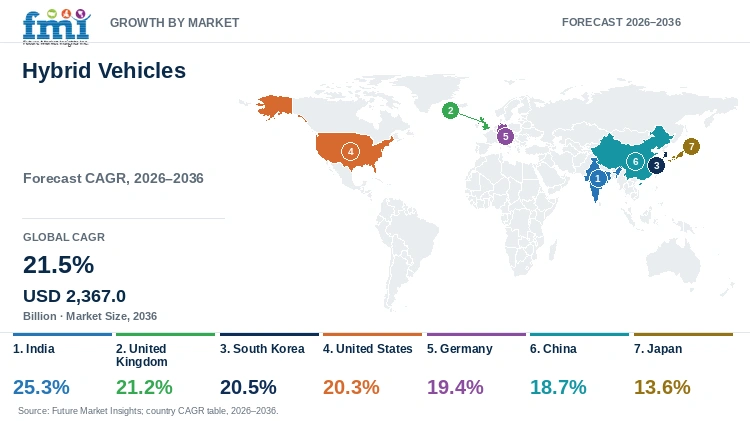
- Plug-in demand puts the United Kingdom first in the mature group at 21.2%. South Korea, home market of Hyundai Motor, is projected at 20.5%, just ahead of 20.3% for the United States. Growth is slower for Germany (19.4%) and China (18.7%), as battery cars gain more of new sales. Japan, with hybrids already the main powertrain, is the slowest at 13.6%.
- In September 2026, hybrid cars accounted for 98,871 new registrations in Germany, a 38.5% share, including 27,861 plug-in hybrids.[4]
Market Size & Forecast
Table 1: Market Size and Forecast for the Hybrid Vehicles Market (USD billion and percentage), 2025 to 2036
| Metric | Value |
|---|---|
| 2025 Market Size | USD 277.9 billion |
| Estimated Market Size in 2026 | USD 337.6 billion |
| Projected Market Size by 2036 | USD 2,367.0 billion |
| CAGR, 2026 to 2036 | 21.5% |
| Added Revenue, 2026 to 2036 | USD 2,029.4 billion |
| Market Expansion Multiple | 7x |
Demand for hybrid vehicles moves with model launches, as each new hybrid trim on a high-volume nameplate shifts dealer orders within one model year. Hybrids made up 18.9% of global volume at Hyundai Motor in April to June 2026, with 187,661 units, and a new Grandeur with hybrid options is planned.[5] Global hybrid sales at Toyota came to 3,093,426 cars from January to August 2026.[6] Suppliers of motors, inverters and battery packs share in this growth, and the vehicle electrification market is expected to grow at an 8.3% CAGR through 2036. Between 2026 and 2036, FMI estimates that hybrid vehicles add USD 2,029.4 billion of sales, so the hybrid vehicles market in 2036 would be about seven times the 2026 size. Zero-emission mandates are the main risk, as rising battery car quotas cap the share left for hybrids in Europe and the United Kingdom.
Mandates, Plug-in Demand and Brand Mix
Buyers who want electric driving without range worry are moving to plug-in hybrids. SMMT counted 350,536 new cars in the United Kingdom in September 2026, and plug-in hybrid registrations rose 55.5% to a 17% share. Full hybrid registrations fell 4.3% to 13.1% over the same month.[3] Battery electric cars reached 28.3% that month, still below the 33% ZEV mandate for 2026. Carmakers selling in the United Kingdom will keep pricing plug-in hybrids keenly to fill the gap below the mandate.
Brand mix is moving toward electrified versions of existing models. Toyota's division reached an electrification mix of 61% in the third quarter of 2026 in the United States, and TMNA electrified sales rose 28.5%.[2] In China, plug-in hybrid retail sales fell 29.6% in August 2026 to 226,000 as battery cars gained, CnEVPost reported from CPCA data.[7] Hybrid growth will come mainly from markets with thin charging networks and buyers who still want petrol range.
Table 2: Registration, Sales and Mix Indicators for the Hybrid Vehicles Market (units and percentage share), 2025 to 2026
| Indicator | Data Point | Relevance | Source |
|---|---|---|---|
| EU hybrid-electric share, January to August 2026 | 36.6% of new registrations | Hybrids as the leading powertrain in the EU | [1] |
| TMNA electrified sales, Q3 2026 | 363,367 units; 57.4% of volume | Hybrid demand in the United States | [2] |
| UK plug-in hybrid share, September 2026 | 17%; registrations up 55.5% | Plug-in demand under the ZEV mandate | [3] |
| Germany hybrid registrations, September 2026 | 98,871 units; 38.5% share | Hybrid demand in Germany | [4] |
| Hyundai Motor hybrid sales, Q2 2026 | 187,661 units; 18.9% of global sales | Hybrid range growth in South Korea and abroad | [5] |
| Toyota global hybrid sales, January to August 2026 | 3,093,426 units | Scale of the largest hybrid maker | [6] |
| China PHEV retail sales, August 2026 | 226,000 units; down 29.6% | Battery cars gaining in China | [7] |
Analyst Perspective
“I see the biggest hybrid opportunity of the decade in markets with thin charging and high petrol prices, as buyers there want lower fuel bills without changing refuelling habits. Carmakers adding plug-in versions to pickups and seven-seat SUVs will be carving out fresh territory for plug-in hybrids in fleet and family lines, and I expect full hybrids to stay the volume base through 2036.”
- Nikhil Kaitwade, Principal Consultant, Future Market Insights.
How is the hybrid vehicles market segmented?
The market is segmented into hybrid type, vehicle type, powertrain architecture, propulsion, sales channel, and region. Full hybrids are expected to lead hybrid type with 49% share in 2026, and passenger cars lead vehicle type with 82%.
By hybrid type: full hybrid (HEV), plug-in hybrid (PHEV), and mild hybrid (MHEV).
By vehicle type: passenger cars, light commercial vehicles, and heavy commercial vehicles.
By powertrain architecture: parallel hybrid, series-parallel (power-split), and series hybrid.
By propulsion: FWD, AWD, and RWD.
By sales channel: OEM/dealership and fleet/institutional direct sales.
By region: car buyers and fleets in North America, Latin America, Western Europe, Eastern Europe, East Asia, South Asia and Pacific, and Middle East and Africa.
Why do full hybrids lead hybrid vehicles sales by hybrid type?
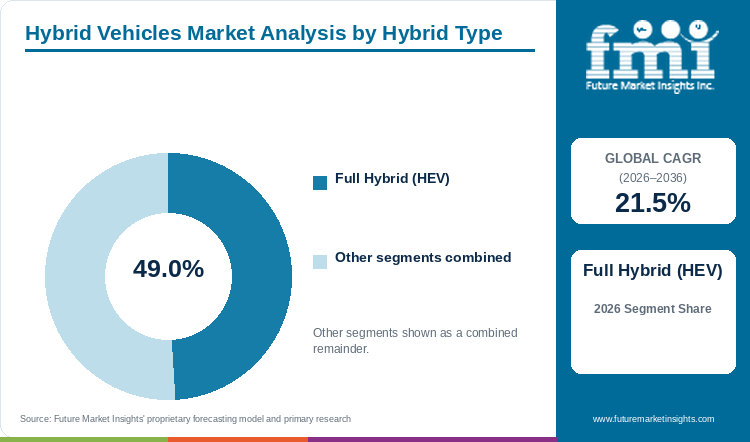
Full hybrids are expected to lead hybrid type sales with 49% share in 2026, against an estimated 33.5% for plug-in hybrids and 17.5% for mild hybrids.
Table 3: Hybrid Type Share for the Hybrid Vehicles Market (percentage share), 2026
| Hybrid Type | Estimated Share (2026) |
|---|---|
| Full Hybrid (HEV) | 49% |
| Plug-in Hybrid (PHEV) | 33.5% |
| Mild Hybrid (MHEV) | 17.5% |
| Total | 100.0% |
Table 4: Hybrid Type Leadership and Market Growth for the Hybrid Vehicles Market (segment and CAGR percentage), 2026 to 2036
| Metric | Value |
|---|---|
| Global CAGR (2026 to 2036) | 21.5% |
| Leading Segment | Full Hybrid (HEV) |
Since a full hybrid needs no plug and costs only a little more than the petrol version, full hybrids are expected to lead hybrid type with a 49% share in 2026. At an estimated 33.5%, plug-in hybrids run 50 km or more on electricity, but the larger battery adds cost and the savings rely on regular charging, so buyers with a driveway or company car choose them most. Mild hybrids, about 17.5%, use a 48-volt starter-generator that cuts fuel use by a few percent, which helps carmakers meet fleet CO2 limits at low cost, and drivers see little difference at the pump. Sizing for plug-in models is tracked in the plug-in hybrid electric vehicles (PHEV) market, which carmakers use to plan battery orders for those trims. In the United Kingdom, plug-in hybrid registrations rose 55.5% in September 2026, and full hybrid registrations fell 4.3%.[3] Buyers wanting the lowest running cost without charging will stay with full hybrids, and company car drivers will move to plug-ins.
- Self-charging sedans, compact SUVs, minivans and pickups make up most full hybrid volume.
- SMMT reported a 17% plug-in hybrid share of UK registrations for September 2026, the highest volume so far.[3]
Why do passenger cars lead hybrid vehicles sales by vehicle type?
Passenger cars are projected to lead vehicle type sales with 82% share in 2026, ahead of light commercial vehicles at an estimated 13.2% and heavy commercial vehicles at about 4.8%.
Table 5: Vehicle Type Share for the Hybrid Vehicles Market (percentage share), 2026
| Vehicle Type | Estimated Share (2026) |
|---|---|
| Passenger Cars | 82% |
| Light Commercial Vehicles | 13.2% |
| Heavy Commercial Vehicles | 4.8% |
| Total | 100.0% |
Every major brand now sells hybrid sedans and SUVs, and passenger cars are projected to lead vehicle type with 82% share in 2026. Light commercial vehicles, an estimated 13.2%, include hybrid pickups and vans, and fleet buyers judge them on payload and towing, which limits how much battery weight a van can carry. Heavy commercial vehicles, about 4.8%, use hybrid systems mainly in city buses and refuse trucks, as stop-start routes recover the most braking energy, but long-haul trucks gain little. Hybrid units at Hyundai Motor reached 187,661 in Q2 2026.[5] Most of those were sedans and SUVs. Private buyers will keep the volume, and van fleets will add hybrids as more models arrive.
- Sedans, crossovers, SUVs and minivans form the passenger car base.
- Hyundai Motor said hybrids reached 18.9% of global sales in Q2 2026, the highest quarterly share for the company.[5]
Why do parallel hybrids lead hybrid vehicles sales by powertrain architecture?
Parallel hybrids are likely to lead powertrain architecture sales with 46% share in 2026, with series-parallel power-split systems at an estimated 39.5% and series hybrids at about 14.5%.
Table 6: Powertrain Architecture Share for the Hybrid Vehicles Market (percentage share), 2026
| Powertrain Architecture | Estimated Share (2026) |
|---|---|
| Parallel Hybrid | 46% |
| Series-Parallel (Power-split) | 39.5% |
| Series Hybrid | 14.5% |
| Total | 100.0% |
Parallel hybrids are likely to lead powertrain architecture with a 46% share in 2026, as most mild hybrids and many plug-ins place one motor between engine and gearbox, which carmakers can fit to existing platforms. Series-parallel power-split systems, an estimated 39.5%, give the best fuel economy in city driving, and one maker supplies most of them. Toyota sold 3,093,426 hybrid cars from January to August 2026.[6] Most Toyota hybrids use the power-split layout. Series hybrids, about 14.5%, drive the wheels only with the electric motor and use the engine as a generator, a layout found in range-extender models and some Japanese compacts. Gear and coupling suppliers follow these layouts, and a projected 6.9% CAGR for the hybrid power-split couplings market tracks the power-split side. Traction motors are common to all three, and motor suppliers size plants with the electric vehicle drive motor market in view. Brands lacking an in-house hybrid system will keep choosing parallel layouts.
- Most parallel volume comes from P2 single-motor hybrids, 48-volt mild systems and dual-clutch hybrid modules.
- Toyota sold 3,616,595 electrified vehicles globally from January to August 2026, up 10.3%, Zigwheels reported.[6]
Why does front-wheel drive lead hybrid vehicles sales by propulsion?
Front-wheel drive is estimated to lead propulsion sales with 52% share in 2026, ahead of all-wheel drive at about 35.4% and rear-wheel drive at 12.6%.
Table 7: Propulsion Share for the Hybrid Vehicles Market (percentage share), 2026
| Propulsion | Estimated Share (2026) |
|---|---|
| FWD | 52% |
| AWD | 35.4% |
| RWD | 12.6% |
| Total | 100.0% |
Compact cars and crossovers carry most hybrid volume, so front-wheel drive is estimated to lead propulsion with a 52% share in 2026. All-wheel drive, about 35.4%, often adds an electric motor on the rear axle with no driveshaft, which gives SUV buyers traction at a small price step. Rear-wheel drive, near 12.6%, stays with premium sedans, large SUVs and pickups from German and American brands, and higher prices limit that volume. Toyota's division in the United States reached a 61% electrification mix in Q3 2026, with hybrid SUVs and minivans in the range.[2] Buyers in snowy regions will pay for electric all-wheel drive, and city buyers will stay with front-wheel drive.
- Compact hatchbacks, sedans and small crossovers make up most front-wheel drive hybrids.
- TMNA electrified sales reached 58.2% of September 2026 volume, Toyota said.[2]
Why do dealerships lead hybrid vehicles sales by sales channel?
OEM and dealership sales are expected to lead the sales channel with 96% share in 2026, with fleet and institutional direct sales at an estimated 4%.
Table 8: Sales Channel Share for the Hybrid Vehicles Market (percentage share), 2026
| Sales Channel | Estimated Share (2026) |
|---|---|
| OEM/Dealership | 96% |
| Fleet/Institutional Direct Sales | 4% |
| Total | 100.0% |
Car buyers trade in, finance and service through franchised dealers, so OEM and dealership sales are expected to lead the channel split with a 96% share in 2026. Fleet and institutional direct sales, an estimated 4%, cover taxi operators, police forces, utilities and rental companies that buy in bulk from the carmaker, and those buyers choose hybrids for fuel savings over long daily mileage. Ride-hailing drivers buy hybrid sedans and minivans to cut fuel bills on long shifts. Over January to August 2026, Toyota sold 1,423,770 vehicles in Japan.[6] Japanese buyers order almost all of those cars through brand dealers. Dealers will keep the retail buyer, and fleet contracts will grow as more taxi and rental operators replace petrol cars.
- Franchised dealers, brand showrooms and dealer finance desks form the retail channel.
- Germany registered 256,774 new cars in September 2026, up 9%, electrive reported.[4]
What are the drivers, restraints, and opportunities in the hybrid vehicles market?
Uneven charging access and high fuel prices keep buyers choosing hybrids. Zero-emission quotas and falling battery car prices limit hybrid share, and fast-growing car markets with thin charging open new demand.
- Driver: Many buyers lack a home or workplace charger, so a car that saves fuel without plugging in fits existing refuelling habits.
- Restraint: Zero-emission quotas and cheaper battery cars push carmakers to steer marketing and allocation toward full electric models.
- Opportunity: Car markets with rising incomes and few public chargers are moving straight from petrol to hybrid, which rewards brands with low-cost hybrid systems.
Charging Gaps Keep Buyers on Hybrids
Consumer preference for hybrids is strongest among drivers with poor access to charging. Hybrid-electric cars held the largest share of EU registrations from January to August 2026, at 36.6%, with plug-in hybrids adding 10%.[1] TMNA electrified sales rose 28.5% in Q3 2026.[2] Buyers in apartments and rural areas will keep choosing hybrids until public charging catches up.
Zero-Emission Quotas Cap Hybrid Share
Key challenges in the hybrid vehicles market come from rules that count only battery cars toward targets. The UK ZEV mandate requires 33% of 2026 new car sales to be zero emission, and the battery electric share reached 28.3% in September.[3] In China, plug-in hybrid retail sales fell 29.6% in August 2026 and NEV penetration reached a new high of 65.2%.[7] FMI data indicate that carmakers will move allocation toward battery cars in these markets, slowing hybrid growth there.
Fast-Growing Car Markets Open New Demand
Growth of the hybrid vehicles market will come next from car markets with rising incomes and thin charging. Strong hybrid sales in India more than doubled to 26,460 units in April to June 2025, Autocar Professional reported.[8] Battery car growth spreads the cost of motors and cells over more units, and with a projected 15% CAGR for the battery electric vehicle (BEV) market, hybrid makers will buy those parts more cheaply. Brands with low-cost hybrid systems will gain first-time buyers in these markets.
Which country CAGRs are profiled in the hybrid vehicles market?
Table 9: Country CAGR Comparison for the Hybrid Vehicles Market (CAGR percentage), 2026 to 2036
| Country | CAGR (2026 to 2036) |
|---|---|
| India | 25.3% |
| United Kingdom | 21.2% |
| South Korea | 20.5% |
| United States | 20.3% |
| Germany | 19.4% |
| China | 18.7% |
| Japan | 13.6% |
How do country-level CAGRs compare in the hybrid vehicles market?
Toyota Kirloskar Motor sold 21,489 strong hybrids in India in April to June 2025, 81% of the segment.[8] That base gives India a 25.3% CAGR, the quickest in the table. In FMI's estimate, the United Kingdom grows at 21.2%, close to the global pace, as plug-in hybrids fill the gap below the ZEV mandate. Hyundai Motor and Toyota keep adding hybrid trims, holding South Korea at 20.5% and the United States at 20.3%. Battery cars are pulling buyers away from hybrids in Germany, projected at 19.4%, and in China, at 18.7%. Japan grows slowest at 13.6%, as hybrids already lead new car sales there.
- Strong hybrid ranges from Toyota, Maruti Suzuki and Honda are drawing first-time buyers in India.
- Plug-in hybrids help carmakers in the United Kingdom bridge the ZEV mandate gap.
- Hyundai Motor and Kia hybrid launches carry demand in South Korea.
- Buyers without home chargers keep hybrid sales rising in the United States.
- German buyers split between hybrids and a growing battery car share.
- Battery cars are taking share from plug-in hybrids in China.
- A mature hybrid base slows new growth in Japan.
Full report country CAGRs cover: India well above the 21.5% global rate; the United Kingdom, South Korea and the United States near that rate; Germany and China a step below; Japan lowest; remaining standard countries grouped by region.
Country-wise Analysis
India Hybrid Vehicles Market Outlook (2026 to 2036)
Sales of strong hybrids in India reached 26,460 units in April to June 2025, up 118%, with Toyota Kirloskar Motor at 21,489, Maruti Suzuki at 4,745 and Honda Cars India at 226.[8] Models such as the Innova Hycross, Urban Cruiser Hyryder and Grand Vitara bring hybrid fuel savings to family buyers, and a 25.3% CAGR through 2036 is projected for India.
Key takeaway: Family SUVs and MPVs drive India.
United Kingdom Hybrid Vehicles Market Outlook (2026 to 2036)
UK registrations in September 2026 gave plug-in hybrids a 17% share, the highest volume so far, as the overall car market grew 12% to 350,536 units.[3] Carmakers short of the 33% ZEV mandate are pricing plug-in hybrids for buyers not ready for a battery car. The United Kingdom is projected at 21.2%, near the global pace.
Key takeaway: Plug-in hybrids fill the mandate gap in the United Kingdom.
South Korea Hybrid Vehicles Market Outlook (2026 to 2036)
At home, Hyundai Motor wholesale volume fell 16.4% to 157,647 units in Q2 2026, even as global hybrid sales reached a quarterly high of 187,661.[5] A new Grandeur with hybrid options is planned, and hybrid versions of popular SUVs keep buyers in South Korea moving from petrol models, which supports a 20.5% CAGR.
Key takeaway: Fresh hybrid trims from Hyundai Motor and Kia anchor South Korea.
United States Hybrid Vehicles Market Outlook (2026 to 2036)
Electrified vehicles made up 57.4% of Toyota Motor North America sales in Q3 2026, and the Toyota division reached a 61% electrification mix.[2] Buyers in the United States are choosing hybrid crossovers, minivans and pickups over battery cars as charging stays patchy outside cities. FMI estimates the United States at 20.3%.
Key takeaway: Hybrid crossovers and pickups drive the United States.
Germany Hybrid Vehicles Market Outlook (2026 to 2036)
Hybrid cars accounted for 38.5% of new registrations in Germany in September 2026, with 27,861 plug-in hybrids, and battery cars reached 34.5%.[4] Petrol registrations fell 29.2%, so hybrids and battery cars are splitting the buyers leaving combustion models. On FMI's forecast, Germany grows at 19.4%.
Key takeaway: Battery cars compete hard with hybrids in Germany.
China Hybrid Vehicles Market Outlook (2026 to 2036)
Plug-in hybrid retail sales in China fell 29.6% in August 2026 to 226,000, and extended-range models fell 22.2% to 81,000. Battery car retail sales rose 0.8% to 698,000 in the same month.[7] Buyers in Chinese cities are moving to cheaper battery cars, so China is projected at 18.7%, below the global CAGR.
Key takeaway: Cheaper battery cars hold back hybrids in China.
Japan Hybrid Vehicles Market Outlook (2026 to 2036)
In Japan, Toyota delivered 1,423,770 vehicles from January to August 2026.[6] Hybrids already form most of that home-market volume, and replacement buying keeps Japanese hybrid sales steady. FMI's model shows Japan growing at 13.6%, the slowest pace in the table, as the base is mature.
Key takeaway: A mature hybrid base slows Japan.
Who are the notable companies in the hybrid vehicles market?
Toyota, Honda, Hyundai Motor, Kia, Ford, General Motors, Nissan, Stellantis, Volkswagen Group and BMW Group are the profiled companies.
Toyota and Hyundai Motor lead the documented hybrid makers, and the companies FMI profiles span Japanese, Korean, American and European carmakers. Over the first eight months of 2026, Toyota hybrid sales came to 3,093,426 cars.[6] Quarterly revenue at Hyundai Motor reached a high of KRW 49.22 trillion in Q2 2026, with hybrids at a company high of 18.9% of global sales.[5] Honda, Kia, Ford, General Motors, Nissan, Stellantis, Volkswagen Group and BMW Group complete the group.
- Japanese hybrid makers: Toyota, Honda and Nissan.
- Korean carmakers: Hyundai Motor and Kia.
- American and European carmakers: Ford, General Motors, Stellantis, Volkswagen Group and BMW Group.
Competitive Benchmarking: Hybrid Vehicles Market
Table 10: Competitive Benchmarking for the Hybrid Vehicles Market (qualitative documentation ratings), 2026
| Company | Full Hybrid | Plug-in Hybrid | Dealer Reach | Recency |
|---|---|---|---|---|
| Toyota | High | Medium | High | High |
| Hyundai Motor | High | Medium | High | High |
| Honda | High | Low | High | Medium |
| Ford | Medium | Medium | High | Medium |
| BMW Group | Low | High | Medium | Medium |
Ratings follow how fully each company documented hybrid activity in 2025 and 2026 releases, and the scores do not rank market share.
Key Developments in the Hybrid Vehicles Market
- On 5 October 2026, SMMT reported that UK plug-in hybrid registrations rose 55.5% in September to a 17% share.[3]
- On 5 October 2026, electrive reported 98,871 hybrid car registrations in Germany for September, a 38.5% share.[4]
- On 1 October 2026, Toyota Motor North America said Q3 electrified sales rose 28.5% to 363,367 units.[2]
- On 30 September 2026, Zigwheels reported Toyota hybrid sales of 3,093,426 units for January to August.[6]
- On 28 September 2026, ACEA data carried by EV Infrastructure News showed hybrid-electric cars at 36.6% of EU registrations for January to August.[1]
- On 8 September 2026, CnEVPost reported that plug-in hybrid retail sales in China fell 29.6% in August.[7]
- On 23 July 2026, Hyundai Motor announced quarterly hybrid sales of 187,661 units, a company high.[5]
- On 28 July 2025, Autocar Professional reported that strong hybrid sales in India rose 118% in April to June.[8]
Key Players in the Hybrid Vehicles Market
Japanese Hybrid Makers
- Toyota
- Honda
- Nissan
Korean Carmakers
- Hyundai Motor
- Kia
American and European Carmakers
- Ford
- General Motors
- Stellantis
- Volkswagen Group
- BMW Group
Hybrid Vehicles Market - Report Scope
Table 11: Report Scope for the Hybrid Vehicles Market (coverage fields and definitions), 2026 to 2036
| Coverage field | Report scope |
|---|---|
| Market breakdown | Hybrid type; vehicle type; powertrain architecture; propulsion; sales channel; region |
| Quantitative units | USD billion |
| Market definition | New passenger and commercial vehicles that combine a combustion engine with one or more electric motors and a battery, including full, plug-in and mild hybrids, sold through dealers and direct fleet channels. |
| Regions covered | North America; Latin America; Western Europe; Eastern Europe; East Asia; South Asia and Pacific; Middle East and Africa |
| Countries covered | United States; Canada; Brazil; Mexico; Argentina; Chile; Germany; France; United Kingdom; Italy; Spain; Benelux; Nordics; Poland; Czech Republic; Romania; Hungary; China; Japan; South Korea; India; ASEAN; Australia and New Zealand; GCC Countries; South Africa; Türkiye; Israel |
| Key companies profiled | Toyota, Honda, Hyundai Motor, Kia, Ford, General Motors, Nissan, Stellantis, Volkswagen Group, BMW Group |
| Forecast period | 2026 to 2036 |
Hybrid Vehicles Market - Research Methodology
Table 12: Research Methodology for the Hybrid Vehicles Market (research methods and approach), 2026 edition
| Method | Approach |
|---|---|
| Data Sources | Carmaker sales and results releases, national registration data from SMMT and KBA as reported, EU and China registration data in trade press, from May 2025 onward. |
| Desk Research | Desk research covers registrations by powertrain, carmaker hybrid sales, zero-emission mandates and plug-in hybrid trends. |
| Market Sizing and Forecasting | Sizing starts from the 2026 base of USD 337.6 billion and the 21.5% CAGR for 2026 to 2036. |
| Data Validation | Unit and share figures were checked against the release or article that first carried them. |
Hybrid Vehicles Market by Segments
Hybrid Vehicles Market segmented by Hybrid Type:
- Full Hybrid (HEV)
- Plug-in Hybrid (PHEV)
- Mild Hybrid (MHEV)
Hybrid Vehicles Market segmented by Vehicle Type:
- Passenger Cars
- Light Commercial Vehicles
- Heavy Commercial Vehicles
Hybrid Vehicles Market segmented by Powertrain Architecture:
- Parallel Hybrid
- Series-Parallel (Power-split)
- Series Hybrid
Hybrid Vehicles Market segmented by Propulsion:
- FWD
- AWD
- RWD
Hybrid Vehicles Market segmented by Sales Channel:
- OEM/Dealership
- Fleet/Institutional Direct Sales
Hybrid Vehicles Market by Region
- North America
- United States
- Canada
- Latin America
- Brazil
- Mexico
- Argentina
- Chile
- Western Europe
- Germany
- France
- United Kingdom
- Italy
- Spain
- Benelux
- Nordics
- Eastern Europe
- Poland
- Czech Republic
- Romania
- Hungary
- East Asia
- China
- Japan
- South Korea
- South Asia and Pacific
- India
- ASEAN
- Australia and New Zealand
- Middle East and Africa
- GCC Countries
- South Africa
- Türkiye
- Israel
Research Sources and Bibliography
- [1] EV Infrastructure News. (2026, September 28). ACEA: Battery EVs take over 20% of EU market in first eight months of 2026. https://www.evinfrastructurenews.com/emobility/acea-battery-evs-take-over-20-of-eu-market-in-first-eight-months-of-2026
- [2] Toyota Motor North America. (2026, October 1). Toyota Motor North America Reports September, Third Quarter 2026 U.S. Sales Results. https://pressroom.lexus.com/?p=78497
- [3] Society of Motor Manufacturers and Traders. (2026, October 5). Record electric car market powers bumper September. https://www.smmt.co.uk/record-electric-car-market-powers-bumper-september/
- [4] electrive. (2026, October 5). Neuer Spitzenwert: Mehr als jeder dritte Neuwagen ist ein Elektroauto. https://www.electrive.net/2026/10/05/jeder-dritte-neuwagen-elektroauto/
- [5] Hyundai Motor Company. (2026, July 23). Hyundai Motor Announces 2026 Q2 Business Results. https://www.hyundai.com/worldwide/en/newsroom/detail/0000001234
- [6] Zigwheels Philippines. (2026, September 30). Toyota-owned marques yield more than 7-M units globally from Jan.-Aug. 2026. https://www.zigwheels.ph/car-news/toyota-owned-marques-yield-more-than-7-m-units-globally-from-jan-aug-2026
- [7] CnEVPost. (2026, September 8). China NEV retail sales, August 2026 (CPCA). https://cnevpost.com/2026/09/08/china-aug-2026-nev-retail/
- [8] Autocar Professional. (2025, July 28). Toyota India rules strong hybrid car, SUV and MPV market with 81% share in Q1 FY2026. https://www.autocarpro.in/analysis-sales/toyota-india-rules-strong-hybrid-car-suv-and-mpv-market-with-81-share-in-q1-fy2026-127731
This bibliography is provided for reader reference. The full report contains the complete reference list and detailed citations.
This Report Answers
- How big is the hybrid vehicles market during 2026?
- What market size is projected by 2036?
- Which hybrid type holds notable share?
- Which vehicle type holds notable share?
- Which countries have notable growth?
- Which companies are notable in the market?
Frequently Asked Questions
How large is the hybrid vehicles market expected in 2026?
The hybrid vehicles market is expected to reach USD 337.6 billion in 2026, up from an estimated USD 277.9 billion in 2025, according to FMI. Sales of hybrid vehicles are projected to reach USD 2,367.0 billion by 2036.
What CAGR is projected for the hybrid vehicles market through 2036?
The hybrid vehicles market is projected to grow at a 21.5% CAGR from 2026 to 2036. Buyers without home charging and carmakers adding hybrid trims carry that growth.
Which hybrid type holds a notable market share in 2026?
Full hybrids are expected to lead with 49% share in 2026. Plug-in hybrids follow at an estimated 33.5%.
Which vehicle type holds a notable market share in 2026?
Passenger cars are projected to lead with 82% share in 2026. Light commercial vehicles hold an estimated 13.2%.
Which country has a notable expansion outlook through 2036?
India leads FMI's country table with a 25.3% CAGR, as strong hybrid SUVs and MPVs draw family buyers. The United Kingdom follows at 21.2%.
Who are the key companies in the hybrid vehicles market?
Toyota, Honda and Nissan lead the Japanese hybrid group, and Hyundai Motor and Kia lead the Korean group. Ford, General Motors, Stellantis, Volkswagen Group and BMW Group complete the profiled companies.
Preview the report firsthand - request a free sample
Get SampleGet the brochure for pricing and purchase details.
Get PDFTable of Content
- Key Takeaways
- Market Size and CAGR
- Top Growth Driver
- Fastest Growing Segment
- Leading Region
- Key Companies
- Emerging Opportunities
- Executive Summary
- Global Market Outlook
- Demand-side Trends
- Supply-side Trends
- Technology Roadmap Analysis
- Analysis and Recommendations
- Analyst Perspective (What is happening? Why now? What should investors know?)
- Key Questions Answered
- How large is the market?
- What is the CAGR?
- What are key trends?
- Which region dominates?
- Who are the leaders?
- Market Overview
- Market Coverage / Taxonomy
- Market Definition / Scope / Limitations
- Research Methodology
- Chapter Orientation
- Analytical Lens and Working Hypotheses
- Market Structure, Signals, and Trend Drivers
- Benchmarking and Cross-market Comparability
- Market Sizing, Forecasting, and Opportunity Mapping
- Research Design and Evidence Framework
- Desk Research Programme (Secondary Evidence)
- Expert Input and Fieldwork (Primary Evidence)
- Tooling, Models, and Reference Databases
- Data Engineering and Model Build
- Quality Assurance and Audit Trail
- Market Background
- Market Dynamics (Drivers, Restraints, Opportunity, Trends)
- Scenario Forecast (Optimistic, Likely, Conservative)
- Impact Analysis
- AI Impact
- Sustainability Impact
- Regulatory Impact
- Technology Impact
- Consumer / Buyer Analysis
- Purchase Drivers
- Adoption Barriers
- Buyer Journey
- Opportunity Map Analysis
- Product Life Cycle Analysis
- Supply Chain Analysis
- Investment Feasibility Matrix
- Value Chain Analysis
- PESTLE and Porter's Analysis
- Regulatory Landscape
- Regional Parent Market Outlook
- Production and Consumption Statistics
- Import and Export Statistics
- Global Market Analysis and Forecast, 2021 to 2036
- Historical Market Size Value (USD Billion) Analysis, 2021 to 2025
- Current and Future Market Size Value (USD Billion) Projections, 2026 to 2036
- Y-o-Y Growth Trend Analysis
- Absolute $ Opportunity Analysis
- Global Market Pricing Analysis, 2021 to 2036
- Global Market Analysis and Forecast, By Hybrid Type, 2021 to 2036
- Introduction / Key Findings
- Historical Market Size Value (USD Billion) Analysis By Hybrid Type, 2021 to 2025
- Current and Future Market Size Value (USD Billion) Analysis and Forecast By Hybrid Type, 2026 to 2036
- Full Hybrid (HEV)
- Plug-in Hybrid (PHEV)
- Mild Hybrid (MHEV)
- Y-o-Y Growth Trend Analysis By Hybrid Type, 2021 to 2025
- Absolute $ Opportunity Analysis By Hybrid Type, 2026 to 2036
- Global Market Analysis and Forecast, By Vehicle Type, 2021 to 2036
- Introduction / Key Findings
- Historical Market Size Value (USD Billion) Analysis By Vehicle Type, 2021 to 2025
- Current and Future Market Size Value (USD Billion) Analysis and Forecast By Vehicle Type, 2026 to 2036
- Passenger Cars
- Light Commercial Vehicles
- Heavy Commercial Vehicles
- Y-o-Y Growth Trend Analysis By Vehicle Type, 2021 to 2025
- Absolute $ Opportunity Analysis By Vehicle Type, 2026 to 2036
- Global Market Analysis and Forecast, By Powertrain Architecture, 2021 to 2036
- Introduction / Key Findings
- Historical Market Size Value (USD Billion) Analysis By Powertrain Architecture, 2021 to 2025
- Current and Future Market Size Value (USD Billion) Analysis and Forecast By Powertrain Architecture, 2026 to 2036
- Parallel Hybrid
- Series-Parallel (Power-split)
- Series Hybrid
- Y-o-Y Growth Trend Analysis By Powertrain Architecture, 2021 to 2025
- Absolute $ Opportunity Analysis By Powertrain Architecture, 2026 to 2036
- Global Market Analysis and Forecast, By Propulsion, 2021 to 2036
- Introduction / Key Findings
- Historical Market Size Value (USD Billion) Analysis By Propulsion, 2021 to 2025
- Current and Future Market Size Value (USD Billion) Analysis and Forecast By Propulsion, 2026 to 2036
- FWD
- AWD
- RWD
- Y-o-Y Growth Trend Analysis By Propulsion, 2021 to 2025
- Absolute $ Opportunity Analysis By Propulsion, 2026 to 2036
- Global Market Analysis and Forecast, By Sales Channel, 2021 to 2036
- Introduction / Key Findings
- Historical Market Size Value (USD Billion) Analysis By Sales Channel, 2021 to 2025
- Current and Future Market Size Value (USD Billion) Analysis and Forecast By Sales Channel, 2026 to 2036
- OEM/Dealership
- Fleet/Institutional Direct Sales
- Y-o-Y Growth Trend Analysis By Sales Channel, 2021 to 2025
- Absolute $ Opportunity Analysis By Sales Channel, 2026 to 2036
- Global Market Analysis and Forecast, By Region, 2021 to 2036
- Introduction
- Historical Market Size Value (USD Billion) Analysis By Region, 2021 to 2025
- Current Market Size Value (USD Billion) Analysis and Forecast By Region, 2026 to 2036
- North America
- Latin America
- Western Europe
- Eastern Europe
- East Asia
- South Asia and Pacific
- Middle East and Africa
- Market Attractiveness Analysis By Region
- North America Market Analysis and Forecast, By Country, 2021 to 2036
- Historical Market Size Value (USD Billion) Trend Analysis By Market Taxonomy, 2021 to 2025
- Market Size Value (USD Billion) Forecast By Market Taxonomy, 2026 to 2036
- By Country
- United States
- Canada
- By Hybrid Type
- By Vehicle Type
- By Powertrain Architecture
- By Propulsion
- By Sales Channel
- By Country
- Market Attractiveness Analysis
- By Country
- By Hybrid Type
- By Vehicle Type
- By Powertrain Architecture
- By Propulsion
- By Sales Channel
- Key Takeaways
- Latin America Market Analysis and Forecast, By Country
- Historical Market Size Value (USD Billion) Trend Analysis By Market Taxonomy, 2021 to 2025
- Market Size Value (USD Billion) Forecast By Market Taxonomy, 2026 to 2036
- By Country
- Brazil
- Mexico
- Argentina
- Chile
- By Hybrid Type
- By Vehicle Type
- By Powertrain Architecture
- By Propulsion
- By Sales Channel
- By Country
- Market Attractiveness Analysis
- By Country
- By Hybrid Type
- By Vehicle Type
- By Powertrain Architecture
- By Propulsion
- By Sales Channel
- Key Takeaways
- Western Europe Market Analysis and Forecast, By Country
- Historical Market Size Value (USD Billion) Trend Analysis By Market Taxonomy, 2021 to 2025
- Market Size Value (USD Billion) Forecast By Market Taxonomy, 2026 to 2036
- By Country
- Germany
- France
- United Kingdom
- Italy
- Spain
- Benelux
- Nordics
- By Hybrid Type
- By Vehicle Type
- By Powertrain Architecture
- By Propulsion
- By Sales Channel
- By Country
- Market Attractiveness Analysis
- By Country
- By Hybrid Type
- By Vehicle Type
- By Powertrain Architecture
- By Propulsion
- By Sales Channel
- Key Takeaways
- Eastern Europe Market Analysis and Forecast, By Country
- Historical Market Size Value (USD Billion) Trend Analysis By Market Taxonomy, 2021 to 2025
- Market Size Value (USD Billion) Forecast By Market Taxonomy, 2026 to 2036
- By Country
- Poland
- Czech Republic
- Romania
- Hungary
- By Hybrid Type
- By Vehicle Type
- By Powertrain Architecture
- By Propulsion
- By Sales Channel
- By Country
- Market Attractiveness Analysis
- By Country
- By Hybrid Type
- By Vehicle Type
- By Powertrain Architecture
- By Propulsion
- By Sales Channel
- Key Takeaways
- East Asia Market Analysis and Forecast, By Country
- Historical Market Size Value (USD Billion) Trend Analysis By Market Taxonomy, 2021 to 2025
- Market Size Value (USD Billion) Forecast By Market Taxonomy, 2026 to 2036
- By Country
- China
- Japan
- South Korea
- By Hybrid Type
- By Vehicle Type
- By Powertrain Architecture
- By Propulsion
- By Sales Channel
- By Country
- Market Attractiveness Analysis
- By Country
- By Hybrid Type
- By Vehicle Type
- By Powertrain Architecture
- By Propulsion
- By Sales Channel
- Key Takeaways
- South Asia and Pacific Market Analysis and Forecast, By Country
- Historical Market Size Value (USD Billion) Trend Analysis By Market Taxonomy, 2021 to 2025
- Market Size Value (USD Billion) Forecast By Market Taxonomy, 2026 to 2036
- By Country
- India
- ASEAN
- Australia and New Zealand
- By Hybrid Type
- By Vehicle Type
- By Powertrain Architecture
- By Propulsion
- By Sales Channel
- By Country
- Market Attractiveness Analysis
- By Country
- By Hybrid Type
- By Vehicle Type
- By Powertrain Architecture
- By Propulsion
- By Sales Channel
- Key Takeaways
- Middle East and Africa Market Analysis and Forecast, By Country
- Historical Market Size Value (USD Billion) Trend Analysis By Market Taxonomy, 2021 to 2025
- Market Size Value (USD Billion) Forecast By Market Taxonomy, 2026 to 2036
- By Country
- GCC Countries
- South Africa
- Türkiye
- Israel
- By Hybrid Type
- By Vehicle Type
- By Powertrain Architecture
- By Propulsion
- By Sales Channel
- By Country
- Market Attractiveness Analysis
- By Country
- By Hybrid Type
- By Vehicle Type
- By Powertrain Architecture
- By Propulsion
- By Sales Channel
- Key Takeaways
- Key Countries Market Analysis
- United States
- Pricing Analysis
- Market Share Analysis, 2025
- By Hybrid Type
- By Vehicle Type
- By Powertrain Architecture
- By Propulsion
- By Sales Channel
- Canada
- Pricing Analysis
- Market Share Analysis, 2025
- By Hybrid Type
- By Vehicle Type
- By Powertrain Architecture
- By Propulsion
- By Sales Channel
- Mexico
- Pricing Analysis
- Market Share Analysis, 2025
- By Hybrid Type
- By Vehicle Type
- By Powertrain Architecture
- By Propulsion
- By Sales Channel
- Brazil
- Pricing Analysis
- Market Share Analysis, 2025
- By Hybrid Type
- By Vehicle Type
- By Powertrain Architecture
- By Propulsion
- By Sales Channel
- Chile
- Pricing Analysis
- Market Share Analysis, 2025
- By Hybrid Type
- By Vehicle Type
- By Powertrain Architecture
- By Propulsion
- By Sales Channel
- Germany
- Pricing Analysis
- Market Share Analysis, 2025
- By Hybrid Type
- By Vehicle Type
- By Powertrain Architecture
- By Propulsion
- By Sales Channel
- United Kingdom
- Pricing Analysis
- Market Share Analysis, 2025
- By Hybrid Type
- By Vehicle Type
- By Powertrain Architecture
- By Propulsion
- By Sales Channel
- Italy
- Pricing Analysis
- Market Share Analysis, 2025
- By Hybrid Type
- By Vehicle Type
- By Powertrain Architecture
- By Propulsion
- By Sales Channel
- Spain
- Pricing Analysis
- Market Share Analysis, 2025
- By Hybrid Type
- By Vehicle Type
- By Powertrain Architecture
- By Propulsion
- By Sales Channel
- France
- Pricing Analysis
- Market Share Analysis, 2025
- By Hybrid Type
- By Vehicle Type
- By Powertrain Architecture
- By Propulsion
- By Sales Channel
- India
- Pricing Analysis
- Market Share Analysis, 2025
- By Hybrid Type
- By Vehicle Type
- By Powertrain Architecture
- By Propulsion
- By Sales Channel
- ASEAN
- Pricing Analysis
- Market Share Analysis, 2025
- By Hybrid Type
- By Vehicle Type
- By Powertrain Architecture
- By Propulsion
- By Sales Channel
- Australia and New Zealand
- Pricing Analysis
- Market Share Analysis, 2025
- By Hybrid Type
- By Vehicle Type
- By Powertrain Architecture
- By Propulsion
- By Sales Channel
- China
- Pricing Analysis
- Market Share Analysis, 2025
- By Hybrid Type
- By Vehicle Type
- By Powertrain Architecture
- By Propulsion
- By Sales Channel
- Japan
- Pricing Analysis
- Market Share Analysis, 2025
- By Hybrid Type
- By Vehicle Type
- By Powertrain Architecture
- By Propulsion
- By Sales Channel
- South Korea
- Pricing Analysis
- Market Share Analysis, 2025
- By Hybrid Type
- By Vehicle Type
- By Powertrain Architecture
- By Propulsion
- By Sales Channel
- Poland
- Pricing Analysis
- Market Share Analysis, 2025
- By Hybrid Type
- By Vehicle Type
- By Powertrain Architecture
- By Propulsion
- By Sales Channel
- Hungary
- Pricing Analysis
- Market Share Analysis, 2025
- By Hybrid Type
- By Vehicle Type
- By Powertrain Architecture
- By Propulsion
- By Sales Channel
- Türkiye
- Pricing Analysis
- Market Share Analysis, 2025
- By Hybrid Type
- By Vehicle Type
- By Powertrain Architecture
- By Propulsion
- By Sales Channel
- South Africa
- Pricing Analysis
- Market Share Analysis, 2025
- By Hybrid Type
- By Vehicle Type
- By Powertrain Architecture
- By Propulsion
- By Sales Channel
- United States
- Market Structure Analysis
- Competition Dashboard
- Competition Benchmarking
- Market Share Analysis of Top Players
- By Regional
- By Hybrid Type
- By Vehicle Type
- By Powertrain Architecture
- By Propulsion
- By Sales Channel
- Emerging Startups
- Innovation Benchmarking
- Competition Analysis
- Competition Deep Dive
- Toyota
- Overview
- Product Portfolio
- Profitability by Market Segments
- Sales Footprint
- Strategy Overview
- Marketing Strategy
- Product Strategy
- Channel Strategy
- Hyundai Motor
- Honda
- Ford
- BMW Group
- Nissan
- Kia
- General Motors
- Stellantis
- Volkswagen Group
- Toyota
- Case Studies
- Success Stories
- Recent Developments
- Competition Deep Dive
- Assumptions & Acronyms Used


