

- Market Size (2026)
- USD 669.1 Mn
- Forecast (2036)
- USD 1366.3 Mn
- CAGR (2026 to 2036)
- 7.4%
Hybrid Vehicle Rear Axle Disconnect Systems Market Size, Market Forecast and Outlook By FMI
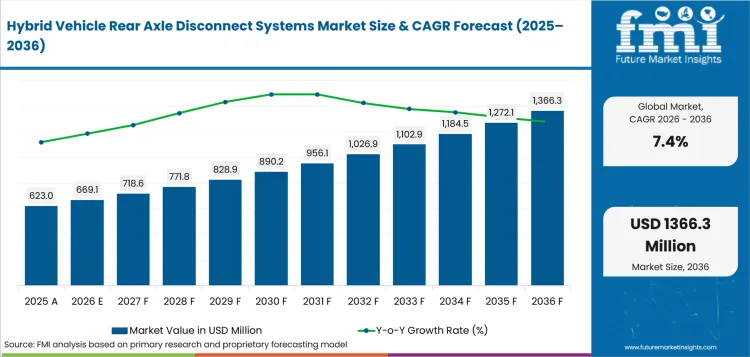
The hybrid vehicle rear axle disconnect systems market is expected to rise from USD 623.0 million in 2025 to USD 1,366.3 million by 2036 at 7.4% CAGR, supported by growing emphasis on improving fuel efficiency and reducing vehicle emissions. OEM fitment is forecast to hold 62.7% share in 2026 and electronic actuation is projected at 48.4% share as hybrid SUVs need rear axle separation during front-drive cruising.
Key Takeaways, Market Size, and Forecast
- 2026 Market Size: USD 669.1 million
- 2036 Market Size: USD 1,366.3 million
- Forecast CAGR: 7.4% from 2026 to 2036
- Leading Sales Channel: OEM fitment
- OEM Fitment Share in 2026: 62.7%
- Leading Actuation Type: Electronic
- Electronic Share in 2026: 48.4%
- Fastest-growing Country: China
- China CAGR: 8.9% by 2036
Summary of Hybrid Vehicle Rear Axle Disconnect Systems Market
- Demand and Growth Drivers
- Automakers are using disconnect modules to reduce rotating losses in hybrid AWD layouts.
- Hybrid SUVs need rear axle separation during steady driving and fast reconnection under traction demand.
- Electronic control is gaining preference as OEMs connect axle state with drive mode and stability control.
- Product and Segment View
- OEM fitment is projected to hold 62.7% share in 2026, influenced by axle disconnects being packaged during platform design.
- Electronic systems are expected to represent 48.4% share in 2026, led by software-controlled AWD and hybrid torque management.
- Electric rear axle formats are forecast to secure 45.9% share in 2026, helped by e-motor rear drive modules in hybrid SUVs.
- Geography and Competitive Outlook
- China is projected to record 8.9% CAGR by 2036, reflected by high hybrid and plug-in hybrid output across domestic SUV programs.
- India is expected to expand at 8.4% CAGR by 2036 through hybrid SUV model additions and higher local drivetrain sourcing.
- GKN Automotive and Magna compete on AWD coupling depth and system packaging for hybrid platforms.
- Schaeffler and BorgWarner compete through clutch actuation, hybrid module knowledge and drivetrain service exposure.
- Analyst Opinion
- Nikhil Kaitwade, Principal Consultant for Automotive at FMI, observes, “Hybrid AWD is no longer a simple traction add-on. Automakers now compare actuator response and software integration before locking drivetrain content. Suppliers with validated disconnect hardware and vehicle calibration support should gain repeat programs from hybrid SUV platforms.”
- Hybrid Vehicle Rear Axle Disconnect Systems Market Value Analysis
- Market value is tied to OEM axle module supply before service kits add aftermarket revenue.
- Supplier pricing reflects clutch pack design and electronic actuation before software validation affects program value.
- Revenue improves as plug-in hybrid SUVs use rear axle separation to manage electric cruising and fuel economy.
- Platform trust rises as OEMs reduce drivetrain drag without removing AWD capability from hybrid trims.
Hybrid AWD systems need one clear design answer: keep rear traction ready and reduce energy loss during normal driving. GKN Automotive’s 2025 report stated that Disconnect AWD cut AWD-related CO2 emissions by 80% and used components that were 30% more efficient than earlier models. Such proof makes rear axle disconnect hardware a stronger sourcing point in hybrid drivetrain planning. Schaeffler’s December 2024 patent for an electronic differential disconnect clutch shows how suppliers are moving control deeper into the axle. Solenoid actuation and hub-sleeve movement can support compact designs for electric vehicle e-axle programs. BorgWarner’s October 2024 transfer case award for combustion and hybrid truck platforms adds a commercial signal. Hybrid SUVs and pickups now need suppliers combining clutch durability and software support across automotive axle systems.
Hybrid Vehicle Rear Axle Disconnect Systems Market Definition
The hybrid vehicle rear axle disconnect systems market covers clutch, actuator and control assemblies that decouple rear axle torque paths in hybrid vehicles. Scope includes systems used in mechanical AWD hybrids and electric rear axle layouts. Revenue includes OEM fitment modules and service parts sold for rear axle torque separation. General differential parts are counted only if sold as part of a disconnect assembly.
Hybrid Vehicle Rear Axle Disconnect Systems Market Inclusions
Market scope covers commercially traded disconnect systems by sales channel such as OEM fitment and authorized service, actuation type such as electronic and electromechanical, axle architecture such as electric rear axle and mechanical AWD, vehicle type such as plug-in hybrid and full hybrid, and application such as compact SUV and pickup truck. Revenue scope covers activity from 2026 to 2036 across rear axle disconnect modules and related actuator packages. Key participants include driveline suppliers, axle module makers, clutch specialists, actuator producers, OEM platform teams and authorized service networks.
Hybrid Vehicle Rear Axle Disconnect Systems Market Exclusions
Scope excludes front axle disconnects and transfer cases sold without rear axle decoupling hardware. Conventional differentials without clutch separation and BEV e-axles lacking hybrid drivetrain use are also outside scope. General bearings and gears are counted only if bundled inside a defined disconnect module. Battery packs, inverters and charging parts sit outside scope unless supplied with rear axle control hardware.
Hybrid Vehicle Rear Axle Disconnect Systems Market Research Methodology
- Primary Research: FMI analysts reviewed driveline supplier inputs and OEM platform fitment discussions across hybrid AWD programs.
- Desk Research: Official electrification data, supplier releases and vehicle registration sources were checked against hybrid AWD disconnect evidence.
- Market Sizing and Forecasting: Market size used hybrid AWD platform counts and country-level production exposure across seven country markets. Module pricing and vehicle mix were used for cross-checks.
- Data Validation: Forecast checks compared 2026 value with 2036 value and tested CAGR consistency across seven country rates. Official supplier launches and rear axle disconnect developments were reviewed across hybrid AWD demand.
Why is the Hybrid Vehicle Rear Axle Disconnect Systems Market Growing?
- Hybrid AWD platforms need rear axle separation during cruising to reduce drag and protect fuel economy.
- Electronic actuation is improving control response as OEMs connect rear torque demand with drive mode software.
- Compact and mid-size SUVs are keeping hybrid AWD content due to traction needs and consumer preference for all-weather usability.
Hybrid powertrains are retaining a longer role in vehicle lineups. ACEA reported in January 2026 that EU plug-in hybrid cars rose 36.7% year over year in December 2025 and hybrid-electric cars rose 5.8% in the same month. Such growth keeps demand active for axle systems that preserve AWD performance without full-time mechanical load. Automakers can compare rear disconnect modules with hybrid drivetrain content and automotive electric drivetrain components during platform cost planning.
Market Segmentation Analysis
- OEM fitment is expected to represent 62.7% share in 2026, driven by rear axle disconnect modules needing platform-level packaging and warranty alignment before vehicle launch.
- Electronic actuation is projected to account for 48.4% share in 2026 as hybrid AWD systems need fast response between fuel-saving cruise mode and rear torque engagement.
- Electric rear axle formats are forecast to capture 45.9% share in 2026, led by rear e-motor modules allowing hybrid platforms to add AWD without a long mechanical shaft.
- Plug-in hybrids are anticipated to hold 43.6% share in 2026 due to larger batteries and electric driving modes creating stronger need for rear axle state control.
- Compact SUVs are expected to represent 39.8% share in 2026 since high-volume family vehicles use hybrid AWD for traction and trim differentiation.
The hybrid vehicle rear axle disconnect systems market is divided into groups based on sales channel, actuation type, axle architecture, vehicle type, application and region. Sales channel includes OEM fitment, authorized service, independent service and parts distributors. Actuation type coverage includes electronic, electromechanical, hydraulic and mechanical formats. Axle architecture connects with electric rear axle, mechanical AWD, modular e-axle and differential disconnect formats. Vehicle type analysis covers plug-in hybrid, full hybrid, mild hybrid and range extender platforms. Application analysis includes compact SUV, mid-size SUV, pickup truck and performance vehicle.
Insights into Hybrid Vehicle Rear Axle Disconnect Systems Market by Sales Channel
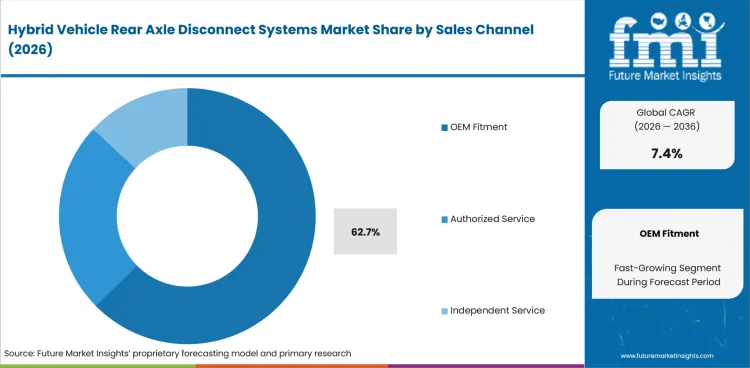
- OEM fitment is projected to account for 62.7% share in 2026, led by automakers building rear axle disconnect units into hybrid AWD platforms before launch.
- Authorized service gains value as hybrid driveline repair needs fitment data and actuator calibration rather than basic mechanical replacement.
Insights into Hybrid Vehicle Rear Axle Disconnect Systems Market by Actuation Type
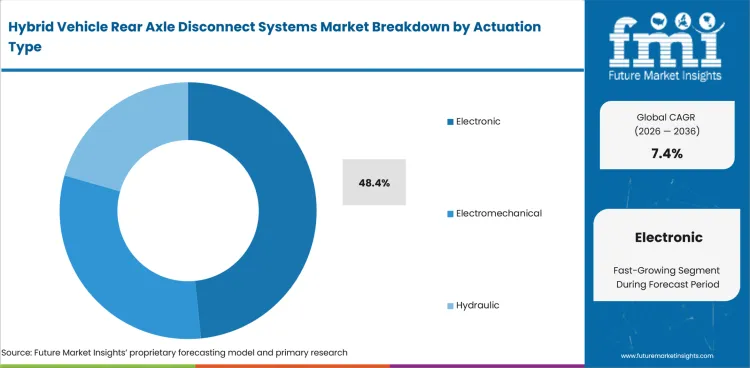
- Electronic actuation is forecast to hold 48.4% share in 2026 due to drive mode control and torque request timing across hybrid AWD vehicles.
- Electromechanical systems gain attention as suppliers seek compact actuator designs that reduce hydraulic complexity inside axle modules.
Insights into Hybrid Vehicle Rear Axle Disconnect Systems Market by Axle Architecture
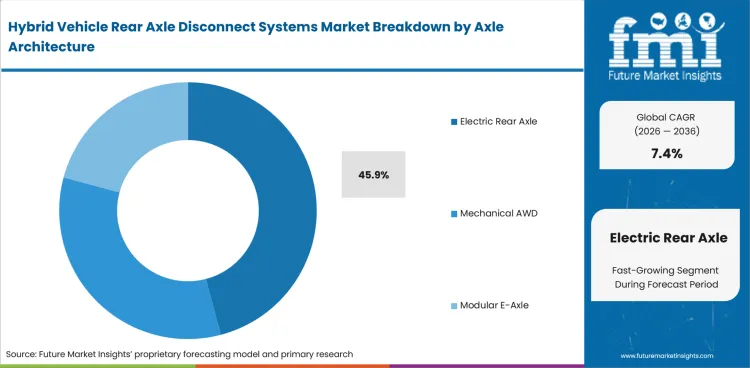
- Electric rear axle formats are expected to account for 45.9% share in 2026 as rear e-drive modules support traction without a full-time propshaft.
- Mechanical AWD systems retain use in larger hybrid SUVs and pickup trucks that need towing strength and familiar axle service practices.
Insights into Hybrid Vehicle Rear Axle Disconnect Systems Market by Vehicle Type
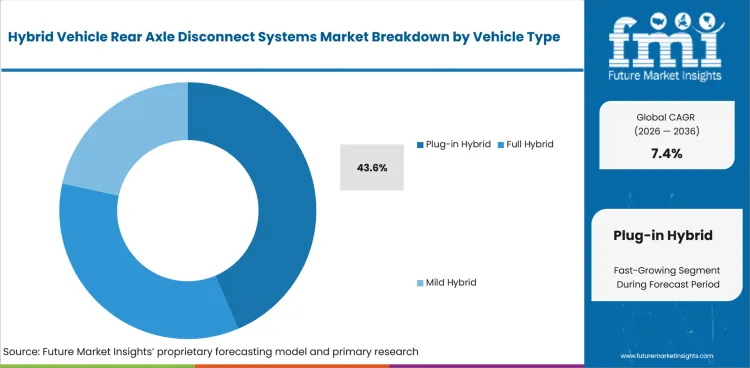
- Plug-in hybrids are anticipated to hold 43.6% share in 2026, driven by electric cruising modes that need axle drag reduction during daily driving.
- Full hybrids create steady demand through high-volume SUV models that use rear torque only during launch, slip and steep grades.
Insights into Hybrid Vehicle Rear Axle Disconnect Systems Market by Application
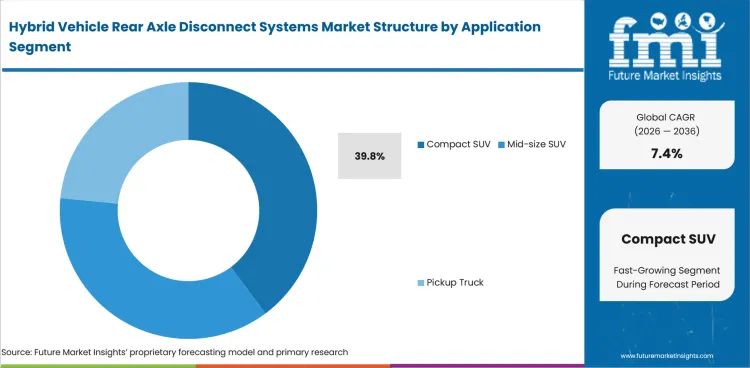
- Compact SUVs are projected to represent 39.8% share in 2026 since family SUV platforms combine hybrid fuel economy with AWD availability.
- Pickup trucks gain order attention as hybrid towing and light off-road use require durable rear torque connection under higher loads.
Hybrid Vehicle Rear Axle Disconnect Systems Market Drivers, Restraints and Opportunities
- Driver: Hybrid AWD platforms are raising rear axle disconnect use as automakers reduce driveline drag during front-drive operation.
- Restraint: Calibration cost can slow adoption since disconnect timing must align with stability control and torque delivery.
- Opportunity: Electric rear axle modules create added value by combining rear traction, disconnect control and compact packaging.
Demand is expected to be significant in hybrid SUVs and light trucks that need AWD image with lower fuel use. Magna states its disconnect, 4WD and AWD products are suitable for hybrid powertrains. Linamar lists nested differential disconnect as suitable for ICE and e-axle driveline applications along with lower disconnected-state noise and drag than competing architectures. Such supplier positioning supports adjacent electric vehicle e-axle and e-axle input and output couplings demand.
Production Capacity and Supplier Footprint Analysis
Production capability is a platform-selection factor as OEMs ask rear axle disconnect suppliers to support hybrid and ICE programs from nearby engineering and manufacturing sites. AAM’s June 2025 investor presentation states, the company generated USD 6.1 billion in 2024 sales, operated in 16 countries and had over 75 locations with 11 engineering and technology centers. Driveline represented 69% of 2024 sales, and the portfolio includes hybrid rear axle electric drive units. Such footprint depth points to a supplier advantage in rear axle disconnect systems, since OEMs need launch support and in-region supply for hybrid AWD platforms.
Import Dependence and Trade Flow Analysis
Cross-border supply remains important for rear axle disconnect systems since axle modules rely on auto parts networks moving components between OEM plants and tier suppliers. International Trade Administration stated in February 2026 that Mexico’s auto parts exports reached USD 106.0 billion in 2024. Total imports reached USD 68.6 billion and the United States supplied 52.2% of Mexico’s auto parts imports. It also states, some parts cross the U.S.-Mexico border up to a dozen times before completion. This makes USMCA compliance and regional sourcing central to hybrid AWD component availability.
Analysis of Hybrid Vehicle Rear Axle Disconnect Systems Market by Key Countries
.webp "Top Country Growth Comparison Hybrid Vehicle Rear Axle Disconnect Systems Market Cagr (2026 2036)")
| Country | CAGR |
|---|---|
| China | 8.9% |
| India | 8.4% |
| United States | 7.8% |
| Germany | 7.3% |
| South Korea | 7.1% |
| Japan | 6.8% |
| United Kingdom | 6.4% |
Source: Future Market Insights, 2026.
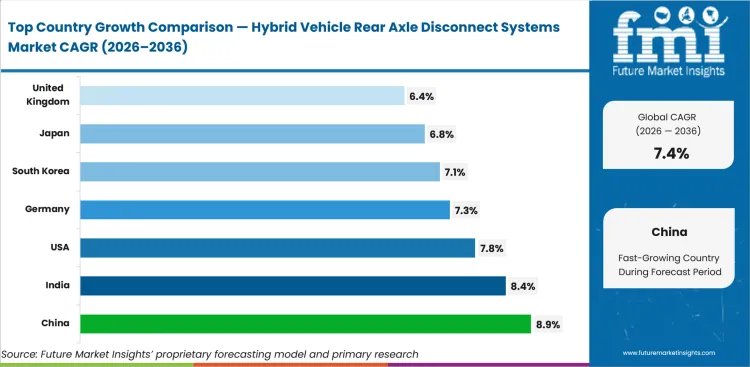
Hybrid Vehicle Rear Axle Disconnect Systems Market CAGR Analysis by Country
- China is projected to record 8.9% CAGR by 2036, driven by sustained hybrid SUV production that continues to support rear disconnect system integration.
- India is expected to advance at 8.4% CAGR through 2036, supported by localized SUV programs incorporating electrified AWD configurations.
- The United States is forecast to rise at 7.8% CAGR by 2036, fueled by increasing demand for driveline upgrades in hybrid pickups and SUVs.
- Germany is estimated to expand at 7.3% CAGR over the forecast period, owing to strong premium AWD engineering and rising validation requirements.
- South Korea’s 7.1% CAGR is attributed to hybrid crossover exports and collaborative OEM-supplier calibration activities.
- Japan is anticipated to grow at 6.8% CAGR through 2036, supported by compact e-AWD system adoption in hybrid crossovers.
- The United Kingdom is forecast to post 6.4% CAGR by 2036, backed by premium SUV service networks sustaining replacement and aftermarket demand.
- The United Kingdom is forecast to post 6.4% CAGR by 2036 as premium SUV service networks sustain later-stage demand.
Sales Outlook for Hybrid Vehicle Rear Axle Disconnect Systems Market in China
Large hybrid SUV production center · 2026 to 2036
Country Market Snapshot Table
| Parameter | Value |
|---|---|
| Market Size in 2025 (Value) | USD 151.8 million |
| Market Size in 2026 (Value) | USD 165.3 million |
| Market Forecast in 2036 (Value) | USD 386.4 million |
| CAGR (2026-2036) | 8.9% |
| Years Considered | 2021-2036 |
| Base Year | 2025 |
| Forecast Period | 2026-2036 |
| Units Considered | Value (USD million) |
| Leading Sub-Region | Yangtze River Delta |
China Hybrid Vehicle Rear Axle Disconnect Systems Market Outlook
China demand is shaped by domestic hybrid platforms and SUV production scale. Rear axle disconnect systems support automakers trying to balance AWD traction with lower driveline drag during daily driving.
Local platform sourcing gives suppliers a strong path into actuator housings and clutch assemblies. OEMs are expected to favor driveline partners that can support validation across several vehicle programs.
Key Growth Drivers
- Chinese OEM programs offer a large platform pool, reflected by China producing 34.531 million vehicles in 2025. Such output scale supports higher rear axle disconnect content across hybrid SUV lines.
- NEV platform activity strengthens rear axle module demand, backed by China recording 16.49 million NEV sales in 2025. Hybrid AWD suppliers can use high electrified-vehicle volume to justify local actuator and clutch production.
- Local drivetrain sourcing gains support from NEV production scale, shown by China manufacturing 16.626 million NEVs in 2025. Rear axle disconnect suppliers can align with domestic e-axle and AWD module programs.
- Export-oriented vehicle planning raises validation needs, influenced by China keeping global output leadership for 17 consecutive years. Suppliers need stronger quality checks before entering global hybrid programs supplied from China.
Key Restraints
- Platform price pressure can limit module margins, reflected by China auto sales rising 9.4% in 2025. OEMs may push suppliers toward lower-cost actuator and clutch packages.
- Variant complexity can extend engineering cycles, backed by China auto sales reaching 34.4 million vehicles in 2025. Rear axle disconnect suppliers need more calibration support across fuel, hybrid and NEV platforms.
- Global suppliers face scale barriers in local sourcing, shown by China holding the top NEV position for 11 consecutive years. Domestic drivetrain firms can challenge imported disconnect modules through cost and proximity.
What makes China unique
China is unique due to high hybrid platform scale and fast local sourcing for drivetrain modules.
Key Companies
- GKN Automotive
- Magna International
- BorgWarner
- Schaeffler
- ZF Friedrichshafen
- Linamar
- American Axle & Manufacturing
Sales & Marketing Channels
- OEM platform awards
- Tier-one supply agreements
- Joint development programs
- Authorized service kits
- Local distributor networks
- Aftermarket repair channels
Country Segment Breakdown Table
| Segment | Sub-Segments |
|---|---|
| By Sales Channel | OEM Fitment · Authorized Service · Independent Service · Parts Distributors |
| By Actuation Type | Electronic · Electromechanical · Hydraulic · Mechanical |
| By Axle Architecture | Electric Rear Axle · Mechanical AWD · Modular E-Axle · Differential Disconnect |
| By Vehicle Type | Plug-in Hybrid · Full Hybrid · Mild Hybrid · Range Extender |
| By Application | Compact SUV · Mid-size SUV · Pickup Truck · Performance Vehicle |
| Key Sub-Regions Covered, Production Clusters | Shanghai · Jiangsu · Zhejiang · Guangdong · Chongqing · Anhui |
Frequently Asked Questions
How fast is China hybrid vehicle rear axle disconnect systems market growing?
Demand in China is forecast at 8.9% CAGR by 2036, driven by hybrid SUV platform expansion.
Who leads China hybrid vehicle rear axle disconnect systems market?
GKN Automotive, Magna International and BorgWarner compete through AWD module supply and local OEM platform support.
What is driving adoption in China hybrid vehicle rear axle disconnect systems market?
Hybrid SUV output and domestic e-axle sourcing are moving automakers toward compact rear axle disconnect modules.
Demand Outlook for Hybrid Vehicle Rear Axle Disconnect Systems Market in India
Hybrid SUV localization center · 2026 to 2036
Country Market Snapshot Table
| Parameter | Value |
|---|---|
| Market Size in 2025 (Value) | USD 47.6 million |
| Market Size in 2026 (Value) | USD 51.6 million |
| Market Forecast in 2036 (Value) | USD 115.6 million |
| CAGR (2026-2036) | 8.4% |
| Years Considered | 2021-2036 |
| Base Year | 2025 |
| Forecast Period | 2026-2036 |
| Units Considered | Value (USD million) |
| Leading Sub-Region | Western India auto cluster |
India Hybrid Vehicle Rear Axle Disconnect Systems Market Outlook
India demand is shaped by hybrid SUV launches and local component sourcing. Rear axle disconnect systems suit automakers adding AWD capability to upper trims while protecting fuel economy.
Domestic manufacturers are expected to evaluate module cost before adding rear disconnect systems across high-volume models. Suppliers with local testing and assembly support are likely to gain stronger program access.
Key Growth Drivers
- Passenger vehicle scale supports hybrid drivetrain planning, reflected by India recording 4.3 million passenger vehicle sales in FY2024-25. Rear axle disconnect systems can gain value as OEMs add higher-content SUV trims.
- Utility vehicle mix gives suppliers a clear application path, backed by utility vehicles forming around two-thirds of passenger vehicle sales in Q2 FY2025-26. Compact and mid-size SUVs can absorb AWD disconnect content faster than small cars.
- Electrified vehicle registration is improving, shown by India recording 1.97 million EV registrations in FY2024-25. Hybrid AWD suppliers can use electrification planning to support rear axle separation hardware.
- Electric passenger vehicle activity supports component readiness, influenced by electric passenger vehicle registrations crossing one lakh in FY2024-25. Local suppliers can connect actuator assembly with hybrid driveline localization.
Key Restraints
- Passenger vehicle softness can delay new content adoption, reflected by Q2 FY2025-26 passenger vehicle sales falling 1.5% to 1.04 million units. OEMs may phase rear axle disconnect systems into premium variants first.
- Utility vehicle growth is not uniform, shown by utility vehicle sales declining 2.1% in Q2 FY2025-26. Rear axle disconnect suppliers may face uneven program timing across SUV models.
- Local cost pressure remains high, backed by total vehicle production reaching 31.0 million units in FY2024-25. High-volume production can push suppliers to simplify actuator designs before wider fitment.
What makes India unique
India is unique due to fast SUV mix growth and rising hybrid localization across domestic OEM programs.
Key Companies
- GKN Automotive
- Magna International
- BorgWarner
- Schaeffler
- ZF Friedrichshafen
- Linamar
- American Axle & Manufacturing
Sales & Marketing Channels
- OEM platform awards
- Tier-one supply agreements
- Joint development programs
- Authorized service kits
- Local distributor networks
- Aftermarket repair channels
Country Segment Breakdown Table
| Segment | Sub-Segments |
|---|---|
| By Sales Channel | OEM Fitment · Authorized Service · Independent Service · Parts Distributors |
| By Actuation Type | Electronic · Electromechanical · Hydraulic · Mechanical |
| By Axle Architecture | Electric Rear Axle · Mechanical AWD · Modular E-Axle · Differential Disconnect |
| By Vehicle Type | Plug-in Hybrid · Full Hybrid · Mild Hybrid · Range Extender |
| By Application | Compact SUV · Mid-size SUV · Pickup Truck · Performance Vehicle |
| Key Sub-Regions Covered, Auto Clusters | Pune · Chennai · Gujarat · NCR · Bengaluru · Sanand |
Frequently Asked Questions
How fast is India hybrid vehicle rear axle disconnect systems market growing?
Industry in India is forecast at 8.4% CAGR from 2026 to 2036, led by hybrid SUV localization improvement.
Who leads India hybrid vehicle rear axle disconnect systems market?
Magna International, GKN Automotive and BorgWarner compete based on AWD program experience and local production support.
What is driving adoption in India hybrid vehicle rear axle disconnect systems market?
Hybrid SUV launches and mileage needs are pushing automakers toward rear axle separation systems.
Growth Outlook for Hybrid Vehicle Rear Axle Disconnect Systems Market in the United States
Hybrid SUV and pickup upgrade center · 2026 to 2036
Country Market Snapshot Table
| Parameter | Value |
|---|---|
| Market Size in 2025 (Value) | USD 142.7 million |
| Market Size in 2026 (Value) | USD 153.8 million |
| Market Forecast in 2036 (Value) | USD 326.5 million |
| CAGR (2026-2036) | 7.8% |
| Years Considered | 2021-2036 |
| Base Year | 2025 |
| Forecast Period | 2026-2036 |
| Units Considered | Value (USD million) |
| Leading Sub-Region | Midwest and Southeast vehicle plants |
United States Hybrid Vehicle Rear Axle Disconnect Systems Market Outlook
United States demand is centered on hybrid SUVs and pickup programs. Rear axle disconnect systems allow automakers to keep AWD performance while reducing drivetrain losses during highway travel.
Pickup and SUV platforms create higher torque requirements than small passenger cars. Suppliers with durable clutch packs and software support are expected to gain an advantage in OEM sourcing.
Key Growth Drivers
- Electrified powertrain acceptance supports rear axle disconnect demand, reflected by BEV and PHEV vehicles forming about 22.0% of light-duty sales in 2025. Hybrid AWD suppliers can use this shift to support fuel-saving driveline hardware.
- Hybrid vehicles offer a resilient path within electrified fleets, backed by HEVs gaining share in 2025 while plug-in formats faced a weaker second half. Rear axle disconnect modules can serve hybrid SUVs that do not rely on charging behavior.
- September sales patterns show traction for electrified platforms, recorded through BEVs reaching 12.0% share of light-duty sales in September 2025. Such consumer exposure supports higher comfort with electric rear drive and AWD control systems.
- Regulatory pressure keeps efficiency hardware in platform reviews, supported by EPA finalizing light-duty emission standards for model year 2027 onward in March 2024. Rear axle disconnects can help automakers reduce mechanical losses without removing AWD options.
Key Restraints
- Plug-in incentive changes can disturb powertrain planning, reflected by federal clean vehicle tax credits expiring on September 30, 2025. BEV sales then fell below 6.0% in the remaining months and created planning risk for electrified driveline content.
- Service population is still limited for some electrified driveline parts, shown by EVs accounting for 2.0% of registered light-duty vehicles in 2024. Aftermarket demand for hybrid rear axle disconnect repairs may build gradually.
- Premium demand can narrow early adoption, backed by luxury vehicles forming 14.0% of total light-duty sales in 2025. Rear axle disconnect systems may remain concentrated in higher-value AWD trims before broader rollout.
What makes the United States unique
United States is unique due to large hybrid SUV and pickup demand across high-value vehicle segments.
Key Companies
- American Axle & Manufacturing
- Magna International
- GKN Automotive
- BorgWarner
- Dana Incorporated
- ZF Friedrichshafen
- Schaeffler
Sales & Marketing Channels
- OEM platform awards
- Tier-one supply agreements
- Joint development programs
- Authorized service kits
- Local distributor networks
- Aftermarket repair channels
Country Segment Breakdown Table
| Segment | Sub-Segments |
|---|---|
| By Sales Channel | OEM Fitment · Authorized Service · Independent Service · Parts Distributors |
| By Actuation Type | Electronic · Electromechanical · Hydraulic · Mechanical |
| By Axle Architecture | Electric Rear Axle · Mechanical AWD · Modular E-Axle · Differential Disconnect |
| By Vehicle Type | Plug-in Hybrid · Full Hybrid · Mild Hybrid · Range Extender |
| By Application | Compact SUV · Mid-size SUV · Pickup Truck · Performance Vehicle |
| Key Sub-Regions Covered, Production Clusters | Michigan · Ohio · Kentucky · Tennessee · Alabama · South Carolina |
Frequently Asked Questions
How fast is United States hybrid vehicle rear axle disconnect systems market growing?
Demand in the United States is anticipated to rise at 7.8% CAGR by 2036 with hybrid SUVs and pickups add AWD efficiency hardware.
Who leads United States hybrid vehicle rear axle disconnect systems market?
American Axle & Manufacturing, Magna International and GKN Automotive compete through axle system supply and OEM program history.
What is driving adoption in United States hybrid vehicle rear axle disconnect systems market?
Hybrid SUV and pickup platforms are increasing use of rear disconnect systems to cut drag during cruise.
Demand Analysis for Hybrid Vehicle Rear Axle Disconnect Systems Market in Germany
Premium hybrid AWD engineering center · 2026 to 2036
Country Market Snapshot Table
| Parameter | Value |
|---|---|
| Market Size in 2025 (Value) | USD 65.9 million |
| Market Size in 2026 (Value) | USD 70.7 million |
| Market Forecast in 2036 (Value) | USD 143.2 million |
| CAGR (2026-2036) | 7.3% |
| Years Considered | 2021-2036 |
| Base Year | 2025 |
| Forecast Period | 2026-2036 |
| Units Considered | Value (USD million) |
| Leading Sub-Region | Baden-Württemberg and Bavaria |
Germany Hybrid Vehicle Rear Axle Disconnect Systems Market Outlook
Germany demand is shaped by premium hybrid AWD platforms and supplier engineering depth. Rear axle disconnect systems need low noise and smooth torque handover for German OEM driving standards.
Local drivetrain suppliers are expected to compete on validation quality and system integration. Premium OEM programs may favor disconnect hardware that protects refinement during electric driving and engine restart events.
Key Growth Drivers
- Plug-in hybrid demand supports rear axle control needs, reflected by German PHEV registrations rising 62.3% in 2025. Strong PHEV movement raises demand for axle systems that support electric driving modes.
- Hybrid-electric vehicle uptake adds steady platform content, backed by German hybrid-electric registrations increasing 8.0% in 2025. Rear axle disconnect suppliers can address AWD efficiency needs across premium hybrid lines.
- BEV growth keeps drivetrain electrification skills active, shown by German BEV registrations rising 43.2% in 2025. Such engineering depth supports electronic actuation and e-axle adjacent rear disconnect work.
- Early 2026 demand signals support new platform planning, influenced by German BEV registrations rising 41.3% in Q1 2026. Suppliers can use electrified platform momentum to support hybrid AWD module proposals.
Key Restraints
- Powertrain churn can complicate module planning, reflected by German petrol registrations falling 21.6% in 2025. OEMs may reassess hybrid AWD content as fuel mix shifts across model lines.
- Hybrid demand can move unevenly month to month, shown by German HEV registrations falling 1.8% in January 2026. Rear axle disconnect suppliers may face delayed awards on selected platforms.
- Plug-in growth can remain below faster European peers, supported by German PHEV registrations rising 19.3% in Q1 2026. Suppliers may need to justify rear disconnect value against BEV-first engineering budgets.
What makes Germany unique
Germany is unique due to premium AWD engineering standards and strong local drivetrain supplier depth.
Key Companies
- ZF Friedrichshafen
- Schaeffler
- GKN Automotive
- Magna International
- BorgWarner
- American Axle & Manufacturing
- Linamar
Sales & Marketing Channels
- OEM platform awards
- Tier-one supply agreements
- Joint development programs
- Authorized service kits
- Local distributor networks
- Aftermarket repair channels
Country Segment Breakdown Table
| Segment | Sub-Segments |
|---|---|
| By Sales Channel | OEM Fitment · Authorized Service · Independent Service · Parts Distributors |
| By Actuation Type | Electronic · Electromechanical · Hydraulic · Mechanical |
| By Axle Architecture | Electric Rear Axle · Mechanical AWD · Modular E-Axle · Differential Disconnect |
| By Vehicle Type | Plug-in Hybrid · Full Hybrid · Mild Hybrid · Range Extender |
| By Application | Compact SUV · Mid-size SUV · Pickup Truck · Performance Vehicle |
| Key Sub-Regions Covered, Production Clusters | Stuttgart · Munich · Wolfsburg · Leipzig · Saarland · Lower Saxony |
Frequently Asked Questions
How fast is Germany hybrid vehicle rear axle disconnect systems market growing?
Sector in Germany is set to scale at 7.3% CAGR by 2036 through premium hybrid AWD systems needing lower driveline losses.
Who leads Germany hybrid vehicle rear axle disconnect systems market?
ZF Friedrichshafen, Schaeffler and GKN Automotive compete depending on actuator skill and hybrid drivetrain system experience.
What is driving adoption in Germany hybrid vehicle rear axle disconnect systems market?
Premium hybrid SUV engineering is moving suppliers toward quieter and faster rear axle disconnect systems.
Sales Analysis for Hybrid Vehicle Rear Axle Disconnect Systems Market in South Korea
Hybrid crossover platform center · 2026 to 2036
Country Market Snapshot Table
| Parameter | Value |
|---|---|
| Market Size in 2025 (Value) | USD 39.7 million |
| Market Size in 2026 (Value) | USD 42.5 million |
| Market Forecast in 2036 (Value) | USD 84.3 million |
| CAGR (2026-2036) | 7.1% |
| Years Considered | 2021-2036 |
| Base Year | 2025 |
| Forecast Period | 2026-2036 |
| Units Considered | Value (USD million) |
| Leading Sub-Region | Ulsan and Gyeonggi auto belt |
South Korea Hybrid Vehicle Rear Axle Disconnect Systems Market Outlook
South Korea demand is tied to crossover exports and hybrid platform expansion. Rear axle disconnect systems match OEM efforts to offer AWD while keeping fuel economy competitive in export markets.
Domestic supplier networks allow close coordination between axle hardware and vehicle software. Export programs should favor disconnect systems with predictable durability across North American and European driving conditions.
Key Growth Drivers
- Electrified vehicle penetration supports axle system upgrades, reflected by EV share being projected to reach 20.0% of total vehicle sales by end-2025. Hybrid AWD modules can gain from wider electrified drivetrain planning.
- Local EV industry growth supports drivetrain supplier investment, backed by an annual growth rate of 19.0% from 2020 to 2024 across EV and charging activity. Rear axle disconnect suppliers can align with local e-drive capability.
- Production scale gives suppliers a stronger testing base, shown by South Korea producing 407,009 EVs in 2025. Hybrid and plug-in hybrid platforms can use shared validation work across rear drive hardware.
- Vehicle electrification is becoming a production priority, influenced by EVs accounting for 11.0% of total automobile production in 2025. Rear axle disconnect suppliers can position modules near electrified crossover programs.
Key Restraints
- Subsidy changes can affect electrified trim pricing, reflected by the maximum EV subsidy being reduced to USD 3,950.0 in 2025. Cost pressure may limit rear disconnect fitment to higher trims first.
- Certification rules add validation work, backed by the EV Battery Certification System taking effect on February 17, 2025. Suppliers connected to electrified axle systems may face stricter documentation demands.
- Charging policy can shift OEM investment priorities, shown by only EVs transmitting real-time battery state-of-charge data qualifying for subsidies. Rear axle disconnect systems must compete with software and battery compliance spending.
What makes South Korea unique
South Korea is unique due to export-oriented hybrid crossover production and strong OEM-supplier integration.
Key Companies
- Hyundai Transys
- HL Mando
- GKN Automotive
- Magna International
- BorgWarner
- Schaeffler
- ZF Friedrichshafen
Sales & Marketing Channels
- OEM platform awards
- Tier-one supply agreements
- Joint development programs
- Authorized service kits
- Local distributor networks
- Aftermarket repair channels
Country Segment Breakdown Table
| Segment | Sub-Segments |
|---|---|
| By Sales Channel | OEM Fitment · Authorized Service · Independent Service · Parts Distributors |
| By Actuation Type | Electronic · Electromechanical · Hydraulic · Mechanical |
| By Axle Architecture | Electric Rear Axle · Mechanical AWD · Modular E-Axle · Differential Disconnect |
| By Vehicle Type | Plug-in Hybrid · Full Hybrid · Mild Hybrid · Range Extender |
| By Application | Compact SUV · Mid-size SUV · Pickup Truck · Performance Vehicle |
| Key Sub-Regions Covered, Production Clusters | Ulsan · Hwaseong · Gwangmyeong · Asan · Pyeongtaek · Busan |
Frequently Asked Questions
How fast is South Korea hybrid vehicle rear axle disconnect systems market growing?
Sales in South Korea are projected to grow at 7.1% CAGR by 2036 due to the consistent expansion of hybrid crossover exports.
Who leads South Korea hybrid vehicle rear axle disconnect systems market?
Hyundai Transys, HL Mando and global driveline suppliers compete through close OEM platform support.
What is driving adoption in South Korea hybrid vehicle rear axle disconnect systems market?
Hybrid crossover export programs are raising demand for low-drag rear axle disconnect systems.
Future Outlook for Hybrid Vehicle Rear Axle Disconnect Systems Market in Japan
Hybrid engineering and quality center · 2026 to 2036
Country Market Snapshot Table
| Parameter | Value |
|---|---|
| Market Size in 2025 (Value) | USD 58.4 million |
| Market Size in 2026 (Value) | USD 62.3 million |
| Market Forecast in 2036 (Value) | USD 120.4 million |
| CAGR (2026-2036) | 6.8% |
| Years Considered | 2021-2036 |
| Base Year | 2025 |
| Forecast Period | 2026-2036 |
| Units Considered | Value (USD million) |
| Leading Sub-Region | Aichi and Shizuoka corridor |
Japan Hybrid Vehicle Rear Axle Disconnect Systems Market Outlook
Japan demand is influenced by long-running hybrid know-how and quality-focused drivetrain sourcing. Rear axle disconnect systems need compact size and high reliability due to dense packaging in hybrid crossovers.
Japanese automakers are expected to retain hybrid platforms across domestic and export models. Suppliers with precision machining and actuator quality can gain program access in e-AWD and modular rear drive packages.
Key Growth Drivers
- Hybrid platform depth supports rear axle separation hardware, reflected by Japan hybrid vehicle sales surpassing 2.0 million units in 2024. Rear disconnect modules can serve e-AWD crossovers and export hybrid models.
- Hybrid vehicles dominate passenger car mix, backed by HVs accounting for 54.8% of Japan new passenger car sales in 2024. Such share creates a wide base for compact rear axle disconnect adoption.
- Domestic supplier ties support engineering control, shown by domestic brands holding about 95.0% of Japan’s vehicle market in 2024. Rear axle disconnect suppliers must align closely with Japan-based OEM quality systems.
- Toyota Group influence shapes drivetrain choices, influenced by Toyota Group holding about 41.0% of Japan vehicle sales in 2024. Approved suppliers can gain scale through hybrid platform carryover.
Key Restraints
- Vehicle demand softness can slow new content expansion, reflected by Japan new passenger vehicle sales falling 7.5% in 2024. Rear axle disconnect suppliers may face slower rollout beyond core hybrid models.
- BEV weakness can reduce adjacent e-drive momentum, shown by Japan EV sales totaling 59,736 units in 2024. Lower BEV scale may limit shared component economics for rear electrified axle hardware.
- Compact vehicle mix can restrict package space, backed by kei car sales reaching 1,557,868 units in 2024. Small vehicle formats reduce the addressable pool for rear axle disconnect assemblies.
What makes Japan unique
Japan is unique due to deep hybrid platform history and high reliability expectations for drivetrain components.
Key Companies
- JTEKT
- Aisin
- GKN Automotive
- Magna International
- BorgWarner
- Schaeffler
- ZF Friedrichshafen
Sales & Marketing Channels
- OEM platform awards
- Tier-one supply agreements
- Joint development programs
- Authorized service kits
- Local distributor networks
- Aftermarket repair channels
Country Segment Breakdown Table
| Segment | Sub-Segments |
|---|---|
| By Sales Channel | OEM Fitment · Authorized Service · Independent Service · Parts Distributors |
| By Actuation Type | Electronic · Electromechanical · Hydraulic · Mechanical |
| By Axle Architecture | Electric Rear Axle · Mechanical AWD · Modular E-Axle · Differential Disconnect |
| By Vehicle Type | Plug-in Hybrid · Full Hybrid · Mild Hybrid · Range Extender |
| By Application | Compact SUV · Mid-size SUV · Pickup Truck · Performance Vehicle |
| Key Sub-Regions Covered, Production Clusters | Aichi · Shizuoka · Fukuoka · Kanagawa · Saitama · Hiroshima |
Frequently Asked Questions
How fast is Japan hybrid vehicle rear axle disconnect systems market growing?
The market in Japan is likely to grow at 6.8% CAGR by 2036 since e-AWD hybrid crossovers support module demand.
Who leads Japan hybrid vehicle rear axle disconnect systems market?
JTEKT, Aisin and global driveline suppliers compete led by compact design and quality control.
What is driving adoption in Japan hybrid vehicle rear axle disconnect systems market?
Hybrid platform depth is moving automakers toward compact rear axle disconnect systems with smooth actuation.
Demand Outlook for Hybrid Vehicle Rear Axle Disconnect Systems Market in the United Kingdom
Premium SUV and service center · 2026 to 2036
Country Market Snapshot Table
| Parameter | Value |
|---|---|
| Market Size in 2025 (Value) | USD 31.9 million |
| Market Size in 2026 (Value) | USD 33.9 million |
| Market Forecast in 2036 (Value) | USD 63.1 million |
| CAGR (2026-2036) | 6.4% |
| Years Considered | 2021-2036 |
| Base Year | 2025 |
| Forecast Period | 2026-2036 |
| Units Considered | Value (USD million) |
| Leading Sub-Region | Midlands automotive belt |
United Kingdom Hybrid Vehicle Rear Axle Disconnect Systems Market Outlook
United Kingdom demand is linked to premium SUV production and authorized repair exposure. Rear axle disconnect systems suit hybrid AWD platforms that need lower drag while keeping traction performance.
Local service channels are expected to gain repair value as hybrid AWD vehicles age. Suppliers with approved kits and calibration support can gain stronger access to premium vehicle networks.
Key Growth Drivers
- Passenger vehicle demand supports hybrid content, reflected by UK new car registrations reaching 2,020,520 units in 2025. Rear axle disconnect suppliers can target premium SUVs within a larger recovering car market.
- Plug-in hybrid growth supports AWD efficiency hardware, backed by PHEV registrations rising 34.7% to 225,143 units in 2025. Rear disconnect systems can support electric driving modes in premium hybrid SUVs.
- Hybrid vehicle demand remains active, shown by HEV registrations reaching 280,185 units in 2025. Higher hybrid volume supports service demand for actuators and clutch modules over time.
- SUV-specific electrified demand gives suppliers a clear model signal, influenced by Kia Sportage HEV registrations reaching 22,365 units in 2025. Popular hybrid SUV nameplates can support rear axle disconnect content in upper trims.
Key Restraints
- BEV policy pressure can draw funding from hybrid modules, reflected by the UK ZEV mandate target reaching 28.0% in 2025. Hybrid rear axle disconnect suppliers may compete against BEV program spending.
- Manufacturer support costs remain high, backed by SMMT estimating over GBP 5.0 billion in BEV discounting in 2025. OEMs may limit added hybrid driveline content during margin pressure.
- Combustion mix remains large, shown by petrol cars holding 46.4% share of UK registrations in 2025. Rear axle disconnect adoption may stay linked to premium hybrid AWD rather than mass-market vehicles.
What makes the United Kingdom unique
United Kingdom is unique due to premium hybrid SUV exposure and established AWD service networks.
Key Companies
- GKN Automotive
- ZF Friedrichshafen
- Magna International
- BorgWarner
- Schaeffler
- American Axle & Manufacturing
- Linamar
Sales & Marketing Channels
- OEM platform awards
- Tier-one supply agreements
- Joint development programs
- Authorized service kits
- Local distributor networks
- Aftermarket repair channels
Country Segment Breakdown Table
| Segment | Sub-Segments |
|---|---|
| By Sales Channel | OEM Fitment · Authorized Service · Independent Service · Parts Distributors |
| By Actuation Type | Electronic · Electromechanical · Hydraulic · Mechanical |
| By Axle Architecture | Electric Rear Axle · Mechanical AWD · Modular E-Axle · Differential Disconnect |
| By Vehicle Type | Plug-in Hybrid · Full Hybrid · Mild Hybrid · Range Extender |
| By Application | Compact SUV · Mid-size SUV · Pickup Truck · Performance Vehicle |
| Key Sub-Regions Covered, Production and Service Areas | West Midlands · Solihull · Halewood · Sunderland · Oxford · South Wales |
Frequently Asked Questions
How fast is United Kingdom hybrid vehicle rear axle disconnect systems market growing?
Demand in the United Kingdom is forecast at 6.4% CAGR by 2036 as premium hybrid AWD service demand improves.
Who leads United Kingdom hybrid vehicle rear axle disconnect systems market?
GKN Automotive, ZF Friedrichshafen and Magna International compete through AWD system experience and service network reach.
What is driving adoption in United Kingdom hybrid vehicle rear axle disconnect systems market?
Premium hybrid SUV production and authorized service needs are supporting rear axle disconnect systems demand.
Competitive Landscape and Strategic Positioning
- Full driveline suppliers hold an advantage depending on actuator integration and OEM platform validation.
- Clutch specialists gain orders by improving engagement smoothness during hybrid drive mode changes.
- Service kit suppliers strengthen long-term revenue as hybrid AWD vehicles age and actuator replacement starts.
- Local plants reduce program risk by supporting quality checks near OEM assembly and axle module production.
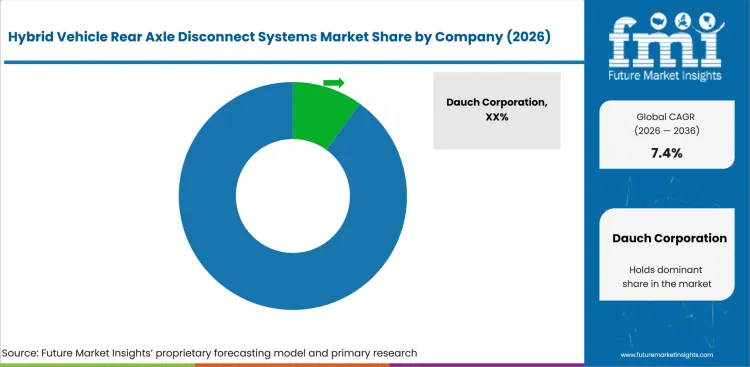
Competition in the industryis led by driveline system suppliers and axle module producers. Dauch Corporation now brings together legacy AAM axle system depth and GKN Automotive’s AWD driveline capability. Magna International holds a strong position through AWD system packaging and global OEM program reach. BorgWarner and Schaeffler compete through hybrid drivetrain module and control hardware experience. Linamar adds value through nested differential disconnect architecture, while ZF Friedrichshafen supports electric vehicle e-axle system engineering and premium OEM integration. Dana Incorporated remains important because it supplies driveline and axle systems across light vehicle and commercial vehicle platforms.
Channel strength now carries the same weight as module design. Direct OEM programs support early platform integration and calibration control. Authorized service kits can gain value as hybrid AWD fleets age and actuator replacement needs increase. Adjacent spending across EV driveline NVH couplings along with propeller shaft couplings and flanges and driveline coupling and joint remanufacturing can create bundled opportunities for repair networks.
Key Companies in the Hybrid Vehicle Rear Axle Disconnect Systems Market
Competitive structure is clearest when grouped by full driveline suppliers, clutch specialists and axle module producers.
- Vehicle Driveline Suppliers: Dauch Corporation, Magna International and Dana Incorporated compete through AWD programs and OEM platform integration.
- Hybrid Clutch Specialists: Schaeffler and BorgWarner compete led by clutch actuation knowledge and electronic control experience.
- Axle Module Producers: ZF Friedrichshafen and Linamar compete on OEM reach and e-axle input and output couplings architecture depth.
Competitive Benchmarking: Hybrid Vehicle Rear Axle Disconnect Systems Market
| Company | AWD Coupling Depth | Rear Axle Packaging | Actuator Control Focus | Channel Reach | Geographic Footprint |
|---|---|---|---|---|---|
| Dauch Corporation | Very Strong | Very Strong | Strong | Very Strong | Global |
| Magna International | Very Strong | Very Strong | Strong | Very Strong | Global |
| BorgWarner | Strong | Moderate | Very Strong | Strong | Global |
| Schaeffler | Moderate | Strong | Very Strong | Strong | Global |
| ZF Friedrichshafen | Strong | Strong | Strong | Very Strong | Global |
| Linamar | Moderate | Very Strong | Moderate | Moderate | North America |
| Dana Incorporated | Strong | Strong | Moderate | Strong | Global |
Source: Future Market Insights competitive analysis, 2026.
Key Developments in Hybrid Vehicle Rear Axle Disconnect Systems Market
- In August 2024, American Axle & Manufacturing highlighted EcoTrac as a disconnecting all-wheel-drive technology.
- In August 2025, Jeep introduced the 2026 Cherokee with a new 1.6L I4 Turbo Hybrid powertrain and standard Jeep Active Drive I 4x4 system with standard rear-axle disconnect.
- In February 2026, Dauch Corporation completed the acquisition of Dowlais Group plc and its subsidiaries, including GKN Automotive and GKN Powder Metallurgy.
Key Players in the Hybrid Vehicle Rear Axle Disconnect Systems Market
- Dauch Corporation
- Magna International
- BorgWarner
- Schaeffler
- ZF Friedrichshafen
- Linamar
- Dana Incorporated
Hybrid Vehicle Rear Axle Disconnect Systems Market - Report Scope
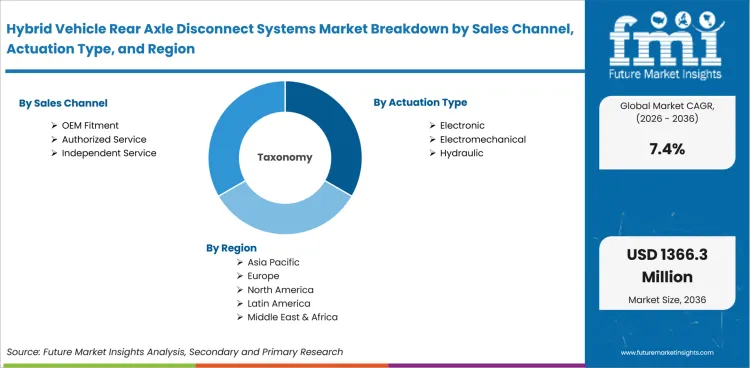
| Item | Value |
|---|---|
| Market size by 2036 | USD 1,366.3 million |
| Growth rate | 7.4% CAGR (2026-2036) |
| Forecast period | 2026 to 2036 |
| Estimated year value (2026) | USD 669.1 million |
| By sales channel | OEM fitment, authorized service, independent service, parts distributors |
| By actuation type | Electronic, electromechanical, hydraulic, mechanical |
| By axle architecture | Electric rear axle, mechanical AWD, modular e-axle, differential disconnect |
| By vehicle type | Plug-in hybrid, full hybrid, mild hybrid, range extender |
| By application | Compact SUV, mid-size SUV, pickup truck, performance vehicle |
| Regions covered | North America, Latin America, Europe, Asia Pacific, Middle East and Africa |
| Countries covered | China, India, United States, Germany, South Korea, Japan, United Kingdom |
| Key companies profiled | GKN Automotive, Magna International, AAM, BorgWarner, Schaeffler, ZF Friedrichshafen, Linamar |
| Approach | Bottom-up hybrid AWD platform checks with module pricing, vehicle mix and supplier validation |
Source: Future Market Insights competitive analysis, 2026.
Hybrid Vehicle Rear Axle Disconnect Systems Market Breakdown by Sales Channel, Actuation Type, Axle Architecture, Vehicle Type, Application, and Region
Hybrid Vehicle Rear Axle Disconnect Systems Market Segmented by Sales Channel:
- OEM Fitment
- Authorized Service
- Independent Service
- Parts Distributors
Hybrid Vehicle Rear Axle Disconnect Systems Market Segmented by Actuation Type:
- Electronic
- Electromechanical
- Hydraulic
- Mechanical
Hybrid Vehicle Rear Axle Disconnect Systems Market Segmented by Axle Architecture:
- Electric Rear Axle
- Mechanical AWD
- Modular E-Axle
- Differential Disconnect
Hybrid Vehicle Rear Axle Disconnect Systems Market Segmented by Vehicle Type:
- Plug-in Hybrid
- Full Hybrid
- Mild Hybrid
- Range Extender
Hybrid Vehicle Rear Axle Disconnect Systems Market Segmented by Application:
- Compact SUV
- Mid-size SUV
- Pickup Truck
- Performance Vehicle
Hybrid Vehicle Rear Axle Disconnect Systems Market by Region:
- North America
- Latin America
- Europe
- Asia Pacific
- Middle East and Africa
This Report Answers
- What is the 2026 value and 2036 forecast for hybrid vehicle rear axle disconnect systems market?
- What sales channel is projected to hold the leading share during the forecast period?
- What actuation type is expected to account for the leading 2026 share?
- How do rear axle disconnect systems affect hybrid AWD efficiency and system pricing?
- What companies compete in hybrid vehicle rear axle disconnect systems?
Frequently Asked Questions
What is the hybrid vehicle rear axle disconnect systems market size in 2026?
The hybrid vehicle rear axle disconnect systems market size is anticipated to reach USD 669.1 million in 2026 as hybrid AWD platform content rises.
What is the forecast value of hybrid vehicle rear axle disconnect systems market by 2036?
The hybrid vehicle rear axle disconnect systems industry value is predicted to rise to USD 1,366.3 million by 2036 as electronic axle control expands.
What is the forecast CAGR for hybrid vehicle rear axle disconnect systems market?
The hybrid vehicle rear axle disconnect systems sector is projected to expand at 7.4% CAGR from 2026 to 2036.
What sales channel leads hybrid vehicle rear axle disconnect systems market?
OEM fitment is expected to hold 62.7% share in 2026 due to platform-level integration needs.
What actuation type leads hybrid vehicle rear axle disconnect systems market?
Electronic actuation is forecast to account for 48.4% share in 2026, led by software-controlled AWD engagement.
Preview the report firsthand - request a free sample
Get SampleGet the brochure for pricing and purchase details.
Get PDFTable of Content
- Executive Summary
- Global Market Outlook
- Demand-side Trends
- Supply-side Trends
- Technology Roadmap Analysis
- Analysis and Recommendations
- Market Overview
- Market Coverage / Taxonomy
- Market Definition / Scope / Limitations
- Research Methodology
- Chapter Orientation
- Analytical Lens and Working Hypotheses
- Market Structure, Signals, and Trend Drivers
- Benchmarking and Cross-market Comparability
- Market Sizing, Forecasting, and Opportunity Mapping
- Research Design and Evidence Framework
- Desk Research Programme (Secondary Evidence)
- Company Annual and Sustainability Reports
- Peer-reviewed Journals and Academic Literature
- Corporate Websites, Product Literature, and Technical Notes
- Earnings Decks and Investor Briefings
- Statutory Filings and Regulatory Disclosures
- Technical White Papers and Standards Notes
- Trade Journals, Industry Magazines, and Analyst Briefs
- Conference Proceedings, Webinars, and Seminar Materials
- Government Statistics Portals and Public Data Releases
- Press Releases and Reputable Media Coverage
- Specialist Newsletters and Curated Briefings
- Sector Databases and Reference Repositories
- FMI Internal Proprietary Databases and Historical Market Datasets
- Subscription Datasets and Paid Sources
- Social Channels, Communities, and Digital Listening Inputs
- Additional Desk Sources
- Expert Input and Fieldwork (Primary Evidence)
- Primary Modes
- Qualitative Interviews and Expert Elicitation
- Quantitative Surveys and Structured Data Capture
- Blended Approach
- Why Primary Evidence is Used
- Field Techniques
- Interviews
- Surveys
- Focus Groups
- Observational and In-context Research
- Social and Community Interactions
- Stakeholder Universe Engaged
- C-suite Leaders
- Board Members
- Presidents and Vice Presidents
- R&D and Innovation Heads
- Technical Specialists
- Domain Subject-matter Experts
- Scientists
- Equipment OEMs, suppliers, and service professionals
- Governance, Ethics, and Data Stewardship
- Research Ethics
- Data Integrity and Handling
- Primary Modes
- Tooling, Models, and Reference Databases
- Desk Research Programme (Secondary Evidence)
- Data Engineering and Model Build
- Data Acquisition and Ingestion
- Cleaning, Normalisation, and Verification
- Synthesis, Triangulation, and Analysis
- Quality Assurance and Audit Trail
- Market Background
- Market Dynamics
- Drivers
- Restraints
- Opportunity
- Trends
- Scenario Forecast
- Demand in Optimistic Scenario
- Demand in Likely Scenario
- Demand in Conservative Scenario
- Opportunity Map Analysis
- Product Life Cycle Analysis
- Supply Chain Analysis
- Investment Feasibility Matrix
- Value Chain Analysis
- PESTLE and Porter’s Analysis
- Regulatory Landscape
- Regional Parent Market Outlook
- Production and Consumption Statistics
- Import and Export Statistics
- Market Dynamics
- Global Market Analysis 2021 to 2025 and Forecast, 2026 to 2036
- Historical Market Size Value (USD Million) Analysis, 2021 to 2025
- Current and Future Market Size Value (USD Million) Projections, 2026 to 2036
- Y-o-Y Growth Trend Analysis
- Absolute $ Opportunity Analysis
- Global Market Pricing Analysis 2021 to 2025 and Forecast 2026 to 2036
- Global Market Analysis 2021 to 2025 and Forecast 2026 to 2036, By Sales Channel
- Introduction / Key Findings
- Historical Market Size Value (USD Million) Analysis By Sales Channel , 2021 to 2025
- Current and Future Market Size Value (USD Million) Analysis and Forecast By Sales Channel , 2026 to 2036
- OEM Fitment
- Authorized Service
- Independent Service
- OEM Fitment
- Y-o-Y Growth Trend Analysis By Sales Channel , 2021 to 2025
- Absolute $ Opportunity Analysis By Sales Channel , 2026 to 2036
- Global Market Analysis 2021 to 2025 and Forecast 2026 to 2036, By Actuation Type
- Introduction / Key Findings
- Historical Market Size Value (USD Million) Analysis By Actuation Type, 2021 to 2025
- Current and Future Market Size Value (USD Million) Analysis and Forecast By Actuation Type, 2026 to 2036
- Electronic
- Electromechanical
- Hydraulic
- Electronic
- Y-o-Y Growth Trend Analysis By Actuation Type, 2021 to 2025
- Absolute $ Opportunity Analysis By Actuation Type, 2026 to 2036
- Global Market Analysis 2021 to 2025 and Forecast 2026 to 2036, By Axle Architecture
- Introduction / Key Findings
- Historical Market Size Value (USD Million) Analysis By Axle Architecture, 2021 to 2025
- Current and Future Market Size Value (USD Million) Analysis and Forecast By Axle Architecture, 2026 to 2036
- Electric Rear Axle
- Mechanical AWD
- Modular E-Axle
- Electric Rear Axle
- Y-o-Y Growth Trend Analysis By Axle Architecture, 2021 to 2025
- Absolute $ Opportunity Analysis By Axle Architecture, 2026 to 2036
- Global Market Analysis 2021 to 2025 and Forecast 2026 to 2036, By Vehicle Type
- Introduction / Key Findings
- Historical Market Size Value (USD Million) Analysis By Vehicle Type, 2021 to 2025
- Current and Future Market Size Value (USD Million) Analysis and Forecast By Vehicle Type, 2026 to 2036
- Plug-in Hybrid
- Full Hybrid
- Mild Hybrid
- Plug-in Hybrid
- Y-o-Y Growth Trend Analysis By Vehicle Type, 2021 to 2025
- Absolute $ Opportunity Analysis By Vehicle Type, 2026 to 2036
- Global Market Analysis 2021 to 2025 and Forecast 2026 to 2036, By Application
- Introduction / Key Findings
- Historical Market Size Value (USD Million) Analysis By Application, 2021 to 2025
- Current and Future Market Size Value (USD Million) Analysis and Forecast By Application, 2026 to 2036
- Compact SUV
- Mid-size SUV
- Pickup Truck
- Compact SUV
- Y-o-Y Growth Trend Analysis By Application, 2021 to 2025
- Absolute $ Opportunity Analysis By Application, 2026 to 2036
- Global Market Analysis 2021 to 2025 and Forecast 2026 to 2036, By Region
- Introduction
- Historical Market Size Value (USD Million) Analysis By Region, 2021 to 2025
- Current Market Size Value (USD Million) Analysis and Forecast By Region, 2026 to 2036
- North America
- Latin America
- Western Europe
- Eastern Europe
- East Asia
- South Asia and Pacific
- Middle East & Africa
- Market Attractiveness Analysis By Region
- North America Market Analysis 2021 to 2025 and Forecast 2026 to 2036, By Country
- Historical Market Size Value (USD Million) Trend Analysis By Market Taxonomy, 2021 to 2025
- Market Size Value (USD Million) Forecast By Market Taxonomy, 2026 to 2036
- By Country
- USA
- Canada
- Mexico
- By Sales Channel
- By Actuation Type
- By Axle Architecture
- By Vehicle Type
- By Application
- By Country
- Market Attractiveness Analysis
- By Country
- By Sales Channel
- By Actuation Type
- By Axle Architecture
- By Vehicle Type
- By Application
- Key Takeaways
- Latin America Market Analysis 2021 to 2025 and Forecast 2026 to 2036, By Country
- Historical Market Size Value (USD Million) Trend Analysis By Market Taxonomy, 2021 to 2025
- Market Size Value (USD Million) Forecast By Market Taxonomy, 2026 to 2036
- By Country
- Brazil
- Chile
- Rest of Latin America
- By Sales Channel
- By Actuation Type
- By Axle Architecture
- By Vehicle Type
- By Application
- By Country
- Market Attractiveness Analysis
- By Country
- By Sales Channel
- By Actuation Type
- By Axle Architecture
- By Vehicle Type
- By Application
- Key Takeaways
- Western Europe Market Analysis 2021 to 2025 and Forecast 2026 to 2036, By Country
- Historical Market Size Value (USD Million) Trend Analysis By Market Taxonomy, 2021 to 2025
- Market Size Value (USD Million) Forecast By Market Taxonomy, 2026 to 2036
- By Country
- Germany
- UK
- Italy
- Spain
- France
- Nordic
- BENELUX
- Rest of Western Europe
- By Sales Channel
- By Actuation Type
- By Axle Architecture
- By Vehicle Type
- By Application
- By Country
- Market Attractiveness Analysis
- By Country
- By Sales Channel
- By Actuation Type
- By Axle Architecture
- By Vehicle Type
- By Application
- Key Takeaways
- Eastern Europe Market Analysis 2021 to 2025 and Forecast 2026 to 2036, By Country
- Historical Market Size Value (USD Million) Trend Analysis By Market Taxonomy, 2021 to 2025
- Market Size Value (USD Million) Forecast By Market Taxonomy, 2026 to 2036
- By Country
- Russia
- Poland
- Hungary
- Balkan & Baltic
- Rest of Eastern Europe
- By Sales Channel
- By Actuation Type
- By Axle Architecture
- By Vehicle Type
- By Application
- By Country
- Market Attractiveness Analysis
- By Country
- By Sales Channel
- By Actuation Type
- By Axle Architecture
- By Vehicle Type
- By Application
- Key Takeaways
- East Asia Market Analysis 2021 to 2025 and Forecast 2026 to 2036, By Country
- Historical Market Size Value (USD Million) Trend Analysis By Market Taxonomy, 2021 to 2025
- Market Size Value (USD Million) Forecast By Market Taxonomy, 2026 to 2036
- By Country
- China
- Japan
- South Korea
- By Sales Channel
- By Actuation Type
- By Axle Architecture
- By Vehicle Type
- By Application
- By Country
- Market Attractiveness Analysis
- By Country
- By Sales Channel
- By Actuation Type
- By Axle Architecture
- By Vehicle Type
- By Application
- Key Takeaways
- South Asia and Pacific Market Analysis 2021 to 2025 and Forecast 2026 to 2036, By Country
- Historical Market Size Value (USD Million) Trend Analysis By Market Taxonomy, 2021 to 2025
- Market Size Value (USD Million) Forecast By Market Taxonomy, 2026 to 2036
- By Country
- India
- ASEAN
- Australia & New Zealand
- Rest of South Asia and Pacific
- By Sales Channel
- By Actuation Type
- By Axle Architecture
- By Vehicle Type
- By Application
- By Country
- Market Attractiveness Analysis
- By Country
- By Sales Channel
- By Actuation Type
- By Axle Architecture
- By Vehicle Type
- By Application
- Key Takeaways
- Middle East & Africa Market Analysis 2021 to 2025 and Forecast 2026 to 2036, By Country
- Historical Market Size Value (USD Million) Trend Analysis By Market Taxonomy, 2021 to 2025
- Market Size Value (USD Million) Forecast By Market Taxonomy, 2026 to 2036
- By Country
- Kingdom of Saudi Arabia
- Other GCC Countries
- Turkiye
- South Africa
- Other African Union
- Rest of Middle East & Africa
- By Sales Channel
- By Actuation Type
- By Axle Architecture
- By Vehicle Type
- By Application
- By Country
- Market Attractiveness Analysis
- By Country
- By Sales Channel
- By Actuation Type
- By Axle Architecture
- By Vehicle Type
- By Application
- Key Takeaways
- Key Countries Market Analysis
- USA
- Pricing Analysis
- Market Share Analysis, 2025
- By Sales Channel
- By Actuation Type
- By Axle Architecture
- By Vehicle Type
- By Application
- Canada
- Pricing Analysis
- Market Share Analysis, 2025
- By Sales Channel
- By Actuation Type
- By Axle Architecture
- By Vehicle Type
- By Application
- Mexico
- Pricing Analysis
- Market Share Analysis, 2025
- By Sales Channel
- By Actuation Type
- By Axle Architecture
- By Vehicle Type
- By Application
- Brazil
- Pricing Analysis
- Market Share Analysis, 2025
- By Sales Channel
- By Actuation Type
- By Axle Architecture
- By Vehicle Type
- By Application
- Chile
- Pricing Analysis
- Market Share Analysis, 2025
- By Sales Channel
- By Actuation Type
- By Axle Architecture
- By Vehicle Type
- By Application
- Germany
- Pricing Analysis
- Market Share Analysis, 2025
- By Sales Channel
- By Actuation Type
- By Axle Architecture
- By Vehicle Type
- By Application
- UK
- Pricing Analysis
- Market Share Analysis, 2025
- By Sales Channel
- By Actuation Type
- By Axle Architecture
- By Vehicle Type
- By Application
- Italy
- Pricing Analysis
- Market Share Analysis, 2025
- By Sales Channel
- By Actuation Type
- By Axle Architecture
- By Vehicle Type
- By Application
- Spain
- Pricing Analysis
- Market Share Analysis, 2025
- By Sales Channel
- By Actuation Type
- By Axle Architecture
- By Vehicle Type
- By Application
- France
- Pricing Analysis
- Market Share Analysis, 2025
- By Sales Channel
- By Actuation Type
- By Axle Architecture
- By Vehicle Type
- By Application
- India
- Pricing Analysis
- Market Share Analysis, 2025
- By Sales Channel
- By Actuation Type
- By Axle Architecture
- By Vehicle Type
- By Application
- ASEAN
- Pricing Analysis
- Market Share Analysis, 2025
- By Sales Channel
- By Actuation Type
- By Axle Architecture
- By Vehicle Type
- By Application
- Australia & New Zealand
- Pricing Analysis
- Market Share Analysis, 2025
- By Sales Channel
- By Actuation Type
- By Axle Architecture
- By Vehicle Type
- By Application
- China
- Pricing Analysis
- Market Share Analysis, 2025
- By Sales Channel
- By Actuation Type
- By Axle Architecture
- By Vehicle Type
- By Application
- Japan
- Pricing Analysis
- Market Share Analysis, 2025
- By Sales Channel
- By Actuation Type
- By Axle Architecture
- By Vehicle Type
- By Application
- South Korea
- Pricing Analysis
- Market Share Analysis, 2025
- By Sales Channel
- By Actuation Type
- By Axle Architecture
- By Vehicle Type
- By Application
- Russia
- Pricing Analysis
- Market Share Analysis, 2025
- By Sales Channel
- By Actuation Type
- By Axle Architecture
- By Vehicle Type
- By Application
- Poland
- Pricing Analysis
- Market Share Analysis, 2025
- By Sales Channel
- By Actuation Type
- By Axle Architecture
- By Vehicle Type
- By Application
- Hungary
- Pricing Analysis
- Market Share Analysis, 2025
- By Sales Channel
- By Actuation Type
- By Axle Architecture
- By Vehicle Type
- By Application
- Kingdom of Saudi Arabia
- Pricing Analysis
- Market Share Analysis, 2025
- By Sales Channel
- By Actuation Type
- By Axle Architecture
- By Vehicle Type
- By Application
- Turkiye
- Pricing Analysis
- Market Share Analysis, 2025
- By Sales Channel
- By Actuation Type
- By Axle Architecture
- By Vehicle Type
- By Application
- South Africa
- Pricing Analysis
- Market Share Analysis, 2025
- By Sales Channel
- By Actuation Type
- By Axle Architecture
- By Vehicle Type
- By Application
- USA
- Market Structure Analysis
- Competition Dashboard
- Competition Benchmarking
- Market Share Analysis of Top Players
- By Regional
- By Sales Channel
- By Actuation Type
- By Axle Architecture
- By Vehicle Type
- By Application
- Competition Analysis
- Competition Deep Dive
- Dauch Corporation
- Overview
- Product Portfolio
- Profitability by Market Segments (Product/Sales Channel/Region)
- Sales Footprint
- Strategy Overview
- Marketing Strategy
- Product Strategy
- Channel Strategy
- Magna International
- BorgWarner
- Schaeffler
- ZF Friedrichshafen
- Linamar
- Dana Incorporated
- Dauch Corporation
- Competition Deep Dive
- Assumptions & Acronyms Used


