

- Market Size (2026)
- USD 42.8 Bn
- Forecast (2036)
- USD 58.2 Bn
- CAGR (2026 to 2036)
- 3.1%
How big is Lead Acid Battery Market in 2026?
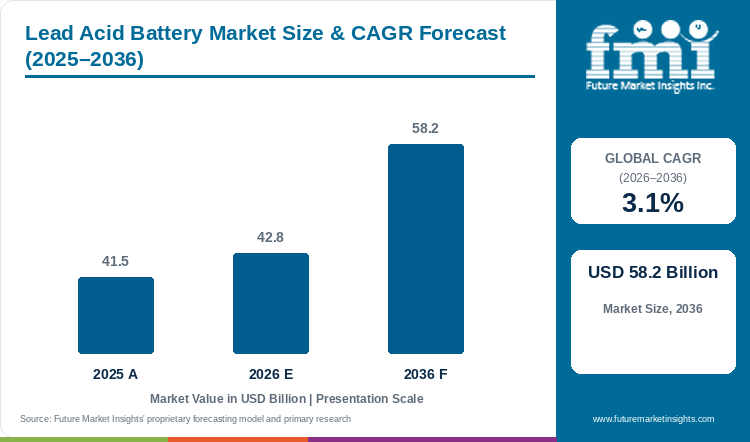
Demand is projected to expand at 3.1% CAGR from 2026 to 2036. Market value rises from USD 41.51 billion in 2025 to USD 42.8 billion in 2026 and USD 58.2 billion by 2036.
The global lead acid battery market, serving automotive, industrial, telecommunications, renewable-energy storage and backup-power applications, is estimated at USD 41.51 billion in 2025 and USD 42.8 billion in 2026. It is projected to reach USD 58.2 billion by 2036 at a CAGR of 3.1% from 2026 to 2036. Flooded cell batteries represent 45.0% of the 2026 product-type breakdown, while automotive applications account for 65.0% of the separate application breakdown. Demand combines recurring replacements for vehicles and equipment already in service with batteries specified for new equipment and planned standby installations.
The installed vehicle and equipment base supports replacement demand, while industrial and backup-power orders depend on the required charging, cycling and standby duties. Development continues within the chemistry: a March 2025 study examines strontium-enriched barite as a promoter of lead-sulfate nucleation. [1] End-of-life services also influence the market. EPA's July 2026 guidance identifies suitable collection routes. [2] USGS's April 2025 lead data release provides separate commodity-supply context for materials purchasing. [4] These developments link the product offer with its operating duty, service channel and spent-battery handling.
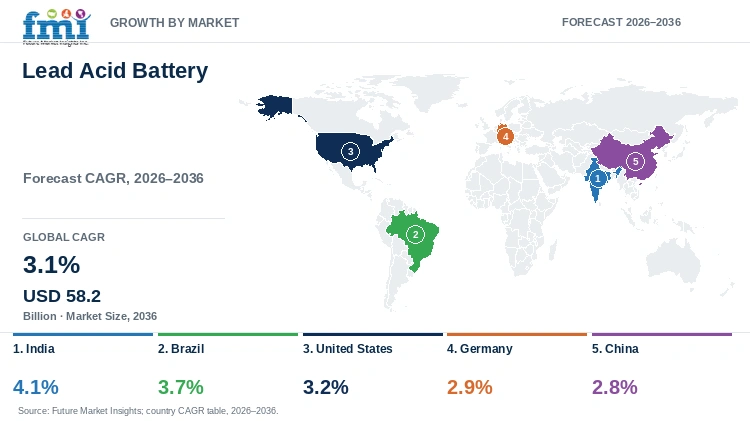
India has the highest profiled CAGR at 4.1%, followed by Brazil at 3.7%, for 2026 to 2036. Growth estimates for the United States, Germany and China are 3.2%, 2.9% and 2.8%, respectively, over the same period. These markets encompass both immediate replacement purchases and planned equipment installations, creating different requirements for availability, application guidance and support.
Clarios, East Penn Manufacturing, GS Yuasa Corporation, EnerSys and Exide Technologies are representative participants. Their covered product areas span automotive, industrial and standby batteries, with competition shaped by the customer's application and route to purchase. Vehicle replacements place weight on fit information and prompt availability; industrial and standby installations require defined charging and maintenance arrangements. Application-specific products, dependable replacement support and coordinated spent-unit collection allow suppliers to compete across the battery's service life.
Key Market Trends & Insights
- Replacement and backup-power purchases follow different duties, even when they use the same broad chemistry.
- A March 2025 study investigates how strontium-enriched barite changes lead-sulfate nucleation, a materials-research result rather than a commercial lifetime guarantee. [1]
Regional Highlights
- India has the highest profiled CAGR at 4.1%, followed by Brazil at 3.7%, for 2026 to 2036.
- The USA, Germany and China are profiled at 3.2%, 2.9% and 2.8% respectively for the same period.
- USGS's April 2025 lead data release supplies commodity context; it is separate from a battery-market demand forecast. [4]
Market Size & Forecast
Table 1: Market Size and Forecast for Lead Acid Battery Market (USD billion and percentage), 2025 to 2036
| Metric | Value |
|---|---|
| 2025 market value | USD 41.51 billion |
| 2026 market value | USD 42.8 billion |
| 2036 market value | USD 58.2 billion |
| CAGR 2026 to 2036 | 3.1% |
| Revenue increase 2026 to 2036 | USD 15.4 billion |
| Market expansion 2026 to 2036 | 1.36 times |
Orders come through vehicle manufacturing and replacement channels as well as equipment and backup-power projects. The customer choosing a replacement usually starts with an installed battery specification and a service deadline. A project buyer can assess the battery within a wider power system, including charging, operating conditions and access for maintenance. These differences affect the route to market and the support required after delivery. Suppliers can make the commercial proposition clearer by matching the proposed battery with the intended duty and explaining the service and collection arrangements included in the price.
Charging is part of the battery's operating system. The Industrial Battery Chargers Market provides adjacent coverage of the equipment used to support industrial battery duties.
The purchase combines battery duty, service access and end-of-life arrangements
Lead acid batteries serve several operating roles, so a useful demand assessment needs to separate starting, cycling and standby requirements. A customer also needs to consider the practical service conditions around the battery. How it is charged, accessed and replaced can influence the economics of the installation. Public research provides context on continuing materials development, while government guidance describes specific end-of-life considerations. These sources address different parts of the product lifecycle and should not be converted into a common performance or recycling claim for every battery in the market.
Table 2: Industry evidence relevant to the lead acid battery market
| Indicator | Data point or observation | Market relevance | Source |
|---|---|---|---|
| Materials research | A March 2025 paper studied strontium-enriched barite as a nucleation promoter. | Technical development continues within the established chemistry. | [1] |
| US collection guidance | EPA's battery guidance was updated in July 2026. | Customers need a suitable route for the spent lead acid battery. | [2] |
| Commodity information | USGS's lead data release was updated in April 2025. | Lead supply statistics provide background to materials purchasing. | [4] |
Analyst Perspective
“Replacement demand gives the market recurring orders, but the customer still needs an application-specific product. A supplier can strengthen the offer by making battery duty, service support and spent-unit collection clear, so the buyer can compare a complete ownership proposition rather than a nominal capacity and invoice price.”
- Nikhil Kaitwade, Future Market Insights
A starting-battery purchase and a standby installation need different comparisons of duty, charging and service responsibilities.
How is the Lead Acid Battery Market segmented?
The market is segmented by Product Type, Application Type, and Region.
Product type and application describe different aspects of demand. The published taxonomy includes starting, lighting and ignition batteries, deep-cycle batteries, valve-regulated designs and flooded cells. These labels are commercially useful but should be interpreted with care because a function and a construction can describe the same battery. The two profiles below retain the source's published categories and separate percentage breakdowns. Automotive demand is classified by application, while flooded cells form a product category. Industrial, telecommunications, renewable-energy storage and uninterruptible-power applications are also included in the market coverage.
Why do flooded cell batteries lead the product-type breakdown?
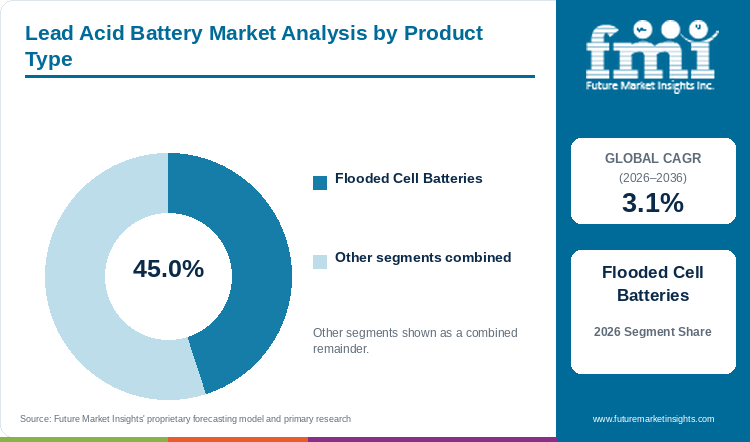
Table 3: Product Type Share for Lead Acid Battery Market (percentage share), 2026
| Product Type | Estimated share (2026) |
|---|---|
| Flooded Cell Batteries | 45.0% |
| Other product types | 55.0% |
| Total | 100.0% |
Table 4: Segment Position and Market Growth for Lead Acid Battery Market, 2026 to 2036
| Metric | Value |
|---|---|
| Global CAGR (2026 to 2036) | 3.1% |
| Profiled product type segment | Flooded Cell Batteries |
Flooded cell batteries hold an estimated 45.0% of the product-type breakdown in 2026. A customer assessing this category needs a product suited to the equipment and the service conditions, including the charging arrangement and access available for maintenance. Replacement orders can place particular weight on a clear match with the installed specification and prompt availability. A project order allows a wider assessment of the battery within the complete power arrangement. Suppliers can make both purchases easier to evaluate by stating the intended application and the support included with the product. The comparison also needs to distinguish battery construction from duty: the label alone does not establish whether a proposed unit is appropriate for starting, repeated cycling or standby use.
The Flooded Cell Batteries segment is estimated to account for 45.0% of product type demand in 2026.
- Flooded cell batteries represent 45.0% of the product-type breakdown in 2026; other types together represent 55.0%.
- Battery duty and the installation's service conditions remain central to selection.
What keeps automotive applications at the centre of demand?
Table 5: Application Type Share for Lead Acid Battery Market (percentage share), 2026
| Application Type | Estimated share (2026) |
|---|---|
| Automotive | 65.0% |
| Other application type segments | 35.0% |
| Total | 100.0% |
Automotive applications account for an estimated 65.0% of the application breakdown in 2026. The category combines batteries purchased for vehicles with replacements for the installed fleet. A replacement customer typically needs a suitable product within a short service window, making fit information, availability and the collection route relevant to the sale. EPA's guidance identifies lead acid batteries among automotive uses and directs consumers toward appropriate collection channels. [2] That end-of-life consideration forms part of the service surrounding the physical product. For suppliers, the commercial task is to maintain an application-specific range and a dependable route through the service channel, while distinguishing the requirements of vehicle starting from other battery duties covered elsewhere in the market.
The Automotive segment is estimated to account for 65.0% of application type demand in 2026.
- Automotive applications hold 65.0% of the application breakdown in 2026; other applications together hold 35.0%.
- Replacement availability and a suitable spent-battery collection route affect the customer offer.
- Storage customers compare several technologies and system configurations. The Stationary Battery Storage Market offers related demand coverage, separate from the lead acid chemistry forecast.
What are the drivers, restraints, and opportunities in the Lead Acid Battery Market?
Installed-base replacement supports demand; operating and service conditions limit interchangeability; application guidance and collection support can strengthen the offer.
Driver
The existing vehicle and equipment base creates recurring replacement needs, while new equipment adds demand for the batteries specified within it. Backup-power purchases bring a different set of customers, with the battery selected as part of an operating system rather than an isolated component. Both routes depend on the product meeting the required duty and being available when the customer needs it. EPA's guidance describes several lead acid battery uses, including automotive and backup applications. [2] Suppliers can address that demand through a clearly defined application range, useful fit information and a service network able to handle replacement enquiries and the spent battery.
Restraint
A nominal capacity and purchase price do not describe the full cost of a battery installation. The operating duty, charging arrangement, maintenance access and replacement process all affect the customer's decision. A buyer considering an alternative chemistry also has to assess the wider system rather than assume direct interchangeability. At end of life, handling requirements can add complexity. Suppliers need to make these conditions visible in the offer so the customer can assess the installation and service requirements alongside the product itself.
Opportunity
There is room to improve the ownership proposition around an established chemistry. Customers can benefit from clear application guidance, planned replacement support and coordinated collection of spent units. Materials research also continues: the March 2025 nucleation study investigates an approach to changing lead-sulfate growth behaviour. [1] Its commercial relevance is the continuing effort to address battery behaviour, while product-level performance still needs evidence under the intended duty. Suppliers can connect such development with a defined customer requirement and a practical support package, rather than asking a buyer to infer field life from a laboratory result.
Backup-power projects can involve batteries alongside other equipment. The Genset Market provides adjacent coverage of generating equipment with a different role in the installation.
Which country CAGRs are profiled in the Lead Acid Battery Market?
Table 6: Country CAGR Comparison for Lead Acid Battery Market (CAGR percentage), 2026 to 2036
| Country | CAGR |
|---|---|
| India | 4.1% |
| Brazil | 3.7% |
| United States | 3.2% |
| Germany | 2.9% |
| China | 2.8% |
Country-wise Analysis
India Lead Acid Battery Market Outlook (2026 to 2036)
India has the highest profiled growth estimate, at a CAGR of 4.1% for 2026 to 2036. Its battery demand covers automotive use and equipment applications with different purchasing cycles. A vehicle replacement enters a service channel and usually carries an immediate fit and availability requirement. A backup installation can instead be planned within a wider equipment project, where charging, operating duty and maintenance access need to be assessed together. Suppliers can make their offers more useful by distinguishing these customer situations and providing an appropriate route for later service. The national growth estimate describes the market as a whole; individual battery constructions and applications can face different operating conditions and competitive choices.
Brazil Lead Acid Battery Market Outlook (2026 to 2036)
A replacement buyer in Brazil begins with the requirements of the vehicle or equipment already in service. The proposed battery needs to match that application and be available through a workable support channel. Beyond individual replacements, equipment and backup-power projects can create orders with a longer planning period and a more detailed system specification. Suppliers need to account for both routes when assessing their range and service coverage. Clear product information helps the customer distinguish starting, cycling and standby duties, while a defined process for the spent unit makes the complete service proposition easier to compare alongside the initial purchase price.
United States Lead Acid Battery Market Outlook (2026 to 2036)
US buyers have access to EPA guidance describing lead acid battery applications and suitable routes for spent batteries. [2] That practical service context sits alongside a market forecast of 3.2% CAGR for 2026 to 2036. An automotive customer needs a battery appropriate to the vehicle and a dependable replacement route; an industrial or standby customer may place greater weight on the complete installation duty and service plan. Suppliers can make those distinctions clear in their product and support offer. The separate USGS lead data release provides commodity information rather than a measure of battery demand. [4] Customers assessing materials exposure or supply arrangements need to keep that background distinct from the battery-market forecast.
Germany Lead Acid Battery Market Outlook (2026 to 2036)
The German market combines established replacement demand with batteries purchased for equipment and backup applications. A buyer comparing options needs to consider the required duty and the surrounding charging and service arrangements, especially if the proposal changes an installed system. Product support can therefore be commercially relevant even where competing units have similar nominal ratings. Suppliers can provide a clearer comparison by stating the application, installation requirements and replacement arrangements included in the offer. For a fleet or multi-site customer, consistent product information and an organised service route also help keep individual purchases aligned with the wider maintenance programme.
China Lead Acid Battery Market Outlook (2026 to 2036)
A vehicle service order can require immediate replacement, while an equipment project may evaluate the battery as part of a broader power arrangement. These situations create different priorities for inventory, technical information and service support. Suppliers need to identify the operating duty before proposing a product, then explain the conditions under which it is intended to be used. A customer can use that information to compare the complete installation and replacement proposition. Materials research remains relevant to future product development, but an experimental result does not establish a common lifetime improvement across all batteries sold into the national market.
Who are the notable companies in the Lead Acid Battery Market?
Clarios; East Penn Manufacturing; GS Yuasa Corporation; EnerSys; Exide Technologies
Clarios, East Penn Manufacturing, GS Yuasa, EnerSys and Exide Technologies are representative participants identified in the market coverage. Their relevant product ranges address different customer duties, so a useful comparison begins with the application rather than the corporate portfolio. Automotive replacements, industrial batteries and standby systems can require different distribution and service arrangements. The table sets out assessment points for the purchaser. The customer still needs to review the exact product offered, its intended operating conditions and the support available through the proposed sales channel.
Competitive Benchmarking: Lead Acid Battery Market
Table 7: Competitive positioning for the lead acid battery market
| Company | Positioning | Buyer comparison focus |
|---|---|---|
| Clarios | Automotive batteries | Match the battery to the vehicle and replacement channel. |
| East Penn Manufacturing | Lead acid batteries for multiple duties | Review the intended duty and service arrangements. |
| GS Yuasa Corporation | Automotive and industrial batteries | Compare application scope, charging conditions and support. |
| EnerSys | Industrial and standby batteries | Define standby or cycling requirements and maintenance access. |
| Exide Technologies | Automotive and industrial batteries | Assess fit information, availability and collection arrangements. |
Key Developments in the Lead Acid Battery Market
- A March 2025 public research paper examined strontium-enriched barite for lead-sulfate nucleation. [1]
- EPA's household-battery guidance was updated in July 2026. [2]
Key Players in the Lead Acid Battery Market
Automotive batteries
- Clarios
Lead acid batteries for multiple duties
- East Penn Manufacturing
Automotive and industrial batteries
- GS Yuasa Corporation
- Exide Technologies
Industrial and standby batteries
- EnerSys
Lead Acid Battery Market Report Scope
Table 8: Report Scope for Lead Acid Battery Market, 2026 to 2036
| Coverage field | Report scope |
|---|---|
| Market definition | Lead acid batteries used in automotive, industrial, telecommunications, storage and backup-power applications. |
| Units | USD billion and percentage |
| 2025 reference | USD 41.51 billion, 2025 estimate |
| Forecast period | 2026 to 2036 |
| Market breakdown | Product Type; Application Type |
| Segment reference year | 2026 |
| Country profiles | India; Brazil; United States; Germany; China |
| Representative participants | Clarios; East Penn Manufacturing; GS Yuasa Corporation; EnerSys; Exide Technologies |
Lead Acid Battery Market Research Methodology
Table 9: Research Methodology for Lead Acid Battery Market, 2026 edition
| Method | Approach |
|---|---|
| Published market estimates | FMI supplies USD 42.8 billion for 2026, USD 58.2 billion for 2036 and a CAGR of 3.1%. |
| 2025 reference basis | The 2025 market estimate is USD 41.51 billion. |
| Segment shares | Flooded-cell and automotive shares describe separate 2026 breakdowns. |
| Country estimates | National CAGRs retain the published 2026 to 2036 period. |
| Public evidence | Dated research and government material supports the product and service discussion. |
| Company assessment | Representative participants are compared through application duty, availability and service scope. |
Lead Acid Battery Market by Segments
Lead Acid Battery Market segmented by Product Type:
- Starting, Lighting, Ignition (SLI) Batteries
- Deep Cycle Batteries
- Valve Regulated Lead Acid (VRLA) Batteries
- Flooded Cell Batteries
Lead Acid Battery Market segmented by Application Type:
- Automotive
- Industrial
- Telecommunications
- Renewable Energy Storage
- Uninterruptible Power Supply
Lead Acid Battery Market by Region
- North America
- United States
- Canada
- Mexico
- Latin America
- Brazil
- Argentina
- Western Europe
- Germany
- France
- United Kingdom
- Italy
- Spain
- Eastern Europe
- Poland
- Czech Republic
- Romania
- East Asia
- China
- Japan
- South Korea
- South Asia and Pacific
- India
- ASEAN
- Australia
- New Zealand
- Middle East and Africa
- Saudi Arabia
- United Arab Emirates
- South Africa
Research Sources and Bibliography
- [1] Pacific Northwest National Laboratory and University of Oregon; Campbell and colleagues; public PMC archive. 3 March 2025. Strontium-Enriched Barite for Enhanced PbSO4 Nucleation in Lead-Acid Batteries
- [2] US Environmental Protection Agency. Updated 21 July 2026. Used Household Batteries
- [4] US Geological Survey; Data.gov public catalog. Dataset updated 8 April 2025. Mineral Commodity Summaries 2025 - LEAD Data Release
This Report Answers
- How big is the lead acid battery market in 2026?
- What is the market forecast for 2036?
- Which product type leads the published 2026 breakdown?
- Which application has the largest 2026 share?
- Which country has the highest profiled CAGR?
- What is the basis of the 2025 reference value?
Frequently Asked Questions
What is the estimated market size in 2026?
The market is estimated at USD 42.8 billion in 2026.
What is the market forecast for 2036?
FMI projects USD 58.2 billion by 2036, with a CAGR of 3.1% from 2026 to 2036.
Which product type leads the published 2026 breakdown?
Flooded cell batteries account for 45.0% of the product-type breakdown in 2026.
Which application has the largest 2026 share?
Automotive applications represent 65.0% of the application breakdown in 2026.
Which country has the highest profiled CAGR?
India leads these five profiles at 4.1%, followed by Brazil at 3.7%, for 2026 to 2036.
What is the basis of the 2025 reference value?
The 2025 market estimate is USD 41.51 billion.
Preview the report firsthand - request a free sample
Get SampleGet the brochure for pricing and purchase details.
Get PDFTable of Content
- Key Takeaways
- Market Size and CAGR
- Top Growth Driver
- Fastest Growing Segment
- Leading Region
- Key Companies
- Emerging Opportunities
- Executive Summary
- Global Market Outlook
- Demand-side Trends
- Supply-side Trends
- Technology Roadmap Analysis
- Analysis and Recommendations
- Analyst Perspective (What is happening? Why now? What should investors know?)
- Key Questions Answered
- How large is the market?
- What is the CAGR?
- What are key trends?
- Which region dominates?
- Who are the leaders?
- Market Overview
- Market Coverage / Taxonomy
- Market Definition / Scope / Limitations
- Research Methodology
- Chapter Orientation
- Analytical Lens and Working Hypotheses
- Market Structure, Signals, and Trend Drivers
- Benchmarking and Cross-market Comparability
- Market Sizing, Forecasting, and Opportunity Mapping
- Research Design and Evidence Framework
- Desk Research Programme (Secondary Evidence)
- Expert Input and Fieldwork (Primary Evidence)
- Tooling, Models, and Reference Databases
- Data Engineering and Model Build
- Quality Assurance and Audit Trail
- Market Background
- Market Dynamics (Drivers, Restraints, Opportunity, Trends)
- Scenario Forecast (Optimistic, Likely, Conservative)
- Impact Analysis
- AI Impact
- Sustainability Impact
- Regulatory Impact
- Technology Impact
- Consumer / Buyer Analysis
- Purchase Drivers
- Adoption Barriers
- Buyer Journey
- Opportunity Map Analysis
- Product Life Cycle Analysis
- Supply Chain Analysis
- Investment Feasibility Matrix
- Value Chain Analysis
- PESTLE and Porter's Analysis
- Regulatory Landscape
- Regional Parent Market Outlook
- Production and Consumption Statistics
- Import and Export Statistics
- Global Market Analysis and Forecast, 2021 to 2036
- Historical Market Size Value (USD Billion) Analysis, 2021 to 2025
- Current and Future Market Size Value (USD Billion) Projections, 2026 to 2036
- Y-o-Y Growth Trend Analysis
- Absolute $ Opportunity Analysis
- Global Market Pricing Analysis, 2021 to 2036
- Global Market Analysis and Forecast, By Product Type, 2021 to 2036
- Introduction / Key Findings
- Historical Market Size Value (USD Billion) Analysis By Product Type, 2021 to 2025
- Current and Future Market Size Value (USD Billion) Analysis and Forecast By Product Type, 2026 to 2036
- Starting, Lighting, Ignition (SLI) Batteries
- Deep Cycle Batteries
- Valve Regulated Lead Acid (VRLA) Batteries
- Flooded Cell Batteries
- Y-o-Y Growth Trend Analysis By Product Type, 2021 to 2025
- Absolute $ Opportunity Analysis By Product Type, 2026 to 2036
- Global Market Analysis and Forecast, By Application Type, 2021 to 2036
- Introduction / Key Findings
- Historical Market Size Value (USD Billion) Analysis By Application Type, 2021 to 2025
- Current and Future Market Size Value (USD Billion) Analysis and Forecast By Application Type, 2026 to 2036
- Automotive
- Industrial
- Telecommunications
- Renewable Energy Storage
- Uninterruptible Power Supply
- Y-o-Y Growth Trend Analysis By Application Type, 2021 to 2025
- Absolute $ Opportunity Analysis By Application Type, 2026 to 2036
- Global Market Analysis and Forecast, By Region, 2021 to 2036
- Introduction
- Historical Market Size Value (USD Billion) Analysis By Region, 2021 to 2025
- Current Market Size Value (USD Billion) Analysis and Forecast By Region, 2026 to 2036
- North America
- Latin America
- Western Europe
- Eastern Europe
- East Asia
- South Asia and Pacific
- Middle East and Africa
- Market Attractiveness Analysis By Region
- North America Market Analysis and Forecast, By Country, 2021 to 2036
- Historical Market Size Value (USD Billion) Trend Analysis By Market Taxonomy, 2021 to 2025
- Market Size Value (USD Billion) Forecast By Market Taxonomy, 2026 to 2036
- By Country
- United States
- Canada
- Mexico
- By Product Type
- By Application Type
- By Country
- Market Attractiveness Analysis
- By Country
- By Product Type
- By Application Type
- Key Takeaways
- Latin America Market Analysis and Forecast, By Country
- Historical Market Size Value (USD Billion) Trend Analysis By Market Taxonomy, 2021 to 2025
- Market Size Value (USD Billion) Forecast By Market Taxonomy, 2026 to 2036
- By Country
- Brazil
- Argentina
- By Product Type
- By Application Type
- By Country
- Market Attractiveness Analysis
- By Country
- By Product Type
- By Application Type
- Key Takeaways
- Western Europe Market Analysis and Forecast, By Country
- Historical Market Size Value (USD Billion) Trend Analysis By Market Taxonomy, 2021 to 2025
- Market Size Value (USD Billion) Forecast By Market Taxonomy, 2026 to 2036
- By Country
- Germany
- France
- United Kingdom
- Italy
- Spain
- By Product Type
- By Application Type
- By Country
- Market Attractiveness Analysis
- By Country
- By Product Type
- By Application Type
- Key Takeaways
- Eastern Europe Market Analysis and Forecast, By Country
- Historical Market Size Value (USD Billion) Trend Analysis By Market Taxonomy, 2021 to 2025
- Market Size Value (USD Billion) Forecast By Market Taxonomy, 2026 to 2036
- By Country
- Poland
- Czech Republic
- Romania
- By Product Type
- By Application Type
- By Country
- Market Attractiveness Analysis
- By Country
- By Product Type
- By Application Type
- Key Takeaways
- East Asia Market Analysis and Forecast, By Country
- Historical Market Size Value (USD Billion) Trend Analysis By Market Taxonomy, 2021 to 2025
- Market Size Value (USD Billion) Forecast By Market Taxonomy, 2026 to 2036
- By Country
- China
- Japan
- South Korea
- By Product Type
- By Application Type
- By Country
- Market Attractiveness Analysis
- By Country
- By Product Type
- By Application Type
- Key Takeaways
- South Asia and Pacific Market Analysis and Forecast, By Country
- Historical Market Size Value (USD Billion) Trend Analysis By Market Taxonomy, 2021 to 2025
- Market Size Value (USD Billion) Forecast By Market Taxonomy, 2026 to 2036
- By Country
- India
- ASEAN
- Australia
- New Zealand
- By Product Type
- By Application Type
- By Country
- Market Attractiveness Analysis
- By Country
- By Product Type
- By Application Type
- Key Takeaways
- Middle East and Africa Market Analysis and Forecast, By Country
- Historical Market Size Value (USD Billion) Trend Analysis By Market Taxonomy, 2021 to 2025
- Market Size Value (USD Billion) Forecast By Market Taxonomy, 2026 to 2036
- By Country
- Saudi Arabia
- United Arab Emirates
- South Africa
- By Product Type
- By Application Type
- By Country
- Market Attractiveness Analysis
- By Country
- By Product Type
- By Application Type
- Key Takeaways
- Key Countries Market Analysis
- United States
- Pricing Analysis
- Market Share Analysis, 2025
- By Product Type
- By Application Type
- Canada
- Pricing Analysis
- Market Share Analysis, 2025
- By Product Type
- By Application Type
- Mexico
- Pricing Analysis
- Market Share Analysis, 2025
- By Product Type
- By Application Type
- Brazil
- Pricing Analysis
- Market Share Analysis, 2025
- By Product Type
- By Application Type
- Germany
- Pricing Analysis
- Market Share Analysis, 2025
- By Product Type
- By Application Type
- United Kingdom
- Pricing Analysis
- Market Share Analysis, 2025
- By Product Type
- By Application Type
- Italy
- Pricing Analysis
- Market Share Analysis, 2025
- By Product Type
- By Application Type
- Spain
- Pricing Analysis
- Market Share Analysis, 2025
- By Product Type
- By Application Type
- France
- Pricing Analysis
- Market Share Analysis, 2025
- By Product Type
- By Application Type
- India
- Pricing Analysis
- Market Share Analysis, 2025
- By Product Type
- By Application Type
- ASEAN
- Pricing Analysis
- Market Share Analysis, 2025
- By Product Type
- By Application Type
- China
- Pricing Analysis
- Market Share Analysis, 2025
- By Product Type
- By Application Type
- Japan
- Pricing Analysis
- Market Share Analysis, 2025
- By Product Type
- By Application Type
- South Korea
- Pricing Analysis
- Market Share Analysis, 2025
- By Product Type
- By Application Type
- Poland
- Pricing Analysis
- Market Share Analysis, 2025
- By Product Type
- By Application Type
- South Africa
- Pricing Analysis
- Market Share Analysis, 2025
- By Product Type
- By Application Type
- United States
- Market Structure Analysis
- Competition Dashboard
- Competition Benchmarking
- Market Share Analysis of Top Players
- By Regional
- By Product Type
- By Application Type
- Emerging Startups
- Innovation Benchmarking
- Competition Analysis
- Competition Deep Dive
- Clarios
- Overview
- Product Portfolio
- Profitability by Market Segments
- Sales Footprint
- Strategy Overview
- Marketing Strategy
- Product Strategy
- Channel Strategy
- East Penn Manufacturing
- GS Yuasa Corporation
- EnerSys
- Exide Technologies
- Clarios
- Case Studies
- Success Stories
- Recent Developments
- Competition Deep Dive
- Assumptions & Acronyms Used


