

- Market Size (2026)
- USD 8.84 Bn
- Forecast (2036)
- USD 15.84 Bn
- CAGR (2026 to 2036)
- 6.0%
Luxury Rigid Box Market Size, Market Forecast and Outlook By FMI
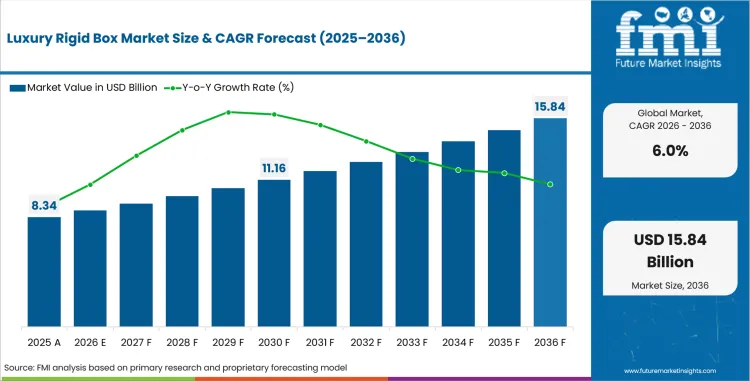
Luxury rigid box market was valued at USD 8.34 billion in 2025 and is expected to reach USD 8.84 billion in 2026. Revenue is forecast to rise to USD 15.84 billion by 2036 at 6.0% CAGR during the forecast period. Paperboard is anticipated to hold 58.0% of product type demand in 2026. Cosmetics and personal care is expected to account for 37.0% of application demand in 2026.
Key Takeaways, Market Size, and Forecast
| Metric | Value |
|---|---|
| Market Size (2025) | USD 8.34 Billion |
| Market Size (2036) | USD 15.84 Billion |
| CAGR | 6.0% |
| Incremental Opportunity (2026–2036) | USD 7.00 Billion |
| Leading Product Type (2026) | Paperboard |
| Paperboard Share (2026) | 58.0% |
| Leading Application (2026) | Cosmetics And Personal Care |
| Cosmetics And Personal Care Share (2026) | 37.0% |
| Leading Sales Channel (2026) | Direct Brand Contracts |
| Direct Brand Contracts Share (2026) | 52.0% |
| Fastest-Growing Country | China |
| China CAGR | 7.2% |
| 2nd Fastest-Growing Country | India |
| India CAGR | 6.8% |
Summary of the Luxury Rigid Box Market
- Demand and Growth Drivers
- Premium beauty and fragrance brands use rigid boxes to protect products and improve the first-use moment.
- Luxury e-commerce is expected to raise pressure on box strength since packaging must survive shipping and still look gift ready.
- Recycling rules are projected to push suppliers toward certified paperboard and simpler finishes that do not block recovery.
- Product and Segment View
- Paperboard is anticipated to lead product type demand because it accepts wrap papers and decorative finishes well.
- Lid and base boxes are likely to remain common since the format is easy to specify for gift sets and fragrance kits.
- Magnetic closures are forecast to gain use where brands want a premium opening feel and repeat handling after purchase.
- Geography and Competitive Outlook
- China and India are expected to show faster expansion as premium beauty retail and gifting channels move into more cities.
- France and Italy are projected to add design depth through luxury houses and specialist packaging converters.
- Suppliers with design support and certified fiber access are likely to be better placed with beauty and watch brands.
- Analyst Opinion
- Nandini Roy Choudhury, Principal Consultant at FMI says, “I see luxury rigid boxes becoming less about decoration alone and more about disciplined brand protection. A beauty house wants a box that looks premium on a shelf. The same box must pass shipping checks and recycling review. Suppliers that combine hand-finish skill with cleaner material choices are expected to win more repeat work.”
- Luxury Rigid Box Market Value Analysis
- Presentation-led box design is expected to raise unit value as beauty and jewelry launches use packaging as part of the product experience.
- Wrapped board and controlled opening details are projected to lift per-unit value where brands pay for tactile handling.
- Luxury e-commerce is anticipated to widen the buyer base as direct delivery makes protective presentation boxes more useful.
- Hand assembly cost is expected to constrain adoption when seasonal launches need short runs and faster redesigns.
- FMI opines that certified paperboard is likely to reduce audit friction when brands need clearer retailer packaging records.
Luxury brands are asking box suppliers to prove presentation quality and material traceability at the same time. The European Commission states that packaging rules aim to make all packaging on the European Union market recyclable in an economically viable way by 2030. Eurostat reported 79.7 million tonnes of packaging waste in the European Union in 2023. Paper and cardboard made up 32.3 million tonnes of that total. Paperboard selection is therefore more important for premium boxes where a rigid feel must work with recycling rules. Smurfit Westrock completed its New York and London debut in July 2024 after the Smurfit Kappa and WestRock combination. The event shows how large paper packaging groups are building scale around brand packaging and retail presentation.
Luxury Rigid Box Market Definition
The luxury rigid box market covers premium box packaging made from heavyweight board or specialty substrates. The box is wrapped and finished to protect high-value goods and present them as gifts. It is used for cosmetics and personal care. It is also used for jewelry and watches. The scope covers commercial boxes supplied to brands where box feel and finish are part of the product experience.
Luxury Rigid Box Market Inclusions
Market inclusions cover paperboard and corrugated board luxury rigid boxes. Specialty materials are included when they form the main box structure or outer wrap. Application coverage includes cosmetics and personal care and jewelry and watches. Electronics and technology are included when the product uses a premium rigid box for retail or direct delivery. Fashion and apparel and food and beverage gifting are included when a box is sold as branded premium packaging. Box formats include lid and base and drawer styles. Magnetic closure and book style formats are included. Decoration coverage includes foil stamping and embossing. Soft touch finishes and printed wraps are included where they are part of the finished rigid box.
Luxury Rigid Box Market Exclusions
Scope excludes standard folding cartons and corrugated shipping boxes sold as ordinary transport packs. Flexible packaging and shopping bags are outside the defined boundary. Loose tissue paper and point-of-sale displays are excluded unless supplied as part of a finished luxury rigid box program. Plastic inserts sold separately are outside scope. Wooden keepsake boxes are included only when sold through the same premium packaging contract.
Luxury Rigid Box Market Research Methodology
- Primary Research: Direct interviews with packaging manufacturers, brand owners, and distributors to understand product demand, design trends, and usage across key end-use industries.
- Secondary Research: Review of industry reports, company publications, trade data, and regulatory sources to analyze market trends, sustainability developments, and competitive landscape.
- Market Sizing and Forecasting: Estimation based on historical data, current market trends, and demand analysis across product types and applications, using top-down and bottom-up approaches.
- Data Validation: Cross-verification of data through triangulation of primary insights, secondary sources, and analysis of company activities across the luxury packaging value chain.
Why is the Luxury Rigid Box Market Growing?
- Premium brands use rigid boxes to protect price position when consumers compare presentation quality closely.
- Direct delivery makes box strength more important as the pack must travel without losing shelf appearance.
- Recycling rules are pushing suppliers to reduce mixed materials and offer simpler fiber-based box designs.
- Beauty and fragrance launches use gift sets where the outer box becomes part of the product story.
Luxury rigid box formats are gaining attention as brands face a tougher balance between presentation and proof. The European Commission states that packaging rules aim to make all packaging recyclable in an economically viable way by 2030. Policy pressure gives paperboard boxes an advantage when a brand wants a rigid feel and a clearer recovery route. Standard rigid boxes help brands protect heavier gift packs during delivery. Rigid box formats benefit from the same shift where luxury packaging formats must work for retail shelves and direct delivery. Suppliers that can explain material origin and finishing limits are expected to have better access to brand briefs.
E-commerce is changing how a premium pack is judged after purchase. The United States Census Bureau reported first quarter 2026 e-commerce sales of USD 302.3 billion on a not adjusted basis. E-commerce accounted for 16.8% of total retail sales in the same quarter. The channel share is relevant because a box now has to protect the product before it creates the unboxing moment. Luxury packaging formats are therefore specified with firmer board and fewer fragile decorative parts. The structure is expected to remain useful after shipping and reduce replacement claims for brand owners.
Market Segmentation Analysis
- Paperboard is anticipated to account for 58.0% of product type demand in 2026 as wrapped board supports print and finish control.
- Cosmetics and personal care applications are anticipated to represent 37.0% of demand in 2026 where gift sets and fragrance launches need premium presentation.
- Lid and base formats are forecast to hold 34.0% of box format demand in 2026 as the design suits repeat gifting programs.
- Magnetic closures are likely to capture 29.0% of closure demand in 2026 since opening feel affects premium perception.
- Foil stamping is projected to account for 31.0% of decoration demand in 2026 as brands use controlled shine for logos.
- Direct brand contracts are forecast to hold 52.0% of sales channel demand in 2026 as custom boxes need close design approval.
The market is divided into six primary segment groups based on product type and application. Box format and closure type complete the physical specification. Decoration and sales channel describe how brands finish and buy the box. Product type covers paperboard and corrugated board. Specialty materials complete the group. Application covers cosmetics and personal care. Jewelry and watches are included. Electronics and technology complete the high-value goods scope. Sales channel covers direct brand contracts and distributor supply. Design agencies and online suppliers complete the route to market. The segmentation connects luxury packaging formats with how buyers actually brief and approve boxes.
Insights into Luxury Rigid Box Market by Product Type
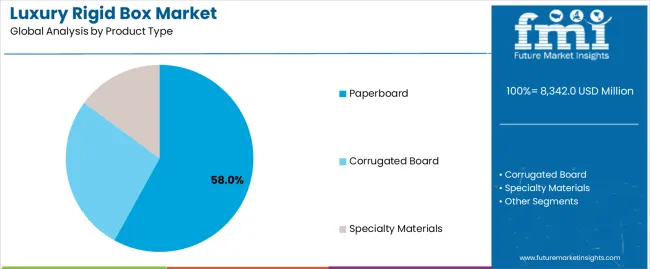
- With an estimated 58.0% share of product type demand in 2026, paperboard is anticipated to lead because wrapped board supports smooth print surfaces and firm box walls.
- Specialty materials support limited launches when texture and weight are part of the purchase cue. The paperboard packaging field is important here because board grade affects finish and box feel.
Insights into Luxury Rigid Box Market by Box Format
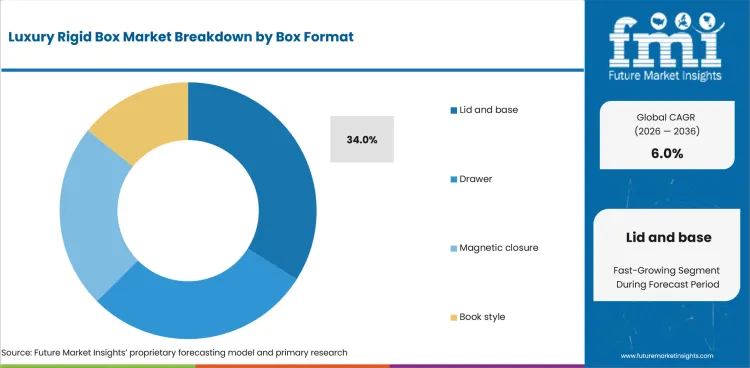
- Lid and base formats are forecast to hold 34.0% share in 2026 since fragrance sets and gift packs use the structure repeatedly.
- Drawer and book style designs serve buyers that want a slower opening moment. Rigid sleeve boxes connect closely with that logic as sliding structures support premium reveals.
Insights into Luxury Rigid Box Market by Application
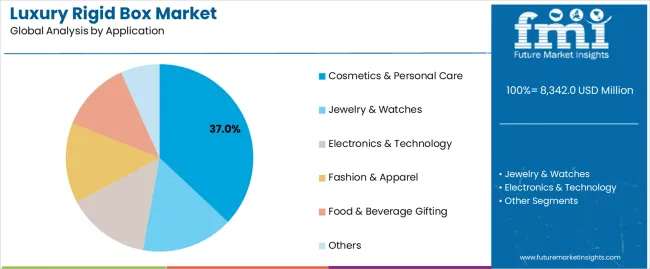
- Gift-set launch planning is expected to push cosmetics and personal care to 37.0% of application demand in 2026.
- Jewelry and watches use smaller runs where hand finishing matters. The paper and paperboard packaging field supports the same need for printable and fold-resistant board.
Insights into Luxury Rigid Box Market by Closure Type
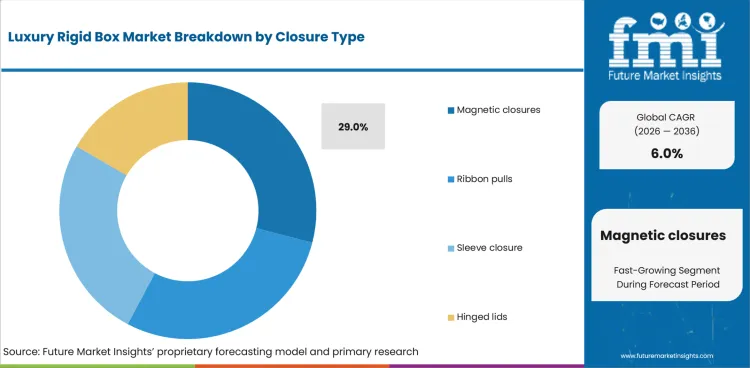
- Magnetic formats are likely to hold a 29.0% closure share in 2026 as repeat opening and controlled closing improve product handling.
- Ribbon pulls and hinged lids serve boxes where buyers want a softer gift opening. Closure choice affects assembly time and unit cost.
Insights into Luxury Rigid Box Market by Decoration
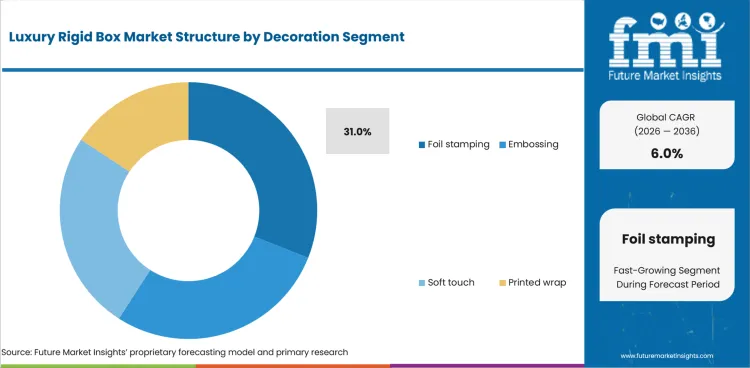
- Logo contrast needs are projected to push foil stamping to 31.0% of decoration demand in 2026.
- Embossing and soft touch finishes serve beauty brands that want a tactile surface. The folding boxboard is gaining momentum as board stiffness controls finish quality.
Insights into Luxury Rigid Box Market by Sales Channel
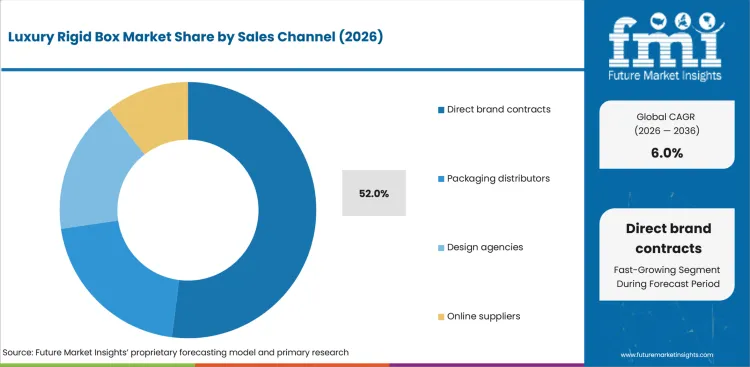
- Direct brand contracts are estimated to account for 52.0% of sales channel value in 2026 because custom boxes need close design approval.
- Distributors and design agencies remain useful for smaller launches. The paper packaging field connects here as sourcing teams compare fiber-based formats across budgets.
Luxury Rigid Box Market Drivers, Restraints, and Opportunities
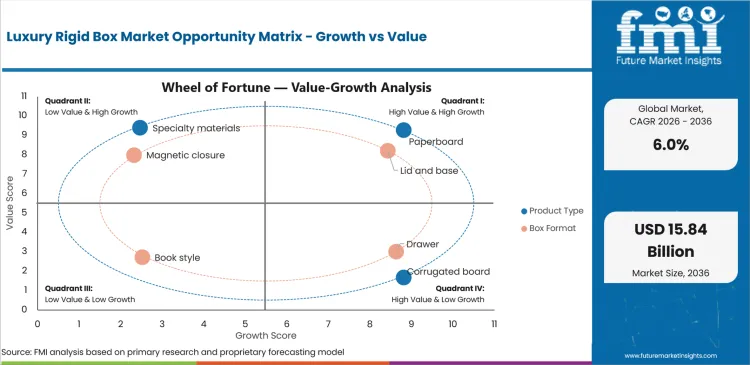
- Brand launch cycles are expected to support box programs where packaging must signal product value before first use.
- Hand assembly cost can slow adoption for smaller brands that cannot commit to larger runs.
- Certified paperboard is likely to create opportunity as brands need cleaner material records for retailer review.
Beauty Gift Sets Raise Box Content
Beauty brands are using rigid boxes to turn seasonal launches into giftable products. Coty reported in August 2024 that FY24 net revenue grew 10.0%. Rigid boxes are relevant because fragrance and skincare sets often need trays and wrapped outer shells. Packaging waste recycling rules further support demand since mixed-material packs are harder to explain to retailers. Suppliers that can simplify the box without removing the premium opening moment are expected to gain more brand trials.
Assembly Cost Limits Short Runs
Luxury rigid boxes still depend on more manual work than folding cartons. That makes small launch runs costly when a brand needs samples and fast redesigns. CEPI reported in February 2026 that European paper and board production decreased by 1.5% in 2025. Input pressure can therefore move into board pricing and finishing schedules. Buyers are expected to keep testing digital folding cartons for lower-cost trials before committing to rigid boxes for hero products.
Certified Fiber Opens Upgrade Routes
Premium brands are asking suppliers to document fiber origin and finishing choices before box approval. AF&PA reported a 13.5% increase in net containers entering the United States in 2024. More imported paper-based packaging raised the amount available for recycling. The signal supports certified fiber and clearer recovery claims in luxury programs. Paperboard suppliers with documented chains are likely to serve brands that want premium appearance and fewer audit questions.
Analysis of Luxury Rigid Box Market by Key Countries
.webp "Top Country Growth Comparison Luxury Rigid Box Market Cagr (2026 2036)")
| Country | CAGR |
|---|---|
| China | 7.2% |
| India | 6.8% |
| United States | 6.5% |
| France | 5.7% |
| Italy | 5.6% |
| Japan | 5.3% |
| Germany | 5.1% |
Source: Future Market Insights.
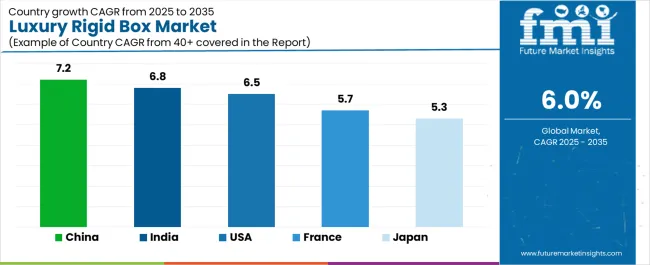
Luxury Rigid Box Market CAGR Analysis by Country
- China is expected to record 7.2% CAGR by 2036 as online premium retail keeps box presentation important.
- India is forecast to expand at 6.8% CAGR through 2036 as gifting and beauty retail widen.
- The United States is projected to rise at 6.5% CAGR by 2036 since direct delivery keeps box protection relevant.
- France is likely to advance at 5.7% CAGR through 2036 as heritage beauty and fragrance houses keep design standards high.
- Italy is forecast at 5.6% CAGR through 2036 where cosmetics exports and premium design work support box demand.
- Japan is estimated to post 5.3% CAGR by 2036 as gift culture and beauty quality checks support precision boxes.
- Germany is projected to record 5.1% CAGR by 2036 reflecting packaging compliance and paper recovery demands.
Demand Outlook for Luxury Rigid Box Market in China
China has a large online retail base that makes premium delivery packaging more visible. China is projected to record 7.2% CAGR through 2036 as online physical goods sales keep luxury products moving through direct channels. The National Bureau of Statistics of China reported online retail sales of physical goods at 13,092.3 billion yuan in 2025. That scale gives beauty and gifting brands a reason to specify boxes that protect products and photograph well after delivery. Suppliers with local finishing capacity are likely to be better placed when brands need faster redesigns.
- Domestic beauty brands use rigid boxes to raise perceived value in online gift sets.
- Luxury retailers need packs that protect corners during courier handling.
- Local converters benefit when international brands want shorter lead times.
Demand Outlook for Luxury Rigid Box Market in India
Premium gifting is a practical entry route for rigid boxes in India. India is expected to expand at 6.8% CAGR through 2036 as e-retail and beauty channels reach more cities. Invest India states that online sales across major non-grocery retail categories are targeted to reach 25% by 2026. The target matters because fragrance and skincare gift boxes can travel beyond metro stores. Box suppliers are likely to win when they offer smaller runs with reliable finish control.
- Wedding and festival gifting support decorated boxes for beauty and watches.
- Brand owners compare unit cost closely before moving from folding cartons.
- Converters that provide sampling support can win early premium launches.
Sales Analysis of Luxury Rigid Box Market in the United States
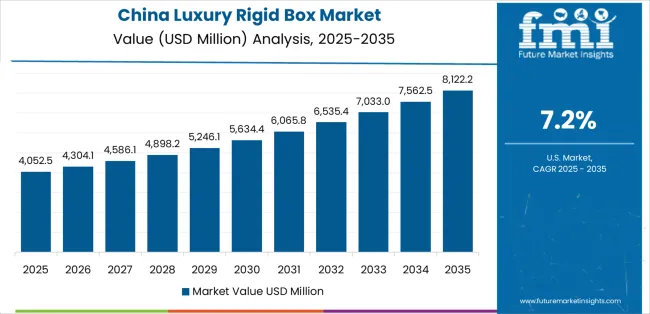
American buyers often specify boxes around e-commerce protection first and shelf appeal second. The United States is forecast to grow at 6.5% CAGR through 2036 as direct delivery keeps the outer pack visible to consumers. The United States Census Bureau reported first quarter 2026 e-commerce sales of USD 302.3 billion on a not adjusted basis. The channel makes rigid box structure more important for premium beauty and electronics. Suppliers with drop-test knowledge are expected to reduce damage claims for brands.
- Beauty gift sets need boxes that survive fulfillment handling.
- Premium electronics use rigid packs where accessories need fixed placement.
- Domestic design teams help brands approve prototypes with fewer revisions.
Opportunity Analysis of Luxury Rigid Box Market in France
French luxury houses protect brand codes through strict packaging approvals. France is expected to advance at 5.7% CAGR through 2036 as fragrance and fashion brands keep presentation standards high. European Union packaging rules create a compliance layer for paperboard and decoration choices. That condition favors converters able to pair luxury finish with recyclability records. Country demand stays below China and India but remains important for supplier credibility with global maisons.
- Perfume houses use rigid boxes for gift sets and limited editions.
- Design approval cycles favor suppliers with finishing proof and color control.
- Certified paperboard helps brands meet retailer and regulatory review.
Sales Analysis of Luxury Rigid Box Market in Italy
Italy links luxury packaging demand to cosmetics exports and premium design work. Italy is projected to rise at 5.6% CAGR through 2036 as beauty exporters keep asking for polished presentation formats. OpportunItaly reported that cosmetics exports reached EUR 8.6 billion in 2025. Exports increased 4.1% in the same year. Export-led beauty sales make rigid boxes relevant for fragrance and skincare kits. Local suppliers are likely to compete where brands want design work close to production.
- Cosmetics exporters need boxes that carry Italian brand cues.
- Shorter local approval loops support seasonal product launches.
- Premium confectionery adds demand during gifting periods.
Future Outlook for Luxury Rigid Box Market in Japan
Japanese buyers place high value on neat opening and exact box fit. Japan is expected to post 5.3% CAGR through 2036 as gift culture keeps premium packaging part of product quality. The Japan Cosmetic Industry Association tracks cosmetic shipment and export data from official ministries. The reporting base matters because beauty brands often specify packaging with strict tolerances. Suppliers that can hold small visual details are expected to retain premium work.
- Beauty packaging often requires exact fit and clean edge finishing.
- Gift culture supports lid and base boxes for seasonal packs.
- Small production runs need disciplined quality checks before launch.
Future Outlook for Luxury Rigid Box Market in Germany
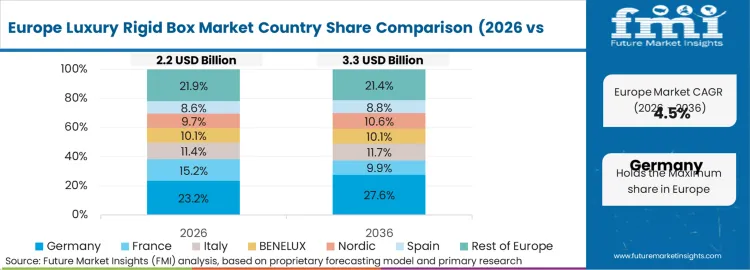
Germany’s packaging buyers work inside a tighter waste and recycling framework. Germany is forecast at 5.1% CAGR through 2036 as compliance review affects material choices for premium boxes. The European Commission states that EU packaging rules aim to make all packaging recyclable in an economically viable way by 2030. That policy direction explains why fiber packaging is expected to remain central to premium box decisions.
- Retailers require clearer packaging records before listing premium goods.
- Paperboard recovery systems support fiber-based rigid box decisions.
- Decoration choices are limited when finishes reduce recyclability.
Competitive Landscape and Strategic Positioning
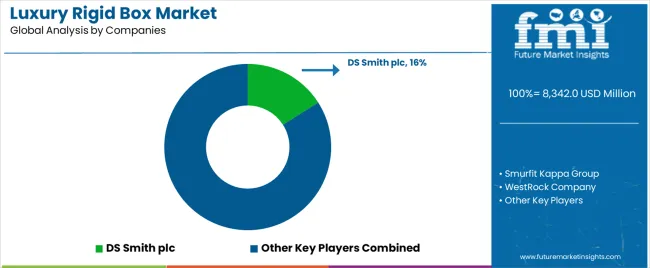
- Competition is expected to center on board sourcing and finish control instead of box supply alone.
- Brand owners are likely to shortlist suppliers that can move from design sketch to tested sample quickly.
- Large packaging groups are expected to gain from procurement reach and certified paperboard access.
- Specialist converters are projected to hold ground where hand finishing and luxury design review matter.
- Entry barriers include tooling cost and strict approval cycles for color and texture.
Large paper packaging groups are using scale to serve brand owners that want certified materials and steady supply. Smurfit Westrock began trading in New York and London in July 2024 after the Smurfit Kappa and WestRock combination. International Paper received European Commission approval in January 2025 for its acquisition of DS Smith. The moves extend beyond corrugated capacity. They show how suppliers want deeper access to paperboard packaging and premium brand accounts.
Specialist suppliers compete by solving the details that larger plants may not handle as closely. Knoll introduced an Ecoform molded pulp ornament in January 2024 as part of its luxury packaging work. Metsä Board introduced FastTrack Service in March 2026 for folding boxboard sheets in Europe. These examples show how material access and design speed are becoming procurement criteria. Digital folding cartons remain a useful comparison when brands test lower-cost launch packs before choosing rigid boxes.
Key Companies in the Luxury Rigid Box Market
The supplier base combines global paper packaging groups and specialist luxury converters with design-led production strengths.
- Global Leaders: DS Smith plc and Smurfit Westrock plc serve paper-based packaging programs where brands need board supply and wide manufacturing reach.
- Specialist Luxury Converters: Pusterla 1880 S.p.A. and Knoll Printing & Packaging Inc. focus on premium presentation work for beauty and high-value consumer goods.
- Regional and Format Specialists: Sonoco Products Company and Bell Incorporated serve packaging programs that need controlled rigid structures and retail presentation.
Competitive Benchmarking: Luxury Rigid Box Market
| Company | Design-to-sample speed | Certified board access | Hand-finish control | Geographic Footprint |
|---|---|---|---|---|
| DS Smith plc | High | High | Medium | Europe and North America |
| Smurfit Westrock plc | High | High | Medium | Global |
| International Paper Company | Medium | High | Medium | North America and Europe |
| Mondi plc | Medium | High | Medium | Europe centered |
| Sonoco Products Company | Medium | Medium | Medium | North America and Europe |
| Pusterla 1880 S.p.A. | High | Medium | High | Europe and North America |
| Knoll Printing & Packaging Inc. | High | Medium | High | United States, Europe and Asia |
| HH Deluxe Packaging Limited | Medium | Medium | High | Hong Kong and China centered |
| Progress Packaging Limited | Medium | Medium | High | United Kingdom centered |
| Bell Incorporated | Medium | Medium | Medium | United States centered |
Source: Future Market Insights competitive analysis, 2026. Ratings reflect relative positioning based on design-to-sample speed and certified board access. Hand-finish control is evaluated as a separate supplier capability.
Key Developments in Luxury Rigid Box Market
- In August 2025, Stora Enso inaugurated its Oulu consumer board line after a EUR 1.1 billion investment. The project adds board supply for premium packaging converters.
- In March 2026, Metsä Board introduced FastTrack Service for folding boxboard sheets in Europe. The service helps converters handle urgent brand packaging needs.
Key Players in the Luxury Rigid Box Market
Global Leaders
- DS Smith plc
- Smurfit Westrock plc
- International Paper Company
- Mondi plc
- Sonoco Products Company
Specialist Luxury Converters
- Pusterla 1880 S.p.A.
- Knoll Printing & Packaging Inc.
- HH Deluxe Packaging Limited
Regional and Format Specialists
- Progress Packaging Limited
- Bell Incorporated
Report Scope and Coverage
| Parameter | Details |
|---|---|
| Quantitative Units | USD 8.84 billion to USD 15.84 billion at 6.0% CAGR |
| Market Definition | Premium rigid boxes made from heavyweight board or specialty substrates for luxury goods presentation and protection |
| Segments Covered | Product type, application, box format, closure type, decoration, sales channel, and region |
| Product Type | Paperboard, corrugated board, and specialty materials |
| Application | Cosmetics and personal care, jewelry and watches, electronics and technology, fashion and apparel, and food and beverage gifting |
| Box Format | Lid and base, drawer, magnetic closure, and book style |
| Closure Type | Magnetic closures, ribbon pulls, sleeve closure, and hinged lids |
| Decoration | Foil stamping, embossing, soft touch, and printed wrap |
| Sales Channel | Direct brand contracts, packaging distributors, design agencies, and online suppliers |
| Regions Covered | North America, Latin America, Western Europe, Eastern Europe, East Asia, South Asia and Pacific, Middle East and Africa |
| Countries Covered | China, India, United States, France, Italy, Japan, Germany, and more than 30 countries |
| Key Companies Profiled | DS Smith plc, Smurfit Westrock plc, International Paper Company, Mondi plc, Sonoco Products Company, Pusterla 1880 S.p.A., Knoll Printing & Packaging Inc. |
| Forecast Period | 2026 to 2036 |
| Approach | Hybrid bottom-up and top-down method using FMI values, end-use signals, packaging rules, and company activity |
Source: Future Market Insights.
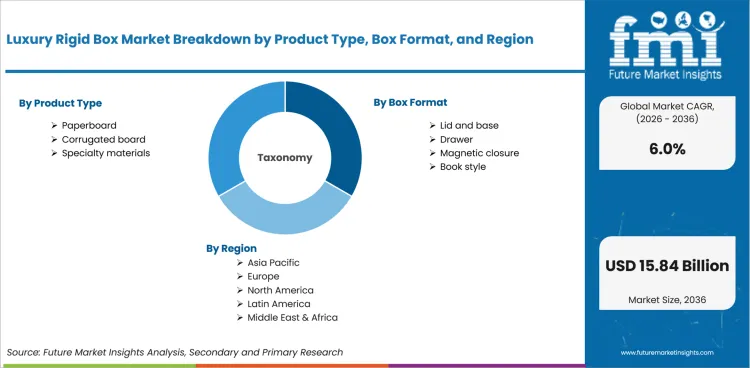
Luxury Rigid Box Market Breakdown by Product Type, Box Format, Application, Closure Type, Decoration, Sales Channel, and Region
Luxury Rigid Box Market Segmented by Product Type
- Paperboard
- Corrugated board
- Specialty materials
Luxury Rigid Box Market Segmented by Box Format
- Lid and base
- Drawer
- Magnetic closure
- Book style
Luxury Rigid Box Market Segmented by Application
- Cosmetics and personal care
- Jewelry and watches
- Electronics and technology
- Fashion and apparel
- Food and beverage gifting
Luxury Rigid Box Market Segmented by Closure Type
- Magnetic closures
- Ribbon pulls
- Sleeve closure
- Hinged lids
Luxury Rigid Box Market Segmented by Decoration
- Foil stamping
- Embossing
- Soft touch
- Printed wrap
Luxury Rigid Box Market Segmented by Sales Channel
- Direct brand contracts
- Packaging distributors
- Design agencies
- Online suppliers
Luxury Rigid Box Market by Region
- North America
- Latin America
- Western Europe
- Eastern Europe
- East Asia
- South Asia and Pacific
- Middle East and Africa
Research Sources and Bibliography
- European Commission Directorate-General for Environment. (2026). Packaging waste. European Commission.
- Eurostat. (2025). Packaging waste statistics. Eurostat Statistics Explained.
- American Forest & Paper Association. (2025). Paper industry announces 2024 USA paper recycling rates. AF&PA.
- Confederation of European Paper Industries. (2026). New 2025 pulp and paper manufacturing figures show moderate resilience. CEPI.
- United States Census Bureau. (2026). Quarterly retail e-commerce sales report. United States Census Bureau.
- National Bureau of Statistics of China. (2026). Total retail sales of consumer goods in December 2025. National Bureau of Statistics of China.
- Invest India. (2026). Investment opportunities in retail and e-commerce. Invest India.
- OpportunItaly. (2026). Italian cosmetics 2025: exports, consumption and turnover. Government of Italy.
- Smurfit Westrock plc. (2024). Smurfit Westrock makes its debut in New York and London. Smurfit Westrock plc.
- European Commission. (2025). Commission approves International Paper acquisition of DS Smith. European Commission.
- Stora Enso Oyj. (2025). Stora Enso’s billion-euro investment in renewable packaging. Stora Enso.
- Metsä Board Corporation. (2026). Metsä Board introduces a new product and service concept for brand packaging. Metsä Board.
- Knoll Printing & Packaging Inc. (2024). Knoll Ecoform molded pulp ornament. Knoll Printing & Packaging.
- Coty Inc. (2024). Coty reports double-digit growth in FY24. Coty Inc.
- Japan Cosmetic Industry Association. (2026). Statistics. Japan Cosmetic Industry Association.
All sources used are primary company pages and government pages. Regulatory pages and official trade body pages are used where market evidence requires them.
This Report Answers
- What is the projected value of the Luxury Rigid Box Market in 2026 and 2036?
- How fast is the Luxury Rigid Box Market expected to expand during the forecast period?
- Which product type is expected to lead Luxury Rigid Box Market demand in 2026?
- Why does cosmetics and personal care account for the largest application share in 2026?
- How are recycling rules changing material choices for luxury rigid box suppliers?
- Which countries are expected to record faster expansion in the Luxury Rigid Box Market?
- Which companies compete in luxury rigid boxes and what capabilities matter most?
- How does FMI define the Luxury Rigid Box Market for sizing and forecast work?
- What research method is used to validate Luxury Rigid Box Market projections?
- How do direct brand contracts affect pricing and sample approval in this market?
Frequently Asked Questions
What is the global market demand for Luxury Rigid Box Market in 2026?
In 2026, the global Luxury Rigid Box Market is expected to be worth USD 8.84 billion as beauty and gifting brands use premium boxes.
What is the Luxury Rigid Box Market forecast value by 2036?
By 2036, the Luxury Rigid Box Market is projected to reach USD 15.84 billion as branded gift packaging stays relevant.
What is the forecast rate of the Luxury Rigid Box Market from 2026 to 2036?
The Luxury Rigid Box Market is forecast to expand at 6.0% CAGR during the forecast period based on FMI analysis.
Which product type leads the Luxury Rigid Box Market?
Paperboard is expected to account for 58.0% share in 2026 as it supports wrapping and premium finishing work.
Which application leads the Luxury Rigid Box Market?
Cosmetics and personal care is anticipated to account for 37.0% share in 2026 due to fragrance and skincare gift sets.
Why is China the fastest growing country in the Luxury Rigid Box Market?
China is projected at 7.2% CAGR by 2036 as online premium retail and local luxury brands expand box use.
What does Luxury Rigid Box Market mean in this report?
The market covers premium rigid boxes made for high-value goods where box structure and finish support product presentation.
How does FMI validate the Luxury Rigid Box Market forecast?
FMI uses market values and segment shares to test the forecast. Company activity and packaging rules are used as validation checks.
Which luxury rigid box type is best for beauty gift sets?
Paperboard lid and base boxes work best for most beauty gift sets because they offer a premium feel and allow clean printed wraps.
How much does a luxury rigid box usually cost?
Cost depends on board grade and order volume. Small premium runs cost more per unit than larger repeat brand programs.
Preview the report firsthand - request a free sample
Get SampleGet the brochure for pricing and purchase details.
Get PDFTable of Content
- Executive Summary
- Global Market Outlook
- Demand-side Trends
- Supply-side Trends
- Technology Roadmap Analysis
- Analysis and Recommendations
- Market Overview
- Market Coverage / Taxonomy
- Market Definition / Scope / Limitations
- Research Methodology
- Chapter Orientation
- Analytical Lens and Working Hypotheses
- Market Structure, Signals, and Trend Drivers
- Benchmarking and Cross-market Comparability
- Market Sizing, Forecasting, and Opportunity Mapping
- Research Design and Evidence Framework
- Desk Research Programme (Secondary Evidence)
- Company Annual and Sustainability Reports
- Peer-reviewed Journals and Academic Literature
- Corporate Websites, Product Literature, and Technical Notes
- Earnings Decks and Investor Briefings
- Statutory Filings and Regulatory Disclosures
- Technical White Papers and Standards Notes
- Trade Journals, Industry Magazines, and Analyst Briefs
- Conference Proceedings, Webinars, and Seminar Materials
- Government Statistics Portals and Public Data Releases
- Press Releases and Reputable Media Coverage
- Specialist Newsletters and Curated Briefings
- Sector Databases and Reference Repositories
- FMI Internal Proprietary Databases and Historical Market Datasets
- Subscription Datasets and Paid Sources
- Social Channels, Communities, and Digital Listening Inputs
- Additional Desk Sources
- Expert Input and Fieldwork (Primary Evidence)
- Primary Modes
- Qualitative Interviews and Expert Elicitation
- Quantitative Surveys and Structured Data Capture
- Blended Approach
- Why Primary Evidence is Used
- Field Techniques
- Interviews
- Surveys
- Focus Groups
- Observational and In-context Research
- Social and Community Interactions
- Stakeholder Universe Engaged
- C-suite Leaders
- Board Members
- Presidents and Vice Presidents
- R&D and Innovation Heads
- Technical Specialists
- Domain Subject-matter Experts
- Scientists
- Physicians and Other Healthcare Professionals
- Governance, Ethics, and Data Stewardship
- Research Ethics
- Data Integrity and Handling
- Primary Modes
- Tooling, Models, and Reference Databases
- Desk Research Programme (Secondary Evidence)
- Data Engineering and Model Build
- Data Acquisition and Ingestion
- Cleaning, Normalisation, and Verification
- Synthesis, Triangulation, and Analysis
- Quality Assurance and Audit Trail
- Market Background
- Market Dynamics
- Drivers
- Restraints
- Opportunity
- Trends
- Scenario Forecast
- Demand in Optimistic Scenario
- Demand in Likely Scenario
- Demand in Conservative Scenario
- Opportunity Map Analysis
- Product Life Cycle Analysis
- Supply Chain Analysis
- Investment Feasibility Matrix
- Value Chain Analysis
- PESTLE and Porter’s Analysis
- Regulatory Landscape
- Regional Parent Market Outlook
- Production and Consumption Statistics
- Import and Export Statistics
- Market Dynamics
- Global Market Analysis 2021 to 2025 and Forecast, 2026 to 2036
- Historical Market Size Value (USD Billion) Analysis, 2021 to 2025
- Current and Future Market Size Value (USD Billion) Projections, 2026 to 2036
- Y-o-Y Growth Trend Analysis
- Absolute $ Opportunity Analysis
- Global Market Pricing Analysis 2021 to 2025 and Forecast 2026 to 2036
- Global Market Analysis 2021 to 2025 and Forecast 2026 to 2036, By Product Type
- Introduction / Key Findings
- Historical Market Size Value (USD Billion) Analysis By Product Type , 2021 to 2025
- Current and Future Market Size Value (USD Billion) Analysis and Forecast By Product Type , 2026 to 2036
- Paperboard
- Corrugated board
- Specialty materials
- Paperboard
- Y-o-Y Growth Trend Analysis By Product Type , 2021 to 2025
- Absolute $ Opportunity Analysis By Product Type , 2026 to 2036
- Global Market Analysis 2021 to 2025 and Forecast 2026 to 2036, By Box Format
- Introduction / Key Findings
- Historical Market Size Value (USD Billion) Analysis By Box Format, 2021 to 2025
- Current and Future Market Size Value (USD Billion) Analysis and Forecast By Box Format, 2026 to 2036
- Lid and base
- Drawer
- Magnetic closure
- Book style
- Lid and base
- Y-o-Y Growth Trend Analysis By Box Format, 2021 to 2025
- Absolute $ Opportunity Analysis By Box Format, 2026 to 2036
- Global Market Analysis 2021 to 2025 and Forecast 2026 to 2036, By Application
- Introduction / Key Findings
- Historical Market Size Value (USD Billion) Analysis By Application, 2021 to 2025
- Current and Future Market Size Value (USD Billion) Analysis and Forecast By Application, 2026 to 2036
- Cosmetics and personal care
- Jewelry and watches
- Electronics and technology
- Fashion and apparel
- Food and beverage gifting
- Cosmetics and personal care
- Y-o-Y Growth Trend Analysis By Application, 2021 to 2025
- Absolute $ Opportunity Analysis By Application, 2026 to 2036
- Global Market Analysis 2021 to 2025 and Forecast 2026 to 2036, By Closure Type
- Introduction / Key Findings
- Historical Market Size Value (USD Billion) Analysis By Closure Type, 2021 to 2025
- Current and Future Market Size Value (USD Billion) Analysis and Forecast By Closure Type, 2026 to 2036
- Magnetic closures
- Ribbon pulls
- Sleeve closure
- Hinged lids
- Magnetic closures
- Y-o-Y Growth Trend Analysis By Closure Type, 2021 to 2025
- Absolute $ Opportunity Analysis By Closure Type, 2026 to 2036
- Global Market Analysis 2021 to 2025 and Forecast 2026 to 2036, By Decoration
- Introduction / Key Findings
- Historical Market Size Value (USD Billion) Analysis By Decoration, 2021 to 2025
- Current and Future Market Size Value (USD Billion) Analysis and Forecast By Decoration, 2026 to 2036
- Foil stamping
- Embossing
- Soft touch
- Printed wrap
- Foil stamping
- Y-o-Y Growth Trend Analysis By Decoration, 2021 to 2025
- Absolute $ Opportunity Analysis By Decoration, 2026 to 2036
- Global Market Analysis 2021 to 2025 and Forecast 2026 to 2036, By Sales Channel
- Introduction / Key Findings
- Historical Market Size Value (USD Billion) Analysis By Sales Channel, 2021 to 2025
- Current and Future Market Size Value (USD Billion) Analysis and Forecast By Sales Channel, 2026 to 2036
- Direct brand contracts
- Packaging distributors
- Design agencies
- Online suppliers
- Direct brand contracts
- Y-o-Y Growth Trend Analysis By Sales Channel, 2021 to 2025
- Absolute $ Opportunity Analysis By Sales Channel, 2026 to 2036
- Global Market Analysis 2021 to 2025 and Forecast 2026 to 2036, By Region
- Introduction
- Historical Market Size Value (USD Billion) Analysis By Region, 2021 to 2025
- Current Market Size Value (USD Billion) Analysis and Forecast By Region, 2026 to 2036
- North America
- Latin America
- Western Europe
- Eastern Europe
- East Asia
- South Asia and Pacific
- Middle East & Africa
- Market Attractiveness Analysis By Region
- North America Market Analysis 2021 to 2025 and Forecast 2026 to 2036, By Country
- Historical Market Size Value (USD Billion) Trend Analysis By Market Taxonomy, 2021 to 2025
- Market Size Value (USD Billion) Forecast By Market Taxonomy, 2026 to 2036
- By Country
- USA
- Canada
- Mexico
- By Product Type
- By Box Format
- By Application
- By Closure Type
- By Decoration
- By Sales Channel
- By Country
- Market Attractiveness Analysis
- By Country
- By Product Type
- By Box Format
- By Application
- By Closure Type
- By Decoration
- By Sales Channel
- Key Takeaways
- Latin America Market Analysis 2021 to 2025 and Forecast 2026 to 2036, By Country
- Historical Market Size Value (USD Billion) Trend Analysis By Market Taxonomy, 2021 to 2025
- Market Size Value (USD Billion) Forecast By Market Taxonomy, 2026 to 2036
- By Country
- Brazil
- Chile
- Rest of Latin America
- By Product Type
- By Box Format
- By Application
- By Closure Type
- By Decoration
- By Sales Channel
- By Country
- Market Attractiveness Analysis
- By Country
- By Product Type
- By Box Format
- By Application
- By Closure Type
- By Decoration
- By Sales Channel
- Key Takeaways
- Western Europe Market Analysis 2021 to 2025 and Forecast 2026 to 2036, By Country
- Historical Market Size Value (USD Billion) Trend Analysis By Market Taxonomy, 2021 to 2025
- Market Size Value (USD Billion) Forecast By Market Taxonomy, 2026 to 2036
- By Country
- Germany
- UK
- Italy
- Spain
- France
- Nordic
- BENELUX
- Rest of Western Europe
- By Product Type
- By Box Format
- By Application
- By Closure Type
- By Decoration
- By Sales Channel
- By Country
- Market Attractiveness Analysis
- By Country
- By Product Type
- By Box Format
- By Application
- By Closure Type
- By Decoration
- By Sales Channel
- Key Takeaways
- Eastern Europe Market Analysis 2021 to 2025 and Forecast 2026 to 2036, By Country
- Historical Market Size Value (USD Billion) Trend Analysis By Market Taxonomy, 2021 to 2025
- Market Size Value (USD Billion) Forecast By Market Taxonomy, 2026 to 2036
- By Country
- Russia
- Poland
- Hungary
- Balkan & Baltic
- Rest of Eastern Europe
- By Product Type
- By Box Format
- By Application
- By Closure Type
- By Decoration
- By Sales Channel
- By Country
- Market Attractiveness Analysis
- By Country
- By Product Type
- By Box Format
- By Application
- By Closure Type
- By Decoration
- By Sales Channel
- Key Takeaways
- East Asia Market Analysis 2021 to 2025 and Forecast 2026 to 2036, By Country
- Historical Market Size Value (USD Billion) Trend Analysis By Market Taxonomy, 2021 to 2025
- Market Size Value (USD Billion) Forecast By Market Taxonomy, 2026 to 2036
- By Country
- China
- Japan
- South Korea
- By Product Type
- By Box Format
- By Application
- By Closure Type
- By Decoration
- By Sales Channel
- By Country
- Market Attractiveness Analysis
- By Country
- By Product Type
- By Box Format
- By Application
- By Closure Type
- By Decoration
- By Sales Channel
- Key Takeaways
- South Asia and Pacific Market Analysis 2021 to 2025 and Forecast 2026 to 2036, By Country
- Historical Market Size Value (USD Billion) Trend Analysis By Market Taxonomy, 2021 to 2025
- Market Size Value (USD Billion) Forecast By Market Taxonomy, 2026 to 2036
- By Country
- India
- ASEAN
- Australia & New Zealand
- Rest of South Asia and Pacific
- By Product Type
- By Box Format
- By Application
- By Closure Type
- By Decoration
- By Sales Channel
- By Country
- Market Attractiveness Analysis
- By Country
- By Product Type
- By Box Format
- By Application
- By Closure Type
- By Decoration
- By Sales Channel
- Key Takeaways
- Middle East & Africa Market Analysis 2021 to 2025 and Forecast 2026 to 2036, By Country
- Historical Market Size Value (USD Billion) Trend Analysis By Market Taxonomy, 2021 to 2025
- Market Size Value (USD Billion) Forecast By Market Taxonomy, 2026 to 2036
- By Country
- Kingdom of Saudi Arabia
- Other GCC Countries
- Turkiye
- South Africa
- Other African Union
- Rest of Middle East & Africa
- By Product Type
- By Box Format
- By Application
- By Closure Type
- By Decoration
- By Sales Channel
- By Country
- Market Attractiveness Analysis
- By Country
- By Product Type
- By Box Format
- By Application
- By Closure Type
- By Decoration
- By Sales Channel
- Key Takeaways
- Key Countries Market Analysis
- USA
- Pricing Analysis
- Market Share Analysis, 2025
- By Product Type
- By Box Format
- By Application
- By Closure Type
- By Decoration
- By Sales Channel
- Canada
- Pricing Analysis
- Market Share Analysis, 2025
- By Product Type
- By Box Format
- By Application
- By Closure Type
- By Decoration
- By Sales Channel
- Mexico
- Pricing Analysis
- Market Share Analysis, 2025
- By Product Type
- By Box Format
- By Application
- By Closure Type
- By Decoration
- By Sales Channel
- Brazil
- Pricing Analysis
- Market Share Analysis, 2025
- By Product Type
- By Box Format
- By Application
- By Closure Type
- By Decoration
- By Sales Channel
- Chile
- Pricing Analysis
- Market Share Analysis, 2025
- By Product Type
- By Box Format
- By Application
- By Closure Type
- By Decoration
- By Sales Channel
- Germany
- Pricing Analysis
- Market Share Analysis, 2025
- By Product Type
- By Box Format
- By Application
- By Closure Type
- By Decoration
- By Sales Channel
- UK
- Pricing Analysis
- Market Share Analysis, 2025
- By Product Type
- By Box Format
- By Application
- By Closure Type
- By Decoration
- By Sales Channel
- Italy
- Pricing Analysis
- Market Share Analysis, 2025
- By Product Type
- By Box Format
- By Application
- By Closure Type
- By Decoration
- By Sales Channel
- Spain
- Pricing Analysis
- Market Share Analysis, 2025
- By Product Type
- By Box Format
- By Application
- By Closure Type
- By Decoration
- By Sales Channel
- France
- Pricing Analysis
- Market Share Analysis, 2025
- By Product Type
- By Box Format
- By Application
- By Closure Type
- By Decoration
- By Sales Channel
- India
- Pricing Analysis
- Market Share Analysis, 2025
- By Product Type
- By Box Format
- By Application
- By Closure Type
- By Decoration
- By Sales Channel
- ASEAN
- Pricing Analysis
- Market Share Analysis, 2025
- By Product Type
- By Box Format
- By Application
- By Closure Type
- By Decoration
- By Sales Channel
- Australia & New Zealand
- Pricing Analysis
- Market Share Analysis, 2025
- By Product Type
- By Box Format
- By Application
- By Closure Type
- By Decoration
- By Sales Channel
- China
- Pricing Analysis
- Market Share Analysis, 2025
- By Product Type
- By Box Format
- By Application
- By Closure Type
- By Decoration
- By Sales Channel
- Japan
- Pricing Analysis
- Market Share Analysis, 2025
- By Product Type
- By Box Format
- By Application
- By Closure Type
- By Decoration
- By Sales Channel
- South Korea
- Pricing Analysis
- Market Share Analysis, 2025
- By Product Type
- By Box Format
- By Application
- By Closure Type
- By Decoration
- By Sales Channel
- Russia
- Pricing Analysis
- Market Share Analysis, 2025
- By Product Type
- By Box Format
- By Application
- By Closure Type
- By Decoration
- By Sales Channel
- Poland
- Pricing Analysis
- Market Share Analysis, 2025
- By Product Type
- By Box Format
- By Application
- By Closure Type
- By Decoration
- By Sales Channel
- Hungary
- Pricing Analysis
- Market Share Analysis, 2025
- By Product Type
- By Box Format
- By Application
- By Closure Type
- By Decoration
- By Sales Channel
- Kingdom of Saudi Arabia
- Pricing Analysis
- Market Share Analysis, 2025
- By Product Type
- By Box Format
- By Application
- By Closure Type
- By Decoration
- By Sales Channel
- Turkiye
- Pricing Analysis
- Market Share Analysis, 2025
- By Product Type
- By Box Format
- By Application
- By Closure Type
- By Decoration
- By Sales Channel
- South Africa
- Pricing Analysis
- Market Share Analysis, 2025
- By Product Type
- By Box Format
- By Application
- By Closure Type
- By Decoration
- By Sales Channel
- USA
- Market Structure Analysis
- Competition Dashboard
- Competition Benchmarking
- Market Share Analysis of Top Players
- By Regional
- By Product Type
- By Box Format
- By Application
- By Closure Type
- By Decoration
- By Sales Channel
- Competition Analysis
- Competition Deep Dive
- DS Smith plc
- Overview
- Product Portfolio
- Profitability by Market Segments (Product/Age /Sales Channel/Region)
- Sales Footprint
- Strategy Overview
- Marketing Strategy
- Product Strategy
- Channel Strategy
- Smurfit Westrock plc
- International Paper Company
- Mondi plc
- Sonoco Products Company
- Pusterla 1880 S.p.A.
- Knoll Printing & Packaging Inc.
- HH Deluxe Packaging Limited
- Progress Packaging Limited
- Bell Incorporated
- DS Smith plc
- Competition Deep Dive
- Assumptions & Acronyms Used


