

- Industry Size (2026)
- USD 348 Mn
- Forecast (2036)
- USD 779.6 Mn
- CAGR (2026 to 2036)
- 8.4%
Heat-Stress Mitigation Foliar Protectant Market Forecast and Outlook 2026 to 2036
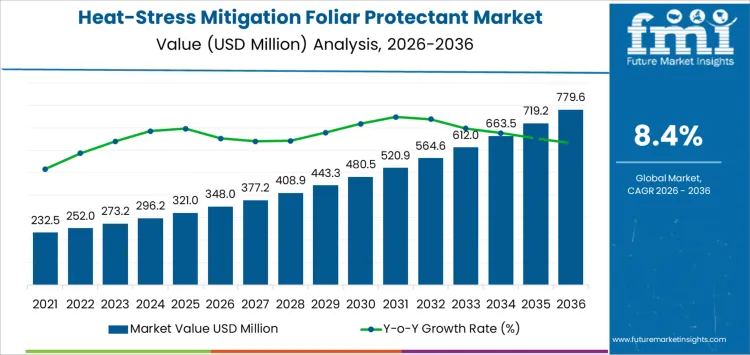
The global heat-stress mitigation foliar protectant market is growing rapidly, with an estimated CAGR of 8.4% from 2026 to 2036, increasing from USD 348 million in 2026 to USD 779.6 million in 2036. The market is driven by rising temperatures and climate change, which have led to a surge in the need for effective solutions to protect crops from heat stress. Anti-transpirants, which account for 26% of the market, are the leading protectant type due to their effectiveness in reducing water loss and helping plants maintain hydration. In terms of application mechanisms, foliar sprays using tractor-mounted equipment hold the largest share at 42%, owing to their efficiency in covering large agricultural areas quickly and uniformly, making them ideal for large-scale operations. Other application mechanisms, such as aerial sprays, high-pressure sprayers, and precision sprayers, are also gaining traction, reflecting the market’s broad range of solutions.
Quick Stats for Heat-Stress Mitigation Foliar Protectant Market
- Heat-Stress Mitigation Foliar Protectant Market Value (2026): USD 348 million
- Heat-Stress Mitigation Foliar Protectant Market Forecast Value (2036): USD 779.6 million
- Heat-Stress Mitigation Foliar Protectant Market Forecast CAGR (2026-2036): 8.4%
- Leading Protectant Type in Heat-Stress Mitigation Foliar Protectant Market: Anti-Transpirants (Film-Forming / Stomatal Regulation) (26%)
- Key Growth Regions in Heat-Stress Mitigation Foliar Protectant Market: Asia Pacific, Europe, North America
- Top Players in Heat-Stress Mitigation Foliar Protectant Market: BASF, Corteva Agriscience, Syngenta, UPL, Valent BioSciences, Oro Agri / Rovensa Group
The market’s growth is further fueled by key countries like India, which leads with a 10.3% CAGR, driven by its expansive agricultural sector and increasing challenges from heat stress. Brazil follows with 9.1%, supported by its major crop production and focus on heat resilience. China’s market grows at 8.7%, influenced by its large agricultural industry and increasing need for eco-friendly crop protection. The USA shows steady growth at 7.4%, driven by growing demand for solutions to mitigate heat stress and improve crop resilience. As the global agricultural sector increasingly prioritizes duarbility, the demand for heat-stress mitigation foliar protectants is set to continue expanding across these key regions.
Heat‑Stress Mitigation Foliar Protectant Market Key Takeaways
| Metric | Value |
|---|---|
| Industry Value (2026) | USD 348 million |
| Forecast Value (2036) | USD 779.6 million |
| Forecast CAGR (2026-2036) | 8.4% |
How is the Global Heat Stress Mitigation Foliar Protectant Sector Advancing?
The global heat stress mitigation foliar protectant market is expanding as agricultural producers seek solutions to protect crops from rising temperatures and climate related stress. Foliar protectants are applied directly to plant leaves to enhance tolerance to heat and environmental stressors, helping maintain crop health, yield, and quality. Traditional crop care practices have often focused on pest and disease control, but increasingly frequent heat waves and temperature extremes have highlighted the need for products that support plant resilience. This shift is driving interest in foliar protectants that can help crops better withstand heat stress.
As global temperatures trend upward and growers confront more unpredictable weather patterns, demand for effective foliar protectants continues to grow across major crop sectors such as cereals, fruits, and vegetables. Innovations in product formulations are improving performance by combining protective agents with nutrients that enhance plant physiology under stress conditions. These advancements help growers achieve better outcomes even under challenging climatic conditions while aligning with eco-friendly agriculture goals.
The market is expected to grow further as heat stress becomes a more common concern for agriculture worldwide. Adoption will be supported by ongoing research into plant physiology and stress mitigation, as well as by farmer awareness of the benefits of foliar interventions. Challenges such as product cost, variability in field performance, and the need for tailored solutions for different crops and regions may influence market dynamics. Nonetheless, the increasing focus on climate adaptation strategies in agriculture will drive continued demand for heat stress mitigation foliar protectants.
What Is the Segment-Wise Analysis for the Global Heat-Stress Mitigation Foliar Protectant Market?
The global heat-stress mitigation foliar protectant market is segmented by protectant type and application mechanism. Anti-transpirants (film-forming/stomatal regulation) lead the market with a 26% share due to their effectiveness in reducing water loss and managing plant stress. Other significant protectant types include osmoprotectant sprays, biostimulants, reflective kaolin/mineral particle films, amino-acid foliar protectants, and microbial/biological foliar stress reducers. In terms of application mechanisms, foliar spray using tractor-mounted equipment holds the largest share at 42%, followed by aerial applications (drones/aircraft), high-pressure sprayers, low-volume precision sprayers, and hand-held/greenhouse systems.
Why Do Anti-Transpirants (Film-Forming / Stomatal Regulation) Lead the Global Heat-Stress Mitigation Foliar Protectant Market?
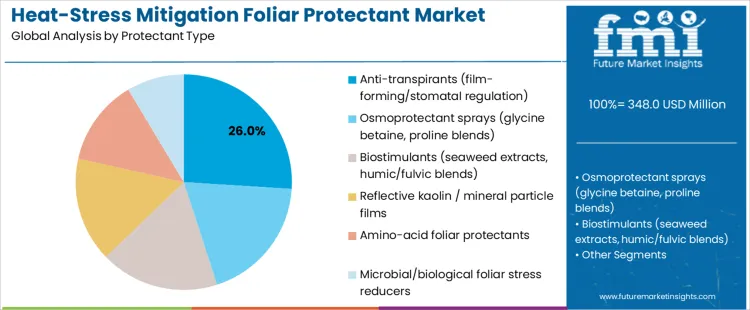
Anti-transpirants (film-forming/stomatal regulation) hold a 26% share in the global heat-stress mitigation foliar protectant market due to their effectiveness in reducing water loss from plants under heat stress. By forming a protective film on leaf surfaces, anti-transpirants regulate stomatal opening, reducing transpiration and water evaporation. This helps plants conserve moisture and maintain hydration during extreme heat conditions. The widespread use of anti-transpirants in various agricultural applications, particularly during hot weather or droughts, makes them a popular and essential tool for heat stress management, contributing to their dominance in the market.
How Does Foliar Spray (Tractor-Mounted) Hold the Largest Market Share?
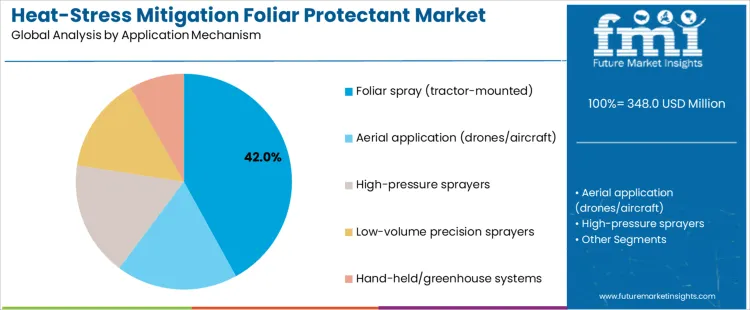
Foliar spray using tractor-mounted equipment holds the largest market share of 42% in the global heat-stress mitigation foliar protectant market due to its efficiency in applying protectants across large agricultural fields. This method allows for quick and uniform distribution of foliar protectants like anti-transpirants and biostimulants, ensuring comprehensive coverage to protect plants from heat stress. Tractor-mounted sprayers are widely adopted in crop farming, especially for large-scale operations, making them the preferred application mechanism. The ability to cover vast areas efficiently while reducing labor costs further strengthens the dominance of foliar spray in this market.
What is Shaping the Heat Stress Mitigation Foliar Protectant Market?
The heat stress mitigation foliar protectant market is shaped by rising global temperatures, more frequent heat waves, and increasing pressure on agricultural productivity. Crops exposed to heat stress during critical growth stages can suffer reduced yields, lower quality, and increased susceptibility to disease. Foliar protectants containing anti transpirants, stress relief polymers, and protective films help plants retain moisture, regulate gas exchange, and withstand thermal stress. Growing awareness of climate change impacts and the need to safeguard food security are driving demand for solutions that help crops tolerate extreme heat while maintaining performance.
What Challenges Are Limiting Adoption of Heat Stress Mitigation Foliar Protectants?
Adoption challenges include cost concerns and uncertainty about consistent performance across diverse climatic conditions and crop types. Some growers may hesitate to invest in foliar protectants without clear yield benefit data under variable field conditions. Differences in application timing, crop growth stage, and local weather patterns can complicate decision making. Limited awareness or experience with advanced foliar protectants in certain regions also slows uptake. Navigating regulatory approval for new chemistries in different countries can extend time to market for innovative products.
What Key Trends Are Shaping the Heat Stress Mitigation Foliar Protectant Market?
Key trends include the development of multi functional products that combine heat stress protection with micronutrient delivery, bio stimulant action, or improved water use efficiency. There is growing interest in bio based and low toxicity formulations that align with eco-friendly agriculture practices and reduce environmental impact. Precision agriculture tools, such as weather based application advisories and drone assisted spraying, are enhancing targeted foliar protectant use. Partnerships between agritech firms and crop scientists are accelerating research into next generation stress mitigation chemistries. Digital platforms that provide field level performance data are helping farmers optimize protectant strategies.
What is the Growth Outlook for the Heat-Stress Mitigation Foliar Protectant Market by Country?
| Country | CAGR (%) |
|---|---|
| USA | 7.4% |
| China | 8.8% |
| Brazil | 9.1% |
| India | 10.3% |
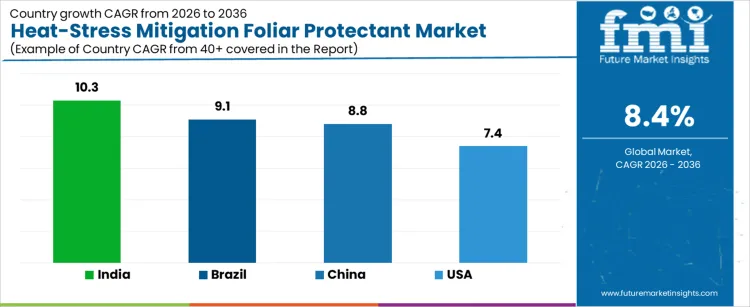
The heat-stress mitigation foliar protectant market is growing at a strong pace, with India leading at a 10.3% CAGR, driven by increasing agricultural activities and the rising need to protect crops from heat stress in a warming climate. Brazil follows closely with 9.1%, supported by its large agricultural sector and the need to protect key crops from heat-related damage. China’s market grows at 8.8%, influenced by rapid industrialization and a focus on enhancing agricultural resilience. The USA shows steady growth at 7.4%, driven by ongoing demand for agricultural innovations and the need to mitigate heat stress on crops in key farming regions.
Why is India Leading in the Heat-Stress Mitigation Foliar Protectant Market?
India’s heat-stress mitigation foliar protectant market is growing at 10.3%, driven by the country’s expansive agricultural sector and the growing challenges posed by rising temperatures. With agriculture being a significant part of India’s economy, protecting crops from extreme heat is becoming increasingly important. The effects of climate change, such as higher temperatures and irregular rainfall, are putting crops at risk, particularly in regions dependent on water-intensive farming. As a result, there is a rising demand for foliar protectants that help mitigate heat stress and enhance crop resilience. Government support for agricultural innovation, along with rising awareness among farmers about crop protection, is further accelerating the market’s growth. As India’s agricultural practices evolve, the demand for heat-stress mitigation products will continue to rise.
What is Driving the Growth of the Heat-Stress Mitigation Foliar Protectant Market in China?
China’s heat-stress mitigation foliar protectant market is growing at 8.8%, driven by the country’s large agricultural industry and increasing challenges related to heat stress on crops. China’s vast farming regions, particularly in the north and central parts of the country, are experiencing more extreme temperatures, making it necessary to adopt strategies to protect crops from heat-induced damage. The government’s focus on improving agricultural productivity and resilience in the face of climate change is fueling the demand for foliar protectants. China’s growing emphasis on eco-friendly agriculture and innovations in crop protection technologies are contributing to market growth. With the rising importance of food security and agricultural duarbility, the market for heat-stress mitigation foliar protectants in China is expected to continue growing.
How is the Heat-Stress Mitigation Foliar Protectant Market Expanding in Brazil?
Brazil’s heat-stress mitigation foliar protectant market is growing at 9.1%, supported by the country’s extensive agricultural sector and increasing need to protect crops from heat stress. As Brazil is a major producer of crops such as soybeans, coffee, and sugarcane, the demand for foliar protectants to safeguard these crops from high temperatures and drought conditions is rising. The country’s farmers are increasingly turning to innovative solutions that help crops cope with extreme weather, which is becoming more frequent due to climate change. Brazil’s focus on agricultural advancements and eco-friendly farming practices is accelerating the adoption of heat-stress mitigation products. As the country continues to be a global agricultural leader, the market for foliar protectants is set to grow as part of the broader drive for crop protection.
What is Contributing to the Growth of the Heat-Stress Mitigation Foliar Protectant Market in the USA?
The USA’s heat-stress mitigation foliar protectant market is growing at 7.4%, driven by ongoing demand for solutions that address the challenges posed by heat stress on crops. With regions such as the Midwest and Southwest experiencing hotter temperatures, the need for foliar protectants to reduce the effects of heat stress is growing. Agriculture in the USA is facing increasing pressure from climate change, making the adoption of protective technologies more important for maintaining crop yields. The demand for foliar protectants is also being fueled by farmers’ interest in improving crop resilience and reducing the impact of extreme weather. With continued advancements in agricultural technologies and a focus on crop protection, the market for heat-stress mitigation products is expected to grow steadily in the USA.
How Are Companies Competing in the Heat Stress Mitigation Foliar Protectant Market?
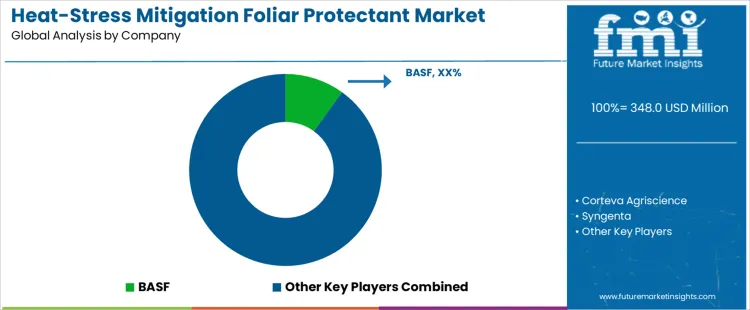
In the heat stress mitigation foliar protectant market BASF, Corteva Agriscience, Syngenta, UPL, Valent BioSciences, and Oro Agri / Rovensa Group are positioned with brochures that emphasize protection of crops from extreme temperatures while supporting yield stability. BASF product brochures showcase foliar agents formulated to enhance plant resilience to heat stress, with data on improved canopy health and stress recovery. These brochures highlight application guidance and compatibility with existing spray programs. Corteva Agriscience materials present intellectual property foliar protectants that are described with science based performance metrics, focusing on cellular protection mechanisms and plant water use efficiency under high temperature conditions. Syngenta promotional literature emphasizes broad crop applicability and stress protection efficacy, with visuals and performance summaries that aid agronomists in product selection for hot climates.
UPL brochures present integrated protectant solutions with additives that support foliar uptake and heat tolerance, designed to fit into eco-friendly crop protection plans. Valent BioSciences focuses on bio derived foliar protectants that are described with emphasis on environmental profiles and reduced impact on beneficial organisms; product brochures are crafted to appeal to growers seeking biologically based heat stress solutions. Oro Agri / Rovensa Group materials position foliar stress protectants with proprietary formulations that support plant physiological balance, extending spray windows in hot conditions and improving stress recovery. These brochures detail compatibility with tank mixtures and recommendations for peak heat periods.
Key Players in Heat-Stress Mitigation Foliar Protectant Market
- BASF
- Corteva Agriscience
- Syngenta
- UPL
- Valent BioSciences
- Oro Agri / Rovensa Group
Scope of Report
| Items | Values |
|---|---|
| Quantitative Units (2026) | USD million |
| Protectant Type | Anti-transpirants (film-forming/stomatal regulation), Osmoprotectant sprays (glycine betaine, proline blends), Biostimulants (seaweed extracts, humic/fulvic blends), Reflective kaolin/mineral particle films, Amino-acid foliar protectants, Microbial/biological foliar stress reducers |
| Application Mechanism | Foliar spray (tractor-mounted), Aerial application (drones/aircraft), High-pressure sprayers, Low-volume precision sprayers, Hand-held/greenhouse systems |
| Regions Covered | Asia Pacific, Europe, North America, Latin America, Middle East & Africa |
| Countries Covered | USA, China, Japan, South Korea, India, Australia & New Zealand, ASEAN, Germany, UK, France, Italy, Spain, Nordic, BENELUX, Brazil, Chile, Mexico, Saudi Arabia, Other GCC Countries, Turkey, South Africa, Other African Union |
| Key Companies Profiled | BASF, Corteva Agriscience, Syngenta, UPL, Valent BioSciences, Oro Agri / Rovensa Group |
| Additional Attributes | Dollar sales by protectant type, application mechanism, and region; regional CAGR and growth outlook; distribution channels including agricultural cooperatives, field service providers, and distributors; innovation trends in heat-stress mitigation, foliar protectants; competitive positioning of global vs regional suppliers. |
Heat-Stress Mitigation Foliar Protectant Market by Segments
Protectant Type
- Anti-transpirants (film-forming/stomatal regulation)
- Osmoprotectant sprays (glycine betaine, proline blends)
- Biostimulants (seaweed extracts, humic/fulvic blends)
- Reflective kaolin / mineral particle films
- Amino-acid foliar protectants
- Microbial/biological foliar stress reducers
Application Mechanism
- Foliar spray (tractor-mounted)
- Aerial application (drones/aircraft)
- High-pressure sprayers
- Low-volume precision sprayers
- Hand-held/greenhouse systems
Region
- Asia Pacific
- China
- Japan
- South Korea
- India
- Australia & New Zealand
- ASEAN
- Rest of Asia Pacific
- Europe
- Germany
- United Kingdom
- France
- Italy
- Spain
- Nordic
- BENELUX
- Rest of Europe
- North America
- United States
- Canada
- Mexico
- Latin America
- Brazil
- Chile
- Rest of Latin America
- Middle East & Africa
- Kingdom of Saudi Arabia
- Other GCC Countries
- Turkey
- South Africa
- Other African Union
- Rest of Middle East & Africa
Frequently Asked Questions
How big is the heat-stress mitigation foliar protectant market in 2026?
The global heat-stress mitigation foliar protectant market is estimated to be valued at USD 348.0 million in 2026.
What will be the size of heat-stress mitigation foliar protectant market in 2036?
The market size for the heat-stress mitigation foliar protectant market is projected to reach USD 779.6 million by 2036.
How much will be the heat-stress mitigation foliar protectant market growth between 2026 and 2036?
The heat-stress mitigation foliar protectant market is expected to grow at a 8.4% CAGR between 2026 and 2036.
What are the key product types in the heat-stress mitigation foliar protectant market?
The key product types in heat-stress mitigation foliar protectant market are anti-transpirants (film-forming/stomatal regulation), osmoprotectant sprays (glycine betaine, proline blends), biostimulants (seaweed extracts, humic/fulvic blends), reflective kaolin / mineral particle films, amino-acid foliar protectants and microbial/biological foliar stress reducers.
Which application mechanism segment to contribute significant share in the heat-stress mitigation foliar protectant market in 2026?
In terms of application mechanism, foliar spray (tractor-mounted) segment to command 42.0% share in the heat-stress mitigation foliar protectant market in 2026.
Preview the report firsthand - request a free sample
Get SampleGet the brochure for pricing and purchase details.
Get PDFTable of Content
- Executive Summary
- Global Market Outlook
- Demand-side Trends
- Supply-side Trends
- Technology Roadmap Analysis
- Analysis and Recommendations
- Market Overview
- Market Coverage / Taxonomy
- Market Definition / Scope / Limitations
- Market Background
- Market Dynamics
- Drivers
- Restraints
- Opportunity
- Trends
- Scenario Forecast
- Demand in Optimistic Scenario
- Demand in Likely Scenario
- Demand in Conservative Scenario
- Opportunity Map Analysis
- Product Life Cycle Analysis
- Supply Chain Analysis
- Investment Feasibility Matrix
- Value Chain Analysis
- PESTLE and Porter’s Analysis
- Regulatory Landscape
- Regional Parent Market Outlook
- Production and Consumption Statistics
- Import and Export Statistics
- Market Dynamics
- Global Market Analysis 2021 to 2025 and Forecast, 2026 to 2036
- Historical Market Size Value (USD Million) Analysis, 2021 to 2025
- Current and Future Market Size Value (USD Million) Projections, 2026 to 2036
- Y-o-Y Growth Trend Analysis
- Absolute $ Opportunity Analysis
- Global Market Pricing Analysis 2021 to 2025 and Forecast 2026 to 2036
- Global Market Analysis 2021 to 2025 and Forecast 2026 to 2036, By Protectant Type
- Introduction / Key Findings
- Historical Market Size Value (USD Million) Analysis By Protectant Type , 2021 to 2025
- Current and Future Market Size Value (USD Million) Analysis and Forecast By Protectant Type , 2026 to 2036
- Anti-transpirants (film-forming/stomatal regulation)
- Osmoprotectant sprays (glycine betaine, proline blends)
- Biostimulants (seaweed extracts, humic/fulvic blends)
- Reflective kaolin / mineral particle films
- Amino-acid foliar protectants
- Microbial/biological foliar stress reducers
- Y-o-Y Growth Trend Analysis By Protectant Type , 2021 to 2025
- Absolute $ Opportunity Analysis By Protectant Type , 2026 to 2036
- Global Market Analysis 2021 to 2025 and Forecast 2026 to 2036, By Application Mechanism
- Introduction / Key Findings
- Historical Market Size Value (USD Million) Analysis By Application Mechanism, 2021 to 2025
- Current and Future Market Size Value (USD Million) Analysis and Forecast By Application Mechanism, 2026 to 2036
- Foliar spray (tractor-mounted)
- Aerial application (drones/aircraft)
- High-pressure sprayers
- Low-volume precision sprayers
- Hand-held/greenhouse systems
- Y-o-Y Growth Trend Analysis By Application Mechanism, 2021 to 2025
- Absolute $ Opportunity Analysis By Application Mechanism, 2026 to 2036
- Global Market Analysis 2021 to 2025 and Forecast 2026 to 2036, By Region
- Introduction
- Historical Market Size Value (USD Million) Analysis By Region, 2021 to 2025
- Current Market Size Value (USD Million) Analysis and Forecast By Region, 2026 to 2036
- North America
- Latin America
- Western Europe
- Eastern Europe
- East Asia
- South Asia and Pacific
- Middle East & Africa
- Market Attractiveness Analysis By Region
- North America Market Analysis 2021 to 2025 and Forecast 2026 to 2036, By Country
- Historical Market Size Value (USD Million) Trend Analysis By Market Taxonomy, 2021 to 2025
- Market Size Value (USD Million) Forecast By Market Taxonomy, 2026 to 2036
- By Country
- USA
- Canada
- Mexico
- By Protectant Type
- By Application Mechanism
- By Country
- Market Attractiveness Analysis
- By Country
- By Protectant Type
- By Application Mechanism
- Key Takeaways
- Latin America Market Analysis 2021 to 2025 and Forecast 2026 to 2036, By Country
- Historical Market Size Value (USD Million) Trend Analysis By Market Taxonomy, 2021 to 2025
- Market Size Value (USD Million) Forecast By Market Taxonomy, 2026 to 2036
- By Country
- Brazil
- Chile
- Rest of Latin America
- By Protectant Type
- By Application Mechanism
- By Country
- Market Attractiveness Analysis
- By Country
- By Protectant Type
- By Application Mechanism
- Key Takeaways
- Western Europe Market Analysis 2021 to 2025 and Forecast 2026 to 2036, By Country
- Historical Market Size Value (USD Million) Trend Analysis By Market Taxonomy, 2021 to 2025
- Market Size Value (USD Million) Forecast By Market Taxonomy, 2026 to 2036
- By Country
- Germany
- UK
- Italy
- Spain
- France
- Nordic
- BENELUX
- Rest of Western Europe
- By Protectant Type
- By Application Mechanism
- By Country
- Market Attractiveness Analysis
- By Country
- By Protectant Type
- By Application Mechanism
- Key Takeaways
- Eastern Europe Market Analysis 2021 to 2025 and Forecast 2026 to 2036, By Country
- Historical Market Size Value (USD Million) Trend Analysis By Market Taxonomy, 2021 to 2025
- Market Size Value (USD Million) Forecast By Market Taxonomy, 2026 to 2036
- By Country
- Russia
- Poland
- Hungary
- Balkan & Baltic
- Rest of Eastern Europe
- By Protectant Type
- By Application Mechanism
- By Country
- Market Attractiveness Analysis
- By Country
- By Protectant Type
- By Application Mechanism
- Key Takeaways
- East Asia Market Analysis 2021 to 2025 and Forecast 2026 to 2036, By Country
- Historical Market Size Value (USD Million) Trend Analysis By Market Taxonomy, 2021 to 2025
- Market Size Value (USD Million) Forecast By Market Taxonomy, 2026 to 2036
- By Country
- China
- Japan
- South Korea
- By Protectant Type
- By Application Mechanism
- By Country
- Market Attractiveness Analysis
- By Country
- By Protectant Type
- By Application Mechanism
- Key Takeaways
- South Asia and Pacific Market Analysis 2021 to 2025 and Forecast 2026 to 2036, By Country
- Historical Market Size Value (USD Million) Trend Analysis By Market Taxonomy, 2021 to 2025
- Market Size Value (USD Million) Forecast By Market Taxonomy, 2026 to 2036
- By Country
- India
- ASEAN
- Australia & New Zealand
- Rest of South Asia and Pacific
- By Protectant Type
- By Application Mechanism
- By Country
- Market Attractiveness Analysis
- By Country
- By Protectant Type
- By Application Mechanism
- Key Takeaways
- Middle East & Africa Market Analysis 2021 to 2025 and Forecast 2026 to 2036, By Country
- Historical Market Size Value (USD Million) Trend Analysis By Market Taxonomy, 2021 to 2025
- Market Size Value (USD Million) Forecast By Market Taxonomy, 2026 to 2036
- By Country
- Kingdom of Saudi Arabia
- Other GCC Countries
- Turkiye
- South Africa
- Other African Union
- Rest of Middle East & Africa
- By Protectant Type
- By Application Mechanism
- By Country
- Market Attractiveness Analysis
- By Country
- By Protectant Type
- By Application Mechanism
- Key Takeaways
- Key Countries Market Analysis
- USA
- Pricing Analysis
- Market Share Analysis, 2025
- By Protectant Type
- By Application Mechanism
- Canada
- Pricing Analysis
- Market Share Analysis, 2025
- By Protectant Type
- By Application Mechanism
- Mexico
- Pricing Analysis
- Market Share Analysis, 2025
- By Protectant Type
- By Application Mechanism
- Brazil
- Pricing Analysis
- Market Share Analysis, 2025
- By Protectant Type
- By Application Mechanism
- Chile
- Pricing Analysis
- Market Share Analysis, 2025
- By Protectant Type
- By Application Mechanism
- Germany
- Pricing Analysis
- Market Share Analysis, 2025
- By Protectant Type
- By Application Mechanism
- UK
- Pricing Analysis
- Market Share Analysis, 2025
- By Protectant Type
- By Application Mechanism
- Italy
- Pricing Analysis
- Market Share Analysis, 2025
- By Protectant Type
- By Application Mechanism
- Spain
- Pricing Analysis
- Market Share Analysis, 2025
- By Protectant Type
- By Application Mechanism
- France
- Pricing Analysis
- Market Share Analysis, 2025
- By Protectant Type
- By Application Mechanism
- India
- Pricing Analysis
- Market Share Analysis, 2025
- By Protectant Type
- By Application Mechanism
- ASEAN
- Pricing Analysis
- Market Share Analysis, 2025
- By Protectant Type
- By Application Mechanism
- Australia & New Zealand
- Pricing Analysis
- Market Share Analysis, 2025
- By Protectant Type
- By Application Mechanism
- China
- Pricing Analysis
- Market Share Analysis, 2025
- By Protectant Type
- By Application Mechanism
- Japan
- Pricing Analysis
- Market Share Analysis, 2025
- By Protectant Type
- By Application Mechanism
- South Korea
- Pricing Analysis
- Market Share Analysis, 2025
- By Protectant Type
- By Application Mechanism
- Russia
- Pricing Analysis
- Market Share Analysis, 2025
- By Protectant Type
- By Application Mechanism
- Poland
- Pricing Analysis
- Market Share Analysis, 2025
- By Protectant Type
- By Application Mechanism
- Hungary
- Pricing Analysis
- Market Share Analysis, 2025
- By Protectant Type
- By Application Mechanism
- Kingdom of Saudi Arabia
- Pricing Analysis
- Market Share Analysis, 2025
- By Protectant Type
- By Application Mechanism
- Turkiye
- Pricing Analysis
- Market Share Analysis, 2025
- By Protectant Type
- By Application Mechanism
- South Africa
- Pricing Analysis
- Market Share Analysis, 2025
- By Protectant Type
- By Application Mechanism
- USA
- Market Structure Analysis
- Competition Dashboard
- Competition Benchmarking
- Market Share Analysis of Top Players
- By Regional
- By Protectant Type
- By Application Mechanism
- Competition Analysis
- Competition Deep Dive
- BASF
- Overview
- Product Portfolio
- Profitability by Market Segments (Product/Age /Sales Channel/Region)
- Sales Footprint
- Strategy Overview
- Marketing Strategy
- Product Strategy
- Channel Strategy
- Corteva Agriscience
- Syngenta
- UPL
- Valent BioSciences
- Oro Agri / Rovensa Group
- BASF
- Competition Deep Dive
- Assumptions & Acronyms Used
- Research Methodology


