

- Industry Size (2026)
- USD 459 Mn
- Forecast (2036)
- USD 1746 Mn
- CAGR (2026 to 2036)
- 14.3%
Salinity-Tolerance Enhancing Foliar Shield Market Forecast and Outlook 2026 to 2036
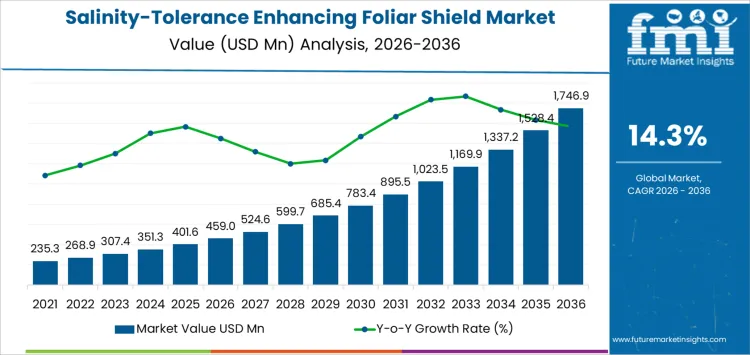
The global salinity-tolerance enhancing foliar shield market is expected to grow significantly, expanding from USD 459 million in 2026 to USD 1,746 million by 2036, at a CAGR of 14.3%. This growth is fueled by the increasing salinization of soil due to irrigation practices, rising groundwater levels, and climate change, which affect plant water uptake and nutrient balance. Osmoprotectant–polymer barrier blends lead the market with a 35% share, as they create protective barriers on plant leaves to mitigate osmotic stress and reduce salt toxicity. Other key chemistries include silicon & mineral-based foliar shields, amino acid & compatible solute films, and bio-extract & algal-derived coatings, each offering unique benefits for improving plant resilience under saline conditions.
Quick Stats for Salinity-Tolerance Enhancing Foliar Shield Market
- Salinity-Tolerance Enhancing Foliar Shield Market Value (2026): USD 459 million
- Salinity-Tolerance Enhancing Foliar Shield Market Forecast Value (2036): USD 1,746 million
- Salinity-Tolerance Enhancing Foliar Shield Market Forecast CAGR: 14.3%
- Leading Shield Chemistry in Salinity-Tolerance Enhancing Foliar Shield Market: Osmoprotectant-Polymer Barrier Blends (35%)
- Key Growth Regions in Salinity-Tolerance Enhancing Foliar Shield Market: India, China, Egypt, USA, Australia
- Key Players in Salinity-Tolerance Enhancing Foliar Shield Market: Valagro, Tradecorp International, Biolchim, Haifa Group, Atlantica Agricola
Ion toxicity shielding holds the largest share at 38%, reflecting its importance in preventing the harmful accumulation of sodium and chloride ions in plant tissues. This mechanism is crucial for maintaining plant health under salt stress. Other stress-mitigation mechanisms, such as osmotic balance regulation, enhanced leaf cuticle protection, and stomatal stress moderation, also contribute to effective salinity management. As demand for sustainable agriculture solutions rises, the market continues to expand with innovations in bio-based, low-toxicity products and enhanced delivery mechanisms, supporting the development of more effective and environmentally friendly foliar shield solutions.
Salinity‑Tolerance Enhancing Foliar Shield Market Key Takeaways
| Metric | Value |
|---|---|
| Industry Value (2026) | USD 459 million |
| Forecast Value (2036) | USD 1,746 million |
| Forecast CAGR (2026 to 2036) | 14.3% |
How is the Global Salinity Tolerance Enhancing Foliar Shield Sector Advancing?
The global salinity tolerance enhancing foliar shield market is growing rapidly as agricultural producers seek solutions that help crops withstand saline soil and water stress, which are increasingly prevalent due to irrigation practices, climate change, and land degradation. Saline conditions can disrupt plant water uptake, nutrient balance, and physiological processes, leading to reduced yields and crop quality. Salinity tolerance enhancing foliar shields are specialized formulations applied to the foliage that help plants maintain cellular homeostasis, improve osmotic adjustment, and activate stress response pathways. These products support crop resilience under salt stress, enabling more stable yields in areas affected by salinity.
Demand for foliar shields is rising across diverse cropping systems including cereals, vegetables, fruits, and high value specialty crops, where salinity can significantly impact emergence, growth, and reproductive development. Traditional agronomic practices for salinity management such as soil amendments, drainage improvements, or freshwater sourcing often involve high costs and limited feasibility in many regions. Foliar shields offer a crop centric mitigation approach that delivers targeted biochemical support directly to plant tissues. Advances in formulation science, including improved uptake, compatibility with other foliar inputs, and enhanced stress signaling modulation, have further boosted the effectiveness and adoption of these products.
Foliar shields are integrated into broader resilience programs that include precision irrigation, soil health monitoring, and balanced nutrient management. Innovations in bio based and naturally derived actives that enhance salinity tolerance while aligning with sustainability goals are also emerging, appealing to growers focused on reducing chemical inputs. However, adoption may be influenced by factors such as variable field responses under different crop and soil conditions, the need for tailored application guidance, and cost considerations relative to traditional stress mitigation practices. Despite these challenges, the emphasis on improving crop performance in saline environments will sustain demand for salinity tolerance enhancing foliar shields across global agriculture.
What is the Segment-Wise Analysis for the Global Salinity-Tolerance Enhancing Foliar Shield Market?
The global salinity-tolerance enhancing foliar shield market is segmented by shield chemistry type and stress-mitigation mechanism. Osmoprotectant polymer barrier blends lead the market with a 35% share, offering effective protection against salt stress by creating a barrier on the leaf surface. Other notable shield chemistries include silicon & mineral-based foliar shields, amino acid & compatible solute films, and bio-extract & algal-derived coatings. In terms of stress-mitigation mechanisms, ion toxicity shielding holds the largest share at 38%, followed by osmotic balance regulation, enhanced leaf cuticle protection, and stomatal stress moderation.
How Do Osmoprotectant-Polymer Barrier Blends Lead the Global Salinity-Tolerance Enhancing Foliar Shield Market?
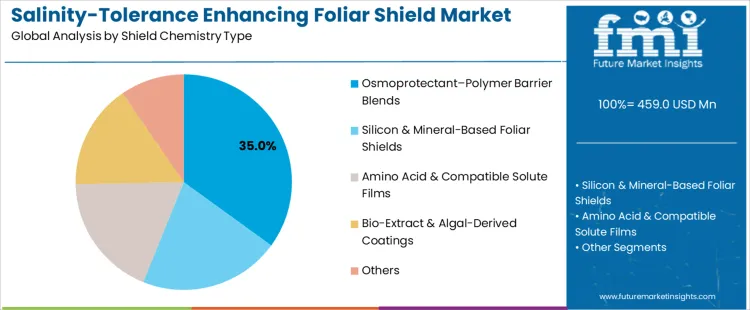
Osmoprotectant polymer barrier blends hold a 35% share in the global salinity-tolerance enhancing foliar shield market due to their ability to provide effective protection against salt-induced stress. These blends create a barrier on the plant leaf that helps mitigate osmotic pressure and protects against harmful ions from high salinity levels. By improving water retention and reducing salt toxicity, these blends are essential in maintaining plant health in saline environments. As agriculture faces increasing salinity challenges, osmoprotectant polymer barrier blends continue to lead the market, offering sustainable solutions for enhancing crop performance in salt-affected areas.
Why Does Ion Toxicity Shielding Hold the Largest Market Share in the Global Salinity-Tolerance Enhancing Foliar Shield Market?
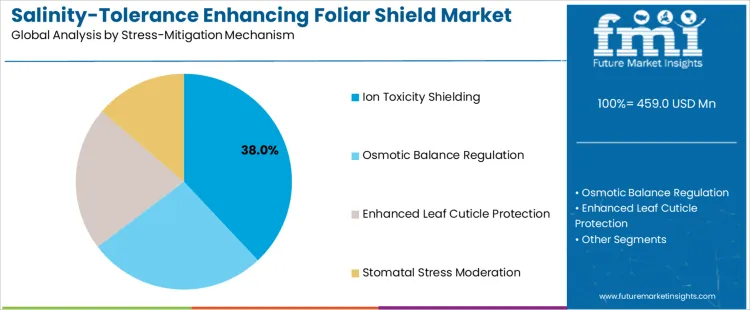
Ion toxicity shielding holds the largest share of 38% in the global salinity-tolerance enhancing foliar shield market due to its effectiveness in protecting plants from the harmful effects of excess salt ions. Salt stress often leads to toxic ion accumulation in plant tissues, particularly sodium and chloride ions, which hinder normal cellular functions. Ion toxicity shielding mechanisms help prevent this ion buildup, ensuring that plants maintain healthy growth despite the presence of high salinity. With increasing salinity challenges in agriculture, ion toxicity shielding remains the most sought-after stress-mitigation mechanism, driving its dominance in the market.
What is Shaping the Salinity Tolerance Enhancing Foliar Shield Market?
The salinity tolerance enhancing foliar shield market is shaped by increasing soil salinization due to irrigation practices, climate change, and rising groundwater. High soil salinity limits water uptake and disrupts nutrient balance, reducing crop growth and yield. Foliar shield products containing osmoprotectants, anti stress agents, and signal modulating compounds help plants maintain cellular integrity and physiological function under saline conditions. As growers confront salinity challenges, there is growing interest in solutions that improve tolerance, stabilize yields, and support sustainable crop production in marginal lands.
What Challenges Are Limiting Adoption of Salinity Tolerance Enhancing Foliar Shields?
Adoption faces challenges related to performance variability and cost. Effectiveness of foliar shields can differ across crop types, stages of growth, and environmental conditions, making growers cautious about consistent yield benefits. Some products carry higher upfront costs, affecting uptake in budget constrained production systems. Integrating foliar shields into existing spray schedules requires agronomic expertise to optimize timing and dose for maximum benefit, which may be limited in certain regions. Limited localized field data on performance under specific soil salinity profiles also slows broader adoption.
What Key Trends Are Shaping the Salinity Tolerance Enhancing Foliar Shield Market?
Key trends include development of multi component foliar shields that combine salinity tolerance enhancement with nutrient delivery and stress related signaling compounds for holistic stress mitigation. Interest in bio based and low toxicity formulations that align with sustainable agriculture goals is rising. Precision application technologies, such as drone assisted foliar delivery and sensor based stress monitoring, are improving placement accuracy and responsiveness to stress conditions. Collaboration between crop science researchers, agritech firms, and chemical formulators is accelerating tailored solutions. Data driven agronomy platforms are helping growers identify optimal application windows based on soil salinity and weather forecasts.
What is the Growth Outlook for the Salinity-Tolerance Enhancing Foliar Shield Market by Country?
| Country | CAGR (%) |
|---|---|
| India | 15.9% |
| China | 14.8% |
| Egypt | 14.2% |
| Australia | 13.9% |
| USA | 13.6% |
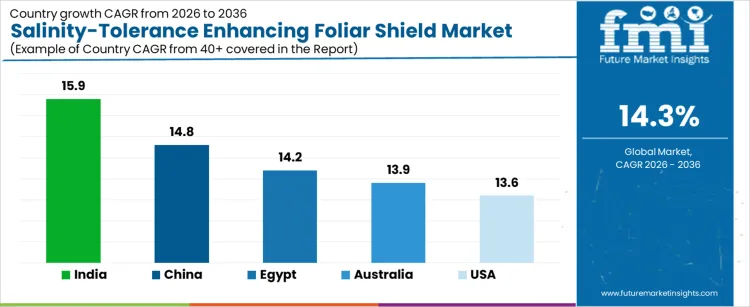
The salinity-tolerance enhancing foliar shield market is growing rapidly, with India leading at a 15.9% CAGR, driven by the country's need to combat soil salinity challenges that affect agricultural productivity. China follows closely with 14.8%, supported by the large agricultural base and the need to protect crops from the effects of saline soil. Egypt’s market grows at 14.2%, driven by increasing demand for solutions to address salinity in its arid agricultural regions. Australia’s market grows at 13.9%, with farmers increasingly adopting salinity-tolerance solutions to improve crop yields in saline-prone areas. The USA’s market grows at 13.6%, driven by the increasing focus on soil and crop resilience in response to environmental challenges.
Why is India Leading in the Salinity-Tolerance Enhancing Foliar Shield Market?
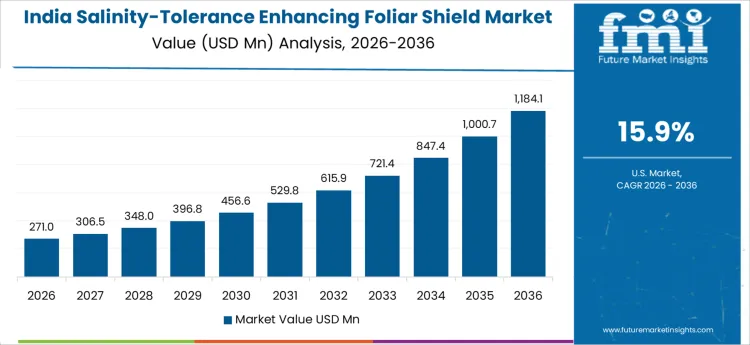
India’s salinity-tolerance enhancing foliar shield market is growing at 15.9%, driven by the country’s significant agricultural base and the increasing challenges posed by soil salinity, especially in regions with intensive farming practices. Soil salinity is a major issue in many parts of India, where it severely impacts crop growth and agricultural productivity. Salinity-tolerance enhancing foliar shields help crops withstand the stress of saline conditions by improving their tolerance to salt, thereby ensuring better yields. With rising concerns over food security and increasing agricultural demand, India’s farmers are adopting these foliar shields as an effective solution to combat salinity stress. As the government pushes for more sustainable and resilient farming practices, the demand for salinity-tolerance enhancing foliar shields is expected to continue growing, ensuring enhanced crop productivity in challenging soil conditions.
What is Driving the Growth of the Salinity-Tolerance Enhancing Foliar Shield Market in China?
China’s salinity-tolerance enhancing foliar shield market is growing at 14.8%, supported by the country’s large agricultural base and the increasing need to manage soil salinity, particularly in arid and semi-arid regions. With China’s agricultural output facing threats from salinity, which reduces water and nutrient uptake in crops, salinity-tolerance enhancing foliar shields provide a valuable solution. These shields improve the ability of crops to thrive in saline environments, enhancing yields and reducing the reliance on chemical interventions. As China seeks to boost crop resilience and address environmental challenges, the demand for salinity-tolerance solutions continues to rise. Government initiatives and the push for sustainable farming practices further contribute to the market’s growth, positioning China as a key player in the adoption of salinity-tolerance enhancing technologies.
How is the Salinity-Tolerance Enhancing Foliar Shield Market Expanding in Egypt?
Egypt’s salinity-tolerance enhancing foliar shield market is growing at 14.2%, driven by the country’s reliance on agriculture in saline-affected soils, particularly in regions dependent on irrigation from the Nile River. With increasing salinity levels in both irrigated and non-irrigated agricultural lands, Egyptian farmers are turning to salinity-tolerance enhancing foliar shields to protect crops and improve yields. These shields help crops resist salinity-induced stress, improving overall productivity in arid and semi-arid regions. As Egypt continues to face the challenge of water scarcity and soil salinity, the adoption of foliar shields is growing. The demand for these products is expected to increase as farmers seek sustainable solutions to enhance crop resilience and protect food security.
What is Contributing to the Growth of the Salinity-Tolerance Enhancing Foliar Shield Market in Australia?
Australia’s salinity-tolerance enhancing foliar shield market is growing at 13.9%, supported by the country’s large agricultural industry and the rising challenges posed by soil salinity, particularly in regions with intensive farming. Salinity is a major issue for Australian farmers, especially in the coastal and inland areas, where high salt concentrations affect crop yields and soil health. Salinity-tolerance enhancing foliar shields provide an effective way to protect crops from the damaging effects of salinity, improving productivity and soil quality. With Australia’s focus on sustainable farming and the need to ensure long-term agricultural resilience, the demand for salinity-tolerance solutions is expected to rise steadily. As Australian farmers continue to adopt environmentally friendly technologies to improve crop growth, the market for foliar shields is expected to expand.
What is Driving the Growth of the Salinity-Tolerance Enhancing Foliar Shield Market in the USA?
The USA’s salinity-tolerance enhancing foliar shield market is growing at 13.6%, driven by the increasing need for effective crop protection in saline-prone soils, particularly in the western and southern regions. Salinity in agricultural soils, caused by irrigation practices and environmental factors, is a growing concern for farmers, impacting crop yields and soil health. Salinity-tolerance enhancing foliar shields help crops better tolerate salt stress, improving their overall resilience and yield potential. As the USA faces growing challenges related to soil degradation and water scarcity, farmers are increasingly turning to advanced solutions like foliar shields to address salinity issues. With a growing focus on sustainable agriculture and precision farming, the demand for salinity-tolerance enhancing foliar shields is expected to continue expanding in the USA.
How Are Companies Competing in the Salinity‑Tolerance Enhancing Foliar Shield Market?
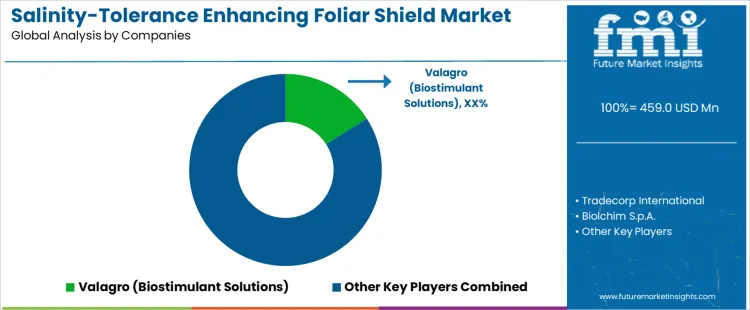
In the salinity‑tolerance enhancing foliar shield market Valagro (Biostimulant Solutions), Tradecorp International, Biolchim S.p.A., Haifa Group (Specialty Foliar Nutrition), Atlantica Agricola, and others are positioned with product brochures that highlight plant resilience and stress mitigation under saline conditions. At Valagro products are presented with detailed data on osmotic balance support and ion regulation, with application guidance tailored to saline stress scenarios. Emphasis is placed on foliar uptake efficiency and improved leaf turgor. Tradecorp International materials describe specialized foliar shields formulated to enhance root‑to‑shoot signaling under salt stress, with trials cited to show performance benefits. Visuals and product summaries are used to convey ease of use and compatibility with existing spray programs.
Biolchim S.p.A. brochures showcase their biostimulant‑based foliar shields with mode‑of‑action explanations and crop‑specific use recommendations. Technical notes reinforce improved salinity tolerance and chlorophyll retention. Haifa Group literature presents specialty foliar nutrition products combined with stress mitigation chemistries, with short performance comparisons that help growers evaluate options for saline environments. Atlantica Agricola collateral highlights formulations designed to maintain cellular function and enhance stress recovery, with charts showing outcomes under fluctuating salt levels. Others in the market are featured with niche solutions that focus on natural extracts or microbial‑enhanced foliar systems aimed at salinity adaptation.
Key Players in Salinity-Tolerance Enhancing Foliar Shield Market
- Valagro (Biostimulant Solutions)
- Tradecorp International
- Biolchim S.p.A.
- Haifa Group (Specialty Foliar Nutrition)
- Atlantica Agricola
- Others
Scope of Report
| Items | Values |
|---|---|
| Quantitative Units (2026) | USD million |
| Shield Chemistry Type | Osmoprotectant–Polymer Barrier Blends, Silicon & Mineral-Based Foliar Shields, Amino Acid & Compatible Solute Films, Bio-Extract & Algal-Derived Coatings, Others |
| Stress-Mitigation Mechanism | Ion Toxicity Shielding, Osmotic Balance Regulation, Enhanced Leaf Cuticle Protection, Stomatal Stress Moderation |
| Regions Covered | Asia Pacific, Europe, North America, Latin America, Middle East & Africa |
| Countries Covered | USA, China, Japan, South Korea, India, Australia & New Zealand, ASEAN, Germany, UK, France, Italy, Spain, Nordic, BENELUX, Brazil, Chile, Mexico, Saudi Arabia, Other GCC Countries, Turkey, South Africa, Other African Union |
| Key Companies Profiled | Valagro (Biostimulant Solutions), Tradecorp International, Biolchim S.p.A., Haifa Group (Specialty Foliar Nutrition), Atlantica Agricola, Others |
| Additional Attributes | Dollar sales by shield chemistry type, stress-mitigation mechanism, and region; regional CAGR and growth outlook; distribution channels including biostimulant suppliers, agriculture solutions providers, and foliar nutrition experts; innovation trends in salinity-tolerance enhancing foliar shields; competitive positioning of global vs regional suppliers. |
Salinity-Tolerance Enhancing Foliar Shield Market by Segments
Shield Chemistry Type:
- Osmoprotectant-Polymer Barrier Blends
- Silicon & Mineral-Based Foliar Shields
- Amino Acid & Compatible Solute Films
- Bio-Extract & Algal-Derived Coatings
- Others
Stress-Mitigation Mechanism:
- Ion Toxicity Shielding
- Osmotic Balance Regulation
- Enhanced Leaf Cuticle Protection
- Stomatal Stress Moderation
Region:
- Asia Pacific
- China
- Japan
- South Korea
- India
- Australia & New Zealand
- ASEAN
- Rest of Asia Pacific
- Europe
- Germany
- United Kingdom
- France
- Italy
- Spain
- Nordic
- BENELUX
- Rest of Europe
- North America
- United States
- Canada
- Mexico
- Latin America
- Brazil
- Chile
- Rest of Latin America
- Middle East & Africa
- Kingdom of Saudi Arabia
- Other GCC Countries
- Turkey
- South Africa
- Other African Union
- Rest of Middle East & Africa
Frequently Asked Questions
How big is the salinity-tolerance enhancing foliar shield market in 2026?
The global salinity-tolerance enhancing foliar shield market is estimated to be valued at USD 459.0 mn in 2026.
What will be the size of salinity-tolerance enhancing foliar shield market in 2036?
The market size for the salinity-tolerance enhancing foliar shield market is projected to reach USD 1,746.9 mn by 2036.
How much will be the salinity-tolerance enhancing foliar shield market growth between 2026 and 2036?
The salinity-tolerance enhancing foliar shield market is expected to grow at a 14.3% CAGR between 2026 and 2036.
What are the key product types in the salinity-tolerance enhancing foliar shield market?
The key product types in salinity-tolerance enhancing foliar shield market are osmoprotectant–polymer barrier blends, silicon & mineral-based foliar shields, amino acid & compatible solute films, bio-extract & algal-derived coatings and others.
Which stress-mitigation mechanism segment to contribute significant share in the salinity-tolerance enhancing foliar shield market in 2026?
In terms of stress-mitigation mechanism, ion toxicity shielding segment to command 38.0% share in the salinity-tolerance enhancing foliar shield market in 2026.
Preview the report firsthand - request a free sample
Get SampleGet the brochure for pricing and purchase details.
Get PDFTable of Content
- Executive Summary
- Global Market Outlook
- Demand-side Trends
- Supply-side Trends
- Technology Roadmap Analysis
- Analysis and Recommendations
- Market Overview
- Market Coverage / Taxonomy
- Market Definition / Scope / Limitations
- Market Background
- Market Dynamics
- Drivers
- Restraints
- Opportunity
- Trends
- Scenario Forecast
- Demand in Optimistic Scenario
- Demand in Likely Scenario
- Demand in Conservative Scenario
- Opportunity Map Analysis
- Product Life Cycle Analysis
- Supply Chain Analysis
- Investment Feasibility Matrix
- Value Chain Analysis
- PESTLE and Porter’s Analysis
- Regulatory Landscape
- Regional Parent Market Outlook
- Production and Consumption Statistics
- Import and Export Statistics
- Market Dynamics
- Global Market Analysis 2021 to 2025 and Forecast, 2026 to 2036
- Historical Market Size Value (USD Million) Analysis, 2021 to 2025
- Current and Future Market Size Value (USD Million) Projections, 2026 to 2036
- Y-o-Y Growth Trend Analysis
- Absolute $ Opportunity Analysis
- Global Market Pricing Analysis 2021 to 2025 and Forecast 2026 to 2036
- Global Market Analysis 2021 to 2025 and Forecast 2026 to 2036, By Shield Chemistry Type
- Introduction / Key Findings
- Historical Market Size Value (USD Million) Analysis By Shield Chemistry Type , 2021 to 2025
- Current and Future Market Size Value (USD Million) Analysis and Forecast By Shield Chemistry Type , 2026 to 2036
- Osmoprotectant-Polymer Barrier Blends
- Silicon & Mineral-Based Foliar Shields
- Amino Acid & Compatible Solute Films
- Bio-Extract & Algal-Derived Coatings
- Others
- Y-o-Y Growth Trend Analysis By Shield Chemistry Type , 2021 to 2025
- Absolute $ Opportunity Analysis By Shield Chemistry Type , 2026 to 2036
- Global Market Analysis 2021 to 2025 and Forecast 2026 to 2036, By Stress-Mitigation Mechanism
- Introduction / Key Findings
- Historical Market Size Value (USD Million) Analysis By Stress-Mitigation Mechanism, 2021 to 2025
- Current and Future Market Size Value (USD Million) Analysis and Forecast By Stress-Mitigation Mechanism, 2026 to 2036
- Ion Toxicity Shielding
- Osmotic Balance Regulation
- Enhanced Leaf Cuticle Protection
- Stomatal Stress Moderation
- Y-o-Y Growth Trend Analysis By Stress-Mitigation Mechanism, 2021 to 2025
- Absolute $ Opportunity Analysis By Stress-Mitigation Mechanism, 2026 to 2036
- Global Market Analysis 2021 to 2025 and Forecast 2026 to 2036, By Region
- Introduction
- Historical Market Size Value (USD Million) Analysis By Region, 2021 to 2025
- Current Market Size Value (USD Million) Analysis and Forecast By Region, 2026 to 2036
- North America
- Latin America
- Western Europe
- Eastern Europe
- East Asia
- South Asia and Pacific
- Middle East & Africa
- Market Attractiveness Analysis By Region
- North America Market Analysis 2021 to 2025 and Forecast 2026 to 2036, By Country
- Historical Market Size Value (USD Million) Trend Analysis By Market Taxonomy, 2021 to 2025
- Market Size Value (USD Million) Forecast By Market Taxonomy, 2026 to 2036
- By Country
- USA
- Canada
- Mexico
- By Shield Chemistry Type
- By Stress-Mitigation Mechanism
- By Country
- Market Attractiveness Analysis
- By Country
- By Shield Chemistry Type
- By Stress-Mitigation Mechanism
- Key Takeaways
- Latin America Market Analysis 2021 to 2025 and Forecast 2026 to 2036, By Country
- Historical Market Size Value (USD Million) Trend Analysis By Market Taxonomy, 2021 to 2025
- Market Size Value (USD Million) Forecast By Market Taxonomy, 2026 to 2036
- By Country
- Brazil
- Chile
- Rest of Latin America
- By Shield Chemistry Type
- By Stress-Mitigation Mechanism
- By Country
- Market Attractiveness Analysis
- By Country
- By Shield Chemistry Type
- By Stress-Mitigation Mechanism
- Key Takeaways
- Western Europe Market Analysis 2021 to 2025 and Forecast 2026 to 2036, By Country
- Historical Market Size Value (USD Million) Trend Analysis By Market Taxonomy, 2021 to 2025
- Market Size Value (USD Million) Forecast By Market Taxonomy, 2026 to 2036
- By Country
- Germany
- UK
- Italy
- Spain
- France
- Nordic
- BENELUX
- Rest of Western Europe
- By Shield Chemistry Type
- By Stress-Mitigation Mechanism
- By Country
- Market Attractiveness Analysis
- By Country
- By Shield Chemistry Type
- By Stress-Mitigation Mechanism
- Key Takeaways
- Eastern Europe Market Analysis 2021 to 2025 and Forecast 2026 to 2036, By Country
- Historical Market Size Value (USD Million) Trend Analysis By Market Taxonomy, 2021 to 2025
- Market Size Value (USD Million) Forecast By Market Taxonomy, 2026 to 2036
- By Country
- Russia
- Poland
- Hungary
- Balkan & Baltic
- Rest of Eastern Europe
- By Shield Chemistry Type
- By Stress-Mitigation Mechanism
- By Country
- Market Attractiveness Analysis
- By Country
- By Shield Chemistry Type
- By Stress-Mitigation Mechanism
- Key Takeaways
- East Asia Market Analysis 2021 to 2025 and Forecast 2026 to 2036, By Country
- Historical Market Size Value (USD Million) Trend Analysis By Market Taxonomy, 2021 to 2025
- Market Size Value (USD Million) Forecast By Market Taxonomy, 2026 to 2036
- By Country
- China
- Japan
- South Korea
- By Shield Chemistry Type
- By Stress-Mitigation Mechanism
- By Country
- Market Attractiveness Analysis
- By Country
- By Shield Chemistry Type
- By Stress-Mitigation Mechanism
- Key Takeaways
- South Asia and Pacific Market Analysis 2021 to 2025 and Forecast 2026 to 2036, By Country
- Historical Market Size Value (USD Million) Trend Analysis By Market Taxonomy, 2021 to 2025
- Market Size Value (USD Million) Forecast By Market Taxonomy, 2026 to 2036
- By Country
- India
- ASEAN
- Australia & New Zealand
- Rest of South Asia and Pacific
- By Shield Chemistry Type
- By Stress-Mitigation Mechanism
- By Country
- Market Attractiveness Analysis
- By Country
- By Shield Chemistry Type
- By Stress-Mitigation Mechanism
- Key Takeaways
- Middle East & Africa Market Analysis 2021 to 2025 and Forecast 2026 to 2036, By Country
- Historical Market Size Value (USD Million) Trend Analysis By Market Taxonomy, 2021 to 2025
- Market Size Value (USD Million) Forecast By Market Taxonomy, 2026 to 2036
- By Country
- Kingdom of Saudi Arabia
- Other GCC Countries
- Turkiye
- South Africa
- Other African Union
- Rest of Middle East & Africa
- By Shield Chemistry Type
- By Stress-Mitigation Mechanism
- By Country
- Market Attractiveness Analysis
- By Country
- By Shield Chemistry Type
- By Stress-Mitigation Mechanism
- Key Takeaways
- Key Countries Market Analysis
- USA
- Pricing Analysis
- Market Share Analysis, 2025
- By Shield Chemistry Type
- By Stress-Mitigation Mechanism
- Canada
- Pricing Analysis
- Market Share Analysis, 2025
- By Shield Chemistry Type
- By Stress-Mitigation Mechanism
- Mexico
- Pricing Analysis
- Market Share Analysis, 2025
- By Shield Chemistry Type
- By Stress-Mitigation Mechanism
- Brazil
- Pricing Analysis
- Market Share Analysis, 2025
- By Shield Chemistry Type
- By Stress-Mitigation Mechanism
- Chile
- Pricing Analysis
- Market Share Analysis, 2025
- By Shield Chemistry Type
- By Stress-Mitigation Mechanism
- Germany
- Pricing Analysis
- Market Share Analysis, 2025
- By Shield Chemistry Type
- By Stress-Mitigation Mechanism
- UK
- Pricing Analysis
- Market Share Analysis, 2025
- By Shield Chemistry Type
- By Stress-Mitigation Mechanism
- Italy
- Pricing Analysis
- Market Share Analysis, 2025
- By Shield Chemistry Type
- By Stress-Mitigation Mechanism
- Spain
- Pricing Analysis
- Market Share Analysis, 2025
- By Shield Chemistry Type
- By Stress-Mitigation Mechanism
- France
- Pricing Analysis
- Market Share Analysis, 2025
- By Shield Chemistry Type
- By Stress-Mitigation Mechanism
- India
- Pricing Analysis
- Market Share Analysis, 2025
- By Shield Chemistry Type
- By Stress-Mitigation Mechanism
- ASEAN
- Pricing Analysis
- Market Share Analysis, 2025
- By Shield Chemistry Type
- By Stress-Mitigation Mechanism
- Australia & New Zealand
- Pricing Analysis
- Market Share Analysis, 2025
- By Shield Chemistry Type
- By Stress-Mitigation Mechanism
- China
- Pricing Analysis
- Market Share Analysis, 2025
- By Shield Chemistry Type
- By Stress-Mitigation Mechanism
- Japan
- Pricing Analysis
- Market Share Analysis, 2025
- By Shield Chemistry Type
- By Stress-Mitigation Mechanism
- South Korea
- Pricing Analysis
- Market Share Analysis, 2025
- By Shield Chemistry Type
- By Stress-Mitigation Mechanism
- Russia
- Pricing Analysis
- Market Share Analysis, 2025
- By Shield Chemistry Type
- By Stress-Mitigation Mechanism
- Poland
- Pricing Analysis
- Market Share Analysis, 2025
- By Shield Chemistry Type
- By Stress-Mitigation Mechanism
- Hungary
- Pricing Analysis
- Market Share Analysis, 2025
- By Shield Chemistry Type
- By Stress-Mitigation Mechanism
- Kingdom of Saudi Arabia
- Pricing Analysis
- Market Share Analysis, 2025
- By Shield Chemistry Type
- By Stress-Mitigation Mechanism
- Turkiye
- Pricing Analysis
- Market Share Analysis, 2025
- By Shield Chemistry Type
- By Stress-Mitigation Mechanism
- South Africa
- Pricing Analysis
- Market Share Analysis, 2025
- By Shield Chemistry Type
- By Stress-Mitigation Mechanism
- USA
- Market Structure Analysis
- Competition Dashboard
- Competition Benchmarking
- Market Share Analysis of Top Players
- By Regional
- By Shield Chemistry Type
- By Stress-Mitigation Mechanism
- Competition Analysis
- Competition Deep Dive
- Valagro (Biostimulant Solutions)
- Overview
- Product Portfolio
- Profitability by Market Segments (Product/Age /Sales Channel/Region)
- Sales Footprint
- Strategy Overview
- Marketing Strategy
- Product Strategy
- Channel Strategy
- Tradecorp International
- Biolchim S.p.A.
- Haifa Group (Specialty Foliar Nutrition)
- Atlantica Agricola
- Others
- Valagro (Biostimulant Solutions)
- Competition Deep Dive
- Assumptions & Acronyms Used
- Research Methodology


