

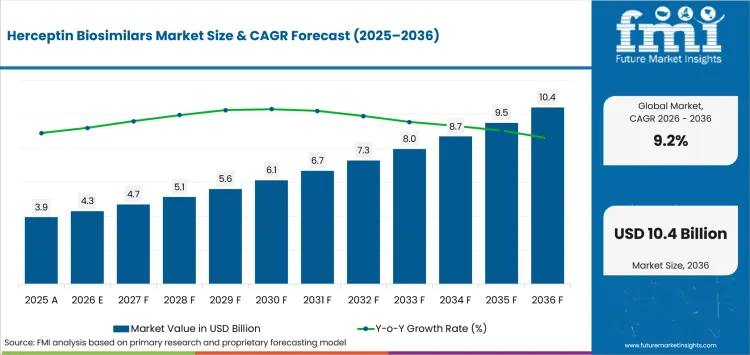
- Market Size (2026)
- USD 4.3 Bn
- Forecast (2036)
- USD 10.4 Bn
- CAGR (2026 to 2036)
- 9.2%
How big is the Herceptin Biosimilars Market in 2026?
USD 4.3 billion in 2026 and USD 10.4 billion by 2036 at a 9.2% CAGR.
Herceptin biosimilars sales are projected at 9.2% CAGR through 2036, rising from USD 4.3 billion to USD 10.4 billion. Hospitals use biosimilars and follow-on biologics to maintain lower-cost treatment within oncology formularies. WHO reported in February 2025 that trastuzumab biosimilars cost 65% less than reference therapy, while access requires dependable supply.
Approval routes determine which products hospitals can contract, and FDA's June 2026 Purple Book lists six licensed trastuzumab biosimilars. Japan and the United Kingdom use national routes while France and Germany rely on reimbursement lists and tenders, which shape launch timing for monoclonal antibody therapies and formulary conversion.
Key Takeaways of Herceptin Biosimilars Market
- Hospital oncology systems convert regulatory comparability into recurring demand through formulary control, infusion capacity and pharmacy oversight.
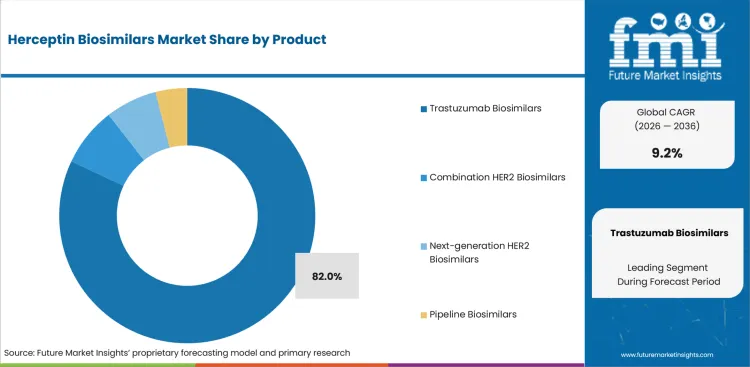
- Trastuzumab biosimilars are projected to hold 82.0% of product demand in 2026, driven by established regulatory approvals and broad adoption across approved oncology indications.
- Hospital pharmacies are estimated to account for 54.0% of distribution in 2026, as they oversee the storage and traceability requirements of biologic cancer therapies.
- HER2-positive breast cancer is forecast to represent 64.0% of indications in 2026, supported by its large patient population and the widespread use of trastuzumab-based treatment regimens.
- Tender discounting weakens returns because validated production, pharmacovigilance and reserve inventory remain necessary during contracted supply.
- Celltrion, Samsung Bioepis, Amgen, Pfizer, Biocon Biologics, Sandoz, Organon, Teva, Dr. Reddy's Laboratories and Shanghai Henlius form the notable companies in the industry.
Analyst Perspective
“Hospital contracting teams should compare delivered treatment cost with vial use, supply resilience and the work required to change pharmacy protocols. Commercial value depends on keeping trastuzumab available across scheduled cycles instead of winning an unsustainable tender.”
- Anurag Sharma, Principal Consultant for Healthcare, Future Market Insights
How is the Herceptin Biosimilars Market segmented?
The Herceptin biosimilars market is segmented by product, distribution channel, indication, route of administration, end user and region.
Products include trastuzumab biosimilars, HER2 combinations and pipeline candidates, while distribution spans hospital, specialty and retail pharmacies. Indications cover HER2-positive breast, gastric and other cancers, while intravenous, subcutaneous and combination therapy serve hospitals, oncology clinics and infusion centers.
Why do trastuzumab biosimilars lead demand within the product category?
Approved trastuzumab biosimilars enter established HER2-positive breast and gastric cancer protocols against the same reference medicine. Hospital committees compare regulatory evidence, vial presentation and supply terms during formulary review for each product.
- By product, trastuzumab biosimilars are estimated to hold 82.0% in 2026 owing to approved indications and familiar hospital use.
- Next-generation programs compete on administration, requiring subcutaneous candidates to prove comparable pharmacokinetics and dependable device supply before hospitals justify conversion.
Why do hospital pharmacies lead demand within the distribution channel category?
Hospital pharmacies turn an intravenous biologic into a scheduled treatment dose under controlled oncology protocols and manage cold storage plus patient-specific preparation and release to infusion units.
- In 2026, hospital pharmacies are expected to lead distribution with 54.0% share because institutional teams control preparation and product release.
- Specialty pharmacies support outpatient biologics distribution and cold-chain management, but recurring orders depend on documented handoffs between dispensing teams and clinical administration sites.
Why does HER2-positive breast cancer lead demand within the indication category?
Breast cancer drugs provide the broadest established clinical base for trastuzumab across early and metastatic settings. IARC reported in October 2024 that more than 2.3 million new breast cancer cases occurred worldwide during 2022.
- HER2-positive breast cancer is set to lead the indication category with 64.0% share in 2026 due to established adjuvant and metastatic pathways.
- HER2-positive gastric cancer forms a second approved indication with different testing and treatment routes, while broader oncology adjuvants generate less recurring trastuzumab use than established breast cancer protocols.
Why does intravenous administration lead demand within the route category?
Commercial trastuzumab biosimilars remain concentrated in intravenous presentations that fit established injectable drug platforms, so pharmacy teams assess vial strengths and infusion-chair capacity during formulary review.
- The route category is forecast to be led by intravenous administration at 78.0% share in 2026 due to established hospital infusion workflows.
- Subcutaneous biologics require a separate comparative program because high-dose delivery uses a different formulation route. Commercial adoption depends on shorter administration without transferring monitoring or supply risk to oncology clinics.
What are the drivers, restraints and opportunities in the Herceptin Biosimilars Market?
Hospital purchasing expands approved use, while tender price erosion limits returns and subcutaneous delivery offers differentiation beyond vial discounts.
- Driver: Hospital formularies convert regulatory comparability into routine trastuzumab use across established oncology treatment pathways.
- Restraint: Tender discounting lowers net revenue while manufacturers retain validated production, pharmacovigilance and continuity obligations.
- Opportunity: Subcutaneous delivery and payer preference can distinguish comparable products beyond intravenous vial pricing and infusion time.
Hospital Purchasing Converts Regulatory Comparability into Routine Use
Regulatory comparability gives hospital committees a common clinical baseline across approved biosimilar oncology medicines, and routine use follows once contracts cover treatment cost plus switching support and uninterrupted inventory.
Price Erosion Raises the Cost of Supply Failure
Tender discounting reduces net revenue although biologics contract manufacturing still requires validated production and pharmacovigilance. Manufacturers carry traceability and reserve-inventory duties, so low bids become uneconomic if shortages force an unplanned switch.
Subcutaneous Programs Depend on a Distinct Access Route
Subcutaneous delivery gives developers a route beyond vial discounting and infusion-chair competition, but each formulation requires comparative evidence with compatible hospital monitoring. Revenue depends on dependable device supply and implementation support during commercial rollout across infusion centers.
Which country CAGRs are profiled in the Herceptin Biosimilars Market?
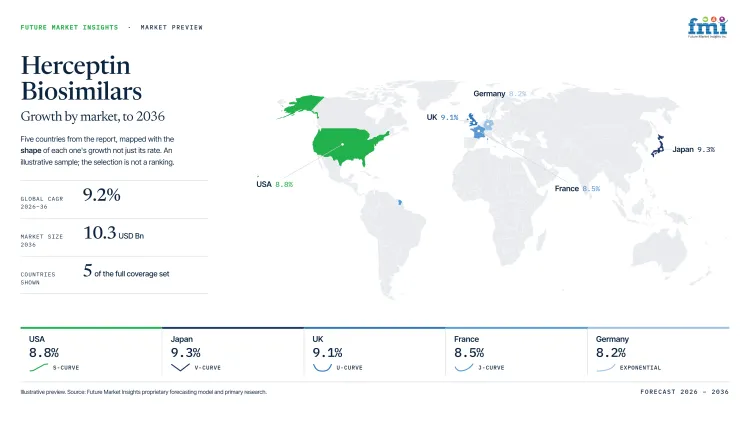
| Country | CAGR |
|---|---|
| Japan | 9.3% |
| United Kingdom | 9.1% |
| United States | 8.8% |
| France | 8.5% |
| Germany | 8.2% |
How do country-level CAGRs compare in the Herceptin Biosimilars Market?
The forecasts span 1.1 percentage points between Japan and Germany across mature oncology systems, although shared clinical eligibility masks different authorization and contracting routes.
- Japan combines biosimilar reimbursement incentives with hospital control over switching decisions and inventory planning across oncology services.
- United Kingdom growth reflects national biological-medicine commissioning with local implementation responsibilities across established cancer treatment networks.
- United States expansion depends on payer contracts across six licensed products and several site-of-care settings.
- France links recurring hospital orders to indication-level reimbursement and dependable product availability across public oncology services.
- Germany places greater weight on tender design, traceability and continuity commitments across competing EU-authorized products.
Comparable CAGRs across the profiled countries do not imply equal scale or identical commercial routes. Full report coverage includes North America, Latin America, Western Europe, Eastern Europe, East Asia, South Asia and Pacific, and Middle East and Africa.
Country-wise Analysis
- Japan is projected to expand at a 9.3% CAGR through 2036, reflecting continued policy support for biosimilar adoption within the national reimbursement system. Biosimilar use is linked to incentive programs and price listings that define reimbursable presentations, with a March 2026 MHLW notice covering four trastuzumab biosimilar presentations. Hospital-level switching protocols and inventory coordination nevertheless remain important determinants of conversion rates and treatment continuity.
- The United Kingdom is anticipated to advance at a 9.1% CAGR over the assessment period, supported by established procurement and commissioning frameworks for biological medicines. NHS England's April 2025 best-value biological medicines framework encourages biosimilar uptake across hospital networks, while individual trusts continue to determine formulary implementation and supply-transition timelines.
- The United States is expected to record an 8.8% CAGR during the forecast period, aided by broad reimbursement access for physician-administered biologics. Providers can choose among multiple intravenous trastuzumab biosimilars, while Medicare coverage supports treatment access across physician offices and outpatient settings. Product selection ultimately depends on payer agreements and supplier performance.
- France is forecast to expand at an 8.5% CAGR through 2036, with uptake closely tied to hospital reimbursement structures. Oncology providers can procure trastuzumab biosimilars through mechanisms that reimburse selected medicines outside standard hospitalization tariffs. Commercial adoption depends not only on regulatory authorization but also on hospital contracting decisions and inventory management across treatment cycles.
- Germany is estimated to post an 8.2% CAGR over the forecast period, shaped by competitive tendering and structured procurement practices. Hospital groups routinely evaluate EU-authorized trastuzumab products on the basis of pricing, traceability, and supply reliability. The addition of Dazublys following its EU authorization in June 2025 broadened available options, although manufacturers must still balance tender pricing with inventory commitments and pharmacovigilance obligations.
Who are the notable companies in the Herceptin Biosimilars Market?
Celltrion, Samsung Bioepis, Amgen, Pfizer, Biocon Biologics, Sandoz, Organon, Teva Pharmaceutical Industries, Dr. Reddy's Laboratories and Shanghai Henlius are the notable companies serving this market.
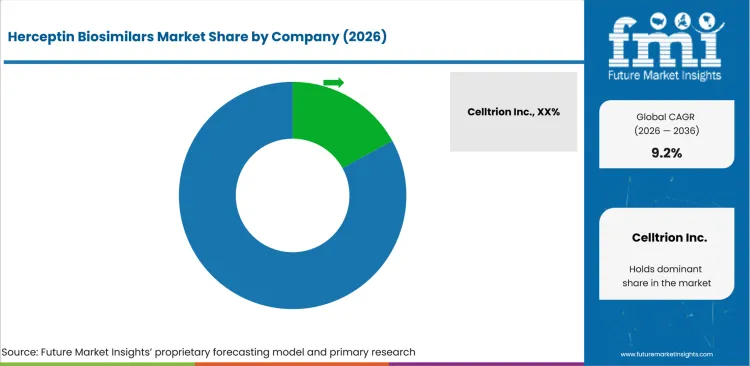
The competitive outlook combines biosimilar developers with multinational commercialization platforms and regional oncology manufacturers, while hospital tenders favor comparative evidence plus dependable production and clear market rights. Development ownership may differ from commercial control, so targeted oncology biologics access often depends on commercialization partners.
- Celltrion, Samsung Bioepis, Amgen, Pfizer and Biocon Biologics combine regulated-market approvals with direct or partner-led commercialization.
- Sandoz and Shanghai Henlius extend competition through adjacent HER2 programs, regional licensing and broader geographic coverage.
- Organon and Teva add established commercialization routes, while Dr. Reddy's Laboratories maintains regional trastuzumab activity in selected markets.
Competitive Benchmarking: Herceptin Biosimilars Market
| Company | Regulatory Footprint | Commercial Control | HER2 Portfolio Depth | Geographic Reach |
|---|---|---|---|---|
| Celltrion Inc. | High | Medium | High | Global |
| Samsung Bioepis Co., Ltd. | High | Medium | Medium | Global |
| Amgen Inc. | High | High | Medium | Global |
| Pfizer Inc. | High | High | Medium | Global |
| Biocon Biologics Ltd. | High | High | Medium | Global |
| Sandoz Group AG | Medium | High | High | Europe and international markets |
| Organon & Co. | High | Medium | Medium | Global |
| Teva Pharmaceutical Industries Ltd. | Medium | Medium | Medium | North America |
| Dr. Reddy's Laboratories Ltd. | Low | High | Low | India and selected markets |
| Shanghai Henlius Biotech, Inc. | High | Medium | High | Global through partners |
Key Developments in the Herceptin Biosimilars Market
- In February 2026, Celltrion completed the pivotal Herzuma SC regulatory trial and planned submissions in Europe and Korea. The program reported equivalent pharmacokinetics with administration lasting about five minutes for scheduled hospital use.
- In January 2026, Accord BioPharma reported HERCESSI preferred status on Express Scripts national commercial formularies. The placement made HERCESSI one of two preferred trastuzumab biosimilars under that national commercial coverage.
- In November 2025, Sandoz signed a global license agreement with EirGenix for pertuzumab biosimilar EG1206A. EirGenix retained development and manufacturing while Sandoz received commercialization rights outside specified Asian markets.
Key Players in the Herceptin Biosimilars Market
Global Biosimilar Developers
- Celltrion Inc.
- Samsung Bioepis Co., Ltd.
- Amgen Inc.
- Pfizer Inc.
- Biocon Biologics Ltd.
- Sandoz Group AG
- Shanghai Henlius Biotech, Inc.
Regional Oncology Biosimilar Developer
- Dr. Reddy's Laboratories Ltd.
Commercialization and Market-access Partners
- Organon & Co.
- Teva Pharmaceutical Industries Ltd.
Herceptin Biosimilars Market - Report Scope
| Coverage field | Report scope |
|---|---|
| Market breakdown | By product, distribution channel, indication, route of administration, end user and region. |
| Quantitative Units | Revenue in USD billion and CAGR in %. |
| Market Definition | Approved and pipeline trastuzumab biosimilars referencing Herceptin, with related HER2 combination and administration categories. |
| Regions Covered | North America, Latin America, Western Europe, Eastern Europe, East Asia, South Asia and Pacific, and Middle East and Africa. |
| Countries Covered | Japan, United Kingdom, United States, France, Germany, and 30+ countries included in the full report. |
| Key Companies Profiled | Celltrion, Samsung Bioepis, Amgen, Pfizer, Biocon Biologics, Sandoz, Organon, Teva, Dr. Reddy's Laboratories and Shanghai Henlius. |
| Forecast Period | 2026 to 2036. |
| Approach | Primary and secondary research with market triangulation. |
Herceptin Biosimilars Market - Research Methodology
| Method | Approach |
|---|---|
| Primary Research | FMI analysts gathered input from manufacturers, service providers, technology developers, distributors, end users, procurement teams, and subject-matter experts. Interviews examined purchasing decisions, product or service evaluation, adoption barriers, approval requirements, pricing considerations, and expectations for technical or commercial support. Respondents were also asked what evidence is required before a trial, pilot, or initial order develops into regular purchasing. |
| Desk Research | Desk research covered government statistics, regulatory publications, trade data, industry associations, technical literature, standards, company filings, product information, and official corporate announcements. Sources were reviewed for relevance, publication date, geographic coverage, and consistency with the defined market scope. Claims relating to performance, applications, approvals, capacity, investment, and commercial activity were retained only when supported by credible public evidence. |
| Market Sizing and Forecasting | The market model combined the baseline value with historical performance, segment structure, pricing and volume indicators, adoption levels, company participation, and country-level demand conditions. Forecast assumptions considered economic activity, investment trends, regulatory developments, technology adoption, purchasing cycles, supply availability, and barriers to wider market use. Segment and regional estimates were reconciled before the final market total was calculated. |
| Data Validation | Estimates were checked against multiple independent indicators, including public data, company activity, trade patterns, industry developments, and findings from primary interviews. Validation also tested whether products, services, applications, and company revenues fell within the defined market boundaries. Adjacent categories, unsupported claims, overlapping revenues, and activities without direct market relevance were excluded to reduce double counting and maintain consistency across segments and countries. |
Herceptin Biosimilars Market by Segments
Herceptin Biosimilars Market segmented by Product:
- Trastuzumab Biosimilars
- Approved Trastuzumab Biosimilars
- Interchangeable Biosimilars
- Intravenous Formulations
- Combination HER2 Biosimilars
- Trastuzumab-Pertuzumab Combinations
- Fixed-dose Combination Biosimilars
- Pipeline Combination Products
- Next-generation HER2 Biosimilars
- Subcutaneous Biosimilars
- High-concentration Formulations
- Long-acting Biosimilars
- Pipeline Biosimilars
- Phase III Candidates
- Regulatory Review Products
- Regional Biosimilar Candidates
Herceptin Biosimilars Market segmented by Distribution Channel:
- Hospital Pharmacies
- Inpatient Pharmacies
- Outpatient Hospital Pharmacies
- Oncology Pharmacy Units
- Specialty Pharmacies
- Biologics Distribution
- Oncology Specialty Pharmacies
- Cold Chain Distribution
- Retail & Online Pharmacies
- Chain Pharmacies
- E-pharmacy Platforms
- Home Delivery Services
Herceptin Biosimilars Market segmented by Indication:
- HER2-positive Breast Cancer
- Early-stage Breast Cancer
- Metastatic Breast Cancer
- Adjuvant & Neoadjuvant Therapy
- HER2-positive Gastric Cancer
- Metastatic Gastric Cancer
- Gastroesophageal Junction Cancer
- Advanced Gastric Adenocarcinoma
- Other HER2-positive Cancers
- Colorectal Cancer
- Endometrial Cancer
- Non-small Cell Lung Cancer
Herceptin Biosimilars Market segmented by Route of Administration:
- Intravenous
- Hospital Infusion
- Day-care Infusion Centers
- Oncology Infusion Units
- Subcutaneous
- Prefilled Injection Systems
- Outpatient Administration
- Home-based Administration
- Combination Therapy
- With Chemotherapy
- With Targeted Therapy
- With Immunotherapy
Herceptin Biosimilars Market segmented by End User:
- Hospitals
- Comprehensive Cancer Centers
- Tertiary Care Hospitals
- Academic Medical Centers
- Specialty Oncology Clinics
- Breast Cancer Clinics
- Oncology Day-care Centers
- Multispecialty Cancer Clinics
- Ambulatory Infusion Centers
- Outpatient Infusion Centers
- Specialty Infusion Facilities
- Cancer Treatment Networks
Herceptin Biosimilars Market by Region:
- North America
- United States
- Canada
- Mexico
- Latin America
- Brazil
- Chile
- Rest of Latin America
- Western Europe
- Germany
- United Kingdom
- Italy
- Spain
- France
- Nordics
- Benelux
- Rest of Western Europe
- Eastern Europe
- Russia
- Poland
- Hungary
- Balkan and Baltic States
- Rest of Eastern Europe
- East Asia
- China
- Japan
- South Korea
- South Asia and Pacific
- India
- ASEAN
- Australia and New Zealand
- Rest of South Asia and Pacific
- Middle East and Africa
- Kingdom of Saudi Arabia
- Other GCC Countries
- Türkiye
- South Africa
- Other African Union Countries
- Rest of Middle East and Africa
Research Sources and Bibliography
- World Health Organization. (2025, February 13). Biosimilars: expanding access to essential biologic therapies.
- USA Food and Drug Administration. (2026, June). Download Purple Book Data.
- International Agency for Research on Cancer. (2024, October 1). IARC marks Breast Cancer Awareness Month 2024.
- Ministry of Health, Labour and Welfare. (2026, March 5).
- NHS England. (2025, April 9). Commissioning framework for best value biological medicines.
- Centers for Medicare & Medicaid Services. (2026, March 10). Part B Drugs and Biologicals.
- Ministère de la Santé. (2026, June 1). Référentiel des indications des spécialités pharmaceutiques inscrites sur la liste en sus.
- European Medicines Agency. (2025, August 12). Dazublys.
- Celltrion. (2026, February 2). Celltrion to File for Approval of ‘Herzuma SC’ in Europe and Korea Within Three Months... World's First Biosimilar Incorporating Hyaluronidase and Establishing an Integrated Platform.
- Accord BioPharma. (2026, January 5). Accord BioPharma's HERCESSI™ (trastuzumab-strf) Gains Preferred Status on Express Scripts National Commercial Formularies.
- EirGenix Inc. (2025, November 12). EirGenix Signed The Commercial Licensing Agreement for Its Second HER2 Biosimilar Asset EG1206A.
This bibliography is provided for reader reference and is not exhaustive. The full report contains the complete reference list and detailed citations.
This Report Answers
- How large is the Herceptin biosimilars market in 2026 and 2036?
- How do approval breadth and hospital contracting shape recurring demand?
- Why do trastuzumab biosimilars hold 82.0% of product demand in 2026?
- How does hospital-pharmacy control shape distribution and switching?
- Which indication and administration route categories lead during 2026?
- How do reimbursement and tender routes differ across five profiled countries?
- Which companies combine regulatory reach with direct or partner-led commercialization?
- What limits manufacturer returns under tender pricing and supply obligations?
Frequently Asked Questions
How big is the Herceptin Biosimilars Market in 2026?
The herceptin biosimilars market is estimated at USD 4.3 billion in 2026. Hospital formularies convert regulatory comparability into recurring orders across approved breast and gastric cancer pathways, provided manufacturers maintain traceable inventory and dependable delivery throughout scheduled treatment cycles.
What is the CAGR of the Herceptin Biosimilars Market from 2026 to 2036?
The herceptin biosimilars market is projected to expand at a 9.2% CAGR between 2026 and 2036. Expansion depends on wider contracting access, hospital switching support and supply performance that protects scheduled treatment cycles despite continuing price pressure across competitive tenders.
Which product category leads the Herceptin Biosimilars Market?
Trastuzumab biosimilars are estimated to hold 82.0% of the Herceptin biosimilars market product category in 2026. Established approvals and reference-aligned indications let hospital committees compare price, vial presentation and supply terms without changing the established oncology treatment pathway and pharmacy workflow.
How much value will the Herceptin Biosimilars Market add by 2036?
The herceptin biosimilars market is forecast to add USD 6.06 billion between 2026 and 2036. Wider formulary access expands treated volume, although tender price erosion and continuing pharmacovigilance obligations limit how much forecast growth becomes recurring net manufacturer revenue over time.
Which companies are active in the Herceptin Biosimilars Market?
The herceptin biosimilars market includes Celltrion, Samsung Bioepis, Amgen, Pfizer, Biocon Biologics and Sandoz. Organon, Teva, Dr. Reddy's Laboratories and Shanghai Henlius also participate through development, regional commercialization or partner-led market access across approved trastuzumab products and presentations in regulated markets.
Preview the report firsthand - request a free sample
Get SampleGet the brochure for pricing and purchase details.
Get PDFTable of Content
- Key Takeaways
- Market Size and CAGR
- Top Growth Driver
- Fastest Growing Segment
- Leading Region
- Key Companies
- Emerging Opportunities
- Executive Summary
- Global Market Outlook
- Demand-side Trends
- Supply-side Trends
- Technology Roadmap Analysis
- Analysis and Recommendations
- Analyst Perspective (What is happening? Why now? What should investors know?)
- Key Questions Answered
- How large is the market?
- What is the CAGR?
- What are key trends?
- Which region dominates?
- Who are the leaders?
- Market Overview
- Market Coverage / Taxonomy
- Market Definition / Scope / Limitations
- Research Methodology
- Chapter Orientation
- Analytical Lens and Working Hypotheses
- Market Structure, Signals, and Trend Drivers
- Benchmarking and Cross-market Comparability
- Market Sizing, Forecasting, and Opportunity Mapping
- Research Design and Evidence Framework
- Desk Research Programme (Secondary Evidence)
- Expert Input and Fieldwork (Primary Evidence)
- Tooling, Models, and Reference Databases
- Data Engineering and Model Build
- Quality Assurance and Audit Trail
- Market Background
- Market Dynamics (Drivers, Restraints, Opportunity, Trends)
- Scenario Forecast (Optimistic, Likely, Conservative)
- Impact Analysis
- AI Impact
- Sustainability Impact
- Regulatory Impact
- Technology Impact
- Consumer / Buyer Analysis
- Purchase Drivers
- Adoption Barriers
- Buyer Journey
- Opportunity Map Analysis
- Product Life Cycle Analysis
- Supply Chain Analysis
- Investment Feasibility Matrix
- Value Chain Analysis
- PESTLE and Porter's Analysis
- Regulatory Landscape
- Regional Parent Market Outlook
- Production and Consumption Statistics
- Import and Export Statistics
- Global Market Analysis and Forecast, 2021 to 2036
- Historical Market Size Value (USD Billion) Analysis, 2021 to 2025
- Current and Future Market Size Value (USD Billion) Projections, 2026 to 2036
- Y-o-Y Growth Trend Analysis
- Absolute $ Opportunity Analysis
- Global Market Pricing Analysis, 2021 to 2036
- Global Market Analysis and Forecast, By Product, 2021 to 2036
- Introduction / Key Findings
- Historical Market Size Value (USD Billion) Analysis By Product, 2021 to 2025
- Current and Future Market Size Value (USD Billion) Analysis and Forecast By Product, 2026 to 2036
- Trastuzumab Biosimilars
- Approved Trastuzumab Biosimilars
- Interchangeable Biosimilars
- Intravenous Formulations
- Combination HER2 Biosimilars
- Trastuzumab - Pertuzumab Combinations
- Fixed-dose Combination Biosimilars
- Pipeline Combination Products
- Next-generation HER2 Biosimilars
- Subcutaneous Biosimilars
- High-concentration Formulations
- Long-acting Biosimilars
- Pipeline Biosimilars
- Phase III Candidates
- Regulatory Review Products
- Regional Biosimilar Candidates
- Trastuzumab Biosimilars
- Y-o-Y Growth Trend Analysis By Product, 2021 to 2025
- Absolute $ Opportunity Analysis By Product, 2026 to 2036
- Global Market Analysis and Forecast, By Distribution Channel, 2021 to 2036
- Introduction / Key Findings
- Historical Market Size Value (USD Billion) Analysis By Distribution Channel, 2021 to 2025
- Current and Future Market Size Value (USD Billion) Analysis and Forecast By Distribution Channel, 2026 to 2036
- Hospital Pharmacies
- Inpatient Pharmacies
- Outpatient Hospital Pharmacies
- Oncology Pharmacy Units
- Specialty Pharmacies
- Biologics Distribution
- Oncology Specialty Pharmacies
- Cold Chain Distribution
- Retail & Online Pharmacies
- Chain Pharmacies
- E-pharmacy Platforms
- Home Delivery Services
- Hospital Pharmacies
- Y-o-Y Growth Trend Analysis By Distribution Channel, 2021 to 2025
- Absolute $ Opportunity Analysis By Distribution Channel, 2026 to 2036
- Global Market Analysis and Forecast, By Indication, 2021 to 2036
- Introduction / Key Findings
- Historical Market Size Value (USD Billion) Analysis By Indication, 2021 to 2025
- Current and Future Market Size Value (USD Billion) Analysis and Forecast By Indication, 2026 to 2036
- HER2-positive Breast Cancer
- Early-stage Breast Cancer
- Metastatic Breast Cancer
- Adjuvant & Neoadjuvant Therapy
- HER2-positive Gastric Cancer
- Metastatic Gastric Cancer
- Gastroesophageal Junction Cancer
- Advanced Gastric Adenocarcinoma
- Other HER2-positive Cancers
- Colorectal Cancer
- Endometrial Cancer
- Non-small Cell Lung Cancer
- HER2-positive Breast Cancer
- Y-o-Y Growth Trend Analysis By Indication, 2021 to 2025
- Absolute $ Opportunity Analysis By Indication, 2026 to 2036
- Global Market Analysis and Forecast, By Route of Administration, 2021 to 2036
- Introduction / Key Findings
- Historical Market Size Value (USD Billion) Analysis By Route of Administration, 2021 to 2025
- Current and Future Market Size Value (USD Billion) Analysis and Forecast By Route of Administration, 2026 to 2036
- Intravenous
- Hospital Infusion
- Day-care Infusion Centers
- Oncology Infusion Units
- Subcutaneous
- Prefilled Injection Systems
- Outpatient Administration
- Home-based Administration
- Combination Therapy
- With Chemotherapy
- With Targeted Therapy
- With Immunotherapy
- Intravenous
- Y-o-Y Growth Trend Analysis By Route of Administration, 2021 to 2025
- Absolute $ Opportunity Analysis By Route of Administration, 2026 to 2036
- Global Market Analysis and Forecast, By End User, 2021 to 2036
- Introduction / Key Findings
- Historical Market Size Value (USD Billion) Analysis By End User, 2021 to 2025
- Current and Future Market Size Value (USD Billion) Analysis and Forecast By End User, 2026 to 2036
- Hospitals
- Comprehensive Cancer Centers
- Tertiary Care Hospitals
- Academic Medical Centers
- Specialty Oncology Clinics
- Breast Cancer Clinics
- Oncology Day-care Centers
- Multispecialty Cancer Clinics
- Ambulatory Infusion Centers
- Outpatient Infusion Centers
- Specialty Infusion Facilities
- Cancer Treatment Networks
- Hospitals
- Y-o-Y Growth Trend Analysis By End User, 2021 to 2025
- Absolute $ Opportunity Analysis By End User, 2026 to 2036
- Global Market Analysis and Forecast, By Region, 2021 to 2036
- Introduction
- Historical Market Size Value (USD Billion) Analysis By Region, 2021 to 2025
- Current Market Size Value (USD Billion) Analysis and Forecast By Region, 2026 to 2036
- North America
- Latin America
- Western Europe
- Eastern Europe
- East Asia
- South Asia and Pacific
- Middle East & Africa
- Market Attractiveness Analysis By Region
- North America Market Analysis and Forecast, By Country, 2021 to 2036
- Historical Market Size Value (USD Billion) Trend Analysis By Market Taxonomy, 2021 to 2025
- Market Size Value (USD Billion) Forecast By Market Taxonomy, 2026 to 2036
- By Country
- USA
- Canada
- By Product
- By Distribution Channel
- By Indication
- By Route of Administration
- By End User
- By Country
- Market Attractiveness Analysis
- By Country
- By Product
- By Distribution Channel
- By Indication
- By Route of Administration
- By End User
- Key Takeaways
- Latin America Market Analysis and Forecast, By Country
- Historical Market Size Value (USD Billion) Trend Analysis By Market Taxonomy, 2021 to 2025
- Market Size Value (USD Billion) Forecast By Market Taxonomy, 2026 to 2036
- By Country
- Brazil
- Mexico
- Chile
- Rest of Latin America
- By Product
- By Distribution Channel
- By Indication
- By Route of Administration
- By End User
- By Country
- Market Attractiveness Analysis
- By Country
- By Product
- By Distribution Channel
- By Indication
- By Route of Administration
- By End User
- Key Takeaways
- Western Europe Market Analysis and Forecast, By Country
- Historical Market Size Value (USD Billion) Trend Analysis By Market Taxonomy, 2021 to 2025
- Market Size Value (USD Billion) Forecast By Market Taxonomy, 2026 to 2036
- By Country
- Germany
- UK
- Italy
- Spain
- France
- Nordic
- BENELUX
- Rest of Western Europe
- By Product
- By Distribution Channel
- By Indication
- By Route of Administration
- By End User
- By Country
- Market Attractiveness Analysis
- By Country
- By Product
- By Distribution Channel
- By Indication
- By Route of Administration
- By End User
- Key Takeaways
- Eastern Europe Market Analysis and Forecast, By Country
- Historical Market Size Value (USD Billion) Trend Analysis By Market Taxonomy, 2021 to 2025
- Market Size Value (USD Billion) Forecast By Market Taxonomy, 2026 to 2036
- By Country
- Russia
- Poland
- Hungary
- Balkan & Baltic
- Rest of Eastern Europe
- By Product
- By Distribution Channel
- By Indication
- By Route of Administration
- By End User
- By Country
- Market Attractiveness Analysis
- By Country
- By Product
- By Distribution Channel
- By Indication
- By Route of Administration
- By End User
- Key Takeaways
- East Asia Market Analysis and Forecast, By Country
- Historical Market Size Value (USD Billion) Trend Analysis By Market Taxonomy, 2021 to 2025
- Market Size Value (USD Billion) Forecast By Market Taxonomy, 2026 to 2036
- By Country
- China
- Japan
- South Korea
- By Product
- By Distribution Channel
- By Indication
- By Route of Administration
- By End User
- By Country
- Market Attractiveness Analysis
- By Country
- By Product
- By Distribution Channel
- By Indication
- By Route of Administration
- By End User
- Key Takeaways
- South Asia and Pacific Market Analysis and Forecast, By Country
- Historical Market Size Value (USD Billion) Trend Analysis By Market Taxonomy, 2021 to 2025
- Market Size Value (USD Billion) Forecast By Market Taxonomy, 2026 to 2036
- By Country
- India
- ASEAN
- Australia & New Zealand
- Rest of South Asia and Pacific
- By Product
- By Distribution Channel
- By Indication
- By Route of Administration
- By End User
- By Country
- Market Attractiveness Analysis
- By Country
- By Product
- By Distribution Channel
- By Indication
- By Route of Administration
- By End User
- Key Takeaways
- Middle East & Africa Market Analysis and Forecast, By Country
- Historical Market Size Value (USD Billion) Trend Analysis By Market Taxonomy, 2021 to 2025
- Market Size Value (USD Billion) Forecast By Market Taxonomy, 2026 to 2036
- By Country
- Kingdom of Saudi Arabia
- Other GCC Countries
- Türkiye
- South Africa
- Other African Union
- Rest of Middle East & Africa
- By Product
- By Distribution Channel
- By Indication
- By Route of Administration
- By End User
- By Country
- Market Attractiveness Analysis
- By Country
- By Product
- By Distribution Channel
- By Indication
- By Route of Administration
- By End User
- Key Takeaways
- Key Countries Market Analysis
- USA
- Pricing Analysis
- Market Share Analysis, 2025
- By Product
- By Distribution Channel
- By Indication
- By Route of Administration
- By End User
- Canada
- Pricing Analysis
- Market Share Analysis, 2025
- By Product
- By Distribution Channel
- By Indication
- By Route of Administration
- By End User
- Mexico
- Pricing Analysis
- Market Share Analysis, 2025
- By Product
- By Distribution Channel
- By Indication
- By Route of Administration
- By End User
- Brazil
- Pricing Analysis
- Market Share Analysis, 2025
- By Product
- By Distribution Channel
- By Indication
- By Route of Administration
- By End User
- Chile
- Pricing Analysis
- Market Share Analysis, 2025
- By Product
- By Distribution Channel
- By Indication
- By Route of Administration
- By End User
- Germany
- Pricing Analysis
- Market Share Analysis, 2025
- By Product
- By Distribution Channel
- By Indication
- By Route of Administration
- By End User
- UK
- Pricing Analysis
- Market Share Analysis, 2025
- By Product
- By Distribution Channel
- By Indication
- By Route of Administration
- By End User
- Italy
- Pricing Analysis
- Market Share Analysis, 2025
- By Product
- By Distribution Channel
- By Indication
- By Route of Administration
- By End User
- Spain
- Pricing Analysis
- Market Share Analysis, 2025
- By Product
- By Distribution Channel
- By Indication
- By Route of Administration
- By End User
- France
- Pricing Analysis
- Market Share Analysis, 2025
- By Product
- By Distribution Channel
- By Indication
- By Route of Administration
- By End User
- India
- Pricing Analysis
- Market Share Analysis, 2025
- By Product
- By Distribution Channel
- By Indication
- By Route of Administration
- By End User
- ASEAN
- Pricing Analysis
- Market Share Analysis, 2025
- By Product
- By Distribution Channel
- By Indication
- By Route of Administration
- By End User
- Australia & New Zealand
- Pricing Analysis
- Market Share Analysis, 2025
- By Product
- By Distribution Channel
- By Indication
- By Route of Administration
- By End User
- China
- Pricing Analysis
- Market Share Analysis, 2025
- By Product
- By Distribution Channel
- By Indication
- By Route of Administration
- By End User
- Japan
- Pricing Analysis
- Market Share Analysis, 2025
- By Product
- By Distribution Channel
- By Indication
- By Route of Administration
- By End User
- South Korea
- Pricing Analysis
- Market Share Analysis, 2025
- By Product
- By Distribution Channel
- By Indication
- By Route of Administration
- By End User
- Russia
- Pricing Analysis
- Market Share Analysis, 2025
- By Product
- By Distribution Channel
- By Indication
- By Route of Administration
- By End User
- Poland
- Pricing Analysis
- Market Share Analysis, 2025
- By Product
- By Distribution Channel
- By Indication
- By Route of Administration
- By End User
- Hungary
- Pricing Analysis
- Market Share Analysis, 2025
- By Product
- By Distribution Channel
- By Indication
- By Route of Administration
- By End User
- Kingdom of Saudi Arabia
- Pricing Analysis
- Market Share Analysis, 2025
- By Product
- By Distribution Channel
- By Indication
- By Route of Administration
- By End User
- Türkiye
- Pricing Analysis
- Market Share Analysis, 2025
- By Product
- By Distribution Channel
- By Indication
- By Route of Administration
- By End User
- South Africa
- Pricing Analysis
- Market Share Analysis, 2025
- By Product
- By Distribution Channel
- By Indication
- By Route of Administration
- By End User
- USA
- Market Structure Analysis
- Competition Dashboard
- Competition Benchmarking
- Market Share Analysis of Top Players
- By Regional
- By Product
- By Distribution Channel
- By Indication
- By Route of Administration
- By End User
- Emerging Startups
- Innovation Benchmarking
- Competition Analysis
- Competition Deep Dive
- Celltrion Inc.
- Overview
- Product Portfolio
- Profitability by Market Segments
- Sales Footprint
- Strategy Overview
- Marketing Strategy
- Product Strategy
- Channel Strategy
- Samsung Bioepis Co., Ltd.
- Amgen Inc.
- Pfizer Inc.
- Biocon Biologics Ltd.
- Sandoz Group AG
- Organon & Co.
- Teva Pharmaceutical Industries Ltd.
- Dr. Reddy's Laboratories Ltd.
- Shanghai Henlius Biotech, Inc.
- Celltrion Inc.
- Case Studies
- Success Stories
- Recent Developments
- Competition Deep Dive
- Assumptions & Acronyms Used


