

- Market Size (2026)
- USD 22.2 Bn
- Forecast (2036)
- USD 50.3 Bn
- CAGR (2026 to 2036)
- 8.5%
How big is Immunology Biosimilars Market in 2026?
USD 22.2 billion in 2026 and USD 50.3 billion by 2036 at 8.5% CAGR.
Sales of immunology biosimilars are projected to drive valuation from USD 22.2 billion in 2026 and USD 50.3 billion by 2036, expanding at an 8.5% CAGR, supported by new competition across established immune targets and recently opened interleukin pathways. The European Medicines Agency reported in January 2025 that it recommended 28 new biosimilar products during 2024, including products for plaque psoriasis and inflammatory bowel disease. The evidence shows that the biosimilar and biologics category is moving beyond its early concentration in tumor necrosis factor medicines. Regulatory approval does not create sales without payer placement and dependable supply across the treatment channel.
The USA relies heavily on commercial formularies and pharmacy benefit structures, whereas the UK uses national value programs and coordinated switching through public health organizations. Hospital teams in both markets must align stock availability with patient communication before treatment changes begin. Amgen reported in February 2026 that WEZLANA and WEZENLA generated USD 273 million during full-year 2025. The result shows that an ustekinumab biosimilar can convert regulatory clearance into measurable sales once payer access and supply are aligned. The wider biologics market provides the reference pool for future biosimilar entry, which makes patent timing and local launch execution more commercially important than approval counts alone.
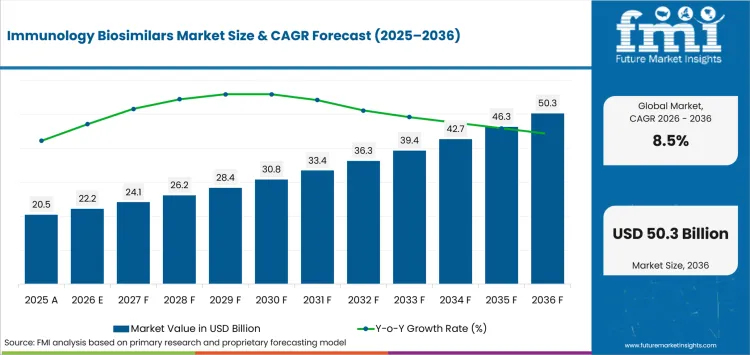
Key Takeaways of Immunology Biosimilars Market
- Demand for immunology biosimilars is driven by broader molecule competition and payer-led switching programs, with market expansion depending on new molecule entry and deeper use within established immune-mediated treatment pathways.
- By molecule, adalimumab holds the leading share at 30.3% in 2026, owing to broad indication coverage across rheumatology, dermatology, and gastroenterology pathways alongside established biosimilar switching processes built on extensive physician familiarity.
- Rheumatoid arthritis leads the indication category at 31.3% share in 2026, supported by long treatment duration and recurring payer review that produces repeated purchasing across several years rather than revenue from a single limited treatment course.
- Hospital pharmacies account for 53.0% distribution channel share in 2026, attributable to specialist treatment control over biologic initiation, dispensing, and reimbursement documentation throughout the forecast period.
- Public drug plans capture 53.5% payer share in 2026, underpinned by coordinated procurement authority and payer savings programs that convert price competition into treatment volume after hospitals and specialists complete switching plans.
- Japan, Germany, and the United Kingdom record CAGRs of 10.6%, 10.0%, and 8.7% respectively through 2036, shaped by new molecule entry alongside hospital-led prescribing, statutory payer pressure on specialist medicine spending, and national value programs preparing for further patent expiries.
- Competition is shifting from single-product discounting toward portfolio access and dependable supply, with vendors differentiating through integrated manufacturing and regulatory capabilities, device support across multiple presentations, and reliable cold-chain supply across hospital and outpatient treatment settings.
Analyst Perspective
"The immunology biosimilars market is increasingly shaped by clinical adoption rather than regulatory approval alone. Healthcare providers and payers are evaluating supply reliability, physician confidence, and switching strategies alongside pricing. Companies that combine dependable product availability with strong market access, stakeholder education, and broad commercialization capabilities will be better positioned to expand biosimilar utilization across immunology care."
— Anurag Sharma, Principal Analyst at Future Market Insights
Source: FMI's proprietary forecasting model and primary research.
How is the Immunology Biosimilars Market segmented?
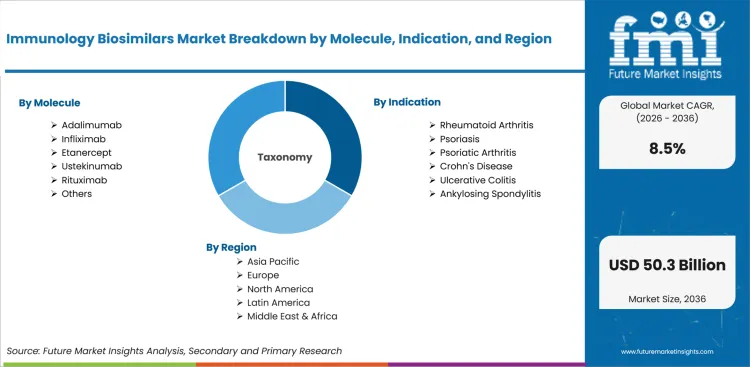
The market is segmented by Molecule, Indication, Distribution Channel, Payer, and Region, with each category separating clinical demand from the route used to purchase and reimburse treatment.
Molecule analysis separates products by reference biologic and immune pathway, which affects dosing patterns and the depth of direct competition. Indication analysis follows recurring treatment demand across rheumatology, dermatology, gastroenterology, and specialist allergy care settings. Distribution channel analysis distinguishes hospital-controlled supply from specialty and retail dispensing routes that handle different treatment formats. Payer analysis identifies whether public plans, private insurance, or self-pay arrangements control access and reimbursement. Regional analysis then compares tendering and substitution systems across countries with different reimbursement authorities and treatment settings. A medicine can move through different payment routes despite serving the same clinical indication, so product choice depends on approval, supply reliability, and formulary authority. The final category connects the segment view with demand patterns across the wider autoimmune disease therapeutics environment.
What supports demand for adalimumab within the molecule category?
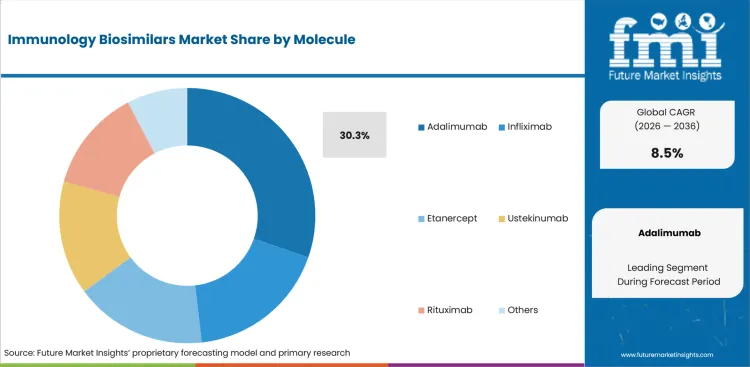
Adalimumab has a broad set of immune-mediated indications and a mature record of biosimilar switching across regulated markets. Celltrion reported in April 2025 that the FDA granted YUFLYMA interchangeable status for a high-concentration and citrate-free formulation available in several strengths. The development shows how device format and substitution status can influence purchasing after clinical similarity is established. Pharmacies and health plans therefore have more practical options within a molecule that already carries extensive physician familiarity.
- By molecule, Adalimumab is projected to account for 30.3% share in 2026, owing to broad indication coverage and established switching processes during the forecast period. The molecule supports treatment across arthritis and inflammatory bowel disease pathways with familiar dosing practices. Its commercial position reflects years of reference-product prescribing and extensive biosimilar competition rather than dependence on one recent launch.
- Rheumatology and dermatology teams purchase Adalimumab products after reviewing device format, dosing needs, and coverage rules. High-concentration presentations can reduce injection volume while preserving familiar dosing for patients in established treatment pathways. The dermatology biosimilars segment adds another demand route through plaque psoriasis care managed by specialist clinics and pharmacies. Stable inventory remains necessary since a preferred contract loses commercial value whenever pharmacies cannot complete scheduled patient starts.
How does rheumatoid arthritis shape demand within the indication category?
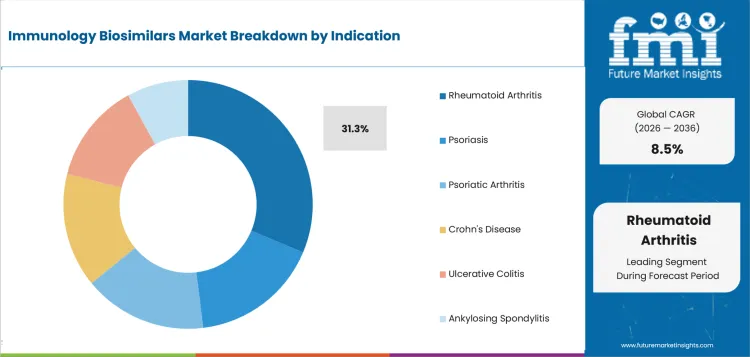
Rheumatoid arthritis creates recurring biologic demand since treatment often continues for years and requires regular monitoring. The Pharmaceuticals and Medical Devices Agency listed two tocilizumab biosimilar entries in March 2026 for rheumatoid arthritis, covering intravenous and subcutaneous presentations. The approvals show that competition is reaching additional immune pathways beyond tumor necrosis factor medicines. A broader molecule set gives treatment systems another way to compare clinical fit and cost without reducing the need for specialist oversight.
- By indication, Rheumatoid Arthritis is estimated to represent 31.3% share in 2026, supported by long treatment duration and regular payer review over the forecast period. Chronic therapy produces repeated purchasing across several years rather than revenue from one limited treatment course. The segment therefore rewards manufacturers that maintain supply and support patient transitions across hospital and outpatient settings.
- Rheumatology departments favor products that fit established dosing and monitoring routines across long treatment cycles. A switch can require physician communication and benefit verification before an existing treatment plan continues. Demand is shaped by the eligible patient pool and the speed of formulary implementation within each institution. Manufacturers must support clinical teams with clear product information while protecting treatment continuity for stable patients.
What makes hospital pharmacies central to the distribution channel category?
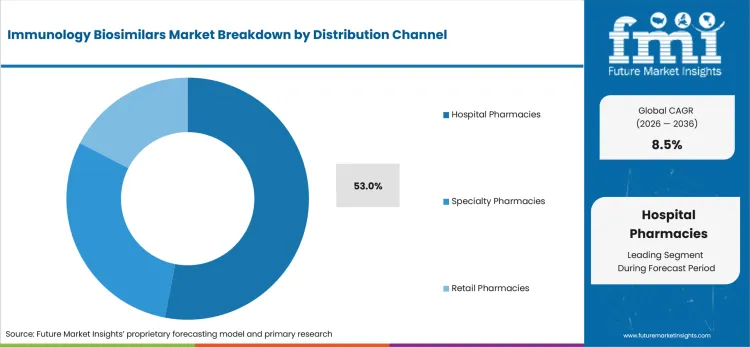
Hospital pharmacies control many infused medicines and coordinate specialist-administered biosimilars across medication-safety and inventory systems. The Centers for Medicare and Medicaid Services stated in April 2026 that qualifying biosimilars can receive payment based on average sales price plus eight percent of the reference product amount. The policy changes the economics of medicines supplied under Medicare Part B and shows why reimbursement design can influence hospital purchasing after regulators establish clinical similarity.
- By distribution channel, Hospital Pharmacies are forecast to represent 53.0% share in 2026, attributable to their control over infusion stock and specialist protocols through 2036. Hospital committees often approve products before clinicians use them consistently within routine specialist treatment pathways. Pharmacy operations must then manage cold-chain storage and product identification across different brands of the same molecule.
- Hospital systems purchase biosimilars that fit infusion capacity, medication-safety controls, and established specialist treatment protocols. Subcutaneous presentations can move selected treatment away from infusion chairs and reduce pressure on staffed facilities. The large volume wearable injectors category shows how delivery technology can reshape treatment location across hospital and homecare settings. Biosimilar manufacturers need clear handling instructions and reliable replenishment across every approved presentation throughout the contract period.
How do public health systems evaluate public drug plans within the payer category?
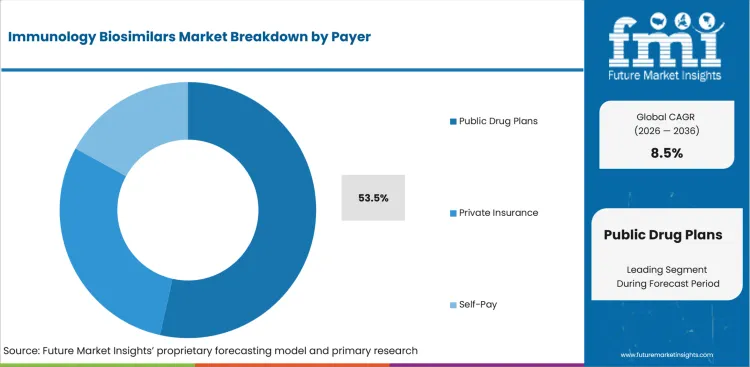
Public drug plans can coordinate purchasing across large patient populations and convert price differences into system-wide savings. NHS England reported in April 2025 that biological medicine switches produced EUR 1.2 billion in savings during the prior three years, including EUR 400 million from adalimumab switches. The scale explains why public plans use structured procurement and switching targets across several treatment institutions. Savings become commercially meaningful once clinicians and pharmacy teams move eligible patients without interrupting treatment continuity.
- By payer, Public Drug Plans are projected to hold 53.5% share in 2026, underpinned by tender scale and coordinated formulary rules between 2026 and 2036. Public systems can compare products across an entire treatment pathway instead of negotiating isolated hospital purchases. Their purchasing influence increases once national or regional guidance gives hospitals a clear implementation timetable.
- Public health authorities favor products that combine price value with dependable supply and structured switch support. Public procurement decisions can change preferred brands across many institutions during one coordinated contracting cycle. An aggressive price loses credibility during a shortage, which creates execution risk for every participating institution. Manufacturers must align contract volume with production and distribution capacity before accepting broad coverage across multiple institutions.
What are the drivers, restraints, and opportunities in the Immunology Biosimilars Market?
Patent expiry widens molecule choice; formulary access separates approval from revenue; allergy and inflammatory targets create additional portfolio space.
- Driver: New reference-product expiries are opening immune pathways that previously had limited direct biosimilar competition.
- Restraint: Regulatory approval does not guarantee preferred coverage or completed patient switching across fragmented payer systems.
- Opportunity: New allergy targets and varied delivery formats can expand the addressable market beyond established arthritis molecules.
Industry is estimated to grow due to commercial launch of biosimilars for newer immune targets and treatment settings. Fresenius Kabi reported in March 2025 that Otulfi became available in the USA with subcutaneous and intravenous presentations for psoriasis and inflammatory bowel disease indications. Each new molecule increases the value of development and supply capabilities across the biosimilar contract manufacturing chain. Commercial gains depend on coordinated launch inventory and payer agreements rather than regulatory availability alone.
One of the factor limiting growth is the gap between regulatory availability and routine use across fragmented coverage systems. The FDA reported in October 2025 that it had approved 76 biosimilars and that their market share remained below 20%. The agency stated that biologics represented 5% of prescriptions but 51% of drug spending during 2024. The contrast shows that approval volume alone does not remove coverage barriers limiting completed patient starts. Developers still need evidence packages and commercial execution across the biosimilar testing services pathway before market access converts into treatment volume.
A lucrative opportunity is competition in allergic and inflammatory conditions that previously had no biosimilar option. Celltrion reported in March 2025 that OMLYCLO became the first FDA-approved omalizumab biosimilar for uses including asthma and chronic spontaneous urticaria. The entry links immunology biosimilars with the respiratory biologics category and adds new specialist channels. Commercial success requires payer education and dependable device supply since these patients follow treatment pathways that differ from arthritis populations.
Which country CAGRs are profiled in the Immunology Biosimilars Market?
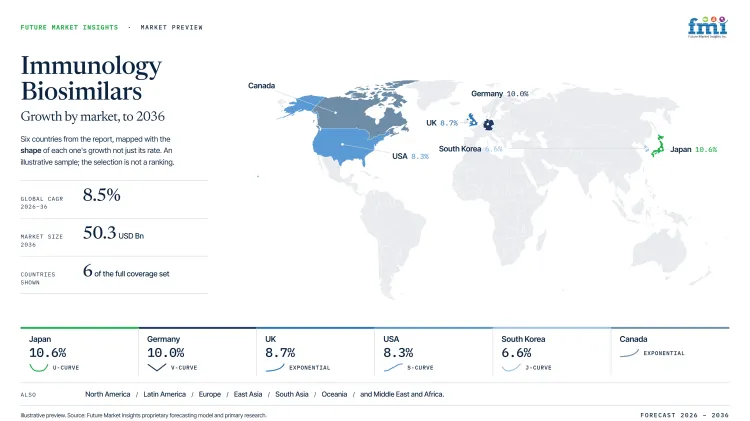
| Country | CAGR |
|---|---|
| USA | 8.3% |
| UK | 8.7% |
| Germany | 10.0% |
| Japan | 10.6% |
| South Korea | 6.6% |
How do country-level CAGRs compare in the Immunology Biosimilars Market?
The country comparison covers 4.0 percentage points and separates two pairs from South Korea. Japan and Germany form a compact upper cluster supported by hospital review and payer savings pressure. The UK and USA remain closely aligned despite fundamentally different coordinated and fragmented coverage models. South Korea’s pronounced step-down reflects domestic reimbursement limits rather than weak biosimilar development capability.
- Japan relies on hospital specialists and local partners to convert new molecule approvals into routine use.
- Germany combines statutory payer pressure with decentralized prescribing and regional contract implementation across specialist providers.
- UK uptake follows national value programs that coordinate switching ahead of major patent expiries.
- The USA requires separate formulary wins across commercial plans and public reimbursement channels and treatment settings.
- South Korea pairs extensive manufacturing capability with export partnerships beyond its smaller domestic prescribing pool.
Similar CAGRs can produce different launch conditions because approval does not ensure formulary placement or supply continuity. Manufacturers must align pricing and distribution with local switching authority and specialist treatment settings. The full report provides country-level CAGR analysis across North America, Latin America, Europe, East Asia, South Asia, Oceania and the Middle East and Africa.
- The USA combines rapid product entry with fragmented coverage decisions across commercial plans and public programs. The market is projected to grow at an 8.3% CAGR from 2026 to 2036, driven by new ustekinumab and omalizumab competition. The FDA reported in January 2026 that it approved 18 biosimilars during 2025 and had approved 81 products since 2015. The expanded approval base gives pharmacy benefit managers and hospital committees more choices without creating uniform access across plans. Manufacturers must pair competitive contracts with stable inventory and patient support across the full treatment pathway.
- The UK uses national commissioning tools to translate patent expiry into coordinated purchasing across the NHS. Treatment programs still require patient communication, clinical agreement, and local implementation capacity across participating NHS organizations. Immunology biosimilar demand is forecast to rise at an 8.7% CAGR over the forecast period, supported by national value targets and upcoming loss-of-exclusivity events. NHS England reported in April 2025 that about EUR 1.4 billion of biological medicine spending covered products due to lose patent protection by 2028, with up to EUR 1 billion in potential savings. Integrated care boards and regional procurement pharmacy specialists can use that pipeline to plan switching ahead of launch. Manufacturers must provide realistic volume commitments since national access can expose supply shortages across many institutions quickly.
- Germany’s statutory health insurance system places medicine spending under regular payer scrutiny across decentralized specialist providers and local contracts. The Federal Ministry of Health reported in June 2025 that pharmaceutical expenditure rose by 6.1% or €826 million during the first quarter. Immunology biosimilar demand in Germany is projected to record a 10.0% CAGR during the forecast period, attributable to savings pressure and new interleukin competition. Statutory sickness funds can encourage economical prescribing through contracts and regional controls across outpatient care. Hospitals still require reliable stock across infusion and self-injection formats throughout every local and regional contract period. Companies that connect national pricing with local distribution can convert approvals into routine use more consistently.
- Japan’s hospital-centered treatment system gives specialist physicians and local partners substantial influence over biosimilar uptake. Adoption of immunology biosimilars is estimated to expand at a 10.6% CAGR through 2036, reinforced by recent approvals across interleukin and allergy targets. The Pharmaceuticals and Medical Devices Agency listed 47 approved biosimilar entries in March 2026, including new omalizumab and tocilizumab products for asthma and rheumatoid arthritis. The broader approval base increases the number of products that hospital committees can assess through established review procedures. Japanese launches still require careful wholesaler coordination, hospital education, and dependable support for each approved presentation. Celltrion Healthcare Japan and Mochida Pharmaceutical appear in the official list for recent immunology entries.
- South Korea combines biosimilar development capacity with a domestic market that remains closely shaped by reimbursement decisions. Export partnerships allow Korean developers to seek manufacturing scale beyond the prescribing volume available through domestic channels. The market is estimated to post a 6.6% CAGR by 2036, aided by established manufacturing and a broad national approval base. The Ministry of Food and Drug Safety published a list of 82 approved biosimilar products in December 2025, including adalimumab and ustekinumab products used in immune-mediated diseases. Celltrion and Samsung Bioepis can apply domestic technical experience across overseas launches and partner networks. Local revenue still depends on hospital listing, reimbursement terms, and the pace of routine physician use. Investment decisions should separate export manufacturing value from prescription revenue generated through South Korea's domestic reimbursement system.
Who are the notable companies in the Immunology Biosimilars Market?
Notable companies include Amgen Inc., Celltrion Healthcare Canada, Sandoz Canada, Biocon Biologics, Fresenius Kabi Canada, Samsung Bioepis, Pfizer Canada, Organon Canada, JAMP Pharma Group, and Teva Canada.
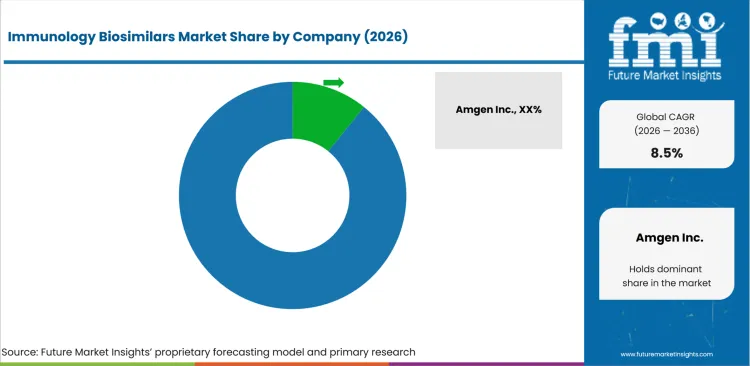
The company landscape includes integrated developers and local commercialization organizations with different control over manufacturing, regulatory work, and payer access. Amgen and Biocon Biologics manage development decisions across several regulated markets, whereas Celltrion and Samsung Bioepis combine product creation with partner-based or affiliate-led access. Sandoz and Fresenius Kabi use established specialty medicine channels, while Pfizer and Organon bring local payer relationships to selected portfolios. JAMP Pharma Group provides a Canada-focused platform, and Teva uses partnerships to extend its product set. The Remicade biosimilar category illustrates how mature infliximab competition differs from newer ustekinumab entry across specialist treatment channels. Portfolio breadth matters since local access and supply requirements vary materially by molecule and treatment setting.
- Amgen and Biocon Biologics combine development ownership with commercial access across several regulated markets and immune-treatment categories. Their scale supports multiple launches, device programs, and complex supply planning across different immune pathways. Revenue still depends on local formulary decisions and completed patient starts rather than global approval alone.
- Celltrion Healthcare Canada and Organon Canada use direct local organizations to connect global products with Canadian public plans and specialty channels. Samsung Bioepis supports Organon through development and manufacturing capabilities that remain separate from local commercialization responsibility. Clear operating roles reduce execution gaps during launch preparation, supply management, payer negotiation, and contract renewal.
- JAMP Pharma Group and Teva Canada show how partnership models can expand a portfolio without duplicating every development capability. Sandoz Canada and Fresenius Kabi Canada add established specialty distribution experience across public and private channels. The trade-off is greater dependence on clear contractual roles across supply, device support, and market access.
Competitive Benchmarking: Immunology Biosimilars Market
| Company | Molecule Breadth | Regulated-Market Approvals | Payer and Channel Access | Supply and Device Support | Geographic Reach |
|---|---|---|---|---|---|
| Amgen Inc. | High | High | High | High | Global regulated markets |
| Celltrion Healthcare Canada | High | High | High | High | Canada with a global parent network |
| Sandoz Canada | Medium | High | High | High | Canada with international portfolio support |
| Biocon Biologics | High | High | High | High | North America and other regulated markets |
| Fresenius Kabi Canada | Medium | High | Medium | High | Canada with global biopharma operations |
| Samsung Bioepis | High | High | Medium | High | Global reach through direct and partner channels |
| Pfizer Canada | Medium | High | High | High | Canada with global corporate support |
| Organon Canada | Medium | High | High | Medium | Canada with multinational commercialization rights |
| JAMP Pharma Group | Low | Medium | High | Medium | Canada-focused commercial reach |
| Teva Canada | Medium | High | High | Medium | Canada with global partnership access |
Key Developments in the Immunology Biosimilars Market
- In March 2025, Celltrion launched STEQEYMA in the USA for plaque psoriasis, psoriatic arthritis, Crohn's disease, and ulcerative colitis, including pediatric indications. The company set the wholesale acquisition cost at an 85% discount to the reference product and offered subcutaneous and intravenous presentations. The launch shows why aggressive list pricing needs several dosage forms and patient-assistance services to support practical access across distinct treatment settings.
- In May 2025, Biocon Biologics reported that Yesintek secured formulary agreements representing more than 100 million covered lives in the USA. Coverage included major commercial and managed-care organizations with different effective dates, showing how payer sequencing can determine launch speed across the same molecule. Broad formulary reach creates commercial opportunity once physicians and pharmacies complete benefit verification for eligible patients.
- In February 2025, Teva and Alvotech made SELARSDI available in the USA for plaque psoriasis, psoriatic arthritis, Crohn's disease, and ulcerative colitis. The product became the second biosimilar launched under a partnership covering nine planned products across several therapeutic categories. Alvotech retained development and manufacturing responsibility, whereas Teva handled commercialization through its established sales and market-access infrastructure.
- In May 2026, Samsung Bioepis launched a ustekinumab biosimilar in Japan through Nipro Corporation, marking the company's first commercial product entry in the country. The medicine added another treatment option for plaque psoriasis and psoriatic arthritis within a hospital-centered market. The development shows how a local partner can provide distribution and institutional access while the developer retains product and manufacturing expertise.
Key Players in the Immunology Biosimilars Market
Integrated Global Developers
- Amgen Inc.
- Biocon Biologics
- Samsung Bioepis
Portfolio and Commercialization Platforms
- Celltrion Healthcare Canada
- Sandoz Canada
- Fresenius Kabi Canada
- Pfizer Canada
- Organon Canada
- Teva Canada
Canada-Focused Biosimilar Specialist
- JAMP Pharma Group
Immunology Biosimilars Market - Report Scope
| Coverage field | Report scope |
|---|---|
| Market breakdown | Molecule, Indication, Distribution Channel, Payer, and Region. |
| Market Definition | The market includes approved biosimilar biological medicines used for immune-mediated inflammatory and allergic conditions, with revenue limited to covered immunology indications. |
| Regions Covered | North America, Latin America, Europe, East Asia, South Asia, Oceania, and Middle East and Africa. |
| Countries Covered | The country CAGR profile covers the USA, UK, Germany, Japan, and South Korea across the global model. |
| Key Companies Profiled | Amgen Inc., Celltrion Healthcare Canada, Sandoz Canada, Biocon Biologics, Fresenius Kabi Canada, Samsung Bioepis, Pfizer Canada, Organon Canada, JAMP Pharma Group, Teva Canada. |
| Forecast Period | 2026 to 2036. |
| Approach | Hybrid bottom-up and top-down market sizing supported by primary interviews and official desk research. |
Immunology Biosimilars Market - Research Methodology
| Method | Approach |
|---|---|
| Primary Research | FMI analysts gathered input from manufacturers, service providers, technology developers, distributors, end users, procurement teams, and subject-matter experts. Interviews examined purchasing decisions, product or service evaluation, adoption barriers, approval requirements, pricing considerations, and expectations for technical or commercial support. Respondents were also asked what evidence is required before a trial, pilot, or initial order develops into regular purchasing. |
| Desk Research | Desk research covered government statistics, regulatory publications, trade data, industry associations, technical literature, standards, company filings, product information, and official corporate announcements. Sources were reviewed for relevance, publication date, geographic coverage, and consistency with the defined market scope. Claims relating to performance, applications, approvals, capacity, investment, and commercial activity were retained only when supported by credible public evidence. |
| Market Sizing and Forecasting | The market model combined the baseline value with historical performance, segment structure, pricing and volume indicators, adoption levels, company participation, and country-level demand conditions. Forecast assumptions considered economic activity, investment trends, regulatory developments, technology adoption, purchasing cycles, supply availability, and barriers to wider market use. Segment and regional estimates were reconciled before the final market total was calculated. |
| Data Validation | Estimates were checked against multiple independent indicators, including public data, company activity, trade patterns, industry developments, and findings from primary interviews. Validation also tested whether products, services, applications, and company revenues fell within the defined market boundaries. Adjacent categories, unsupported claims, overlapping revenues, and activities without direct market relevance were excluded to reduce double counting and maintain consistency across segments and countries. |
Immunology Biosimilars Market by Segments
By Molecule
- Adalimumab
- Infliximab
- Etanercept
- Ustekinumab
- Rituximab
- Others
By Indication
- Rheumatoid Arthritis
- Psoriasis
- Psoriatic Arthritis
- Crohn's Disease
- Ulcerative Colitis
- Ankylosing Spondylitis
By Distribution Channel
- Hospital Pharmacies
- Specialty Pharmacies
- Retail Pharmacies
By Payer
- Public Drug Plans
- Private Insurance
- Self-Pay
Immunology Biosimilars Market by Region:
- North America
- United States
- Canada
- Latin America
- Brazil
- Mexico
- Argentina
- Chile
- Europe
- United Kingdom
- Germany
- France
- Italy
- Spain
- Benelux
- Nordic Countries
- Poland
- Czech Republic
- Romania
- East Asia
- China
- Japan
- South Korea
- South Asia
- India
- Bangladesh
- Sri Lanka
- Oceania
- Australia
- New Zealand
- Middle East and Africa
- GCC Countries
- South Africa
- Türkiye
- Israel
Research Sources and Bibliography
- European Medicines Agency. (2025, January 16). Human medicines in 2024.
- Amgen Inc.. (2026, February 3). Amgen reports fourth quarter and full year 2025 financial results.
- Celltrion. (2025, April 15). USA FDA grants interchangeable designation to YUFLYMA.
- Pharmaceuticals and Medical Devices Agency. (2026, March 23). PMDA approved biosimilars as of March 2026.
- Centers for Medicare and Medicaid Services. (2026, April 7). Medicare claims processing guidance for 2026 biosimilar payment.
- NHS England. (2025, April 9). Commissioning framework for best value biological medicines.
- Fresenius Kabi. (2025, March 3). Fresenius Continues Growth of Biosimilars Portfolio with the U.S. Availability of Otulfi® (ustekinumab-aauz).
- U.S. Food and Drug Administration. (2025, October 29). FDA moves to accelerate biosimilar development and lower drug costs.
- Celltrion. (2025, March 10). U.S. FDA approves Celltrion's OMLYCLO® (omalizumab-igec) as the first and only biosimilar with interchangeability designation referencing XOLAIR®.
- Celltrion USA. (2025, March 13). STEQEYMA® (ustekinumab-stba), a biosimilar to STELARA® (ustekinumab), now available in the United States.
- U.S. Food and Drug Administration. (2026, January). Advancing health through innovation: New drug therapy approvals 2025.
- Federal Ministry of Health Germany. (2025, June 20). Finanzentwicklung der GKV im 1. Quartal 2025.
- Ministry of Food and Drug Safety Republic of Korea. (2025, December 30). Approved biosimilar products in Korea.
- Sandoz Canada. (2024, April 17). Sandoz Canada launches Hyrimoz® high-concentration formulation, expanding its adalimumab biosimilar offer.
- Biocon Biologics. (2025, May 5). Biocon Biologics Secures Strong Market Access Coverage for Yesintek™ in the United States Covering 100+ Million Lives.
- Fresenius Kabi Canada. (2025, January 8). Fresenius Kabi Canada has received a Health Canada Notice of Compliance (NOC) for Otulfi™ an Ustekinumab Biosimilar.
- Samsung Bioepis. (2026, May 20). Samsung Bioepis launches ustekinumab biosimilar in Japan.
- Organon Canada. (2026, June 18). Organon and Samsung Bioepis Expand Agreement to Commercialize PYZCHIVA® (ustekinumab), a Biosimilar Referencing STELARA® (ustekinumab) in Canada.
- Teva Pharmaceutical Industries and Alvotech. (2025, February 21). Teva and Alvotech Announce SELARSDI™ (ustekinumab-aekn) Injection Now Available in the U.S..
This Report Answers
- How is value expected to change between 2026 and 2036 across the defined market boundary?
- Which molecule accounts for the stated 30.3% share at the start of the forecast period?
- Why does Rheumatoid Arthritis remain the central indication within the defined segment structure?
- How do hospital pharmacy controls influence the conversion of approval into routine product use?
- What gives public drug plans greater purchasing influence than private insurance or self-pay routes?
- How do country reimbursement systems change the commercial meaning of the stated CAGR figures?
- Which companies combine product development with local commercialization and patient-support capabilities?
- What evidence should executives use to separate formulary access from completed patient treatment starts?
- How should suppliers evaluate device format and supply commitments before entering a broad contract?
Frequently Asked Questions
How big is the Immunology Biosimilars Market in 2026?
The immunology biosimilars market is valued at USD 22.2 billion in 2026 and is forecast to reach USD 50.3 billion by 2036. Growth reflects expanding biosimilar adoption across established immunology molecules, broader payer-led switching programs, and increasing competition following biologic patent expiries.
What is the CAGR of the Immunology Biosimilars Market from 2026 to 2036?
The immunology biosimilars market is projected to grow at a CAGR of 8.5% between 2026 and 2036, supported by new molecule launches, wider formulary adoption, and increasing use of biosimilars across rheumatology, dermatology, and gastroenterology treatment pathways.
Which molecule leads the Immunology Biosimilars Market?
Adalimumab accounts for 30.3% of the immunology biosimilars market by molecule in 2026, reflecting its broad indication coverage, established physician familiarity, and extensive biosimilar competition across multiple immune-mediated diseases.
How much will the Immunology Biosimilars Market add between 2026 and 2036?
The immunology biosimilars market is set to add USD 28.1 billion between 2026 and 2036, growing from USD 22.2 billion to USD 50.3 billion as biosimilar competition expands across additional immune targets and payer-driven switching programs continue to increase treatment adoption.
Who are the leading companies in the Immunology Biosimilars Market?
Leading companies in the immunology biosimilars market include Amgen Inc., Celltrion Healthcare Canada, Sandoz Canada, Biocon Biologics, Fresenius Kabi Canada, Samsung Bioepis, Pfizer Canada, Organon Canada, JAMP Pharma Group, and Teva Canada, competing through biosimilar development, manufacturing, commercialization, and market access across immunology therapies.
Preview the report firsthand - request a free sample
Get SampleGet the brochure for pricing and purchase details.
Get PDFTable of Content
- Key Takeaways
- Market Size and CAGR
- Top Growth Driver
- Fastest Growing Segment
- Leading Region
- Key Companies
- Emerging Opportunities
- Executive Summary
- Global Market Outlook
- Demand-side Trends
- Supply-side Trends
- Technology Roadmap Analysis
- Analysis and Recommendations
- Analyst Perspective (What is happening? Why now? What should investors know?)
- Key Questions Answered
- How large is the market?
- What is the CAGR?
- What are key trends?
- Which region dominates?
- Who are the leaders?
- Market Overview
- Market Coverage / Taxonomy
- Market Definition / Scope / Limitations
- Research Methodology
- Chapter Orientation
- Analytical Lens and Working Hypotheses
- Market Structure, Signals, and Trend Drivers
- Benchmarking and Cross-market Comparability
- Market Sizing, Forecasting, and Opportunity Mapping
- Research Design and Evidence Framework
- Desk Research Programme (Secondary Evidence)
- Expert Input and Fieldwork (Primary Evidence)
- Tooling, Models, and Reference Databases
- Data Engineering and Model Build
- Quality Assurance and Audit Trail
- Market Background
- Market Dynamics (Drivers, Restraints, Opportunity, Trends)
- Scenario Forecast (Optimistic, Likely, Conservative)
- Impact Analysis
- AI Impact
- Sustainability Impact
- Regulatory Impact
- Technology Impact
- Consumer / Buyer Analysis
- Purchase Drivers
- Adoption Barriers
- Buyer Journey
- Opportunity Map Analysis
- Product Life Cycle Analysis
- Supply Chain Analysis
- Investment Feasibility Matrix
- Value Chain Analysis
- PESTLE and Porter's Analysis
- Regulatory Landscape
- Regional Parent Market Outlook
- Production and Consumption Statistics
- Import and Export Statistics
- Global Market Analysis and Forecast, 2021 to 2036
- Historical Market Size Value (USD Billion) Analysis, 2021 to 2025
- Current and Future Market Size Value (USD Billion) Projections, 2026 to 2036
- Y-o-Y Growth Trend Analysis
- Absolute $ Opportunity Analysis
- Global Market Pricing Analysis, 2021 to 2036
- Global Market Analysis and Forecast, By Molecule, 2021 to 2036
- Introduction / Key Findings
- Historical Market Size Value (USD Billion) Analysis By Molecule, 2021 to 2025
- Current and Future Market Size Value (USD Billion) Analysis and Forecast By Molecule, 2026 to 2036
- Adalimumab
- Infliximab
- Etanercept
- Ustekinumab
- Rituximab
- Others
- Adalimumab
- Y-o-Y Growth Trend Analysis By Molecule, 2021 to 2025
- Absolute $ Opportunity Analysis By Molecule, 2026 to 2036
- Global Market Analysis and Forecast, By Indication, 2021 to 2036
- Introduction / Key Findings
- Historical Market Size Value (USD Billion) Analysis By Indication, 2021 to 2025
- Current and Future Market Size Value (USD Billion) Analysis and Forecast By Indication, 2026 to 2036
- Rheumatoid Arthritis
- Psoriasis
- Psoriatic Arthritis
- Crohn's Disease
- Ulcerative Colitis
- Ankylosing Spondylitis
- Rheumatoid Arthritis
- Y-o-Y Growth Trend Analysis By Indication, 2021 to 2025
- Absolute $ Opportunity Analysis By Indication, 2026 to 2036
- Global Market Analysis and Forecast, By Distribution Channel, 2021 to 2036
- Introduction / Key Findings
- Historical Market Size Value (USD Billion) Analysis By Distribution Channel, 2021 to 2025
- Current and Future Market Size Value (USD Billion) Analysis and Forecast By Distribution Channel, 2026 to 2036
- Hospital Pharmacies
- Specialty Pharmacies
- Retail Pharmacies
- Hospital Pharmacies
- Y-o-Y Growth Trend Analysis By Distribution Channel, 2021 to 2025
- Absolute $ Opportunity Analysis By Distribution Channel, 2026 to 2036
- Global Market Analysis and Forecast, By Payer, 2021 to 2036
- Introduction / Key Findings
- Historical Market Size Value (USD Billion) Analysis By Payer, 2021 to 2025
- Current and Future Market Size Value (USD Billion) Analysis and Forecast By Payer, 2026 to 2036
- Public Drug Plans
- Private Insurance
- Self-Pay
- Public Drug Plans
- Y-o-Y Growth Trend Analysis By Payer, 2021 to 2025
- Absolute $ Opportunity Analysis By Payer, 2026 to 2036
- Global Market Analysis and Forecast, By Region, 2021 to 2036
- Introduction
- Historical Market Size Value (USD Billion) Analysis By Region, 2021 to 2025
- Current Market Size Value (USD Billion) Analysis and Forecast By Region, 2026 to 2036
- North America
- Latin America
- Western Europe
- Eastern Europe
- East Asia
- South Asia and Pacific
- Middle East & Africa
- Market Attractiveness Analysis By Region
- North America Market Analysis and Forecast, By Country, 2021 to 2036
- Historical Market Size Value (USD Billion) Trend Analysis By Market Taxonomy, 2021 to 2025
- Market Size Value (USD Billion) Forecast By Market Taxonomy, 2026 to 2036
- By Country
- USA
- Canada
- By Molecule
- By Indication
- By Distribution Channel
- By Payer
- By Country
- Market Attractiveness Analysis
- By Country
- By Molecule
- By Indication
- By Distribution Channel
- By Payer
- Key Takeaways
- Latin America Market Analysis and Forecast, By Country
- Historical Market Size Value (USD Billion) Trend Analysis By Market Taxonomy, 2021 to 2025
- Market Size Value (USD Billion) Forecast By Market Taxonomy, 2026 to 2036
- By Country
- Brazil
- Mexico
- Chile
- Rest of Latin America
- By Molecule
- By Indication
- By Distribution Channel
- By Payer
- By Country
- Market Attractiveness Analysis
- By Country
- By Molecule
- By Indication
- By Distribution Channel
- By Payer
- Key Takeaways
- Western Europe Market Analysis and Forecast, By Country
- Historical Market Size Value (USD Billion) Trend Analysis By Market Taxonomy, 2021 to 2025
- Market Size Value (USD Billion) Forecast By Market Taxonomy, 2026 to 2036
- By Country
- Germany
- UK
- Italy
- Spain
- France
- Nordic
- BENELUX
- Rest of Western Europe
- By Molecule
- By Indication
- By Distribution Channel
- By Payer
- By Country
- Market Attractiveness Analysis
- By Country
- By Molecule
- By Indication
- By Distribution Channel
- By Payer
- Key Takeaways
- Eastern Europe Market Analysis and Forecast, By Country
- Historical Market Size Value (USD Billion) Trend Analysis By Market Taxonomy, 2021 to 2025
- Market Size Value (USD Billion) Forecast By Market Taxonomy, 2026 to 2036
- By Country
- Russia
- Poland
- Hungary
- Balkan & Baltic
- Rest of Eastern Europe
- By Molecule
- By Indication
- By Distribution Channel
- By Payer
- By Country
- Market Attractiveness Analysis
- By Country
- By Molecule
- By Indication
- By Distribution Channel
- By Payer
- Key Takeaways
- East Asia Market Analysis and Forecast, By Country
- Historical Market Size Value (USD Billion) Trend Analysis By Market Taxonomy, 2021 to 2025
- Market Size Value (USD Billion) Forecast By Market Taxonomy, 2026 to 2036
- By Country
- China
- Japan
- South Korea
- By Molecule
- By Indication
- By Distribution Channel
- By Payer
- By Country
- Market Attractiveness Analysis
- By Country
- By Molecule
- By Indication
- By Distribution Channel
- By Payer
- Key Takeaways
- South Asia and Pacific Market Analysis and Forecast, By Country
- Historical Market Size Value (USD Billion) Trend Analysis By Market Taxonomy, 2021 to 2025
- Market Size Value (USD Billion) Forecast By Market Taxonomy, 2026 to 2036
- By Country
- India
- ASEAN
- Australia & New Zealand
- Rest of South Asia and Pacific
- By Molecule
- By Indication
- By Distribution Channel
- By Payer
- By Country
- Market Attractiveness Analysis
- By Country
- By Molecule
- By Indication
- By Distribution Channel
- By Payer
- Key Takeaways
- Middle East & Africa Market Analysis and Forecast, By Country
- Historical Market Size Value (USD Billion) Trend Analysis By Market Taxonomy, 2021 to 2025
- Market Size Value (USD Billion) Forecast By Market Taxonomy, 2026 to 2036
- By Country
- Kingdom of Saudi Arabia
- Other GCC Countries
- Türkiye
- South Africa
- Other African Union
- Rest of Middle East & Africa
- By Molecule
- By Indication
- By Distribution Channel
- By Payer
- By Country
- Market Attractiveness Analysis
- By Country
- By Molecule
- By Indication
- By Distribution Channel
- By Payer
- Key Takeaways
- Key Countries Market Analysis
- USA
- Pricing Analysis
- Market Share Analysis, 2025
- By Molecule
- By Indication
- By Distribution Channel
- By Payer
- Canada
- Pricing Analysis
- Market Share Analysis, 2025
- By Molecule
- By Indication
- By Distribution Channel
- By Payer
- Mexico
- Pricing Analysis
- Market Share Analysis, 2025
- By Molecule
- By Indication
- By Distribution Channel
- By Payer
- Brazil
- Pricing Analysis
- Market Share Analysis, 2025
- By Molecule
- By Indication
- By Distribution Channel
- By Payer
- Chile
- Pricing Analysis
- Market Share Analysis, 2025
- By Molecule
- By Indication
- By Distribution Channel
- By Payer
- Germany
- Pricing Analysis
- Market Share Analysis, 2025
- By Molecule
- By Indication
- By Distribution Channel
- By Payer
- UK
- Pricing Analysis
- Market Share Analysis, 2025
- By Molecule
- By Indication
- By Distribution Channel
- By Payer
- Italy
- Pricing Analysis
- Market Share Analysis, 2025
- By Molecule
- By Indication
- By Distribution Channel
- By Payer
- Spain
- Pricing Analysis
- Market Share Analysis, 2025
- By Molecule
- By Indication
- By Distribution Channel
- By Payer
- France
- Pricing Analysis
- Market Share Analysis, 2025
- By Molecule
- By Indication
- By Distribution Channel
- By Payer
- India
- Pricing Analysis
- Market Share Analysis, 2025
- By Molecule
- By Indication
- By Distribution Channel
- By Payer
- ASEAN
- Pricing Analysis
- Market Share Analysis, 2025
- By Molecule
- By Indication
- By Distribution Channel
- By Payer
- Australia & New Zealand
- Pricing Analysis
- Market Share Analysis, 2025
- By Molecule
- By Indication
- By Distribution Channel
- By Payer
- China
- Pricing Analysis
- Market Share Analysis, 2025
- By Molecule
- By Indication
- By Distribution Channel
- By Payer
- Japan
- Pricing Analysis
- Market Share Analysis, 2025
- By Molecule
- By Indication
- By Distribution Channel
- By Payer
- South Korea
- Pricing Analysis
- Market Share Analysis, 2025
- By Molecule
- By Indication
- By Distribution Channel
- By Payer
- Russia
- Pricing Analysis
- Market Share Analysis, 2025
- By Molecule
- By Indication
- By Distribution Channel
- By Payer
- Poland
- Pricing Analysis
- Market Share Analysis, 2025
- By Molecule
- By Indication
- By Distribution Channel
- By Payer
- Hungary
- Pricing Analysis
- Market Share Analysis, 2025
- By Molecule
- By Indication
- By Distribution Channel
- By Payer
- Kingdom of Saudi Arabia
- Pricing Analysis
- Market Share Analysis, 2025
- By Molecule
- By Indication
- By Distribution Channel
- By Payer
- Türkiye
- Pricing Analysis
- Market Share Analysis, 2025
- By Molecule
- By Indication
- By Distribution Channel
- By Payer
- South Africa
- Pricing Analysis
- Market Share Analysis, 2025
- By Molecule
- By Indication
- By Distribution Channel
- By Payer
- USA
- Market Structure Analysis
- Competition Dashboard
- Competition Benchmarking
- Market Share Analysis of Top Players
- By Regional
- By Molecule
- By Indication
- By Distribution Channel
- By Payer
- Emerging Startups
- Innovation Benchmarking
- Competition Analysis
- Competition Deep Dive
- Amgen Inc.
- Overview
- Product Portfolio
- Profitability by Market Segments
- Sales Footprint
- Strategy Overview
- Marketing Strategy
- Product Strategy
- Channel Strategy
- Celltrion Healthcare Canada
- Sandoz Canada
- Biocon Biologics
- Fresenius Kabi Canada
- Samsung Bioepis
- Pfizer Canada
- Organon Canada
- JAMP Pharma Group
- Teva Canada
- Amgen Inc.
- Case Studies
- Success Stories
- Recent Developments
- Competition Deep Dive
- Assumptions & Acronyms Used


