

- Market Size (2026)
- USD 650.9 Mn
- Forecast (2036)
- USD 2371.1 Mn
- CAGR (2026 to 2036)
- 13.8%
How big is High-Density AI Hall Conversion Services Market in 2026?
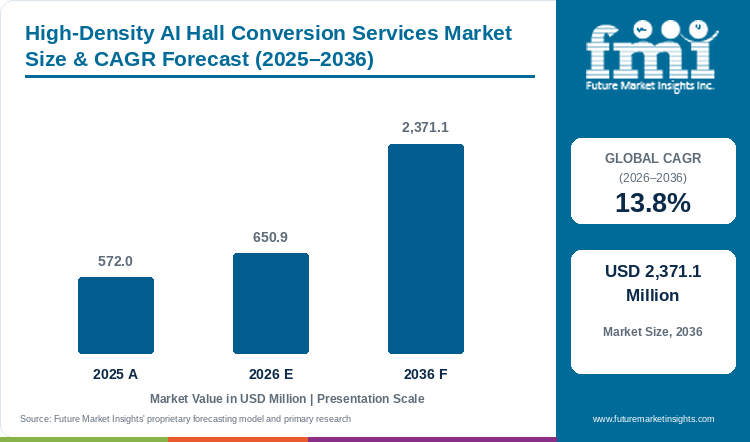
The market was valued at USD 572.0 Million in 2025 and is expected to reach USD 650.9 Million in 2026, with growth at a 13.8% CAGR from 2026 to 2036 taking its value to USD 2,371.1 Million by 2036.
Conversion starts with a survey of the existing building, where electrical routes, cooling headroom and maintenance access may limit feasible density before a rack is selected. Owners need to identify reusable assets and compare adaptation with replacement, including the possibility that part of a proposed conversion is uneconomic. Live operations make isolation boundaries and temporary services central to the sequence, with acceptance required to demonstrate new equipment together with retained plant. Germany’s efficiency and heat-use requirements illustrate how local obligations can alter the engineering brief, while utility readiness may dominate another site’s schedule. The opportunity therefore follows a viable facility and an approved plan rather than hardware demand alone. Revenue includes qualifying engineering, retrofit, migration and acceptance, including a newly configured hall within an existing building, while unrelated construction and standalone equipment remain outside the service estimate. [5]
Key Market Trends & Insights
- Commissioning & acceptance holds 27.0% of service scope in 2026, establishing the operating limits of new AI equipment connected to retained plant.
- New AI hall build holds 36.0% of project stage in 2026, allowing a newly configured area to coordinate busways, liquid loops and rack access within the receiving facility.
- The 251–500 kW band holds 32.0% of AI rack density in 2026, requiring upstream supply and coolant conditions to support simultaneous operation rather than startup alone.
- Hyperscale AI data centers account for 46.0% of data center type in 2026, allowing methods to be reused while each receiving hall retains its own survey and restrictions.
Regional Highlights
- Saudi Arabia has the highest profiled CAGR at 15.0% during 2026–2036.
- The next two profiled growth rates are South Korea at 14.7% and France at 14.4% over the same period.
Market Size & Forecast
| Metric | Value |
|---|---|
| 2025 market value | USD 572.0 Million |
| 2026 market estimate | USD 650.9 Million |
| 2036 market forecast | USD 2,371.1 Million |
| Forecast CAGR, 2026–2036 | 13.8% |
The market covers engineering, retrofit, migration, integration and acceptance services used to convert or reconfigure data halls for high-density AI operation. Qualifying work can include commissioning a newly configured AI hall within an existing facility. Unrelated new construction and standalone equipment sales are excluded.
Hall conversion often begins with the usable limits of existing data-center power, which can determine the feasible density before detailed construction design.
Infrastructure readiness and acceptance
| Documented operating context | Source |
|---|---|
| Schneider Electric introduced prefabricated pod and rack solutions for high-density AI applications in June 2025. | [1] |
| Jacobs released an AI data-center digital-twin solution in March 2026 covering compute, power and cooling interactions. | [2] |
| Siemens and nVent announced a joint reference-architecture initiative for NVIDIA AI data centers in December 2025. | [3] |
| The IEA’s 2025 Energy and AI report examines electricity demand and supply constraints associated with AI infrastructure. | [4] |
Analyst Perspective
A conversion proposal needs to make retained assets, live-site dependencies and temporary arrangements visible before the owner commits to a density target. Testing the adapted area with the plant it will actually use gives the operating team a clear loading boundary and helps preserve adjacent capacity during phased work.
- Sudip Saha, Principal Analyst at Future Market Insights
How is the high-density AI hall conversion services market segmented?
Service Scope covers Commissioning & acceptance, Design & engineering, Performance validation, Retrofit & migration and Managed support. Project Stage covers New AI hall build, Rack/pod deployment, Capacity expansion, Legacy conversion and Ongoing operations. AI Rack Density covers 251–500 kW, 100–250 kW, Below 100 kW and Above 500 kW. Data Center Type covers Hyperscale AI data centers, Colocation AI facilities, Enterprise private AI and HPC & research centers. Commercial Model covers Direct enterprise contract, System integrator / EPC-led, Subscription / license and Managed-service contract.
Records held in data-center infrastructure management can reduce uncertainty about installed assets and help separate reusable infrastructure from equipment requiring replacement.
Why does Commissioning & acceptance lead service scope demand?
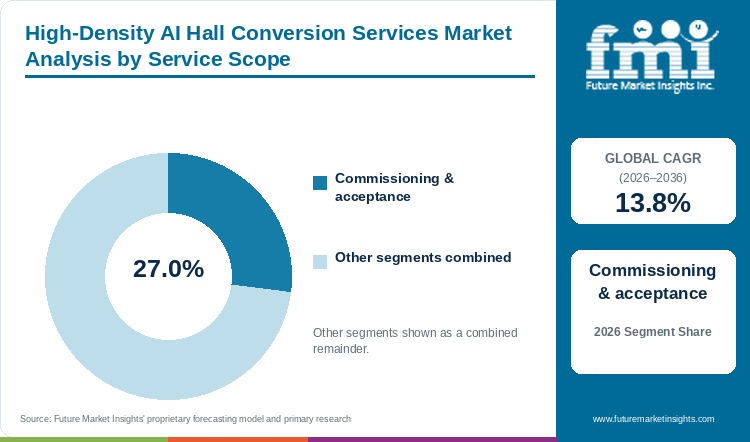
Commissioning & acceptance: 27.0% of service scope in 2026.
Acceptance in a converted hall needs to examine new equipment connected to plant designed for a different duty, including coolant preparation, control response and retained electrical feeds. A component’s factory result cannot establish those installed interactions, so the contractor must record both validated capacity and legacy restrictions. The owner can then load the upgraded area within a usable boundary without interpreting an improved rack specification as permission to increase demand throughout the facility.
- The Commissioning & acceptance segment accounts for 27.0% of service scope in 2026.
- The handover should distinguish the capacity validated by the conversion from restrictions that remain in the retained plant.
Why does New AI hall build lead project stage demand?
New AI hall build: 36.0% of project stage in 2026.
A newly configured AI area within an existing facility allows rack spacing, busway routes and liquid-loop access to be coordinated before cabinets arrive. Structural space and upstream utilities still constrain that freedom, requiring the contract to distinguish new, modified and retained systems. Clear scope makes adaptation responsibilities visible when a new rack depends on older plant, keeping the service assignment separate from the wider construction value of a campus.
- The New AI hall build segment accounts for 36.0% of project stage in 2026.
- A purpose-configured area still needs a survey of the building interfaces it will use rather than an assumption that existing utilities have sufficient headroom.
What are the drivers, restraints, and opportunities in the high-density AI hall conversion services market?
Existing halls need adaptation for denser compute
Concentrated accelerator loads can exceed what a legacy hall was designed to supply or cool. Owners need to establish whether the existing location offers a practical route to additional AI capacity. This creates work for engineers who can assess feeder loading and thermal arrangements before equipment is committed. The study should identify both reusable assets and necessary replacements. A feasible conversion can avoid abandoning useful infrastructure. An unrealistic one can leave expensive computing equipment waiting on work that was not included in the initial plan.
Live-site dependencies constrain construction sequences
Live-site drawings may omit later modifications, and an apparent isolation point can also supply neighboring workloads, making surveys necessary before a cutover is promised. Costly pipe or switchgear restrictions may lead an owner to choose another area or a lower-density first phase. Resolving those choices during feasibility keeps the conversion target aligned with the work that can be performed safely.
Phased conversion can preserve useful infrastructure
A facility with sufficient upstream power may still need liquid-cooling distribution and operating procedures before dense AI racks can be used. A staged package can begin with a survey and isolation plan, followed by monitored flushing and integrated tests before load transfer. Providers can reuse that engineering method while retaining decisions specific to access, utilities and unaffected operations in each hall.
The converted hall still requires AI infrastructure commissioning, including tests of interfaces between retained plant and newly installed AI infrastructure.
Which country and market CAGRs are profiled for high-density AI hall conversion services?
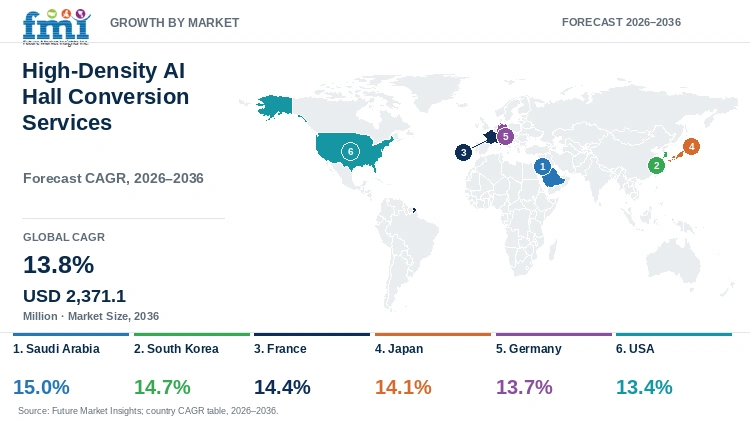
| Country | CAGR |
|---|---|
| Saudi Arabia | 15.0% |
| South Korea | 14.7% |
| France | 14.4% |
| Japan | 14.1% |
| Germany | 13.7% |
| USA | 13.4% |
Country-wise Analysis
Saudi Arabia
- Available feeder capacity and feasible heat rejection determine whether Saudi Arabian retained assets can support the intended rack duty. The fastest profiled forecast is a 15.0% CAGR from 2026 to 2036, with local thermal conditions influencing which equipment can remain and which creates a hidden density limit. A defined feasibility boundary lets owners compare adaptation with replacement before approving an installation sequence.
South Korea
- A government-led compute purchase in South Korea can create a conversion requirement while leaving receiving-site responsibility and power availability to be settled. Tender conditions and confirmed service scope therefore shape timing within the country’s 14.7% CAGR forecast for 2026 to 2036. Explicit phasing gives crews access to the changed area while protecting unaffected equipment, instead of treating a funded GPU order as evidence of hall readiness.
France
- French conversion proposals need to reconcile planned computing load with the electrical supply and operating requirements of the selected facility. Temporary services deserve explicit pricing because they can change whether reuse remains economical, even within a market forecast to grow at a 14.4% CAGR from 2026 to 2036. A clear account of retained interfaces and cutover costs gives the owner a sounder comparison before work is approved.
Japan
- Electricity and telecommunications coordination helps determine which Japanese sites can receive additional AI demand, after which access routes and live systems govern the work sequence. Contractors need those constraints before committing to density, with phased thermal design aligned to utility availability. Japan’s forecast is a 14.1% CAGR from 2026 to 2036 for service work shaped by these site-specific conditions.
Germany
- Efficiency and heat-recovery requirements influence the German case for adapting an older hall alongside asset life and the disruption required for change. Within the 13.7% CAGR forecast for 2026 to 2036, buyers need a documented boundary between old and new systems that preserves redundancy and workable coolant conditions. Maintainability and measured performance then sit alongside rack density in approval of each stage.
USA
- Existing tenants and workloads give an American campus conversion a different sequence from work in an empty hall. The USA’s 13.4% CAGR forecast for 2026 to 2036 accompanies demand for clear outage permissions, fallback arrangements and interface tests before load transfer. Utility readiness also affects the choice between specialty packages and broader integration, making the disruption required for reuse part of a reviewable procurement plan.
Who are the notable companies in the high-density AI hall conversion services market?
Vertiv; Siemens; Jacobs; Schneider Electric; Eaton
Conversion providers need to understand the existing hall as well as the proposed AI installation. Expertise in cooling or electrical design may need to be combined with live-site sequencing and cross-system testing. The owner should know which party takes responsibility for those interfaces before construction begins.
Competitive Benchmarking: High-Density AI Hall Conversion Services Market
| Participant | Commercial focus | Buyer qualification priority |
|---|---|---|
| Vertiv | Power, cooling and infrastructure services | Integrated commissioning and service access |
| Siemens | Electrical and building-system integration | Protection logic and controls handover |
| Jacobs | Engineering and facility integration | Cross-system acceptance and owner requirements |
| Schneider Electric | Power, cooling and prefabricated infrastructure | Interface definition and system-level testing |
| Eaton | Power infrastructure and services | Protection coordination and recovery behavior |
Key Developments in the High-Density AI Hall Conversion Services Market
- Schneider Electric introduced prefabricated pod and rack solutions for high-density AI applications in June 2025. [1]
- Jacobs released an AI data-center digital-twin solution in March 2026 covering compute, power and cooling interactions. [2]
Key Players in the High-Density AI Hall Conversion Services Market
- Vertiv
- Siemens
- Jacobs
- Schneider Electric
- Eaton
High-Density AI Hall Conversion Services Market - Report Scope
| Coverage field | Report scope |
|---|---|
| Market breakdown | Service Scope; Project Stage; AI Rack Density; Data Center Type; Commercial Model; Region |
| Quantitative unit | USD Million |
| Market definition | The market covers engineering, retrofit, migration, integration and acceptance services used to convert or reconfigure data halls for high-density AI operation. Qualifying work can include commissioning a newly configured AI hall within an existing facility. Unrelated new construction and standalone equipment sales are excluded. |
| Regions covered | North America; Latin America; Western Europe; Eastern Europe; East Asia; South Asia and Pacific; Middle East and Africa |
| Countries / markets profiled | Saudi Arabia; South Korea; France; Japan; Germany; USA |
| Key companies profiled | Vertiv; Siemens; Jacobs; Schneider Electric; Eaton |
| Base year / forecast period | 2026 / 2026–2036 |
| Estimate coverage | 2025 and 2026 market estimates; 2036 forecast; segment shares and country / market CAGRs. |
High-Density AI Hall Conversion Services Market - Research Methodology
| Method | Application |
|---|---|
| Market definition | The analysis follows the stated product or service boundary and distinguishes direct category revenue from adjacent activities. |
| Secondary research | Official technical, regulatory, research and company publications provide the documented operating context and recent developments cited in this report. |
| Forecast and segmentation | Market estimates, segment shares and geographic forecasts are presented as analytical estimates within the stated commercial scope. |
| Competitive assessment | Participants are compared by their relevant products or services, commercial role and buyer qualification requirements. |
| Interpretation | The assessment considers purchasing conditions and the scope of the documented product, service or performance claim. |
High-Density AI Hall Conversion Services Market by Segments
Service Scope
- Commissioning & acceptance
- Design & engineering
- Performance validation
- Retrofit & migration
- Managed support
Project Stage
- New AI hall build
- Rack/pod deployment
- Capacity expansion
- Legacy conversion
- Ongoing operations
AI Rack Density
- 251–500 kW
- 100–250 kW
- Below 100 kW
- Above 500 kW
Data Center Type
- Hyperscale AI data centers
- Colocation AI facilities
- Enterprise private AI
- HPC & research centers
Commercial Model
- Direct enterprise contract
- System integrator / EPC-led
- Subscription / license
- Managed-service contract
High-Density AI Hall Conversion Services Market by Region
- North America
- United States
- Canada
- Latin America
- Brazil
- Mexico
- Argentina
- Chile
- Western Europe
- Germany
- France
- United Kingdom
- Italy
- Spain
- Benelux
- Nordics
- Eastern Europe
- Poland
- Czech Republic
- Romania
- Hungary
- East Asia
- China
- Japan
- South Korea
- South Asia and Pacific
- India
- ASEAN
- Australia and New Zealand
- Middle East and Africa
- GCC Countries
- South Africa
- Türkiye
- Israel
Research Sources and Bibliography
- [1] Schneider Electric. (2025, June 11). Schneider Electric Launches New Data Center Solutions to Meet Challenges of High-Density AI and Accelerated Compute Applications.
- [2] Jacobs. (2026, March 16). Jacobs releases digital twin solution for AI data centers.
- [3] Siemens. (2025, December 9). Siemens and nVent to Release Joint Reference Architecture Purpose-Built for NVIDIA AI Data Centers.
- [4] International Energy Agency. (2025, April 10). Energy and AI.
- [5] Future Market Insights. (2026). High-Density AI Hall Conversion Services Market: Global industry analysis and opportunity assessment, 2026–2036.
This Report Answers
- How large is the high-density AI hall conversion services market in 2026?
- What value and CAGR are forecast through 2036?
- Which service scope segment leads in 2026?
- Which project stage segment has the largest share?
- Which profiled country or market has the fastest forecast growth?
- Which participants are covered in the competitive assessment?
Frequently Asked Questions
How large is the high-density AI hall conversion services market in 2026?
The market was valued at USD 572.0 Million in 2025 and is expected to reach USD 650.9 Million in 2026.
What value and CAGR are forecast through 2036?
The market is projected to reach USD 2,371.1 Million by 2036, with a 13.8% CAGR during 2026–2036.
Which service scope segment leads in 2026?
The Commissioning & acceptance segment accounts for 27.0% of service scope in 2026.
Which project stage segment has the largest share?
The New AI hall build segment accounts for 36.0% of project stage in 2026.
Which profiled country or market has the fastest forecast growth?
Saudi Arabia has the highest profiled CAGR at 15.0% during 2026–2036.
Which participants are covered in the competitive assessment?
The assessment covers Vertiv, Siemens, Jacobs, Schneider Electric and Eaton.
Preview the report firsthand - request a free sample
Get SampleGet the brochure for pricing and purchase details.
Get PDFTable of Content
- Key Takeaways
- Market Size and CAGR
- Top Growth Driver
- Fastest Growing Segment
- Leading Region
- Key Companies
- Emerging Opportunities
- Executive Summary
- Global Market Outlook
- Demand-side Trends
- Supply-side Trends
- Technology Roadmap Analysis
- Analysis and Recommendations
- Analyst Perspective (What is happening? Why now? What should investors know?)
- Key Questions Answered
- How large is the market?
- What is the CAGR?
- What are key trends?
- Which region dominates?
- Who are the leaders?
- Market Overview
- Market Coverage / Taxonomy
- Market Definition / Scope / Limitations
- Research Methodology
- Chapter Orientation
- Analytical Lens and Working Hypotheses
- Market Structure, Signals, and Trend Drivers
- Benchmarking and Cross-market Comparability
- Market Sizing, Forecasting, and Opportunity Mapping
- Research Design and Evidence Framework
- Desk Research Programme (Secondary Evidence)
- Expert Input and Fieldwork (Primary Evidence)
- Tooling, Models, and Reference Databases
- Data Engineering and Model Build
- Quality Assurance and Audit Trail
- Market Background
- Market Dynamics (Drivers, Restraints, Opportunity, Trends)
- Scenario Forecast (Optimistic, Likely, Conservative)
- Impact Analysis
- AI Impact
- Sustainability Impact
- Regulatory Impact
- Technology Impact
- Consumer / Buyer Analysis
- Purchase Drivers
- Adoption Barriers
- Buyer Journey
- Opportunity Map Analysis
- Product Life Cycle Analysis
- Supply Chain Analysis
- Investment Feasibility Matrix
- Value Chain Analysis
- PESTLE and Porter's Analysis
- Regulatory Landscape
- Regional Parent Market Outlook
- Production and Consumption Statistics
- Import and Export Statistics
- Global Market Analysis and Forecast, 2021 to 2036
- Historical Market Size Value (USD Million) Analysis, 2021 to 2025
- Current and Future Market Size Value (USD Million) Projections, 2026 to 2036
- Y-o-Y Growth Trend Analysis
- Absolute $ Opportunity Analysis
- Global Market Pricing Analysis, 2021 to 2036
- Global Market Analysis and Forecast, By Service Scope, 2021 to 2036
- Introduction / Key Findings
- Historical Market Size Value (USD Million) Analysis By Service Scope, 2021 to 2025
- Current and Future Market Size Value (USD Million) Analysis and Forecast By Service Scope, 2026 to 2036
- Commissioning & acceptance
- Design & engineering
- Performance validation
- Retrofit & migration
- Managed support
- Y-o-Y Growth Trend Analysis By Service Scope, 2021 to 2025
- Absolute $ Opportunity Analysis By Service Scope, 2026 to 2036
- Global Market Analysis and Forecast, By Project Stage, 2021 to 2036
- Introduction / Key Findings
- Historical Market Size Value (USD Million) Analysis By Project Stage, 2021 to 2025
- Current and Future Market Size Value (USD Million) Analysis and Forecast By Project Stage, 2026 to 2036
- New AI hall build
- Rack/pod deployment
- Capacity expansion
- Legacy conversion
- Ongoing operations
- Y-o-Y Growth Trend Analysis By Project Stage, 2021 to 2025
- Absolute $ Opportunity Analysis By Project Stage, 2026 to 2036
- Global Market Analysis and Forecast, By AI Rack Density, 2021 to 2036
- Introduction / Key Findings
- Historical Market Size Value (USD Million) Analysis By AI Rack Density, 2021 to 2025
- Current and Future Market Size Value (USD Million) Analysis and Forecast By AI Rack Density, 2026 to 2036
- 251–500 kW
- 100–250 kW
- Below 100 kW
- Above 500 kW
- Y-o-Y Growth Trend Analysis By AI Rack Density, 2021 to 2025
- Absolute $ Opportunity Analysis By AI Rack Density, 2026 to 2036
- Global Market Analysis and Forecast, By Data Center Type, 2021 to 2036
- Introduction / Key Findings
- Historical Market Size Value (USD Million) Analysis By Data Center Type, 2021 to 2025
- Current and Future Market Size Value (USD Million) Analysis and Forecast By Data Center Type, 2026 to 2036
- Hyperscale AI data centers
- Colocation AI facilities
- Enterprise private AI
- HPC & research centers
- Y-o-Y Growth Trend Analysis By Data Center Type, 2021 to 2025
- Absolute $ Opportunity Analysis By Data Center Type, 2026 to 2036
- Global Market Analysis and Forecast, By Commercial Model, 2021 to 2036
- Introduction / Key Findings
- Historical Market Size Value (USD Million) Analysis By Commercial Model, 2021 to 2025
- Current and Future Market Size Value (USD Million) Analysis and Forecast By Commercial Model, 2026 to 2036
- Direct enterprise contract
- System integrator / EPC-led
- Subscription / license
- Managed-service contract
- Y-o-Y Growth Trend Analysis By Commercial Model, 2021 to 2025
- Absolute $ Opportunity Analysis By Commercial Model, 2026 to 2036
- Global Market Analysis and Forecast, By Region, 2021 to 2036
- Introduction
- Historical Market Size Value (USD Million) Analysis By Region, 2021 to 2025
- Current Market Size Value (USD Million) Analysis and Forecast By Region, 2026 to 2036
- North America
- Latin America
- Western Europe
- Eastern Europe
- East Asia
- South Asia and Pacific
- Middle East and Africa
- Market Attractiveness Analysis By Region
- North America Market Analysis and Forecast, By Country, 2021 to 2036
- Historical Market Size Value (USD Million) Trend Analysis By Market Taxonomy, 2021 to 2025
- Market Size Value (USD Million) Forecast By Market Taxonomy, 2026 to 2036
- By Country
- United States
- Canada
- By Service Scope
- By Project Stage
- By AI Rack Density
- By Data Center Type
- By Commercial Model
- By Country
- Market Attractiveness Analysis
- By Country
- By Service Scope
- By Project Stage
- By AI Rack Density
- By Data Center Type
- By Commercial Model
- Key Takeaways
- Latin America Market Analysis and Forecast, By Country
- Historical Market Size Value (USD Million) Trend Analysis By Market Taxonomy, 2021 to 2025
- Market Size Value (USD Million) Forecast By Market Taxonomy, 2026 to 2036
- By Country
- Brazil
- Mexico
- Argentina
- Chile
- By Service Scope
- By Project Stage
- By AI Rack Density
- By Data Center Type
- By Commercial Model
- By Country
- Market Attractiveness Analysis
- By Country
- By Service Scope
- By Project Stage
- By AI Rack Density
- By Data Center Type
- By Commercial Model
- Key Takeaways
- Western Europe Market Analysis and Forecast, By Country
- Historical Market Size Value (USD Million) Trend Analysis By Market Taxonomy, 2021 to 2025
- Market Size Value (USD Million) Forecast By Market Taxonomy, 2026 to 2036
- By Country
- Germany
- France
- United Kingdom
- Italy
- Spain
- Benelux
- Nordics
- By Service Scope
- By Project Stage
- By AI Rack Density
- By Data Center Type
- By Commercial Model
- By Country
- Market Attractiveness Analysis
- By Country
- By Service Scope
- By Project Stage
- By AI Rack Density
- By Data Center Type
- By Commercial Model
- Key Takeaways
- Eastern Europe Market Analysis and Forecast, By Country
- Historical Market Size Value (USD Million) Trend Analysis By Market Taxonomy, 2021 to 2025
- Market Size Value (USD Million) Forecast By Market Taxonomy, 2026 to 2036
- By Country
- Poland
- Czech Republic
- Romania
- Hungary
- By Service Scope
- By Project Stage
- By AI Rack Density
- By Data Center Type
- By Commercial Model
- By Country
- Market Attractiveness Analysis
- By Country
- By Service Scope
- By Project Stage
- By AI Rack Density
- By Data Center Type
- By Commercial Model
- Key Takeaways
- East Asia Market Analysis and Forecast, By Country
- Historical Market Size Value (USD Million) Trend Analysis By Market Taxonomy, 2021 to 2025
- Market Size Value (USD Million) Forecast By Market Taxonomy, 2026 to 2036
- By Country
- China
- Japan
- South Korea
- By Service Scope
- By Project Stage
- By AI Rack Density
- By Data Center Type
- By Commercial Model
- By Country
- Market Attractiveness Analysis
- By Country
- By Service Scope
- By Project Stage
- By AI Rack Density
- By Data Center Type
- By Commercial Model
- Key Takeaways
- South Asia and Pacific Market Analysis and Forecast, By Country
- Historical Market Size Value (USD Million) Trend Analysis By Market Taxonomy, 2021 to 2025
- Market Size Value (USD Million) Forecast By Market Taxonomy, 2026 to 2036
- By Country
- India
- ASEAN
- Australia and New Zealand
- By Service Scope
- By Project Stage
- By AI Rack Density
- By Data Center Type
- By Commercial Model
- By Country
- Market Attractiveness Analysis
- By Country
- By Service Scope
- By Project Stage
- By AI Rack Density
- By Data Center Type
- By Commercial Model
- Key Takeaways
- Middle East and Africa Market Analysis and Forecast, By Country
- Historical Market Size Value (USD Million) Trend Analysis By Market Taxonomy, 2021 to 2025
- Market Size Value (USD Million) Forecast By Market Taxonomy, 2026 to 2036
- By Country
- GCC Countries
- South Africa
- Türkiye
- Israel
- By Service Scope
- By Project Stage
- By AI Rack Density
- By Data Center Type
- By Commercial Model
- By Country
- Market Attractiveness Analysis
- By Country
- By Service Scope
- By Project Stage
- By AI Rack Density
- By Data Center Type
- By Commercial Model
- Key Takeaways
- Key Countries Market Analysis
- United States
- Pricing Analysis
- Market Share Analysis, 2025
- By Service Scope
- By Project Stage
- By AI Rack Density
- By Data Center Type
- By Commercial Model
- Canada
- Pricing Analysis
- Market Share Analysis, 2025
- By Service Scope
- By Project Stage
- By AI Rack Density
- By Data Center Type
- By Commercial Model
- Mexico
- Pricing Analysis
- Market Share Analysis, 2025
- By Service Scope
- By Project Stage
- By AI Rack Density
- By Data Center Type
- By Commercial Model
- Brazil
- Pricing Analysis
- Market Share Analysis, 2025
- By Service Scope
- By Project Stage
- By AI Rack Density
- By Data Center Type
- By Commercial Model
- Chile
- Pricing Analysis
- Market Share Analysis, 2025
- By Service Scope
- By Project Stage
- By AI Rack Density
- By Data Center Type
- By Commercial Model
- Germany
- Pricing Analysis
- Market Share Analysis, 2025
- By Service Scope
- By Project Stage
- By AI Rack Density
- By Data Center Type
- By Commercial Model
- United Kingdom
- Pricing Analysis
- Market Share Analysis, 2025
- By Service Scope
- By Project Stage
- By AI Rack Density
- By Data Center Type
- By Commercial Model
- Italy
- Pricing Analysis
- Market Share Analysis, 2025
- By Service Scope
- By Project Stage
- By AI Rack Density
- By Data Center Type
- By Commercial Model
- Spain
- Pricing Analysis
- Market Share Analysis, 2025
- By Service Scope
- By Project Stage
- By AI Rack Density
- By Data Center Type
- By Commercial Model
- France
- Pricing Analysis
- Market Share Analysis, 2025
- By Service Scope
- By Project Stage
- By AI Rack Density
- By Data Center Type
- By Commercial Model
- India
- Pricing Analysis
- Market Share Analysis, 2025
- By Service Scope
- By Project Stage
- By AI Rack Density
- By Data Center Type
- By Commercial Model
- ASEAN
- Pricing Analysis
- Market Share Analysis, 2025
- By Service Scope
- By Project Stage
- By AI Rack Density
- By Data Center Type
- By Commercial Model
- Australia and New Zealand
- Pricing Analysis
- Market Share Analysis, 2025
- By Service Scope
- By Project Stage
- By AI Rack Density
- By Data Center Type
- By Commercial Model
- China
- Pricing Analysis
- Market Share Analysis, 2025
- By Service Scope
- By Project Stage
- By AI Rack Density
- By Data Center Type
- By Commercial Model
- Japan
- Pricing Analysis
- Market Share Analysis, 2025
- By Service Scope
- By Project Stage
- By AI Rack Density
- By Data Center Type
- By Commercial Model
- South Korea
- Pricing Analysis
- Market Share Analysis, 2025
- By Service Scope
- By Project Stage
- By AI Rack Density
- By Data Center Type
- By Commercial Model
- Poland
- Pricing Analysis
- Market Share Analysis, 2025
- By Service Scope
- By Project Stage
- By AI Rack Density
- By Data Center Type
- By Commercial Model
- Hungary
- Pricing Analysis
- Market Share Analysis, 2025
- By Service Scope
- By Project Stage
- By AI Rack Density
- By Data Center Type
- By Commercial Model
- Türkiye
- Pricing Analysis
- Market Share Analysis, 2025
- By Service Scope
- By Project Stage
- By AI Rack Density
- By Data Center Type
- By Commercial Model
- South Africa
- Pricing Analysis
- Market Share Analysis, 2025
- By Service Scope
- By Project Stage
- By AI Rack Density
- By Data Center Type
- By Commercial Model
- Saudi Arabia
- Pricing Analysis
- Market Share Analysis, 2025
- By Service Scope
- By Project Stage
- By AI Rack Density
- By Data Center Type
- By Commercial Model
- United States
- Market Structure Analysis
- Competition Dashboard
- Competition Benchmarking
- Market Share Analysis of Top Players
- By Regional
- By Service Scope
- By Project Stage
- By AI Rack Density
- By Data Center Type
- By Commercial Model
- Emerging Startups
- Innovation Benchmarking
- Competition Analysis
- Competition Deep Dive
- Vertiv
- Overview
- Product Portfolio
- Profitability by Market Segments
- Sales Footprint
- Strategy Overview
- Marketing Strategy
- Product Strategy
- Channel Strategy
- Siemens
- Jacobs
- Schneider Electric
- Eaton
- Vertiv
- Case Studies
- Success Stories
- Recent Developments
- Competition Deep Dive
- Assumptions & Acronyms Used


