

- Market Size (2026)
- USD 429.0 Mn
- Forecast (2036)
- USD 1562.9 Mn
- CAGR (2026 to 2036)
- 13.8%
How big is 800VDC AI Rack Electrical Commissioning Services Market in 2026?
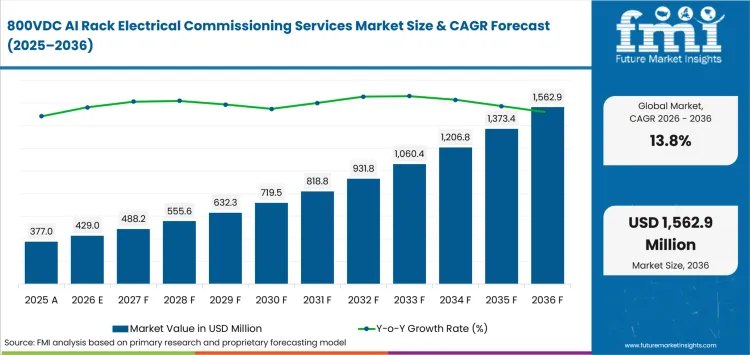
USD 429.0 million in 2026 and USD 1,562.9 million by 2036 at a 13.8% CAGR.
Demand is projected to rise from USD 429.0 million in 2026 to USD 1,562.9 million by 2036 at a 13.8% CAGR. NVIDIA stated in May 2025 that its 800 VDC architecture targets racks from 100 kW to beyond 1 MW and reduces current for the same delivered power. Higher distribution voltage changes insulation checks, protection settings and interface verification required before safe first energization. Each denser power path therefore carries more documented acceptance work before the operations team assumes the asset.
Country conversion depends on how quickly grid capacity and data-center construction reach an energizable state. The International Energy Agency projected in April 2025 that data-center electricity use would rise about 80% in Japan by 2030 and about 70% in Europe. Commissioning revenue appears near electrical turnover instead of the initial AI capacity announcement because funded construction creates the testable asset. Markets with funded utility connections and repeatable construction packages can therefore convert 800 VDC designs into service orders sooner.
Key Takeaways
- Higher rack density increases acceptance work because 800 VDC distribution changes insulation, protection and interface checks before first energization.
- Based on service scope, commissioning & acceptance is projected to account for 26.0% in 2026 due to documented system verification required at electrical turnover.
- By nominal DC voltage, 750-850 VDC is estimated to hold 49.0% in 2026 owing to emerging reference architectures centered near 800 VDC.
- In 2026, 250-500 kW is expected to lead rack power density with 36.0% share because this range captures the first broad high-density deployment band.
- Field skills and inconsistent test practice can delay acceptance because higher DC voltage raises the consequence of weak procedures under compressed construction schedules.
- Some of the key players in this market include Eaton, Vertiv, Schneider Electric, ABB, Delta Electronics, Megger, Fluke, and Bender.
Analyst Perspective
“At 800 VDC, the commercial dividing line is whether a provider can prove source-to-rack protection behavior before operational handover. Providers that tie insulation tests and protection settings to a traceable turnover record can reduce late rework on megawatt-class AI deployments.”
- Sudip saha, Principal Consultant, Future Market Insights
How is the 800VDC AI rack electrical commissioning services market segmented?
The market is segmented by service scope, nominal DC voltage, rack power density, data center type, route to market and region.
Service scope covers commissioning & acceptance, protection / coordination studies, architecture & design, safety validation and retrofit engineering. Nominal DC voltage covers 750-850 VDC, 600-749 VDC, 851-1,000 VDC and above 1,000 VDC. Rack power density covers 250-500 kW, below 250 kW, 501-750 kW and above 750 kW. Data center type covers hyperscale AI data centers, colocation AI facilities, enterprise / sovereign AI and HPC & research centers. Route to market covers power OEM direct, electrical EPC / system integrator, authorized distributor and retrofit / service channel.
What supports hyperscale AI data centers in the data center type category?
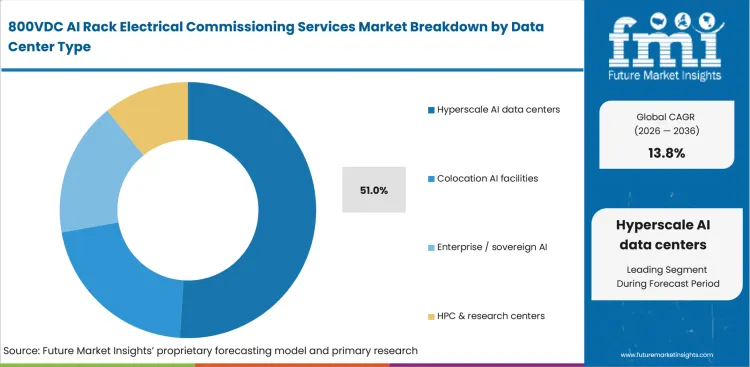
Repeatable hyperscale blocks make standardized acceptance inputs commercially useful, and Schneider Electric released a September 2025 NVIDIA GB300 NVL72 reference design supporting up to 142 kW per rack. Operators can reuse those defined power-control boundaries across large build programs instead of rebuilding the commissioning script for every rack group.
- By data center type, hyperscale AI data centers are forecast to represent 51.0% in 2026 driven by repeatable fleet designs that attach commissioning work to standardized deployment blocks.
- The same repeatability supports modular data centers because factory-built electrical blocks can arrive with defined test boundaries that shorten site-specific acceptance planning.
What makes commissioning & acceptance central to the service scope category?
Commissioning & acceptance begins once installed power equipment can be tested as one electrical path before the owner assumes operating responsibility. ANSI/NETA ATS-2025 defines field tests and inspections used to assess suitability for initial energization, which makes documented acceptance a direct turnover requirement for new 800 VDC rack power systems.
- Based on service scope, commissioning & acceptance is projected to account for 26.0% in 2026 due to electrical turnover requiring evidence that installed settings match design intent.
- Field teams use power quality monitoring to reconcile protection behavior with recorded measurements, which reduces disputes between equipment startup and owner acceptance.
Why does 750-850 VDC lead the nominal DC voltage category?
Reference designs are concentrating near the intended 800 VDC operating window, and Eaton announced an 800 VDC AI-factory architecture in October 2025 with integrated protection and energy storage. That alignment lets commissioning procedures focus on one emerging voltage class without treating each early installation as a completely different electrical architecture.
- By nominal DC voltage, 750-850 VDC is estimated to hold 49.0% in 2026 owing to direct alignment with emerging 800 VDC reference designs.
- Commissioning plans must coordinate 800 VDC distribution with upstream data center UPS behavior, especially during transfer events and short-duration backup conditions.
How does 250-500 kW lead the rack power density category?
Several-hundred-kilowatt racks expose conductor sizing, protection coordination and fault-current issues that conventional rack commissioning encounters less often. Delta presented 800 VDC conversion technology for AI data centers at NVIDIA GTC in March 2025, placing this power range inside active commercial engineering programs rather than a laboratory-only design cycle.
- In 2026, 250-500 kW is expected to lead rack power density with 36.0% share because it captures the first broad high-voltage deployment band.
- Test scope expands toward switchgear for data centers as rack load increases, since source-to-rack protection settings must remain coordinated under larger DC fault exposure.
What are the drivers, restraints and opportunities in the 800VDC AI Rack Electrical Commissioning Services Market?
Higher rack power increases 800 VDC commissioning demand, field-confidence gaps restrain execution and reusable acceptance packages offer a scalable service route.
- Driver: Megawatt-class rack design increases the amount of insulation, protection and interface verification required before energization.
- Restraint: Limited field confidence and inconsistent measurement practice can extend acceptance schedules for unfamiliar higher-voltage DC systems.
- Opportunity: Providers can package repeatable test sequences and digital turnover records around emerging 800 VDC reference architectures.
Rising Rack Power Expands Electrical Acceptance Scope
The deployment of high-density AI infrastructure is expanding the scope of electrical commissioning requirements. Schneider Electric stated in October 2025 that its 800 VDC sidecar design supports racks up to 1.2 MW and includes protection plus metering. That power level widens the commissioning boundary beyond a rack check because teams must validate conversion, protection and source-to-load behavior before handover. Demand therefore moves with critical power and cooling projects that require one acceptance record for the complete high-density electrical path.
Field Confidence Limits Faster Turnover
Limited confidence in test results can extend commissioning timelines and delay final project sign-off. Fluke found in April 2026 that only 22% of surveyed data-center professionals fully trusted test data to reflect real operating conditions. Skills and training gaps affected 43% of respondents while commissioning time pressure affected 16%. Owners can delay final sign-off until measurements are repeatable enough to support unfamiliar DC protection settings and operating limits during handover.
Reusable Acceptance Packages Extend Post-Energization Service
Digital acceptance and monitoring platforms create opportunities to extend commissioning value beyond initial energization. Bender launched its COMTRAXX EDGE500IP condition-monitoring gateway in August 2025 for modern energy infrastructure with data logging and remote access functions. Commissioning firms can use comparable digital records to turn one-time tests into structured acceptance packages that remain useful after energization. That approach also supports data center battery and protection handover by keeping settings, measurements and condition records in one traceable package.
Which country CAGRs are profiled in the 800VDC AI Rack Electrical Commissioning Services Market?
| Country | CAGR |
|---|---|
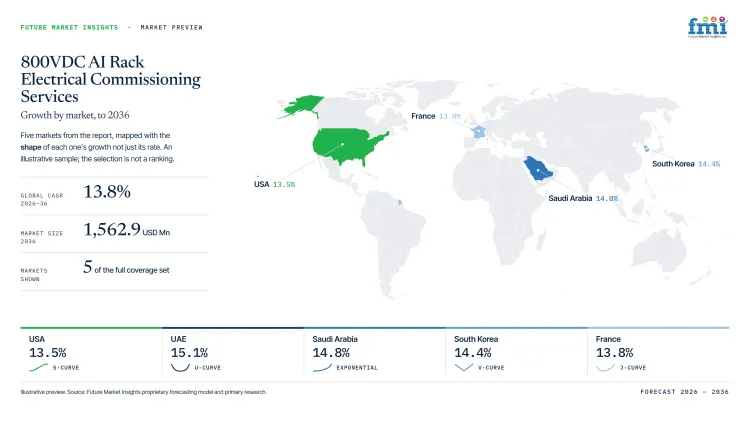
| UAE | 15.0% |
| Saudi Arabia | 14.8% |
| South Korea | 14.4% |
| Japan | 14.1% |
| France | 13.8% |
How do country-level CAGRs compare in the 800VDC AI Rack Electrical Commissioning Services Market?
The five CAGRs span 1.2 percentage points from 13.8% in France to 15.0% in UAE. Gulf projects form the upper group because greenfield campuses standardize turnover before electrical blocks reach energization. South Korea and Japan occupy the middle range because data center power planning governs construction schedules.
- UAE projects repeat electrical blocks, letting commissioning teams reuse staged energization procedures during campus phases.
- Saudi greenfield programs let EPC contractors define acceptance scope before electrical rooms enter field testing.
- South Korean projects tie acceptance records to permitting milestones and grid-impact requirements for large sites.
- Japanese sites need early power management coordination because electricity and communications infrastructure must be planned together.
- French projects convert more slowly where grid connection timing trails funded AI campus construction schedules.
The full report provides country-level CAGR analysis across North America, Latin America, Europe, East Asia, South Asia, Oceania and the Middle East and Africa.
Country-wise Analysis
- In May 2025, Abu Dhabi Media Office placed the 1 GW Stargate UAE compute cluster inside a planned 5 GW campus with staged delivery. UAE demand is forecast to expand at 15.0% CAGR through 2036 owing to greenfield programs that let power OEMs define protection settings and turnover records before electrical rooms reach final acceptance. Staged energization is the practical friction because utility interfaces must meet rack handover dates for each campus block. Commissioning firms with local engineers and reusable acceptance records are therefore better positioned to follow successive phases without rebuilding the acceptance method for every energization package.
- Saudi developers favor large greenfield packages because EPC contractors and power OEMs can define acceptance procedures before final electrical turnover. The Ministry of Communications and Information Technology documented in April 2026 that operational data-center capacity rose from 68 MW in 2021 to more than 440 MW in 2025. Saudi Arabia is projected to record 14.8% CAGR through 2036 because that capacity expansion broadens the addressable commissioning base. Localization requirements and limited specialist labor remain a commercial constraint for complex high-voltage DC turnover work, which gives providers with trained in-country crews a stronger position than firms relying mainly on remote engineering support.
- South Korean AI data-center projects face formal power-system review for large loads before developers can lock energization schedules. The AIDC Special Act passed the National Assembly in May 2026 according to MSIT, with provisions for streamlined approvals and selected grid-impact exemptions outside the capital region. Demand is anticipated to advance at 14.4% CAGR through 2036 given that faster permitting route for qualifying projects. Grid capacity still limits site delivery for large electrical loads and keeps network planning inside the commissioning timetable, so providers must align protection studies and compliance records with the developer’s permit sequence instead of assuming regulatory relief removes network constraints.
- Japanese data-center developers are using prefabricated systems to compress site work while transferring more acceptance risk to module-to-site electrical interfaces. Factory records must still reconcile with utility settings and owner turnover requirements during phased energization. JETRO’s July 2025 investment note documented EPG Power’s Yokohama office after the company established a Japanese sales base for prefabricated data-center systems earlier that year. Japan is estimated to post 14.1% CAGR through 2036 attributable to modular infrastructure that integrates power, cooling and testing before site acceptance. Local engineering coverage should become more valuable as prefabrication shortens construction schedules without eliminating final electrical verification.
- French AI projects are moving toward multi-gigawatt campuses with large electrical packages that can be commissioned in separate blocks. In June 2026, the Élysée stated that SoftBank plans at least 3 GW and up to 5 GW of dedicated AI data-center capacity in France. France is forecast to grow at 13.8% CAGR through 2036 reflecting funded large-site development and an experienced electrical contracting base. Grid connection timing still determines when commissioning revenue becomes addressable. International power companies therefore gain less from early equipment positioning than from French field coverage that can align OEM protection settings with each owner’s phased energization schedule.
Who are the notable companies in the 800VDC AI Rack Electrical Commissioning Services Market?
Eaton, Vertiv, Schneider Electric, ABB, Delta Electronics, Megger, Fluke and Bender are the notable companies serving this market.
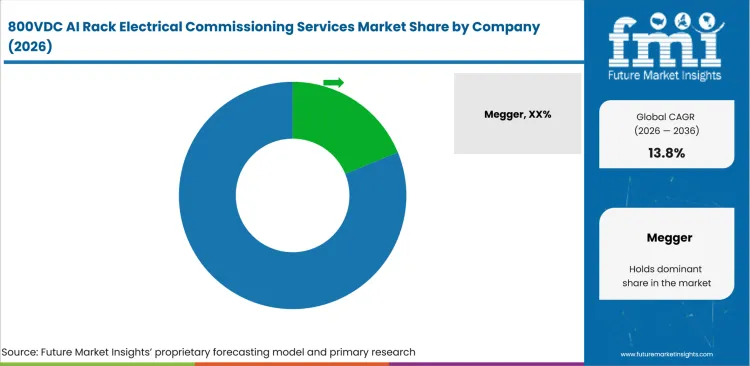
Competition splits between power-architecture companies that influence the 800 VDC design basis and test specialists that verify the installed electrical path. Entry barriers depend on access to architecture data, safe high-voltage DC measurement and repeatable commissioning records more than corporate size. Liquid cooling interfaces also affect electrical acceptance because verification increasingly occurs beside high-density thermal infrastructure during coordinated rack turnover.
- Eaton, Vertiv, Schneider Electric, ABB and Delta Electronics compete closest to architecture definition through AI data-center power systems and reference-design work.
- Megger, Fluke and Bender compete around field measurement, insulation evidence, diagnostics and condition records used during electrical acceptance and later maintenance.
Competitive Benchmarking: 800VDC AI Rack Electrical Commissioning Services Market
| Company | 800 VDC Architecture Depth | Commissioning & Test Coverage | DC Safety & Diagnostics | Geographic Reach |
|---|---|---|---|---|
| Eaton | High | High | High | Global |
| Vertiv | High | High | Medium | Global |
| Schneider Electric | High | High | High | Global |
| ABB | High | High | High | Global |
| Delta Electronics | High | Medium | Medium | Global |
| Megger | Low | High | High | Global |
| Fluke | Low | High | High | Global |
| Bender | Low | Medium | High | Europe, Americas and Asia-Pacific |
Scoring basis: High architecture depth requires a documented 800 VDC AI program, while Medium requires adjacent high-density DC work and Low identifies a test-focused role outside architecture delivery. High commissioning coverage requires several verification functions, Medium covers one substantial acceptance layer and Low indicates narrow support. High safety depth requires protection or diagnostic evidence as a core offer, Medium shows integrated support and Low reflects a limited documented role. Ratings use current official company announcements and service records that document exact-market architecture, testing or safety roles.
Key Developments in the 800VDC AI Rack Electrical Commissioning Services Market
- In October 2025, Vertiv announced collaboration with NVIDIA to advance 800 VDC platform designs toward engineering readiness for AI-factory power deployment.
- In July 2025, Eaton announced collaboration with NVIDIA on design practices and reference architectures for 800 V HVDC infrastructure supporting 1 MW racks and beyond.
- In May 2025, Delta Electronics unveiled an HVDC power solution for AI data centers at COMPUTEX 2025 alongside containerized infrastructure for high-density deployment.
Key Players in the 800VDC AI Rack Electrical Commissioning Services Market
800 VDC Power Architecture Platforms
- Eaton
- Vertiv
- Schneider Electric
- ABB
- Delta Electronics
Electrical Test and Commissioning Instrumentation
- Megger
- Fluke
DC Safety and Condition Monitoring
- Bender
800VDC AI Rack Electrical Commissioning Services Market - Report Scope
| Coverage field | Report scope |
|---|---|
| Market breakdown | By service scope, nominal DC voltage, rack power density, data center type, route to market and region. |
| Quantitative Units | USD million. |
| Market Definition | Professional electrical engineering, testing, verification and acceptance services used to commission 800 VDC-capable AI rack power delivery before operational handover. |
| Regions Covered | North America, Latin America, Europe, East Asia, South Asia and Pacific and Middle East and Africa. |
| Countries Covered | UAE, Saudi Arabia, South Korea, Japan, France, and 20+ countries included in the full report. |
| Key Companies Profiled | Eaton, Vertiv, Schneider Electric, ABB, Delta Electronics, Megger, Fluke, Bender. |
| Forecast Period | 2026 to 2036. |
| Approach | Primary and secondary research with market triangulation. |
800VDC AI Rack Electrical Commissioning Services Market - Research Methodology
| Method | Approach |
|---|---|
| Primary Research | FMI analysts gathered input from manufacturers, service providers, technology developers, distributors, end users, procurement teams, and subject-matter experts. Interviews examined purchasing decisions, product or service evaluation, adoption barriers, approval requirements, pricing considerations, and expectations for technical or commercial support. Respondents were also asked what evidence is required before a trial, pilot, or initial order develops into regular purchasing. |
| Desk Research | Desk research covered government statistics, regulatory publications, trade data, industry associations, technical literature, standards, company filings, product information, and official corporate announcements. Sources were reviewed for relevance, publication date, geographic coverage, and consistency with the defined market scope. Claims relating to performance, applications, approvals, capacity, investment, and commercial activity were retained only when supported by credible public evidence. |
| Market Sizing and Forecasting | The market model combined the baseline value with historical performance, segment structure, pricing and volume indicators, adoption levels, company participation, and country-level demand conditions. Forecast assumptions considered economic activity, investment trends, regulatory developments, technology adoption, purchasing cycles, supply availability, and barriers to wider market use. Segment and regional estimates were reconciled before the final market total was calculated. |
| Data Validation | Estimates were checked against multiple independent indicators, including public data, company activity, trade patterns, industry developments, and findings from primary interviews. Validation also tested whether products, services, applications, and company revenues fell within the defined market boundaries. Adjacent categories, unsupported claims, overlapping revenues, and activities without direct market relevance were excluded to reduce double counting and maintain consistency across segments and countries. |
800VDC AI Rack Electrical Commissioning Services Market by Segments
800VDC AI Rack Electrical Commissioning Services Market segmented by Service Scope:
- Commissioning & acceptance
- Protection / coordination studies
- Architecture & design
- Safety validation
- Retrofit engineering
800VDC AI Rack Electrical Commissioning Services Market segmented by Nominal DC Voltage:
- 750-850 VDC
- 600-749 VDC
- 851-1,000 VDC
- Above 1,000 VDC
800VDC AI Rack Electrical Commissioning Services Market segmented by Rack Power Density:
- Below 250 kW
- 250-500 kW
- 501-750 kW
- Above 750 kW
800VDC AI Rack Electrical Commissioning Services Market segmented by Data Center Type:
- Hyperscale AI data centers
- Colocation AI facilities
- Enterprise / sovereign AI
- HPC & research centers
800VDC AI Rack Electrical Commissioning Services Market segmented by Route to Market:
- Power OEM direct
- Electrical EPC / system integrator
- Authorized distributor
- Retrofit / service channel
800VDC AI Rack Electrical Commissioning Services Market by Region:
- North America
- United States
- Canada
- Latin America
- Brazil
- Mexico
- Chile
- Rest of Latin America
- Western Europe
- Germany
- United Kingdom
- Italy
- Spain
- France
- Nordics
- Benelux
- Rest of Western Europe
- Eastern Europe
- Russia
- Poland
- Hungary
- Balkan and Baltic States
- Rest of Eastern Europe
- East Asia
- China
- Japan
- South Korea
- South Asia and Pacific
- India
- ASEAN
- Australia and New Zealand
- Rest of South Asia and Pacific
- Middle East and Africa
- Kingdom of Saudi Arabia
- Other GCC Countries
- Türkiye
- South Africa
- Other African Union Countries
- Rest of Middle East and Africa
Research Sources and Bibliography
- NVIDIA. (2025, May 20). NVIDIA 800 VDC architecture will power the next generation of AI factories.
- International Energy Agency. (2025, April 10). Energy demand from AI.
- InterNational Electrical Testing Association. (2025). ANSI/NETA ATS-2025: Standard for acceptance testing specifications for electrical power equipment and systems.
- Eaton. (2025, October 13). Eaton unveils next-generation architecture to advance 800 VDC power infrastructure for AI factories.
- Delta Electronics. (2025, March 20). Delta unveils next-generation power and cooling solutions for AI data centers at NVIDIA GTC 2025.
- Schneider Electric. (2025, September 18). Schneider Electric announces new reference designs, featuring integrated power management and liquid cooling controls, supporting NVIDIA Mission Control and NVIDIA GB300 NVL72.
- Schneider Electric. (2025, October 13). Schneider Electric highlights innovation in 800 VDC power systems in support of NVIDIA’s next generation GPUs.
- Fluke Corporation. (2026, April 22). Only one in five data centre professionals fully trust data
- Bender. (2025, August 5). New COMTRAXX EDGE500IP: Gateway & condition monitoring in one device.
- Abu Dhabi Media Office. (2025, May 22). Global tech alliance launches 'Stargate UAE'.
- Ministry of Communications and Information Technology. (2026, April 28). Saudi Arabia strengthens its global position in artificial intelligence through data center growth and accelerated smart manufacturing.
- Ministry of Science and ICT. (2026, May 7). The AIDC Special Act passes the National Assembly plenary session.
- Japan External Trade Organization. (2025, July 31). EPG Power, a prefabricated construction manufacturer for data centers, has established an office in Yokohama, Kanagawa.
- Élysée. (2026, June 1). Meeting with Masayoshi Son, CEO of SoftBank.
- Vertiv. (2025, October 13). From vision to readiness: Vertiv collaborates with NVIDIA to advance 800 VDC platform designs to power the next generation of AI factories.
- Eaton. (2025, July 15). Eaton accelerates the transformation of data center infrastructure in the AI era with NVIDIA.
- Delta Electronics. (2025, May 21). Delta presents comprehensive solutions for AI data center with containerized data center & HVDC power solution at COMPUTEX 2025.
- Megger. (2025, December 9). Introducing DCI3: One tool for cable & phase identification.
- Eaton. (2026, March 16). Eaton collaborates with NVIDIA to unveil the Eaton Beam Rubin DSX platform to address the nearly $7 trillion data center buildout market from grid to chip
- Schneider Electric. (2026, March 16). Schneider Electric teams with NVIDIA to develop validated blueprints to design, simulate, build, operate and maintain gigawatt-scale AI factories
- Delta Electronics. (2026, March 17). Delta exhibits energy-saving solutions for 800 VDC in next-gen AI factories and digital twin applications built on Omniverse at NVIDIA GTC 2026
- Siemens. (2026, August 14). Siemens and Reinhausen develop direct current power solutions for AI data centers.
- Vertiv. (2026, July 23). Spotlight: Bringing NVIDIA AI computing capability to the Naval Postgraduate School.
- ABB. (2026, June 1). ABB expands collaboration with NVIDIA through integration of DSX blueprint for AI infrastructure.
- Siemens. (2026, March 17). Siemens and Rittal partner to design data center infrastructure of the future.
- Siemens. (2025, December 9). Siemens and nVent to release joint reference architecture purpose-built for NVIDIA AI data centers.
This bibliography is provided for reader reference and is not exhaustive. The full report contains the complete reference list and detailed citations
This Report Answers
- What is the 2026 market value and 2036 forecast?
- What is the market CAGR from 2026 to 2036?
- Why does commissioning & acceptance lead service scope?
- Why does 750-850 VDC lead nominal DC voltage?
- How does rack density change electrical commissioning scope?
- Which countries carry the highest profiled CAGRs?
- Which companies shape architecture and field verification?
- Which recent developments affect 800 VDC deployment?
- What slows electrical turnover at new AI sites?
Frequently Asked Questions
How big is the 800VDC AI rack electrical commissioning services market in 2026?
The 800VDC AI rack electrical commissioning services market is valued at USD 429.0 million in 2026 and is projected to reach USD 1,562.9 million by 2036. Higher rack power requires architecture-specific acceptance before owners authorize first energization.
What is the CAGR of the 800VDC AI rack electrical commissioning services market from 2026 to 2036?
The 800VDC AI rack electrical commissioning services market is projected to grow at a CAGR of 13.8% between 2026 and 2036. Denser AI racks require more protection verification and source-to-rack evidence before owners accept the electrical system.
Which service scope leads the 800VDC AI rack electrical commissioning services market?
The commissioning & acceptance segment is expected to hold 26.0% of the 800VDC AI rack electrical commissioning services market in 2026, driven by documented verification at electrical turnover. Acceptance records must show that installed settings and measured performance match the approved design basis.
Which countries are projected to record the highest growth in the 800VDC AI rack electrical commissioning services market?
The UAE is projected to grow at 15.0% CAGR followed by Saudi Arabia at 14.8% and South Korea at 14.4% through 2036. Large greenfield AI campuses convert capacity into commissioning work faster when staged utility connections are planned with electrical turnover.
Which companies are active in the 800VDC AI rack electrical commissioning services market?
Key companies operating in the 800VDC AI rack electrical commissioning services market include Eaton, Vertiv, Schneider Electric, ABB, Delta Electronics, Megger, Fluke, and Bender. Their roles cover power architecture, electrical testing and protection engineering tied to high-density deployment.
Preview the report firsthand - request a free sample
Get SampleGet the brochure for pricing and purchase details.
Get PDFTable of Content
- Key Takeaways
- Market Size and CAGR
- Top Growth Driver
- Fastest Growing Segment
- Leading Region
- Key Companies
- Emerging Opportunities
- Executive Summary
- Global Market Outlook
- Demand-side Trends
- Supply-side Trends
- Technology Roadmap Analysis
- Analysis and Recommendations
- Analyst Perspective (What is happening? Why now? What should investors know?)
- Key Questions Answered
- How large is the market?
- What is the CAGR?
- What are key trends?
- Which region dominates?
- Who are the leaders?
- Market Overview
- Market Coverage / Taxonomy
- Market Definition / Scope / Limitations
- Research Methodology
- Chapter Orientation
- Analytical Lens and Working Hypotheses
- Market Structure, Signals, and Trend Drivers
- Benchmarking and Cross-market Comparability
- Market Sizing, Forecasting, and Opportunity Mapping
- Research Design and Evidence Framework
- Desk Research Programme (Secondary Evidence)
- Expert Input and Fieldwork (Primary Evidence)
- Tooling, Models, and Reference Databases
- Data Engineering and Model Build
- Quality Assurance and Audit Trail
- Market Background
- Market Dynamics (Drivers, Restraints, Opportunity, Trends)
- Scenario Forecast (Optimistic, Likely, Conservative)
- Impact Analysis
- AI Impact
- Sustainability Impact
- Regulatory Impact
- Technology Impact
- Consumer / Buyer Analysis
- Purchase Drivers
- Adoption Barriers
- Buyer Journey
- Opportunity Map Analysis
- Product Life Cycle Analysis
- Supply Chain Analysis
- Investment Feasibility Matrix
- Value Chain Analysis
- PESTLE and Porter's Analysis
- Regulatory Landscape
- Regional Parent Market Outlook
- Production and Consumption Statistics
- Import and Export Statistics
- Global Market Analysis and Forecast, 2021 to 2036
- Historical Market Size Value (USD Million) Analysis, 2021 to 2025
- Current and Future Market Size Value (USD Million) Projections, 2026 to 2036
- Y-o-Y Growth Trend Analysis
- Absolute $ Opportunity Analysis
- Global Market Pricing Analysis, 2021 to 2036
- Global Market Analysis and Forecast, By Service Scope, 2021 to 2036
- Introduction / Key Findings
- Historical Market Size Value (USD Million) Analysis By Service Scope, 2021 to 2025
- Current and Future Market Size Value (USD Million) Analysis and Forecast By Service Scope, 2026 to 2036
- Commissioning & acceptance
- Protection / coordination studies
- Architecture & design
- Safety validation
- Retrofit engineering
- Commissioning & acceptance
- Y-o-Y Growth Trend Analysis By Service Scope, 2021 to 2025
- Absolute $ Opportunity Analysis By Service Scope, 2026 to 2036
- Global Market Analysis and Forecast, By Nominal DC Voltage, 2021 to 2036
- Introduction / Key Findings
- Historical Market Size Value (USD Million) Analysis By Nominal DC Voltage, 2021 to 2025
- Current and Future Market Size Value (USD Million) Analysis and Forecast By Nominal DC Voltage, 2026 to 2036
- 750-850 VDC
- 600-749 VDC
- 851-1,000 VDC
- Above 1,000 VDC
- 750-850 VDC
- Y-o-Y Growth Trend Analysis By Nominal DC Voltage, 2021 to 2025
- Absolute $ Opportunity Analysis By Nominal DC Voltage, 2026 to 2036
- Global Market Analysis and Forecast, By Rack Power Density, 2021 to 2036
- Introduction / Key Findings
- Historical Market Size Value (USD Million) Analysis By Rack Power Density, 2021 to 2025
- Current and Future Market Size Value (USD Million) Analysis and Forecast By Rack Power Density, 2026 to 2036
- 250-500 kW
- Below 250 kW
- 501-750 kW
- Above 750 kW
- 250-500 kW
- Y-o-Y Growth Trend Analysis By Rack Power Density, 2021 to 2025
- Absolute $ Opportunity Analysis By Rack Power Density, 2026 to 2036
- Global Market Analysis and Forecast, By Data Center Type, 2021 to 2036
- Introduction / Key Findings
- Historical Market Size Value (USD Million) Analysis By Data Center Type, 2021 to 2025
- Current and Future Market Size Value (USD Million) Analysis and Forecast By Data Center Type, 2026 to 2036
- Hyperscale AI data centers
- Colocation AI facilities
- Enterprise / sovereign AI
- HPC & research centers
- Hyperscale AI data centers
- Y-o-Y Growth Trend Analysis By Data Center Type, 2021 to 2025
- Absolute $ Opportunity Analysis By Data Center Type, 2026 to 2036
- Global Market Analysis and Forecast, By Route to Market, 2021 to 2036
- Introduction / Key Findings
- Historical Market Size Value (USD Million) Analysis By Route to Market, 2021 to 2025
- Current and Future Market Size Value (USD Million) Analysis and Forecast By Route to Market, 2026 to 2036
- Power OEM direct
- Electrical EPC / system integrator
- Authorized distributor
- Retrofit / service channel
- Power OEM direct
- Y-o-Y Growth Trend Analysis By Route to Market, 2021 to 2025
- Absolute $ Opportunity Analysis By Route to Market, 2026 to 2036
- Global Market Analysis and Forecast, By Region, 2021 to 2036
- Introduction
- Historical Market Size Value (USD Million) Analysis By Region, 2021 to 2025
- Current Market Size Value (USD Million) Analysis and Forecast By Region, 2026 to 2036
- North America
- Latin America
- Western Europe
- Eastern Europe
- East Asia
- South Asia and Pacific
- Middle East & Africa
- Market Attractiveness Analysis By Region
- North America Market Analysis and Forecast, By Country, 2021 to 2036
- Historical Market Size Value (USD Million) Trend Analysis By Market Taxonomy, 2021 to 2025
- Market Size Value (USD Million) Forecast By Market Taxonomy, 2026 to 2036
- By Country
- USA
- Canada
- By Service Scope
- By Nominal DC Voltage
- By Rack Power Density
- By Data Center Type
- By Route to Market
- By Country
- Market Attractiveness Analysis
- By Country
- By Service Scope
- By Nominal DC Voltage
- By Rack Power Density
- By Data Center Type
- By Route to Market
- Key Takeaways
- Latin America Market Analysis and Forecast, By Country
- Historical Market Size Value (USD Million) Trend Analysis By Market Taxonomy, 2021 to 2025
- Market Size Value (USD Million) Forecast By Market Taxonomy, 2026 to 2036
- By Country
- Brazil
- Mexico
- Chile
- Rest of Latin America
- By Service Scope
- By Nominal DC Voltage
- By Rack Power Density
- By Data Center Type
- By Route to Market
- By Country
- Market Attractiveness Analysis
- By Country
- By Service Scope
- By Nominal DC Voltage
- By Rack Power Density
- By Data Center Type
- By Route to Market
- Key Takeaways
- Western Europe Market Analysis and Forecast, By Country
- Historical Market Size Value (USD Million) Trend Analysis By Market Taxonomy, 2021 to 2025
- Market Size Value (USD Million) Forecast By Market Taxonomy, 2026 to 2036
- By Country
- Germany
- UK
- Italy
- Spain
- France
- Nordic
- BENELUX
- Rest of Western Europe
- By Service Scope
- By Nominal DC Voltage
- By Rack Power Density
- By Data Center Type
- By Route to Market
- By Country
- Market Attractiveness Analysis
- By Country
- By Service Scope
- By Nominal DC Voltage
- By Rack Power Density
- By Data Center Type
- By Route to Market
- Key Takeaways
- Eastern Europe Market Analysis and Forecast, By Country
- Historical Market Size Value (USD Million) Trend Analysis By Market Taxonomy, 2021 to 2025
- Market Size Value (USD Million) Forecast By Market Taxonomy, 2026 to 2036
- By Country
- Russia
- Poland
- Hungary
- Balkan & Baltic
- Rest of Eastern Europe
- By Service Scope
- By Nominal DC Voltage
- By Rack Power Density
- By Data Center Type
- By Route to Market
- By Country
- Market Attractiveness Analysis
- By Country
- By Service Scope
- By Nominal DC Voltage
- By Rack Power Density
- By Data Center Type
- By Route to Market
- Key Takeaways
- East Asia Market Analysis and Forecast, By Country
- Historical Market Size Value (USD Million) Trend Analysis By Market Taxonomy, 2021 to 2025
- Market Size Value (USD Million) Forecast By Market Taxonomy, 2026 to 2036
- By Country
- China
- Japan
- South Korea
- By Service Scope
- By Nominal DC Voltage
- By Rack Power Density
- By Data Center Type
- By Route to Market
- By Country
- Market Attractiveness Analysis
- By Country
- By Service Scope
- By Nominal DC Voltage
- By Rack Power Density
- By Data Center Type
- By Route to Market
- Key Takeaways
- South Asia and Pacific Market Analysis and Forecast, By Country
- Historical Market Size Value (USD Million) Trend Analysis By Market Taxonomy, 2021 to 2025
- Market Size Value (USD Million) Forecast By Market Taxonomy, 2026 to 2036
- By Country
- India
- ASEAN
- Australia & New Zealand
- Rest of South Asia and Pacific
- By Service Scope
- By Nominal DC Voltage
- By Rack Power Density
- By Data Center Type
- By Route to Market
- By Country
- Market Attractiveness Analysis
- By Country
- By Service Scope
- By Nominal DC Voltage
- By Rack Power Density
- By Data Center Type
- By Route to Market
- Key Takeaways
- Middle East & Africa Market Analysis and Forecast, By Country
- Historical Market Size Value (USD Million) Trend Analysis By Market Taxonomy, 2021 to 2025
- Market Size Value (USD Million) Forecast By Market Taxonomy, 2026 to 2036
- By Country
- Kingdom of Saudi Arabia
- Other GCC Countries
- Türkiye
- South Africa
- Other African Union
- Rest of Middle East & Africa
- By Service Scope
- By Nominal DC Voltage
- By Rack Power Density
- By Data Center Type
- By Route to Market
- By Country
- Market Attractiveness Analysis
- By Country
- By Service Scope
- By Nominal DC Voltage
- By Rack Power Density
- By Data Center Type
- By Route to Market
- Key Takeaways
- Key Countries Market Analysis
- USA
- Pricing Analysis
- Market Share Analysis, 2025
- By Service Scope
- By Nominal DC Voltage
- By Rack Power Density
- By Data Center Type
- By Route to Market
- Canada
- Pricing Analysis
- Market Share Analysis, 2025
- By Service Scope
- By Nominal DC Voltage
- By Rack Power Density
- By Data Center Type
- By Route to Market
- Mexico
- Pricing Analysis
- Market Share Analysis, 2025
- By Service Scope
- By Nominal DC Voltage
- By Rack Power Density
- By Data Center Type
- By Route to Market
- Brazil
- Pricing Analysis
- Market Share Analysis, 2025
- By Service Scope
- By Nominal DC Voltage
- By Rack Power Density
- By Data Center Type
- By Route to Market
- Chile
- Pricing Analysis
- Market Share Analysis, 2025
- By Service Scope
- By Nominal DC Voltage
- By Rack Power Density
- By Data Center Type
- By Route to Market
- Germany
- Pricing Analysis
- Market Share Analysis, 2025
- By Service Scope
- By Nominal DC Voltage
- By Rack Power Density
- By Data Center Type
- By Route to Market
- UK
- Pricing Analysis
- Market Share Analysis, 2025
- By Service Scope
- By Nominal DC Voltage
- By Rack Power Density
- By Data Center Type
- By Route to Market
- Italy
- Pricing Analysis
- Market Share Analysis, 2025
- By Service Scope
- By Nominal DC Voltage
- By Rack Power Density
- By Data Center Type
- By Route to Market
- Spain
- Pricing Analysis
- Market Share Analysis, 2025
- By Service Scope
- By Nominal DC Voltage
- By Rack Power Density
- By Data Center Type
- By Route to Market
- France
- Pricing Analysis
- Market Share Analysis, 2025
- By Service Scope
- By Nominal DC Voltage
- By Rack Power Density
- By Data Center Type
- By Route to Market
- India
- Pricing Analysis
- Market Share Analysis, 2025
- By Service Scope
- By Nominal DC Voltage
- By Rack Power Density
- By Data Center Type
- By Route to Market
- ASEAN
- Pricing Analysis
- Market Share Analysis, 2025
- By Service Scope
- By Nominal DC Voltage
- By Rack Power Density
- By Data Center Type
- By Route to Market
- Australia & New Zealand
- Pricing Analysis
- Market Share Analysis, 2025
- By Service Scope
- By Nominal DC Voltage
- By Rack Power Density
- By Data Center Type
- By Route to Market
- China
- Pricing Analysis
- Market Share Analysis, 2025
- By Service Scope
- By Nominal DC Voltage
- By Rack Power Density
- By Data Center Type
- By Route to Market
- Japan
- Pricing Analysis
- Market Share Analysis, 2025
- By Service Scope
- By Nominal DC Voltage
- By Rack Power Density
- By Data Center Type
- By Route to Market
- South Korea
- Pricing Analysis
- Market Share Analysis, 2025
- By Service Scope
- By Nominal DC Voltage
- By Rack Power Density
- By Data Center Type
- By Route to Market
- Russia
- Pricing Analysis
- Market Share Analysis, 2025
- By Service Scope
- By Nominal DC Voltage
- By Rack Power Density
- By Data Center Type
- By Route to Market
- Poland
- Pricing Analysis
- Market Share Analysis, 2025
- By Service Scope
- By Nominal DC Voltage
- By Rack Power Density
- By Data Center Type
- By Route to Market
- Hungary
- Pricing Analysis
- Market Share Analysis, 2025
- By Service Scope
- By Nominal DC Voltage
- By Rack Power Density
- By Data Center Type
- By Route to Market
- Kingdom of Saudi Arabia
- Pricing Analysis
- Market Share Analysis, 2025
- By Service Scope
- By Nominal DC Voltage
- By Rack Power Density
- By Data Center Type
- By Route to Market
- Türkiye
- Pricing Analysis
- Market Share Analysis, 2025
- By Service Scope
- By Nominal DC Voltage
- By Rack Power Density
- By Data Center Type
- By Route to Market
- South Africa
- Pricing Analysis
- Market Share Analysis, 2025
- By Service Scope
- By Nominal DC Voltage
- By Rack Power Density
- By Data Center Type
- By Route to Market
- USA
- Market Structure Analysis
- Competition Dashboard
- Competition Benchmarking
- Market Share Analysis of Top Players
- By Regional
- By Service Scope
- By Nominal DC Voltage
- By Rack Power Density
- By Data Center Type
- By Route to Market
- Emerging Startups
- Innovation Benchmarking
- Competition Analysis
- Competition Deep Dive
- Megger
- Overview
- Product Portfolio
- Profitability by Market Segments
- Sales Footprint
- Strategy Overview
- Marketing Strategy
- Product Strategy
- Channel Strategy
- Eaton
- Fluke
- Bender
- Megger
- Case Studies
- Success Stories
- Recent Developments
- Competition Deep Dive
- Assumptions & Acronyms Used


