

- Market Size (2026)
- USD 442.2 Mn
- Forecast (2036)
- USD 1474.6 Mn
- CAGR (2026 to 2036)
- 12.8%
How big is High-Temperature Data Center Heat-Reuse Interface Skids Market in 2026?
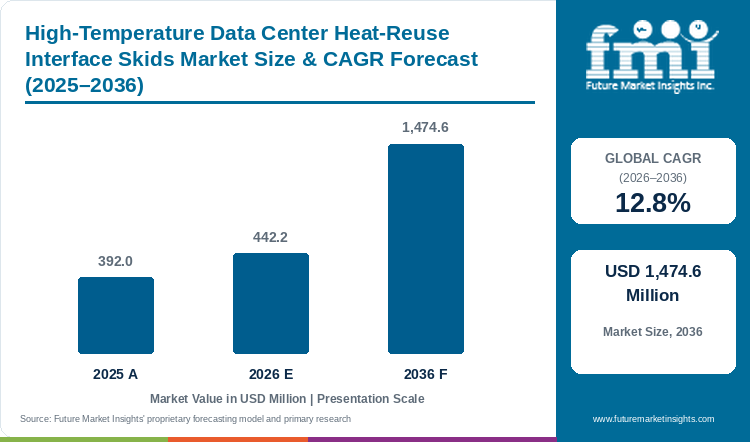
The market was valued at USD 392.0 Million in 2025 and is expected to reach USD 442.2 Million in 2026, with growth at a 12.8% CAGR from 2026 to 2036 taking its value to USD 1,474.6 Million by 2036.
Recoverable energy needs a receiving customer before it becomes useful heat, with source temperature, seasonal demand and the connecting route shaping the interface duty. A skid can separate circuits and provide circulation, measurement and control, but it cannot create a nearby customer or guarantee that the network will accept every unit available. Buyers therefore need to settle offtake and backup rejection alongside equipment selection, preserving data-center cooling when the receiver is unavailable. Liquid cooling can improve the thermal quality of captured heat, while Finnish projects illustrate how district demand may be considered early in design. Other users may require temperature lift or a different delivery profile, making the agreed relationship more useful than a maximum recovery rating alone. The forecast covers qualifying packaged interfaces and integrated functions, excluding general heat networks and standalone equipment without the data-center connection role. [5]
Key Market Trends & Insights
- Liquid-to-liquid heat exchanger skids account for 28.0% of heat recovery technology in 2026, separating circuits that may need different pressure and water-quality conditions.
- 40–60°C holds 33.0% of useful heat temperature in 2026, requiring the receiving duty to match the available thermal grade or include an agreed temperature lift.
- District heating holds 38.0% of offtake application in 2026, pooling receiving demand across buildings while retaining seasonal limits on useful delivery.
- Hyperscale AI holds 43.0% of data center type in 2026, concentrating recoverable heat that may justify dedicated connections where a suitable customer and duty are established.
Regional Highlights
- Germany has the highest profiled CAGR at 14.7% during 2026–2036.
- The next two profiled growth rates are Finland at 14.3% and Norway at 14.0% over the same period.
Market Size & Forecast
| Metric | Value |
|---|---|
| 2025 market value | USD 392.0 Million |
| 2026 market estimate | USD 442.2 Million |
| 2036 market forecast | USD 1,474.6 Million |
| Forecast CAGR, 2026–2036 | 12.8% |
The market covers packaged interfaces that connect data-center heat recovery with an intended heat user, including integrated heat-exchange, pumping, control and buffering functions. General district-heating infrastructure and standalone equipment without the qualifying data-center interface role are excluded.
The heat available for reuse is linked to data-center power, but usable heat delivery also depends on temperature and the receiving network’s demand.
Infrastructure readiness and acceptance
| Documented operating context | Source |
|---|---|
| The EU Energy Efficiency Directive addresses energy efficiency and recovery of waste heat, including data-center applications. | [1] |
| Alfa Laval described HeatChain’s Data Boiler approach to heat recovery in February 2026. | [2] |
| Alfa Laval described use of waste heat from an Odense data center for community heating in January 2026. | [3] |
| GEA described a high-efficiency heat-pump project serving Tallinn district heating in June 2025. | [4] |
Analyst Perspective
A dependable interface needs an agreed thermal duty and a clear division of metering, maintenance and interruption responsibilities between the data center and heat user. The package should deliver useful heat while preserving independent cooling when offtake stops, making the continuing operating agreement as relevant as its maximum recovery rating.
- Nikhil Kaitwade, Principal Analyst at Future Market Insights
How is the high-temperature data center heat-reuse interface skids market segmented?
Heat Recovery Technology covers Liquid-to-liquid heat exchanger skids, Industrial heat pumps, Heat-reuse control systems, Thermal storage / buffering and District-interface packages. Useful Heat Temperature covers 40–60°C, Below 40°C, 61–80°C and Above 80°C. Offtake Application covers District heating, Commercial building heating, Industrial process heat and Greenhouse / aquaculture / other. Data Center Type covers Hyperscale AI, Colocation campuses, Enterprise / public-sector and HPC / research. Commercial Model covers Equipment sale, EPC / integration project, Heat-as-a-service / ESCO and O&M / performance contract.
A connection to data-center infrastructure management can preserve visibility of the thermal interface when the data center and heat-network operator have separate control responsibilities.
Why do Liquid-to-liquid heat exchanger skids lead heat recovery technology demand?
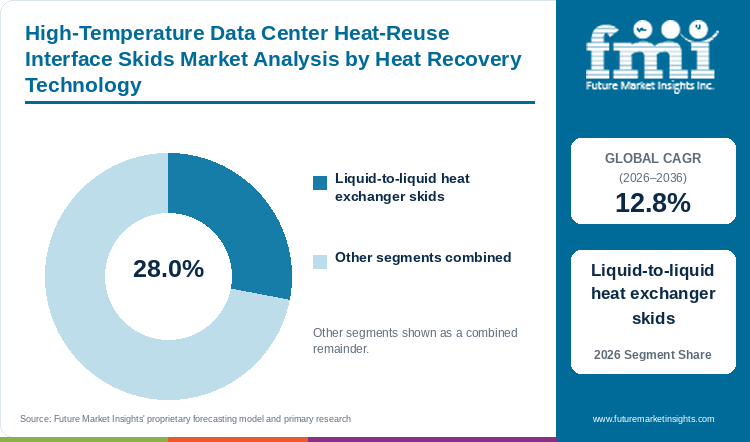
Liquid-to-liquid heat exchanger skids: 28.0% of heat recovery technology in 2026.
A liquid-to-liquid exchanger skid transfers energy while maintaining separate pressure and water-quality conditions for the data center and receiving circuit. Pump duty, fouling allowances, redundancy and maintenance access affect qualification alongside the required temperature approach. Defining control responsibility and service arrangements lets a packaged unit simplify installation within a dependable operating connection, rather than selecting an exchanger independently of the systems and parties it must serve.
- The Liquid-to-liquid heat exchanger skids segment accounts for 28.0% of heat recovery technology in 2026.
- Kelvion's Finnish heat-recovery case describes one NP and seven NX exchangers in service as part of the thermal connection. [6]
Why does 40-60°C lead useful heat temperature demand?
40-60°C: 33.0% of useful heat temperature in 2026.
The 40-60°C category describes temperature at the relevant interface, with the receiver either using that stream directly or requiring a heat-pump stage. Direct-to-chip and immersion arrangements can provide warmer recovered fluid, but available heat still needs to match the customer’s duty. A project therefore needs to assess thermal grade and any energy required for lift together, since a large recoverable quantity alone cannot establish useful delivery.
- The 40-60°C segment accounts for 33.0% of useful heat temperature in 2026.
- A 40-60°C stream needs a receiving system matched to that temperature or an agreed means of raising it before useful delivery.
What are the drivers, restraints, and opportunities in the high-temperature data center heat-reuse interface skids market?
Recoverable heat needs a usable receiving network
A committed customer gives recovered heat a practical destination when the source’s operating pattern, connection cost and receiver’s demand form a workable relationship. Dense computing may encourage early reuse design, while technical feasibility still varies by location. An interface agreement needs to preserve each party’s primary service, with a safe rejection path available when the heat network cannot accept the data center’s output.
Offtake uncertainty can delay equipment commitment
A suitable thermal source can remain commercially unused when the pipe route is too costly or the customer cannot commit to demand. Seasonal variation can also reduce the amount delivered over the year. The data center must keep cooling when offtake stops so backup rejection may still be required. These conditions can delay equipment orders while responsibilities are negotiated. Buyers should select the skid against the agreed operating duty and fallback arrangement. Counting all recoverable energy as useful annual delivery would conceal the limits that determine project viability.
Packaged interfaces simplify thermal integration
Packaged interfaces can reduce the amount of assembly required at a live or nearly completed facility. Defined exchanger and pump duties make commissioning easier to plan. A lower-temperature receiving building may use a direct connection while another project needs heat-pump lift. Suppliers should specify metering boundaries and safe behavior for the actual customer. Modular packages can then support staged connections without implying that installed capacity is always used. Clear operating responsibility makes an extension easier when both parties understand what the interface can deliver and what happens during an interruption.
Experience from AI cooling diagnostics is relevant to identifying thermal faults, although a reuse skid must also account for the external off-taker’s operating conditions.
Which country and market CAGRs are profiled for high-temperature data center heat-reuse interface skids?
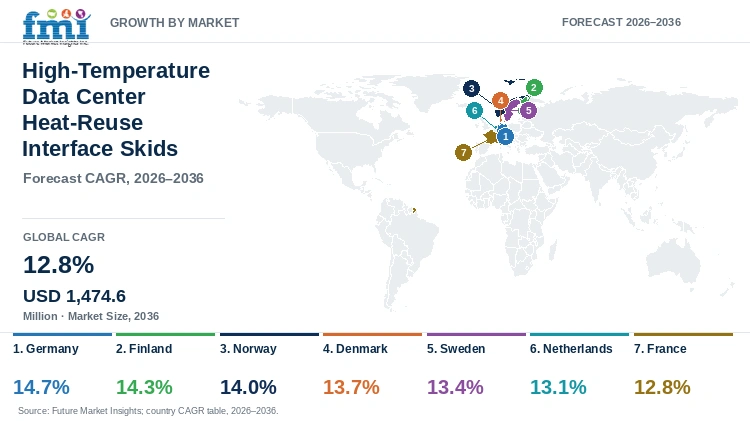
| Country | CAGR |
|---|---|
| Germany | 14.7% |
| Finland | 14.3% |
| Norway | 14.0% |
| Denmark | 13.7% |
| Sweden | 13.4% |
| Netherlands | 13.1% |
| France | 12.8% |
Country-wise Analysis
Germany
- German data-center owners and heat users need an agreed division of return-temperature control, metering and maintenance before selecting an interface. The fastest profiled forecast is a 14.7% CAGR from 2026 to 2036, with fallback cooling protecting the source facility when the customer cannot accept heat. Acceptance can then confirm behavior under that interruption rather than depending on permanent offtake.
Finland
- Seasonal district-heat needs determine the Finnish skid duty, including pumping and any required temperature lift. Within Finland’s 14.3% CAGR forecast for 2026 to 2036, modular construction can simplify site work after those requirements and maintenance arrangements are agreed. A safe rejection path remains necessary when the network cannot take output, making useful annual delivery more informative than the maximum recoverable load.
Norway
- Norwegian projects can consider process users as well as conventional networks, with a steady-input customer potentially placing more value on delivery quality than the largest nominal quantity. Norway’s forecast is a 14.0% CAGR from 2026 to 2036, with controls needing to accommodate demand changes while isolating the operating systems. Including receiver unavailability in the original design preserves cooling as the data center’s primary duty.
Denmark
- Danish utility-facing projects need a thermal and control boundary that remains workable through seasonal operation, not only at the first transfer of heat. The 13.7% CAGR forecast for 2026 to 2036 accompanies agreements specifying who operates the connection and bears interruption costs. Metering, maintenance access and fallback then give both parties a continuing basis for using the interface.
Sweden
- Building users and district networks in Sweden can call for different package sizes, making the receiver’s duty the starting point for exchanger and control selection. Sweden is forecast to grow at a 13.4% CAGR from 2026 to 2036, with buyers needing a realistic annual-delivery estimate that includes pumping and temperature lift. Explicit ownership of the connection also prevents a compact package from concealing ongoing maintenance obligations.
Netherlands
- Pipe-route feasibility and ownership can determine whether a Dutch heat source reaches its intended customer on a workable schedule. The Netherlands’ 13.1% CAGR forecast for 2026 to 2036 includes interfaces that need an agreed offtake plan and receiving-infrastructure sequence before dispatch. Aligning equipment delivery with those milestones reduces the risk of a completed skid waiting on an unfinished connection.
France
- French municipal networks and property users provide different possible outlets, with the physical connection and operating schedules needing agreement before either becomes dependable offtake. Within France’s 12.8% CAGR forecast for 2026 to 2036, a transparent metering boundary and documented fallback belong in procurement. The data center must remain able to reject heat independently when the network or building is offline.
Who are the notable companies in the high-temperature data center heat-reuse interface skids market?
Alfa Laval; Kelvion; GEA; Danfoss; Tranter
Heat-reuse suppliers work across a project shared by the data-center owner and the receiving customer. Exchanger and heat-pump specialists contribute different functions while controls define the operating boundary. The proposal needs to bring those parts together under an agreed duty rather than compare equipment ratings in isolation.
Competitive Benchmarking: High-Temperature Data Center Heat-Reuse Interface Skids Market
| Participant | Commercial focus | Buyer qualification priority |
|---|---|---|
| Alfa Laval | Heat exchangers and thermal systems | Approach temperature and water quality |
| Kelvion | Heat-transfer equipment | Pressure drop and fouling allowance |
| GEA | Heat pumps and thermal process systems | Temperature lift and system integration |
| Danfoss | Heat-transfer and district-energy controls | Hydraulic separation and control stability |
| Tranter | Plate heat exchangers and service | Maintainability and duty-point performance |
Key Developments in the High-Temperature Data Center Heat-Reuse Interface Skids Market
- Alfa Laval described HeatChain’s Data Boiler approach to heat recovery in February 2026. [2]
- Alfa Laval described use of waste heat from an Odense data center for community heating in January 2026. [3]
Key Players in the High-Temperature Data Center Heat-Reuse Interface Skids Market
- Alfa Laval
- Kelvion
- GEA
- Danfoss
- Tranter
High-Temperature Data Center Heat-Reuse Interface Skids Market - Report Scope
| Coverage field | Report scope |
|---|---|
| Market breakdown | Heat Recovery Technology; Useful Heat Temperature; Offtake Application; Data Center Type; Commercial Model; Region |
| Quantitative unit | USD Million |
| Market definition | The market covers packaged interfaces that connect data-center heat recovery with an intended heat user, including integrated heat-exchange, pumping, control and buffering functions. General district-heating infrastructure and standalone equipment without the qualifying data-center interface role are excluded. |
| Regions covered | North America; Latin America; Western Europe; Eastern Europe; East Asia; South Asia and Pacific; Middle East and Africa |
| Countries / markets profiled | Germany; Finland; Norway; Denmark; Sweden; Netherlands; France |
| Key companies profiled | Alfa Laval; Kelvion; GEA; Danfoss; Tranter |
| Base year / forecast period | 2026 / 2026–2036 |
| Estimate coverage | 2025 and 2026 market estimates; 2036 forecast; segment shares and country / market CAGRs. |
High-Temperature Data Center Heat-Reuse Interface Skids Market - Research Methodology
| Method | Application |
|---|---|
| Market definition | The analysis follows the stated product or service boundary and distinguishes direct category revenue from adjacent activities. |
| Secondary research | Official technical, regulatory, research and company publications provide the documented operating context and recent developments cited in this report. |
| Forecast and segmentation | Market estimates, segment shares and geographic forecasts are presented as analytical estimates within the stated commercial scope. |
| Competitive assessment | Participants are compared by their relevant products or services, commercial role and buyer qualification requirements. |
| Interpretation | The assessment considers purchasing conditions and the scope of the documented product, service or performance claim. |
High-Temperature Data Center Heat-Reuse Interface Skids Market by Segments
Heat Recovery Technology
- Liquid-to-liquid heat exchanger skids
- Industrial heat pumps
- Heat-reuse control systems
- Thermal storage / buffering
- District-interface packages
Useful Heat Temperature
- 40-60°C
- Below 40°C
- 61-80°C
- Above 80°C
Offtake Application
- District heating
- Commercial building heating
- Industrial process heat
- Greenhouse / aquaculture / other
Data Center Type
- Hyperscale AI
- Colocation campuses
- Enterprise / public-sector
- HPC / research
Commercial Model
- Equipment sale
- EPC / integration project
- Heat-as-a-service / ESCO
- O&M / performance contract
High-Temperature Data Center Heat-Reuse Interface Skids Market by Region
- North America
- United States
- Canada
- Latin America
- Brazil
- Mexico
- Argentina
- Chile
- Western Europe
- Germany
- France
- United Kingdom
- Italy
- Spain
- Benelux
- Nordics
- Eastern Europe
- Poland
- Czech Republic
- Romania
- Hungary
- East Asia
- China
- Japan
- South Korea
- South Asia and Pacific
- India
- ASEAN
- Australia and New Zealand
- Middle East and Africa
- GCC Countries
- South Africa
- Türkiye
- Israel
Research Sources and Bibliography
- [1] European Parliament and Council of the European Union. (2023, September 13). Directive (EU) 2023/1791 on energy efficiency.
- [2] Alfa Laval. (2026, February 6). Maximizing cooling and heat reuse: How AlfaQ heat exchangers connect data centers to district heating.
- [3] Alfa Laval. (2026, January 8). Waste heat from Odense data center to warm local community.
- [4] GEA. (2025, June 10). GEA and Utilitas Drive Clean Heat Innovation in Tallinn.
- [5] Future Market Insights. (2026). High-Temperature Data Center Heat-Reuse Interface Skids Market: Global industry analysis and opportunity assessment, 2026–2036.
- [6] Kelvion. (n.d.). Data Centre waste heat powers district heating.
This Report Answers
- How large is the high-temperature data center heat-reuse interface skids market in 2026?
- What value and CAGR are forecast through 2036?
- Which heat recovery technology segment leads in 2026?
- Which useful heat temperature segment has the largest share?
- Which profiled country or market has the fastest forecast growth?
- Which participants are covered in the competitive assessment?
Frequently Asked Questions
How large is the high-temperature data center heat-reuse interface skids market in 2026?
The market was valued at USD 392.0 Million in 2025 and is expected to reach USD 442.2 Million in 2026.
What value and CAGR are forecast through 2036?
The market is projected to reach USD 1,474.6 Million by 2036, with a 12.8% CAGR during 2026–2036.
Which heat recovery technology segment leads in 2026?
The Liquid-to-liquid heat exchanger skids segment accounts for 28.0% of heat recovery technology in 2026.
Which useful heat temperature segment has the largest share?
The 40–60°C segment accounts for 33.0% of useful heat temperature in 2026.
Which profiled country or market has the fastest forecast growth?
Germany has the highest profiled CAGR at 14.7% during 2026–2036.
Which participants are covered in the competitive assessment?
The assessment covers Alfa Laval, Kelvion, GEA, Danfoss and Tranter.
Preview the report firsthand - request a free sample
Get SampleGet the brochure for pricing and purchase details.
Get PDFTable of Content
- Key Takeaways
- Market Size and CAGR
- Top Growth Driver
- Fastest Growing Segment
- Leading Region
- Key Companies
- Emerging Opportunities
- Executive Summary
- Global Market Outlook
- Demand-side Trends
- Supply-side Trends
- Technology Roadmap Analysis
- Analysis and Recommendations
- Analyst Perspective (What is happening? Why now? What should investors know?)
- Key Questions Answered
- How large is the market?
- What is the CAGR?
- What are key trends?
- Which region dominates?
- Who are the leaders?
- Market Overview
- Market Coverage / Taxonomy
- Market Definition / Scope / Limitations
- Research Methodology
- Chapter Orientation
- Analytical Lens and Working Hypotheses
- Market Structure, Signals, and Trend Drivers
- Benchmarking and Cross-market Comparability
- Market Sizing, Forecasting, and Opportunity Mapping
- Research Design and Evidence Framework
- Desk Research Programme (Secondary Evidence)
- Expert Input and Fieldwork (Primary Evidence)
- Tooling, Models, and Reference Databases
- Data Engineering and Model Build
- Quality Assurance and Audit Trail
- Market Background
- Market Dynamics (Drivers, Restraints, Opportunity, Trends)
- Scenario Forecast (Optimistic, Likely, Conservative)
- Impact Analysis
- AI Impact
- Sustainability Impact
- Regulatory Impact
- Technology Impact
- Consumer / Buyer Analysis
- Purchase Drivers
- Adoption Barriers
- Buyer Journey
- Opportunity Map Analysis
- Product Life Cycle Analysis
- Supply Chain Analysis
- Investment Feasibility Matrix
- Value Chain Analysis
- PESTLE and Porter's Analysis
- Regulatory Landscape
- Regional Parent Market Outlook
- Production and Consumption Statistics
- Import and Export Statistics
- Global Market Analysis and Forecast, 2021 to 2036
- Historical Market Size Value (USD Million) Analysis, 2021 to 2025
- Current and Future Market Size Value (USD Million) Projections, 2026 to 2036
- Y-o-Y Growth Trend Analysis
- Absolute $ Opportunity Analysis
- Global Market Pricing Analysis, 2021 to 2036
- Global Market Analysis and Forecast, By Heat Recovery Technology, 2021 to 2036
- Introduction / Key Findings
- Historical Market Size Value (USD Million) Analysis By Heat Recovery Technology, 2021 to 2025
- Current and Future Market Size Value (USD Million) Analysis and Forecast By Heat Recovery Technology, 2026 to 2036
- Liquid-to-liquid heat exchanger skids
- Industrial heat pumps
- Heat-reuse control systems
- Thermal storage / buffering
- District-interface packages
- Y-o-Y Growth Trend Analysis By Heat Recovery Technology, 2021 to 2025
- Absolute $ Opportunity Analysis By Heat Recovery Technology, 2026 to 2036
- Global Market Analysis and Forecast, By Useful Heat Temperature, 2021 to 2036
- Introduction / Key Findings
- Historical Market Size Value (USD Million) Analysis By Useful Heat Temperature, 2021 to 2025
- Current and Future Market Size Value (USD Million) Analysis and Forecast By Useful Heat Temperature, 2026 to 2036
- 40–60°C
- Below 40°C
- 61–80°C
- Above 80°C
- Y-o-Y Growth Trend Analysis By Useful Heat Temperature, 2021 to 2025
- Absolute $ Opportunity Analysis By Useful Heat Temperature, 2026 to 2036
- Global Market Analysis and Forecast, By Offtake Application, 2021 to 2036
- Introduction / Key Findings
- Historical Market Size Value (USD Million) Analysis By Offtake Application, 2021 to 2025
- Current and Future Market Size Value (USD Million) Analysis and Forecast By Offtake Application, 2026 to 2036
- District heating
- Commercial building heating
- Industrial process heat
- Greenhouse / aquaculture / other
- Y-o-Y Growth Trend Analysis By Offtake Application, 2021 to 2025
- Absolute $ Opportunity Analysis By Offtake Application, 2026 to 2036
- Global Market Analysis and Forecast, By Data Center Type, 2021 to 2036
- Introduction / Key Findings
- Historical Market Size Value (USD Million) Analysis By Data Center Type, 2021 to 2025
- Current and Future Market Size Value (USD Million) Analysis and Forecast By Data Center Type, 2026 to 2036
- Hyperscale AI
- Colocation campuses
- Enterprise / public-sector
- HPC / research
- Y-o-Y Growth Trend Analysis By Data Center Type, 2021 to 2025
- Absolute $ Opportunity Analysis By Data Center Type, 2026 to 2036
- Global Market Analysis and Forecast, By Commercial Model, 2021 to 2036
- Introduction / Key Findings
- Historical Market Size Value (USD Million) Analysis By Commercial Model, 2021 to 2025
- Current and Future Market Size Value (USD Million) Analysis and Forecast By Commercial Model, 2026 to 2036
- Equipment sale
- EPC / integration project
- Heat-as-a-service / ESCO
- O&M / performance contract
- Y-o-Y Growth Trend Analysis By Commercial Model, 2021 to 2025
- Absolute $ Opportunity Analysis By Commercial Model, 2026 to 2036
- Global Market Analysis and Forecast, By Region, 2021 to 2036
- Introduction
- Historical Market Size Value (USD Million) Analysis By Region, 2021 to 2025
- Current Market Size Value (USD Million) Analysis and Forecast By Region, 2026 to 2036
- North America
- Latin America
- Western Europe
- Eastern Europe
- East Asia
- South Asia and Pacific
- Middle East and Africa
- Market Attractiveness Analysis By Region
- North America Market Analysis and Forecast, By Country, 2021 to 2036
- Historical Market Size Value (USD Million) Trend Analysis By Market Taxonomy, 2021 to 2025
- Market Size Value (USD Million) Forecast By Market Taxonomy, 2026 to 2036
- By Country
- United States
- Canada
- By Heat Recovery Technology
- By Useful Heat Temperature
- By Offtake Application
- By Data Center Type
- By Commercial Model
- By Country
- Market Attractiveness Analysis
- By Country
- By Heat Recovery Technology
- By Useful Heat Temperature
- By Offtake Application
- By Data Center Type
- By Commercial Model
- Key Takeaways
- Latin America Market Analysis and Forecast, By Country
- Historical Market Size Value (USD Million) Trend Analysis By Market Taxonomy, 2021 to 2025
- Market Size Value (USD Million) Forecast By Market Taxonomy, 2026 to 2036
- By Country
- Brazil
- Mexico
- Argentina
- Chile
- By Heat Recovery Technology
- By Useful Heat Temperature
- By Offtake Application
- By Data Center Type
- By Commercial Model
- By Country
- Market Attractiveness Analysis
- By Country
- By Heat Recovery Technology
- By Useful Heat Temperature
- By Offtake Application
- By Data Center Type
- By Commercial Model
- Key Takeaways
- Western Europe Market Analysis and Forecast, By Country
- Historical Market Size Value (USD Million) Trend Analysis By Market Taxonomy, 2021 to 2025
- Market Size Value (USD Million) Forecast By Market Taxonomy, 2026 to 2036
- By Country
- Germany
- France
- United Kingdom
- Italy
- Spain
- Benelux
- Nordics
- By Heat Recovery Technology
- By Useful Heat Temperature
- By Offtake Application
- By Data Center Type
- By Commercial Model
- By Country
- Market Attractiveness Analysis
- By Country
- By Heat Recovery Technology
- By Useful Heat Temperature
- By Offtake Application
- By Data Center Type
- By Commercial Model
- Key Takeaways
- Eastern Europe Market Analysis and Forecast, By Country
- Historical Market Size Value (USD Million) Trend Analysis By Market Taxonomy, 2021 to 2025
- Market Size Value (USD Million) Forecast By Market Taxonomy, 2026 to 2036
- By Country
- Poland
- Czech Republic
- Romania
- Hungary
- By Heat Recovery Technology
- By Useful Heat Temperature
- By Offtake Application
- By Data Center Type
- By Commercial Model
- By Country
- Market Attractiveness Analysis
- By Country
- By Heat Recovery Technology
- By Useful Heat Temperature
- By Offtake Application
- By Data Center Type
- By Commercial Model
- Key Takeaways
- East Asia Market Analysis and Forecast, By Country
- Historical Market Size Value (USD Million) Trend Analysis By Market Taxonomy, 2021 to 2025
- Market Size Value (USD Million) Forecast By Market Taxonomy, 2026 to 2036
- By Country
- China
- Japan
- South Korea
- By Heat Recovery Technology
- By Useful Heat Temperature
- By Offtake Application
- By Data Center Type
- By Commercial Model
- By Country
- Market Attractiveness Analysis
- By Country
- By Heat Recovery Technology
- By Useful Heat Temperature
- By Offtake Application
- By Data Center Type
- By Commercial Model
- Key Takeaways
- South Asia and Pacific Market Analysis and Forecast, By Country
- Historical Market Size Value (USD Million) Trend Analysis By Market Taxonomy, 2021 to 2025
- Market Size Value (USD Million) Forecast By Market Taxonomy, 2026 to 2036
- By Country
- India
- ASEAN
- Australia and New Zealand
- By Heat Recovery Technology
- By Useful Heat Temperature
- By Offtake Application
- By Data Center Type
- By Commercial Model
- By Country
- Market Attractiveness Analysis
- By Country
- By Heat Recovery Technology
- By Useful Heat Temperature
- By Offtake Application
- By Data Center Type
- By Commercial Model
- Key Takeaways
- Middle East and Africa Market Analysis and Forecast, By Country
- Historical Market Size Value (USD Million) Trend Analysis By Market Taxonomy, 2021 to 2025
- Market Size Value (USD Million) Forecast By Market Taxonomy, 2026 to 2036
- By Country
- GCC Countries
- South Africa
- Türkiye
- Israel
- By Heat Recovery Technology
- By Useful Heat Temperature
- By Offtake Application
- By Data Center Type
- By Commercial Model
- By Country
- Market Attractiveness Analysis
- By Country
- By Heat Recovery Technology
- By Useful Heat Temperature
- By Offtake Application
- By Data Center Type
- By Commercial Model
- Key Takeaways
- Key Countries Market Analysis
- United States
- Pricing Analysis
- Market Share Analysis, 2025
- By Heat Recovery Technology
- By Useful Heat Temperature
- By Offtake Application
- By Data Center Type
- By Commercial Model
- Canada
- Pricing Analysis
- Market Share Analysis, 2025
- By Heat Recovery Technology
- By Useful Heat Temperature
- By Offtake Application
- By Data Center Type
- By Commercial Model
- Mexico
- Pricing Analysis
- Market Share Analysis, 2025
- By Heat Recovery Technology
- By Useful Heat Temperature
- By Offtake Application
- By Data Center Type
- By Commercial Model
- Brazil
- Pricing Analysis
- Market Share Analysis, 2025
- By Heat Recovery Technology
- By Useful Heat Temperature
- By Offtake Application
- By Data Center Type
- By Commercial Model
- Chile
- Pricing Analysis
- Market Share Analysis, 2025
- By Heat Recovery Technology
- By Useful Heat Temperature
- By Offtake Application
- By Data Center Type
- By Commercial Model
- Germany
- Pricing Analysis
- Market Share Analysis, 2025
- By Heat Recovery Technology
- By Useful Heat Temperature
- By Offtake Application
- By Data Center Type
- By Commercial Model
- United Kingdom
- Pricing Analysis
- Market Share Analysis, 2025
- By Heat Recovery Technology
- By Useful Heat Temperature
- By Offtake Application
- By Data Center Type
- By Commercial Model
- Italy
- Pricing Analysis
- Market Share Analysis, 2025
- By Heat Recovery Technology
- By Useful Heat Temperature
- By Offtake Application
- By Data Center Type
- By Commercial Model
- Spain
- Pricing Analysis
- Market Share Analysis, 2025
- By Heat Recovery Technology
- By Useful Heat Temperature
- By Offtake Application
- By Data Center Type
- By Commercial Model
- France
- Pricing Analysis
- Market Share Analysis, 2025
- By Heat Recovery Technology
- By Useful Heat Temperature
- By Offtake Application
- By Data Center Type
- By Commercial Model
- India
- Pricing Analysis
- Market Share Analysis, 2025
- By Heat Recovery Technology
- By Useful Heat Temperature
- By Offtake Application
- By Data Center Type
- By Commercial Model
- ASEAN
- Pricing Analysis
- Market Share Analysis, 2025
- By Heat Recovery Technology
- By Useful Heat Temperature
- By Offtake Application
- By Data Center Type
- By Commercial Model
- Australia and New Zealand
- Pricing Analysis
- Market Share Analysis, 2025
- By Heat Recovery Technology
- By Useful Heat Temperature
- By Offtake Application
- By Data Center Type
- By Commercial Model
- China
- Pricing Analysis
- Market Share Analysis, 2025
- By Heat Recovery Technology
- By Useful Heat Temperature
- By Offtake Application
- By Data Center Type
- By Commercial Model
- Japan
- Pricing Analysis
- Market Share Analysis, 2025
- By Heat Recovery Technology
- By Useful Heat Temperature
- By Offtake Application
- By Data Center Type
- By Commercial Model
- South Korea
- Pricing Analysis
- Market Share Analysis, 2025
- By Heat Recovery Technology
- By Useful Heat Temperature
- By Offtake Application
- By Data Center Type
- By Commercial Model
- Poland
- Pricing Analysis
- Market Share Analysis, 2025
- By Heat Recovery Technology
- By Useful Heat Temperature
- By Offtake Application
- By Data Center Type
- By Commercial Model
- Hungary
- Pricing Analysis
- Market Share Analysis, 2025
- By Heat Recovery Technology
- By Useful Heat Temperature
- By Offtake Application
- By Data Center Type
- By Commercial Model
- Türkiye
- Pricing Analysis
- Market Share Analysis, 2025
- By Heat Recovery Technology
- By Useful Heat Temperature
- By Offtake Application
- By Data Center Type
- By Commercial Model
- South Africa
- Pricing Analysis
- Market Share Analysis, 2025
- By Heat Recovery Technology
- By Useful Heat Temperature
- By Offtake Application
- By Data Center Type
- By Commercial Model
- Finland
- Pricing Analysis
- Market Share Analysis, 2025
- By Heat Recovery Technology
- By Useful Heat Temperature
- By Offtake Application
- By Data Center Type
- By Commercial Model
- Norway
- Pricing Analysis
- Market Share Analysis, 2025
- By Heat Recovery Technology
- By Useful Heat Temperature
- By Offtake Application
- By Data Center Type
- By Commercial Model
- Denmark
- Pricing Analysis
- Market Share Analysis, 2025
- By Heat Recovery Technology
- By Useful Heat Temperature
- By Offtake Application
- By Data Center Type
- By Commercial Model
- Sweden
- Pricing Analysis
- Market Share Analysis, 2025
- By Heat Recovery Technology
- By Useful Heat Temperature
- By Offtake Application
- By Data Center Type
- By Commercial Model
- Netherlands
- Pricing Analysis
- Market Share Analysis, 2025
- By Heat Recovery Technology
- By Useful Heat Temperature
- By Offtake Application
- By Data Center Type
- By Commercial Model
- United States
- Market Structure Analysis
- Competition Dashboard
- Competition Benchmarking
- Market Share Analysis of Top Players
- By Regional
- By Heat Recovery Technology
- By Useful Heat Temperature
- By Offtake Application
- By Data Center Type
- By Commercial Model
- Emerging Startups
- Innovation Benchmarking
- Competition Analysis
- Competition Deep Dive
- Alfa Laval
- Overview
- Product Portfolio
- Profitability by Market Segments
- Sales Footprint
- Strategy Overview
- Marketing Strategy
- Product Strategy
- Channel Strategy
- Kelvion
- GEA
- Danfoss
- Tranter
- Alfa Laval
- Case Studies
- Success Stories
- Recent Developments
- Competition Deep Dive
- Assumptions & Acronyms Used


