

- Market Size (2026)
- USD 194.9 Mn
- Forecast (2036)
- USD 533.7 Mn
- CAGR (2026 to 2036)
- 10.6%
How big is AI Cooling Remote Diagnostics Platforms Market in 2026?
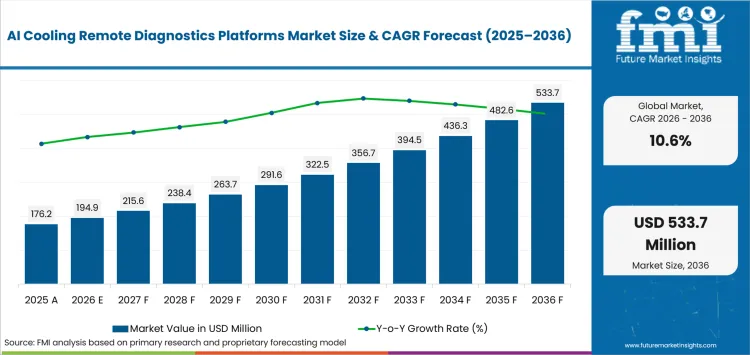
USD 194.9 million in 2026 and USD 533.7 million by 2036 at a 10.6% CAGR.
Demand for AI cooling remote diagnostics platforms are projected to grow at 10.6% CAGR between 2026 and 2036, increasing industry value from USD 194.9 million in 2026 to USD 533.7 million by 2036 driven by rising adoption of AI data-center liquid cooling which raises the cost of delayed thermal diagnosis. The IEA reported in April 2026 that data-center electricity demand increased 17% during 2025. Faster load growth gives live cooling telemetry a direct role in uptime planning before plant drift reaches the rack.
Regional purchase logic changes with grid exposure and build patterns, which alter the value of remote oversight. The IEA's April 2025 data show Japan's data-center electricity use rising about 80% by 2030 from its 2024 level. Operators need data center infrastructure management that can supervise regional clusters without multiplying site visits. European operators place more weight on auditable cooling energy and water records.
Key Takeaways
- Demand expands as AI operators replace periodic thermal checks with software that can diagnose plant and rack conditions continuously.
- By software function, optimization & control is estimated to hold 29.0% in 2026 owing to direct control over equipment sequencing and thermal margins.
- The hyperscale AI segment is likely to capture 48.0% share in 2026 attributable to centralized operations over large cooling estates.
- Cooling OEM direct is set to lead route to market with 36.0% share in 2026 due to control of commissioning data and service access.
- Mixed control protocols and protected remote-access rights slow deployment if operators cannot trace recommendations to validated equipment signals during change approval.
- Some of the key players in this market include EkkoSense, Schneider Electric, Daikin Applied, LG Electronics, Vertiv, Johnson Controls, Airedale by Modine, and STULZ.
Analyst Perspective
"Operators should compare these platforms on diagnostic accuracy and control boundaries instead of dashboard breadth alone. A useful platform turns rack telemetry into safe cooling actions that engineers can audit without weakening change-control discipline."
- Sudip saha, Principal Consultant, Future Market Insights
How is the AI Cooling Remote Diagnostics Platforms Market segmented?
The AI cooling remote diagnostics platforms market is segmented by software function, heat rejection - secondary loop, rack density, data center type, route to market and region.
Software function includes optimization & control, thermal / hydraulic monitoring, predictive maintenance, digital twin / simulation and water / energy reporting. Heat rejection - secondary loop covers dry coolers, chillers, cooling towers / evaporative systems, facility water loop / district interfaces and hybrid systems. Rack density spans below 100 kW through above 500 kW. Data center type includes hyperscale AI, colocation AI, enterprise AI/HPC and research / sovereign compute. Route to market covers cooling OEM direct, MEP / EPC integrators, server / rack OEM bundles and service & retrofit channels.
How does 251-500 kW shape demand within the Rack density category?
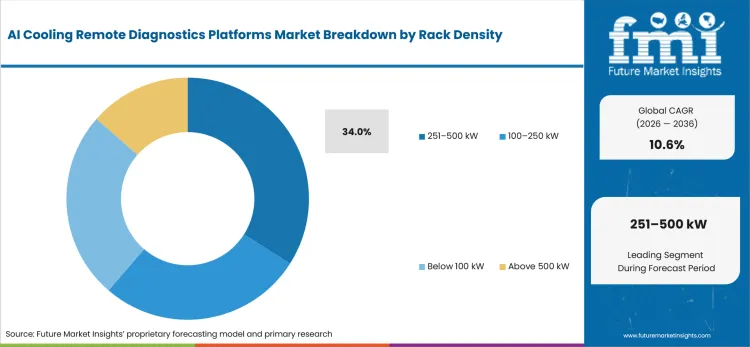
The 251-500 kW band is dense enough to justify liquid-loop instrumentation without forcing every site into megawatt rack designs. Airedale by Modine expanded its CDU range to 400 kW-2 MW in March 2025. That range fits localized hotspot cooling projects that need instrumented transition capacity before the most extreme rack tier arrives.
- By rack density, 251-500 kW is forecast to represent 34.0% in 2026 driven by costly hydraulic imbalance below the highest-density tier.
- Operators in this band need flow, supply temperature, return temperature and CDU-state data in one diagnostic view before approving remote corrective action.
What makes Optimization & control central to the Software function category?
Operations teams buy optimization software after passive monitoring stops answering which cooling action should change first. EkkoSense launched EkkoSoft Critical 9.0 in May 2025 with data center liquid cooling optimization for large hybrid rooms. That release moved diagnosis closer to controlled intervention by putting cooling recommendations beside live power and thermal data.
- By software function, optimization & control is estimated to hold 29.0% in 2026 owing to its direct role in equipment sequencing and thermal-margin management.
- Operations teams adopt the function to convert live sensor conditions into ranked interventions that engineers can review prior to changing critical equipment during commissioning.
Why do Dry coolers lead the heat rejection - Secondary loop category?
Dry coolers give software a visible boundary between the facility water loop and outdoor heat rejection. Schneider Electric published Reference Design 121 in July 2026 with adiabatic dry coolers supporting a liquid-cooled AI cluster. Its architecture makes data center chillers and dry-cooler sequencing part of one measurable heat-rejection path.
- Based on heat rejection - secondary loop, dry coolers are projected to account for 29.0% in 2026 due to measurable fan and loop behavior.
- Remote teams can flag fouling, sensor drift or poor staging from temperature and flow deviation early enough to preserve available cooling margin during normal operation.
What supports Hyperscale AI leadership in the Data center type category?
Hyperscale AI makes remote diagnosis economical because one operating model can supervise repeated cooling blocks at many megawatts. Vertiv published a 142 kW-per-rack architecture for NVIDIA GB300 NVL72 in June 2025 with SimReady design assets. The design links critical power and cooling planning during detailed pre-commissioning engineering review of high-density AI infrastructure at campus scale.
- Hyperscale AI is projected to hold 48.0% share in 2026 owing to centralized engineering over larger cooling estates.
- Central engineering teams use diagnostics to compare sites and prioritize anomalies, reducing unnecessary specialist dispatches to individual cooling rooms during routine fleet reviews.
What are the drivers, restraints and opportunities in the AI Cooling Remote Diagnostics Platforms Market?
AI density raises demand for continuous thermal diagnosis. Integration trust constrains control access, and hybrid air-liquid retrofits provide a revenue route for platforms that normalize mixed cooling data.
- Driver: Rising rack densities turn delayed cooling diagnosis into an uptime risk and increase the value of predictive plant and liquid-loop visibility.
- Restraint: Mixed protocols and protected control boundaries slow scale-up since remote recommendations require reliable equipment data during operator approval.
- Opportunity: Brownfield hybrid cooling gives platform vendors a revenue route where one diagnostic layer can reconcile rack, CDU, chiller and reporting data.
Higher Rack Density Raises the Cost of Delayed Diagnosis
High-density AI racks shorten the interval between cooling drift and a compute-impacting alarm, which raises the value of earlier diagnosis. Johnson Controls launched its Silent-Aire CDU platform in September 2025 with capacities from 500 kW to more than 10 MW. The higher capacity puts direct-to-chip coolant fluids and secondary-loop control in one fault path, so earlier diagnosis protects usable compute capacity before rack temperatures rise.
Integration Trust Limits Remote Control Rights
Remote recommendations depend first on trustworthy telemetry because mixed cooling estates expose several protocol and access boundaries. Schneider Electric said in March 2026 that its agentic alarm-management tests ingest real-time IoT streams from multiple data-center systems and then diagnose root causes. Operators retain datacenter infrastructure services during rollout until point mapping and access security prove that each diagnosis traces to a valid source signal.
Hybrid Estates Reward Unified Diagnostic Models
Brownfield AI sites often retain room cooling after CDUs and direct-to-chip loops arrive, leaving software to reconcile old and new thermal layers. France's ecological ministry stated in April 2026 that qualifying data centers of at least 500 kW must report energy, water and recovered heat. A shared equipment record can support data center power management and resource reporting during retrofit commissioning, which gives diagnostic vendors a clearer route into existing facilities.
Which country CAGRs are profiled in the AI Cooling Remote Diagnostics Platforms Market?
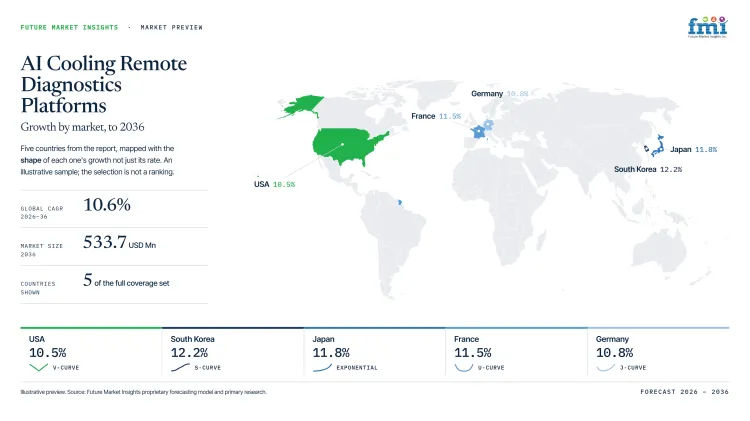
| Country | CAGR |
|---|---|
| South Korea | 12.2% |
| Japan | 11.8% |
| France | 11.5% |
| Germany | 10.8% |
| USA | 10.5% |
How do country-level CAGRs compare in the AI Cooling Remote Diagnostics Platforms Market?
The five profiled CAGRs span 1.7 percentage points from USA at 10.8% to South Korea at 12.2%. South Korea and Japan form the upper pair. France and the Germany make up the middle group. Germany follows from a mature installed base. The narrow spread still hides materially different operating constraints.
- South Korea's AI campuses favor centralized controls and fast commissioning after handover.
- Japan's regional data-center strategy raises demand for remote specialist coverage beyond hubs.
- France brings cooling-control decisions forward as AI projects coordinate grid access earlier.
- Germany's formal energy reporting increases the commercial value of traceable cooling records.
- The USA’s structured energy-efficiency reporting increases the commercial value of traceable cooling records.
Local operating conditions therefore determine how similar forecast rates convert into software budgets. The full report provides country-level CAGR analysis across North America, Latin America, Europe, East Asia, South Asia, Oceania and the Middle East and Africa.
Country-wise Analysis
- South Korea is commissioning large AI campuses on compressed schedules, so cooling controls must pass testing beside compute and electrical handover during initial facility acceptance. In South Korea, AI cooling remote diagnostics platform demand is predicted to advance at 12.2% CAGR through 2036 because centralized oversight suits large GPU estates. The Ministry of Science and ICT announced the Haenam National AI Computing Center groundbreaking in August 2026 with 15,000 advanced AI chips targeted by 2028. Cybersecurity approval can still delay remote control rights, which favors platforms backed by local engineering teams able to trace recommendations to validated equipment signals.
- Japan is shifting new data-center capacity toward regional sites with available power and land, which increases the need for remote specialist support beyond established operating hubs. METI's 2026 GX Strategic Zone profile for Shika Town lists 300 MW of power capacity and redundant 100 Gbps telecommunications for the planned site. Adoption of AI cooling remote diagnostics platforms in Japan is estimated to expand at 11.8% CAGR through 2036 given distributed build-out and centralized engineering coverage. Public water and sewerage remain unavailable at the site, so each deployment still requires local utility design and site-specific control models during commissioning.
- French AI projects reach cooling design earlier because grid access and environmental reporting must be resolved before mechanical commissioning begins at large campuses. The France AI cooling remote diagnostics platforms sector is projected to record 11.5% CAGR during the assessment period as remote telemetry supports plant tuning and auditable records. In May 2025 the Ministry of Economy documented four Prologis data-center projects near Paris totaling 584 MW, giving diagnostic vendors an early integration point. Protocol gaps between legacy plants and new liquid loops still complicate phased handover, so firms with commissioning support hold a practical advantage during retrofit and service transitions.
- Germany's mature data-center base makes retrofit diagnostics dependent on detailed point mapping since mixed legacy automation can weaken traceable cooling records during site commissioning. Germany is estimated to post 10.8% CAGR over the forecast period tied to plant data that fits formal efficiency reporting and retrofit management. BMWE's July 2025 data put national data-center capacity above 2,730 MW in 2024 after years of sustained expansion. The ministry also projected 4,850 MW by 2030 and the larger base increases the number of sites needing diagnostic retrofits. Older facilities still require proven protocol libraries plus commissioning support, which limits how quickly operators approve remote setpoint changes.
- The USA’s large and rapidly expanding data-center base makes retrofit diagnostics dependent on detailed point mapping, since mixed legacy automation can weaken traceable cooling records during site commissioning. The USA is estimated to post a 10.5% CAGR over the forecast period, supported by growing demand for plant data that can improve efficiency management, benchmarking, and retrofit decisions. U.S. data centers consumed about 176 TWh of electricity in 2023, while DOE projects substantial further growth through 2028, reinforcing the need for stronger energy-management practices. The expanding U.S. capacity base increases the number of facilities requiring diagnostic and cooling-system retrofits. Older facilities still require proven protocol libraries plus commissioning support, which limits how quickly operators approve remote setpoint changes.
Who are the notable companies in the AI Cooling Remote Diagnostics Platforms Market?
EkkoSense, Schneider Electric, Daikin Applied, LG Electronics, Vertiv, Johnson Controls, Airedale by Modine and STULZ
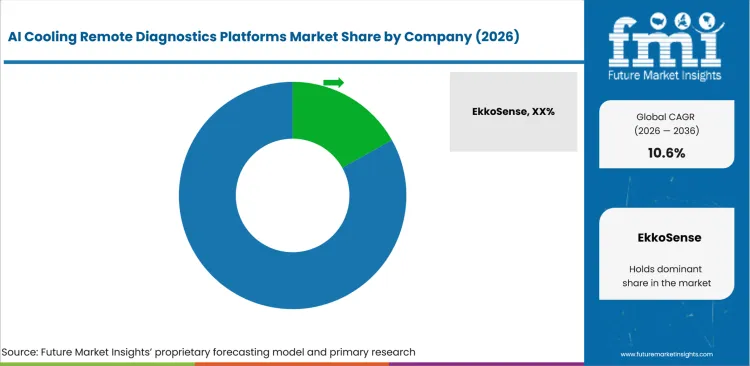
The field is split between software specialists and cooling OEMs that own different parts of the diagnostic workflow. Entry barriers come from protocol coverage and control authority plus proof that recommendations remain safe under high-density operating conditions. Companies serving liquid-cooled edge data center deployments also need service reach because remote diagnosis still depends on local commissioning and repair capacity.
- EkkoSense specializes in AI thermal analytics whereas Vertiv and Schneider Electric pair digital control layers with broader critical-infrastructure systems.
- Daikin Applied, LG Electronics and Johnson Controls extend remote diagnosis through cooling equipment portfolios that cover rack-side loops and facility plant.
- Airedale by Modine and STULZ compete from specialist thermal-management positions with controls that supervise high-density cooling equipment and retrofit operating conditions.
Competitive Benchmarking: AI Cooling Remote Diagnostics Platforms Market
| Company | Diagnostic Analytics Depth | Cooling-System Control Integration | High-Density AI Qualification | Geographic Reach |
|---|---|---|---|---|
| EkkoSense | High | Medium | High | Europe, North America and APAC |
| Schneider Electric | High | High | High | Global |
| Daikin Applied | Medium | High | High | North America with global Daikin reach |
| LG Electronics | High | High | High | Global |
| Vertiv | High | High | High | Global |
| Johnson Controls | Medium | High | High | Global |
| Airedale by Modine | High | High | High | North America, Europe and APAC |
| STULZ | Medium | Medium | Medium | Global |
Scoring basis: High diagnostic analytics requires predictive or optimization logic using live cooling data. Medium identifies connected monitoring without broad predictive functions and Low identifies basic equipment status. High control integration spans several thermal layers whereas Medium covers two linked layers and Low covers one. High AI qualification requires a validated design or documented high-density deployment. Medium requires a documented high-density offer and Low identifies general data-center cooling.
Source basis: Ratings use current official company announcements and public technical documentation. Geographic reach is descriptive and does not affect the capability scores.
Key Developments in the AI Cooling Remote Diagnostics Platforms Market
- In March 2026, EkkoSense launched vendor-agnostic Auto Cooling Anomalies Detection within EkkoSoft Critical for hybrid air and liquid cooling environments.
- In November 2025, Daikin Applied acquired Chilldyne to add negative-pressure direct-to-chip liquid cooling technology to its data-center thermal-management portfolio.
- In August 2025, Vertiv acquired Waylay to extend AI-based monitoring and predictive services into its power and cooling infrastructure portfolio.
Key Players in the AI Cooling Remote Diagnostics Platforms Market
AI Thermal Analytics and Optimization
- EkkoSense
Integrated Cooling and Critical Infrastructure Platforms
- Schneider Electric
- Vertiv
- Johnson Controls
Cooling OEMs with Connected Control
- Daikin Applied
- LG Electronics
- Airedale by Modine
- STULZ
AI Cooling Remote Diagnostics Platforms Market - Report Scope
| Coverage field | Report scope |
|---|---|
| Market breakdown | By software function, heat rejection - secondary loop, rack density, data center type, route to market and region. |
| Quantitative Units | USD Million. |
| Market Definition | Software platforms and connected control services that diagnose, predict or optimize cooling performance for AI data-center thermal systems using remote operating data. |
| Regions Covered | North America, Latin America, Europe, East Asia, South Asia and Pacific and Middle East and Africa. |
| Countries Covered | South Korea, Japan, France, UAE, Germany, and 20+ countries included in the full report. |
| Key Companies Profiled | EkkoSense, Schneider Electric, Daikin Applied, LG Electronics, Vertiv, Johnson Controls, Airedale by Modine and STULZ |
| Forecast Period | 2026 to 2036. |
| Approach | Primary and secondary research with market triangulation. |
AI Cooling Remote Diagnostics Platforms Market - Research Methodology
| Method | Approach |
|---|---|
| Primary Research | FMI analysts gathered input from manufacturers, service providers, technology developers, distributors, end users, procurement teams, and subject-matter experts. Interviews examined purchasing decisions, product or service evaluation, adoption barriers, approval requirements, pricing considerations, and expectations for technical or commercial support. Respondents were also asked what evidence is required before a trial, pilot, or initial order develops into regular purchasing. |
| Desk Research | Desk research covered government statistics, regulatory publications, trade data, industry associations, technical literature, standards, company filings, product information, and official corporate announcements. Sources were reviewed for relevance, publication date, geographic coverage, and consistency with the defined market scope. Claims relating to performance, applications, approvals, capacity, investment, and commercial activity were retained only when supported by credible public evidence. |
| Market Sizing and Forecasting | The market model combined the baseline value with historical performance, segment structure, pricing and volume indicators, adoption levels, company participation, and country-level demand conditions. Forecast assumptions considered economic activity, investment trends, regulatory developments, technology adoption, purchasing cycles, supply availability, and barriers to wider market use. Segment and regional estimates were reconciled before the final market total was calculated. |
| Data Validation | Estimates were checked against multiple independent indicators, including public data, company activity, trade patterns, industry developments, and findings from primary interviews. Validation also tested whether products, services, applications, and company revenues fell within the defined market boundaries. Adjacent categories, unsupported claims, overlapping revenues, and activities without direct market relevance were excluded to reduce double counting and maintain consistency across segments and countries. |
AI Cooling Remote Diagnostics Platforms Market by Segments
Software Function
- Optimization & control
- Thermal / hydraulic monitoring
- Predictive maintenance
- Digital twin / simulation
- Water / energy reporting
Heat Rejection - secondary Loop
- Dry coolers
- Chillers
- Cooling towers / evaporative
- Facility water loop / district interface
- Hybrid systems
Rack Density
- Below 100 kW
- 100-250 kW
- 251-500 kW
- Above 500 kW
Data Center Type
- Hyperscale AI
- Colocation AI
- Enterprise AI/HPC
- Research / sovereign compute
Route to Market
- Cooling OEM direct
- MEP / EPC integrator
- Server / rack OEM bundle
- Service & retrofit channel
AI Cooling Remote Diagnostics Platforms Market by Region:
- North America
- United States
- Canada
- Latin America
- Brazil
- Mexico
- Argentina
- Chile
- Western Europe
- Germany
- France
- United Kingdom
- Italy
- Spain
- Benelux
- Nordics
- Eastern Europe
- Poland
- Czech Republic
- Romania
- Hungary
- East Asia
- China
- Japan
- South Korea
- South Asia and Pacific
- India
- ASEAN
- Australia and New Zealand
- Middle East and Africa
- GCC Countries
- South Africa
- Türkiye
- Israel
Research Sources and Bibliography
- International Energy Agency. (2026, April 16). Data centre electricity use surged in 2025, even with tightening bottlenecks driving a scramble for solutions.
- International Energy Agency. (2025, April 10). Energy demand from AI
- EkkoSense. (2025, May 22). EkkoSoft Critical 9.0 unlocks next level data center capacity, power management and cooling optimization performance.
- Schneider Electric. (2026, July 14). Data Center Reference Design 121: 10.4 and 6.2 MW, Tier III, ANSI, Chilled Water, Liquid-Cooled AI Clusters (AMD Instinct MI455X GPUs).
- Modine Manufacturing Company. (2025, March 5). Airedale by Modine™ Unveils Expanded Capacities for Coolant Distribution Unit.
- Vertiv. (2025, June 11). Vertiv develops energy-efficient cooling and power reference architecture for the NVIDIA GB300 NVL72 platform, available as SimReady™ assets in NVIDIA Omniverse blueprint for AI factory design and operations.
- Johnson Controls. (2025, September 8). Johnson Controls expands thermal management offering with scalable liquid cooling solution to meet the increasing demand of high-density data centers.
- Schneider Electric. (2026, March 16). Schneider Electric teams with NVIDIA to develop validated blueprints to design, simulate, build, operate and maintain gigawatt-scale AI Factories.
- Ministry for Ecological Transition, France. (2026, April 29). Efficacité énergétique des centres de données (datacenters).
- Ministry of Science and ICT, Republic of Korea. (2026, August 4). National AI Computing Center, a Key Infrastructure for Korea’s AI Highway, Breaks Ground in Haenam
- Ministry of Economy, Trade and Industry, Japan. (2026). GX Strategic Zone project profile: Shika Town GX Industrial Park.
- Ministry of Economy, Finance and Industrial and Digital Sovereignty, France. (2025, May 21). IA : des investissements records annoncés lors du Sommet Choose France 2025.
- Ministry of Energy and Infrastructure, United Arab Emirates. (2025, March 23). Water Security is a National Priority for the UAE.
- Federal Ministry for Economic Affairs and Energy, Germany. (2025, July). How data centres increase our demand for energy.
- EkkoSense. (2026, March 24). EkkoSoft Critical New Auto Cooling Anomalies Detection helps derisk data center air and liquid cooling.
- Daikin Applied. (2025, November 4). Daikin Applied Expands Data Center Offering with Acquisition of Chilldyne.
- Vertiv. (2025, August 26). Vertiv acquires Generative AI software leader Waylay NV to enhance critical digital infrastructure operational intelligence, optimization, and services.
- LG Electronics. (2026, July 27). LG Electronics Earns NVIDIA Infrastructure Validation for Its 600kW Coolant Distribution Unit.
- Airedale by Modine. (2025, April 24). Airedale by Modine™ Cooling AI™ Control System Brings Unprecedented Efficiency Gains to High-Density Data Centers.
- LG Electronics. (2025, October 28). LG, SK Enmove and GRC Sign MOU to Advance Liquid Immersion Cooling Solutions for AI Data Centers.
- Schneider Electric. (2025, September 29). Schneider Electric Unveils Liquid Cooling Portfolio with Motivair Featuring Dedicated Solutions and Services for HPC and AI Workloads.
- Daikin Applied. (2025, December 9). Daikin Applied Invests $163M in Advanced R&D Test Lab to Bolster HVAC Innovation for Data Centers and Beyond.
- Vertiv. (2026, July 21). Vertiv Expands Global Manufacturing Capacity for AI-Ready Data Center Cooling Solutions.
- EkkoSense. (2025, May 30). EkkoSense partners with Meikyo Electric to accelerate growth in Japanese data center optimization sector.
- Schneider Electric. (2026, February 18). Schneider Electric launches Motivair liquid cooling solutions factory, to accelerate India’s high-density AI infrastructure.
- Daikin Applied. (2025, August 18). Daikin Applied Completes Acquisition of DDC Solutions.
- LG Electronics. (2025, August 22). LG Expands AI Infrastructure Footprint Across Asia.
- Vertiv. (2025, July 22). Oklo and Vertiv announce collaboration to advance power and cooling solutions for hyperscale and colocation data centers in the United States.
- Johnson Controls. (2026, May 13). Johnson Controls completes acquisition of Alloy Enterprises.
- Modine Manufacturing Company. (2025, August 21). Modine Opens India Facility to Manufacture Data Center Cooling Equipment for APAC Region.
- STULZ. (2026, January 22). CyberRack Active Rear Door für High-Density-Anwendungen.
This bibliography is provided for reader reference and is not exhaustive. The full report contains the complete reference list and detailed citations
This Report Answers
- How large is the AI cooling remote diagnostics platforms market in 2026 and what value is projected for 2036?
- What CAGR is projected for the AI cooling remote diagnostics platforms market between 2026 and 2036?
- Why does optimization & control hold the largest stated software function share in 2026?
- How do dry coolers and 251-500 kW rack densities shape remote diagnostic requirements?
- Why does hyperscale AI account for the largest stated data center type share in 2026?
- Which operating factors raise demand and which integration conditions slow deployment?
- How do the five profiled country CAGRs differ and what local conditions shape order conversion?
- Which companies are active in remote cooling diagnostics and how do their verified capabilities compare?
- Which recent company actions are changing software, control and service competition in AI data-center cooling?
Frequently Asked Questions
How big is the AI Cooling Remote Diagnostics Platforms Market in 2026?
The AI cooling remote diagnostics platforms market is valued at USD 194.9 million in 2026 and is projected to reach USD 533.7 million by 2036. Growth comes from thermal supervision as denser AI compute loads reduce the time available for diagnosing cooling drift.
What is the CAGR of the AI Cooling Remote Diagnostics Platforms Market from 2026 to 2036?
The AI cooling remote diagnostics platforms market is projected to grow at a CAGR of 10.6% between 2026 and 2036. Expansion is supported by higher rack densities and the shift from periodic inspection to software-led cooling diagnosis.
Which software function leads the AI Cooling Remote Diagnostics Platforms Market?
The optimization & control segment is expected to hold 29.0% of the AI cooling remote diagnostics platforms market in 2026, driven by reviewed cooling setpoint and equipment sequencing changes. Operators validate recommendations against live telemetry prior to changing setpoints or equipment sequencing in critical rooms.
Which countries are projected to record the highest growth in the AI Cooling Remote Diagnostics Platforms Market?
South Korea is projected to grow at 12.2% CAGR, followed by Japan at 11.8% and France at 11.5% through 2036. Growth is significant in countries where new AI capacity raises the value of centralized cooling supervision during commissioning.
Which companies are active in the AI Cooling Remote Diagnostics Platforms Market?
Key companies operating in the market include EkkoSense, Schneider Electric, Daikin Applied, LG Electronics, Vertiv, Johnson Controls, Airedale by Modine, and STULZ. These companies compete through thermal analytics, cooling controls, high-density equipment integration and regional service coverage for critical facilities.
Preview the report firsthand - request a free sample
Get SampleGet the brochure for pricing and purchase details.
Get PDFTable of Content
- Key Takeaways
- Market Size and CAGR
- Top Growth Driver
- Fastest Growing Segment
- Leading Region
- Key Companies
- Emerging Opportunities
- Executive Summary
- Global Market Outlook
- Demand-side Trends
- Supply-side Trends
- Technology Roadmap Analysis
- Analysis and Recommendations
- Analyst Perspective (What is happening? Why now? What should investors know?)
- Key Questions Answered
- How large is the market?
- What is the CAGR?
- What are key trends?
- Which region dominates?
- Who are the leaders?
- Market Overview
- Market Coverage / Taxonomy
- Market Definition / Scope / Limitations
- Research Methodology
- Chapter Orientation
- Analytical Lens and Working Hypotheses
- Market Structure, Signals, and Trend Drivers
- Benchmarking and Cross-market Comparability
- Market Sizing, Forecasting, and Opportunity Mapping
- Research Design and Evidence Framework
- Desk Research Programme (Secondary Evidence)
- Expert Input and Fieldwork (Primary Evidence)
- Tooling, Models, and Reference Databases
- Data Engineering and Model Build
- Quality Assurance and Audit Trail
- Market Background
- Market Dynamics (Drivers, Restraints, Opportunity, Trends)
- Scenario Forecast (Optimistic, Likely, Conservative)
- Impact Analysis
- AI Impact
- Sustainability Impact
- Regulatory Impact
- Technology Impact
- Consumer / Buyer Analysis
- Purchase Drivers
- Adoption Barriers
- Buyer Journey
- Opportunity Map Analysis
- Product Life Cycle Analysis
- Supply Chain Analysis
- Investment Feasibility Matrix
- Value Chain Analysis
- PESTLE and Porter's Analysis
- Regulatory Landscape
- Regional Parent Market Outlook
- Production and Consumption Statistics
- Import and Export Statistics
- Global Market Analysis and Forecast, 2021 to 2036
- Historical Market Size Value (USD Million) Analysis, 2021 to 2025
- Current and Future Market Size Value (USD Million) Projections, 2026 to 2036
- Y-o-Y Growth Trend Analysis
- Absolute $ Opportunity Analysis
- Global Market Pricing Analysis, 2021 to 2036
- Global Market Analysis and Forecast, By Software Function, 2021 to 2036
- Introduction / Key Findings
- Historical Market Size Value (USD Million) Analysis By Software Function, 2021 to 2025
- Current and Future Market Size Value (USD Million) Analysis and Forecast By Software Function, 2026 to 2036
- Optimization & control
- Thermal / hydraulic monitoring
- Predictive maintenance
- Digital twin / simulation
- Water / energy reporting
- Optimization & control
- Y-o-Y Growth Trend Analysis By Software Function, 2021 to 2025
- Absolute $ Opportunity Analysis By Software Function, 2026 to 2036
- Global Market Analysis and Forecast, By Heat Rejection / Secondary Loop, 2021 to 2036
- Introduction / Key Findings
- Historical Market Size Value (USD Million) Analysis By Heat Rejection / Secondary Loop, 2021 to 2025
- Current and Future Market Size Value (USD Million) Analysis and Forecast By Heat Rejection / Secondary Loop, 2026 to 2036
- Dry coolers
- Chillers
- Cooling towers / evaporative
- Facility water loop / district interface
- Hybrid systems
- Dry coolers
- Y-o-Y Growth Trend Analysis By Heat Rejection / Secondary Loop, 2021 to 2025
- Absolute $ Opportunity Analysis By Heat Rejection / Secondary Loop, 2026 to 2036
- Global Market Analysis and Forecast, By Rack Density, 2021 to 2036
- Introduction / Key Findings
- Historical Market Size Value (USD Million) Analysis By Rack Density, 2021 to 2025
- Current and Future Market Size Value (USD Million) Analysis and Forecast By Rack Density, 2026 to 2036
- 251-500 kW
- 100-250 kW
- Below 100 kW
- Above 500 kW
- 251-500 kW
- Y-o-Y Growth Trend Analysis By Rack Density, 2021 to 2025
- Absolute $ Opportunity Analysis By Rack Density, 2026 to 2036
- Global Market Analysis and Forecast, By Data Center Type, 2021 to 2036
- Introduction / Key Findings
- Historical Market Size Value (USD Million) Analysis By Data Center Type, 2021 to 2025
- Current and Future Market Size Value (USD Million) Analysis and Forecast By Data Center Type, 2026 to 2036
- Hyperscale AI
- Colocation AI
- Enterprise AI/HPC
- Research / sovereign compute
- Hyperscale AI
- Y-o-Y Growth Trend Analysis By Data Center Type, 2021 to 2025
- Absolute $ Opportunity Analysis By Data Center Type, 2026 to 2036
- Global Market Analysis and Forecast, By Route to Market, 2021 to 2036
- Introduction / Key Findings
- Historical Market Size Value (USD Million) Analysis By Route to Market, 2021 to 2025
- Current and Future Market Size Value (USD Million) Analysis and Forecast By Route to Market, 2026 to 2036
- Cooling OEM direct
- MEP / EPC integrator
- Server / rack OEM bundle
- Service & retrofit channel
- Cooling OEM direct
- Y-o-Y Growth Trend Analysis By Route to Market, 2021 to 2025
- Absolute $ Opportunity Analysis By Route to Market, 2026 to 2036
- Global Market Analysis and Forecast, By Region, 2021 to 2036
- Introduction
- Historical Market Size Value (USD Million) Analysis By Region, 2021 to 2025
- Current Market Size Value (USD Million) Analysis and Forecast By Region, 2026 to 2036
- North America
- Latin America
- Western Europe
- Eastern Europe
- East Asia
- South Asia and Pacific
- Middle East & Africa
- Market Attractiveness Analysis By Region
- North America Market Analysis and Forecast, By Country, 2021 to 2036
- Historical Market Size Value (USD Million) Trend Analysis By Market Taxonomy, 2021 to 2025
- Market Size Value (USD Million) Forecast By Market Taxonomy, 2026 to 2036
- By Country
- USA
- Canada
- By Software Function
- By Heat Rejection / Secondary Loop
- By Rack Density
- By Data Center Type
- By Route to Market
- By Country
- Market Attractiveness Analysis
- By Country
- By Software Function
- By Heat Rejection / Secondary Loop
- By Rack Density
- By Data Center Type
- By Route to Market
- Key Takeaways
- Latin America Market Analysis and Forecast, By Country
- Historical Market Size Value (USD Million) Trend Analysis By Market Taxonomy, 2021 to 2025
- Market Size Value (USD Million) Forecast By Market Taxonomy, 2026 to 2036
- By Country
- Brazil
- Mexico
- Chile
- Rest of Latin America
- By Software Function
- By Heat Rejection / Secondary Loop
- By Rack Density
- By Data Center Type
- By Route to Market
- By Country
- Market Attractiveness Analysis
- By Country
- By Software Function
- By Heat Rejection / Secondary Loop
- By Rack Density
- By Data Center Type
- By Route to Market
- Key Takeaways
- Western Europe Market Analysis and Forecast, By Country
- Historical Market Size Value (USD Million) Trend Analysis By Market Taxonomy, 2021 to 2025
- Market Size Value (USD Million) Forecast By Market Taxonomy, 2026 to 2036
- By Country
- Germany
- UK
- Italy
- Spain
- France
- Nordic
- BENELUX
- Rest of Western Europe
- By Software Function
- By Heat Rejection / Secondary Loop
- By Rack Density
- By Data Center Type
- By Route to Market
- By Country
- Market Attractiveness Analysis
- By Country
- By Software Function
- By Heat Rejection / Secondary Loop
- By Rack Density
- By Data Center Type
- By Route to Market
- Key Takeaways
- Eastern Europe Market Analysis and Forecast, By Country
- Historical Market Size Value (USD Million) Trend Analysis By Market Taxonomy, 2021 to 2025
- Market Size Value (USD Million) Forecast By Market Taxonomy, 2026 to 2036
- By Country
- Russia
- Poland
- Hungary
- Balkan & Baltic
- Rest of Eastern Europe
- By Software Function
- By Heat Rejection / Secondary Loop
- By Rack Density
- By Data Center Type
- By Route to Market
- By Country
- Market Attractiveness Analysis
- By Country
- By Software Function
- By Heat Rejection / Secondary Loop
- By Rack Density
- By Data Center Type
- By Route to Market
- Key Takeaways
- East Asia Market Analysis and Forecast, By Country
- Historical Market Size Value (USD Million) Trend Analysis By Market Taxonomy, 2021 to 2025
- Market Size Value (USD Million) Forecast By Market Taxonomy, 2026 to 2036
- By Country
- China
- Japan
- South Korea
- By Software Function
- By Heat Rejection / Secondary Loop
- By Rack Density
- By Data Center Type
- By Route to Market
- By Country
- Market Attractiveness Analysis
- By Country
- By Software Function
- By Heat Rejection / Secondary Loop
- By Rack Density
- By Data Center Type
- By Route to Market
- Key Takeaways
- South Asia and Pacific Market Analysis and Forecast, By Country
- Historical Market Size Value (USD Million) Trend Analysis By Market Taxonomy, 2021 to 2025
- Market Size Value (USD Million) Forecast By Market Taxonomy, 2026 to 2036
- By Country
- India
- ASEAN
- Australia & New Zealand
- Rest of South Asia and Pacific
- By Software Function
- By Heat Rejection / Secondary Loop
- By Rack Density
- By Data Center Type
- By Route to Market
- By Country
- Market Attractiveness Analysis
- By Country
- By Software Function
- By Heat Rejection / Secondary Loop
- By Rack Density
- By Data Center Type
- By Route to Market
- Key Takeaways
- Middle East & Africa Market Analysis and Forecast, By Country
- Historical Market Size Value (USD Million) Trend Analysis By Market Taxonomy, 2021 to 2025
- Market Size Value (USD Million) Forecast By Market Taxonomy, 2026 to 2036
- By Country
- Kingdom of Saudi Arabia
- Other GCC Countries
- Türkiye
- South Africa
- Other African Union
- Rest of Middle East & Africa
- By Software Function
- By Heat Rejection / Secondary Loop
- By Rack Density
- By Data Center Type
- By Route to Market
- By Country
- Market Attractiveness Analysis
- By Country
- By Software Function
- By Heat Rejection / Secondary Loop
- By Rack Density
- By Data Center Type
- By Route to Market
- Key Takeaways
- Key Countries Market Analysis
- USA
- Pricing Analysis
- Market Share Analysis, 2025
- By Software Function
- By Heat Rejection / Secondary Loop
- By Rack Density
- By Data Center Type
- By Route to Market
- Canada
- Pricing Analysis
- Market Share Analysis, 2025
- By Software Function
- By Heat Rejection / Secondary Loop
- By Rack Density
- By Data Center Type
- By Route to Market
- Mexico
- Pricing Analysis
- Market Share Analysis, 2025
- By Software Function
- By Heat Rejection / Secondary Loop
- By Rack Density
- By Data Center Type
- By Route to Market
- Brazil
- Pricing Analysis
- Market Share Analysis, 2025
- By Software Function
- By Heat Rejection / Secondary Loop
- By Rack Density
- By Data Center Type
- By Route to Market
- Chile
- Pricing Analysis
- Market Share Analysis, 2025
- By Software Function
- By Heat Rejection / Secondary Loop
- By Rack Density
- By Data Center Type
- By Route to Market
- Germany
- Pricing Analysis
- Market Share Analysis, 2025
- By Software Function
- By Heat Rejection / Secondary Loop
- By Rack Density
- By Data Center Type
- By Route to Market
- UK
- Pricing Analysis
- Market Share Analysis, 2025
- By Software Function
- By Heat Rejection / Secondary Loop
- By Rack Density
- By Data Center Type
- By Route to Market
- Italy
- Pricing Analysis
- Market Share Analysis, 2025
- By Software Function
- By Heat Rejection / Secondary Loop
- By Rack Density
- By Data Center Type
- By Route to Market
- Spain
- Pricing Analysis
- Market Share Analysis, 2025
- By Software Function
- By Heat Rejection / Secondary Loop
- By Rack Density
- By Data Center Type
- By Route to Market
- France
- Pricing Analysis
- Market Share Analysis, 2025
- By Software Function
- By Heat Rejection / Secondary Loop
- By Rack Density
- By Data Center Type
- By Route to Market
- India
- Pricing Analysis
- Market Share Analysis, 2025
- By Software Function
- By Heat Rejection / Secondary Loop
- By Rack Density
- By Data Center Type
- By Route to Market
- ASEAN
- Pricing Analysis
- Market Share Analysis, 2025
- By Software Function
- By Heat Rejection / Secondary Loop
- By Rack Density
- By Data Center Type
- By Route to Market
- Australia & New Zealand
- Pricing Analysis
- Market Share Analysis, 2025
- By Software Function
- By Heat Rejection / Secondary Loop
- By Rack Density
- By Data Center Type
- By Route to Market
- China
- Pricing Analysis
- Market Share Analysis, 2025
- By Software Function
- By Heat Rejection / Secondary Loop
- By Rack Density
- By Data Center Type
- By Route to Market
- Japan
- Pricing Analysis
- Market Share Analysis, 2025
- By Software Function
- By Heat Rejection / Secondary Loop
- By Rack Density
- By Data Center Type
- By Route to Market
- South Korea
- Pricing Analysis
- Market Share Analysis, 2025
- By Software Function
- By Heat Rejection / Secondary Loop
- By Rack Density
- By Data Center Type
- By Route to Market
- Russia
- Pricing Analysis
- Market Share Analysis, 2025
- By Software Function
- By Heat Rejection / Secondary Loop
- By Rack Density
- By Data Center Type
- By Route to Market
- Poland
- Pricing Analysis
- Market Share Analysis, 2025
- By Software Function
- By Heat Rejection / Secondary Loop
- By Rack Density
- By Data Center Type
- By Route to Market
- Hungary
- Pricing Analysis
- Market Share Analysis, 2025
- By Software Function
- By Heat Rejection / Secondary Loop
- By Rack Density
- By Data Center Type
- By Route to Market
- Kingdom of Saudi Arabia
- Pricing Analysis
- Market Share Analysis, 2025
- By Software Function
- By Heat Rejection / Secondary Loop
- By Rack Density
- By Data Center Type
- By Route to Market
- Türkiye
- Pricing Analysis
- Market Share Analysis, 2025
- By Software Function
- By Heat Rejection / Secondary Loop
- By Rack Density
- By Data Center Type
- By Route to Market
- South Africa
- Pricing Analysis
- Market Share Analysis, 2025
- By Software Function
- By Heat Rejection / Secondary Loop
- By Rack Density
- By Data Center Type
- By Route to Market
- USA
- Market Structure Analysis
- Competition Dashboard
- Competition Benchmarking
- Market Share Analysis of Top Players
- By Regional
- By Software Function
- By Heat Rejection / Secondary Loop
- By Rack Density
- By Data Center Type
- By Route to Market
- Emerging Startups
- Innovation Benchmarking
- Competition Analysis
- Competition Deep Dive
- EkkoSense
- Overview
- Product Portfolio
- Profitability by Market Segments
- Sales Footprint
- Strategy Overview
- Marketing Strategy
- Product Strategy
- Channel Strategy
- Schneider Electric
- Daikin
- LG Electronics
- EkkoSense
- Case Studies
- Success Stories
- Recent Developments
- Competition Deep Dive
- Assumptions & Acronyms Used


