

- Market Size (2026)
- USD 147.5 Mn
- Forecast (2036)
- USD 318.4 Mn
- CAGR (2026 to 2036)
- 8.0%
How big is Home Dough Proofing Boxes Market in 2026?
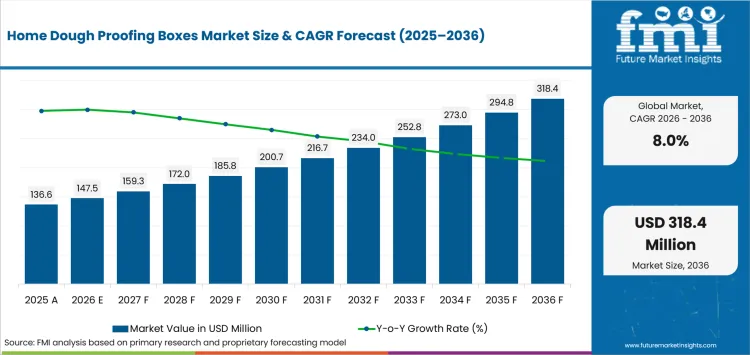
USD 147.5 million in 2026 and USD 318.4 million by 2036 at an 8.0% CAGR.
Demand for home dough proofing boxes is projected to expand at 8.0% CAGR between 2026 and 2036, increasing valuation from USD 147.5 million in 2026 to USD 318.4 million by 2036. Consumer demand is tied to products that make fermentation easier to observe and repeat while fitting the space limits of a home kitchen.
Dedicated systems range from passive stackable trays and lidded containers to heated proofing equipment. Ooni sells stackable dough boxes with fitted lids for pizza dough, while Brod & Taylor offers folding proofers and food-safe proofing containers designed around controlled temperature and humidity. This range gives buyers a choice between simple dough organization and more controlled fermentation without moving into commercial bakery equipment.
Key Takeaways of Home Dough Proofing Boxes Market
- Home dough proofing products gain relevance when they combine repeatable fermentation with storage efficiency and food-contact suitability for regular home use.
- Complete kits & sets are projected at 39.0% share in 2026 because bundled components reduce the need to assemble a proofing setup from separate containers and accessories.
- Mid-range is estimated at 44.0% of Price Tier demand in 2026 as buyers balance reusable materials and useful proofing features against the cost of advanced temperature-control systems.
- Everyday baking is forecast at 38.0% by Occasion in 2026, supported by repeat bread and pizza preparation rather than one-time event purchases.
- Ordinary bowls and food-storage containers remain practical substitutes, while food-contact requirements and storage space influence whether a dedicated product earns regular kitchen use.
- Brod & Taylor, Ooni Limited, Gozney Group Limited, Cambro Manufacturing Company, DoughMate, King Arthur Baking Company, Inc., Sourhouse LLC and Reliatrace, Inc. (Raisenne) serve the category through proofing boxes, trays, containers, warming systems or specialist home-baking distribution.
Analyst Perspective
"A home proofing product earns repeat use when the baker can see fermentation progress, keep dough from drying out and store the system without surrendering permanent counter space. Product teams should treat material suitability and cleaning as core design requirements because a clever temperature feature does not compensate for a container that is awkward to use after every bake."
- Rahul Pandita, Principal Consultant, Future Market Insights
How is the Home Dough Proofing Boxes Market segmented?
The home dough proofing boxes market is segmented by Product Type, Price Tier, Occasion, User Group, Sales Channel and Region.
Product Type covers Complete kits & sets, Starter kits & basics, Refills & consumables, and Premium & licensed editions. Price Tier includes Mid-range, Economy and Premium. Occasion covers Everyday baking, Celebration & party, and Seasonal & gifting. User Group includes Adult hobbyists, Kids & family, and Prosumer / semi-professional users. Sales Channel covers Online marketplaces, Specialty craft stores, Mass retail and Grocery.
Why do complete kits & sets lead the product type category?
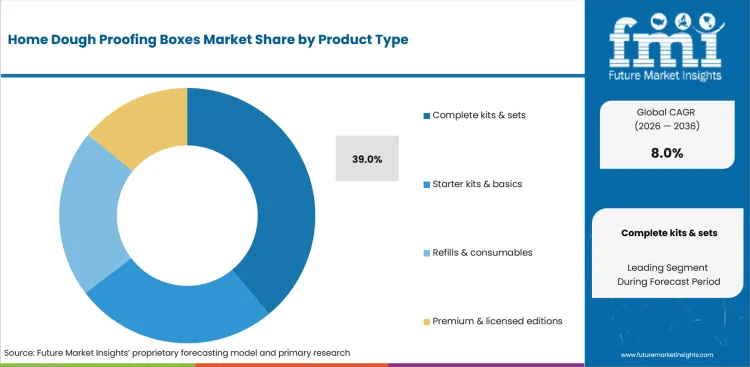
Complete kits & sets reduce setup friction by combining the items needed to contain, cover or manage dough during fermentation. Ooni packages stackable proofing boxes with lids, while Sourhouse combines a warming mat, bowl and lid in its DoughBed system for home proofing.
- Based on Product Type, Complete kits & sets are projected to account for 39.0% in 2026 as bundled configurations give home bakers a defined proofing setup in one purchase.
- A set format also makes storage and replacement decisions easier because lids, trays and accessories are designed to work together. That supports repeat use for pizza dough, sourdough and yeast breads where the same setup is used across many baking sessions.
Why does mid-range lead the price tier category?
Mid-range products sit between basic food containers and advanced controlled proofers. Buyers in this tier can obtain stackable construction, fitted lids, measurement markings or passive temperature indicators without paying for a larger powered appliance.
- In 2026, Mid-range is expected to lead the Price Tier category with 44.0% share as home bakers look for durable reusable products with clear functional improvements over general kitchen storage.
- The tier also accommodates several purchase paths, including dedicated pizza dough trays and home baking containers. Brands can add value through better lids, cleaning convenience or compact nesting instead of relying on decorative features that do not change proofing performance.
Why does everyday baking lead the occasion category?
Everyday baking rewards products that remain easy to reach, clean and store between sessions. Bread and pizza dough can require bulk fermentation or proofing several times a month, so a dedicated container can become part of the normal preparation routine rather than an occasional accessory.
- The Everyday baking segment is likely to capture 38.0% share in 2026 because recurring bread and pizza preparation gives proofing boxes more opportunities for reuse across the year.
- Reusable lidded containers help bakers track dough expansion and protect the surface from drying. Compact powered systems can add temperature control when room conditions vary, while passive boxes still serve routine fermentation and refrigerated storage.
Why do adult hobbyists lead the user group category?
Adult hobbyists are more likely to compare fermentation time, dough temperature and container geometry as they refine bread or pizza routines. Specialist home-baking products therefore compete on useful process control rather than novelty alone.
- Adult hobbyists are projected to hold 53.0% of User Group demand in 2026 because repeat baking gives this group a practical reason to invest in dedicated proofing equipment and reusable accessories.
- Products that make fermentation visible or easier to schedule fit the learning cycle of hobby bakers. Brod & Taylor emphasizes temperature control, while Gozney integrates a temperature gauge into its dough tray, showing how product design can support process observation without requiring commercial equipment.
Why do online marketplaces lead the sales channel category?
Online marketplaces give niche proofing products access to buyers who may not find specialist dough equipment in local kitchen stores. Product pages can also explain capacity, dimensions and proofing features before purchase, which matters when home users are comparing storage fit as closely as baking function.
- Online marketplaces are forecast to account for 34.0% of Sales Channel demand in 2026 as specialty proofing products are suited to search-led purchasing and parcel delivery.
- Direct and marketplace distribution can support replacement lids, add-on trays and starter bundles after the first purchase. USA Census data show e-commerce represented 16.9% of USA retail sales in the first quarter of 2026, providing a broad distribution environment for specialized home-kitchen products.
What are the drivers, restraints and opportunities in the Home Dough Proofing Boxes Market?
Repeat home bread and pizza preparation supports dedicated proofing products, while ordinary containers remain substitutes as compact controlled systems create room for higher-value home baking solutions.
- Driver: Repeat home bread and pizza preparation increases demand for reusable proofing and fermentation tools that simplify dough storage and observation.
- Restraint: Bowls, tubs and improvised warm spaces can perform basic proofing tasks, while food-contact requirements raise the material and documentation burden for dedicated products.
- Opportunity: Nestable kits, integrated temperature indicators and compact warming formats can combine proofing, storage and process control for home bakers.
Dedicated products become more useful when they reduce several small sources of friction at once. Ooni proofing boxes use stackable containers and fitted lids, while Gozney adds an airtight seal, pressure release valve and temperature gauge to its dough tray. These features address storage, surface drying and process visibility without requiring a permanent appliance footprint.
Substitution remains a structural limit because a covered bowl or food-safe storage container can support many dough recipes. Product suppliers therefore need a clear functional reason for the dedicated purchase. In the United States, the FDA treats food-contact substances and food-contact articles as a regulated area, while European Union food-contact materials must comply with the framework established under Regulation (EC) No 1935/2004. Material choices and use instructions therefore remain part of product credibility.
The opportunity is to make controlled proofing easier to store. Brod & Taylor sells a folding proofer for home cooks, Sourhouse uses a low-profile warming mat with a bowl and lid, and Raisenne uses a thin warming surface under a separate dough container. These approaches show how temperature support can move into home kitchens without requiring a fixed commercial proofing cabinet.
Which country CAGRs are profiled in the Home Dough Proofing Boxes Market?
| Country | CAGR |
|---|---|
| UAE | 9.4% |
| Saudi Arabia | 9.1% |
| USA | 8.8% |
| South Korea | 8.5% |
| Germany | 8.1% |
| UK | 7.8% |
| France | 7.5% |
| Japan | 7.2% |
How do country-level CAGRs compare in the Home Dough Proofing Boxes Market?
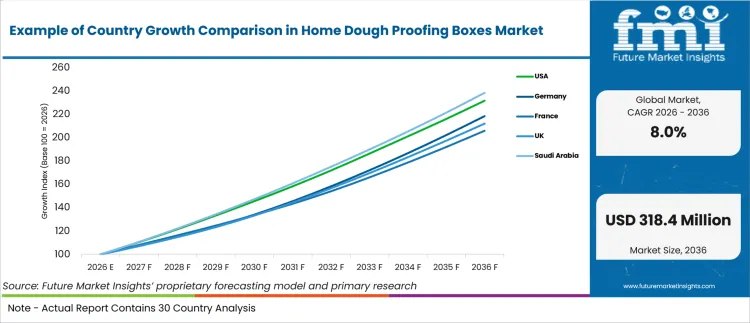
The eight profiled CAGRs span 2.3 percentage points across different e-commerce systems and home-baking retail environments. The spacing describes expected market expansion rather than current market size or household penetration in each country.
- UAE is projected to grow at 9.4% CAGR, with online commercial activity supported by a regulated digital-business environment and a strong route for specialist imported kitchen products.
- Saudi Arabia is likely to expand at 9.1% CAGR as e-commerce activity improves access to niche home-kitchen equipment outside store-led specialist retail.
- The USA is set to expand at 8.8% CAGR, supported by direct-to-consumer baking brands and retail e-commerce that give proofing boxes several distribution routes.
- South Korea is projected to grow at 8.5% CAGR, with the high mobile share of online shopping supporting discovery and purchase of compact household products.
- Germany is forecast to expand at 8.1% CAGR as widespread online shopping and European food-contact rules shape product access and material expectations.
- The UK is anticipated to grow at 7.8% CAGR, supported by the substantial online share of retail sales and specialist kitchenware channels serving home bakers.
- France is expected to expand at 7.5% CAGR as established online purchasing gives specialist kitchen products a national route to consumers.
- Japan is forecast to grow at 7.2% CAGR, with continued B2C e-commerce expansion supporting online distribution for compact baking accessories and home-kitchen equipment.
Comparable growth rates can produce different commercial conditions because proofing habits, kitchen space and retail channels vary by country. The full report provides country-level CAGR analysis across North America, Latin America, Europe, East Asia, South Asia and Pacific, and the Middle East and Africa.
Country-wise Analysis
- UAE home dough proofing box demand benefits from digital retail access that allows specialist international kitchen products to reach buyers without relying on dense store networks. TDRA provides a formal NOC route for businesses and individuals conducting economic activity online through websites, applications or social media accounts, showing an established regulatory framework for e-activity. The UAE home dough proofing boxes sector is projected to record 9.4% CAGR during the assessment period, with compact kits and online distribution helping suppliers serve home bakers across a market where many specialty products are imported.
- Saudi Arabian home dough proofing box demand is supported by a retail environment in which e-commerce continues to expand as a sales route for household products. The General Authority for Statistics reported that the e-commerce sales index increased 13.6% year on year in the first quarter of 2026, giving specialist products a broader digital route to consumers. Home dough proofing boxes in Saudi Arabia are forecast to advance at 9.1% CAGR through 2036, while product dimensions, heat tolerance and replacement-part availability remain important for repeat use in home kitchens.
- Home dough proofing products in the USA operate through specialist baking stores, direct brand sites and broad online retail. The USA Census Bureau reported that e-commerce accounted for 16.9% of retail sales in the first quarter of 2026 and that adjusted e-commerce sales increased 9.8% from a year earlier. USA is estimated to post 8.8% CAGR over the forecast period as online product discovery and a developed home-baking supplier base support dedicated proofing containers, trays and temperature-control systems.
- South Korean demand benefits from mobile-led online shopping, which suits compact household products that can be demonstrated and compared through digital storefronts. Statistics Korea reported online shopping transaction value of 24.1004 trillion won in January 2026, up 8.6% year on year, with mobile shopping representing 78.2% of the total. The South Korean home dough proofing boxes sector is projected to expand at 8.5% CAGR through 2036, while small-kitchen storage and clear product dimensions influence conversion for home proofing equipment.
- German home dough proofing box demand combines specialist kitchen retail with established online purchasing. Destatis reported that 83% of people aged 16 to 74 in Germany had bought or ordered something online in 2024, giving niche baking products a broad digital distribution route. Germany is projected to register 8.1% CAGR during the assessment period, while food-contact compliance and practical storage design remain material considerations for reusable plastic trays, containers and related proofing accessories.
- UK demand is supported by a retail market where online purchasing remains a significant share of household shopping. The Office for National Statistics reported that online sales represented 29.4% of total retail sales in June 2026. The UK home dough proofing boxes market is forecast to grow at 7.8% CAGR through 2036 as specialist kitchen retailers and online brands serve home bread and pizza bakers looking for stackable containers and compact temperature-control products.
- French home dough proofing box demand can use established digital purchasing routes for specialist kitchenware and baking accessories. INSEE reported that 72.9% of people aged 15 or above made an online purchase in the previous twelve months in 2025, with higher participation among several working-age groups. France is estimated to advance at 7.5% CAGR during the assessment period, supported by online access although dedicated proofing products still compete with general food-storage containers already present in households.
- Japanese demand is shaped by compact kitchens and established e-commerce distribution for specialist household goods. METI reported that Japan's domestic B2C e-commerce market reached 26.1 trillion yen in 2024, increasing 5.1% from the previous year. The Japan home dough proofing boxes market is projected to record 7.2% CAGR through 2036 as online channels improve access to compact proofing tools while storage efficiency remains a practical purchase criterion.
Who are the notable companies in the Home Dough Proofing Boxes Market?
Brod & Taylor, Ooni Limited, Gozney Group Limited, Cambro Manufacturing Company, DoughMate, King Arthur Baking Company, Inc., Sourhouse LLC and Reliatrace, Inc. (Raisenne) are notable companies and brands serving the home dough proofing boxes market through dedicated boxes, trays, containers, warming systems or home-baking distribution.
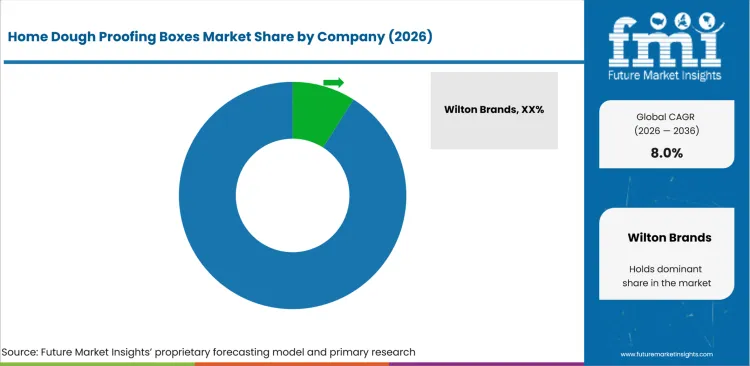
Competition spans passive proofing containers and active temperature-support systems. Pizza-equipment brands use fitted trays and lids, while specialist bread-baking suppliers compete through temperature control, measurement markings and compact storage. The relevant competitive boundary is the home proofing function, so companies without a current proofing product have been excluded from the company set.
- Brod & Taylor, Sourhouse LLC and Reliatrace, Inc. (Raisenne) serve controlled home proofing through powered temperature-support products or compatible proofing systems.
- Ooni Limited, Gozney Group Limited, Cambro Manufacturing Company and DoughMate provide dedicated boxes or trays for dough fermentation, storage and handling.
- King Arthur Baking Company, Inc. serves home bakers through dough-rising containers and specialist proofing equipment distribution.
Competitive Benchmarking: Home Dough Proofing Boxes Market
| Company | Proofing fit | Temp. control | Container fit | Geographic Reach |
|---|---|---|---|---|
| Brod & Taylor | High | High | High | North America, Europe and distributor markets |
| Ooni Limited | High | Low | High | North America, Europe and selected international markets |
| Gozney Group Limited | High | Medium | High | North America, Europe, Australia and selected markets |
| Cambro Manufacturing Company | Medium | Low | High | Global foodservice and retail distribution |
| DoughMate | High | Low | High | United States and direct online markets |
| King Arthur Baking Company, Inc. | Medium | Medium | High | United States |
| Sourhouse LLC | High | High | Medium | North America and international online markets |
| Reliatrace, Inc. (Raisenne) | High | High | Low | United States and selected online markets |
Key Developments in the Home Dough Proofing Boxes Market
- In July 2026, Ooni introduced the Halo Core spiral mixer, extending its home dough-preparation range around an ecosystem that also includes pizza dough boxes and proofing accessories.
- In May 2026, the USA Food and Drug Administration published its scientific evaluation of eight phthalates authorized for food-contact use, keeping material safety and documentation visible for manufacturers of reusable plastic food-contact products.
- In 2026, DoughMate continued to market NSF-certified dough proofing containers for pizzerias and home use, positioning sanitation verification and durable stacking as purchase criteria in reusable proofing boxes.
Key Players in the Home Dough Proofing Boxes Market
Controlled Proofing and Fermentation Systems
- Brod & Taylor
- Sourhouse LLC
- Reliatrace, Inc. (Raisenne)
Pizza Dough Proofing Boxes and Trays
- Ooni Limited
- Gozney Group Limited
- Cambro Manufacturing Company
- DoughMate
Home Baking Retail and Proofing Accessories
- King Arthur Baking Company, Inc.
Home Dough Proofing Boxes Market - Report Scope
| Coverage field | Report scope |
|---|---|
| Market breakdown | By Product Type, Price Tier, Occasion, User Group, Sales Channel and Region. |
| Quantitative Units | Revenue in USD million and CAGR in %. |
| Market Definition | Dedicated home-use proofing boxes, trays, containers, kits and related systems used to support dough fermentation, proofing, storage and handling. |
| Regions Covered | North America, Latin America, Europe, East Asia, South Asia and Pacific, and Middle East and Africa. |
| Countries Covered | UAE, Saudi Arabia, USA, South Korea, Germany, UK, France, Japan, and 20+ countries included in the full report. |
| Key Companies Profiled | Brod & Taylor, Ooni Limited, Gozney Group Limited, Cambro Manufacturing Company, DoughMate, King Arthur Baking Company, Inc., Sourhouse LLC and Reliatrace, Inc. (Raisenne). |
| Forecast Period | 2026 to 2036. |
| Approach | Primary and secondary research with market triangulation. |
Home Dough Proofing Boxes Market - Research Methodology
| Method | Approach |
|---|---|
| Primary Research | FMI analysts gathered input from manufacturers, specialist baking suppliers, retailers, distributors, home bakers, procurement teams, and subject-matter experts. Interviews examined purchase criteria, proofing routines, product evaluation, storage constraints, material expectations, pricing considerations, and the evidence required before a trial purchase develops into repeat use or recommendation. |
| Desk Research | Desk research covered government statistics, regulatory publications, food-contact guidance, industry associations, technical literature, company product information, filings, and official corporate announcements. Sources were reviewed for relevance, publication date, geographic coverage, and consistency with the defined market scope. Product claims relating to proofing function, temperature support, materials, capacity, distribution and commercial activity were retained only when supported by credible public evidence. |
| Market Sizing and Forecasting | The market model combined the baseline value with historical performance, segment structure, pricing and volume indicators, adoption levels, company participation, and country-level demand conditions. Forecast assumptions considered household baking participation, e-commerce access, product replacement cycles, material requirements, retail availability, technology adoption and substitution from general kitchen containers. Segment and regional estimates were reconciled before the final market total was calculated. |
| Data Validation | Estimates were checked against multiple independent indicators, including public statistics, company activity, retail availability, regulatory conditions, product specifications and findings from primary interviews. Validation also tested whether products and related revenues fell within the defined home proofing boundary. General storage products without a direct dough-proofing use case and unsupported or overlapping activities were excluded to reduce double counting and maintain consistency across segments and countries. |
Home Dough Proofing Boxes Market by Segments
Home Dough Proofing Boxes Market segmented by Product Type:
- Complete kits & sets
- Starter kits & basics
- Refills & consumables
- Premium & licensed editions
Home Dough Proofing Boxes Market segmented by Price Tier:
- Mid-range
- Economy
- Premium
Home Dough Proofing Boxes Market segmented by Occasion:
- Everyday baking
- Celebration & party
- Seasonal & gifting
Home Dough Proofing Boxes Market segmented by User Group:
- Adult hobbyists
- Kids & family
- Prosumer / semi-professional
Home Dough Proofing Boxes Market segmented by Sales Channel:
- Online marketplaces
- Specialty craft stores
- Mass retail
- Grocery
Home Dough Proofing Boxes Market by Region:
- North America
- United States
- Canada
- Latin America
- Brazil
- Chile
- Mexico
- Rest of Latin America
- Western Europe
- Germany
- United Kingdom
- Italy
- Spain
- France
- Nordics
- Benelux
- Rest of Western Europe
- Eastern Europe
- Russia
- Poland
- Hungary
- Balkan and Baltic States
- Rest of Eastern Europe
- East Asia
- China
- Japan
- South Korea
- South Asia and Pacific
- India
- ASEAN
- Australia and New Zealand
- Rest of South Asia and Pacific
- Middle East and Africa
- Kingdom of Saudi Arabia
- Other GCC Countries
- Türkiye
- South Africa
- Other African Union Countries
- Rest of Middle East and Africa
Research Sources and Bibliography
- Brod & Taylor. Folding Proofer with Accessory Shelf.
- Brod & Taylor. Proofing Container (6L).
- Ooni. Pizza Dough Boxes.
- Ooni. Prep and Proof Pack.
- Ooni. (2026, July 15). Ooni announces new Halo Core Spiral Mixer.
- Gozney. Dough Tray.
- Cambro. Pizza Dough Proofing Box.
- DoughMate. Pizza Dough Trays & Boxes.
- King Arthur Baking Company. Dough Proofing Container.
- King Arthur Baking Company. (2023, August 31). What is proofing bread? And how do I get it right?
- Sourhouse. DoughBed by Sourhouse.
- Raisenne. Raisenne Dough Riser.
- USA Food and Drug Administration. Food Packaging & Other Substances that Come in Contact with Food.
- USA Food and Drug Administration. (2026, May 27). FDA Advances Post-Market Review of Phthalates Used in Food Contact Materials.
- European Commission. Food Contact Materials.
- USA Census Bureau. (2026, May 18). Quarterly Retail E-Commerce Sales, First Quarter 2026.
- Office for National Statistics. (2026, July 24). Retail sales, Great Britain: June 2026.
- German Federal Statistical Office. (2024, November 28). 83% of 16- to 74-year-olds shop online.
- INSEE. (2025, December 2). Online shopping by age, France.
- Ministry of Economy, Trade and Industry, Japan. (2025, August 26). Results of FY2024 E-Commerce Market Survey Compiled.
- Statistics Korea. (2026, March). Online Shopping in January 2026.
- General Authority for Statistics, Saudi Arabia. (2026). Wholesale and Retail Trade Statistics, Q1 2026.
- Telecommunications and Digital Government Regulatory Authority, UAE. (2026). NOC for Practicing E-Activity.
This bibliography is provided for reader reference and is not exhaustive. The full report contains the complete reference list and detailed citations
This Report Answers
- How large is the Home Dough Proofing Boxes Market in 2026 and 2036?
- Which product features support recurring proofing-box use across home kitchens?
- Which Product Type segment accounts for the approved 2026 share?
- How does Price Tier shape home proofing-product demand?
- Which Occasion supports repeated use of proofing boxes and kits?
- Which User Group accounts for the approved 2026 share?
- How do country growth rates affect commercial entry conditions?
- Which companies serve home dough proofing applications?
Frequently Asked Questions
How big is the Home Dough Proofing Boxes Market in 2026?
USD 147.5 million represents the home dough proofing boxes market value in 2026 across dedicated home-use proofing boxes, trays, containers, kits and related systems. The category is projected to reach USD 318.4 million by 2036 as reusable proofing products gain wider access through home-baking and online retail channels.
What is the CAGR of the Home Dough Proofing Boxes Market from 2026 to 2036?
An 8.0% CAGR is projected for the home dough proofing boxes market between 2026 and 2036. Growth depends on repeat bread and pizza preparation, better online availability and product designs that make proofing easier to observe or control without taking excessive kitchen space.
Which Product Type segment is projected to account for 39.0% of the Home Dough Proofing Boxes Market?
Complete kits & sets are projected to account for 39.0% of Product Type demand within the home dough proofing boxes market in 2026. Bundled trays, lids or complementary proofing components reduce setup effort and give buyers a defined system for repeated fermentation and dough storage.
How much will the Home Dough Proofing Boxes Market add between 2026 and 2036?
USD 170.9 million is expected to be added to the home dough proofing boxes market between 2026 and 2036. The increase reflects broader access to dedicated home proofing products across passive storage formats and compact temperature-support systems.
Which companies are active in the Home Dough Proofing Boxes Market?
Eight companies and brands active in the home dough proofing boxes market include Brod & Taylor, Ooni Limited, Gozney Group Limited, Cambro Manufacturing Company, DoughMate, King Arthur Baking Company, Inc., Sourhouse LLC and Reliatrace, Inc. (Raisenne). The group covers lidded dough boxes, proofing trays, rising containers, temperature-support systems and specialist home-baking distribution.
Preview the report firsthand - request a free sample
Get SampleGet the brochure for pricing and purchase details.
Get PDFTable of Content
- Key Takeaways
- Market Size and CAGR
- Top Growth Driver
- Fastest Growing Segment
- Leading Region
- Key Companies
- Emerging Opportunities
- Executive Summary
- Global Market Outlook
- Demand-side Trends
- Supply-side Trends
- Technology Roadmap Analysis
- Analysis and Recommendations
- Analyst Perspective (What is happening? Why now? What should investors know?)
- Key Questions Answered
- How large is the market?
- What is the CAGR?
- What are key trends?
- Which region dominates?
- Who are the leaders?
- Market Overview
- Market Coverage / Taxonomy
- Market Definition / Scope / Limitations
- Research Methodology
- Chapter Orientation
- Analytical Lens and Working Hypotheses
- Market Structure, Signals, and Trend Drivers
- Benchmarking and Cross-market Comparability
- Market Sizing, Forecasting, and Opportunity Mapping
- Research Design and Evidence Framework
- Desk Research Programme (Secondary Evidence)
- Expert Input and Fieldwork (Primary Evidence)
- Tooling, Models, and Reference Databases
- Data Engineering and Model Build
- Quality Assurance and Audit Trail
- Market Background
- Market Dynamics (Drivers, Restraints, Opportunity, Trends)
- Scenario Forecast (Optimistic, Likely, Conservative)
- Impact Analysis
- AI Impact
- Sustainability Impact
- Regulatory Impact
- Technology Impact
- Consumer / Buyer Analysis
- Purchase Drivers
- Adoption Barriers
- Buyer Journey
- Opportunity Map Analysis
- Product Life Cycle Analysis
- Supply Chain Analysis
- Investment Feasibility Matrix
- Value Chain Analysis
- PESTLE and Porter's Analysis
- Regulatory Landscape
- Regional Parent Market Outlook
- Production and Consumption Statistics
- Import and Export Statistics
- Global Market Analysis and Forecast, 2021 to 2036
- Historical Market Size Value (USD Million) Analysis, 2021 to 2025
- Current and Future Market Size Value (USD Million) Projections, 2026 to 2036
- Y-o-Y Growth Trend Analysis
- Absolute $ Opportunity Analysis
- Global Market Pricing Analysis, 2021 to 2036
- Global Market Analysis and Forecast, By Product Type, 2021 to 2036
- Introduction / Key Findings
- Historical Market Size Value (USD Million) Analysis By Product Type, 2021 to 2025
- Current and Future Market Size Value (USD Million) Analysis and Forecast By Product Type, 2026 to 2036
- Complete kits & sets
- Starter kits & basics
- Refills & consumables
- Premium & licensed editions
- Complete kits & sets
- Y-o-Y Growth Trend Analysis By Product Type, 2021 to 2025
- Absolute $ Opportunity Analysis By Product Type, 2026 to 2036
- Global Market Analysis and Forecast, By Price Tier, 2021 to 2036
- Introduction / Key Findings
- Historical Market Size Value (USD Million) Analysis By Price Tier, 2021 to 2025
- Current and Future Market Size Value (USD Million) Analysis and Forecast By Price Tier, 2026 to 2036
- Mid-range
- Economy
- Premium
- Mid-range
- Y-o-Y Growth Trend Analysis By Price Tier, 2021 to 2025
- Absolute $ Opportunity Analysis By Price Tier, 2026 to 2036
- Global Market Analysis and Forecast, By Occasion, 2021 to 2036
- Introduction / Key Findings
- Historical Market Size Value (USD Million) Analysis By Occasion, 2021 to 2025
- Current and Future Market Size Value (USD Million) Analysis and Forecast By Occasion, 2026 to 2036
- Everyday baking
- Celebration & party
- Seasonal & gifting
- Everyday baking
- Y-o-Y Growth Trend Analysis By Occasion, 2021 to 2025
- Absolute $ Opportunity Analysis By Occasion, 2026 to 2036
- Global Market Analysis and Forecast, By User Group, 2021 to 2036
- Introduction / Key Findings
- Historical Market Size Value (USD Million) Analysis By User Group, 2021 to 2025
- Current and Future Market Size Value (USD Million) Analysis and Forecast By User Group, 2026 to 2036
- Adult hobbyists
- Kids & family
- Prosumer / semi-professional
- Adult hobbyists
- Y-o-Y Growth Trend Analysis By User Group, 2021 to 2025
- Absolute $ Opportunity Analysis By User Group, 2026 to 2036
- Global Market Analysis and Forecast, By Sales Channel, 2021 to 2036
- Introduction / Key Findings
- Historical Market Size Value (USD Million) Analysis By Sales Channel, 2021 to 2025
- Current and Future Market Size Value (USD Million) Analysis and Forecast By Sales Channel, 2026 to 2036
- Online marketplaces
- Specialty craft stores
- Mass retail
- Grocery
- Online marketplaces
- Y-o-Y Growth Trend Analysis By Sales Channel, 2021 to 2025
- Absolute $ Opportunity Analysis By Sales Channel, 2026 to 2036
- Global Market Analysis and Forecast, By Region, 2021 to 2036
- Introduction
- Historical Market Size Value (USD Million) Analysis By Region, 2021 to 2025
- Current Market Size Value (USD Million) Analysis and Forecast By Region, 2026 to 2036
- North America
- Latin America
- Western Europe
- Eastern Europe
- East Asia
- South Asia and Pacific
- Middle East & Africa
- Market Attractiveness Analysis By Region
- North America Market Analysis and Forecast, By Country, 2021 to 2036
- Historical Market Size Value (USD Million) Trend Analysis By Market Taxonomy, 2021 to 2025
- Market Size Value (USD Million) Forecast By Market Taxonomy, 2026 to 2036
- By Country
- USA
- Canada
- By Product Type
- By Price Tier
- By Occasion
- By User Group
- By Sales Channel
- By Country
- Market Attractiveness Analysis
- By Country
- By Product Type
- By Price Tier
- By Occasion
- By User Group
- By Sales Channel
- Key Takeaways
- Latin America Market Analysis and Forecast, By Country
- Historical Market Size Value (USD Million) Trend Analysis By Market Taxonomy, 2021 to 2025
- Market Size Value (USD Million) Forecast By Market Taxonomy, 2026 to 2036
- By Country
- Brazil
- Mexico
- Chile
- Rest of Latin America
- By Product Type
- By Price Tier
- By Occasion
- By User Group
- By Sales Channel
- By Country
- Market Attractiveness Analysis
- By Country
- By Product Type
- By Price Tier
- By Occasion
- By User Group
- By Sales Channel
- Key Takeaways
- Western Europe Market Analysis and Forecast, By Country
- Historical Market Size Value (USD Million) Trend Analysis By Market Taxonomy, 2021 to 2025
- Market Size Value (USD Million) Forecast By Market Taxonomy, 2026 to 2036
- By Country
- Germany
- UK
- Italy
- Spain
- France
- Nordic
- BENELUX
- Rest of Western Europe
- By Product Type
- By Price Tier
- By Occasion
- By User Group
- By Sales Channel
- By Country
- Market Attractiveness Analysis
- By Country
- By Product Type
- By Price Tier
- By Occasion
- By User Group
- By Sales Channel
- Key Takeaways
- Eastern Europe Market Analysis and Forecast, By Country
- Historical Market Size Value (USD Million) Trend Analysis By Market Taxonomy, 2021 to 2025
- Market Size Value (USD Million) Forecast By Market Taxonomy, 2026 to 2036
- By Country
- Russia
- Poland
- Hungary
- Balkan & Baltic
- Rest of Eastern Europe
- By Product Type
- By Price Tier
- By Occasion
- By User Group
- By Sales Channel
- By Country
- Market Attractiveness Analysis
- By Country
- By Product Type
- By Price Tier
- By Occasion
- By User Group
- By Sales Channel
- Key Takeaways
- East Asia Market Analysis and Forecast, By Country
- Historical Market Size Value (USD Million) Trend Analysis By Market Taxonomy, 2021 to 2025
- Market Size Value (USD Million) Forecast By Market Taxonomy, 2026 to 2036
- By Country
- China
- Japan
- South Korea
- By Product Type
- By Price Tier
- By Occasion
- By User Group
- By Sales Channel
- By Country
- Market Attractiveness Analysis
- By Country
- By Product Type
- By Price Tier
- By Occasion
- By User Group
- By Sales Channel
- Key Takeaways
- South Asia and Pacific Market Analysis and Forecast, By Country
- Historical Market Size Value (USD Million) Trend Analysis By Market Taxonomy, 2021 to 2025
- Market Size Value (USD Million) Forecast By Market Taxonomy, 2026 to 2036
- By Country
- India
- ASEAN
- Australia & New Zealand
- Rest of South Asia and Pacific
- By Product Type
- By Price Tier
- By Occasion
- By User Group
- By Sales Channel
- By Country
- Market Attractiveness Analysis
- By Country
- By Product Type
- By Price Tier
- By Occasion
- By User Group
- By Sales Channel
- Key Takeaways
- Middle East & Africa Market Analysis and Forecast, By Country
- Historical Market Size Value (USD Million) Trend Analysis By Market Taxonomy, 2021 to 2025
- Market Size Value (USD Million) Forecast By Market Taxonomy, 2026 to 2036
- By Country
- Kingdom of Saudi Arabia
- Other GCC Countries
- Türkiye
- South Africa
- Other African Union
- Rest of Middle East & Africa
- By Product Type
- By Price Tier
- By Occasion
- By User Group
- By Sales Channel
- By Country
- Market Attractiveness Analysis
- By Country
- By Product Type
- By Price Tier
- By Occasion
- By User Group
- By Sales Channel
- Key Takeaways
- Key Countries Market Analysis
- USA
- Pricing Analysis
- Market Share Analysis, 2025
- By Product Type
- By Price Tier
- By Occasion
- By User Group
- By Sales Channel
- Canada
- Pricing Analysis
- Market Share Analysis, 2025
- By Product Type
- By Price Tier
- By Occasion
- By User Group
- By Sales Channel
- Mexico
- Pricing Analysis
- Market Share Analysis, 2025
- By Product Type
- By Price Tier
- By Occasion
- By User Group
- By Sales Channel
- Brazil
- Pricing Analysis
- Market Share Analysis, 2025
- By Product Type
- By Price Tier
- By Occasion
- By User Group
- By Sales Channel
- Chile
- Pricing Analysis
- Market Share Analysis, 2025
- By Product Type
- By Price Tier
- By Occasion
- By User Group
- By Sales Channel
- Germany
- Pricing Analysis
- Market Share Analysis, 2025
- By Product Type
- By Price Tier
- By Occasion
- By User Group
- By Sales Channel
- UK
- Pricing Analysis
- Market Share Analysis, 2025
- By Product Type
- By Price Tier
- By Occasion
- By User Group
- By Sales Channel
- Italy
- Pricing Analysis
- Market Share Analysis, 2025
- By Product Type
- By Price Tier
- By Occasion
- By User Group
- By Sales Channel
- Spain
- Pricing Analysis
- Market Share Analysis, 2025
- By Product Type
- By Price Tier
- By Occasion
- By User Group
- By Sales Channel
- France
- Pricing Analysis
- Market Share Analysis, 2025
- By Product Type
- By Price Tier
- By Occasion
- By User Group
- By Sales Channel
- India
- Pricing Analysis
- Market Share Analysis, 2025
- By Product Type
- By Price Tier
- By Occasion
- By User Group
- By Sales Channel
- ASEAN
- Pricing Analysis
- Market Share Analysis, 2025
- By Product Type
- By Price Tier
- By Occasion
- By User Group
- By Sales Channel
- Australia & New Zealand
- Pricing Analysis
- Market Share Analysis, 2025
- By Product Type
- By Price Tier
- By Occasion
- By User Group
- By Sales Channel
- China
- Pricing Analysis
- Market Share Analysis, 2025
- By Product Type
- By Price Tier
- By Occasion
- By User Group
- By Sales Channel
- Japan
- Pricing Analysis
- Market Share Analysis, 2025
- By Product Type
- By Price Tier
- By Occasion
- By User Group
- By Sales Channel
- South Korea
- Pricing Analysis
- Market Share Analysis, 2025
- By Product Type
- By Price Tier
- By Occasion
- By User Group
- By Sales Channel
- Russia
- Pricing Analysis
- Market Share Analysis, 2025
- By Product Type
- By Price Tier
- By Occasion
- By User Group
- By Sales Channel
- Poland
- Pricing Analysis
- Market Share Analysis, 2025
- By Product Type
- By Price Tier
- By Occasion
- By User Group
- By Sales Channel
- Hungary
- Pricing Analysis
- Market Share Analysis, 2025
- By Product Type
- By Price Tier
- By Occasion
- By User Group
- By Sales Channel
- Kingdom of Saudi Arabia
- Pricing Analysis
- Market Share Analysis, 2025
- By Product Type
- By Price Tier
- By Occasion
- By User Group
- By Sales Channel
- Türkiye
- Pricing Analysis
- Market Share Analysis, 2025
- By Product Type
- By Price Tier
- By Occasion
- By User Group
- By Sales Channel
- South Africa
- Pricing Analysis
- Market Share Analysis, 2025
- By Product Type
- By Price Tier
- By Occasion
- By User Group
- By Sales Channel
- USA
- Market Structure Analysis
- Competition Dashboard
- Competition Benchmarking
- Market Share Analysis of Top Players
- By Regional
- By Product Type
- By Price Tier
- By Occasion
- By User Group
- By Sales Channel
- Emerging Startups
- Innovation Benchmarking
- Competition Analysis
- Competition Deep Dive
- Wilton Brands
- Overview
- Product Portfolio
- Profitability by Market Segments
- Sales Footprint
- Strategy Overview
- Marketing Strategy
- Product Strategy
- Channel Strategy
- Ateco
- Nordic Ware
- Baketivity
- King Arthur Baking
- General Mills
- Conagra Brands
- Lakeland
- Dr. Oetker
- Renshaw Baking
- Wilton Brands
- Case Studies
- Success Stories
- Recent Developments
- Competition Deep Dive
- Assumptions & Acronyms Used


