

- Market Size (2026)
- USD 563.0 Mn
- Forecast (2036)
- USD 5243.0 Mn
- CAGR (2026 to 2036)
- 25.0%
How big is the Home Companion & Social Robots Market in 2026?
USD 563.0 million in 2026 and USD 5,243.0 million by 2036 at a 25.0% CAGR.
Sales of home companion and social robots are estimated to rise at 25.0% CAGR through 2036, increasing valuation from USD 563.0 million in 2026 to USD 5,243.0 million by 2036. Growth is driven by regular usage of companion robots that continues long beyond the first impressive product demonstration inside the home. The New York State Office for the Aging reported in February 2026 that 834 older adults had entered its ElliQ program by May 2025. More than 3,500 applications were received by the same date and pointed to demand beyond places funded through local aging services. That gap gives service robots a credible route into care programs, but products need a useful daily role and dependable support.
Country routes differ in practical ways that shape product design and support costs across the forecast period. United States programs can place robots through home-care services that already visit private residences each week. South Korean companies can connect new devices with appliance platforms and local repair networks that households already recognize. Japanese brands face a different test: character design must sustain attachment across years of regular use. Invest KOREA reported in January 2026 that South Korea planned USD 478 million for manufacturing AI projects during 2026. The program covers robot models and on-device chips that may reduce repeated engineering work across connected appliances. Shared technology may speed remote home monitoring products, yet each robot needs a useful role and plain service terms.
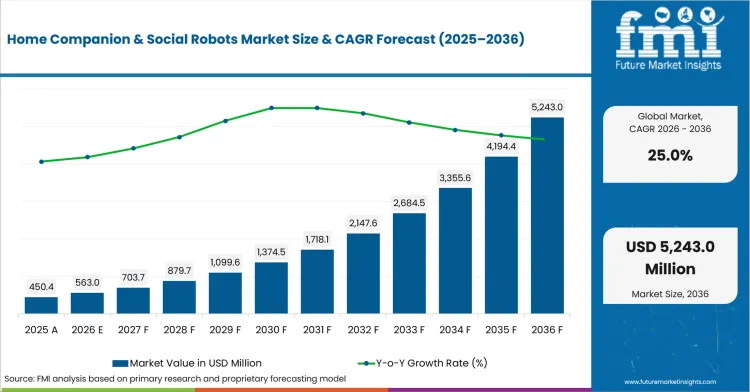
Key Takeaways of Home Companion & Social Robots Market
- Demand for home companion and social robots is driven by their ability to solve one problem that matters during an ordinary day, with repeat use depending on a valued routine rather than a long feature list.
- By component, hardware is expected to lead with 54.0% share in 2026, driven by the cost of motors and sensors along with repair access across the product's working life.
- Companionship and engagement is the dominant function segment, projected to hold 38.0% share in 2026, reflecting the core value households seek from these devices.
- Mobile home robots are estimated to lead the product category with 44.0% share in 2026, valued for carrying the same useful routine through several rooms without requiring another screen.
- Visible recording controls and clear deletion settings remain critical to household trust, as devices that may hear private conversations need practical ways for families to manage sensitive recordings.
- The United States, South Korea, and Japan are expected to form the higher-growth country tier, advancing at 27.0%, 26.0%, and 23.0% CAGR respectively through 2036, supported by home-health channels, appliance ecosystems, and established care systems.
- Competition centers on Samsung Electronics, LG Electronics, Sony, Casio, Sharp, Intuition Robotics, Enabot, and Tombot, with vendors differentiating through appliance integration, character design and attachment, and narrowly defined companionship or care roles.
Analyst Perspective
"The consumer home humanoids market will be shaped by practical usefulness rather than the breadth of advertised capabilities. Households and care providers are looking for robots that perform everyday tasks consistently, fit naturally into daily routines, and reduce dependence on manual assistance without adding operational complexity. Companies that focus on reliable functionality, intuitive user experiences, and continuous software improvements will be better placed to build trust and encourage sustained adoption as home robotics moves into the mainstream."
-Rahul Pandita, Principal Analyst Future market Insight
Source: FMI's proprietary forecasting model and primary research
How is the Home Companion & Social Robots Market segmented?
By product, function, component, end user, business model, and region
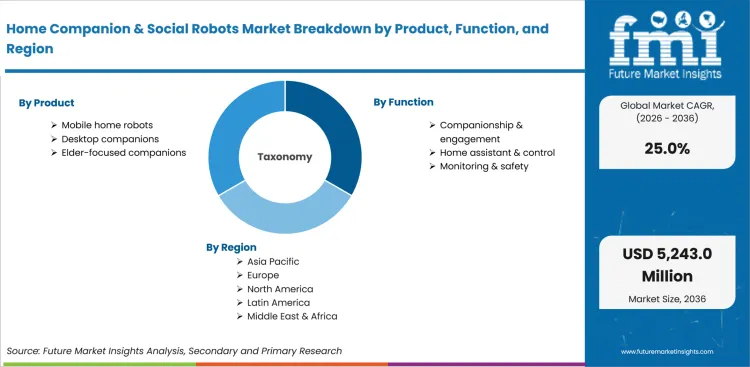
The market is divided in six segments including product, function, component, end user, business model, and region. The product segment differentiates mobile robots, tabletop companions, and devices designed to support older adults living independently at home. Functional segmentation separates conversational interaction from home control, monitoring, and safety assistance embedded in routine household activities. By component, the analysis distinguishes physical hardware from recurring software revenue streams, while the services segment captures installation, updates, and ongoing technical support over each device’s operating life. The end‑user view identifies the individual or household that directly engages with the robot in daily use. The business model segment contrasts outright purchase with subscription‑based access, while care and assisted‑living programs introduce an additional route through public and private service organizations. Regional analysis reflects how language localization, regulatory environments, and access to repair and support infrastructure influence adoption across markets.
How does mobility shape demand within the product category?
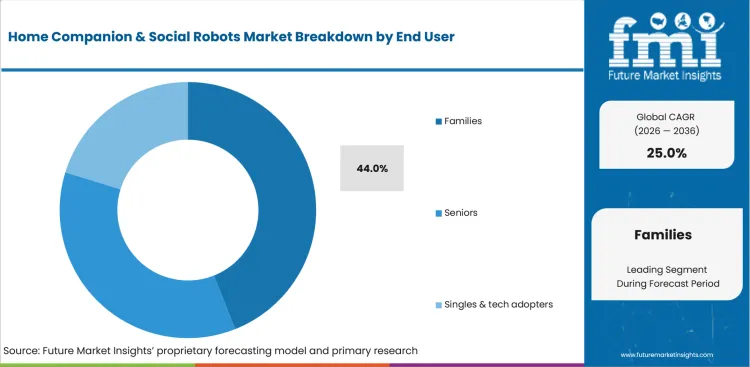
Mobility economics are expected to improve only when a single robot can repeat the same routine across multiple rooms without requiring additional navigation aids or environmental markers. Data published by the International Federation of Robotics in October 2025 reported 536 care‑at‑home robot sales in its 2024 sample, a level that is projected to indicate ongoing challenges in achieving reliable and safe navigation in typical residential environments.
- Mobile home robots are projected to hold 44.0% share in 2026 owing to their ability to carry one routine across several rooms. The International Federation of Robotics reported in October 2025 that consumer service robot sales reached nearly 20.1 million units in 2024. Domestic-task models represented 97% of that total. Familiar mobile bases can ease acceptance, but companion robots need safer movement around people and pets.
- Families using home automation are expected to favor mobile robots that can reach several rooms without extra screens. The product must improve a specific routine during an ordinary day. A fixed companion may offer better value if movement does not change the result. Multiweek home trials provide a better test of navigation and charging than a staged demonstration.
What supports demand for companionship and engagement functions?
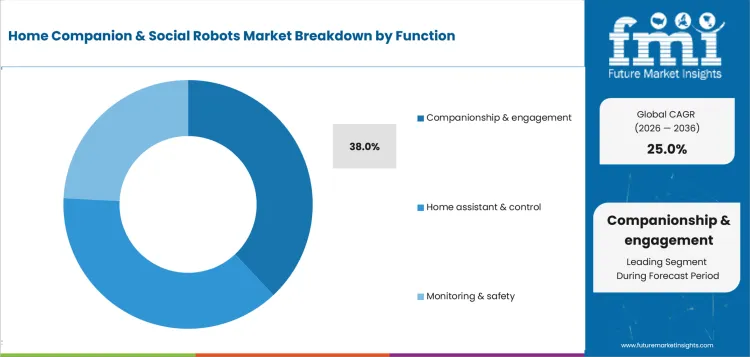
Companionship becomes useful through remembered names and routines that feel consistent across many conversations. The New York State Office for the Aging reported in February 2026 that 94% of ElliQ clients felt less lonely and 88% said daily life improved. Clients averaged 41 interactions each day from June 2024 through May 2025, which shows that remembered conversation can become a regular routine. These results give companionship a measurable role instead of an unclear promise about emotional support inside the home.
- By Function, companionship and engagement are estimated to hold 38.0% in 2026 owing to demand for remembered conversation and personal prompts. The New York State Office for the Aging reported in February 2026 that companionship represented 40.1% of ElliQ client activity during a typical month. This use pattern shows why persistent memory can justify a dedicated device beyond a lower-cost voice assistant.
- Older adults and distant relatives are expected to favor features that make regular contact easier. Service terms should state what information connected home devices store and how long it remains available.
Why does hardware lead component spending?
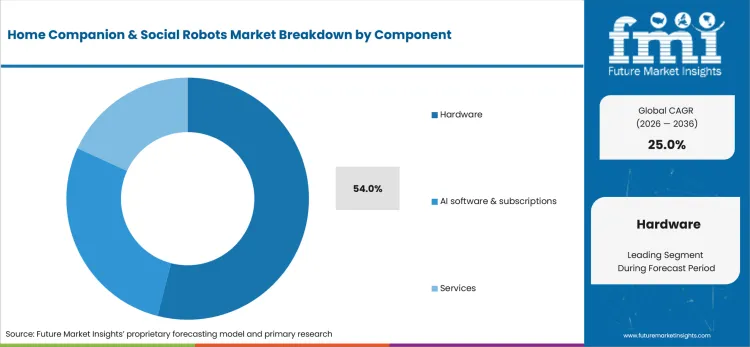
Hardware determines whether a robot can move safely and operate quietly without constant help. In February 2025, 1X Technologies introduced NEO Gamma for internal household testing and reported a tenfold increase in hardware reliability. The announcement reported a 10 dB reduction in operating noise across the updated design. Soft covers and quieter joints improve daily use in ways that a longer feature list cannot replace.
- In 2026, hardware is expected to lead Component spending with 54.0% share due to the cost of movement and sensing. In October 2025, 1X Technologies opened orders for NEO at USD 20,000 or USD 499 per month. Those terms show how motors and actuators continue to shape the financial hurdle for a capable home robot.
- Families evaluating connected robots are expected to compare battery life with operating noise and camera placement. A reliable base design makes later software features easier to trust across several years. Battery replacement and repair access determine whether connected robot networks remain useful across the ownership period. These details carry more weight than the number of functions shown in a demonstration.
What are the drivers, restraints, and opportunities in the Home Companion & Social Robots Market?
Useful conversation features and reminder functions are expected to encourage repeat use, while privacy concerns and service gaps may slow adoption, creating opportunities for subscription plans that reduce upfront cost and fund ongoing capability updates.
- Driver: Demand grows from useful conversation and reminders that address one repeated need without adding daily setup work.
- Restraint: Cameras and microphones create privacy concerns that require visible recording controls from the first setup.
- Opportunity: Subscription plans can lower the upfront price and fund updates that improve a familiar daily routine.
A companion robot earns trust by proving one benefit during ordinary household routines over time. Casio reported in April 2026 that Moflin units entered pediatric protective isolation rooms at Jikei University Hospital on February 9. The hospital planned interviews to examine emotional support for children and families during the full care period. This design gives the care team a practical way to compare user response with staff time and service cost. A defined trial can turn an emotional claim into evidence for a wider care-program decision later.
Privacy can stop adoption even if conversation quality is high inside homes with children or dependent adults. The Federal Trade Commission finalized changes to the Children’s Online Privacy Protection Rule in January 2025. The rule added biometric identifiers to personal information and restricted indefinite data retention by covered services. Robots that collect faces or voices therefore need clear recording and deletion controls across the service life. Weak controls can damage trust during a software update and may end a trial too early for users to see full value.
Subscription plans can lower upfront cost and fund support across the working life of a robot. Sharp introduced Poketomo in August 2025 as a palm-sized character linked to a phone application. Memories continue across both interfaces and give subscription-based home services value beyond the first hardware sale. The model succeeds if each fee improves a familiar routine that users can notice and describe. Extra features add little value if they make the product harder to use during ordinary household routines.
Which country CAGRs are profiled in the Home Companion & Social Robots Market?
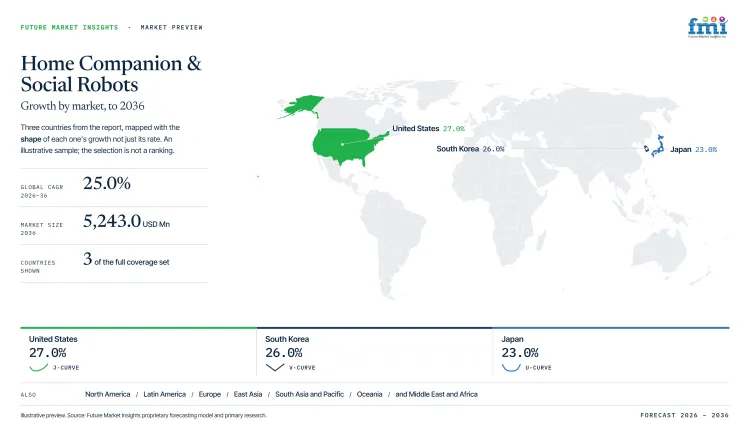
| Country | CAGR |
|---|---|
| United States | 27.0% |
| South Korea | 26.0% |
| Japan | 23.0% |
Source: FMI's proprietary forecasting model and primary research
How do country-level CAGRs compare in the Home Companion & Social Robots Market?
The comparison covers a 4.0 percentage point range and reveals two distinct growth groups across the home companion & social robots market. The United States and South Korea occupy the leading tier with only a 1.0-point difference between them, while Japan follows after a wider 3.0-point gap. The distribution reflects differences in consumer adoption of domestic robotics, AI integration in home devices and acceptance of interactive companion technologies.
- The United States leads the comparison with a CAGR of 27.0%. Consumer demand is expanding beyond smart speakers and connected home devices toward AI-powered companion robots that provide social interaction, household assistance and personalized digital services. Technology developers are also introducing new platforms that integrate conversational AI with home automation features.
- South Korea records a CAGR of 26.0%, just 1.0 percentage point behind the United States. The market benefits from strong consumer acceptance of robotics, widespread smart home adoption and continued investment in AI technologies that support home assistance, elder care and interactive household services.
- Japan reaches a CAGR of 23.0%, standing 3.0 percentage points below South Korea. Longstanding familiarity with social robotics, combined with interest in technologies that support independent living and companionship, continues to encourage adoption across households. Product development remains focused on natural interaction, emotional engagement and practical daily assistance.
Comparable CAGRs do not necessarily create identical commercial opportunities. Differences in consumer preferences, AI ecosystem maturity, demographic trends and smart home infrastructure influence purchasing decisions, product positioning and long-term market expansion. The full report provides country-level CAGR analysis across North America, Latin America, Europe, East Asia, South Asia, Oceania and the Middle East and Africa.
Country-wise Analysis
Country growth depends on the route that brings a robot into the home and the organization that supports regular use. United States programs can use home-health networks that already serve private residences through established care relationships. South Korean companies can connect robots with appliance platforms and local service teams that households already recognize. Japan combines long experience in character products with mature services for older adults living at home. These routes create different tests for trust and the effort required during setup at home.
-
Home-health networks give the United States a practical route for bringing robots into private homes. Demand is forecast to rise at 27.0% CAGR from 2026 to 2036. The Centers for Medicare & Medicaid Services reported in December 2025 that home-health spending reached USD 169.4 billion in 2024. The total rose 10.2% from the prior year and shows the scale of care already delivered at home. Companion robots can add reminders or remote contact within this service channel. Area agencies on aging and home-health providers can manage onboarding if funding covers training and support. Programs must assign setup and connected home surveillance duties clearly during the contract.
- South Korea can draw on appliance engineering and consumer electronics skills already used at commercial scale. The sector is projected to record 26.0% CAGR from 2026 to 2036 during the assessment period. Invest KOREA reported in September 2025 that the Manufacturing AX Alliance was expected to create more than USD 72 billion in added value by 2030. The program includes AI home appliances and a foundation model for humanoid robot development. Samsung Electronics and LG Electronics can test robot hardware with related home software and local service teams. This base may shorten development work and make household trials easier to support. Lasting demand depends on a useful task and simple service terms.
- Japan brings long experience in character robots and care services designed for older adults living at home. Adoption is estimated to expand at 23.0% CAGR from 2026 through 2036. The OECD reported in November 2025 that Japan spent USD 5,790 per person on health in purchasing-power terms. The same release recorded 6.8 long-term care workers per 100 people aged 65 or older. These figures show an established care system with demanding service expectations rather than direct robot demand. Sony aibo and Casio Moflin build attachment through behavior that develops over years. Sharp Poketomo preserves memories across a robot and phone application. Growth is expected to favor long service lives and dependable support over short-lived novelty.
Who are the notable companies in the Home Companion & Social Robots Market?
Samsung Electronics, LG Electronics, 1X Technologies, Sony Group Corporation, Sharp Corporation, Casio Computer Co., Ltd., Intuition Robotics, Enabot, and Tombot, Inc. are notable companies across mobile home robots, character companions, older-adult support, and robotic pet products.
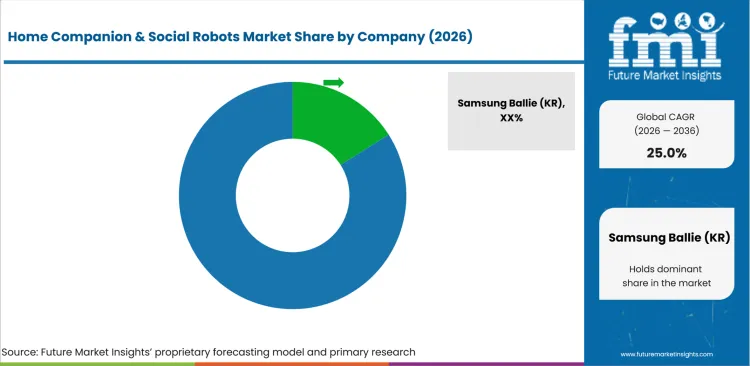
Competition divides into four groups based on the household task and the service burden created by each design. Samsung Electronics and LG Electronics connect mobile robots with appliances already used in the home through established software and service channels. Sony and Casio build attachment through character behavior that changes as owners interact with the product over time. Sharp and Intuition Robotics focus on compact conversation or guided support for older adults living at home. Enabot and Tombot address mobile contact or robotic pet companionship through products with narrowly defined roles. 1X Technologies pursues physical household work through a humanoid design that carries greater safety and repair demands. The approach needs reliable task completion to justify its higher cost inside a private home.
- Samsung Electronics and LG Electronics share a connected-home base but assign different jobs to their robots. Ballie centers on conversation and appliance control, and LG CLOiD adds two arms for physical work. Both companies can use existing home software and service channels to support launches in selected markets.
- Character products compete through attachment rather than movement or appliance control. Sony aibo changes its behavior as owners interact with it across several years. Casio Moflin develops recognizable responses through touch and conversation. Repair policies need to preserve the behavior and memories that give each product its personal value.
- Compact companions avoid the cost and safety burden created by complex movement. Sharp Poketomo carries memories across its robot and phone application. Intuition Robotics uses guided programs for older adults through care organizations that can manage setup. Both approaches place greater weight on conversation quality and long-term service than movement through the home.
- Enabot and Tombot address needs that larger electronics groups may not treat as a priority. Enabot combines mobile video with basic household observation for remote family contact. Tombot offers robotic pet companionship for people who cannot care for a live animal. Their focused roles make product value and service needs easier to explain.
- Physical household work gives 1X Technologies a larger opportunity and a harder commercial test than compact companions. NEO links conversation with chores and remote expert help for unfamiliar tasks. The product needs dependable performance without privacy or repair costs that exceed the value of completed work.
Competitive Benchmarking: Home Companion & Social Robots Market
| Company | Physical Mobility | Household or Care Fit | Personalization | Commercial Reach |
|---|---|---|---|---|
| Samsung Electronics | High | High | High | United States and South Korea |
| LG Electronics | High | High | Medium | South Korea and selected launch markets |
| 1X Technologies | High | High | Medium | United States early access |
| Sony Group Corporation | Medium | Medium | High | Japan and selected consumer markets |
| Sharp Corporation | Low | Medium | High | Japan and Taiwan |
| Casio Computer Co., Ltd. | Low | Medium | High | Japan |
| Intuition Robotics | Low | High | High | United States care programs |
| Enabot | High | Medium | Medium | Global online channels |
| Tombot, Inc. | Low | High | Medium | United States launch programs |
Scoring basis: High indicates broad capability supported by current product evidence, and Medium indicates partial coverage limited by product scope or active markets. Low indicates narrow or early capability with little evidence of wider commercial use in this category.
Source: Future Market Insights competitive assessment.
Key Developments in the Home Companion & Social Robots Market
- In April 2025, Samsung Electronics expanded its Google Cloud partnership to bring Gemini models to Ballie and confirmed summer availability in the United States and South Korea. The company said Ballie would combine natural conversation with schedules and home controls through an existing SmartThings connection, giving households one device for reminders and routine appliance tasks without requiring a separate voice system for each room.
- In January 2026, LG Electronics presented LG CLOiD at CES 2026 with two articulated arms and a wheeled base designed for routine household tasks. LG linked the robot with ThinQ and used a low center of gravity to reduce tipping risk, extending appliance control into physical work without taking on the balance demands of a walking humanoid inside the home.
- In March 2026, Sony Group Corporation released a My aibo application update with aibo Memories and aibo Party for current owners in supported markets. The update creates AI-generated daily journals from interaction records and adds shared event features through the same application, giving subscribers new services that preserve familiar routines without requiring another robot or a separate account system.
- In May 2026, Sharp Corporation announced Poketomo’s first launch outside Japan through a Taiwan release scheduled for July 1 with local distribution support. Sharp opened preorders on May 20 and added Traditional Chinese support with shared memory across the robot and phone application, testing whether a compact character service can cross language and support systems without changing its core experience for users.
Key Players in the Home Companion & Social Robots Market
Connected-home and mobile robot developers
- Samsung Electronics
- LG Electronics
- 1X Technologies
- Enabot
Character and robotic-pet specialists
- Sony Group Corporation
- Sharp Corporation
- Casio Computer Co., Ltd.
Older-adult and therapeutic companion developers
- Intuition Robotics
- Tombot, Inc.
Home Companion & Social Robots Market - Report Scope
| Report Attribute | Coverage |
|---|---|
| Market Breakdown | Product, Function, Component, End User, Business Model, and Region |
| Quantitative Units | USD million |
| Market Definition | Home robots designed for companionship, engagement, remote contact, limited assistance, or care support inside private homes |
| Regions Covered | North America, Latin America, Europe, East Asia, South Asia and Pacific, Oceania, and Middle East and Africa |
| Countries Covered | United States, South Korea, Japan, and other countries within the regional model |
| Key Companies Profiled | Samsung Electronics, LG Electronics, 1X Technologies, Sony Group Corporation, Sharp Corporation, Casio Computer Co., Ltd., Intuition Robotics, Enabot, and Tombot, Inc. |
| Approach | A demand-driven evaluation of household use cases and robot form factors, combined with analysis of service access, recurring revenue potential, company positioning, and country-level forecast reconciliation. |
Source: Future Market Insights - analysis driven by proprietary forecasting models and primary research
Home Companion & Social Robots Market - Research Methodology
| Method | Application |
|---|---|
| Primary Research | FMI analysts gathered input from manufacturers, service providers, technology developers, distributors, end users, sourcing teams, and subject-matter experts. Interviews examined purchasing decisions, product or service evaluation, adoption barriers, approval requirements, pricing considerations, and expectations for technical or commercial support. Respondents were also asked what evidence is required before a trial, pilot, or initial order develops into regular purchasing. |
| Desk Research | Desk research covered government statistics, regulatory publications, trade data, industry associations, technical literature, standards, company filings, product information, and official corporate announcements. Sources were reviewed for relevance, publication date, geographic coverage, and consistency with the defined market scope. Claims relating to performance, applications, approvals, capacity, investment, and commercial activity were retained only when supported by credible public evidence. |
| Market Sizing and Forecasting | The market model combined the baseline value with historical performance, segment structure, pricing and volume indicators, adoption levels, company participation, and country-level demand conditions. Forecast assumptions considered economic activity, investment trends, regulatory developments, technology adoption, purchasing cycles, supply availability, and barriers to wider market use. Segment and regional estimates were reconciled before the final market total was calculated. |
| Data Validation | Estimates were checked against multiple independent indicators, including public data, company activity, trade patterns, industry developments, and findings from primary interviews. Validation also tested whether products, services, applications, and company revenues fell within the defined market boundaries. Adjacent categories, unsupported claims, overlapping revenues, and activities without direct market relevance were excluded to reduce double counting and maintain consistency across segments and countries. |
Source: Future Market Insights (FMI) analysis, based on proprietary forecasting model and primary research
Home Companion & Social Robots Market by Segments
Home Companion & Social Robots Market segmented by Product:
- Mobile home robots
- Desktop and tabletop companions
- Elder-focused and therapeutic companions
Home Companion & Social Robots Market segmented by Function:
- Companionship and engagement
- Home assistant and control
- Monitoring and safety
Home Companion & Social Robots Market segmented by Component:
- Hardware
- AI software and subscriptions
- Services
Home Companion & Social Robots Market segmented by End User:
- Families
- Older adults
- Individual technology adopters
Home Companion & Social Robots Market segmented by Business Model:
- Direct purchase
- Subscription bundles
- B2B2C care programs
Home Companion & Social Robots Market by Region:
- North America
- United States
- Canada
- Latin America
- Brazil
- Mexico
- Rest of Latin America
- Europe
- Germany
- United Kingdom
- France
- Italy
- Spain
- Rest of Europe
- East Asia
- China
- Japan
- South Korea
- South Asia and Pacific
- India
- ASEAN
- Rest of South Asia and Pacific
- Oceania
- Australia
- New Zealand
- Middle East and Africa
- Gulf Cooperation Council countries
- South Africa
- Rest of Middle East and Africa
Research Sources and Bibliography
- 1X Technologies. (2025, February 21). Introducing NEO Gamma.
- 1X Technologies. (2025, October 28). NEO Home Robot: Order today.
- Casio Computer Co., Ltd. (2026, April 9). Moflin used in pediatric protective isolation rooms at Jikei University Hospital.
- Centers for Medicare & Medicaid Services. (2025, December). National Health Expenditures 2024 highlights.
- Enabot. (n.d.). EBO X FamilyBot.
- Federal Trade Commission. (2025, January 16). FTC finalizes changes to children’s privacy rule limiting companies’ ability to monetize children’s data.
- International Federation of Robotics. (2025, October 7). Executive summary: World Robotics 2025 - Service Robots.
- Invest KOREA. (2025, September 10). S. Korea aims to enter mass production of humanoid robots in 2029, self-driving cars in 2030.
- Invest KOREA. (2026, January). Government to funnel KRW 700 billion into AI transformation of manufacturing sector in 2026.
- LG Electronics. (2026, January 4). LG Electronics presents LG CLOiD home robot to demonstrate zero-labor home at CES 2026.
- New York State Office for the Aging. (2026, February). ElliQ project update 2026.
- Organisation for Economic Co-operation and Development. (2025, November 13). Health at a Glance 2025: Japan.
- Samsung Electronics. (2025, April 9). Samsung and Google Cloud expand partnership and bring Gemini to Ballie.
- Sharp Corporation. (2025, August 20). Sharp introduces conversational AI character Poketomo.
- Sharp Corporation. (2026, May 20). Sharp launches Poketomo conversational AI character in Taiwan.
- Sony Electronics Inc. (n.d.). aibo official website.
- Sony Group Corporation. (2026, March 25). Introducing the My aibo application update with aibo Memories.
This bibliography is provided for reader reference and uses primary government, standards-body, official trade body, and company sources.
This Report Answers
- How large is the Home Companion & Social Robots Market in 2026?
- Which household routines are most likely to support repeated use?
- Why do mobile home robots lead the Product category?
- How do privacy requirements affect product design and support costs?
- Which business models can reduce the upfront cost of a companion robot?
- Why do the United States and South Korea grow faster than Japan?
- How do connected-home companies differ from character-robot specialists?
- Which companies announced launches or partnerships from January 2025 onward?
- What should care programs examine during companion robot selection?
- Which segment and country assumptions shape the 2026 to 2036 forecast?
Frequently Asked Questions
What is driving growth in the Home Companion & Social Robots Market?
Growth comes from robots that improve a repeated home routine through conversation and well-timed reminders. Products gain lasting value if families can explain the benefit without relying on a staged demonstration.
Who are the key players in the Home Companion & Social Robots Market?
Samsung Electronics and LG Electronics lead the connected-home group with robots tied to household appliances. Sony and Casio focus on character attachment; Sharp and specialist firms target conversation or care support.
What is a notable restraint in the Home Companion & Social Robots Market?
Cameras and microphones can record sensitive activity inside private rooms during normal household use over long periods. Weak controls for recording and deletion can end a trial too early for the household to understand the product’s value.
Why should executives track the Home Companion & Social Robots Market?
The category combines consumer hardware with recurring software and care programs that can reach private homes. A successful product can become a useful home interface instead of another device that loses attention within weeks.
What business problem does the Home Companion & Social Robots Market address?
These robots address gaps in daily engagement and remote contact for people who spend long periods at home. Some designs add reminders or limited monitoring without claiming to replace personal care or professional judgment.
What should procurement leaders evaluate before selecting suppliers?
Care organizations should review data controls and setup effort together with support response times across the service period. Contract terms should match user and staff needs without creating repeated work for relatives who provide regular help.
What limits return on investment for purchasers?
Low daily use and unreliable software reduce the value of expensive hardware across its working life. Recurring fees add risk if later updates do not create a benefit that users can notice.
How do suppliers build long-term account confidence?
Companies build confidence through visible privacy settings and dependable support across the full device life. A narrow product promise is easier to verify than broad claims about home intelligence or emotional support.
Preview the report firsthand - request a free sample
Get SampleGet the brochure for pricing and purchase details.
Get PDFTable of Content
- Key Takeaways
- Market Size and CAGR
- Top Growth Driver
- Fastest Growing Segment
- Leading Region
- Key Companies
- Emerging Opportunities
- Executive Summary
- Global Market Outlook
- Demand-side Trends
- Supply-side Trends
- Technology Roadmap Analysis
- Analysis and Recommendations
- Analyst Perspective (What is happening? Why now? What should investors know?)
- Key Questions Answered
- How large is the market?
- What is the CAGR?
- What are key trends?
- Which region dominates?
- Who are the leaders?
- Market Overview
- Market Coverage / Taxonomy
- Market Definition / Scope / Limitations
- Research Methodology
- Chapter Orientation
- Analytical Lens and Working Hypotheses
- Market Structure, Signals, and Trend Drivers
- Benchmarking and Cross-market Comparability
- Market Sizing, Forecasting, and Opportunity Mapping
- Research Design and Evidence Framework
- Desk Research Programme (Secondary Evidence)
- Expert Input and Fieldwork (Primary Evidence)
- Tooling, Models, and Reference Databases
- Data Engineering and Model Build
- Quality Assurance and Audit Trail
- Market Background
- Market Dynamics (Drivers, Restraints, Opportunity, Trends)
- Scenario Forecast (Optimistic, Likely, Conservative)
- Impact Analysis
- AI Impact
- Sustainability Impact
- Regulatory Impact
- Technology Impact
- Consumer / Buyer Analysis
- Purchase Drivers
- Adoption Barriers
- Buyer Journey
- Opportunity Map Analysis
- Product Life Cycle Analysis
- Supply Chain Analysis
- Investment Feasibility Matrix
- Value Chain Analysis
- PESTLE and Porter's Analysis
- Regulatory Landscape
- Regional Parent Market Outlook
- Production and Consumption Statistics
- Import and Export Statistics
- Global Market Analysis and Forecast, 2021 to 2036
- Historical Market Size Value (USD Million) Analysis, 2021 to 2025
- Current and Future Market Size Value (USD Million) Projections, 2026 to 2036
- Y-o-Y Growth Trend Analysis
- Absolute $ Opportunity Analysis
- Global Market Pricing Analysis, 2021 to 2036
- Global Market Analysis and Forecast, By Product, 2021 to 2036
- Introduction / Key Findings
- Historical Market Size Value (USD Million) Analysis By Product, 2021 to 2025
- Current and Future Market Size Value (USD Million) Analysis and Forecast By Product, 2026 to 2036
- Mobile home robots
- Desktop companions
- Elder-focused companions
- Mobile home robots
- Y-o-Y Growth Trend Analysis By Product, 2021 to 2025
- Absolute $ Opportunity Analysis By Product, 2026 to 2036
- Global Market Analysis and Forecast, By Function, 2021 to 2036
- Introduction / Key Findings
- Historical Market Size Value (USD Million) Analysis By Function, 2021 to 2025
- Current and Future Market Size Value (USD Million) Analysis and Forecast By Function, 2026 to 2036
- Companionship & engagement
- Home assistant & control
- Monitoring & safety
- Companionship & engagement
- Y-o-Y Growth Trend Analysis By Function, 2021 to 2025
- Absolute $ Opportunity Analysis By Function, 2026 to 2036
- Global Market Analysis and Forecast, By Component, 2021 to 2036
- Introduction / Key Findings
- Historical Market Size Value (USD Million) Analysis By Component, 2021 to 2025
- Current and Future Market Size Value (USD Million) Analysis and Forecast By Component, 2026 to 2036
- Hardware
- AI software & subscriptions
- Services
- Hardware
- Y-o-Y Growth Trend Analysis By Component, 2021 to 2025
- Absolute $ Opportunity Analysis By Component, 2026 to 2036
- Global Market Analysis and Forecast, By End User, 2021 to 2036
- Introduction / Key Findings
- Historical Market Size Value (USD Million) Analysis By End User, 2021 to 2025
- Current and Future Market Size Value (USD Million) Analysis and Forecast By End User, 2026 to 2036
- Families
- Seniors
- Singles & tech adopters
- Families
- Y-o-Y Growth Trend Analysis By End User, 2021 to 2025
- Absolute $ Opportunity Analysis By End User, 2026 to 2036
- Global Market Analysis and Forecast, By Business Model, 2021 to 2036
- Introduction / Key Findings
- Historical Market Size Value (USD Million) Analysis By Business Model, 2021 to 2025
- Current and Future Market Size Value (USD Million) Analysis and Forecast By Business Model, 2026 to 2036
- Direct purchase
- Subscription bundles
- B2B2C (care programs)
- Direct purchase
- Y-o-Y Growth Trend Analysis By Business Model, 2021 to 2025
- Absolute $ Opportunity Analysis By Business Model, 2026 to 2036
- Global Market Analysis and Forecast, By Region, 2021 to 2036
- Introduction
- Historical Market Size Value (USD Million) Analysis By Region, 2021 to 2025
- Current Market Size Value (USD Million) Analysis and Forecast By Region, 2026 to 2036
- North America
- Latin America
- Western Europe
- Eastern Europe
- East Asia
- South Asia and Pacific
- Middle East & Africa
- Market Attractiveness Analysis By Region
- North America Market Analysis and Forecast, By Country, 2021 to 2036
- Historical Market Size Value (USD Million) Trend Analysis By Market Taxonomy, 2021 to 2025
- Market Size Value (USD Million) Forecast By Market Taxonomy, 2026 to 2036
- By Country
- USA
- Canada
- By Product
- By Function
- By Component
- By End User
- By Business Model
- By Country
- Market Attractiveness Analysis
- By Country
- By Product
- By Function
- By Component
- By End User
- By Business Model
- Key Takeaways
- Latin America Market Analysis and Forecast, By Country
- Historical Market Size Value (USD Million) Trend Analysis By Market Taxonomy, 2021 to 2025
- Market Size Value (USD Million) Forecast By Market Taxonomy, 2026 to 2036
- By Country
- Brazil
- Mexico
- Chile
- Rest of Latin America
- By Product
- By Function
- By Component
- By End User
- By Business Model
- By Country
- Market Attractiveness Analysis
- By Country
- By Product
- By Function
- By Component
- By End User
- By Business Model
- Key Takeaways
- Western Europe Market Analysis and Forecast, By Country
- Historical Market Size Value (USD Million) Trend Analysis By Market Taxonomy, 2021 to 2025
- Market Size Value (USD Million) Forecast By Market Taxonomy, 2026 to 2036
- By Country
- Germany
- UK
- Italy
- Spain
- France
- Nordic
- BENELUX
- Rest of Western Europe
- By Product
- By Function
- By Component
- By End User
- By Business Model
- By Country
- Market Attractiveness Analysis
- By Country
- By Product
- By Function
- By Component
- By End User
- By Business Model
- Key Takeaways
- Eastern Europe Market Analysis and Forecast, By Country
- Historical Market Size Value (USD Million) Trend Analysis By Market Taxonomy, 2021 to 2025
- Market Size Value (USD Million) Forecast By Market Taxonomy, 2026 to 2036
- By Country
- Russia
- Poland
- Hungary
- Balkan & Baltic
- Rest of Eastern Europe
- By Product
- By Function
- By Component
- By End User
- By Business Model
- By Country
- Market Attractiveness Analysis
- By Country
- By Product
- By Function
- By Component
- By End User
- By Business Model
- Key Takeaways
- East Asia Market Analysis and Forecast, By Country
- Historical Market Size Value (USD Million) Trend Analysis By Market Taxonomy, 2021 to 2025
- Market Size Value (USD Million) Forecast By Market Taxonomy, 2026 to 2036
- By Country
- China
- Japan
- South Korea
- By Product
- By Function
- By Component
- By End User
- By Business Model
- By Country
- Market Attractiveness Analysis
- By Country
- By Product
- By Function
- By Component
- By End User
- By Business Model
- Key Takeaways
- South Asia and Pacific Market Analysis and Forecast, By Country
- Historical Market Size Value (USD Million) Trend Analysis By Market Taxonomy, 2021 to 2025
- Market Size Value (USD Million) Forecast By Market Taxonomy, 2026 to 2036
- By Country
- India
- ASEAN
- Australia & New Zealand
- Rest of South Asia and Pacific
- By Product
- By Function
- By Component
- By End User
- By Business Model
- By Country
- Market Attractiveness Analysis
- By Country
- By Product
- By Function
- By Component
- By End User
- By Business Model
- Key Takeaways
- Middle East & Africa Market Analysis and Forecast, By Country
- Historical Market Size Value (USD Million) Trend Analysis By Market Taxonomy, 2021 to 2025
- Market Size Value (USD Million) Forecast By Market Taxonomy, 2026 to 2036
- By Country
- Kingdom of Saudi Arabia
- Other GCC Countries
- Türkiye
- South Africa
- Other African Union
- Rest of Middle East & Africa
- By Product
- By Function
- By Component
- By End User
- By Business Model
- By Country
- Market Attractiveness Analysis
- By Country
- By Product
- By Function
- By Component
- By End User
- By Business Model
- Key Takeaways
- Key Countries Market Analysis
- USA
- Pricing Analysis
- Market Share Analysis, 2025
- By Product
- By Function
- By Component
- By End User
- By Business Model
- Canada
- Pricing Analysis
- Market Share Analysis, 2025
- By Product
- By Function
- By Component
- By End User
- By Business Model
- Mexico
- Pricing Analysis
- Market Share Analysis, 2025
- By Product
- By Function
- By Component
- By End User
- By Business Model
- Brazil
- Pricing Analysis
- Market Share Analysis, 2025
- By Product
- By Function
- By Component
- By End User
- By Business Model
- Chile
- Pricing Analysis
- Market Share Analysis, 2025
- By Product
- By Function
- By Component
- By End User
- By Business Model
- Germany
- Pricing Analysis
- Market Share Analysis, 2025
- By Product
- By Function
- By Component
- By End User
- By Business Model
- UK
- Pricing Analysis
- Market Share Analysis, 2025
- By Product
- By Function
- By Component
- By End User
- By Business Model
- Italy
- Pricing Analysis
- Market Share Analysis, 2025
- By Product
- By Function
- By Component
- By End User
- By Business Model
- Spain
- Pricing Analysis
- Market Share Analysis, 2025
- By Product
- By Function
- By Component
- By End User
- By Business Model
- France
- Pricing Analysis
- Market Share Analysis, 2025
- By Product
- By Function
- By Component
- By End User
- By Business Model
- India
- Pricing Analysis
- Market Share Analysis, 2025
- By Product
- By Function
- By Component
- By End User
- By Business Model
- ASEAN
- Pricing Analysis
- Market Share Analysis, 2025
- By Product
- By Function
- By Component
- By End User
- By Business Model
- Australia & New Zealand
- Pricing Analysis
- Market Share Analysis, 2025
- By Product
- By Function
- By Component
- By End User
- By Business Model
- China
- Pricing Analysis
- Market Share Analysis, 2025
- By Product
- By Function
- By Component
- By End User
- By Business Model
- Japan
- Pricing Analysis
- Market Share Analysis, 2025
- By Product
- By Function
- By Component
- By End User
- By Business Model
- South Korea
- Pricing Analysis
- Market Share Analysis, 2025
- By Product
- By Function
- By Component
- By End User
- By Business Model
- Russia
- Pricing Analysis
- Market Share Analysis, 2025
- By Product
- By Function
- By Component
- By End User
- By Business Model
- Poland
- Pricing Analysis
- Market Share Analysis, 2025
- By Product
- By Function
- By Component
- By End User
- By Business Model
- Hungary
- Pricing Analysis
- Market Share Analysis, 2025
- By Product
- By Function
- By Component
- By End User
- By Business Model
- Kingdom of Saudi Arabia
- Pricing Analysis
- Market Share Analysis, 2025
- By Product
- By Function
- By Component
- By End User
- By Business Model
- Türkiye
- Pricing Analysis
- Market Share Analysis, 2025
- By Product
- By Function
- By Component
- By End User
- By Business Model
- South Africa
- Pricing Analysis
- Market Share Analysis, 2025
- By Product
- By Function
- By Component
- By End User
- By Business Model
- USA
- Market Structure Analysis
- Competition Dashboard
- Competition Benchmarking
- Market Share Analysis of Top Players
- By Regional
- By Product
- By Function
- By Component
- By End User
- By Business Model
- Emerging Startups
- Innovation Benchmarking
- Competition Analysis
- Competition Deep Dive
- Samsung Ballie (KR)
- Overview
- Product Portfolio
- Profitability by Market Segments
- Sales Footprint
- Strategy Overview
- Marketing Strategy
- Product Strategy
- Channel Strategy
- LG Q9 (KR)
- Amazon Astro (US)
- ElliQ (IL)
- Samsung Ballie (KR)
- Case Studies
- Success Stories
- Recent Developments
- Competition Deep Dive
- Assumptions & Acronyms Used


