

- Market Size (2026)
- USD 8.7 Bn
- Forecast (2036)
- USD 16.0 Bn
- CAGR (2026 to 2036)
- 6.2%
How big is Home Appliances Glass Market in 2026?
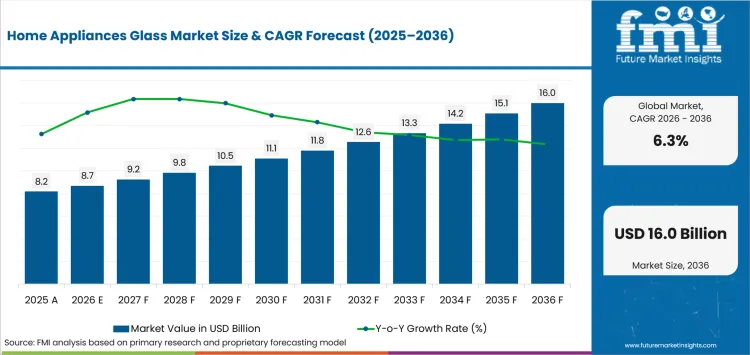
USD 8.7 billion in 2026 and USD 16.0 billion by 2036 at a 6.2% CAGR.
Demand for home appliances glass is projected to expand at 6.2% CAGR between 2026 and 2036, increasing valuation from USD 8.7 billion in 2026 to USD 16.0 billion by 2036. Appliance replacement supplies the volume base as larger viewing areas and integrated controls raise processed glass value per unit.
National appliance sales demonstrate the production scale supporting repeated component qualification across established model platforms each year. GIFAM reported 75.8 million appliances sold in France during 2025, linking model turnover with recurring processed-glass demand. Appliance brands therefore compare accepted yield across the broader household appliances market instead of relying on untreated sheet prices. Consistent flat glass quality also governs downstream tempering and printing performance throughout repeated appliance production programs.
Key Takeaways of Home Appliances Glass Market
- Larger viewing areas and integrated controls raise processed glass value without compromising safety across appliance designs.
- Tempered glass is projected to represent 44.0% share in 2026 owing to scalable conversion and familiar inspection methods.
- Kitchen appliances are estimated to account for 49.0% share in 2026 due to repeated glass use across cooktops and ovens.
- Heat-resistant glass is forecast to capture 41.0% share in 2026 driven by controlled expansion near heated appliance zones.
- Conversion yield remains the principal restraint as edge damage or coating variation can trigger rejection and model requalification.
- The profiled set includes SCHOTT AG, EuroKera, Nippon Electric Glass Co., Ltd., SSW Advanced Technologies, Nippon Sheet Glass Co., Ltd., AGC Inc., Zhejiang Hongyao Glass Co., Ltd. and Jiaozuo Feihong Safety Glass Co., Ltd.
Analyst Perspective
"Finished-panel economics decide appliance-glass margins through tempering yield and printed-interface accuracy across each approved production run. Fabricators that reproduce legacy colors and hole patterns for replacement orders can protect OEM programs long beyond serial production."
- Rahul Pandita, Principal Consultant, Future Market Insights
How is the Home Appliances Glass Market segmented?
The home appliances glass industry is segmented by product, application, end user, distribution channel, glass type and region.
The market is organized by product, application, end user, distribution channel, glass type and region. Product covers tempered, ceramic, laminated, insulated and decorative glass with variants for doors, cooktops and printed finishes. Applications span kitchen, refrigeration, laundry, small appliance and home comfort uses across original and replacement programs. End users access components through direct OEM supply, industrial distribution, aftermarket channels and online sales, with glass type defined by expected duty and surface function.
Why does tempered glass lead demand within the product category?
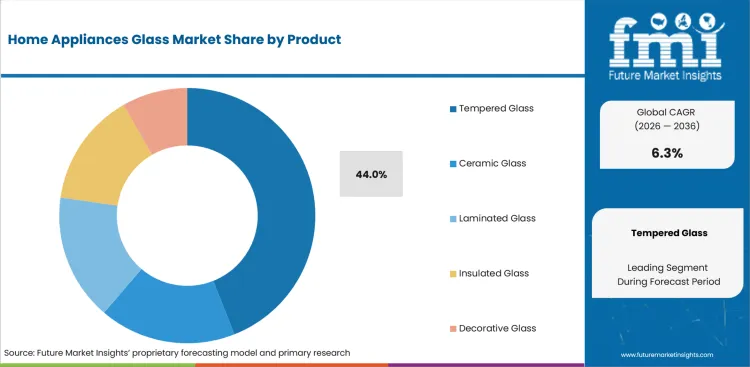
Tempered glass fits doors, shelves and control panels that require predictable breakage behavior across high-volume appliance designs. Induction hob platforms impose tighter flatness and printed-control tolerances, raising the value of stable edge preparation and tempering recipes.
- The product category is forecast to be led by tempered glass at 44.0% share in 2026 due to scalable heat-treatment capacity and familiar inspection routines across appliance plants.
- Appliance engineers qualify common thicknesses across several model families to reduce testing and service-part complexity. Glass-ceramic serves harsher thermal zones as fabricators repeat color and optical distortion limits during production.
Why do kitchen appliances lead demand within the application category?
Kitchen appliances place glass beside heating elements and cookware across surfaces that also provide visibility or user control. Built-in cooking appliances expose panel color and edge detail across aligned cabinetry and visible front elevations.
- In 2026, kitchen appliances are expected to lead the application category with 49.0% share because ovens and smooth cooktops use several qualified glass components.
- Microwave oven programs sustain tempered-door volumes through repeat platforms combining shielding assemblies with stable printed borders. Premium cooking models accept higher material costs for low-expansion surfaces that withstand repeated heating and daily cleaning across regional appliance programs.
Why does direct OEM supply lead the distribution channel category?
Direct OEM supply connects each panel specification with drawings, inspection limits and delivery windows across the appliance production schedule. Dishwasher platforms require durable decoration and protective packing to limit rejection exposure during final appliance assembly.
- The direct OEM supply segment is likely to capture 52.0% share in 2026 attributable to model-level validation and scheduled component delivery.
- Household refrigerator programs depend on shelf and door glass that matches dimensions across long model runs and later replacement periods. Direct contracts align tooling ownership with traceable specifications and service-part obligations across contracted regional assembly and repair programs.
Why does heat-resistant glass lead the glass type category?
Heat-resistant glass covers repeated duties that combine thermal gradients with clear viewing across cooking and heating appliances. Washing machines extend qualification toward detergent exposure and mechanical loading through chemically resistant door windows.
- By glass type, heat-resistant glass is estimated to hold 41.0% share in 2026 owing to recurring thermal duties across oven windows and heated fronts.
- Appliance designers select borosilicate or glass-ceramic compositions for severe temperature changes and tempered safety glass for moderate duties. Smart home appliances add display windows requiring stable light transmission beside heat-control or fingerprint-resistant coatings across premium connected appliance designs.
What are the drivers, restraints and opportunities in theHome Appliances Glass Market?
Driver: appliance designs combine thermal protection with larger viewing and control surfaces. Restraint: edge damage and coating variation increase conversion losses and requalification. Opportunity: regional finishing and matched service parts reduce schedule risk across assembly and repair programs.
- Driver: Appliance designs combine thermal protection with larger viewing and control surfaces inside one qualified glass component.
- Restraint: Edge damage and coating variation increase conversion losses and require renewed appliance testing across affected model platforms.
- Opportunity: Regional finishing and matched service parts reduce schedule risk across appliance assembly and repair programs.
Appliance designers increasingly combine heat separation, visibility and illuminated controls within a single exterior panel. Smart kitchen appliances raise glass value per unit by placing touch zones beneath surfaces that must retain optical accuracy and thermal durability.
Conversion defects become expensive near final assembly as each panel already carries cutting, tempering and decoration costs. Quality teams therefore compare accepted yield and renewed testing exposure ahead of any lower sheet price.
Regional finishing aligns decoration and protective packing with appliance schedules across several major assembly plants. Local glass fabricators shorten replenishment routes and reproduce matched service parts through coating expertise that preserves display transmission across functional surfaces.
Which country CAGRs are profiled in the Home Appliances Glass Market?
| Country | CAGR |
|---|---|
| United States | 6.7% |
| Germany | 6.5% |
| Japan | 6.4% |
| South Korea | 6.3% |
| France | 6.2% |
How do country-level CAGRs compare in the Home Appliances Glass Market?
The country forecasts are concentrated across the home appliances glass market, with only 0.5 percentage points separating the United States and France. The United States, Germany, Japan, South Korea and France all fall within a very narrow growth band, indicating broadly similar demand conditions across major appliance manufacturing and consumer markets. The absence of meaningful gaps suggests that market expansion is being supported by common industry drivers rather than country-specific surges in adoption. This pattern reflects steady demand for premium appliance designs, increasing use of glass in ovens, cooktops, refrigerator shelves and display panels, and ongoing product upgrades focused on aesthetics and durability. Differences between countries are therefore shaped more by appliance manufacturing activity, replacement cycles and product mix than by fundamentally different market dynamics.
- The United States benefits from strong demand for premium home appliances that incorporate high-performance and aesthetically enhanced glass components.
- Germany supports market growth through its established appliance manufacturing base and continued emphasis on product quality and engineering standards.
- Japan reflects steady demand driven by innovation in compact, energy-efficient and technologically advanced household appliances.
- South Korea benefits from the presence of major appliance manufacturers that continue to integrate specialized glass components into premium product lines.
- France maintains growth through replacement demand and increasing consumer preference for modern appliance designs featuring glass-based elements.
Comparable CAGRs do not necessarily translate into identical market conditions. Differences in appliance production volumes, consumer purchasing trends, manufacturing supply chains and adoption of premium appliance features can influence demand for home appliance glass across countries. The full report provides country-level CAGR analysis across North America, Latin America, Europe, East Asia, South Asia, Oceania and the Middle East and Africa.
Country-wise Analysis
- United States appliance programs use national model platforms that preserve approved glass specifications across assembly plants and national service networks. The United States is estimated to post 6.7% CAGR over the forecast period, supported by repeat production and accessible national appliance engineering. Regulatory timing links cooking-platform changes to fresh thermal and dimensional qualification across multi-year appliance programs. The Department of Energy confirms that newly manufactured conventional cooking products require compliance with amended standards from January 31, 2028. National engineering coverage supports coordinated testing, although long service distances complicate replacement panels requiring legacy prints and curvature throughout extended support periods.
- Germany has a mature appliance base that makes replacement cycles and premium specification changes more influential than first-time ownership. Germany's home appliances glass outlook is anticipated to advance at 6.5% CAGR over the assessment period, reinforced by dense engineering support and established fabrication capacity. Installed equipment provides a measurable route for recurring shelf and door-panel requirements across several appliance categories. Destatis recorded 51.0 million refrigerators or fridge-freezers in German private households during the 2025 reporting year. Local fabrication networks support qualification work, although strict change controls complicate revised coatings or edge profiles requiring renewed testing across appliance families.
- Japan links domestic production engineering with imported and exported appliance programs requiring controlled specification transfer across regional assembly plants. In Japan, home appliances glass demand is predicted to advance at 6.4% CAGR through 2036, shaped by precision requirements and compact product designs. Current industry reporting connects domestic production with trade activity across appliance categories and regional manufacturing routes. JEMA presents production alongside exports and imports using official production and trade data current to May 2025. Detailed engineering documentation supports high-value components, although overseas assembly complicates reproduction of optical tolerances and decoration across separate production locations and transferred model programs.
- South Korea combines concentrated appliance manufacturing with mandatory efficiency management across major household equipment categories and model families. Home appliances glass sales in South Korea are forecast to expand at 6.3% CAGR by 2036, aided by display-rich platforms and accessible technical teams. National rules define testing and reporting procedures that influence redesign schedules for regulated appliances and associated glass components. A January 2026 government notice updated the operating regulations for energy-efficiency management equipment across covered appliance and equipment groups. Concentrated engineering resources support disciplined validation, although rapid model renewal complicates printing and display-zone changes without disturbing established thermal performance.
- France connects appliance replacement with renovation activity and premium cooking designs that expose glass color across fitted kitchen fronts. Home appliances glass demand in France is forecast to rise at 6.2% CAGR over the forecast period, influenced by design-led cooking products and established retail channels. National appliance sales provide a direct measure of model turnover supporting qualification volumes for shelves and cooking panels. GIFAM recorded 14.5 million major household appliances sold through national retail channels during 2025. Premium cooktops support matte and display-compatible surfaces, although softer housing activity can delay qualification volumes and extend tooling recovery for panels.
Who are the notable companies in the Home Appliances Glass Market?
SCHOTT AG, EuroKera, Nippon Electric Glass Co., Ltd., SSW Advanced Technologies, Nippon Sheet Glass Co., Ltd., AGC Inc., Zhejiang Hongyao Glass Co., Ltd. and Jiaozuo Feihong Safety Glass Co., Ltd.
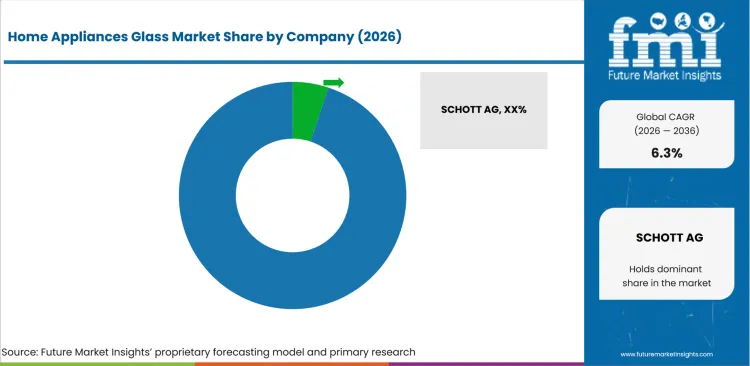
The competition is moderately fragmented as glass-ceramic specialists compete beside component fabricators and float-glass groups across distinct qualification routes. Entry requires tempering and printing capability, and appliance-level validation shifts competition toward accepted yield and service continuity across production programs.
- SCHOTT AG, EuroKera and Nippon Electric Glass Co., Ltd. focus on heat-resistant cooktop materials with decoration and display integration.
- SSW Advanced Technologies, Zhejiang Hongyao Glass Co., Ltd. and Jiaozuo Feihong Safety Glass Co., Ltd. supply converted parts across cooking, refrigeration and laundry applications.
- Nippon Sheet Glass Co., Ltd. and AGC Inc. support oven doors, refrigeration panels and appliance fascias through coated or toughened glass platforms.
Competitive Benchmarking: Home Appliances Glass Market
| Company | Thermal or Mechanical Performance | Surface and Display Functions | Appliance Component Breadth | Geographic Reach |
|---|---|---|---|---|
| SCHOTT AG | High | High | Medium | Global |
| EuroKera | High | High | Low | Global |
| Nippon Electric Glass Co., Ltd. | High | High | Low | Global |
| SSW Advanced Technologies | High | High | High | North America |
| Nippon Sheet Glass Co., Ltd. | High | High | High | Global |
| AGC Inc. | High | High | Medium | Global |
| Zhejiang Hongyao Glass Co., Ltd. | High | High | High | Asia and Europe |
| Jiaozuo Feihong Safety Glass Co., Ltd. | High | Medium | High | Global |
Key Developments in the Home Appliances Glass Market
- In February 2026, Nippon Electric Glass Co., Ltd. developed StellaShine DuraMatt with matte color options and integrated cooktop controls. The material combines thermal durability with display visibility for premium European and North American appliance models.
- In November 2025, SCHOTT AG completed a multi-week pilot that remelted 50 tons of externally collected glass-ceramic cooktop cullet without quality loss. The verified route maintains material quality, although separate collection remains necessary for any increase in production volume.
- In October 2025, Nippon Electric Glass Co., Ltd. launched StellaShine Mono with specialized black printing for full-color LED and LCD controls. The standardized color route supports display integration without requiring a separate black glass-ceramic substrate material.
- In March 2025, SCHOTT AG started serial production of its CERAN matte line in Mainz for planned appliance launches. The coated surface preserves control clarity and reduces visible fingerprints and scratches across premium cooktop programs.
Home Appliances Glass Market - Report Scope
| Coverage field | Report scope |
|---|---|
| Market breakdown | Product, application, end user, distribution channel, glass type and region. |
| Quantitative Units | Revenue in USD billion and CAGR in %. |
| Market Definition | Revenue covers processed glass panels and components sold for household appliance production and replacement applications. |
| Regions Covered | North America, Latin America, Europe, East Asia, South Asia and Pacific, and Middle East and Africa. |
| Countries Covered | United States, Germany, Japan, South Korea, France, and 20+ countries included in the full report. |
| Key Companies Profiled | SCHOTT AG, EuroKera, Nippon Electric Glass Co., Ltd., SSW Advanced Technologies, Nippon Sheet Glass Co., Ltd., AGC Inc., Zhejiang Hongyao Glass Co., Ltd. and Jiaozuo Feihong Safety Glass Co., Ltd. |
| Forecast Period | 2026 to 2036. |
| Approach | Primary and secondary research with market triangulation. |
Home Appliances Glass Market - Research Methodology
| Method | Approach |
|---|---|
| Primary Research | FMI analysts gathered input from manufacturers, service providers, technology developers, distributors, end users, procurement teams, and subject-matter experts. Interviews examined purchasing decisions, product or service evaluation, adoption barriers, approval requirements, pricing considerations, and expectations for technical or commercial support. Respondents were also asked what evidence is required before a trial, pilot, or initial order develops into regular purchasing. |
| Desk Research | Desk research covered government statistics, regulatory publications, trade data, industry associations, technical literature, standards, company filings, product information, and official corporate announcements. Sources were reviewed for relevance, publication date, geographic coverage, and consistency with the defined market scope. Claims relating to performance, applications, approvals, capacity, investment, and commercial activity were retained only when supported by credible public evidence. |
| Market Sizing and Forecasting | The market model combined the baseline value with historical performance, segment structure, pricing and volume indicators, adoption levels, company participation, and country-level demand conditions. Forecast assumptions considered economic activity, investment trends, regulatory developments, technology adoption, purchasing cycles, supply availability, and barriers to wider market use. Segment and regional estimates were reconciled before the final market total was calculated. |
| Data Validation | Estimates were checked against multiple independent indicators, including public data, company activity, trade patterns, industry developments, and findings from primary interviews. Validation also tested whether products, services, applications, and company revenues fell within the defined market boundaries. Adjacent categories, unsupported claims, overlapping revenues, and activities without direct market relevance were excluded to reduce double counting and maintain consistency across segments and countries. |
Home Appliances Glass Market by Segments
Home Appliances Glass Market segmented by Product:
- Tempered Glass
- Tempered Oven Door Glass
- Tempered Cooktop Glass
- Ceramic Glass
- Induction Cooktop Glass
- Radiant Cooktop Glass
- Laminated Glass
- Safety Laminated Glass
- Decorative Laminated Glass
- Insulated Glass
- Low-E Insulated Glass
- Double Glazed Panels
- Decorative Glass
- Printed Glass
- Frosted Glass
Home Appliances Glass Market segmented by Application:
- Kitchen Appliances
- Ovens
- Cooktops
- Refrigeration Appliances
- Refrigerators
- Wine Coolers
- Laundry Appliances
- Washing Machines
- Dryers
- Small Home Appliances
- Microwave Ovens
- Air Fryers
- Home Comfort Appliances
- Air Purifiers
- Electric Heaters
Home Appliances Glass Market segmented by End User:
- Home Appliance Manufacturers
- Major Appliance OEMs
- Small Appliance OEMs
- Aftermarket Suppliers
- Replacement Glass Suppliers
- Service Parts Providers
- Commercial Appliance Manufacturers
- Restaurant Equipment Manufacturers
- Industrial Kitchen Equipment Manufacturers
- Retail Service Providers
- Authorized Service Centers
- Independent Repair Shops
- Custom Appliance Fabricators
- Bespoke Kitchen Manufacturers
- Designer Appliance Integrators
Home Appliances Glass Market segmented by Distribution Channel:
- Direct OEM Supply
- Long-Term OEM Contracts
- Just-in-Time Supply
- Industrial Distributors
- Glass Material Distributors
- Component Suppliers
- Aftermarket Distribution
- Authorized Spare Parts Dealers
- Independent Parts Suppliers
- Online Sales
- B2B E-Commerce Platforms
- Manufacturer Portals
- Specialty Glass Suppliers
- Custom Glass Fabricators
- Regional Glass Dealers
Home Appliances Glass Market segmented by Glass Type:
- Heat Resistant Glass
- Borosilicate Glass
- Aluminosilicate Glass
- Tempered Safety Glass
- Clear Tempered Glass
- Tinted Tempered Glass
- Ceramic Glass
- Black Ceramic Glass
- Transparent Ceramic Glass
- Coated Glass
- Anti-Reflective Glass
- Fingerprint Resistant Glass
- Decorative Glass
- Digital Printed Glass
- Textured Glass
Home Appliances Glass Market by Region:
- North America
- United States
- Canada
- Latin America
- Brazil
- Chile
- Mexico
- Rest of Latin America
- Western Europe
- Germany
- United Kingdom
- Italy
- Spain
- France
- Nordics
- Benelux
- Rest of Western Europe
- Eastern Europe
- Russia
- Poland
- Hungary
- Balkan and Baltic States
- Rest of Eastern Europe
- East Asia
- China
- Japan
- South Korea
- South Asia and Pacific
- India
- ASEAN
- Australia and New Zealand
- Rest of South Asia and Pacific
- Middle East and Africa
- Kingdom of Saudi Arabia
- Other GCC Countries
- Türkiye
- South Africa
- Other African Union Countries
- Rest of Middle East and Africa
Research Sources and Bibliography
- GIFAM. (2026, February 12). Bilan 2025 de l’électroménager : l’innovation, principal moteur de croissance.
- USA Department of Energy. (2024, August 12). Consumer conventional cooking products.
- Federal Statistical Office of Germany. (2025, December 9). Equipment of households with electrical household appliances and others in Germany.
- Japan Electrical Manufacturers’ Association. (2025, May). Home electrical appliances industry in Japan.
- Ministry of Climate, Energy and Environment. (2026, January 23).[Regulations on the operation of energy efficiency management equipment].
- SCHOTT AG. (2025, March 4). Kitchen trend: SCHOTT starts serial production for matte glass-ceramic cooktops.
- SCHOTT AG. (2025, November 4). Next milestone: Successful SCHOTT pilot project for circular economy.
- Nippon Electric Glass Co., Ltd. (2025, October 10). New type of glass-ceramic top plate for cooking appliances.
- Nippon Electric Glass Co., Ltd. (2026, February 26). Develops “StellaShine DuraMatt,” an unprecedented matte-finish glass-ceramic cooktop.
- AGC Glass Europe. (n.d.). Home appliances and commercial refrigeration.
- Zhejiang Hongyao Glass Co., Ltd. (n.d.). Zhejiang Hongyao Glass Co., Ltd..
This Report Answers
- How large is the home appliances glass market in 2026 and 2036?
- Which operating conditions support home appliances glass demand?
- Which product segment holds the significant share in 2026?
- How does the application mix shape commercial demand?
- Which operating condition shapes home appliances glass adoption?
- How do country growth rates differ for home appliances glass?
- Which companies serve the home appliances glass market?
- What currently limits home appliances glass adoption?
- How should appliance teams compare glass options?
Frequently Asked Questions
How big is the Home Appliances Glass Market in 2026?
The home appliances glass market is valued at USD 8.7 billion in 2026 and is forecast to reach USD 16.0 billion by 2036. Growth is supported by larger viewing areas and integrated controls that raise processed glass value per unit across repeated appliance production programs.
What is the CAGR of the Home Appliances Glass Market from 2026 to 2036?
The home appliances glass market grows at a CAGR of 6.2% between 2026 and 2036, supported by appliance designs that combine thermal protection with larger viewing and control surfaces inside one qualified glass component across model platforms.
Which product leads the Home Appliances Glass Market?
Tempered glass accounts for 44.0% of the home appliances glass market by product in 2026, driven by scalable heat-treatment capacity and familiar inspection routines that support doors, shelves and control panels across high-volume appliance designs.
How much will the Home Appliances Glass Market add between 2026 and 2036?
The home appliances glass market is set to add USD 7.3 billion between 2026 and 2036, growing from USD 8.7 billion to USD 16.0 billion as processed glass components extend across kitchen, refrigeration, laundry and small appliance programs worldwide.
Who are the leading companies in the Home Appliances Glass Market?
Eight companies lead the home appliances glass market consistently, including SCHOTT AG, EuroKera, Nippon Electric Glass Co., Ltd., SSW Advanced Technologies, Nippon Sheet Glass Co., Ltd., AGC Inc., Zhejiang Hongyao Glass Co., Ltd. and Jiaozuo Feihong Safety Glass Co., Ltd., competing through thermal or mechanical performance, surface and display functions, and appliance component breadth worldwide.
Preview the report firsthand - request a free sample
Get SampleGet the brochure for pricing and purchase details.
Get PDFTable of Content
- Key Takeaways
- Market Size and CAGR
- Top Growth Driver
- Fastest Growing Segment
- Leading Region
- Key Companies
- Emerging Opportunities
- Executive Summary
- Global Market Outlook
- Demand-side Trends
- Supply-side Trends
- Technology Roadmap Analysis
- Analysis and Recommendations
- Analyst Perspective (What is happening? Why now? What should investors know?)
- Key Questions Answered
- How large is the market?
- What is the CAGR?
- What are key trends?
- Which region dominates?
- Who are the leaders?
- Market Overview
- Market Coverage / Taxonomy
- Market Definition / Scope / Limitations
- Research Methodology
- Chapter Orientation
- Analytical Lens and Working Hypotheses
- Market Structure, Signals, and Trend Drivers
- Benchmarking and Cross-market Comparability
- Market Sizing, Forecasting, and Opportunity Mapping
- Research Design and Evidence Framework
- Desk Research Programme (Secondary Evidence)
- Expert Input and Fieldwork (Primary Evidence)
- Tooling, Models, and Reference Databases
- Data Engineering and Model Build
- Quality Assurance and Audit Trail
- Market Background
- Market Dynamics (Drivers, Restraints, Opportunity, Trends)
- Scenario Forecast (Optimistic, Likely, Conservative)
- Impact Analysis
- AI Impact
- Sustainability Impact
- Regulatory Impact
- Technology Impact
- Consumer / Buyer Analysis
- Purchase Drivers
- Adoption Barriers
- Buyer Journey
- Opportunity Map Analysis
- Product Life Cycle Analysis
- Supply Chain Analysis
- Investment Feasibility Matrix
- Value Chain Analysis
- PESTLE and Porter's Analysis
- Regulatory Landscape
- Regional Parent Market Outlook
- Production and Consumption Statistics
- Import and Export Statistics
- Global Market Analysis and Forecast, 2021 to 2036
- Historical Market Size Value (USD Billion) Analysis, 2021 to 2025
- Current and Future Market Size Value (USD Billion) Projections, 2026 to 2036
- Y-o-Y Growth Trend Analysis
- Absolute $ Opportunity Analysis
- Global Market Pricing Analysis, 2021 to 2036
- Global Market Analysis and Forecast, By Product, 2021 to 2036
- Introduction / Key Findings
- Historical Market Size Value (USD Billion) Analysis By Product, 2021 to 2025
- Current and Future Market Size Value (USD Billion) Analysis and Forecast By Product, 2026 to 2036
- Tempered Glass
- Tempered Oven Door Glass
- Tempered Cooktop Glass
- Ceramic Glass
- Induction Cooktop Glass
- Radiant Cooktop Glass
- Laminated Glass
- Safety Laminated Glass
- Decorative Laminated Glass
- Insulated Glass
- Low-E Insulated Glass
- Double Glazed Panels
- Decorative Glass
- Printed Glass
- Frosted Glass
- Tempered Glass
- Y-o-Y Growth Trend Analysis By Product, 2021 to 2025
- Absolute $ Opportunity Analysis By Product, 2026 to 2036
- Global Market Analysis and Forecast, By Application, 2021 to 2036
- Introduction / Key Findings
- Historical Market Size Value (USD Billion) Analysis By Application, 2021 to 2025
- Current and Future Market Size Value (USD Billion) Analysis and Forecast By Application, 2026 to 2036
- Kitchen Appliances
- Ovens
- Cooktops
- Refrigeration Appliances
- Refrigerators
- Wine Coolers
- Laundry Appliances
- Washing Machines
- Dryers
- Small Home Appliances
- Microwave Ovens
- Air Fryers
- Home Comfort Appliances
- Air Purifiers
- Electric Heaters
- Kitchen Appliances
- Y-o-Y Growth Trend Analysis By Application, 2021 to 2025
- Absolute $ Opportunity Analysis By Application, 2026 to 2036
- Global Market Analysis and Forecast, By End User, 2021 to 2036
- Introduction / Key Findings
- Historical Market Size Value (USD Billion) Analysis By End User, 2021 to 2025
- Current and Future Market Size Value (USD Billion) Analysis and Forecast By End User, 2026 to 2036
- Home Appliance Manufacturers
- Major Appliance OEMs
- Small Appliance OEMs
- Aftermarket Suppliers
- Replacement Glass Suppliers
- Service Parts Providers
- Commercial Appliance Manufacturers
- Restaurant Equipment Manufacturers
- Industrial Kitchen Equipment Manufacturers
- Retail Service Providers
- Authorized Service Centers
- Independent Repair Shops
- Custom Appliance Fabricators
- Bespoke Kitchen Manufacturers
- Designer Appliance Integrators
- Home Appliance Manufacturers
- Y-o-Y Growth Trend Analysis By End User, 2021 to 2025
- Absolute $ Opportunity Analysis By End User, 2026 to 2036
- Global Market Analysis and Forecast, By Distribution Channel, 2021 to 2036
- Introduction / Key Findings
- Historical Market Size Value (USD Billion) Analysis By Distribution Channel, 2021 to 2025
- Current and Future Market Size Value (USD Billion) Analysis and Forecast By Distribution Channel, 2026 to 2036
- Direct OEM Supply
- Long-Term OEM Contracts
- Just-in-Time Supply
- Industrial Distributors
- Glass Material Distributors
- Component Suppliers
- Aftermarket Distribution
- Authorized Spare Parts Dealers
- Independent Parts Suppliers
- Online Sales
- B2B E-Commerce Platforms
- Manufacturer Portals
- Specialty Glass Suppliers
- Custom Glass Fabricators
- Regional Glass Dealers
- Direct OEM Supply
- Y-o-Y Growth Trend Analysis By Distribution Channel, 2021 to 2025
- Absolute $ Opportunity Analysis By Distribution Channel, 2026 to 2036
- Global Market Analysis and Forecast, By Glass Type, 2021 to 2036
- Introduction / Key Findings
- Historical Market Size Value (USD Billion) Analysis By Glass Type, 2021 to 2025
- Current and Future Market Size Value (USD Billion) Analysis and Forecast By Glass Type, 2026 to 2036
- Heat Resistant Glass
- Borosilicate Glass
- Aluminosilicate Glass
- Tempered Safety Glass
- Clear Tempered Glass
- Tinted Tempered Glass
- Ceramic Glass
- Black Ceramic Glass
- Transparent Ceramic Glass
- Coated Glass
- Anti-Reflective Glass
- Fingerprint Resistant Glass
- Decorative Glass
- Digital Printed Glass
- Textured Glass
- Heat Resistant Glass
- Y-o-Y Growth Trend Analysis By Glass Type, 2021 to 2025
- Absolute $ Opportunity Analysis By Glass Type, 2026 to 2036
- Global Market Analysis and Forecast, By Region, 2021 to 2036
- Introduction
- Historical Market Size Value (USD Billion) Analysis By Region, 2021 to 2025
- Current Market Size Value (USD Billion) Analysis and Forecast By Region, 2026 to 2036
- North America
- Latin America
- Western Europe
- Eastern Europe
- East Asia
- South Asia and Pacific
- Middle East & Africa
- Market Attractiveness Analysis By Region
- North America Market Analysis and Forecast, By Country, 2021 to 2036
- Historical Market Size Value (USD Billion) Trend Analysis By Market Taxonomy, 2021 to 2025
- Market Size Value (USD Billion) Forecast By Market Taxonomy, 2026 to 2036
- By Country
- USA
- Canada
- By Product
- By Application
- By End User
- By Distribution Channel
- By Glass Type
- By Country
- Market Attractiveness Analysis
- By Country
- By Product
- By Application
- By End User
- By Distribution Channel
- By Glass Type
- Key Takeaways
- Latin America Market Analysis and Forecast, By Country
- Historical Market Size Value (USD Billion) Trend Analysis By Market Taxonomy, 2021 to 2025
- Market Size Value (USD Billion) Forecast By Market Taxonomy, 2026 to 2036
- By Country
- Brazil
- Mexico
- Chile
- Rest of Latin America
- By Product
- By Application
- By End User
- By Distribution Channel
- By Glass Type
- By Country
- Market Attractiveness Analysis
- By Country
- By Product
- By Application
- By End User
- By Distribution Channel
- By Glass Type
- Key Takeaways
- Western Europe Market Analysis and Forecast, By Country
- Historical Market Size Value (USD Billion) Trend Analysis By Market Taxonomy, 2021 to 2025
- Market Size Value (USD Billion) Forecast By Market Taxonomy, 2026 to 2036
- By Country
- Germany
- UK
- Italy
- Spain
- France
- Nordic
- BENELUX
- Rest of Western Europe
- By Product
- By Application
- By End User
- By Distribution Channel
- By Glass Type
- By Country
- Market Attractiveness Analysis
- By Country
- By Product
- By Application
- By End User
- By Distribution Channel
- By Glass Type
- Key Takeaways
- Eastern Europe Market Analysis and Forecast, By Country
- Historical Market Size Value (USD Billion) Trend Analysis By Market Taxonomy, 2021 to 2025
- Market Size Value (USD Billion) Forecast By Market Taxonomy, 2026 to 2036
- By Country
- Russia
- Poland
- Hungary
- Balkan & Baltic
- Rest of Eastern Europe
- By Product
- By Application
- By End User
- By Distribution Channel
- By Glass Type
- By Country
- Market Attractiveness Analysis
- By Country
- By Product
- By Application
- By End User
- By Distribution Channel
- By Glass Type
- Key Takeaways
- East Asia Market Analysis and Forecast, By Country
- Historical Market Size Value (USD Billion) Trend Analysis By Market Taxonomy, 2021 to 2025
- Market Size Value (USD Billion) Forecast By Market Taxonomy, 2026 to 2036
- By Country
- China
- Japan
- South Korea
- By Product
- By Application
- By End User
- By Distribution Channel
- By Glass Type
- By Country
- Market Attractiveness Analysis
- By Country
- By Product
- By Application
- By End User
- By Distribution Channel
- By Glass Type
- Key Takeaways
- South Asia and Pacific Market Analysis and Forecast, By Country
- Historical Market Size Value (USD Billion) Trend Analysis By Market Taxonomy, 2021 to 2025
- Market Size Value (USD Billion) Forecast By Market Taxonomy, 2026 to 2036
- By Country
- India
- ASEAN
- Australia & New Zealand
- Rest of South Asia and Pacific
- By Product
- By Application
- By End User
- By Distribution Channel
- By Glass Type
- By Country
- Market Attractiveness Analysis
- By Country
- By Product
- By Application
- By End User
- By Distribution Channel
- By Glass Type
- Key Takeaways
- Middle East & Africa Market Analysis and Forecast, By Country
- Historical Market Size Value (USD Billion) Trend Analysis By Market Taxonomy, 2021 to 2025
- Market Size Value (USD Billion) Forecast By Market Taxonomy, 2026 to 2036
- By Country
- Kingdom of Saudi Arabia
- Other GCC Countries
- Türkiye
- South Africa
- Other African Union
- Rest of Middle East & Africa
- By Product
- By Application
- By End User
- By Distribution Channel
- By Glass Type
- By Country
- Market Attractiveness Analysis
- By Country
- By Product
- By Application
- By End User
- By Distribution Channel
- By Glass Type
- Key Takeaways
- Key Countries Market Analysis
- USA
- Pricing Analysis
- Market Share Analysis, 2025
- By Product
- By Application
- By End User
- By Distribution Channel
- By Glass Type
- Canada
- Pricing Analysis
- Market Share Analysis, 2025
- By Product
- By Application
- By End User
- By Distribution Channel
- By Glass Type
- Mexico
- Pricing Analysis
- Market Share Analysis, 2025
- By Product
- By Application
- By End User
- By Distribution Channel
- By Glass Type
- Brazil
- Pricing Analysis
- Market Share Analysis, 2025
- By Product
- By Application
- By End User
- By Distribution Channel
- By Glass Type
- Chile
- Pricing Analysis
- Market Share Analysis, 2025
- By Product
- By Application
- By End User
- By Distribution Channel
- By Glass Type
- Germany
- Pricing Analysis
- Market Share Analysis, 2025
- By Product
- By Application
- By End User
- By Distribution Channel
- By Glass Type
- UK
- Pricing Analysis
- Market Share Analysis, 2025
- By Product
- By Application
- By End User
- By Distribution Channel
- By Glass Type
- Italy
- Pricing Analysis
- Market Share Analysis, 2025
- By Product
- By Application
- By End User
- By Distribution Channel
- By Glass Type
- Spain
- Pricing Analysis
- Market Share Analysis, 2025
- By Product
- By Application
- By End User
- By Distribution Channel
- By Glass Type
- France
- Pricing Analysis
- Market Share Analysis, 2025
- By Product
- By Application
- By End User
- By Distribution Channel
- By Glass Type
- India
- Pricing Analysis
- Market Share Analysis, 2025
- By Product
- By Application
- By End User
- By Distribution Channel
- By Glass Type
- ASEAN
- Pricing Analysis
- Market Share Analysis, 2025
- By Product
- By Application
- By End User
- By Distribution Channel
- By Glass Type
- Australia & New Zealand
- Pricing Analysis
- Market Share Analysis, 2025
- By Product
- By Application
- By End User
- By Distribution Channel
- By Glass Type
- China
- Pricing Analysis
- Market Share Analysis, 2025
- By Product
- By Application
- By End User
- By Distribution Channel
- By Glass Type
- Japan
- Pricing Analysis
- Market Share Analysis, 2025
- By Product
- By Application
- By End User
- By Distribution Channel
- By Glass Type
- South Korea
- Pricing Analysis
- Market Share Analysis, 2025
- By Product
- By Application
- By End User
- By Distribution Channel
- By Glass Type
- Russia
- Pricing Analysis
- Market Share Analysis, 2025
- By Product
- By Application
- By End User
- By Distribution Channel
- By Glass Type
- Poland
- Pricing Analysis
- Market Share Analysis, 2025
- By Product
- By Application
- By End User
- By Distribution Channel
- By Glass Type
- Hungary
- Pricing Analysis
- Market Share Analysis, 2025
- By Product
- By Application
- By End User
- By Distribution Channel
- By Glass Type
- Kingdom of Saudi Arabia
- Pricing Analysis
- Market Share Analysis, 2025
- By Product
- By Application
- By End User
- By Distribution Channel
- By Glass Type
- Türkiye
- Pricing Analysis
- Market Share Analysis, 2025
- By Product
- By Application
- By End User
- By Distribution Channel
- By Glass Type
- South Africa
- Pricing Analysis
- Market Share Analysis, 2025
- By Product
- By Application
- By End User
- By Distribution Channel
- By Glass Type
- USA
- Market Structure Analysis
- Competition Dashboard
- Competition Benchmarking
- Market Share Analysis of Top Players
- By Regional
- By Product
- By Application
- By End User
- By Distribution Channel
- By Glass Type
- Emerging Startups
- Innovation Benchmarking
- Competition Analysis
- Competition Deep Dive
- SCHOTT AG
- Overview
- Product Portfolio
- Profitability by Market Segments
- Sales Footprint
- Strategy Overview
- Marketing Strategy
- Product Strategy
- Channel Strategy
- EuroKera
- Nippon Electric Glass Co., Ltd.
- SSW Advanced Technologies
- Nippon Sheet Glass Co., Ltd.
- AGC Inc.
- Zhejiang Hongyao Glass Co., Ltd.
- Jiaozuo Feihong Safety Glass Co., Ltd.
- SCHOTT AG
- Case Studies
- Success Stories
- Recent Developments
- Competition Deep Dive
- Assumptions & Acronyms Used


