

- Market Size (2026)
- USD 24.6 Mn
- Forecast (2036)
- USD 61.0 Mn
- CAGR (2026 to 2036)
- 9.5%
How big is Hordein Packaging Films Market in 2026?
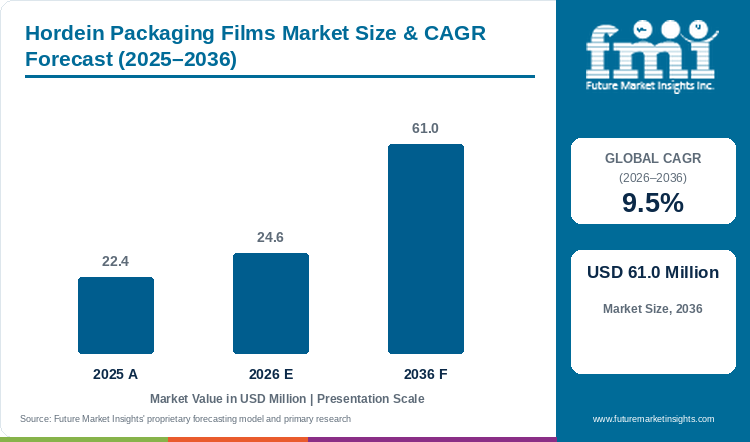
Registering a value of USD 22.4 million in 2025, the hordein packaging films market expanded to USD 24.6 million in 2026 and is anticipated to achieve USD 61.0 million by 2036, driven by a 9.5% CAGR.
The global hordein packaging films market was valued at USD 22.4 million in 2025 and is estimated to reach USD 24.6 million in 2026. The market is projected to reach USD 61.0 million by 2036, expanding at a compound annual growth rate (CAGR) of 9.5% between 2026 and 2036. B-hordein crosslinked films are projected to capture 45.5% of 2026 demand, because eight conserved C-terminal cysteine residues reform covalent networks during curing that deliver water-vapor resistance standalone plant proteins cannot match. Demand for prolamin films is supported by feedstock logistics already paid for, since breweries hauling wet spent grain to disposal now fund extraction inside the same malting hubs that own the barley stream. That sunk-cost advantage keeps hordein films growing ahead of the edible packaging market at 7.6% CAGR despite the category's broader customer base, because edible packaging sales chase novel applications while prolamin supply rides an existing beer volume curve [5]. Producer commitment is measurably widening, as AB InBev scaled its EverGrain barley protein platform across North America and Europe in early 2025 [3], InVivo and Soufflet Malt pushed an industrial side-stream valorization program through 41 malting plants in January 2025 [2], and Carlsberg advanced spent-grain upcycling milestones under its circularity program in February 2025 [5]. Film buyers sign against resin consistency from owned grain streams, and converters who integrate with malting capacity rather than merchant feedstock hold the confectionery barrier contracts through 2036.
Key Market Trends & Insights
- By protein fraction grade: B-Hordein Crosslinked Films are projected to capture 45.5% in 2026 because eight conserved C-terminal cysteine residues reform covalent inter-chain disulfide bridges during drying.
- By feedstock source: Brewer Spent Grain Extraction is estimated to command 58.1% in 2026 as enzymatic wort mashing pre-concentrates insoluble barley prolamins to 24% dry weight.
- By packaging application: Edible Confectionery Wraps are expected to concentrate 38.6% in 2026 because malted chocolates and pretzel snacks already carry barley gluten allergen declarations.
- By film format: Solvent-Cast Flexible Films are forecast to generate 49.2% in 2026 owing to rapid 60% aqueous-ethanol flash-off on stainless-steel belt casters.
- By sales channel: Direct Brewery Biorefinery Offtake is anticipated to account for 51.5% in 2026 through co-located spent-grain dewatering and prolamin precipitation skids.
Regional Highlights
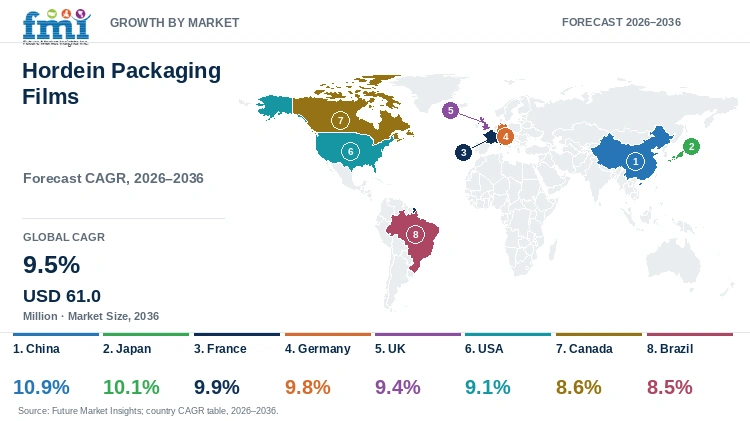
- Top national expansion: China is projected to lead major converting markets at a 10.9% CAGR through 2036 under instant wheat-noodle dissolvable seasoning and chili-oil sachet adoption.
- Broader country progression: Japan is expected to expand at 10.1% CAGR ahead of France at 9.9% with Germany at 9.8%, while the UK is forecast to advance at a 9.4% yearly pace.
Market Size & Forecast
Table 1: Market Size and Forecast for the Hordein Packaging Films Market (USD million and CAGR percentage), 2025 to 2036
| Metric | Value |
|---|---|
| 2025 Market Size | USD 22.4 million |
| Estimated Market Size in 2026 | USD 24.6 million |
| Projected Market Size by 2036 | USD 61.0 million |
| CAGR, 2026 to 2036 | 9.5% |
| Added Value, 2026 to 2036 | USD 36.4 million |
Confectionery pan-coaters and instant-food pouch converters confront rising lac-bug shellac prices with tightening European single-use plastic condiment sachet restrictions. Conventional whey and soy protein films absorb ambient moisture rapidly, which directly triggers seal delamination and lipid rancidity in high-fat snacks. In February 2025, Anheuser-Busch InBev reported full-year operational expansion of its EverGrain barley protein and spent-grain valorization platform across North America and Europe [3]. so food packaging engineers are substituting imported shellac and zein with upcycled barley prolamin resins within the edible films and coatings sector to cut raw-material costs by 55% while preserving hydrophobic lipid holdout.
Prolamin Fractionation and Film-Area Sizing
Table 2: Prolamin Fractionation and Film-Area Sizing for the Hordein Packaging Films Market (USD million and operational ranges), 2025 to 2036
| Metric | 2025 | 2026 | 2036 |
|---|---|---|---|
| Market size (USD million) | 22.4 | 24.6 | 61.0 |
| Purified film-grade hordein volume (thousand tonnes) | 2.3 to 2.5 | 2.5 to 2.8 | 7.4 to 8.1 |
| Converted hordein film & glaze area (billion m2) | 0.98 to 1.06 | 1.08 to 1.16 | 3.25 to 3.55 |
| Formulated film value per m2 (USD) | 0.021 to 0.023 | 0.021 to 0.023 | 0.017 to 0.019 |
Operational note: Fractionation and film-area ranges apply brewer spent grain dry-matter protein content (22% to 28% crude protein, of which 55% to 65% is alcohol-soluble hordein) against weighted cast film and pan-glaze basis weights of 15 to 28 g/m2.
Brewery side-stream biorefineries require reductive sodium metabisulfite or alcalase conditioning to cleave heat-set disulfide aggregates formed during 75-degree-Celsius wort mashing. Prolamin extractors partner with hydrocolloid compounders in the plant protein value chain to co-isolate soluble nutritional peptides with insoluble film-grade B-hordein.
Per Capita & Brewery Biorefinery Sizing
Table 3: Per Capita and Biorefinery Spending Indicators for the Hordein Packaging Films Market (USD), 2025 to 2036
| Metric | 2025 | 2026 | 2036 |
|---|---|---|---|
| World population (billion) | 8.2 | 8.3 | 9.0 |
| Spend per 1,000 people (USD) | 2.7 | 3.0 | 6.8 |
| Annual resin output per BSG extraction line (USD thousand) | 620 to 710 | 680 to 780 | 1,450 to 1,680 |
| Upcycled BSG & malting side-stream share (%) | 82.0% to 84.0% | 83.0% to 85.0% | 86.0% to 89.0% |
Table 4: Facility & Industrial Converter Spending Indicators for the Hordein Packaging Films Market (USD and percentages), 2026
| Metric | Value | Industrial Reference Basis |
|---|---|---|
| Market size, 2026 | USD 24.6 million | 2026 global market valuation baseline |
| Commercial BSG & malting extraction hubs globally | 34 facilities | European, North American & Asian malting/brewing hubs |
| Market value per extraction facility | USD 723.5 thousand | Annualized film-grade hordein resin shipment value |
| Brewer spent grain feedstock allocation, 2026 | USD 14.3 million | 58.1% feedstock source segment allocation |
Formulating optically clear hordein films from brewery mash streams requires activated-carbon adsorption to strip brown Maillard melanoidin pigments generated during malt kilning. Specialty converters pair decolorized B-hordein with biopolymer films to fabricate heat-sealable unit-dose seasoning pouches.
Analyst Perspective
"Commercial corn zein priced above USD 25 per kilogram priced cereal prolamins out of mainstream food packaging for two decades. Upcycling water-insoluble B-hordein press-cake from brewery spent-grain protein plants cuts prolamin resin cost below USD 9.50 per kilogram, opening instant-noodle oil sachets and vegan confectionery glazes."
- Nandini Roy Choudhury, Principal Analyst at Future Market Insights
How is the hordein packaging films market segmented?
The hordein packaging films market is segmented by protein fraction grade, feedstock source, packaging application, film format with sales channel. In 2026, B-Hordein Crosslinked Films are projected at 45.5%, Brewer Spent Grain Extraction at 58.1%, Edible Confectionery Wraps at 38.6%, Solvent-Cast Flexible Films at 49.2% with Direct Brewery Biorefinery Offtake at 51.5%.
By protein fraction grade: B-Hordein Crosslinked Films, Polyphenol Reinforced Hordein, Composite Hordein-Polysaccharide Films, and C-Hordein Plasticized Films.
By feedstock source: Brewer Spent Grain Extraction, Malting Barley Pearling Flour, and Hulless Barley Protein Isolate.
By packaging application: Edible Confectionery Wraps, Single-Dose Seasoning Sachets, Lipid-Barrier Meat Casings, and Fresh Produce Respiration Coatings.
By film format: Solvent-Cast Flexible Films, Aqueous-Ethanol Pan & Spray Glazes, and Compression-Molded Trays & Casings.
By sales channel: Direct Brewery Biorefinery Offtake, Specialty Food-Coating Formulators, and B2B IngredTech Distributors.
Why do B-Hordein Crosslinked Films lead the protein fraction grade category?
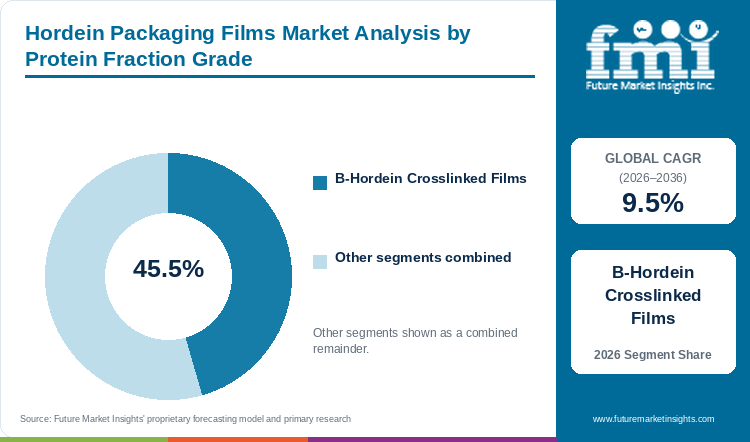
B-Hordein Crosslinked Films are projected to capture 45.5% of protein fraction grade demand in 2026, supported by inter-chain disulfide wet strength.
Table 5: Protein Fraction Grade Share for the Hordein Packaging Films Market (percentage share), 2026
| Protein Fraction Grade | Share (2026) |
|---|---|
| B-Hordein Crosslinked Films | 45.5% |
| Other Segments Combined | 54.5%* |
| Total | 100.0% |
*Note: Remaining protein fraction grades (Polyphenol Reinforced Hordein at 24.0%, Composite Hordein-Polysaccharide Films at 19.1% with C-Hordein Plasticized Films at 11.4%) sum to 100.0% of 2026 market volume.
Table 6: Protein Fraction Grade Leadership and Market Growth for the Hordein Packaging Films Market (segment and CAGR percentage), 2026 to 2036
| Metric | Value |
|---|---|
| Global CAGR (2026 to 2036) | 9.5% |
| Leading Segment | B-Hordein Crosslinked Films |
Edible film converters specify sulfur-rich B-hordein (30 to 45 kDa, accounting for 70% to 80% of total barley prolamin) because its eight conserved cysteine residues undergo sulfhydryl-disulfide interchange during alkaline-ethanol casting to form a water-insoluble elastomeric network. Unlike cysteine-free C-hordein, disulfide-linked B-hordein retains 78% of dry burst strength when contacting moist foods across high barrier packaging films applications.
- B-Hordein Crosslinked Films are projected to secure 45.5% of protein fraction grade value in 2026 by delivering 14.2 to 17.8 MPa tensile strength and complete liquid oil holdout.
- Physicochemical characterization published in the Journal of Agricultural and Food Chemistry (PubMed PMID 21970574) confirmed that barley B-hordein films exhibit dense beta-sheet and disulfide packing with controlled enzymatic digestibility [4].
Why does Brewer Spent Grain Extraction define the largest feedstock source segment?
Brewer Spent Grain Extraction is estimated to secure 58.1% of the feedstock source category in 2026, driven by pre-concentrated mash protein economics.
Enzymatic wort mashing removes fermentable barley starch into beer wort while leaving water-insoluble B- and D-hordein concentrated at 22% to 28% dry weight in the spent grain press-cake. Diverting dewatered mash cake from USD 45/tonne cattle fodder into aqueous-ethanol prolamin extraction supplies low-carbon resin for bio-based barrier coatings at less than half the cost of virgin grain isolates.
- Brewer Spent Grain Extraction is estimated to command 58.1% of the feedstock source segment in 2026 as global breweries monetize 38 million annual tonnes of wet mash side streams.
- In February 2025, Carlsberg Group updated its Together Towards ZERO and Beyond (TTZAB) circularity program, expanding brewer spent grain upcycling and recyclable packaging targets across European breweries [5].
What keeps Edible Confectionery Wraps ahead by packaging application?
Edible Confectionery Wraps are expected to command 38.6% of packaging application volume in 2026, reflecting allergen-aligned adoption in malted and cereal snacks.
Malted milk balls, chocolate-enrobed pretzel bites, roasted nut clusters with granola bars experience surface cocoa-butter fat bloom and lipid oxidation during ambient retail display. Applying an 8 to 15 micron hordein glaze or inner wrap blocks triglyceride migration while replacing insect-derived shellac across biopolymer coatings lines without adding new allergen warnings to barley- or wheat-containing snacks.
- Edible Confectionery Wraps are expected to hold 38.6% of packaging application value in 2026 because switching from shellac or zein to BSG hordein cuts glaze material cost by 48%.
- Active packaging fabrication research published in Foods (PMC9105396) demonstrated that barley hordein films reinforced with plant polyphenols cut water vapor permeability by 34% and retard lipid peroxide oxidation by over 60% [6].
Why do Solvent-Cast Flexible Films lead the film format category?
Solvent-Cast Flexible Films are forecast to generate 49.2% of film format demand in 2026, owing to continuous belt-casting of unit-dose condiment sachets.
Dissolving B- and C-hordein at 18% to 24% solids in 60% v/v aqueous ethanol plasticized with glycerol allows continuous casting onto heated stainless-steel belts with closed-loop ethanol condensation. Because aqueous ethanol flashes off at 78 degrees Celsius, belt casters achieve pinhole-free 30-micron self-supporting films for instant-noodle chili-oil and seasoning sachets.
- Solvent-Cast Flexible Films are forecast to account for 49.2% of film format demand in 2026 as instant wheat-noodle producers replace oil-contaminated BOPP/PE micro-sachets.
- Structural and enzymatic crosslinking studies in Food Chemistry (PubMed PMID 27979109) verified that controlled enzymatic hydrolysis and crosslinking of barley hordein tunes film elasticity and radical-scavenging stability [7].
What gives Direct Brewery Biorefinery Offtake the leading position in sales channel?
Direct Brewery Biorefinery Offtake is anticipated to account for 51.5% of sales channel value in 2026, reinforced by captive wet-mash dewatering.
Wet brewer spent grain contains 75% to 80% moisture and sours via thermophilic lactic fermentation within 12 hours unless dewatered and extracted immediately adjacent to the brewhouse. Captive biorefineries co-located at major brewing and malting complexes pipe fresh press-cake directly into alkaline-ethanol extraction vessels, locking in direct B2B supply contracts with food converters.
- Direct Brewery Biorefinery Offtake is anticipated to capture 51.5% of sales channel value in 2026 by eliminating third-party wet-mash haulage and thermal drying degradation.
- In February 2025, Lantmännen ek för reported expanded cereal biorefinery and plant-protein fractionation investments across its Norrköping and Lidköping facilities in Sweden [8].
What are the drivers, restraints with opportunities in the hordein packaging films market?
In the hordein packaging films market, industrial brewer spent grain upcycling and a 55% cost advantage over corn zein are projected to expand edible wrap adoption whereas Codex gluten allergen labelling restrains gluten-free snack deployment and polyphenol-crosslinked antioxidant meat casings create premium opportunities.
- Driver: Multinational brewing and malting groups scaling BSG protein biorefineries generate abundant, low-cost hordein co-product streams priced 50% to 55% below commercial corn zein.
- Restraint: Celiac-active proline and glutamine epitopes in barley hordein require mandatory 'Contains: Barley (Gluten)' retail declaration above 20 ppm, excluding unlabelled use on certified gluten-free products.
- Opportunity: Grafting 3% to 5% green-tea catechins, ferulic acid or hop polyphenols onto proline-rich hordein chains creates active antioxidant casings for dry-cured meats and cheeses.
Growth Analysis and Future Potential: Qualitative Demand Catalysts
Global snack and instant-noodle processors are phasing out miniature plastic seasoning packets and insect-derived confectioner's glaze because oil-stained sachets fail municipal recycling and shellac disqualifies vegan labels. Blocking palm-oil wicking and headspace oxygen ingress requires hydrophobic prolamin chains enriched in leucine, valine with proline residues. Future Market Insights notes that brewery side-stream fractionation is turning barley hordein into a cost-competitive bio-resin with barrier systems in unit-dose food packaging. Foundational cereal protein research by Shewry and Halford in the Journal of Experimental Botany (PubMed PMID 11912237) established how inter-chain disulfide bonding in sulfur-rich prolamins governs elastomeric film cohesion [9]. Multinational noodle and bakery brands systematically sign direct offtake agreements with malting and brewing biorefineries to secure upcycled hordein sachets for gluten-declared product lines.
Risk Assessment of the Hordein Packaging Films Market: Operational and Formulation Friction
Mandatory celiac allergen declaration under European Union Regulation 1169/2011 and U.S. FDA rules with dark malt melanoidin pigment carryover represent the primary barriers restricting commercial hordein film adoption. Because barley B- and C-hordeins contain repetitive Pro-Gln-Gln-Pro-Phe-Pro-Gln-Gln octapeptides homologous to wheat gliadin, intact hordein films cannot be applied to certified gluten-free foods without forfeiting the <20 ppm claim. Biochemical analyses by Tatham and Shewry in the Journal of Cereal Science (PubMed PMID 22048773) detailed the conserved repetitive beta-turn domains across wheat, barley with rye sulfur-poor prolamins responsible for both film flexibility and celiac immunoreactivity [10]. Food safety directors consequently restrict edible hordein wraps to wheat-noodle cups, malted confectionery with barley bakery items where gluten is already declared on the pack. When converters evaluate dark stout or Munich malt BSG streams against virgin cellulose film for clear window cartons, activated-carbon decolorization costs add USD 0.65/kg in processing friction.
Commercial Opportunity Analysis: Formulation Differentiation and Value-Add Formats
Processed meat and specialty cheese packaging economics reward formulators that exploit barley hordein's natural proline-polyphenol binding affinity—the exact biochemical interaction that causes chill haze in beer—to engineer active antioxidant casings. Approximately 14 mol% of hordein consists of proline residues whose open pyrrolidine rings form strong hydrogen and pi-pi stacking bonds with botanical phenolics such as catechins, quercetin with rosemary rosmarinic acid. Converters capturing higher margins replace non-recyclable polyvinylidene chloride (PVDC) chub films and bovine collagen casings with polyphenol-crosslinked B-hordein wraps that complement paperboard packaging butcher trays. Foundational purification studies by Shewry et al. in Biochimica et Biophysica Acta (PubMed PMID 6733118) characterized the high-molecular-weight disulfide subunits that anchor tough cereal protein networks [11]. Pairing un-kilned malting pearling flour with hop or grape-seed polyphenols enables converters to supply pale, antimicrobial edible casings to European charcuterie and plant-based sausage producers.
Hordein Packaging Films Market by Country (2026 to 2036)
As per FMI, China is projected to lead hordein packaging film expansion across major converting economies at a 10.9% CAGR through 2036, whereas Canada is forecast to progress at an 8.6% annual pace. Commercial performance across East Asian instant-noodle hubs with European malting corridors and North American brewery biorefineries depends on captive BSG dewatering scale, un-kilned pearling flour purity with alignment with existing wheat/barley allergen declarations.
Table 7: Country CAGR and Primary Growth Levers for the Hordein Packaging Films Market (CAGR percentage and operational drivers), 2026 to 2036
| Country | CAGR (2026 to 2036) | Primary Growth Lever |
|---|---|---|
| China | 10.9% | Dissolvable chili-oil and seasoning sachets across 42B+ annual instant wheat-noodle packets |
| Japan | 10.1% | Precision 15-micron ramen tare pouches and brewery closed-loop snack moisture coatings |
| France | 9.9% | InVivo / Soufflet Malt un-kilned barley pearling flour extraction for optical-grade patisserie glazes |
| Germany | 9.8% | Bavarian & NRW brewery BSG extraction and polyphenol-crosslinked Rohwurst sausage casings |
| UK | 9.4% | 100%-malted-barley Scotch distilling draff valorization and plastic-tax-free biscuit inner wraps |
| USA | 9.1% | AB InBev EverGrain St. Louis BSG scale-up and vegan replacement of lac-bug confectioner's glaze |
| Canada | 8.6% | Western Canadian hulless waxy barley beta-glucan and virgin hordein wet co-fractionation |
| Brazil | 8.5% | Ambev brewery BSG side-stream valorization and non-ingested export avocado/citrus respiration sprays |
Source: Future Market Insights analysis
China Hordein Packaging Films Market Outlook (2026 to 2036)
Unlike Western markets where gluten-free retail claims complicate edible prolamin adoption, China's primary volume driver—instant wheat-noodle seasoning and chili-oil sachets (>42 billion packets consumed annually)—already carries mandatory wheat gluten declarations. Chinese megabreweries (Tsingtao, China Resources Snow, Budweiser APAC) generate over 7 million tonnes of wet brewer spent grain annually across Shandong, Henan with Guangdong [3]. Domestic hordein packaging film demand in China is projected to expand at a leading 10.9% annual rate through 2036 as noodle makers replace oil-stained BOPP/PE condiment packets with boiling-water-soluble Composite Hordein-Polysaccharide pouches [6]. Although dark malt pigments require carbon filtration for clear films, unbleached BSG hordein blends smoothly into amber soy-sauce and chili-oil tare sachets.
Key takeaway: In China, allergen compatibility with wheat-flour instant noodles and massive domestic brewery BSG supply are projected to drive rapid conversion to dissolvable hordein oil sachets.
Japan Hordein Packaging Films Market Outlook (2026 to 2036)
Demand for hordein packaging films in Japan is expected to climb at a 10.1% annual rate over the 2026 to 2036 window as major breweries (Asahi, Kirin, Suntory, Sapporo) and instant-food processors execute closed-loop side-stream circularity programs. Whereas Chinese converters focus on high-volume commodity noodle packets, Japanese food scientists engineer ultra-thin (12 to 20 micron) transglutaminase- and catechin-crosslinked B-hordein pouches for liquid ramen soup bases and senbei rice-cracker moisture shields [6] [7]. Corporate sustainability mandates under Japan's Plastic Resource Circulation Act favor upcycled brewery prolamin films, though strict convenience-store shelf-life tests require zero sesame-oil plasticizer leaching over six months at 25 degrees Celsius.
Key takeaway: In Japan, closed-loop brewery BSG upcycling into precision ramen condiment pouches and snack glazes is expected to sustain 10.1% annual growth.
France Hordein Packaging Films Market Outlook (2026 to 2036)
In contrast to brewery-mash-dominated markets, France's competitive advantage lies in its position as the European Union's leading malting barley exporter and headquarters of InVivo Group / Soufflet Malt, which accelerated industrial malt side-stream valorization across its malting plants in January 2025 [2]. Because abrasive barley pearling removes the protein-rich sub-aleurone kernel layer prior to high-temperature malt kilning, French extractors isolate pale, melanoidin-free B- and C-hordein resins (L* lightness > 90) without carbon decolorization [4]. French converters are forecast to expand hordein packaging film consumption at a 9.9% annual pace through 2036 under AGEC anti-waste law single-use plastic bans, supplying transparent edible glazes and window films for artisanal bakery, brioche with affineur cheese crusts.
Key takeaway: In France, un-kilned malting barley pearling flour side streams are forecast to anchor domestic production of optically clear patisserie and cheese barrier coatings.
Germany Hordein Packaging Films Market Outlook (2026 to 2036)
Operating over 1,450 breweries generating 1.7 million tonnes of wet spent grain annually across Bavaria and North Rhine-Westphalia, Germany combines dense raw-material availability with Europe's largest processed meat and sausage casing industry [1] [5]. German meat-casing formulators in Lower Saxony and Hesse crosslink B-hordein with hop and grape-seed polyphenols to create dip-coated and co-extruded lipid barriers for dry-cured Rohwurst and vegan deli slices [6]. Commercial hordein packaging film value in Germany is anticipated to rise at a 9.8% yearly clip over the ten-year horizon to 2036. Because EU Regulation 2025/40 (PPWR) restricts non-recyclable single-use plastic condiment sachets and multilayer meat wraps, German convenience-food brands are qualifying water-soluble hordein-glucan spice pouches for boxed pasta kits [12].
Key takeaway: In Germany, regional brewery BSG extraction hubs and polyphenol-reinforced cured sausage casing conversion are anticipated to drive steady industrial demand.
UK Hordein Packaging Films Market Outlook (2026 to 2036)
What sets the UK apart from continental brewing markets is the availability of 750,000+ annual tonnes of Scottish malt distilling draff generated across Speyside and Highland single-malt distilleries that mash 100% malted barley with zero corn or rice adjuncts [9] [10]. Pure all-malt distilling draff yields uniform B- and C-hordein molecular weight distributions free of zein or oryzenin cross-contamination. UK hordein packaging film expenditure is predicted to grow at a 9.4% yearly pace through 2036 as Scottish and English biscuit, shortbread with oatcake manufacturers replace polyethylene carton liners to avoid the GBP 217.85/tonne UK Plastic Packaging Tax. Because oatcakes and shortbread already carry cereal gluten declarations, hordein inner wraps integrate with zero retail label friction.
Key takeaway: In the UK, 100%-all-malt Scotch distillery draff purity and Plastic Packaging Tax avoidance in biscuit and bakery cartons are predicted to underpin market expansion.
USA Hordein Packaging Films Market Outlook (2026 to 2036)
United States demand is anchored by industrial-scale brewer spent grain fractionation in St. Louis, Missouri and Newark, New Jersey—led by AB InBev's EverGrain platform—with malting barley processing across North Dakota, Montana with Idaho [1] [3]. U.S. confectionery and snack manufacturers are actively replacing imported lac-bug shellac (confectioner's glaze) and expensive corn zein (USD 26+/kg) with C/B-hordein pan-coatings on malted milk balls, chocolate-covered pretzels with cereal bars. Commercial hordein packaging film demand in the USA is estimated to climb at a 9.1% annual rate through 2036. While U.S. FDA food-allergen rules (FALCPA) prohibit unlabelled hordein coatings on gluten-free produce, Upcycled Food Association (UFA)-certified BSG hordein inner wraps command strong retail placement across wheat- and barley-based natural grocery snacks [13].
Key takeaway: In the USA, domestic BSG biorefinery scale-up in St. Louis and 50%+ cost savings over shellac and corn zein in malted confectionery glazes are estimated to sustain volume leadership.
Canada Hordein Packaging Films Market Outlook (2026 to 2036)
Canada diverges from brewery-waste-centric markets by pioneering the wet co-fractionation of virgin hulless (naked) waxy barley cultivars across Alberta, Saskatchewan with Manitoba—where Canada harvests over 8.5 million metric tons of barley annually [1]. Foundational wet-milling protocols developed at the University of Alberta extract cholesterol-lowering beta-glucan soluble fiber while simultaneously isolating pale, husk-free virgin hordein and glutelin proteins for bioplastic films [4] [7]. Canadian demand for hordein packaging films is slated to expand at an 8.6% CAGR through 2036. High-margin sales of soluble beta-glucan into cardiovascular nutraceuticals cross-subsidize the co-extracted virgin hordein resin, enabling Canadian converters to supply pharmaceutical-grade edible films across North America.
Key takeaway: In Canada, hulless barley beta-glucan wet-milling co-product economics are slated to supply high-purity, husk-free virgin hordein resin for North American edible films.
Brazil Hordein Packaging Films Market Outlook (2026 to 2036)
Whereas Northern Hemisphere markets focus on indoor bakery and noodle sachets, Brazil combines Latin America's largest brewing footprint (Ambev / AB InBev South America generating over 2.8 million tonnes of wet BSG annually) with massive export packhouse demand for non-ingested tropical fruit respiration coatings [3]. When dilute hordein-lipid micro-emulsions are sprayed onto thick, discarded-peel avocados, melons with citrus fruits, stomatal oxygen and moisture loss drops by 45% during 28-day ocean reefer transit to Europe without dietary gluten ingestion concerns [6]. Brazilian hordein packaging film consumption is likely to increase at an 8.5% yearly rate through 2036 as export packhouses replace synthetic morpholine-polyethylene fruit waxes.
Key takeaway: In Brazil, captive Ambev brewery BSG supply paired with export avocado and citrus peel respiration coatings is likely to drive regional adoption.
Full report country CAGRs cover: North America; Latin America; Western Europe; Eastern Europe; East Asia; South Asia and Pacific; Middle East and Africa.
Who are the notable companies in the hordein packaging films market?
Anheuser-Busch InBev SA/NV (EverGrain), InVivo Group / Soufflet Malt, Carlsberg Group, Boortmalt (Axéréal Group), Lantmännen Biorefineries, Viking Malt Oy, Flo Chemical Corporation with Roquette Frères are the notable companies in the hordein packaging films market.
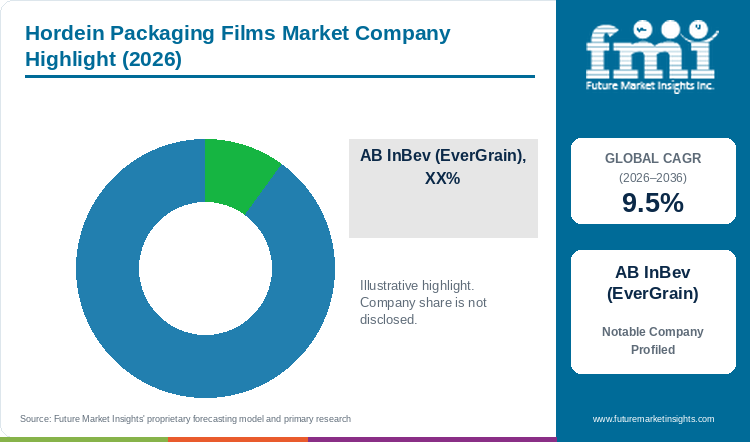
FMI analysis indicates that the competitive arena divides between global brewing and malting conglomerates operating captive side-stream biorefineries, integrated agricultural grain fractionators with specialty prolamin film and glaze formulators. Brewing and malting majors control multi-million-tonne wet spent grain and un-kilned pearling flour streams, whereas specialty coating compounders blend hordein with plant polyphenols and polyols for confectionery pan-glazing and belt-cast sachets.
- Global Brewing & Malting Side-Stream Majors: Anheuser-Busch InBev (EverGrain) with InVivo Group / Soufflet Malt, Carlsberg Group with Boortmalt control captive wet BSG and malting pearling flour feedstocks.
- Nordic & European Grain Biorefinery Platforms: Lantmännen Biorefineries with Viking Malt Oy integrate on-site bioethanol solvent loops with cereal prolamin and beta-glucan fractionation.
- Specialty Prolamin Glaze & Plasticizer Formulators: Flo Chemical Corporation and Roquette Frères supply ready-to-spray alcohol-soluble prolamin glazes and non-blooming sorbitol/glycerol plasticizer systems.
Competitive Benchmarking: Hordein Packaging Films Market
Table 8: Competitive Benchmarking for the Hordein Packaging Films Market (qualitative capability ratings), 2026
| Company | Captive BSG / Malt Feedstock | Prolamin Fractionation Purity | Film & Glaze Formulation Depth | Geographic Reach |
|---|---|---|---|---|
| AB InBev (EverGrain) | High | High | Medium | High |
| InVivo / Soufflet Malt | High | High | Medium | High |
| Carlsberg Group | High | Medium | Medium | High |
| Boortmalt (Axéréal) | High | Medium | Medium | High |
| Lantmännen Biorefineries | Medium | High | High | Medium |
| Viking Malt Oy | Medium | High | Medium | Medium |
| Flo Chemical Corp. | Medium | High | High | Medium |
| Roquette Frères | Medium | High | High | High |
Scoring basis: Capability tiers evaluate captive access to fresh brewer spent grain or un-kilned malting pearling flour and reductive-ethanol B/C-hordein isolation capacity. Formulation depth and geographic ratings reflect verified polyphenol crosslinking IP, food-grade allergen QA with multi-region supply networks.
Key Developments in the Hordein Packaging Films Market
- Anheuser-Busch InBev reported full-year 2024/2025 operational expansion of its EverGrain barley protein and spent-grain valorization platform in February 2025, scaling hydrophobic co-product availability across North America and Europe [3].
- InVivo Group and Soufflet Malt accelerated their industrial malt side-stream valorization program across 41 malting plants in January 2025 to convert un-kilned barley pearling fractions into functional bio-ingredients and biopolymers [2].
- Carlsberg Group updated its Together Towards ZERO and Beyond (TTZAB) circularity milestones in February 2025, advancing brewer spent grain upcycling and bio-based packaging partnerships across European breweries [5].
Key Players in the Hordein Packaging Films Market
Global Brewing and Malting Side-Stream Majors
- Anheuser-Busch InBev SA/NV (EverGrain)
- InVivo Group / Soufflet Malt
- Carlsberg Group
- Boortmalt (Axéréal Group)
Integrated Grain Biorefineries and Specialty Maltsters
- Lantmännen Biorefineries
- Viking Malt Oy
Specialty Prolamin Glaze and Biopolymer Formulators
- Flo Chemical Corporation
- Roquette Frères
Hordein Packaging Films Market - Report Scope
Table 9: Report Scope for the Hordein Packaging Films Market (coverage fields and definitions), 2026 to 2036
| Coverage field | Report scope |
|---|---|
| Market breakdown | Protein Fraction Grade; Feedstock Source; Packaging Application; Film Format; Sales Channel |
| Quantitative Units | USD Million |
| Market Definition | Includes commercial supplier value of purified barley hordein film resins, polyphenol-crosslinked hordein wraps with alcohol-soluble hordein confectionery/produce glazes. Category Scope Note: Excludes water-soluble barley peptides sold for beverage nutrition, raw wet BSG cattle feed, corn zein with rye secalin coatings. |
| Regions Covered | North America; Latin America; Western Europe; Eastern Europe; East Asia; South Asia and Pacific; Middle East and Africa |
| Countries Covered | China, Japan, France, Germany, UK, USA, Canada, Brazil with additional countries in the full report |
| Key Companies Covered | Anheuser-Busch InBev (EverGrain), InVivo / Soufflet Malt, Carlsberg Group, Boortmalt, Lantmännen Biorefineries, Viking Malt Oy, Flo Chemical Corp., Roquette Frères |
| Forecast Period | 2026 to 2036 |
| Approach | Primary and secondary research with bottom-up BSG/pearling prolamin mass-balance and top-down converted film-area triangulation. |
Hordein Packaging Films Market - Research Methodology
Table 10: Research Methodology for the Hordein Packaging Films Market (research methods and approach), 2026 edition
| Method | Approach |
|---|---|
| Primary Research | Structured interviews with brewery side-stream biorefinery directors, malting process engineers with edible film/glaze formulators to validate reductive-ethanol extraction yields and zein substitution pricing. |
| Secondary Research | Analysis of USDA FAS global barley balances, corporate reports (AB InBev, Carlsberg, InVivo, Lantmännen) with PubMed/PMC barley hordein disulfide and polyphenol crosslinking studies. |
| Market Sizing and Forecasting | Bottom-up industrial BSG and pearling flour prolamin extraction mass balances (2,645 tonnes film-grade resin in 2026 at USD 9.30/kg ASP) reconciled against top-down converted film and glaze area (1.12 billion m2). |
| Country Forecasting Model | Econometric country projections weight domestic beer/malt production volumes, instant wheat-noodle sachet demand with gluten allergen labelling alignment across eight national markets. |
| Operational Benchmark Traceability | Prolamin fractionation and biorefinery indicators in Tables 2, 3 with 4 trace to Journal of Agricultural and Food Chemistry and Foods hordein film trials with USDA FAS grain grind statistics. |
| Data Triangulation and Validation | Demand estimates are cross-checked against commercial prolamin glaze shipments and BSG biorefinery co-product outputs without double counting soluble nutritional barley protein isolates. |
Hordein Packaging Films Market by Segments
Hordein Packaging Films Market segmented by Protein Fraction Grade:
- B-Hordein Crosslinked Films
- Polyphenol Reinforced Hordein
- Composite Hordein-Polysaccharide Films
- C-Hordein Plasticized Films
Hordein Packaging Films Market segmented by Feedstock Source:
- Brewer Spent Grain Extraction
- Malting Barley Pearling Flour
- Hulless Barley Protein Isolate
Hordein Packaging Films Market segmented by Packaging Application:
- Edible Confectionery Wraps
- Single-Dose Seasoning Sachets
- Lipid-Barrier Meat Casings
- Fresh Produce Respiration Coatings
Hordein Packaging Films Market segmented by Film Format:
- Solvent-Cast Flexible Films
- Aqueous-Ethanol Pan & Spray Glazes
- Compression-Molded Trays & Casings
Hordein Packaging Films Market segmented by Sales Channel:
- Direct Brewery Biorefinery Offtake
- Specialty Food-Coating Formulators
- B2B IngredTech Distributors
Hordein Packaging Films Market by Region
- North America
- United States
- Canada
- Latin America
- Brazil
- Mexico
- Argentina
- Chile
- Western Europe
- Germany
- France
- United Kingdom
- Italy
- Spain
- Benelux
- Nordics
- Eastern Europe
- Poland
- Czech Republic
- Romania
- Hungary
- East Asia
- China
- Japan
- South Korea
- South Asia and Pacific
- India
- ASEAN
- Australia and New Zealand
- Middle East and Africa
- GCC Countries
- South Africa
- Türkiye
- Israel
Research Sources and Bibliography
- [1] U.S. Department of Agriculture Foreign Agricultural Service (USDA FAS). (2025, May 12). Grain: World Markets and Trade - Global Barley and Rye Production, Malting Demand, and Industrial Grind Balances (2025/26 Forecast). USDA Economic & Market Intelligence.
- [2] InVivo Group & Soufflet Malt. (2025, January 14). InVivo and Soufflet Malt accelerate industrial malt side-stream valorization and low-carbon barley processing across global malting plants. InVivo Group Press Releases.
- [3] Anheuser-Busch InBev SA/NV. (2025, February 26). AB InBev reports full-year and fourth-quarter 2024 results: EverGrain barley protein and spent grain valorization expansion. AB InBev Official Press Releases.
- [4] Xia, Y., Wang, Y., & Chen, L. (2011, December 28). Molecular structure, physicochemical characterization, and in vitro degradation of barley protein films. Journal of Agricultural and Food Chemistry, 59(24), 13221-13229 (PubMed PMID 21970574).
- [5] Carlsberg Group. (2025, February 6). Full-year 2024 Financial Statement and 2025 Together Towards ZERO and Beyond (TTZAB) packaging circularity and brewer spent grain upcycling update. Carlsberg Group Newsroom.
- [6] Wang, R., Chen, Z., & Lixin, L. (2022, May 3). Fabrication and characterization of barley hordein-based active packaging films reinforced with plant polyphenols. Foods, 11(9), 1318 (PubMed Central PMC9105396).
- [7] Bamdad, F., Wu, J., & Chen, L. (2017, April 15). Effects of enzymatic hydrolysis and crosslinking on molecular structure and antioxidant activity of barley hordein. Food Chemistry, 221, 1412-1420 (PubMed PMID 27979109).
- [8] Lantmännen ek för. (2025, February 11). Lantmännen Year-End Report 2024 and Biorefineries investment update: Rye, wheat, and oats fractionation in Norrköping and Lidköping. Lantmännen Financial Press Releases.
- [9] Shewry, P. R., & Halford, N. G. (2002, April 1). Cereal seed storage proteins: Structures, properties and role in grain utilization. Journal of Experimental Botany, 53(370), 947-958 (PubMed PMID 11912237).
- [10] Tatham, A. S., & Shewry, P. R. (2012, March 1). The S-poor prolamins of wheat, barley and rye: Revisited. Journal of Cereal Science, 55(2), 79-99 (PubMed PMID 22048773).
- [11] Shewry, P. R., Field, J. M., Faulks, A. J., Parmar, S., Miflin, B. J., Dietler, M. D., Lew, E. J., & Kasarda, D. D. (1984, January 24). The purification and N-terminal amino acid sequence analysis of the high molecular weight glutenin subunits of wheat, barley and rye. Biochimica et Biophysica Acta, 788(1), 23-34 (PubMed PMID 6733118).
- [12] European Parliament and Council of the European Union. (2025, January 22). Regulation (EU) 2025/40 of the European Parliament and of the Council of 19 December 2024 on packaging and packaging waste. Official Journal of the European Union (EUR-Lex).
- [13] U.S. Food and Drug Administration (FDA). (2025, January 15). Inventory of Effective Food Contact Substance (FCS) Notifications and 21 CFR Part 175 Indirect Food Additives. U.S. Department of Health and Human Services.
This bibliography is provided for reader reference and is not exhaustive. The full report contains the complete reference list and detailed citations.
This Report Answers
- How large is the hordein packaging films market in 2026 and what is forecast for 2036?
- Why does upcycled brewer spent grain hordein undercut commercial corn zein by over 50%?
- Why do B-Hordein Crosslinked Films lead the protein fraction grade category?
- Why does Brewer Spent Grain Extraction lead the feedstock source category globally?
- How do growth rates differ across China, Japan, France, Germany with the USA?
- Which leading brewing, malting with grain-refining companies supply barley prolamin streams today?
- How do gluten allergen labelling rules shape application targeting in hordein packaging films?
- What should buyers evaluate before purchasing hordein film resins or confectionery glazes?
Frequently Asked Questions
How big is the hordein packaging films market in 2026 with what is forecast for 2036?
According to FMI, the global hordein packaging films market value is estimated to reach USD 24.6 million in 2026 from USD 22.4 million in 2025. The industry valuation is forecast to hit USD 61.0 million by 2036 as breweries and maltsters valorize spent grain into lipid-barrier films.
What is the CAGR for the hordein packaging films market from 2026 to 2036?
Future Market Insights projects a 9.5% compound annual growth rate between 2026 and 2036, representing an anticipated USD 36.4 million increase in annual market value across edible confectionery wraps, dissolvable noodle sachets with meat casings.
Which protein fraction grade segment leads the hordein packaging films market?
B-Hordein Crosslinked Films are projected to capture 45.5% of protein fraction grade demand in 2026 because eight conserved cysteine residues form covalent inter-chain disulfide networks with high wet tensile strength.
Which feedstock source segment leads the hordein packaging films market?
Brewer Spent Grain Extraction is estimated to secure 58.1% of the feedstock source category in 2026 as wort mashing removes starch and concentrates insoluble barley prolamins at a 55% cost discount to corn zein.
Which country has a notable growth outlook during the assessment period?
China is projected to lead national growth at a 10.9% CAGR through 2036, driven by boiling-water-soluble chili-oil and seasoning sachets in instant wheat-noodle cups.
Who are the key players in the market?
Anheuser-Busch InBev (EverGrain), InVivo Group / Soufflet Malt, Carlsberg Group, Boortmalt, Lantmännen Biorefineries, Viking Malt Oy, Flo Chemical Corporation with Roquette Frères lead feedstock extraction and prolamin formulation.
Preview the report firsthand - request a free sample
Get SampleGet the brochure for pricing and purchase details.
Get PDFTable of Content
- Key Takeaways
- Market Size and CAGR
- Top Growth Driver
- Fastest Growing Segment
- Leading Region
- Key Companies
- Emerging Opportunities
- Executive Summary
- Global Market Outlook
- Demand-side Trends
- Supply-side Trends
- Technology Roadmap Analysis
- Analysis and Recommendations
- Analyst Perspective (What is happening? Why now? What should investors know?)
- Key Questions Answered
- How large is the market?
- What is the CAGR?
- What are key trends?
- Which region dominates?
- Who are the leaders?
- Market Overview
- Market Coverage / Taxonomy
- Market Definition / Scope / Limitations
- Research Methodology
- Chapter Orientation
- Analytical Lens and Working Hypotheses
- Market Structure, Signals, and Trend Drivers
- Benchmarking and Cross-market Comparability
- Market Sizing, Forecasting, and Opportunity Mapping
- Research Design and Evidence Framework
- Desk Research Programme (Secondary Evidence)
- Expert Input and Fieldwork (Primary Evidence)
- Tooling, Models, and Reference Databases
- Data Engineering and Model Build
- Quality Assurance and Audit Trail
- Market Background
- Market Dynamics (Drivers, Restraints, Opportunity, Trends)
- Scenario Forecast (Optimistic, Likely, Conservative)
- Impact Analysis
- AI Impact
- Sustainability Impact
- Regulatory Impact
- Technology Impact
- Consumer / Buyer Analysis
- Purchase Drivers
- Adoption Barriers
- Buyer Journey
- Opportunity Map Analysis
- Product Life Cycle Analysis
- Supply Chain Analysis
- Investment Feasibility Matrix
- Value Chain Analysis
- PESTLE and Porter's Analysis
- Regulatory Landscape
- Regional Parent Market Outlook
- Production and Consumption Statistics
- Import and Export Statistics
- Global Market Analysis and Forecast, 2021 to 2036
- Historical Market Size Value (USD Million) Analysis, 2021 to 2025
- Current and Future Market Size Value (USD Million) Projections, 2026 to 2036
- Y-o-Y Growth Trend Analysis
- Absolute $ Opportunity Analysis
- Global Market Pricing Analysis, 2021 to 2036
- Global Market Analysis and Forecast, By Protein Fraction Grade, 2021 to 2036
- Introduction / Key Findings
- Historical Market Size Value (USD Million) Analysis By Protein Fraction Grade, 2021 to 2025
- Current and Future Market Size Value (USD Million) Analysis and Forecast By Protein Fraction Grade, 2026 to 2036
- B-Hordein Crosslinked Films
- Polyphenol Reinforced Hordein
- Composite Hordein-Polysaccharide Films
- C-Hordein Plasticized Films
- Y-o-Y Growth Trend Analysis By Protein Fraction Grade, 2021 to 2025
- Absolute $ Opportunity Analysis By Protein Fraction Grade, 2026 to 2036
- Global Market Analysis and Forecast, By Feedstock Source, 2021 to 2036
- Introduction / Key Findings
- Historical Market Size Value (USD Million) Analysis By Feedstock Source, 2021 to 2025
- Current and Future Market Size Value (USD Million) Analysis and Forecast By Feedstock Source, 2026 to 2036
- Brewer Spent Grain Extraction
- Malting Barley Pearling Flour
- Hulless Barley Protein Isolate
- Y-o-Y Growth Trend Analysis By Feedstock Source, 2021 to 2025
- Absolute $ Opportunity Analysis By Feedstock Source, 2026 to 2036
- Global Market Analysis and Forecast, By Packaging Application, 2021 to 2036
- Introduction / Key Findings
- Historical Market Size Value (USD Million) Analysis By Packaging Application, 2021 to 2025
- Current and Future Market Size Value (USD Million) Analysis and Forecast By Packaging Application, 2026 to 2036
- Edible Confectionery Wraps
- Single-Dose Seasoning Sachets
- Lipid-Barrier Meat Casings
- Fresh Produce Respiration Coatings
- Y-o-Y Growth Trend Analysis By Packaging Application, 2021 to 2025
- Absolute $ Opportunity Analysis By Packaging Application, 2026 to 2036
- Global Market Analysis and Forecast, By Film Format, 2021 to 2036
- Introduction / Key Findings
- Historical Market Size Value (USD Million) Analysis By Film Format, 2021 to 2025
- Current and Future Market Size Value (USD Million) Analysis and Forecast By Film Format, 2026 to 2036
- Solvent-Cast Flexible Films
- Aqueous-Ethanol Pan & Spray Glazes
- Compression-Molded Trays & Casings
- Y-o-Y Growth Trend Analysis By Film Format, 2021 to 2025
- Absolute $ Opportunity Analysis By Film Format, 2026 to 2036
- Global Market Analysis and Forecast, By Sales Channel, 2021 to 2036
- Introduction / Key Findings
- Historical Market Size Value (USD Million) Analysis By Sales Channel, 2021 to 2025
- Current and Future Market Size Value (USD Million) Analysis and Forecast By Sales Channel, 2026 to 2036
- Direct Brewery Biorefinery Offtake
- Specialty Food-Coating Formulators
- B2B IngredTech Distributors
- Y-o-Y Growth Trend Analysis By Sales Channel, 2021 to 2025
- Absolute $ Opportunity Analysis By Sales Channel, 2026 to 2036
- Global Market Analysis and Forecast, By Region, 2021 to 2036
- Introduction
- Historical Market Size Value (USD Million) Analysis By Region, 2021 to 2025
- Current Market Size Value (USD Million) Analysis and Forecast By Region, 2026 to 2036
- North America
- Latin America
- Western Europe
- Eastern Europe
- East Asia
- South Asia and Pacific
- Middle East and Africa
- Market Attractiveness Analysis By Region
- North America Market Analysis and Forecast, By Country, 2021 to 2036
- Historical Market Size Value (USD Million) Trend Analysis By Market Taxonomy, 2021 to 2025
- Market Size Value (USD Million) Forecast By Market Taxonomy, 2026 to 2036
- By Country
- United States
- Canada
- By Protein Fraction Grade
- By Feedstock Source
- By Packaging Application
- By Film Format
- By Sales Channel
- By Country
- Market Attractiveness Analysis
- By Country
- By Protein Fraction Grade
- By Feedstock Source
- By Packaging Application
- By Film Format
- By Sales Channel
- Key Takeaways
- Latin America Market Analysis and Forecast, By Country
- Historical Market Size Value (USD Million) Trend Analysis By Market Taxonomy, 2021 to 2025
- Market Size Value (USD Million) Forecast By Market Taxonomy, 2026 to 2036
- By Country
- Brazil
- Mexico
- Argentina
- Chile
- By Protein Fraction Grade
- By Feedstock Source
- By Packaging Application
- By Film Format
- By Sales Channel
- By Country
- Market Attractiveness Analysis
- By Country
- By Protein Fraction Grade
- By Feedstock Source
- By Packaging Application
- By Film Format
- By Sales Channel
- Key Takeaways
- Western Europe Market Analysis and Forecast, By Country
- Historical Market Size Value (USD Million) Trend Analysis By Market Taxonomy, 2021 to 2025
- Market Size Value (USD Million) Forecast By Market Taxonomy, 2026 to 2036
- By Country
- Germany
- France
- United Kingdom
- Italy
- Spain
- Benelux
- Nordics
- By Protein Fraction Grade
- By Feedstock Source
- By Packaging Application
- By Film Format
- By Sales Channel
- By Country
- Market Attractiveness Analysis
- By Country
- By Protein Fraction Grade
- By Feedstock Source
- By Packaging Application
- By Film Format
- By Sales Channel
- Key Takeaways
- Eastern Europe Market Analysis and Forecast, By Country
- Historical Market Size Value (USD Million) Trend Analysis By Market Taxonomy, 2021 to 2025
- Market Size Value (USD Million) Forecast By Market Taxonomy, 2026 to 2036
- By Country
- Poland
- Czech Republic
- Romania
- Hungary
- By Protein Fraction Grade
- By Feedstock Source
- By Packaging Application
- By Film Format
- By Sales Channel
- By Country
- Market Attractiveness Analysis
- By Country
- By Protein Fraction Grade
- By Feedstock Source
- By Packaging Application
- By Film Format
- By Sales Channel
- Key Takeaways
- East Asia Market Analysis and Forecast, By Country
- Historical Market Size Value (USD Million) Trend Analysis By Market Taxonomy, 2021 to 2025
- Market Size Value (USD Million) Forecast By Market Taxonomy, 2026 to 2036
- By Country
- China
- Japan
- South Korea
- By Protein Fraction Grade
- By Feedstock Source
- By Packaging Application
- By Film Format
- By Sales Channel
- By Country
- Market Attractiveness Analysis
- By Country
- By Protein Fraction Grade
- By Feedstock Source
- By Packaging Application
- By Film Format
- By Sales Channel
- Key Takeaways
- South Asia and Pacific Market Analysis and Forecast, By Country
- Historical Market Size Value (USD Million) Trend Analysis By Market Taxonomy, 2021 to 2025
- Market Size Value (USD Million) Forecast By Market Taxonomy, 2026 to 2036
- By Country
- India
- ASEAN
- Australia and New Zealand
- By Protein Fraction Grade
- By Feedstock Source
- By Packaging Application
- By Film Format
- By Sales Channel
- By Country
- Market Attractiveness Analysis
- By Country
- By Protein Fraction Grade
- By Feedstock Source
- By Packaging Application
- By Film Format
- By Sales Channel
- Key Takeaways
- Middle East and Africa Market Analysis and Forecast, By Country
- Historical Market Size Value (USD Million) Trend Analysis By Market Taxonomy, 2021 to 2025
- Market Size Value (USD Million) Forecast By Market Taxonomy, 2026 to 2036
- By Country
- GCC Countries
- South Africa
- Türkiye
- Israel
- By Protein Fraction Grade
- By Feedstock Source
- By Packaging Application
- By Film Format
- By Sales Channel
- By Country
- Market Attractiveness Analysis
- By Country
- By Protein Fraction Grade
- By Feedstock Source
- By Packaging Application
- By Film Format
- By Sales Channel
- Key Takeaways
- Key Countries Market Analysis
- United States
- Pricing Analysis
- Market Share Analysis, 2025
- By Protein Fraction Grade
- By Feedstock Source
- By Packaging Application
- By Film Format
- By Sales Channel
- Canada
- Pricing Analysis
- Market Share Analysis, 2025
- By Protein Fraction Grade
- By Feedstock Source
- By Packaging Application
- By Film Format
- By Sales Channel
- Mexico
- Pricing Analysis
- Market Share Analysis, 2025
- By Protein Fraction Grade
- By Feedstock Source
- By Packaging Application
- By Film Format
- By Sales Channel
- Brazil
- Pricing Analysis
- Market Share Analysis, 2025
- By Protein Fraction Grade
- By Feedstock Source
- By Packaging Application
- By Film Format
- By Sales Channel
- Chile
- Pricing Analysis
- Market Share Analysis, 2025
- By Protein Fraction Grade
- By Feedstock Source
- By Packaging Application
- By Film Format
- By Sales Channel
- Germany
- Pricing Analysis
- Market Share Analysis, 2025
- By Protein Fraction Grade
- By Feedstock Source
- By Packaging Application
- By Film Format
- By Sales Channel
- United Kingdom
- Pricing Analysis
- Market Share Analysis, 2025
- By Protein Fraction Grade
- By Feedstock Source
- By Packaging Application
- By Film Format
- By Sales Channel
- Italy
- Pricing Analysis
- Market Share Analysis, 2025
- By Protein Fraction Grade
- By Feedstock Source
- By Packaging Application
- By Film Format
- By Sales Channel
- Spain
- Pricing Analysis
- Market Share Analysis, 2025
- By Protein Fraction Grade
- By Feedstock Source
- By Packaging Application
- By Film Format
- By Sales Channel
- France
- Pricing Analysis
- Market Share Analysis, 2025
- By Protein Fraction Grade
- By Feedstock Source
- By Packaging Application
- By Film Format
- By Sales Channel
- India
- Pricing Analysis
- Market Share Analysis, 2025
- By Protein Fraction Grade
- By Feedstock Source
- By Packaging Application
- By Film Format
- By Sales Channel
- ASEAN
- Pricing Analysis
- Market Share Analysis, 2025
- By Protein Fraction Grade
- By Feedstock Source
- By Packaging Application
- By Film Format
- By Sales Channel
- Australia and New Zealand
- Pricing Analysis
- Market Share Analysis, 2025
- By Protein Fraction Grade
- By Feedstock Source
- By Packaging Application
- By Film Format
- By Sales Channel
- China
- Pricing Analysis
- Market Share Analysis, 2025
- By Protein Fraction Grade
- By Feedstock Source
- By Packaging Application
- By Film Format
- By Sales Channel
- Japan
- Pricing Analysis
- Market Share Analysis, 2025
- By Protein Fraction Grade
- By Feedstock Source
- By Packaging Application
- By Film Format
- By Sales Channel
- South Korea
- Pricing Analysis
- Market Share Analysis, 2025
- By Protein Fraction Grade
- By Feedstock Source
- By Packaging Application
- By Film Format
- By Sales Channel
- Poland
- Pricing Analysis
- Market Share Analysis, 2025
- By Protein Fraction Grade
- By Feedstock Source
- By Packaging Application
- By Film Format
- By Sales Channel
- Hungary
- Pricing Analysis
- Market Share Analysis, 2025
- By Protein Fraction Grade
- By Feedstock Source
- By Packaging Application
- By Film Format
- By Sales Channel
- Türkiye
- Pricing Analysis
- Market Share Analysis, 2025
- By Protein Fraction Grade
- By Feedstock Source
- By Packaging Application
- By Film Format
- By Sales Channel
- South Africa
- Pricing Analysis
- Market Share Analysis, 2025
- By Protein Fraction Grade
- By Feedstock Source
- By Packaging Application
- By Film Format
- By Sales Channel
- United States
- Market Structure Analysis
- Competition Dashboard
- Competition Benchmarking
- Market Share Analysis of Top Players
- By Regional
- By Protein Fraction Grade
- By Feedstock Source
- By Packaging Application
- By Film Format
- By Sales Channel
- Emerging Startups
- Innovation Benchmarking
- Competition Analysis
- Competition Deep Dive
- AB InBev (EverGrain)
- Overview
- Product Portfolio
- Profitability by Market Segments
- Sales Footprint
- Strategy Overview
- Marketing Strategy
- Product Strategy
- Channel Strategy
- InVivo / Soufflet Malt
- Carlsberg Group
- Boortmalt (Axéréal)
- Lantmännen Biorefineries
- Viking Malt Oy
- Flo Chemical Corp.
- Roquette Frères
- Anheuser-Busch InBev SA/NV (EverGrain)
- InVivo Group / Soufflet Malt
- Boortmalt (Axéréal Group)
- Flo Chemical Corporation
- AB InBev (EverGrain)
- Case Studies
- Success Stories
- Recent Developments
- Competition Deep Dive
- Assumptions & Acronyms Used


