

- Industry Size (2026)
- USD 1059.8 Mn
- Forecast (2036)
- USD 2850.5 Mn
- CAGR (2026 to 2036)
- 10.4%
Hypersonic Thermal Protection Test Facilities Market Forecast and Outlook 2026to 2036
Demand for hypersonic thermal protection test facilities is valued at USD 1,059.8 million in 2026 and is projected to reach USD 2,850.5 million by 2036, expanding at a CAGR of 10.4%. Demand growth is driven by accelerated hypersonic vehicle programs, reentry system development, and validation requirements for extreme thermal and aerodynamic loads.
Arc-jet facilities represent the leading test method in global demand due to ability to replicate high-enthalpy flow conditions, surface heating rates, and material ablation behavior at hypersonic velocities. Test adoption emphasizes material qualification, thermal barrier performance verification, and durability assessment under sustained heat flux exposure.
Quick Stats for Hypersonic Thermal Protection Test Facilities Market
- Hypersonic Thermal Protection Test Facilities Market Value (2026): USD 1,059.8 million
- Hypersonic Thermal Protection Test Facilities Market Forecast Value (2036): USD 2,850.5 million
- Hypersonic Thermal Protection Test Facilities Market Forecast CAGR (2026 to 2036): 10.4%
- Leading Test Method in Global Demand: Arc-Jet Facilities
- Fastest-Growing Countries: China, Brazil, USA, South Korea, United Kingdom
- Top Players in Global Demand: CUBRC, Kratos Defense & Security Solutions, Calspan, Leidos, Jacobs, Lockheed Martin, Raytheon Technologies, Northrop Grumman, Boeing, L3Harris
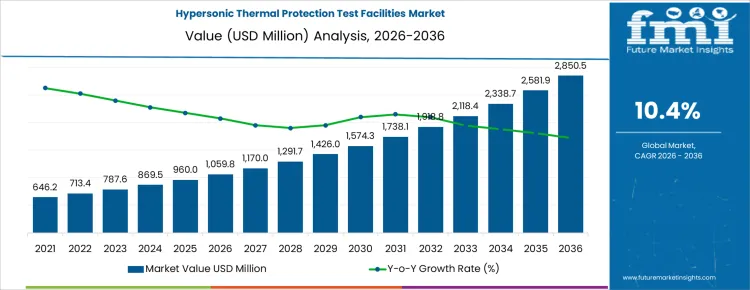
China, Brazil, USA, South Korea, and United Kingdom emerge as fastest-growing countries, supported by defense modernization programs and expanding investment in hypersonic research infrastructure. CUBRC, Kratos Defense & Security Solutions, Calspan, Leidos, Jacobs, Lockheed Martin, Raytheon Technologies, Northrop Grumman, Boeing, and L3Harris maintain strong positions through advanced arc-jet capabilities, integrated test services, and long-standing defense and aerospace program involvement.
Hypersonic Thermal Protection Test Facilities Market Key Takeaways
| Metric | Value |
|---|---|
| Market Value (2026) | USD 1,059.8 million |
| Market Forecast Value (2036) | USD 2,850.5 million |
| Forecast CAGR (2026 to 2036) | 10.4% |
Why is the Demand for Hypersonic Thermal Protection Test Facilities Globally Growing?
Demand for hypersonic thermal protection test facilities is growing globally due to expanding research and development in hypersonic flight technologies across defense, aerospace, and space sectors. Countries investing in hypersonic vehicles require ground based test infrastructure to evaluate thermal protection systems under extreme aerodynamic heating, high enthalpy flows, and shock layer conditions that replicate flight at Mach five and above. Aerospace prime contractors and research institutions adopt advanced wind tunnels, arcjet, and plasma arc facilities to validate heat shield materials, ablative coatings, and structural integrity before full scale integration.
Growth in reusable launch vehicles and next generation high speed aircraft increases demand for test data to support design optimization and mission assurance. International collaboration on hypersonic research programs expands access to shared facilities and data exchanges while driving broader procurement of complementary diagnostic equipment. Regulatory and safety requirements emphasize rigorous environmental qualification to mitigate risk during flight testing and operational deployment. Academic programs in propulsion, materials science, and aerothermodynamics expand usage for experimental research. Test facility developers focus on scalable, high throughput systems that reduce cycle time and improve fidelity across a range of flow regimes and thermal loads.
How Are the Segments Classified in the Hypersonic Thermal Protection Test Facilities Market?
Demand for hypersonic thermal protection test facilities globally is shaped by sustained hypersonic program activity, extreme heat-flux validation needs, and material qualification requirements. Stakeholders assess heat load replication, flow uniformity, test duration control, and instrumentation accuracy. Adoption patterns reflect alignment with defense-led development cycles, government research mandates, and expanding commercial interest in high-speed atmospheric and space-access systems.
Which Test Method Commands the Largest Share of Global Facility Demand?
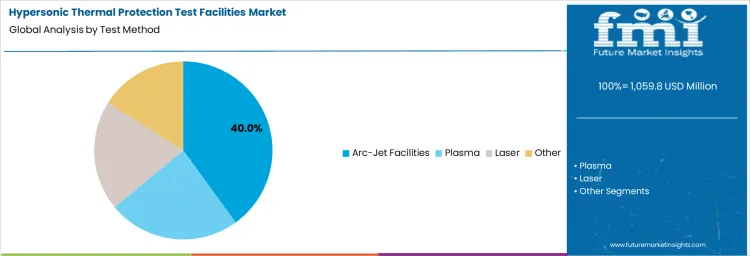
Arc-jet facilities hold 40.0%, commanding the largest share of global demand. Arc-jet testing enables simulation of high-enthalpy flow and sustained heat flux representative of hypersonic flight regimes. Facilities support material recession measurement, thermal response characterization, and surface chemistry evaluation. Plasma facilities hold 24.0%, providing controlled ionized flow conditions for localized heating studies. Laser-based methods account for 20.0%, enabling precise, high-intensity thermal loading on small samples. Other methods hold 16.0%, covering complementary and hybrid approaches. Test-method distribution reflects priority for realistic, sustained thermal environments.
Key Points
- Arc-jet facilities lead due to sustained high-enthalpy simulation.
- Plasma methods support controlled ionized flow testing.
- Laser systems enable precise localized heating studies.
Which Customer Segment Drives Global Demand for Hypersonic TPS Testing?
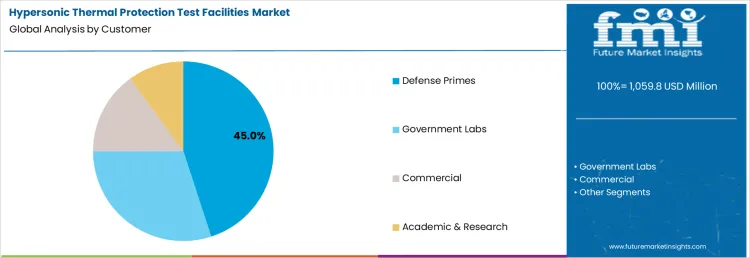
Defense primes hold 45.0%, driving global demand for hypersonic TPS testing. These organizations require qualification and validation to meet mission performance and survivability requirements. Government laboratories hold 30.0%, focusing on standards development, independent verification, and national program support. Commercial customers account for 15.0%, supporting emerging hypersonic concepts and access-to-space initiatives. Academic and research institutions hold 10.0%, advancing material science and modeling validation. Customer distribution reflects concentration of demand within defense-led development ecosystems.
Key Points
- Defense primes dominate due to program qualification needs.
- Government labs support verification and standards.
- Commercial and academic users address emerging concepts.
Which TPS Material Category Accounts for the Highest Share of Testing Activity Globally?
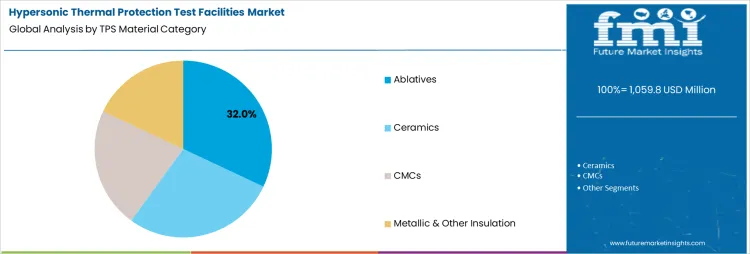
Ablative materials hold 32.0%, accounting for the highest share of global testing activity. Ablatives require validation of mass loss, char formation, and thermal protection effectiveness under extreme heat loads. Ceramics hold 28.0%, supporting high-temperature stability and oxidation resistance evaluation. Ceramic matrix composites account for 22.0%, requiring assessment of damage tolerance and thermal cycling behavior. Metallic and other insulation materials hold 18.0%, addressing structural integration and thermal management roles. Material-category distribution reflects focus on consumable protection and high-temperature stability.
Key Points
- Ablatives lead due to erosion and recession validation needs.
- Ceramics support high-temperature stability assessment.
- CMCs require evaluation of damage tolerance and cycling.
What are the Key Dynamics in the Hypersonic Thermal Protection Test Facilities Market?
Global demand rises as aerospace agencies, defense organizations, and commercial space developers expand hypersonic vehicle programs requiring rigorous thermal protection validation. Test facilities simulate extreme aerodynamic heating and reentry conditions to evaluate TPS materials and structures. Adoption aligns with accelerated hypersonic defense initiatives, launch vehicle advancement, and strategic priorities in North America, Europe, Asia-Pacific, and the Middle East. Usage spans research, qualification, and iterative material development across institutional and industry test centers.
How do defense programs and high-speed aerospace objectives shape demand globally?
Hypersonic systems operating at Mach 5+ generate intense thermal loads that challenge material integrity, aerodynamics, and structural resilience. National defense agencies invest in ground-based test facilities such as arc jets, shock tunnels, and high-enthalpy wind tunnels to characterize TPS performance under controlled conditions. Space launch developers use thermal test data to validate heat shields and ablative coatings for reentry vehicles and reusable systems. Research consortia and universities contribute to fundamental studies on material response, oxidation resistance, and thermal cycling effects. Test outcomes inform design refinement, risk mitigation, and qualification pathways for flight hardware across diverse program portfolios.
How do facility capital intensity, technical complexity, and access inequality influence global scalability?
Hypersonic thermal test facilities require extremely high power, specialized vacuum systems, and precision diagnostics to replicate flight-like conditions, resulting in substantial capital expenditure. Operational expertise is critical to manage complex test sequences, safety protocols, and data interpretation. Established aerospace nations maintain the majority of advanced facilities, while emerging space and defense programs often rely on international partnerships or shared access arrangements. High operating costs and maintenance burden limit throughput and constrain availability for smaller developers. Infrastructure disparity affects regional test planning and program timelines. Market expansion depends on collaborative facility networks, modular test cell development, and investment in workforce training to broaden global access to high-fidelity hypersonic TPS testing capability.
How Is Demand for Hypersonic Thermal Protection Test Facilities Evolving?
Demand for hypersonic thermal protection test facilities is increasing globally due to acceleration of hypersonic vehicle programs, materials qualification needs, and extreme environment validation requirements. China leads with a 12.2% CAGR, supported by sustained government-backed hypersonic research and testing infrastructure expansion. Brazil follows at 11.5%, driven by capability development and experimental aerospace programs. USA records a 10.7% CAGR, shaped by defense modernization and advanced flight testing activity. South Korea posts 10.1%, reflecting integration of hypersonic research within defense and aerospace initiatives. UK records 9.7%, supported by collaborative research facilities and materials testing programs. Growth reflects rising thermal loads, material complexity, and emphasis on ground-based risk reduction worldwide.
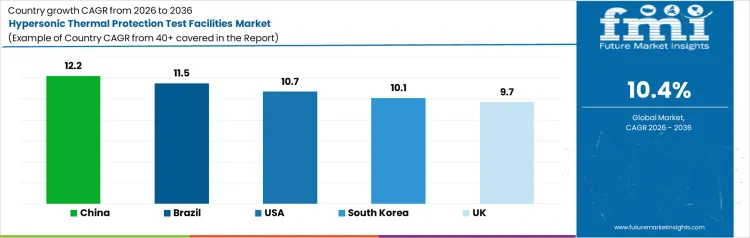
| Country | CAGR (%) |
|---|---|
| China | 12.2 |
| Brazil | 11.5 |
| South Korea | 10.1 |
| USA | 10.7 |
| UK | 9.7 |
What factors are accelerating expansion of hypersonic thermal test facilities in China?
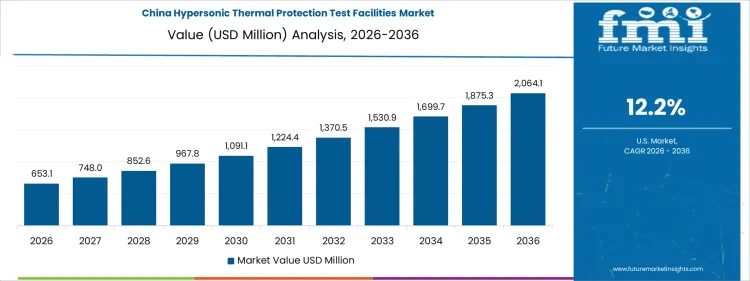
China drives demand through extensive hypersonic vehicle development, propulsion testing, and materials research programs. Country’s CAGR of 12.2% reflects investment in arc jet facilities, plasma wind tunnels, and high-enthalpy test systems. Programs require validation of thermal protection materials under sustained extreme heat flux and pressure conditions. Facilities support iterative testing of ceramics, composites, and ablative materials. Emphasis remains on in-house testing capacity to reduce development risk and timelines. Academic and state laboratories expand parallel test infrastructure. Growth remains policy-supported and volume-driven, aligned with long-term strategic aerospace objectives.
- Large-scale hypersonic research programs
- Investment in arc jet and plasma facilities
- High-temperature material qualification focus
- Expansion of in-house testing capacity
Why is Brazil emerging as a fast-growing hypersonic test facility market?
Brazil demand is shaped by expansion of aerospace research capabilities, experimental hypersonic studies, and academic defense collaboration. Country’s CAGR of 11.5% reflects increasing establishment of thermal testing infrastructure for material and component evaluation. Facilities focus on high-temperature exposure, thermal cycling, and erosion resistance testing. Shared research centers optimize capital usage across institutions. International cooperation encourages alignment with global test methodologies. Demand favors mid-scale and modular test setups. Growth remains research-led and capability-focused, aligned with gradual advancement of national hypersonic experimentation programs.
- Aerospace and defense research expansion
- Academic and shared testing facilities
- High-temperature materials evaluation
- Modular test system adoption
How do defense priorities influence hypersonic test facility demand in the USA?
USA demand reflects active hypersonic weapon programs, advanced aerospace research, and defense modernization initiatives. Country’s CAGR of 10.7% is supported by upgrades to existing arc jet facilities and development of new high-enthalpy test capabilities. Programs emphasize validating thermal protection systems for sustained hypersonic flight. Facilities support component-level and system-level testing under controlled conditions. Public-private collaboration accelerates facility utilization. Demand remains performance-driven, aligned with reducing flight test risk and supporting rapid development cycles.
- Defense-led hypersonic development programs
- Upgrades to high-enthalpy test infrastructure
- Component and system-level validation needs
- Public and private sector collaboration
What drives steady growth of hypersonic thermal testing capacity in South Korea?
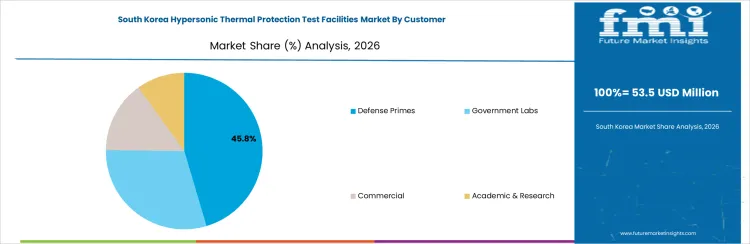
South Korea demand reflects integration of hypersonic research into defense and aerospace technology development. Country’s CAGR of 10.1% is supported by investment in thermal testing for advanced materials and propulsion components. Facilities focus on precise temperature control, data accuracy, and repeatability. Government-backed programs promote domestic testing capability development. Demand favors compact and high-precision test systems suitable for research laboratories. Growth remains technology-driven, aligned with strengthening national aerospace research capabilities.
- Defense and aerospace research integration
- Advanced material and component testing
- Precision-focused thermal validation
- Government-supported facility development
How is the UK positioning within the global hypersonic thermal protection test facility landscape?
UK demand reflects collaborative research models, materials science specialization, and participation in multinational hypersonic programs. Country’s CAGR of 9.7% is supported by investment in shared arc heating and plasma-based thermal test facilities serving academia and defense contractors. Facilities focus on validating ceramic matrix composites, ultra-high-temperature ceramics, and advanced coatings under controlled heat flux conditions. Public funding supports infrastructure upgrades and cross-institutional access. Testing activity emphasizes material screening, component qualification, and data generation for numerical model validation. Demand growth remains research-led and partnership-driven, aligned with UK’s role as a contributor to international hypersonic technology development rather than large-scale vehicle production.
- Shared thermal test infrastructure across academia and industry
- Focus on advanced materials and coating qualification
- Government-funded research and facility upgrades
- Participation in multinational hypersonic programs
What is the competitive landscape of demand for hypersonic thermal protection test facilities?
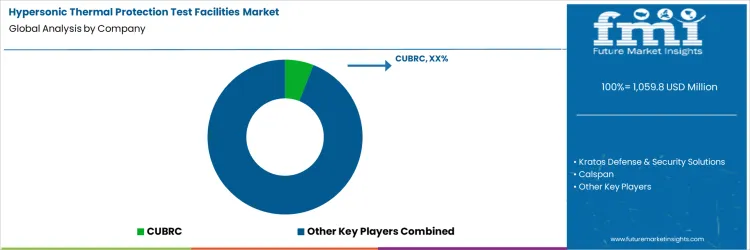
Demand for hypersonic thermal protection test facilities is driven by accelerated development of hypersonic vehicles, reentry systems, and advanced missile platforms. Testing focuses on simulating extreme aerodynamic heating, high-enthalpy flow, shock interactions, and material ablation under controlled conditions. Buyers require arc-heated wind tunnels, shock tunnels, plasma facilities, and high-temperature material characterization infrastructure. Procurement teams emphasize data fidelity, repeatability, instrumentation accuracy, and alignment with defense qualification standards. Facility availability, safety compliance, and ability to support classified programs influence supplier selection significantly. Trend in the global market reflects increased government funding, rapid prototyping cycles, and parallel testing of multiple thermal protection concepts.
CUBRC maintains strong positioning through long-established hypersonic wind tunnels and arc-heated facilities supporting government and defense customers. Kratos Defense and Security Solutions operates specialized test infrastructure and range services supporting hypersonic system validation. Calspan supplies high-enthalpy testing, shock tunnel services, and thermal material evaluation for aerospace and defense programs. Leidos and Jacobs provide test facility operations, engineering services, and system integration for government-owned hypersonic laboratories. Lockheed Martin, Raytheon Technologies, Northrop Grumman, Boeing, and L3Harris operate proprietary test assets supporting internal development and classified programs. Competitive differentiation depends on achievable enthalpy range, test duration control, diagnostic instrumentation, and ability to scale programs rapidly.
Key Players in the Hypersonic Thermal Protection Test Facilities Market
- CUBRC
- Kratos Defense & Security Solutions
- Calspan
- Leidos
- Jacobs
- Lockheed Martin
- Raytheon Technologies
- Northrop Grumman
- Boeing
- L3Harris
Scope of the Report
| Items | Values |
|---|---|
| Quantitative Units | USD million |
| Test Method |
Arc-Jet Facilities, Plasma, Laser, Other |
| Customer |
Defense Primes, Government Labs, Commercial, Academic & Research |
|
TPS Material Category |
Ablatives, Ceramics, CMCs, Metallic & Other Insulation |
|
Service Model |
Facility Time, Integrated Test Campaigns, Instrumentation & Diagnostics, Facility Build |
| Regions Covered | Asia Pacific; Europe; North America; Latin America; Middle East & Africa |
| Countries Covered | USA; China; Brazil; UK; Japan; South Korea; and 40+ countries |
| Key Companies Profiled |
CUBRC, Kratos Defense & Security Solutions, Calspan, Leidos, Jacobs, Lockheed Martin, Raytheon Technologies, Northrop Grumman, Boeing, L3Harris |
| Additional Attributes | Growth is supported by rising deployment of LEO constellations, electric propulsion platforms, and lunar missions. Demand centers on real-time power validation, fault injection, hardware-in-the-loop accuracy, and system-level integration for qualification of space-grade power electronics across global space programs. |
Hypersonic Thermal Protection Test Facilities Market by Segment
Test Method:
- Arc-Jet Facilities
- Plasma
- Laser
- Other
Customer:
- Defense Primes
- Government Labs
- Commercial
- Academic & Research
TPS Material Category:
- Ablatives
- Ceramics
- CMCs
- Metallic & Other Insulation
Service Model:
- Facility Time
- Integrated Test Campaigns
- Instrumentation & Diagnostics
- Facility Build
Region:
- Asia Pacific
- China
- Japan
- South Korea
- India
- Australia & New Zealand
- ASEAN
- Rest of Asia Pacific
- Europe
- Germany
- United Kingdom
- France
- Italy
- Spain
- Nordic
- BENELUX
- Rest of Europe
- North America
- United States
- Canada
- Mexico
- Latin America
- Brazil
- Chile
- Rest of Latin America
- Middle East & Africa
- Kingdom of Saudi Arabia
- Other GCC Countries
- Turkey
- South Africa
- Other African Union
- Rest of Middle East & Africa
Frequently Asked Questions
How big is the hypersonic thermal protection test facilities market in 2026?
The global hypersonic thermal protection test facilities market is estimated to be valued at USD 1,059.8 million in 2026.
What will be the size of hypersonic thermal protection test facilities market in 2036?
The market size for the hypersonic thermal protection test facilities market is projected to reach USD 2,850.5 million by 2036.
How much will be the hypersonic thermal protection test facilities market growth between 2026 and 2036?
The hypersonic thermal protection test facilities market is expected to grow at a 10.4% CAGR between 2026 and 2036.
What are the key product types in the hypersonic thermal protection test facilities market?
The key product types in hypersonic thermal protection test facilities market are arc-jet facilities, plasma, laser and other.
Which customer segment to contribute significant share in the hypersonic thermal protection test facilities market in 2026?
In terms of customer, defense primes segment to command 45.0% share in the hypersonic thermal protection test facilities market in 2026.
Preview the report firsthand - request a free sample
Get SampleGet the brochure for pricing and purchase details.
Get PDFTable of Content
- Executive Summary
- Global Market Outlook
- Demand-side Trends
- Supply-side Trends
- Technology Roadmap Analysis
- Analysis and Recommendations
- Market Overview
- Market Coverage / Taxonomy
- Market Definition / Scope / Limitations
- Market Background
- Market Dynamics
- Drivers
- Restraints
- Opportunity
- Trends
- Scenario Forecast
- Demand in Optimistic Scenario
- Demand in Likely Scenario
- Demand in Conservative Scenario
- Opportunity Map Analysis
- Product Life Cycle Analysis
- Supply Chain Analysis
- Investment Feasibility Matrix
- Value Chain Analysis
- PESTLE and Porter’s Analysis
- Regulatory Landscape
- Regional Parent Market Outlook
- Production and Consumption Statistics
- Import and Export Statistics
- Market Dynamics
- Global Market Analysis 2021 to 2026 and Forecast, 2026 to 2036
- Historical Market Size Value (USD Million) Analysis, 2021 to 2026
- Current and Future Market Size Value (USD Million) Projections, 2026 to 2036
- Y-o-Y Growth Trend Analysis
- Absolute $ Opportunity Analysis
- Global Market Pricing Analysis 2021 to 2026 and Forecast 2026 to 2036
- Global Market Analysis 2021 to 2026 and Forecast 2026 to 2036, By Test Method
- Introduction / Key Findings
- Historical Market Size Value (USD Million) Analysis By Test Method , 2021 to 2026
- Current and Future Market Size Value (USD Million) Analysis and Forecast By Test Method , 2026 to 2036
- Arc-Jet Facilities
- Plasma
- Laser
- Other
- Y-o-Y Growth Trend Analysis By Test Method , 2021 to 2026
- Absolute $ Opportunity Analysis By Test Method , 2026 to 2036
- Global Market Analysis 2021 to 2026 and Forecast 2026 to 2036, By Customer
- Introduction / Key Findings
- Historical Market Size Value (USD Million) Analysis By Customer, 2021 to 2026
- Current and Future Market Size Value (USD Million) Analysis and Forecast By Customer, 2026 to 2036
- Defense Primes
- Government Labs
- Commercial
- Academic & Research
- Y-o-Y Growth Trend Analysis By Customer, 2021 to 2026
- Absolute $ Opportunity Analysis By Customer, 2026 to 2036
- Global Market Analysis 2021 to 2026 and Forecast 2026 to 2036, By TPS Material Category
- Introduction / Key Findings
- Historical Market Size Value (USD Million) Analysis By TPS Material Category, 2021 to 2026
- Current and Future Market Size Value (USD Million) Analysis and Forecast By TPS Material Category, 2026 to 2036
- Ablatives
- Ceramics
- CMCs
- Metallic & Other Insulation
- Y-o-Y Growth Trend Analysis By TPS Material Category, 2021 to 2026
- Absolute $ Opportunity Analysis By TPS Material Category, 2026 to 2036
- Global Market Analysis 2021 to 2026 and Forecast 2026 to 2036, By Service Model
- Introduction / Key Findings
- Historical Market Size Value (USD Million) Analysis By Service Model, 2021 to 2026
- Current and Future Market Size Value (USD Million) Analysis and Forecast By Service Model, 2026 to 2036
- Facility Time
- Integrated Test Campaigns
- Instrumentation & Diagnostics
- Facility Build
- Y-o-Y Growth Trend Analysis By Service Model, 2021 to 2026
- Absolute $ Opportunity Analysis By Service Model, 2026 to 2036
- Global Market Analysis 2021 to 2026 and Forecast 2026 to 2036, By Region
- Introduction
- Historical Market Size Value (USD Million) Analysis By Region, 2021 to 2026
- Current Market Size Value (USD Million) Analysis and Forecast By Region, 2026 to 2036
- North America
- Latin America
- Western Europe
- Eastern Europe
- East Asia
- South Asia and Pacific
- Middle East & Africa
- Market Attractiveness Analysis By Region
- North America Market Analysis 2021 to 2026 and Forecast 2026 to 2036, By Country
- Historical Market Size Value (USD Million) Trend Analysis By Market Taxonomy, 2021 to 2026
- Market Size Value (USD Million) Forecast By Market Taxonomy, 2026 to 2036
- By Country
- USA
- Canada
- Mexico
- By Test Method
- By Customer
- By TPS Material Category
- By Service Model
- By Country
- Market Attractiveness Analysis
- By Country
- By Test Method
- By Customer
- By TPS Material Category
- By Service Model
- Key Takeaways
- Latin America Market Analysis 2021 to 2026 and Forecast 2026 to 2036, By Country
- Historical Market Size Value (USD Million) Trend Analysis By Market Taxonomy, 2021 to 2026
- Market Size Value (USD Million) Forecast By Market Taxonomy, 2026 to 2036
- By Country
- Brazil
- Chile
- Rest of Latin America
- By Test Method
- By Customer
- By TPS Material Category
- By Service Model
- By Country
- Market Attractiveness Analysis
- By Country
- By Test Method
- By Customer
- By TPS Material Category
- By Service Model
- Key Takeaways
- Western Europe Market Analysis 2021 to 2026 and Forecast 2026 to 2036, By Country
- Historical Market Size Value (USD Million) Trend Analysis By Market Taxonomy, 2021 to 2026
- Market Size Value (USD Million) Forecast By Market Taxonomy, 2026 to 2036
- By Country
- Germany
- UK
- Italy
- Spain
- France
- Nordic
- BENELUX
- Rest of Western Europe
- By Test Method
- By Customer
- By TPS Material Category
- By Service Model
- By Country
- Market Attractiveness Analysis
- By Country
- By Test Method
- By Customer
- By TPS Material Category
- By Service Model
- Key Takeaways
- Eastern Europe Market Analysis 2021 to 2026 and Forecast 2026 to 2036, By Country
- Historical Market Size Value (USD Million) Trend Analysis By Market Taxonomy, 2021 to 2026
- Market Size Value (USD Million) Forecast By Market Taxonomy, 2026 to 2036
- By Country
- Russia
- Poland
- Hungary
- Balkan & Baltic
- Rest of Eastern Europe
- By Test Method
- By Customer
- By TPS Material Category
- By Service Model
- By Country
- Market Attractiveness Analysis
- By Country
- By Test Method
- By Customer
- By TPS Material Category
- By Service Model
- Key Takeaways
- East Asia Market Analysis 2021 to 2026 and Forecast 2026 to 2036, By Country
- Historical Market Size Value (USD Million) Trend Analysis By Market Taxonomy, 2021 to 2026
- Market Size Value (USD Million) Forecast By Market Taxonomy, 2026 to 2036
- By Country
- China
- Japan
- South Korea
- By Test Method
- By Customer
- By TPS Material Category
- By Service Model
- By Country
- Market Attractiveness Analysis
- By Country
- By Test Method
- By Customer
- By TPS Material Category
- By Service Model
- Key Takeaways
- South Asia and Pacific Market Analysis 2021 to 2026 and Forecast 2026 to 2036, By Country
- Historical Market Size Value (USD Million) Trend Analysis By Market Taxonomy, 2021 to 2026
- Market Size Value (USD Million) Forecast By Market Taxonomy, 2026 to 2036
- By Country
- India
- ASEAN
- Australia & New Zealand
- Rest of South Asia and Pacific
- By Test Method
- By Customer
- By TPS Material Category
- By Service Model
- By Country
- Market Attractiveness Analysis
- By Country
- By Test Method
- By Customer
- By TPS Material Category
- By Service Model
- Key Takeaways
- Middle East & Africa Market Analysis 2021 to 2026 and Forecast 2026 to 2036, By Country
- Historical Market Size Value (USD Million) Trend Analysis By Market Taxonomy, 2021 to 2026
- Market Size Value (USD Million) Forecast By Market Taxonomy, 2026 to 2036
- By Country
- Kingdom of Saudi Arabia
- Other GCC Countries
- Turkiye
- South Africa
- Other African Union
- Rest of Middle East & Africa
- By Test Method
- By Customer
- By TPS Material Category
- By Service Model
- By Country
- Market Attractiveness Analysis
- By Country
- By Test Method
- By Customer
- By TPS Material Category
- By Service Model
- Key Takeaways
- Key Countries Market Analysis
- USA
- Pricing Analysis
- Market Share Analysis, 2026
- By Test Method
- By Customer
- By TPS Material Category
- By Service Model
- Canada
- Pricing Analysis
- Market Share Analysis, 2026
- By Test Method
- By Customer
- By TPS Material Category
- By Service Model
- Mexico
- Pricing Analysis
- Market Share Analysis, 2026
- By Test Method
- By Customer
- By TPS Material Category
- By Service Model
- Brazil
- Pricing Analysis
- Market Share Analysis, 2026
- By Test Method
- By Customer
- By TPS Material Category
- By Service Model
- Chile
- Pricing Analysis
- Market Share Analysis, 2026
- By Test Method
- By Customer
- By TPS Material Category
- By Service Model
- Germany
- Pricing Analysis
- Market Share Analysis, 2026
- By Test Method
- By Customer
- By TPS Material Category
- By Service Model
- UK
- Pricing Analysis
- Market Share Analysis, 2026
- By Test Method
- By Customer
- By TPS Material Category
- By Service Model
- Italy
- Pricing Analysis
- Market Share Analysis, 2026
- By Test Method
- By Customer
- By TPS Material Category
- By Service Model
- Spain
- Pricing Analysis
- Market Share Analysis, 2026
- By Test Method
- By Customer
- By TPS Material Category
- By Service Model
- France
- Pricing Analysis
- Market Share Analysis, 2026
- By Test Method
- By Customer
- By TPS Material Category
- By Service Model
- India
- Pricing Analysis
- Market Share Analysis, 2026
- By Test Method
- By Customer
- By TPS Material Category
- By Service Model
- ASEAN
- Pricing Analysis
- Market Share Analysis, 2026
- By Test Method
- By Customer
- By TPS Material Category
- By Service Model
- Australia & New Zealand
- Pricing Analysis
- Market Share Analysis, 2026
- By Test Method
- By Customer
- By TPS Material Category
- By Service Model
- China
- Pricing Analysis
- Market Share Analysis, 2026
- By Test Method
- By Customer
- By TPS Material Category
- By Service Model
- Japan
- Pricing Analysis
- Market Share Analysis, 2026
- By Test Method
- By Customer
- By TPS Material Category
- By Service Model
- South Korea
- Pricing Analysis
- Market Share Analysis, 2026
- By Test Method
- By Customer
- By TPS Material Category
- By Service Model
- Russia
- Pricing Analysis
- Market Share Analysis, 2026
- By Test Method
- By Customer
- By TPS Material Category
- By Service Model
- Poland
- Pricing Analysis
- Market Share Analysis, 2026
- By Test Method
- By Customer
- By TPS Material Category
- By Service Model
- Hungary
- Pricing Analysis
- Market Share Analysis, 2026
- By Test Method
- By Customer
- By TPS Material Category
- By Service Model
- Kingdom of Saudi Arabia
- Pricing Analysis
- Market Share Analysis, 2026
- By Test Method
- By Customer
- By TPS Material Category
- By Service Model
- Turkiye
- Pricing Analysis
- Market Share Analysis, 2026
- By Test Method
- By Customer
- By TPS Material Category
- By Service Model
- South Africa
- Pricing Analysis
- Market Share Analysis, 2026
- By Test Method
- By Customer
- By TPS Material Category
- By Service Model
- USA
- Market Structure Analysis
- Competition Dashboard
- Competition Benchmarking
- Market Share Analysis of Top Players
- By Regional
- By Test Method
- By Customer
- By TPS Material Category
- By Service Model
- Competition Analysis
- Competition Deep Dive
- CUBRC
- Overview
- Product Portfolio
- Profitability by Market Segments (Product/Age /Sales Channel/Region)
- Sales Footprint
- Strategy Overview
- Marketing Strategy
- Product Strategy
- Channel Strategy
- Kratos Defense & Security Solutions
- Calspan
- Leidos
- Jacobs
- Lockheed Martin
- Raytheon Technologies
- Northrop Grumman
- Boeing
- L3Harris
- CUBRC
- Competition Deep Dive
- Assumptions & Acronyms Used
- Research Methodology


