

- Industry Size (2026)
- USD 34.9 Mn
- Forecast (2036)
- USD 38.6 Mn
- CAGR (2026 to 2036)
- 10.7%
Lithium Metal Anode Dendrite Growth Visualization Test Platforms Market Size, Market Forecast and Outlook By FMI
The lithium metal anode dendrite growth visualization test platforms market was valued at USD 34.9 million in 2025 and is projected to reach USD 38.6 million in 2026. The market is expected to expand at a CAGR of 10.7% during 2026 to 2036, with total valuation projected at USD 106.8 million by 2036. Demand remains linked to the transition from post-cycle cell teardown methods to continuous operando validation during battery testing.
Summary of Lithium Metal Anode Dendrite Growth Visualization Test Platforms Market
- Market Snapshot
- The lithium metal anode dendrite growth visualization test platforms market was valued at USD 34.9 million in 2025 and is projected to reach USD 106.8 million by 2036.
- Expansion is expected at a CAGR of 10.7% in this market during 2026 to 2036, creating an incremental opportunity of USD 68.2 million over the forecast period.
- This market includes research-grade platforms designed to visualize lithium plating, dendrite formation, interface instability, and short-circuit behavior in lithium-metal and next-generation battery systems.
- Market structure remains specification-driven and centered on laboratory use, with demand influenced by operando testing capability, sample stability, cryogenic handling requirements, imaging precision, and compatibility with battery test-cell configurations.
- Demand and Growth Drivers
- Demand is increasing as lithium-metal battery development requires direct visualization of dendrite formation and interface instability before moving into validated cell designs.
- Operando and in situ testing methods are gaining adoption, as they enable observation of morphological changes during cycling instead of relying on post-cycle inspection.
- Public battery research programs continue to support adoption, with ongoing focus on lithium-metal and solid-state technologies driving instrument demand.
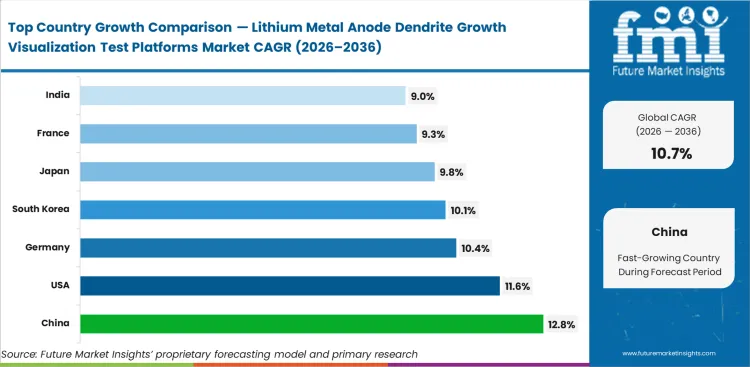
- China is estimated to record a CAGR of 12.8% in the lithium metal anode dendrite growth visualization test platforms market during 2026 to 2036, followed by the United States at 11.6%, Germany at 10.4%, South Korea at 10.1%, Japan at 9.8%, France at 9.3%, and India at 9.0%.
- High instrument cost, complexity in sample handling, limited throughput, and concentration of usage within advanced research environments continue to influence adoption.
- Product and Segment View
- Scope includes optical cells, AFM-based electrochemical platforms, X-ray and tomography systems, cryogenic electron workflows, and magnetic resonance or EPR-linked setups used for lithium-metal dendrite analysis.
- Applications span symmetric-cell studies, half-cell plating tests, solid-state diagnostics, pouch-cell validation, and failure analysis following soft-short events.
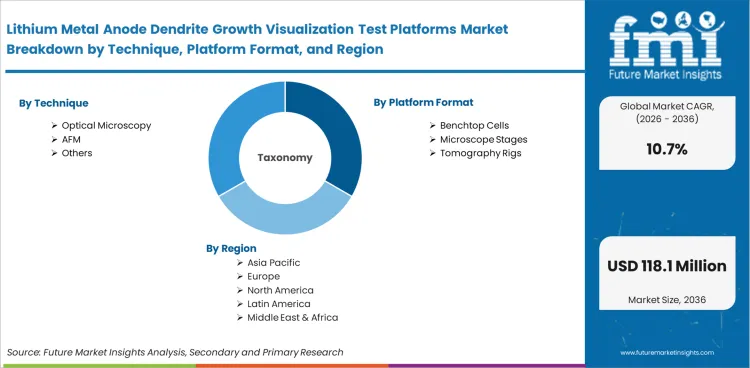
- Optical microscopy is expected to account for 28.0% share of the lithium metal anode dendrite growth visualization test platforms market in 2026 by technique, supported by lower entry cost and compatibility with operando testing.
- Benchtop platforms are projected to capture 34.0% share in 2026 by format, reflecting adoption of modular and microscope-compatible systems in early-stage research.
- Symmetric-cell configurations are anticipated to represent 31.0% share in 2026, as they remain a standard approach for studying lithium plating and stripping behavior.
- Universities are expected to hold 39.0% share in 2026 by end user, reflecting concentration of research activity in academic and public laboratory environments.
- Dendrite imaging is projected to secure 36.0% share in 2026 by application, driven by demand for direct visualization of lithium deposition behavior.
- Coverage includes dedicated operando imaging platforms and compatible test-cell systems, while excluding standard battery cyclers, general environmental chambers, and equipment not designed for direct dendrite visualization.
- Geography and Competitive Outlook
- China, the United States, and Germany are estimated to record higher CAGRs in the lithium metal anode dendrite growth visualization test platforms market during 2026 to 2036, while Japan and South Korea remain stable markets supported by strong battery research capabilities.
- Competitive positioning depends on application-specific workflows, including cryogenic handling capability, operando-compatible fixtures, battery-focused software integration, and multi-modal imaging support.
- Key participants include Bruker Corporation, Carl Zeiss AG, Thermo Fisher Scientific, Oxford Instruments, TESCAN GROUP, Rigaku Corporation, and EL-CELL GmbH.
- Market structure remains fragmented, with leading suppliers estimated to account for significant share, as demand is distributed across imaging systems, sample preparation tools, and specialized test-cell platforms
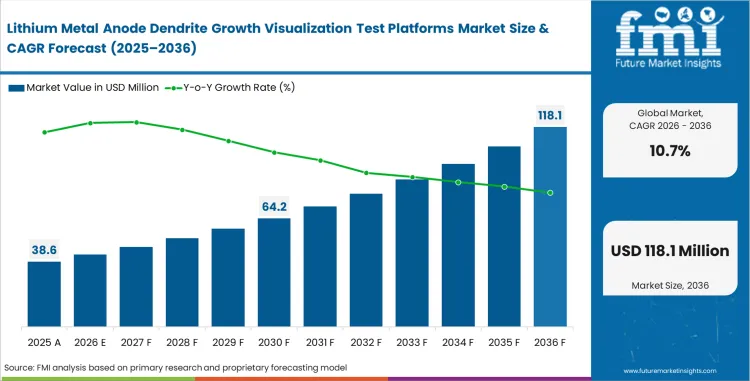
Key Takeaways, Market Size, and Forecast
- The Lithium Metal Anode Dendrite Growth Visualization Test Platforms Market is projected to grow from USD 38.6 million in 2026 to USD 106.8 million by 2036, at a CAGR of 10.7%.
- The market was valued at USD 34.9 million in 2025.
- By 2036, the market is expected to reach USD 106.8 million as demand rises for real‑time operando battery validation.
- From 2026 to 2036, the market is projected to expand at a CAGR of 10.7% driven by solid‑state battery development and advanced failure‑analysis requirements.
- The market is expected to create an incremental opportunity of USD 68.2 million between 2026 and 2036.
- In 2026, Optical Microscopy is expected to account for 28.0% of the technique segment, emerging as the leading modality.
- China (12.8%) and the United States (11.6%) are among the fastest‑growing regional markets, supported by strong battery R&D and pilot‑scale deployment initiatives.
Battery development programs increasingly rely on real-time visualization to identify failure mechanisms within lithium metal anodes. Voltage-based endpoint testing provides limited insight into internal degradation pathways. Imaging systems that capture lithium plating behavior during cycling improve detection of early-stage defects. Delays in adopting advanced test platforms increase the risk of undetected micro-shorts and reduce development efficiency. High-resolution imaging supports precise identification of nucleation sites and material instability.
Integration of pressure-controlled cycling and multi-modal testing systems is improving validation workflows. Combined measurement of physical expansion and electrochemical response enables more accurate performance assessment. Operando imaging platforms reduce testing timelines by eliminating sequential validation steps. Data correlation across mechanical and electrochemical parameters supports faster material qualification and design optimization.
China is estimated to record a CAGR of 12.8% in the lithium metal anode dendrite growth visualization test platforms market during 2026 to 2036, supported by faster solid-state battery pilot deployment and demand for real-time failure analysis. The United States is projected to expand at a CAGR of 11.6% over the same period, reflecting funding-linked requirements for domestic battery validation capability. Germany is expected to grow at 10.4%, driven by upgrades in material characterization infrastructure across automotive programs. South Korea is anticipated to register 10.1%, while Japan records 9.8% through 2036, supported by established testing frameworks. France is projected at 9.3%, followed by India at 9.0%. Regional variation reflects differing safety validation priorities, including early defect detection and thermal risk assessment.
Segmental Analysis
Lithium Metal Anode Dendrite Growth Visualization Test Platforms Market Analysis by Technique
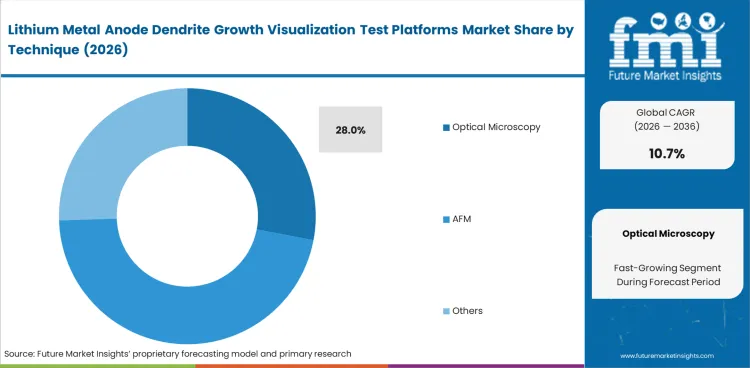
Optical microscopy is anticipated to maintain a leading 28.0% share, as the systems integrate rapidly into standard argon gloveboxes. According to FMI's estimates, chief technology officers at cell startups rely on this modality to rule out plating before escalating to more expensive structural analysis. Securing clear views of macroscopic growth helps engineering teams adjust electrolyte formulations quickly. Optical resolution misses critical solid state battery interphase nanopores, creating a dangerous false sense of security before soft shorts occur. Organizations relying completely on light-based methods risk advancing flawed cathode materials into late-stage pilot testing, where failure costs multiply exponentially.
- Rapid screening deployment: Basic visible-light systems integrate directly inside inert atmospheres without complex vacuum requirements. R&D directors secure immediate qualitative feedback on bulk deposition uniformity across wide anode areas.
- Cryogenic preservation protocols: Utilizing cryo-EM for lithium metal anodes prevents delicate interphase structures from melting under intense electron beam radiation. Startup founders outsource this highly specific imaging step to central academic facilities to avoid massive internal capital expenditures.
- Mechanical stiffness mapping: Deploying AFM for lithium dendrite growth tracking provides unparalleled topographical stiffness data. Material scientists rely on atomic force microscopy to measure exact pressure responses and physical deformation during initial plating cycles.
Lithium Metal Anode Dendrite Growth Visualization Test Platforms Market Analysis by Platform format
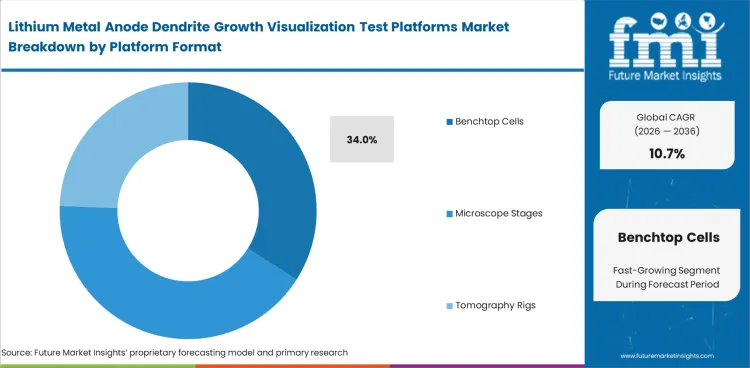
Controlled testing environments must balance isolation from ambient conditions with accessibility for real-time observation. Benchtop configurations allow multiple experiments to run simultaneously while maintaining stable operating conditions. Benchtop platforms is likely to hold 34.0% share of visualization setups in 2026, supported by their ability to generate repeatable datasets across parallel testing systems. Structural deviations from commercial cell formats introduce measurement differences, affecting the accuracy of growth behavior interpretation under real-world pressure conditions.
- Distributed testing capacity: Standalone viewing stations operate independently from expensive central imaging facilities. Lab managers deploy dozens of units simultaneously to generate massive datasets on electrolyte additive performance under varying current densities.
- Optical fixture constraints: Integrating an operando optical battery cell for dendrite imaging introduces uneven mechanical stress across the lithium surface compared to flexible packaging materials. Packaging engineers observe altered plating morphologies that never actually form inside commercial product environments.
- Format scaling penalty: Discoveries made inside specialized viewing vessels require extensive recalibration before pilot line implementation. Manufacturing directors face months of delay adjusting pressure-application parameters to match laboratory findings.
Lithium Metal Anode Dendrite Growth Visualization Test Platforms Market Analysis by Battery configuration
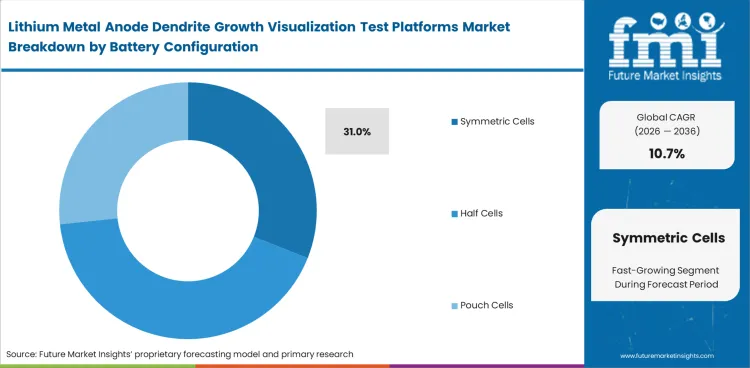
Stripping away complex cathode interactions allows researchers to isolate pure lithium plating behaviors. Symmetric cells are anticipated to command 31.0% share, as they eliminate transition metal dissolution variables from the electrochemical equation. Fundamental material researchers use these configurations to establish baseline reversibility metrics for novel electrolyte designs. Testing anode against anode accelerates experiment turnaround times significantly. Removing the opposing electrode hides severe battery cell module crossover effects that actively poison the interphase during realistic operation. Groups relying solely on symmetric data frequently design separator structures that fail immediately when paired with high-voltage oxide materials.
- Variable isolation logic: Pitting identical lithium electrodes against each other removes complex transition metal dynamics from cycle data. Material scientists evaluate pure stripping efficiency without guessing if capacity fade originates from the opposite terminal.
- Solid-state interface tracking: Transitioning solid-state battery interface visualization workflows to symmetric setups clarifies pure ionic transport limitations. Formulation officers isolate exact resistance bottlenecks happening purely at the solid electrolyte boundary layer.
- Validation sequence enforcement: Passing symmetric cell benchmarks simply acts as a preliminary gate before full-cell verification. Testing directors must re-run visualization protocols using actual cathode pairings to secure final module design approval.
Lithium Metal Anode Dendrite Growth Visualization Test Platforms Market Analysis by End user
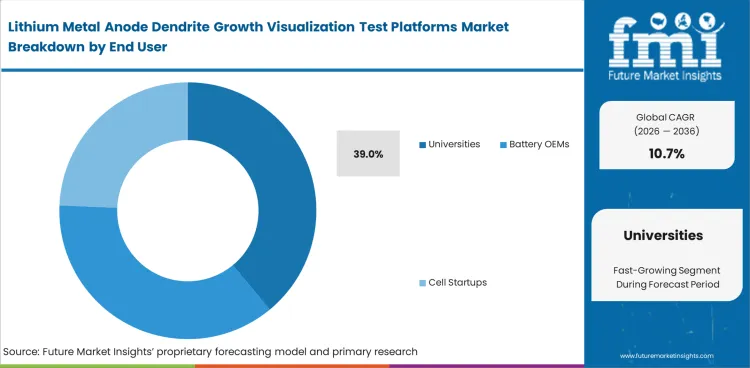
Universities are expected to reach 39.0% share by combining federal research grants to build centralized characterization facilities. Principal investigators utilize these shared labs to publish high-impact structural findings on solid electrolyte interfaces. Consolidating expensive cryo-tomography equipment ensures maximum utilization rates across diverse engineering departments. While academic institutions buy these complex solid-state battery research instruments, commercial cell startups end up renting significant time on them because operating battery energy storage visualization equipment requires highly specialized doctoral training. Startup founders delaying their own equipment purchases trade upfront capital savings for dangerous losses in intellectual property control.
- Grant funding aggregation: Academic consortiums pool multi-agency resources to afford premium multi-modal imaging stations. Facility directors establish regional hubs that serve both internal physics departments and external corporate clients.
- Operational skill bottleneck: Running operando electron microscopy requires distinct expertise combining electrochemistry with advanced optics. Cell startup CEOs realize outsourcing characterization costs less than hiring dedicated staff for occasional troubleshooting sessions.
- Intellectual property friction: Sharing external testing facilities exposes sensitive proprietary electrolyte formulations to public academic environments. Procurement directors eventually justify internal purchases strictly to prevent competitor reverse-engineering during vulnerable early development phases.
Lithium Metal Anode Dendrite Growth Visualization Test Platforms Market Analysis by Application
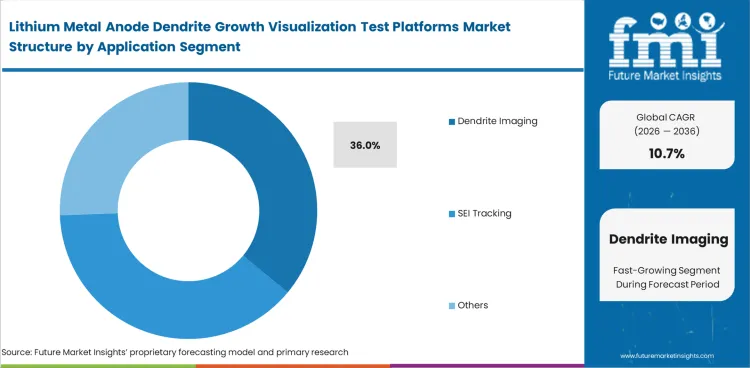
Identifying the exact stage at which a conductive filament bridges two electrodes remains a key safety objective in lithium-metal battery development. Direct visualization supports validation of separator performance under high-stress conditions such as fast charging. Imaging data provides evidence required for safety certification and confirms resistance to internal short formation. Capturing only fully developed dendrites highlights end-stage failure, while interface-level analysis reveals earlier structural degradation mechanisms. Dendrite imaging is expected to account for 36.0% share of the lithium metal anode dendrite growth visualization test platforms market in 2026, reflecting its role in safety validation and failure detection.
- Direct puncture verification: Watching filaments physically contact the opposite electrode provides undeniable proof of mechanical barrier failure. Safety directors use this visual evidence to reject inadequate separator materials before building full-scale prototype packs.
- Soft short diagnosis mapping: Executing soft short diagnosis in lithium metal batteries requires real-time monitoring of subtle voltage dips correlated to localized plating spikes. Research scientists shift focus toward early-stage impedance mapping to understand root causes rather than just admiring the final destruction.
- Regulatory mandate alignment: Upcoming compliance frameworks demand exact visual proof of containment strategies under abuse conditions. Compliance officers mandate operando visualization runs specifically to generate necessary documentation for international transport certifications.
Lithium Metal Anode Dendrite Growth Visualization Test Platforms Market Drivers, Restraints, and Opportunities
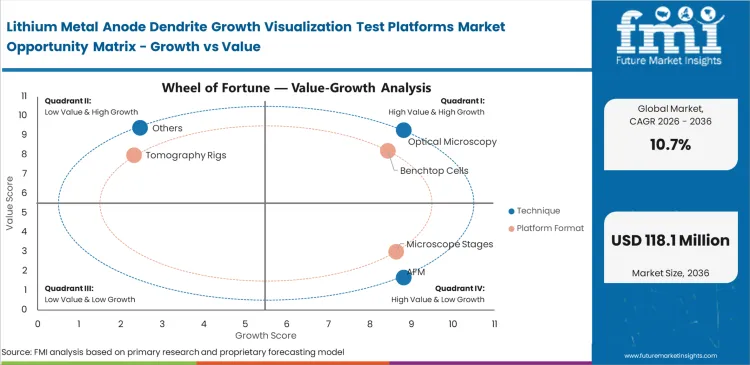
Solid-state cell developers must validate commercial cycle life to secure ongoing capital investment. Suppressing lithium filament growth under high current densities remains a primary requirement for reaching standard cycling benchmarks. Direct visualization provides the necessary operational proof that proprietary protective coatings function correctly. Post-cycle teardowns offer delayed feedback, often identifying interface failure long after the initial defect occurs. Operando visualization platforms enable engineering teams to detect nucleation events in real time, allowing for immediate adjustment of pressure and temperature parameters. Continuous monitoring prevents prolonged iteration cycles and reduces capital expenditure associated with unguided failure analysis.
Beam damage from high-energy electron sources fundamentally alters lithium morphology during active observation. Material scientists must bombard the sample with intense radiation to achieve nanometer resolution, which ironically melts or deforms the exact delicate structures they attempt to measure. This physical contradiction slows high-resolution adoption because interpreting the resulting images requires untangling natural electrochemical growth from electron-beam artifacts. Cryogenic techniques partially freeze the structure to limit damage, but cooling the sample stops the electrochemical reaction entirely. Instrument vendors attempt to balance dose rates with detector sensitivity, yet finding the optimal threshold remains a severe operational hurdle for new laboratory technicians.
Opportunities in the Lithium Metal Anode Dendrite Growth Visualization Test Platforms Market
- AI-driven defect prediction: Integrating machine learning algorithms directly into real-time optical feeds. Software engineers train models to recognize microscopic nucleation patterns seconds before runaway growth begins.
- Inline manufacturing adaptation: Transitioning benchtop diagnostic sensors into roll-to-roll production monitoring systems. Quality control directors flag defective battery manufacturing anode coatings before assembling them into final pouch formats.
- Interface evolution tracking: Developing specific SEI evolution imaging tools to monitor continuous chemical degradation cycles. Research scientists gain immediate correlations between rising internal resistance and physical volume expansion over extended battery lifespans.
Regional Analysis
Based on regional analysis, Lithium Metal Anode Dendrite Growth Visualization Test Platforms is segmented into North America, Latin America, Western Europe, Eastern Europe, East Asia, South Asia and Pacific, and Middle East and Africa across 40 plus countries.
.webp "Top Country Growth Comparison Lithium Metal Anode Dendrite Growth Visualization Test Platforms Market Cagr (2026 2036)")
| Country | CAGR (2026 to 2036) |
|---|---|
| China | 12.8% |
| United States | 11.6% |
| Germany | 10.4% |
| South Korea | 10.1% |
| Japan | 9.8% |
| France | 9.3% |
| India | 9.0% |
Source: Future Market Insights (FMI) analysis, based on proprietary forecasting model and primary research
East Asia Lithium Metal Anode Dendrite Growth Visualization Test Platforms Market Analysis
Solid-state commercialization timelines mandate completely new material characterization protocols across Asian production hubs. Gigafactory pilot lines require immediate diagnostic feedback to minimize scrap rates during initial capacity scaling. Facility directors mandate operando imaging integration to catch interface delamination before completing entire battery modules. Based on FMI's assessment, strong localized supply chains for electron microscopy components lower procurement barriers significantly for regional cell startups. Relying on imported diagnostic tools previously slowed iteration cycles, but domestic instrument manufacturers now provide custom vacuum stages specifically tailored for local pouch cell form factors.
- China: Demand for lithium metal anode dendrite visualization platforms in China is anticipated to rise at a CAGR of 12.8% from 2026 to 2036. Large-scale gigafactory expansion under state-backed programs creates pressure to maintain yield during early production stages. Manufacturing teams rely on inline imaging systems to identify plating defects before they impact full cell assembly. Funding approvals for next-generation battery chemistries require clear validation of dendrite suppression performance. Equipment selection is closely tied to these compliance requirements. Domestic suppliers support faster deployment by offering customized systems suited to local cell designs. This alignment between policy, production, and validation continues to support steady demand.
- South Korea: Prominent consumer electronics conglomerates leverage legacy semiconductor testing infrastructure to accelerate battery interface analysis. Research scientists adapt existing wafer-inspection tools to monitor electrochemical swelling. The market growth is anticipated to expand at 10.1% through 2036. Adapting these legacy workflows allows domestic companies to outpace competitors in rapid cell prototyping.
- Japan: Strict automotive safety validation frameworks shape demand for battery testing systems in Japan. Research institutions and industrial labs focus on detailed imaging of separator behavior under stress conditions. Tomographic techniques are widely used to assess failure risks before vehicle integration. The market for lithium metal anode dendrite visualization platforms in Japan is projected to reach a CAGR of 9.8% between 2026 and 2036. Compliance requirements define testing protocols across the country. Equipment is selected based on its ability to provide reproducible and high-resolution results. These standards support long-term supplier relationships with automotive manufacturers.
North America Lithium Metal Anode Dendrite Growth Visualization Test Platforms Market Analysis
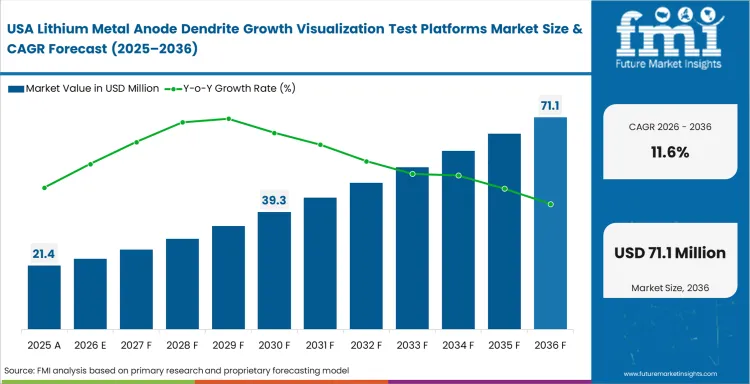
Federal funding mandates requiring native supply chain development push laboratories to build localized qualification capabilities. National research facilities prioritize high-end tomographic setups to support domestic startup ecosystems lacking private testing infrastructure. FMI's analysis indicates that grant stipulations explicitly favor projects incorporating real-time degradation monitoring. Pushing fundamental material science forward remains a primary focus, rather than pure manufacturing throughput. Academic consortiums consolidate their purchasing power to secure multi-modal platforms that individual corporate players cannot justify independently.
- United States: The United States lithium metal anode dendrite visualization platform market is expected to expand at a CAGR of 11.6%. Federal programs support the creation of centralized battery characterization facilities across the country. Laboratories invest in cryogenic electron microscopy and operando imaging systems to support detailed failure analysis. These shared facilities reduce capital requirements for startups and smaller manufacturers. Access to advanced testing infrastructure improves participation across the domestic battery ecosystem. Procurement decisions are often influenced by grant eligibility criteria. This structure supports consistent adoption across research and early-stage production environments.
Western Europe Lithium Metal Anode Dendrite Growth Visualization Test Platforms Market Analysis
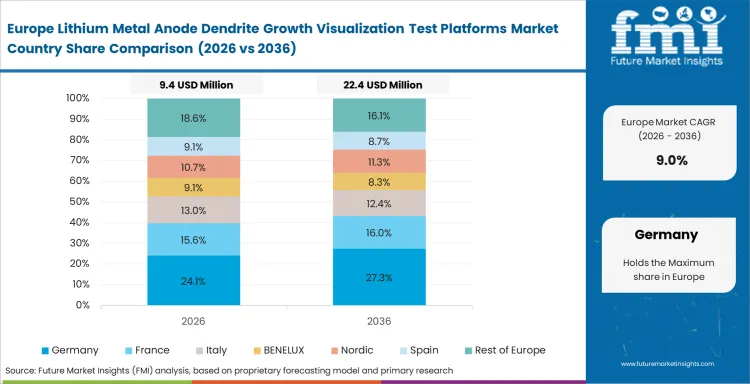
Legacy automotive consortiums retrofitting their internal combustion engineering labs dictate testing procurement strategies here. Material science teams pivot from mechanical stress testing to electrochemical interface tracking. In FMI's view, cross-border collaborative research projects pool capital to establish standardized battery validation protocols. Creating unified safety metrics requires equipment that produces universally reproducible imaging data. Regional instrumentation companies focus heavily on environmental stage adaptability to accommodate diverse cell prototypes emerging from various European research initiatives.
- Germany: Germany’s automotive sector drives demand for advanced battery testing platforms as manufacturers transition toward solid-state technologies. Internal laboratories are upgraded to support detailed interface characterization and early-stage defect analysis. The country is anticipated to record a CAGR of 10.4% in lithium metal anode dendrite visualization platforms during 2026 to 2036. Equipment selection depends on compatibility with existing automotive data systems used for product development. Traceability requirements for EV batteries require accurate morphology tracking from initial testing stages. These operational needs shape procurement strategies across OEMs and suppliers.
- France: Specialized aerospace engineering hubs adapt extreme-environment testing vessels for battery failure analysis. Test engineers evaluate lithium plating behavior under simulated high-altitude pressure gradients. Sales are expected to climb at 9.3% over the study period. Discovering novel interface behaviors under extreme conditions positions regional suppliers uniquely within niche aviation electrification contracts.
FMI's report includes United Kingdom, Italy, Spain, Canada, and Brazil. Diverse climate conditions across these unlisted nations drive specific regional demands for temperature-controlled operando stages capable of simulating extreme weather cycling behaviors.
Competitive Aligners for Market Players
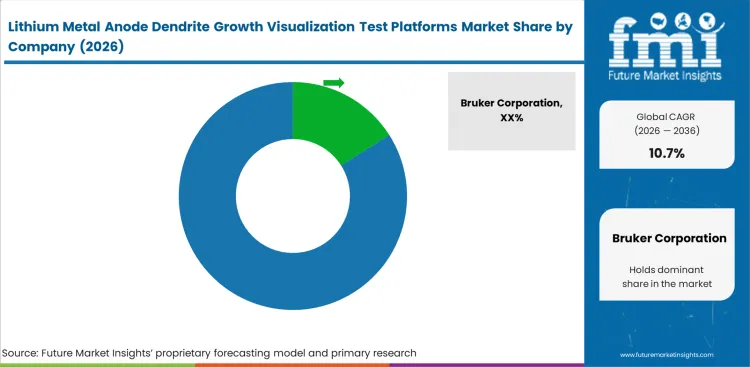
Instrumentation design in this segment must balance high-vacuum imaging requirements with reactive electrochemical environments. Established suppliers such as Carl Zeiss AG and Thermo Fisher Scientific supply core imaging platforms based on electron and X-ray technologies. Specialized providers such as EL-CELL GmbH focus on electrochemical test cells that integrate within these systems. Procurement decisions increasingly depend on compatibility between imaging platforms, sample holders, and battery cycling equipment rather than resolution alone.
Software capability and data integration define long-term supplier positioning. Established vendors maintain advantage through proprietary data processing and synchronization tools. Reconstruction of multi-layer imaging data into usable analytical models requires advanced algorithms, which increases switching complexity. Smaller suppliers focus on adapter systems and specialized components to ensure compatibility with existing platforms. Mechanical innovations such as pressure-controlled viewing interfaces support differentiation during system integration.
Large-scale testing facilities prioritize interoperability across equipment platforms. Procurement specifications increasingly require modular systems that can operate across different microscope brands without disrupting vacuum conditions. Standardization of mounting interfaces becomes necessary to support multi-vendor environments. Hardware differentiation continues to narrow, shifting value toward software-driven analysis. Automated detection of early-stage anomalies through image processing tools is becoming a key factor in supplier selection.
Key Players in Lithium Metal Anode Dendrite Growth Visualization Test Platforms Market
- Bruker Corporation
- Carl Zeiss AG
- Thermo Fisher Scientific
- Oxford Instruments
- TESCAN GROUP
- Rigaku Corporation
- EL-CELL GmbH
Scope of the Report
| Metric | Value |
|---|---|
| Quantitative Units | USD 38.6 million to USD 106.8 million, at a CAGR of 10.7% |
| Market Definition | Analytical instrumentation engineered for operando monitoring of electrochemical plating while maintaining active cell cycling conditions. |
| Segmentation | Technique, Platform format, Battery configuration, End user, Application |
| Regions Covered | North America, Latin America, Western Europe, Eastern Europe, East Asia, South Asia and Pacific, Middle East and Africa |
| Countries Covered | China, United States, Germany, South Korea, Japan, France, India |
| Key Companies Profiled | Bruker Corporation, Carl Zeiss AG, Thermo Fisher Scientific, Oxford Instruments, TESCAN GROUP, Rigaku Corporation, EL-CELL GmbH |
| Forecast Period | 2026 to 2036 |
| Approach | Validating capital expenditure budgets across pilot line facilities. |
Source: Future Market Insights (FMI) analysis, based on proprietary forecasting model and primary research
Lithium Metal Anode Dendrite Growth Visualization Test Platforms Market Analysis by Segments
Technique
- Optical microscopy
- AFM
- X-ray tomography
- Cryo-EM
- NMR/EPR
Platform format
- Benchtop cells
- Microscope stages
- Tomography rigs
- Cryo holders
- Multi-modal setups
Battery configuration
- Symmetric cells
- Half cells
- Solid-state cells
- Pouch cells
- Coin cells
End user
- Universities
- National labs
- Battery OEMs
- Cell startups
- Instrument centers
Application
- Dendrite imaging
- SEI tracking
- Interface failure
- Short diagnosis
- Pressure studies
Region:
- North America
- United States
- Canada
- Europe
- Germany
- United Kingdom
- France
- Italy
- Spain
- Asia Pacific
- China
- Japan
- South Korea
- Taiwan
- Singapore
- Latin America
- Brazil
- Mexico
- Argentina
- Middle East & Africa
- GCC Countries
- South Africa
- Israel
Bibliography
- Costa, C. M., Lanceros-Méndez, S., & Vilas-Boas, M. (2025). An overview of solid-state lithium metal batteries: Materials, technologies, and future perspectives. Energy Materials and Devices.
- Han, X., et al. (2024). Operando monitoring of dendrite formation in lithium metal batteries with an inserted optical fiber sensor. Nature Communications.
- , Y., et al. (2026). In situ EPR imaging for lithium/sodium batteries. Cell Reports Physical Science.
- Kim, S. Y., et al. (2025). Predicting dendrite growth in lithium metal batteries with machine learning and first-principles modeling. npj Computational Materials.
- Liang, Y., et al. (2024). Review of the Real-Time Monitoring Technologies for Rechargeable Lithium Batteries. Molecules.
This bibliography is provided for reader reference. The full FMI report contains the complete reference list with primary source documentation.
This Report Addresses
- Optical microscopy integration requirements within standard argon gloveboxes for rapid screening.
- Benchtop cell artifacts causing pressure distribution deviations during extended cycle life testing.
- Crossover blindness risks associated with symmetric cell baseline reversibility metrics.
- Cryo-EM operational skill bottlenecks forcing cell startups to outsource fundamental characterization.
- Direct puncture verification techniques necessary for passing upcoming automotive safety frameworks.
- Electron beam damage mechanisms altering true lithium morphology during active high-resolution observation.
- Interoperability mandates driving modular environmental chamber designs across diverse imaging platforms.
- Federal supply chain qualification grants funding centralized tomography labs across North America.
Frequently Asked Questions
What is a lithium dendrite visualization platform?
These platforms are specialized analytical instruments designed for operando or in-situ monitoring of electrochemical plating. They maintain active cell cycling while capturing spatial, morphological, or chemical changes at anode interfaces without breaking internal seals.
How do researchers visualize lithium dendrite growth?
Scientists utilize a combination of optical tools, cryogenic preservation, atomic force measurements, and tomographic setups. Each technique balances image resolution against the potential for altering the delicate electrochemical structures through external radiation or pressure interference.
Which techniques detect lithium metal dendrites in real time?
Optical microscopy provides the fastest real-time screening capability, while advanced researchers increasingly deploy X-ray tomography for battery dendrites to track three-dimensional volumetric expansion continuously during active charge and discharge cycles.
How large is the lithium dendrite visualization market?
Demand is estimated to reach USD 106.8 million by 2036. Sustained capital investment drives this buildup as pilot lines completely abandon post-mortem cell tear-downs in favor of continuous operando cycling validation strategies.
Explain the lithium metal dendrite growth visualization test platforms market projection?
Sales advance at a 10.7% CAGR through the forecast period. Aggressive solid-state commercialization deadlines force testing facilities to upgrade their characterization tools rapidly before next-round investor funding expires.
Which companies sell lithium dendrite imaging platforms?
Major incumbent instrumentation conglomerates like Carl Zeiss AG, Thermo Fisher Scientific, and Bruker Corporation supply the foundational microscopes, while boutique firms like EL-CELL GmbH design the highly specific specialized electrochemical sample stages.
Compare AFM, cryo-EM, and XCT for lithium dendrite imaging?
AFM provides precise mechanical stiffness data at the surface, cryo-EM achieves nanometer resolution by freezing delicate structures to prevent beam damage, and X-ray tomography offers three-dimensional internal mapping without requiring destructive sample cross-sectioning.
What is the best platform for lithium plating visualization?
Selection depends entirely on the operational phase. Optical microscopy serves rapid electrolyte screening efficiently, while late-stage qualification strictly requires multi-modal platforms combining X-ray data with precise electrochemical impedance measurements.
AFM vs cryo-EM for lithium dendrite imaging?
Atomic force microscopy excels at mapping physical pressure responses and topological deformation, whereas cryo-EM is mandatory when researchers need to resolve the exact chemical composition of the solid electrolyte interphase at the atomic level.
How do benchtop platforms alter true cell behavior?
Rigid viewing windows create uneven mechanical stress across the lithium surface compared to flexible pouch materials. Packaging engineers frequently observe altered plating morphologies that never actually form inside commercial product environments.
What hides crossover effects during interface testing?
Symmetric cell configurations command 31.0% share by isolating pure lithium behavior, but removing the opposing oxide electrode prevents trace transition metals from migrating. This hides critical interphase poisoning mechanisms.
Why do universities purchase the most expensive imaging rigs?
Academic institutions account for 39.0% share by aggressively pooling federal research grants. Consolidating complex cryo-tomography equipment ensures maximum utilization rates while offering specialized analytical services to commercial startups.
How does electron beam exposure affect measurement accuracy?
Bombarding samples with high-energy radiation to achieve nanometer resolution physically melts or deforms delicate solid electrolyte structures. Interpreting images requires untangling natural electrochemical growth from severe electron-beam damage artifacts.
What structural difference places China ahead of other regions?
China expands at 12.8% because massive state-subsidized gigafactory scaling initiatives force plant managers to implement inline diagnostic tools instantly. Establishing visual proof of dendrite suppression secures crucial ongoing government allocations.
How do automotive legacy labs in Germany adapt?
Germany grows at 10.4% as deeply entrenched automotive OEMs transform internal combustion engineering labs into solid-state validation centers. Testing directors prioritize equipment that interfaces with existing proprietary data management backbones.
What specific risk do startup founders face when renting lab time?
Sharing external academic testing facilities exposes sensitive proprietary electrolyte formulations to public environments. Procurement directors eventually justify internal hardware purchases strictly to prevent competitor reverse-engineering.
Why is direct puncture verification critical for commercialization?
Safety certification engineers utilize direct visual evidence to prove their separator designs resist penetration under extreme fast-charging conditions. Documenting physical barrier integrity provides irrefutable data for international regulatory submissions.
What creates true vendor lock-in for imaging conglomerates?
Writing proprietary algorithms to stitch together thousands of X-ray slices into a 3D prediction model tethers researchers to specific software ecosystems. Hardware represents just the entry point for massive ongoing software licensing fees.
How do challengers disrupt established optics manufacturers?
Specialized boutique firms build unique adapter kits that bypass proprietary software moats. Securing patents on pressure-controlled viewing windows offers smaller companies immense advantage against larger conglomerates lacking internal electrochemistry expertise.
What limits widespread cryo-electron microscopy deployment?
Running operando electron microscopy requires distinct doctoral expertise combining fundamental electrochemistry with advanced optics manipulation. Finding personnel possessing both skill sets remains a severe operational hurdle for new diagnostic laboratories.
Why do North American labs favor centralized tomography hubs?
Department of Energy initiatives specifically fund advanced characterization centers to lower entry barriers for domestic cell manufacturers. Startups bypass massive capital expenditures while retaining access to critical failure analysis capabilities.
How do flexible pouch cells complicate real-time visualization?
Maintaining consistent stack pressure while allowing optical probe access presents a massive mechanical contradiction. Custom stages struggle to apply uniform force without blocking the necessary viewing pathways required for accurate data capture.
What differentiates dendrite imaging from interface failure tracking?
Capturing images of mature metallic protrusions only registers the final symptom. Advanced tracking focuses on early-stage impedance mapping and nanopore formation to understand root causes long before macroscopic filaments appear.
How do Japanese testing consortiums influence equipment design?
Japan tracks at 9.8% due to stringent domestic safety protocols mandating exact visualization of thermal runaway triggers. Perfecting specialized test rigs grants regional instrumentation firms exclusive supplier status with top-tier mobility brands.
Preview the report firsthand - request a free sample
Get SampleGet the brochure for pricing and purchase details.
Get PDFTable of Content
- Executive Summary
- Global Market Outlook
- Demand-side Trends
- Supply-side Trends
- Technology Roadmap Analysis
- Analysis and Recommendations
- Market Overview
- Market Coverage / Taxonomy
- Market Definition / Scope / Limitations
- Research Methodology
- Chapter Orientation
- Analytical Lens and Working Hypotheses
- Market Structure, Signals, and Trend Drivers
- Benchmarking and Cross-market Comparability
- Market Sizing, Forecasting, and Opportunity Mapping
- Research Design and Evidence Framework
- Desk Research Programme (Secondary Evidence)
- Company Annual and Sustainability Reports
- Peer-reviewed Journals and Academic Literature
- Corporate Websites, Product Literature, and Technical Notes
- Earnings Decks and Investor Briefings
- Statutory Filings and Regulatory Disclosures
- Technical White Papers and Standards Notes
- Trade Journals, Industry Magazines, and Analyst Briefs
- Conference Proceedings, Webinars, and Seminar Materials
- Government Statistics Portals and Public Data Releases
- Press Releases and Reputable Media Coverage
- Specialist Newsletters and Curated Briefings
- Sector Databases and Reference Repositories
- FMI Internal Proprietary Databases and Historical Market Datasets
- Subscription Datasets and Paid Sources
- Social Channels, Communities, and Digital Listening Inputs
- Additional Desk Sources
- Expert Input and Fieldwork (Primary Evidence)
- Primary Modes
- Qualitative Interviews and Expert Elicitation
- Quantitative Surveys and Structured Data Capture
- Blended Approach
- Why Primary Evidence is Used
- Field Techniques
- Interviews
- Surveys
- Focus Groups
- Observational and In-context Research
- Social and Community Interactions
- Stakeholder Universe Engaged
- C-suite Leaders
- Board Members
- Presidents and Vice Presidents
- R&D and Innovation Heads
- Technical Specialists
- Domain Subject-matter Experts
- Scientists
- Physicians and Other Healthcare Professionals
- Governance, Ethics, and Data Stewardship
- Research Ethics
- Data Integrity and Handling
- Primary Modes
- Tooling, Models, and Reference Databases
- Desk Research Programme (Secondary Evidence)
- Data Engineering and Model Build
- Data Acquisition and Ingestion
- Cleaning, Normalisation, and Verification
- Synthesis, Triangulation, and Analysis
- Quality Assurance and Audit Trail
- Market Background
- Market Dynamics
- Drivers
- Restraints
- Opportunity
- Trends
- Scenario Forecast
- Demand in Optimistic Scenario
- Demand in Likely Scenario
- Demand in Conservative Scenario
- Opportunity Map Analysis
- Product Life Cycle Analysis
- Supply Chain Analysis
- Investment Feasibility Matrix
- Value Chain Analysis
- PESTLE and Porter’s Analysis
- Regulatory Landscape
- Regional Parent Market Outlook
- Production and Consumption Statistics
- Import and Export Statistics
- Market Dynamics
- Global Market Analysis 2021 to 2025 and Forecast, 2026 to 2036
- Historical Market Size Value (USD Million) Analysis, 2021 to 2025
- Current and Future Market Size Value (USD Million) Projections, 2026 to 2036
- Y-o-Y Growth Trend Analysis
- Absolute $ Opportunity Analysis
- Global Market Pricing Analysis 2021 to 2025 and Forecast 2026 to 2036
- Global Market Analysis 2021 to 2025 and Forecast 2026 to 2036, By Technique
- Introduction / Key Findings
- Historical Market Size Value (USD Million) Analysis By Technique , 2021 to 2025
- Current and Future Market Size Value (USD Million) Analysis and Forecast By Technique , 2026 to 2036
- Optical Microscopy
- AFM
- Others
- Optical Microscopy
- Y-o-Y Growth Trend Analysis By Technique , 2021 to 2025
- Absolute $ Opportunity Analysis By Technique , 2026 to 2036
- Global Market Analysis 2021 to 2025 and Forecast 2026 to 2036, By Platform Format
- Introduction / Key Findings
- Historical Market Size Value (USD Million) Analysis By Platform Format, 2021 to 2025
- Current and Future Market Size Value (USD Million) Analysis and Forecast By Platform Format, 2026 to 2036
- Benchtop Cells
- Microscope Stages
- Tomography Rigs
- Benchtop Cells
- Y-o-Y Growth Trend Analysis By Platform Format, 2021 to 2025
- Absolute $ Opportunity Analysis By Platform Format, 2026 to 2036
- Global Market Analysis 2021 to 2025 and Forecast 2026 to 2036, By Battery Configuration
- Introduction / Key Findings
- Historical Market Size Value (USD Million) Analysis By Battery Configuration, 2021 to 2025
- Current and Future Market Size Value (USD Million) Analysis and Forecast By Battery Configuration, 2026 to 2036
- Symmetric Cells
- Half Cells
- Pouch Cells
- Symmetric Cells
- Y-o-Y Growth Trend Analysis By Battery Configuration, 2021 to 2025
- Absolute $ Opportunity Analysis By Battery Configuration, 2026 to 2036
- Global Market Analysis 2021 to 2025 and Forecast 2026 to 2036, By End User
- Introduction / Key Findings
- Historical Market Size Value (USD Million) Analysis By End User, 2021 to 2025
- Current and Future Market Size Value (USD Million) Analysis and Forecast By End User, 2026 to 2036
- Universities
- Battery OEMs
- Cell Startups
- Universities
- Y-o-Y Growth Trend Analysis By End User, 2021 to 2025
- Absolute $ Opportunity Analysis By End User, 2026 to 2036
- Global Market Analysis 2021 to 2025 and Forecast 2026 to 2036, By Application
- Introduction / Key Findings
- Historical Market Size Value (USD Million) Analysis By Application, 2021 to 2025
- Current and Future Market Size Value (USD Million) Analysis and Forecast By Application, 2026 to 2036
- Dendrite Imaging
- SEI Tracking
- Others
- Dendrite Imaging
- Y-o-Y Growth Trend Analysis By Application, 2021 to 2025
- Absolute $ Opportunity Analysis By Application, 2026 to 2036
- Global Market Analysis 2021 to 2025 and Forecast 2026 to 2036, By Region
- Introduction
- Historical Market Size Value (USD Million) Analysis By Region, 2021 to 2025
- Current Market Size Value (USD Million) Analysis and Forecast By Region, 2026 to 2036
- North America
- Latin America
- Western Europe
- Eastern Europe
- East Asia
- South Asia and Pacific
- Middle East & Africa
- Market Attractiveness Analysis By Region
- North America Market Analysis 2021 to 2025 and Forecast 2026 to 2036, By Country
- Historical Market Size Value (USD Million) Trend Analysis By Market Taxonomy, 2021 to 2025
- Market Size Value (USD Million) Forecast By Market Taxonomy, 2026 to 2036
- By Country
- USA
- Canada
- Mexico
- By Technique
- By Platform Format
- By Battery Configuration
- By End User
- By Application
- By Country
- Market Attractiveness Analysis
- By Country
- By Technique
- By Platform Format
- By Battery Configuration
- By End User
- By Application
- Key Takeaways
- Latin America Market Analysis 2021 to 2025 and Forecast 2026 to 2036, By Country
- Historical Market Size Value (USD Million) Trend Analysis By Market Taxonomy, 2021 to 2025
- Market Size Value (USD Million) Forecast By Market Taxonomy, 2026 to 2036
- By Country
- Brazil
- Chile
- Rest of Latin America
- By Technique
- By Platform Format
- By Battery Configuration
- By End User
- By Application
- By Country
- Market Attractiveness Analysis
- By Country
- By Technique
- By Platform Format
- By Battery Configuration
- By End User
- By Application
- Key Takeaways
- Western Europe Market Analysis 2021 to 2025 and Forecast 2026 to 2036, By Country
- Historical Market Size Value (USD Million) Trend Analysis By Market Taxonomy, 2021 to 2025
- Market Size Value (USD Million) Forecast By Market Taxonomy, 2026 to 2036
- By Country
- Germany
- UK
- Italy
- Spain
- France
- Nordic
- BENELUX
- Rest of Western Europe
- By Technique
- By Platform Format
- By Battery Configuration
- By End User
- By Application
- By Country
- Market Attractiveness Analysis
- By Country
- By Technique
- By Platform Format
- By Battery Configuration
- By End User
- By Application
- Key Takeaways
- Eastern Europe Market Analysis 2021 to 2025 and Forecast 2026 to 2036, By Country
- Historical Market Size Value (USD Million) Trend Analysis By Market Taxonomy, 2021 to 2025
- Market Size Value (USD Million) Forecast By Market Taxonomy, 2026 to 2036
- By Country
- Russia
- Poland
- Hungary
- Balkan & Baltic
- Rest of Eastern Europe
- By Technique
- By Platform Format
- By Battery Configuration
- By End User
- By Application
- By Country
- Market Attractiveness Analysis
- By Country
- By Technique
- By Platform Format
- By Battery Configuration
- By End User
- By Application
- Key Takeaways
- East Asia Market Analysis 2021 to 2025 and Forecast 2026 to 2036, By Country
- Historical Market Size Value (USD Million) Trend Analysis By Market Taxonomy, 2021 to 2025
- Market Size Value (USD Million) Forecast By Market Taxonomy, 2026 to 2036
- By Country
- China
- Japan
- South Korea
- By Technique
- By Platform Format
- By Battery Configuration
- By End User
- By Application
- By Country
- Market Attractiveness Analysis
- By Country
- By Technique
- By Platform Format
- By Battery Configuration
- By End User
- By Application
- Key Takeaways
- South Asia and Pacific Market Analysis 2021 to 2025 and Forecast 2026 to 2036, By Country
- Historical Market Size Value (USD Million) Trend Analysis By Market Taxonomy, 2021 to 2025
- Market Size Value (USD Million) Forecast By Market Taxonomy, 2026 to 2036
- By Country
- India
- ASEAN
- Australia & New Zealand
- Rest of South Asia and Pacific
- By Technique
- By Platform Format
- By Battery Configuration
- By End User
- By Application
- By Country
- Market Attractiveness Analysis
- By Country
- By Technique
- By Platform Format
- By Battery Configuration
- By End User
- By Application
- Key Takeaways
- Middle East & Africa Market Analysis 2021 to 2025 and Forecast 2026 to 2036, By Country
- Historical Market Size Value (USD Million) Trend Analysis By Market Taxonomy, 2021 to 2025
- Market Size Value (USD Million) Forecast By Market Taxonomy, 2026 to 2036
- By Country
- Kingdom of Saudi Arabia
- Other GCC Countries
- Turkiye
- South Africa
- Other African Union
- Rest of Middle East & Africa
- By Technique
- By Platform Format
- By Battery Configuration
- By End User
- By Application
- By Country
- Market Attractiveness Analysis
- By Country
- By Technique
- By Platform Format
- By Battery Configuration
- By End User
- By Application
- Key Takeaways
- Key Countries Market Analysis
- USA
- Pricing Analysis
- Market Share Analysis, 2025
- By Technique
- By Platform Format
- By Battery Configuration
- By End User
- By Application
- Canada
- Pricing Analysis
- Market Share Analysis, 2025
- By Technique
- By Platform Format
- By Battery Configuration
- By End User
- By Application
- Mexico
- Pricing Analysis
- Market Share Analysis, 2025
- By Technique
- By Platform Format
- By Battery Configuration
- By End User
- By Application
- Brazil
- Pricing Analysis
- Market Share Analysis, 2025
- By Technique
- By Platform Format
- By Battery Configuration
- By End User
- By Application
- Chile
- Pricing Analysis
- Market Share Analysis, 2025
- By Technique
- By Platform Format
- By Battery Configuration
- By End User
- By Application
- Germany
- Pricing Analysis
- Market Share Analysis, 2025
- By Technique
- By Platform Format
- By Battery Configuration
- By End User
- By Application
- UK
- Pricing Analysis
- Market Share Analysis, 2025
- By Technique
- By Platform Format
- By Battery Configuration
- By End User
- By Application
- Italy
- Pricing Analysis
- Market Share Analysis, 2025
- By Technique
- By Platform Format
- By Battery Configuration
- By End User
- By Application
- Spain
- Pricing Analysis
- Market Share Analysis, 2025
- By Technique
- By Platform Format
- By Battery Configuration
- By End User
- By Application
- France
- Pricing Analysis
- Market Share Analysis, 2025
- By Technique
- By Platform Format
- By Battery Configuration
- By End User
- By Application
- India
- Pricing Analysis
- Market Share Analysis, 2025
- By Technique
- By Platform Format
- By Battery Configuration
- By End User
- By Application
- ASEAN
- Pricing Analysis
- Market Share Analysis, 2025
- By Technique
- By Platform Format
- By Battery Configuration
- By End User
- By Application
- Australia & New Zealand
- Pricing Analysis
- Market Share Analysis, 2025
- By Technique
- By Platform Format
- By Battery Configuration
- By End User
- By Application
- China
- Pricing Analysis
- Market Share Analysis, 2025
- By Technique
- By Platform Format
- By Battery Configuration
- By End User
- By Application
- Japan
- Pricing Analysis
- Market Share Analysis, 2025
- By Technique
- By Platform Format
- By Battery Configuration
- By End User
- By Application
- South Korea
- Pricing Analysis
- Market Share Analysis, 2025
- By Technique
- By Platform Format
- By Battery Configuration
- By End User
- By Application
- Russia
- Pricing Analysis
- Market Share Analysis, 2025
- By Technique
- By Platform Format
- By Battery Configuration
- By End User
- By Application
- Poland
- Pricing Analysis
- Market Share Analysis, 2025
- By Technique
- By Platform Format
- By Battery Configuration
- By End User
- By Application
- Hungary
- Pricing Analysis
- Market Share Analysis, 2025
- By Technique
- By Platform Format
- By Battery Configuration
- By End User
- By Application
- Kingdom of Saudi Arabia
- Pricing Analysis
- Market Share Analysis, 2025
- By Technique
- By Platform Format
- By Battery Configuration
- By End User
- By Application
- Turkiye
- Pricing Analysis
- Market Share Analysis, 2025
- By Technique
- By Platform Format
- By Battery Configuration
- By End User
- By Application
- South Africa
- Pricing Analysis
- Market Share Analysis, 2025
- By Technique
- By Platform Format
- By Battery Configuration
- By End User
- By Application
- USA
- Market Structure Analysis
- Competition Dashboard
- Competition Benchmarking
- Market Share Analysis of Top Players
- By Regional
- By Technique
- By Platform Format
- By Battery Configuration
- By End User
- By Application
- Competition Analysis
- Competition Deep Dive
- Bruker Corporation
- Overview
- Product Portfolio
- Profitability by Market Segments (Product/Age /Sales Channel/Region)
- Sales Footprint
- Strategy Overview
- Marketing Strategy
- Product Strategy
- Channel Strategy
- Carl Zeiss AG
- Thermo Fisher Scientific
- Oxford Instruments
- TESCAN GROUP
- Rigaku Corporation
- EL-CELL GmbH
- Bruker Corporation
- Competition Deep Dive
- Assumptions & Acronyms Used


