

- Market Size (2026)
- USD 0.9 Bn
- Forecast (2036)
- USD 2.3 Bn
- CAGR (2026 to 2036)
- 10%
Biosimilar Monoclonal Antibody Comparability Test Platforms Market Size, Market Forecast and Outlook by FMI
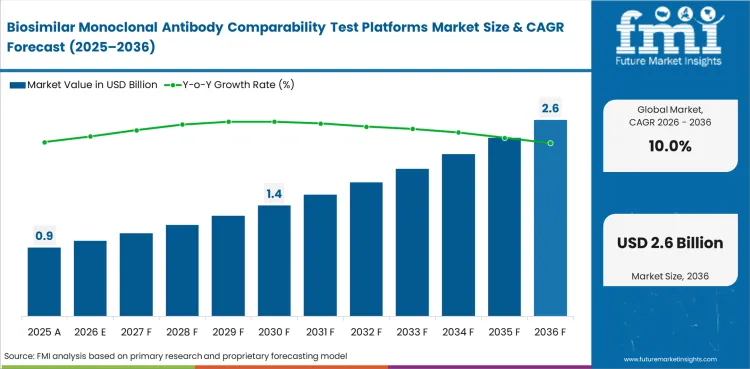
Biosimilar monoclonal antibody comparability test platforms market crossed a valuation of USD 0.8 billion in 2025 and is projected to reach USD 0.9 billion in 2026. By 2036, the market is forecast to expand to USD 2.3 billion at a 10% CAGR. Based on Future Market Insights analysis, the market is expected to create an incremental opportunity of USD 1.4 billion during 2026 to 2036. Demand is growing because developers need clearer analytical evidence, more consistent batch-to-batch comparison, and stronger support for regulatory filings.
Summary of Biosimilar Monoclonal Antibody Comparability Test Platforms Market
- Biosimilar monoclonal antibody comparability test platforms market valuation is expected to reach USD 2.3 billion by 2036.
- The industry is forecast to expand at a 10% CAGR from 2026 to 2036.
- The market was estimated at USD 0.8 billion in 2025.
- Market value is expected to rise to USD 0.9 billion in 2026.
- Instruments are projected to remain the leading product type with 36% share in 2026.
- Analytical Similarity is set to lead workflow stage demand at 44% share in 2026.
- Chromatography is expected to dominate technology with 27% share in 2026.
- Structural Assays capture 31% of the assay type segment in 2026, as similarity work usually starts with direct comparison of key molecular attributes.
- IgG1 mAbs account for 42% of the molecule class segment, reflecting the large number of biosimilar targets in this format.
- In-house Labs represent 61% of the deployment model segment, supported by the need to keep critical analytical work close to internal quality systems.
- Biosimilar Developers hold 49% of the end user segment, reflecting their central role in comparability planning and regulatory submission.
Key Takeaways, Market Size, and Forecast
- Biosimilar Monoclonal Antibody Comparability Test Platforms Market is expected to rise from USD 0.9 billion in 2026 to USD 2.3 billion by 2036, registering a CAGR of 10.0%.
- The biosimilar monoclonal antibody comparability test platforms market was valued at USD 0.8 billion in 2025.
- By 2036, the Biosimilar Monoclonal Antibody Comparability Test Platforms Market is likely to reach USD 2.3 billion.
- The market is forecast to advance at a CAGR of 10.0% between 2026 and 2036.
- The market is set to generate an incremental opportunity of USD 1.4 billion over the forecast period.
- In 2026, Instruments are expected to account for 36.0% of the product type segment.
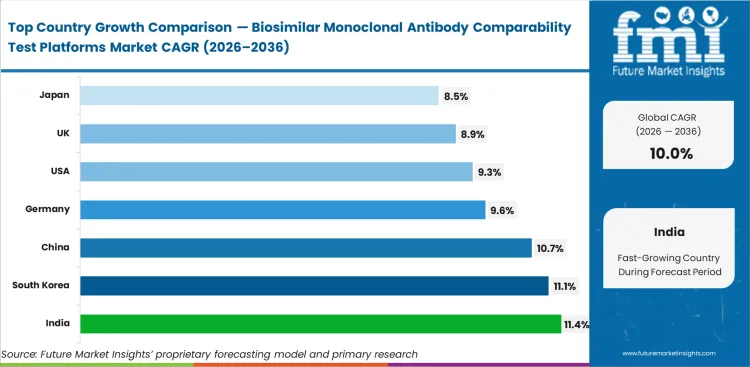
- India (11.4%) and South Korea (11.1%) are two of the fastest growing markets.
Biosimilar Monoclonal Antibody Comparability Test Platforms Market Key Takeaways
| Parameter | Details |
|---|---|
| Market value (2026) | USD 0.9 billion |
| Forecast value (2036) | USD 2.3 billion |
| CAGR (2026 to 2036) | 10% |
| Estimated market value (2025) | USD 0.8 billion |
| Incremental opportunity | USD 1.4 billion |
| Leading product type | Instruments (36% of product type segment) |
| Leading workflow stage | Analytical Similarity (44% of workflow stage segment) |
| Leading technology | Chromatography (27% of technology segment) |
| Leading assay type | Structural Assays (31% of assay type segment) |
| Leading molecule class | IgG1 mAbs (42% of molecule class segment) |
| Leading deployment model | In-house Labs (61% of deployment model segment) |
| Leading end user | Biosimilar Developers (49% of end user segment) |
| Key players | Danaher Corporation, Waters Corporation, Thermo Fisher Scientific, Agilent Technologies, Sartorius AG, Shimadzu Corporation, Charles River Laboratories |
Source: Future Market Insights, 2026.
Analytical comparison matters more in biosimilar monoclonal antibody development because regulators expect clear analytical evidence. Early test results help teams identify molecular differences before later development stage begin. Platform choice depends on method sensitivity, result consistency, software support, and how clearly the data can support comparability claims. Adoption improves when developers aligns each platform to routine characterization, validation, and filing needs.
India is expected to rise at 11.4% CAGR by 2036 because biosimilar development activity and regulatory progress are supporting more analytical platform use. South Korea is projected to grow at 11.1% CAGR as biologics manufacturing strength and biosimilar focus continue supporting demand. Demand in China is anticipated to expand at 10.7% CAGR through 2036, supported by rising domestic biologics development and broader analytical investment. Germany is likely to register 9.6% CAGR, while the United States is set to rise at 9.3% CAGR and the United Kingdom at 8.9% CAGR as established development environments continue adding more advanced comparability tools. Japan is expected to expand at 8.5% CAGR through 2036.
Biosimilar Monoclonal Antibody Comparability Test Platforms Market Definition
The biosimilar monoclonal antibody comparability test platforms market includes instruments, software, reagents, standards, and related testing systems used to compare a biosimilar monoclonal antibody with its reference product across structural, functional, and stability parameters. The scope is limited to platforms used for analytical similarity work, method development, validation support, and comparability review. This makes the market narrower than the broader monoclonal antibodies, space because it focuses on tools used to establish similarity.
Biosimilar Monoclonal Antibody Comparability Test Platforms Market Inclusions
The market includes chromatography systems, mass spectrometry platforms, electrophoresis tools, spectroscopy systems, bioassay platforms, data analysis software, reference standards, and supporting reagents used in biosimilar monoclonal antibody comparison. It also use across analytical similarity studies, method qualification, validation work, and stability-linked comparison. The focus stays on platforms directly used in biosimilar monoclonal antibody comparability programs.
Biosimilar Monoclonal Antibody Comparability Test Platforms Market Exclusions
The scope excludes full clinical trial services, biologic manufacturing equipment, fill-finish systems, upstream bioprocess hardware, and general laboratory tools that do not have a direct role in biosimilar monoclonal antibody comparison. Routine plant monitoring tools and broader control systems are excluded because they do not establish product similarity in the way analytical comparability.
Biosimilar Monoclonal Antibody Comparability Test Platforms Market Research Methodology
- Primary research: It involved discussions with biosimilar development teams, analytical scientists, biopharma quality leaders, regulatory consultants, CRO specialists, and platform suppliers across the United States, Germany, India, South Korea, China, and Japan.
- Secondary research: It covered biosimilar guidance documents, regulatory publications, pharma-copoeial references, supplier application notes, company annual reports, technical papers on monoclonal antibody characterization, and public information on analytical method use in biosimilar development.
- Market sizing and forecasting: They were developed through a bottom-up review of biosimilar monoclonal antibody development activity, platform intensity by workflow stage, likely technology mix, and expected spending across sponsor laboratories, CROs, and selected CDMO-linked analytical settings.
Why is the Biosimilar Monoclonal Antibody Comparability Test Platforms Market Growing?
- Instruments are expected to account for 36% of product type demand in 2026, supported by the need for reliable platform performance across core comparability workflows.
- Analytical Similarity is projected to hold 44% of workflow stage demand in 2026, reflecting its central role in biosimilar monoclonal antibody evaluation.
- India and South Korea are reshaping regional demand for biosimilar monoclonal antibody comparability test platforms, as biosimilar development activity, manufacturing expansion, and regulatory progress increase the need for stronger analytical comparison tools.
Demand for biosimilar monoclonal antibody comparability test platforms is rising because developers need stronger analytical evidence earlier in development. Small differences in structure, glycan profile, charge pattern, or potency can create larger problems later if they are not identify early. These platforms help developments teams compare the biosimilar with the reference product in a more consistent way.
Analytical similarity is the main workflow area because comparability decisions start with direct evidence on product quality attributes. Development teams are giving more attention to systems that can support repeatable characterization, clean data output, and stronger method confidence across multiple batches. Chromatography, mass spectrometry, and related characterization tools continue to take an important role in biosimilar monoclonal antibody work.
Market growth is also supported by wider biosimilar development activity in countries adding new programs, manufacturing capacity, and regulatory support. Companies are looking at these platforms as part of a development and filing strategy that strengthen submission packages and supports similarity assessment. Demand is becoming more important in routine biosimilar development settings.
Segmental Analysis
- Chromatography is projected to hold 27% share of the technology segment in 2026 because biosimilar monoclonal antibody comparison still depends on methods that can separate, track, and explain product variation with clear analytical output.
- Analytical Similarity is expected to account for 44% share of the workflow stage segment in 2026 because comparability programs are built around direct evidence that the biosimilar remains close to the reference product across critical quality attributes.
- Instruments are expected to hold 36% share of the product type segment in 2026 because developers still place the highest value on platforms that generate the core data used in head-to-head comparison.
- Structural Assays are projected to account for 31% share of the assay type segment in 2026 because most similarity programs begin with a close look at molecular structure, impurity profile, and attribute consistency before broader interpretation moves forward.
- In-house Labs are projected to hold 61% share of the deployment model segment in 2026 because many developers prefer to keep key comparability work close to internal quality, regulatory, and development teams.
- Biosimilar Developers are expected to account for 49% share of the end user segment in 2026 because they lead similarity planning, method strategy, and filing preparation across the full development cycle.
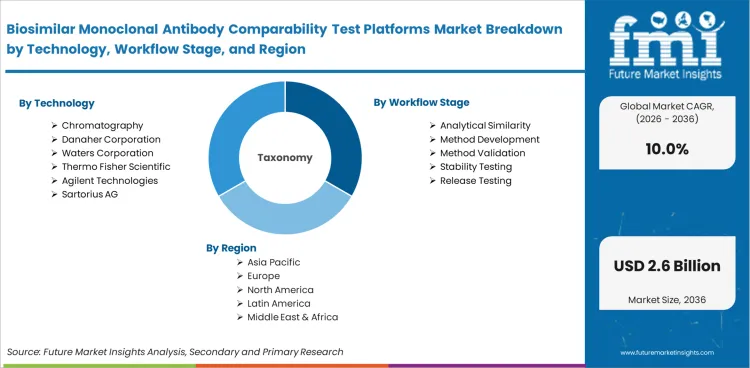
The biosimilar monoclonal antibody comparability test platforms market is segmented by product type, technology, assay type, workflow stage, molecule class, deployment model, and end user. By product type, the market is divided into instruments, software, reagents, standards, and services. In terms of technology, the market is classified into chromatography, mass spectrometry, electrophoresis, spectroscopy, and bioassays. Based on assay type, the market is segmented into structural assays, purity assays, glycan assays, potency assays, and stability assays. By workflow stage, the market is divided into analytical similarity, method development, method validation, stability testing, and release testing. In terms of molecule class, the market is classified into IgG1 mAbs, IgG4 mAbs, Fc fusions, fragments, and conjugates. Based on deployment model, the market is segmented into in-house labs, CRO labs, and hybrid labs. By end user, the market is divided into biosimilar developers, CDMOs, CROs, academic centers, and regulators.
Insights into the Chromatography Technology Segment
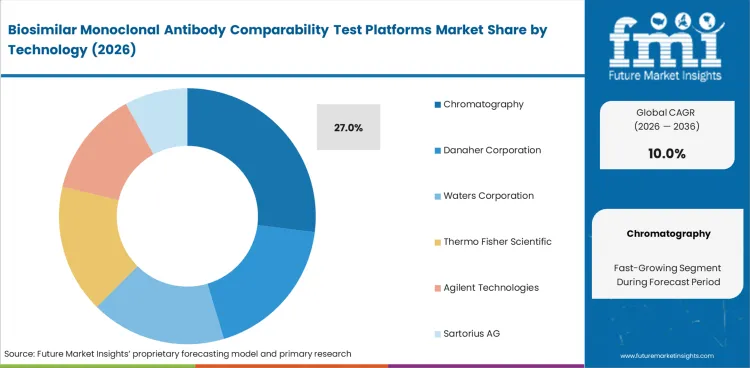
Chromatography leads this segment because biosimilar monoclonal antibody comparison requires clear separation of charge variants, size-related changes, purity differences, and glycan-linked variation. Chromatography is expected to account for 27% share in 2026. Mass spectrometry and electrophoresis remain important, though chromatography holds the broadest routine role because it is widely used, familiar, and dependable across biosimilar characterization workflows.
Insights into the Analytical Similarity Workflow Stage Segment
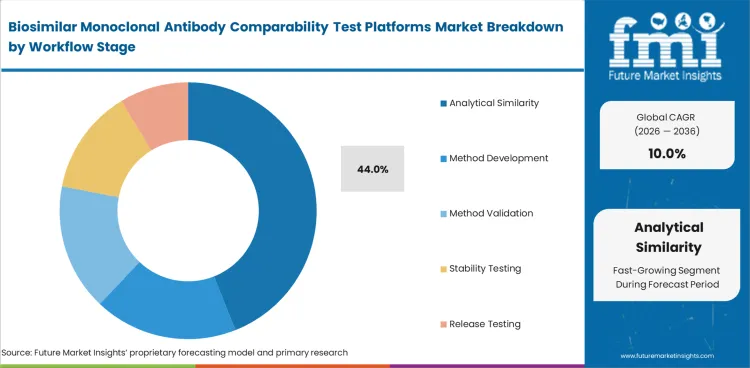
Analytical similarity leads this market because biosimilar assessment begins with direct comparison between the biosimilar and the reference product. Analytical Similarity is projected to hold 44% share in 2026. Developers give this stage the most attention because it supports similarity claims and later filing decisions. Method development and validation remain important, though they mainly support this core comparability work.
Insights into the Instruments Product Type Segment
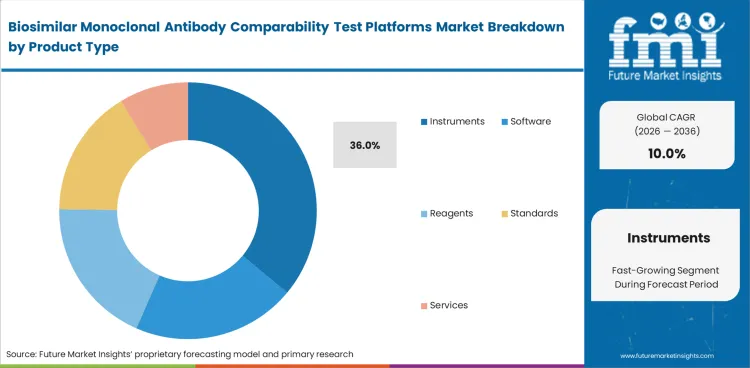
Instruments lead this segment because comparability programs depend first on the systems that generate the main analytical evidence. Instruments are likely to account for 36% share in 2026. Biosimilar developers need reliable tools for separation, detection, and characterization across many monoclonal antibody attributes. Software, reagents, and standards remain important, though spending usually begins with core laboratory platforms.
Insights into the Structural Assays Segment
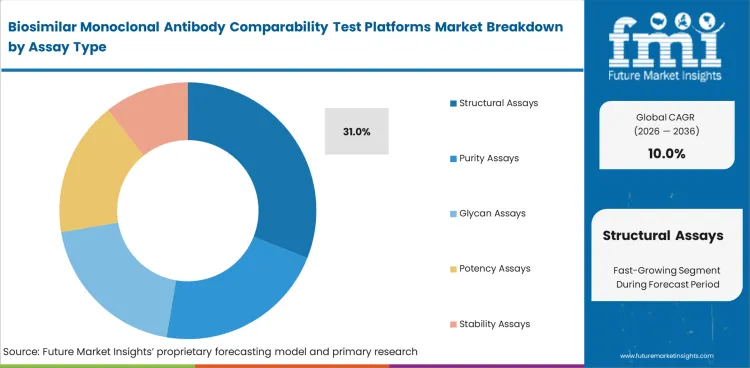
Structural assays lead because similarity studies usually begin with close review of the biosimilar’s physical and chemical profile. Structural Assays are projected to account for 31% share in 2026. Developers need early clarity on molecular composition, higher-order structure, and visible analytical differences before moving further. This first layer of evidence helps interpret later purity, potency, glycan, and stability findings.
Insights into the In-house Labs Deployment Model Segment
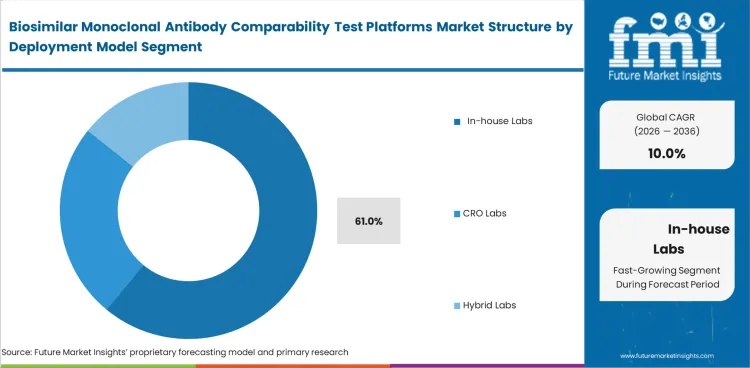
In-house labs are expected to account for 61% share in 2026 because many companies prefer to keep critical comparability work within their own scientific and quality groups. Internal control remains important in biosimilar development, especially in data review and submission planning. CRO labs support many programs, though sponsors often keep the most sensitive analytical work within their own organizations.
Insights into the Biosimilar Developers End User Segment
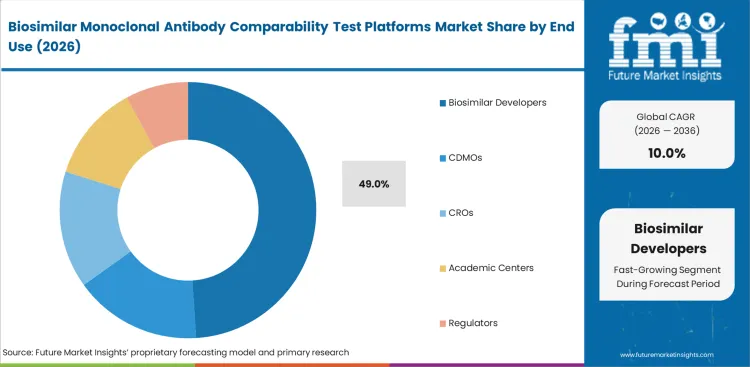
Biosimilar developers are anticipated to hold 49% market share in 2026 because they decide the comparability strategy and carry responsibility for proving similarity to regulators. CDMOs and CROs provide useful support, but the largest share of demand still comes from companies that own the biosimilar program. Platform needs continue rising as more sponsor-led biosimilar development programs move forward.
What are the Drivers, Restraints, and Key Trends of the Biosimilar Monoclonal Antibody Comparability Test Platforms Market?
- Rising demand for stronger analytical proof in biosimilar development is increasing the need for platforms that support clearer molecular comparison and more dependable similarity assessment.
- Method validation burden, reference product variability, and the need for consistent interpretation across multiple assays continue to slow broader adoption and standardization.
- Growing focus on integrated workflows, cleaner data handling, and stronger regulatory alignment is supporting platforms that fit routine comparability work instead of one-time analytical use.
The biosimilar monoclonal antibody comparability test platforms market is expanding steadily as developers place more weight on analytical evidence that supports similarity claims with less uncertainty. Adoption depends on whether a platform can deliver repeatable output, support method confidence, and remains useful across multiple stages of comparability work. Activity in the biosimilars and follow-on biologics market continues to shape demand for these tools. Growth remains firm, though platform selection is still influenced by validation burden, workflow complexity, and the challenge of turning large volumes of analytical data into conclusions that hold up during review.
Stronger Analytical Evidence is Supporting Market Growth
Demand is rising because biosimilar developers need clearer evidence that a candidate product remains close to the reference molecule across structural and functional attributes. Small difference in glycan profile, charge pattern, aggregation level, or potency can raise bigger questions later when they are not understood early. This is increasing investment in platforms that improve visibility at the analytical stage.
Validation Burden and Interpretation Complexity are Holding Back Faster Uptake
Broader adoption still faces limits because developers need more than sensitive instruments and wider assay coverage. They need validated methods, dependable reference standards, clean cross-batch comparison, and a clear path for explaining results that do not align neatly across assays. Similar buying appears in the analytical laboratory service market, where data quality must also supports defensible review, smoother documentation, and confidence in final decisions.
Analysis of the Biosimilar Monoclonal Antibody Comparability Test Platforms Market by Key Countries
- India leads the tracked markets at 11.4% CAGR because biosimilar development is expanding, local manufacturing capability is improving, and regulatory support is making analytical comparison work more relevant across active programs.
- China follows at 10.7% CAGR as domestic biologics development, capacity build-out, and higher investment in analytical tools continue supporting broader use of comparability platforms.
- The United States records 9.3% CAGR because an established biologics development base can add more advanced analytical platforms without rebuilding the full development model from the start.
- Germany, the United Kingdom, Japan, and South Korea remain important markets where scientific depth, regulatory discipline, development intensity, and data quality continue shaping platform demand and supplier selection.
- Based on the regional analysis, the biosimilar monoclonal antibody comparability test platforms market is segmented into North America, Latin America, Western Europe, Eastern Europe, East Asia, South Asia & Pacific, and Middle East & Africa across 40+ countries. Demand patterns in this market also connect closely with the biosimilars and follow-on biologics market, since broader biosimilar development activity directly influences the need for stronger analytical comparison.
.webp "Top Country Growth Comparison Biosimilar Monoclonal Antibody Comparability Test Platforms Market Cagr (2026 2036)")
| Country | CAGR (2026 to 2036) |
|---|---|
| India | 11.4% |
| South Korea | 11.1% |
| China | 10.7% |
| Germany | 9.6% |
| United States | 9.3% |
| United Kingdom | 8.9% |
| Japan | 8.5% |
Source: Future Market Insights analysis, based on proprietary forecasting model and primary research.
Demand Outlook for Biosimilar Monoclonal Antibody Comparability Test Platforms Market in India
India is projected to expand at an 11.4% CAGR through 2036. Biosimilar development is growing across domestic and export-focused programs, which is increasing demand for platforms that support stronger head-to-head comparison with reference biologics. Companies want analytical systems that help build cleaner comparability packages without stretching timelines too far. This patterns also reflects growth in the large molecule bioanalytical testing services market.
- Biosimilar pipeline expansion is increasing demand for comparability platforms.
- Regulatory progress is supporting wider use of structured analytical evidence.
- Newer programs face fewer legacy workflow limits than mature markets.
Future Outlook for Biosimilar Monoclonal Antibody Comparability Test Platforms Market in South Korea
South Korea is expected to grow at an 11.1% CAGR by 2036. Strong biologics manufacturing capability and a well-established biosimilar base continue to support demand for advanced comparability tools. Developers want platforms that improve similarity assessment without adding unnecessary complexity across analytical workflows. This gives an advantage to suppliers with stronger software, method support, and application depth.
- Biologics manufacturing strength supports wider platform adoption.
- Established biosimilar activity improves commercial relevance for analytical systems.
- Suppliers with stronger workflow support are better placed to grow.
Opportunity Analysis of Biosimilar Monoclonal Antibody Comparability Test Platforms Market in China
China is projected to record 10.7% CAGR from 2026 to 2036. A growing biologics development base gives the market greater capacity to absorb advanced analytical systems across biosimilar monoclonal antibody programs. Adoption is supported by rising domestic research and manufacturing investment, though manufacturers still place strong emphasis on platform reliability, technical support, and result consistency.
- Domestic biologics expansion supports added demand for comparability tools.
- Analytical investment is increasing across biosimilar development settings.
- Buyers continue to favor platforms with dependable performance and support.
In-depth Analysis of Biosimilar Monoclonal Antibody Comparability Test Platforms Market in Germany
Germany is projected to expand at 9.6% CAGR through 2036. Strong scientific infrastructure and a clear preference for methods that hold up under detailed technical review support this market. Developers and laboratory groups assess platforms on data clarity, reproducibility, and service depth rather than on instrument capability alone. This keeps demand steady for suppliers that can support well-documented, method-driven use across biosimilar characterization programs.
- Scientific depth supports demand for high-quality analytical systems.
- Review discipline raises the value of reproducible output and documentation.
- Service support remains important in a technically demanding market.
In-depth Analysis of Biosimilar Monoclonal Antibody Comparability Test Platforms Market in the United States
The United States is expected to grow at a 9.3% CAGR from 2026 to 2036. A large biologics and biosimilar development base supports continued demand for comparability platforms across sponsor laboratories, CROs, and selected CDMO-linked settings. Adoption moves forward through careful scientific and regulatory review, though the installed analytical foundation is strong enough to absorb new technologies without a full reset.
- A large development base supports demand across multiple user settings.
- Established analytical infrastructure improves the case for platform upgrades.
- Buyers continue to favor systems that support strong regulatory positioning.
Sales Analysis of Biosimilar Monoclonal Antibody Comparability Test Platforms Market in the United Kingdom
The United Kingdom is projected to register an 8.9% CAGR through 2036. Demand comes from research-led and development-led environments where method quality, scientific credibility, and workflow clarity carry more expansion. Organizations invest in comparability platforms with a long-term view, especially when those systems support better interpretation across structural and functional testing.
- Research-driven demand supports steady platform adoption.
- Data credibility matters as much as instrument capability.
- Long-term technical fit carries more weight than rapid rollout.
Demand Outlook for Biosimilar Monoclonal Antibody Comparability Test Platforms Market in Japan
Japan is expected to expand at 8.5% CAGR through 2036. Companies move carefully because new analytical platforms must improve similarity assessment without creating extra burden across established quality and development routines. Method confidence, stable performance, and use-case clarity stay central in system selection, which keeps adoption remains measured. This supports stronger preference for dependable long-use systems over quick shifts toward unfamiliar platforms.
- Careful qualification keeps adoption slower than in faster-growing markets.
- Developers prioritize stable performance and clear analytical value.
- Long-use consistency remains central to platform selection.
Competitive Landscape of Biosimilar Monoclonal Antibody Comparability Test Platforms Market
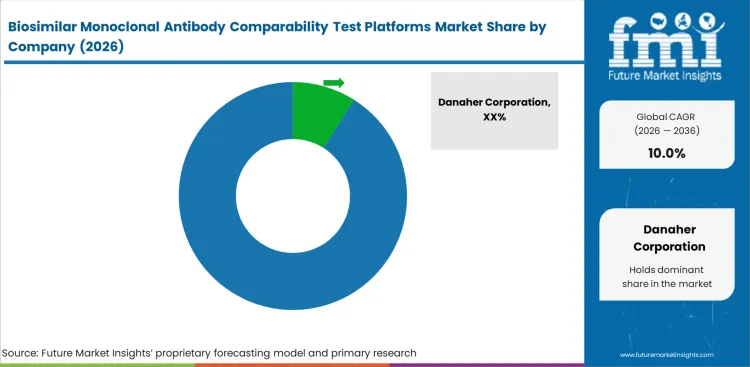
- Danaher Corporation, Waters Corporation, and Thermo Fisher Scientific compete through broad analytical depth, strong installed-base familiarity, and the ability to support regulated biologics development environments.
- The market remains moderately fragmented, with workflow coverage, method support, data quality, and application strength shaping competition more than instrument performance alone.
- Suppliers that can combine dependable analytical platforms, software continuity, and strong technical support hold an advantage as biosimilar developers move toward more structured and repeatable comparability programs.
The biosimilar monoclonal antibody comparability test platforms market includes analytical instrument companies, software providers, life science tool suppliers, and selected testing support providers serving biosimilar development environments that need strong similarity evidence across structural and functional attributes. Competition depends on more than raw analytical capability. Developers compare method fit, workflow continuity, software usability, documentation support, and application depth before a platform becomes part of regular comparability work.
Danaher Corporation, Waters Corporation, and Thermo Fisher Scientific remain well placed because their analytical reach, technical credibility, and broad biopharma presence support buyer confidence in regulated biosimilar programs. Agilent Technologies, Sartorius AG, and Shimadzu Corporation stay competitive through strong relevance in characterization workflows, while Charles River Laboratories remains important where buyers want added testing support around the core analytical package. Platform choice usually depends on how well the system fits day-to-day comparability work rather than on sensitivity claims.
Barriers to entry are moderate at the basic instrument level and higher where suppliers need to support repeatable use in regulated biosimilar development. A company may offer technically sound analysis, though wider commercial adoption depends on whether the platform supports validation, cross-batch consistency, software-backed interpretation, and dependable output under filing-oriented review conditions. This keeps competition focused on practical scientific fit as much as on hardware capability.
Major Industry Players
Key global companies leading the biosimilar monoclonal antibody comparability test platforms market include:
- Danaher Corporation, Waters Corporation, and Thermo Fisher Scientific are among the leading participants due to their broad analytical capability, strong presence in biopharma laboratories, and ability to support regulated biosimilar comparison with reliable application and workflow support.
- Agilent Technologies, Sartorius AG, and Shimadzu Corporation maintain solid competitive relevance through their role in monoclonal antibody characterization, dependable platform quality, and fit across routine comparability workflows that require stable and repeatable data output.
- Charles River Laboratories remains an important participant where buyers value analytical support, biologics testing experience, and access to broader service-linked capability around biosimilar development programs.
Competitive Benchmarking: Biosimilar Monoclonal Antibody Comparability Test Platforms Market
| Company | Analytical Capability | Validation Support | Workflow Fit | Service / Application Support |
|---|---|---|---|---|
| Danaher Corporation | High | High | Strong | Strong |
| Waters Corporation | High | High | Strong | Strong |
| Thermo Fisher Scientific | High | High | Strong | Strong |
| Agilent Technologies | High | High | Moderate | Strong |
| Sartorius AG | Medium | High | Moderate | Strong |
| Shimadzu Corporation | Medium | Medium | Moderate | Moderate |
| Charles River Laboratories | Medium | Strong | Moderate | Strong |
Source: Future Market Insights competitive analysis, 2026.
Recent Developments in Biosimilar Monoclonal Antibody Comparability Test Platforms Market
- In October 2025, Waters launched the Xevo CDMS system, enabling rapid charge detection mass spectrometry for large biomolecules, including empty, partial, full, and overfull viral vector capsids.
- In May 2025: Sartorius launched the Octet® R8e system, expanding real-time, label-free biomolecular interaction analysis with higher sensitivity and improved efficiency for analytical workflows.
Key Players in the Biosimilar Monoclonal Antibody Comparability Test Platforms Market
Major Global Players
- Danaher Corporation
- Waters Corporation
- Thermo Fisher Scientific
- Agilent Technologies
- Sartorius AG
Emerging Players / Specialized Participants
- Shimadzu Corporation
- Charles River Laboratories
Scope of the Report
| Metric | Value |
|---|---|
| Quantitative Units | USD 0.8 billion (2025) to USD 2.3 billion (2036), at a 10% CAGR |
| Market Definition | The biosimilar monoclonal antibody comparability test platforms market covers instruments, software, reagents, standards, and related analytical systems used to compare a biosimilar monoclonal antibody with its reference product. These platforms support structural, functional, purity, glycan, stability, and similarity assessment across biosimilar development and regulatory review. |
| Segmentation |
|
| Regions Covered | North America, Latin America, Western Europe, Eastern Europe, East Asia, South Asia & Pacific, Middle East & Africa |
| Countries Covered | India, South Korea, China, Germany, United States, United Kingdom, Japan, and 30+ countries |
| Key Companies Profiled | Danaher Corporation, Waters Corporation, Thermo Fisher Scientific, Agilent Technologies, Sartorius AG, Shimadzu Corporation, Charles River Laboratories, and other regional and specialized participants |
| Forecast Period | 2026 to 2036 |
| Approach | A blended bottom-up and top-down approach was used, supported by biosimilar development activity, analytical platform relevance across comparability workflows, supplier revenue direction, regulatory requirements, and demand modeling by technology, assay type, workflow stage, deployment model, and end user. Primary interviews and secondary industry data were used to validate market estimates and forecast assumptions. |
Source: Future Market Insights analysis, based on proprietary forecasting model and primary research
Biosimilar Monoclonal Antibody Comparability Test Platforms Market Analysis by Segments
Product Type
- Instruments
- Software
- Reagents
- Standards
- Services
Technology
- Chromatography
- Mass Spectrometry
- Electrophoresis
- Spectroscopy
- Bioassays
Assay Type
- Structural Assays
- Purity Assays
- Glycan Assays
- Potency Assays
- Stability Assays
Workflow Stage
- Analytical Similarity
- Method Development
- Method Validation
- Stability Testing
- Release Testing
Molecule Class
- IgG1 mAbs
- IgG4 mAbs
- Fc Fusions
- Fragments
- Conjugates
Deployment Model
- In-house Labs
- CRO Labs
- Hybrid Labs
End User
- Biosimilar Developers
- CDMOs
- CROs
- Academic Centers
- Regulators
Region
- North America
- United States
- Europe
- Germany
- United Kingdom
- Asia Pacific
- India
- South Korea
- China
- Japan
Bibliography
- Waters Corporation. (2025, October 13). Waters launches charge detection mass spectrometry technology to accelerate the development of next-generation biotherapeutics.
- Sartorius AG. (2025, May 21). Sartorius launches the Octet® R8e System: real-time, label-free biomolecular interaction analysis with unprecedented sensitivity and efficiency.
- Food and Drug Administration. (2025, September). Development of therapeutic protein biosimilars: Comparative analytical assessment and other quality-related considerations Guidance for Industry.
- Central Drugs Standard Control Organization. (2025, May 6). Inviting comments on revised guidelines on similar biologics- Regulatory requirements for marketing authorization in India, 2025 drafted by CDSCO.
- Fletcher, B., & Kenrick, S. (2025, December 19). Assessment of biosimilarity in mAb-based therapeutics using SEC-MALS.
This bibliography is provided for reader reference. The full FMI report contains the complete reference list with primary source documentation.
This Report Addresses
- Market intelligence across analytical platforms used in biosimilar monoclonal antibody comparability work.
- Revenue forecast from 2026 to 2036 using validated adoption assumptions across platform types and workflows.
- Opportunity mapping across product type, technology, assay type, workflow stage, molecule class, deployment model, and end user.
- Regional outlook covering India, South Korea, China, Germany, the United States, the United Kingdom, and Japan.
- Competitive comparison based on analytical capability, validation support, workflow fit, service quality, and application support.
- Technology review across chromatography, mass spectrometry, electrophoresis, spectroscopy, and bioassays.
- Scope boundaries separating comparability platforms from full clinical services, manufacturing equipment, and general laboratory tools.
- Delivery format supports strategy, planning, benchmarking, portfolio review, and investment assessment.
Frequently Asked Questions
How large is Biosimilar Monoclonal Antibody Comparability Test Platforms Market in 2026?
Biosimilar Monoclonal Antibody Comparability Test Platforms Market is expected to reach USD 0.9 billion in 2026, showing clear commercial relevance in biosimilar development.
What will the market be valued at by 2036?
FMI estimates market valuation will reach USD 2.3 billion by 2036, reflecting broader use of analytical platforms in biosimilar monoclonal antibody comparison.
What CAGR is projected for the market during 2026 to 2036?
FMI projects a 10% CAGR from 2026 to 2036, indicating steady expansion in this specialized analytical category.
Which Technology segment leads the market?
Chromatography leads Technology, with 27% share expected in 2026 because it remains widely used in routine comparability workflows.
Which Workflow Stage segment leads the market?
Analytical Similarity leads the category, with 44% share expected in 2026, as direct similarity evidence remains central to biosimilar assessment.
Which Product Type segment leads the market?
Instruments lead Product Type, with 36% share expected in 2026 due to their core role in generating primary analytical evidence.
Preview the report firsthand - request a free sample
Get SampleGet the brochure for pricing and purchase details.
Get PDFTable of Content
- Executive Summary
- Global Market Outlook
- Demand-side Trends
- Supply-side Trends
- Technology Roadmap Analysis
- Analysis and Recommendations
- Market Overview
- Market Coverage / Taxonomy
- Market Definition / Scope / Limitations
- Research Methodology
- Chapter Orientation
- Analytical Lens and Working Hypotheses
- Market Structure, Signals, and Trend Drivers
- Benchmarking and Cross-market Comparability
- Market Sizing, Forecasting, and Opportunity Mapping
- Research Design and Evidence Framework
- Desk Research Programme (Secondary Evidence)
- Company Annual and Sustainability Reports
- Peer-reviewed Journals and Academic Literature
- Corporate Websites, Product Literature, and Technical Notes
- Earnings Decks and Investor Briefings
- Statutory Filings and Regulatory Disclosures
- Technical White Papers and Standards Notes
- Trade Journals, Industry Magazines, and Analyst Briefs
- Conference Proceedings, Webinars, and Seminar Materials
- Government Statistics Portals and Public Data Releases
- Press Releases and Reputable Media Coverage
- Specialist Newsletters and Curated Briefings
- Sector Databases and Reference Repositories
- FMI Internal Proprietary Databases and Historical Market Datasets
- Subscription Datasets and Paid Sources
- Social Channels, Communities, and Digital Listening Inputs
- Additional Desk Sources
- Expert Input and Fieldwork (Primary Evidence)
- Primary Modes
- Qualitative Interviews and Expert Elicitation
- Quantitative Surveys and Structured Data Capture
- Blended Approach
- Why Primary Evidence is Used
- Field Techniques
- Interviews
- Surveys
- Focus Groups
- Observational and In-context Research
- Social and Community Interactions
- Stakeholder Universe Engaged
- C-suite Leaders
- Board Members
- Presidents and Vice Presidents
- R&D and Innovation Heads
- Technical Specialists
- Domain Subject-matter Experts
- Scientists
- Physicians and Other Healthcare Professionals
- Governance, Ethics, and Data Stewardship
- Research Ethics
- Data Integrity and Handling
- Primary Modes
- Tooling, Models, and Reference Databases
- Desk Research Programme (Secondary Evidence)
- Data Engineering and Model Build
- Data Acquisition and Ingestion
- Cleaning, Normalisation, and Verification
- Synthesis, Triangulation, and Analysis
- Quality Assurance and Audit Trail
- Market Background
- Market Dynamics
- Drivers
- Restraints
- Opportunity
- Trends
- Scenario Forecast
- Demand in Optimistic Scenario
- Demand in Likely Scenario
- Demand in Conservative Scenario
- Opportunity Map Analysis
- Product Life Cycle Analysis
- Supply Chain Analysis
- Investment Feasibility Matrix
- Value Chain Analysis
- PESTLE and Porter’s Analysis
- Regulatory Landscape
- Regional Parent Market Outlook
- Production and Consumption Statistics
- Import and Export Statistics
- Market Dynamics
- Global Market Analysis 2021 to 2025 and Forecast, 2026 to 2036
- Historical Market Size Value (USD Million) Analysis, 2021 to 2025
- Current and Future Market Size Value (USD Million) Projections, 2026 to 2036
- Y-o-Y Growth Trend Analysis
- Absolute $ Opportunity Analysis
- Global Market Pricing Analysis 2021 to 2025 and Forecast 2026 to 2036
- Global Market Analysis 2021 to 2025 and Forecast 2026 to 2036, By Technology
- Introduction / Key Findings
- Historical Market Size Value (USD Million) Analysis By Technology , 2021 to 2025
- Current and Future Market Size Value (USD Million) Analysis and Forecast By Technology , 2026 to 2036
- Chromatography
- Danaher Corporation
- Waters Corporation
- Thermo Fisher Scientific
- Agilent Technologies
- Sartorius AG
- Chromatography
- Y-o-Y Growth Trend Analysis By Technology , 2021 to 2025
- Absolute $ Opportunity Analysis By Technology , 2026 to 2036
- Global Market Analysis 2021 to 2025 and Forecast 2026 to 2036, By Workflow Stage
- Introduction / Key Findings
- Historical Market Size Value (USD Million) Analysis By Workflow Stage, 2021 to 2025
- Current and Future Market Size Value (USD Million) Analysis and Forecast By Workflow Stage, 2026 to 2036
- Analytical Similarity
- Method Development
- Method Validation
- Stability Testing
- Release Testing
- Analytical Similarity
- Y-o-Y Growth Trend Analysis By Workflow Stage, 2021 to 2025
- Absolute $ Opportunity Analysis By Workflow Stage, 2026 to 2036
- Global Market Analysis 2021 to 2025 and Forecast 2026 to 2036, By Product Type
- Introduction / Key Findings
- Historical Market Size Value (USD Million) Analysis By Product Type, 2021 to 2025
- Current and Future Market Size Value (USD Million) Analysis and Forecast By Product Type, 2026 to 2036
- Instruments
- Software
- Reagents
- Standards
- Services
- Instruments
- Y-o-Y Growth Trend Analysis By Product Type, 2021 to 2025
- Absolute $ Opportunity Analysis By Product Type, 2026 to 2036
- Global Market Analysis 2021 to 2025 and Forecast 2026 to 2036, By Assay Type
- Introduction / Key Findings
- Historical Market Size Value (USD Million) Analysis By Assay Type, 2021 to 2025
- Current and Future Market Size Value (USD Million) Analysis and Forecast By Assay Type, 2026 to 2036
- Structural Assays
- Purity Assays
- Glycan Assays
- Potency Assays
- Stability Assays
- Structural Assays
- Y-o-Y Growth Trend Analysis By Assay Type, 2021 to 2025
- Absolute $ Opportunity Analysis By Assay Type, 2026 to 2036
- Global Market Analysis 2021 to 2025 and Forecast 2026 to 2036, By Deployment Model
- Introduction / Key Findings
- Historical Market Size Value (USD Million) Analysis By Deployment Model, 2021 to 2025
- Current and Future Market Size Value (USD Million) Analysis and Forecast By Deployment Model, 2026 to 2036
- In-house Labs
- CRO Labs
- Hybrid Labs
- In-house Labs
- Y-o-Y Growth Trend Analysis By Deployment Model, 2021 to 2025
- Absolute $ Opportunity Analysis By Deployment Model, 2026 to 2036
- Global Market Analysis 2021 to 2025 and Forecast 2026 to 2036, By End Use
- Introduction / Key Findings
- Historical Market Size Value (USD Million) Analysis By End Use, 2021 to 2025
- Current and Future Market Size Value (USD Million) Analysis and Forecast By End Use, 2026 to 2036
- Biosimilar Developers
- CDMOs
- CROs
- Academic Centers
- Regulators
- Biosimilar Developers
- Y-o-Y Growth Trend Analysis By End Use, 2021 to 2025
- Absolute $ Opportunity Analysis By End Use, 2026 to 2036
- Global Market Analysis 2021 to 2025 and Forecast 2026 to 2036, By Region
- Introduction
- Historical Market Size Value (USD Million) Analysis By Region, 2021 to 2025
- Current Market Size Value (USD Million) Analysis and Forecast By Region, 2026 to 2036
- North America
- Latin America
- Western Europe
- Eastern Europe
- East Asia
- South Asia and Pacific
- Middle East & Africa
- Market Attractiveness Analysis By Region
- North America Market Analysis 2021 to 2025 and Forecast 2026 to 2036, By Country
- Historical Market Size Value (USD Million) Trend Analysis By Market Taxonomy, 2021 to 2025
- Market Size Value (USD Million) Forecast By Market Taxonomy, 2026 to 2036
- By Country
- USA
- Canada
- Mexico
- By Technology
- By Workflow Stage
- By Product Type
- By Assay Type
- By Deployment Model
- By End Use
- By Country
- Market Attractiveness Analysis
- By Country
- By Technology
- By Workflow Stage
- By Product Type
- By Assay Type
- By Deployment Model
- By End Use
- Key Takeaways
- Latin America Market Analysis 2021 to 2025 and Forecast 2026 to 2036, By Country
- Historical Market Size Value (USD Million) Trend Analysis By Market Taxonomy, 2021 to 2025
- Market Size Value (USD Million) Forecast By Market Taxonomy, 2026 to 2036
- By Country
- Brazil
- Chile
- Rest of Latin America
- By Technology
- By Workflow Stage
- By Product Type
- By Assay Type
- By Deployment Model
- By End Use
- By Country
- Market Attractiveness Analysis
- By Country
- By Technology
- By Workflow Stage
- By Product Type
- By Assay Type
- By Deployment Model
- By End Use
- Key Takeaways
- Western Europe Market Analysis 2021 to 2025 and Forecast 2026 to 2036, By Country
- Historical Market Size Value (USD Million) Trend Analysis By Market Taxonomy, 2021 to 2025
- Market Size Value (USD Million) Forecast By Market Taxonomy, 2026 to 2036
- By Country
- Germany
- UK
- Italy
- Spain
- France
- Nordic
- BENELUX
- Rest of Western Europe
- By Technology
- By Workflow Stage
- By Product Type
- By Assay Type
- By Deployment Model
- By End Use
- By Country
- Market Attractiveness Analysis
- By Country
- By Technology
- By Workflow Stage
- By Product Type
- By Assay Type
- By Deployment Model
- By End Use
- Key Takeaways
- Eastern Europe Market Analysis 2021 to 2025 and Forecast 2026 to 2036, By Country
- Historical Market Size Value (USD Million) Trend Analysis By Market Taxonomy, 2021 to 2025
- Market Size Value (USD Million) Forecast By Market Taxonomy, 2026 to 2036
- By Country
- Russia
- Poland
- Hungary
- Balkan & Baltic
- Rest of Eastern Europe
- By Technology
- By Workflow Stage
- By Product Type
- By Assay Type
- By Deployment Model
- By End Use
- By Country
- Market Attractiveness Analysis
- By Country
- By Technology
- By Workflow Stage
- By Product Type
- By Assay Type
- By Deployment Model
- By End Use
- Key Takeaways
- East Asia Market Analysis 2021 to 2025 and Forecast 2026 to 2036, By Country
- Historical Market Size Value (USD Million) Trend Analysis By Market Taxonomy, 2021 to 2025
- Market Size Value (USD Million) Forecast By Market Taxonomy, 2026 to 2036
- By Country
- China
- Japan
- South Korea
- By Technology
- By Workflow Stage
- By Product Type
- By Assay Type
- By Deployment Model
- By End Use
- By Country
- Market Attractiveness Analysis
- By Country
- By Technology
- By Workflow Stage
- By Product Type
- By Assay Type
- By Deployment Model
- By End Use
- Key Takeaways
- South Asia and Pacific Market Analysis 2021 to 2025 and Forecast 2026 to 2036, By Country
- Historical Market Size Value (USD Million) Trend Analysis By Market Taxonomy, 2021 to 2025
- Market Size Value (USD Million) Forecast By Market Taxonomy, 2026 to 2036
- By Country
- India
- ASEAN
- Australia & New Zealand
- Rest of South Asia and Pacific
- By Technology
- By Workflow Stage
- By Product Type
- By Assay Type
- By Deployment Model
- By End Use
- By Country
- Market Attractiveness Analysis
- By Country
- By Technology
- By Workflow Stage
- By Product Type
- By Assay Type
- By Deployment Model
- By End Use
- Key Takeaways
- Middle East & Africa Market Analysis 2021 to 2025 and Forecast 2026 to 2036, By Country
- Historical Market Size Value (USD Million) Trend Analysis By Market Taxonomy, 2021 to 2025
- Market Size Value (USD Million) Forecast By Market Taxonomy, 2026 to 2036
- By Country
- Kingdom of Saudi Arabia
- Other GCC Countries
- Turkiye
- South Africa
- Other African Union
- Rest of Middle East & Africa
- By Technology
- By Workflow Stage
- By Product Type
- By Assay Type
- By Deployment Model
- By End Use
- By Country
- Market Attractiveness Analysis
- By Country
- By Technology
- By Workflow Stage
- By Product Type
- By Assay Type
- By Deployment Model
- By End Use
- Key Takeaways
- Key Countries Market Analysis
- USA
- Pricing Analysis
- Market Share Analysis, 2025
- By Technology
- By Workflow Stage
- By Product Type
- By Assay Type
- By Deployment Model
- By End Use
- Canada
- Pricing Analysis
- Market Share Analysis, 2025
- By Technology
- By Workflow Stage
- By Product Type
- By Assay Type
- By Deployment Model
- By End Use
- Mexico
- Pricing Analysis
- Market Share Analysis, 2025
- By Technology
- By Workflow Stage
- By Product Type
- By Assay Type
- By Deployment Model
- By End Use
- Brazil
- Pricing Analysis
- Market Share Analysis, 2025
- By Technology
- By Workflow Stage
- By Product Type
- By Assay Type
- By Deployment Model
- By End Use
- Chile
- Pricing Analysis
- Market Share Analysis, 2025
- By Technology
- By Workflow Stage
- By Product Type
- By Assay Type
- By Deployment Model
- By End Use
- Germany
- Pricing Analysis
- Market Share Analysis, 2025
- By Technology
- By Workflow Stage
- By Product Type
- By Assay Type
- By Deployment Model
- By End Use
- UK
- Pricing Analysis
- Market Share Analysis, 2025
- By Technology
- By Workflow Stage
- By Product Type
- By Assay Type
- By Deployment Model
- By End Use
- Italy
- Pricing Analysis
- Market Share Analysis, 2025
- By Technology
- By Workflow Stage
- By Product Type
- By Assay Type
- By Deployment Model
- By End Use
- Spain
- Pricing Analysis
- Market Share Analysis, 2025
- By Technology
- By Workflow Stage
- By Product Type
- By Assay Type
- By Deployment Model
- By End Use
- France
- Pricing Analysis
- Market Share Analysis, 2025
- By Technology
- By Workflow Stage
- By Product Type
- By Assay Type
- By Deployment Model
- By End Use
- India
- Pricing Analysis
- Market Share Analysis, 2025
- By Technology
- By Workflow Stage
- By Product Type
- By Assay Type
- By Deployment Model
- By End Use
- ASEAN
- Pricing Analysis
- Market Share Analysis, 2025
- By Technology
- By Workflow Stage
- By Product Type
- By Assay Type
- By Deployment Model
- By End Use
- Australia & New Zealand
- Pricing Analysis
- Market Share Analysis, 2025
- By Technology
- By Workflow Stage
- By Product Type
- By Assay Type
- By Deployment Model
- By End Use
- China
- Pricing Analysis
- Market Share Analysis, 2025
- By Technology
- By Workflow Stage
- By Product Type
- By Assay Type
- By Deployment Model
- By End Use
- Japan
- Pricing Analysis
- Market Share Analysis, 2025
- By Technology
- By Workflow Stage
- By Product Type
- By Assay Type
- By Deployment Model
- By End Use
- South Korea
- Pricing Analysis
- Market Share Analysis, 2025
- By Technology
- By Workflow Stage
- By Product Type
- By Assay Type
- By Deployment Model
- By End Use
- Russia
- Pricing Analysis
- Market Share Analysis, 2025
- By Technology
- By Workflow Stage
- By Product Type
- By Assay Type
- By Deployment Model
- By End Use
- Poland
- Pricing Analysis
- Market Share Analysis, 2025
- By Technology
- By Workflow Stage
- By Product Type
- By Assay Type
- By Deployment Model
- By End Use
- Hungary
- Pricing Analysis
- Market Share Analysis, 2025
- By Technology
- By Workflow Stage
- By Product Type
- By Assay Type
- By Deployment Model
- By End Use
- Kingdom of Saudi Arabia
- Pricing Analysis
- Market Share Analysis, 2025
- By Technology
- By Workflow Stage
- By Product Type
- By Assay Type
- By Deployment Model
- By End Use
- Turkiye
- Pricing Analysis
- Market Share Analysis, 2025
- By Technology
- By Workflow Stage
- By Product Type
- By Assay Type
- By Deployment Model
- By End Use
- South Africa
- Pricing Analysis
- Market Share Analysis, 2025
- By Technology
- By Workflow Stage
- By Product Type
- By Assay Type
- By Deployment Model
- By End Use
- USA
- Market Structure Analysis
- Competition Dashboard
- Competition Benchmarking
- Market Share Analysis of Top Players
- By Regional
- By Technology
- By Workflow Stage
- By Product Type
- By Assay Type
- By Deployment Model
- By End Use
- Competition Analysis
- Competition Deep Dive
- Danaher Corporation
- Overview
- Product Portfolio
- Profitability by Market Segments (Product/Age /Sales Channel/Region)
- Sales Footprint
- Strategy Overview
- Marketing Strategy
- Product Strategy
- Channel Strategy
- Waters Corporation
- Thermo Fisher Scientific
- Agilent Technologies
- Sartorius AG
- Danaher Corporation
- Competition Deep Dive
- Assumptions & Acronyms Used


