

- Market Size (2026)
- USD 318.8 Mn
- Forecast (2036)
- USD 490.4 Mn
- CAGR (2026 to 2036)
- 4.4%
How big is In-Shower Moisturizers Market in 2026?
USD 305.4 Million in 2025 and USD 318.8 Million in 2026. Sales are forecast to reach USD 490.4 Million by 2036 at a 4.4% CAGR, adding USD 171.6 Million over the forecast period.
FMI estimates the in-shower moisturizers market at USD 305.4 Million in 2025 and USD 318.8 Million in 2026. Sales are forecast to reach USD 490.4 Million by 2036 at a 4.4% CAGR, adding USD 171.6 Million over the forecast period. Category growth is limited by trial conversion more than by awareness. In-shower application replaces an established post-shower routine. Consumers are also unsure how the product will feel on the skin, which makes a full-size purchase feel risky. Kao's September 2026 launch of 15 ml single-use sachets of Biore wet-skin body lotion was a response to shopper hesitation over skin feel. The sachet cuts the trial unit down to a single use. Format determines usage instructions, pack design and expected after-feel, and so shapes claims and trial strategy. Category-level data combines two separate purchase decisions, so segment analysis should be read by format.
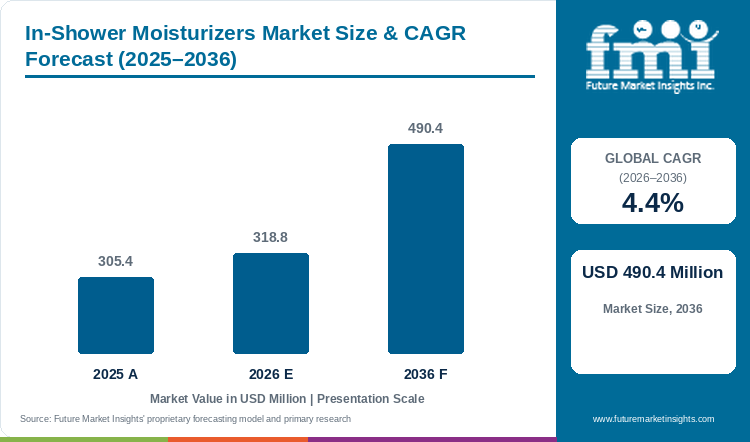
Market Size & CAGR Forecast (2025-2036)
| Year | Basis | Market value (USD million) |
|---|---|---|
| 2025 | Actual | 305.4 |
| 2026 | Estimate | 318.8 |
| 2036 | Forecast | 490.4 |
| CAGR, 2026 to 2036 | 4.4% | |
Source: Future Market Insights proprietary forecasting model and primary research.
Key Takeaways
- Core / classic lines lead with 38.0% in 2026. Everyday hydration gives shoppers a simple starting point
- Conventional leads with 52.0% in 2026. Brands can compete on moisture retention and skin feel without making ingredient-origin certification the main proposition.
- Cream & balm leads with 39.0% in 2026. Spreading on wet skin and the finish after towel-drying determine how well the format works in use. [6]
- Rinse-off conditioners and leave-on wet-skin moisturizers require different directions. Smaller packs can help shoppers assess the feel before buying a full-size product. [2, 9]
Analyst Perspective
“The decisive advantage is not another moisturizing claim. It is a product that earns a permanent place between cleansing and towel-drying, with a finish worth buying again.”
- Rahul Pandita, Principal Consultant, Future Market Insights
How is the in-shower moisturizers market segmented?
The market is segmented by Product Type, Nature, Format, Price Positioning and Sales Channel.
Product Type comprises Core / classic lines, Targeted treatment lines, Sensitive & gentle lines, Premium & clinical lines, Kits & sets. Nature comprises Conventional, Vegan & cruelty-free, Natural & organic, Dermocosmetic / clinical, Fragrance-free & sensitive. Format comprises Cream & balm, Liquid & serum, Stick & solid, Spray & mist, Sheet & patch, Powder. Price Positioning comprises Mass, Masstige, Premium, Professional. Sales Channel comprises Specialty beauty retail, E-commerce & DTC, Pharmacies & drugstores, Supermarkets & hypermarkets, Salons & spas. The market covers moisturizers explicitly designed for wet body skin during showering or bathing before towel-drying. Both rinse-off and leave-on wet-skin products qualify. Ordinary moisturizing cleansers and lotions designed only for application after drying are excluded. Sheet & patch and Powder count only where the product meets this wet-body moisturizing definition. Kits & sets contribute only the identifiable in-shower moisturizer component. [2, 6]
Why do Core / Classic Lines lead demand within the Product Type category?
Core / Classic Lines account for 38.0% of Product Type demand in 2026.
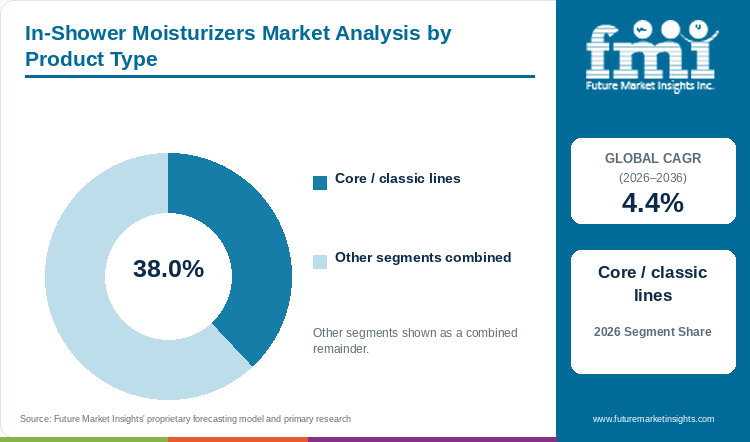
| Product type | Share (2026) |
|---|---|
| Core / Classic Lines | 38.0% |
| Other segments combined | 62.0%* |
| Total | 100.0% |
| Metric | Value |
|---|---|
| Global CAGR (2026 to 2036) | 4.4% |
| Leading segment | Core / Classic Lines |
Everyday hydration is easy for shoppers to understand. In-shower moisturizers already introduce a different point of use, so a simple moisturizing proposition can make the category easier to try and easier to repurchase. Brands are also finding ways to reduce hesitation at first purchase. In September 2026, Kao introduced 15 ml single-use sachets of its Biore wet-skin body lotion so shoppers could experience the finish before committing to a full-size pack. Trial formats can help consumers become familiar with the routine before moving to regular use.
- Core / Classic Lines account for 38.0% of Product Type demand in 2026, as their simple everyday hydration proposition is easier for first-time buyers to understand and adopt within the bathing routine.
Why do Conventional Products lead demand within the Nature category?
Conventional Products hold 52.0% of Nature demand in 2026.
These formulations give brands flexibility to focus on moisture retention, spreadability and the feel left on the skin. That matters because an in-shower moisturizer has to work comfortably on wet skin and still leave an acceptable finish after rinsing or towel-drying.
Sensory choice is becoming more important within the category. In October 2025, Kao announced a reformulated Biore wet-skin body lotion range with a richer-finish option alongside a smoother-feel version. This gives consumers a choice based on how the product feels after use rather than requiring a different ingredient-positioning claim.
Vegan, natural and fragrance-free products serve more specific preferences. Conventional products can address a wider group of buyers because the main decision remains whether the moisturizer works well and fits easily into the bathing routine.
- Conventional Products hold 52.0% of Nature demand in 2026, supported by broad formulation flexibility around moisture retention, spreadability and skin feel across different consumer preferences.How does Cream & balm retain the leading position in Format?
What are the drivers, restraints and opportunities in the in-shower moisturizers market?
Demand is supported by the convenience of combining moisturization with the bathing routine. Adoption can be limited by uncertainty around post-use skin feel and application preference, while sensitive-skin and performance-led formulations provide scope for product differentiation.
- Driver: Integration of moisturization into the bathing routine improves convenience and supports regular product use.
- Restraint: Uncertainty around post-use skin feel and finish can slow trial and repeat purchase.
- Opportunity: Sensitive-skin and performance-led formulations can create differentiation within the wet-skin moisturization category.
Which country CAGRs are profiled in the in-shower moisturizers market?
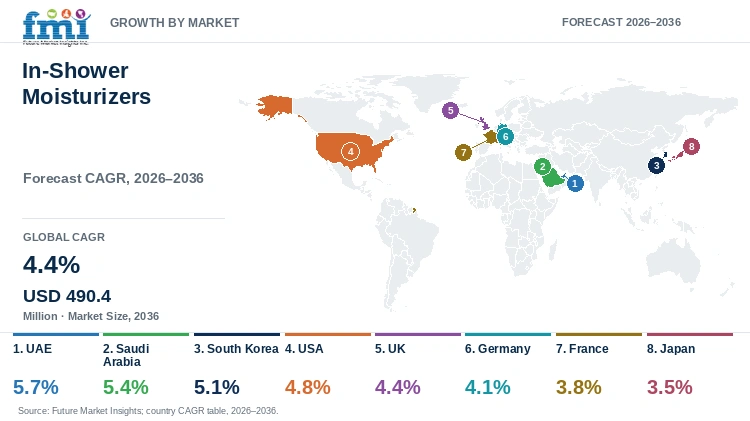
| Country | CAGR |
|---|---|
| UAE | 5.7% |
| Saudi Arabia | 5.4% |
| South Korea | 5.1% |
| USA | 4.8% |
| UK | 4.4% |
| Germany | 4.1% |
| France | 3.8% |
| Japan | 3.5% |
Country-wise Analysis
- UAE: The UAE has the fastest growth among the countries profiled at 5.7% CAGR from 2026 to 2036. In-shower moisturizers are still a relatively unfamiliar body-care step, so the opportunity is strongest where brands make the routine easy to understand at first purchase. Clear directions on whether the product is rinsed off or left on wet skin will matter as much as the moisturizing claim itself. Smaller packs and straightforward product descriptions can also help reduce hesitation around texture and post-shower feel.
- Saudi Arabia: At 5.4% CAGR from 2026 to 2036, Saudi Arabia offers room for brands that can introduce the format without making the routine feel complicated. An in-shower moisturizer adds another product to an established bathing sequence, so assortment discipline matters. A smaller number of clearly differentiated formulas can be easier for retailers and consumers to understand than a wide range built around minor variations.
- South Korea: Product discovery is already visible among Korean consumers. Kao reported in September 2026 that its hanging wet-skin lotion was attracting attention on Korean social media and being purchased by visitors to Japan. That interest gives the category a useful starting point, but regular purchasing will depend on local availability and a finish consumers are comfortable using repeatedly. South Korea is forecast to grow at 5.1% CAGR from 2026 to 2036.
- USA: The USA carries a 4.8% CAGR from 2026 to 2036. The commercial challenge is not simply getting another moisturizer onto the shelf. Brands need to show why it belongs inside the shower rather than after it. Products that fit alongside body wash and other familiar bath-care items have a clearer role, especially when the application sequence is easy to understand and the product does not leave an unwanted residue.
- UK: The UK is forecast to grow at 4.4% CAGR from 2026 to 2036. Trial is likely to depend heavily on how well brands explain the routine. Consumers need to know when the moisturizer is applied, whether it should be rinsed and what the skin will feel like after towel-drying. Clear instructions can therefore reduce uncertainty around a format that behaves differently from a conventional body lotion.
- Germany: Germany is expected to grow at 4.1% CAGR from 2026 to 2036. Replenishment economics are particularly important because an in-shower moisturizer becomes another recurring body-care purchase. Refill packs and bathroom-friendly dispensing can improve convenience, but the product still needs to be simple to replace and store. Brands that make continued use easier have a better chance of turning initial trial into routine demand.
- France: France carries a 3.8% CAGR from 2026 to 2036. Sensitive-skin and clinical positioning can give the category a clearer reason for use beyond convenience alone. These claims need to remain specific to the formula while the product still delivers the sensory experience expected from everyday body care. A comfortable finish after rinsing or towel-drying is likely to remain central to repeat purchase.
- Japan: Japan has the slowest growth among the profiled countries at 3.5% CAGR from 2026 to 2036, but it also provides some of the clearest recent product innovation. Kao introduced a richer-finish version of its Biore wet-skin body lotion in October 2025 and followed with 15 ml trial sachets in September 2026. These changes address two practical barriers at once: different preferences for skin feel and reluctance to buy a full-size product before trying the routine.
Who are the notable companies in the in-shower moisturizers market?
Key players in the In-Shower Moisturizers Market include Beiersdorf, Procter & Gamble, Kao Corporation, Estée Lauder Companies, Unilever, Shiseido, e.l.f. Beauty, Amorepacific, L'Oréal and Coty.
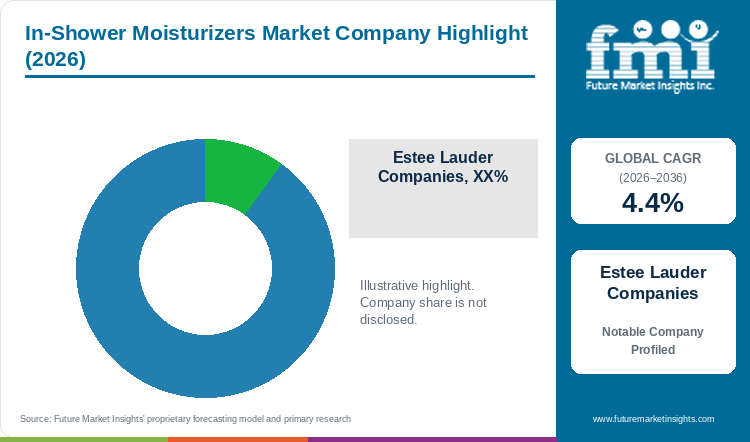
Beiersdorf and Procter & Gamble have documented rinse-off moisturizers. Kao Corporation offers a leave-on wet-skin route. These application systems differ in their directions and in the finish consumers expect after bathing. Seven broader beauty companies are also profiled. The cited sources do not establish qualifying in-shower products for those participants, so their wider portfolios provide context rather than confirmed category sales. [2, 5, 6]
- Rinse-off moisturizing systems: Beiersdorf and Procter & Gamble have product-specific evidence for this application sequence. [2, 5]
- Leave-on wet-skin systems: Kao Corporation has documented products used before towel-drying without a rinse step. [7]
- Broader beauty portfolios: Seven additional beauty companies are included in the profiles. Their qualifying in-shower product activity is not established in the cited sources.
Competitive Benchmarking: In-Shower Moisturizers Market
| Company | Wet-skin formula breadth | Shower-use dispensing | Moisturization evidence | Geographic Reach |
|---|---|---|---|---|
| Estee Lauder Companies | Low | Low | Low | Qualifying product coverage not established. |
| Beiersdorf | High | Medium | Medium | USA product page; Italy pilot and international rollout documented historically. |
| Unilever | Low | Low | Low | Qualifying product coverage not established. |
| Procter & Gamble | High | Medium | Medium | USA nationwide mass-retail availability documented in 2021. |
| Shiseido | Low | Low | Low | Qualifying product coverage not established. |
| e.l.f. Beauty | Low | Low | Low | Qualifying product coverage not established. |
| Amorepacific | Low | Low | Low | Qualifying product coverage not established. |
| Kao Corporation | High | High | Medium | Japan and USA product introductions documented; Korean visitor purchases and social-media interest reported. |
| L'Oreal | Low | Low | Low | Qualifying product coverage not established. |
| Coty | Low | Low | Low | Qualifying product coverage not established. |
Scoring basis: Wet-skin formula breadth is High for multiple documented qualifying variants and Medium for a single offer. Shower-use dispensing is High for a bathroom-specific dosing system and Medium for a conventional pack with shower directions. Moisturization evidence is High where detailed product-specific results support assessment and Medium where the source provides a manufacturer’s benefit description. Low denotes limited qualifying product evidence or a documented capability limitation. The ratings compare evidence depth rather than market share or independent efficacy. Beiersdorf’s product page and annual report support its row; Olay and Kao announcements support the other documented product positions. [4, 14, 2, 5, 1, 6, 7]
Key Developments in the In-Shower Moisturizers Market
- In September 2026, Kao Corporation announced single-use Biore The Body wet-skin lotion sachets for a September 12 rollout in Japan. The 15 ml packs were intended to let shoppers assess the finish before choosing a full-size product. [9]
- In October 2025, Kao Corporation announced a reformulated Biore The Body wet-skin lotion range with a richer finish alongside its smoother-feel option. The Japanese introduction was scheduled for October 11. This offered a choice of skin finish within the same bathing routine. [15]
- In April 2021, Procter & Gamble introduced Olay body-care collections that included a retinol rinse-off body conditioner. The launch brought ingredient-led positioning familiar from the retinol body lotions market into a moisturizing step paired with cleansing. [5]
Key Players in the In-Shower Moisturizers Market
Rinse-off moisturizing systems
- Beiersdorf
- Procter & Gamble
Leave-on wet-skin systems
- Kao Corporation
Broader beauty portfolios
- Estee Lauder Companies
- Unilever
- Shiseido
- e.l.f. Beauty
- Amorepacific
- L'Oreal
- Coty
In-Shower Moisturizers Market - Report Scope
| Coverage field | Report scope |
|---|---|
| Market breakdown | Product Type, Nature, Format, Price Positioning, Sales Channel |
| Quantitative Units | USD Million |
| Market Definition | Revenue from moisturizers explicitly designed for application to wet body skin during showering or bathing before towel-drying. Both rinse-off and leave-on products are included. Kits contribute only their identifiable in-shower moisturizer component. Downstream revenue from other finished products is excluded, along with adjacent or substitute products and service revenue. |
| Regions Covered | North America, Latin America, Western Europe, Eastern Europe, East Asia, South Asia and Pacific, Middle East and Africa |
| Countries Covered | USA, Germany, France, UK, Saudi Arabia, UAE, Japan, South Korea |
| Key Companies Profiled | Estee Lauder Companies, Beiersdorf, Unilever, Procter & Gamble, Shiseido, e.l.f. Beauty, Amorepacific, Kao Corporation, L'Oreal, Coty |
| Forecast Period | 2026 to 2036 |
| Approach | Primary and secondary research with market triangulation. |
In-Shower Moisturizers Market - Research Methodology
| Method | Approach |
|---|---|
| Primary Research | FMI analysts gathered input from manufacturers and the wider supply chain. Interviews with end users and procurement teams examined purchasing decisions and product evaluation. Discussions covered adoption barriers and approval requirements alongside pricing and support expectations. Respondents were also asked what turns a trial or initial order into regular purchasing. |
| Desk Research | Desk research combined government and regulatory publications with trade data and industry sources. Technical literature and standards were assessed alongside company filings and official product announcements. Sources were checked for publication date and geographic relevance to the market definition. Product and commercial claims required supporting public evidence. |
| Market Sizing and Forecasting | The model combined the baseline value with historical performance and segment structure. Pricing and volume indicators were assessed alongside adoption and company participation. Country-level conditions and purchasing cycles informed the forecast assumptions together with economic activity and investment. Regulatory and technical developments were considered with supply availability and adoption barriers. Segment and regional estimates were reconciled with the market total. |
| Data Validation | Estimates were checked against public indicators and company activity as well as trade patterns and primary interviews. Validation tested whether reported activity fell within the defined market. Overlapping revenue and adjacent categories were excluded to reduce double counting across segments and countries. |
In-Shower Moisturizers Market by Segments
In-Shower Moisturizers Market segmented by Product Type:
- Core / classic lines
- Targeted treatment lines
- Sensitive & gentle lines
- Premium & clinical lines
- Kits & sets
In-Shower Moisturizers Market segmented by Nature:
- Conventional
- Vegan & cruelty-free
- Natural & organic
- Dermocosmetic / clinical
- Fragrance-free & sensitive
In-Shower Moisturizers Market segmented by Format:
- Cream & balm
- Liquid & serum
- Stick & solid
- Spray & mist
- Sheet & patch
- Powder
In-Shower Moisturizers Market segmented by Price Positioning:
- Mass
- Masstige
- Premium
- Professional
In-Shower Moisturizers Market segmented by Sales Channel:
- Specialty beauty retail
- E-commerce & DTC
- Pharmacies & drugstores
- Supermarkets & hypermarkets
- Salons & spas
In-Shower Moisturizers Market by Region:
- North America
- United States
- Canada
- Latin America
- Brazil
- Mexico
- Argentina
- Chile
- Western Europe
- Germany
- France
- United Kingdom
- Italy
- Spain
- Benelux
- Nordics
- Eastern Europe
- Poland
- Czech Republic
- Romania
- Hungary
- East Asia
- China
- Japan
- South Korea
- South Asia and Pacific
- India
- ASEAN
- Australia and New Zealand
- Middle East and Africa
- GCC Countries
- South Africa
- Türkiye
- Israel
Research Sources and Bibliography
- [1] Kao Corporation (2020, August 19). Biore u The Body: launch of a body lotion used on wet skin, with a hanging pack [translated title].
- [2] NIVEA / Beiersdorf (n.d.). Cocoa Butter In-Shower Body Lotion.
- [3] Office for Product Safety and Standards (2021, October 4). Making cosmetic products available to consumers in Great Britain.
- [4] Beiersdorf (2013, May 2). Results Q1/2013.
- [5] Procter & Gamble (2021, April 1). Olay Body Debuts Its Biggest and Most Innovative Product Bundle with Three New Premium Collections.
- [6] Kao Corporation (2022, August 9). Introducing Curél Bath Time Moisture Barrier Cream [translated title].
- [7] Kao USA (2016, November 29). A Revolutionary Formula to End Dry Skin for Good: Introducing Curél Hydra Therapy Wet Skin Moisturizer.
- [8] Leslie Tessler / Hanni (2023, June 4). What are In-Shower Moisturizers, and What Brands Are Killing It?.
- [9] Kao Corporation (2026, September 7). Biore The Body wet-skin body lotion: new single-use sachets and interest on Korean social media [translated title].
- [10] Dubai Municipality (2024, October 16). GITEX 2024 previews bold digital transformation initiatives.
- [11] Saudi Food and Drug Authority (n.d.). Guidance and Requirements of Cosmetic Product Notification, Volume No. 2.
- [12] Zentrale Stelle Verpackungsregister (2024, April 9). From 55,000 to 1,000,000 - how the LUCID Packaging Register is improving fairness and transparency in the packaging recycling market.
- [13] Direction générale de la concurrence, de la consommation et de la répression des fraudes (2023, December 29). Produits cosmétiques : la DGCCRF assure désormais seule le contrôle des produits et établissements.
- [14] Beiersdorf (2015). Annual Report 2014.
- [15] Kao Corporation (2025, October 6). Biore The Body wet-skin body lotion: reformulation and addition of a richer finish [translated title].
- [16] Procter & Gamble (2020, December 8). Olay Body Teams Up with Olympic Snowboarder Jamie Anderson to Gear Up for Winter Skin Dryness.
This Report Answers
- How large is the in-shower moisturizers market in 2026 and what is forecast for 2036?
- Which pressures can turn intended body moisturizing into a repeated purchase?
- Why do Core / classic lines lead Product Type in in-shower moisturizers?
- What supports Conventional products within the Nature segmentation?
- How do growth rates and operating conditions differ across the profiled countries?
- Which profiled companies have verified rinse-off or leave-on wet-skin products?
- What prevents trial and makes switching from an established bathing routine difficult?
- What should buyers examine in application instructions and product-specific benefit support?
Frequently Asked Questions
How big is the in-shower moisturizers market in 2026 and what is forecast for 2036?
The market is valued at USD 318.8 Million in 2026 and is forecast to reach USD 490.4 Million by 2036. It covers qualifying in-shower moisturizers and excludes ordinary moisturizing body washes and lotions designed only for application after drying.
What is the in-shower moisturizers market CAGR from 2026 to 2036?
FMI forecasts a 4.4% CAGR from 2026 to 2036.
Which Product Type segment leads the in-shower moisturizers market?
Core / classic lines lead with 38.0% in 2026. Everyday hydration gives consumers a straightforward introduction to the routine.
Which Nature segment leads the in-shower moisturizers market?
Conventional leads with 52.0% in 2026. Products in this segment can compete on wet-skin performance without making ingredient origin or certification their main positioning.
Which profiled countries have the highest growth rates for in-shower moisturizers?
UAE at 5.7% and Saudi Arabia at 5.4% have the highest forecast CAGRs from 2026 to 2036. Growth rankings differ from rankings by national market size.
Which companies are active in the in-shower moisturizers market?
Beiersdorf and Procter & Gamble have documented rinse-off moisturizers. Kao Corporation has documented leave-on wet-skin products. Seven broader beauty companies are also profiled; their qualifying in-shower product activity is not established in the cited sources. [2, 5, 7]
Preview the report firsthand - request a free sample
Get SampleGet the brochure for pricing and purchase details.
Get PDFTable of Content
- Key Takeaways
- Market Size and CAGR
- Top Growth Driver
- Fastest Growing Segment
- Leading Region
- Key Companies
- Emerging Opportunities
- Executive Summary
- Global Market Outlook
- Demand-side Trends
- Supply-side Trends
- Technology Roadmap Analysis
- Analysis and Recommendations
- Analyst Perspective (What is happening? Why now? What should investors know?)
- Key Questions Answered
- How large is the market?
- What is the CAGR?
- What are key trends?
- Which region dominates?
- Who are the leaders?
- Market Overview
- Market Coverage / Taxonomy
- Market Definition / Scope / Limitations
- Research Methodology
- Chapter Orientation
- Analytical Lens and Working Hypotheses
- Market Structure, Signals, and Trend Drivers
- Benchmarking and Cross-market Comparability
- Market Sizing, Forecasting, and Opportunity Mapping
- Research Design and Evidence Framework
- Desk Research Programme (Secondary Evidence)
- Expert Input and Fieldwork (Primary Evidence)
- Tooling, Models, and Reference Databases
- Data Engineering and Model Build
- Quality Assurance and Audit Trail
- Market Background
- Market Dynamics (Drivers, Restraints, Opportunity, Trends)
- Scenario Forecast (Optimistic, Likely, Conservative)
- Impact Analysis
- AI Impact
- Sustainability Impact
- Regulatory Impact
- Technology Impact
- Consumer / Buyer Analysis
- Purchase Drivers
- Adoption Barriers
- Buyer Journey
- Opportunity Map Analysis
- Product Life Cycle Analysis
- Supply Chain Analysis
- Investment Feasibility Matrix
- Value Chain Analysis
- PESTLE and Porter's Analysis
- Regulatory Landscape
- Regional Parent Market Outlook
- Production and Consumption Statistics
- Import and Export Statistics
- Global Market Analysis and Forecast, 2021 to 2036
- Historical Market Size Value (USD Million) Analysis, 2021 to 2025
- Current and Future Market Size Value (USD Million) Projections, 2026 to 2036
- Y-o-Y Growth Trend Analysis
- Absolute $ Opportunity Analysis
- Global Market Pricing Analysis, 2021 to 2036
- Global Market Analysis and Forecast, By Product Type, 2021 to 2036
- Introduction / Key Findings
- Historical Market Size Value (USD Million) Analysis By Product Type, 2021 to 2025
- Current and Future Market Size Value (USD Million) Analysis and Forecast By Product Type, 2026 to 2036
- Core / classic lines
- Targeted treatment lines
- Sensitive & gentle lines
- Premium & clinical lines
- Kits & sets
- Y-o-Y Growth Trend Analysis By Product Type, 2021 to 2025
- Absolute $ Opportunity Analysis By Product Type, 2026 to 2036
- Global Market Analysis and Forecast, By Nature, 2021 to 2036
- Introduction / Key Findings
- Historical Market Size Value (USD Million) Analysis By Nature, 2021 to 2025
- Current and Future Market Size Value (USD Million) Analysis and Forecast By Nature, 2026 to 2036
- Conventional
- Vegan & cruelty-free
- Natural & organic
- Dermocosmetic / clinical
- Fragrance-free & sensitive
- Y-o-Y Growth Trend Analysis By Nature, 2021 to 2025
- Absolute $ Opportunity Analysis By Nature, 2026 to 2036
- Global Market Analysis and Forecast, By Format, 2021 to 2036
- Introduction / Key Findings
- Historical Market Size Value (USD Million) Analysis By Format, 2021 to 2025
- Current and Future Market Size Value (USD Million) Analysis and Forecast By Format, 2026 to 2036
- Cream & balm
- Liquid & serum
- Stick & solid
- Spray & mist
- Sheet & patch
- Powder
- Y-o-Y Growth Trend Analysis By Format, 2021 to 2025
- Absolute $ Opportunity Analysis By Format, 2026 to 2036
- Global Market Analysis and Forecast, By Price Positioning, 2021 to 2036
- Introduction / Key Findings
- Historical Market Size Value (USD Million) Analysis By Price Positioning, 2021 to 2025
- Current and Future Market Size Value (USD Million) Analysis and Forecast By Price Positioning, 2026 to 2036
- Mass
- Masstige
- Premium
- Professional
- Y-o-Y Growth Trend Analysis By Price Positioning, 2021 to 2025
- Absolute $ Opportunity Analysis By Price Positioning, 2026 to 2036
- Global Market Analysis and Forecast, By Sales Channel, 2021 to 2036
- Introduction / Key Findings
- Historical Market Size Value (USD Million) Analysis By Sales Channel, 2021 to 2025
- Current and Future Market Size Value (USD Million) Analysis and Forecast By Sales Channel, 2026 to 2036
- Specialty beauty retail
- E-commerce & DTC
- Pharmacies & drugstores
- Supermarkets & hypermarkets
- Salons & spas
- Y-o-Y Growth Trend Analysis By Sales Channel, 2021 to 2025
- Absolute $ Opportunity Analysis By Sales Channel, 2026 to 2036
- Global Market Analysis and Forecast, By Region, 2021 to 2036
- Introduction
- Historical Market Size Value (USD Million) Analysis By Region, 2021 to 2025
- Current Market Size Value (USD Million) Analysis and Forecast By Region, 2026 to 2036
- North America
- Latin America
- Western Europe
- Eastern Europe
- East Asia
- South Asia and Pacific
- Middle East and Africa
- Market Attractiveness Analysis By Region
- North America Market Analysis and Forecast, By Country, 2021 to 2036
- Historical Market Size Value (USD Million) Trend Analysis By Market Taxonomy, 2021 to 2025
- Market Size Value (USD Million) Forecast By Market Taxonomy, 2026 to 2036
- By Country
- United States
- Canada
- By Product Type
- By Nature
- By Format
- By Price Positioning
- By Sales Channel
- By Country
- Market Attractiveness Analysis
- By Country
- By Product Type
- By Nature
- By Format
- By Price Positioning
- By Sales Channel
- Key Takeaways
- Latin America Market Analysis and Forecast, By Country
- Historical Market Size Value (USD Million) Trend Analysis By Market Taxonomy, 2021 to 2025
- Market Size Value (USD Million) Forecast By Market Taxonomy, 2026 to 2036
- By Country
- Brazil
- Mexico
- Argentina
- Chile
- By Product Type
- By Nature
- By Format
- By Price Positioning
- By Sales Channel
- By Country
- Market Attractiveness Analysis
- By Country
- By Product Type
- By Nature
- By Format
- By Price Positioning
- By Sales Channel
- Key Takeaways
- Western Europe Market Analysis and Forecast, By Country
- Historical Market Size Value (USD Million) Trend Analysis By Market Taxonomy, 2021 to 2025
- Market Size Value (USD Million) Forecast By Market Taxonomy, 2026 to 2036
- By Country
- Germany
- France
- United Kingdom
- Italy
- Spain
- Benelux
- Nordics
- By Product Type
- By Nature
- By Format
- By Price Positioning
- By Sales Channel
- By Country
- Market Attractiveness Analysis
- By Country
- By Product Type
- By Nature
- By Format
- By Price Positioning
- By Sales Channel
- Key Takeaways
- Eastern Europe Market Analysis and Forecast, By Country
- Historical Market Size Value (USD Million) Trend Analysis By Market Taxonomy, 2021 to 2025
- Market Size Value (USD Million) Forecast By Market Taxonomy, 2026 to 2036
- By Country
- Poland
- Czech Republic
- Romania
- Hungary
- By Product Type
- By Nature
- By Format
- By Price Positioning
- By Sales Channel
- By Country
- Market Attractiveness Analysis
- By Country
- By Product Type
- By Nature
- By Format
- By Price Positioning
- By Sales Channel
- Key Takeaways
- East Asia Market Analysis and Forecast, By Country
- Historical Market Size Value (USD Million) Trend Analysis By Market Taxonomy, 2021 to 2025
- Market Size Value (USD Million) Forecast By Market Taxonomy, 2026 to 2036
- By Country
- China
- Japan
- South Korea
- By Product Type
- By Nature
- By Format
- By Price Positioning
- By Sales Channel
- By Country
- Market Attractiveness Analysis
- By Country
- By Product Type
- By Nature
- By Format
- By Price Positioning
- By Sales Channel
- Key Takeaways
- South Asia and Pacific Market Analysis and Forecast, By Country
- Historical Market Size Value (USD Million) Trend Analysis By Market Taxonomy, 2021 to 2025
- Market Size Value (USD Million) Forecast By Market Taxonomy, 2026 to 2036
- By Country
- India
- ASEAN
- Australia and New Zealand
- By Product Type
- By Nature
- By Format
- By Price Positioning
- By Sales Channel
- By Country
- Market Attractiveness Analysis
- By Country
- By Product Type
- By Nature
- By Format
- By Price Positioning
- By Sales Channel
- Key Takeaways
- Middle East and Africa Market Analysis and Forecast, By Country
- Historical Market Size Value (USD Million) Trend Analysis By Market Taxonomy, 2021 to 2025
- Market Size Value (USD Million) Forecast By Market Taxonomy, 2026 to 2036
- By Country
- GCC Countries
- South Africa
- Türkiye
- Israel
- By Product Type
- By Nature
- By Format
- By Price Positioning
- By Sales Channel
- By Country
- Market Attractiveness Analysis
- By Country
- By Product Type
- By Nature
- By Format
- By Price Positioning
- By Sales Channel
- Key Takeaways
- Key Countries Market Analysis
- United States
- Pricing Analysis
- Market Share Analysis, 2025
- By Product Type
- By Nature
- By Format
- By Price Positioning
- By Sales Channel
- Canada
- Pricing Analysis
- Market Share Analysis, 2025
- By Product Type
- By Nature
- By Format
- By Price Positioning
- By Sales Channel
- Mexico
- Pricing Analysis
- Market Share Analysis, 2025
- By Product Type
- By Nature
- By Format
- By Price Positioning
- By Sales Channel
- Brazil
- Pricing Analysis
- Market Share Analysis, 2025
- By Product Type
- By Nature
- By Format
- By Price Positioning
- By Sales Channel
- Chile
- Pricing Analysis
- Market Share Analysis, 2025
- By Product Type
- By Nature
- By Format
- By Price Positioning
- By Sales Channel
- Germany
- Pricing Analysis
- Market Share Analysis, 2025
- By Product Type
- By Nature
- By Format
- By Price Positioning
- By Sales Channel
- United Kingdom
- Pricing Analysis
- Market Share Analysis, 2025
- By Product Type
- By Nature
- By Format
- By Price Positioning
- By Sales Channel
- Italy
- Pricing Analysis
- Market Share Analysis, 2025
- By Product Type
- By Nature
- By Format
- By Price Positioning
- By Sales Channel
- Spain
- Pricing Analysis
- Market Share Analysis, 2025
- By Product Type
- By Nature
- By Format
- By Price Positioning
- By Sales Channel
- France
- Pricing Analysis
- Market Share Analysis, 2025
- By Product Type
- By Nature
- By Format
- By Price Positioning
- By Sales Channel
- India
- Pricing Analysis
- Market Share Analysis, 2025
- By Product Type
- By Nature
- By Format
- By Price Positioning
- By Sales Channel
- ASEAN
- Pricing Analysis
- Market Share Analysis, 2025
- By Product Type
- By Nature
- By Format
- By Price Positioning
- By Sales Channel
- Australia and New Zealand
- Pricing Analysis
- Market Share Analysis, 2025
- By Product Type
- By Nature
- By Format
- By Price Positioning
- By Sales Channel
- China
- Pricing Analysis
- Market Share Analysis, 2025
- By Product Type
- By Nature
- By Format
- By Price Positioning
- By Sales Channel
- Japan
- Pricing Analysis
- Market Share Analysis, 2025
- By Product Type
- By Nature
- By Format
- By Price Positioning
- By Sales Channel
- South Korea
- Pricing Analysis
- Market Share Analysis, 2025
- By Product Type
- By Nature
- By Format
- By Price Positioning
- By Sales Channel
- Poland
- Pricing Analysis
- Market Share Analysis, 2025
- By Product Type
- By Nature
- By Format
- By Price Positioning
- By Sales Channel
- Hungary
- Pricing Analysis
- Market Share Analysis, 2025
- By Product Type
- By Nature
- By Format
- By Price Positioning
- By Sales Channel
- Türkiye
- Pricing Analysis
- Market Share Analysis, 2025
- By Product Type
- By Nature
- By Format
- By Price Positioning
- By Sales Channel
- South Africa
- Pricing Analysis
- Market Share Analysis, 2025
- By Product Type
- By Nature
- By Format
- By Price Positioning
- By Sales Channel
- UAE
- Pricing Analysis
- Market Share Analysis, 2025
- By Product Type
- By Nature
- By Format
- By Price Positioning
- By Sales Channel
- Saudi Arabia
- Pricing Analysis
- Market Share Analysis, 2025
- By Product Type
- By Nature
- By Format
- By Price Positioning
- By Sales Channel
- United States
- Market Structure Analysis
- Competition Dashboard
- Competition Benchmarking
- Market Share Analysis of Top Players
- By Regional
- By Product Type
- By Nature
- By Format
- By Price Positioning
- By Sales Channel
- Emerging Startups
- Innovation Benchmarking
- Competition Analysis
- Competition Deep Dive
- Estee Lauder Companies
- Overview
- Product Portfolio
- Profitability by Market Segments
- Sales Footprint
- Strategy Overview
- Marketing Strategy
- Product Strategy
- Channel Strategy
- Beiersdorf
- Unilever
- Procter & Gamble
- Shiseido
- e.l.f. Beauty
- Amorepacific
- Kao Corporation
- L'Oreal
- Coty
- Estee Lauder Companies
- Case Studies
- Success Stories
- Recent Developments
- Competition Deep Dive
- Assumptions & Acronyms Used


