

- Market Size (2026)
- USD 305.6 Mn
- Forecast (2036)
- USD 470.1 Mn
- CAGR (2026 to 2036)
- 4.4%
How big is Shower Oils Market in 2026?
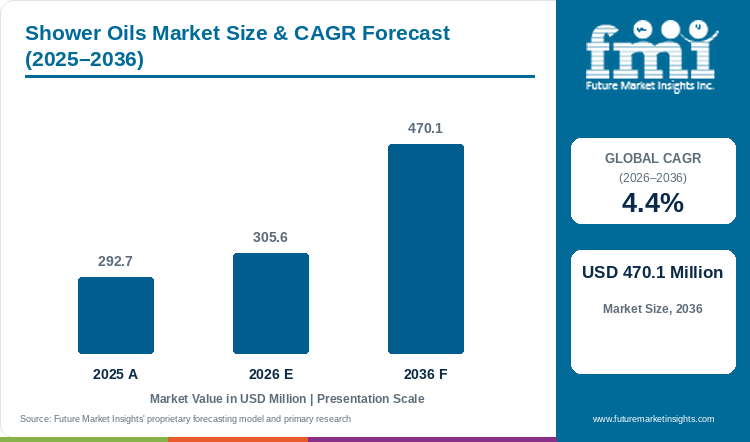
Demand for shower oils is projected to expand at 4.4% CAGR between 2026 and 2036. Industry value grows from USD 292.7 million in 2025 to USD 305.6 million in 2026 and is projected to reach USD 470.1 million by 2036.
Increasing preference for body cleansing products that cleans the skin and leaves less dry after-feel is driving the demand for shower oils. Unlike ordinary body wash, shower oils contain emollients and changes into milk or light foam when mixed with water. In the second quarter of 2026, e-commerce represented 17.1% of total retail sales in the U.S., which is also helping brands to explain this different texture and skin use before purchase[1]. Products from Eucerin, La Roche-Posay and Naturium have made oil-based cleansing more visible for everyday shower routines. Shower oils market is still smaller than the regular body wash category; however, increasing concern regarding skin dryness and harsh cleansing is expected to support its adoption. Wider availability of mass products will encourage trial, while premium shower oils will mainly depend on fragrance, skin comfort and the experience offered after rinsing. FMI analysis suggests that clean rinsing, reasonable price and noticeable moisturized feel is expected to decide the repeat demand over the forecast period.
Regional commercial dynamics and retail channel development create distinct growth outlook across key markets, with UAE shower oils market projected to grow at 5.7% CAGR, whereas South Korea is anticipated to expand at 5.4% through 2036. In January 2026, the Ministry of Food and Drug Safety reported cosmetics exports of USD 11.43 billion in 2025, recording 12.3% growth from 2024, which shows the strong product development and comparison environment in the country[2]. Korean consumers are increasingly looking for lightweight textures that rinses without leaving heavy oil feel. In UAE, premium beauty retail products have better scope, but complete registration, label and import documents are required before wider retail sale. Therefore, digital access will create the product interest in both markets, while formulation suitability and proper product documentation will decide the actual market availability.
Key Takeaways
- Increasing demand for skin-barrier care is supporting shower oils as the product cleanses the skin and also reduces dry after-feel.
- Based on product type, core / classic lines is projected to account for 41.0% in 2026, owing to familiar daily shower use.
- By nature, conventional products are estimated to hold 50.0% in 2026, due to wider formulation and retail availability.
- Liquid & serum formats are expected to represent 27.0% of format demand in 2026, attributed to easy dosing and rinsing.
- The UAE is projected to grow at 5.7% CAGR, whereas South Korea will expand at 5.4%, supported by different channel and registration conditions.
- Some of the key companies in shower oils market are Beiersdorf, Unilever, Coty, e.l.f. Beauty, Estee Lauder Companies, Shiseido, Procter & Gamble, Kao Corporation, Amorepacific and L’Oreal.
Analyst Perspective
“Shower oils will move beyond seasonal dry-skin use when the product rinses clean and gives visible comfort. Over the years of analysis, brands offering simple claims and repeatable pricing are expected to gain regular household demand.”
- Rahul Pandita, Principal Consultant, Future Market Insights.
How is the shower oils market segmented?
The market is segmented by Product Type, Nature, Format, Price Positioning, and Sales Channel. Core / classic lines is projected at 41.0%, conventional products at 50.0%, and liquid & serum formats at 27.0% in 2026.
By product type: core / classic lines, targeted treatment lines, sensitive & gentle lines, premium & clinical lines, and kits & sets.
By nature: conventional, vegan & cruelty-free, natural & organic, dermocosmetic / clinical, and fragrance-free & sensitive.
By format: liquid & serum, cream & balm, stick & solid, spray & mist, sheet & patch, and powder.
By price positioning: mass, masstige, premium, and professional.
By sales channel: e-commerce & DTC, specialty beauty retail, pharmacies & drugstores, supermarkets & hypermarkets, and salons & spas.
By region: North America, Latin America, Western Europe, Eastern Europe, East Asia, South Asia and Pacific, and Middle East and Africa.
Why do core / classic lines retain product type demand?
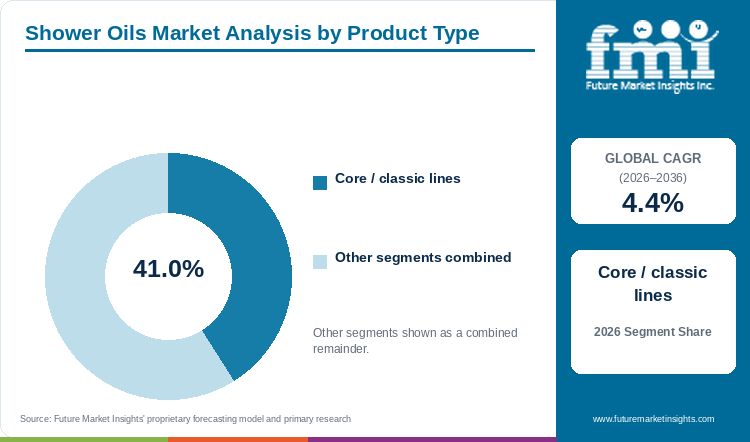
Core / classic lines hold 41.0% share in 2026, owing to familiar cleansing behavior and lower requirement for product education.
Core / classic shower oils are mainly used for regular body cleansing and does not require a separate treatment step. These products have familiar oil-to-milk behavior and can be used in the same shower routine as body wash. Easy availability through pharmacies, drugstores and online stores is expected to drive the core / classic lines segment during the forecast period.
- Core / classic lines hold 41.0% share in 2026, owing to familiar cleansing behavior and lower requirement for product education.
- In March 2026, Beiersdorf reported 11.7% organic growth in its Derma business during 2025, with positive development of Eucerin body categories in several regions[3]. This established body-care reach is helping consumers to understand the use of cleansing oils for dry and sensitive skin.
What keeps conventional products preferred within the nature category?
Conventional products account for 50.0% share in 2026, attributed to wider formulation choices and availability across price ranges.
Conventional shower oils are manufactured with a combination of emollients, cleansing agents and fragrance, depending upon the selected price and end-user requirement. These formulations are available in wider varieties and can be offered from mass to premium price range. In February 2026, the U.S. FDA updated Cosmetics Direct for biennial facility-registration renewal, which increases the importance of stable formulation and complete product records[4]. Conventional products are easier to develop across several fragrance and texture choices as compared to narrowly certified variants. Thus, broad availability and flexible pricing is expected to maintain the demand for conventional shower oils.
- Conventional products account for 50.0% share in 2026, attributed to wider formulation choices and availability across price ranges.
- As of June 30, 2026, the FDA reported 1,298,361 active cosmetic product listings, which shows the scale of product documentation.
How do liquid & serum formats meet shower-use needs?
Liquid & serum formats hold 27.0% share in 2026, owing to controlled dosing, quick spreading and easy rinse-off use.
Liquid & serum shower oils spread easily on wet skin and changes into milk or slight foam during rinsing. Pump and bottle packs also help the consumer in using a controlled quantity without adding another step in the shower. In July 2025, Naturium expanded its body-care availability through Ulta Beauty, allowing consumers to compare the texture in stores instead of depending only on online description[5]. The format is suitable for daily use, refill packs and fragrance or sensitive-skin variants. These factors are anticipated to support the liquid & serum segment in shower oils market.
- Liquid & serum formats hold 27.0% share in 2026, owing to controlled dosing, quick spreading and easy rinse-off use.
- Naturium retail expansion provides physical access to its multi-oil body wash and supports product trial outside online channels.
Why are buyers selecting mass offers by price positioning?
Mass products account for 31.0% share in 2026, due to affordable pricing and regular household shower use.
Mass shower oils keep the cost per use close to ordinary body wash and therefore, are more suitable for frequent household consumption. Consumers are likely to try the product when it is available beside familiar shower products and does not require a high premium. Increasing availability at routine price points is expected to support the mass segment over the forecast period.
- Mass products account for 31.0% share in 2026, due to affordable pricing and regular household shower use.
- Amorepacific continued Happy Bath activity for the mid-to-low price body wash category and supermarket channels in 2025[6]. Such wider shelf presence and simple product communication helps in shifting consumers from standard body wash towards oil-containing cleansers.
Which conditions support e-commerce & DTC sales channel demand?
E-commerce & DTC holds 30.0% share in 2026, owing to product education, reviews and convenient replenishment.
E-commerce & DTC channels provide enough space for explaining the oil texture, ingredients, fragrance, skin type and method of rinsing. This is important for shower oils as many first-time buyers may otherwise consider the product to leave a greasy layer. Reviews, comparison of pack size and replenishment options also supports the purchase decision. In July 2025, e.l.f. Beauty continued the retail expansion of Naturium while maintaining its digital product education[7]. The combination of online explanation and physical product trial is expected to increase the sales of shower oils through e-commerce & DTC channels.
- E-commerce & DTC holds 30.0% share in 2026, owing to product education, reviews and convenient replenishment.
- Naturium uses both digital and specialty-retail channels, which supports product explanation as well as physical texture trial.
What are the drivers, restraints, and opportunities in the shower oils market?
In the shower oils market, the key driver is skin-barrier focused cleansing, the key restraint is fragrance and claims compliance, and the key opportunity is refillable and sensitive-skin oil formulations.
- Driver: Increasing demand for moisturizing and skin-barrier oriented cleansing is anticipated to support shower oils market growth.
- Restraint: Fragrance disclosure, product listing and claim support can increase reformulation cost and may limiting new product entry.
- Opportunity: Fragrance-free, refill and sensitive-skin shower oils is expected to create new avenues for daily household use.
Skin-Barrier Ingredients Expand Cleansing Formats
Increasing inclusion of skincare ingredients in body wash is creating a favorable demand for shower oils. Ingredients and claims earlier used mainly in facial skincare are now appearing in everyday body cleansing products. In March 2025, Unilever reported continued premiumisation in personal care and wider use of benefit-led cleansing formats[8]. This has made hydration, serum and skin-barrier benefits more familiar in the shower category. Shower oils that provides noticeable comfort without leaving the skin oily is expected to witness higher repeat purchase, thereby driving the market growth.
Compliance and Fragrance Listing Requirements Restrain Market Entry
Fragrance disclosure and formulation requirements can restrain the introduction of new shower oils. Covered cosmetics in the U.S. require facility registration and product listing under MoCRA, while EU Regulation 2023/1545 has expanded individual fragrance-allergen labeling requirements. Shower oils commonly depend upon fragrance and a complex combination of oils and surfactants for their sensorial value. As a result, suppliers may require label changes, safety support or reformulation before selling the same variant in different countries. This increases the launch time and cost, especially for smaller companies, and can hamper the expansion of weakly differentiated products.
Cosmetic suppliers require complete labels, safety records and product listings before wider distribution. In September 2026, the U.S. FDA stated that it does not issue certificates for confirming cosmetic facility registration or product listing[9]. The agency reported 16,398 active facility registrations and 1,298,361 active product listings as of June 30, 2026. Therefore, companies have to maintain their own correct regulatory records and cannot use an FDA certificate as a selling support. Additional documentation and formulation work can increase the time required for launching shower oils, which is a major challenge for small product portfolios.
Refill Packs and Sensitive Formulations Open New Avenues
Fragrance-free, refill and family-size shower oils are expected to create growth opportunities beyond seasonal dry-skin use. Beiersdorf reported positive development of Eucerin body categories across Western Europe, Latin America and Africa, Asia and Australia during 2025[10]. This wider body-care demand provides scope for shower oils that can be used by the family on a regular basis. Refill packs can reduce the packaging cost, while fragrance-free and sensitive-skin products can reach consumers avoiding strongly perfumed cleansers. Clean rinsing and easy dosing is anticipated to create new avenues for the market during the forecast period.
Which country CAGRs are profiled in the shower oils market?
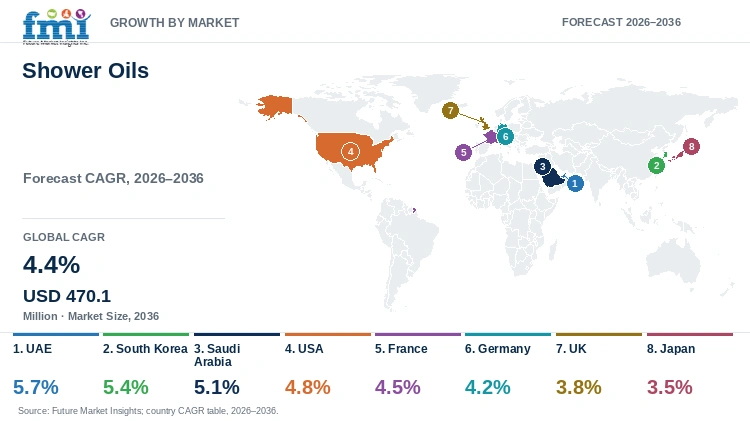
| Country | CAGR |
|---|---|
| UAE | 5.7% |
| South Korea | 5.4% |
| Saudi Arabia | 5.1% |
| USA | 4.8% |
| France | 4.5% |
| Germany | 4.2% |
| UK | 3.8% |
| Japan | 3.5% |
How does the country outlook differ in the shower oils market?
Demand for shower oils is expected to grow faster in countries where premium body care, online beauty purchase and workable cosmetic registration are present. Mature markets will also witness growth; however, strong use of ordinary body wash and higher compliance cost can restrict faster adoption.
UAE, South Korea and Saudi Arabia are benefiting from premium retail and online product discovery, whereas the USA and European countries have stronger pharmacy and dermocosmetic channels. Japan is expected to witness steady demand due to preference for mild cleansing and lightweight texture.
- South Korea: Digital shopping depth and a regulatory distinction between general and functional cosmetics support sophisticated product comparison.
- Saudi Arabia: Very high internet use and strong online cosmetics purchasing expand reach beyond physical beauty retail.
- USA: Large e-commerce scale supports education-led discovery, while MoCRA increases documentation expectations for cosmetic suppliers.
- France: Pharmacy-linked dermocosmetic culture supports skin-barrier claims, while EU fragrance labeling rules shape formulation and packaging decisions.
- Germany: Sensitive-skin and dermocosmetic positioning is well established, with Eucerin providing a local example of direct shower-oil availability.
- UK: A high online share of retail sales favors DTC replenishment and comparison shopping even as the market remains promotion-sensitive.
- Japan: An aging population and sophisticated skin-care market support gentle cleansing, but slower population growth limits broad volume expansion.
Country-wise Analysis below explains commercial conditions that can influence the stated growth rates; public evidence is used to explain market conditions rather than replace the report’s market sizing.
Country-wise Analysis
- UAE shower oils market is projected to grow at 5.7% CAGR through 2036, owing to increasing premium beauty retail and availability of international personal-care brands. In September 2026, the Ministry of Economy and Tourism published open trade data reflecting sustained consumer goods imports and registered retail growth[11]. Consumer products require complete registration and trade documents before wider market entry. Online and specialty beauty stores are helping brands to explain the oil-to-milk use and skin-comfort benefit before purchase. Increasing preference for premium bathing products and fragrance-led personal care is expected to drive the market. However, products without clear benefit or correct local documentation may find limited retail acceptance.
- South Korea shower oils market is anticipated to advance at 5.4% CAGR during the forecast period. The country has a large cosmetics manufacturing base and consumers are fast in comparing new ingredients, textures and product functions. In October 2025, the Korea Customs Service reported that cosmetic exports achieved strong momentum across global consumer markets[12]. This strong beauty production environment is expected to support the introduction of light oil-to-milk cleansers. Products that rinses clean and does not leave heavy after-feel are likely to witness higher demand in the country.
- Shower oil demand in Saudi Arabia is forecast to rise at 5.1% CAGR over the assessment period, supported by increasing online purchasing. Official 2025 ICT statistics reported that 80.2% of individuals purchased goods or services online, while cosmetics were bought by 40.2% of online shoppers[13]. E-commerce allows specialized shower cleansers to reach consumers even without a large physical store network. Premium fragrance and sensitive-skin offers have considerable scope; however, authenticity, import requirement and correct product registration remains important for market growth.
- USA shower oils market is estimated to expand at 4.8% CAGR through 2036, owing to digital discovery and growing demand for treatment-led body care. In August 2026, the U.S. Census Bureau reported expanding health and personal care store retail activity alongside steady online sales channels[14]. Online product pages explain the oil texture, ingredients and change during rinsing, which makes purchase easier for a new user. At the same time, FDA records included 16,398 active cosmetic facilities as of June 30, 2026, showing the need for proper records in a large and competitive category. Increasing use of stable formulations with clear moisturization claims is expected to drive the market.
- France shower oils market is projected to record 4.5% CAGR during the assessment period, attributed to the strong pharmacy and dermocosmetic culture. La Roche-Posay and other familiar pharmacy brands have made cleansing oils better understood among dry and sensitive-skin users. In May 2025, COSMED reported that 12.6% of French cosmetics production was exported to the United States during 2024[15]. Such export activity requires updated formulation and labeling records. Increasing demand for mild shower products will support the market, whereas expanded fragrance-allergen disclosure can add packaging and reformulation work.
- Germany shower oils market is predicted to advance at 4.2% CAGR through 2036, reinforced by established drugstore and body-care retail. In December 2025, the German Cosmetic, Toiletry, Perfumery and Detergent Association reported 0.8% growth in bath and shower preparations from 2024[16]. Shower oils have to compete with a wide selection of ordinary body wash in this mature category. Eucerin provides a familiar sensitive-skin route through pharmacies and drugstores. Products offering mild cleansing, clean rinsing and regular-use pricing are expected to support the market growth.
- UK shower oils market is estimated to post 3.8% CAGR over the forecast period, supported by the high use of internet retail. Internet sales represented 27.5% of total retail sales in 2025 and 28.0% in the second quarter of 2026[17]. This channel helps consumers to compare ingredients, reviews, pack size and price before selecting an oil cleanser. However, shower oils competes with body wash, cleansing bars and pharmacy products, which can restrict easy switching. Fragrance-free variants, refill packs and visible comfort after rinsing are expected to support the market demand.
- Japan shower oils market is forecast to expand at 3.5% CAGR through 2036, linked to regular bathing routines and demand for mild-care products. In November 2025, the U.S. Department of Commerce placed Japan B2C e-commerce at USD 176.8 billion using official Japanese survey data[18]. Online channels provide enough space for comparing texture, claims and compact pack sizes. Consumers in Japan commonly prefer lightweight products that rinses clean instead of a heavy oily layer. Thus, compact and gentle shower oils are expected to witness steady growth, while slower population growth can restrict wider volume expansion.
Who are the notable companies in the shower oils market?
Beiersdorf, Unilever, Coty, e.l.f. Beauty, Estee Lauder Companies, Shiseido, Procter & Gamble, Kao Corporation, Amorepacific, and L'Oreal are the notable companies profiled in this market.
Shower oils market is moderately fragmented with the presence of dermocosmetic brands, mass body-cleansing companies and prestige beauty groups. Beiersdorf and L'Oreal offer direct oil-based cleansers through Eucerin and La Roche-Posay, whereas e.l.f. Beauty participates through Naturium multi-oil body wash. Unilever, Procter & Gamble, Kao Corporation and Amorepacific have wider body-cleansing portfolios and retail distribution. Coty, Estee Lauder Companies and Shiseido have strong prestige beauty reach, but their direct shower-oil availability is comparatively limited. Increasing focus on skin comfort, texture and channel expansion is expected to intensify the competition during the forecast period.
- Dermocosmetic and skin-barrier specialists: Beiersdorf and L'Oreal have direct public evidence for oil-based rinse-off body cleansing and sensitive-skin positioning.
- Mass and ingredient-led body-cleansing platforms: Unilever, e.l.f. Beauty, Procter & Gamble, Kao Corporation, and Amorepacific compete through body wash, treatment-style cleansing or oil-rich body-care propositions.
- Prestige and selective beauty portfolios: Coty, Estee Lauder Companies, and Shiseido have broad beauty reach, but direct shower-oil evidence is less complete in the public material reviewed.
Competitive Benchmarking: Shower Oils Market
| Company | Oil-Based Rinse-Off Cleansing | Skin-Barrier / Sensitive-Skin Proposition | Channel Breadth | Geographic Reach |
|---|---|---|---|---|
| Beiersdorf | High | High | High | Europe, North America, Latin America, Asia, Middle East and Africa |
| Unilever | Unscored | High | High | North America, Europe, Asia, Latin America, Middle East and Africa |
| Coty | Unscored | Medium | Medium | North America, Europe, Asia and selected global prestige markets |
| e.l.f. Beauty | High | Medium | High | United States with international retail expansion and DTC reach |
| Estee Lauder Companies | Unscored | Medium | High | Approximately 150 countries and territories across prestige channels |
| Shiseido | Unscored | Medium | High | Japan, Asia-Pacific, Americas, Europe and travel retail |
| Procter & Gamble | Unscored | High | High | Global mass retail and e-commerce through Olay and other personal-care brands |
| Kao Corporation | Unscored | Medium | High | Japan, wider Asia, Oceania, North America and Europe |
| Amorepacific | Unscored | Medium | Medium | South Korea, wider Asia and selected global beauty markets |
| L'Oreal | High | High | High | Global reach across dermatological beauty, mass, luxury and e-commerce channels |
High rating indicates wider product depth, current activity, channel availability and geographic reach. Medium rating shows narrower or adjacent capability, whereas unscored means that sufficient direct shower-oil evidence was not available in the reviewed public material. These ratings do not represent product quality or company market share.
Key Developments in the Shower Oils Market
- In March 2026, Beiersdorf reported 11.7% organic growth for its Derma business during 2025. Positive development of Eucerin body categories across several regions is supporting the company position in sensitive-skin and oil-based cleansing.
- In August 2025, Estée Lauder Companies reported the expansion of fragrance distribution through Jo Malone London and Le Labo store openings. This wider premium beauty reach can support sensorial body-care discovery, although direct shower-oil capability remains limited.
- In July 2025, e.l.f. Beauty reported continued retail expansion of Naturium. Wider store availability is helping consumers to physically compare the texture and use of the company’s multi-oil body wash.
Key Players in the Shower Oils Market
Dermocosmetic and Skin-Barrier Specialists
- Beiersdorf
- L'Oreal
Mass and Ingredient-Led Body Cleansing Platforms
- Unilever
- e.l.f. Beauty
- Procter & Gamble
- Kao Corporation
- Amorepacific
Prestige and Selective Beauty Portfolios
- Coty
- Estee Lauder Companies
- Shiseido
Shower Oils Market - Report Scope
| Coverage field | Report scope |
|---|---|
| Market breakdown | Product Type, Nature, Format, Price Positioning, Sales Channel |
| Quantitative Units | USD Million |
| Market Definition | Revenue from products marketed for shower or bath-body cleansing and treatment where oil, lipid-rich emollients or cleansing-oil behavior is a defining proposition. Leave-on body oils and lotions are excluded. Standalone facial cleansing oils, conventional body washes without oil or emollient positioning, services and downstream finished-product revenue outside the named category are also excluded. |
| Regions Covered | North America, Latin America, Western Europe, Eastern Europe, East Asia, South Asia and Pacific, Middle East and Africa |
| Countries Covered | USA, Germany, France, UK, Saudi Arabia, UAE, Japan, South Korea |
| Key Companies Profiled | Beiersdorf, Unilever, Coty, e.l.f. Beauty, Estee Lauder Companies, Shiseido, Procter & Gamble, Kao Corporation, Amorepacific, L'Oreal |
| Forecast Period | 2026 to 2036 |
Shower Oils Market - Research Methodology
| Method | Approach |
|---|---|
| Primary Research | Primary interviews were conducted with manufacturers, distributors, retailers, end users, procurement teams and industry experts. Interviews covers purchasing decision, product evaluation, pricing, adoption barriers and approval requirement. |
| Desk Research | Desk research includes government statistics, regulatory publications, trade data, industry associations, company reports, product pages and official announcements. Information was checked for date, market relevance and geographic coverage. |
| Market Sizing and Forecasting | Market sizing combines the 2025 baseline with segment structure, pricing, volume indicators, company participation and country demand. Forecast assumptions considers economic activity, product adoption, supply availability and regulatory changes. |
| Data Validation | Estimates were compared with public data, company activity, trade patterns and primary inputs. Adjacent products, unsupported claims and overlapping revenue were excluded in order to maintain the defined market boundary. |
Shower Oils Market by Segments
Shower Oils Market segmented by Product Type:
- Core / classic lines
- Targeted treatment lines
- Sensitive & gentle lines
- Premium & clinical lines
- Kits & sets
Shower Oils Market segmented by Nature:
- Conventional
- Vegan & cruelty-free
- Natural & organic
- Dermocosmetic / clinical
- Fragrance-free & sensitive
Shower Oils Market segmented by Format:
- Liquid & serum
- Cream & balm
- Stick & solid
- Spray & mist
- Sheet & patch
- Powder
Shower Oils Market segmented by Price Positioning:
- Mass
- Masstige
- Premium
- Professional
Shower Oils Market segmented by Sales Channel:
- E-commerce & DTC
- Specialty beauty retail
- Pharmacies & drugstores
- Supermarkets & hypermarkets
- Salons & spas
Shower Oils Market by Region
- North America
- United States
- Canada
- Latin America
- Brazil
- Mexico
- Argentina
- Chile
- Western Europe
- Germany
- France
- United Kingdom
- Italy
- Spain
- Benelux
- Nordics
- Eastern Europe
- Poland
- Czech Republic
- Romania
- Hungary
- East Asia
- China
- Japan
- South Korea
- South Asia and Pacific
- India
- ASEAN
- Australia and New Zealand
- Middle East and Africa
- GCC Countries
- South Africa
- Türkiye
- Israel
Research Sources and Bibliography
- [1] U.S. Census Bureau. (2026, August 18). Quarterly retail e-commerce sales.
- [2] Ministry of Food and Drug Safety, Republic of Korea. (2026, January). Cosmetics exports of USD 11.43 billion in 2025.
- [3] Beiersdorf AG. (2026, March 3). Annual report 2025: Results of operations, business segments.
- [4] U.S. Food and Drug Administration. (2026, September 9). Registration and listing of cosmetic product facilities and products.
- [5] e.l.f. Beauty, Inc. (2025, July). Naturium retail and body-care expansion.
- [6] Amorepacific Corporation. (2025, January). HAPPYBATH body cleansing portfolio activity.
- [7] e.l.f. Beauty, Inc. (2025, July). Naturium retail expansion and digital product education.
- [8] Unilever PLC. (2025, March). Personal care premiumisation and benefit-led cleansing formats.
- [9] U.S. Food and Drug Administration. (2026, September 9). FDA clarification on cosmetic registration and product listing certificates.
- [10] Beiersdorf AG. (2026, March 3). Eucerin body category development during 2025.
- [11] Ministry of Economy and Tourism, United Arab Emirates. (2026, September 2). MoEc open data.
- [12] Korea Customs Service. (2025, October 17). Korean cosmetic exports achieve record growth in 2025.
- [13] General Authority for Statistics, Saudi Arabia. (2026). ICT access and usage statistics by households and individuals 2025.
- [14] U.S. Census Bureau. (2026, September 16). Advance monthly sales for retail and food services: Health and personal care stores.
- [15] COSMED. (2025, May). Rapport COSMED-SVP, first quarter 2025.
- [16] Industrieverband Körperpflege- und Waschmittel. (2025, December 3). The German cosmetic, toiletry, perfumery and detergent market at retail sales prices.
- [17] Office for National Statistics. (2026, September 18). Internet sales as a percentage of total retail sales.
- [18] U.S. Department of Commerce, International Trade Administration. (2025, November 18). Japan: E-commerce.
This bibliography is provided for reader reference. The full report contains the complete reference list and detailed citations.
This Report Answers
- How large is the Shower Oils Market in 2026 and what value is forecast for 2036?
- Which skin-care and channel pressures support demand for shower oils?
- Why do Core / classic lines hold the leading position in Product Type?
- Why does Conventional remain the nature category?
- How do the profiled country growth rates differ from the UAE through Japan?
- Which profiled companies supply direct shower oils or adjacent rinse-off body-cleansing propositions?
- What limits adoption, reformulation or supplier switching in the market?
- What should buyers evaluate before selecting a shower-oil product or supplier?
Frequently Asked Questions
How large is the Shower Oils Market expected to be in 2026?
Future Market Insights estimates that the shower oils market will reach USD 305.6 million in 2026. The market is projected to expand further and reach USD 470.1 million by 2036.
What CAGR is forecast for the Shower Oils Market through 2036?
As per FMI, the shower oils market is projected to grow at a 4.4% CAGR from 2026 to 2036. Growth is supported by increasing adoption of mild oil-to-milk cleansers and rising demand for skin-barrier care.
Which product type holds a notable shower oils demand share in 2026?
Future Market Insights projects core / classic lines to hold 41.0% of product type demand in 2026. The segment benefits from familiar daily shower routines and lower requirement for product education.
Which nature segment holds a notable shower oils share in 2026?
FMI finds that conventional products will hold 50.0% of nature demand in 2026 (with liquid & serum formats representing 27.0% by format). Demand is supported by wider formulation choices, easy dosing, and convenient rinse-off use.
Which country has a notable shower oils expansion outlook during the forecast period?
Future Market Insights predicts the UAE to expand at a 5.7% CAGR during the 2026 to 2036 assessment period (with South Korea growing at 5.4%). Growth is supported by premium beauty retail, digital brand discovery, and growing demand for skin-comfort formulations.
Which companies are active in the Shower Oils Market during 2026?
As per FMI analysis, notable companies include Beiersdorf, Unilever, Coty, e.l.f. Beauty, Estee Lauder Companies, Shiseido, Procter & Gamble, Kao Corporation, Amorepacific, and L'Oreal. These companies are focusing on formulation development, retail channel expansion, and sensitive-skin cleansing propositions.
Preview the report firsthand - request a free sample
Get SampleGet the brochure for pricing and purchase details.
Get PDFTable of Content
- Key Takeaways
- Market Size and CAGR
- Top Growth Driver
- Fastest Growing Segment
- Leading Region
- Key Companies
- Emerging Opportunities
- Executive Summary
- Global Market Outlook
- Demand-side Trends
- Supply-side Trends
- Technology Roadmap Analysis
- Analysis and Recommendations
- Analyst Perspective (What is happening? Why now? What should investors know?)
- Key Questions Answered
- How large is the market?
- What is the CAGR?
- What are key trends?
- Which region dominates?
- Who are the leaders?
- Market Overview
- Market Coverage / Taxonomy
- Market Definition / Scope / Limitations
- Research Methodology
- Chapter Orientation
- Analytical Lens and Working Hypotheses
- Market Structure, Signals, and Trend Drivers
- Benchmarking and Cross-market Comparability
- Market Sizing, Forecasting, and Opportunity Mapping
- Research Design and Evidence Framework
- Desk Research Programme (Secondary Evidence)
- Expert Input and Fieldwork (Primary Evidence)
- Tooling, Models, and Reference Databases
- Data Engineering and Model Build
- Quality Assurance and Audit Trail
- Market Background
- Market Dynamics (Drivers, Restraints, Opportunity, Trends)
- Scenario Forecast (Optimistic, Likely, Conservative)
- Impact Analysis
- AI Impact
- Sustainability Impact
- Regulatory Impact
- Technology Impact
- Consumer / Buyer Analysis
- Purchase Drivers
- Adoption Barriers
- Buyer Journey
- Opportunity Map Analysis
- Product Life Cycle Analysis
- Supply Chain Analysis
- Investment Feasibility Matrix
- Value Chain Analysis
- PESTLE and Porter's Analysis
- Regulatory Landscape
- Regional Parent Market Outlook
- Production and Consumption Statistics
- Import and Export Statistics
- Global Market Analysis and Forecast, 2021 to 2036
- Historical Market Size Value (USD Million) Analysis, 2021 to 2025
- Current and Future Market Size Value (USD Million) Projections, 2026 to 2036
- Y-o-Y Growth Trend Analysis
- Absolute $ Opportunity Analysis
- Global Market Pricing Analysis, 2021 to 2036
- Global Market Analysis and Forecast, By Product Type, 2021 to 2036
- Introduction / Key Findings
- Historical Market Size Value (USD Million) Analysis By Product Type, 2021 to 2025
- Current and Future Market Size Value (USD Million) Analysis and Forecast By Product Type, 2026 to 2036
- Core / classic lines
- Targeted treatment lines
- Sensitive & gentle lines
- Premium & clinical lines
- Kits & sets
- Y-o-Y Growth Trend Analysis By Product Type, 2021 to 2025
- Absolute $ Opportunity Analysis By Product Type, 2026 to 2036
- Global Market Analysis and Forecast, By Nature, 2021 to 2036
- Introduction / Key Findings
- Historical Market Size Value (USD Million) Analysis By Nature, 2021 to 2025
- Current and Future Market Size Value (USD Million) Analysis and Forecast By Nature, 2026 to 2036
- Conventional
- Vegan & cruelty-free
- Natural & organic
- Dermocosmetic / clinical
- Fragrance-free & sensitive
- Y-o-Y Growth Trend Analysis By Nature, 2021 to 2025
- Absolute $ Opportunity Analysis By Nature, 2026 to 2036
- Global Market Analysis and Forecast, By Format, 2021 to 2036
- Introduction / Key Findings
- Historical Market Size Value (USD Million) Analysis By Format, 2021 to 2025
- Current and Future Market Size Value (USD Million) Analysis and Forecast By Format, 2026 to 2036
- Liquid & serum
- Cream & balm
- Stick & solid
- Spray & mist
- Sheet & patch
- Powder
- Y-o-Y Growth Trend Analysis By Format, 2021 to 2025
- Absolute $ Opportunity Analysis By Format, 2026 to 2036
- Global Market Analysis and Forecast, By Price Positioning, 2021 to 2036
- Introduction / Key Findings
- Historical Market Size Value (USD Million) Analysis By Price Positioning, 2021 to 2025
- Current and Future Market Size Value (USD Million) Analysis and Forecast By Price Positioning, 2026 to 2036
- Mass
- Masstige
- Premium
- Professional
- Y-o-Y Growth Trend Analysis By Price Positioning, 2021 to 2025
- Absolute $ Opportunity Analysis By Price Positioning, 2026 to 2036
- Global Market Analysis and Forecast, By Sales Channel, 2021 to 2036
- Introduction / Key Findings
- Historical Market Size Value (USD Million) Analysis By Sales Channel, 2021 to 2025
- Current and Future Market Size Value (USD Million) Analysis and Forecast By Sales Channel, 2026 to 2036
- E-commerce & DTC
- Specialty beauty retail
- Pharmacies & drugstores
- Supermarkets & hypermarkets
- Salons & spas
- Y-o-Y Growth Trend Analysis By Sales Channel, 2021 to 2025
- Absolute $ Opportunity Analysis By Sales Channel, 2026 to 2036
- Global Market Analysis and Forecast, By Region, 2021 to 2036
- Introduction
- Historical Market Size Value (USD Million) Analysis By Region, 2021 to 2025
- Current Market Size Value (USD Million) Analysis and Forecast By Region, 2026 to 2036
- North America
- Latin America
- Western Europe
- Eastern Europe
- East Asia
- South Asia and Pacific
- Middle East and Africa
- Market Attractiveness Analysis By Region
- North America Market Analysis and Forecast, By Country, 2021 to 2036
- Historical Market Size Value (USD Million) Trend Analysis By Market Taxonomy, 2021 to 2025
- Market Size Value (USD Million) Forecast By Market Taxonomy, 2026 to 2036
- By Country
- United States
- Canada
- By Product Type
- By Nature
- By Format
- By Price Positioning
- By Sales Channel
- By Country
- Market Attractiveness Analysis
- By Country
- By Product Type
- By Nature
- By Format
- By Price Positioning
- By Sales Channel
- Key Takeaways
- Latin America Market Analysis and Forecast, By Country
- Historical Market Size Value (USD Million) Trend Analysis By Market Taxonomy, 2021 to 2025
- Market Size Value (USD Million) Forecast By Market Taxonomy, 2026 to 2036
- By Country
- Brazil
- Mexico
- Argentina
- Chile
- By Product Type
- By Nature
- By Format
- By Price Positioning
- By Sales Channel
- By Country
- Market Attractiveness Analysis
- By Country
- By Product Type
- By Nature
- By Format
- By Price Positioning
- By Sales Channel
- Key Takeaways
- Western Europe Market Analysis and Forecast, By Country
- Historical Market Size Value (USD Million) Trend Analysis By Market Taxonomy, 2021 to 2025
- Market Size Value (USD Million) Forecast By Market Taxonomy, 2026 to 2036
- By Country
- Germany
- France
- United Kingdom
- Italy
- Spain
- Benelux
- Nordics
- By Product Type
- By Nature
- By Format
- By Price Positioning
- By Sales Channel
- By Country
- Market Attractiveness Analysis
- By Country
- By Product Type
- By Nature
- By Format
- By Price Positioning
- By Sales Channel
- Key Takeaways
- Eastern Europe Market Analysis and Forecast, By Country
- Historical Market Size Value (USD Million) Trend Analysis By Market Taxonomy, 2021 to 2025
- Market Size Value (USD Million) Forecast By Market Taxonomy, 2026 to 2036
- By Country
- Poland
- Czech Republic
- Romania
- Hungary
- By Product Type
- By Nature
- By Format
- By Price Positioning
- By Sales Channel
- By Country
- Market Attractiveness Analysis
- By Country
- By Product Type
- By Nature
- By Format
- By Price Positioning
- By Sales Channel
- Key Takeaways
- East Asia Market Analysis and Forecast, By Country
- Historical Market Size Value (USD Million) Trend Analysis By Market Taxonomy, 2021 to 2025
- Market Size Value (USD Million) Forecast By Market Taxonomy, 2026 to 2036
- By Country
- China
- Japan
- South Korea
- By Product Type
- By Nature
- By Format
- By Price Positioning
- By Sales Channel
- By Country
- Market Attractiveness Analysis
- By Country
- By Product Type
- By Nature
- By Format
- By Price Positioning
- By Sales Channel
- Key Takeaways
- South Asia and Pacific Market Analysis and Forecast, By Country
- Historical Market Size Value (USD Million) Trend Analysis By Market Taxonomy, 2021 to 2025
- Market Size Value (USD Million) Forecast By Market Taxonomy, 2026 to 2036
- By Country
- India
- ASEAN
- Australia and New Zealand
- By Product Type
- By Nature
- By Format
- By Price Positioning
- By Sales Channel
- By Country
- Market Attractiveness Analysis
- By Country
- By Product Type
- By Nature
- By Format
- By Price Positioning
- By Sales Channel
- Key Takeaways
- Middle East and Africa Market Analysis and Forecast, By Country
- Historical Market Size Value (USD Million) Trend Analysis By Market Taxonomy, 2021 to 2025
- Market Size Value (USD Million) Forecast By Market Taxonomy, 2026 to 2036
- By Country
- GCC Countries
- South Africa
- Türkiye
- Israel
- By Product Type
- By Nature
- By Format
- By Price Positioning
- By Sales Channel
- By Country
- Market Attractiveness Analysis
- By Country
- By Product Type
- By Nature
- By Format
- By Price Positioning
- By Sales Channel
- Key Takeaways
- Key Countries Market Analysis
- United States
- Pricing Analysis
- Market Share Analysis, 2025
- By Product Type
- By Nature
- By Format
- By Price Positioning
- By Sales Channel
- Canada
- Pricing Analysis
- Market Share Analysis, 2025
- By Product Type
- By Nature
- By Format
- By Price Positioning
- By Sales Channel
- Mexico
- Pricing Analysis
- Market Share Analysis, 2025
- By Product Type
- By Nature
- By Format
- By Price Positioning
- By Sales Channel
- Brazil
- Pricing Analysis
- Market Share Analysis, 2025
- By Product Type
- By Nature
- By Format
- By Price Positioning
- By Sales Channel
- Chile
- Pricing Analysis
- Market Share Analysis, 2025
- By Product Type
- By Nature
- By Format
- By Price Positioning
- By Sales Channel
- Germany
- Pricing Analysis
- Market Share Analysis, 2025
- By Product Type
- By Nature
- By Format
- By Price Positioning
- By Sales Channel
- United Kingdom
- Pricing Analysis
- Market Share Analysis, 2025
- By Product Type
- By Nature
- By Format
- By Price Positioning
- By Sales Channel
- Italy
- Pricing Analysis
- Market Share Analysis, 2025
- By Product Type
- By Nature
- By Format
- By Price Positioning
- By Sales Channel
- Spain
- Pricing Analysis
- Market Share Analysis, 2025
- By Product Type
- By Nature
- By Format
- By Price Positioning
- By Sales Channel
- France
- Pricing Analysis
- Market Share Analysis, 2025
- By Product Type
- By Nature
- By Format
- By Price Positioning
- By Sales Channel
- India
- Pricing Analysis
- Market Share Analysis, 2025
- By Product Type
- By Nature
- By Format
- By Price Positioning
- By Sales Channel
- ASEAN
- Pricing Analysis
- Market Share Analysis, 2025
- By Product Type
- By Nature
- By Format
- By Price Positioning
- By Sales Channel
- Australia and New Zealand
- Pricing Analysis
- Market Share Analysis, 2025
- By Product Type
- By Nature
- By Format
- By Price Positioning
- By Sales Channel
- China
- Pricing Analysis
- Market Share Analysis, 2025
- By Product Type
- By Nature
- By Format
- By Price Positioning
- By Sales Channel
- Japan
- Pricing Analysis
- Market Share Analysis, 2025
- By Product Type
- By Nature
- By Format
- By Price Positioning
- By Sales Channel
- South Korea
- Pricing Analysis
- Market Share Analysis, 2025
- By Product Type
- By Nature
- By Format
- By Price Positioning
- By Sales Channel
- Poland
- Pricing Analysis
- Market Share Analysis, 2025
- By Product Type
- By Nature
- By Format
- By Price Positioning
- By Sales Channel
- Hungary
- Pricing Analysis
- Market Share Analysis, 2025
- By Product Type
- By Nature
- By Format
- By Price Positioning
- By Sales Channel
- Türkiye
- Pricing Analysis
- Market Share Analysis, 2025
- By Product Type
- By Nature
- By Format
- By Price Positioning
- By Sales Channel
- South Africa
- Pricing Analysis
- Market Share Analysis, 2025
- By Product Type
- By Nature
- By Format
- By Price Positioning
- By Sales Channel
- UAE
- Pricing Analysis
- Market Share Analysis, 2025
- By Product Type
- By Nature
- By Format
- By Price Positioning
- By Sales Channel
- Saudi Arabia
- Pricing Analysis
- Market Share Analysis, 2025
- By Product Type
- By Nature
- By Format
- By Price Positioning
- By Sales Channel
- United States
- Market Structure Analysis
- Competition Dashboard
- Competition Benchmarking
- Market Share Analysis of Top Players
- By Regional
- By Product Type
- By Nature
- By Format
- By Price Positioning
- By Sales Channel
- Emerging Startups
- Innovation Benchmarking
- Competition Analysis
- Competition Deep Dive
- Beiersdorf
- Overview
- Product Portfolio
- Profitability by Market Segments
- Sales Footprint
- Strategy Overview
- Marketing Strategy
- Product Strategy
- Channel Strategy
- Unilever
- Coty
- e.l.f. Beauty
- Estee Lauder Companies
- Shiseido
- Procter & Gamble
- Kao Corporation
- Amorepacific
- L'Oreal
- Beiersdorf
- Case Studies
- Success Stories
- Recent Developments
- Competition Deep Dive
- Assumptions & Acronyms Used


