

- Market Size (2026)
- USD 246.9 Mn
- Forecast (2036)
- USD 365.5 Mn
- CAGR (2026 to 2036)
- 4.0%
How big is Bath Oils Market in 2026?
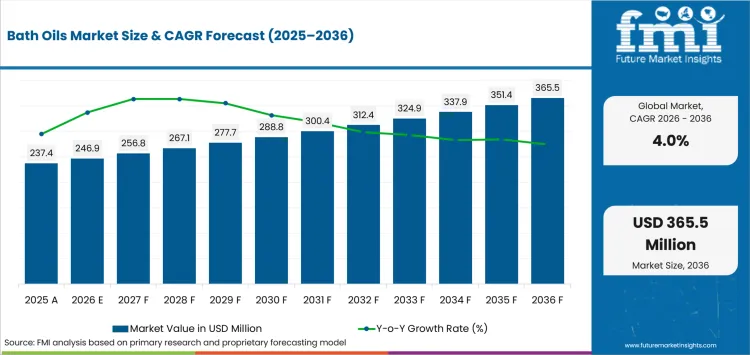
USD 246.9 million in 2026 and USD 365.5 million by 2036 at a 4.0% CAGR.
Sales in the bath oils market are projected to grow at 4.0% CAGR through 2036, driving valuation to USD 365.5 million by 2036 from USD 246.9 million in 2026. The category depends on repeat personal-care routines more than occasional treatment claims. Cosmetics Europe found in June 2026 that 91% of surveyed Europeans had an established personal-care routine. Bath oils can enter that routine as a small-format skin-feel and scent purchase within broader beauty and personal care spending.
Growth rates differ because local channels create different reasons to use the product. Dubai welcomed 19.59 million international overnight visitors in 2025, up 5% according to the Dubai Department of Economy and Tourism in February 2026. That visitor base gives UAE brands more hotel, gifting, and spa discovery occasions than mature European retail alone can provide. The faster UAE forecast therefore depends partly on hospitality-led trial linked to spa services.
Key Takeaways
- Routine bathing and personal-care habits keep bath oils tied to repeat skin-feel and fragrance purchases rather than one-off treatment demand.
- By product type, everyday essentials are estimated to hold 41.0% in 2026 because familiar dosing and broad use occasions reduce the need for product education.
- Conventional formulations are projected to account for 40.0% of nature in 2026 owing to wider fragrance and emollient formulation choices at mainstream price points.
- Daily routine is anticipated to represent 45.0% of use occasion in 2026 because regular bathing provides more replenishment opportunities than gifting or recovery use.
- Fragrance sensitivity, ingredient restrictions, and country-specific product notification can delay launches and increase reformulation work for cross-border assortments.
- Some of the key players in this market include Lush, Rituals Cosmetics, Aromatherapy Associates, Susanne Kaufmann, and Olverum Limited.
Analyst Perspective
"Bath oils earn repeat revenue if scent, after-feel, dose, and claims are easy to understand at first use. Strong offers justify trade-up with formulation quality or a clear ritual, then protect margin by avoiding regulatory rework between markets."
- Rahul Pandita, Principal Consultant, Future Market Insights
How is the bath oils market segmented?
The bath oils market is segmented by product type, nature, use occasion, price tier, sales channel, and region.
Product type includes everyday essentials, targeted therapy formats, premium and smart formats, and gift and travel sets. Nature covers conventional, natural and organic, vegan, and clinically positioned products. Use occasion includes daily routine, recovery and post-workout, sleep and wind-down, and gifting. Price tier separates mass, mid-range, and premium offers. Sales channel covers e-commerce and DTC, specialty wellness retail, pharmacies, supermarkets, and spas and studios.
What makes everyday essentials central to the product type category?
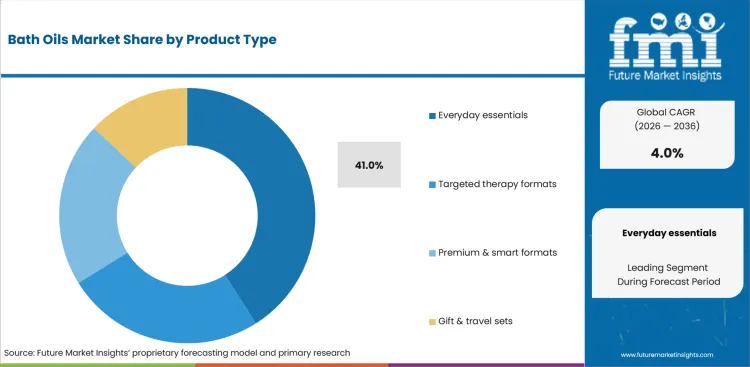
Everyday essentials fit an existing bath without asking consumers to learn a new device, schedule, or treatment sequence. The format is judged on scent, skin feel, residue, and dose before a household decides whether to reorder it.
- By product type, everyday essentials are estimated to hold 41.0% in 2026 owing to familiar use and broad coverage of ordinary bathing occasions.
- Cosmetics Europe found in June 2026 that 76% of routine users considered cosmetics and personal-care products important or very important. Routine relevance gives simple bath oils a wider replenishment base than narrow special-purpose formats.
Why does conventional lead the nature category?
Conventional formulas give manufacturers more room to select carrier oils, fragrance systems, textures, and preservation choices without adding an organic certification claim. Natural cosmetics can strengthen premium positioning. Ingredient origin alone does not remove safety or labeling work.
- Conventional is projected to represent 40.0% of nature in 2026 attributable to wider formulation choices that can serve mass and mid-range price points.
- The European Commission recorded cosmetics in 36% of Safety Gate dangerous-product alerts for 2025. That enforcement burden keeps fragrance selection and ingredient control relevant even for conventional products with broad design freedom.
How does daily routine anchor the use occasion category?
Daily routine converts a sensory bath product into a replenishable personal-care item. Consumers can use fragrance and emollient oils during ordinary bathing. Aromatherapy-led sleep or recovery propositions need a more specific reason to believe.
- Daily routine is expected to lead use occasion with 45.0% share in 2026 since frequent bathing produces more purchase occasions than seasonal gifting or occasional recovery use.
- CTPA reported in December 2025 that 55% of surveyed UK parents linked healthy skin habits with lifelong self-care habits. The finding supports routine-led personal care without treating a bath oil as a medical product.
What supports mid-range leadership in the price tier category?
Mid-range bath oils have enough pricing room for fragrance character, gift-ready presentation, and oil-rich formulas without requiring prestige-level spending. Premium cosmetics can command more if provenance or design is distinctive, although frequent use then reaches a narrower audience.
- By price tier, mid-range is forecast to capture 42.0% in 2026 because the tier balances sensory differentiation with a purchase level suited to replenishment and gifting.
- IKW found that drugstores accounted for 53% of German beauty-care purchases in 2025. That channel concentration gives accessible price points broad visibility beside mainstream body-care and personal-care products.
What drives e-commerce and DTC within the sales channel category?
Bath oils are difficult to sample digitally, so online conversion depends on specific scent notes, ingredient disclosure, dosage guidance, and credible use descriptions. Direct channels compensate by making limited editions, bundles, and replenishment easier to merchandise beside personal care packaging and related body products.
- E-commerce and DTC is set to lead sales channel with 36.0% share in 2026 because direct merchandising can explain use and support limited releases plus repeat ordering.
- IKW recorded 22.5% growth in German beauty e-commerce during 2025. Online purchasing reached 9% share, showing that digital beauty buying can grow quickly even where drugstores retain the largest channel position.
What are the drivers, restraints and opportunities in the Bath Oils Market?
Repeat self-care routines support demand, fragrance and safety requirements slow broad launches, and occasion-led products give brands room to widen use without medical claims.
- Driver: Familiar bathing routines let brands sell fragrance and skin-conditioning benefits without requiring equipment or a new household workflow.
- Restraint: Essential-oil concentration, allergen disclosure, and cosmetic claim boundaries increase formulation and documentation work before multi-country launch.
- Opportunity: Sleep, gifting, and seasonal formats can widen purchase occasions provided product instructions are simple and claims stay within cosmetic scope.
The strongest demand route is repeat use inside an existing personal-care routine. Rituals Cosmetics disclosed in January 2026 that it opened more than 200 stores during 2025, widening physical discovery for its beauty and wellness assortment. Bath oils gain trial opportunities in stores that can demonstrate scent, texture, and dosage beside body-care products.
Fragrance complexity can improve differentiation and increase the work needed to protect sensitive users. Germany's BfR stated in September 2026 that essential oils used in cosmetics are generally strongly diluted because skin irritation, respiratory complaints, and allergic reactions can occur. Functional cosmetic ingredients therefore need documented concentration choices and clear use directions before a formula scales.
Occasion design gives bath oils another route to higher basket value without changing the basic bathing step. Lush announced Narcotick bath oil in August 2025 for its Halloween collection with coordinated store and online release. Flavors and fragrances can carry similar gift or wind-down stories provided the finished claim stays within cosmetic scope.
Which country CAGRs are profiled in the Bath Oils Market?
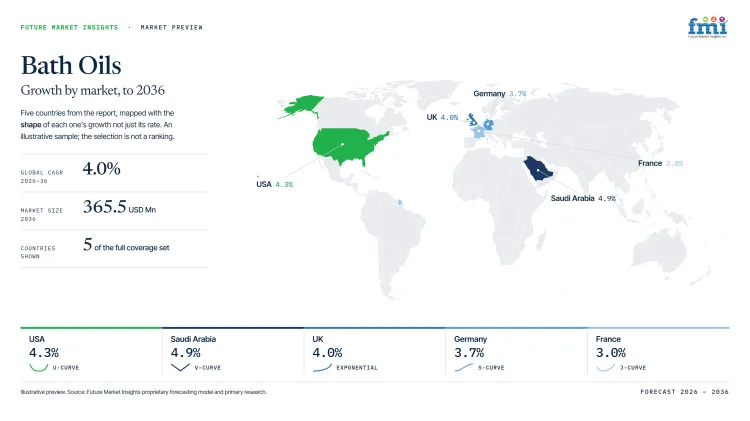
| Country | CAGR |
|---|---|
| UAE | 5.2% |
| Saudi Arabia | 4.9% |
| South Korea | 4.6% |
| USA | 4.3% |
| UK | 4.0% |
| Germany | 3.7% |
| Japan | 3.4% |
| France | 3.0% |
How do country-level CAGRs compare in the Bath Oils Market?
The profiled forecasts span 2.2 percentage points from the UAE at 5.2% to France at 3.0%. Gulf markets and South Korea form the upper group. The USA and UK occupy the middle. Germany, Japan, and France progress more slowly because mature beauty channels place greater weight on product fit, labeling, and repeat conversion than initial category discovery.
- UAE gains extra trial from hotel, spa, and visitor-led gifting.
- Saudi Arabia pairs premium mall discovery with formal imported-product routes.
- South Korea rewards fast digital merchandising and frequent beauty launches.
- USA offers deep DTC reach but higher federal listing discipline.
- UK distribution is broad, with responsible-person ownership shaping imported assortments.
- Germany relies heavily on drugstores and conservative fragrance communication.
- Japan favors exact product descriptions and restrained cosmetic claims.
- France pairs strong beauty heritage with intense imported-product competition.
Similar CAGRs can therefore produce different entry economics because trial channels, compliance ownership, and repeat-use behavior differ by country. The growth rate should be read beside these operating conditions.
The full report provides country-level CAGR analysis across North America, Latin America, Western Europe, Eastern Europe, East Asia, South Asia and Pacific, and the Middle East and Africa.
Country-wise Analysis
- UAE bath-oil demand is closely tied to premium beauty retail, hospitality, travel gifting, and spa exposure that place sensory products in front of residents and visitors. Dubai Municipality reported nearly 13,000 cosmetics and consumer-product trading establishments in October 2025, giving imported beauty brands a dense commercial network for discovery, trial, and replenishment during busy visitor periods. Adoption of bath oils in the UAE is estimated to expand at 5.2% CAGR through 2036, aided by that channel density and constrained by Montaji registration requirements that favor launch calendars built on completed conformity files before digital, hotel, and travel-retail assortments are synchronized.
- Saudi bath-oil discovery is concentrated in malls, pharmacies, premium beauty stores, and e-commerce channels that carry a large imported assortment and frequent international brand launches during the year. The Saudi Arabia bath oils market is projected to progress at 4.9% CAGR through 2036, and SFDA reported 43 licensed cosmetics factories plus 831 cosmetics warehouses for 2025. Warehouse depth and premium retail support availability, but imported products still require formal notification and localized documentation, which gives prepared brands a better chance to use gifting and wellness positioning without letting fast assortment turnover outrun regulatory clearance or cause avoidable stock delays at local distributors.
- South Korea pairs dense beauty retail with rapid digital discovery, short novelty cycles, and domestic brands that train consumers to expect frequent product refreshes and detailed product content. MFDS reported in May 2026 that Korean cosmetics exports increased 11.8% in 2025 and moved the country to second place globally by export value. Bath-oil demand in South Korea is forecast to advance at 4.6% CAGR through 2036, tied to this competitive beauty base and tempered by a high bar for content speed, scent differentiation, and local relevance, so ritual-led imports need compliant Korean claims plus a clear reason to displace familiar domestic alternatives.
- USA bath-oil brands can sell through national beauty chains, DTC sites, department stores, and wellness retailers, and federal listing now accompanies ordinary commercial launch work for every active assortment. The USA bath oils market is forecast to grow at 4.3% CAGR through 2036, and FDA data showed 1,298,361 active cosmetic product listings as of June 30, 2026. Deep digital reach gives new formats room to test scent and routine positioning, subject to current listings and safety substantiation from responsible persons so brands avoid confusing cosmetic benefits with drug claims or losing launch time to preventable corrections.
- Great Britain offers bath oils through DTC brands, specialist beauty stores, pharmacies, and longstanding bath-and-body retailers, with online launch speed constrained by formal product notification for imported assortments sold through several channels. OPSS recorded 861,686 SCPN notifications and 24,112 registered Responsible Persons as of May 28, 2026, making compliance ownership visible before assortment scale. The UK bath oils market is projected to record 4.0% CAGR through 2036, supported by broad beauty distribution and limited by the need for imported brands to maintain a UK-based Responsible Person plus current product information before wider marketplace expansion becomes commercially sensible.
- German bath-oil selling is shaped by drugstore scale, pharmacy credibility, and consumers who scrutinize fragrance and skin compatibility before repeat purchase in a mature beauty category with broad retail choice. IKW reported that skin and face care grew 11.1% in 2025 within the national beauty-care sector, giving bath oils a mature retail setting but not automatic repeat demand. Germany is expected to register 3.7% CAGR over the assessment period, attributable to that retail depth and constrained by sensitivity concerns plus labeling work that reward controlled fragrance loads, plain ingredient explanations, and claims that stay inside ordinary cosmetic use.
- Japanese bath-oil selling rewards exact labeling, controlled fragrance claims, and product descriptions that stay clearly inside the cosmetic category sold through sophisticated beauty, department-store, and pharmacy channels nationwide and online. MHLW confirmed in July 2026 that ICCR-20 approved general principles for cosmetic e-labeling and digital information provision, improving access to ingredient and use details without changing product classification. The Japan bath oils market is expected to maintain 3.4% CAGR over the assessment period, reflecting disciplined beauty retail and constrained by the need for compliant Japanese communication that prevents ordinary cosmetics from drifting toward quasi-drug claims requiring a different pathway.
- French bath-oil brands operate beside powerful pharmacy, perfumery, and prestige-beauty channels where product origin, scent quality, and presentation receive close attention from experienced beauty shoppers comparing domestic and imported brands. FEBEA recorded a 6% rise in cosmetic imports during 2025, which raises the competitive standard for fragrance, formulation quality, and merchandising even in a market with strong category familiarity. Bath-oil sales in France are projected to expand at 3.0% CAGR during the forecast period, driven by premium personal-care routines but limited by safety assessment and fragrance-allergen obligations that leave natural positioning unable to substitute for careful claims and dependable stock planning.
Who are the notable companies in the Bath Oils Market?
Lush, Rituals Cosmetics, Aromatherapy Associates, Susanne Kaufmann, and Olverum Limited are notable companies serving the bath oils market.
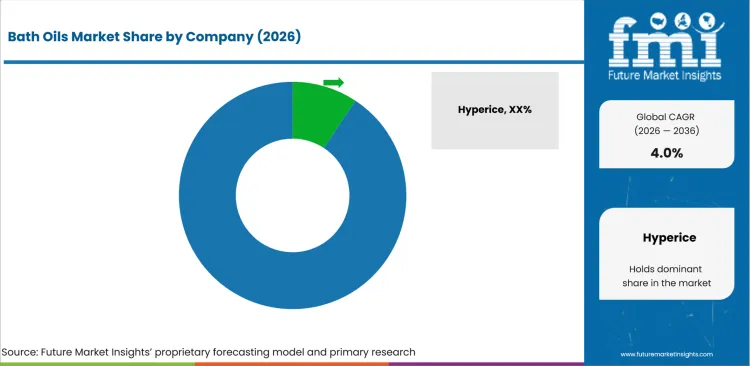
Bath oils draw bath-first retailers, aromatherapy specialists, premium botanical brands, and larger ritual-led beauty companies. Entry depends less on corporate scale than on direct bath-oil evidence, fragrance credibility, safe formulation, and channels that can explain use before first purchase. Soothing skin care products compete for some of the same routine spend, making a clear bathwater use case important for repeat conversion.
- Bath-focused retail: Lush and Rituals Cosmetics use owned retail and digital channels to place bath oils beside related body and gifting assortments.
- Aromatherapy specialist: Aromatherapy Associates carries multiple bath and shower oils organized by distinct use states with professional spa discovery.
- Premium botanical specialists: Susanne Kaufmann and Olverum Limited compete with concentrated bath-oil propositions, botanical formulation, and premium distribution.
Competitive Benchmarking: Bath Oils Market
| Company | Direct Bath-Oil Portfolio Depth | Ritual and Need-State Breadth | Channel Coverage | Geographic Reach |
|---|---|---|---|---|
| Lush | Medium | High | High | Global retail and e-commerce |
| Rituals Cosmetics | Low | Medium | High | Europe-led global boutiques and online |
| Aromatherapy Associates | High | High | High | UK-led international DTC, stockist, and spa channels |
| Susanne Kaufmann | Medium | High | Medium | Europe and international premium stockists |
| Olverum Limited | Low | Medium | Medium | United Kingdom with international premium distribution |
Scoring basis: High portfolio depth requires at least four documented direct bath-oil routes, Medium requires two or three, and Low identifies one documented direct route. High need-state breadth requires three or more distinct use occasions, Medium requires two, and Low identifies one. High channel coverage requires DTC plus physical retail or professional spa routes, Medium confirms two narrower routes, and Low identifies one documented route.
Key Developments in the Bath Oils Market
- In May 2026, Rituals Cosmetics reintroduced The Ritual of Ayurveda as a 24-product bath, body, and home collection with three gift sets. Its official media kit includes a Rich Bath Oil, giving the relaunch a direct bath-oil route within one coordinated fragrance story.
- In September 2025, Aromatherapy Associates began a partnership with Look Good Feel Better that directs 10% of profits from Inner Strength Bath & Shower Oil and Body Oil to the charity. The programme gives the existing bath-oil line a documented cause-led purchase route without changing its wellbeing positioning.
- In April 2026, Olverum Limited appeared in the Royal Warrant holders list as a manufacturer of bath oil to HM The King. The appointment gives a direct category specialist a documented quality credential that premium retailers and gift buyers can verify independently.
Key Players in the Bath Oils Market
Bath-Focused Retail and Ritual Platforms
- Lush
- Rituals Cosmetics
Aromatherapy Specialist
- Aromatherapy Associates
Premium Botanical Bath-Oil Specialists
- Susanne Kaufmann
- Olverum Limited
Bath Oils Market - Report Scope
| Coverage field | Report scope |
|---|---|
| Market breakdown | By product type, nature, use occasion, price tier, sales channel, and region. |
| Quantitative Units | USD million. |
| Market Definition | Revenue includes bath oils and oil-rich bath melts intended for use in bathwater within the defined segmentation. Body oils used solely on skin, diffuser oils, bath salts, non-oil bath bombs, devices, supplements, and spa-service revenue are excluded. |
| Regions Covered | North America, Latin America, Western Europe, Eastern Europe, East Asia, South Asia and Pacific, and Middle East and Africa. |
| Countries Covered | UAE, Saudi Arabia, South Korea, USA, UK, Germany, Japan, France, and 20+ countries included in the full report. |
| Key Companies Profiled | Lush, Rituals Cosmetics, Aromatherapy Associates, Susanne Kaufmann, Olverum Limited. |
| Forecast Period | 2026 to 2036. |
| Approach | Primary and secondary research with market triangulation. |
Bath Oils Market - Research Methodology
| Method | Approach |
|---|---|
| Primary Research | FMI analysts gathered input from manufacturers, service providers, technology developers, distributors, end users, procurement teams, and subject-matter experts. Interviews examined purchasing decisions, product or service evaluation, adoption barriers, approval requirements, pricing considerations, and expectations for technical or commercial support. Respondents were also asked what evidence is required before a trial, pilot, or initial order develops into regular purchasing. |
| Desk Research | Desk research covered government statistics, regulatory publications, trade data, industry associations, technical literature, standards, company filings, product information, and official corporate announcements. Sources were reviewed for relevance, publication date, geographic coverage, and consistency with the defined market scope. Claims relating to performance, applications, approvals, capacity, investment, and commercial activity were retained only when supported by credible public evidence. |
| Market Sizing and Forecasting | The market model combined the baseline value with historical performance, segment structure, pricing and volume indicators, adoption levels, company participation, and country-level demand conditions. Forecast assumptions considered economic activity, investment trends, regulatory developments, technology adoption, purchasing cycles, supply availability, and barriers to wider market use. Segment and regional estimates were reconciled before the final market total was calculated. |
| Data Validation | Estimates were checked against multiple independent indicators, including public data, company activity, trade patterns, industry developments, and findings from primary interviews. Validation also tested whether products, services, applications, and company revenues fell within the defined market boundaries. Adjacent categories, unsupported claims, overlapping revenues, and activities without direct market relevance were excluded to reduce double counting and maintain consistency across segments and countries. |
Bath Oils Market by Segments
Bath Oils Market segmented by Product Type:
- Everyday essentials
- Targeted therapy formats
- Premium & smart formats
- Gift & travel sets
Bath Oils Market segmented by Nature:
- Conventional
- Natural & organic
- Vegan
- Clinically positioned
Bath Oils Market segmented by Use Occasion:
- Daily routine
- Recovery & post-workout
- Sleep & wind-down
- Gifting
Bath Oils Market segmented by Price Tier:
- Mid-range
- Mass
- Premium
Bath Oils Market segmented by Sales Channel:
- E-commerce & DTC
- Specialty wellness retail
- Pharmacies
- Supermarkets
- Spas & studios
Bath Oils Market by Region:
- North America
- United States
- Canada
- Latin America
- Brazil
- Mexico
- Argentina
- Chile
- Western Europe
- Germany
- France
- United Kingdom
- Italy
- Spain
- Benelux
- Nordics
- Eastern Europe
- Poland
- Czech Republic
- Romania
- Hungary
- East Asia
- China
- Japan
- South Korea
- South Asia and Pacific
- India
- ASEAN
- Australia and New Zealand
- Middle East and Africa
- GCC Countries
- South Africa
- Türkiye
- Israel
Research Sources and Bibliography
- Cosmetics Europe. (2026, June 16). New Pan-European Study Reveals: Europeans Value Cosmetics and Personal Care for Daily Life, Wellbeing, and Healthy Ageing - Far Beyond Appearance.
- Dubai Department of Economy and Tourism. (2026, February 9). Dubai welcomes 19.59 million visitors in third record year.
- European Commission. (2026, March 5). Commission's 2025 Safety Gate Report shows increased action against dangerous products and stronger consumer protection.
- Cosmetic, Toiletry and Perfumery Association. (2025, December 2). SkinCare Simplified - A Parent's Guide.
- Industrieverband Körperpflege- und Waschmittel e. V.. (2026). Economy: Annual Report 2025/2026.
- Rituals Cosmetics. (2026, January 28). Rituals Cosmetics marks 25 years with over €2.4bn in revenue, driving global expansion and positive impact.
- German Federal Institute for Risk Assessment. (2026, September 2). Ätherische Öle: Duftende Wirkungen mit Einschränkungen.
- Lush. (2025, January 24). Lush's new Mother's Day collection.
- USA Food and Drug Administration. (2026, February 11). Registration & Listing of Cosmetic Product Facilities and Products.
- Fédération des Entreprises de la Beauté. (2026, February 6). Coup de frein sur les exportations de cosmétiques français en 2025 : le secteur demeure deuxième contributeur à la balance commerciale malgré un repli sur le marché américain.
- Office for Product Safety and Standards. (2026, July 17). New data on UK cosmetic product safety notifications.
- Saudi Food and Drug Authority. (2026, January 26). SFDA Reports 18% Growth in Licensed Factories and Warehouses During 2025.
- Dubai Municipality. (2025, October 27). Product safety at Beautyworld Middle East 2025.
- Ministry of Health, Labour and Welfare, Japan. (2026, July 17). 第20回化粧品規制協力国際会議(ICCR)が開催されました.
- Ministry of Food and Drug Safety, Republic of Korea. (2026, May 28). ’25년 화장품 무역수지 흑자 첫 100억 달러 돌파, 세계 2위 화장품 수출국 달성.
- Rituals Cosmetics. (2026, May 1). The Ritual of Ayurveda.
- Aromatherapy Associates. (2025, September). Finding Strength in Stillness with Look Good Feel Better.
- Lush. (2025, August 18). Lush's new Halloween collection encourages self-care if you dare.
- Rituals Cosmetics. (2026, July 13). Rituals launches unique retail transformation: 1,500 boutiques renewed in 30 working days.
- Royal Warrant Holders Association. (2026, April). Warrant holders April 2026.
- Susanne Kaufmann. (2026, April 24). The Ultimate Buyer's Guide to the Best Luxury Bath Oils.
- Rituals Cosmetics. (2026, September 1). Uukumwe.
- Mandarin Oriental Hotel Group. (2025, October 18). Pause and Reset.
This bibliography is provided for reader reference and is not exhaustive. The full report contains the complete reference list and detailed citations
This Report Answers
- What is the bath oils market size in 2026 and what value is forecast for 2036?
- Which routine and channel conditions support repeat demand for bath oils?
- Why do everyday essentials hold the leading position within product type?
- How does conventional formulation flexibility affect nature-based competition?
- Why does daily routine lead use occasion in 2026?
- How do country growth rates differ among the eight profiled markets?
- Which companies have direct bath-oil or bath-and-shower-oil positions?
- What limits cross-border launch speed for fragrance-led bath oils?
- Which channels give bath-oil brands the clearest route to repeat purchase?
Frequently Asked Questions
How big is the bath oils market in 2026?
The bath oils market is valued at USD 246.9 million in 2026 and is projected to reach USD 365.5 million by 2036. Repeat personal-care routines and sensory bathing occasions support the forecast.
What is the CAGR of the bath oils market from 2026 to 2036?
The bath oils market is projected to grow at a CAGR of 4.0% between 2026 and 2036. Expansion follows repeat use, digital merchandising, and occasion-led formats that fit existing bathing habits.
Which product type leads the bath oils market?
The everyday essentials segment is expected to hold 41.0% of the bath oils market in 2026, attributable to familiar use and broad household bathing occasions. Routine formats also require less explanation before a first purchase.
Which use occasion leads the bath oils market?
The daily routine segment is expected to hold 45.0% of the bath oils market in 2026, supported by more frequent replenishment opportunities than gifting or occasional recovery use. Regular bathing gives the segment a wider repeat-purchase base.
Which companies are active in the bath oils market?
Key companies operating in the bath oils market include Lush, Rituals Cosmetics, Aromatherapy Associates, Susanne Kaufmann, and Olverum Limited. Their positions differ by direct bath-oil breadth, aromatherapy specialization, botanical formulation, owned retail, and premium distribution.
Preview the report firsthand - request a free sample
Get SampleGet the brochure for pricing and purchase details.
Get PDFTable of Content
- Key Takeaways
- Market Size and CAGR
- Top Growth Driver
- Fastest Growing Segment
- Leading Region
- Key Companies
- Emerging Opportunities
- Executive Summary
- Global Market Outlook
- Demand-side Trends
- Supply-side Trends
- Technology Roadmap Analysis
- Analysis and Recommendations
- Analyst Perspective (What is happening? Why now? What should investors know?)
- Key Questions Answered
- How large is the market?
- What is the CAGR?
- What are key trends?
- Which region dominates?
- Who are the leaders?
- Market Overview
- Market Coverage / Taxonomy
- Market Definition / Scope / Limitations
- Research Methodology
- Chapter Orientation
- Analytical Lens and Working Hypotheses
- Market Structure, Signals, and Trend Drivers
- Benchmarking and Cross-market Comparability
- Market Sizing, Forecasting, and Opportunity Mapping
- Research Design and Evidence Framework
- Desk Research Programme (Secondary Evidence)
- Expert Input and Fieldwork (Primary Evidence)
- Tooling, Models, and Reference Databases
- Data Engineering and Model Build
- Quality Assurance and Audit Trail
- Market Background
- Market Dynamics (Drivers, Restraints, Opportunity, Trends)
- Scenario Forecast (Optimistic, Likely, Conservative)
- Impact Analysis
- AI Impact
- Sustainability Impact
- Regulatory Impact
- Technology Impact
- Consumer / Buyer Analysis
- Purchase Drivers
- Adoption Barriers
- Buyer Journey
- Opportunity Map Analysis
- Product Life Cycle Analysis
- Supply Chain Analysis
- Investment Feasibility Matrix
- Value Chain Analysis
- PESTLE and Porter's Analysis
- Regulatory Landscape
- Regional Parent Market Outlook
- Production and Consumption Statistics
- Import and Export Statistics
- Global Market Analysis and Forecast, 2021 to 2036
- Historical Market Size Value (USD Million) Analysis, 2021 to 2025
- Current and Future Market Size Value (USD Million) Projections, 2026 to 2036
- Y-o-Y Growth Trend Analysis
- Absolute $ Opportunity Analysis
- Global Market Pricing Analysis, 2021 to 2036
- Global Market Analysis and Forecast, By Product Type, 2021 to 2036
- Introduction / Key Findings
- Historical Market Size Value (USD Million) Analysis By Product Type, 2021 to 2025
- Current and Future Market Size Value (USD Million) Analysis and Forecast By Product Type, 2026 to 2036
- Everyday essentials
- Targeted therapy formats
- Premium & smart formats
- Gift & travel sets
- Everyday essentials
- Y-o-Y Growth Trend Analysis By Product Type, 2021 to 2025
- Absolute $ Opportunity Analysis By Product Type, 2026 to 2036
- Global Market Analysis and Forecast, By Nature, 2021 to 2036
- Introduction / Key Findings
- Historical Market Size Value (USD Million) Analysis By Nature, 2021 to 2025
- Current and Future Market Size Value (USD Million) Analysis and Forecast By Nature, 2026 to 2036
- Conventional
- Natural & organic
- Vegan
- Clinically positioned
- Conventional
- Y-o-Y Growth Trend Analysis By Nature, 2021 to 2025
- Absolute $ Opportunity Analysis By Nature, 2026 to 2036
- Global Market Analysis and Forecast, By Use Occasion, 2021 to 2036
- Introduction / Key Findings
- Historical Market Size Value (USD Million) Analysis By Use Occasion, 2021 to 2025
- Current and Future Market Size Value (USD Million) Analysis and Forecast By Use Occasion, 2026 to 2036
- Daily routine
- Recovery & post-workout
- Sleep & wind-down
- Gifting
- Daily routine
- Y-o-Y Growth Trend Analysis By Use Occasion, 2021 to 2025
- Absolute $ Opportunity Analysis By Use Occasion, 2026 to 2036
- Global Market Analysis and Forecast, By Price Tier, 2021 to 2036
- Introduction / Key Findings
- Historical Market Size Value (USD Million) Analysis By Price Tier, 2021 to 2025
- Current and Future Market Size Value (USD Million) Analysis and Forecast By Price Tier, 2026 to 2036
- Mid-range
- Mass
- Premium
- Mid-range
- Y-o-Y Growth Trend Analysis By Price Tier, 2021 to 2025
- Absolute $ Opportunity Analysis By Price Tier, 2026 to 2036
- Global Market Analysis and Forecast, By Sales Channel, 2021 to 2036
- Introduction / Key Findings
- Historical Market Size Value (USD Million) Analysis By Sales Channel, 2021 to 2025
- Current and Future Market Size Value (USD Million) Analysis and Forecast By Sales Channel, 2026 to 2036
- E-commerce & DTC
- Specialty wellness retail
- Pharmacies
- Supermarkets
- Spas & studios
- E-commerce & DTC
- Y-o-Y Growth Trend Analysis By Sales Channel, 2021 to 2025
- Absolute $ Opportunity Analysis By Sales Channel, 2026 to 2036
- Global Market Analysis and Forecast, By Region, 2021 to 2036
- Introduction
- Historical Market Size Value (USD Million) Analysis By Region, 2021 to 2025
- Current Market Size Value (USD Million) Analysis and Forecast By Region, 2026 to 2036
- North America
- Latin America
- Western Europe
- Eastern Europe
- East Asia
- South Asia and Pacific
- Middle East & Africa
- Market Attractiveness Analysis By Region
- North America Market Analysis and Forecast, By Country, 2021 to 2036
- Historical Market Size Value (USD Million) Trend Analysis By Market Taxonomy, 2021 to 2025
- Market Size Value (USD Million) Forecast By Market Taxonomy, 2026 to 2036
- By Country
- USA
- Canada
- By Product Type
- By Nature
- By Use Occasion
- By Price Tier
- By Sales Channel
- By Country
- Market Attractiveness Analysis
- By Country
- By Product Type
- By Nature
- By Use Occasion
- By Price Tier
- By Sales Channel
- Key Takeaways
- Latin America Market Analysis and Forecast, By Country
- Historical Market Size Value (USD Million) Trend Analysis By Market Taxonomy, 2021 to 2025
- Market Size Value (USD Million) Forecast By Market Taxonomy, 2026 to 2036
- By Country
- Brazil
- Mexico
- Chile
- Rest of Latin America
- By Product Type
- By Nature
- By Use Occasion
- By Price Tier
- By Sales Channel
- By Country
- Market Attractiveness Analysis
- By Country
- By Product Type
- By Nature
- By Use Occasion
- By Price Tier
- By Sales Channel
- Key Takeaways
- Western Europe Market Analysis and Forecast, By Country
- Historical Market Size Value (USD Million) Trend Analysis By Market Taxonomy, 2021 to 2025
- Market Size Value (USD Million) Forecast By Market Taxonomy, 2026 to 2036
- By Country
- Germany
- UK
- Italy
- Spain
- France
- Nordic
- BENELUX
- Rest of Western Europe
- By Product Type
- By Nature
- By Use Occasion
- By Price Tier
- By Sales Channel
- By Country
- Market Attractiveness Analysis
- By Country
- By Product Type
- By Nature
- By Use Occasion
- By Price Tier
- By Sales Channel
- Key Takeaways
- Eastern Europe Market Analysis and Forecast, By Country
- Historical Market Size Value (USD Million) Trend Analysis By Market Taxonomy, 2021 to 2025
- Market Size Value (USD Million) Forecast By Market Taxonomy, 2026 to 2036
- By Country
- Russia
- Poland
- Hungary
- Balkan & Baltic
- Rest of Eastern Europe
- By Product Type
- By Nature
- By Use Occasion
- By Price Tier
- By Sales Channel
- By Country
- Market Attractiveness Analysis
- By Country
- By Product Type
- By Nature
- By Use Occasion
- By Price Tier
- By Sales Channel
- Key Takeaways
- East Asia Market Analysis and Forecast, By Country
- Historical Market Size Value (USD Million) Trend Analysis By Market Taxonomy, 2021 to 2025
- Market Size Value (USD Million) Forecast By Market Taxonomy, 2026 to 2036
- By Country
- China
- Japan
- South Korea
- By Product Type
- By Nature
- By Use Occasion
- By Price Tier
- By Sales Channel
- By Country
- Market Attractiveness Analysis
- By Country
- By Product Type
- By Nature
- By Use Occasion
- By Price Tier
- By Sales Channel
- Key Takeaways
- South Asia and Pacific Market Analysis and Forecast, By Country
- Historical Market Size Value (USD Million) Trend Analysis By Market Taxonomy, 2021 to 2025
- Market Size Value (USD Million) Forecast By Market Taxonomy, 2026 to 2036
- By Country
- India
- ASEAN
- Australia & New Zealand
- Rest of South Asia and Pacific
- By Product Type
- By Nature
- By Use Occasion
- By Price Tier
- By Sales Channel
- By Country
- Market Attractiveness Analysis
- By Country
- By Product Type
- By Nature
- By Use Occasion
- By Price Tier
- By Sales Channel
- Key Takeaways
- Middle East & Africa Market Analysis and Forecast, By Country
- Historical Market Size Value (USD Million) Trend Analysis By Market Taxonomy, 2021 to 2025
- Market Size Value (USD Million) Forecast By Market Taxonomy, 2026 to 2036
- By Country
- Kingdom of Saudi Arabia
- Other GCC Countries
- Türkiye
- South Africa
- Other African Union
- Rest of Middle East & Africa
- By Product Type
- By Nature
- By Use Occasion
- By Price Tier
- By Sales Channel
- By Country
- Market Attractiveness Analysis
- By Country
- By Product Type
- By Nature
- By Use Occasion
- By Price Tier
- By Sales Channel
- Key Takeaways
- Key Countries Market Analysis
- USA
- Pricing Analysis
- Market Share Analysis, 2025
- By Product Type
- By Nature
- By Use Occasion
- By Price Tier
- By Sales Channel
- Canada
- Pricing Analysis
- Market Share Analysis, 2025
- By Product Type
- By Nature
- By Use Occasion
- By Price Tier
- By Sales Channel
- Mexico
- Pricing Analysis
- Market Share Analysis, 2025
- By Product Type
- By Nature
- By Use Occasion
- By Price Tier
- By Sales Channel
- Brazil
- Pricing Analysis
- Market Share Analysis, 2025
- By Product Type
- By Nature
- By Use Occasion
- By Price Tier
- By Sales Channel
- Chile
- Pricing Analysis
- Market Share Analysis, 2025
- By Product Type
- By Nature
- By Use Occasion
- By Price Tier
- By Sales Channel
- Germany
- Pricing Analysis
- Market Share Analysis, 2025
- By Product Type
- By Nature
- By Use Occasion
- By Price Tier
- By Sales Channel
- UK
- Pricing Analysis
- Market Share Analysis, 2025
- By Product Type
- By Nature
- By Use Occasion
- By Price Tier
- By Sales Channel
- Italy
- Pricing Analysis
- Market Share Analysis, 2025
- By Product Type
- By Nature
- By Use Occasion
- By Price Tier
- By Sales Channel
- Spain
- Pricing Analysis
- Market Share Analysis, 2025
- By Product Type
- By Nature
- By Use Occasion
- By Price Tier
- By Sales Channel
- France
- Pricing Analysis
- Market Share Analysis, 2025
- By Product Type
- By Nature
- By Use Occasion
- By Price Tier
- By Sales Channel
- India
- Pricing Analysis
- Market Share Analysis, 2025
- By Product Type
- By Nature
- By Use Occasion
- By Price Tier
- By Sales Channel
- ASEAN
- Pricing Analysis
- Market Share Analysis, 2025
- By Product Type
- By Nature
- By Use Occasion
- By Price Tier
- By Sales Channel
- Australia & New Zealand
- Pricing Analysis
- Market Share Analysis, 2025
- By Product Type
- By Nature
- By Use Occasion
- By Price Tier
- By Sales Channel
- China
- Pricing Analysis
- Market Share Analysis, 2025
- By Product Type
- By Nature
- By Use Occasion
- By Price Tier
- By Sales Channel
- Japan
- Pricing Analysis
- Market Share Analysis, 2025
- By Product Type
- By Nature
- By Use Occasion
- By Price Tier
- By Sales Channel
- South Korea
- Pricing Analysis
- Market Share Analysis, 2025
- By Product Type
- By Nature
- By Use Occasion
- By Price Tier
- By Sales Channel
- Russia
- Pricing Analysis
- Market Share Analysis, 2025
- By Product Type
- By Nature
- By Use Occasion
- By Price Tier
- By Sales Channel
- Poland
- Pricing Analysis
- Market Share Analysis, 2025
- By Product Type
- By Nature
- By Use Occasion
- By Price Tier
- By Sales Channel
- Hungary
- Pricing Analysis
- Market Share Analysis, 2025
- By Product Type
- By Nature
- By Use Occasion
- By Price Tier
- By Sales Channel
- Kingdom of Saudi Arabia
- Pricing Analysis
- Market Share Analysis, 2025
- By Product Type
- By Nature
- By Use Occasion
- By Price Tier
- By Sales Channel
- Türkiye
- Pricing Analysis
- Market Share Analysis, 2025
- By Product Type
- By Nature
- By Use Occasion
- By Price Tier
- By Sales Channel
- South Africa
- Pricing Analysis
- Market Share Analysis, 2025
- By Product Type
- By Nature
- By Use Occasion
- By Price Tier
- By Sales Channel
- USA
- Market Structure Analysis
- Competition Dashboard
- Competition Benchmarking
- Market Share Analysis of Top Players
- By Regional
- By Product Type
- By Nature
- By Use Occasion
- By Price Tier
- By Sales Channel
- Emerging Startups
- Innovation Benchmarking
- Competition Analysis
- Competition Deep Dive
- Hyperice
- Overview
- Product Portfolio
- Profitability by Market Segments
- Sales Footprint
- Strategy Overview
- Marketing Strategy
- Product Strategy
- Channel Strategy
- Lush
- Renpho
- Vitruvi
- Therabody
- Vital Proteins
- Church & Dwight
- HigherDOSE
- Plunge
- The Body Shop
- Hyperice
- Case Studies
- Success Stories
- Recent Developments
- Competition Deep Dive
- Assumptions & Acronyms Used


