

- Market Size (2026)
- USD 497.2 Mn
- Forecast (2036)
- USD 969.0 Mn
- CAGR (2026 to 2036)
- 6.9%
How big is Shower Filters Market in 2026?
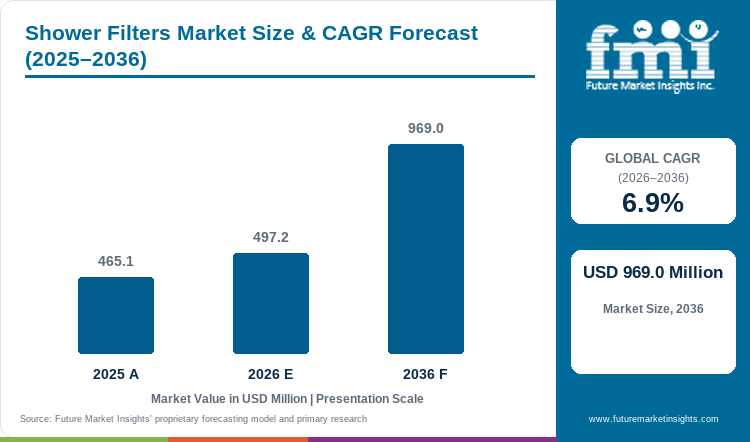
USD 497.2 million in 2026 and USD 969.0 million by 2036, expanding at 6.9% CAGR.
Sales in the shower filters market are projected to grow at a 6.9% CAGR through 2036, increasing from USD 465.1 million in 2025 to USD 497.2 million in 2026 before reaching USD 969.0 million by 2036. Households compare filtration products using performance claims that can be verified rather than broad purification language. NSF/ANSI 177 provides an independent reference for free available chlorine reduction in shower-filtration systems. The standard helps manufacturers support measurable filtration positioning while giving retailers a clearer basis for explaining replacement schedules and product performance.
Country water systems change which filtration claim deserves attention before households install treatment at one fixture. UAE authorities reported in March 2025 that desalinated seawater and treated wastewater contribute 53% of national water supply. Germany follows a different source-water pattern where chlorine reduction is not a universal household purchase case. These differences alter which performance evidence retailers need before positioning shower filtration as a useful fixture upgrade. Suppliers need country-specific messaging that connects measured performance with local water characteristics and normal shower pressure.
Key Takeaways of Shower Filters Market
- Households favor fixture-level filtration when verified claims avoid building-wide treatment changes and complex installation requirements.
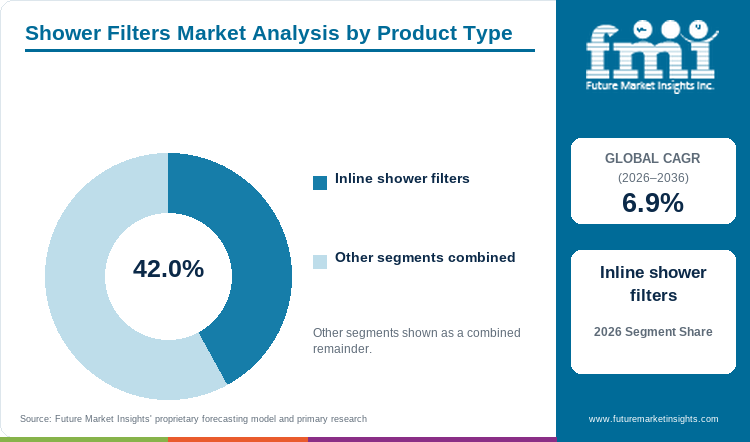
- Based on product type, inline shower filters are projected to account for 42.0% in 2026, owing to retrofit housings that preserve existing showerheads.
- By use setting, at-home use is estimated to hold 61.0% in 2026, supported by household control over installation and cartridge replacement.
- In 2026, rechargeable cordless configurations are expected to lead power source with 51.0% share, influenced by battery operation that avoids permanent cable placement near water.
- Claim ambiguity and missed cartridge changes weaken repeat purchases even when original shower fixtures perform correctly.
- Some of the key players in this market include Jolie Skin Co., Filterbaby, Weddell Water, Canopy, Sans, BOROUX, Hello Klean, Afina, Water2, and HigherDOSE.
Analyst Perspective
"Shower filtration converts when verified reduction claims match local water conditions without compromising normal fixture performance. Repeat revenue depends on replacement schedules that households understand before cartridges reach their defined service limits."
- Rahul Pandita, Principal Consultant, Future Market Insights
How is the Shower Filters Market segmented?
The shower filters market is segmented by product type, use setting, power source, price band, sales channel, and region.
Product type covers inline shower filters, filtered showerheads, replacement cartridges, and bath & tap filters for household fixture treatment. Use setting covers at-home, professional & clinic, and hybrid prosumer demand while power source separates rechargeable cordless, corded, and battery configurations. Price band separates entry, mid, and premium offers while sales channel covers e-commerce & DTC, specialty beauty & electronics, professional distribution, and department stores.
How does inline shower filtration shape demand within the product type category?
Inline housings preserve an existing showerhead while adding serviceable filtration between the shower arm and fixture. Current NSF listings include Weddell Water's Duo system with a defined service capacity for shower filtration. That evidence keeps residential filtration systems focused on measurable reduction performance and replacement timing before household adoption. Households can retain a preferred spray fixture while replacing only the filtration cartridge at the stated interval. The architecture also reduces installation friction because the existing shower arm stays in service without permanent plumbing modification. Retailers can therefore explain filtration performance and maintenance separately from showerhead styling during the purchase decision.
- By product type, inline shower filters are forecast to represent 42.0% in 2026, owing to retrofit compatibility with existing fixtures.
- Households preserve their preferred showerhead while separate housings carry replaceable media with a clearly defined service interval.
What supports at-home use within the use setting category?
Households control installation and cartridge timing because filtration operates at one familiar bathroom fixture without facility approval. Canopy sells filtered showerheads with scheduled replacement filters that keep maintenance inside the household purchase relationship. That model links recurring filtration with adjacent personalized beauty devices without requiring a professional purchasing process. Users can assess pressure and spray comfort immediately before deciding whether scheduled cartridge refills justify continued spending. At-home replacement also keeps product education close to the original owner who selected the fixture and filter. Brands that simplify filter identification reduce missed changes and protect the recurring revenue expected after installation.
- At-home use is likely to capture 61.0% share in 2026, supported by household control over purchasing and replacement timing.
- Direct subscriptions connect original fixture purchases with known service intervals and reduce forgotten replacement during routine household use.
What operating condition supports rechargeable cordless demand in the power source category?
Powered shower products need electrical features that operate safely without permanent cables beside active household water. HigherDOSE sells an integrated shower filter with a detachable rechargeable red-light ring designed for routine home use. The format shows how smart bathroom fixtures can preserve flexible placement while making battery reliability part of evaluation. Design teams must also isolate charging hardware from the shower stream and keep controls usable with wet hands. A detachable power module avoids permanent wiring and lets the fixture remain compatible with ordinary shower-arm installation. Households still judge filtration and pressure first because added electronics cannot compensate for weak water performance.
- Rechargeable cordless configurations are set to lead the power source category with 51.0% share in 2026, influenced by portable power near wet-use spaces.
- Design teams must protect battery life and sealing so charging requirements never interrupt a routine household shower schedule.
What supports entry pricing within the price band category?
Entry pricing lets households test fixture-level filtration before committing to more expensive integrated shower hardware or broader treatment. BOROUX sells a replaceable inline shower filter that can remain with an existing showerhead and use recurring cartridges. That structure resembles other consumer appliances where durable hardware and shorter-life service parts separate the first purchase from later maintenance. Households can compare pressure and comfort before accepting recurring filter costs after the original installation. Lower initial spending also reduces the financial penalty if local water conditions make one media choice less useful. Brands must keep replacement prices visible because an inexpensive housing loses its advantage when cartridge costs surprise buyers.
- Entry products below USD 100 are projected to hold 41.0% share in 2026, supported by a lower trial threshold for first-time buyers.
- Replacement media must remain affordable because recurring cartridge expense can otherwise weaken the original entry-price proposition after installation.
How does e-commerce and DTC influence selection within the sales channel category?
Digital selling gives shower-filter brands enough space to explain performance claims and fixture compatibility before household checkout. Jolie offers replacement filters through one-time purchasing and subscription plans tied to the original filtered showerhead. Direct accounts keep replenishment inside the original relationship alongside bath accessories purchased for recurring household routines. That continuity reduces refill search effort and keeps cartridge selection attached to the installed fixture. Online channels also let brands show installation steps before purchase without relying on limited shelf explanations. Retailers remain useful for physical comparison but direct channels retain more control over replacement reminders and education.
- The sales channel category is forecast to be led by e-commerce & DTC at 42.0% share in 2026, supported by online product education and repeat cartridge ordering.
- Direct accounts support compatibility guidance and replacement reminders without forcing households to revisit stores for every cartridge purchase.
What are the drivers, restraints and opportunities in the Shower Filters Market?
Specific point-of-use performance expands household interest, narrow claim boundaries constrain conversion, and predictable cartridge replenishment provides a repeat-purchase route.
- Driver: Independent shower-filter standards let households compare a defined performance claim before buying fixture-level treatment for routine use.
- Restraint: Filtration claims lose credibility when they exceed tested contaminant scope or ignore pressure and cartridge maintenance requirements.
- Opportunity: Suppliers can improve repeat revenue by pairing transparent service intervals with subscriptions that deliver compatible replacement cartridges on schedule.
Independent performance evidence reduces uncertainty before household installation
Households compare shower filters more confidently when performance claims refer to recognized testing instead of broad wellness language. NSF/ANSI 177 verifies aesthetic free available chlorine reduction for shower-filtration products under an established testing protocol. That boundary lets retailers explain exactly what was tested before discussing comfort or personal-care benefits. Water treatment equipment buyers already expect measured performance and service requirements before replacing components during routine use. Shower-filter brands gain the same advantage when independent evidence appears beside installation and cartridge guidance. Clear proof reduces uncertainty before checkout and gives households a practical basis for comparing fixture-level treatment options during normal shower use.
Narrow claim scope and maintenance can delay repeat purchase
Shower-filter trust weakens when households cannot tell whether replacement parts preserve the tested housing and media combination. Weddell Water explained in September 2025 that NSF certification requires independent testing plus continued compliance against a defined standard. That distinction makes vague filtration language a commercial liability when sellers cannot identify the exact tested configuration. Water softeners address different treatment needs and cannot validate performance claims for a shower-filtration cartridge. Brands need precise contaminant language and identifiable cartridges so households maintain the intended system instead of substituting unverified parts. Retailers also need service intervals that stay visible after checkout and remain consistent with the tested configuration.
Scheduled replenishment can convert one fixture sale into repeat cartridge revenue
Repeat cartridge revenue improves when brands make maintenance predictable and remove friction from the next purchase. Watego states that it shipped its first shower filter on March 21 2025 after moving from development into commercial sale. That launch illustrates a practical opportunity for newer brands because one installed housing can support later cartridge orders. under-sink water purifiers use different hardware but face the same need for identifiable replacement parts. Shower-filter suppliers can strengthen recurring sales by pairing service intervals with subscriptions and one-click refill matching. Every replacement should preserve housing compatibility and service conditions established for the original fixture during normal household use.
Which country CAGRs are profiled in the Shower Filters Market?
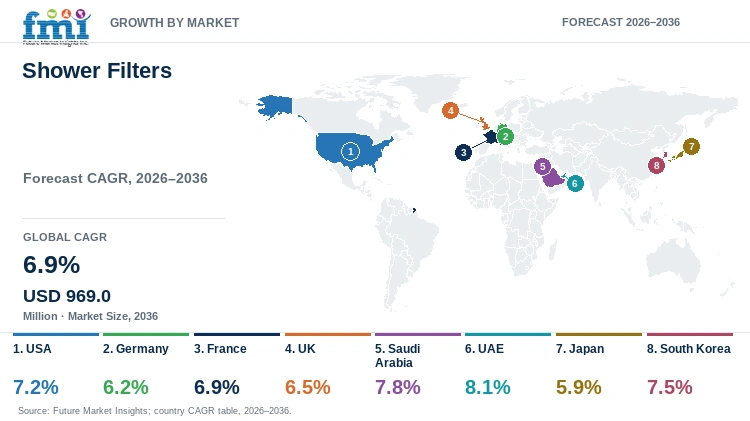
| Country | CAGR |
|---|---|
| USA | 7.2% |
| Germany | 6.2% |
| France | 6.9% |
| UK | 6.5% |
| Saudi Arabia | 7.8% |
| UAE | 8.1% |
| Japan | 5.9% |
| South Korea | 7.5% |
How do country-level CAGRs compare in the Shower Filters Market?
The forecasts span 2.2 percentage points from UAE at 8.1% to Japan at 5.9%. Similar growth rates can still reflect different national water systems and household purchase conditions.
- In the USA, widespread access to regulated public water systems keeps shower-filter purchasing focused on clearly defined, fixture-level performance benefits.
- Germany’s groundwater-influenced water profile encourages consumers to look for shower-filter claims that address local water-quality considerations.
- High levels of water-quality monitoring in France have increased expectations for precise performance claims and measurable filtration outcomes.
- The UK’s large household market positions shower filters as a personal-care purchase that competes with broader home-improvement and bathroom spending priorities.
- In Saudi Arabia, desalination-based water supply systems create demand for shower filters designed around specific mineral and disinfectant concerns.
- UAE households often rely on diverse water sources, making filtration-media selection and product positioning important differentiators.
- Japan’s mature water infrastructure favors compact shower-filter designs that are easy to install, replace, and maintain.
- South Korea’s well-established public-water network supports competition based on measurable filtration performance and product effectiveness.
The full report provides country-level CAGR analysis across North America, Latin America, Western Europe, Eastern Europe, East Asia, South Asia and Pacific, and the Middle East and Africa.
Country-wise Analysis
- USA households evaluate shower filtration as optional fixture treatment within a nationally regulated public-water system. By 2036, USA is projected to grow at 7.2% CAGR, influenced by simple installation and bounded performance claims. The USA Environmental Protection Agency's national compliance report lists 147,252 active public water systems in 2024 and states that 69% reported no drinking-water-standard violations. That scale keeps shower-filter claims focused on fixture performance instead of implying public supplies are broadly unsafe. Retailers need simple compatibility guidance because one shower-arm connection carries the entire household installation decision. Suppliers also need independent reduction evidence and clear cartridge timing before repeat purchases develop.
- Germany combines near-universal public-water access with source conditions that differ from heavily chlorinated systems. Germany's shower filters outlook is anticipated to advance at 6.2% CAGR over the assessment period, influenced by groundwater-heavy national supply conditions. Umweltbundesamt reported in July 2026 that more than 99% of residents receive public drinking water and over 70% comes from groundwater or springs. That source mix weakens universal chlorine messaging and increases the value of locally specific claims. Brands must distinguish odor and sediment concerns from water conditions that require a different treatment approach. Conversion depends on evidence matching the household water source without sacrificing normal shower pressure.
- French buyers operate within a national system that publishes extensive tap-water monitoring and raises expectations for precise product claims. Shower filter demand in France is forecast to rise at 6.9% CAGR over the forecast period, reinforced by visible national monitoring. The French health ministry states that sanitary control generates roughly 320,000 water samples and more than 18.5 million analyses each year. That monitoring scale raises the proof burden for alarmist safety language and broad contaminant claims. Retailers therefore need clear separation between aesthetic chlorine reduction and treatment claims aimed at other water conditions. Brands need exact reduction targets and replacement instructions that complement public treatment controls without questioning regulated water safety.
- UK households form a large home-installation buyer base where shower filters compete with ordinary bathroom spending instead of infrastructure replacement. Adoption of shower filters in the UK is estimated to expand at 6.5% CAGR through 2036, shaped by household-led purchasing and personal-care positioning. The Office for National Statistics reported that the United Kingdom contained 29.0 million households during 2025. That national buyer base supports direct fixture replacement while keeping the decision inside normal household budgets. Brands need bounded performance claims because users are selecting an accessory instead of replacing public treatment. Repeat purchases depend on pressure retention and cartridge costs that remain acceptable after installation.
- Saudi Arabia evaluates household water products within a national system built around large desalination and distribution assets. The Saudi Arabia shower filters sector is projected to record 7.8% CAGR during the assessment period, influenced by expanding desalinated-water capacity and network reach. The Ministry of Environment reported in 2026 that desalinated production capacity reached 16 million cubic meters per day and roughly 85% of the population receives network service. The national supply structure makes source-specific explanations more useful than generic hard-water or purification claims. Suppliers must distinguish chlorine reduction from dissolved-mineral treatment before selecting filtration media for household fixtures. Fixture compatibility then determines whether clear performance claims convert into recurring cartridge purchases after installation.
- UAE households use water supplied substantially by desalination and other non-conventional sources that change media-selection questions for fixture-level treatment. In the UAE, shower filter demand is predicted to advance at 8.1% CAGR through 2036, influenced by national reliance on alternative water sources. The UAE national sustainable development report states that three major desalination plants completed from 2020 to 2024 added 390 million gallons per day of capacity. That system context favors product claims tied to actual shower-water conditions instead of generic purification language. Broader industrial water treatment systems provide source-water context while household purchases still require compatibility and defined reduction evidence for repeat cartridge decisions.
- Japan combines broad public-water coverage with established expectations for compact fixtures and predictable maintenance during routine household use. Japan is estimated to post 5.9% CAGR over the forecast period, influenced by a mature public-water base that shifts buying toward fixture fit. Japan's Ministry of Land, Infrastructure, Transport and Tourism reported in its 2025 white paper that national water-supply coverage reached 98.2% at fiscal 2023 year-end. That broad infrastructure limits the credibility of generalized safety messaging and shifts household attention toward fixture performance. Related bathroom vanities provide renovation context while filtration revenue still depends on verified media performance. Suppliers need compact replacement parts and service guidance that fit established household routines without complicating maintenance.
- South Korea operates a highly connected public-water system where broad access makes measurable product differentiation important. Shower filter sales in South Korea are forecast to expand at 7.5% CAGR by 2036, reinforced by near-universal public-water coverage and visible water-quality management. The national environment ministry reported in January 2026 that public-water coverage reached 99.5% during 2024 and supplied 52.427 million people. That mature system leaves little room for unsupported safety claims and increases the value of exact service information. Suppliers need measurable reduction evidence plus cartridges that remain easy to identify throughout the replacement cycle. Stable pressure also matters because filtration must fit a familiar household routine without changing normal shower performance.
Who are the notable companies in the Shower Filters Market?
Jolie Skin Co., Filterbaby, Weddell Water, Canopy, Sans, BOROUX, Hello Klean, Afina, Water2, and HigherDOSE are notable companies serving the defined shower filters market.
Competition includes specialist filter brands and integrated showerhead companies that differ in test records and refill systems.
- Filterbaby, Weddell Water, Sans, BOROUX, and Water2 emphasize filtration evidence and recurring replacement systems.
- Jolie Skin Co., Canopy, Hello Klean, Afina, and HigherDOSE integrate filtration into complete showerhead or powered wellness fixtures.
- Several companies pair direct subscriptions with retail access so replacement filters remain easy to identify after purchase.
Competitive Benchmarking: Shower Filters Market
| Company | Independent Performance Evidence | Refill Architecture | Shower Format Breadth | Geographic Reach |
|---|---|---|---|---|
| Jolie Skin Co. | Medium | High | Low | North America |
| Filterbaby | High | High | High | United States |
| Weddell Water | High | Medium | Low | United States |
| Canopy | Medium | High | High | US and Canada |
| Sans | Medium | High | Low | United States |
| BOROUX | Medium | High | Medium | United States |
| Hello Klean | Medium | High | Medium | UK and international |
| Afina | Medium | High | High | United States |
| Water2 | Medium | High | Low | United Kingdom |
| HigherDOSE | Medium | High | Low | United States |
Scoring basis: High performance evidence requires independent certification while Medium requires quantified third-party testing and Low reflects manufacturer-only evidence. High refill architecture requires recurring replacement routes while Medium requires a documented replaceable element and Low lacks recurring service support. High format breadth requires three verified shower formats while Medium requires two and Low identifies one documented format.
Key Developments in the Shower Filters Market
- In July 2026, HigherDOSE entered Ulta Beauty with its Red Light Shower Filter in the retailer's national wellness assortment.
- In March 2026, Hello Klean secured a strategic minority investment from BRITA Group for filtration research and international expansion.
- In January 2026, Filterbaby expanded into Target with its Essential Series shower filters at more than 1,700 locations.
Key Players in the Shower Filters Market
Independent filtration and test-led platforms
- Filterbaby
- Weddell Water
- Sans
Integrated filtered showerhead and refill platforms
- Jolie Skin Co.
- Canopy
- BOROUX
- Hello Klean
- Afina
- Water2
Powered wellness shower platform
- HigherDOSE
Shower Filters Market - Report Scope
| Coverage field | Report scope |
|---|---|
| Market breakdown | By product type, use setting, power source, price band, sales channel, and region. |
| Quantitative Units | USD million. |
| Market Definition | Revenue from inline shower filters, filtered showerheads, replacement shower cartridges, bath & tap filters, and powered shower-filtration configurations inside the authorized segmentation boundary. |
| Regions Covered | North America, Latin America, Western Europe, Eastern Europe, East Asia, South Asia and Pacific, and Middle East and Africa. |
| Countries Covered | USA, Germany, France, UK, Saudi Arabia, UAE, Japan, South Korea, and 30+ countries included in the full report. |
| Key Companies Profiled | Jolie Skin Co., Filterbaby, Weddell Water, Canopy, Sans, BOROUX, Hello Klean, Afina, Water2, and HigherDOSE. |
| Forecast Period | 2026 to 2036. |
| Approach | Primary and secondary research with market triangulation. |
Shower Filters Market - Research Methodology
| Method | Approach |
|---|---|
| Primary Research | FMI analysts gathered input from manufacturers, service providers, technology developers, distributors, end users, procurement teams, and subject-matter experts. Interviews examined purchasing decisions, product or service evaluation, adoption barriers, approval requirements, pricing considerations, and expectations for technical or commercial support. Respondents were also asked what evidence is required before a trial, pilot, or initial order develops into regular purchasing. |
| Desk Research | Desk research covered government statistics, regulatory publications, trade data, industry associations, technical literature, standards, company filings, product information, and official corporate announcements. Sources were reviewed for relevance, publication date, geographic coverage, and consistency with the defined market scope. Claims relating to performance, applications, approvals, capacity, investment, and commercial activity were retained only when supported by credible public evidence. |
| Market Sizing and Forecasting | The market model combined the baseline value with historical performance, segment structure, pricing and volume indicators, adoption levels, company participation, and country-level demand conditions. Forecast assumptions considered economic activity, investment trends, regulatory developments, technology adoption, purchasing cycles, supply availability, and barriers to wider market use. Segment and regional estimates were reconciled before the final market total was calculated. |
| Data Validation | Estimates were checked against multiple independent indicators, including public data, company activity, trade patterns, industry developments, and findings from primary interviews. Validation also tested whether products, services, applications, and company revenues fell within the defined market boundaries. Adjacent categories, unsupported claims, overlapping revenues, and activities without direct market relevance were excluded to reduce double counting and maintain consistency across segments and countries. |
Shower Filters Market by Segments
Shower Filters Market segmented by Product Type:
- Inline shower filters
- Filtered showerheads
- Replacement cartridges
- Bath & tap filters
Shower Filters Market segmented by Use Setting:
- At-home
- Professional & clinic
- Hybrid prosumer
Shower Filters Market segmented by Power Source:
- Rechargeable cordless
- Corded
- Battery
Shower Filters Market segmented by Price Band:
- Entry (below USD 100)
- Mid (USD 100-300)
- Premium (above USD 300)
Shower Filters Market segmented by Sales Channel:
- E-commerce & DTC
- Specialty beauty & electronics
- Professional distribution
- Department stores
Shower Filters Market by Region:
- North America
- United States
- Canada
- Latin America
- Brazil
- Mexico
- Argentina
- Chile
- Western Europe
- Germany
- France
- United Kingdom
- Italy
- Spain
- Benelux
- Nordics
- Eastern Europe
- Poland
- Czech Republic
- Romania
- Hungary
- East Asia
- China
- Japan
- South Korea
- South Asia and Pacific
- India
- ASEAN
- Australia and New Zealand
- Middle East and Africa
- GCC Countries
- South Africa
- Türkiye
- Israel
Research Sources and Bibliography
- NSF. (n.d.). NSF/ANSI 177 - Shower filtration systems - aesthetic effects. Retrieved September 16, 2026.
- UAE Ministry of Energy and Infrastructure. (2025, March 23). Water security is a national priority for the UAE.
- NSF. (n.d.). NSF product and service listings: Shower filtration systems - aesthetic effects. Retrieved September 16, 2026.
- Canopy. (n.d.). Filtered Showerhead. Retrieved September 16, 2026.
- HigherDOSE. (n.d.). Red Light Showerhead Filter. Retrieved September 16, 2026.
- BOROUX. (n.d.). Shower Filter System. Retrieved September 16, 2026.
- Jolie Skin Co. (n.d.). The Jolie Replacement Filter. Retrieved September 16, 2026.
- Weddell Water. (2025, September 18). What does ‘NSF Certified’ mean, and why is it important?
- Watego. (n.d.). Why I created a shower filter. Retrieved September 16, 2026.
- USA Environmental Protection Agency. (2026, June 24). Providing Safe Drinking Water in America: National Public Water Systems Compliance Report.
- Umweltbundesamt. (2026, July 3). Wasserwirtschaft.
- Ministère de la Santé, de la Famille, de l’Autonomie et des Personnes handicapées. (2026). Le contrôle de la qualité de l’eau du robinet.
- Office for National Statistics. (2026, April 17). Families and households in the UK: 2025.
- Ministry of Environment, Water and Agriculture, Saudi Arabia. (2026). Inaugural Saudi Water Week 2026 launches in Jeddah.
- National Committee on Sustainable Development Goals. (2025). UAE Sustainable Development Goals annual report.
- Ministry of Land, Infrastructure, Transport and Tourism, Japan. (2025). 国土交通白書 2025: 水道の基盤強化.
- Ministry of Climate, Energy and Environment, Republic of Korea. (2026, January 21). 상수도 보급률 99.5%… 국민 대부분 안정적 물복지 누린다.
- HigherDOSE. (2026, July 27). HigherDOSE and Ulta Beauty announce partnership, bringing wellness innovation to 400+ stores nationwide.
- Hello Klean. (2026, March 12). BRITA Group's strategic investment in Hello Klean.
- Filterbaby. (2026, January 16). Filterbaby announces nationwide retail expansion into Target.
- Filterbaby. (2025, August 12). Filterbaby assembles expert dermatology advisory board to lead conversation on tap water's impact on skin health.
- Weddell Water. (2025, July 29). Weddell Water selected as a Good Housekeeping 2025 Bath Award winner.
- Canopy. (2026, June). Which showerhead is best for me?
- Weddell Water. (2026, April 16). Weddell Water issues consumer warning regarding counterfeit shower filters sold online.
- Afina. (2026, March 7). Water quality by city & state: 239 US reports (2026).
- Jolie Skin Co. (2025, May). Product test reports: Third-party skin testing.
- Filterbaby. (2025, August 27). Filterbaby brings dermatologist-approved water filtration to Santa Monica Proper Hotel's wellness suites.
- Weddell Water. (2025, September 11). Announcing Weddell Water on Truemed: Your HSA/FSA funds aren’t just for doctor visits anymore.
- NBC Select. (2026, April 30). Canopy launched a Mini Filtered Showerhead.
- Sans. (2026, August 4). Sans launches new filtered showerhead to bring cleaner water to every shower.
- BOROUX. (2026, January 13). Shower filter now offered by BOROUX.
- CEW UK. (2026, April 24). Hello Klean launches first intelligent shower filter.
- Afina. (2025, May 7). Everyone says they’ll pay more for ‘Made in the USA’ - we tested it.
- Water2. (2025, September 10). Water2 expands into bathroom innovation with new shower head co-developed with Bear Grylls.
- Trend Hunter. (2026, January 16). Red Light Shower Filters.
- Filterbaby. (n.d.). The science: Contaminant removal. Retrieved September 16, 2026.
- Filterbaby. (n.d.). Store locator. Retrieved September 16, 2026.
- Sans. (n.d.). Sans Filtered Showerhead. Retrieved September 16, 2026.
- Hello Klean. (n.d.). Shower Head+. Retrieved September 16, 2026.
- Afina. (n.d.). Afina Filtered Shower Head. Retrieved September 16, 2026.
- Water2. (n.d.). Shower Filter 2.0. Retrieved September 16, 2026.
This bibliography is provided for reader reference and is not exhaustive. The full report contains the complete reference list and detailed citations
This Report Answers
- How large is the shower filters market in 2026 and 2036?
- Which operating conditions convert shower-water concerns into fixture-level household purchases?
- How does inline architecture affect product type demand and replacement revenue?
- Why does at-home use account for 61.0% of use setting demand?
- Which conditions delay repeat shower-filter purchases after household installation and cartridge use?
- How do national water systems change claims across the eight countries?
- Which companies sell documented shower-filtration products and recurring replacement systems?
- How do testing and refill architecture shape shower-filter supplier competition?
Frequently Asked Questions
How big is the Shower Filters Market in 2026?
The shower filters market is valued at USD 497.2 million in 2026 and should reach USD 969.0 million by 2036. Verified fixture performance and manageable replacement schedules support sustained household adoption after the original installation.
What is the Shower Filters Market CAGR from 2026 to 2036?
The shower filters market is projected to grow at 6.9% CAGR between 2026 and 2036. Recurring cartridge purchases extend revenue when households receive clear service intervals and compatible replacement parts for installed fixtures.
Which product type accounts for 42.0% of demand in 2026?
Inline shower filters are estimated to hold 42.0% of product type demand in 2026. Retrofit housings preserve existing showerheads while adding replaceable filtration media without requiring complete fixture changes.
Which countries occupy the upper forecast CAGR range?
UAE is forecast at 8.1% CAGR followed by Saudi Arabia at 7.8% and South Korea at 7.5% through 2036. National water systems change which treatment claims require local explanation before households make purchase decisions.
Which companies are active in the Shower Filters Market?
Active companies include Jolie Skin Co., Filterbaby, Weddell Water, Canopy, Sans, BOROUX, Hello Klean, Afina, Water2, and HigherDOSE. These companies differ in performance evidence and refill architecture as well as shower format and documented channel reach.
Preview the report firsthand - request a free sample
Get SampleGet the brochure for pricing and purchase details.
Get PDFTable of Content
- Key Takeaways
- Market Size and CAGR
- Top Growth Driver
- Fastest Growing Segment
- Leading Region
- Key Companies
- Emerging Opportunities
- Executive Summary
- Global Market Outlook
- Demand-side Trends
- Supply-side Trends
- Technology Roadmap Analysis
- Analysis and Recommendations
- Analyst Perspective (What is happening? Why now? What should investors know?)
- Key Questions Answered
- How large is the market?
- What is the CAGR?
- What are key trends?
- Which region dominates?
- Who are the leaders?
- Market Overview
- Market Coverage / Taxonomy
- Market Definition / Scope / Limitations
- Research Methodology
- Chapter Orientation
- Analytical Lens and Working Hypotheses
- Market Structure, Signals, and Trend Drivers
- Benchmarking and Cross-market Comparability
- Market Sizing, Forecasting, and Opportunity Mapping
- Research Design and Evidence Framework
- Desk Research Programme (Secondary Evidence)
- Expert Input and Fieldwork (Primary Evidence)
- Tooling, Models, and Reference Databases
- Data Engineering and Model Build
- Quality Assurance and Audit Trail
- Market Background
- Market Dynamics (Drivers, Restraints, Opportunity, Trends)
- Scenario Forecast (Optimistic, Likely, Conservative)
- Impact Analysis
- AI Impact
- Sustainability Impact
- Regulatory Impact
- Technology Impact
- Consumer / Buyer Analysis
- Purchase Drivers
- Adoption Barriers
- Buyer Journey
- Opportunity Map Analysis
- Product Life Cycle Analysis
- Supply Chain Analysis
- Investment Feasibility Matrix
- Value Chain Analysis
- PESTLE and Porter's Analysis
- Regulatory Landscape
- Regional Parent Market Outlook
- Production and Consumption Statistics
- Import and Export Statistics
- Global Market Analysis and Forecast, 2021 to 2036
- Historical Market Size Value (USD Million) Analysis, 2021 to 2025
- Current and Future Market Size Value (USD Million) Projections, 2026 to 2036
- Y-o-Y Growth Trend Analysis
- Absolute $ Opportunity Analysis
- Global Market Pricing Analysis, 2021 to 2036
- Global Market Analysis and Forecast, By Product Type, 2021 to 2036
- Introduction / Key Findings
- Historical Market Size Value (USD Million) Analysis By Product Type, 2021 to 2025
- Current and Future Market Size Value (USD Million) Analysis and Forecast By Product Type, 2026 to 2036
- Inline shower filters
- Filtered showerheads
- Replacement cartridges
- Bath & tap filters
- Y-o-Y Growth Trend Analysis By Product Type, 2021 to 2025
- Absolute $ Opportunity Analysis By Product Type, 2026 to 2036
- Global Market Analysis and Forecast, By Use Setting, 2021 to 2036
- Introduction / Key Findings
- Historical Market Size Value (USD Million) Analysis By Use Setting, 2021 to 2025
- Current and Future Market Size Value (USD Million) Analysis and Forecast By Use Setting, 2026 to 2036
- At-home
- Professional & clinic
- Hybrid prosumer
- Y-o-Y Growth Trend Analysis By Use Setting, 2021 to 2025
- Absolute $ Opportunity Analysis By Use Setting, 2026 to 2036
- Global Market Analysis and Forecast, By Power Source, 2021 to 2036
- Introduction / Key Findings
- Historical Market Size Value (USD Million) Analysis By Power Source, 2021 to 2025
- Current and Future Market Size Value (USD Million) Analysis and Forecast By Power Source, 2026 to 2036
- Rechargeable cordless
- Corded
- Battery
- Y-o-Y Growth Trend Analysis By Power Source, 2021 to 2025
- Absolute $ Opportunity Analysis By Power Source, 2026 to 2036
- Global Market Analysis and Forecast, By Price Band, 2021 to 2036
- Introduction / Key Findings
- Historical Market Size Value (USD Million) Analysis By Price Band, 2021 to 2025
- Current and Future Market Size Value (USD Million) Analysis and Forecast By Price Band, 2026 to 2036
- Entry (below USD 100)
- Mid (USD 100-300)
- Premium (above USD 300)
- Y-o-Y Growth Trend Analysis By Price Band, 2021 to 2025
- Absolute $ Opportunity Analysis By Price Band, 2026 to 2036
- Global Market Analysis and Forecast, By Sales Channel, 2021 to 2036
- Introduction / Key Findings
- Historical Market Size Value (USD Million) Analysis By Sales Channel, 2021 to 2025
- Current and Future Market Size Value (USD Million) Analysis and Forecast By Sales Channel, 2026 to 2036
- E-commerce & DTC
- Specialty beauty & electronics
- Professional distribution
- Department stores
- Y-o-Y Growth Trend Analysis By Sales Channel, 2021 to 2025
- Absolute $ Opportunity Analysis By Sales Channel, 2026 to 2036
- Global Market Analysis and Forecast, By Region, 2021 to 2036
- Introduction
- Historical Market Size Value (USD Million) Analysis By Region, 2021 to 2025
- Current Market Size Value (USD Million) Analysis and Forecast By Region, 2026 to 2036
- North America
- Latin America
- Western Europe
- Eastern Europe
- East Asia
- South Asia and Pacific
- Middle East and Africa
- Market Attractiveness Analysis By Region
- North America Market Analysis and Forecast, By Country, 2021 to 2036
- Historical Market Size Value (USD Million) Trend Analysis By Market Taxonomy, 2021 to 2025
- Market Size Value (USD Million) Forecast By Market Taxonomy, 2026 to 2036
- By Country
- United States
- Canada
- By Product Type
- By Use Setting
- By Power Source
- By Price Band
- By Sales Channel
- By Country
- Market Attractiveness Analysis
- By Country
- By Product Type
- By Use Setting
- By Power Source
- By Price Band
- By Sales Channel
- Key Takeaways
- Latin America Market Analysis and Forecast, By Country
- Historical Market Size Value (USD Million) Trend Analysis By Market Taxonomy, 2021 to 2025
- Market Size Value (USD Million) Forecast By Market Taxonomy, 2026 to 2036
- By Country
- Brazil
- Mexico
- Argentina
- Chile
- By Product Type
- By Use Setting
- By Power Source
- By Price Band
- By Sales Channel
- By Country
- Market Attractiveness Analysis
- By Country
- By Product Type
- By Use Setting
- By Power Source
- By Price Band
- By Sales Channel
- Key Takeaways
- Western Europe Market Analysis and Forecast, By Country
- Historical Market Size Value (USD Million) Trend Analysis By Market Taxonomy, 2021 to 2025
- Market Size Value (USD Million) Forecast By Market Taxonomy, 2026 to 2036
- By Country
- Germany
- France
- United Kingdom
- Italy
- Spain
- Benelux
- Nordics
- By Product Type
- By Use Setting
- By Power Source
- By Price Band
- By Sales Channel
- By Country
- Market Attractiveness Analysis
- By Country
- By Product Type
- By Use Setting
- By Power Source
- By Price Band
- By Sales Channel
- Key Takeaways
- Eastern Europe Market Analysis and Forecast, By Country
- Historical Market Size Value (USD Million) Trend Analysis By Market Taxonomy, 2021 to 2025
- Market Size Value (USD Million) Forecast By Market Taxonomy, 2026 to 2036
- By Country
- Poland
- Czech Republic
- Romania
- Hungary
- By Product Type
- By Use Setting
- By Power Source
- By Price Band
- By Sales Channel
- By Country
- Market Attractiveness Analysis
- By Country
- By Product Type
- By Use Setting
- By Power Source
- By Price Band
- By Sales Channel
- Key Takeaways
- East Asia Market Analysis and Forecast, By Country
- Historical Market Size Value (USD Million) Trend Analysis By Market Taxonomy, 2021 to 2025
- Market Size Value (USD Million) Forecast By Market Taxonomy, 2026 to 2036
- By Country
- China
- Japan
- South Korea
- By Product Type
- By Use Setting
- By Power Source
- By Price Band
- By Sales Channel
- By Country
- Market Attractiveness Analysis
- By Country
- By Product Type
- By Use Setting
- By Power Source
- By Price Band
- By Sales Channel
- Key Takeaways
- South Asia and Pacific Market Analysis and Forecast, By Country
- Historical Market Size Value (USD Million) Trend Analysis By Market Taxonomy, 2021 to 2025
- Market Size Value (USD Million) Forecast By Market Taxonomy, 2026 to 2036
- By Country
- India
- ASEAN
- Australia and New Zealand
- By Product Type
- By Use Setting
- By Power Source
- By Price Band
- By Sales Channel
- By Country
- Market Attractiveness Analysis
- By Country
- By Product Type
- By Use Setting
- By Power Source
- By Price Band
- By Sales Channel
- Key Takeaways
- Middle East and Africa Market Analysis and Forecast, By Country
- Historical Market Size Value (USD Million) Trend Analysis By Market Taxonomy, 2021 to 2025
- Market Size Value (USD Million) Forecast By Market Taxonomy, 2026 to 2036
- By Country
- GCC Countries
- South Africa
- Türkiye
- Israel
- By Product Type
- By Use Setting
- By Power Source
- By Price Band
- By Sales Channel
- By Country
- Market Attractiveness Analysis
- By Country
- By Product Type
- By Use Setting
- By Power Source
- By Price Band
- By Sales Channel
- Key Takeaways
- Key Countries Market Analysis
- United States
- Pricing Analysis
- Market Share Analysis, 2025
- By Product Type
- By Use Setting
- By Power Source
- By Price Band
- By Sales Channel
- Canada
- Pricing Analysis
- Market Share Analysis, 2025
- By Product Type
- By Use Setting
- By Power Source
- By Price Band
- By Sales Channel
- Mexico
- Pricing Analysis
- Market Share Analysis, 2025
- By Product Type
- By Use Setting
- By Power Source
- By Price Band
- By Sales Channel
- Brazil
- Pricing Analysis
- Market Share Analysis, 2025
- By Product Type
- By Use Setting
- By Power Source
- By Price Band
- By Sales Channel
- Chile
- Pricing Analysis
- Market Share Analysis, 2025
- By Product Type
- By Use Setting
- By Power Source
- By Price Band
- By Sales Channel
- Germany
- Pricing Analysis
- Market Share Analysis, 2025
- By Product Type
- By Use Setting
- By Power Source
- By Price Band
- By Sales Channel
- United Kingdom
- Pricing Analysis
- Market Share Analysis, 2025
- By Product Type
- By Use Setting
- By Power Source
- By Price Band
- By Sales Channel
- Italy
- Pricing Analysis
- Market Share Analysis, 2025
- By Product Type
- By Use Setting
- By Power Source
- By Price Band
- By Sales Channel
- Spain
- Pricing Analysis
- Market Share Analysis, 2025
- By Product Type
- By Use Setting
- By Power Source
- By Price Band
- By Sales Channel
- France
- Pricing Analysis
- Market Share Analysis, 2025
- By Product Type
- By Use Setting
- By Power Source
- By Price Band
- By Sales Channel
- India
- Pricing Analysis
- Market Share Analysis, 2025
- By Product Type
- By Use Setting
- By Power Source
- By Price Band
- By Sales Channel
- ASEAN
- Pricing Analysis
- Market Share Analysis, 2025
- By Product Type
- By Use Setting
- By Power Source
- By Price Band
- By Sales Channel
- Australia and New Zealand
- Pricing Analysis
- Market Share Analysis, 2025
- By Product Type
- By Use Setting
- By Power Source
- By Price Band
- By Sales Channel
- China
- Pricing Analysis
- Market Share Analysis, 2025
- By Product Type
- By Use Setting
- By Power Source
- By Price Band
- By Sales Channel
- Japan
- Pricing Analysis
- Market Share Analysis, 2025
- By Product Type
- By Use Setting
- By Power Source
- By Price Band
- By Sales Channel
- South Korea
- Pricing Analysis
- Market Share Analysis, 2025
- By Product Type
- By Use Setting
- By Power Source
- By Price Band
- By Sales Channel
- Poland
- Pricing Analysis
- Market Share Analysis, 2025
- By Product Type
- By Use Setting
- By Power Source
- By Price Band
- By Sales Channel
- Hungary
- Pricing Analysis
- Market Share Analysis, 2025
- By Product Type
- By Use Setting
- By Power Source
- By Price Band
- By Sales Channel
- Türkiye
- Pricing Analysis
- Market Share Analysis, 2025
- By Product Type
- By Use Setting
- By Power Source
- By Price Band
- By Sales Channel
- South Africa
- Pricing Analysis
- Market Share Analysis, 2025
- By Product Type
- By Use Setting
- By Power Source
- By Price Band
- By Sales Channel
- Saudi Arabia
- Pricing Analysis
- Market Share Analysis, 2025
- By Product Type
- By Use Setting
- By Power Source
- By Price Band
- By Sales Channel
- UAE
- Pricing Analysis
- Market Share Analysis, 2025
- By Product Type
- By Use Setting
- By Power Source
- By Price Band
- By Sales Channel
- United States
- Market Structure Analysis
- Competition Dashboard
- Competition Benchmarking
- Market Share Analysis of Top Players
- By Regional
- By Product Type
- By Use Setting
- By Power Source
- By Price Band
- By Sales Channel
- Emerging Startups
- Innovation Benchmarking
- Competition Analysis
- Competition Deep Dive
- Jolie Skin Co.
- Overview
- Product Portfolio
- Profitability by Market Segments
- Sales Footprint
- Strategy Overview
- Marketing Strategy
- Product Strategy
- Channel Strategy
- Filterbaby
- Weddell Water
- Canopy
- Sans
- BOROUX
- Hello Klean
- Afina
- Water2
- HigherDOSE
- Jolie Skin Co.
- Case Studies
- Success Stories
- Recent Developments
- Competition Deep Dive
- Assumptions & Acronyms Used


