

- Market Size (2026)
- USD 180.0 Mn
- Forecast (2036)
- USD 2934.9 Mn
- CAGR (2026 to 2036)
- 32.2%
How big is In Vivo CAR-T Cell Therapy Market in 2026?
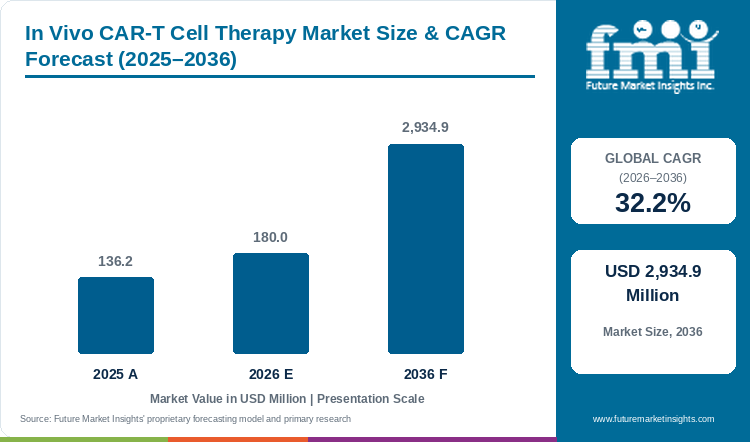
In vivo CAR-T cell therapy revenue rises from USD 136.2 million in 2025 to an estimated USD 180.0 million in 2026 and USD 2,934.9 million by 2036. Demand for in vivo CAR-T cell therapy is projected to expand at a 32.2% CAGR from 2026 to 2036, as trial supply gives way to approved use.
Key drivers of the in vivo CAR-T cell therapy market include one-dose delivery, strong early patient data and large-pharma funding. In March 2026, Nature Medicine reported that a single ESO-T01 infusion produced responses in four of five myeloma patients, with three stringent complete remissions [1]. Kelonia Therapeutics also reported in December 2025 that all four of the first KLN-1010 patients reached MRD-negative status [2]. As per FMI, lentiviral vector particles hold the leading 48.7% share in 2026, as one vial dose can write the CAR gene into T cells without cell collection. Eli Lilly and Company agreed in April 2026 to acquire Kelonia for up to USD 7.0 billion [3]. Sponsors are widening cell and gene therapy clinical trials to more sites. First approvals later this decade are expected to move in vivo CAR-T from trial supply into routine use at cancer centers.
Key Market Trends & Insights
- By vector platform, lentiviral vector particles capture 48.7% of demand in 2026, as one dose writes the CAR gene into T cells for lasting expression.
- By target antigen, CD19 leads at 34.8% in 2026, owing to use in both B-cell cancer and autoimmune programs. Umoja Biopharma gained FDA Fast Track designation for CD19-directed UB-VV111 in September 2025 [4].
- By indication, B-cell malignancies account for 28.7% of demand in 2026, and FMI expects the lead to hold as hematologists already give ex vivo CAR-T in these cancers.
- By end user, specialty cancer centers take 44.3% in 2026 and carry most early dosing. Vyriad opened a Phase 1 study of VV169 at Mayo Clinic in September 2026 for up to 40 patients [5].
Regional Highlights
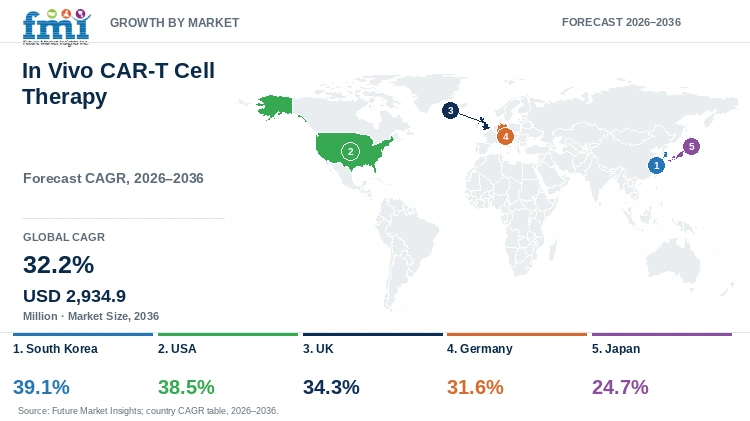
- Fastest-growing profiled country: South Korea (39.1% CAGR, 2026 to 2036).
- By country: USA (38.5%) and UK (34.3%) come next, and Japan posts the lowest profiled CAGR at 24.7% through 2036.
- In April 2026, MFDS approved Curocell's Rimqarto, the first home-grown CAR-T product in South Korea, after a 67.1% complete response rate in the approval trial [6]. FMI expects this treatment base to help local in vivo CAR-T trials enrol patients.
Market Size & Forecast
Table 1: Market Size and Forecast for the In Vivo CAR-T Cell Therapy Market (USD million and percentage), 2025 to 2036
| Metric | Value |
|---|---|
| 2025 Market Size | USD 136.2 million |
| Estimated Market Size in 2026 | USD 180.0 million |
| Projected Market Size by 2036 | USD 2,934.9 million |
| CAGR, 2026 to 2036 | 32.2% |
| Added Revenue, 2026 to 2036 | USD 2,754.9 million |
| Market Expansion Multiple | 16.3x |
Revenue from in vivo CAR-T cell therapy currently comes from early-phase trials at a small group of cancer centers. Sponsors buy vector lots for these studies, as no in vivo product has yet reached an approved label. Kelonia's FDA clearance in January 2026 opened US sites for a trial of up to 40 patients that began in Australia [7]. Approved ex vivo products already give the class a known revenue base, with Bristol Myers Squibb reporting USD 1,358 million of Breyanzi sales in 2025, up 82% [8]. However, all five ESO-T01 patients had grade 3 or higher adverse events, which keeps dosing under close specialist watch [1]. Hospital adoption is likely to stay trial-led until the first approvals and then widen as labelled products reach more treatment centers.
Patient Data, Ex Vivo Sales and Platform Deals
Key trends in the in vivo CAR-T cell therapy market point to multi-site trials, as one vector lot can treat many patients. ESO-T01 was given as a single intravenous infusion without leukapheresis, ex vivo manufacturing or lymphodepleting chemotherapy [1]. Ex vivo CAR-T, however, still needs cell collection, shipping and a plant slot for every patient. FDA clearance in January 2026 let Kelonia's Australian trial of up to 40 patients add US sites [7], and Vyriad opened a trial at Mayo Clinic in September 2026 [5]. Safety results differ by platform, as all five ESO-T01 patients had grade 3 or higher adverse events and three had grade 3 cytokine release syndrome [1]. Kelonia reported no cytokine release syndrome of grade 3 or above in the first four KLN-1010 patients [2]. Due to this, hospitals are expected to favour therapies with steady safety data. Spending on ex vivo CAR-T shows what payers already accept for the class. Gilead reported USD 1,839 million of cell therapy sales in 2025, down 7% [9]. Bristol Myers Squibb reported USD 1,358 million for Breyanzi, up 82%, and USD 427 million for Abecma [8]. Together these lines earned USD 3,624 million in 2025, and FMI expects in vivo products to compete for this revenue pool after approval. Apart from that, more centers can now give CAR-T, as the FDA removed REMS for six autologous products in June 2025 and set monitoring at two weeks [10].
Drug makers are paying well ahead of revenue for in vivo CAR-T platforms. AstraZeneca completed the EsoBiotec purchase in May 2025 for up to USD 1.0 billion, including USD 425 million upfront [11]. AbbVie closed the Capstan Therapeutics deal in August 2025 [12], valued at USD 2.1 billion [13]. Kite agreed to buy Interius BioTherapeutics for USD 350 million [14], and Bristol Myers Squibb agreed to buy Orbital Therapeutics for USD 1.5 billion [15]. Eli Lilly and Company agreed in February 2026 to buy Orna Therapeutics for up to USD 2.4 billion [16], then Kelonia for up to USD 7.0 billion in April [3]. Lilly completed both deals in the second quarter of 2026 [17]. Together, the six deals carry headline values of up to USD 14,350 million. These prices reflect the 16.3-fold rise in market value that FMI projects to 2036, and trial funding is likely to stay steady through the late 2020s. New programs are already moving, with Umoja expecting first VIBRANT-1 dosing of UB-VV400 in the third quarter of 2026 [18]. Public funders are active too, as AMED selected an academic glioblastoma CAR-T program in Japan in June 2026 [19].
Table 2: Patient Data, Ex Vivo Sales and Platform Deal Indicators for the In Vivo CAR-T Cell Therapy Market (patients, response rates, trial sites, approvals and USD values), mixed reporting years from 2025 to 2026
| Indicator | Data Point | Market Relevance | Source |
|---|---|---|---|
| ESO-T01 Phase 1 results | Responses in four of five patients; three stringent complete remissions; grade 3 or higher events in all five | Strong responses draw sponsors, and side effects keep dosing in specialist centers. | [1] |
| KLN-1010 first-in-human data | All four patients MRD-negative; no grade 3 or higher cytokine release syndrome | Dosing without lymphodepleting chemotherapy can widen the pool of eligible patients. | [2] |
| KLN-1010 US IND | Cleared January 2026; trial of up to 40 patients adds US sites | Myeloma enrolment widens to more US cancer centers. | [7] |
| VV169 Phase 1 trial | Up to 40 patients at Mayo Clinic from September 2026 | A second US myeloma program is now dosing patients. | [5] |
| Gilead cell therapy sales | Full-year 2025 total of USD 1,839 million, down 7% | Ex vivo CAR-T revenue sets the spending pool open to in vivo therapies. | [9] |
| Breyanzi and Abecma revenue | USD 1,358 million, up 82%, and USD 427 million in 2025 | Revenue from CAR-T in B-cell cancer and myeloma keeps growing. | [8] |
| FDA REMS removal | June 2025; six autologous CAR-T products; two-week monitoring and stay near care | New centers can give CAR-T with fewer barriers. | [10] |
| AstraZeneca and EsoBiotec deal | Completed May 2025; up to USD 1.0 billion, USD 425 million upfront | The ESO-T01 lentiviral platform joins a large pharma pipeline. | [11] |
| Lilly and Kelonia deal | Deal value up to USD 7.0 billion, with USD 3.25 billion upfront, April 2026 | Large-company funding supports later-stage lentiviral trials. | [3] |
| Rimqarto approval in South Korea | MFDS approval April 2026; 67.1% complete response rate | Hospitals in the fastest-growing country gain more CAR-T experience. | [6] |
| UB-VV400 IND | Cleared July 2026; first patient dosing expected in Q3 2026 | In vivo CAR-T reaches a CD22 target for patients who relapse after CD19 therapy. | [18] |
Table 3: Ex Vivo Sales Benchmarks and In Vivo Platform Deal Values for the In Vivo CAR-T Cell Therapy Market (USD million, percentage and multiples), 2025 to 2036, mixed years
| Metric | Value | Source |
|---|---|---|
| In vivo CAR-T market 2026 | USD 180.0 million | Future Market Insights |
| In vivo CAR-T market 2036 | USD 2,934.9 million | Future Market Insights |
| Gilead cell therapy sales 2025 | USD 1,839 million | [9] |
| Breyanzi revenue 2025 | USD 1,358 million | [8] |
| Abecma revenue 2025 | USD 427 million | [8] |
| Three ex vivo lines combined 2025 | USD 3,624 million | Gilead [9], Bristol Myers Squibb [8] |
| In vivo market 2026 as share of ex vivo lines | about 5% | Future Market Insights, Gilead [9], Bristol Myers Squibb [8] |
| In vivo market 2036 as share of ex vivo lines | about 81% | Future Market Insights, Gilead [9], Bristol Myers Squibb [8] |
| AstraZeneca and EsoBiotec | Up to USD 1,000 million | [11] |
| AbbVie and Capstan Therapeutics | USD 2,100 million | [13] |
| Kite and Interius BioTherapeutics | USD 350 million | [14] |
| Bristol Myers Squibb and Orbital Therapeutics | USD 1,500 million | [15] |
| Eli Lilly and Company and Kelonia Therapeutics | Up to USD 7,000 million | [3] |
| Eli Lilly and Company and Orna Therapeutics | Up to USD 2,400 million | [16] |
| Headline deal value total | Up to USD 14,350 million | Deal announcements [11] [13] [14] [15] [3] [16] |
| Deal total as multiple of 2026 market | about 80 times | Future Market Insights, deal announcements [11] [13] [14] [15] [3] [16] |
| Deal total as multiple of 2036 market | about 4.9 times | Future Market Insights, deal announcements [11] [13] [14] [15] [3] [16] |
| Market growth 2026 to 2036 | 16.3-fold | Future Market Insights |
Analyst Perspective
“Cancer centers will move from trial use to routine adoption of in vivo CAR-T once the first products carry an approved label and steady safety data. Developers that can supply consistent vector lots to many sites at once are set to gain the larger share of growth through 2036.”
- Anurag Sharma, Principal Consultant, Future Market Insights.
How is the in vivo CAR-T cell therapy market segmented?
The in vivo CAR-T cell therapy market is organised across vector platform, target antigen, indication, end user and region. For 2026, FMI places lentiviral vector particles at 48.7%, CD19 at 34.8%, B-cell malignancies at 28.7% and specialty cancer centers at 44.3%.
By vector platform: lentiviral vector particles, lipid nanoparticle mRNA delivery, adeno-associated viral vectors, and targeted protein nanocarriers.
By target antigen: CD19, BCMA, CD20, CD22, and multi-antigen targets.
By indication: B-cell malignancies, multiple myeloma, autoimmune diseases, and solid tumors.
By end user: specialty cancer centers, hospitals and transplant centers, and academic research institutes.
By region: North America, Latin America, Western Europe, Eastern Europe, East Asia, South Asia and Pacific, and Middle East and Africa.
Why do lentiviral vector particles hold the top vector platform position?
Nearly half of vector platform demand in 2026, at 48.7%, goes to lentiviral vector particles, owing to lasting CAR expression from one dose.
Table 4: Vector Platform Share for the In Vivo CAR-T Cell Therapy Market (percentage share), 2026
| Vector Platform | Share (2026) |
|---|---|
| Lentiviral Vector Particles | 48.7% |
| Other Segments Combined | 51.3% |
| Total | 100% |
Table 5: Vector Platform Leadership and Market Growth for the In Vivo CAR-T Cell Therapy Market (segment and CAGR percentage), 2026 to 2036
| Metric | Value |
|---|---|
| Global CAGR (2026 to 2036) | 32.2% |
| Leading Segment | Lentiviral Vector Particles |
Lentiviral vector particles hold 48.7% of vector platform demand in 2026, the largest share of any delivery route. Sponsors prefer this vector, as the CAR gene enters the T cell genome and modified cells keep dividing after one infusion. Leading myeloma programs such as ESO-T01, KLN-1010 and VV169 use this route and draw on methods from the viral vector development market. In May 2025, AstraZeneca completed the acquisition of EsoBiotec and the targeted lentiviral platform for up to USD 1.0 billion [11]. Lipid nanoparticle mRNA delivery is the main alternative, with Capstan, now part of AbbVie, aiming a shorter-lived CAR at autoimmune disease [12]. FMI expects lentiviral particles to stay ahead through 2036 as more programs open multi-site trials.
- A single vial dose with stable gene insertion keeps lentiviral vector particles at a 48.7% share in 2026.
- Each lentiviral lot can supply many patients, so treatment centers review vector titer and lot-to-lot consistency before adoption.
What gives CD19 the largest target antigen share?
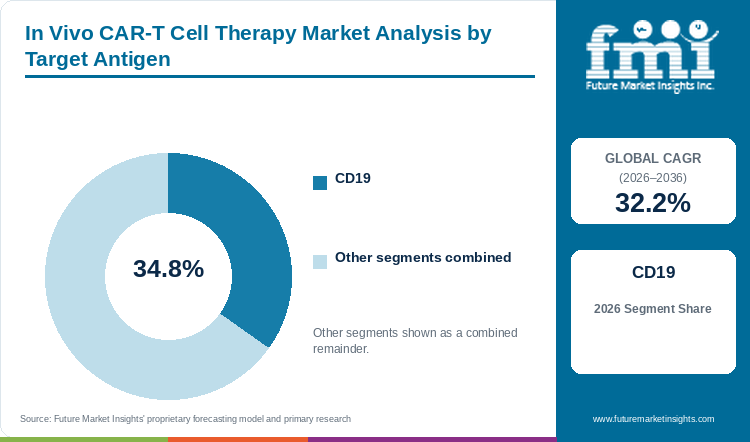
CD19 programs take 34.8% of target antigen demand in 2026, with use spanning lymphoma and autoimmune disease.
CD19 leads the target antigen segment with 34.8% of demand in 2026, as the same marker serves hematologists treating B-cell cancers and rheumatologists treating autoimmune disease. In August 2025, AbbVie completed the purchase of Capstan Therapeutics, adding CPTX2309, a targeted lipid nanoparticle therapy that makes CD19-directed CAR-T cells inside the body [12]. BCMA ranks next on the strength of early data in multiple myeloma. Adoption of CD19-directed in vivo CAR-T is likely to widen as lupus and related programs reach patients.
- Use across both cancer and autoimmune programs gives CD19 a 34.8% share of target antigen demand in 2026.
- Rheumatology clinics entering CD19 trials will need CAR-T safety training and fast access to intensive care beds.
Why do B-cell malignancies stay ahead among indications?
B-cell malignancies capture 28.7% of indication demand in 2026, as hematologists already use CAR-T in these cancers.
B-cell malignancies account for 28.7% of indication demand in 2026, the largest share among disease groups. Hematologists in this field already give ex vivo CAR-T and other adoptive cell therapy for cancer treatment options, so early in vivo responses are judged quickly. Patients relapsing after CD19-directed treatment form a ready group for new targets. In July 2026, Umoja Biopharma received FDA IND clearance for CD22-directed UB-VV400, with the VIBRANT-1 study open to patients who progressed after prior CAR-T [18]. Multiple myeloma follows with the strongest early in vivo data, and the share of this indication is expected to rise as BCMA programs advance.
- B-cell malignancies hold 28.7% share in 2026, as hematologists in this field already manage CAR-T patients and side effects.
- Relapse after CD19 treatment opens room for CD22 and multi-antigen products, which are set to gain share as second-line trials enrol.
Why do specialty cancer centers place the largest share of end user orders?
Specialty cancer centers account for 44.3% of end user demand in 2026, owing to early in vivo trial activity at these sites.
Specialty cancer centers account for 44.3% of end user demand in 2026, as these sites already manage cytokine release syndrome and neurotoxicity after CAR-T. In September 2026, Vyriad began a Phase 1 trial of BCMA-directed VV169 at Mayo Clinic for up to 40 patients after the FDA accepted the IND [5]. Hospitals and transplant centers are expected to adopt later, once product labels and payment terms are settled. The June 2025 FDA removal of REMS rules for six approved autologous CAR-T products is also making CAR-T easier to give at new centers [10].
- Specialty cancer centers account for 44.3% share in 2026, and this share is expected to ease as hospitals and transplant centers adopt after the first approvals.
- Approved CAR-T rules require patients to stay near the treatment site for two weeks after infusion, adding to center planning [10].
What are the drivers, restraints, and opportunities in the in vivo CAR-T cell therapy market?
Off-the-shelf dosing draws sponsors and centers to in vivo CAR-T, serious side effects slow wider adoption, and autoimmune programs open a second patient group through 2036.
- Driver: Adoption of in vivo CAR-T cell therapy is rising, as centers seek ready-made doses that need no cell collection or per-patient manufacturing.
- Restraint: Serious adverse events after infusion are the top challenge for in vivo CAR-T developers, due to which each patient needs close monitoring inside specialist centers.
- Opportunity: Key opportunities in the in vivo CAR-T market lie beyond cancer, as CD19 programs in lupus and other autoimmune diseases add rheumatology clinics as new adopters.
Ready-made Doses Draw Sponsors
Developers are moving to in vivo CAR-T, as a single vector lot can treat many patients without cell collection or a manufacturing slot for each person. Kelonia reported in December 2025 that CAR-T cells expanded in patients given KLN-1010 without lymphodepleting chemotherapy [2]. Vector and nanoparticle lots for these trials draw on suppliers in the cell therapy manufacturing market. Shorter waits between diagnosis and dosing are expected to bring more myeloma and lymphoma patients into in vivo trials through the late 2020s.
Side Effects Keep Dosing in Specialist Hands
Serious adverse events after infusion are slowing the move from trials to routine use. All five ESO-T01 patients had grade 3 or higher adverse events, and three had grade 3 cytokine release syndrome [1]. Centers giving these doses keep buying supportive care from the cytokine release syndrome management market and keep intensive care beds on hand. However, Kelonia reported no grade 3 or higher cytokine release syndrome in the first four patients, so safety results differ by platform [2]. Hospitals outside specialist networks are likely to wait for larger safety data sets before adoption.
Autoimmune Programs Add a Second Patient Group
CD19-directed in vivo CAR-T can reset B cells in lupus and related diseases, adding rheumatology patients to the cancer base. In July 2026, CREATE Medicines gained Australian ethics approval for a Phase 1/2 trial of CRT-402 in lupus, systemic sclerosis and inflammatory myopathies [20]. Bristol Myers Squibb also agreed in October 2025 to buy Orbital Therapeutics for USD 1.5 billion, gaining an RNA-based CD19 CAR program for autoimmune disease [15]. Rheumatology clinics are expected to become new adopters once these trials report results.
Which country CAGRs are profiled in the in vivo CAR-T cell therapy market?
South Korea leads the five profiled countries with a 39.1% CAGR over 2026 to 2036, and Japan posts the lowest rate at 24.7% through 2036. Growth in each market follows regulator approvals, trial clearances and payer decisions on CAR-T vectors given by infusion.
Table 6: Country CAGRs and Primary Growth Levers for the In Vivo CAR-T Cell Therapy Market (CAGR percentage), 2026 to 2036
| Country | CAGR (2026-2036) | Primary Growth Lever |
|---|---|---|
| South Korea | 39.1% | Law change for gene delivery inside the body |
| USA | 38.5% | FDA trial clearances at cancer centers |
| UK | 34.3% | Updated trial rules at NHS specialist hospitals |
| Germany | 31.6% | Pricing against hospital-made CAR-T |
| Japan | 24.7% | Local trial data ahead of PMDA filings |
Source: Future Market Insights
South Korea In Vivo CAR-T Cell Therapy Market Outlook (2026-2036)
Korean adoption of in vivo CAR-T is set for a 39.1% CAGR through 2036, the highest of any profiled country. On 13 March 2026, the National Assembly Health and Welfare Committee passed a bill that counts genetic material as part of human cells [21]. The bill brings gene therapy given inside the body under the regenerative medicine law, pending Legislation and Judiciary Committee review and a full Assembly vote. Hematology centers gained the first home-grown CAR-T product when MFDS approved Curocell's Rimqarto in April 2026 [6]. More than 10 Korean drug developers, Curocell among them, were working on in vivo CAR-T by June 2026, and most compete on in-house delivery platforms [22].
Key takeaway: Final passage of the gene therapy bill would let Korean hospitals and developers start in vivo CAR-T studies at home.
USA In Vivo CAR-T Cell Therapy Market Outlook (2026-2036)
The USA ranks second in the country table at a 38.5% CAGR through 2036. Demand for in vivo CAR-T trials is building at US cancer centers as FDA clearances arrive. Kelonia's KLN-1010 study expanded to US sites in January 2026 [7], and Umoja's CD22-directed UB-VV400 was cleared in July 2026 [18]. Vector makers gained room to adjust production in January 2026, when the FDA set out a flexible approach to manufacturing and quality requirements for small-batch cell and gene therapies [23]. However, patients given approved CAR-T still stay near the treatment center for two weeks after infusion [10], so early in vivo use will stay at large academic sites.
Key takeaway: FDA clearances for new US trial sites will set the pace of early American adoption.
UK In Vivo CAR-T Cell Therapy Market Outlook (2026-2036)
Adoption of in vivo CAR-T in the UK is set to rise at a 34.3% CAGR through 2036, the third-fastest rate of the five. In November 2025, NICE recommended the UK-developed AUCATZYL from Autolus for NHS patients in England and Wales. The recommendation covers adults aged 26 and over with relapsed or refractory B-cell acute lymphoblastic leukaemia [24]. Sponsors opening early in vivo studies at NHS specialist hospitals now work under updated clinical trial regulations, in force since 28 April 2026, with new model research agreements [25].
Key takeaway: Faster study set-up at NHS specialist hospitals offers the clearest path to UK growth.
Germany In Vivo CAR-T Cell Therapy Market Outlook (2026-2036)
Revenue from in vivo CAR-T in Germany is forecast at a 31.6% CAGR through 2036, just below the global rate. Hospital-made CAR-T competes on price with in vivo products in the German market. Heidelberg University Hospital became the first German hospital with a special licence to make CAR-T cells, for the Heidi-cel product, in February 2026 [26]. Approved CAR-T products launched in Germany at EUR 282,000 to EUR 420,000 per dose, and list prices fell by 18.3% on average after AMNOG price talks [27].
Key takeaway: Launch prices measured against hospital-made cells will shape German adoption of in vivo CAR-T.
Japan In Vivo CAR-T Cell Therapy Market Outlook (2026-2036)
Japan is set for a 24.7% CAGR through 2036, the lowest in the table, as hospitals wait for local trial data and PMDA approval. Japan's national health insurance lists Novartis's Kymriah at about JPY 33.5 million per patient, a price set in May 2019 [28]. Developers of one-dose in vivo CAR-T will price against that figure in Japan. Public research money is going to academic CAR-T projects, such as an AMED-selected glioblastoma program from June 2026 [19].
Key takeaway: Japanese hospitals will hold back adoption until local in vivo trial data support a PMDA filing.
Who are the notable companies in the in vivo CAR-T cell therapy market?
AbbVie, Gilead Sciences, AstraZeneca, Bristol Myers Squibb, Umoja Biopharma, Kelonia Therapeutics, Vyriad, CREATE Medicines, Orna Therapeutics, and Azalea Therapeutics are the key companies profiled in this market.
Ownership of in vivo CAR-T platforms is moving to large drug makers, and smaller developers compete on clinical data and in-house vector supply. Kite, a Gilead company, agreed in August 2025 to buy Interius BioTherapeutics for USD 350 million [14]. Eli Lilly and Company completed the Kelonia and Orna deals in the second quarter of 2026 [17]. Umoja Biopharma, Vyriad and CREATE Medicines remain independent, with Umoja running a lentiviral vector plant in Louisville, Colorado [18]. As per FMI, treatment centers that approve one product for internal protocols are likely to be slow to switch suppliers.
- Large pharmaceutical acquirers: AbbVie, Gilead Sciences, AstraZeneca, and Bristol Myers Squibb added in vivo platforms through 2025 deals and are now building clinical records.
- Lentiviral program developers: Umoja Biopharma, Kelonia Therapeutics, and Vyriad, with Kelonia now owned by Eli Lilly and Company and the other two still independent.
- RNA and gene-insertion developers: CREATE Medicines, Orna Therapeutics, and Azalea Therapeutics treat delivery technology as the main asset, which is set to draw further partnerships.
Competitive Benchmarking: In Vivo CAR-T Cell Therapy Market
Table 7: Competitive Benchmarking for the In Vivo CAR-T Cell Therapy Market (qualitative capability ratings), 2026
| Company | Human Data | Antigen Range | Vector Supply | Reach |
|---|---|---|---|---|
| AbbVie | Medium | Medium | Low | High |
| Gilead Sciences | Medium | Medium | Low | High |
| AstraZeneca | High | Medium | Low | High |
| Bristol Myers Squibb | Low | Medium | Low | High |
| Umoja Biopharma | Medium | High | High | Medium |
| Kelonia Therapeutics | High | Medium | Low | Medium |
| Vyriad | Medium | Medium | Medium | Low |
| CREATE Medicines | Medium | High | Low | Medium |
| Orna Therapeutics | Low | High | Low | Medium |
| Azalea Therapeutics | Low | Low | Low | Low |
High means several documented programs or disclosures for that criterion, Medium means one documented example, and Low means limited public documentation.
Key Developments in the In Vivo CAR-T Cell Therapy Market
- In September 2026, Vyriad began a Phase 1 trial of BCMA-directed VV169 at Mayo Clinic after FDA acceptance of the IND [5].
- CREATE Medicines formed a research and licensing collaboration with WestGene in August 2026 for targeted lipid nanoparticle delivery, covering dual CD19 and BCMA programs [29].
- In July 2026, Umoja Biopharma gained FDA IND clearance for CD22-directed UB-VV400 and plans to run the Phase 1/2 VIBRANT-1 study [18].
- Eli Lilly and Company agreed in April 2026 to acquire Kelonia Therapeutics for up to USD 7.0 billion, including USD 3.25 billion upfront [3]. The new funding is expected to move KLN-1010 toward registration trials.
Key Players in the In Vivo CAR-T Cell Therapy Market
Large Pharmaceutical Acquirers
- AbbVie Inc.
- Gilead Sciences, Inc.
- AstraZeneca PLC
- Bristol-Myers Squibb Company
Lentiviral Program Developers
- Umoja Biopharma
- Kelonia Therapeutics
- Vyriad
RNA and Gene-Insertion Developers
- CREATE Medicines
- Orna Therapeutics
- Azalea Therapeutics
In Vivo CAR-T Cell Therapy Market - Report Scope
Table 8: Report Scope for the In Vivo CAR-T Cell Therapy Market (coverage fields and definitions), 2026 to 2036
| Coverage field | Report scope |
|---|---|
| Market breakdown | Vector platform; target antigen; indication; end user; region |
| Quantitative units | USD million |
| Market definition | Net sales of administered vector or nanocarrier drug products that generate CAR-T cells inside patients, with bundled delivery components counted once. The scope excludes ex vivo engineered cell products, non-T-cell therapies, general-purpose reagents, separately billed services, licensing and acquisition payments, and downstream care charges. |
| Regions covered | North America; Latin America; Western Europe; Eastern Europe; East Asia; South Asia and Pacific; Middle East and Africa |
| Countries covered | South Korea; USA; UK; Germany; Japan |
| Key companies profiled | AbbVie, Gilead Sciences, AstraZeneca, Bristol Myers Squibb, Umoja Biopharma, Kelonia Therapeutics, Vyriad, CREATE Medicines, Orna Therapeutics, Azalea Therapeutics |
| Forecast period | 2026 to 2036 |
| Approach | Bottom-up build from trial sites, dosing volumes and expected approval dates, checked top-down against ex vivo CAR-T sales and price benchmarks in each profiled country. |
In Vivo CAR-T Cell Therapy Market - Research Methodology
Table 9: Research Methodology for the In Vivo CAR-T Cell Therapy Market (research methods and approach), 2026 edition
| Method | Approach |
|---|---|
| Primary Research | Analysts interviewed in vivo CAR-T developers, hematologists, rheumatologists, cell therapy center managers, vector suppliers and trial sponsors on dosing, safety monitoring, expected pricing and site set-up. |
| Desk Research | Sources include regulator decisions, peer-reviewed trial results, company releases and filings, trial registries and health technology assessment guidance. |
| Market Sizing and Forecasting | The 2025 base value is combined with trial enrolment, expected approval timing, ex vivo CAR-T price benchmarks, segment shares and country treatment capacity to build the forecast. |
| Data Validation | Estimates are cross-checked against company disclosures, regulator records and interview findings. Ex vivo cell products, licensing income and acquisition payments are excluded to avoid double counting. |
In Vivo CAR-T Cell Therapy Market by Segments
In Vivo CAR-T Cell Therapy Market segmented by Vector Platform:
- Lentiviral vector particles
- Lipid nanoparticle mRNA delivery
- Adeno-associated viral vectors
- Targeted protein nanocarriers
In Vivo CAR-T Cell Therapy Market segmented by Target Antigen:
- CD19
- BCMA
- CD20
- CD22
- Multi-antigen targets
In Vivo CAR-T Cell Therapy Market segmented by Indication:
- B-cell malignancies
- Multiple myeloma
- Autoimmune diseases
- Solid tumors
In Vivo CAR-T Cell Therapy Market segmented by End User:
- Specialty cancer centers
- Hospitals and transplant centers
- Academic research institutes
In Vivo CAR-T Cell Therapy Market by Region
- North America
- United States
- Canada
- Latin America
- Brazil
- Mexico
- Argentina
- Chile
- Western Europe
- Germany
- France
- United Kingdom
- Italy
- Spain
- Benelux
- Nordics
- Eastern Europe
- Poland
- Czech Republic
- Romania
- Hungary
- East Asia
- Japan
- South Korea
- South Asia and Pacific
- ASEAN
- Australia and New Zealand
- Middle East and Africa
- GCC Countries
- South Africa
- Türkiye
- Israel
Research Sources and Bibliography
- [1] Nature Medicine (An, N., Wang, D., Zhang, P., et al.). (2026, March). In vivo generation of anti-BCMA CAR-T cells in relapsed or refractory multiple myeloma: a phase 1 study.https://www.nature.com/articles/s41591-026-04244-6
- [2] Kelonia Therapeutics. (2025, December). Kelonia Therapeutics Presents First-in-Human Data From Phase 1 inMMyCAR Study of KLN-1010 in vivo BCMA CAR-T Therapy at the American Society of Hematology (ASH) 2025 Annual Meeting.https://www.businesswire.com/news/home/20251209935959/en/Kelonia-Therapeutics-Presents-First-in-Human-Data-From-Phase-1-inMMyCAR-Study-of-KLN-1010-in-vivo-BCMA-CAR-T-Therapy-at-the-American-Society-of-Hematology-ASH-2025-Annual-Meeting
- [3] Eli Lilly and Company. (2026, April). Lilly to acquire Kelonia Therapeutics to advance in vivo CAR-T cell therapies.https://investor.lilly.com/node/54136
- [4] CGTLive. (2025, October). Umoja Biopharma's In Situ CAR-T Therapy UB-VV111 Fast Tracked for Several B-Cell Malignancy Indications.https://cgtlive.com/view/umoja-biopharma-in-situ-car-t-therapy-ub-vv111-fast-tracked-several-b-cell-malignancy-indications
- [5] Vyriad. (2026, September). Vyriad Begins Phase 1 Clinical Trial for Lead In Vivo CAR T Cell Therapy VV169 Following FDA Acceptance of IND Application.https://vyriad.com/newsevents/vyriad-begins-phase-1-clinical-trial-for-lead-in-vivo-car-t-cell-therapy-vv169-following-fda-acceptance-of-ind-application/
- [6] Curocell. (2026, April). Curocell's RIMQARTO Inj. Wins Full Regulatory Approval, Poised to Enter CAR-T Market with 67% Complete Response Rate.https://www.businesswire.com/news/home/20260429207749/en/Curocells-RIMQARTO-Inj.-Wins-Full-Regulatory-Approval-Poised-to-Enter-CAR-T-Market-with-67-Complete-Response-Rate
- [7] Kelonia Therapeutics. (2026, January). Kelonia Therapeutics Announces FDA Clearance of Investigational New Drug (IND) Application for KLN-1010, an in vivo BCMA CAR-T Therapy for Relapsed and Refractory Multiple Myeloma.https://www.businesswire.com/news/home/20260107179212/en/Kelonia-Therapeutics-Announces-FDA-Clearance-of-Investigational-New-Drug-IND-Application-for-KLN-1010-an-in-vivo-BCMA-CAR-T-Therapy-for-Relapsed-and-Refractory-Multiple-Myeloma
- [8] Bristol Myers Squibb. (2026, February). Bristol Myers Squibb Reports Fourth Quarter and Full-Year Financial Results for 2025 (Form 8-K, Exhibit 99.1).https://www.sec.gov/Archives/edgar/data/14272/000001427226000002/a2025q4ex991.htm
- [9] Gilead Sciences. (2026, February). Gilead Sciences Announces Fourth Quarter and Full Year 2025 Financial Results.https://www.businesswire.com/news/home/20260210935221/en/Gilead-Sciences-Announces-Fourth-Quarter-and-Full-Year-2025-Financial-Results
- [10] U.S. Food and Drug Administration. (2025, June). FDA Eliminates Risk Evaluation and Mitigation Strategies (REMS) for Autologous Chimeric Antigen Receptor CAR T cell Immunotherapies.https://www.fda.gov/vaccines-blood-biologics/safety-availability-biologics/fda-eliminates-risk-evaluation-and-mitigation-strategies-rems-autologous-chimeric-antigen-receptor
- [11] AstraZeneca. (2025, May). Acquisition of EsoBiotec completed (Form 6-K).https://www.sec.gov/Archives/edgar/data/0000901832/000165495425005901/a3029j.htm
- [12] AbbVie. (2025, August). AbbVie Completes Acquisition of Capstan Therapeutics.https://news.abbvie.com/2025-08-19-AbbVie-Completes-Acquisition-of-Capstan-Therapeutics
- [13] Drug, Chemical & Associated Technologies Association (DCAT). (2025, August). AbbVie Completes $2.1-Bn Acquisition of Capstan Therapeutics.https://www.dcatvci.org/top-industry-news/abbvie-completes-2-1-bn-acquisition-of-capstan-therapeutics/
- [14] Fierce Biotech. (2025, August). Gilead's Kite sails into in vivo CAR-T space with $350M Interius buyout.https://www.fiercebiotech.com/biotech/gileads-kite-sails-vivo-car-t-space-350m-interius-buyout
- [15] Bristol Myers Squibb. (2025, October). Bristol Myers Squibb Strengthens and Diversifies Cell Therapy Portfolio with Acquisition of Orbital Therapeutics.https://www.businesswire.com/news/home/20251009968216/en/Bristol-Myers-Squibb-Strengthens-and-Diversifies-Cell-Therapy-Portfolio-with-Acquisition-of-Orbital-Therapeutics
- [16] Eli Lilly and Company. (2026, February). Lilly to acquire Orna Therapeutics to advance cell therapies.https://investor.lilly.com/news-releases/news-release-details/lilly-acquire-orna-therapeutics-advance-cell-therapies
- [17] Eli Lilly and Company. (2026, August). Lilly reports second-quarter 2026 financial results, raises full-year guidance, and highlights continued growth and pipeline progress (Form 8-K exhibit).https://www.sec.gov/Archives/edgar/data/0000059478/000005947826000077/q226lillysalesandearningsp.htm
- [18] Umoja Biopharma. (2026, July). Umoja Biopharma Announces FDA Clearance of IND Application for UB-VV400, the Industry's First Known CD22-Directed In Vivo CAR T Cell Therapy for Relapsed/Refractory B Cell Malignancies.https://www.biospace.com/press-releases/umoja-biopharma-announces-fda-clearance-of-ind-application-for-ub-vv400-the-industrys-first-known-cd22-directed-in-vivo-car-t-cell-therapy-for-relapsed-refractory-b-cell-malignancies
- [19] Research Institute for Cell Design Medical Science, Yamaguchi University. (2026, June). Research and Development of Next-Generation CAR-T Cell Therapy for Malignant Brain Tumor (Glioblastoma) selected by AMED.https://ds0n.cc.yamaguchi-u.ac.jp/~celldesign/en_news/260602en/
- [20] CREATE Medicines. (2026, July). CREATE Medicines Receives Approval to Initiate First-in-Human Phase 1/2 Clinical Trial of In Vivo CAR-T Candidate CRT-402 for Autoimmune Diseases.https://www.biospace.com/press-releases/create-medicines-receives-approval-to-initiate-first-in-human-phase-1-2-clinical-trial-of-in-vivo-car-t-candidate-crt-402-for-autoimmune-diseases
- [21] The Asia Business Daily (Asiae). (2026, April). Big Pharma and Biotech Firms Eye 'In-Vivo CAR-T'... One Step Closer to Legalization.https://view.asiae.co.kr/en/article/2026033117494547009
- [22] BizWatch. (2026, June). 'Making anticancer drugs inside the body': in vivo CAR-T development heats up (in Korean).https://news.bizwatch.co.kr/article/healthcare/2026/06/17/0038
- [23] U.S. Food and Drug Administration. (2026, January). FDA Increases Flexibility on Requirements for Cell and Gene Therapies to Advance Innovation.https://fda.gov/news-events/press-announcements/fda-increases-flexibility-requirements-cell-and-gene-therapies-advance-innovation
- [24] Autolus Therapeutics. (2025, November). NICE Recommends AUCATZYL (obecabtagene autoleucel) as a Treatment Option for Adult Patients (≥26 years) with Relapsed or Refractory B-Cell Precursor Acute Lymphoblastic Leukemia (R/R B-ALL).https://autolus.gcs-web.com/news-releases/news-release-details/nice-recommends-aucatzylr-obecabtagene-autoleucel-treatment
- [25] Health Research Authority. (2026, April). Clinical trials regulations: a round-up of HRA operational changes.https://www.hra.nhs.uk/about-us/news-updates/clinical-trials-regulations-a-round-up-of-hra-operational-changes/
- [26] Heidelberg University Hospital. (2026, February). First German hospital with special manufacturing license for CAR-T cells.https://www.heidelberg-university-hospital.com/24022026-first-german-hospital-with-special-manufacturing-license-for-car-t-cells/
- [27] ISPOR Europe 2024, Value in Health (Cullen, K., Owens-Smith, I.). (2024, December). The Cost of Innovation: Evaluating the Evolution of Willingness-to-Pay for CAR-T Therapies in Germany.https://www.ispor.org/heor-resources/presentations-database/presentation/euro2024-4018/144884
- [28] PHARMA JAPAN (Jiho). (2019, May). Kymriah Gets 33.5 Million Yen Price Tag, Peak Sales Put at 7.2 Billion Yen.https://pj.jiho.jp/node/239968
- [29] CREATE Medicines (via Eastern Progress newswire). (2026, August). CREATE Medicines Expands Clinical In Vivo CAR Pipeline and LNP Technology Suite by Forming Strategic Collaboration with WestGene.https://www.easternprogress.com/create-medicines-expands-clinical-in-vivo-car-pipeline-and-lnp-technology-suite-by-forming-strategic/article_aaffa8eb-a640-5d26-900a-ee2b542ef9a2.html
- [30] Azalea Therapeutics (via Eagle-Tribune newswire). (2026, May). Azalea Therapeutics Announces Late-Breaking Oral Presentation at ASGCT Annual Meeting.https://www.eagletribune.com/region/azalea-therapeutics-announces-late-breaking-oral-presentation-at-asgct-annual-meeting/article_85f49ac8-b08c-5d12-9d32-9cf36170bb3a.html
This bibliography is provided for reader reference. The full report contains the complete reference list and detailed citations.
This Report Answers
- What is the size of the in vivo CAR-T cell therapy market in 2026?
- By 2036, what value will in vivo CAR-T cell therapy sales reach?
- Which vector platform holds the largest share of in vivo CAR-T demand, and why?
- Why do CD19 programs and B-cell malignancies lead early in vivo CAR-T use?
- Which profiled country shows the fastest in vivo CAR-T growth through 2036?
- Who are the leading drug makers and developers in the in vivo CAR-T market?
Frequently Asked Questions
What is the size of the in vivo CAR-T cell therapy market in 2026?
FMI values the in vivo CAR-T cell therapy market at USD 180.0 million in 2026, up from USD 136.2 million in 2025. Revenue will reach USD 2,934.9 million by 2036 as the first approved therapies move from trials into cancer centers.
What growth rate is forecast for in vivo CAR-T cell therapy through 2036?
The market will expand at a 32.2% CAGR from 2026 to 2036, according to FMI. Most added revenue will arrive after the first approvals, when hospitals can adopt the therapy outside clinical trials.
Which vector platform leads in vivo CAR-T demand in 2026?
Lentiviral vector particles will hold 48.7% of vector platform demand in 2026. Sponsors will keep choosing these vectors for lasting CAR expression after a single infusion.
Which end user buys the most in vivo CAR-T doses?
Specialty cancer centers account for 44.3% of end user demand in 2026. These centers run the first trials and already manage side effects after CAR-T infusion, so early adoption will stay concentrated there.
Which country grows fastest in the in vivo CAR-T cell therapy market?
South Korea will grow fastest among the five profiled countries at a 39.1% CAGR from 2026 to 2036. The first home-grown CAR-T approval in April 2026 and a pending gene therapy bill will support local development.
Which companies are active in the in vivo CAR-T cell therapy market?
Key companies include AbbVie, Gilead Sciences, AstraZeneca, Bristol Myers Squibb, Umoja Biopharma, Kelonia Therapeutics, Vyriad, CREATE Medicines, Orna Therapeutics, and Azalea Therapeutics. These companies will compete through lentiviral, RNA and gene-insertion delivery platforms.
Preview the report firsthand - request a free sample
Get SampleGet the brochure for pricing and purchase details.
Get PDFTable of Content
- Key Takeaways
- Market Size and CAGR
- Top Growth Driver
- Fastest Growing Segment
- Leading Region
- Key Companies
- Emerging Opportunities
- Executive Summary
- Global Market Outlook
- Demand-side Trends
- Supply-side Trends
- Technology Roadmap Analysis
- Analysis and Recommendations
- Analyst Perspective (What is happening? Why now? What should investors know?)
- Key Questions Answered
- How large is the market?
- What is the CAGR?
- What are key trends?
- Which region dominates?
- Who are the leaders?
- Market Overview
- Market Coverage / Taxonomy
- Market Definition / Scope / Limitations
- Research Methodology
- Chapter Orientation
- Analytical Lens and Working Hypotheses
- Market Structure, Signals, and Trend Drivers
- Benchmarking and Cross-market Comparability
- Market Sizing, Forecasting, and Opportunity Mapping
- Research Design and Evidence Framework
- Desk Research Programme (Secondary Evidence)
- Expert Input and Fieldwork (Primary Evidence)
- Tooling, Models, and Reference Databases
- Data Engineering and Model Build
- Quality Assurance and Audit Trail
- Market Background
- Market Dynamics (Drivers, Restraints, Opportunity, Trends)
- Scenario Forecast (Optimistic, Likely, Conservative)
- Impact Analysis
- AI Impact
- Sustainability Impact
- Regulatory Impact
- Technology Impact
- Consumer / Buyer Analysis
- Purchase Drivers
- Adoption Barriers
- Buyer Journey
- Opportunity Map Analysis
- Product Life Cycle Analysis
- Supply Chain Analysis
- Investment Feasibility Matrix
- Value Chain Analysis
- PESTLE and Porter's Analysis
- Regulatory Landscape
- Regional Parent Market Outlook
- Production and Consumption Statistics
- Import and Export Statistics
- Global Market Analysis and Forecast, 2021 to 2036
- Historical Market Size Value (USD Million) Analysis, 2021 to 2025
- Current and Future Market Size Value (USD Million) Projections, 2026 to 2036
- Y-o-Y Growth Trend Analysis
- Absolute $ Opportunity Analysis
- Global Market Pricing Analysis, 2021 to 2036
- Global Market Analysis and Forecast, By Vector Platform, 2021 to 2036
- Introduction / Key Findings
- Historical Market Size Value (USD Million) Analysis By Vector Platform, 2021 to 2025
- Current and Future Market Size Value (USD Million) Analysis and Forecast By Vector Platform, 2026 to 2036
- Lentiviral vector particles
- Lipid nanoparticle mRNA delivery
- Adeno-associated viral vectors
- Targeted protein nanocarriers
- Y-o-Y Growth Trend Analysis By Vector Platform, 2021 to 2025
- Absolute $ Opportunity Analysis By Vector Platform, 2026 to 2036
- Global Market Analysis and Forecast, By Target Antigen, 2021 to 2036
- Introduction / Key Findings
- Historical Market Size Value (USD Million) Analysis By Target Antigen, 2021 to 2025
- Current and Future Market Size Value (USD Million) Analysis and Forecast By Target Antigen, 2026 to 2036
- CD19
- BCMA
- CD20
- CD22
- Multi-antigen targets
- Y-o-Y Growth Trend Analysis By Target Antigen, 2021 to 2025
- Absolute $ Opportunity Analysis By Target Antigen, 2026 to 2036
- Global Market Analysis and Forecast, By Indication, 2021 to 2036
- Introduction / Key Findings
- Historical Market Size Value (USD Million) Analysis By Indication, 2021 to 2025
- Current and Future Market Size Value (USD Million) Analysis and Forecast By Indication, 2026 to 2036
- B-cell malignancies
- Multiple myeloma
- Autoimmune diseases
- Solid tumors
- Y-o-Y Growth Trend Analysis By Indication, 2021 to 2025
- Absolute $ Opportunity Analysis By Indication, 2026 to 2036
- Global Market Analysis and Forecast, By End User, 2021 to 2036
- Introduction / Key Findings
- Historical Market Size Value (USD Million) Analysis By End User, 2021 to 2025
- Current and Future Market Size Value (USD Million) Analysis and Forecast By End User, 2026 to 2036
- Specialty cancer centers
- Hospitals and transplant centers
- Academic research institutes
- Y-o-Y Growth Trend Analysis By End User, 2021 to 2025
- Absolute $ Opportunity Analysis By End User, 2026 to 2036
- Global Market Analysis and Forecast, By Region, 2021 to 2036
- Introduction
- Historical Market Size Value (USD Million) Analysis By Region, 2021 to 2025
- Current Market Size Value (USD Million) Analysis and Forecast By Region, 2026 to 2036
- North America
- Latin America
- Western Europe
- Eastern Europe
- East Asia
- South Asia and Pacific
- Middle East and Africa
- Market Attractiveness Analysis By Region
- North America Market Analysis and Forecast, By Country, 2021 to 2036
- Historical Market Size Value (USD Million) Trend Analysis By Market Taxonomy, 2021 to 2025
- Market Size Value (USD Million) Forecast By Market Taxonomy, 2026 to 2036
- By Country
- United States
- Canada
- By Vector Platform
- By Target Antigen
- By Indication
- By End User
- By Country
- Market Attractiveness Analysis
- By Country
- By Vector Platform
- By Target Antigen
- By Indication
- By End User
- Key Takeaways
- Latin America Market Analysis and Forecast, By Country
- Historical Market Size Value (USD Million) Trend Analysis By Market Taxonomy, 2021 to 2025
- Market Size Value (USD Million) Forecast By Market Taxonomy, 2026 to 2036
- By Country
- Brazil
- Mexico
- Argentina
- Chile
- By Vector Platform
- By Target Antigen
- By Indication
- By End User
- By Country
- Market Attractiveness Analysis
- By Country
- By Vector Platform
- By Target Antigen
- By Indication
- By End User
- Key Takeaways
- Western Europe Market Analysis and Forecast, By Country
- Historical Market Size Value (USD Million) Trend Analysis By Market Taxonomy, 2021 to 2025
- Market Size Value (USD Million) Forecast By Market Taxonomy, 2026 to 2036
- By Country
- Germany
- France
- United Kingdom
- Italy
- Spain
- Benelux
- Nordics
- By Vector Platform
- By Target Antigen
- By Indication
- By End User
- By Country
- Market Attractiveness Analysis
- By Country
- By Vector Platform
- By Target Antigen
- By Indication
- By End User
- Key Takeaways
- Eastern Europe Market Analysis and Forecast, By Country
- Historical Market Size Value (USD Million) Trend Analysis By Market Taxonomy, 2021 to 2025
- Market Size Value (USD Million) Forecast By Market Taxonomy, 2026 to 2036
- By Country
- Poland
- Czech Republic
- Romania
- Hungary
- By Vector Platform
- By Target Antigen
- By Indication
- By End User
- By Country
- Market Attractiveness Analysis
- By Country
- By Vector Platform
- By Target Antigen
- By Indication
- By End User
- Key Takeaways
- East Asia Market Analysis and Forecast, By Country
- Historical Market Size Value (USD Million) Trend Analysis By Market Taxonomy, 2021 to 2025
- Market Size Value (USD Million) Forecast By Market Taxonomy, 2026 to 2036
- By Country
- Japan
- South Korea
- By Vector Platform
- By Target Antigen
- By Indication
- By End User
- By Country
- Market Attractiveness Analysis
- By Country
- By Vector Platform
- By Target Antigen
- By Indication
- By End User
- Key Takeaways
- South Asia and Pacific Market Analysis and Forecast, By Country
- Historical Market Size Value (USD Million) Trend Analysis By Market Taxonomy, 2021 to 2025
- Market Size Value (USD Million) Forecast By Market Taxonomy, 2026 to 2036
- By Country
- ASEAN
- Australia and New Zealand
- By Vector Platform
- By Target Antigen
- By Indication
- By End User
- By Country
- Market Attractiveness Analysis
- By Country
- By Vector Platform
- By Target Antigen
- By Indication
- By End User
- Key Takeaways
- Middle East and Africa Market Analysis and Forecast, By Country
- Historical Market Size Value (USD Million) Trend Analysis By Market Taxonomy, 2021 to 2025
- Market Size Value (USD Million) Forecast By Market Taxonomy, 2026 to 2036
- By Country
- GCC Countries
- South Africa
- Türkiye
- Israel
- By Vector Platform
- By Target Antigen
- By Indication
- By End User
- By Country
- Market Attractiveness Analysis
- By Country
- By Vector Platform
- By Target Antigen
- By Indication
- By End User
- Key Takeaways
- Key Countries Market Analysis
- United States
- Pricing Analysis
- Market Share Analysis, 2025
- By Vector Platform
- By Target Antigen
- By Indication
- By End User
- Canada
- Pricing Analysis
- Market Share Analysis, 2025
- By Vector Platform
- By Target Antigen
- By Indication
- By End User
- Mexico
- Pricing Analysis
- Market Share Analysis, 2025
- By Vector Platform
- By Target Antigen
- By Indication
- By End User
- Brazil
- Pricing Analysis
- Market Share Analysis, 2025
- By Vector Platform
- By Target Antigen
- By Indication
- By End User
- Chile
- Pricing Analysis
- Market Share Analysis, 2025
- By Vector Platform
- By Target Antigen
- By Indication
- By End User
- Germany
- Pricing Analysis
- Market Share Analysis, 2025
- By Vector Platform
- By Target Antigen
- By Indication
- By End User
- United Kingdom
- Pricing Analysis
- Market Share Analysis, 2025
- By Vector Platform
- By Target Antigen
- By Indication
- By End User
- Italy
- Pricing Analysis
- Market Share Analysis, 2025
- By Vector Platform
- By Target Antigen
- By Indication
- By End User
- Spain
- Pricing Analysis
- Market Share Analysis, 2025
- By Vector Platform
- By Target Antigen
- By Indication
- By End User
- France
- Pricing Analysis
- Market Share Analysis, 2025
- By Vector Platform
- By Target Antigen
- By Indication
- By End User
- ASEAN
- Pricing Analysis
- Market Share Analysis, 2025
- By Vector Platform
- By Target Antigen
- By Indication
- By End User
- Australia and New Zealand
- Pricing Analysis
- Market Share Analysis, 2025
- By Vector Platform
- By Target Antigen
- By Indication
- By End User
- Japan
- Pricing Analysis
- Market Share Analysis, 2025
- By Vector Platform
- By Target Antigen
- By Indication
- By End User
- South Korea
- Pricing Analysis
- Market Share Analysis, 2025
- By Vector Platform
- By Target Antigen
- By Indication
- By End User
- Poland
- Pricing Analysis
- Market Share Analysis, 2025
- By Vector Platform
- By Target Antigen
- By Indication
- By End User
- Hungary
- Pricing Analysis
- Market Share Analysis, 2025
- By Vector Platform
- By Target Antigen
- By Indication
- By End User
- Türkiye
- Pricing Analysis
- Market Share Analysis, 2025
- By Vector Platform
- By Target Antigen
- By Indication
- By End User
- South Africa
- Pricing Analysis
- Market Share Analysis, 2025
- By Vector Platform
- By Target Antigen
- By Indication
- By End User
- United States
- Market Structure Analysis
- Competition Dashboard
- Competition Benchmarking
- Market Share Analysis of Top Players
- By Regional
- By Vector Platform
- By Target Antigen
- By Indication
- By End User
- Emerging Startups
- Innovation Benchmarking
- Competition Analysis
- Competition Deep Dive
- AbbVie
- Overview
- Product Portfolio
- Profitability by Market Segments
- Sales Footprint
- Strategy Overview
- Marketing Strategy
- Product Strategy
- Channel Strategy
- Gilead Sciences
- AstraZeneca
- Bristol Myers Squibb
- Umoja Biopharma
- Kelonia Therapeutics
- Vyriad
- CREATE Medicines
- Orna Therapeutics
- Azalea Therapeutics
- AstraZeneca PLC
- Bristol-Myers Squibb Company
- AbbVie
- Case Studies
- Success Stories
- Recent Developments
- Competition Deep Dive
- Assumptions & Acronyms Used


