

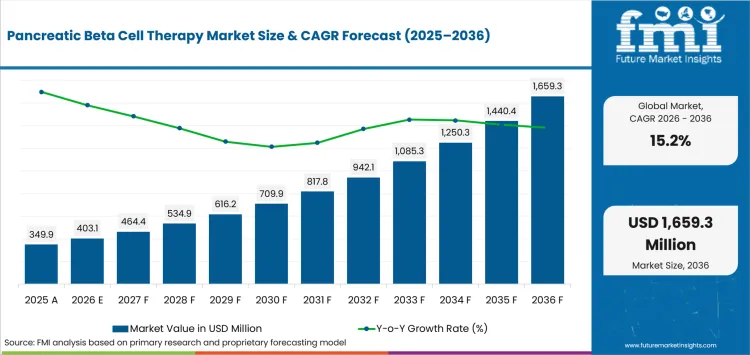
- Market Size (2026)
- USD 403.1 Mn
- Forecast (2036)
- USD 1659.3 Mn
- CAGR (2026 to 2036)
- 15.2%
How big is Pancreatic Beta Cell Therapy Market in 2026?
USD 403.1 million in 2026 and USD 1,659.3 million by 2036 at a 15.2% CAGR.
Demand for pancreatic beta cell therapy is projected to expand at 15.2% CAGR between 2026 and 2036, increasing valuation from USD 403.1 million in 2026 to USD 1,659.3 million by 2036. Commercial spending depends on reproducible insulin-producing cells that specialist hospitals can administer through a controlled transplant pathway. The USA Food and Drug Administration approved Lantidra in June 2023 as the first allogeneic donor pancreatic islet cellular therapy for selected United States adults with recurrent severe hypoglycemia. The approval created a regulated treatment reference but retained narrow eligibility and intensive immune-management requirements. Developers across stem cell therapy therefore compete on durable graft function and batch consistency rather than laboratory differentiation alone. Investment in cell therapy manufacturing rises as late-stage programs require validated potency testing and dependable clinical supply. Hospital groups allocate capital more readily when treatment outcomes and operational responsibilities are documented across the complete care pathway.
National adoption routes differ through commissioning and product regulation alongside specialist-site responsibilities across healthcare systems. England concentrates adult islet transplantation within a commissioned service that coordinates referral and follow-up across selected centers. Japan separates regenerative-product commercialization from clinical-practice governance through a dedicated regulatory framework for therapeutic products. The Pharmaceuticals and Medical Devices Agency published a May 2026 English translation of marketing-approval guidance revised on March 31, 2026 for Japan’s regenerative medical products. South Korea requires biological-product review and institutional readiness before regulated cell therapies enter clinical use. Programs connected with regenerative medicine therefore need country-specific quality files and training plans rather than one global launch package. Sponsors must match product release and patient monitoring with each national hospital network before committing commercial supply.
Key Takeaways for the Pancreatic Beta Cell Therapy Market
- Demand for pancreatic beta cell therapy is led by severe hypoglycemia management, with specialist hospitals favoring treatments delivering durable metabolic and clinical outcomes.
- Stem cell-derived beta cell therapy is forecast to lead therapy type with 43.5% share in 2026, influenced by scalable cell sourcing and reduced dependence on donated pancreata.
- Type 1 diabetes is estimated to capture 41.2% share of indication in 2026, driven by the direct need to replace destroyed insulin-producing beta cells.
- Chronic immunosuppression requirements and restricted reimbursement pathways represent primary barriers limiting routine treatment adoption.
- Competition focusses on Vertex Pharmaceuticals, Sana Biotechnology, Sernova Biotherapeutics, CellTrans, Aspect Biosystems, and Evotec, with developers differentiating based on graft durability and manufacturing readiness.
Analyst Perspective
“Beta-cell therapy is likely to gain commercial relevance with durable glucose control justifying transplantation risks and long-term immune management. Developers are required to establish consistent cell potency across manufacturing batches before expanding treatment beyond highly specialized hospitals. Reimbursement confidence is expected to strengthen on clinical evidence connecting fewer severe hypoglycemic events with manageable follow-up requirements.”
- Anurag Sharma, Principal Analyst at Future Market Insights
How is the pancreatic beta cell therapy market segmented?
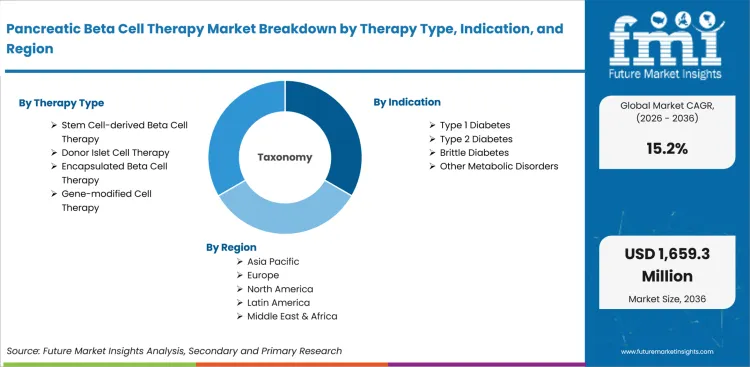
The pancreatic beta cell therapy industry is segmented by therapy type, indication, end user, delivery method, and region.
The segmentation framework separates biological source from disease target and the clinical setting used for administration. Therapy type distinguishes stem-derived cells from donor islets and protected or gene-modified alternatives across clinical development pathways. Indication classifies treatment through diabetes severity and the specific metabolic disorder addressed through cellular replacement therapy. End user identifies hospitals and specialist centers that manage cell administration and long-term metabolic follow-up. Delivery method separates portal-vein infusion from encapsulation devices and implantable platforms requiring different clinical infrastructure. Regional analysis examines regulatory pathways and reimbursement conditions across national healthcare systems with different specialist capacities. Every category remains limited to products and services that directly restore or replace insulin-producing beta-cell function.
What supports demand for Stem Cell-derived Beta Cell Therapy within the Therapy Type category?
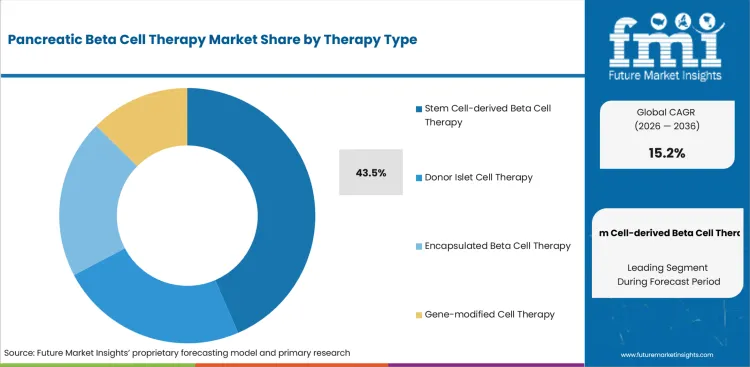
Stem cell-derived beta cells address donor scarcity by creating repeatable cell lots for defined clinical dosing. Commercial scale-up requires stable differentiation and glucose responsiveness across pivotal manufacturing batches used for multicenter treatment. Vertex Pharmaceuticals reported in June 2025 that ten of twelve full-dose zimislecel participants with one-year follow-up were insulin independent across its multinational program. The clinical result supports therapeutic activity but leaves chronic immunosuppression and release-testing risks unresolved for broader deployment. Programs within engineered cell therapy therefore need biological efficacy and controlled production inside one development plan.
- Stem cell-derived beta cell therapy is projected to account for 43.5% share in 2026. Scalable cell sourcing reduces dependence on donated pancreata and gives sponsors greater control over planned dose production. Standardized potency testing also supports comparability across expanding clinical batches produced for several specialist treatment sites.
- Specialist diabetes centers consider stem-derived products through programs that provide reliable supply and long-term graft monitoring. Adoption depends on immune-management risk and validated potency measures across multicenter clinical development involving different hospital teams. Inconsistent production lots can weaken clinical outcomes and complicate valid performance comparisons between participating treatment sites.
Why does Type 1 Diabetes anchor the Indication category?
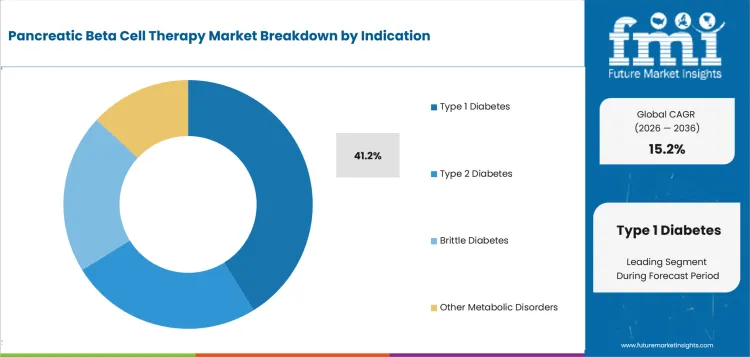
Type 1 diabetes destroys endogenous beta-cell function and creates a direct biological rationale for cellular replacement. The addressable group remains narrower than the total diagnosed population because current procedures target severe disease and require transplant-level monitoring. Candidate selection considers hypoglycemia history and metabolic instability alongside expected benefits from restored insulin secretion. Commercial demand depends on identifying patients whose clinical burden justifies procedural risk and sustained immune-management requirements.
- In 2026, type 1 diabetes is expected to represent 41.2% of the defined indication category. The segment position reflects a direct biological connection between lost beta-cell function and direct cellular replacement. Other metabolic indications need stronger clinical proof that cellular therapy changes meaningful patient outcomes across defined treatment populations.
- Diabetes specialists first identify patients whose severe hypoglycemia persists despite intensive insulin management and education. The Centers for Disease Control and Prevention reported in January 2026 that 2.1 million people had diagnosed type 1 diabetes in the United States. Treatment programs must narrow that population through transplant assessment and documented clinical risk across specialist diabetes services.
How are Hospitals positioned within the End User category?
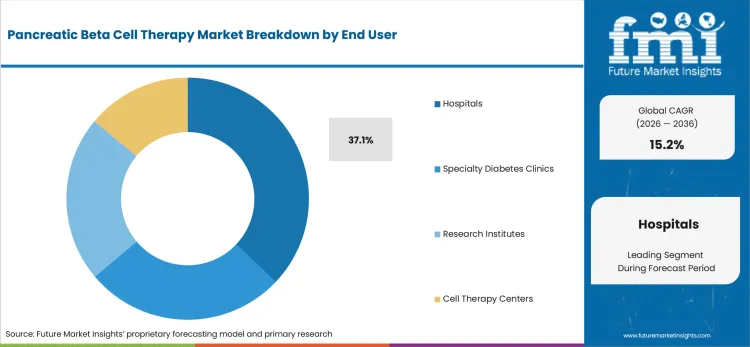
Beta-cell therapy combines controlled cellular-product handling with interventional delivery and long-term metabolic monitoring across specialist hospital departments. Hospitals coordinate endocrinology and transplant expertise alongside pharmacy and imaging support within one governed pathway. Smaller clinics may identify suitable candidates but usually lack complete procedure infrastructure for cellular infusion or implantation. Hospital economics depend on adequate referral volume and reimbursement for the complete episode of care.
- By end user, hospitals are estimated to hold 37.1% share in 2026 through specialist facilities and controlled follow-up. ClinicalTrials.gov listed zimislecel as a Phase 3 study in March 2026 across specialist sites in the United States and European countries. Multisite administration places pharmacy control and transplant monitoring within hospital systems responsible for consistent cellular-product handling.
- Large transplant hospitals connect candidate selection with controlled infusion and adverse-event management across integrated specialist departments. Participation in clinical trials establishes staff competency across complex cellular procedures and documented adverse-event management requirements. Routine purchasing also requires payer coverage and dependable commercial supply throughout long follow-up periods for treated patients.
What makes Intraportal Infusion central to the Delivery Method category?
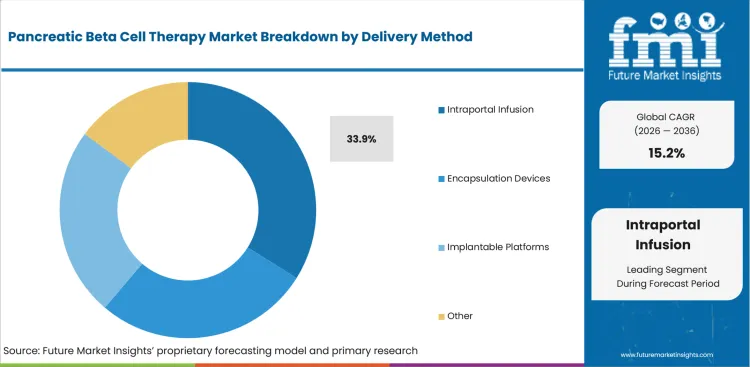
Intraportal infusion places islet cells within the liver through a procedure managed by transplant physicians and interventional radiologists. The delivery route avoids a permanent implant but requires vascular access and post-procedure monitoring across specialist centers. The USA Food and Drug Administration identified hepatic portal vein infusion in its August 2023 Lantidra record for the approved cellular therapy. Regulated portal-vein administration supports clinical familiarity across beta-cell programs using specialist transplant teams and hospital controls. Reliable clinical trial logistics must protect chain of custody before each prepared dose reaches the hospital.
- Intraportal infusion is forecast to represent 33.9% of the defined delivery method category in 2026. Clinical familiarity from donor-islet transplantation supports its position across active stem-derived development programs requiring controlled cellular administration. The route also avoids dependence on a separate long-term implant platform requiring retrieval and device-specific monitoring.
- Transplant physicians select intraportal infusion through programs that manage vascular access and immune suppression within existing hospital protocols. Adoption faces specialist-capacity limits and liver-specific engraftment conditions across eligible treatment centers with transplant expertise. Device-based alternatives receive consideration through retrievability and localized immune protection across programs seeking reduced systemic exposure.
What are the drivers, restraints, and opportunities in the pancreatic beta cell therapy market?
Late-stage clinical progress supports investment, chronic immune-management burden restricts routine use, and protected cell platforms create a credible development opening.
- Driver: Late-stage programs create demand for reproducible beta-cell supply and specialist administration across expanding clinical networks.
- Restraint: Chronic immunosuppression and limited reimbursement pathways constrain routine access beyond carefully selected high-risk patient groups today.
- Opportunity: Immune-protected cells and retrievable implants can broaden eligibility if clinical durability supports safer routine treatment.
Late-stage programs increase spending on validated cell supply and site readiness across multinational treatment networks. Sponsors cannot expand enrollment without controlled manufacturing and dependable release results for every clinical batch. Vertex Pharmaceuticals reported in May 2026 that its zimislecel manufacturing analysis was complete and dosing had resumed across the global study. The dosing restart connected verified process control with clinical progress across the multinational pivotal development program. Investment in advanced therapy manufacturing rises as developers prepare consistent supply for pivotal enrollment and future regulatory review.
Chronic immunosuppression limits routine use by exposing eligible patients to infection and malignancy risks during extended follow-up. Treatment decisions require durable benefits that exceed procedural and drug-related harm across selected patient groups. The USA Food and Drug Administration reported in June 2023 that 90% of Lantidra study participants experienced at least one serious adverse reaction in the United States. Research on repurposed immunosuppressants may improve graft protection but cannot remove transplant monitoring costs alone. Broader adoption requires safer immune control and reimbursement covering assessment through long-term monitoring for patients.
Immune-evasive cells create a credible opening by separating graft function from chronic immunosuppression across selected patients. Developers can pursue broader eligibility if engineered cells retain measurable insulin production without systemic immune suppression. Sana Biotechnology reported in March 2026 that transplanted allogeneic islets maintained beta-cell function through fourteen months in a Swedish study without immunosuppression. The single clinical case cannot establish commercial durability but verifies a clinically relevant design target for immune-evasive therapies. Companies need dependable cell culture media and retrieval plans before scaling protected-cell programs across multicenter clinical studies.
Which country CAGRs are profiled in the pancreatic beta cell therapy market?
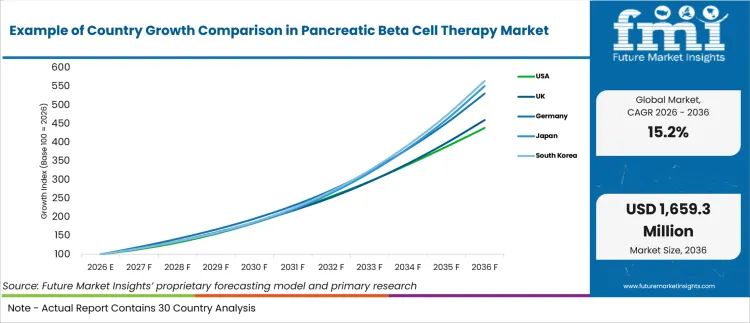
| Country | CAGR |
|---|---|
| USA | 15.9% |
| UK | 16.5% |
| Germany | 18.2% |
| Japan | 18.6% |
| South Korea | 18.9% |
How do country-level CAGRs compare in the pancreatic beta cell therapy market?
The country range spans 3.0 percentage points and separates clearly into two measured growth bands. Germany and Japan sit within 0.4 percentage point of each other across the approved country comparison. South Korea remains another 0.3 point above Japan within the compressed East Asian comparison group. The USA and UK form a second cluster with 0.6 point between their approved rates. A 1.7-point gap separates the UK from Germany and creates a distinct break in the comparison.
- South Korea occupies the upper edge through a regulated regenerative-medicine network supporting hospital participation and structured training across designated institutions.
- Japan remains close through domestic iPSC development and an established regenerative-product framework supporting locally anchored clinical translation.
- Germany occupies the same broad band but European advanced-therapy requirements place greater emphasis on authorization and specialist-site governance.
- The United Kingdom forms a separate cluster through commissioned transplant services and constrained donor-islet availability across national referral pathways.
- The United States remains near the United Kingdom as clinical depth coexists with fragmented coverage and demanding transplant-center economics.
Similar CAGRs can produce different entry conditions through approval timing and reimbursement design alongside service capacity. Developers need country-specific plans for hospital training and product release rather than a single commercial model. The full report provides country-level CAGR analysis across North America, Latin America, Europe, East Asia, South Asia, Oceania and the Middle East and Africa.
Country-wise Analysis
- United States programs operate through transplant hospitals that manage portal-vein infusion and long-term immune suppression. Demand for pancreatic beta cell therapy in the USA is forecast to rise at 15.9% CAGR through 2036 through specialist clinical capacity. The Centers for Medicare & Medicaid Services established national coverage in October 2004 for islet transplantation within qualifying NIH-sponsored trials across the United States. The trial pathway supports clinical training but limits routine payment outside research programs across participating United States hospitals. Commercial entry requires clinical and economic evidence supporting reimbursement beyond sponsored studies across routine hospital services. Developers also need reliable product release and adverse-event support for each transplant center administering cellular therapy.
- United Kingdom access runs through nationally funded transplant units coordinating referral and long-term follow-up across selected centers. Demand for pancreatic beta cell therapy in the UK is forecast to rise at 16.5% CAGR over the assessment period through centralized commissioning. NHS Blood and Transplant reported 23 islet transplants during 2024/25 in a September 2025 activity summary for the United Kingdom. The national network supports consistent clinical governance but the annual procedure count reveals a narrow operating base for commercial supply. Stem-derived products must fit existing referral and immunosuppression protocols across the commissioned United Kingdom service pathway. Commercial entry requires national service evidence and dependable delivery support across the complete specialist treatment pathway.
- Germany regulates cell-based medicines through the Paul-Ehrlich-Institut as the competent authority for advanced therapy medicinal products. Germany’s pancreatic beta cell therapy sector is estimated to post 18.2% CAGR over the forecast period through regulated clinical development. The institute updated its ATMP information in April 2025 and classified somatic cell therapies within Germany’s regulated advanced-therapy framework. Specialist university hospitals provide an adoption route but authorization and manufacturing documentation create material friction. Smaller developers need early regulatory advice and qualified production partners capable of meeting German advanced-therapy standards. German market entry depends on a practical service plan supporting authorized treatment centers and compliant product handling.
- Japan combines a dedicated regenerative-product framework with domestic iPSC expertise and specialist university hospitals conducting early clinical translation. Adoption of pancreatic beta cell therapy in Japan is estimated to expand at 18.6% CAGR through 2036 through this scientific base. Kyoto University Hospital reported Japan’s first OZTx-410 iPSC-derived islet cell-sheet transplant for type 1 diabetes in April 2025. Domestic development supports program formation but specialist surgery and long observation periods increase operating burden across treatment sites. Temperature-controlled transport also requires coordinated product release timing between the manufacturing facility and the specialist hospital team. Commercialization needs local manufacturing comparability and clinical training that preserves product quality throughout transport and surgical implantation.
- South Korea requires advanced regenerative medicine institutions to meet facility and personnel standards before regulated treatment begins. South Korea’s pancreatic beta cell therapy outlook is anticipated to advance at 18.9% CAGR over the assessment period through institutional readiness. The Ministry of Health and Welfare reported 125 designated institutions in April 2025 and required essential staff to complete at least eight hours of core education. The institutional network supports clinical participation but mandatory training obligations increase launch costs across additional treatment sites. Developers need local regulatory partners and structured education programs before expanding beyond initial tertiary treatment centers in South Korea.
Who are the notable companies in the pancreatic beta cell therapy market?
Vertex Pharmaceuticals, Sana Biotechnology, Sernova Biotherapeutics, CellTrans, Aspect Biosystems, Evotec, Novo Nordisk, and NewcelX are the notable companies shaping this market.
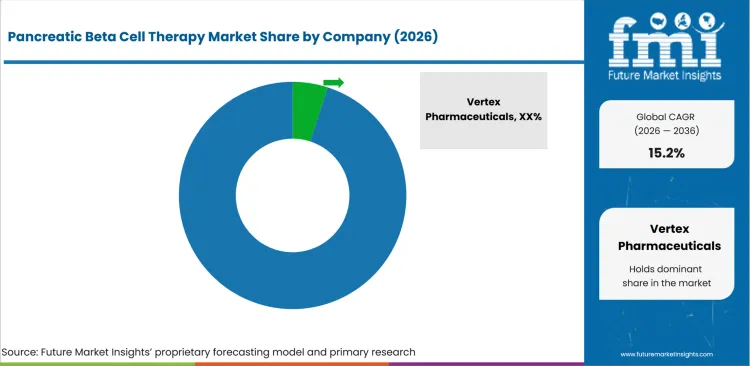
The competitive field includes an approved donor-islet provider and several stem-derived or protected-cell developers with distinct commercial responsibilities. Clinical-stage companies compete through graft function and treatment durability alongside immune-management requirements that influence patient eligibility and operating cost. Platform specialists contribute cell manufacturing or retrievable tissue design rather than direct commercial therapy sales. The current comparison therefore separates clinical maturity from cell-protection strategy and manufacturing readiness across each verified company program. Sponsors also depend on transplant diagnostics and metabolic monitoring to select candidates and document graft performance. Corporate scale alone does not establish a stronger exact-market position without direct evidence from a current beta-cell program.
- Vertex Pharmaceuticals operates a Phase 3 stem-derived program and CellTrans supplies the approved donor-islet product Lantidra. Zimislecel remains investigational across multinational sites while Lantidra serves a narrow United States population through specialist hospitals under the FDA-approved indication.
- Sana Biotechnology develops immune-evasive islet cells and Sernova Biotherapeutics combines cellular therapy with its implantable Cell Pouch. Clinical selection depends on graft function and immune-management burden alongside retrieval options and site responsibilities during extended clinical follow-up.
- Aspect Biosystems and NewcelX develop earlier-stage beta-cell programs through tissue engineering or immune-management combinations intended for future clinical testing. Evotec provides scalable cell-production capability while Novo Nordisk retains defined partnership rights following the January 2026 technology transfer.
Competitive Benchmarking: Pancreatic Beta Cell Therapy Market
| Company | Clinical Development Stage | Cell Protection and Delivery | Manufacturing Readiness | Geographic Reach |
|---|---|---|---|---|
| Vertex Pharmaceuticals | High | Medium | High | North America and Europe |
| Sana Biotechnology | Medium | High | Medium | United States and Sweden |
| Sernova Biotherapeutics | Medium | Medium | Medium | United States and Canada |
| CellTrans | High | Low | High | United States |
| Aspect Biosystems | Low | Medium | Medium | Canada and selected partnerships |
| Evotec | Low | Low | Medium | Europe and North America |
| Novo Nordisk | Low | Low | Low | Global partnership rights |
| NewcelX | Low | Medium | Medium | United States, Switzerland and Israel |
Scoring basis: Clinical Development Stage is High for an approved or Phase 3 exact-market program, Medium for human early-stage development, and Low for documented preclinical or pre-IND work. Cell Protection and Delivery is High for human evidence without chronic immunosuppression, Medium for a documented protected or device-based strategy, and Low for standard immunosuppression or preclinical delivery support. Manufacturing Readiness is High for approved or late-stage supply capability, Medium for documented clinical or scalable manufacturing support, and Low for preclinical production without clinical readiness.
Key Developments in the Pancreatic Beta Cell Therapy Market
- In March 2025, Vertex Pharmaceuticals ended the VX-264 encapsulated-cell program after the study failed to meet efficacy expectations. Corporate resources shifted toward zimislecel Phase 3 development and research-stage immune-protective approaches within the remaining diabetes portfolio. The decision narrowed the near-term commercial pathway to an intraportal therapy that continues to require chronic immunosuppression during clinical expansion.
- In July 2025, Sernova Biotherapeutics entered a research collaboration with Eledon Pharmaceuticals for its ongoing Phase 1/2 Cell Pouch trial. Eledon agreed to supply tegoprubart for Cohort C as an investigational alternative to tacrolimus within the clinical protocol. The program tests whether a different immune-management regimen can improve graft protection without changing the implantable delivery platform.
- In January 2026, Aspect acquired selected stem-cell islet and hypoimmune engineering rights from Novo Nordisk. Aspect assumed responsibility for program development and manufacturing while Novo Nordisk retained defined rights for later-stage participation. The agreement consolidated technologies and specialist capabilities within Aspect’s Canada-anchored platform for future diabetes programs and manufacturing preparation.
- In July 2026, NewcelX reported a successful FDA Type B pre-IND meeting for NCEL-101. The regulator provided a defined path toward clinical testing for the stem-cell-derived islet program combined with tegoprubart in type 1 diabetes. NewcelX must now translate its preclinical package into compliant manufacturing and clinical protocols before enrolling participants in an initial human study.
Key Players in the Pancreatic Beta Cell Therapy Market
Approved and Clinical-stage Therapy Providers
- Vertex Pharmaceuticals
- Sana Biotechnology
- Sernova Biotherapeutics
- CellTrans
Platform and Manufacturing Partners
- Aspect Biosystems
- Evotec
- Novo Nordisk
Emerging Beta-cell Developers
- NewcelX
Pancreatic Beta Cell Therapy Market - Report Scope
| Coverage field | Report scope |
|---|---|
| Market breakdown | Therapy type, indication, end user, delivery method, and region. |
| Quantitative Units | USD million |
| Market Definition | Cellular products and associated services used to replace or restore insulin-producing pancreatic beta-cell function through donor islets, stem-derived cells, protected cells, or gene-modified cell systems. |
| Regions Covered | North America, Latin America, Western Europe, Eastern Europe, East Asia, South Asia and Pacific, and Middle East and Africa. |
| Countries Covered | USA, UK, Germany, Japan, and South Korea within the detailed CAGR comparison, with broader regional coverage across more than thirty countries. |
| Key Companies Profiled | Vertex Pharmaceuticals, Sana Biotechnology, Sernova Biotherapeutics, CellTrans, Aspect Biosystems, Evotec, Novo Nordisk, and NewcelX. |
| Forecast Period | 2026 to 2036. |
| Approach | Hybrid market sizing combines therapy-stage evidence with patient eligibility, manufacturing capacity, hospital readiness, reimbursement conditions, and country-specific adoption routes. |
Pancreatic Beta Cell Therapy Market - Research Methodology
| Method | Approach |
|---|---|
| Primary Research | FMI analysts gathered input from manufacturers, service providers, technology developers, distributors, end users, procurement teams, and subject-matter experts. Interviews examined purchasing decisions, product or service evaluation, adoption barriers, approval requirements, pricing considerations, and expectations for technical or commercial support. Respondents were also asked what evidence is required before a trial, pilot, or initial order develops into regular purchasing. |
| Desk Research | Desk research covered government statistics, regulatory publications, trade data, industry associations, technical literature, standards, company filings, product information, and official corporate announcements. Sources were reviewed for relevance, publication date, geographic coverage, and consistency with the defined market scope. Claims relating to performance, applications, approvals, capacity, investment, and commercial activity were retained only when supported by credible public evidence. |
| Market Sizing and Forecasting | The market model combined the baseline value with historical performance, segment structure, pricing and volume indicators, adoption levels, company participation, and country-level demand conditions. Forecast assumptions considered economic activity, investment trends, regulatory developments, technology adoption, purchasing cycles, supply availability, and barriers to wider market use. Segment and regional estimates were reconciled before the final market total was calculated. |
| Data Validation | Estimates were checked against multiple independent indicators, including public data, company activity, trade patterns, industry developments, and findings from primary interviews. Validation also tested whether products, services, applications, and company revenues fell within the defined market boundaries. Adjacent categories, unsupported claims, overlapping revenues, and activities without direct market relevance were excluded to reduce double counting and maintain consistency across segments and countries. |
Pancreatic Beta Cell Therapy Market by Segments
Pancreatic Beta Cell Therapy Market segmented by Therapy Type:
- Stem Cell-derived Beta Cell Therapy
- Donor Islet Cell Therapy
- Encapsulated Beta Cell Therapy
- Gene-modified Cell Therapy
Pancreatic Beta Cell Therapy Market segmented by Indication:
- Type 1 Diabetes
- Type 2 Diabetes
- Brittle Diabetes
- Other Metabolic Disorders
Pancreatic Beta Cell Therapy Market segmented by End User:
- Hospitals
- Specialty Diabetes Clinics
- Research Institutes
- Cell Therapy Centers
Pancreatic Beta Cell Therapy Market segmented by Delivery Method:
- Intraportal Infusion
- Encapsulation Devices
- Implantable Platforms
- Other
Pancreatic Beta Cell Therapy Market by Region
- North America
- United States
- Canada
- Latin America
- Brazil
- Mexico
- Argentina
- Chile
- Western Europe
- Germany
- France
- United Kingdom
- Italy
- Spain
- Benelux
- Nordics
- Eastern Europe
- Poland
- Czech Republic
- Romania
- Hungary
- East Asia
- China
- Japan
- South Korea
- South Asia and Pacific
- India
- ASEAN
- Australia and New Zealand
- Middle East and Africa
- GCC Countries
- South Africa
- Türkiye
- Israel
Research Sources and Bibliography
- Centers for Disease Control and Prevention. (2026, January 21). National Diabetes Statistics Report.
- Vertex Pharmaceuticals Incorporated. (2025, June 20). Vertex Presents Positive Data for Zimislecel in Type 1 Diabetes at the American Diabetes Association 85th Scientific Sessions.
- Vertex Pharmaceuticals Incorporated. (2026, May 4). Vertex Reports First Quarter 2026 Financial Results.
- Vertex Pharmaceuticals Incorporated. (2025, March 28). Vertex Announces Program Updates for Type 1 Diabetes Portfolio.
- Sana Biotechnology, Inc. (2026, March 13). Sana Biotechnology Announces Continued Positive Clinical Results Through 14 Months from Type 1 Diabetes Study of Islet Cell Transplantation Without Immunosuppression.
- Sernova Biotherapeutics Inc. (2025, July 9). Sernova Biotherapeutics Announces Collaboration with Eledon Pharmaceuticals to Advance a Potential Functional Cure for Type 1 Diabetes.
- Novo Nordisk A/S. (2026, January 20). Aspect Biosystems and Novo Nordisk Enter New Phase of Partnership to Develop Curative Medicines for Diabetes.
- NewcelX Ltd. (2026, July 1). NewcelX Announces Successful FDA Pre-IND Meeting with Clear Path Forward for NCEL-101 Toward Starting Clinical Trials for Type 1 Diabetes.
- ClinicalTrials.gov. (2026, March 17). A Safety, Tolerability, and Efficacy Study of VX-880 in Participants With Type 1 Diabetes.
- NHS Blood and Transplant. (2025, September). Islet Transplant Activity and Outcome Summary.
- Paul-Ehrlich-Institut. (2025, April 14). Advanced Therapy Medicinal Products (ATMP).
- Pharmaceuticals and Medical Devices Agency. (2026, May). Applications for Marketing Approval of Regenerative Medical Products.
- Kyoto University Hospital. (2025, April 15). [First Transplant in an Investigator-Initiated Trial of an iPS Cell-Derived Islet Cell Sheet].
- Ministry of Health and Welfare, Republic of Korea. (2025, April 28). 2025[2025 Call for New Advanced Regenerative Medicine Institutions].
This bibliography is provided for reader reference and is not exhaustive. The full report contains the complete reference list and detailed citations.
This Report Answers
- How large is the pancreatic beta cell therapy market in 2026 and 2036?
- Which clinical and manufacturing conditions support the 15.2% market CAGR?
- Why does stem cell-derived beta cell therapy hold the approved therapy type share in 2026?
- How do type 1 diabetes and hospitals shape commercial adoption pathways?
- What limits broader use of intraportal beta-cell infusion across routine care?
- How do country growth rates compare across the USA, UK, Germany, Japan, and South Korea?
- Which companies provide approved products, clinical programs, protected platforms, or manufacturing capabilities?
- How should decision-makers assess immune protection and manufacturing readiness?
- What developments could expand long-term commercial confidence in beta-cell replacement therapy?
Frequently Asked Questions
What is driving growth in the Pancreatic Beta Cell Therapy Market?
Late-stage clinical programs increase demand for reproducible insulin-producing cells and specialist hospital administration across expanding treatment networks. Manufacturing investment expands as sponsors need consistent release testing and dependable supply across larger clinical networks.
Who are the key players in the Pancreatic Beta Cell Therapy Market?
Vertex Pharmaceuticals and CellTrans provide clinical-stage or approved therapy reference points within beta-cell replacement programs. Sana Biotechnology and Sernova Biotherapeutics join Aspect Biosystems and other platform partners across protected-cell development and manufacturing collaborations.
What notable restraint affects the Pancreatic Beta Cell Therapy Market?
Chronic immunosuppression restricts treatment eligibility because clinical benefits must outweigh infection and organ-toxicity risks across long follow-up periods. Narrow reimbursement pathways also limit routine hospital purchasing beyond specialist trials and carefully selected high-risk patient groups.
Why should executives track the Pancreatic Beta Cell Therapy Market?
Beta-cell replacement could shift severe diabetes care from continuous insulin management toward durable glucose-responsive biological function. Executives should track clinical durability and manufacturing readiness because both conditions determine commercial scale and capital requirements.
What business problem does the Pancreatic Beta Cell Therapy Market address?
The pancreatic beta cell therapy market addresses severe insulin deficiency and recurrent hypoglycemia that remain uncontrolled despite intensive diabetes management for selected patients. Cellular therapy seeks to restore glucose-responsive insulin production rather than improving another external delivery device.
What should healthcare decision-makers evaluate in the Pancreatic Beta Cell Therapy Market?
Healthcare decision-makers should compare insulin independence and severe-hypoglycemia outcomes alongside immunosuppression risk and follow-up burden. Healthcare organizations should also test whether specialist capacity and reimbursement support the complete treatment pathway across routine clinical operations.
What limits return on investment in the Pancreatic Beta Cell Therapy Market?
Low manufacturing yield and delayed clinical enrollment can raise treatment costs substantially before commercial approval and routine reimbursement. Weak payer coverage or limited specialist-site capacity can reduce utilization even after a therapy demonstrates meaningful biological activity.
What supports long-term commercial confidence in the Pancreatic Beta Cell Therapy Market?
Long-term confidence depends on durable graft function and repeatable manufacturing across commercially relevant treatment volumes at scale. Clear immune-management strategies and country-specific reimbursement pathways give developers a defensible basis for sustained adoption decisions.
Preview the report firsthand - request a free sample
Get SampleGet the brochure for pricing and purchase details.
Get PDFTable of Content
- Key Takeaways
- Market Size and CAGR
- Top Growth Driver
- Fastest Growing Segment
- Leading Region
- Key Companies
- Emerging Opportunities
- Executive Summary
- Global Market Outlook
- Demand-side Trends
- Supply-side Trends
- Technology Roadmap Analysis
- Analysis and Recommendations
- Analyst Perspective (What is happening? Why now? What should investors know?)
- Key Questions Answered
- How large is the market?
- What is the CAGR?
- What are key trends?
- Which region dominates?
- Who are the leaders?
- Market Overview
- Market Coverage / Taxonomy
- Market Definition / Scope / Limitations
- Research Methodology
- Chapter Orientation
- Analytical Lens and Working Hypotheses
- Market Structure, Signals, and Trend Drivers
- Benchmarking and Cross-market Comparability
- Market Sizing, Forecasting, and Opportunity Mapping
- Research Design and Evidence Framework
- Desk Research Programme (Secondary Evidence)
- Expert Input and Fieldwork (Primary Evidence)
- Tooling, Models, and Reference Databases
- Data Engineering and Model Build
- Quality Assurance and Audit Trail
- Market Background
- Market Dynamics (Drivers, Restraints, Opportunity, Trends)
- Scenario Forecast (Optimistic, Likely, Conservative)
- Impact Analysis
- AI Impact
- Sustainability Impact
- Regulatory Impact
- Technology Impact
- Consumer / Buyer Analysis
- Purchase Drivers
- Adoption Barriers
- Buyer Journey
- Opportunity Map Analysis
- Product Life Cycle Analysis
- Supply Chain Analysis
- Investment Feasibility Matrix
- Value Chain Analysis
- PESTLE and Porter's Analysis
- Regulatory Landscape
- Regional Parent Market Outlook
- Production and Consumption Statistics
- Import and Export Statistics
- Global Market Analysis and Forecast, 2021 to 2036
- Historical Market Size Value (USD Million) Analysis, 2021 to 2025
- Current and Future Market Size Value (USD Million) Projections, 2026 to 2036
- Y-o-Y Growth Trend Analysis
- Absolute $ Opportunity Analysis
- Global Market Pricing Analysis, 2021 to 2036
- Global Market Analysis and Forecast, By Therapy Type, 2021 to 2036
- Introduction / Key Findings
- Historical Market Size Value (USD Million) Analysis By Therapy Type, 2021 to 2025
- Current and Future Market Size Value (USD Million) Analysis and Forecast By Therapy Type, 2026 to 2036
- Stem Cell-derived Beta Cell Therapy
- Donor Islet Cell Therapy
- Encapsulated Beta Cell Therapy
- Gene-modified Cell Therapy
- Stem Cell-derived Beta Cell Therapy
- Y-o-Y Growth Trend Analysis By Therapy Type, 2021 to 2025
- Absolute $ Opportunity Analysis By Therapy Type, 2026 to 2036
- Global Market Analysis and Forecast, By Indication, 2021 to 2036
- Introduction / Key Findings
- Historical Market Size Value (USD Million) Analysis By Indication, 2021 to 2025
- Current and Future Market Size Value (USD Million) Analysis and Forecast By Indication, 2026 to 2036
- Type 1 Diabetes
- Type 2 Diabetes
- Brittle Diabetes
- Other Metabolic Disorders
- Type 1 Diabetes
- Y-o-Y Growth Trend Analysis By Indication, 2021 to 2025
- Absolute $ Opportunity Analysis By Indication, 2026 to 2036
- Global Market Analysis and Forecast, By End User, 2021 to 2036
- Introduction / Key Findings
- Historical Market Size Value (USD Million) Analysis By End User, 2021 to 2025
- Current and Future Market Size Value (USD Million) Analysis and Forecast By End User, 2026 to 2036
- Hospitals
- Specialty Diabetes Clinics
- Research Institutes
- Cell Therapy Centers
- Hospitals
- Y-o-Y Growth Trend Analysis By End User, 2021 to 2025
- Absolute $ Opportunity Analysis By End User, 2026 to 2036
- Global Market Analysis and Forecast, By Delivery Method, 2021 to 2036
- Introduction / Key Findings
- Historical Market Size Value (USD Million) Analysis By Delivery Method, 2021 to 2025
- Current and Future Market Size Value (USD Million) Analysis and Forecast By Delivery Method, 2026 to 2036
- Intraportal Infusion
- Encapsulation Devices
- Implantable Platforms
- Other
- Intraportal Infusion
- Y-o-Y Growth Trend Analysis By Delivery Method, 2021 to 2025
- Absolute $ Opportunity Analysis By Delivery Method, 2026 to 2036
- Global Market Analysis and Forecast, By Region, 2021 to 2036
- Introduction
- Historical Market Size Value (USD Million) Analysis By Region, 2021 to 2025
- Current Market Size Value (USD Million) Analysis and Forecast By Region, 2026 to 2036
- North America
- Latin America
- Western Europe
- Eastern Europe
- East Asia
- South Asia and Pacific
- Middle East & Africa
- Market Attractiveness Analysis By Region
- North America Market Analysis and Forecast, By Country, 2021 to 2036
- Historical Market Size Value (USD Million) Trend Analysis By Market Taxonomy, 2021 to 2025
- Market Size Value (USD Million) Forecast By Market Taxonomy, 2026 to 2036
- By Country
- USA
- Canada
- By Therapy Type
- By Indication
- By End User
- By Delivery Method
- By Country
- Market Attractiveness Analysis
- By Country
- By Therapy Type
- By Indication
- By End User
- By Delivery Method
- Key Takeaways
- Latin America Market Analysis and Forecast, By Country
- Historical Market Size Value (USD Million) Trend Analysis By Market Taxonomy, 2021 to 2025
- Market Size Value (USD Million) Forecast By Market Taxonomy, 2026 to 2036
- By Country
- Brazil
- Mexico
- Chile
- Rest of Latin America
- By Therapy Type
- By Indication
- By End User
- By Delivery Method
- By Country
- Market Attractiveness Analysis
- By Country
- By Therapy Type
- By Indication
- By End User
- By Delivery Method
- Key Takeaways
- Western Europe Market Analysis and Forecast, By Country
- Historical Market Size Value (USD Million) Trend Analysis By Market Taxonomy, 2021 to 2025
- Market Size Value (USD Million) Forecast By Market Taxonomy, 2026 to 2036
- By Country
- Germany
- UK
- Italy
- Spain
- France
- Nordic
- BENELUX
- Rest of Western Europe
- By Therapy Type
- By Indication
- By End User
- By Delivery Method
- By Country
- Market Attractiveness Analysis
- By Country
- By Therapy Type
- By Indication
- By End User
- By Delivery Method
- Key Takeaways
- Eastern Europe Market Analysis and Forecast, By Country
- Historical Market Size Value (USD Million) Trend Analysis By Market Taxonomy, 2021 to 2025
- Market Size Value (USD Million) Forecast By Market Taxonomy, 2026 to 2036
- By Country
- Russia
- Poland
- Hungary
- Balkan & Baltic
- Rest of Eastern Europe
- By Therapy Type
- By Indication
- By End User
- By Delivery Method
- By Country
- Market Attractiveness Analysis
- By Country
- By Therapy Type
- By Indication
- By End User
- By Delivery Method
- Key Takeaways
- East Asia Market Analysis and Forecast, By Country
- Historical Market Size Value (USD Million) Trend Analysis By Market Taxonomy, 2021 to 2025
- Market Size Value (USD Million) Forecast By Market Taxonomy, 2026 to 2036
- By Country
- China
- Japan
- South Korea
- By Therapy Type
- By Indication
- By End User
- By Delivery Method
- By Country
- Market Attractiveness Analysis
- By Country
- By Therapy Type
- By Indication
- By End User
- By Delivery Method
- Key Takeaways
- South Asia and Pacific Market Analysis and Forecast, By Country
- Historical Market Size Value (USD Million) Trend Analysis By Market Taxonomy, 2021 to 2025
- Market Size Value (USD Million) Forecast By Market Taxonomy, 2026 to 2036
- By Country
- India
- ASEAN
- Australia & New Zealand
- Rest of South Asia and Pacific
- By Therapy Type
- By Indication
- By End User
- By Delivery Method
- By Country
- Market Attractiveness Analysis
- By Country
- By Therapy Type
- By Indication
- By End User
- By Delivery Method
- Key Takeaways
- Middle East & Africa Market Analysis and Forecast, By Country
- Historical Market Size Value (USD Million) Trend Analysis By Market Taxonomy, 2021 to 2025
- Market Size Value (USD Million) Forecast By Market Taxonomy, 2026 to 2036
- By Country
- Kingdom of Saudi Arabia
- Other GCC Countries
- Türkiye
- South Africa
- Other African Union
- Rest of Middle East & Africa
- By Therapy Type
- By Indication
- By End User
- By Delivery Method
- By Country
- Market Attractiveness Analysis
- By Country
- By Therapy Type
- By Indication
- By End User
- By Delivery Method
- Key Takeaways
- Key Countries Market Analysis
- USA
- Pricing Analysis
- Market Share Analysis, 2025
- By Therapy Type
- By Indication
- By End User
- By Delivery Method
- Canada
- Pricing Analysis
- Market Share Analysis, 2025
- By Therapy Type
- By Indication
- By End User
- By Delivery Method
- Mexico
- Pricing Analysis
- Market Share Analysis, 2025
- By Therapy Type
- By Indication
- By End User
- By Delivery Method
- Brazil
- Pricing Analysis
- Market Share Analysis, 2025
- By Therapy Type
- By Indication
- By End User
- By Delivery Method
- Chile
- Pricing Analysis
- Market Share Analysis, 2025
- By Therapy Type
- By Indication
- By End User
- By Delivery Method
- Germany
- Pricing Analysis
- Market Share Analysis, 2025
- By Therapy Type
- By Indication
- By End User
- By Delivery Method
- UK
- Pricing Analysis
- Market Share Analysis, 2025
- By Therapy Type
- By Indication
- By End User
- By Delivery Method
- Italy
- Pricing Analysis
- Market Share Analysis, 2025
- By Therapy Type
- By Indication
- By End User
- By Delivery Method
- Spain
- Pricing Analysis
- Market Share Analysis, 2025
- By Therapy Type
- By Indication
- By End User
- By Delivery Method
- France
- Pricing Analysis
- Market Share Analysis, 2025
- By Therapy Type
- By Indication
- By End User
- By Delivery Method
- India
- Pricing Analysis
- Market Share Analysis, 2025
- By Therapy Type
- By Indication
- By End User
- By Delivery Method
- ASEAN
- Pricing Analysis
- Market Share Analysis, 2025
- By Therapy Type
- By Indication
- By End User
- By Delivery Method
- Australia & New Zealand
- Pricing Analysis
- Market Share Analysis, 2025
- By Therapy Type
- By Indication
- By End User
- By Delivery Method
- China
- Pricing Analysis
- Market Share Analysis, 2025
- By Therapy Type
- By Indication
- By End User
- By Delivery Method
- Japan
- Pricing Analysis
- Market Share Analysis, 2025
- By Therapy Type
- By Indication
- By End User
- By Delivery Method
- South Korea
- Pricing Analysis
- Market Share Analysis, 2025
- By Therapy Type
- By Indication
- By End User
- By Delivery Method
- Russia
- Pricing Analysis
- Market Share Analysis, 2025
- By Therapy Type
- By Indication
- By End User
- By Delivery Method
- Poland
- Pricing Analysis
- Market Share Analysis, 2025
- By Therapy Type
- By Indication
- By End User
- By Delivery Method
- Hungary
- Pricing Analysis
- Market Share Analysis, 2025
- By Therapy Type
- By Indication
- By End User
- By Delivery Method
- Kingdom of Saudi Arabia
- Pricing Analysis
- Market Share Analysis, 2025
- By Therapy Type
- By Indication
- By End User
- By Delivery Method
- Türkiye
- Pricing Analysis
- Market Share Analysis, 2025
- By Therapy Type
- By Indication
- By End User
- By Delivery Method
- South Africa
- Pricing Analysis
- Market Share Analysis, 2025
- By Therapy Type
- By Indication
- By End User
- By Delivery Method
- USA
- Market Structure Analysis
- Competition Dashboard
- Competition Benchmarking
- Market Share Analysis of Top Players
- By Regional
- By Therapy Type
- By Indication
- By End User
- By Delivery Method
- Emerging Startups
- Innovation Benchmarking
- Competition Analysis
- Competition Deep Dive
- Vertex Pharmaceuticals
- Overview
- Product Portfolio
- Profitability by Market Segments
- Sales Footprint
- Strategy Overview
- Marketing Strategy
- Product Strategy
- Channel Strategy
- Sernova
- Sana Biotechnology
- ViaCyte
- CellTrans
- Evotec
- Novo Nordisk
- Eli Lilly
- Sigilon Therapeutics
- Defymed
- Vertex Pharmaceuticals
- Case Studies
- Success Stories
- Recent Developments
- Competition Deep Dive
- Assumptions & Acronyms Used


