

- Market Size (2026)
- USD 92.0 Mn
- Forecast (2036)
- USD 1120.6 Mn
- CAGR (2026 to 2036)
- 28.4%
How big is Hypoimmune Cell Therapy Market in 2026?
Demand for hypoimmune cell therapy is projected to expand at 28.4% CAGR between 2026 and 2036. Industry value grows from USD 71.7 million in 2025 to USD 92.0 million in 2026 and is projected to reach USD 1,120.6 million by 2036.
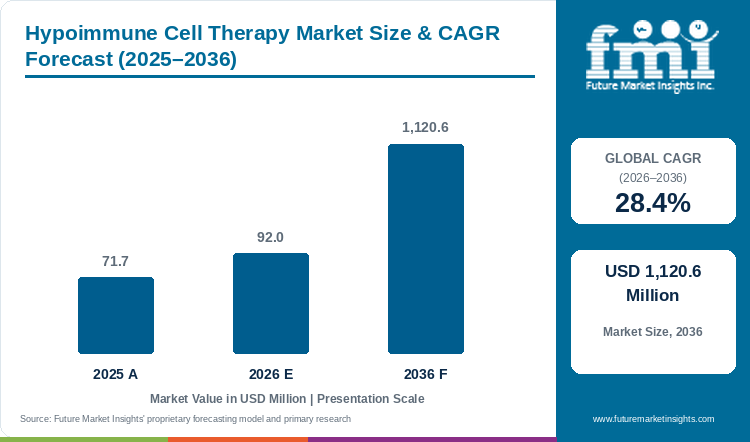
The global hypoimmune cell therapy market was valued at USD 71.7 million in 2025 and is projected to grow from USD 92.0 million in 2026 to USD 1,120.6 million by 2036, at 28.4% CAGR from 2026 to 2036. As per FMI, hypoimmune T cells accounted for the leading 43.9% share in 2026 as edited immune cells can be prepared for target-defined studies. Sana Biotechnology reported that UP421 cells continued producing C-peptide through 14 months without immunosuppression.[1] CRISPR Therapeutics reported 90% overall response and 70% complete response among 10 patients receiving the 600 million-cell zugo-cel dose.[2] UK regulators also reduced combined clinical study set-up time from 169 days to 122 days in 2026.[3] Durable function, measurable response and shorter study routes are expected to support the movement of hypoimmune cell therapy towards repeatable products.
Key Market Trends & Insights
- By cell type, hypoimmune T cells led the market with a share of 43.9% in 2026, aligned with target-defined studies where response and persistence can be measured.
- By engineering approach, HLA knockout with CD47 overexpression represented 52.8% in 2026, as two immune-protection routes can reduce adaptive and innate recognition.
- By application, oncology accounted for 46.1% of demand in 2026. Zugo-cel recorded 90% overall response among 10 patients at the 600 million-cell dose.[2]
- By end user, hospitals and cell therapy centers held 54.6% in 2026. Sana Biotechnology and Mayo Clinic formed an SC451 collaboration covering handling, delivery and follow-up in April 2026.[5]
Regional Highlights
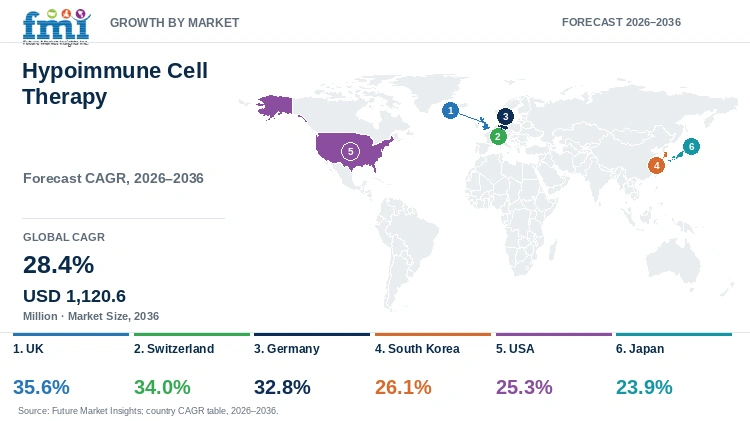
- Fastest-growing profiled country: UK (35.6% CAGR, 2026 to 2036).
- By country: Switzerland (34.0%) and Germany (32.8%) follow, while Japan records the lowest profiled CAGR at 23.9%.
- UK combined study set-up time declined to 122 days from 169 days, while eligible Route B modifications were processed in seven days during the pilot.[3]
Market Size & Forecast
Table 1: Market Size and Forecast for the Hypoimmune Cell Therapy Market (USD million and percentage), 2025 to 2036
| Metric | Value |
|---|---|
| 2025 Market Size | USD 71.7 million |
| Estimated Market Size in 2026 | USD 92.0 million |
| Projected Market Size by 2036 | USD 1,120.6 million |
| CAGR, 2026 to 2036 | 28.4% |
| Added Revenue, 2026 to 2036 | USD 1,028.6 million |
| Market Expansion Multiple | 12.2x |
Clinical use of hypoimmune cell therapy is presently concentrated in early studies, due to which market demand depends on durable cell function, repeatable supply and availability of trained treatment centers. UP421 has one recipient with measurable function through 14 months, while zugo-cel reported 39 treated patients across four dose levels and 10 patients at 600 million cells.[1][2] This moves the evidence from one-patient graft function towards immune-cell cohorts having a defined dose. Switzerland also provides 80% fee reduction for eligible non-commercial clinical trials, which can reduce early study cost.[4] However, genomic safety testing, potency comparison and trained administration sites may limit wider use. Cell-bank production and specialist centers are expected to determine how quickly clinical evidence creates recurring product demand.
Clinical Evidence and Development Readiness
Hypoimmune cell therapy demand is not determined by patient population alone. Cell durability, clinical cohort expansion, manufacturing repeatability and number of trained centers are likely to decide the practical opportunity. Current evidence shows different development stages across replacement-cell and immune-cell programs.
Table 2: Clinical Evidence and Development Readiness Indicators for the Hypoimmune Cell Therapy Market (patients, months, response rates, runs, and study timelines), mixed reporting years from 2025 to 2026
| Indicator | Data Point | Why It Matters | Source |
|---|---|---|---|
| UP421 graft durability | 1 recipient; function through 14 months | Provides human evidence that protected islet cells can continue function without immunosuppression. | [1] |
| Zugo-cel clinical activity | 39 patients across four doses; 10 at 600 million cells; 90% ORR; 70% CRR | Shows movement from an early cohort towards a defined dose and measurable response. | [2] |
| UK study set-up | 169 days reduced to 122 days; Route B pilot averaged 7 days | Shorter study and modification periods can improve clinical program timing. | [3] |
| Swiss study fee relief | 80% reduction for eligible non-commercial trials | Lower early study fees can support investigator-led advanced therapy research. | [4] |
| CNTY-813 manufacturing | 5 consistent clinical-scale runs; more than 11 months glycemic control in a mouse model | Repeatable runs support manufacturing evidence before clinical entry. | [6] |
Basis: Market figures are report estimates. Added revenue equals the 2036 value less the 2026 value. Expansion multiple equals the 2036 value divided by the 2026 value. Supporting indicators use mixed reporting years and do not represent market share.
Analyst Perspective
“Demand will shift towards hypoimmune cells which retain therapeutic function without requiring continued immune suppression after transplantation. Repeatable manufacturing and simpler center handling will decide which programs gain wider adoption during the forecast period.”
- Anurag Sharma, Principal Consultant, Future Market Insights.
How is the hypoimmune cell therapy market segmented?
Hypoimmune cell therapy market is segmented by four primary commercial axes and region: cell type, engineering approach, application, end user, and region. In 2026, hypoimmune T cells are projected at 43.9%, HLA knockout with CD47 overexpression at 52.8%, oncology at 46.1%, and hospitals and cell therapy centers at 54.6%.
By cell type: hypoimmune T cells, hypoimmune NK cells, hypoimmune islet cells, and other hypoimmune cell types.
By engineering approach: HLA knockout with CD47 overexpression, alternative immune-cloaking edits, and encapsulation and combination approaches.
By application: oncology, autoimmune diseases, type 1 diabetes, and other applications.
By end user: hospitals and cell therapy centers, biopharmaceutical companies, and research institutes and CROs.
By region: North America, Latin America, Western Europe, Eastern Europe, East Asia, South Asia and Pacific, and Middle East and Africa.
Why do hypoimmune T cells retain a notable cell type share?
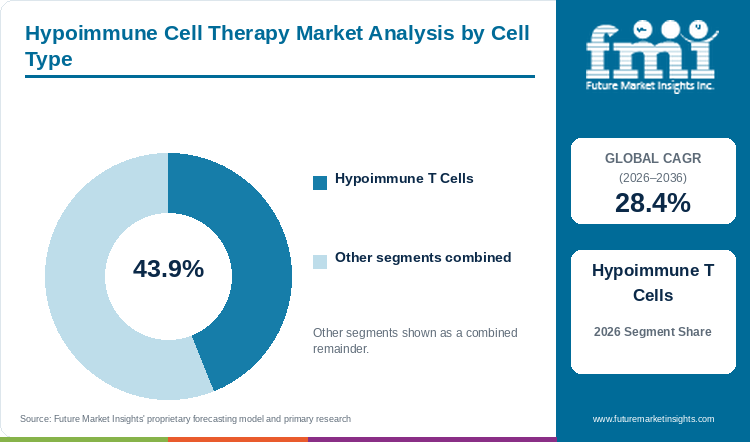
Hypoimmune T cells are projected to hold 43.9% of cell type demand in 2026, supported by target-defined clinical evaluation programs.
Table 3: Cell Type Share for the Hypoimmune Cell Therapy Market (percentage share), 2026
| Cell Type | Share (2026) |
|---|---|
| Hypoimmune T Cells | 43.9% |
| Other Segments Combined | 56.1%* |
| Total | 100.0% |
*Calculated as the balance remaining after deducting the leading segment's reported share from 100.0%.
Table 4: Cell Type Leadership and Market Growth for the Hypoimmune Cell Therapy Market (segment and CAGR percentage), 2026 to 2036
| Metric | Value |
|---|---|
| Global CAGR (2026 to 2036) | 28.4% |
| Leading Segment | Hypoimmune T Cells |
Hypoimmune T cells are immune cells which are engineered for targeting diseased cells and reducing recognition by the recipient immune system. In the FMI report, these cells account for 43.9% of cell type demand in 2026 as target response and persistence can be measured in the same study. In December 2025, CRISPR Therapeutics reported 90% overall response rate among 10 patients receiving 600 million zugo-cel cells.[2] Availability of measurable clinical response is expected to support the hypoimmune T cells segment growth over the forecast period, while widening evaluation of allogeneic T cell therapies establishes scalable treatment protocols across clinical trial sites.
- Hypoimmune T cells account for 43.9% share in 2026, supported by target-defined clinical programs.
- Target-defined programs allow response and cell persistence to be measured in the same clinical study.
Why does HLA knockout with CD47 overexpression anchor the engineering approach category?
HLA knockout with CD47 overexpression is estimated to hold 52.8% of engineering approach demand in 2026, reflecting complementary immune evasion.
HLA knockout with CD47 overexpression provides two forms of protection to transplanted cells. Reduction of HLA lowers recognition by the adaptive immune system, whereas CD47 provides a separate signal for reducing clearance by innate immune cells. According to FMI, the approach holds 52.8% of engineering demand in 2026 owing to protection against two immune routes. In July 2026, Sana Biotechnology reported that HIP-modified islets continued its function for more than one year without immunosuppression.[7] Wider development of protected cells which retain potency after manufacturing is anticipated to support the segment revenue growth.
- HLA knockout with CD47 overexpression accounts for 52.8% share in 2026, owing to complementary dual-pathway immune protection.
- HLA reduction with CD47 expression can support cell protection when potency and genomic integrity is retained after manufacturing.
What supports oncology as the preferred application category?
In 2026, oncology is expected to capture 46.1% of application revenue, driven by defined clinical response and disease control measures.
Oncology represents the primary application for hypoimmune cell therapies, as edited allogeneic immune cells can be evaluated against established clinical response and remission endpoints. The application accounts for 46.1% of demand in 2026, driven by high unmet need in relapsed or refractory hematological malignancies and solid tumors where autologous manufacturing delays remain a barrier. Measurable response and disease control are supporting wider evaluation of allogeneic cells in cancer treatment. Clinical trial progress across standardized cell cohorts is expected to sustain oncology leadership through the forecast period.
- Oncology accounts for 46.1% share in 2026, driven by defined response and persistence measures across patient cohorts.
- Defined response measures support comparison of dose, durability, and disease control during clinical evaluation.
Why are specialist centers central to end-user demand?
Hospitals and cell therapy centers are set to command 54.6% of end user demand in 2026, owing to specialist administration protocols.
Hospitals and cell therapy centers are required for patient selection, cell handling, administration and long-term monitoring of hypoimmune cell therapy. FMI data suggests that these centers account for 54.6% of end-user demand in 2026 owing to specialist administration requirement. In April 2026, Sana Biotechnology and Mayo Clinic entered into a collaboration for standardizing SC451 handling, delivery and post-treatment care across clinical settings.[5] Expansion of trained centers and validated administration procedure is expected to drive demand during the forecast period.
- Hospitals and cell therapy centers account for 54.6% share in 2026, underpinned by specialist administration and clinical monitoring requirements.
- Hospitals require validated handling, administration, monitoring and traceability procedure for each cell product.
What are the drivers, restraints, and opportunities in the hypoimmune cell therapy market?
In the hypoimmune cell therapy market, durable graft function drives clinical adoption, product qualification and off-target safety constrain progression, and renewable cell banks open the principal commercial opportunity.
- Driver: Immune-evasive engineering can preserve donor-cell function without long-term immune suppression.
- Restraint: Genomic safety, potency, comparability, and manufacturing consistency can delay progression.
- Opportunity: Renewable master cell banks and consistent donor sourcing expand clinical and commercial supply.
Durable Graft Function Supports Development
Immune-evasive engineering is increasingly used for preserving the function of donor cells without long-term immune suppression. In July 2026, data presented at the International Society for Stem Cell Research (ISSCR) Annual Meeting demonstrated that immune-engineered allogeneic cells achieved sustained survival and function without chronic immunosuppression.[8] Demonstrating that edited cells can avoid host immune recognition while maintaining therapeutic function provides key validation for islet cell transplantation and allogeneic cell platforms. Continued clinical proof of long-term graft protection is expected to drive the hypoimmune cell therapy market growth.
Genomic Safety Limits Product Progression
Genomic safety and manufacturing consistency are major factors which can limit the progression of edited cell products. In April 2026, the U.S. FDA issued draft guidance for next-generation sequencing methods used for assessing off-target edits and loss of genome integrity.[9] Developers requires validated sequencing, bioinformatics, potency and comparability data before expanding clinical studies. High testing requirement along with the possibility of unintended edits during genome editing can increase development time and cost, which may hamper the growth of hypoimmune cell therapy market.
Renewable Cell Banks Expand Supply Options
Renewable master cell banks can support repeated production of engineered cells from one controlled starting material. This can reduce variation between production runs and provide cells for continued clinical supply. In October 2026, Century Therapeutics reported five consistent clinical-scale CNTY-813 manufacturing runs and more than 11 months of glycemic control in a diabetic mouse model.[6] Consistent production along with continued function after storage can support the movement of replacement cells towards clinical studies. Development of renewable cell banks is expected to create new growth opportunities for stem cell therapies in the hypoimmune cell therapy market.
Which country CAGRs are profiled in the hypoimmune cell therapy market?
Table 5: Country CAGR Comparison for the Hypoimmune Cell Therapy Market (CAGR percentage), 2026 to 2036
| Country | CAGR |
|---|---|
| UK | 35.6% |
| Switzerland | 34.0% |
| Germany | 32.8% |
| South Korea | 26.1% |
| USA | 25.3% |
| Japan | 23.9% |
How do country-level CAGRs compare in the hypoimmune cell therapy market?
Commercial conditions differ across the profiled countries owing to clinical trial reform, study fee relief, and regulatory review pathways. As per the analysis from FMI, European countries are projected to record higher growth as compared to the USA and East Asian countries. The UK is projected at 35.6% CAGR and Switzerland at 34.0% CAGR, owing to shorter study routes and study fee relief. Germany is estimated at 32.8%, while South Korea, USA and Japan are projected at 26.1%, 25.3% and 23.9% respectively. Availability of specialist centers, defined regulatory routes and edited cell banks is expected to influence country growth over the forecast period.
- UK demand gains from clinical-trial reform and shorter review set-up times.
- Switzerland combines ATMP oversight with study fee relief and fast-track assessment.
- Germany requires product-level quality, safety, and efficacy evidence under federal oversight.
- South Korea uses designated regenerative-medicine institutions and treatment-plan review.
- USA development remains tied to IND evidence, genomic safety testing, and manufacturing controls.
- Japan connects genome-edited cell-bank capability with separate final-product requirements.
Full report country CAGRs cover: North America; Latin America; Western Europe; Eastern Europe; East Asia; South Asia and Pacific; Middle East and Africa.
Country-wise Analysis
- The UK hypoimmune cell therapy market is projected to grow at 35.6% CAGR through 2036. In April 2026, the MHRA and HRA reported that combined clinical study set-up time reduced from 169 days to 122 days, while eligible Route B modifications were processed in seven days on average during the pilot.[3] Shorter study set-up and modification period can allow developers to begin eligible edited-cell studies in lower time. Presence of NHS research centers and a defined regulatory route is expected to propel the UK hypoimmune cell therapy market growth.
- Switzerland hypoimmune cell therapy market is anticipated to expand at 34.0% CAGR through 2036. Swissmedic reported that 64 studies used its fee-relief measure and eligible non-commercial studies received 80% fee reduction.[4] Lower study fee can support investigator-led development of advanced therapy medicinal products, whereas fast-track assessment can reduce the waiting period for eligible studies. Increasing clinical research under specialist oversight is anticipated to support the Switzerland hypoimmune cell therapy market revenue growth.
- Germany hypoimmune cell therapy market is estimated to grow at 32.8% CAGR between 2026 and 2036. European regulators recorded 76 scientific-advice procedures for advanced therapy medicinal products during 2025 and another 13 during January and February 2026.[10] Germany also uses federal oversight for gene, somatic-cell and tissue-engineered medicines. Increasing regulatory interaction along with presence of specialist treatment centers is expected to drive the Germany hypoimmune cell therapy market growth.
- South Korea hypoimmune cell therapy market is projected to record 26.1% CAGR during the assessment period. The national regenerative medicine portal listed 203 designated institutions by August 2026.[11] These institutions provide trained staff and facilities for regenerative medicine treatment, while each treatment plan requires separate review. Expansion of designated institutions can support organized treatment access, which is likely to propel the South Korea hypoimmune cell therapy market growth.
- USA hypoimmune cell therapy demand is predicted to rise at 25.3% CAGR through 2036. According to the U.S. FDA, cumulative requests for Regenerative Medicine Advanced Therapy (RMAT) designation reached 91 in fiscal year 2025, with 50 designations granted to support expedited clinical development.[12] Regulatory clarity across investigational new drug pathways enables developers to advance gene-edited cell candidates. Presence of established clinical trial centers and defined safety review frameworks is expected to support the USA hypoimmune cell therapy market growth.
- Japan hypoimmune cell therapy market is forecast to expand at 23.9% CAGR by 2036. In March 2026, the CiRA Foundation started supplying an umbilical-cord-blood-derived HLA-edited iPSC stock for clinical use and estimated that seven edited lines can cover 95% of the Japanese population.[13] Availability of clinical-grade edited iPSC stock can reduce the number of starting cell lines required for wider population matching. Expansion of cell-bank capability is expected to create growth opportunities for hypoimmune cell therapy in Japan.
Who are the notable companies in the hypoimmune cell therapy market?
Sana Biotechnology, Fate Therapeutics, Century Therapeutics, CRISPR Therapeutics, Allogene Therapeutics, Caribou Biosciences, Vertex Pharmaceuticals, Cellectis, Nkarta, and Sernova are notable companies profiled in this market.
Hypoimmune cell therapy market is moderately fragmented across regenerative medicine developers with companies creating different cell sources, immune protection approaches and disease applications. Sana Biotechnology and Century Therapeutics are focusing on immune-protected islet replacement, whereas Fate Therapeutics and CRISPR Therapeutics are developing renewable or edited immune-cell platforms. Allogene Therapeutics and Caribou Biosciences are engaged in allogeneic CAR-T programs. Some of the prominent players are increasing clinical studies, manufacturing runs and treatment-center collaborations in order to expand its product portfolio and market reach.
- Replacement-cell platforms: Sana Biotechnology and Century Therapeutics.
- Engineered immune-cell platforms: Fate Therapeutics, CRISPR Therapeutics, Allogene Therapeutics, and Caribou Biosciences.
- Adjacent and conditional participants: Vertex Pharmaceuticals, Cellectis, Nkarta, and Sernova.
Competitive Benchmarking: Hypoimmune Cell Therapy Market
Table 6: Competitive Benchmarking for the Hypoimmune Cell Therapy Market (qualitative capability ratings), 2026
| Company | Engineering | Supply | Activity | Reach |
|---|---|---|---|---|
| Sana | High | High | Medium | Medium |
| Fate | High | High | Medium | Medium |
| Century | High | High | Medium | Medium |
| CRISPR Therapeutics | High | Medium | High | High |
| Allogene | Medium | Low | Medium | Medium |
| Caribou | High | Low | High | Medium |
| Vertex | Low | High | Low | High |
| Cellectis | Medium | Low | Low | Medium |
| Nkarta | Low | Low | Medium | Medium |
| Sernova | Low | Low | Low | Low |
High indicates wider public evidence, Medium indicates limited program evidence, and Low indicates less direct evidence. Ratings does not indicate product quality, market share or company rank.
Key Developments in the Hypoimmune Cell Therapy Market
- In October 2026, Caribou Biosciences announced plans to discontinue CB-011 and vispa-cel while evaluating strategic alternatives.[15]
- In September 2026, Sernova and Seraxis entered a definitive merger agreement. Closing remained subject to approvals.[14]
- In August 2026, Fate Therapeutics reported FDA clearance of the FT839 IND for an autoimmune-disease study.[16]
- In October 2026, Century Therapeutics reported five consistent clinical-scale CNTY-813 runs and more than 11 months of glycemic control in a diabetic mouse model.[6]
Key Players in the Hypoimmune Cell Therapy Market
Immune-evasive Replacement-cell Platforms
- Sana Biotechnology
- Century Therapeutics
Engineered Immune-cell Platforms
- Fate Therapeutics
- CRISPR Therapeutics
- Allogene Therapeutics
- Caribou Biosciences
Adjacent and Conditional Participants
- Vertex Pharmaceuticals
- Cellectis
- Nkarta
- Sernova
Hypoimmune Cell Therapy Market - Report Scope
Table 7: Report Scope for the Hypoimmune Cell Therapy Market (coverage fields and definitions), 2026 to 2036
| Coverage field | Report scope |
|---|---|
| Market breakdown | Cell type; engineering approach; application; end user; region |
| Quantitative units | USD million |
| Market definition | First-sale revenue from allogeneic therapeutic cells engineered or protected to reduce immune rejection. Standalone devices, reagents, licensing income, contract services, and downstream care are excluded. |
| Regions covered | North America; Latin America; Western Europe; Eastern Europe; East Asia; South Asia and Pacific; Middle East and Africa |
| Countries covered | UK; Switzerland; Germany; South Korea; USA; Japan |
| Key companies profiled | Sana Biotechnology, Fate Therapeutics, Century Therapeutics, CRISPR Therapeutics, Allogene Therapeutics, Caribou Biosciences, Vertex Pharmaceuticals, Cellectis, Nkarta, Sernova |
| Forecast period | 2026 to 2036 |
| Approach | Hybrid bottom-up and top-down sizing that reconciles clinical program development, cell-engineering technology use, care-center delivery, company participation, and country-level adoption conditions within the defined revenue boundary. |
The report covers first-sale product revenue from allogeneic therapeutic cells engineered or protected to reduce immune rejection, and excludes standalone devices, reagents, licensing income, contract services, and downstream patient care.
Hypoimmune Cell Therapy Market - Research Methodology
Table 8: Research Methodology for the Hypoimmune Cell Therapy Market (research methods and approach), 2026 edition
| Method | Approach |
|---|---|
| Primary Research | Primary research includes interviews with manufacturers, developers, distributors, end users, procurement teams and industry experts. Interviews covers product development, adoption, pricing and treatment-center requirement. |
| Desk Research | Desk research covers government publications, regulatory guidance, official company announcements, filings, technical literature and current product information. |
| Market Sizing and Forecasting | Market sizing combines base value, segment share, product pricing, development activity, adoption and country demand condition. |
| Data Validation | Market estimates are checked with public data, official company activity, regulatory records and primary research findings. Overlapping revenue is excluded. |
Hypoimmune Cell Therapy Market by Segments
Hypoimmune Cell Therapy Market segmented by Cell Type:
- Hypoimmune T Cells
- Hypoimmune NK Cells
- Hypoimmune Islet Cells
- Other Hypoimmune Cell Types
Hypoimmune Cell Therapy Market segmented by Engineering Approach:
- HLA Knockout with CD47 Overexpression
- Alternative Immune-Cloaking Edits
- Encapsulation and Combination Approaches
Hypoimmune Cell Therapy Market segmented by Application:
- Oncology
- Autoimmune Diseases
- Type 1 Diabetes
- Other Applications
Hypoimmune Cell Therapy Market segmented by End User:
- Hospitals and Cell Therapy Centers
- Biopharmaceutical Companies
- Research Institutes and CROs
Hypoimmune Cell Therapy Market by Region
- North America
- United States
- Canada
- Latin America
- Brazil
- Mexico
- Argentina
- Chile
- Western Europe
- Germany
- France
- United Kingdom
- Italy
- Spain
- Benelux
- Nordics
- Eastern Europe
- Poland
- Czech Republic
- Romania
- Hungary
- East Asia
- Japan
- South Korea
- South Asia and Pacific
- ASEAN
- Australia and New Zealand
- Middle East and Africa
- GCC Countries
- South Africa
- Türkiye
- Israel
Research Sources and Bibliography
- [1] Sana Biotechnology, Inc. (2026, March 13). Sana Biotechnology announces continued positive clinical results through 14 months from type 1 diabetes study. https://ir.sana.com/news-releases/news-release-details/sana-biotechnology-announces-continued-positive-clinical-results
- [2] CRISPR Therapeutics AG. (2025, December 22). Broad update on zugo-cel. https://ir.crisprtx.com/news-releases/
- [3] Medicines and Healthcare products Regulatory Agency, & Health Research Authority. (2026, April 27). Launch of clinical trial reforms. https://www.gov.uk/government/news/launch-of-clinical-trial-reforms
- [4] Swissmedic. (2025, August). Clinical studies: Improving framework conditions for clinical studies in Switzerland. https://www.swissmedic.ch/swissmedic/en/home/ueber-uns/publikationen/visible/swissmedic-visible-aug-2025.spa.v11.app/en/clinical-studies.html
- [5] Sana Biotechnology, Inc. (2026, April 13). Sana Biotechnology and Mayo Clinic announce strategic collaboration focused on SC451.
- [6] Century Therapeutics, Inc. (2026, October 2). CNTY-813 demonstrates continued advancement toward the clinic.
- [7] Sana Biotechnology, Inc. (2026, July 13). Follow-on publication highlights long-term hypoimmune-modified islet transplantation data.
- [8] International Society for Stem Cell Research. (2026, July 10). New first-in-human study presented at ISSCR 2026 explores immune-engineered cell therapy approach for type 1 diabetes. https://www.isscr.org/isscr-news/new-first-in-human-study-presented-at-isscr-2026-explores-immune-engineered-cell-therapy-approach-for-type-1-diabetes
- [9] U.S. Food and Drug Administration. (2026, April 14). Safety assessment of genome editing in human gene therapy products using next-generation sequencing. https://www.fda.gov/vaccines-blood-biologics/biologics-guidances/cellular-gene-therapy-guidances
- [10] Paul-Ehrlich-Institut. (2025, April 3). Frequently asked questions: Advanced therapy medicinal products.
- [11] Korea Ministry of Health and Welfare. (2026, August). Advanced regenerative medicine designated institutions.
- [12] U.S. Food and Drug Administration. (2025, November 4). Cumulative CBER regenerative medicine advanced therapy (RMAT) designation requests received by fiscal year. https://www.fda.gov/vaccines-blood-biologics/cellular-gene-therapy-products/cumulative-cber-regenerative-medicine-advanced-therapy-rmat-designation-requests-received-fiscal
- [13] CiRA Foundation. (2026, March 2). Provision of the new HLA genome-edited iPS cell stock for clinical use.
- [14] Sernova Corp. (2026, September 8). Sernova and Seraxis enter definitive merger agreement.
- [15] Caribou Biosciences, Inc. (2026, October 15). Caribou Biosciences announces pipeline prioritization to advance clinical stage allogeneic CAR-T cell therapies.
- [16] Fate Therapeutics, Inc. (2026, August). FDA clears FT839 investigational new drug application.
This bibliography is provided for reader reference. The full report contains the complete reference list and detailed citations.
This Report Answers
- How big is the hypoimmune cell therapy market during 2026?
- What value is projected by 2036?
- Which cell type holds notable share?
- Which engineering approach holds notable share?
- Which countries have notable growth?
- Which companies are notable in the market?
Frequently Asked Questions
How large is the hypoimmune cell therapy market expected in 2026?
Future Market Insights estimates that the hypoimmune cell therapy market is valued at USD 92.0 million in 2026 and is projected to reach USD 1,120.6 million by 2036.
What CAGR is projected for the hypoimmune cell therapy market through 2036?
As per FMI analysis, the hypoimmune cell therapy market is projected to grow at 28.4% CAGR from 2026 to 2036.
Which cell type holds a notable market share in 2026?
Hypoimmune T cells are projected to hold 43.9% of cell type demand in 2026.
Which engineering approach holds a notable share in 2026?
HLA knockout with CD47 overexpression is estimated to account for 52.8% of engineering approach demand in 2026.
Which country has a notable expansion outlook through 2036?
The UK market is predicted to expand at 35.6% CAGR from 2026 to 2036.
Who are the key companies in the hypoimmune cell therapy market?
Notable companies include Sana Biotechnology, Fate Therapeutics, Century Therapeutics, CRISPR Therapeutics, Allogene Therapeutics, Caribou Biosciences, Vertex Pharmaceuticals, Cellectis, Nkarta, and Sernova.
Preview the report firsthand - request a free sample
Get SampleGet the brochure for pricing and purchase details.
Get PDFTable of Content
- Key Takeaways
- Market Size and CAGR
- Top Growth Driver
- Fastest Growing Segment
- Leading Region
- Key Companies
- Emerging Opportunities
- Executive Summary
- Global Market Outlook
- Demand-side Trends
- Supply-side Trends
- Technology Roadmap Analysis
- Analysis and Recommendations
- Analyst Perspective (What is happening? Why now? What should investors know?)
- Key Questions Answered
- How large is the market?
- What is the CAGR?
- What are key trends?
- Which region dominates?
- Who are the leaders?
- Market Overview
- Market Coverage / Taxonomy
- Market Definition / Scope / Limitations
- Research Methodology
- Chapter Orientation
- Analytical Lens and Working Hypotheses
- Market Structure, Signals, and Trend Drivers
- Benchmarking and Cross-market Comparability
- Market Sizing, Forecasting, and Opportunity Mapping
- Research Design and Evidence Framework
- Desk Research Programme (Secondary Evidence)
- Expert Input and Fieldwork (Primary Evidence)
- Tooling, Models, and Reference Databases
- Data Engineering and Model Build
- Quality Assurance and Audit Trail
- Market Background
- Market Dynamics (Drivers, Restraints, Opportunity, Trends)
- Scenario Forecast (Optimistic, Likely, Conservative)
- Impact Analysis
- AI Impact
- Sustainability Impact
- Regulatory Impact
- Technology Impact
- Consumer / Buyer Analysis
- Purchase Drivers
- Adoption Barriers
- Buyer Journey
- Opportunity Map Analysis
- Product Life Cycle Analysis
- Supply Chain Analysis
- Investment Feasibility Matrix
- Value Chain Analysis
- PESTLE and Porter's Analysis
- Regulatory Landscape
- Regional Parent Market Outlook
- Production and Consumption Statistics
- Import and Export Statistics
- Global Market Analysis and Forecast, 2021 to 2036
- Historical Market Size Value (USD Million) Analysis, 2021 to 2025
- Current and Future Market Size Value (USD Million) Projections, 2026 to 2036
- Y-o-Y Growth Trend Analysis
- Absolute $ Opportunity Analysis
- Global Market Pricing Analysis, 2021 to 2036
- Global Market Analysis and Forecast, By Cell Type, 2021 to 2036
- Introduction / Key Findings
- Historical Market Size Value (USD Million) Analysis By Cell Type, 2021 to 2025
- Current and Future Market Size Value (USD Million) Analysis and Forecast By Cell Type, 2026 to 2036
- Hypoimmune T Cells
- Hypoimmune NK Cells
- Hypoimmune Islet Cells
- Other Hypoimmune Cell Types
- Y-o-Y Growth Trend Analysis By Cell Type, 2021 to 2025
- Absolute $ Opportunity Analysis By Cell Type, 2026 to 2036
- Global Market Analysis and Forecast, By Engineering Approach, 2021 to 2036
- Introduction / Key Findings
- Historical Market Size Value (USD Million) Analysis By Engineering Approach, 2021 to 2025
- Current and Future Market Size Value (USD Million) Analysis and Forecast By Engineering Approach, 2026 to 2036
- HLA Knockout with CD47 Overexpression
- Alternative Immune-Cloaking Edits
- Encapsulation and Combination Approaches
- Y-o-Y Growth Trend Analysis By Engineering Approach, 2021 to 2025
- Absolute $ Opportunity Analysis By Engineering Approach, 2026 to 2036
- Global Market Analysis and Forecast, By Application, 2021 to 2036
- Introduction / Key Findings
- Historical Market Size Value (USD Million) Analysis By Application, 2021 to 2025
- Current and Future Market Size Value (USD Million) Analysis and Forecast By Application, 2026 to 2036
- Oncology
- Autoimmune Diseases
- Type 1 Diabetes
- Other Applications
- Y-o-Y Growth Trend Analysis By Application, 2021 to 2025
- Absolute $ Opportunity Analysis By Application, 2026 to 2036
- Global Market Analysis and Forecast, By End User, 2021 to 2036
- Introduction / Key Findings
- Historical Market Size Value (USD Million) Analysis By End User, 2021 to 2025
- Current and Future Market Size Value (USD Million) Analysis and Forecast By End User, 2026 to 2036
- Hospitals and Cell Therapy Centers
- Biopharmaceutical Companies
- Research Institutes and CROs
- Y-o-Y Growth Trend Analysis By End User, 2021 to 2025
- Absolute $ Opportunity Analysis By End User, 2026 to 2036
- Global Market Analysis and Forecast, By Region, 2021 to 2036
- Introduction
- Historical Market Size Value (USD Million) Analysis By Region, 2021 to 2025
- Current Market Size Value (USD Million) Analysis and Forecast By Region, 2026 to 2036
- North America
- Latin America
- Western Europe
- Eastern Europe
- East Asia
- South Asia and Pacific
- Middle East and Africa
- Market Attractiveness Analysis By Region
- North America Market Analysis and Forecast, By Country, 2021 to 2036
- Historical Market Size Value (USD Million) Trend Analysis By Market Taxonomy, 2021 to 2025
- Market Size Value (USD Million) Forecast By Market Taxonomy, 2026 to 2036
- By Country
- United States
- Canada
- By Cell Type
- By Engineering Approach
- By Application
- By End User
- By Country
- Market Attractiveness Analysis
- By Country
- By Cell Type
- By Engineering Approach
- By Application
- By End User
- Key Takeaways
- Latin America Market Analysis and Forecast, By Country
- Historical Market Size Value (USD Million) Trend Analysis By Market Taxonomy, 2021 to 2025
- Market Size Value (USD Million) Forecast By Market Taxonomy, 2026 to 2036
- By Country
- Brazil
- Mexico
- Argentina
- Chile
- By Cell Type
- By Engineering Approach
- By Application
- By End User
- By Country
- Market Attractiveness Analysis
- By Country
- By Cell Type
- By Engineering Approach
- By Application
- By End User
- Key Takeaways
- Western Europe Market Analysis and Forecast, By Country
- Historical Market Size Value (USD Million) Trend Analysis By Market Taxonomy, 2021 to 2025
- Market Size Value (USD Million) Forecast By Market Taxonomy, 2026 to 2036
- By Country
- Germany
- France
- United Kingdom
- Italy
- Spain
- Benelux
- Nordics
- By Cell Type
- By Engineering Approach
- By Application
- By End User
- By Country
- Market Attractiveness Analysis
- By Country
- By Cell Type
- By Engineering Approach
- By Application
- By End User
- Key Takeaways
- Eastern Europe Market Analysis and Forecast, By Country
- Historical Market Size Value (USD Million) Trend Analysis By Market Taxonomy, 2021 to 2025
- Market Size Value (USD Million) Forecast By Market Taxonomy, 2026 to 2036
- By Country
- Poland
- Czech Republic
- Romania
- Hungary
- By Cell Type
- By Engineering Approach
- By Application
- By End User
- By Country
- Market Attractiveness Analysis
- By Country
- By Cell Type
- By Engineering Approach
- By Application
- By End User
- Key Takeaways
- East Asia Market Analysis and Forecast, By Country
- Historical Market Size Value (USD Million) Trend Analysis By Market Taxonomy, 2021 to 2025
- Market Size Value (USD Million) Forecast By Market Taxonomy, 2026 to 2036
- By Country
- Japan
- South Korea
- By Cell Type
- By Engineering Approach
- By Application
- By End User
- By Country
- Market Attractiveness Analysis
- By Country
- By Cell Type
- By Engineering Approach
- By Application
- By End User
- Key Takeaways
- South Asia and Pacific Market Analysis and Forecast, By Country
- Historical Market Size Value (USD Million) Trend Analysis By Market Taxonomy, 2021 to 2025
- Market Size Value (USD Million) Forecast By Market Taxonomy, 2026 to 2036
- By Country
- ASEAN
- Australia and New Zealand
- By Cell Type
- By Engineering Approach
- By Application
- By End User
- By Country
- Market Attractiveness Analysis
- By Country
- By Cell Type
- By Engineering Approach
- By Application
- By End User
- Key Takeaways
- Middle East and Africa Market Analysis and Forecast, By Country
- Historical Market Size Value (USD Million) Trend Analysis By Market Taxonomy, 2021 to 2025
- Market Size Value (USD Million) Forecast By Market Taxonomy, 2026 to 2036
- By Country
- GCC Countries
- South Africa
- Türkiye
- Israel
- By Cell Type
- By Engineering Approach
- By Application
- By End User
- By Country
- Market Attractiveness Analysis
- By Country
- By Cell Type
- By Engineering Approach
- By Application
- By End User
- Key Takeaways
- Key Countries Market Analysis
- United States
- Pricing Analysis
- Market Share Analysis, 2025
- By Cell Type
- By Engineering Approach
- By Application
- By End User
- Canada
- Pricing Analysis
- Market Share Analysis, 2025
- By Cell Type
- By Engineering Approach
- By Application
- By End User
- Mexico
- Pricing Analysis
- Market Share Analysis, 2025
- By Cell Type
- By Engineering Approach
- By Application
- By End User
- Brazil
- Pricing Analysis
- Market Share Analysis, 2025
- By Cell Type
- By Engineering Approach
- By Application
- By End User
- Chile
- Pricing Analysis
- Market Share Analysis, 2025
- By Cell Type
- By Engineering Approach
- By Application
- By End User
- Germany
- Pricing Analysis
- Market Share Analysis, 2025
- By Cell Type
- By Engineering Approach
- By Application
- By End User
- United Kingdom
- Pricing Analysis
- Market Share Analysis, 2025
- By Cell Type
- By Engineering Approach
- By Application
- By End User
- Italy
- Pricing Analysis
- Market Share Analysis, 2025
- By Cell Type
- By Engineering Approach
- By Application
- By End User
- Spain
- Pricing Analysis
- Market Share Analysis, 2025
- By Cell Type
- By Engineering Approach
- By Application
- By End User
- France
- Pricing Analysis
- Market Share Analysis, 2025
- By Cell Type
- By Engineering Approach
- By Application
- By End User
- ASEAN
- Pricing Analysis
- Market Share Analysis, 2025
- By Cell Type
- By Engineering Approach
- By Application
- By End User
- Australia and New Zealand
- Pricing Analysis
- Market Share Analysis, 2025
- By Cell Type
- By Engineering Approach
- By Application
- By End User
- Japan
- Pricing Analysis
- Market Share Analysis, 2025
- By Cell Type
- By Engineering Approach
- By Application
- By End User
- South Korea
- Pricing Analysis
- Market Share Analysis, 2025
- By Cell Type
- By Engineering Approach
- By Application
- By End User
- Poland
- Pricing Analysis
- Market Share Analysis, 2025
- By Cell Type
- By Engineering Approach
- By Application
- By End User
- Hungary
- Pricing Analysis
- Market Share Analysis, 2025
- By Cell Type
- By Engineering Approach
- By Application
- By End User
- Türkiye
- Pricing Analysis
- Market Share Analysis, 2025
- By Cell Type
- By Engineering Approach
- By Application
- By End User
- South Africa
- Pricing Analysis
- Market Share Analysis, 2025
- By Cell Type
- By Engineering Approach
- By Application
- By End User
- Switzerland
- Pricing Analysis
- Market Share Analysis, 2025
- By Cell Type
- By Engineering Approach
- By Application
- By End User
- United States
- Market Structure Analysis
- Competition Dashboard
- Competition Benchmarking
- Market Share Analysis of Top Players
- By Regional
- By Cell Type
- By Engineering Approach
- By Application
- By End User
- Emerging Startups
- Innovation Benchmarking
- Competition Analysis
- Competition Deep Dive
- Sana
- Overview
- Product Portfolio
- Profitability by Market Segments
- Sales Footprint
- Strategy Overview
- Marketing Strategy
- Product Strategy
- Channel Strategy
- Fate
- Century
- CRISPR Therapeutics
- Allogene
- Caribou
- Vertex
- Cellectis
- Nkarta
- Sernova
- Sana Biotechnology
- Century Therapeutics
- Fate Therapeutics
- Allogene Therapeutics
- Caribou Biosciences
- Vertex Pharmaceuticals
- Sana
- Case Studies
- Success Stories
- Recent Developments
- Competition Deep Dive
- Assumptions & Acronyms Used


