

- Market Size (2026)
- USD 1.2 Bn
- Forecast (2036)
- USD 4.8 Bn
- CAGR (2026 to 2036)
- 14.8%
How big is Cell Therapy Monitoring Kits Market in 2026?
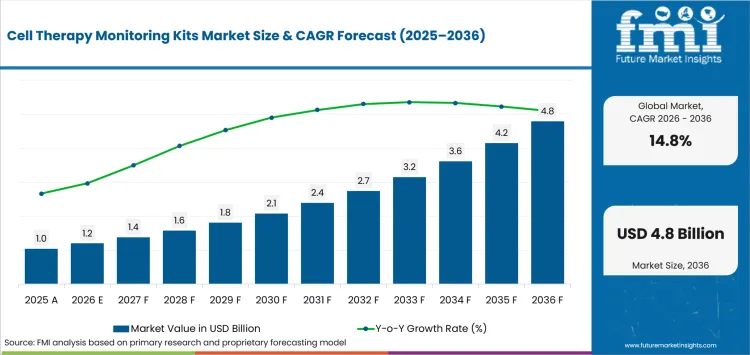
USD 1.2 billion in 2026 and USD 4.8 billion by 2036 at a 14.8% CAGR.
Demand for cell therapy monitoring kits is projected to expand at 14.8% CAGR from 2026 to 2036, lifting valuation from USD 1.2 billion in 2026 to USD 4.8 billion. Commercialization of advanced cell and gene therapies is increasing the number of manufacturing programs that depend on rigorous analytical testing throughout production. FDA stated in January 2026 that CBER had approved close to 50 cell and gene therapies during the previous decade. More commercial programs therefore require repeat identity and safety checks during cell and gene therapy manufacturing. A failed test can delay lot disposition because patient-specific products often have little scheduling slack.
Country demand depends on how quickly manufacturing sites move a living product through qualified testing and release. The MHRA authorized the Cell and Gene Therapy Catapult Manufacturing and Innovation Centre on May 13, 2026 with quality-control testing in scope. UK developers can therefore keep cell and gene therapy trials closer to qualified release work. Smaller programs that outsource specialized assays face longer transfer schedules and greater dependence on external technical support.
Key Takeaways
- Demand rises as cell therapy developers place identity, potency, viability and safety checkpoints before a lot moves toward patient use.
- Based on kit type, cell viability monitoring kits are projected to account for 41.0% in 2026 due to repeated viability checks before higher-cost analysis.
- In 2026, quality control testing is expected to lead monitoring application with 39.0% share because invalid results can postpone scheduled patient release.
- Biopharmaceutical companies are projected to hold 45.0% share in 2026 owing to their control of assay selection during development and method transfer.
- Cross-site comparability can slow adoption because reagent changes or instrument settings may alter results after a method transfer.
- Some of the key players in this market include Thermo Fisher Scientific Inc., Merck KGaA, Bio-Techne Corporation, Sartorius AG, Miltenyi Biotec GmbH, BD (Becton, Dickinson and Company), QIAGEN N.V., and Agilent Technologies, Inc.
Analyst Perspective
"Cell therapy monitoring companies retain accounts if one assay survives method transfer without forcing a new validation package at each site. Platforms gain a stronger commercial position once comparability stays intact and release review shortens for patient-specific batches with limited scheduling slack."
- Anurag Sharma, Principal Consultant, Future Market Insights
How is the Cell Therapy Monitoring Kits Market segmented?
The market is segmented by kit type, monitoring application, end-use organization, customer category, and analytical technology.
Kit type covers viability, potency, sterility, and biomarker monitoring kits used during production. Monitoring application includes quality control, immune characterization, product safety, and clinical response monitoring. End-use organization spans biopharma, biotechnology, institutes, CDMOs, laboratories, and treatment centers. Customer category separates commercial, clinical-stage, academic, contract, hospital, regulatory, and therapy-provider demand. Analytical technology covers flow cytometry, molecular assays, microbial detection, and immunoassays.
What makes Cell viability monitoring kits central to the Kit type category?
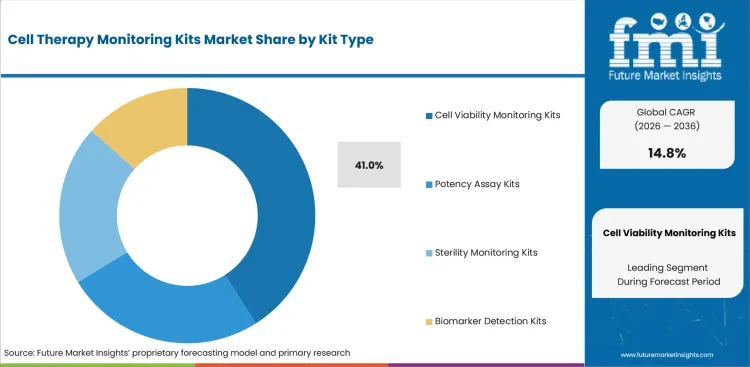
Viability tests recur after expansion or thawing because poor cell recovery can invalidate later potency or phenotype work. Sartorius launched the Incucyte CX3 in July 2025 with continuous live-cell imaging for three-dimensional cell models and repeated observation during longer experiments.
- Based on kit type, cell viability monitoring kits are projected to account for 41.0% in 2026 due to their early go-or-stop role before higher-cost analysis.
- Developers pair viability checks with cell culture media controls so unexpected cell loss can be traced to handling or process conditions before another assay consumes scarce material.
Why does Quality control testing lead the Monitoring application category?
Quality control testing governs batch-disposition decisions and laboratories need methods that return defensible results within fixed treatment schedules. A delayed result can hold patient-specific inventory even if manufacturing finished on time.
- In 2026, quality control testing is expected to lead monitoring application with 39.0% share because release decisions depend on valid results from each required test.
- Bio-Techne announced in July 2025 that Simple Western supported GMP potency and lot-release testing for ZEVASKYN plus its viral vector process. Release panels can also include pharmaceutical sterility testing under the same controlled review schedule.
How do Biopharmaceutical companies shape the End-use organization category?
Biopharmaceutical companies usually select the analytical method before it transfers to a contract manufacturer or later commercial site. FDA stated in January 2026 that cell and gene therapy method validation follows a lifecycle approach with comparability retained as assays change.
- Biopharmaceutical companies are projected to hold 45.0% share in 2026 owing to their control of assay selection during development and method transfer.
- Their specifications shape external laboratories supporting engineered cell therapy programs because transferred methods need matching controls and reagent specifications plus consistent interpretation rules at each qualified site.
What drives Flow cytometry-based assays within Analytical technology?
Flow cytometry measures identity, purity, phenotype, activation state and viability from limited cell material in one analytical sequence. Laboratories therefore use panel design to preserve sample while increasing the number of attributes read from each run.
- By analytical technology, flow cytometry-based assays are forecast to represent 37.0% in 2026 driven by multiparametric analysis of scarce cell samples.
- NIST documented in April 2025 three CD19 quantification methods tested on four cytometer platforms. That comparison makes instrument standardization material to flow cytometry method transfer between qualified laboratories during method validation.
What are the drivers, restraints and opportunities in the Cell Therapy Monitoring Kits Market?
More regulated cell therapy programs expand repeat testing, cross-site assay variability slows qualification, and faster multiplex workflows improve release economics.
- Driver: More cell therapy programs require repeated identity, purity, potency, viability and safety testing before each lot reaches a patient.
- Restraint: Biological variability and laboratory-specific settings extend validation work after a monitoring method transfers between instruments or manufacturing sites.
- Opportunity: Assay formats that reduce sample use and turnaround time can earn repeat demand in programs with narrow release windows.
Regulated Programs Increase the Number of Testing Decisions
Each licensed or late-stage program requires analytical decisions during process development and commercial manufacturing. FDA listed six cellular and gene therapy guidance actions during 2026 by August following three draft guidances in September 2025. Programs moving from clinical lots into routine CAR T-cell therapy release therefore need methods that document change control without interrupting scheduled testing.
Cross-Site Variability Extends Qualification Work
A monitoring result loses commercial utility if instrument settings or reagents shift its interpretation between qualified laboratories. The British Pharmacopoeia stated in July 2026 that experts were resolving more than 200 technical comments from 13 responders on ATMP guidance. The problem is acute in immune marker panels because panel design and cytometer settings can alter phenotype calls during site transfer.
Faster Multiplex Workflows Can Shorten Release Queues
Release laboratories gain time when one run measures several attributes without consuming another scarce sample. The MHRA authorized Oxford Biomedica sites on March 12, 2026 for investigational cell and gene therapy manufacturing with batch certification and quality-control testing in scope. That operating model increases the role for PAT and analytics platforms that shorten the interval from sampling to review and batch disposition.
Which country CAGRs are profiled in the Cell Therapy Monitoring Kits Market?
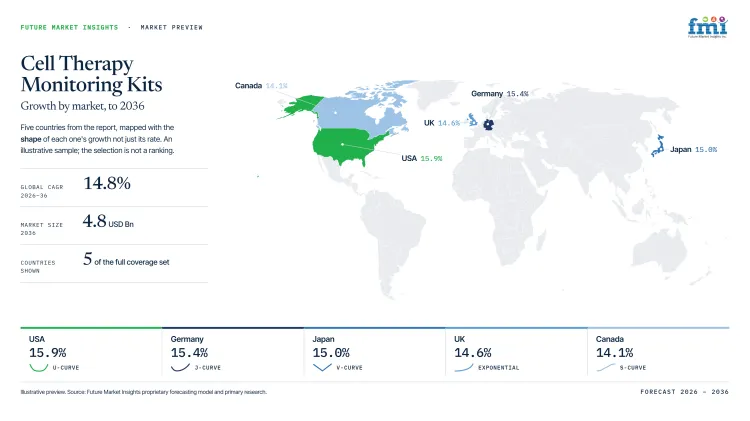
| Country | CAGR |
|---|---|
| USA | 15.9% |
| Germany | 15.4% |
| Japan | 15.0% |
| UK | 14.6% |
| Canada | 14.1% |
How do country-level CAGRs compare in the Cell Therapy Monitoring Kits Market?
USA and Germany form the faster-growth pair while Japan and the UK sit in a middle band. Canada trails the USA by 1.8 percentage points but stays close enough to signal a shared expansion cycle. The rates do not imply equal revenue because local manufacturing density and laboratory coverage differ sharply.
- USA research hubs shorten travel between cell therapy laboratories and manufacturing sites.
- Germany's hospital networks favor companies that maintain centralized European documentation for customers.
- Japan requires bilingual training and rapid local instrument-service escalation during analytical qualification.
- UK specialist centers place premium value on same-day application support during production.
- Canada's provincial program spread favors compact service coverage over broad local inventories.
Similar CAGRs therefore produce different service costs and order-conversion paths for monitoring vendors. The full report provides country-level CAGR analysis across North America, Latin America, Europe, East Asia, South Asia, Oceania and the Middle East and Africa.
Country-wise Analysis
- Commercial cell therapy manufacturing in the USA clusters near academic medical centers and treatment sites that keep release laboratories close to development teams and scheduled dosing. USA demand is projected to grow at 15.9% CAGR through 2036 because FDA's August 2026 final FAQ guidance addresses cellular and gene therapy questions spanning CMC plus clinical and regulatory review. Dense manufacturing clusters provide cell isolation expertise and local assay support, yet instrument or reagent changes can reopen comparability work and increase the value of qualified controls with rapid technical troubleshooting before scheduled batch disposition at commercial and hospital sites during commercial operations.
- In German university-hospital networks, advanced-therapy programs often transfer to specialist manufacturers that must align kit documentation with centralized EU authorization requirements during release preparation. The Paul-Ehrlich-Institut's February 2026 list records Zemcelpro with an August 26, 2025 marketing authorization and gives laboratories a current reference for regulated somatic cell therapy practice. Germany is estimated to post 15.4% CAGR during the forecast period owing to strong quality systems, although instrument differences between sites can extend method transfer and favor companies offering EU documentation with German technical support during qualification and routine change control as manufacturers expand programs within major German therapy centers.
- Before a global assay enters routine production, Japanese regenerative medicine programs put substantial weight on domestic operating procedures and documented comparability at manufacturing sites and hospitals. Japan is forecast to expand at 15.0% CAGR between 2026 and 2036 given PMDA review records showing AMCHEPRY and RiHEART approvals in March 2026 within the regenerative medicine pathway. Concentrated clinical expertise supports adoption, while bilingual documentation and local protocol bridging can lengthen qualification for imported kits and leave an advantage to companies that reproduce acceptance criteria after samples or methods transfer between sites under Japanese operating procedures during routine commercial manufacturing and release.
- Short clinical schedules at UK specialist manufacturing and translational centers put pressure on assay turnaround and same-day technical decisions during patient-specific production. The British Pharmacopoeia revised its ATMP guidance in December 2025 and includes flow cytometry plus vector copy number and cell-characterization tests for assay development in local laboratories. UK demand is projected to advance at 14.6% CAGR from 2026 to 2036 tied to concentrated technical expertise, with local stock and responsive application support becoming more valuable as smaller programs rely on external specialists during short patient-specific release windows and need rapid troubleshooting during same-day clinical production and release decisions.
- Coordinating assay shipments between provincial research hospitals and manufacturing centers requires Canadian teams to account for service distance during qualification and routine technical support. Canada is estimated to record 14.1% CAGR over the forecast period helped by the National Research Council's April 2026 Genome Foundry work that gives researchers one facility for designing and testing potential cell therapies. Commercial scale is thinner than in the USA, so smaller validated kit formats and technical teams covering several provinces fit Canadian programs better than broad local inventory at every site because service travel and reagent availability can delay troubleshooting between provincial centers.
Who are the notable companies in the Cell Therapy Monitoring Kits Market?
Thermo Fisher Scientific Inc., Merck KGaA, Bio-Techne Corporation, Sartorius AG, Miltenyi Biotec GmbH, BD (Becton, Dickinson and Company), QIAGEN N.V., and Agilent Technologies, Inc. are the notable companies serving this market.
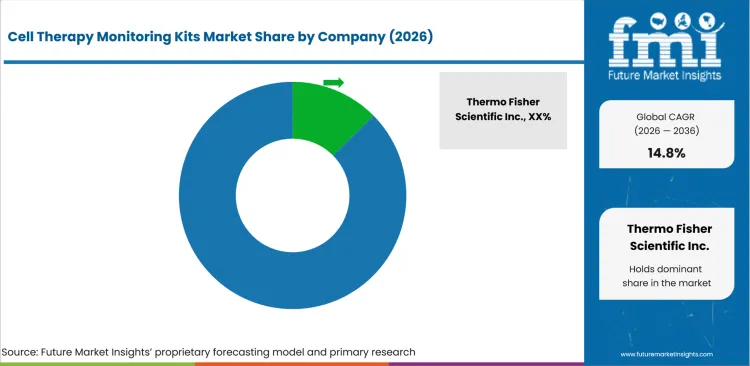
The competitive field splits between broad life-science platforms and specialist analytical companies. Entry barriers come from assay documentation and installed instruments plus reference controls that preserve the measurement principle during regulated method transfer.
- Thermo Fisher Scientific Inc., Merck KGaA and Sartorius AG cover several analytical and bioprocess workflows that reduce handoffs between development and manufacturing support.
- Bio-Techne Corporation, Miltenyi Biotec GmbH and BD (Becton, Dickinson and Company) compete most directly in cell characterization plus functional and immune-analysis workflows.
- QIAGEN N.V. and Agilent Technologies, Inc. concentrate on molecular quantification and functional cell analysis used for defined release or potency decisions.
Competitive Benchmarking: Cell Therapy Monitoring Kits Market
| Company | Monitoring Route Breadth | Regulated Workflow Evidence | Method Integration Depth | Geographic Reach |
|---|---|---|---|---|
| Thermo Fisher Scientific Inc. | High | High | High | Global |
| Merck KGaA | High | High | High | Global |
| Bio-Techne Corporation | High | High | High | Global |
| Sartorius AG | High | Medium | High | Global |
| Miltenyi Biotec GmbH | Medium | High | High | Global |
| BD (Becton, Dickinson and Company) | High | Medium | High | Global |
| QIAGEN N.V. | Medium | High | High | Global |
| Agilent Technologies, Inc. | High | High | Medium | Global |
Scoring basis: High monitoring-route breadth requires at least three verified analytical routes while Medium requires two and Low identifies one documented route. High regulated-workflow evidence requires release or GMP quality-control use while Medium reflects controlled development and Low reflects research-only use. High method-integration depth requires instruments plus reagents and software or services while Medium requires two layers and Low identifies one. Geographic reach is listed as Global only where official corporate evidence confirms commercial operations in several major regions.
Key Developments in the Cell Therapy Monitoring Kits Market
- In July 2026, Agilent Technologies, Inc. launched an AI-driven analysis module for the xCELLigence RTCA eSight platform to classify and analyze cell-imaging data in real time.
- In June 2026, QIAGEN N.V. expanded the QIAcuity digital PCR ecosystem with cell and gene therapy quality-control assays plus automated analysis and reporting functions.
- In May 2025, BD (Becton, Dickinson and Company) launched the FACSDiscover A8 Cell Analyzer with spectral analysis and real-time imaging plus measurement of 50 or more characteristics per cell.
Key Players in the Cell Therapy Monitoring Kits Market
Integrated Life-Science and Bioprocess Platforms
- Thermo Fisher Scientific Inc.
- Merck KGaA
- Sartorius AG
Cell Characterization and Therapy Workflow Specialists
- Bio-Techne Corporation
- Miltenyi Biotec GmbH
- BD (Becton, Dickinson and Company)
Molecular and Functional Analysis Specialists
- QIAGEN N.V.
- Agilent Technologies, Inc.
Cell Therapy Monitoring Kits Market - Report Scope
| Coverage field | Report scope |
|---|---|
| Market breakdown | By kit type, monitoring application, end-use organization, customer category, analytical technology, and region. |
| Quantitative Units | USD Billion. |
| Market Definition | Commercial kits and standardized assay packages used to monitor cell viability, potency, phenotype, molecular attributes, sterility, contamination, and related quality indicators in cell therapy development and manufacturing. |
| Regions Covered | North America, Latin America, Europe, East Asia, South Asia and Pacific, and Middle East and Africa. |
| Countries Covered | USA, Germany, Japan, UK, Canada, and 20+ countries included in the full report. |
| Key Companies Profiled | Thermo Fisher Scientific Inc., Merck KGaA, Bio-Techne Corporation, Sartorius AG, Miltenyi Biotec GmbH, BD (Becton, Dickinson and Company), QIAGEN N.V., and Agilent Technologies, Inc. |
| Forecast Period | Base 2026 to 2036. |
| Approach | Primary and secondary research with market triangulation. |
Cell Therapy Monitoring Kits Market - Research Methodology
| Method | Approach |
|---|---|
| Primary Research | FMI analysts gathered input from manufacturers, service providers, technology developers, distributors, end users, procurement teams, and subject-matter experts. Interviews examined purchasing decisions, product or service evaluation, adoption barriers, approval requirements, pricing considerations, and expectations for technical or commercial support. Respondents were also asked what evidence is required before a trial, pilot, or initial order develops into regular purchasing. |
| Desk Research | Desk research covered government statistics, regulatory publications, trade data, industry associations, technical literature, standards, company filings, product information, and official corporate announcements. Sources were reviewed for relevance, publication date, geographic coverage, and consistency with the defined market scope. Claims relating to performance, applications, approvals, capacity, investment, and commercial activity were retained only when supported by credible public evidence. |
| Market Sizing and Forecasting | The market model combined the baseline value with historical performance, segment structure, pricing and volume indicators, adoption levels, company participation, and country-level demand conditions. Forecast assumptions considered economic activity, investment trends, regulatory developments, technology adoption, purchasing cycles, supply availability, and barriers to wider market use. Segment and regional estimates were reconciled before the final market total was calculated. |
| Data Validation | Estimates were checked against multiple independent indicators, including public data, company activity, trade patterns, industry developments, and findings from primary interviews. Validation also tested whether products, services, applications, and company revenues fell within the defined market boundaries. Adjacent categories, unsupported claims, overlapping revenues, and activities without direct market relevance were excluded to reduce double counting and maintain consistency across segments and countries. |
Cell Therapy Monitoring Kits Market by Segments
By Kit Type
- Cell Viability Monitoring Kits
- Dye Exclusion Kits
- Fluorescent Viability Kits
- Potency Assay Kits
- Cytotoxicity Assay Kits
- Functional Potency Kits
- Sterility Monitoring Kits
- Rapid Sterility Kits
- Endotoxin Detection Kits
- Biomarker Detection Kits
- Cytokine Analysis Kits
- Biomarker Multiplex Kits
By Monitoring Application
- Quality Control Testing
- Release Testing
- In-process Monitoring
- Immune Cell Characterization
- T-cell Phenotyping
- NK Cell Profiling
- Product Safety Testing
- Microbial Contamination Detection
- Endotoxin Testing
- Clinical Response Monitoring
- Cytokine Monitoring
- Biomarker Profiling
By End-use Organization
- Biopharmaceutical Companies
- Biotechnology Companies
- Academic & Research Institutes
- Government Research Institutes
- Contract Development & Manufacturing Organizations
- Hospitals & Specialty Clinics
- Regenerative Medicine Centers
- Specialty Treatment Centers
- Transplant Centers
- Cell Therapy Developers
- Clinical Research Organizations
- Independent Testing Laboratories
By Customer Category
- Commercial Manufacturers
- Clinical-stage Developers
- Academic Research Centers
- Contract Manufacturers
- Hospital Laboratories
- Commercial Therapy Providers
- Cell Therapy Clinics
- Precision Medicine Centers
- Personalized Therapy Providers
- Regulatory Testing Laboratories
- Public Health Laboratories
- Quality Control Laboratories
By Analytical Technology
- Flow Cytometry-based Assays
- Multiparametric Flow Cytometry
- Fluorescent Cell Analysis
- Molecular Assays
- qPCR-based Analysis
- Digital PCR
- Microbial Detection Platform
- ATP Bioluminescence
- Endotoxin Detection Technology
- Immunoassay Platform
- ELISA Technology
- Multiplex Immunoassays
Cell Therapy Monitoring Kits Market by Region:
- North America
- United States
- Canada
- Latin America
- Brazil
- Mexico
- Argentina
- Chile
- Western Europe
- Germany
- France
- United Kingdom
- Italy
- Spain
- Benelux
- Nordics
- Eastern Europe
- Poland
- Czech Republic
- Romania
- Hungary
- East Asia
- China
- Japan
- South Korea
- South Asia and Pacific
- India
- ASEAN
- Australia and New Zealand
- Middle East and Africa
- GCC Countries
- South Africa
- Türkiye
- Israel
Research Sources and Bibliography
- USA Food and Drug Administration. (2026, January 11). FDA increases flexibility on requirements for cell and gene therapies to advance innovation
- Medicines and Healthcare products Regulatory Agency. (2026, May 13). UK MIA(IMP) 59573
- Sartorius AG. (2025, July 31). Incucyte CX3 System transforms continuous analysis of 3D cell models with confocal imaging and unmatched throughput
- QIAGEN N.V. (2025, April 29). QIAGEN expands its digital PCR portfolio with new lentivirus solutions to strengthen cell and gene therapy quality control
- USA Food and Drug Administration. (2026, January 11). Flexible requirements for cell and gene therapies to advance innovation
- National Institute of Standards and Technology. (2025, April 21). Quantification of cells with specific phenotypic characteristics
- USA Food and Drug Administration. (2026, August). Cellular & gene therapy guidances
- British Pharmacopoeia. (2026, July 13). Key Insights: Advanced Therapy Medicinal Products (ATMP) guidance development
- Medicines and Healthcare products Regulatory Agency. (2026, March 12). UK MIA(IMP) 17479
- USA Food and Drug Administration. (2026, August). Frequently Asked Questions - Developing Potential Cellular and Gene Therapy Products
- Paul-Ehrlich-Institut. (2026, February 13). Somatic cell therapy medicinal products with a valid marketing authorisation
- Pharmaceuticals and Medical Devices Agency. (2026, March). Review reports: Regenerative medical products
- British Pharmacopoeia. (2025, December). Advanced Therapy Medicinal Products Guidance
- National Research Council Canada. (2026, April 20). Made-in-Canada medicine: Shaping the future of cell and gene therapy
- Bio-Techne Corporation. (2025, July 14). Bio-Techne's Simple Western™ Technology Utilized in Recent FDA Approval of ZEVASKYN™ Cell-Based Gene Therapy
- BD. (2025, May 13). BD Launches Landmark Cell Analyzer Featuring Breakthrough Spectral and Real-Time Cell Imaging Technologies
- Agilent Technologies, Inc. (2026, July 1). Agilent Launches AI-Driven Analysis Module for Agilent xCELLigence RTCA eSight
- Thermo Fisher Scientific Inc. (2025, November 18). Thermo Fisher Scientific Opens Its Fourth State-of-the-Art Cell and Gene Therapy Collaboration Center
- Merck KGaA, Darmstadt, Germany. (2026, June 25). Merck KGaA, Darmstadt, Germany, Agrees to Acquire Bio-Techne, Strengthening Leadership Position in Fast-Growing Life Sciences Markets
- BD. (2025, December 18). BD and Penn Institute for Immunology and Immune Health Collaborate to Advance Immunotherapy through Flow Cytometry
- QIAGEN N.V. (2026, June 15). QIAGEN expands QIAcuity gene expression portfolio to accelerate digital PCR adoption across research and biopharma
- Beckman Coulter Life Sciences. (2025, March 18). Beckman Coulter Life Sciences Launches Industry-First Modular Spectral Flow Cytometry Solution
- Merck KGaA, Darmstadt, Germany. (2026, May 7). MilliporeSigma Becomes Sole Testing Provider for Genetix Biotherapeutics' Gene Therapies
- Beckman Coulter Life Sciences. (2025, September 16). Beckman Coulter Life Sciences Launches Industry-First Infrared Dye Antibody Conjugates to Expand Human Phenotyping Experiments
- BD. (2026, January 23). BD Helps Scientists Advance Immunology and Cancer Research with AI-Powered Insights and Automation
- Agilent Technologies, Inc. (2026, April 1). Agilent Announces the BioTek Cytation 9 Cell Imaging Multimode Reader
- Cytek Biosciences, Inc. (2025, May 8). Cytek Biosciences Reports First Quarter 2025 Financial Results
- Bio-Techne Corporation. (2025, December 9). Bio-Techne Launches the Enhanced Leo™ System Delivering Advanced Multiplexing and High-Throughput Protein Analysis
- Sartorius AG. (2025, April 7). Sartorius partnership with bio-incubator LiveLabs empowers early-stage startups with cutting-edge solutions
- Agilent Technologies, Inc. (2025, May 1). Agilent Unveils Transformative Seahorse XF Flex Analyzer: Revolutionizing 3D Tissue and Organoid Research
This bibliography is provided for reader reference and is not exhaustive. The full report contains the complete reference list and detailed citations
This Report Answers
- What is the 2026 value of the cell therapy monitoring kits market and what is its 2036 forecast?
- Which operational conditions increase repeat demand for cell therapy monitoring kits during regulated manufacturing?
- Why do cell viability monitoring kits hold the largest approved share within kit type?
- Why does quality control testing lead the monitoring application category?
- How do biopharmaceutical companies influence assay selection and method transfer?
- Why are flow cytometry-based assays important for cell identity, phenotype, and viability monitoring?
- How do the five profiled country CAGRs differ between the USA and Canada?
- Which commercial frictions slow assay qualification between development and manufacturing sites?
- Which eight companies are benchmarked in the cell therapy monitoring kits market?
- Which 2025-2026 company actions changed competitive positioning in cell therapy analytics?
Frequently Asked Questions
How big is the cell therapy monitoring kits market in 2026?
The cell therapy monitoring kits market is valued at USD 1.2 billion in 2026 and is projected to reach USD 4.8 billion by 2036. Growth follows expanding commercial cell therapy manufacturing and repeated analytical checks before batch release.
What is the CAGR of the cell therapy monitoring kits market from 2026 to 2036?
The cell therapy monitoring kits market is projected to grow at a CAGR of 14.8% between 2026 and 2036. Expansion follows more commercial therapy programs and wider quality-control testing during regulated method transfer.
Which kit type leads the cell therapy monitoring kits market?
The cell viability monitoring kits segment is expected to hold 41.0% of the cell therapy monitoring kits market in 2026, driven by repeated viability checks before higher-cost analysis. The result gives developers an early stop-or-continue decision while cell material remains available.
Which monitoring application leads the cell therapy monitoring kits market?
The quality control testing segment is expected to hold 39.0% of the cell therapy monitoring kits market in 2026, attributable to repeated in-process and release decisions. Turnaround time therefore affects scheduled patient treatment and lot disposition decisions directly.
How much value will the cell therapy monitoring kits market add between 2026 and 2036?
The cell therapy monitoring kits market is expected to add USD 3.6 billion in value between 2026 and 2036. The increase follows broader commercial manufacturing and repeated quality testing as more therapies enter regulated production.
Which countries are projected to record the highest growth in the cell therapy monitoring kits market?
USA is projected to grow at 15.9% CAGR through 2036, followed by Germany at 15.4% and Japan at 15.0%. Their higher growth rates align with active advanced-therapy manufacturing and regulated release infrastructure.
Which companies are active in the cell therapy monitoring kits market?
Key companies operating in the cell therapy monitoring kits market include Thermo Fisher Scientific Inc., Merck KGaA, Bio-Techne Corporation, Sartorius AG, Miltenyi Biotec GmbH, BD (Becton, Dickinson and Company), QIAGEN N.V., and Agilent Technologies, Inc. These companies compete through assay breadth and regulated workflow evidence with technical support.
Preview the report firsthand - request a free sample
Get SampleGet the brochure for pricing and purchase details.
Get PDFTable of Content
- Key Takeaways
- Market Size and CAGR
- Top Growth Driver
- Fastest Growing Segment
- Leading Region
- Key Companies
- Emerging Opportunities
- Executive Summary
- Global Market Outlook
- Demand-side Trends
- Supply-side Trends
- Technology Roadmap Analysis
- Analysis and Recommendations
- Analyst Perspective (What is happening? Why now? What should investors know?)
- Key Questions Answered
- How large is the market?
- What is the CAGR?
- What are key trends?
- Which region dominates?
- Who are the leaders?
- Market Overview
- Market Coverage / Taxonomy
- Market Definition / Scope / Limitations
- Research Methodology
- Chapter Orientation
- Analytical Lens and Working Hypotheses
- Market Structure, Signals, and Trend Drivers
- Benchmarking and Cross-market Comparability
- Market Sizing, Forecasting, and Opportunity Mapping
- Research Design and Evidence Framework
- Desk Research Programme (Secondary Evidence)
- Expert Input and Fieldwork (Primary Evidence)
- Tooling, Models, and Reference Databases
- Data Engineering and Model Build
- Quality Assurance and Audit Trail
- Market Background
- Market Dynamics (Drivers, Restraints, Opportunity, Trends)
- Scenario Forecast (Optimistic, Likely, Conservative)
- Impact Analysis
- AI Impact
- Sustainability Impact
- Regulatory Impact
- Technology Impact
- Consumer / Buyer Analysis
- Purchase Drivers
- Adoption Barriers
- Buyer Journey
- Opportunity Map Analysis
- Product Life Cycle Analysis
- Supply Chain Analysis
- Investment Feasibility Matrix
- Value Chain Analysis
- PESTLE and Porter's Analysis
- Regulatory Landscape
- Regional Parent Market Outlook
- Production and Consumption Statistics
- Import and Export Statistics
- Global Market Analysis and Forecast, 2021 to 2036
- Historical Market Size Value (USD Billion) Analysis, 2021 to 2025
- Current and Future Market Size Value (USD Billion) Projections, 2026 to 2036
- Y-o-Y Growth Trend Analysis
- Absolute $ Opportunity Analysis
- Global Market Pricing Analysis, 2021 to 2036
- Global Market Analysis and Forecast, By Kit Type, 2021 to 2036
- Introduction / Key Findings
- Historical Market Size Value (USD Billion) Analysis By Kit Type, 2021 to 2025
- Current and Future Market Size Value (USD Billion) Analysis and Forecast By Kit Type, 2026 to 2036
- Cell Viability Monitoring Kits
- Dye Exclusion Kits
- Fluorescent Viability Kits
- Potency Assay Kits
- Cytotoxicity Assay Kits
- Functional Potency Kits
- Sterility Monitoring Kits
- Rapid Sterility Kits
- Endotoxin Detection Kits
- Biomarker Detection Kits
- Cytokine Analysis Kits
- Biomarker Multiplex Kits
- Cell Viability Monitoring Kits
- Y-o-Y Growth Trend Analysis By Kit Type, 2021 to 2025
- Absolute $ Opportunity Analysis By Kit Type, 2026 to 2036
- Global Market Analysis and Forecast, By Monitoring Application, 2021 to 2036
- Introduction / Key Findings
- Historical Market Size Value (USD Billion) Analysis By Monitoring Application, 2021 to 2025
- Current and Future Market Size Value (USD Billion) Analysis and Forecast By Monitoring Application, 2026 to 2036
- Quality Control Testing
- Release Testing
- In-process Monitoring
- Immune Cell Characterization
- T-cell Phenotyping
- NK Cell Profiling
- Product Safety Testing
- Microbial Contamination Detection
- Endotoxin Testing
- Clinical Response Monitoring
- Cytokine Monitoring
- Biomarker Profiling
- Quality Control Testing
- Y-o-Y Growth Trend Analysis By Monitoring Application, 2021 to 2025
- Absolute $ Opportunity Analysis By Monitoring Application, 2026 to 2036
- Global Market Analysis and Forecast, By End-use Organization, 2021 to 2036
- Introduction / Key Findings
- Historical Market Size Value (USD Billion) Analysis By End-use Organization, 2021 to 2025
- Current and Future Market Size Value (USD Billion) Analysis and Forecast By End-use Organization, 2026 to 2036
- Biopharmaceutical Companies
- Biotechnology Companies
- Academic & Research Institutes
- Contract Development & Manufacturing Organizations
- Hospitals & Specialty Clinics
- Cell Therapy Developers
- Clinical Research Organizations
- Government Research Institutes
- Independent Testing Laboratories
- Regenerative Medicine Centers
- Specialty Treatment Centers
- Transplant Centers
- Biopharmaceutical Companies
- Y-o-Y Growth Trend Analysis By End-use Organization, 2021 to 2025
- Absolute $ Opportunity Analysis By End-use Organization, 2026 to 2036
- Global Market Analysis and Forecast, By Customer Category, 2021 to 2036
- Introduction / Key Findings
- Historical Market Size Value (USD Billion) Analysis By Customer Category, 2021 to 2025
- Current and Future Market Size Value (USD Billion) Analysis and Forecast By Customer Category, 2026 to 2036
- Commercial Manufacturers
- Clinical-stage Developers
- Academic Research Centers
- Contract Manufacturers
- Hospital Laboratories
- Commercial Therapy Providers
- Regulatory Testing Laboratories
- Public Health Laboratories
- Quality Control Laboratories
- Cell Therapy Clinics
- Precision Medicine Centers
- Personalized Therapy Providers
- Commercial Manufacturers
- Y-o-Y Growth Trend Analysis By Customer Category, 2021 to 2025
- Absolute $ Opportunity Analysis By Customer Category, 2026 to 2036
- Global Market Analysis and Forecast, By Analytical Technology, 2021 to 2036
- Introduction / Key Findings
- Historical Market Size Value (USD Billion) Analysis By Analytical Technology, 2021 to 2025
- Current and Future Market Size Value (USD Billion) Analysis and Forecast By Analytical Technology, 2026 to 2036
- Flow Cytometry-based Assays
- Multiparametric Flow Cytometry
- Fluorescent Cell Analysis
- Molecular Assays
- qPCR-based Analysis
- Digital PCR
- Microbial Detection Platform
- ATP Bioluminescence
- Endotoxin Detection Technology
- Immunoassay Platform
- ELISA Technology
- Multiplex Immunoassays
- Flow Cytometry-based Assays
- Y-o-Y Growth Trend Analysis By Analytical Technology, 2021 to 2025
- Absolute $ Opportunity Analysis By Analytical Technology, 2026 to 2036
- Global Market Analysis and Forecast, By Region, 2021 to 2036
- Introduction
- Historical Market Size Value (USD Billion) Analysis By Region, 2021 to 2025
- Current Market Size Value (USD Billion) Analysis and Forecast By Region, 2026 to 2036
- North America
- Latin America
- Western Europe
- Eastern Europe
- East Asia
- South Asia and Pacific
- Middle East & Africa
- Market Attractiveness Analysis By Region
- North America Market Analysis and Forecast, By Country, 2021 to 2036
- Historical Market Size Value (USD Billion) Trend Analysis By Market Taxonomy, 2021 to 2025
- Market Size Value (USD Billion) Forecast By Market Taxonomy, 2026 to 2036
- By Country
- USA
- Canada
- By Kit Type
- By Monitoring Application
- By End-use Organization
- By Customer Category
- By Analytical Technology
- By Country
- Market Attractiveness Analysis
- By Country
- By Kit Type
- By Monitoring Application
- By End-use Organization
- By Customer Category
- By Analytical Technology
- Key Takeaways
- Latin America Market Analysis and Forecast, By Country
- Historical Market Size Value (USD Billion) Trend Analysis By Market Taxonomy, 2021 to 2025
- Market Size Value (USD Billion) Forecast By Market Taxonomy, 2026 to 2036
- By Country
- Brazil
- Mexico
- Chile
- Rest of Latin America
- By Kit Type
- By Monitoring Application
- By End-use Organization
- By Customer Category
- By Analytical Technology
- By Country
- Market Attractiveness Analysis
- By Country
- By Kit Type
- By Monitoring Application
- By End-use Organization
- By Customer Category
- By Analytical Technology
- Key Takeaways
- Western Europe Market Analysis and Forecast, By Country
- Historical Market Size Value (USD Billion) Trend Analysis By Market Taxonomy, 2021 to 2025
- Market Size Value (USD Billion) Forecast By Market Taxonomy, 2026 to 2036
- By Country
- Germany
- UK
- Italy
- Spain
- France
- Nordic
- BENELUX
- Rest of Western Europe
- By Kit Type
- By Monitoring Application
- By End-use Organization
- By Customer Category
- By Analytical Technology
- By Country
- Market Attractiveness Analysis
- By Country
- By Kit Type
- By Monitoring Application
- By End-use Organization
- By Customer Category
- By Analytical Technology
- Key Takeaways
- Eastern Europe Market Analysis and Forecast, By Country
- Historical Market Size Value (USD Billion) Trend Analysis By Market Taxonomy, 2021 to 2025
- Market Size Value (USD Billion) Forecast By Market Taxonomy, 2026 to 2036
- By Country
- Russia
- Poland
- Hungary
- Balkan & Baltic
- Rest of Eastern Europe
- By Kit Type
- By Monitoring Application
- By End-use Organization
- By Customer Category
- By Analytical Technology
- By Country
- Market Attractiveness Analysis
- By Country
- By Kit Type
- By Monitoring Application
- By End-use Organization
- By Customer Category
- By Analytical Technology
- Key Takeaways
- East Asia Market Analysis and Forecast, By Country
- Historical Market Size Value (USD Billion) Trend Analysis By Market Taxonomy, 2021 to 2025
- Market Size Value (USD Billion) Forecast By Market Taxonomy, 2026 to 2036
- By Country
- China
- Japan
- South Korea
- By Kit Type
- By Monitoring Application
- By End-use Organization
- By Customer Category
- By Analytical Technology
- By Country
- Market Attractiveness Analysis
- By Country
- By Kit Type
- By Monitoring Application
- By End-use Organization
- By Customer Category
- By Analytical Technology
- Key Takeaways
- South Asia and Pacific Market Analysis and Forecast, By Country
- Historical Market Size Value (USD Billion) Trend Analysis By Market Taxonomy, 2021 to 2025
- Market Size Value (USD Billion) Forecast By Market Taxonomy, 2026 to 2036
- By Country
- India
- ASEAN
- Australia & New Zealand
- Rest of South Asia and Pacific
- By Kit Type
- By Monitoring Application
- By End-use Organization
- By Customer Category
- By Analytical Technology
- By Country
- Market Attractiveness Analysis
- By Country
- By Kit Type
- By Monitoring Application
- By End-use Organization
- By Customer Category
- By Analytical Technology
- Key Takeaways
- Middle East & Africa Market Analysis and Forecast, By Country
- Historical Market Size Value (USD Billion) Trend Analysis By Market Taxonomy, 2021 to 2025
- Market Size Value (USD Billion) Forecast By Market Taxonomy, 2026 to 2036
- By Country
- Kingdom of Saudi Arabia
- Other GCC Countries
- Türkiye
- South Africa
- Other African Union
- Rest of Middle East & Africa
- By Kit Type
- By Monitoring Application
- By End-use Organization
- By Customer Category
- By Analytical Technology
- By Country
- Market Attractiveness Analysis
- By Country
- By Kit Type
- By Monitoring Application
- By End-use Organization
- By Customer Category
- By Analytical Technology
- Key Takeaways
- Key Countries Market Analysis
- USA
- Pricing Analysis
- Market Share Analysis, 2025
- By Kit Type
- By Monitoring Application
- By End-use Organization
- By Customer Category
- By Analytical Technology
- Canada
- Pricing Analysis
- Market Share Analysis, 2025
- By Kit Type
- By Monitoring Application
- By End-use Organization
- By Customer Category
- By Analytical Technology
- Mexico
- Pricing Analysis
- Market Share Analysis, 2025
- By Kit Type
- By Monitoring Application
- By End-use Organization
- By Customer Category
- By Analytical Technology
- Brazil
- Pricing Analysis
- Market Share Analysis, 2025
- By Kit Type
- By Monitoring Application
- By End-use Organization
- By Customer Category
- By Analytical Technology
- Chile
- Pricing Analysis
- Market Share Analysis, 2025
- By Kit Type
- By Monitoring Application
- By End-use Organization
- By Customer Category
- By Analytical Technology
- Germany
- Pricing Analysis
- Market Share Analysis, 2025
- By Kit Type
- By Monitoring Application
- By End-use Organization
- By Customer Category
- By Analytical Technology
- UK
- Pricing Analysis
- Market Share Analysis, 2025
- By Kit Type
- By Monitoring Application
- By End-use Organization
- By Customer Category
- By Analytical Technology
- Italy
- Pricing Analysis
- Market Share Analysis, 2025
- By Kit Type
- By Monitoring Application
- By End-use Organization
- By Customer Category
- By Analytical Technology
- Spain
- Pricing Analysis
- Market Share Analysis, 2025
- By Kit Type
- By Monitoring Application
- By End-use Organization
- By Customer Category
- By Analytical Technology
- France
- Pricing Analysis
- Market Share Analysis, 2025
- By Kit Type
- By Monitoring Application
- By End-use Organization
- By Customer Category
- By Analytical Technology
- India
- Pricing Analysis
- Market Share Analysis, 2025
- By Kit Type
- By Monitoring Application
- By End-use Organization
- By Customer Category
- By Analytical Technology
- ASEAN
- Pricing Analysis
- Market Share Analysis, 2025
- By Kit Type
- By Monitoring Application
- By End-use Organization
- By Customer Category
- By Analytical Technology
- Australia & New Zealand
- Pricing Analysis
- Market Share Analysis, 2025
- By Kit Type
- By Monitoring Application
- By End-use Organization
- By Customer Category
- By Analytical Technology
- China
- Pricing Analysis
- Market Share Analysis, 2025
- By Kit Type
- By Monitoring Application
- By End-use Organization
- By Customer Category
- By Analytical Technology
- Japan
- Pricing Analysis
- Market Share Analysis, 2025
- By Kit Type
- By Monitoring Application
- By End-use Organization
- By Customer Category
- By Analytical Technology
- South Korea
- Pricing Analysis
- Market Share Analysis, 2025
- By Kit Type
- By Monitoring Application
- By End-use Organization
- By Customer Category
- By Analytical Technology
- Russia
- Pricing Analysis
- Market Share Analysis, 2025
- By Kit Type
- By Monitoring Application
- By End-use Organization
- By Customer Category
- By Analytical Technology
- Poland
- Pricing Analysis
- Market Share Analysis, 2025
- By Kit Type
- By Monitoring Application
- By End-use Organization
- By Customer Category
- By Analytical Technology
- Hungary
- Pricing Analysis
- Market Share Analysis, 2025
- By Kit Type
- By Monitoring Application
- By End-use Organization
- By Customer Category
- By Analytical Technology
- Kingdom of Saudi Arabia
- Pricing Analysis
- Market Share Analysis, 2025
- By Kit Type
- By Monitoring Application
- By End-use Organization
- By Customer Category
- By Analytical Technology
- Türkiye
- Pricing Analysis
- Market Share Analysis, 2025
- By Kit Type
- By Monitoring Application
- By End-use Organization
- By Customer Category
- By Analytical Technology
- South Africa
- Pricing Analysis
- Market Share Analysis, 2025
- By Kit Type
- By Monitoring Application
- By End-use Organization
- By Customer Category
- By Analytical Technology
- USA
- Market Structure Analysis
- Competition Dashboard
- Competition Benchmarking
- Market Share Analysis of Top Players
- By Regional
- By Kit Type
- By Monitoring Application
- By End-use Organization
- By Customer Category
- By Analytical Technology
- Emerging Startups
- Innovation Benchmarking
- Competition Analysis
- Competition Deep Dive
- Thermo Fisher Scientific Inc.
- Overview
- Product Portfolio
- Profitability by Market Segments
- Sales Footprint
- Strategy Overview
- Marketing Strategy
- Product Strategy
- Channel Strategy
- Merck KGaA
- Danaher Corporation
- Bio-Techne Corporation
- Sartorius AG
- Miltenyi Biotec GmbH
- BD (Becton, Dickinson and Company)
- QIAGEN N.V.
- Lonza Group AG
- Agilent Technologies, Inc.
- Thermo Fisher Scientific Inc.
- Case Studies
- Success Stories
- Recent Developments
- Competition Deep Dive
- Assumptions & Acronyms Used


