

- Market Size (2026)
- USD 1.9 Bn
- Forecast (2036)
- USD 5.3 Bn
- CAGR (2026 to 2036)
- 10.7%
How big is the Cell Therapy Packaging Market in 2026?
USD 1.9 billion in 2026 and USD 5.3 billion by 2036 at a 10.7% CAGR.
Demand for cell therapy packaging is projected to expand at 10.7% CAGR between 2026 and 2036, increasing valuation from USD 1.9 billion in 2026 to USD 5.3 billion by 2036. Packaging engineers supporting regenerative medicine programs must preserve sterility, temperature control and product identity across every handoff from final filling through patient administration.
Commercial packaging demand rises as cell and gene therapies advance through clinical programs and approved supply networks. FDA reported in January 2026 that CBER had approved close to 50 cell and gene therapies during the preceding decade. Each additional program requires qualified containers and documented release procedures that remain consistent across patient-specific shipments.
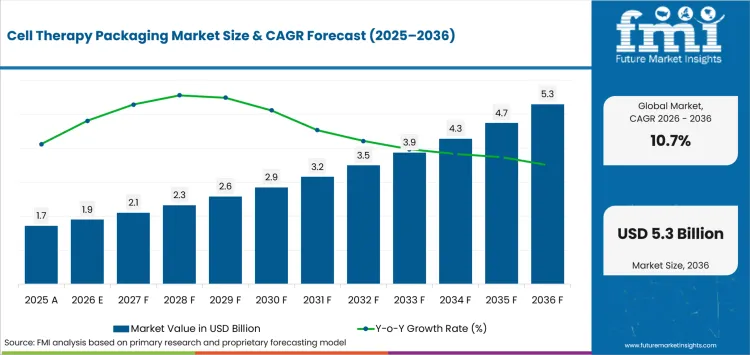
Key Takeaways of Cell Therapy Packaging Market
- Clinical cell therapy programs require packaging that preserves sterility, temperature control and patient identity across validated handoffs.
- Cryogenic packaging is projected at 38.0% by product type in 2026 due to frozen storage and transport.
- Autologous cell therapy is estimated at 39.0% by application in 2026 owing to identification and scheduling.
- Qualification work restricts adoption as containers and overpacks must withstand thermal cycling or physical handling with monitoring components.
- Verified companies include Cryoport Systems, LLC, Thermo Fisher Scientific Inc., Sartorius AG, Avantor, Inc., Azenta Life Sciences, CSafe Global, Ori Biotech Ltd. and BioLife Solutions, Inc.
Analyst Perspective
"Cell therapy packaging becomes a risk if seals or labels fail during the patient journey. Providers gain trust by linking freeze-thaw performance with chain-of-identity evidence across manufacturing and treatment-site receipt."
- Nandini Roy Choudhury, Principal Consultant, Future Market Insights
How is the Cell Therapy Packaging Market segmented?
The cell therapy packaging market is segmented by product type, application, end user, distribution channel, packaging type and region.
Packaging is segmented by product type, application, end user, distribution channel, packaging type and region. Product types include cryogenic, primary, secondary and temperature-controlled formats, while applications cover autologous, allogeneic, clinical-trial and commercial-manufacturing workflows. End users include biopharmaceutical companies, CDMOs, hospitals, cell therapy centers and research institutes, while distribution channels cover direct sales, distributors, logistics providers and online channels. Packaging types include cryogenic, cold-chain, sterile single-use and smart systems across North America, Latin America, Europe, East Asia, South Asia and Pacific, and Middle East and Africa.
What supports cryogenic packaging within the product type category?
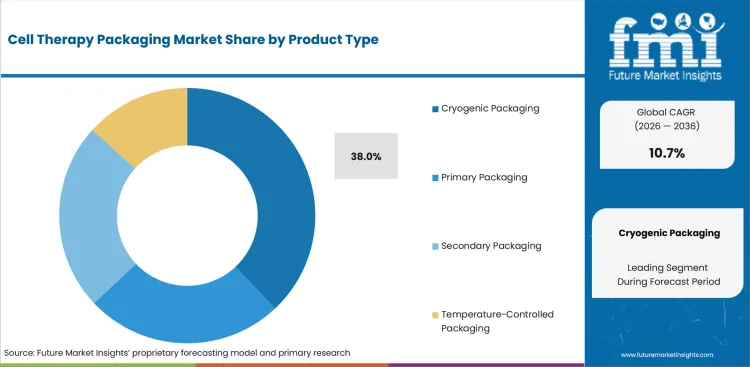
Cryogenic packaging protects frozen cell products during storage and transfer between cell therapy manufacturing sites that operate under validated quality procedures. Engineers evaluate closure integrity, material compatibility and controlled thawing performance as part of container qualification for routine clinical use.
- Cryogenic packaging is projected to hold 38.0% share in 2026 owing to routine use across deep-temperature storage and patient-dose transport through regulated clinical networks.
- Clinical networks are increasingly selecting qualified cryogenic bags and vials, driven by fewer handling changes between filling and patient administration. Protective overpacks limit transfer damage and support consistent inspection during receipt at specialized treatment centers.
How does autologous cell therapy shape packaging requirements within the application category?
Autologous workflows connect every package with one identified patient from collection through final administration at a specialist treatment center. Engineered cell therapies require traceable identifiers and controlled handoffs that preserve identity during manufacturing delays or treatment rescheduling across distant manufacturing and treatment sites.
- By application, autologous cell therapy is estimated to hold 39.0% in 2026 owing to patient-specific scheduling and chain-of-identity requirements.
- Treatment centers favor patient-specific packaging configurations over generic formats, as traceable labels and flexible container volumes preserve identity through collection timing and treatment rescheduling across distant treatment sites during routine clinical care.
Why do biopharmaceutical companies lead the end user category?
Biopharmaceutical companies define packaging specifications across stability studies and release procedures, aligning primary containers with advanced therapy products and treatment-site instructions throughout commercial quality systems from clinical development through distribution.
- Biopharmaceutical companies are set to lead the end user category with 36.0% share in 2026 due to responsibility for container qualification and change control.
- Biopharmaceutical companies purchase developer-qualified packaging through technical service agreements that align material data with filling equipment and distribution procedures across partner facilities. Consistent specifications reduce repeated validation across CDMOs and hospitals as commercial programs extend into regional treatment networks with operating procedures.
How do direct sales support qualification within the distribution channel category?
Direct commercial relationships let packaging specialists review product requirements during agreement design across regulated therapy programs and multiple treatment locations nationwide. Pharmaceutical cold chain programs often need coordinated testing for closures, insulation and tracking components across one configuration.
- Direct sales are likely to capture 42.0% share in 2026 attributable to technical qualification support and controlled replenishment agreements across regulated clinical or commercial therapy networks.
- Biopharmaceutical quality teams favor direct agreements for rapid shipment-deviation investigations and documented specification control with original manufacturers. Specialty distributors remain useful for established components that require limited application engineering during routine replenishment.
What are the drivers, restraints and opportunities in the Cell Therapy Packaging Market?
Distributed cell therapy workflows increase demand for validated packaging while system-level qualification limits changes and interoperable closed configurations support network use.
- Driver: Clinical and commercial programs need packaging that preserves viable cells and patient identity across manufacturing, storage and treatment-site delivery.
- Restraint: Qualification must cover container integrity, thermal performance and monitoring controls across physical handling or transport events.
- Opportunity: Standard interfaces between sterile packaging systems and processing equipment reduce manual transfers across distributed manufacturing networks.
Commercial cell therapy programs require consistent packaging across distributed manufacturing and treatment networks using temperature-controlled packaging solutions. United Kingdom rules effective in July 2025 formalized point-of-care and modular routes that require matched container specifications across varied equipment and transport lanes.
Primary containers must preserve integrity through storage, transport and routine handling across healthcare cold chain logistics networks. Packaging teams qualify bags, overpacks and monitoring components as one configuration to limit repeat stability work across commercial networks.
Closed cell and gene manufacturing systems reduce manual transfers during formulation and filling across regulated therapy programs. Packaging manufacturers document compatibility between processing equipment and primary containers or monitored shippers throughout each operating sequence.
Which country CAGRs are profiled in the Cell Therapy Packaging Market?
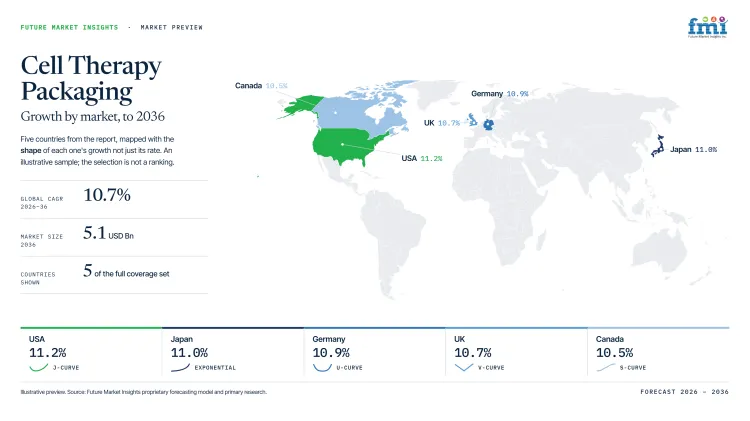
| Country | CAGR |
|---|---|
| United States | 11.2% |
| Japan | 11.0% |
| Germany | 10.9% |
| United Kingdom | 10.7% |
| Canada | 10.5% |
| South Korea | 10.1% |
How do country-level CAGRs compare in the Cell Therapy Packaging Market?
The CAGRs span 1.1 percentage points and describe forecast pace instead of market size. Similar rates conceal national pathways that change qualification costs and service requirements for packaging providers.
- The United States and Japan differ by 0.2 percentage point despite regulatory pathways and treatment-network structures.
- Japan and Germany differ by 0.1 percentage point across consultation routes and documentation expectations for packaging.
- Germany and the United Kingdom differ by 0.2 percentage point across European review and distributed manufacturing conditions.
- The United Kingdom and South Korea differ by 0.6 percentage point across service reach and manufacturing concentration.
- Forecast gaps can carry less commercial weight than qualification lead times and dependable service coverage.
Comparable CAGRs produce materially different entry conditions across national regulatory systems and specialized treatment networks. The full report covers North America, Latin America, Europe, East Asia, South Asia and Pacific, and Middle East and Africa.
Country-wise Analysis
- United States treatment networks combine experienced cell therapy centers with national cold-chain coverage, yet long transport routes complicate patient-specific scheduling and deviation investigations across distant clinical sites during narrow dosing windows nationwide. The United States is estimated to post 11.2% CAGR over the forecast period, supported by established cellular biologics pathways and specialist manufacturing capacity across commercial treatment networks serving multiple regions and treatment centers. FDA issued final CMC flexibility guidance in May 2026 and retained product-specific requirements, which require packaging teams to document container suitability and handling controls throughout clinical development and commercial distribution at every participating site.
- Japan combines metropolitan regenerative medicine centers with domestic logistics partners for controlled delivery, yet translated quality records and scheduled consultations increase qualification work for overseas packaging companies serving specialist hospitals and local manufacturing partners. Cell therapy packaging demand in Japan is forecast to rise at 11.0% CAGR over the forecast period, reinforced by structured consultations and concentrated regenerative medicine capacity across major urban centers supporting specialist programs. PMDA expanded monthly scheduling-request windows in June 2026, requiring applicants to coordinate filing timing with quality and clinical planning for regulated development programs using imported packaging configurations across specialist national treatment networks.
- Germany connects university hospitals with advanced therapy manufacturing sites across established European distribution routes, yet centralized authorization and national implementation requirements extend documentation work for packaging changes across patient-specific multicenter programs and service networks. Adoption of cell therapy packaging in Germany is estimated to expand at 10.9% CAGR through 2036, owing to specialist ATMP expertise and cross-border clinical networks supporting regulated delivery across treatment centers and manufacturers. Paul-Ehrlich-Institut updated its scientific advice information in July 2025, giving developers a central application path for manufacturing and clinical questions that affect packaging controls throughout regulated German programs across national therapy networks.
- United Kingdom cell therapy programs use academic hospitals and licensed manufacturing networks for distributed treatment, yet site variation increases training needs and consistent receipt procedures for qualified packages across regional networks and manufacturing locations. Cell therapy packaging sales in the United Kingdom are forecast to expand at 10.7% CAGR by 2036, driven by point-of-care manufacturing routes and therapy infrastructure across specialist centers and production sites. MHRA granted a manufacturing and import authorization in April 2025 to a United Kingdom stability-storage site covering cell and gene therapy products, adding a regulated import route for packaged materials entering domestic clinical programs.
- South Korea combines centralized biopharmaceutical oversight with specialist hospitals and domestic manufacturing clusters, yet service capacity remains concentrated around metropolitan treatment networks that manage complex cellular products and narrow administration schedules for patient-linked doses. In South Korea, cell therapy packaging demand is predicted to advance at 10.1% CAGR through 2036, shaped by defined cell-product controls and concentrated specialist capacity across regulated manufacturing sites and hospital networks. MFDS published guidance leaflets for human-cell management businesses and cell-processing facilities in January 2026, clarifying responsible organizations that handle cell materials across regulated domestic treatment networks under South Korea's advanced regenerative medicine framework.
Who are the notable companies in the Cell Therapy Packaging Market?
Cryoport Systems, LLC, Thermo Fisher Scientific Inc., Sartorius AG, Avantor, Inc., Azenta Life Sciences, CSafe Global, Ori Biotech Ltd. and BioLife Solutions, Inc. are the notable companies serving this market.
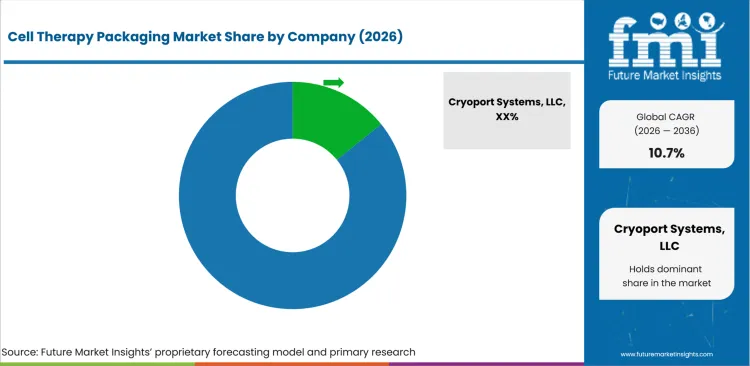
The competitive field remains fragmented as primary-container specialists and cold-chain providers control separate validated handoffs. Entry depends on material compatibility, thermal performance and technical support across manufacturing or treatment sites.
- Thermo Fisher Scientific Inc., Sartorius AG, Avantor, Inc. and Ori Biotech Ltd. connect packaging with manufacturing or fill-and-finish workflows.
- Cryoport Systems, LLC, Azenta Life Sciences and CSafe Global support cryogenic storage, monitored transport or thermal protection across treatment networks.
- BioLife Solutions, Inc. provides primary containment and biopreservation tools designed for cell and gene therapy workflows.
Competitive Benchmarking: Cell Therapy Packaging Market
| Company | Primary Container Capability | Cryogenic or Cold-Chain Capability | Cell Therapy Workflow Coverage | Geographic Reach |
|---|---|---|---|---|
| Cryoport Systems, LLC | Low | High | High | Global |
| Thermo Fisher Scientific Inc. | Medium | High | High | Global |
| Sartorius AG | Medium | High | High | Global |
| Avantor, Inc. | Medium | Low | High | 180 countries |
| Azenta Life Sciences | Low | High | High | Global |
| CSafe Global | Low | High | Medium | Global |
| Ori Biotech Ltd. | Low | Low | High | United States and United Kingdom |
| BioLife Solutions, Inc. | High | Medium | High | Global distribution network |
Key Developments in the Cell Therapy Packaging Market
- In the first quarter of 2026, Thermo Fisher Scientific Inc. launched the Gibco CTS Compleo Fill and Finish System to support scalable cell therapy formulation and filling.
- In September 2025, Ori Biotech Ltd. received FDA Advanced Manufacturing Technology designation for its closed IRO cell therapy manufacturing platform.
- In February 2025, Cryoport Systems, LLC introduced the Cryoport Express Cryogenic HV3 Shipping System for biologics requiring temperatures at or below minus 150 degrees Celsius.
Key Players in the Cell Therapy Packaging Market
Integrated Cell Therapy Processing and Packaging Platforms
- Thermo Fisher Scientific Inc.
- Sartorius AG
- Avantor, Inc.
- Ori Biotech Ltd.
Cryogenic Storage and Logistics Specialists
- Cryoport Systems, LLC
- Azenta Life Sciences
- CSafe Global
Primary Container and Biopreservation Specialist
- BioLife Solutions, Inc.
Cell Therapy Packaging Market - Report Scope
| Coverage field | Report scope |
|---|---|
| Market breakdown | By product type, application, end user, distribution channel, packaging type and region. |
| Quantitative Units | Revenue in USD billion and CAGR in % . |
| Market Definition | Packaging systems and supporting controls used to contain, protect, monitor and transport cell therapy products across clinical or commercial workflows. |
| Regions Covered | North America, Latin America, Europe, East Asia, South Asia and Pacific, and Middle East and Africa. |
| Countries Covered | United States, Japan, Germany, United Kingdom, South Korea, and 20+ countries included in the full report. |
| Key Companies Profiled | Cryoport Systems, LLC, Thermo Fisher Scientific Inc., Sartorius AG, Avantor, Inc., Azenta Life Sciences, CSafe Global, Ori Biotech Ltd. and BioLife Solutions, Inc. |
| Forecast Period | 2026 to 2036. |
| Approach | Primary and secondary research with market triangulation. |
Cell Therapy Packaging Market - Research Methodology
| Method | Approach |
|---|---|
| Primary Research | FMI analysts gathered input from manufacturers, service providers, technology developers, distributors, end users, procurement teams, and subject-matter experts. Interviews examined purchasing decisions, product or service evaluation, adoption barriers, approval requirements, pricing considerations, and expectations for technical or commercial support. Respondents were also asked what evidence is required before a trial, pilot, or initial order develops into regular purchasing. |
| Desk Research | Desk research covered government statistics, regulatory publications, trade data, industry associations, technical literature, standards, company filings, product information, and official corporate announcements. Sources were reviewed for relevance, publication date, geographic coverage, and consistency with the defined market scope. Claims relating to performance, applications, approvals, capacity, investment, and commercial activity were retained only when supported by credible public evidence. |
| Market Sizing and Forecasting | The market model combined the baseline value with historical performance, segment structure, pricing and volume indicators, adoption levels, company participation, and country-level demand conditions. Forecast assumptions considered economic activity, investment trends, regulatory developments, technology adoption, purchasing cycles, supply availability, and barriers to wider market use. Segment and regional estimates were reconciled before the final market total was calculated. |
| Data Validation | Estimates were checked against multiple independent indicators, including public data, company activity, trade patterns, industry developments, and findings from primary interviews. Validation also tested whether products, services, applications, and company revenues fell within the defined market boundaries. Adjacent categories, unsupported claims, overlapping revenues, and activities without direct market relevance were excluded to reduce double counting and maintain consistency across segments and countries. |
Cell Therapy Packaging Market by Segments
Cell Therapy Packaging Market segmented by Product Type:
- Cryogenic Packaging
- Cryogenic Bags
- Cryogenic Vials
- Primary Packaging
- Cell Therapy Bags
- Sterile Containers
- Secondary Packaging
- Insulated Shipping Containers
- Protective Cartons
- Temperature-Controlled Packaging
- Vacuum Insulated Containers
- Phase Change Material Shippers
Cell Therapy Packaging Market segmented by Application:
- Autologous Cell Therapy
- CAR-T Cell Therapy
- Stem Cell Therapy
- Allogeneic Cell Therapy
- Donor-Derived Cell Therapy
- Off-the-Shelf Cell Therapy
- Clinical Trials
- Phase I & II Studies
- Phase III Studies
- Commercial Manufacturing
- Large-Scale Cell Production
- Commercial Distribution
Cell Therapy Packaging Market segmented by End User:
- Biopharmaceutical Companies
- Cell Therapy Developers
- Biotechnology Companies
- Contract Development & Manufacturing Organizations (CDMOs)
- Cell Therapy CDMOs
- Biologics Manufacturing Organizations
- Hospitals & Cell Therapy Centers
- Transplant Centers
- Specialized Treatment Centers
- Research Institutes
- Academic Institutes
- Government Research Centers
Cell Therapy Packaging Market segmented by Distribution Channel:
- Direct Sales
- Key Account Supply
- OEM Contracts
- Specialty Distributors
- Life Science Distributors
- Medical Packaging Distributors
- Third-Party Logistics Providers
- Cold Chain Logistics
- Biopharma Logistics
- Online Sales
- Manufacturer Websites
- B2B E-Commerce Platforms
Cell Therapy Packaging Market segmented by Packaging Type:
- Cryogenic Packaging
- Liquid Nitrogen Storage Systems
- Ultra-Low Temperature Packaging
- Cold Chain Packaging
- Refrigerated Shipping Systems
- Insulated Thermal Packaging
- Sterile Single-Use Packaging
- Single-Use Bags
- Sterile Tubing Sets
- Smart Packaging
- Temperature Monitoring Devices
- GPS Tracking Systems
Cell Therapy Packaging Market by Region:
- North America
- United States
- Canada
- Mexico
- Latin America
- Brazil
- Chile
- Rest of Latin America
- Western Europe
- Germany
- United Kingdom
- Italy
- Spain
- France
- Nordics
- Benelux
- Rest of Western Europe
- Eastern Europe
- Russia
- Poland
- Hungary
- Balkan and Baltic States
- Rest of Eastern Europe
- East Asia
- China
- Japan
- South Korea
- South Asia and Pacific
- India
- ASEAN
- Australia and New Zealand
- Rest of South Asia and Pacific
- Middle East and Africa
- Kingdom of Saudi Arabia
- Other GCC Countries
- Türkiye
- South Africa
- Other African Union Countries
- Rest of Middle East and Africa
Research Sources and Bibliography
- USA Food and Drug Administration. (2026, January 11). FDA Increases Flexibility on Requirements for Cell and Gene Therapies to Advance Innovation.
- Medicines and Healthcare products Regulatory Agency. (2025, June 10). Human medicines Modular Manufacture and Point of Care regulations 2025: Overview.
- USA Food and Drug Administration. (2026, May). Chemistry, Manufacturing, and Controls Flexibilities for Developing Human Cellular and Gene Therapy Products for a Biologics License Application Guidance for Industry May 2026.
- Pharmaceuticals and Medical Devices Agency. (2026, May 29). [Regenerative medical product clinical trial consultations].
- Paul-Ehrlich-Institut. (2025, July 16). Overview of Advice Concepts.
- Medicines and Healthcare products Regulatory Agency. (2025, April 28). UK MIA(IMP) 51381.
- Ministry of Food and Drug Safety. (2026, January 20).[Guidance leaflets for human-cell management businesses and cell-processing facilities].
- Thermo Fisher Scientific Inc. (2026, April 23). Thermo Fisher Scientific Reports First Quarter 2026 Results.
- CSafe Global. (2025, October 7). CSafe Strengthens Temperature-Controlled Portfolio with the Launch of a Reusable Thermal Cover: Silverskin RE.
- Cryoport Systems. (2025, February 3). Cryoport Express Cryogenic HV3 Shipping System Expands Patient Access to Biologics and Other Temperature-Sensitive Life Saving Therapies.
- Cryoport, Inc. (2026, February 24). Annual Report on Form 10-K for the fiscal year ended December 31, 2025.
- Sartorius AG. (2026, March 16). Sartorius launches next-generation platform to boost efficiency in cell therapy production.
- Avantor, Inc. (2026, February 11). Form 10-K.
- Azenta, Inc. (2025, November 21). Azenta Reports Fourth Quarter and Full Year Fiscal 2025 Results, Ended September 30, 2025.
- Oribiotech Ltd. (2025, September 3). Ori Biotech’s IRO® Platform Receives FDA Advanced Manufacturing Technology (AMT) Designation.
- BioLife Solutions, Inc. (2026, February 26). Annual Report on Form 10-K for the fiscal year ended December 31, 2025.
- Cryoport, Inc. (2025, June 12). Cryoport Completes CRYOPDP Divestiture and Commences Strategic Partnership with DHL Group.
- Cryoport, Inc. (2025, October 1). Cryoport Systems Expands Global Footprint with New Global Supply Chain Center in Paris, France.
- BioLife Solutions, Inc. (2026, May 7). BioLife Solutions Reports First Quarter 2026 Financial Results.
- BioLife Solutions, Inc. (2026, J
- une 3). Industry-Leading Solutions for Cell-Based Therapies.
This bibliography is provided for reader reference and is not exhaustive. The full report contains the complete reference list and detailed citations.
This Report Answers
- How large is the cell therapy packaging market in 2026 and 2036?
- Which operating conditions support demand across clinical and commercial cell therapy workflows?
- Which product type accounts for the significant 2026 share within cell therapy packaging?
- How does autologous therapy influence container identification and transport scheduling?
- Which end users control packaging qualification and change management?
- How do country growth rates differ across advanced regulatory systems?
- Which companies provide primary containers, cryogenic logistics and closed processing systems?
- What currently limits packaging adoption across distributed treatment networks?
Frequently Asked Questions
How big is the cell therapy packaging market in 2026?
In 2026, the cell therapy packaging market is valued at USD 1.9 billion across primary containers and temperature-controlled configurations. Qualified materials and documented handling procedures support reliable transfer from final filling through treatment-site receipt without compromising sterility or patient identity.
What is the CAGR of the cell therapy packaging market from 2026 to 2036?
The cell therapy packaging market is projected to expand at 10.7% CAGR from 2026 to 2036. Commercial growth depends on qualified containers and repeatable thermal controls that perform consistently across distributed manufacturing networks and specialist treatment centers during routine transfers.
Which product type is projected to account for 38.0% of the cell therapy packaging market?
Cryogenic packaging is projected to account for 38.0% by product type in the cell therapy packaging market during 2026. Frozen cell products require qualified bags or vials that withstand deep-temperature storage and controlled thawing across patient-dose transport and treatment receipt.
Which application is projected to account for 39.0% of the cell therapy packaging market?
Autologous cell therapy is projected to account for 39.0% by application in the cell therapy packaging market during 2026. Patient-specific doses require traceable labels and controlled handoffs that preserve identity across collection or manufacturing and final administration at specialist centers.
Which end user is projected to account for 36.0% of the cell therapy packaging market?
Biopharmaceutical companies are projected to account for 36.0% by end user in the cell therapy packaging market during 2026. Their quality teams define container specifications and change controls that partner manufacturers or treatment centers must follow across commercial networks.
Which distribution channel is projected to account for 42.0% of the cell therapy packaging market?
Direct sales are projected to account for 42.0% by distribution channel in the cell therapy packaging market during 2026. Technical relationships with original manufacturers support qualification work and controlled replenishment across clinical or commercial therapy networks during regular supply.
How much is the cell therapy packaging market expected to add between 2026 and 2036?
USD 3.4 billion is expected to be added to the cell therapy packaging market between 2026 and 2036. Additional value depends on expanding therapy programs and packaging configurations that preserve sterility or temperature control across repeated clinical handoffs and treatment delivery.
Which companies are active in the cell therapy packaging market?
Eight companies are profiled in the cell therapy packaging market across containers and temperature-controlled logistics or processing workflows. Cryoport Systems, Thermo Fisher Scientific, Sartorius, Avantor, Azenta Life Sciences, CSafe Global, Ori Biotech and BioLife Solutions represent the verified company set.
Preview the report firsthand - request a free sample
Get SampleGet the brochure for pricing and purchase details.
Get PDFTable of Content
- Key Takeaways
- Market Size and CAGR
- Top Growth Driver
- Fastest Growing Segment
- Leading Region
- Key Companies
- Emerging Opportunities
- Executive Summary
- Global Market Outlook
- Demand-side Trends
- Supply-side Trends
- Technology Roadmap Analysis
- Analysis and Recommendations
- Analyst Perspective (What is happening? Why now? What should investors know?)
- Key Questions Answered
- How large is the market?
- What is the CAGR?
- What are key trends?
- Which region dominates?
- Who are the leaders?
- Market Overview
- Market Coverage / Taxonomy
- Market Definition / Scope / Limitations
- Research Methodology
- Chapter Orientation
- Analytical Lens and Working Hypotheses
- Market Structure, Signals, and Trend Drivers
- Benchmarking and Cross-market Comparability
- Market Sizing, Forecasting, and Opportunity Mapping
- Research Design and Evidence Framework
- Desk Research Programme (Secondary Evidence)
- Expert Input and Fieldwork (Primary Evidence)
- Tooling, Models, and Reference Databases
- Data Engineering and Model Build
- Quality Assurance and Audit Trail
- Market Background
- Market Dynamics (Drivers, Restraints, Opportunity, Trends)
- Scenario Forecast (Optimistic, Likely, Conservative)
- Impact Analysis
- AI Impact
- Sustainability Impact
- Regulatory Impact
- Technology Impact
- Consumer / Buyer Analysis
- Purchase Drivers
- Adoption Barriers
- Buyer Journey
- Opportunity Map Analysis
- Product Life Cycle Analysis
- Supply Chain Analysis
- Investment Feasibility Matrix
- Value Chain Analysis
- PESTLE and Porter's Analysis
- Regulatory Landscape
- Regional Parent Market Outlook
- Production and Consumption Statistics
- Import and Export Statistics
- Global Market Analysis and Forecast, 2021 to 2036
- Historical Market Size Value (USD Billion) Analysis, 2021 to 2025
- Current and Future Market Size Value (USD Billion) Projections, 2026 to 2036
- Y-o-Y Growth Trend Analysis
- Absolute $ Opportunity Analysis
- Global Market Pricing Analysis, 2021 to 2036
- Global Market Analysis and Forecast, By Product Type, 2021 to 2036
- Introduction / Key Findings
- Historical Market Size Value (USD Billion) Analysis By Product Type, 2021 to 2025
- Current and Future Market Size Value (USD Billion) Analysis and Forecast By Product Type, 2026 to 2036
- Cryogenic Packaging
- Cryogenic Bags
- Cryogenic Vials
- Primary Packaging
- Cell Therapy Bags
- Sterile Containers
- Secondary Packaging
- Insulated Shipping Containers
- Protective Cartons
- Temperature-Controlled Packaging
- Vacuum Insulated Containers
- Phase Change Material Shippers
- Cryogenic Packaging
- Y-o-Y Growth Trend Analysis By Product Type, 2021 to 2025
- Absolute $ Opportunity Analysis By Product Type, 2026 to 2036
- Global Market Analysis and Forecast, By Application, 2021 to 2036
- Introduction / Key Findings
- Historical Market Size Value (USD Billion) Analysis By Application, 2021 to 2025
- Current and Future Market Size Value (USD Billion) Analysis and Forecast By Application, 2026 to 2036
- Autologous Cell Therapy
- CAR-T Cell Therapy
- Stem Cell Therapy
- Allogeneic Cell Therapy
- Donor-Derived Cell Therapy
- Off-the-Shelf Cell Therapy
- Clinical Trials
- Phase I & II Studies
- Phase III Studies
- Commercial Manufacturing
- Large-Scale Cell Production
- Commercial Distribution
- Autologous Cell Therapy
- Y-o-Y Growth Trend Analysis By Application, 2021 to 2025
- Absolute $ Opportunity Analysis By Application, 2026 to 2036
- Global Market Analysis and Forecast, By End User, 2021 to 2036
- Introduction / Key Findings
- Historical Market Size Value (USD Billion) Analysis By End User, 2021 to 2025
- Current and Future Market Size Value (USD Billion) Analysis and Forecast By End User, 2026 to 2036
- Biopharmaceutical Companies
- Cell Therapy Developers
- Biotechnology Companies
- Contract Development & Manufacturing Organizations (CDMOs)
- Cell Therapy CDMOs
- Biologics Manufacturing Organizations
- Hospitals & Cell Therapy Centers
- Transplant Centers
- Specialized Treatment Centers
- Research Institutes
- Academic Institutes
- Government Research Centers
- Biopharmaceutical Companies
- Y-o-Y Growth Trend Analysis By End User, 2021 to 2025
- Absolute $ Opportunity Analysis By End User, 2026 to 2036
- Global Market Analysis and Forecast, By Distribution Channel, 2021 to 2036
- Introduction / Key Findings
- Historical Market Size Value (USD Billion) Analysis By Distribution Channel, 2021 to 2025
- Current and Future Market Size Value (USD Billion) Analysis and Forecast By Distribution Channel, 2026 to 2036
- Direct Sales
- Key Account Supply
- OEM Contracts
- Specialty Distributors
- Life Science Distributors
- Medical Packaging Distributors
- Third-Party Logistics Providers
- Cold Chain Logistics
- Biopharma Logistics
- Online Sales
- Manufacturer Websites
- B2B E-Commerce Platforms
- Direct Sales
- Y-o-Y Growth Trend Analysis By Distribution Channel, 2021 to 2025
- Absolute $ Opportunity Analysis By Distribution Channel, 2026 to 2036
- Global Market Analysis and Forecast, By Packaging Type, 2021 to 2036
- Introduction / Key Findings
- Historical Market Size Value (USD Billion) Analysis By Packaging Type, 2021 to 2025
- Current and Future Market Size Value (USD Billion) Analysis and Forecast By Packaging Type, 2026 to 2036
- Cryogenic Packaging
- Liquid Nitrogen Storage Systems
- Ultra-Low Temperature Packaging
- Cold Chain Packaging
- Refrigerated Shipping Systems
- Insulated Thermal Packaging
- Sterile Single-Use Packaging
- Single-Use Bags
- Sterile Tubing Sets
- Smart Packaging
- Temperature Monitoring Devices
- GPS Tracking Systems
- Cryogenic Packaging
- Y-o-Y Growth Trend Analysis By Packaging Type, 2021 to 2025
- Absolute $ Opportunity Analysis By Packaging Type, 2026 to 2036
- Global Market Analysis and Forecast, By Region, 2021 to 2036
- Introduction
- Historical Market Size Value (USD Billion) Analysis By Region, 2021 to 2025
- Current Market Size Value (USD Billion) Analysis and Forecast By Region, 2026 to 2036
- North America
- Latin America
- Western Europe
- Eastern Europe
- East Asia
- South Asia and Pacific
- Middle East & Africa
- Market Attractiveness Analysis By Region
- North America Market Analysis and Forecast, By Country, 2021 to 2036
- Historical Market Size Value (USD Billion) Trend Analysis By Market Taxonomy, 2021 to 2025
- Market Size Value (USD Billion) Forecast By Market Taxonomy, 2026 to 2036
- By Country
- USA
- Canada
- By Product Type
- By Application
- By End User
- By Distribution Channel
- By Packaging Type
- By Country
- Market Attractiveness Analysis
- By Country
- By Product Type
- By Application
- By End User
- By Distribution Channel
- By Packaging Type
- Key Takeaways
- Latin America Market Analysis and Forecast, By Country
- Historical Market Size Value (USD Billion) Trend Analysis By Market Taxonomy, 2021 to 2025
- Market Size Value (USD Billion) Forecast By Market Taxonomy, 2026 to 2036
- By Country
- Brazil
- Mexico
- Chile
- Rest of Latin America
- By Product Type
- By Application
- By End User
- By Distribution Channel
- By Packaging Type
- By Country
- Market Attractiveness Analysis
- By Country
- By Product Type
- By Application
- By End User
- By Distribution Channel
- By Packaging Type
- Key Takeaways
- Western Europe Market Analysis and Forecast, By Country
- Historical Market Size Value (USD Billion) Trend Analysis By Market Taxonomy, 2021 to 2025
- Market Size Value (USD Billion) Forecast By Market Taxonomy, 2026 to 2036
- By Country
- Germany
- UK
- Italy
- Spain
- France
- Nordic
- BENELUX
- Rest of Western Europe
- By Product Type
- By Application
- By End User
- By Distribution Channel
- By Packaging Type
- By Country
- Market Attractiveness Analysis
- By Country
- By Product Type
- By Application
- By End User
- By Distribution Channel
- By Packaging Type
- Key Takeaways
- Eastern Europe Market Analysis and Forecast, By Country
- Historical Market Size Value (USD Billion) Trend Analysis By Market Taxonomy, 2021 to 2025
- Market Size Value (USD Billion) Forecast By Market Taxonomy, 2026 to 2036
- By Country
- Russia
- Poland
- Hungary
- Balkan & Baltic
- Rest of Eastern Europe
- By Product Type
- By Application
- By End User
- By Distribution Channel
- By Packaging Type
- By Country
- Market Attractiveness Analysis
- By Country
- By Product Type
- By Application
- By End User
- By Distribution Channel
- By Packaging Type
- Key Takeaways
- East Asia Market Analysis and Forecast, By Country
- Historical Market Size Value (USD Billion) Trend Analysis By Market Taxonomy, 2021 to 2025
- Market Size Value (USD Billion) Forecast By Market Taxonomy, 2026 to 2036
- By Country
- China
- Japan
- South Korea
- By Product Type
- By Application
- By End User
- By Distribution Channel
- By Packaging Type
- By Country
- Market Attractiveness Analysis
- By Country
- By Product Type
- By Application
- By End User
- By Distribution Channel
- By Packaging Type
- Key Takeaways
- South Asia and Pacific Market Analysis and Forecast, By Country
- Historical Market Size Value (USD Billion) Trend Analysis By Market Taxonomy, 2021 to 2025
- Market Size Value (USD Billion) Forecast By Market Taxonomy, 2026 to 2036
- By Country
- India
- ASEAN
- Australia & New Zealand
- Rest of South Asia and Pacific
- By Product Type
- By Application
- By End User
- By Distribution Channel
- By Packaging Type
- By Country
- Market Attractiveness Analysis
- By Country
- By Product Type
- By Application
- By End User
- By Distribution Channel
- By Packaging Type
- Key Takeaways
- Middle East & Africa Market Analysis and Forecast, By Country
- Historical Market Size Value (USD Billion) Trend Analysis By Market Taxonomy, 2021 to 2025
- Market Size Value (USD Billion) Forecast By Market Taxonomy, 2026 to 2036
- By Country
- Kingdom of Saudi Arabia
- Other GCC Countries
- Türkiye
- South Africa
- Other African Union
- Rest of Middle East & Africa
- By Product Type
- By Application
- By End User
- By Distribution Channel
- By Packaging Type
- By Country
- Market Attractiveness Analysis
- By Country
- By Product Type
- By Application
- By End User
- By Distribution Channel
- By Packaging Type
- Key Takeaways
- Key Countries Market Analysis
- USA
- Pricing Analysis
- Market Share Analysis, 2025
- By Product Type
- By Application
- By End User
- By Distribution Channel
- By Packaging Type
- Canada
- Pricing Analysis
- Market Share Analysis, 2025
- By Product Type
- By Application
- By End User
- By Distribution Channel
- By Packaging Type
- Mexico
- Pricing Analysis
- Market Share Analysis, 2025
- By Product Type
- By Application
- By End User
- By Distribution Channel
- By Packaging Type
- Brazil
- Pricing Analysis
- Market Share Analysis, 2025
- By Product Type
- By Application
- By End User
- By Distribution Channel
- By Packaging Type
- Chile
- Pricing Analysis
- Market Share Analysis, 2025
- By Product Type
- By Application
- By End User
- By Distribution Channel
- By Packaging Type
- Germany
- Pricing Analysis
- Market Share Analysis, 2025
- By Product Type
- By Application
- By End User
- By Distribution Channel
- By Packaging Type
- UK
- Pricing Analysis
- Market Share Analysis, 2025
- By Product Type
- By Application
- By End User
- By Distribution Channel
- By Packaging Type
- Italy
- Pricing Analysis
- Market Share Analysis, 2025
- By Product Type
- By Application
- By End User
- By Distribution Channel
- By Packaging Type
- Spain
- Pricing Analysis
- Market Share Analysis, 2025
- By Product Type
- By Application
- By End User
- By Distribution Channel
- By Packaging Type
- France
- Pricing Analysis
- Market Share Analysis, 2025
- By Product Type
- By Application
- By End User
- By Distribution Channel
- By Packaging Type
- India
- Pricing Analysis
- Market Share Analysis, 2025
- By Product Type
- By Application
- By End User
- By Distribution Channel
- By Packaging Type
- ASEAN
- Pricing Analysis
- Market Share Analysis, 2025
- By Product Type
- By Application
- By End User
- By Distribution Channel
- By Packaging Type
- Australia & New Zealand
- Pricing Analysis
- Market Share Analysis, 2025
- By Product Type
- By Application
- By End User
- By Distribution Channel
- By Packaging Type
- China
- Pricing Analysis
- Market Share Analysis, 2025
- By Product Type
- By Application
- By End User
- By Distribution Channel
- By Packaging Type
- Japan
- Pricing Analysis
- Market Share Analysis, 2025
- By Product Type
- By Application
- By End User
- By Distribution Channel
- By Packaging Type
- South Korea
- Pricing Analysis
- Market Share Analysis, 2025
- By Product Type
- By Application
- By End User
- By Distribution Channel
- By Packaging Type
- Russia
- Pricing Analysis
- Market Share Analysis, 2025
- By Product Type
- By Application
- By End User
- By Distribution Channel
- By Packaging Type
- Poland
- Pricing Analysis
- Market Share Analysis, 2025
- By Product Type
- By Application
- By End User
- By Distribution Channel
- By Packaging Type
- Hungary
- Pricing Analysis
- Market Share Analysis, 2025
- By Product Type
- By Application
- By End User
- By Distribution Channel
- By Packaging Type
- Kingdom of Saudi Arabia
- Pricing Analysis
- Market Share Analysis, 2025
- By Product Type
- By Application
- By End User
- By Distribution Channel
- By Packaging Type
- Türkiye
- Pricing Analysis
- Market Share Analysis, 2025
- By Product Type
- By Application
- By End User
- By Distribution Channel
- By Packaging Type
- South Africa
- Pricing Analysis
- Market Share Analysis, 2025
- By Product Type
- By Application
- By End User
- By Distribution Channel
- By Packaging Type
- USA
- Market Structure Analysis
- Competition Dashboard
- Competition Benchmarking
- Market Share Analysis of Top Players
- By Regional
- By Product Type
- By Application
- By End User
- By Distribution Channel
- By Packaging Type
- Emerging Startups
- Innovation Benchmarking
- Competition Analysis
- Competition Deep Dive
- Cryoport Systems, LLC
- Overview
- Product Portfolio
- Profitability by Market Segments
- Sales Footprint
- Strategy Overview
- Marketing Strategy
- Product Strategy
- Channel Strategy
- Thermo Fisher Scientific Inc.
- Sartorius AG
- Avantor, Inc.
- Azenta Life Sciences
- CSafe Global
- Air Liquide Healthcare
- Ori Biotech Ltd.
- BioLife Solutions, Inc.
- Charter Medical, LLC
- Cryoport Systems, LLC
- Case Studies
- Success Stories
- Recent Developments
- Competition Deep Dive
- Assumptions & Acronyms Used


