

- Market Size (2026)
- USD 914.3 Mn
- Forecast (2036)
- USD 3566.6 Mn
- CAGR (2026 to 2036)
- 14.6%
How big is CRISPR Stem Cell Differentiation Market in 2026?
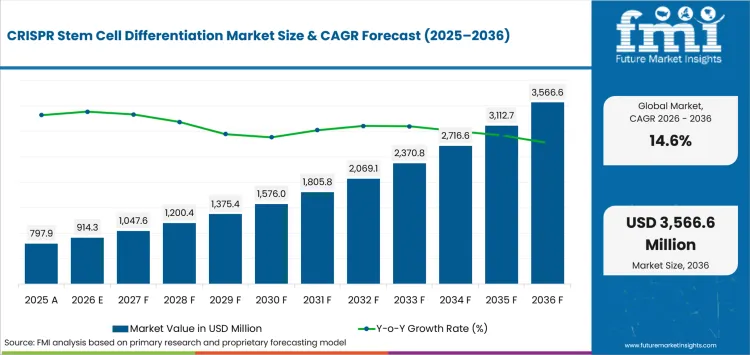
USD 914.3 million in 2026 and USD 3566.6 million by 2036 at a 14.6% CAGR.
Demand for CRISPR stem cell differentiation is forecast to expand at 14.6% CAGR through 2036, with valuation increasing from USD 914.3 million in 2026 to USD 3,566.6 million by 2036. Therapeutic developers require edited stem cells that preserve genomic identity and predictable lineage behavior throughout expansion and regulated manufacturing. In the United States during July 2026, the FDA expanded Casgevy eligibility to patients aged two years and older using CRISPR/Cas9-edited autologous hematopoietic stem cells. The approval confirms a commercial route that connects genome editing with cell processing and controlled reinfusion under formal product requirements. Programs using CRISPR gene editing need validated reagents and assays that preserve genotype through clone recovery and downstream lineage specification. Related stem cell therapies require documented identity and potency evidence before clinical teams can judge whether an edited population remains suitable. Purchasing therefore favors integrated platforms that reduce failed clones and support consistent transfer from research laboratories into regulated production.
United States developers work within detailed FDA expectations for genome-editing design and manufacturing evidence, whereas Japanese programs use a dedicated regenerative medicine framework. Japan’s amended regenerative medicine safety law took effect in May 2025 and formalized updated requirements for research and clinical provision. American programs usually fund extensive characterization earlier as federal reviewers assess product design and comparability across manufacturing changes. Japanese programs plan postmarket evidence under conditional and time-limited approvals for regulated regenerative medicine products. Both routes create spending on quality systems and specialist support, although each route assigns validation cost and timing differently. Commercial teams require partners that preserve edited-cell identity through scale-up and controlled release across repeated production campaigns. Market access depends on regulatory documentation and service continuity rather than one successful differentiation experiment.
Key Takeaways of CRISPR Stem Cell Differentiation Market
- Demand for CRISPR stem cell differentiation solutions is driven by therapeutic programs requiring edited stem cells that retain identity and predictable lineage behavior across research and regulated production.
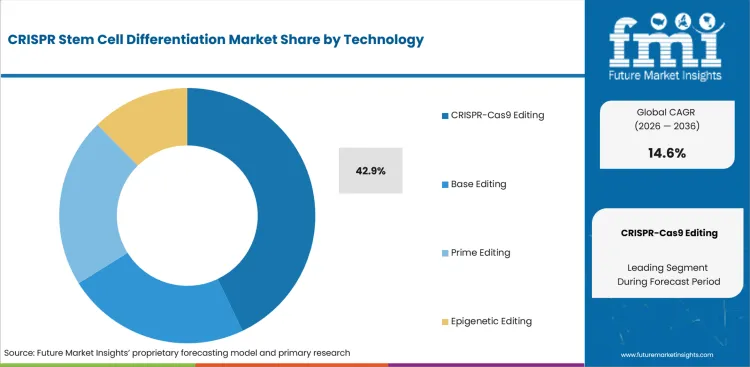
- By technology, CRISPR-Cas9 editing holds the leading share at 42.9% in 2026, attributable to established protocols and broad experimental familiarity.
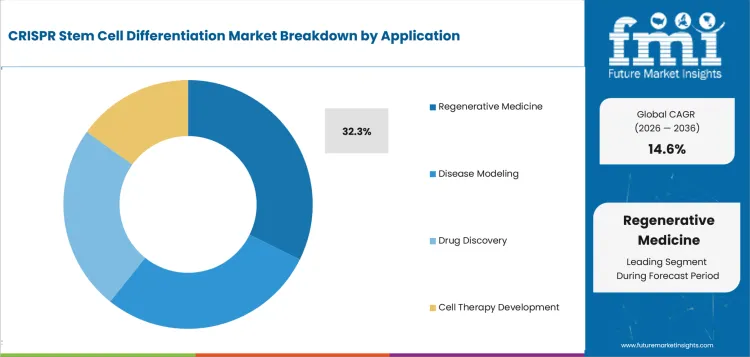
- Regenerative medicine is the dominant application segment, holding 32.3% share in 2026, driven by developers connecting edited cells with repair and replacement strategies.
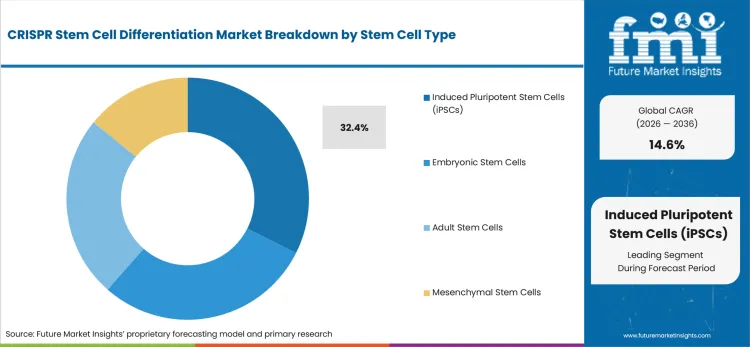
- Induced pluripotent stem cells lead the stem cell type category with 32.4% share in 2026, owing to renewable supply and broad lineage potential.
- Biopharmaceutical companies account for 40.2% of end-user spending in 2026, supported by regulated programs requiring sustained analytical and manufacturing support.
- The United States records the highest growth rate at 16.4% CAGR through the assessment period, with Japan's regenerative medicine pathway and iPSC infrastructure, and the UK's translational centers also shaping regional expansion.
- Competition centers on Thermo Fisher Scientific, Merck KGaA, Revvity, EditCo Bio, Applied StemCell, Takara Bio, STEMCELL Technologies, and ATCC, with vendors differentiating through editing reagents and differentiation tools, engineered-cell platforms, and characterized cell resource supply.
Analyst Perspective
"The stem cell genome editing market is moving beyond editing efficiency toward reproducible manufacturing and regulatory readiness. Developers are prioritizing platforms that preserve genomic integrity, deliver consistent cell differentiation, and support scalable production. Competitive advantage will favor companies that simplify technology transfer, strengthen quality assurance, and reduce development risk across clinical and commercial programs."
- Anurag Sharma,, Principal Analyst at Future Market Insights
Source: FMI’s proprietary forecasting model and primary research
How is the CRISPR Stem Cell Differentiation Market segmented?
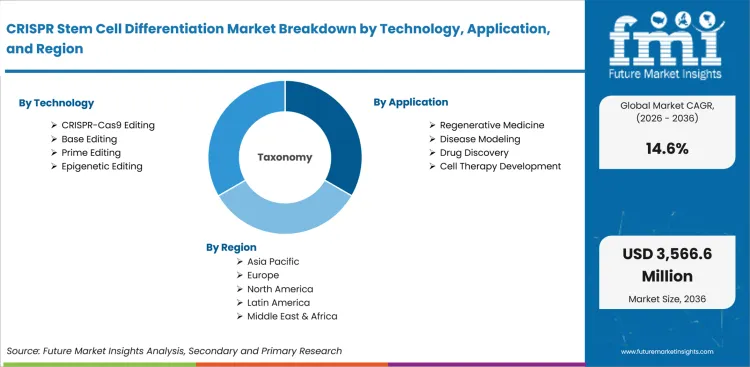
The CRISPR stem cell differentiation industry is segmented by technology, application, stem cell type, end user, and region.
The technology category separates CRISPR-Cas9 editing from base editing, prime editing and epigenetic editing according to precision and repair requirements. Application classifies regenerative medicine alongside disease modeling, drug discovery and cell therapy development through each program objective. Stem cell type separates induced pluripotent cells from embryonic, adult and mesenchymal populations with different culture constraints. End user identifies biopharmaceutical companies alongside academic institutes, contract research organizations and biotechnology companies through purchasing responsibility. Regional analysis compares national approval pathways and service access across the fixed geographic taxonomy for commercial planning.
What supports adoption of CRISPR-Cas9 editing within the technology category?
CRISPR-Cas9 editing gives laboratories a direct method for creating defined genomic changes before stem-cell differentiation begins. Development teams must detect unintended edits before a selected clone enters lineage optimization or regulated manufacturing. In the United States during April 2026, the FDA issued draft guidance recommending next-generation sequencing methods for off-target assessment and genomic integrity testing in human gene therapies. Laboratories therefore use single-cell systems to connect editing results with clone identity and lineage performance. Commercial platforms gain value through validated reagents and interpretable assays rather than editing activity alone.
- Within technology, CRISPR-Cas9 editing is projected to account for 42.9% share in 2026, attributable to established protocols and broad compatibility with stem-cell workflows. Its position reflects practical familiarity across research laboratories and regulated programs that require repeatable validation across several cell sources.
- Biopharmaceutical laboratories select CRISPR-Cas9 systems as established guide design and screening methods reduce development uncertainty across several cell types. Adoption depends on assay sensitivity and clone recovery rather than nominal cleavage efficiency during difficult expansion and differentiation work across regulated development programs.
How does regenerative medicine influence purchasing within the application category?
Regenerative medicine programs require edited cells to perform a defined replacement or repair function after lineage specification. Commercial teams evaluate culture conditions and potency measures beside editing accuracy throughout each development stage. Relevant 3D cell culture systems can expose behavior that simple monolayer assays fail to represent during tissue-oriented testing. Purchasing expands as developers connect molecular edits with reproducible cellular function across therapeutic models requiring repeatable performance.
- By application, regenerative medicine is estimated to hold 32.3% share in 2026, driven by its direct connection with therapeutic cell replacement. In January 2025, researchers from the Ragon Institute and CRISPR Therapeutics reported more than 90% CCR5 editing in human HSPCs. The United States-led study also documented normal hematopoiesis in xenograft mice with Kirby Institute participation.
- Cell therapy developers invest in regenerative applications as edited cells retain identity and measurable function through expansion and delivery preparation. Program sponsors require service partners that preserve critical attributes across larger production batches and repeated potency assessments during manufacturing transfer.
Why are induced pluripotent stem cells central to the stem cell type category?
Induced pluripotent stem cells combine renewable expansion with the ability to produce several specialized lineages from one donor background. Researchers use induced pluripotent stem cells to compare edited and unedited clones without changing the starting genetic context. In July 2025, the Berlin Institute of Health at Charité reported that a CRISPR-corrected iPSC line retained a normal karyotype and trilineage differentiation capacity in Germany. The result supports model development that separates a targeted mutation from unrelated donor variation during downstream testing.
- Induced pluripotent stem cells are forecast to represent 32.4% of stem cell type in 2026, owing to renewable supply and broad lineage potential. Their position also reflects repeated use across disease modeling and cell therapy programs that need matched genetic controls.
- Disease-model developers select edited iPSC lines as matched controls preserve one donor background across direct comparisons. Adoption depends on consistent differentiation across clones with different editing histories and extended culture exposure. Standardized cell banks reduce repeated donor sourcing but require strong genomic and phenotypic release criteria across every distribution batch.
What makes biopharmaceutical companies central to the end user category?
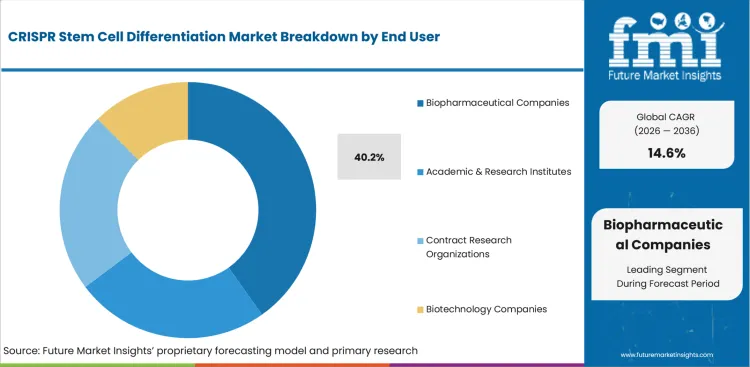
Biopharmaceutical companies manage the longest path from an edited stem-cell concept through manufacturing and clinical evidence. Regulated programs need coordinated product design and analytical controls across several development stages and manufacturing transfer. In the United States during January 2024, the FDA finalized guidance covering product design and manufacturing testing alongside clinical considerations for human genome-editing therapies. Programs involving hematopoietic stem cell transplantation also require controlled collection and reinfusion pathways beside the editing workflow. Commercial spending therefore spans reagents and services across development stages with different evidence requirements and operating responsibilities.
- By end user, biopharmaceutical companies are expected to represent 40.2% share in 2026, supported by sustained responsibility for regulated product development. The segment position reflects repeated spending across editing and characterization plus differentiation and manufacturing transfer throughout extended regulated programs.
- Drug developers outsource specialized steps as internal laboratories cannot maintain every assay or manufacturing capability across complete programs. Service selection depends on data continuity and clear responsibility for failed clones or inconsistent lineage output. Contract terms must define data ownership and corrective responsibilities before larger commercial scale-up campaigns begin.
What are the drivers, restraints, and opportunities in the CRISPR Stem Cell Differentiation Market?
Demand grows through validated therapeutic programs; adoption slows under genomic and manufacturing uncertainty; measurement standards create openings for more comparable development workflows.
- Driver: Approved gene-editing therapies create demand for editing reagents and controlled stem-cell processing across regulated development programs.
- Restraint: Genomic integrity and biological raw-material controls create substantial validation work across research transfer and regulated manufacturing.
- Opportunity: Shared measurement standards can reduce disagreement between laboratories and improve confidence in edited-cell performance across development stages.
Approved gene-editing therapies create a direct need for editing reagents and controlled stem-cell processing across regulated development programs. In the United States during January 2024, the FDA approved Casgevy for transfusion-dependent beta-thalassemia using CRISPR/Cas9-edited autologous hematopoietic stem cells. The action connects a defined edit with stem-cell collection and reinfusion under formal product requirements. Developers pursuing related programs require assays that confirm genomic integrity and consistent cellular attributes during manufacturing. Demand expands across reagents and analytical services as more programs prepare evidence for regulatory review.
Biological raw materials can introduce contamination and traceability risks throughout edited-cell expansion and manufacturing transfer. Material risks increase validation work as developers must qualify media and matrices beside genomic integrity and lineage identity. In the United States during April 2024, the FDA issued draft guidance addressing material qualification and control for cell and gene therapy products. Smaller developers may delay expansion as qualified materials and analytical packages exceed available technical budgets. Adoption improves through traceable inputs and documentation that remains usable during formal regulatory submissions and later manufacturing reviews.
Shared measurement standards create an opening for laboratories that need comparable results across editing and downstream cell characterization. In the United States during April 2026, the NIST Genome Editing Consortium updated its program and continued developing reference methods with common terminology. Tool developers can align gene editing delivery measurements with shared definitions without replacing product-specific validation for each edited-cell program. Commercial value emerges through lower method-transfer friction across independent research partners and manufacturing organizations using comparable measurements.
Which country CAGRs are profiled in the CRISPR Stem Cell Differentiation Market?
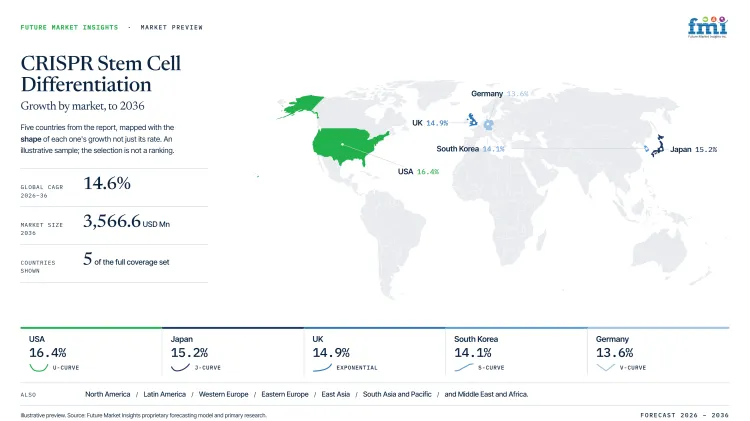
| Country | CAGR |
|---|---|
| USA | 16.4% |
| UK | 14.9% |
| Germany | 13.6% |
| Japan | 15.2% |
| South Korea | 14.1% |
How do country-level CAGRs compare in the CRISPR Stem Cell Differentiation Market?
The country forecasts span 2.8 percentage points and form a compressed range rather than separate growth tiers. The USA sits 1.2 percentage points above Japan within the displayed comparison and maintains modest numerical separation. Japan remains 0.3 percentage points above the UK, which places both countries inside a closely compressed group. South Korea stands 0.8 points below the UK and 0.5 points above Germany. The measured spacing suggests shared commercial interest in edited stem-cell platforms without proving equal regulatory access or current revenue. Each country converts scientific capacity into purchasing through different approval timing and specialist production support.
- The USA occupies the upper portion through established regulatory engagement and broad access to genome-editing tools across several research hubs.
- Japan follows closely through a dedicated regenerative medicine pathway and public investment in iPSC translation across academic and commercial programs.
- The UK holds the middle position through translational centers that connect academic research with manufacturing preparation and clinical planning.
- South Korea remains near the middle cluster through public stem-cell resources but requires deeper GMP transfer and specialist service coverage.
- Germany sits 0.5 points below South Korea as formal stem-cell authorization and safety documentation extend project preparation for regulated cell lines.
Similar CAGRs can therefore produce different entry conditions through regulatory cost and service readiness across local development networks. Commercial plans must assess distributor access and assay transfer plus training and manufacturing distance within each country. The full report provides country-level CAGR analysis across North America, Latin America, Europe, East Asia, South Asia, Oceania and the Middle East and Africa.
Country-wise Analysis
- United States developers operate through an established FDA pathway for genome-edited human gene therapy products and direct access to national laboratory suppliers. Demand for CRISPR stem cell differentiation in the USA is forecast to rise at 16.4% CAGR through 2036, supported by sustained therapeutic development activity. In the United States during June 2026, the FDA issued draft guidance on using prior knowledge across genome-editing products with related design features. Biopharmaceutical companies can source editing tools and technical training directly from platform providers across several research hubs. Regulatory comparability remains a material friction as developers must justify manufacturing changes and assay transfers. Market entry requires strong application support and clear documentation responsibility across internal teams and external service laboratories.
- The United Kingdom combines specialist translational centers with public health assessment and an established advanced-therapy manufacturing network. Demand for CRISPR stem cell differentiation in the UK is projected to record 14.9% CAGR by 2036, owing to continued translational activity. In the United Kingdom during November 2025, Cell and Gene Therapy Catapult reported working with 70 companies during the previous financial year. Local developers can access process-development facilities and training through national centers before committing to larger commercial capacity. Scale-up financing remains uneven for smaller biotechnology companies that need prolonged assay development and GMP readiness. Commercial entrants need partnerships that connect editing expertise with manufacturing support and realistic funding milestones.
- German projects using human embryonic stem cells operate under a formal authorization process administered through the Robert Koch Institute. Germany’s CRISPR stem cell differentiation market is anticipated to advance at 13.6% CAGR over the assessment period, supported by regulated preclinical development. In Germany during May 2025, the Robert Koch Institute authorized a Technical University of Munich study involving genetically modified H9-derived pancreatic beta cells. The authorization covered GMP product work plus testing for tumorigenicity and biodistribution under defined transplantation conditions. European suppliers provide editing reagents and service support but legal documentation can extend project preparation. Commercial plans need early regulatory review and validated safety assays before laboratories commit to larger differentiation campaigns.
- Japan operates a dedicated regenerative medicine framework and supports nationwide iPSC development through public research programs. Adoption of CRISPR stem cell differentiation in Japan is estimated to expand at 15.2% CAGR through 2036, driven by substantial iPSC translation capacity. In March 2026, AMED reported conditional and time-limited marketing approvals for RiHEART and AMCHEPRY as Japan’s first practical iPSC therapeutic products. Local cell therapy manufacturing capabilities and Takara Bio support reduce service distance for Japanese laboratories. Conditional approvals create a material requirement for postmarket evidence and consistent manufacturing transfer controls during commercialization. Market entrants need Japanese-language application support and partners that sustain quality documentation beyond initial clinical deployment.
- South Korea supports stem-cell research through a national bank that supplies characterized lines to universities and commercial organizations. South Korea’s CRISPR stem cell differentiation sector is estimated to post 14.1% CAGR by 2036, supported by expanding institutional access. In June 2026, the Korea National Institute of Health reported 139 cell-resource distributions to 52 research organizations during 2025. Clinical-grade iPSC supply creates an adoption enabler for teams starting cell-therapy programs with documented source materials. Commercial scale-up remains constrained by local GMP transfer requirements and validated lineage protocols beyond banked-cell access. Platform providers need distributor training and manufacturing partnerships that connect research supply with regulated production.
Who are the notable companies in the CRISPR Stem Cell Differentiation Market?
Thermo Fisher Scientific, Merck KGaA, STEMCELL Technologies, Revvity, EditCo Bio, Applied StemCell, ATCC, and Takara Bio are the notable companies shaping this market.
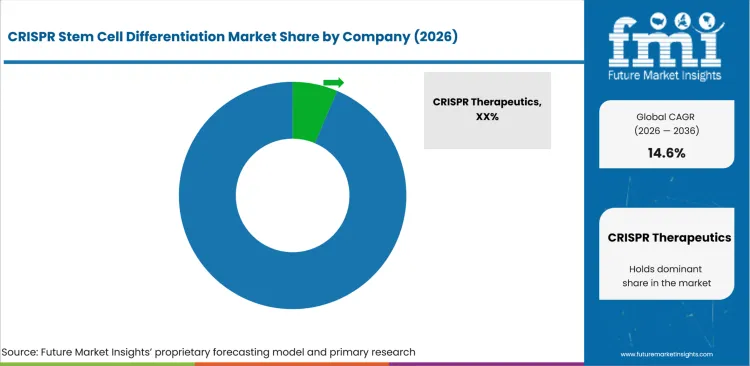
The competitive field includes broad laboratory platforms and specialist engineered-cell providers that support different stages of one development pathway. Integrated suppliers compete through compatible editing reagents and differentiation systems across recurring internal research programs. Specialist companies compete through custom engineering and downstream services for organizations that cannot build every capability. Authenticated model providers reduce stable cell line development time by supplying characterized edited lines with documented provenance and quality records. Commercial selection depends on exact workflow coverage and service accountability rather than corporate scale alone.
- Thermo Fisher Scientific and Merck KGaA support internal laboratories through genome-editing reagents and structured differentiation products across several cell types. Takara Bio combines editing tools with regional technical support and custom stem-cell services for complex development projects.
- Revvity and EditCo Bio focus on engineered-cell platforms with distinct editing approaches and commercial access models. Applied StemCell extends custom engineering through iPSC differentiation and GMP-oriented development support for therapeutic programs. Custom engineering services suit organizations that require specialized cells without maintaining a complete internal engineering department.
- STEMCELL Technologies and ATCC supply characterized edited models with compatible culture or differentiation resources for defined applications. Their offerings reduce model-construction work across disease research and preclinical screening programs that require matched controls. Consistent provenance also supports reliable comparisons across laboratories and extended research programs requiring matched source materials.
Competitive Benchmarking: CRISPR Stem Cell Differentiation Market
| Company | Genome Editing Capability | Differentiation Support | Integrated Service Depth | Geographic Reach |
|---|---|---|---|---|
| Thermo Fisher Scientific | High | High | Medium | Global |
| Merck KGaA | High | High | Medium | Global |
| STEMCELL Technologies | Medium | High | High | Global |
| Revvity | High | Low | Medium | Global |
| EditCo Bio | High | Low | Medium | North America |
| Applied StemCell | High | High | High | North America and international projects |
| ATCC | Medium | Medium | Low | Global |
| Takara Bio | High | High | High | Global |
Key Developments in the CRISPR Stem Cell Differentiation Market
- In March 2024, EditCo Bio launched through the completed acquisition of Synthego’s engineered cell solutions and enhanced guide RNA business. The transaction created an independent provider of edited cells and guide designs for research organizations using ready-to-use CRISPR resources. Customers gained a dedicated commercial route for engineered cell lines and supporting guide design services.
- In September 2025, Revvity announced a collaboration with Profluent to introduce adenine deaminase configurations for the Pin-point base editing platform. The arrangement expanded the available editing toolkit and combined research reagents with licensing options for therapeutic development. Cell engineering teams gained another commercial route for precise base changes in sensitive stem-cell populations during development.
- In March 2026, Applied StemCell formed a strategic collaboration with Cellipont Bioservices to connect engineered iPSC generation with process development and regulated manufacturing. The combined pathway supports therapeutic programs requiring coordinated transfer from genome engineering into clinical-scale production. Developers can align cell banking and analytical work with later manufacturing responsibility through one documented collaboration.
- In July 2026, STEMCELL Technologies partnered with CCRM to distribute matched research-use and GMP iPSC lines worldwide. The matched materials support comparability from early experiments through clinical development without requiring teams to change their starting cell source. Cell therapy programs can use related materials during discovery and regulated scale-up under one cell-line strategy.
Key Players in the CRISPR Stem Cell Differentiation Market
Integrated Editing and Differentiation Platforms
- Thermo Fisher Scientific
- Merck KGaA
- Takara Bio
Engineered iPSC and Service Providers
- Revvity
- EditCo Bio
- Applied StemCell
Cell Model and Differentiation Resource Providers
- STEMCELL Technologies
- ATCC
CRISPR Stem Cell Differentiation Market - Report Scope
| Coverage field | Report scope |
|---|---|
| Market breakdown | Technology, application, stem cell type, end user, and region. |
| Quantitative Units | Revenue in USD Million, CAGR in %. |
| Market Definition | The CRISPR stem cell differentiation market covers products and services used to edit stem cells and direct those cells toward defined lineages for research or therapeutic development. |
| Regions Covered | North America, Latin America, Western Europe, Eastern Europe, East Asia, South Asia and Pacific, and Middle East and Africa. |
| Countries Covered | USA, UK, Germany, Japan and South Korea within the profiled CAGR comparison. |
| Key Companies Profiled | Thermo Fisher Scientific, Merck KGaA, STEMCELL Technologies, Revvity, EditCo Bio, Applied StemCell, ATCC and Takara Bio. |
| Forecast Period | 2026 to 2036. |
| Approach | Hybrid bottom-up and top-down sizing combines modeled values with segment structure, purchasing conditions, company participation and country-level adoption mechanisms. |
CRISPR Stem Cell Differentiation Market - Research Methodology
| Method | Approach |
|---|---|
| Primary Research | FMI analysts gathered input from manufacturers, service providers, technology developers, distributors, end users, sourcing teams, and subject-matter experts. Interviews examined purchasing decisions, product or service evaluation, adoption barriers, approval requirements, pricing considerations, and expectations for technical or commercial support. Respondents were also asked what evidence is required before a trial, pilot, or initial order develops into regular purchasing. |
| Desk Research | Desk research covered government statistics, regulatory publications, trade data, industry associations, technical literature, standards, company filings, product information, and official corporate announcements. Sources were reviewed for relevance, publication date, geographic coverage, and consistency with the defined market scope. Claims relating to performance, applications, approvals, capacity, investment, and commercial activity were retained only when supported by credible public evidence. |
| Market Sizing and Forecasting | The market model combined the baseline value with historical performance, segment structure, pricing and volume indicators, adoption levels, company participation, and country-level demand conditions. Forecast assumptions considered economic activity, investment trends, regulatory developments, technology adoption, purchasing cycles, supply availability, and barriers to wider market use. Segment and regional estimates were reconciled before the final market total was calculated. |
| Data Validation | Estimates were checked against multiple independent indicators, including public data, company activity, trade patterns, industry developments, and findings from primary interviews. Validation also tested whether products, services, applications, and company revenues fell within the defined market boundaries. Adjacent categories, unsupported claims, overlapping revenues, and activities without direct market relevance were excluded to reduce double counting and maintain consistency across segments and countries. |
CRISPR Stem Cell Differentiation Market by Segments
CRISPR Stem Cell Differentiation Market segmented by Technology:
- CRISPR-Cas9 Editing
- Base Editing
- Prime Editing
- Epigenetic Editing
CRISPR Stem Cell Differentiation Market segmented by Application:
- Regenerative Medicine
- Disease Modeling
- Drug Discovery
- Cell Therapy Development
CRISPR Stem Cell Differentiation Market segmented by Stem Cell Type:
- Induced Pluripotent Stem Cells (iPSCs)
- Embryonic Stem Cells
- Adult Stem Cells
- Mesenchymal Stem Cells
CRISPR Stem Cell Differentiation Market segmented by End User:
- Biopharmaceutical Companies
- Academic & Research Institutes
- Contract Research Organizations
- Biotechnology Companies
CRISPR Stem Cell Differentiation Market by Region:
- North America
- United States
- Canada
- Latin America
- Brazil
- Mexico
- Argentina
- Chile
- Western Europe
- Germany
- France
- United Kingdom
- Italy
- Spain
- Benelux
- Nordics
- Eastern Europe
- Poland
- Czech Republic
- Romania
- Hungary
- East Asia
- China
- Japan
- South Korea
- South Asia and Pacific
- India
- ASEAN
- Australia and New Zealand
- Middle East and Africa
- GCC Countries
- South Africa
- Türkiye
- Israel
Research Sources and Bibliography
- USA Food and Drug Administration. (2026, July 1).
- Ministry of Health, Labour and Welfare. (2025, May 31).
- USA Food and Drug Administration. (2026, April).
- Claiborne, D. T., et al. (2025, January 7).
- Ludwik, K. A., et al. (2025, July 25). Stem Cell Research, 87, 103786.
- USA Food and Drug Administration. (2024, January).
- USA Food and Drug Administration. (2024, January 16).
- USA Food and Drug Administration. (2024, April).
- National Institute of Standards and Technology. (2026, April 6).
- USA Food and Drug Administration. (2026, June).
- Cell and Gene Therapy Catapult. (2025, November 4).
- Robert Koch Institute. (2025, May 20).
- Japan Agency for Medical Research and Development. (2026, March 23).
- Korea National Institute of Health. (2026, June 12).
- Thermo Fisher Scientific. (n.d.).
- MilliporeSigma. (n.d.).
- STEMCELL Technologies. (n.d.).
- Revvity. (n.d.).
- EditCo Bio. (n.d.).
- Applied StemCell. (n.d.).
- ATCC. (n.d.).
- Takara Korea Biomedical. (n.d.).
- Synthego. (2024, March 27)
- Revvity. (2025, September 22).
- Applied StemCell. (2026, March 24).
- STEMCELL Technologies. (2026, July 8).
This bibliography is provided for reader reference and is not exhaustive. The full report contains the complete reference list and detailed citations.
This Report Answers
- How large is the CRISPR stem cell differentiation market in 2026 and 2036?
- What supports demand for integrated genome-editing and differentiation workflows?
- Why does CRISPR-Cas9 editing account for 42.9% of technology during 2026?
- How do iPSC characteristics influence downstream differentiation and disease-model development?
- What limits translation from a successful edit into a consistent therapeutic cell population?
- How do country growth rates compare across the USA, UK, Germany, Japan and South Korea?
- Which companies provide editing platforms, differentiated models or integrated development services?
- What should biopharmaceutical companies evaluate before expanding outsourced stem-cell programs?
- What supports long-term commercial confidence in CRISPR stem cell differentiation?
Frequently Asked Questions
What is driving growth in the CRISPR Stem Cell Differentiation Market?
Regulatory progress and therapeutic development increase spending on editing tools and controlled differentiation workflows across biopharmaceutical programs. Developers also require characterization packages that connect genomic changes with stable cellular identity and measurable function.
Who are the key players in the CRISPR Stem Cell Differentiation Market?
Thermo Fisher Scientific and Merck KGaA provide broad platforms alongside EditCo Bio and Takara Bio editing capabilities. Revvity and Applied StemCell offer engineered-cell services alongside characterized models from STEMCELL Technologies and ATCC.
What notable restraint affects the CRISPR Stem Cell Differentiation Market?
Genomic integrity testing and biological raw-material controls create substantial cost across clone selection and manufacturing transfer. Programs can stall if developers lack assays that identify harmful off-target changes or unstable differentiation across representative clones.
Why should executives track the CRISPR Stem Cell Differentiation Market?
Edited stem-cell workflows can influence therapeutic pipelines and research productivity across several high-value development programs. Executive oversight aligns platform spending with regulatory evidence and service capacity before technical commitments become difficult to reverse.
What business problem does the CRISPR Stem Cell Differentiation Market address?
The CRISPR stem cell differentiation market addresses the difficulty of connecting a defined genomic modification with a reproducible cell lineage and usable biological function. Integrated products and services reduce fragmented handoffs across editing and clone recovery through characterization and regulated manufacturing.
What should biopharmaceutical decision-makers evaluate in the CRISPR Stem Cell Differentiation Market?
Biopharmaceutical decision-makers should compare editing efficiency with genomic integrity and lineage consistency across representative clones. They should assign responsibility for assay transfer and failed batches across internal laboratories and external service organizations.
What limits return on investment in the CRISPR Stem Cell Differentiation Market?
Low clone recovery and inconsistent differentiation consume reagents and specialist labor without producing a development-ready cell population. Returns also decline as platforms require extensive revalidation during manufacturing transfer or changes in culture conditions.
What supports long-term commercial confidence in the CRISPR Stem Cell Differentiation Market?
Long-term commercial confidence depends on reproducible genotype and phenotype evidence across research and regulated production stages. Standardized measurements and clear service accountability give development teams a defensible basis for expanding platform use across additional programs.
Preview the report firsthand - request a free sample
Get SampleGet the brochure for pricing and purchase details.
Get PDFTable of Content
- Key Takeaways
- Market Size and CAGR
- Top Growth Driver
- Fastest Growing Segment
- Leading Region
- Key Companies
- Emerging Opportunities
- Executive Summary
- Global Market Outlook
- Demand-side Trends
- Supply-side Trends
- Technology Roadmap Analysis
- Analysis and Recommendations
- Analyst Perspective (What is happening? Why now? What should investors know?)
- Key Questions Answered
- How large is the market?
- What is the CAGR?
- What are key trends?
- Which region dominates?
- Who are the leaders?
- Market Overview
- Market Coverage / Taxonomy
- Market Definition / Scope / Limitations
- Research Methodology
- Chapter Orientation
- Analytical Lens and Working Hypotheses
- Market Structure, Signals, and Trend Drivers
- Benchmarking and Cross-market Comparability
- Market Sizing, Forecasting, and Opportunity Mapping
- Research Design and Evidence Framework
- Desk Research Programme (Secondary Evidence)
- Expert Input and Fieldwork (Primary Evidence)
- Tooling, Models, and Reference Databases
- Data Engineering and Model Build
- Quality Assurance and Audit Trail
- Market Background
- Market Dynamics (Drivers, Restraints, Opportunity, Trends)
- Scenario Forecast (Optimistic, Likely, Conservative)
- Impact Analysis
- AI Impact
- Sustainability Impact
- Regulatory Impact
- Technology Impact
- Consumer / Buyer Analysis
- Purchase Drivers
- Adoption Barriers
- Buyer Journey
- Opportunity Map Analysis
- Product Life Cycle Analysis
- Supply Chain Analysis
- Investment Feasibility Matrix
- Value Chain Analysis
- PESTLE and Porter's Analysis
- Regulatory Landscape
- Regional Parent Market Outlook
- Production and Consumption Statistics
- Import and Export Statistics
- Global Market Analysis and Forecast, 2021 to 2036
- Historical Market Size Value (USD Million) Analysis, 2021 to 2025
- Current and Future Market Size Value (USD Million) Projections, 2026 to 2036
- Y-o-Y Growth Trend Analysis
- Absolute $ Opportunity Analysis
- Global Market Pricing Analysis, 2021 to 2036
- Global Market Analysis and Forecast, By Technology, 2021 to 2036
- Introduction / Key Findings
- Historical Market Size Value (USD Million) Analysis By Technology, 2021 to 2025
- Current and Future Market Size Value (USD Million) Analysis and Forecast By Technology, 2026 to 2036
- CRISPR-Cas9 Editing
- Base Editing
- Prime Editing
- Epigenetic Editing
- CRISPR-Cas9 Editing
- Y-o-Y Growth Trend Analysis By Technology, 2021 to 2025
- Absolute $ Opportunity Analysis By Technology, 2026 to 2036
- Global Market Analysis and Forecast, By Application, 2021 to 2036
- Introduction / Key Findings
- Historical Market Size Value (USD Million) Analysis By Application, 2021 to 2025
- Current and Future Market Size Value (USD Million) Analysis and Forecast By Application, 2026 to 2036
- Regenerative Medicine
- Disease Modeling
- Drug Discovery
- Cell Therapy Development
- Regenerative Medicine
- Y-o-Y Growth Trend Analysis By Application, 2021 to 2025
- Absolute $ Opportunity Analysis By Application, 2026 to 2036
- Global Market Analysis and Forecast, By Stem Cell Type, 2021 to 2036
- Introduction / Key Findings
- Historical Market Size Value (USD Million) Analysis By Stem Cell Type, 2021 to 2025
- Current and Future Market Size Value (USD Million) Analysis and Forecast By Stem Cell Type, 2026 to 2036
- Induced Pluripotent Stem Cells (iPSCs)
- Embryonic Stem Cells
- Adult Stem Cells
- Mesenchymal Stem Cells
- Induced Pluripotent Stem Cells (iPSCs)
- Y-o-Y Growth Trend Analysis By Stem Cell Type, 2021 to 2025
- Absolute $ Opportunity Analysis By Stem Cell Type, 2026 to 2036
- Global Market Analysis and Forecast, By End User, 2021 to 2036
- Introduction / Key Findings
- Historical Market Size Value (USD Million) Analysis By End User, 2021 to 2025
- Current and Future Market Size Value (USD Million) Analysis and Forecast By End User, 2026 to 2036
- Biopharmaceutical Companies
- Academic & Research Institutes
- Contract Research Organizations
- Biotechnology Companies
- Biopharmaceutical Companies
- Y-o-Y Growth Trend Analysis By End User, 2021 to 2025
- Absolute $ Opportunity Analysis By End User, 2026 to 2036
- Global Market Analysis and Forecast, By Region, 2021 to 2036
- Introduction
- Historical Market Size Value (USD Million) Analysis By Region, 2021 to 2025
- Current Market Size Value (USD Million) Analysis and Forecast By Region, 2026 to 2036
- North America
- Latin America
- Western Europe
- Eastern Europe
- East Asia
- South Asia and Pacific
- Middle East & Africa
- Market Attractiveness Analysis By Region
- North America Market Analysis and Forecast, By Country, 2021 to 2036
- Historical Market Size Value (USD Million) Trend Analysis By Market Taxonomy, 2021 to 2025
- Market Size Value (USD Million) Forecast By Market Taxonomy, 2026 to 2036
- By Country
- USA
- Canada
- By Technology
- By Application
- By Stem Cell Type
- By End User
- By Country
- Market Attractiveness Analysis
- By Country
- By Technology
- By Application
- By Stem Cell Type
- By End User
- Key Takeaways
- Latin America Market Analysis and Forecast, By Country
- Historical Market Size Value (USD Million) Trend Analysis By Market Taxonomy, 2021 to 2025
- Market Size Value (USD Million) Forecast By Market Taxonomy, 2026 to 2036
- By Country
- Brazil
- Mexico
- Chile
- Rest of Latin America
- By Technology
- By Application
- By Stem Cell Type
- By End User
- By Country
- Market Attractiveness Analysis
- By Country
- By Technology
- By Application
- By Stem Cell Type
- By End User
- Key Takeaways
- Western Europe Market Analysis and Forecast, By Country
- Historical Market Size Value (USD Million) Trend Analysis By Market Taxonomy, 2021 to 2025
- Market Size Value (USD Million) Forecast By Market Taxonomy, 2026 to 2036
- By Country
- Germany
- UK
- Italy
- Spain
- France
- Nordic
- BENELUX
- Rest of Western Europe
- By Technology
- By Application
- By Stem Cell Type
- By End User
- By Country
- Market Attractiveness Analysis
- By Country
- By Technology
- By Application
- By Stem Cell Type
- By End User
- Key Takeaways
- Eastern Europe Market Analysis and Forecast, By Country
- Historical Market Size Value (USD Million) Trend Analysis By Market Taxonomy, 2021 to 2025
- Market Size Value (USD Million) Forecast By Market Taxonomy, 2026 to 2036
- By Country
- Russia
- Poland
- Hungary
- Balkan & Baltic
- Rest of Eastern Europe
- By Technology
- By Application
- By Stem Cell Type
- By End User
- By Country
- Market Attractiveness Analysis
- By Country
- By Technology
- By Application
- By Stem Cell Type
- By End User
- Key Takeaways
- East Asia Market Analysis and Forecast, By Country
- Historical Market Size Value (USD Million) Trend Analysis By Market Taxonomy, 2021 to 2025
- Market Size Value (USD Million) Forecast By Market Taxonomy, 2026 to 2036
- By Country
- China
- Japan
- South Korea
- By Technology
- By Application
- By Stem Cell Type
- By End User
- By Country
- Market Attractiveness Analysis
- By Country
- By Technology
- By Application
- By Stem Cell Type
- By End User
- Key Takeaways
- South Asia and Pacific Market Analysis and Forecast, By Country
- Historical Market Size Value (USD Million) Trend Analysis By Market Taxonomy, 2021 to 2025
- Market Size Value (USD Million) Forecast By Market Taxonomy, 2026 to 2036
- By Country
- India
- ASEAN
- Australia & New Zealand
- Rest of South Asia and Pacific
- By Technology
- By Application
- By Stem Cell Type
- By End User
- By Country
- Market Attractiveness Analysis
- By Country
- By Technology
- By Application
- By Stem Cell Type
- By End User
- Key Takeaways
- Middle East & Africa Market Analysis and Forecast, By Country
- Historical Market Size Value (USD Million) Trend Analysis By Market Taxonomy, 2021 to 2025
- Market Size Value (USD Million) Forecast By Market Taxonomy, 2026 to 2036
- By Country
- Kingdom of Saudi Arabia
- Other GCC Countries
- Türkiye
- South Africa
- Other African Union
- Rest of Middle East & Africa
- By Technology
- By Application
- By Stem Cell Type
- By End User
- By Country
- Market Attractiveness Analysis
- By Country
- By Technology
- By Application
- By Stem Cell Type
- By End User
- Key Takeaways
- Key Countries Market Analysis
- USA
- Pricing Analysis
- Market Share Analysis, 2025
- By Technology
- By Application
- By Stem Cell Type
- By End User
- Canada
- Pricing Analysis
- Market Share Analysis, 2025
- By Technology
- By Application
- By Stem Cell Type
- By End User
- Mexico
- Pricing Analysis
- Market Share Analysis, 2025
- By Technology
- By Application
- By Stem Cell Type
- By End User
- Brazil
- Pricing Analysis
- Market Share Analysis, 2025
- By Technology
- By Application
- By Stem Cell Type
- By End User
- Chile
- Pricing Analysis
- Market Share Analysis, 2025
- By Technology
- By Application
- By Stem Cell Type
- By End User
- Germany
- Pricing Analysis
- Market Share Analysis, 2025
- By Technology
- By Application
- By Stem Cell Type
- By End User
- UK
- Pricing Analysis
- Market Share Analysis, 2025
- By Technology
- By Application
- By Stem Cell Type
- By End User
- Italy
- Pricing Analysis
- Market Share Analysis, 2025
- By Technology
- By Application
- By Stem Cell Type
- By End User
- Spain
- Pricing Analysis
- Market Share Analysis, 2025
- By Technology
- By Application
- By Stem Cell Type
- By End User
- France
- Pricing Analysis
- Market Share Analysis, 2025
- By Technology
- By Application
- By Stem Cell Type
- By End User
- India
- Pricing Analysis
- Market Share Analysis, 2025
- By Technology
- By Application
- By Stem Cell Type
- By End User
- ASEAN
- Pricing Analysis
- Market Share Analysis, 2025
- By Technology
- By Application
- By Stem Cell Type
- By End User
- Australia & New Zealand
- Pricing Analysis
- Market Share Analysis, 2025
- By Technology
- By Application
- By Stem Cell Type
- By End User
- China
- Pricing Analysis
- Market Share Analysis, 2025
- By Technology
- By Application
- By Stem Cell Type
- By End User
- Japan
- Pricing Analysis
- Market Share Analysis, 2025
- By Technology
- By Application
- By Stem Cell Type
- By End User
- South Korea
- Pricing Analysis
- Market Share Analysis, 2025
- By Technology
- By Application
- By Stem Cell Type
- By End User
- Russia
- Pricing Analysis
- Market Share Analysis, 2025
- By Technology
- By Application
- By Stem Cell Type
- By End User
- Poland
- Pricing Analysis
- Market Share Analysis, 2025
- By Technology
- By Application
- By Stem Cell Type
- By End User
- Hungary
- Pricing Analysis
- Market Share Analysis, 2025
- By Technology
- By Application
- By Stem Cell Type
- By End User
- Kingdom of Saudi Arabia
- Pricing Analysis
- Market Share Analysis, 2025
- By Technology
- By Application
- By Stem Cell Type
- By End User
- Türkiye
- Pricing Analysis
- Market Share Analysis, 2025
- By Technology
- By Application
- By Stem Cell Type
- By End User
- South Africa
- Pricing Analysis
- Market Share Analysis, 2025
- By Technology
- By Application
- By Stem Cell Type
- By End User
- USA
- Market Structure Analysis
- Competition Dashboard
- Competition Benchmarking
- Market Share Analysis of Top Players
- By Regional
- By Technology
- By Application
- By Stem Cell Type
- By End User
- Emerging Startups
- Innovation Benchmarking
- Competition Analysis
- Competition Deep Dive
- CRISPR Therapeutics
- Overview
- Product Portfolio
- Profitability by Market Segments
- Sales Footprint
- Strategy Overview
- Marketing Strategy
- Product Strategy
- Channel Strategy
- Editas Medicine
- Intellia Therapeutics
- Beam Therapeutics
- Sangamo Therapeutics
- BlueRock Therapeutics
- Fate Therapeutics
- Vertex Pharmaceuticals
- Novartis
- Lonza
- CRISPR Therapeutics
- Case Studies
- Success Stories
- Recent Developments
- Competition Deep Dive
- Assumptions & Acronyms Used


