

- Industry Size (2026)
- USD 19.6 Bn
- Forecast (2036)
- USD 35.9 Bn
- CAGR (2026 to 2036)
- 6.2%
Infant Medical Disposables Market Forecast and Outlook 2026 to 2036
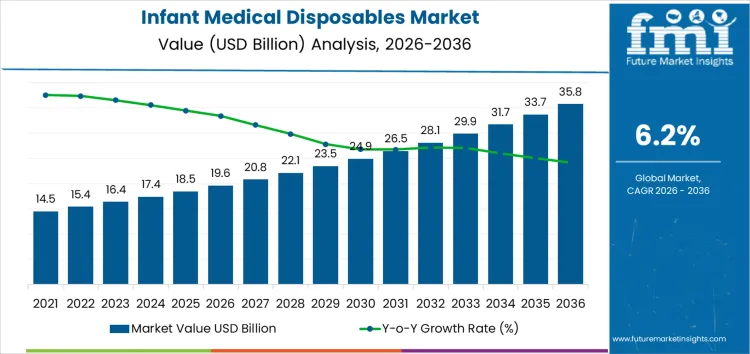
The infant medical disposables market is projected to grow steadily from 2026 to 2036. In 2026, the market value is expected to be USD 19.6 billion, with consistent growth anticipated, reaching USD 35.9 billion by 2036. The compound annual growth rate (CAGR) for this market is forecasted at 6.2%, driven by the increasing demand for disposable products that ensure safety and hygiene for infants in healthcare settings. Infant medical disposables, including diapers, feeding tubes, and medical gloves, are essential for improving healthcare standards and reducing the risk of infections.
The growth is supported by the rising awareness of infant health and hygiene, the increasing birth rate in developing regions, and technological advancements in disposable products. As healthcare systems continue to prioritize infant care and safety, the demand for medical disposables is expected to expand. Over the forecast period, the market will see gradual but steady growth, with continuous advancements in product quality and materials contributing to this upward trend.
Quick Stats of the Infant Medical Disposables Market
- Infant Medical Disposables Market Value (2026): USD 19.6 billion
- Infant Medical Disposables Market Forecast Value (2036): USD 35.9 billion
- Infant Medical Disposables Market Global Forecast CAGR (2026-2036): 6.2%
- Infant Medical Disposables Market Leading Segment: Application (Hospital use) 55%
- Key Growth Regions in Infant Medical Disposables Market: India
- Top Players in Infant Medical Disposables Market: P&G (Pampers), Kimberly-Clark, Unicharm, Huggies, Pigeon, Others
What is the Growth Forecast for the Infant Medical Disposables Market through 2036?
The growth forecast for the infant medical disposables market reflects steady and consistent expansion, with a projected CAGR of 6.2%. Starting at USD 19.6 billion in 2026, the market is expected to grow year-on-year, reaching USD 20.9 billion in 2027, USD 22.2 billion in 2028, and USD 23.5 billion in 2029. By 2030, the market value will rise to USD 25 billion, continuing its steady increase throughout the forecast period.
From 2031 to 2036, the market will continue its growth trajectory, reaching USD 26.5 billion in 2031, USD 28.2 billion in 2032, and USD 29.9 billion in 2033. The market will continue expanding, reaching USD 31.8 billion in 2034, USD 33.8 billion in 2035, and USD 35.9 billion by 2036. The year-on-year growth analysis demonstrates a consistent rise in demand for infant medical disposables, supported by ongoing healthcare improvements and increased focus on infant safety and hygiene across the globe.
Infant Medical Disposables Market Key Takeaways
| Metric | Value |
|---|---|
| Industry Sales Value (2026) | USD 19.6 billion |
| Industry Forecast Value (2036) | USD 35.9 billion |
| Industry Forecast CAGR (2026-2036) | 6.2% |
What Is Driving the Demand for the Infant Medical Disposables Market Globally?
The global demand for infant medical disposables is driven by rising birth rates in several regions, expanding access to neonatal and maternal healthcare services, and heightened standards for infection prevention in care settings. Infant medical disposables include single use products such as nappies/diapers, feeding tubes, syringes, umbilical cord clamps, incubator accessories, thermometers, and wound dressings designed specifically for newborn physiology. Healthcare facilities and caregivers prioritise disposables because they minimise cross contamination risk, support sterile handling, and reduce workload associated with cleaning and reprocessing reusable items.
Growth in hospital deliveries, improved prenatal care access in emerging markets, and scaling of neonatal intensive care units (NICUs) in response to preterm birth and low birth weight conditions contribute to more frequent use of these products. Moreover, global emphasis on reducing hospital acquired infections and adherence to stringent hygiene protocols encourages healthcare providers to adopt single use infant safe solutions. Consumer education about safe newborn care, and expanding private healthcare services in urban and peri urban areas, also reinforce demand for dermally compatible, clinically validated disposables that address unique needs of infants.
Future demand for infant medical disposables is expected to grow as healthcare systems continue prioritising child health and safety, and as innovation expands product functionality and comfort. Advances in materials science are enabling disposables that are softer, more breathable, and better aligned with neonatal skin sensitivity, which influences caregiver preference and clinical adoption. Expansion of home healthcare services, telehealth guidance, and parental access to professional grade disposables at retail and e commerce channels will also support broader uptake.
Public health programmes targeting reductions in infant morbidity and mortality are likely to maintain emphasis on safe delivery practices and postnatal care, which depend on reliable single use products. Regulatory focus on quality and safety standards for infant care products will influence market dynamics, as manufacturers align formulations and designs with global compliance benchmarks and parent expectations. Sustainability trends may shape future product lines as well, with demand for eco friendlier, biodegradable disposables that balance performance with environmental concerns. Overall, as healthcare access expands and caregiver expectations evolve, the infant medical disposables market is poised for continued global growth.
What are the Leading Segments in the Global Infant Medical Disposables Market?
The global infant medical disposables market is segmented by product type and application. Among product types, diapers & nappies lead the market, capturing 45% of the share, followed by wipes, feeding disposables, and others. Diapers & nappies are essential for infant care, driving significant demand in the market. On the application side, hospital use dominates the market, holding 55% of the share, followed by home care. Hospital use requires specialized infant medical disposables for both routine care and critical healthcare settings, where hygiene and infection control are paramount.
What Drives the Growth of Diapers & Nappies in the Infant Medical Disposables Market?
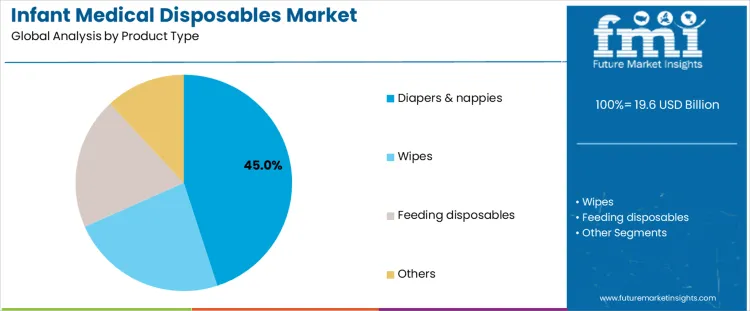
Diapers & nappies are the leading product type in the infant medical disposables market, capturing 45% of the share. This dominance is driven by the essential role diapers play in infant hygiene and comfort. As the primary method for managing infant waste, the demand for high-quality, absorbent, and safe diapers continues to grow globally. Factors such as increasing birth rates, rising awareness about infant hygiene, and advancements in diaper technology contribute to the strong demand. Additionally, the growing preference for eco-friendly and skin-sensitive disposable diapers is driving innovation in the market, with manufacturers focusing on producing more sustainable and hypoallergenic options. The demand for diapers also correlates with trends in baby care and family-oriented consumer behavior, ensuring diapers & nappies remain a dominant product category in the market.
What is Driving the Demand for Hospital Use in the Infant Medical Disposables Market?
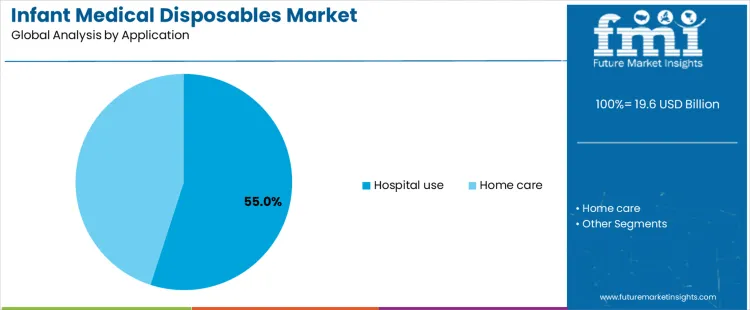
Hospital use is the leading application segment in the infant medical disposables market, holding 55% of the share. This growth is primarily driven by the need for disposable products in healthcare settings where hygiene, safety, and infection control are critical. Hospitals use infant medical disposables like diapers, feeding disposables, and wipes to ensure a sterile, safe, and efficient care environment for newborns and infants. The rise in neonatal care and the increasing number of premature births globally contribute to the growing demand for these disposables. Furthermore, hospitals and healthcare providers emphasize disposable products due to their convenience, cost-effectiveness, and ability to minimize the risk of cross-contamination, especially in sensitive environments like neonatal intensive care units (NICUs). As healthcare standards continue to prioritize hygiene and infection prevention, the demand for infant medical disposables in hospital settings is expected to grow, maintaining its dominant position in the market.
What are the Key Dynamics in the Global Infant Medical Disposables Market?
The global infant medical disposables market is expanding as healthcare systems prioritise safe, infection controlled care for newborns and premature infants. Infant medical disposables include items such as neonatal diapers, feeding tubes, umbilical cord clamps, sample collection swabs and sterile drapes used in delivery rooms and neonatal intensive care units. Growth is supported by rising birth rates in select regions, improved access to hospital based deliveries, and emphasis on reducing hospital acquired infections. Adoption reflects efforts to standardise care quality and minimise risks associated with invasive procedures in vulnerable infant populations.
What are the Key Drivers for the Global Infant Medical Disposables Market?
One key driver is increasing demand for infection prevention and patient safety in neonatal care settings. Hospitals and birthing centres rely on single use disposables to reduce cross contamination and ensure sterile environments, especially for preterm and low birth weight infants with underdeveloped immune systems. Expansion of healthcare infrastructure and neonatal care services in emerging markets increases utilisation of essential disposables. Implementation of stringent clinical guidelines and quality standards for newborn care encourages procurement of certified products. Rising awareness among caregivers and clinicians about the importance of specialised neonatal supplies supports growth across hospital and outpatient settings.
What are the Restraints for the Global Infant Medical Disposables Market?
A significant restraint is the cost pressure on healthcare providers, especially in resource constrained regions where budget limitations affect purchase of premium or specialised disposable products. Some facilities may rely on reusable alternatives or lower cost imports, limiting growth of high quality disposable segments. Variability in regulatory frameworks for medical devices across countries creates complexity for manufacturers seeking global market entry, increasing compliance costs and timelines. Environmental concerns related to medical waste and single use plastics also influence procurement decisions, prompting interest in sustainable options that may not yet be widely available or cost competitive.
What is the Key Trends in the Global Infant Medical Disposables Market?
A key trend is development of eco designed and biodegradable infant disposables that align with sustainability goals without compromising clinical performance. Manufacturers are innovating materials and production processes to reduce environmental impact, responding to both regulatory encouragement and hospital purchasing policies that prioritize green alternatives. Integration of features that enhance comfort, skin safety and ease of use—such as hypoallergenic materials and ergonomically designed components—is influencing product adoption. Growth of digital procurement and supply chain platforms is improving availability and forecasting for neonatal supplies, while partnerships between healthcare systems and suppliers support standardization of quality and inventory management for infant care.
What is the Country-Wise Analysis of the Infant Medical Disposables Market?
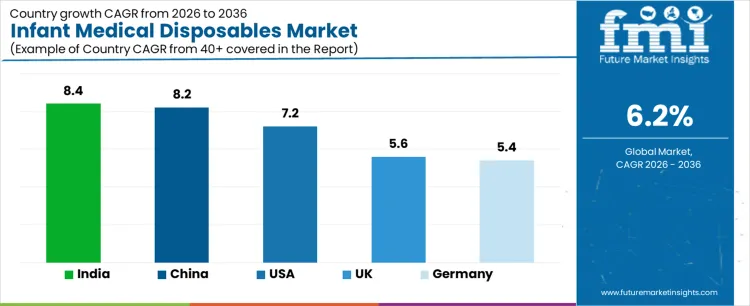
The infant medical disposables market is expected to grow steadily, driven by increasing awareness of infant health, hygiene, and safety. Infant medical disposables include products like diapers, wipes, and medical devices used in neonatal care. As healthcare infrastructure improves and infant care practices evolve, demand for disposable medical products is rising. High-growth markets like India and China are seeing strong demand due to rapidly expanding healthcare sectors, large populations, and rising healthcare standards. Developed markets such as the USA, UK, and Germany are experiencing steady growth, supported by advancements in neonatal care and a growing focus on healthcare quality and hygiene in infant care.
| Country | CAGR (2026-2036) |
|---|---|
| India | 8.4% |
| China | 8.2% |
| United States | 7.2% |
| United Kingdom | 5.6% |
| Germany | 5.4% |
What is the Growth Outlook for the Infant Medical Disposables Market in India?
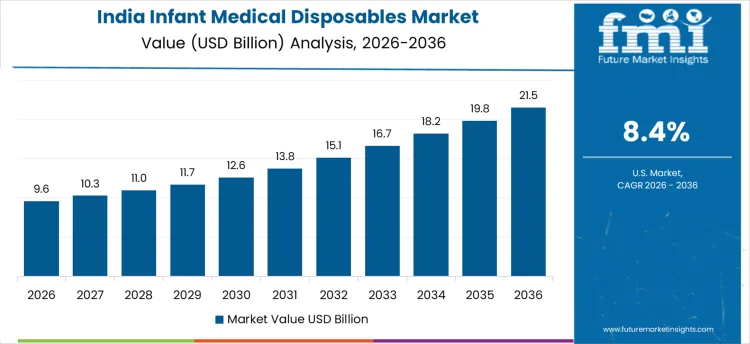
The infant medical disposables market in India is expected to grow at the highest rate, with a projected CAGR of 8.4%. India’s large population and growing awareness of healthcare standards are key drivers of this market. As more parents opt for modern, hygienic, and safe disposable products for their infants, the demand for medical disposables such as diapers, wipes, and other neonatal products is increasing. The government’s focus on improving healthcare infrastructure, particularly in rural areas, further supports the growth of the market. As India continues to expand its healthcare sector and address infant care needs, the market for infant medical disposables is poised for strong growth.
What is the Market Outlook for the Infant Medical Disposables Market in China?
The infant medical disposables market in China is projected to grow at a steady pace, with a projected CAGR of 8.2%. China’s large consumer base, coupled with its growing healthcare sector, is driving the adoption of infant medical disposables. As disposable income rises, more parents are opting for higher-quality, convenient products for infant care, such as disposable diapers and wipes. Additionally, China’s focus on improving healthcare services for infants and children is contributing to market expansion. The country’s strong manufacturing base and the increasing emphasis on neonatal care are expected to support steady demand for infant medical disposables, making it one of the leading markets for these products.
What is the Growth Forecast for the Infant Medical Disposables Market in the United States?
The infant medical disposables market in the United States is expected to grow steadily, with a projected CAGR of 7.2%. In the U.S., there is a high demand for safe, reliable, and convenient products for infant care, with disposable medical products such as diapers and wipes being widely used. The market growth is driven by a growing focus on neonatal healthcare and a rising preference for advanced hygiene products. The U.S. healthcare system’s commitment to improving infant care standards and increasing awareness of product quality further supports market growth. As consumer preferences shift toward eco-friendly and sustainable disposable options, the market for infant medical disposables is expected to continue expanding.
What is the Market Outlook for the Infant Medical Disposables Market in the United Kingdom?
The infant medical disposables market in the United Kingdom is projected to grow at a moderate pace, with a projected CAGR of 5.6%. In the UK, the demand for high-quality disposable products for infant care continues to rise, driven by increasing awareness of hygiene, safety, and convenience. As parents in the UK become more focused on the well-being of their children, the adoption of modern infant medical disposables such as diapers, wipes, and other healthcare products is increasing. The UK’s strong healthcare infrastructure, combined with a growing focus on infant health and hygiene, is supporting steady demand for these products. Although the growth rate may be slower compared to emerging markets, the UK market is expected to continue its expansion.
What are the Growth Prospects for the Infant Medical Disposables Market in Germany?
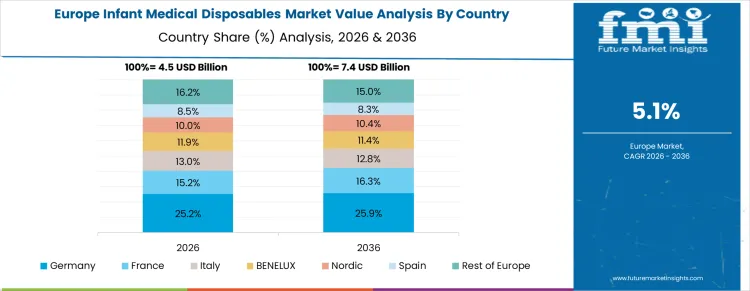
The infant medical disposables market in Germany is expected to grow at a moderate pace, with a projected CAGR of 5.4%. Germany’s high standard of healthcare and strong focus on infant health and safety are driving the demand for disposable products such as diapers and medical supplies for neonatal care. As the demand for convenience and hygiene increases, more parents in Germany are opting for modern, high-quality disposable solutions for their infants. The German healthcare system’s emphasis on neonatal care and safety, along with growing environmental awareness, is expected to drive market demand. As sustainability becomes a growing concern, the market for eco-friendly and biodegradable infant medical disposables is also expected to see gradual growth in Germany.
What is the Competitive Landscape for the Infant Medical Disposables Market?
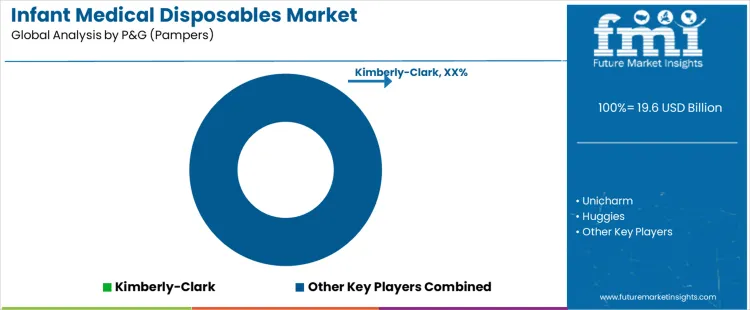
The infant medical disposables market is growing rapidly as demand increases for high-quality, hygienic, and safe disposable products for infant care. P&G (Pampers) leads the market with its well-established line of Pampers products, offering a wide range of disposable diapers and other infant care items designed for comfort, dryness, and skin protection. Their focus on innovation, product quality, and safety has positioned them as the dominant player in this sector. Kimberly-Clark, Unicharm, and Huggies are significant competitors, each offering a variety of high-performance disposable products for infants. Kimberly-Clark, with its Huggies brand, focuses on creating comfortable and absorbent diapering solutions, while Unicharm provides innovative products tailored to different regional markets, emphasizing comfort and skin protection.
Pigeon and Others further contribute to the competitive landscape by offering specialized disposable products designed for infant hygiene and care. Pigeon is known for its high-quality baby products, including diapers and wipes, while Others refers to various regional and local manufacturers that provide affordable and effective disposable items for infant care. These companies compete through product innovation, quality, comfort, and the ability to meet the growing demand for infant medical disposables that promote hygiene, skin health, and overall well-being. Their strategies emphasize sustainability, enhanced functionality, and the ability to offer tailored solutions for parents and caregivers worldwide.
Key Players of the Infant Medical Disposables Market
- P&G (Pampers)
- Kimberly-Clark
- Unicharm
- Huggies
- Pigeon
- Others
Scope of the Report
| Items | Values |
|---|---|
| Quantitative Units (2026) | USD Billion |
| Product Type | Diapers & Nappies, Wipes, Feeding Disposables, Others |
| Application | Hospital Use, Home Care |
| End User | Retail Pharmacies, Supermarkets, E-Commerce, Hospitals |
| Companies | P&G (Pampers), Kimberly-Clark, Unicharm, Huggies, Pigeon, Others |
| Regions Covered | North America, Latin America, Western Europe, Eastern Europe, South Asia and Pacific, East Asia, Middle East & Africa |
| Countries Covered | United States, Canada, Mexico, Brazil, Argentina, Germany, France, United Kingdom, Italy, Spain, Netherlands, China, India, Japan, South Korea, ANZ, GCC Countries, South Africa |
| Additional Attributes | Dollar by sales by product type, application, end user, and region. Includes market trends in infant medical disposables, focusing on diapers, wipes, and feeding disposables. Highlights the role of retail pharmacies, supermarkets, and e-commerce in distribution. Focus on performance, sustainability, regulatory compliance, and market share of key companies in the infant care product market. |
Infant Medical Disposables Market Segmentation
Product Type:
- Diapers & nappies
- Wipes
- Feeding disposables
- Others
Application:
- Hospital use
- Home care
End User:
- Retail pharmacies
- Supermarkets
- E-commerce
- Hospitals
Region:
- Industry Size (2026):
- Forecast (2036):
- CAGR: (2026 to 2036)
- Asia Pacific
- China
- Japan
- South Korea
- India
- Australia & New Zealand
- ASEAN
- Rest of Asia Pacific
- Europe
- Germany
- United Kingdom
- France
- Italy
- Spain
- Nordic
- BENELUX
- Rest of Europe
- North America
- United States
- Canada
- Mexico
- Latin America
- Brazil
- Chile
- Rest of Latin America
- Middle East & Africa
- Kingdom of Saudi Arabia
- Other GCC Countries
- Turkey
- South Africa
- Other African Union
- Rest of Middle East & Africa
Frequently Asked Questions
How big is the infant medical disposables market in 2026?
The global infant medical disposables market is estimated to be valued at USD 19.6 billion in 2026.
What will be the size of infant medical disposables market in 2036?
The market size for the infant medical disposables market is projected to reach USD 35.8 billion by 2036.
How much will be the infant medical disposables market growth between 2026 and 2036?
The infant medical disposables market is expected to grow at a 6.2% CAGR between 2026 and 2036.
What are the key product types in the infant medical disposables market?
The key product types in infant medical disposables market are diapers & nappies, wipes, feeding disposables and others.
Which application segment to contribute significant share in the infant medical disposables market in 2026?
In terms of application, hospital use segment to command 55.0% share in the infant medical disposables market in 2026.
Preview the report firsthand - request a free sample
Get SampleGet the brochure for pricing and purchase details.
Get PDFTable of Content
- Executive Summary
- Global Market Outlook
- Demand-side Trends
- Supply-side Trends
- Technology Roadmap Analysis
- Analysis and Recommendations
- Market Overview
- Market Coverage / Taxonomy
- Market Definition / Scope / Limitations
- Market Background
- Market Dynamics
- Drivers
- Restraints
- Opportunity
- Trends
- Scenario Forecast
- Demand in Optimistic Scenario
- Demand in Likely Scenario
- Demand in Conservative Scenario
- Opportunity Map Analysis
- Product Life Cycle Analysis
- Supply Chain Analysis
- Investment Feasibility Matrix
- Value Chain Analysis
- PESTLE and Porter’s Analysis
- Regulatory Landscape
- Regional Parent Market Outlook
- Production and Consumption Statistics
- Import and Export Statistics
- Market Dynamics
- Global Market Analysis 2021 to 2025 and Forecast, 2026 to 2036
- Historical Market Size Value (USD Million) Analysis, 2021 to 2025
- Current and Future Market Size Value (USD Million) Projections, 2026 to 2036
- Y-o-Y Growth Trend Analysis
- Absolute $ Opportunity Analysis
- Global Market Pricing Analysis 2021 to 2025 and Forecast 2026 to 2036
- Global Market Analysis 2021 to 2025 and Forecast 2026 to 2036, By Product Type
- Introduction / Key Findings
- Historical Market Size Value (USD Million) Analysis By Product Type , 2021 to 2025
- Current and Future Market Size Value (USD Million) Analysis and Forecast By Product Type , 2026 to 2036
- Diapers & nappies
- Wipes
- Feeding disposables
- Others
- Diapers & nappies
- Y-o-Y Growth Trend Analysis By Product Type , 2021 to 2025
- Absolute $ Opportunity Analysis By Product Type , 2026 to 2036
- Global Market Analysis 2021 to 2025 and Forecast 2026 to 2036, By Application
- Introduction / Key Findings
- Historical Market Size Value (USD Million) Analysis By Application, 2021 to 2025
- Current and Future Market Size Value (USD Million) Analysis and Forecast By Application, 2026 to 2036
- Hospital use
- Home care
- Hospital use
- Y-o-Y Growth Trend Analysis By Application, 2021 to 2025
- Absolute $ Opportunity Analysis By Application, 2026 to 2036
- Global Market Analysis 2021 to 2025 and Forecast 2026 to 2036, By End User
- Introduction / Key Findings
- Historical Market Size Value (USD Million) Analysis By End User, 2021 to 2025
- Current and Future Market Size Value (USD Million) Analysis and Forecast By End User, 2026 to 2036
- Retail pharmacies
- Supermarkets
- E-commerce
- Hospitals
- Retail pharmacies
- Y-o-Y Growth Trend Analysis By End User, 2021 to 2025
- Absolute $ Opportunity Analysis By End User, 2026 to 2036
- Global Market Analysis 2021 to 2025 and Forecast 2026 to 2036, By Region
- Introduction
- Historical Market Size Value (USD Million) Analysis By Region, 2021 to 2025
- Current Market Size Value (USD Million) Analysis and Forecast By Region, 2026 to 2036
- North America
- Latin America
- Western Europe
- Eastern Europe
- East Asia
- South Asia and Pacific
- Middle East & Africa
- Market Attractiveness Analysis By Region
- North America Market Analysis 2021 to 2025 and Forecast 2026 to 2036, By Country
- Historical Market Size Value (USD Million) Trend Analysis By Market Taxonomy, 2021 to 2025
- Market Size Value (USD Million) Forecast By Market Taxonomy, 2026 to 2036
- By Country
- USA
- Canada
- Mexico
- By Product Type
- By Application
- By End User
- By Country
- Market Attractiveness Analysis
- By Country
- By Product Type
- By Application
- By End User
- Key Takeaways
- Latin America Market Analysis 2021 to 2025 and Forecast 2026 to 2036, By Country
- Historical Market Size Value (USD Million) Trend Analysis By Market Taxonomy, 2021 to 2025
- Market Size Value (USD Million) Forecast By Market Taxonomy, 2026 to 2036
- By Country
- Brazil
- Chile
- Rest of Latin America
- By Product Type
- By Application
- By End User
- By Country
- Market Attractiveness Analysis
- By Country
- By Product Type
- By Application
- By End User
- Key Takeaways
- Western Europe Market Analysis 2021 to 2025 and Forecast 2026 to 2036, By Country
- Historical Market Size Value (USD Million) Trend Analysis By Market Taxonomy, 2021 to 2025
- Market Size Value (USD Million) Forecast By Market Taxonomy, 2026 to 2036
- By Country
- Germany
- UK
- Italy
- Spain
- France
- Nordic
- BENELUX
- Rest of Western Europe
- By Product Type
- By Application
- By End User
- By Country
- Market Attractiveness Analysis
- By Country
- By Product Type
- By Application
- By End User
- Key Takeaways
- Eastern Europe Market Analysis 2021 to 2025 and Forecast 2026 to 2036, By Country
- Historical Market Size Value (USD Million) Trend Analysis By Market Taxonomy, 2021 to 2025
- Market Size Value (USD Million) Forecast By Market Taxonomy, 2026 to 2036
- By Country
- Russia
- Poland
- Hungary
- Balkan & Baltic
- Rest of Eastern Europe
- By Product Type
- By Application
- By End User
- By Country
- Market Attractiveness Analysis
- By Country
- By Product Type
- By Application
- By End User
- Key Takeaways
- East Asia Market Analysis 2021 to 2025 and Forecast 2026 to 2036, By Country
- Historical Market Size Value (USD Million) Trend Analysis By Market Taxonomy, 2021 to 2025
- Market Size Value (USD Million) Forecast By Market Taxonomy, 2026 to 2036
- By Country
- China
- Japan
- South Korea
- By Product Type
- By Application
- By End User
- By Country
- Market Attractiveness Analysis
- By Country
- By Product Type
- By Application
- By End User
- Key Takeaways
- South Asia and Pacific Market Analysis 2021 to 2025 and Forecast 2026 to 2036, By Country
- Historical Market Size Value (USD Million) Trend Analysis By Market Taxonomy, 2021 to 2025
- Market Size Value (USD Million) Forecast By Market Taxonomy, 2026 to 2036
- By Country
- India
- ASEAN
- Australia & New Zealand
- Rest of South Asia and Pacific
- By Product Type
- By Application
- By End User
- By Country
- Market Attractiveness Analysis
- By Country
- By Product Type
- By Application
- By End User
- Key Takeaways
- Middle East & Africa Market Analysis 2021 to 2025 and Forecast 2026 to 2036, By Country
- Historical Market Size Value (USD Million) Trend Analysis By Market Taxonomy, 2021 to 2025
- Market Size Value (USD Million) Forecast By Market Taxonomy, 2026 to 2036
- By Country
- Kingdom of Saudi Arabia
- Other GCC Countries
- Turkiye
- South Africa
- Other African Union
- Rest of Middle East & Africa
- By Product Type
- By Application
- By End User
- By Country
- Market Attractiveness Analysis
- By Country
- By Product Type
- By Application
- By End User
- Key Takeaways
- Key Countries Market Analysis
- USA
- Pricing Analysis
- Market Share Analysis, 2025
- By Product Type
- By Application
- By End User
- Canada
- Pricing Analysis
- Market Share Analysis, 2025
- By Product Type
- By Application
- By End User
- Mexico
- Pricing Analysis
- Market Share Analysis, 2025
- By Product Type
- By Application
- By End User
- Brazil
- Pricing Analysis
- Market Share Analysis, 2025
- By Product Type
- By Application
- By End User
- Chile
- Pricing Analysis
- Market Share Analysis, 2025
- By Product Type
- By Application
- By End User
- Germany
- Pricing Analysis
- Market Share Analysis, 2025
- By Product Type
- By Application
- By End User
- UK
- Pricing Analysis
- Market Share Analysis, 2025
- By Product Type
- By Application
- By End User
- Italy
- Pricing Analysis
- Market Share Analysis, 2025
- By Product Type
- By Application
- By End User
- Spain
- Pricing Analysis
- Market Share Analysis, 2025
- By Product Type
- By Application
- By End User
- France
- Pricing Analysis
- Market Share Analysis, 2025
- By Product Type
- By Application
- By End User
- India
- Pricing Analysis
- Market Share Analysis, 2025
- By Product Type
- By Application
- By End User
- ASEAN
- Pricing Analysis
- Market Share Analysis, 2025
- By Product Type
- By Application
- By End User
- Australia & New Zealand
- Pricing Analysis
- Market Share Analysis, 2025
- By Product Type
- By Application
- By End User
- China
- Pricing Analysis
- Market Share Analysis, 2025
- By Product Type
- By Application
- By End User
- Japan
- Pricing Analysis
- Market Share Analysis, 2025
- By Product Type
- By Application
- By End User
- South Korea
- Pricing Analysis
- Market Share Analysis, 2025
- By Product Type
- By Application
- By End User
- Russia
- Pricing Analysis
- Market Share Analysis, 2025
- By Product Type
- By Application
- By End User
- Poland
- Pricing Analysis
- Market Share Analysis, 2025
- By Product Type
- By Application
- By End User
- Hungary
- Pricing Analysis
- Market Share Analysis, 2025
- By Product Type
- By Application
- By End User
- Kingdom of Saudi Arabia
- Pricing Analysis
- Market Share Analysis, 2025
- By Product Type
- By Application
- By End User
- Turkiye
- Pricing Analysis
- Market Share Analysis, 2025
- By Product Type
- By Application
- By End User
- South Africa
- Pricing Analysis
- Market Share Analysis, 2025
- By Product Type
- By Application
- By End User
- USA
- Market Structure Analysis
- Competition Dashboard
- Competition Benchmarking
- Market Share Analysis of Top Players
- By Regional
- By Product Type
- By Application
- By End User
- Competition Analysis
- Competition Deep Dive
- Kimberly-Clark
- Overview
- Product Portfolio
- Profitability by Market Segments (Product/Age /Sales Channel/Region)
- Sales Footprint
- Strategy Overview
- Marketing Strategy
- Product Strategy
- Channel Strategy
- Unicharm
- Huggies
- Pigeon
- Others
- Kimberly-Clark
- Competition Deep Dive
- Assumptions & Acronyms Used
- Research Methodology


