

- Industry Size (2026)
- USD 956.6 Mn
- Forecast (2036)
- USD 2203.1 Mn
- CAGR (2026 to 2036)
- 8.7%
Infectious Pancreatic Necrosis Market Size, Market Forecast and Outlook By FMI
The infectious pancreatic necrosis market is likely to be valued at USD 956.6 million in 2026, and reach USD 2,203.1 million by 2036, at an 8.7% CAGR. Value formation is tied to structural exposure of salmonid production systems to IPN virus during early life stages, when mortality events create irreversible losses. Hatchery concentration, vertical transmission risk from broodstock, and stress during freshwater to seawater transition concentrate financial impact within narrow windows.
Summary of Infectious Pancreatic Necrosis Market
- Market Snapshot
- The infectious pancreatic necrosis market is valued at USD 956.6 million in 2026.
- The infectious pancreatic necrosis market is projected to reach USD 2,203.1 million by 2036.
- The market is expected to grow at a CAGR of 8.7% during 2026 to 2036.
- Demand and Growth Drivers
- Demand is driven by high mortality risk during early life stages of salmonids exposed to IPN virus.
- Absence of curative therapies shifts spending toward preventive tools such as vaccination and biosecurity.
- Vertical transmission risk from broodstock increases demand for diagnostic screening and control measures.
- Product and Segment View
- Vaccines account for 54.0% of utilization due to their role in reducing outbreak incidence.
- Salmonids represent 72.0% of demand due to higher susceptibility and production scale.
- Salmon farms contribute 68.0% of total deployment due to lifecycle health management responsibilities.
- Geography and Competitive Outlook
- India leads growth with a CAGR of 10.1% during 2026 to 2036.
- China is projected to grow at a CAGR of 9.9% over the forecast period.
- Key companies include Pharmaq, Zoetis, Elanco, MSD Animal Health, and Ceva.
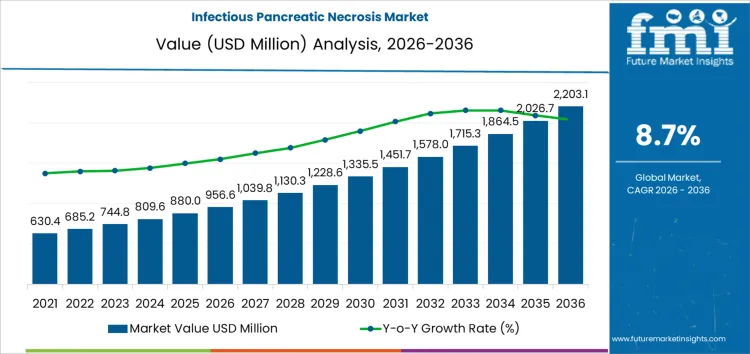
Spending intensity remains highest where juvenile survival directly determines site utilization, stocking schedules, and long-cycle biomass recovery. Demand behavior reflects the absence of curative therapies, placing economic emphasis on prevention-oriented tools that reduce outbreak probability rather than post-infection recovery.
Over the forecast period, expansion is governed by biosecurity discipline and long planning cycles rather than episodic outbreak response. Vaccination programs anchor expenditure because protection must be established well before transfer or density escalation. Diagnostic screening and broodstock control add recurring cost layers that persist regardless of visible disease pressure. Integrated producers allocate capital toward measures that stabilize survival variability across cohorts, as inconsistency carries disproportionate downstream cost. Smaller operators face higher relative exposure due to fixed surveillance and compliance requirements. Market persistence is sustained by intensification of salmonid farming, climate-linked stress amplification, and regulatory intolerance for uncontrolled viral spread, rather than growth in therapeutic intervention volumes.
Infectious Pancreatic Necrosis Market Key Takeaways
| Metric | Value |
|---|---|
| Market Value (2026) | USD 956.6 million |
| Market Forecast Value (2036) | USD 2,203.1 million |
| Forecast CAGR 2026 to 2036 | 8.7% |
Why is the Demand for Infectious Pancreatic Necrosis Growing?
Demand for infectious pancreatic necrosis (IPN) treatment and management solutions is rising as aquaculture producers confront significant losses due to outbreaks in salmonid populations, particularly in trout and salmon hatcheries and grow-out systems. IPN virus targets pancreatic and intestinal tissues early in life stages, causing high mortality, reduced growth rates, and compromised overall health in affected stocks. Aquatic health specialists and veterinarians prioritize disease management products that mitigate viral impact, support immune resilience, and reduce secondary infections that may accompany viral damage. Procurement teams at hatcheries and integrated farms evaluate antiviral supportive therapies, immunostimulants, and adjunctive nutritional supplements with documented benefits in reducing mortality risk and improving recovery indicators under commercial rearing conditions. Reliable water quality management and enhanced biosecurity protocols are coordinated with treatment plans because effective viral management depends on minimizing stress factors that exacerbate disease progression.
Growth in global salmonid farming and consumer demand for consistent seafood supply reinforces adoption of IPN-focused interventions that integrate with broader herd health frameworks. Producers work with diagnostic services that confirm viral presence and quantify disease spread, enabling tailored application of supportive treatments and husbandry adjustments that improve survival outcomes. Health management protocols emphasize vaccination where available, coupled with farm-specific biosecurity measures such as controlled egg sourcing, disinfection routines, and isolation of affected units to limit cross-contamination. Veterinary supply networks maintain inventories of approved products and deliver technical support on dosing regimens, treatment timing, and monitoring markers of recovery to maintain production continuity. These pathogen-specific operational and clinical drivers are contributing to sustained demand growth in the infectious pancreatic necrosis management market.
How Is the Infectious Pancreatic Necrosis Market Segmented?
Demand for infectious pancreatic necrosis control is shaped by biosecurity rigor in salmonid production, lifecycle vulnerability during early stages, and economic exposure from mortality events. Health strategies prioritize prevention, early containment, and reduction of vertical transmission risks. Adoption reflects regional disease pressure, regulatory guidance, and integration with hatchery management practices. Intervention selection considers feasibility across freshwater and seawater phases, durability of protection, and operational compatibility. Segmentation explains how control approach, species susceptibility, and operational ownership influence utilization patterns and deployment intensity across IPN management.
Which Drug Class Drives Control Strategies for Infectious Pancreatic Necrosis?
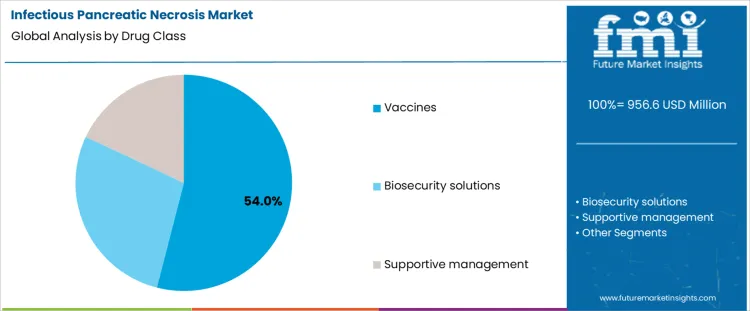
Vaccines lead utilization at 54.0%, driven by their role in reducing outbreak incidence and severity across production cycles. Immunization programs are integrated early to protect juveniles before transfer to grow-out environments. Predictable protection supports planning and reduces reliance on reactive measures. Biosecurity solutions at 28.0% focus on movement control, disinfection, and separation of cohorts to limit virus introduction and spread. Supportive management at 18.0% emphasizes husbandry adjustments and stress reduction during risk periods. Drug class segmentation reflects emphasis on preventive immunity supported by layered operational controls.
Key Points
- Vaccination forms the primary preventive barrier against IPN.
- Biosecurity limits introduction and horizontal transmission.
- Supportive practices mitigate stress-related vulnerability.
How Does Species Susceptibility Shape Application-Level Demand?
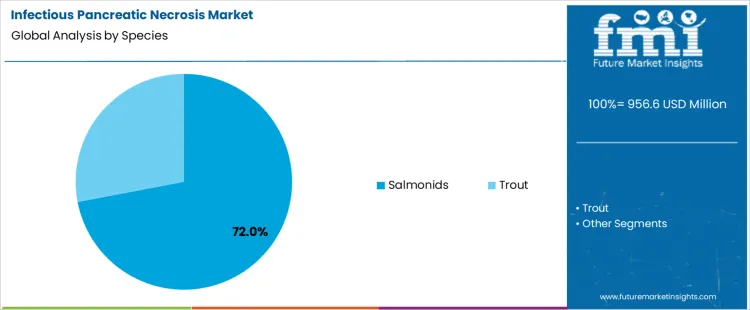
Control efforts concentrate on salmonids at 72.0% due to higher production volumes and documented sensitivity to IPN during early life stages. Intensive farming and transfer stress elevate exposure risk. Trout at 28.0% experience IPN under specific conditions, often with different management timelines. Species-based segmentation highlights higher intervention intensity where production scale, lifecycle handling, and historical disease impact necessitate consistent preventive measures.
Key Points
- Salmonids face higher exposure during juvenile stages.
- Production scale increases intervention intensity.
- Trout management follows more situational control needs.
Which End User Segment Concentrates IPN Control Deployment?
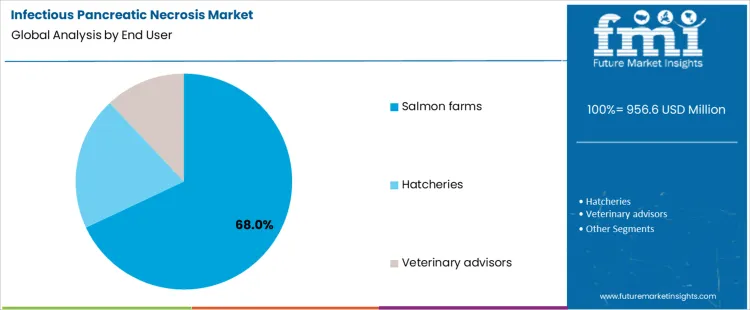
Salmon farms account for 68.0% of control deployment due to responsibility for ongoing health management across grow-out phases. Integrated protocols support vaccination follow-through and biosecurity enforcement. Hatcheries at 20.0% focus on early-life protection and prevention of downstream transmission. Veterinary advisors at 12.0% provide program design, risk assessment, and compliance oversight. End-user segmentation reflects concentration where lifecycle control, scale, and accountability determine implementation of IPN prevention strategies.
Key Points
- Farms execute vaccination and biosecurity at scale.
- Hatcheries protect early stages to prevent spread.
- Advisors guide program design and oversight.
What are the Key Dynamics in the Infectious Pancreatic Necrosis Market?
The demand for infectious pancreatic necrosis management solutions is rising, reflecting the need to control a highly contagious viral disease affecting salmonids and other freshwater fish. Adoption concentrates in hatcheries, freshwater grow-out facilities, and vertically integrated aquaculture operations. Global scope aligns with intensive salmon farming regions and biosecurity-driven production models. Usage centers on vaccines, diagnostic kits, broodstock screening tools, and farm-level disease control measures aimed at reducing mortality and long-term carrier risk.
How do early life stage vulnerability and vertical transmission risk shape adoption?
Infectious pancreatic necrosis causes severe losses during fry and smolt stages, where immune systems remain underdeveloped. Demand increases where vertical transmission from broodstock creates persistent infection pressure across production cycles. Hatcheries prioritize egg disinfection, broodstock testing, and early diagnostics to prevent downstream outbreaks. Vaccination gains relevance in regions with endemic virus presence to reduce clinical disease expression rather than eliminate infection. Producers integrate IPN control into overall health management plans that include stress reduction, stocking density control, and water quality management. Genetic selection for IPN-resistant strains influences complementary adoption of monitoring tools. Adoption reflects operational focus on protecting survival during biologically sensitive stages that determine overall production yield.
How do biosecurity dependence, control limitations, and economic exposure influence market scalability?
IPN control relies heavily on preventive measures rather than curative treatment options. Demand sensitivity rises where vaccine protection remains strain-dependent and incomplete. Persistent carrier states complicate eradication efforts and require continuous surveillance investment. Diagnostic testing adds recurring cost and operational complexity for broodstock and juvenile screening. Outbreaks lead to prolonged site-level restrictions, affecting stocking schedules and cash flow. Small producers face higher relative cost burden for comprehensive biosecurity programs. Regional variation in virus prevalence influences prioritization. Scalability remains constrained by absence of therapeutic solutions, dependence on disciplined farm management, and economic impact of long-term infection control commitments.
How Is Demand for Infectious Pancreatic Necrosis Evolving Globally?
Infectious pancreatic necrosis sector is rising globally as salmonid and trout aquaculture intensifies across freshwater and marine systems. Hatchery-stage mortality risk, vertical transmission concerns, and climate-linked stress elevate prevention and containment priorities. Producers emphasize diagnostics, vaccination programs, and biosecure broodstock management to limit losses. Regulatory oversight and export compliance shape adoption patterns. Growth rates in India at 10.1%, China at 9.9%, Brazil at 9.5%, USA at 8.3%, and the UK at 8.2% reflect sustained expansion driven by hatchery survival protection, disease containment economics, and production continuity rather than episodic outbreak-driven purchasing.
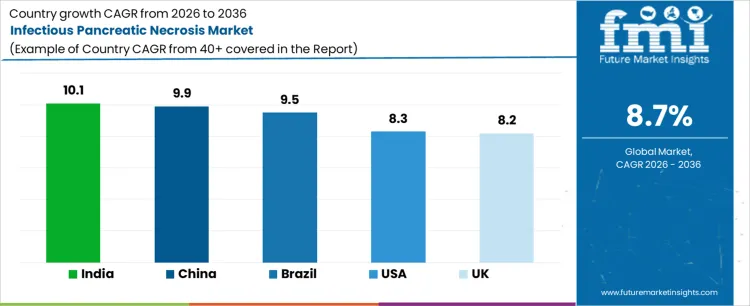
| Country | CAGR (%) |
|---|---|
| India | 10.1% |
| China | 9.9% |
| Brazil | 9.5% |
| USA | 8.3% |
| UK | 8.2% |
What Is Driving Strong Growth of Infectious Pancreatic Necrosis Demand in India?
Demand for infectious pancreatic necrosis treatments in India is expanding at a CAGR of 10.1%, supported by diversification into cold-water aquaculture and hatchery modernization. Trout and salmonid pilot operations increase focus on viral disease management. Hatchery managers prioritize diagnostics and preventive protocols to protect fry survival. Limited therapeutic options elevate reliance on biosecurity and vaccination strategies. Government-backed aquaculture development programs support disease monitoring infrastructure. Growth reflects capacity-building and risk mitigation in emerging segments rather than large-scale commercial outbreak response.
- Expansion of cold-water aquaculture initiatives
- Hatchery modernization improving disease monitoring
- Preventive focus due to limited therapeutics
- Public support for aquaculture health infrastructure
Why Is China Showing Rapid Uptake of IPN Management Solutions?
Infectious Pancreatic Necrosis demand in China is growing at a CAGR of 9.9%, aligned with expansion of intensive trout farming and hatchery systems. High biomass density increases vulnerability to viral transmission. Centralized disease surveillance supports early identification. Producers integrate vaccination and broodstock screening to reduce vertical spread. Domestic suppliers improve access to diagnostics and preventive tools. Growth reflects system-level disease governance and production scaling rather than reliance on curative treatment approaches.
- Intensive trout hatchery expansion
- Centralized viral surveillance programs
- Emphasis on broodstock screening
- Domestic access to diagnostic solutions
How Is Brazil Supporting Expansion of IPN Disease Control Demand?
Demand for Infectious Pancreatic Necrosis management in Brazil is increasing at a CAGR of 9.5%, influenced by inland cold-water aquaculture growth. Hatcheries focus on fry-stage survival to stabilize stocking cycles. Temperature variability elevates viral stress risk. Veterinary oversight promotes biosecurity audits and vaccination where applicable. Regional research institutions support disease awareness. Growth reflects preventive investment and hatchery protection priorities rather than high-frequency treatment utilization.
- Inland cold-water aquaculture development
- Fry-stage survival protection focus
- Climate variability increasing viral stress
- Research-led disease awareness initiatives
What Factors Are Driving IPN Market Growth in United States?
Infectious Pancreatic Necrosis demand in the United States is expanding at a CAGR of 8.3%, driven by established salmonid farming and regulatory discipline. Hatcheries apply surveillance, vaccination, and controlled movement to limit outbreaks. Strong diagnostic capacity supports early containment. Biosecurity protocols are embedded within production standards. Export and interstate movement regulations reinforce compliance. Growth reflects stewardship-led disease control and operational continuity rather than expansion of therapeutic intervention volumes.
- Established salmonid hatchery infrastructure
- Strong diagnostic and surveillance capability
- Embedded biosecurity production standards
- Regulatory compliance for fish movement
Why Is the UK Experiencing Sustained Growth in IPN Disease Management?
Demand for Infectious Pancreatic Necrosis solutions in United Kingdom is growing at a CAGR of 8.2%, shaped by salmon farming concentration and strict health governance. Producers prioritize prevention to avoid site-level depopulation risks. National surveillance programs monitor viral prevalence. Vaccination and broodstock controls reduce transmission probability. Environmental compliance and welfare standards influence protocol design. Growth remains steady, reflecting governance-driven disease prevention and production stability rather than reactive treatment escalation.
- Concentrated salmon farming exposure
- National IPN surveillance programs
- Broodstock and vaccination controls
- Environmental and welfare compliance standards
What is the competitive landscape of demand for the infectious pancreatic necrosis market globally?
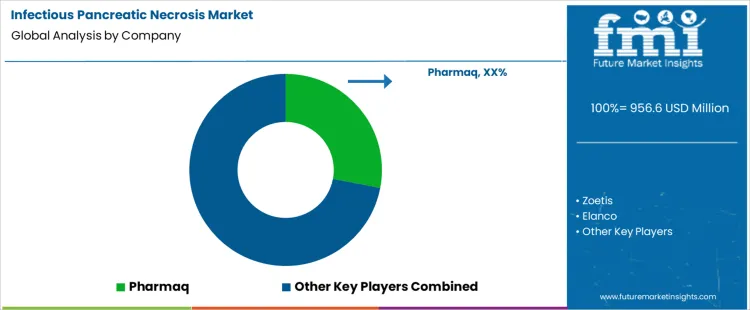
Demand for infectious pancreatic necrosis interventions is shaped by hatchery survival priorities and smolt transfer risk in salmonid production. Aquaculture veterinarians evaluate vaccine strain relevance, duration of protection, safety in early life stages, and compatibility with freshwater and seawater transitions. Buyer assessment includes administration method suitability, impact on growth performance, and alignment with site-specific biosecurity programs. Procurement behavior reflects long planning cycles, regulatory approvals by country, and reliance on suppliers with consistent cold-chain delivery. Trend in the infectious pancreatic necrosis market reflects preventive emphasis through vaccination to limit mortality during stress events and production scaling.
Pharmaq leads competitive positioning through IPN-focused vaccines with strong adoption across salmon-producing regions. Zoetis competes by integrating IPN prevention within broader aquatic health portfolios and veterinary support frameworks. Elanco supports demand through aquatic health solutions aligned with hatchery and grow-out biosecurity strategies. MSD Animal Health maintains relevance by pairing disease prevention tools with diagnostics and health monitoring programs. Ceva participates by supplying IPN-related solutions suited for regional aquaculture systems. Competitive differentiation centers on protection consistency, early-life safety confidence, regulatory reach, and integration within long-term fish health management plans.
Key Players in the Infectious Pancreatic Necrosis Market
- Pharmaq
- Zoetis
- Elanco
- MSD Animal Health
- Ceva
- Others
Scope of the Report
| Items | Values |
|---|---|
| Quantitative Units | USD million |
| Drug Class | Vaccines; Biosecurity solutions; Supportive management |
| Species | Salmonids; Trout |
| End User | Salmon farms; Hatcheries; Veterinary advisors |
| Regions Covered | Asia Pacific, Europe, North America, Latin America, Middle East & Africa |
| Countries Covered | India, China, Brazil, USA, UK, and 40+ countries |
| Key Companies Profiled | Pharmaq; Zoetis; Elanco; MSD Animal Health; Ceva; Others |
| Additional Attributes | Dollar sales by drug class, species, end user, and sales channel; preventive efficacy of vaccination programs against infectious pancreatic necrosis in salmonids and trout; role of biosecurity measures and husbandry practices in outbreak control; supportive management approaches influencing survival and growth performance; regulatory oversight and disease monitoring requirements; procurement dynamics shaped by integrated salmon farming operations, hatchery protocols, and veterinary advisory services. |
Infectious Pancreatic Necrosis Market by Segment
Drug Class:
- Vaccines
- Biosecurity solutions
- Supportive management
Species:
- Salmonids
- Trout
End User:
- Salmon farms
- Hatcheries
- Veterinary advisors
Region:
- Asia Pacific
- China
- Japan
- South Korea
- India
- Australia & New Zealand
- ASEAN
- Rest of Asia Pacific
- Europe
- Germany
- United Kingdom
- France
- Italy
- Spain
- Nordic
- BENELUX
- Rest of Europe
- North America
- United States
- Canada
- Mexico
- Latin America
- Brazil
- Chile
- Rest of Latin America
- Middle East & Africa
- Kingdom of Saudi Arabia
- Other GCC Countries
- Turkey
- South Africa
- Other African Union
- Rest of Middle East & Africa
Bibliography
- Food and Agriculture Organization of the United Nations. (2024). Biosecurity and disease prevention in aquaculture production systems. FAO Animal Production and Health Service.
- World Organisation for Animal Health. (2024). Aquatic Animal Health Code: Infection with infectious pancreatic necrosis virus (IPNV). WOAH.
- European Food Safety Authority. (2024). Scientific assessment of viral diseases affecting salmonids, including infectious pancreatic necrosis. EFSA Journal.
- European Commission. (2024). Animal health requirements for aquaculture establishments and disease prevention under Regulation (EU) 2016/429. Official Journal of the European Union.
- U.S. Food and Drug Administration, Center for Veterinary Medicine. (2024). Aquaculture drugs, biologics, and disease control for aquatic animals. U.S. Food and Drug Administration.
- Organisation for Economic Co-operation and Development. (2024). Aquaculture disease prevention, biosecurity governance, and sustainability. OECD Publishing.
Frequently Asked Questions
How big is the infectious pancreatic necrosis market in 2026?
The global infectious pancreatic necrosis market is estimated to be valued at USD 956.6 million in 2026.
What will be the size of infectious pancreatic necrosis market in 2036?
The market size for the infectious pancreatic necrosis market is projected to reach USD 2,203.1 million by 2036.
How much will be the infectious pancreatic necrosis market growth between 2026 and 2036?
The infectious pancreatic necrosis market is expected to grow at a 8.7% CAGR between 2026 and 2036.
What are the key product types in the infectious pancreatic necrosis market?
The key product types in infectious pancreatic necrosis market are vaccines, biosecurity solutions and supportive management.
Which species segment to contribute significant share in the infectious pancreatic necrosis market in 2026?
In terms of species, salmonids segment to command 72.0% share in the infectious pancreatic necrosis market in 2026.
Preview the report firsthand - request a free sample
Get SampleGet the brochure for pricing and purchase details.
Get PDFTable of Content
- Executive Summary
- Global Market Outlook
- Demand-side Trends
- Supply-side Trends
- Technology Roadmap Analysis
- Analysis and Recommendations
- Market Overview
- Market Coverage / Taxonomy
- Market Definition / Scope / Limitations
- Market Background
- Market Dynamics
- Drivers
- Restraints
- Opportunity
- Trends
- Scenario Forecast
- Demand in Optimistic Scenario
- Demand in Likely Scenario
- Demand in Conservative Scenario
- Opportunity Map Analysis
- Product Life Cycle Analysis
- Supply Chain Analysis
- Investment Feasibility Matrix
- Value Chain Analysis
- PESTLE and Porter’s Analysis
- Regulatory Landscape
- Regional Parent Market Outlook
- Production and Consumption Statistics
- Import and Export Statistics
- Market Dynamics
- Global Market Analysis 2021 to 2025 and Forecast, 2026 to 2036
- Historical Market Size Value (USD Million) Analysis, 2021 to 2025
- Current and Future Market Size Value (USD Million) Projections, 2026 to 2036
- Y-o-Y Growth Trend Analysis
- Absolute $ Opportunity Analysis
- Global Market Pricing Analysis 2021 to 2025 and Forecast 2026 to 2036
- Global Market Analysis 2021 to 2025 and Forecast 2026 to 2036, By Drug Class
- Introduction / Key Findings
- Historical Market Size Value (USD Million) Analysis By Drug Class , 2021 to 2025
- Current and Future Market Size Value (USD Million) Analysis and Forecast By Drug Class , 2026 to 2036
- Vaccines
- Biosecurity solutions
- Supportive management
- Vaccines
- Y-o-Y Growth Trend Analysis By Drug Class , 2021 to 2025
- Absolute $ Opportunity Analysis By Drug Class , 2026 to 2036
- Global Market Analysis 2021 to 2025 and Forecast 2026 to 2036, By Species
- Introduction / Key Findings
- Historical Market Size Value (USD Million) Analysis By Species, 2021 to 2025
- Current and Future Market Size Value (USD Million) Analysis and Forecast By Species, 2026 to 2036
- Salmonids
- Trout
- Salmonids
- Y-o-Y Growth Trend Analysis By Species, 2021 to 2025
- Absolute $ Opportunity Analysis By Species, 2026 to 2036
- Global Market Analysis 2021 to 2025 and Forecast 2026 to 2036, By End User
- Introduction / Key Findings
- Historical Market Size Value (USD Million) Analysis By End User, 2021 to 2025
- Current and Future Market Size Value (USD Million) Analysis and Forecast By End User, 2026 to 2036
- Salmon farms
- Hatcheries
- Veterinary advisors
- Salmon farms
- Y-o-Y Growth Trend Analysis By End User, 2021 to 2025
- Absolute $ Opportunity Analysis By End User, 2026 to 2036
- Global Market Analysis 2021 to 2025 and Forecast 2026 to 2036, By Region
- Introduction
- Historical Market Size Value (USD Million) Analysis By Region, 2021 to 2025
- Current Market Size Value (USD Million) Analysis and Forecast By Region, 2026 to 2036
- North America
- Latin America
- Western Europe
- Eastern Europe
- East Asia
- South Asia and Pacific
- Middle East & Africa
- Market Attractiveness Analysis By Region
- North America Market Analysis 2021 to 2025 and Forecast 2026 to 2036, By Country
- Historical Market Size Value (USD Million) Trend Analysis By Market Taxonomy, 2021 to 2025
- Market Size Value (USD Million) Forecast By Market Taxonomy, 2026 to 2036
- By Country
- USA
- Canada
- Mexico
- By Drug Class
- By Species
- By End User
- By Country
- Market Attractiveness Analysis
- By Country
- By Drug Class
- By Species
- By End User
- Key Takeaways
- Latin America Market Analysis 2021 to 2025 and Forecast 2026 to 2036, By Country
- Historical Market Size Value (USD Million) Trend Analysis By Market Taxonomy, 2021 to 2025
- Market Size Value (USD Million) Forecast By Market Taxonomy, 2026 to 2036
- By Country
- Brazil
- Chile
- Rest of Latin America
- By Drug Class
- By Species
- By End User
- By Country
- Market Attractiveness Analysis
- By Country
- By Drug Class
- By Species
- By End User
- Key Takeaways
- Western Europe Market Analysis 2021 to 2025 and Forecast 2026 to 2036, By Country
- Historical Market Size Value (USD Million) Trend Analysis By Market Taxonomy, 2021 to 2025
- Market Size Value (USD Million) Forecast By Market Taxonomy, 2026 to 2036
- By Country
- Germany
- UK
- Italy
- Spain
- France
- Nordic
- BENELUX
- Rest of Western Europe
- By Drug Class
- By Species
- By End User
- By Country
- Market Attractiveness Analysis
- By Country
- By Drug Class
- By Species
- By End User
- Key Takeaways
- Eastern Europe Market Analysis 2021 to 2025 and Forecast 2026 to 2036, By Country
- Historical Market Size Value (USD Million) Trend Analysis By Market Taxonomy, 2021 to 2025
- Market Size Value (USD Million) Forecast By Market Taxonomy, 2026 to 2036
- By Country
- Russia
- Poland
- Hungary
- Balkan & Baltic
- Rest of Eastern Europe
- By Drug Class
- By Species
- By End User
- By Country
- Market Attractiveness Analysis
- By Country
- By Drug Class
- By Species
- By End User
- Key Takeaways
- East Asia Market Analysis 2021 to 2025 and Forecast 2026 to 2036, By Country
- Historical Market Size Value (USD Million) Trend Analysis By Market Taxonomy, 2021 to 2025
- Market Size Value (USD Million) Forecast By Market Taxonomy, 2026 to 2036
- By Country
- China
- Japan
- South Korea
- By Drug Class
- By Species
- By End User
- By Country
- Market Attractiveness Analysis
- By Country
- By Drug Class
- By Species
- By End User
- Key Takeaways
- South Asia and Pacific Market Analysis 2021 to 2025 and Forecast 2026 to 2036, By Country
- Historical Market Size Value (USD Million) Trend Analysis By Market Taxonomy, 2021 to 2025
- Market Size Value (USD Million) Forecast By Market Taxonomy, 2026 to 2036
- By Country
- India
- ASEAN
- Australia & New Zealand
- Rest of South Asia and Pacific
- By Drug Class
- By Species
- By End User
- By Country
- Market Attractiveness Analysis
- By Country
- By Drug Class
- By Species
- By End User
- Key Takeaways
- Middle East & Africa Market Analysis 2021 to 2025 and Forecast 2026 to 2036, By Country
- Historical Market Size Value (USD Million) Trend Analysis By Market Taxonomy, 2021 to 2025
- Market Size Value (USD Million) Forecast By Market Taxonomy, 2026 to 2036
- By Country
- Kingdom of Saudi Arabia
- Other GCC Countries
- Turkiye
- South Africa
- Other African Union
- Rest of Middle East & Africa
- By Drug Class
- By Species
- By End User
- By Country
- Market Attractiveness Analysis
- By Country
- By Drug Class
- By Species
- By End User
- Key Takeaways
- Key Countries Market Analysis
- USA
- Pricing Analysis
- Market Share Analysis, 2025
- By Drug Class
- By Species
- By End User
- Canada
- Pricing Analysis
- Market Share Analysis, 2025
- By Drug Class
- By Species
- By End User
- Mexico
- Pricing Analysis
- Market Share Analysis, 2025
- By Drug Class
- By Species
- By End User
- Brazil
- Pricing Analysis
- Market Share Analysis, 2025
- By Drug Class
- By Species
- By End User
- Chile
- Pricing Analysis
- Market Share Analysis, 2025
- By Drug Class
- By Species
- By End User
- Germany
- Pricing Analysis
- Market Share Analysis, 2025
- By Drug Class
- By Species
- By End User
- UK
- Pricing Analysis
- Market Share Analysis, 2025
- By Drug Class
- By Species
- By End User
- Italy
- Pricing Analysis
- Market Share Analysis, 2025
- By Drug Class
- By Species
- By End User
- Spain
- Pricing Analysis
- Market Share Analysis, 2025
- By Drug Class
- By Species
- By End User
- France
- Pricing Analysis
- Market Share Analysis, 2025
- By Drug Class
- By Species
- By End User
- India
- Pricing Analysis
- Market Share Analysis, 2025
- By Drug Class
- By Species
- By End User
- ASEAN
- Pricing Analysis
- Market Share Analysis, 2025
- By Drug Class
- By Species
- By End User
- Australia & New Zealand
- Pricing Analysis
- Market Share Analysis, 2025
- By Drug Class
- By Species
- By End User
- China
- Pricing Analysis
- Market Share Analysis, 2025
- By Drug Class
- By Species
- By End User
- Japan
- Pricing Analysis
- Market Share Analysis, 2025
- By Drug Class
- By Species
- By End User
- South Korea
- Pricing Analysis
- Market Share Analysis, 2025
- By Drug Class
- By Species
- By End User
- Russia
- Pricing Analysis
- Market Share Analysis, 2025
- By Drug Class
- By Species
- By End User
- Poland
- Pricing Analysis
- Market Share Analysis, 2025
- By Drug Class
- By Species
- By End User
- Hungary
- Pricing Analysis
- Market Share Analysis, 2025
- By Drug Class
- By Species
- By End User
- Kingdom of Saudi Arabia
- Pricing Analysis
- Market Share Analysis, 2025
- By Drug Class
- By Species
- By End User
- Turkiye
- Pricing Analysis
- Market Share Analysis, 2025
- By Drug Class
- By Species
- By End User
- South Africa
- Pricing Analysis
- Market Share Analysis, 2025
- By Drug Class
- By Species
- By End User
- USA
- Market Structure Analysis
- Competition Dashboard
- Competition Benchmarking
- Market Share Analysis of Top Players
- By Regional
- By Drug Class
- By Species
- By End User
- Competition Analysis
- Competition Deep Dive
- Pharmaq
- Overview
- Product Portfolio
- Profitability by Market Segments (Product/Age /Sales Channel/Region)
- Sales Footprint
- Strategy Overview
- Marketing Strategy
- Product Strategy
- Channel Strategy
- Zoetis
- Elanco
- MSD Animal Health
- Ceva
- Others
- Pharmaq
- Competition Deep Dive
- Assumptions & Acronyms Used
- Research Methodology


