

- Market Size (2026)
- USD 1.2 Bn
- Forecast (2036)
- USD 2.1 Bn
- CAGR (2026 to 2036)
- 5.6%
How big is ISOFIX Anchors Market in 2026?
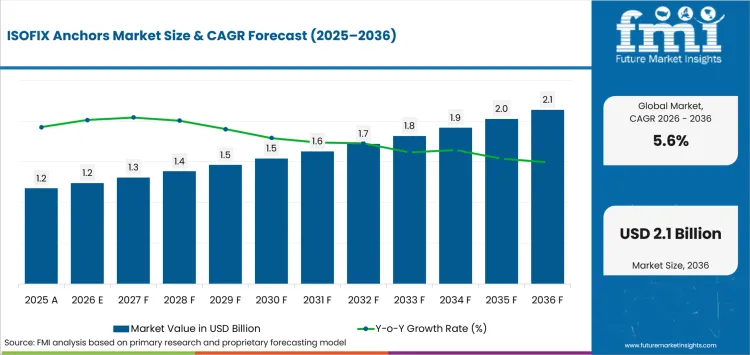
USD 1.2 billion in 2026 and USD 2.1 billion by 2036 at a 5.6% CAGR.
Demand for ISOFIX anchors is projected to expand at 5.6% CAGR between 2026 and 2036, increasing valuation from USD 1.2 billion in 2026 to USD 2.1 billion by 2036. Vehicle approval rules tie anchor geometry and load performance to the seat or body structure, making early program validation a core purchasing condition.
Standardized child-restraint anchorage rules keep demand linked to new-vehicle production and seat redesign cycles. NHTSA's FMVSS No. 225 establishes strength, location and accessibility requirements for lower anchor bars and top tether anchors, while UN Regulation No. 145 covers ISOFIX anchorage systems, ISOFIX top tether anchorages and i-Size seating positions. Accessibility remains relevant after compliance because occupants still need to find and connect the hardware consistently.
Key Takeaways
- Homologated attachment geometry keeps ISOFIX demand tied to seat and body programs, with lower anchor brackets estimated at 33.0% in 2026.
- Passenger cars are projected at 34.0% of vehicle-type demand in 2026 as factory child-restraint anchorages remain part of mainstream light-vehicle safety packages.
- High strength steel is forecast at 61.0% by material in 2026 because compact brackets need repeatable strength within welded seat and body structures.
- OEM supply is estimated at 52.0% by sales channel, while factory vehicle seating is projected at 43.0% by end use in 2026.
- Anchor accessibility, trim interference and changing seat layouts can restrict correct child-restraint installation even when structural requirements are met.
- Adient plc, Lear Corporation, FORVIA SE, Toyota Boshoku Corporation, Magna International Inc., Brose Fahrzeugteile SE & Co. KG. , TS TECH Co.,Ltd., NHK SPRING CO., LTD., RECARO Automotive and GRAMMER AG participate through automotive seating, seat structures or related integration routes.
Analyst Perspective
"ISOFIX anchor programs are decided at the interface between regulation and vehicle structure. Suppliers need to prove load performance, package access and repeatable geometry early in the seat or body design cycle because late changes can affect trim, welding and homologation within the same program."
- Nikhil Kaitwade, Principal Consultant, Future Market Insights
How is the ISOFIX Anchors Market segmented?
The ISOFIX anchors market is segmented by anchor type, vehicle type, material, sales channel, end use and region.
ISOFIX anchors are segmented by anchor type, vehicle type, material, sales channel, end use and region across vehicle safety programs. Anchor type covers lower anchor brackets, top tether anchors, integrated seat-frame anchors, retrofit anchor kits and reinforced body-in-white anchor points. Vehicle type includes passenger cars, SUVs / crossovers, MPVs, LCVs and electric vehicles. Material covers high strength steel, stainless steel, aluminum alloy and composite reinforced brackets. Sales channel includes OEM supply, Tier-1 seat systems, aftermarket retrofit and replacement / service parts. End use covers factory vehicle seating, child safety seats, fleet / taxi retrofits and specialty mobility vehicles.
Why do lower anchor brackets lead the anchor type category?
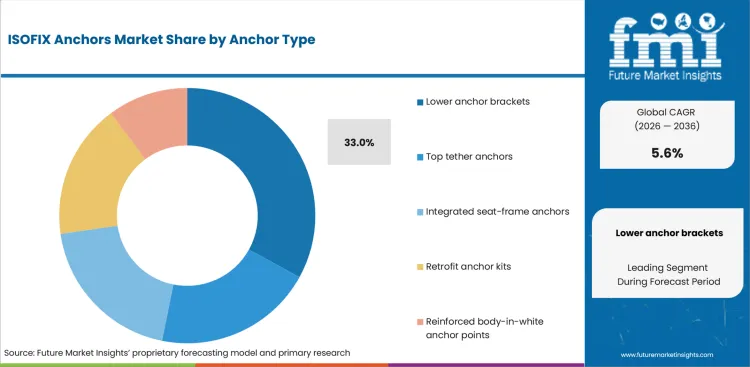
Lower anchor brackets form the primary pair of vehicle-side attachment points used to connect compatible child restraints near the seat bight. Their dimensions, strength and accessibility are controlled within vehicle safety requirements, so bracket design is resolved with the seat or body structure before production release.
- Based on anchor type, lower anchor brackets are projected to account for 33.0% in 2026 because every compatible installation depends on a repeatable vehicle-side lower anchorage interface.
- NHTSA's FMVSS No. 225 specifies lower-anchor strength, location and accessibility, while UN Regulation No. 145 governs ISOFIX anchorage systems in markets using UNECE vehicle approvals. The combination keeps lower brackets inside homologated factory programs instead of treating them as an isolated accessory.
Why do passenger cars lead the vehicle type category?
Passenger cars place child-restraint positions inside high-volume rear-seat architectures where anchor access must coexist with cushion contour, trim and folding functions. Standardized anchor geometry lets vehicle programs support compatible child restraints without changing the attachment concept for each model.
- Passenger cars are estimated to account for 34.0% of vehicle-type demand in 2026 because factory child-restraint anchorages are integrated across mainstream light-vehicle programs.
- Seat redesigns still require validation of anchor exposure and clearance after trim is installed. IIHS evaluates lower anchors for accessibility, clearance angle and connection force, showing why usable packaging remains a design requirement alongside structural compliance.
Why does high strength steel lead the material category?
High strength steel gives anchorage brackets a compact structural path that can be stamped, welded and validated with surrounding seat or body components. The material also fits established automotive joining processes used for seat frames and reinforced body structures.
- The material category is forecast to be led by high strength steel at 61.0% share in 2026 because anchorage hardware needs high load capacity within limited package space.
- Current seating suppliers continue to use high-tensile steels in structural programs. NHK Spring states that its front seat frames combine high-tensile steel with optimized design, illustrating the material logic around safety-critical seat structures.
Why does OEM supply lead the sales channel category?
ISOFIX anchorages are vehicle-installed safety hardware whose geometry and strength are examined as part of the approved vehicle configuration. Factory integration lets welding, trim access and inspection controls be defined before the vehicle reaches final assembly.
- OEM supply is projected to account for 52.0% of sales-channel demand in 2026 because anchorage systems are normally engineered and validated inside vehicle programs.
- Mexico's NOM-194-SE-2021 recognizes UN R14 or UN R145 routes for ISOFIX or LATCH anchorage requirements, while Brazil accepts UN R145 or FMVSS 225 evidence under its current framework. These routes favor parts that enter through controlled vehicle approval and production channels.
Why does factory vehicle seating lead the end-use category?
Factory vehicle seating provides a controlled point for locating anchor hardware relative to cushion, seatback and adjacent structure before trim is finalized. That integration becomes more important as sliding, folding and reconfigurable seats change the space around child-restraint attachment points.
- Factory vehicle seating is likely to account for 43.0% of end-use demand in 2026 due to direct integration with seat frames, vehicle floor structures and production inspection.
- Magna's current seating portfolio includes structures, mechanisms and hardware, while its reconfigurable seating systems use long rails and rotating seat bases. Such architectures increase the need to resolve anchorage load paths and access at the vehicle-development stage.
What are the drivers, restraints and opportunities in the ISOFIX Anchors Market?
Vehicle safety regulation sustains factory-installed demand while packaging difficulty restrains accessibility and modular seating creates new integration work across seat and body structures.
- Driver: Vehicle safety standards require defined lower-anchor and top-tether performance across regulated light-vehicle programs.
- Restraint: Seat-bight depth, trim interference and changing cabin layouts can make compliant anchorages harder to reach or connect correctly.
- Opportunity: Lightweight seat structures and reconfigurable electric-vehicle cabins create new demand for validated anchorage integration within evolving load paths.
Regulatory requirements turn ISOFIX anchor design into a recurring vehicle-program obligation. FMVSS No. 225 in the USA establishes strength, location and accessibility requirements, while UN Regulation No. 145 provides the approval framework for ISOFIX anchorage systems and related top tether points. Mexico's NOM-194-SE-2021 also places ISOFIX or LATCH anchorages within the safety-device framework for new light vehicles and recognizes UN R14 or UN R145 compliance routes.
A technically compliant anchorage can still be difficult to use if the lower bars are buried in the seat bight or surrounding trim leaves insufficient clearance. IIHS evaluates anchor accessibility, clearance angle and required connection force. Its research also connects easier lower-anchor access with a higher likelihood of correct use. Seat designers therefore need usable access after cushions, covers and folding mechanisms are finalized.
Reconfigurable interiors create new engineering work because seat travel and rotation can change how structural loads pass through rails, bases and floor interfaces. Magna's flexible seating systems use long-travel rails and rotating bases, while its Cell to Seat concept integrates reconfigurable seating with the battery enclosure. These shifts create room for lighter anchor brackets and reinforced interfaces provided they remain compatible with regulated child-restraint geometry.
Which country CAGRs are profiled in the ISOFIX Anchors Market?
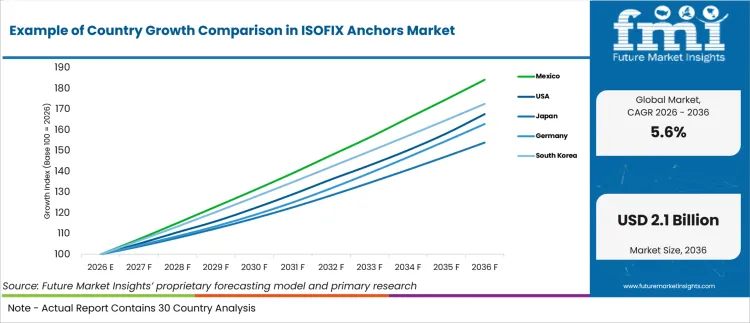
| Country | CAGR |
|---|---|
| Mexico | 6.3% |
| USA | 5.3% |
| Japan | 4.4% |
| Germany | 5.0% |
| South Korea | 5.6% |
| Brazil | 5.9% |
| France | 4.7% |
How do country-level CAGRs compare in the ISOFIX Anchors Market?
The seven profiled CAGRs span 1.9 percentage points across different vehicle-approval systems and seating architectures. The spacing measures expected market expansion rather than current vehicle production or installed anchorage volume in each country.
- Mexico is set to grow at 6.3% CAGR as national light-vehicle safety rules place ISOFIX or LATCH anchorages inside the required safety-device framework.
- USA is likely to expand at 5.3% CAGR within an established FMVSS No. 225 environment where lower-anchor strength, location and accessibility are defined for vehicle compliance.
- Japan is anticipated to grow at 4.4% CAGR, with supplier quality controls focused on bracket geometry, durability and reliable child-seat connection across mature vehicle programs.
- Germany is forecast to expand at 5.0% CAGR under EU and UNECE approval routes that apply UN Regulation No. 145 requirements to installed ISOFIX anchorage systems.
- South Korea is projected to advance at 5.6% CAGR as domestic vehicle programs operate within UNECE-linked safety requirements and Korean experts continue to participate in UN Regulation No. 145 updates.
- Brazil is likely to grow at 5.9% CAGR as current CONTRAN rules accept UN R145 or FMVSS 225 test evidence for ISOFIX, i-Size or LATCH-equipped vehicles.
- France is expected to expand at 4.7% CAGR under the EU and UNECE approval framework while electrified and modular cabin programs continue to alter seat and floor integration.
Comparable CAGRs can produce different engineering and sourcing conditions. The full report provides country-level CAGR analysis across North America, Latin America, Europe, East Asia, South Asia and Pacific, and the Middle East and Africa.
Country-wise Analysis
- Mexico combines a national light-vehicle safety rule with extensive vehicle assembly and supplier integration. NOM-194-SE-2021 lists child-restraint anchorages, ISOFIX or LATCH, among safety devices for new light vehicles and recognizes UN R14 or UN R145 compliance routes. The Mexican ISOFIX anchors sector is projected to expand at 6.3% CAGR through 2036 as program demand shifts toward factory-integrated anchor hardware and controlled validation.
- USA demand operates within FMVSS No. 225, which establishes strength, location and accessibility requirements for lower anchor bars and top tether anchors. The same regulatory foundation gives OEM seating and body teams a fixed interface for new passenger-car, SUV and electric-vehicle programs while usability testing still focuses on how easily occupants can reach the lower anchors. USA is projected to advance at 5.3% CAGR through 2036.
- Japanese vehicle programs require consistent ISOFIX geometry and attachment integrity because an incorrect interface can prevent safe child-restraint installation. Japan's Ministry of Land, Infrastructure, Transport and Tourism warns that aftermarket ISOFIX mounting brackets that may not comply with safety standards are in circulation and notes that vehicle-side anchorages are subject to strength and installation-position requirements. Japan is projected to grow at 4.4% CAGR through 2036.
- Germany operates within the EU type-approval framework that references UNECE vehicle safety rules for ISOFIX anchorage systems. In April 2026, the EU published the current UN Regulation No. 145 text, including requirements for attaching specified ISOFIX fixtures to installed anchorage systems. Germany is estimated to expand at 5.0% CAGR through 2036 as seat structures and increasingly flexible interiors keep anchorage validation inside new vehicle programs.
- South Korea combines domestic vehicle production with direct participation in UNECE passive-safety work. Republic of Korea experts submitted corrigenda to UN Regulation No. 145 during the 2025 GRSP cycle, reflecting continuing involvement in the technical rules governing ISOFIX anchorage systems. South Korea is projected to advance at 5.6% CAGR through 2036 as local seat and vehicle programs adapt current anchorage requirements.
- Brazil's current anchorage framework references ISOFIX, i-Size and LATCH within vehicle compliance. CONTRAN Resolution No. 997/2023 accepts UN R14 series 07 or UN R145 and UN R44 series 04, or FMVSS 225, as evidence for the applicable child-restraint anchorage requirements. Brazil is projected to expand at 5.9% CAGR through 2036 as local vehicle programs procure compliant anchor systems through OEM and seat-system channels.
- France follows the EU vehicle type-approval route, where UN Regulation No. 145 governs ISOFIX anchorage systems, ISOFIX top tether anchorages and i-Size seating positions. The French ISOFIX anchors market is forecast to increase at 4.7% CAGR through 2036 as new seat architectures and electrified vehicle platforms require anchor access to be preserved through structural and trim changes. The regulatory baseline keeps validation tied to each approved vehicle configuration.
Who are the notable companies in the ISOFIX Anchors Market?
Adient plc, Lear Corporation, FORVIA SE, Toyota Boshoku Corporation, Magna International Inc., Brose Fahrzeugteile SE & Co. KG. , TS TECH Co.,Ltd., NHK SPRING CO., LTD., RECARO Automotive and GRAMMER AG are the notable companies serving the ISOFIX anchors market.
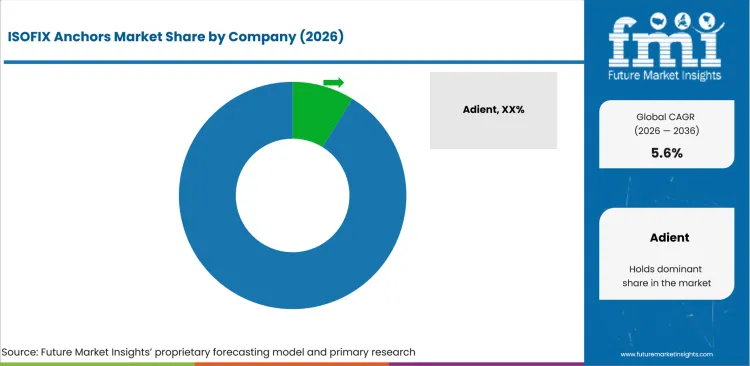
ISOFIX anchor competition sits inside broader automotive seating, seat-structure and vehicle-integration programs rather than a stand-alone consumer hardware category. Suppliers with seat-frame engineering and OEM program access can resolve anchorage loads, bracket geometry and trim access earlier in development. Specialist seat brands remain relevant where vehicle-specific seat structures or retrofit configurations require validated attachment interfaces.
- Adient plc, Lear Corporation, FORVIA SE, Toyota Boshoku Corporation and Magna International Inc. combine complete seating with seat structures, mechanisms or hardware integration for vehicle programs.
- Brose Fahrzeugteile SE & Co. KG., TS TECH Co.,Ltd. and NHK SPRING CO., LTD. provide seat structures, mechanisms or automotive seating platforms that place them close to the structural interface used by anchorage hardware.
- RECARO Automotive, operating under Proma Group since January 2025 following a 2024 restructuring, and GRAMMER AG serve specialized seating routes across passenger, performance or commercial-vehicle applications where vehicle-specific structural integration remains important.
Competitive Benchmarking: ISOFIX Anchors Market
| Company | Seating system integration | Seat structure / hardware capability | OEM program relevance | Geographic Reach |
|---|---|---|---|---|
| Adient plc | High | High | High | North America, Europe and Asia-Pacific |
| Lear Corporation | High | High | High | Americas, Europe and Asia |
| FORVIA SE | High | High | High | Europe, Americas and Asia |
| Toyota Boshoku Corporation | High | High | High | Japan, Americas, Europe and Asia |
| Magna International Inc. | High | High | High | North America, Europe and Asia |
| Brose Fahrzeugteile SE & Co. KG. | Medium | High | High | Europe, North America and Asia |
| TS TECH Co.,Ltd. | High | High | High | Japan, Americas and Asia |
| NHK SPRING CO., LTD. | High | High | High | Japan, Americas, Europe and Asia |
| RECARO Automotive | Medium | Medium | Medium | Europe, North America and Japan |
| GRAMMER AG | Medium | Medium | Medium | Europe, Americas and Asia-Pacific |
Scoring basis: Seating system integration is High for verified complete-seat or broad automotive seating capability across several vehicle programs. Medium covers specialized seating or a narrower vehicle route. Seat structure / hardware capability is High for verified seat frames, structures, mechanisms or related structural hardware. Medium covers seating capability with less evidence of broad structural production. OEM program relevance is High where current automotive manufacturing and validation are integrated into vehicle programs, and Medium covers more specialized or aftermarket-oriented routes. Geographic Reach records active regions documented by official company sources rather than each company's complete corporate footprint.
Key Developments in the ISOFIX Anchors Market
- In April 2026, the European Union published the current UN Regulation No. 145 text covering ISOFIX anchorage systems, ISOFIX top tether anchorages and i-Size seating positions, including fixture-attachment requirements for installed systems.
- In September 2025, the UNECE passive-safety process published a proposal for Supplement 2 to the 01 series of amendments to UN Regulation No. 145.
- In April and May 2025, Republic of Korea experts submitted and presented corrigenda concerning UN Regulation No. 145 during the UNECE GRSP cycle.
Key Players in the ISOFIX Anchors Market
Integrated Automotive Seating and Structures
- Adient plc
- Lear Corporation
- FORVIA SE
- Toyota Boshoku Corporation
- Magna International Inc.
Seat Structures and Mechanisms
- Brose Fahrzeugteile SE & Co. KG.
- TS TECH Co.,Ltd.
- NHK SPRING CO., LTD.
Specialized Seating Platforms
- RECARO Automotive
- GRAMMER AG
ISOFIX Anchors Market - Report Scope
| Coverage field | Report scope |
|---|---|
| Market breakdown | By anchor type, vehicle type, material, sales channel, end use and region. |
| Quantitative Units | USD billion. |
| Market Definition | Vehicle-installed anchorage brackets, top tether points and integrated structural attachment hardware designed to secure ISOFIX-compatible child restraint systems. |
| Regions Covered | North America, Latin America, Europe, East Asia, South Asia and Pacific, and Middle East and Africa. |
| Countries Covered | Mexico, USA, Japan, Germany, South Korea, Brazil, France, and 20+ countries included in the full report. |
| Key Companies Profiled | Adient plc, Lear Corporation, FORVIA SE, Toyota Boshoku Corporation, Magna International Inc., Brose Fahrzeugteile SE & Co. KG., TS TECH Co.,Ltd., NHK SPRING CO., LTD., RECARO Automotive and GRAMMER AG. |
| Forecast Period | 2026 to 2036. |
| Approach | Primary and secondary research with market triangulation. |
ISOFIX Anchors Market - Research Methodology
| Method | Approach |
|---|---|
| Primary Research | FMI analysts gathered input from automotive seating suppliers, component manufacturers, vehicle OEMs, Tier-1 integrators, distributors, fleet operators, procurement teams and subject-matter experts. Interviews examined sourcing decisions, anchorage validation, material selection, approval requirements, pricing considerations and the evidence required before a new seat or vehicle program moves into regular production. |
| Desk Research | Desk research covered vehicle safety regulations, government publications, technical standards, automotive-industry associations, company filings, product information and official corporate announcements. Sources were reviewed for publication date, geographic coverage and direct relevance to ISOFIX anchorage systems, seat structures and vehicle approval. Claims relating to compliance, materials, production programs and company capability were retained only when supported by credible public evidence. |
| Market Sizing and Forecasting | The market model combined the baseline value with historical performance, segment structure, pricing and volume indicators, vehicle production conditions, company participation and country-level demand. Forecast assumptions considered regulatory timing, vehicle-platform changes, seating architecture, electrification, sourcing cycles and barriers to wider retrofit use. Segment and regional estimates were reconciled before the final market total was calculated. |
| Data Validation | Estimates were checked against multiple independent indicators, including vehicle-safety requirements, company activity, production patterns and findings from primary interviews. Validation also tested whether anchor brackets, top tether points, integrated seat-frame anchors and related hardware fell within the defined market boundaries. Adjacent child-restraint products, unsupported claims and overlapping revenues were excluded to reduce double counting and maintain consistency across segments and countries. |
ISOFIX Anchors Market by Segments
ISOFIX Anchors Market segmented by Anchor Type:
- Lower anchor brackets
- Top tether anchors
- Integrated seat-frame anchors
- Retrofit anchor kits
- Reinforced body-in-white anchor points
ISOFIX Anchors Market segmented by Vehicle Type:
- Passenger cars
- SUVs / crossovers
- MPVs
- LCVs
- Electric vehicles
ISOFIX Anchors Market segmented by Material:
- High strength steel
- Stainless steel
- Aluminum alloy
- Composite reinforced brackets
ISOFIX Anchors Market segmented by Sales Channel:
- OEM supply
- Tier-1 seat systems
- Aftermarket retrofit
- Replacement / service parts
ISOFIX Anchors Market segmented by End Use:
- Factory vehicle seating
- Child safety seats
- Fleet / taxi retrofits
- Specialty mobility vehicles
ISOFIX Anchors Market by Region:
- North America
- United States
- Canada
- Latin America
- Brazil
- Chile
- Mexico
- Rest of Latin America
- Western Europe
- Germany
- United Kingdom
- Italy
- Spain
- France
- Nordics
- Benelux
- Rest of Western Europe
- Eastern Europe
- Russia
- Poland
- Hungary
- Balkan and Baltic States
- Rest of Eastern Europe
- East Asia
- China
- Japan
- South Korea
- South Asia and Pacific
- India
- ASEAN
- Australia and New Zealand
- Rest of South Asia and Pacific
- Middle East and Africa
- Kingdom of Saudi Arabia
- Other GCC Countries
- Türkiye
- South Africa
- Other African Union Countries
- Rest of Middle East and Africa
Research Sources and Bibliography
- United Nations Economic Commission for Europe. (2025). UN Regulation No. 145, ISOFIX anchorage systems, ISOFIX top tether anchorages and i-Size seating positions.
- United Nations Economic Commission for Europe. (2025, September). Proposal for Supplement 2 to the 01 series of amendments to UN Regulation No. 145.
- European Union. (2026, April 24). UN Regulation No. 145 - Uniform provisions concerning the approval of vehicles with regard to ISOFIX anchorage systems, ISOFIX top tether anchorages and i-Size seating positions.
- National Highway Traffic Safety Administration. FMVSS No. 225, Child Restraint Anchorage Systems.
- Insurance Institute for Highway Safety. LATCH evaluation criteria and research on lower-anchor accessibility.
- Secretaría de Economía, Mexico. NOM-194-SE-2021, Dispositivos de seguridad para vehículos ligeros nuevos - Requisitos y especificaciones.
- Conselho Nacional de Trânsito, Brazil. (2023, September 26). Resolução CONTRAN No. 997.
- Ministry of Land, Infrastructure, Transport and Tourism, Japan. Safety guidance on aftermarket ISOFIX mounting brackets and automotive recall information.
- Adient plc. Automotive Seating Structures and Mechanisms.
- Lear Corporation. Automotive Seating.
- FORVIA SE. Seating business and current corporate information.
- Toyota Boshoku Corporation. Automobile Seats and Corporate Information.
- Magna International Inc. Magna Seating and Cell to Seat System.
- Brose Fahrzeugteile SE & Co. KG. Seat Structures, Components and Adjustment Systems.
- TS TECH Co.,Ltd. Products, Corporate Profile and Innovation Stories.
- NHK SPRING CO., LTD. Car Seat Products and Company Overview.
- RECARO Automotive. Company and Proma Group information.
- GRAMMER AG. Company Profile.
This bibliography is provided for reader reference and is not exhaustive. The full report contains the complete reference list and detailed citations.
This Report Answers
- How large is the ISOFIX Anchors Market in 2026 and 2036?
- Which vehicle-safety and design conditions support recurring demand for ISOFIX anchorage hardware?
- Which anchor type accounts for the approved 2026 share?
- How does vehicle type shape ISOFIX anchor demand across new vehicle programs?
- Which material holds the approved 2026 demand share?
- How do sales channel and end use affect anchorage sourcing and integration?
- How do profiled country growth rates affect commercial entry conditions?
- Which companies serve automotive seating and structural integration relevant to ISOFIX anchors?
Frequently Asked Questions
How big is the ISOFIX Anchors Market in 2026?
USD 1.2 billion represents the ISOFIX anchors market value in 2026 across vehicle-installed anchorage brackets, top tether points and related structural hardware. Factory integration and regulated child-restraint interfaces support demand as the category advances toward USD 2.1 billion by 2036.
What is the CAGR of the ISOFIX Anchors Market from 2026 to 2036?
A 5.6% CAGR is projected for the ISOFIX anchors market between 2026 and 2036. Vehicle safety requirements keep anchorage demand tied to new model programs, while reconfigurable seating and electric-vehicle packaging create additional structural validation work across seat and body interfaces.
Which anchor type is projected to account for 33.0% of the ISOFIX Anchors Market?
Lower anchor brackets are projected to account for 33.0% of anchor-type demand within the ISOFIX anchors market in 2026. The segment reflects the paired vehicle-side attachment interface used by compatible child restraints and the need to validate strength, geometry and access within each vehicle program.
How much will the ISOFIX Anchors Market add between 2026 and 2036?
USD 0.9 billion is expected to be added to the ISOFIX anchors market between 2026 and 2036. The increase is linked to regulated factory installation, continued vehicle-platform renewal and anchorage integration within changing seat and floor structures.
Which companies are active in the ISOFIX Anchors Market?
Ten companies active in automotive seating and structural integration relevant to the ISOFIX anchors market include Adient plc, Lear Corporation, FORVIA SE, Toyota Boshoku Corporation, Magna International Inc., Brose SE, TS TECH Co.,Ltd., NHK SPRING CO., LTD., RECARO Automotive and GRAMMER AG. The group covers complete seats, seat structures, mechanisms and specialized seating programs.
Preview the report firsthand - request a free sample
Get SampleGet the brochure for pricing and purchase details.
Get PDFTable of Content
- Key Takeaways
- Market Size and CAGR
- Top Growth Driver
- Fastest Growing Segment
- Leading Region
- Key Companies
- Emerging Opportunities
- Executive Summary
- Global Market Outlook
- Demand-side Trends
- Supply-side Trends
- Technology Roadmap Analysis
- Analysis and Recommendations
- Analyst Perspective (What is happening? Why now? What should investors know?)
- Key Questions Answered
- How large is the market?
- What is the CAGR?
- What are key trends?
- Which region dominates?
- Who are the leaders?
- Market Overview
- Market Coverage / Taxonomy
- Market Definition / Scope / Limitations
- Research Methodology
- Chapter Orientation
- Analytical Lens and Working Hypotheses
- Market Structure, Signals, and Trend Drivers
- Benchmarking and Cross-market Comparability
- Market Sizing, Forecasting, and Opportunity Mapping
- Research Design and Evidence Framework
- Desk Research Programme (Secondary Evidence)
- Expert Input and Fieldwork (Primary Evidence)
- Tooling, Models, and Reference Databases
- Data Engineering and Model Build
- Quality Assurance and Audit Trail
- Market Background
- Market Dynamics (Drivers, Restraints, Opportunity, Trends)
- Scenario Forecast (Optimistic, Likely, Conservative)
- Impact Analysis
- AI Impact
- Sustainability Impact
- Regulatory Impact
- Technology Impact
- Consumer / Buyer Analysis
- Purchase Drivers
- Adoption Barriers
- Buyer Journey
- Opportunity Map Analysis
- Product Life Cycle Analysis
- Supply Chain Analysis
- Investment Feasibility Matrix
- Value Chain Analysis
- PESTLE and Porter's Analysis
- Regulatory Landscape
- Regional Parent Market Outlook
- Production and Consumption Statistics
- Import and Export Statistics
- Global Market Analysis and Forecast, 2021 to 2036
- Historical Market Size Value (USD Billion) Analysis, 2021 to 2025
- Current and Future Market Size Value (USD Billion) Projections, 2026 to 2036
- Y-o-Y Growth Trend Analysis
- Absolute $ Opportunity Analysis
- Global Market Pricing Analysis, 2021 to 2036
- Global Market Analysis and Forecast, By Anchor Type, 2021 to 2036
- Introduction / Key Findings
- Historical Market Size Value (USD Billion) Analysis By Anchor Type, 2021 to 2025
- Current and Future Market Size Value (USD Billion) Analysis and Forecast By Anchor Type, 2026 to 2036
- Lower anchor brackets
- Top tether anchors
- Integrated seat-frame anchors
- Retrofit anchor kits
- Reinforced body-in-white anchor points
- Lower anchor brackets
- Y-o-Y Growth Trend Analysis By Anchor Type, 2021 to 2025
- Absolute $ Opportunity Analysis By Anchor Type, 2026 to 2036
- Global Market Analysis and Forecast, By Vehicle Type, 2021 to 2036
- Introduction / Key Findings
- Historical Market Size Value (USD Billion) Analysis By Vehicle Type, 2021 to 2025
- Current and Future Market Size Value (USD Billion) Analysis and Forecast By Vehicle Type, 2026 to 2036
- Passenger cars
- SUVs / crossovers
- MPVs
- LCVs
- Electric vehicles
- Passenger cars
- Y-o-Y Growth Trend Analysis By Vehicle Type, 2021 to 2025
- Absolute $ Opportunity Analysis By Vehicle Type, 2026 to 2036
- Global Market Analysis and Forecast, By Material, 2021 to 2036
- Introduction / Key Findings
- Historical Market Size Value (USD Billion) Analysis By Material, 2021 to 2025
- Current and Future Market Size Value (USD Billion) Analysis and Forecast By Material, 2026 to 2036
- High strength steel
- Stainless steel
- Aluminum alloy
- Composite reinforced brackets
- High strength steel
- Y-o-Y Growth Trend Analysis By Material, 2021 to 2025
- Absolute $ Opportunity Analysis By Material, 2026 to 2036
- Global Market Analysis and Forecast, By Sales Channel, 2021 to 2036
- Introduction / Key Findings
- Historical Market Size Value (USD Billion) Analysis By Sales Channel, 2021 to 2025
- Current and Future Market Size Value (USD Billion) Analysis and Forecast By Sales Channel, 2026 to 2036
- OEM supply
- Tier-1 seat systems
- Aftermarket retrofit
- Replacement / service parts
- OEM supply
- Y-o-Y Growth Trend Analysis By Sales Channel, 2021 to 2025
- Absolute $ Opportunity Analysis By Sales Channel, 2026 to 2036
- Global Market Analysis and Forecast, By End Use, 2021 to 2036
- Introduction / Key Findings
- Historical Market Size Value (USD Billion) Analysis By End Use, 2021 to 2025
- Current and Future Market Size Value (USD Billion) Analysis and Forecast By End Use, 2026 to 2036
- Factory vehicle seating
- Child safety seats
- Fleet / taxi retrofits
- Specialty mobility vehicles
- Factory vehicle seating
- Y-o-Y Growth Trend Analysis By End Use, 2021 to 2025
- Absolute $ Opportunity Analysis By End Use, 2026 to 2036
- Global Market Analysis and Forecast, By Region, 2021 to 2036
- Introduction
- Historical Market Size Value (USD Billion) Analysis By Region, 2021 to 2025
- Current Market Size Value (USD Billion) Analysis and Forecast By Region, 2026 to 2036
- North America
- Latin America
- Western Europe
- Eastern Europe
- East Asia
- South Asia and Pacific
- Middle East & Africa
- Market Attractiveness Analysis By Region
- North America Market Analysis and Forecast, By Country, 2021 to 2036
- Historical Market Size Value (USD Billion) Trend Analysis By Market Taxonomy, 2021 to 2025
- Market Size Value (USD Billion) Forecast By Market Taxonomy, 2026 to 2036
- By Country
- USA
- Canada
- By Anchor Type
- By Vehicle Type
- By Material
- By Sales Channel
- By End Use
- By Country
- Market Attractiveness Analysis
- By Country
- By Anchor Type
- By Vehicle Type
- By Material
- By Sales Channel
- By End Use
- Key Takeaways
- Latin America Market Analysis and Forecast, By Country
- Historical Market Size Value (USD Billion) Trend Analysis By Market Taxonomy, 2021 to 2025
- Market Size Value (USD Billion) Forecast By Market Taxonomy, 2026 to 2036
- By Country
- Brazil
- Mexico
- Chile
- Rest of Latin America
- By Anchor Type
- By Vehicle Type
- By Material
- By Sales Channel
- By End Use
- By Country
- Market Attractiveness Analysis
- By Country
- By Anchor Type
- By Vehicle Type
- By Material
- By Sales Channel
- By End Use
- Key Takeaways
- Western Europe Market Analysis and Forecast, By Country
- Historical Market Size Value (USD Billion) Trend Analysis By Market Taxonomy, 2021 to 2025
- Market Size Value (USD Billion) Forecast By Market Taxonomy, 2026 to 2036
- By Country
- Germany
- UK
- Italy
- Spain
- France
- Nordic
- BENELUX
- Rest of Western Europe
- By Anchor Type
- By Vehicle Type
- By Material
- By Sales Channel
- By End Use
- By Country
- Market Attractiveness Analysis
- By Country
- By Anchor Type
- By Vehicle Type
- By Material
- By Sales Channel
- By End Use
- Key Takeaways
- Eastern Europe Market Analysis and Forecast, By Country
- Historical Market Size Value (USD Billion) Trend Analysis By Market Taxonomy, 2021 to 2025
- Market Size Value (USD Billion) Forecast By Market Taxonomy, 2026 to 2036
- By Country
- Russia
- Poland
- Hungary
- Balkan & Baltic
- Rest of Eastern Europe
- By Anchor Type
- By Vehicle Type
- By Material
- By Sales Channel
- By End Use
- By Country
- Market Attractiveness Analysis
- By Country
- By Anchor Type
- By Vehicle Type
- By Material
- By Sales Channel
- By End Use
- Key Takeaways
- East Asia Market Analysis and Forecast, By Country
- Historical Market Size Value (USD Billion) Trend Analysis By Market Taxonomy, 2021 to 2025
- Market Size Value (USD Billion) Forecast By Market Taxonomy, 2026 to 2036
- By Country
- China
- Japan
- South Korea
- By Anchor Type
- By Vehicle Type
- By Material
- By Sales Channel
- By End Use
- By Country
- Market Attractiveness Analysis
- By Country
- By Anchor Type
- By Vehicle Type
- By Material
- By Sales Channel
- By End Use
- Key Takeaways
- South Asia and Pacific Market Analysis and Forecast, By Country
- Historical Market Size Value (USD Billion) Trend Analysis By Market Taxonomy, 2021 to 2025
- Market Size Value (USD Billion) Forecast By Market Taxonomy, 2026 to 2036
- By Country
- India
- ASEAN
- Australia & New Zealand
- Rest of South Asia and Pacific
- By Anchor Type
- By Vehicle Type
- By Material
- By Sales Channel
- By End Use
- By Country
- Market Attractiveness Analysis
- By Country
- By Anchor Type
- By Vehicle Type
- By Material
- By Sales Channel
- By End Use
- Key Takeaways
- Middle East & Africa Market Analysis and Forecast, By Country
- Historical Market Size Value (USD Billion) Trend Analysis By Market Taxonomy, 2021 to 2025
- Market Size Value (USD Billion) Forecast By Market Taxonomy, 2026 to 2036
- By Country
- Kingdom of Saudi Arabia
- Other GCC Countries
- Türkiye
- South Africa
- Other African Union
- Rest of Middle East & Africa
- By Anchor Type
- By Vehicle Type
- By Material
- By Sales Channel
- By End Use
- By Country
- Market Attractiveness Analysis
- By Country
- By Anchor Type
- By Vehicle Type
- By Material
- By Sales Channel
- By End Use
- Key Takeaways
- Key Countries Market Analysis
- USA
- Pricing Analysis
- Market Share Analysis, 2025
- By Anchor Type
- By Vehicle Type
- By Material
- By Sales Channel
- By End Use
- Canada
- Pricing Analysis
- Market Share Analysis, 2025
- By Anchor Type
- By Vehicle Type
- By Material
- By Sales Channel
- By End Use
- Mexico
- Pricing Analysis
- Market Share Analysis, 2025
- By Anchor Type
- By Vehicle Type
- By Material
- By Sales Channel
- By End Use
- Brazil
- Pricing Analysis
- Market Share Analysis, 2025
- By Anchor Type
- By Vehicle Type
- By Material
- By Sales Channel
- By End Use
- Chile
- Pricing Analysis
- Market Share Analysis, 2025
- By Anchor Type
- By Vehicle Type
- By Material
- By Sales Channel
- By End Use
- Germany
- Pricing Analysis
- Market Share Analysis, 2025
- By Anchor Type
- By Vehicle Type
- By Material
- By Sales Channel
- By End Use
- UK
- Pricing Analysis
- Market Share Analysis, 2025
- By Anchor Type
- By Vehicle Type
- By Material
- By Sales Channel
- By End Use
- Italy
- Pricing Analysis
- Market Share Analysis, 2025
- By Anchor Type
- By Vehicle Type
- By Material
- By Sales Channel
- By End Use
- Spain
- Pricing Analysis
- Market Share Analysis, 2025
- By Anchor Type
- By Vehicle Type
- By Material
- By Sales Channel
- By End Use
- France
- Pricing Analysis
- Market Share Analysis, 2025
- By Anchor Type
- By Vehicle Type
- By Material
- By Sales Channel
- By End Use
- India
- Pricing Analysis
- Market Share Analysis, 2025
- By Anchor Type
- By Vehicle Type
- By Material
- By Sales Channel
- By End Use
- ASEAN
- Pricing Analysis
- Market Share Analysis, 2025
- By Anchor Type
- By Vehicle Type
- By Material
- By Sales Channel
- By End Use
- Australia & New Zealand
- Pricing Analysis
- Market Share Analysis, 2025
- By Anchor Type
- By Vehicle Type
- By Material
- By Sales Channel
- By End Use
- China
- Pricing Analysis
- Market Share Analysis, 2025
- By Anchor Type
- By Vehicle Type
- By Material
- By Sales Channel
- By End Use
- Japan
- Pricing Analysis
- Market Share Analysis, 2025
- By Anchor Type
- By Vehicle Type
- By Material
- By Sales Channel
- By End Use
- South Korea
- Pricing Analysis
- Market Share Analysis, 2025
- By Anchor Type
- By Vehicle Type
- By Material
- By Sales Channel
- By End Use
- Russia
- Pricing Analysis
- Market Share Analysis, 2025
- By Anchor Type
- By Vehicle Type
- By Material
- By Sales Channel
- By End Use
- Poland
- Pricing Analysis
- Market Share Analysis, 2025
- By Anchor Type
- By Vehicle Type
- By Material
- By Sales Channel
- By End Use
- Hungary
- Pricing Analysis
- Market Share Analysis, 2025
- By Anchor Type
- By Vehicle Type
- By Material
- By Sales Channel
- By End Use
- Kingdom of Saudi Arabia
- Pricing Analysis
- Market Share Analysis, 2025
- By Anchor Type
- By Vehicle Type
- By Material
- By Sales Channel
- By End Use
- Türkiye
- Pricing Analysis
- Market Share Analysis, 2025
- By Anchor Type
- By Vehicle Type
- By Material
- By Sales Channel
- By End Use
- South Africa
- Pricing Analysis
- Market Share Analysis, 2025
- By Anchor Type
- By Vehicle Type
- By Material
- By Sales Channel
- By End Use
- USA
- Market Structure Analysis
- Competition Dashboard
- Competition Benchmarking
- Market Share Analysis of Top Players
- By Regional
- By Anchor Type
- By Vehicle Type
- By Material
- By Sales Channel
- By End Use
- Emerging Startups
- Innovation Benchmarking
- Competition Analysis
- Competition Deep Dive
- Adient
- Overview
- Product Portfolio
- Profitability by Market Segments
- Sales Footprint
- Strategy Overview
- Marketing Strategy
- Product Strategy
- Channel Strategy
- Lear Corporation
- Forvia
- Toyota Boshoku
- Magna International
- Brose
- TS Tech
- NHK Spring
- Recaro Automotive
- Grammer
- Adient
- Case Studies
- Success Stories
- Recent Developments
- Competition Deep Dive
- Assumptions & Acronyms Used


