

- Market Size (2026)
- USD 1680.6 Mn
- Forecast (2036)
- USD 3214.5 Mn
- CAGR (2026 to 2036)
- 6.7%
How big is the jet dyeing machine market in 2026?
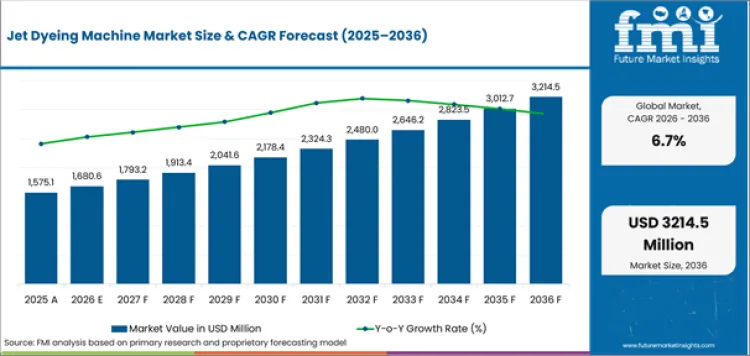
USD 1,680.6 million in 2026 and USD 3,214.5 million by 2036 at a 6.7% CAGR.
The jet dyeing machine market was valued at USD 1,575.1 million in 2025. It is expected to grow from USD 1,680.6 million in 2026 to USD 3,214.5 million in 2036 at a CAGR of 6.7%. Soft-flow jet dyeing is forecast to represent 37.5% share in 2026 with gentler fabric movement. Knits are expected to hold 42.0% share in 2026 due to frequent shade changes in sportswear and innerwear dyehouses.
| Metric | Value |
|---|---|
| 2026 Market Size | USD 1,680.6 million |
| 2036 Market Size | USD 3,214.5 million |
| Forecast CAGR | 6.7% from 2026 to 2036 |
| Leading Machine Type | Soft-flow Jet Dyeing |
| Soft-flow Jet Dyeing Share in 2026 | 37.5% |
| Leading Fabric Type | Knits |
| Knits Share in 2026 | 42.0% |
| Fastest-growing Country | India |
| India CAGR | 8.1% by 2036 |
Summary of the Jet Dyeing Machine Market
| Market Signal | Commercial Impact |
|---|---|
| Demand and Growth Drivers | Jet dyeing machine demand is increasing as textile manufacturers prioritize energy efficiency, process stability, and flexible production.
|
| Product and Segment View | Soft-flow systems, knit processing, medium-batch machines, and direct OEM sales lead the market.
|
| Geography and Growth Outlook | India and China are expected to remain the fastest-growing markets, while Germany and Japan continue to influence technology standards.
|
| Competitive Landscape | Competition focuses on process efficiency, liquor-ratio optimization, and technical support.
|
| Analyst Perspective | Jet dyeing machine purchasing decisions are increasingly driven by operating efficiency rather than production capacity alone.
— Nikhil Kaitwade, Principal Analyst, Future Market Insights |
Jet dyeing machine demand is being shaped by mills that need shorter dye cycles and lower rework risk while handling mixed fabric orders. USA textile mill shipments stood at USD 2,009 million in April 2026, which shows a current production base where finishing equipment uptime still affects order execution. Benninger said in September 2025 that its ITMA Singapore lineup would include next-generation continuous wet processing and jet dyeing solutions, including FabricMaster as its latest soft-flow dyeing machine.
The company also positioned the platform around first-time-right processing for newer fibers and blends. Advanced jet dyeing systems are becoming increasingly important for technical textiles processors seeking consistent shade accuracy and enhanced fabric quality across diverse material blends.
The jet dyeing machine market is projected to expand by 2036 with demand centered on low-liquor dyeing and knit fabric protection. Buyers are treating machine replacement like a water and rework decision.
Which factors support expansion in the jet dyeing machine market?
Low-liquor design and fabric protection support market value across dyehouse replacement cycles.
- Machine value improves with documented steam savings and reduced reprocessing loss.
- Buyer pools widen with machines that process knits and wovens. Synthetic fabrics and blended fabrics add further use cases.
- Volume expands with medium-batch dyehouses that process more shade lots per week.
- Purchase barriers fall with OEM installation and spare-part assurance.
Why is the jet dyeing machine market growing?
Dyehouses are replacing older overflow vessels with machines that lower liquor use and reduce batch failures.
Jet dyeing machine market growth is expected to be propelled by dyehouses that need faster batch turns and stronger shade control. Lower rework across knitted and woven fabric orders is another buyer pressure. The USA Census Bureau reported that overall manufacturing shipments rose 1.0% to USD 641.0 billion in April 2026. This is crucial for jet dyeing equipment suppliers because active production environments place more value on machines that reduce correction cycles and keep fabric quality consistent. Buyers are expected to compare textile testing equipment requirements with machine repeatability during mill audits.
How is the jet dyeing machine market segmented?
The jet dyeing machine industry is segmented by machine type, fabric type, capacity, end use and sales channel.
- Soft-flow Jet Dyeing is projected to secure 37.5% share in 2026, supported by its ability to handle knitted fabrics with reduced tension and improved fabric protection.
- Knits are anticipated to hold 42.0% share in 2026, driven by growing demand for stretchable fabrics that require carefully controlled fabric movement during dyeing.
- Medium Batch machines are forecast to represent 46.0% share in 2026, owing to their suitability for varying production volumes and changing order requirements.
- Dyehouses are expected to account for 48.0% share in 2026, benefiting from their role in serving multiple customers across diverse fabric processing needs.
- Direct OEM sales are projected to hold 61.0% share in 2026, supported by customer preference for manufacturer-led installation and commissioning services.
Which machine type category holds a notable share in the jet dyeing machine market?
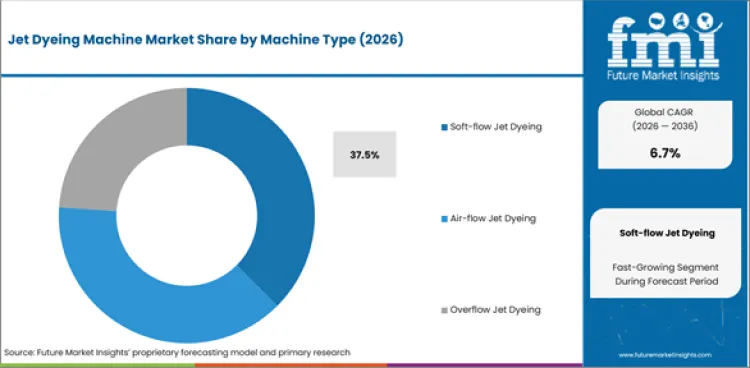
- Soft-flow jet dyeing is projected to account for 37.5% share in 2026 with lower fabric stress in knit dyehouses.
- Air-flow jet dyeing gains attention in synthetic fabrics that need lower bath volume and shorter process cycles.
How does the fabric type segment perform in the jet dyeing machine market?
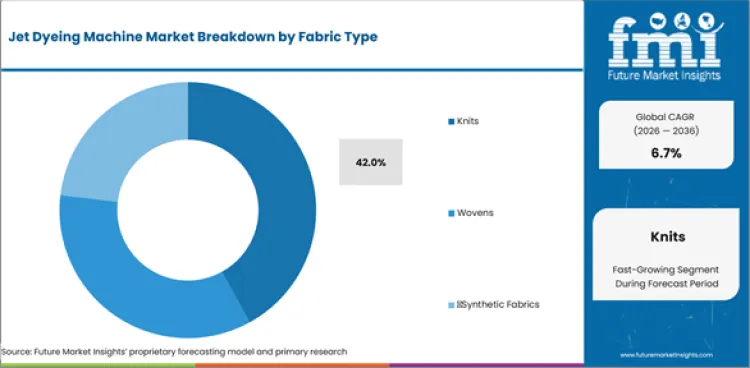
- Knits are estimated to account for 42.0% share in 2026 with stretch fabrics needing controlled rope travel.
- Wovens remain relevant for mills that process shirting and home textile fabrics.
What drives demand across the capacity segment in the jet dyeing machine market?
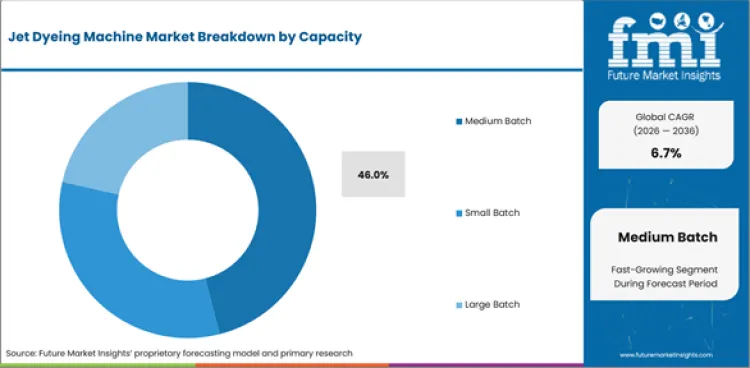
- Medium batch is anticipated to hold 46.0% share in 2026 with better fit for shorter shade lots.
- Large batch machines remain important for mills that run stable export programs.
Which end-use segment shows a prominent position in the jet dyeing machine market?
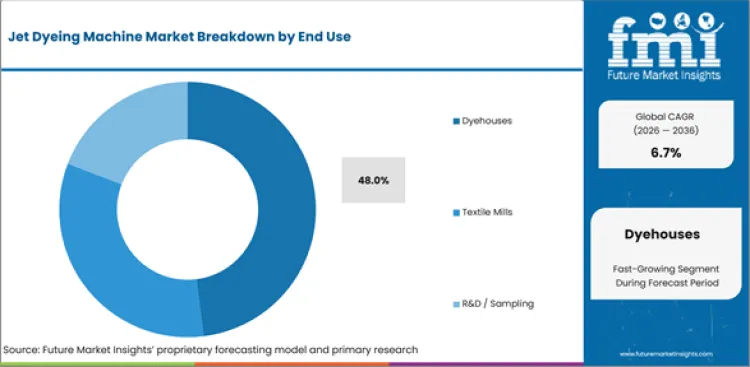
- Dyehouses are expected to represent 48.0% share in 2026 with versatile machine needs among contract processors.
- Integrated finishing lowers outsourcing risk for textile mills buying jet dyeing systems.
How are buyers selecting across sales channel options in the jet dyeing machine market?
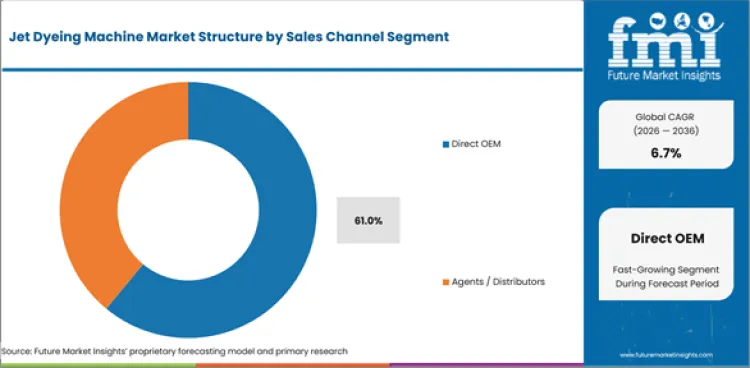
- Direct OEM is projected to account for 61.0% share in 2026 with factory-backed installation and recipe support.
- Agents and distributors remain relevant for smaller mills that need local service access.
What are the driver, restraints, and opportunities in the jet dyeing machine market?
Low-liquor dyehouse economics support replacement demand. Service risk and capital cost limit faster upgrades.
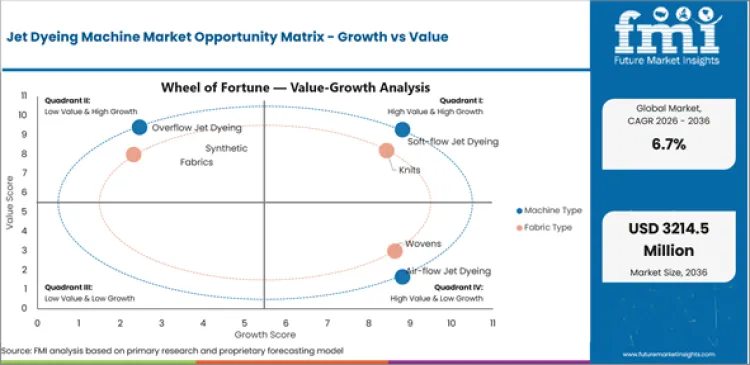
- Driver: Low-liquor machine design is expected to lift replacement demand in mills that track water and steam use per kilogram of fabric.
- Restraint: Service dependence can slow purchases in smaller clusters that lack fast spare-part support.
- Opportunity: Air-flow systems create a route into synthetic fabrics that need shorter cycles and lower bath volumes.
Low-Liquor Dyehouse Payback
Jet dyeing upgrades are now approved through payback math because mills are trying to reduce liquor use, steam load and effluent cost. In October 2025, ACME presented its AM-ICD dyeing machine at ITMA Asia with a reported liquor ratio of 1:1 to 1.5 and more than 65% savings in water, energy and chemicals. This gives buyers a sharper cost case than a standard replacement pitch. Dyehouses are more likely to approve new machines when the supplier can show lower utility use and less wastewater exposure per batch.
Fabric Quality and Rework Control
Fabric quality risk is becoming a stronger purchase filter because dyehouses lose margin when sensitive blends need shade correction or reprocessing. In September 2025, Benninger said its ITMA Singapore lineup would include next-generation jet dyeing solutions for modern fibers and blends. The company also positioned its systems around the highest first-time-right rates. This matters because buyers are not only comparing machine price. They want fabric movement and process control that reduce creases, shade variation and restart losses during bulk production.
Service-backed Replacement Cycles
Replacement timing is also shaped by service access because dyehouses cannot leave machines idle during export or retail delivery windows. In October 2025, CEMATEX said ITMA ASIA + CITME Singapore 2025 brought more than 840 exhibitors from 30 countries and regions. The same release said CEMATEX and China exhibitors covered almost 70% of the show floor. This is important as buyers use major machinery events to compare spare-part access and upgrade support before replacing older jet dyeing lines.
Which countries are growing fastest in the jet dyeing machine market?
India 8.1% CAGR, China 7.3% CAGR, South Korea 5.8% CAGR, Germany 5.4% CAGR, United States 5.2% CAGR, France 5.1% CAGR, Japan 4.9% CAGR, and United Kingdom 4.8% CAGR through 2036.
.webp "Top Country Growth Comparison Jet Dyeing Machine Market Cagr (2026 2036)")
| Country | CAGR |
|---|---|
| India | 8.1% |
| China | 7.3% |
| South Korea | 5.8% |
| Germany | 5.4% |
| United States | 5.2% |
| France | 5.1% |
| Japan | 4.9% |
| United Kingdom | 4.8% |
Source: Future Market Insights, 2026.
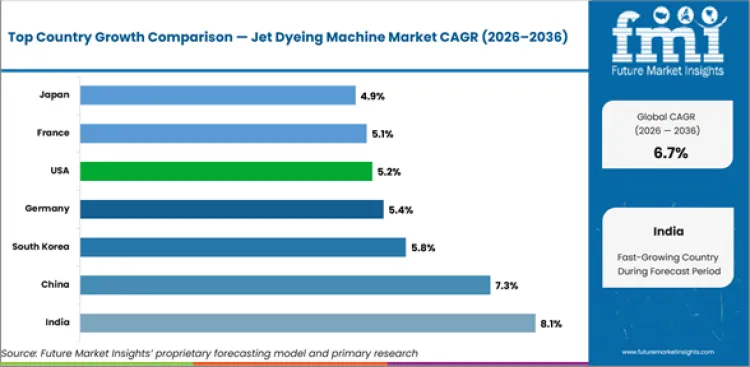
How do country-level CAGRs compare in the jet dyeing machine market?
- India is projected to achieve an 8.1% CAGR through 2036, supported by textile cluster modernization and upgrades across export-oriented dyehouses.
- China is expected to expand at a 7.3% CAGR through 2036, benefiting from its extensive processing capacity and strong domestic supplier base.
- South Korea's market is anticipated to grow at a 5.8% CAGR through 2036, driven by synthetic and performance fabric manufacturing activities.
- Germany is likely to witness a 5.4% CAGR through 2036, reflecting specification-driven equipment replacement and a well-established OEM ecosystem.
- The United States market is set to advance at a 5.2% CAGR through 2036, supported by replacement demand from technical textile producers.
- France is poised to register a 5.1% CAGR through 2036, underpinned by demand from luxury textile and technical fabric finishing applications.
- Japan is estimated to post a 4.9% CAGR through 2036, aided by precision-focused modernization initiatives and demand for compact dyeing systems.
- The United Kingdom is expected to see a 4.8% CAGR through 2036, supported by specialty finishing operations and short-run production requirements.
How fast is the jet dyeing machine market growing in India?
A 8.1% CAGR by 2036 reflects textile cluster modernization and export dyehouse upgrades.
Country Market Snapshot Table
| Parameter | Value |
|---|---|
| Market Size in 2025 (Value) | USD 286.8 million |
| Market Size in 2026 (Value) | USD 310.0 million |
| Market Forecast in 2036 (Value) | USD 675.5 million |
| CAGR (2026 to 2036) | 8.1% |
| Years Considered | 2021 to 2036 |
| Base Year | 2025 |
| Forecast Period | 2026 to 2036 |
| Units Considered | Value (USD million) |
| Leading Sub-Region | Tiruppur and Surat textile clusters |
India Jet Dyeing Machine Market Outlook
- India records a notable growth outlook with textile cluster modernization and export dyehouse upgrades.
- Dyehouses in Tiruppur and Surat compare payback with service reach before approving new vessels. Ludhiana and NCR add further demand for flexible medium-batch systems.
Key Growth Drivers
- Export-oriented dyehouses need machines that reduce shade rework. The Ministry of Textiles reported 5% textile and apparel export growth in 2024-25.
- Integrated parks are expected to support larger processing projects. The government approved 7 PM MITRA sites under the national textile park program.
- Knitwear and blended fabric processors are expected to prefer medium-batch systems for shorter shade lots.
- Distributor networks are expected to support smaller mills outside integrated processing clusters.
Key Restraints
- Financing cost can delay purchases by small dyehouses that still use rebuilt vessels.
- Water compliance raises total project cost in processing clusters. PIB reported near-universal ZLD adoption in Tiruppur dyeing and processing units.
- Fragmented buyer structure increases service cost for OEMs outside major clusters.
What makes India unique
India combines a high CAGR outlook with a fragmented buyer base. Service channels therefore matter as much as machine specification.
Key Companies
- Skilled Industries
- Texfab Engineers (India) Pvt. Ltd.
- Bhagyarekha Engineers Pvt. Ltd.
- R. B. Electronic & Engineering Pvt. Ltd.
- Accurate Trans Heat Pvt. Ltd.
Sales & Marketing Channels
- Direct OEM sales
- Agents and distributors
- Retrofit channels
- Machinery finance networks
- Exhibition leads
- Cluster demonstrations
Country Segment Breakdown Table
| Segment | Sub-Segments |
|---|---|
| By Machine Type | Soft-flow Jet Dyeing · Air-flow Jet Dyeing · Overflow Jet Dyeing · High-temperature Jet Dyeing |
| By Fabric Type | Knits · Wovens · Synthetic Fabrics · Blended Fabrics |
| By Capacity | Small Batch · Medium Batch · Large Batch |
| By End Use | Textile Mills · Dyehouses · Garment Wash Units · R&D / Sampling |
| By Sales Channel | Direct OEM · Agents / Distributors |
| Key Sub-Regions Covered, Textile Processing Clusters | Tiruppur and Surat textile clusters |
Frequently Asked Questions
How fast is India jet dyeing machine market growing?
Sales in India are projected to grow at 8.1% CAGR from 2026 to 2036.
Who serves India jet dyeing machine market?
Skilled Industries and Texfab Engineers serve India buyers with soft-flow and jet dyeing equipment. Bhagyarekha Engineers and R. B. Electronic add local supply depth.
What is driving adoption in India jet dyeing machine market?
Adoption is expected to rise with export dyehouse payback and lower liquor use. Faster service response adds further purchase support.
How fast is the jet dyeing machine market growing in China?
A 7.3% CAGR by 2036 reflects processing scale and local supplier density.
Country Market Snapshot Table
| Parameter | Value |
|---|---|
| Market Size in 2025 (Value) | USD 493.9 million |
| Market Size in 2026 (Value) | USD 530.0 million |
| Market Forecast in 2036 (Value) | USD 1,072.2 million |
| CAGR (2026 to 2036) | 7.3% |
| Years Considered | 2021 to 2036 |
| Base Year | 2025 |
| Forecast Period | 2026 to 2036 |
| Units Considered | Value (USD million) |
| Leading Sub-Region | Zhejiang and Guangdong dyeing clusters |
China Jet Dyeing Machine Market Outlook
- China records a prominent volume opportunity with processing scale and local machinery supplier depth.
- Large dyehouses compare throughput with service coverage before selecting a supplier. Domestic manufacturers improve delivery access for mills that need fast replacement.
Key Growth Drivers
- Export dyehouses need high-throughput machines with repeatable color control. CEMATEX said dyeing and finishing held 22% of booked exhibition space at ITMA ASIA + CITME 2024.
- Industrial activity supports machinery replacement. China NBS reported 4.6% textile industry value-added growth in 2024.
- Local supplier density is expected to shorten delivery cycles for replacement machines.
- Synthetic fabric processing is expected to support high-temperature and air-flow configurations.
Key Restraints
- Local price pressure can limit imported premium equipment penetration.
- Utilization discipline affects new investment. China NBS reported 95.5% sales rate for industrial enterprises above designated size in May 2025.
- Environmental compliance can raise total project cost beyond machine purchase.
What makes China unique
China combines processing scale with a dense domestic textile machinery supplier ecosystem.
Key Companies
- CHTC Fong's Industries Co., Ltd.
- Fong's National Engineering Co., Ltd.
- Shanghai Singularity Imp. & Exp. Co., Ltd.
- Wuxi Zhongyin Textile Technology Co., Ltd.
- Wuxi Honghao International Co., Ltd.
Sales & Marketing Channels
- Direct OEM sales
- Regional machinery distributors
- Exhibition leads
- Association networks
- Service-center programs
- Cluster tenders
Country Segment Breakdown Table
| Segment | Sub-Segments |
|---|---|
| By Machine Type | Soft-flow Jet Dyeing · Air-flow Jet Dyeing · Overflow Jet Dyeing · High-temperature Jet Dyeing |
| By Fabric Type | Knits · Wovens · Synthetic Fabrics · Blended Fabrics |
| By Capacity | Small Batch · Medium Batch · Large Batch |
| By End Use | Textile Mills · Dyehouses · Garment Wash Units · R&D / Sampling |
| By Sales Channel | Direct OEM · Agents / Distributors |
| Key Sub-Regions Covered, Textile Processing Clusters | Zhejiang and Guangdong dyeing clusters |
Frequently Asked Questions
How fast is China jet dyeing machine market growing?
Sales in China are projected to grow at 7.3% CAGR from 2026 to 2036.
Who serves China jet dyeing machine market?
CHTC Fong's and Fong's National Engineering serve China buyers with dyeing and finishing equipment. Shanghai Singularity and Wuxi Zhongyin add regional supply options.
What is driving adoption in China jet dyeing machine market?
Replacement buying is expected to increase with local service access and large dyehouse throughput needs.
How is the jet dyeing machine market performing in South Korea?
A 5.8% CAGR by 2036 reflects synthetic and performance fabric processing.
Country Market Snapshot Table
| Parameter | Value |
|---|---|
| Market Size in 2025 (Value) | USD 71.8 million |
| Market Size in 2026 (Value) | USD 76.0 million |
| Market Forecast in 2036 (Value) | USD 133.6 million |
| CAGR (2026 to 2036) | 5.8% |
| Years Considered | 2021 to 2036 |
| Base Year | 2025 |
| Forecast Period | 2026 to 2036 |
| Units Considered | Value (USD million) |
| Leading Sub-Region | Daegu and Gyeonggi textile corridors |
South Korea Jet Dyeing Machine Market Outlook
- South Korea is a technically demanding replacement market shaped by performance fabrics and synthetic processing.
- Buyers need high-temperature control and repeatable shade records for export programs. Imported OEM service partners remain important for quick repair needs.
Key Growth Drivers
- Performance fabric producers need high-temperature dyeing control. Invest Korea says about 90% of textile and fashion companies have fewer than 10 employees.
- Automation policy supports process upgrades. Korea.net reported that automation facilities are planned for more than 250 companies by 2028.
- Technical textile users are expected to favor machines with predictable process records.
- Imported OEM service partners are expected to support buyers that need process references.
Key Restraints
- Limited local OEM visibility increases reliance on imported systems.
- Small-company structure slows capital replacement. Invest Korea says large and medium firms handle most raw material production and supply.
- High operating costs push buyers to extend machine life before replacement.
What makes South Korea unique
South Korea connects jet dyeing demand with specialty synthetic fabrics instead of broad capacity additions.
Key Companies
- ACE Machinery Co., Ltd.
- Samill Industrial Co., Ltd.
- Il Sung Machinery Co., Ltd.
Sales & Marketing Channels
- Imported OEM distributors
- Direct mill sales
- Retrofit channels
- Brand-approved programs
- Agent networks
- Engineering referrals
Country Segment Breakdown Table
| Segment | Sub-Segments |
|---|---|
| By Machine Type | Soft-flow Jet Dyeing · Air-flow Jet Dyeing · Overflow Jet Dyeing · High-temperature Jet Dyeing |
| By Fabric Type | Knits · Wovens · Synthetic Fabrics · Blended Fabrics |
| By Capacity | Small Batch · Medium Batch · Large Batch |
| By End Use | Textile Mills · Dyehouses · Garment Wash Units · R&D / Sampling |
| By Sales Channel | Direct OEM · Agents / Distributors |
| Key Sub-Regions Covered, Textile Processing Clusters | Daegu and Gyeonggi textile corridors |
Frequently Asked Questions
How fast is South Korea jet dyeing machine market growing?
Sales in South Korea are projected to grow at 5.8% CAGR from 2026 to 2036.
Who serves South Korea jet dyeing machine market?
ACE Machinery and Samill Industrial serve South Korean dyehouses with textile dyeing machinery. Il Sung Machinery adds regional finishing-machine depth.
What is driving adoption in South Korea jet dyeing machine market?
Adoption is expected to improve with high-temperature control and performance-fabric repeatability.
How is the jet dyeing machine market performing in Germany?
A 5.4% CAGR by 2036 reflects specification-led replacement and OEM depth.
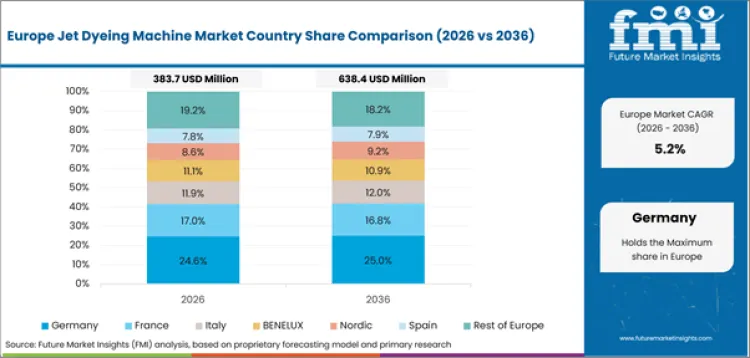
Country Market Snapshot Table
| Parameter | Value |
|---|---|
| Market Size in 2025 (Value) | USD 112.0 million |
| Market Size in 2026 (Value) | USD 118.0 million |
| Market Forecast in 2036 (Value) | USD 199.7 million |
| CAGR (2026 to 2036) | 5.4% |
| Years Considered | 2021 to 2036 |
| Base Year | 2025 |
| Forecast Period | 2026 to 2036 |
| Units Considered | Value (USD million) |
| Leading Sub-Region | North Rhine-Westphalia and Baden-Wurttemberg clusters |
Germany Jet Dyeing Machine Market Outlook
- Germany is both a demand market and a specification benchmark for textile dyeing machinery.
- Thies gives Germany a direct OEM reference in fabric dyeing machines. Buyers review controller accuracy and low-liquor performance before purchase approval.
Key Growth Drivers
- German textile engineering standards influence buyer specifications. VDMA Textile Machinery represents around 140 manufacturers.
- Supplier depth supports premium machinery comparisons. VDMA says members represent about 90% of German industry volume.
- Technical textile producers are expected to need repeatable wet processing for high-value end uses.
- Energy cost pressure is expected to support low-liquor replacement decisions.
Key Restraints
- Premium machine pricing faces longer approval cycles in small and mid-sized mills.
- Specification complexity can lengthen supplier qualification. Techtextil 2026 lists VDMA Services among textile machinery exhibitors.
- Selective local production limits broad volume expansion compared with Asian clusters.
What makes Germany unique
Germany exports specifications with OEM engineering. Its influence is wider than local machine demand.
Key Companies
- Thies GmbH & Co. KG
- FONG'S Europe GmbH
- Karl Menzel Maschinenfabrik GmbH & Co.
- A. Monforts Textilmaschinen GmbH & Co. KG
Sales & Marketing Channels
- Direct OEM engagement
- Technical demonstrations
- VDMA networks
- Plant consultants
- Retrofit programs
- Distributor support
Country Segment Breakdown Table
| Segment | Sub-Segments |
|---|---|
| By Machine Type | Soft-flow Jet Dyeing · Air-flow Jet Dyeing · Overflow Jet Dyeing · High-temperature Jet Dyeing |
| By Fabric Type | Knits · Wovens · Synthetic Fabrics · Blended Fabrics |
| By Capacity | Small Batch · Medium Batch · Large Batch |
| By End Use | Textile Mills · Dyehouses · Garment Wash Units · R&D / Sampling |
| By Sales Channel | Direct OEM · Agents / Distributors |
| Key Sub-Regions Covered, Textile Processing Clusters | North Rhine-Westphalia and Baden-Wurttemberg clusters |
Frequently Asked Questions
How fast is Germany jet dyeing machine market growing?
Sales in Germany are projected to grow at 5.4% CAGR from 2026 to 2036.
Who serves Germany jet dyeing machine market?
Thies GmbH & Co. KG and FONG'S Europe GmbH anchor Germany supply. Menzel and Monforts support adjacent wet-finishing machinery demand.
What is driving adoption in Germany jet dyeing machine market?
Buyer interest is expected to remain tied to specification compliance and OEM service depth.
What is the jet dyeing machine market outlook in United States?
A 5.2% CAGR by 2036 reflects technical textile replacement demand.
Country Market Snapshot Table
| Parameter | Value |
|---|---|
| Market Size in 2025 (Value) | USD 131.2 million |
| Market Size in 2026 (Value) | USD 138.0 million |
| Market Forecast in 2036 (Value) | USD 229.1 million |
| CAGR (2026 to 2036) | 5.2% |
| Years Considered | 2021 to 2036 |
| Base Year | 2025 |
| Forecast Period | 2026 to 2036 |
| Units Considered | Value (USD million) |
| Leading Sub-Region | Carolinas and technical textile corridors |
United States Jet Dyeing Machine Market Outlook
- The United States is a selective replacement market for technical textile and knit processing equipment.
- Buyers compare new machines with rebuilt European and domestic units. Suppliers with local service staff can shorten qualification and reduce downtime concerns.
Key Growth Drivers
- Technical textile mills need dyeing systems that support repeatable shades. FRED placed USA textile mill sectoral output at USD 21.3 billion in 2025.
- Textile product mill activity supports replacement sales. FRED placed USA textile product mill sectoral output at USD 20.6 billion in 2025.
- Domestic reshoring interest is expected to raise attention on finishing capacity for smaller runs.
- Serviceable machines gain preference in plants that avoid long imported-part delays.
Key Restraints
- High capital cost slows upgrades in mills that can rebuild existing vessels.
- Smaller dyehouse counts reduce distributor coverage outside textile clusters. FRED placed textile mill employment at 86.7 thousand jobs in 2025.
- Used machinery channels can delay new-machine orders among capital-disciplined buyers.
What makes United States unique
The United States has domestic jet dyeing machine legacy and a visible rebuilt-equipment channel.
Key Companies
- Gaston County Dyeing Machine Company
- Mascoe Systems Corporation
- Navis TubeTex
- R. Horton Textile Machinery Sales & Service
Sales & Marketing Channels
- Direct OEM sales
- Rebuilt machinery dealers
- Engineering referrals
- Retrofit channels
- Technical textile outreach
- Specification discussions
Country Segment Breakdown Table
| Segment | Sub-Segments |
|---|---|
| By Machine Type | Soft-flow Jet Dyeing · Air-flow Jet Dyeing · Overflow Jet Dyeing · High-temperature Jet Dyeing |
| By Fabric Type | Knits · Wovens · Synthetic Fabrics · Blended Fabrics |
| By Capacity | Small Batch · Medium Batch · Large Batch |
| By End Use | Textile Mills · Dyehouses · Garment Wash Units · R&D / Sampling |
| By Sales Channel | Direct OEM · Agents / Distributors |
| Key Sub-Regions Covered, Textile Processing Clusters | Carolinas and technical textile corridors |
Frequently Asked Questions
How fast is United States jet dyeing machine market growing?
Sales in United States are projected to grow at 5.2% CAGR from 2026 to 2036.
Who serves United States jet dyeing machine market?
Gaston County Dyeing Machine Company and Mascoe Systems Corporation support domestic replacements. Navis TubeTex and R. Horton Textile Machinery add service-channel coverage.
What is driving adoption in United States jet dyeing machine market?
Adoption is expected to track technical textile replacement and domestic service access.
What is the jet dyeing machine market outlook in France?
A 5.1% CAGR by 2036 reflects luxury and technical textile finishing needs.
Country Market Snapshot Table
| Parameter | Value |
|---|---|
| Market Size in 2025 (Value) | USD 68.5 million |
| Market Size in 2026 (Value) | USD 72.0 million |
| Market Forecast in 2036 (Value) | USD 118.4 million |
| CAGR (2026 to 2036) | 5.1% |
| Years Considered | 2021 to 2036 |
| Base Year | 2025 |
| Forecast Period | 2026 to 2036 |
| Units Considered | Value (USD million) |
| Leading Sub-Region | Auvergne-Rhone-Alpes and northern textile corridors |
France Jet Dyeing Machine Market Outlook
- France is a selective market shaped by luxury fabric finishing and technical textile requirements.
- Suppliers must sell process proof and fabric protection instead of capacity alone. Environmental product communication raises interest in documented wet-processing choices.
Key Growth Drivers
- Luxury supply chains need trusted dyeing outcomes on delicate fabrics. Atout France cited 154 billion euros for the fashion and luxury value chain.
- Environmental display supports process documentation. The French ecology ministry said close to 100 brands were engaged in the clothing display system.
- Technical textile clusters are expected to support demand for precise finishing equipment.
- Short-batch production is expected to favor machinery that can protect fabric hand feel.
Key Restraints
- Limited local OEM evidence makes supplier verification harder for buyers.
- Environmental reporting adds documentation work. The French ecology ministry cited 40,000 referenced products on its display portal.
- Smaller production runs can reduce the payback speed of large vessels.
What makes France unique
France connects machine buying with luxury-grade process assurance and environmental product communication.
Key Companies
- Alliance Machines Textiles
- Superba SAS
- NSC Schlumberger
- Dollfus & Muller
Sales & Marketing Channels
- European OEM sales
- Technical textile outreach
- Luxury supply-chain audits
- Equipment integrators
- Used-machinery brokers
- Environmental program channels
Country Segment Breakdown Table
| Segment | Sub-Segments |
|---|---|
| By Machine Type | Soft-flow Jet Dyeing · Air-flow Jet Dyeing · Overflow Jet Dyeing · High-temperature Jet Dyeing |
| By Fabric Type | Knits · Wovens · Synthetic Fabrics · Blended Fabrics |
| By Capacity | Small Batch · Medium Batch · Large Batch |
| By End Use | Textile Mills · Dyehouses · Garment Wash Units · R&D / Sampling |
| By Sales Channel | Direct OEM · Agents / Distributors |
| Key Sub-Regions Covered, Textile Processing Clusters | Auvergne-Rhone-Alpes and northern textile corridors |
Frequently Asked Questions
How fast is France jet dyeing machine market growing?
Sales in France are projected to grow at 5.1% CAGR from 2026 to 2036.
Who serves France jet dyeing machine market?
Alliance Machines Textiles and Superba SAS support French machinery demand. NSC Schlumberger and Dollfus & Muller add adjacent textile equipment depth.
What is driving adoption in France jet dyeing machine market?
Adoption is expected to rise with luxury finishing needs and documented process control.
How fast is the jet dyeing machine market growing in Japan?
A 4.9% CAGR by 2036 reflects precision-led modernization and compact machine demand.
Country Market Snapshot Table
| Parameter | Value |
|---|---|
| Market Size in 2025 (Value) | USD 80.1 million |
| Market Size in 2026 (Value) | USD 84.0 million |
| Market Forecast in 2036 (Value) | USD 135.5 million |
| CAGR (2026 to 2036) | 4.9% |
| Years Considered | 2021 to 2036 |
| Base Year | 2025 |
| Forecast Period | 2026 to 2036 |
| Units Considered | Value (USD million) |
| Leading Sub-Region | Kansai and greater Tokyo textile corridors |
Japan Jet Dyeing Machine Market Outlook
- Japan is a precision-led replacement market with high expectations for machine reliability.
- Hisaka Works gives Japan a direct benchmark for jet dyeing engineering. Buyers favor compact designs and long parts availability.
Key Growth Drivers
- Precision dyeing supports replacement of older vessels. Hisaka Works states that CUT-SP operation improves speed by 10% to 20% versus conventional operation.
- Resource-circulation planning keeps dyeing visible. METI reported 98.5% import penetration by apparel volume in 2022.
- Technical fabrics create demand for controlled heat and liquor movement.
- Local OEM engineering is expected to raise buyer attention on productivity and rework metrics.
Key Restraints
- Slow mass-apparel output limits new capacity projects.
- High lifecycle expectations can delay replacement. METI data show Japan supplied more than 1.8 times as many apparel items in 2022 than in 1990.
- Buyers often use maintenance to extend equipment life before replacement.
What makes Japan unique
Japan is a quality benchmark market that values reliability more than broad installed capacity growth.
Key Companies
- Hisaka Works, Ltd.
- Kouei Japan Trading Co., Ltd.
Sales & Marketing Channels
- Direct OEM relationships
- Engineering demonstrations
- Maintenance sales
- Technical textile outreach
- Distributor support
- Quality audit referrals
Country Segment Breakdown Table
| Segment | Sub-Segments |
|---|---|
| By Machine Type | Soft-flow Jet Dyeing · Air-flow Jet Dyeing · Overflow Jet Dyeing · High-temperature Jet Dyeing |
| By Fabric Type | Knits · Wovens · Synthetic Fabrics · Blended Fabrics |
| By Capacity | Small Batch · Medium Batch · Large Batch |
| By End Use | Textile Mills · Dyehouses · Garment Wash Units · R&D / Sampling |
| By Sales Channel | Direct OEM · Agents / Distributors |
| Key Sub-Regions Covered, Textile Processing Clusters | Kansai and greater Tokyo textile corridors |
Frequently Asked Questions
How fast is Japan jet dyeing machine market growing?
Sales in Japan are projected to grow at 4.9% CAGR from 2026 to 2036.
Who serves Japan jet dyeing machine market?
Hisaka Works serves precision-led buyers with jet dyeing machines. Kouei Japan Trading supports resale and quotation access for Hisaka equipment.
What is driving adoption in Japan jet dyeing machine market?
Replacement demand is expected to reflect compact machine design and high reliability requirements.
How is the jet dyeing machine market performing in United Kingdom?
A 4.8% CAGR by 2036 reflects specialty finishing and short-run production.
Country Market Snapshot Table
| Parameter | Value |
|---|---|
| Market Size in 2025 (Value) | USD 59.2 million |
| Market Size in 2026 (Value) | USD 62.0 million |
| Market Forecast in 2036 (Value) | USD 99.1 million |
| CAGR (2026 to 2036) | 4.8% |
| Years Considered | 2021 to 2036 |
| Base Year | 2025 |
| Forecast Period | 2026 to 2036 |
| Units Considered | Value (USD million) |
| Leading Sub-Region | North West and Yorkshire textile corridors |
United Kingdom Jet Dyeing Machine Market Outlook
- The United Kingdom is a quality-led replacement market for specialist finishing and short-run textile production.
- UK buyers prioritize lower environmental burden and proof of fabric quality. Imported OEMs remain central with limited local jet dyeing machine production.
Key Growth Drivers
- Workwear and PPE supply chains need durable shades and tested wet-processing control. The House of Commons Library reviewed onshoring for fashion and textiles in 2026.
- Dyeing technology review supports equipment comparison. UKFT launched its textile and apparel dyeing report in September 2024.
- Short-run production is expected to favor flexible vessels over high-capacity machines.
- Brand audit requirements improve demand for process records and shade repeatability.
Key Restraints
- Limited domestic OEM presence increases dependence on imported equipment.
- Skills pressure slows controller adoption in smaller mills. The UK parliamentary debate covered jobs and skills for fashion and textiles in 2026.
- Thin local dyehouse scale makes distributor economics harder outside clusters.
What makes United Kingdom unique
The United Kingdom connects jet dyeing demand with reshoring and specialist finishing.
Key Companies
- Ctex (UK) Ltd.
- D M Textile Machinery Ltd.
- Macart Textiles (Machinery) Ltd.
- Used Textile Machinery Live
- Allertex Ltd.
Sales & Marketing Channels
- Machinery sales agents
- Used machinery dealers
- Engineering referrals
- Technical textile outreach
- Demonstration programs
- Retrofit channels
Country Segment Breakdown Table
| Segment | Sub-Segments |
|---|---|
| By Machine Type | Soft-flow Jet Dyeing · Air-flow Jet Dyeing · Overflow Jet Dyeing · High-temperature Jet Dyeing |
| By Fabric Type | Knits · Wovens · Synthetic Fabrics · Blended Fabrics |
| By Capacity | Small Batch · Medium Batch · Large Batch |
| By End Use | Textile Mills · Dyehouses · Garment Wash Units · R&D / Sampling |
| By Sales Channel | Direct OEM · Agents / Distributors |
| Key Sub-Regions Covered, Textile Processing Clusters | North West and Yorkshire textile corridors |
Frequently Asked Questions
How fast is United Kingdom jet dyeing machine market growing?
Sales in United Kingdom are projected to grow at 4.8% CAGR from 2026 to 2036.
Who serves United Kingdom jet dyeing machine market?
Ctex (UK) Ltd. and D M Textile Machinery serve UK buyers through machinery sales and used-equipment channels. Macart Textiles adds resale coverage.
What is driving adoption in United Kingdom jet dyeing machine market?
Adoption is expected to track short-run finishing and lower-impact dyeing choices.
Who are the leading companies in the jet dyeing machine market?
Fong's, THEN, Thies, Hisaka Works, Brazzoli, Dilmenler, Sclavos, and MCS Textile
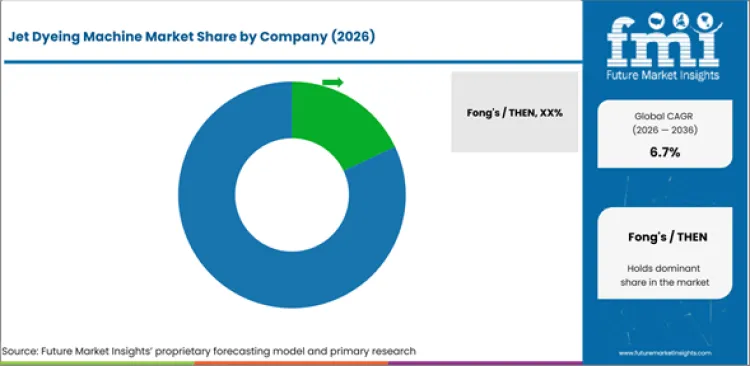
- Competition is based on low-liquor performance and proof of batch repeatability.
- Premium OEMs win specification-led accounts with process history and installation support.
- Regional suppliers compete on price-fit machines and faster service response.
- Used machinery dealers remain relevant in mills that cannot justify full replacement cost.
Competition in the jet dyeing machine market is shaped more by technology specialization, process performance, and aftermarket support than by company size alone. Leading suppliers differentiate themselves through fabric transport design, liquor ratio optimization, automation capabilities, and dyeing consistency. Thies and Fong's are recognized for their expertise in fabric-path engineering and airflow-based dyeing technologies, while Hisaka Works and Brazzoli emphasize machine reliability and operational stability in high-temperature dyeing applications.
Product differentiation is centered on soft-flow and air-flow dyeing technologies that improve fabric handling and process efficiency. Suppliers with advanced engineering capabilities are better positioned to serve processors working with diverse fabric types and demanding shade specifications. For example, Fong's markets its THEN-AIRFLOW platform as a high-temperature aerodynamic piece-dyeing solution designed to support efficient processing and enhanced fabric quality.
Service networks and spare-parts availability remain important competitive factors, particularly in medium-batch dyehouses where equipment uptime directly affects production schedules. Companies with broader regional support capabilities are often better placed to secure replacement demand and long-term customer relationships. Smaller suppliers can remain competitive by offering application-specific expertise and customized machine configurations tailored to individual fabric requirements. As buyers increasingly focus on quality assurance and defect reduction and lifecycle support continue to influence supplier selection.
How do top jet dyeing machine companies compare?
Suppliers differ by low-liquor handling and high-temperature process control. Service reach and geographic footprint add separation.
| Company | Relevance to Market Title | Low-Liquor Fabric Handling | High-Temperature Process Control | Service and Retrofit Reach | Channel Reach | Geographic Footprint |
|---|---|---|---|---|---|---|
| Fong's / THEN | Very High | Very Strong | Very Strong | Strong | Very Strong | Global |
| Thies | Very High | Very Strong | Very Strong | Strong | Strong | Global |
| Hisaka Works | Very High | Strong | Very Strong | Strong | Moderate | Japan and export markets |
| Brazzoli | High | Strong | Strong | Moderate | Strong | Europe and export markets |
| Dilmenler | High | Moderate | Moderate | Strong | Strong | Europe and Asia |
| Sclavos | Moderate to High | Moderate | Moderate | Moderate | Moderate | Europe and export markets |
| Gaston County | High | Moderate | Strong | Moderate | Moderate | United States and export channels |
| MCS Textile | Moderate to High | Moderate | Moderate | Moderate | Moderate | Europe and export markets |
| Loris Bellini | Adjacent | Moderate | Strong | Strong | Moderate | Global yarn dyeing channels |
Source: Future Market Insights competitive analysis, 2026.
Who are the key players in the jet dyeing machine market?
Fong's / THEN, Thies and Hisaka Works are listed with Brazzoli, Dilmenler, Sclavos, MCS Textile and Canlar Mekatronik.
Key global companies leading the jet dyeing machine market include:
- Fong's / THEN
- Thies GmbH & Co. KG
- Hisaka Works, Ltd.
- Brazzoli S.r.l.
- Dilmenler Makina
- Sclavos S.A.
- Gaston County Dyeing Machine Company
- MCS Textile
- Canlar Mekatronik
Key Developments in Jet Dyeing Machine Market
- In October 2024, CEMATEX said ITMA ASIA + CITME 2024 had about 12% more exhibitors than the 2022 edition. The event widened comparison options for dyeing and finishing suppliers.
- In October 2024, Danitech Group hosted an International Customer Open Day that covered dyeing machines and stenters. The event showed how live demonstrations support machinery buyer conversion.
- In September 2024, UKFT launched its Innovations in Textile and Apparel Dyeing report. The report directed UK textile buyers toward lower-impact dyeing options and technology review.
Key Players in the Jet Dyeing Machine Market
Global Dyeing System OEMs
- Fong's / THEN
- Thies GmbH & Co. KG
- Hisaka Works, Ltd.
- Brazzoli S.r.l.
- Dilmenler Makina
- Sclavos S.A.
Regional and Specialist Fabric Machine Suppliers
- Gaston County Dyeing Machine Company
- MCS Textile
- Canlar Mekatronik
- Alliance Machines Textiles
Country Channel and Service Suppliers
- Skilled Industries
- Texfab Engineers (India) Pvt. Ltd.
- ACE Machinery Co., Ltd.
- D M Textile Machinery Ltd.
Jet Dyeing Machine Market - Scope & Definition
| Attribute | Detail |
|---|---|
| Market Definition | Batch textile dyeing machines that move fabric rope through a closed vessel using dye liquor, airflow or both. |
| Functions Covered | Fabric rope movement, dye circulation, heating, rinsing, liquor-ratio control, recipe repeatability and batch process monitoring. |
| Applications Covered | Soft-flow jet dyeing, air-flow jet dyeing, overflow jet dyeing and high-temperature jet dyeing for fabrics. |
| End-Use Industries | Textile mills, contract dyehouses, garment wash units and sampling or R&D facilities. |
| Grades Covered | Small batch, medium batch and large batch equipment configurations. |
| Inclusions | New jet dyeing machines, direct OEM sales, agent sales, retrofit-relevant replacement demand and selected country revenue. |
| Exclusions | Yarn package dyeing machines, beam dyeing machines, jiggers, pad batch ranges, digital printers and dye chemicals. |
Jet Dyeing Machine Market - Research Methodology
| Method | Description |
|---|---|
| Primary Research | FMI analyst interviews with dyehouse buyers, textile mill engineering teams, machinery distributors and service technicians. |
| Desk Research | Review of machinery show information, official textile data, company product portfolios and wet-processing references. |
| Market Sizing & Forecasting | Bottom-up replacement model using machine value, capacity class, fabric mix, country processing scale and channel structure. |
| Data Validation | Cross-verification against textile machinery exhibition signals, country textile activity and company product evidence. |
Jet Dyeing Machine Market - Report Scope
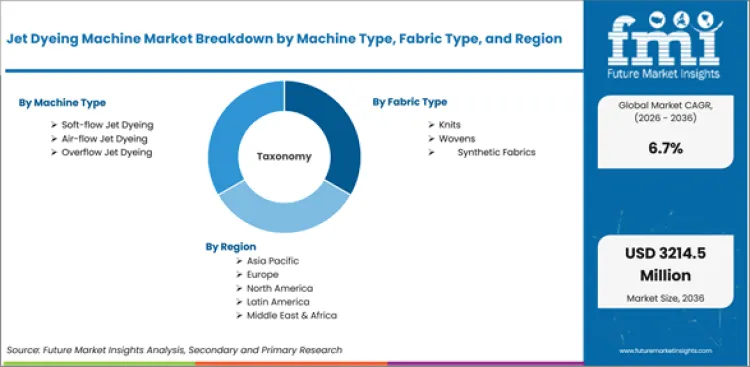
| Parameter | Details |
|---|---|
| Forecast period | 2026 to 2036 |
| Historical period | 2021 to 2025 |
| Quantitative unit | Revenue in USD million |
| By machine type | Soft-flow jet dyeing, air-flow jet dyeing, overflow jet dyeing, high-temperature jet dyeing |
| By fabric type | Knits, wovens, synthetic fabrics, blended fabrics |
| By capacity | Small batch, medium batch, large batch |
| By end use | Textile mills, dyehouses, garment wash units, R&D / Sampling |
| By sales channel | Direct OEM, agents / distributors |
| Regions covered | North America, Latin America, Europe, East Asia, South Asia and Pacific, Middle East and Africa |
| Countries covered | India, China, South Korea, Germany, United States, France, Japan, United Kingdom |
| Key companies profiled | Fong's / THEN, Thies, Hisaka Works, Brazzoli, Dilmenler, Sclavos, Gaston County, MCS Textile, Loris Bellini |
| Approach | Hybrid bottom-up and top-down methodology using verified product evidence and machine replacement behavior |
Source: Future Market Insights, 2026.
Jet Dyeing Machine Market Breakdown by Machine Type, Fabric Type, Capacity, End Use, Sales Channel, and Region
Jet Dyeing Machine Market Segmented by Machine Type
- Soft-flow Jet Dyeing
- Air-flow Jet Dyeing
- Overflow Jet Dyeing
- High-temperature Jet Dyeing
Jet Dyeing Machine Market Segmented by Fabric Type
- Knits
- Wovens
- Synthetic Fabrics
- Blended Fabrics
Jet Dyeing Machine Market Segmented by Capacity
- Small Batch
- Medium Batch
- Large Batch
Jet Dyeing Machine Market Segmented by End Use
- Textile Mills
- Dyehouses
- Garment Wash Units
- R&D / Sampling
Jet Dyeing Machine Market Segmented by Sales Channel
- Direct OEM
- Agents / Distributors
Jet Dyeing Machine Market by Region
- North America
- Latin America
- Europe
- East Asia
- South Asia and Pacific
- Middle East and Africa
Research Sources and Bibliography
- CEMATEX. (2024, October 14). ITMA ASIA + CITME 2024 features a bigger cutting-edge textile technology showcase to advance the textile industry.
- CEMATEX. (2024, November 6). ITMA ASIA + CITME 2024 enjoys strong local attendance.
- Danitech Group. (2024, October). Danitech International Open Day 2024 event.
- Federal Reserve Bank of St. Louis. (2026, June 3). Sectoral output for manufacturing: Textile mills in the United States.
- Federal Reserve Bank of St. Louis. (2026, June 3). Sectoral output for manufacturing: Textile product mills in the United States.
- Fong's Industries Co. Ltd. (2026). THEN-AIRFLOW technology.
- House of Commons Library. (2026, February 9). Onshoring in the fashion and textiles industry.
- Invest Korea. (2026). Fashion: Status of the textile and fashion industry.
- Korea.net. (2024, August 13). Korea's textile and fashion industry eyeing new growth via industrial textiles.
- Ministry for Ecological Transition, France. (2025, September 9). Mode durable: l'affichage du coût environnemental des vêtements est lancé.
- Ministry of Economy, Trade and Industry of Japan. (2024, February 29). Establishing resource circulation systems for textile products in Japan.
- Ministry of Textiles, Government of India. (2025, August 13). India's textile industry to meet the global trade headwinds. Press Information Bureau.
- Ministry of Textiles, Government of India. (2025, December 17). PM MITRA Parks anchored in 5F vision generating employment and investment. Press Information Bureau.
- Ministry of Textiles, Government of India. (2026, May 14). Rebuttal on recent media report on textile recycling in Panipat. Press Information Bureau.
- National Bureau of Statistics of China. (2025, January 24). Industrial production operation in December 2024.
- National Bureau of Statistics of China. (2025, June 28). The profit of industrial enterprises above designated size from January to May 2025.
- UK Fashion and Textile Association. (2024, September 16). UKFT launches the Innovations in Textile and Apparel Dyeing report.
- Accurate Trans Heat Pvt. Ltd. (2026). Jet dyeing machine manufacturer in India.
- Alliance Machines Textiles. (2024, February 26). ALLIANCE Machines Textiles profile. Business France.
- Canlar Mekatronik San. ve Tic. A.S. (2026). Textile dyeing machinery product portfolio.
- Ctex (UK) Ltd. (2026). Textile machinery sales UK and Ireland.
- Kouei Japan Trading Co., Ltd. (2026). Hisaka Circular CUT-ZR jet dyeing machine.
- Shanghai Singularity Imp. & Exp. Co., Ltd. (2026). Fabric dyeing machine and textile machinery.
This bibliography is provided for reader reference and is not exhaustive. The full report contains the complete reference list and detailed citations.
This Report Answers
- Market size estimates for 2026 and forecasts to 2036 for the jet dyeing machine market.
- The report provides insights across more than 30 regional and country-level markets.
- The report analyzes demand drivers and fabric-processing needs. Machinery replacement patterns are also assessed.
- The report evaluates machine type and fabric type segments. Capacity, end-use and sales-channel segments are also covered.
- The report assesses water and energy factors that influence machinery selection. Liquor-ratio and service factors are also reviewed.
- The report identifies growth opportunities across low-liquor systems, air-flow systems and medium-batch machines.
- The report evaluates supplier positioning and service-channel structures.
- Country-level growth analysis covers India and China. South Korea and Germany are also covered. The United States and France add further coverage.
- The report assesses the competitive landscape including global dyeing system OEMs and regional machinery suppliers.
- The report delivers market data, forecasts and supporting analysis in PDF and Excel formats.
Frequently Asked Questions
What is the growth prospect for jet dyeing machines?
Demand for jet dyeing machines is expected to rise with dyehouse replacement of older high-liquor vessels.
Which companies are expected to shape the jet dyeing machine market?
Fong's / THEN and Thies are expected to shape supplier selection. Hisaka Works and Brazzoli add further supply options.
Why are textile mills investing in jet dyeing machines?
Textile mills are investing in jet dyeing machines to reduce rework and improve shade repeatability.
Which capacity class is gaining attention?
Medium-batch machines are gaining attention from smaller apparel orders and wider shade variety.
How do service channels influence buyer decisions?
Service channels influence buyer decisions by reducing downtime risk after installation and warranty periods.
What role do air-flow systems play in this market?
Air-flow systems support processors that need lower bath volume and controlled treatment of synthetic fabrics.
How do regulations influence jet dyeing machine purchases?
Regulations influence purchases by making water and chemical documentation more important in wet-processing plants.
Preview the report firsthand - request a free sample
Get SampleGet the brochure for pricing and purchase details.
Get PDFTable of Content
- Key Takeaways
- Market Size and CAGR
- Top Growth Driver
- Fastest Growing Segment
- Leading Region
- Key Companies
- Emerging Opportunities
- Executive Summary
- Global Market Outlook
- Demand-side Trends
- Supply-side Trends
- Technology Roadmap Analysis
- Analysis and Recommendations
- Analyst Perspective (What is happening? Why now? What should investors know?)
- Key Questions Answered
- How large is the market?
- What is the CAGR?
- What are key trends?
- Which region dominates?
- Who are the leaders?
- Market Overview
- Market Coverage / Taxonomy
- Market Definition / Scope / Limitations
- Research Methodology
- Chapter Orientation
- Analytical Lens and Working Hypotheses
- Market Structure, Signals, and Trend Drivers
- Benchmarking and Cross-market Comparability
- Market Sizing, Forecasting, and Opportunity Mapping
- Research Design and Evidence Framework
- Desk Research Programme (Secondary Evidence)
- Expert Input and Fieldwork (Primary Evidence)
- Tooling, Models, and Reference Databases
- Data Engineering and Model Build
- Quality Assurance and Audit Trail
- Market Background
- Market Dynamics (Drivers, Restraints, Opportunity, Trends)
- Scenario Forecast (Optimistic, Likely, Conservative)
- Impact Analysis
- AI Impact
- Sustainability Impact
- Regulatory Impact
- Technology Impact
- Consumer / Buyer Analysis
- Purchase Drivers
- Adoption Barriers
- Buyer Journey
- Opportunity Map Analysis
- Product Life Cycle Analysis
- Supply Chain Analysis
- Investment Feasibility Matrix
- Value Chain Analysis
- PESTLE and Porter's Analysis
- Regulatory Landscape
- Regional Parent Market Outlook
- Production and Consumption Statistics
- Import and Export Statistics
- Global Market Analysis and Forecast, 2021 to 2036
- Historical Market Size Value (USD Million) & Volume (Unit) Analysis, 2021 to 2025
- Current and Future Market Size Value (USD Million) & Volume (Unit) Projections, 2026 to 2036
- Y-o-Y Growth Trend Analysis
- Absolute $ Opportunity Analysis
- Global Market Pricing Analysis, 2021 to 2036
- Global Market Analysis and Forecast, By Machine Type, 2021 to 2036
- Introduction / Key Findings
- Historical Market Size Value (USD Million) & Volume (Unit) Analysis By Machine Type, 2021 to 2025
- Current and Future Market Size Value (USD Million) & Volume (Unit) Analysis and Forecast By Machine Type, 2026 to 2036
- Soft-flow Jet Dyeing
- Air-flow Jet Dyeing
- Overflow Jet Dyeing
- Soft-flow Jet Dyeing
- Y-o-Y Growth Trend Analysis By Machine Type, 2021 to 2025
- Absolute $ Opportunity Analysis By Machine Type, 2026 to 2036
- Global Market Analysis and Forecast, By Fabric Type, 2021 to 2036
- Introduction / Key Findings
- Historical Market Size Value (USD Million) & Volume (Unit) Analysis By Fabric Type, 2021 to 2025
- Current and Future Market Size Value (USD Million) & Volume (Unit) Analysis and Forecast By Fabric Type, 2026 to 2036
- Knits
- Wovens
- Synthetic Fabrics
- Knits
- Y-o-Y Growth Trend Analysis By Fabric Type, 2021 to 2025
- Absolute $ Opportunity Analysis By Fabric Type, 2026 to 2036
- Global Market Analysis and Forecast, By Capacity, 2021 to 2036
- Introduction / Key Findings
- Historical Market Size Value (USD Million) & Volume (Unit) Analysis By Capacity, 2021 to 2025
- Current and Future Market Size Value (USD Million) & Volume (Unit) Analysis and Forecast By Capacity, 2026 to 2036
- Medium Batch
- Small Batch
- Large Batch
- Medium Batch
- Y-o-Y Growth Trend Analysis By Capacity, 2021 to 2025
- Absolute $ Opportunity Analysis By Capacity, 2026 to 2036
- Global Market Analysis and Forecast, By End Use, 2021 to 2036
- Introduction / Key Findings
- Historical Market Size Value (USD Million) & Volume (Unit) Analysis By End Use, 2021 to 2025
- Current and Future Market Size Value (USD Million) & Volume (Unit) Analysis and Forecast By End Use, 2026 to 2036
- Dyehouses
- Textile Mills
- R&D / Sampling
- Dyehouses
- Y-o-Y Growth Trend Analysis By End Use, 2021 to 2025
- Absolute $ Opportunity Analysis By End Use, 2026 to 2036
- Global Market Analysis and Forecast, By Sales Channel, 2021 to 2036
- Introduction / Key Findings
- Historical Market Size Value (USD Million) & Volume (Unit) Analysis By Sales Channel, 2021 to 2025
- Current and Future Market Size Value (USD Million) & Volume (Unit) Analysis and Forecast By Sales Channel, 2026 to 2036
- Direct OEM
- Agents / Distributors
- Direct OEM
- Y-o-Y Growth Trend Analysis By Sales Channel, 2021 to 2025
- Absolute $ Opportunity Analysis By Sales Channel, 2026 to 2036
- Global Market Analysis and Forecast, By Region, 2021 to 2036
- Introduction
- Historical Market Size Value (USD Million) & Volume (Unit) Analysis By Region, 2021 to 2025
- Current Market Size Value (USD Million) & Volume (Unit) Analysis and Forecast By Region, 2026 to 2036
- North America
- Latin America
- Western Europe
- Eastern Europe
- East Asia
- South Asia and Pacific
- Middle East & Africa
- Market Attractiveness Analysis By Region
- North America Market Analysis and Forecast, By Country, 2021 to 2036
- Historical Market Size Value (USD Million) & Volume (Unit) Trend Analysis By Market Taxonomy, 2021 to 2025
- Market Size Value (USD Million) & Volume (Unit) Forecast By Market Taxonomy, 2026 to 2036
- By Country
- USA
- Canada
- Mexico
- By Machine Type
- By Fabric Type
- By Capacity
- By End Use
- By Sales Channel
- By Country
- Market Attractiveness Analysis
- By Country
- By Machine Type
- By Fabric Type
- By Capacity
- By End Use
- By Sales Channel
- Key Takeaways
- Latin America Market Analysis and Forecast, By Country
- Historical Market Size Value (USD Million) & Volume (Unit) Trend Analysis By Market Taxonomy, 2021 to 2025
- Market Size Value (USD Million) & Volume (Unit) Forecast By Market Taxonomy, 2026 to 2036
- By Country
- Brazil
- Chile
- Rest of Latin America
- By Machine Type
- By Fabric Type
- By Capacity
- By End Use
- By Sales Channel
- By Country
- Market Attractiveness Analysis
- By Country
- By Machine Type
- By Fabric Type
- By Capacity
- By End Use
- By Sales Channel
- Key Takeaways
- Western Europe Market Analysis and Forecast, By Country
- Historical Market Size Value (USD Million) & Volume (Unit) Trend Analysis By Market Taxonomy, 2021 to 2025
- Market Size Value (USD Million) & Volume (Unit) Forecast By Market Taxonomy, 2026 to 2036
- By Country
- Germany
- UK
- Italy
- Spain
- France
- Nordic
- BENELUX
- Rest of Western Europe
- By Machine Type
- By Fabric Type
- By Capacity
- By End Use
- By Sales Channel
- By Country
- Market Attractiveness Analysis
- By Country
- By Machine Type
- By Fabric Type
- By Capacity
- By End Use
- By Sales Channel
- Key Takeaways
- Eastern Europe Market Analysis and Forecast, By Country
- Historical Market Size Value (USD Million) & Volume (Unit) Trend Analysis By Market Taxonomy, 2021 to 2025
- Market Size Value (USD Million) & Volume (Unit) Forecast By Market Taxonomy, 2026 to 2036
- By Country
- Russia
- Poland
- Hungary
- Balkan & Baltic
- Rest of Eastern Europe
- By Machine Type
- By Fabric Type
- By Capacity
- By End Use
- By Sales Channel
- By Country
- Market Attractiveness Analysis
- By Country
- By Machine Type
- By Fabric Type
- By Capacity
- By End Use
- By Sales Channel
- Key Takeaways
- East Asia Market Analysis and Forecast, By Country
- Historical Market Size Value (USD Million) & Volume (Unit) Trend Analysis By Market Taxonomy, 2021 to 2025
- Market Size Value (USD Million) & Volume (Unit) Forecast By Market Taxonomy, 2026 to 2036
- By Country
- China
- Japan
- South Korea
- By Machine Type
- By Fabric Type
- By Capacity
- By End Use
- By Sales Channel
- By Country
- Market Attractiveness Analysis
- By Country
- By Machine Type
- By Fabric Type
- By Capacity
- By End Use
- By Sales Channel
- Key Takeaways
- South Asia and Pacific Market Analysis and Forecast, By Country
- Historical Market Size Value (USD Million) & Volume (Unit) Trend Analysis By Market Taxonomy, 2021 to 2025
- Market Size Value (USD Million) & Volume (Unit) Forecast By Market Taxonomy, 2026 to 2036
- By Country
- India
- ASEAN
- Australia & New Zealand
- Rest of South Asia and Pacific
- By Machine Type
- By Fabric Type
- By Capacity
- By End Use
- By Sales Channel
- By Country
- Market Attractiveness Analysis
- By Country
- By Machine Type
- By Fabric Type
- By Capacity
- By End Use
- By Sales Channel
- Key Takeaways
- Middle East & Africa Market Analysis and Forecast, By Country
- Historical Market Size Value (USD Million) & Volume (Unit) Trend Analysis By Market Taxonomy, 2021 to 2025
- Market Size Value (USD Million) & Volume (Unit) Forecast By Market Taxonomy, 2026 to 2036
- By Country
- Kingdom of Saudi Arabia
- Other GCC Countries
- Türkiye
- South Africa
- Other African Union
- Rest of Middle East & Africa
- By Machine Type
- By Fabric Type
- By Capacity
- By End Use
- By Sales Channel
- By Country
- Market Attractiveness Analysis
- By Country
- By Machine Type
- By Fabric Type
- By Capacity
- By End Use
- By Sales Channel
- Key Takeaways
- Key Countries Market Analysis
- USA
- Pricing Analysis
- Market Share Analysis, 2025
- By Machine Type
- By Fabric Type
- By Capacity
- By End Use
- By Sales Channel
- Canada
- Pricing Analysis
- Market Share Analysis, 2025
- By Machine Type
- By Fabric Type
- By Capacity
- By End Use
- By Sales Channel
- Mexico
- Pricing Analysis
- Market Share Analysis, 2025
- By Machine Type
- By Fabric Type
- By Capacity
- By End Use
- By Sales Channel
- Brazil
- Pricing Analysis
- Market Share Analysis, 2025
- By Machine Type
- By Fabric Type
- By Capacity
- By End Use
- By Sales Channel
- Chile
- Pricing Analysis
- Market Share Analysis, 2025
- By Machine Type
- By Fabric Type
- By Capacity
- By End Use
- By Sales Channel
- Germany
- Pricing Analysis
- Market Share Analysis, 2025
- By Machine Type
- By Fabric Type
- By Capacity
- By End Use
- By Sales Channel
- UK
- Pricing Analysis
- Market Share Analysis, 2025
- By Machine Type
- By Fabric Type
- By Capacity
- By End Use
- By Sales Channel
- Italy
- Pricing Analysis
- Market Share Analysis, 2025
- By Machine Type
- By Fabric Type
- By Capacity
- By End Use
- By Sales Channel
- Spain
- Pricing Analysis
- Market Share Analysis, 2025
- By Machine Type
- By Fabric Type
- By Capacity
- By End Use
- By Sales Channel
- France
- Pricing Analysis
- Market Share Analysis, 2025
- By Machine Type
- By Fabric Type
- By Capacity
- By End Use
- By Sales Channel
- India
- Pricing Analysis
- Market Share Analysis, 2025
- By Machine Type
- By Fabric Type
- By Capacity
- By End Use
- By Sales Channel
- ASEAN
- Pricing Analysis
- Market Share Analysis, 2025
- By Machine Type
- By Fabric Type
- By Capacity
- By End Use
- By Sales Channel
- Australia & New Zealand
- Pricing Analysis
- Market Share Analysis, 2025
- By Machine Type
- By Fabric Type
- By Capacity
- By End Use
- By Sales Channel
- China
- Pricing Analysis
- Market Share Analysis, 2025
- By Machine Type
- By Fabric Type
- By Capacity
- By End Use
- By Sales Channel
- Japan
- Pricing Analysis
- Market Share Analysis, 2025
- By Machine Type
- By Fabric Type
- By Capacity
- By End Use
- By Sales Channel
- South Korea
- Pricing Analysis
- Market Share Analysis, 2025
- By Machine Type
- By Fabric Type
- By Capacity
- By End Use
- By Sales Channel
- Russia
- Pricing Analysis
- Market Share Analysis, 2025
- By Machine Type
- By Fabric Type
- By Capacity
- By End Use
- By Sales Channel
- Poland
- Pricing Analysis
- Market Share Analysis, 2025
- By Machine Type
- By Fabric Type
- By Capacity
- By End Use
- By Sales Channel
- Hungary
- Pricing Analysis
- Market Share Analysis, 2025
- By Machine Type
- By Fabric Type
- By Capacity
- By End Use
- By Sales Channel
- Kingdom of Saudi Arabia
- Pricing Analysis
- Market Share Analysis, 2025
- By Machine Type
- By Fabric Type
- By Capacity
- By End Use
- By Sales Channel
- Türkiye
- Pricing Analysis
- Market Share Analysis, 2025
- By Machine Type
- By Fabric Type
- By Capacity
- By End Use
- By Sales Channel
- South Africa
- Pricing Analysis
- Market Share Analysis, 2025
- By Machine Type
- By Fabric Type
- By Capacity
- By End Use
- By Sales Channel
- USA
- Market Structure Analysis
- Competition Dashboard
- Competition Benchmarking
- Market Share Analysis of Top Players
- By Regional
- By Machine Type
- By Fabric Type
- By Capacity
- By End Use
- By Sales Channel
- Emerging Startups
- Innovation Benchmarking
- Competition Analysis
- Competition Deep Dive
- Fong's / THEN
- Overview
- Product Portfolio
- Profitability by Market Segments (Product/Region/Sales Channel)
- Sales Footprint
- Strategy Overview
- Marketing Strategy
- Product Strategy
- Channel Strategy
- Thies GmbH & Co. KG
- Hisaka Works, Ltd.
- Brazzoli S.r.l.
- Dilmenler Makina
- Sclavos S.A.
- Fong's / THEN
- Case Studies
- Success Stories
- Recent Developments
- Competition Deep Dive
- Assumptions & Acronyms Used


