

- Market Size (2026)
- USD 160.8 Mn
- Forecast (2036)
- USD 340.9 Mn
- CAGR (2026 to 2036)
- 7.8%
How big is the Laparoscopic Power Morcellators Market in 2026?
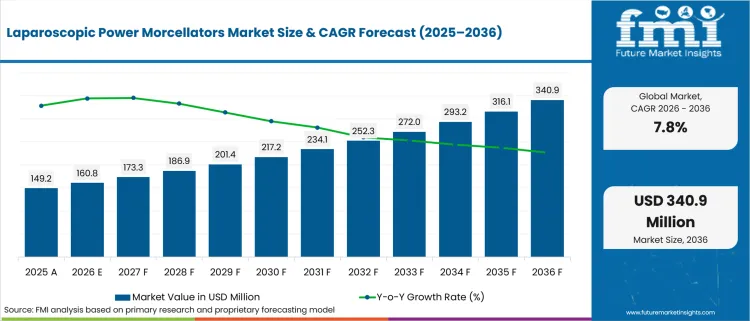
USD 160.8 million in 2026 and USD 340.9 million by 2036 at a 7.8% CAGR.
FMI estimates that demand for Laparoscopic Power Morcellators will rise from USD 160.8 million in 2026 to USD 340.9 million by 2036, reflecting a 7.8% CAGR. Revenue expands as hospitals replace legacy platforms, procure contained-system components, and maintain selected laparoscopic myomectomy or hysterectomy pathways. The category is specialized, so purchasing is more sensitive to procedure protocols, containment compatibility and physician credentialing than general trocar and insufflation or visualization demand.
The forecast does not assume a return to routine uncontained use. It reflects a market in which hospitals concentrate procedures among trained surgeons, require explicit patient-selection rules, and evaluate whether a reusable capital platform and a disposable device or a compatible containment pathway offers the most defensible total procedure cost. Growth therefore comes from controlled use, device replacement, single-use component consumption and tighter workflow integration rather than unrestricted procedural expansion.
Key Takeaways of Laparoscopic Power Morcellators Market
- FMI estimates the market at USD 160.8 million in 2026 and USD 340.9 million by 2036, at a 7.8% CAGR.
- Reusable Power Morcellators lead Product Type at 32.0%, as high-volume hospitals can spread capital cost across selected cases while maintaining defined reprocessing and maintenance controls.
- Uterine Myomectomy leads Application at 39.0%, while Hospitals lead End User at 43.0%.
- Direct Sales leads Distribution Channel at 38.0%, and Rotary Blade Technology leads Technology at 30.0%.
- Compatible containment, preoperative screening, informed consent and surgeon training and pathology workflow are central qualification requirements.
- USA is forecast at 8.2% and Japan at 7.9% among the countries covered, with regulation and center-level protocol shaping replacement demand.
- Medtronic plc, KARL STORZ SE & Co. KG, Richard Wolf GmbH, Olympus Corporation and LiNA Medical ApS and Boston Scientific Corporation and Nouvag AG and RUDOLF Medical GmbH + Co. KG, Cook Medical, and Advin Healthcare form the named competitive set across direct morcellation and adjacent tissue-management and broader minimally invasive portfolios.
Analyst perspective
"Power morcellator purchasing is no longer a decision about cutting speed alone. The selected platform must move tissue through a small port while keeping the handpiece, blade, containment bag and visualization method and reprocessing workflow aligned. Hospitals will favor suppliers that document compatibility, train the operating-room team, and support a controlled patient-selection protocol."
- Anurag Sharma, Principal Consultant, Future Market Insights
How is the Laparoscopic Power Morcellators Market segmented?
The Laparoscopic Power Morcellators Market is segmented by Product Type, Application, End User, Distribution Channel, Technology, and Region.
Why do Reusable Power Morcellators lead the Product Type category?
Reusable Power Morcellators hold a 32.0% share in 2026
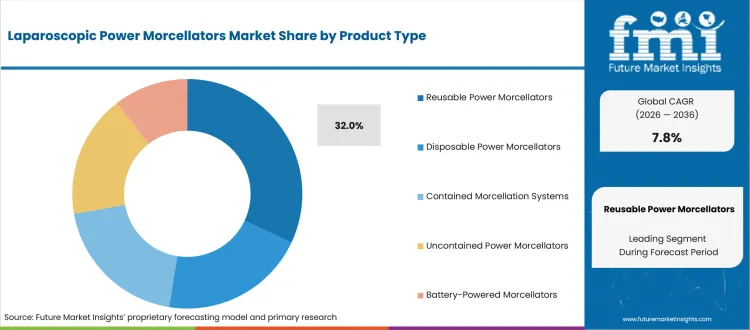
Disposable Power Morcellators, including Single-Use Morcellators and Single-Use Blade Assemblies, shift blade-condition uncertainty and device processing away from the facility and into a per-case purchase. They fit ambulatory centers, low-volume hospitals, or sites that lack a dependable reusable-instrument pathway but their value depends on sterile inventory availability and waste handling and a predictable procedure budget.
Why does Uterine Myomectomy lead the Application category?
Uterine Myomectomy holds a 39.0% share in 2026.
Hysterectomy demand is divided between Supracervical Hysterectomy and Total Laparoscopic Hysterectomy. In both, the need for powered fragmentation depends on uterine size, the surgical route and whether the specimen can be removed en bloc through the vagina or a mini-laparotomy and the patient-specific risk profile. Gynecological Tissue Removal covers Uterine Tissue Extraction and Adnexal Tissue Removal.
Why do Hospitals lead the End User category?
Hospitals hold a 43.0% share in 2026
Ambulatory Surgical Centers, including Multispecialty ASCs and Specialty Surgical Centers, can offer efficient room turnover and a focused minimally invasive workflow. They are more likely to favor single-use, cordless, or simplified configurations when reusable-device processing and capital utilization are uncertain. Their constraint is case selection: limited inpatient backup, emergency transfer requirements, and lower procedure volume can make a complex contained-morcellation program difficult to justify. Specialty Clinics, including Gynecology Clinics and
Why does Direct Sales lead the Distribution Channel category?
Direct Sales holds a 38.0% share in 2026
Medical Device Distributors expand coverage through Regional Distributors and Specialty Surgical Distributors. Their advantage is local inventory, registration knowledge, and field access and especially where direct manufacturer teams are limited. The constraint is consistency: technical training, complaint escalation, warranty and instructions-for-use updates must reach the user without distortion. Hospital Procurement Groups, including Group Purchasing Organizations and Centralized Hospital Procurement, can standardize price and supplier terms across a network. However, clinical committees may still require a product-specific exception when surgeon training, containment compatibility or installed equipment differs by site.
Why does Rotary Blade Technology lead the Technology category?
Rotary Blade Technology holds a 30.0% share in 2026.
Electromechanical Drive Technology includes Electric Motor Systems and High-Torque Drive Systems. These configurations convert the surgeon command into controlled rotation, so hospitals compare speed range, torque behavior and foot-switch response and overload handling and electromagnetic compatibility and serviceability. Tissue Containment Technology includes Bag-Based Containment and Integrated Containment
What are the drivers, restraints, and opportunities in the Laparoscopic Power Morcellators Market?
- Driver: Selected minimally invasive gynecologic procedures continue to require controlled extraction of tissue larger than the available port or incision.
- Restraint: Occult malignancy risk, age and patient-selection limits, containment complexity and reprocessing obligations narrow the addressable procedure pool.
- Opportunity: Compatible contained systems, single-use and cordless designs, validated training and dependable service can reduce workflow friction.
How do country-level CAGRs compare in the Laparoscopic Power Morcellators Market?
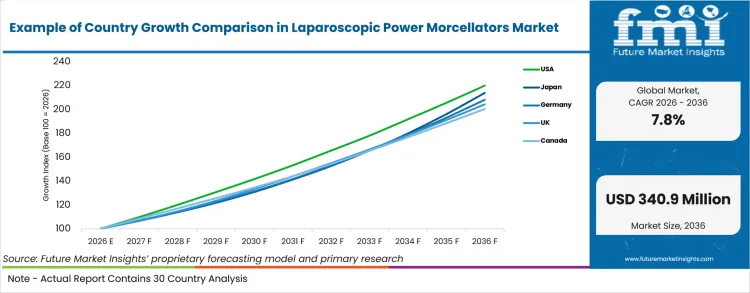
| Country | CAGR (2026 to 2036) |
|---|---|
| USA | 8.2% |
| Japan | 7.9% |
| Germany | 7.6% |
| UK | 7.4% |
| Canada | 7.2% |
| Australia | 7.0% |
| Brazil | 6.7% |
What does the country-wise analysis show for the Laparoscopic Power Morcellators Market?
- USA: FDA recommends laparoscopic power morcellation for myomectomy or hysterectomy only with a legally marketed, compatible containment system and in appropriately selected patients. It also advises against use for known or suspected malignancy, in postmenopausal patients or those over 50, and when en bloc removal is feasible. This pushes hospital demand toward documented compatibility, credentialing, consent and label review and adverse-event reporting and direct vendor support. The 8.2% CAGR reflects replacement and contained-workflow investment within a selected population, not a return to routine uncontained use.
- Japan: The Ministry of Health, Labour and Welfare revised precautions in December 2021 and emphasized informed consent and communication of US handling restrictions. A survey of 302 responding facilities covering 2017 to 2019 reported power morcellator use in 54.8% of laparoscopic myomectomies and 4.6% of laparoscopic hysterectomy or supracervical cases. That difference keeps myomectomy at the center of demand. Japanese hospitals are likely to value retrieval-bag protocols, detailed preoperative work-up, controlled change management and training evidence and supporting the 7.9% CAGR.
- Germany: German hospitals operate within the EU Medical Device Regulation framework, where reusable devices require appropriate cleaning, disinfection and packaging and validated re-sterilization processes. That makes central sterile services, manufacturer instructions, traceability and functional testing and service documentation part of the purchase. Procurement committees are therefore more likely to compare a reusable platform against single-use alternatives on total compliance cost rather than unit price. The 7.6% CAGR is supported by replacement and containment-system qualification in specialist gynecologic centers.
- UK: Royal College of Obstetricians and Gynaecologists information, last reviewed in September 2024, states that morcellation can support smaller-incision surgery and quicker recovery but should not be used in women over 50 or after menopause. It also emphasizes individualized risk discussion. UK purchasing consequently depends on patient-information materials, documented consent, surgeon competency and governance approval and a clear alternative-extraction pathway. The 7.4% CAGR reflects controlled use in selected cases and replacement of devices that no longer fit current local protocols.
- Canada: Health Canada updated hospital guidance and product labeling around the risk of spreading unsuspected uterine cancer. The notice identifies contraindications for peri- or postmenopausal patients, candidates for en bloc removal, and tissue known or suspected to be cancerous. Canadian demand therefore centers on facilities able to enforce selection criteria, communicate risk, track adverse incidents and verify current labeling. Provincial procurement networks can concentrate volume, but they also lengthen clinical and risk review before a platform or disposable set is standardized, resulting in a 7.2% CAGR.
- Australia: The Therapeutic Goods Administration reviewed instructions for use and training documentation for six morcellators on the Australian Register of Therapeutic Goods. Its 2021 update said devices should be used with compatible containment, identified the over-50 and postmenopausal contraindication, and reported IFU updates for four products. This creates a sponsor- and device-specific market in which registration status, current IFU, training material and post-market action history are checked before purchase. The 7.0% CAGR is tied to compliant replacement and specialist use.
- Brazil: Anvisa requirements place the importer and local authorization holder at the center of commercialization. Medical-device applications can require a technical dossier, legal-manufacturer authorization, proof of foreign marketing status and Anvisa Good Manufacturing Practices documentation and Portuguese instructions and labeling. Hospitals therefore need a supplier that can combine registration, local inventory, service and training and complaint handling. This raises the entry burden for smaller exporters but supports distributor-led replacement and single-use demand, producing a 6.7% CAGR.
Who are the notable companies in the Laparoscopic Power Morcellators Market?
Medtronic plc, KARL STORZ SE & Co. KG, Richard Wolf GmbH, Olympus Corporation and LiNA Medical ApS and Boston Scientific Corporation.
- LiNA Medical ApS and Nouvag AG document gynecologic morcellation configurations, while Olympus Corporation and KARL STORZ SE & Co. KG document established laparoscopic morcellation platforms.
- RUDOLF Medical GmbH + Co. KG and Advin Healthcare publish morcellator components or systems. Boston Scientific Corporation and Richard Wolf GmbH provide tissue-morcellation platforms with broader or urologic indications.
- Medtronic plc and Cook Medical occupy adjacent minimally invasive and gynecologic device portfolios. Product availability, indication, registration and containment compatibility vary by country.
Public evidence does not support treating every named company as a like-for-like laparoscopic power morcellator vendor in every country. Product availability, indication, registration and containment compatibility vary by geography. Procurement teams should confirm the current local configuration and authorized channel before benchmarking price or performance.
How does competitive benchmarking distinguish companies in the Laparoscopic Power Morcellators Market?
| Company | Documented product or role | Commercial qualification focus |
|---|---|---|
| LiNA Medical ApS | Xcise cordless, fully disposable morcellator; sterile single-use Xcise containment bag documented as compatible. | Per-case model reduces capital and reprocessing burden; supply continuity and bag-device compatibility drive qualification. |
| Nouvag AG | TCM 3000 BL reusable electromechanical system with adjustable and preset speeds; gynecologic laparoscopic IFU. | Capital, handpiece, blade and service and validated reprocessing must be managed as one lifecycle. |
| Olympus Corporation | PK Morcellator uses bipolar cutting; official materials describe coordinated use with PneumoLiner contained extraction. | Differentiated energy and system integration; buyer must verify current regional availability and exact IFU. |
| KARL STORZ SE & Co. KG | ROTOCUT G1 documented as a hollow-shaft laparoscopic morcellator within the company endoscopy history and portfolio. | Installed-base and service integration can matter; current regional configuration requires confirmation. |
| Boston Scientific Corporation | VersaCut Tissue Morcellator supports tissue removal under direct or endoscopic visualization across several approaches. | Blade-set, aspiration, fluid-environment and capital and indication-specific requirements shape adoption. |
| Richard Wolf GmbH | PIRANHA is a high-speed rotary tissue morcellation platform for urologic enucleation workflows with disposable blades. | Provides adjacent tissue-morcellation capability; it is not a like-for-like gynecologic benchmark. |
| RUDOLF Medical GmbH + Co. KG | Official catalog evidence includes a morcellator knife tube and repair component within a gynecology and endoscopy portfolio. | Instrument breadth and repair support are relevant; public evidence is limited for a current complete platform. |
| Advin Healthcare | Official technical material describes a laparoscopic morcellator with adjustable rotation speed, torque control, a retractable cutter blade and electronic control. | Export and distributor model requires verification of local registration, IFU, containment and service and training. |
| Medtronic plc | TruClear is an adjacent hysteroscopic tissue-removal platform rather than a laparoscopic power morcellator. | Gynecology account access is relevant, but the product should not be benchmarked as the same device category. |
| Cook Medical | Broad endoscopy, extraction, and minimally invasive product portfolio; no current official LPM-specific product was identified. | Channel and procedure adjacency are relevant, but current public evidence does not support a like-for-like product comparison. |
What are the key developments in the Laparoscopic Power Morcellators Market?
- In July 2025, LiNA Medical dated product literature for the Xcise Morcellation Bag, a sterile single-use closed-system bag identified as compatible with the cordless Xcise morcellator.
- In November 2025, Advin Healthcare published an updated technical overview for its laparoscopic morcellator, describing an electronically controlled system with adjustable rotation speed and torque control.
- In December 2023, Nouvag issued version 20231201 of the TCM 3000 BL instructions for use, defining the system for laparoscopic gynecologic tissue extraction and removal of myomas or the uterus.
- In September 2021, Boston Scientific completed its acquisition of the global surgical business of Lumenis, expanding its urology and pelvic health surgical portfolio; current Boston Scientific materials list the VersaCut Tissue Morcellator.
- In September 2017, Olympus presented the PK Morcellator and PneumoLiner contained tissue extraction system as coordinated gynecologic offerings in its investor strategy materials.
What does the Laparoscopic Power Morcellators Market report scope include?
| Coverage field | Report scope |
|---|---|
| Market breakdown | Product Type, Application, End User and Distribution Channel and Technology and Region |
| Quantitative Units | Revenue USD Million and CAGR in %. |
| Market Definition | Revenue includes first-sale manufacturer or authorized-supplier revenue from powered laparoscopic morcellator control units, handpieces, blade or cutter assemblies and dedicated single-use devices and purpose-built contained morcellation systems within the segmentation universe. Manual morcellation tools, hysteroscopic shavers, and urologic-only morcellators are excluded from core sizing unless sold into a qualifying laparoscopic application. |
| Regions Covered | North America; Latin America; Western Europe; Eastern Europe; East Asia; South Asia and Pacific; Middle East and Africa |
| Countries Covered | USA, Japan, Germany and UK and Canada and Australia and Brazil and more than thirty additional countries in the full report |
| Key Companies Profiled | Medtronic plc; KARL STORZ SE & Co. KG; Richard Wolf GmbH; Olympus Corporation; LiNA Medical ApS; Boston Scientific Corporation; Nouvag AG; RUDOLF Medical GmbH + Co. KG; Cook Medical; Advin Healthcare |
| Forecast Period | 2026 to 2036 |
| Approach | Hybrid bottom-up and top-down sizing using manufacturer and authorized-channel revenue, procedure mix, installed-base and replacement indicators and capital and disposable pricing and regulatory evidence and buyer-side validation. |
What research methodology supports the Laparoscopic Power Morcellators Market?
| Method | Approach |
|---|---|
| Primary Research | FMI engages device manufacturers, authorized distributors, gynecologic and laparoscopic surgeons and operating-room managers and sterile processing teams and procurement professionals and biomedical engineers and regulatory and quality experts. |
| Desk Research | The review covers regulator safety communications and guidance, medical-device laws and standards, government releases and company filings and official product pages and instructions for use and catalogs and company announcements. |
| Market Sizing and Forecasting | The model reconciles manufacturer and channel revenue, installed base, replacement cycles and procedure and indication mix and reusable and single-use configurations and containment consumption and average selling prices and country-level adoption constraints. |
| Data Validation | Supply-side findings are cross-checked with hospital procurement, surgeon workflow, distributor and reprocessing and regulatory and country evidence. High-risk claims are retained only when the underlying evidence is current and traceable. |
How is the Laparoscopic Power Morcellators Market segmented by category?
Laparoscopic Power Morcellators Market segmented by Product Type:
- Reusable Power Morcellators
- Electromechanical Morcellators
- Multi-Use Blade Systems
- Disposable Power Morcellators
- Single-Use Morcellators
- Single-Use Blade Assemblies
- Contained Morcellation Systems
- Integrated Containment Systems
- Contained Tissue Extraction Systems
- Uncontained Power Morcellators
- Standard Rotary Morcellators
- High-Speed Morcellators
- Battery-Powered Morcellators
- Cordless Morcellation Systems
- Portable Battery-Operated Systems
Laparoscopic Power Morcellators Market segmented by Application:
- Uterine Myomectomy
- Laparoscopic Myomectomy
- Robotic-Assisted Myomectomy
- Hysterectomy
- Supracervical Hysterectomy
- Total Laparoscopic Hysterectomy
- Gynecological Tissue Removal
- Uterine Tissue Extraction
- Adnexal Tissue Removal
- General Laparoscopic Surgery
- Spleen Tissue Removal
- General Abdominal Tissue Removal
- Other Minimally Invasive Procedures
- Organ Fragmentation
- Specialized Tissue Extraction
Laparoscopic Power Morcellators Market segmented by End User:
- Hospitals
- Public Hospitals
- Private Hospitals
- Ambulatory Surgical Centers
- Multispecialty ASCs
- Specialty Surgical Centers
- Specialty Clinics
- Gynecology Clinics
- Minimally Invasive Surgery Clinics
- Academic Medical Centers
- University Hospitals
- Teaching Hospitals
- Other Healthcare Facilities
- Outpatient Surgical Facilities
- Specialized Treatment Centers
Laparoscopic Power Morcellators Market segmented by Distribution Channel:
- Direct Sales
- Direct Manufacturer Sales
- Key Account Contracts
- Medical Device Distributors
- Regional Distributors
- Specialty Surgical Distributors
- Hospital Procurement Groups
- Group Purchasing Organizations
- Centralized Hospital Procurement
- Online Medical Equipment Platforms
- Manufacturer E-Commerce Portals
- B2B Medical Marketplaces
- Third-Party Resellers
- Local Medical Equipment Dealers
- Independent Resellers
Laparoscopic Power Morcellators Market segmented by Technology:
- Rotary Blade Technology
- Single-Blade Systems
- Multi-Blade Systems
- Electromechanical Drive Technology
- Electric Motor Systems
- High-Torque Drive Systems
- Tissue Containment Technology
- Bag-Based Containment
- Integrated Containment Systems
- Advanced Blade Technology
- High-Speed Cutting Blades
- Replaceable Blade Cartridges
- Safety & Control Technology
- Speed Control Systems
- Overload Protection Systems
Laparoscopic Power Morcellators Market segmented by Region:
- North America
- Latin America
- Western Europe
- Eastern Europe
- East Asia
- South Asia and Pacific
- Middle East and Africa
Which research sources and bibliography support the Laparoscopic Power Morcellators Market?
- USA Food and Drug Administration (2020, December 29). UPDATE: Perform Only Contained Morcellation When Laparoscopic Power Morcellation Is Appropriate.
- USA Food and Drug Administration (2020, December). Product Labeling for Laparoscopic Power Morcellators.
- USA Food and Drug Administration (2023, May). Non-Clinical Performance Assessment of Tissue Containment Systems Used During Power Morcellation Procedures.
- Royal College of Obstetricians and Gynaecologists (2019, October; reviewed 2024, September). Morcellation for myomectomy or hysterectomy.
- Health Canada (2014, December 10). Laparoscopic Electric Morcellators - Update on the Risk of Spread of Unsuspected Uterine Cancer - Notice to Hospitals.
- Therapeutic Goods Administration, Australia (2021, October 1). Laparoscopic power morcellators - Update 3.
- Ministry of Health, Labour and Welfare, Japan (2021 and December 24). Revision of precautions for electric morcellators.
- European Commission (accessed 2026, July 31). Reprocessing of devices.
- European Commission (2020). Factsheet for Manufacturers of Medical Devices.
- Agencia Nacional de Vigilancia Sanitaria, Brazil (2022). Collegiate Board Resolution RDC No. 751/2022.
- Agencia Nacional de Vigilancia Sanitaria, Brazil (2025, October 22). Anvisa publishes new version of the medical equipment regularization manual.
- LiNA Medical ApS (accessed 2026, July 31). LiNA Xcise Cordless Laparoscopic Morcellator.
- LiNA Medical ApS (2025, July). LiNA Xcise Morcellation Bag product literature.
- Nouvag AG (accessed 2026, July 31). TCM 3000 BL Morcellator.
- Nouvag AG (2023, December 1). TCM 3000 BL Morcellator Instructions for Use, version 20231201.
- Olympus Corporation (accessed 2026, July 31). PK Morcellator design and cutting principle.
- Olympus Corporation (2017, September 13). Corporate strategy presentation covering PK Morcellator and PneumoLiner.
- KARL STORZ SE & Co. KG (accessed 2026, July 31). Company history entry for the ROTOCUT G1 morcellator.
- Boston Scientific Corporation (accessed 2026, July 31). VersaCut Tissue Morcellator Prescriptive Information.
- Boston Scientific Corporation (2021, September 1). Boston Scientific closes acquisition of Lumenis surgical business.
- Richard Wolf GmbH (accessed 2026, July 31). PIRANHA tissue morcellation system.
- RUDOLF Medical GmbH + Co. KG (accessed 2026, July 31). Morcellator Knife Tube with Cutter for Repair.
- Advin Healthcare (2025, November 4). Laparoscopic Morcellator - Advanced Solution for Efficient Tissue Morcellation.
- Medtronic plc (accessed 2026, July 31). TruClear Hysteroscopic Tissue Removal System.
- Cook Medical (accessed 2026, July 31). Product portfolio.
This bibliography is provided for reader reference and is not exhaustive. The full report contains the complete reference list and detailed citations.
What does this report answer about the Laparoscopic Power Morcellators Market?
- What is the Laparoscopic Power Morcellators Market size in 2026 and what value is forecast for 2036?
- How do patient selection, consent, containment and pathology requirements shape demand?
- Why do Reusable Power Morcellators lead the Product Type category?
- Why does Uterine Myomectomy hold the leading position within Application?
- Why do Hospitals account for the largest End User share?
- How do Direct Sales and Rotary Blade Technology influence procurement and workflow?
- How do growth mechanisms differ across USA, Japan, Germany and UK and Canada and Australia and Brazil?
- Which named companies provide direct morcellation systems, adjacent tissue-management platforms, or broader minimally invasive portfolios?
- What should surgeons, sterile processing teams, biomedical engineers and procurement committees evaluate before purchase?
- How do regulatory limits, reprocessing, containment compatibility and service availability affect return on investment?
Frequently Asked Questions
How big is the Laparoscopic Power Morcellators Market in 2026?
The laparoscopic power morcellators market is valued at USD 160.8 million in 2026 and is forecast to reach USD 340.9 million by 2036, reflecting a 7.8% CAGR as hospitals replace legacy platforms and adopt compatible containment systems within controlled, selected patient pathways.
What is the CAGR of the Laparoscopic Power Morcellators Market from 2026 to 2036?
The laparoscopic power morcellators market grows at a CAGR of 7.8% between 2026 and 2036, rising from USD 160.8 million to USD 340.9 million as hospitals invest in replacement platforms, containment compatibility and disciplined patient-selection protocols rather than unrestricted procedural expansion.
Which product type leads the Laparoscopic Power Morcellators Market?
Reusable Power Morcellators lead the laparoscopic power morcellators market by product type with a 32.0% share in 2026, as high-volume hospitals spread capital cost across selected cases while maintaining defined reprocessing, maintenance controls and dependable service support for long-term platform use.
How much will the Laparoscopic Power Morcellators Market add between 2026 and 2036?
The laparoscopic power morcellators market is set to add USD 180.1 million between 2026 and 2036, growing from USD 160.8 million to USD 340.9 million as hospitals expand compatible containment adoption and replace legacy platforms across selected, controlled surgical pathways.
Who are the leading companies in the Laparoscopic Power Morcellators Market?
Ten companies lead the laparoscopic power morcellators market, including Medtronic, KARL STORZ, Richard Wolf, Olympus, LiNA Medical and Boston Scientific, competing through reusable and disposable morcellation platforms, containment-compatible systems and gynecologic and urologic tissue-removal technologies across hospital and ambulatory surgical channels.
Preview the report firsthand - request a free sample
Get SampleGet the brochure for pricing and purchase details.
Get PDFTable of Content
- Key Takeaways
- Market Size and CAGR
- Top Growth Driver
- Fastest Growing Segment
- Leading Region
- Key Companies
- Emerging Opportunities
- Executive Summary
- Global Market Outlook
- Demand-side Trends
- Supply-side Trends
- Technology Roadmap Analysis
- Analysis and Recommendations
- Analyst Perspective (What is happening? Why now? What should investors know?)
- Key Questions Answered
- How large is the market?
- What is the CAGR?
- What are key trends?
- Which region dominates?
- Who are the leaders?
- Market Overview
- Market Coverage / Taxonomy
- Market Definition / Scope / Limitations
- Research Methodology
- Chapter Orientation
- Analytical Lens and Working Hypotheses
- Market Structure, Signals, and Trend Drivers
- Benchmarking and Cross-market Comparability
- Market Sizing, Forecasting, and Opportunity Mapping
- Research Design and Evidence Framework
- Desk Research Programme (Secondary Evidence)
- Expert Input and Fieldwork (Primary Evidence)
- Tooling, Models, and Reference Databases
- Data Engineering and Model Build
- Quality Assurance and Audit Trail
- Market Background
- Market Dynamics (Drivers, Restraints, Opportunity, Trends)
- Scenario Forecast (Optimistic, Likely, Conservative)
- Impact Analysis
- AI Impact
- Sustainability Impact
- Regulatory Impact
- Technology Impact
- Consumer / Buyer Analysis
- Purchase Drivers
- Adoption Barriers
- Buyer Journey
- Opportunity Map Analysis
- Product Life Cycle Analysis
- Supply Chain Analysis
- Investment Feasibility Matrix
- Value Chain Analysis
- PESTLE and Porter's Analysis
- Regulatory Landscape
- Regional Parent Market Outlook
- Production and Consumption Statistics
- Import and Export Statistics
- Global Market Analysis and Forecast, 2021 to 2036
- Historical Market Size Value (USD Million) Analysis, 2021 to 2025
- Current and Future Market Size Value (USD Million) Projections, 2026 to 2036
- Y-o-Y Growth Trend Analysis
- Absolute $ Opportunity Analysis
- Global Market Pricing Analysis, 2021 to 2036
- Global Market Analysis and Forecast, By Product Type, 2021 to 2036
- Introduction / Key Findings
- Historical Market Size Value (USD Million) Analysis By Product Type, 2021 to 2025
- Current and Future Market Size Value (USD Million) Analysis and Forecast By Product Type, 2026 to 2036
- Reusable Power Morcellators
- Electromechanical Morcellators
- Multi-Use Blade Systems
- Disposable Power Morcellators
- Single-Use Morcellators
- Single-Use Blade Assemblies
- Contained Morcellation Systems
- Integrated Containment Systems
- Contained Tissue Extraction Systems
- Uncontained Power Morcellators
- Standard Rotary Morcellators
- High-Speed Morcellators
- Battery-Powered Morcellators
- Cordless Morcellation Systems
- Portable Battery-Operated Systems
- Reusable Power Morcellators
- Y-o-Y Growth Trend Analysis By Product Type, 2021 to 2025
- Absolute $ Opportunity Analysis By Product Type, 2026 to 2036
- Global Market Analysis and Forecast, By Application, 2021 to 2036
- Introduction / Key Findings
- Historical Market Size Value (USD Million) Analysis By Application, 2021 to 2025
- Current and Future Market Size Value (USD Million) Analysis and Forecast By Application, 2026 to 2036
- Uterine Myomectomy
- Laparoscopic Myomectomy
- Robotic-Assisted Myomectomy
- Hysterectomy
- Supracervical Hysterectomy
- Total Laparoscopic Hysterectomy
- Gynecological Tissue Removal
- Uterine Tissue Extraction
- Adnexal Tissue Removal
- General Laparoscopic Surgery
- Spleen Tissue Removal
- General Abdominal Tissue Removal
- Other Minimally Invasive Procedures
- Organ Fragmentation
- Specialized Tissue Extraction
- Uterine Myomectomy
- Y-o-Y Growth Trend Analysis By Application, 2021 to 2025
- Absolute $ Opportunity Analysis By Application, 2026 to 2036
- Global Market Analysis and Forecast, By End User, 2021 to 2036
- Introduction / Key Findings
- Historical Market Size Value (USD Million) Analysis By End User, 2021 to 2025
- Current and Future Market Size Value (USD Million) Analysis and Forecast By End User, 2026 to 2036
- Hospitals
- Public Hospitals
- Private Hospitals
- Ambulatory Surgical Centers
- Multispecialty ASCs
- Specialty Surgical Centers
- Specialty Clinics
- Gynecology Clinics
- Minimally Invasive Surgery Clinics
- Academic Medical Centers
- University Hospitals
- Teaching Hospitals
- Other Healthcare Facilities
- Outpatient Surgical Facilities
- Specialized Treatment Centers
- Hospitals
- Y-o-Y Growth Trend Analysis By End User, 2021 to 2025
- Absolute $ Opportunity Analysis By End User, 2026 to 2036
- Global Market Analysis and Forecast, By Distribution Channel, 2021 to 2036
- Introduction / Key Findings
- Historical Market Size Value (USD Million) Analysis By Distribution Channel, 2021 to 2025
- Current and Future Market Size Value (USD Million) Analysis and Forecast By Distribution Channel, 2026 to 2036
- Direct Sales
- Direct Manufacturer Sales
- Key Account Contracts
- Medical Device Distributors
- Regional Distributors
- Specialty Surgical Distributors
- Hospital Procurement Groups
- Group Purchasing Organizations
- Centralized Hospital Procurement
- Online Medical Equipment Platforms
- Manufacturer E-Commerce Portals
- B2B Medical Marketplaces
- Third-Party Resellers
- Local Medical Equipment Dealers
- Independent Resellers
- Direct Sales
- Y-o-Y Growth Trend Analysis By Distribution Channel, 2021 to 2025
- Absolute $ Opportunity Analysis By Distribution Channel, 2026 to 2036
- Global Market Analysis and Forecast, By Technology, 2021 to 2036
- Introduction / Key Findings
- Historical Market Size Value (USD Million) Analysis By Technology, 2021 to 2025
- Current and Future Market Size Value (USD Million) Analysis and Forecast By Technology, 2026 to 2036
- Rotary Blade Technology
- Single-Blade Systems
- Multi-Blade Systems
- Electromechanical Drive Technology
- Electric Motor Systems
- High-Torque Drive Systems
- Tissue Containment Technology
- Bag-Based Containment
- Integrated Containment Systems
- Advanced Blade Technology
- High-Speed Cutting Blades
- Replaceable Blade Cartridges
- Safety & Control Technology
- Speed Control Systems
- Overload Protection Systems
- Rotary Blade Technology
- Y-o-Y Growth Trend Analysis By Technology, 2021 to 2025
- Absolute $ Opportunity Analysis By Technology, 2026 to 2036
- Global Market Analysis and Forecast, By Region, 2021 to 2036
- Introduction
- Historical Market Size Value (USD Million) Analysis By Region, 2021 to 2025
- Current Market Size Value (USD Million) Analysis and Forecast By Region, 2026 to 2036
- North America
- Latin America
- Western Europe
- Eastern Europe
- East Asia
- South Asia and Pacific
- Middle East & Africa
- Market Attractiveness Analysis By Region
- North America Market Analysis and Forecast, By Country, 2021 to 2036
- Historical Market Size Value (USD Million) Trend Analysis By Market Taxonomy, 2021 to 2025
- Market Size Value (USD Million) Forecast By Market Taxonomy, 2026 to 2036
- By Country
- USA
- Canada
- By Product Type
- By Application
- By End User
- By Distribution Channel
- By Technology
- By Country
- Market Attractiveness Analysis
- By Country
- By Product Type
- By Application
- By End User
- By Distribution Channel
- By Technology
- Key Takeaways
- Latin America Market Analysis and Forecast, By Country
- Historical Market Size Value (USD Million) Trend Analysis By Market Taxonomy, 2021 to 2025
- Market Size Value (USD Million) Forecast By Market Taxonomy, 2026 to 2036
- By Country
- Brazil
- Mexico
- Chile
- Rest of Latin America
- By Product Type
- By Application
- By End User
- By Distribution Channel
- By Technology
- By Country
- Market Attractiveness Analysis
- By Country
- By Product Type
- By Application
- By End User
- By Distribution Channel
- By Technology
- Key Takeaways
- Western Europe Market Analysis and Forecast, By Country
- Historical Market Size Value (USD Million) Trend Analysis By Market Taxonomy, 2021 to 2025
- Market Size Value (USD Million) Forecast By Market Taxonomy, 2026 to 2036
- By Country
- Germany
- UK
- Italy
- Spain
- France
- Nordic
- BENELUX
- Rest of Western Europe
- By Product Type
- By Application
- By End User
- By Distribution Channel
- By Technology
- By Country
- Market Attractiveness Analysis
- By Country
- By Product Type
- By Application
- By End User
- By Distribution Channel
- By Technology
- Key Takeaways
- Eastern Europe Market Analysis and Forecast, By Country
- Historical Market Size Value (USD Million) Trend Analysis By Market Taxonomy, 2021 to 2025
- Market Size Value (USD Million) Forecast By Market Taxonomy, 2026 to 2036
- By Country
- Russia
- Poland
- Hungary
- Balkan & Baltic
- Rest of Eastern Europe
- By Product Type
- By Application
- By End User
- By Distribution Channel
- By Technology
- By Country
- Market Attractiveness Analysis
- By Country
- By Product Type
- By Application
- By End User
- By Distribution Channel
- By Technology
- Key Takeaways
- East Asia Market Analysis and Forecast, By Country
- Historical Market Size Value (USD Million) Trend Analysis By Market Taxonomy, 2021 to 2025
- Market Size Value (USD Million) Forecast By Market Taxonomy, 2026 to 2036
- By Country
- China
- Japan
- South Korea
- By Product Type
- By Application
- By End User
- By Distribution Channel
- By Technology
- By Country
- Market Attractiveness Analysis
- By Country
- By Product Type
- By Application
- By End User
- By Distribution Channel
- By Technology
- Key Takeaways
- South Asia and Pacific Market Analysis and Forecast, By Country
- Historical Market Size Value (USD Million) Trend Analysis By Market Taxonomy, 2021 to 2025
- Market Size Value (USD Million) Forecast By Market Taxonomy, 2026 to 2036
- By Country
- India
- ASEAN
- Australia & New Zealand
- Rest of South Asia and Pacific
- By Product Type
- By Application
- By End User
- By Distribution Channel
- By Technology
- By Country
- Market Attractiveness Analysis
- By Country
- By Product Type
- By Application
- By End User
- By Distribution Channel
- By Technology
- Key Takeaways
- Middle East & Africa Market Analysis and Forecast, By Country
- Historical Market Size Value (USD Million) Trend Analysis By Market Taxonomy, 2021 to 2025
- Market Size Value (USD Million) Forecast By Market Taxonomy, 2026 to 2036
- By Country
- Kingdom of Saudi Arabia
- Other GCC Countries
- Türkiye
- South Africa
- Other African Union
- Rest of Middle East & Africa
- By Product Type
- By Application
- By End User
- By Distribution Channel
- By Technology
- By Country
- Market Attractiveness Analysis
- By Country
- By Product Type
- By Application
- By End User
- By Distribution Channel
- By Technology
- Key Takeaways
- Key Countries Market Analysis
- USA
- Pricing Analysis
- Market Share Analysis, 2025
- By Product Type
- By Application
- By End User
- By Distribution Channel
- By Technology
- Canada
- Pricing Analysis
- Market Share Analysis, 2025
- By Product Type
- By Application
- By End User
- By Distribution Channel
- By Technology
- Mexico
- Pricing Analysis
- Market Share Analysis, 2025
- By Product Type
- By Application
- By End User
- By Distribution Channel
- By Technology
- Brazil
- Pricing Analysis
- Market Share Analysis, 2025
- By Product Type
- By Application
- By End User
- By Distribution Channel
- By Technology
- Chile
- Pricing Analysis
- Market Share Analysis, 2025
- By Product Type
- By Application
- By End User
- By Distribution Channel
- By Technology
- Germany
- Pricing Analysis
- Market Share Analysis, 2025
- By Product Type
- By Application
- By End User
- By Distribution Channel
- By Technology
- UK
- Pricing Analysis
- Market Share Analysis, 2025
- By Product Type
- By Application
- By End User
- By Distribution Channel
- By Technology
- Italy
- Pricing Analysis
- Market Share Analysis, 2025
- By Product Type
- By Application
- By End User
- By Distribution Channel
- By Technology
- Spain
- Pricing Analysis
- Market Share Analysis, 2025
- By Product Type
- By Application
- By End User
- By Distribution Channel
- By Technology
- France
- Pricing Analysis
- Market Share Analysis, 2025
- By Product Type
- By Application
- By End User
- By Distribution Channel
- By Technology
- India
- Pricing Analysis
- Market Share Analysis, 2025
- By Product Type
- By Application
- By End User
- By Distribution Channel
- By Technology
- ASEAN
- Pricing Analysis
- Market Share Analysis, 2025
- By Product Type
- By Application
- By End User
- By Distribution Channel
- By Technology
- Australia & New Zealand
- Pricing Analysis
- Market Share Analysis, 2025
- By Product Type
- By Application
- By End User
- By Distribution Channel
- By Technology
- China
- Pricing Analysis
- Market Share Analysis, 2025
- By Product Type
- By Application
- By End User
- By Distribution Channel
- By Technology
- Japan
- Pricing Analysis
- Market Share Analysis, 2025
- By Product Type
- By Application
- By End User
- By Distribution Channel
- By Technology
- South Korea
- Pricing Analysis
- Market Share Analysis, 2025
- By Product Type
- By Application
- By End User
- By Distribution Channel
- By Technology
- Russia
- Pricing Analysis
- Market Share Analysis, 2025
- By Product Type
- By Application
- By End User
- By Distribution Channel
- By Technology
- Poland
- Pricing Analysis
- Market Share Analysis, 2025
- By Product Type
- By Application
- By End User
- By Distribution Channel
- By Technology
- Hungary
- Pricing Analysis
- Market Share Analysis, 2025
- By Product Type
- By Application
- By End User
- By Distribution Channel
- By Technology
- Kingdom of Saudi Arabia
- Pricing Analysis
- Market Share Analysis, 2025
- By Product Type
- By Application
- By End User
- By Distribution Channel
- By Technology
- Türkiye
- Pricing Analysis
- Market Share Analysis, 2025
- By Product Type
- By Application
- By End User
- By Distribution Channel
- By Technology
- South Africa
- Pricing Analysis
- Market Share Analysis, 2025
- By Product Type
- By Application
- By End User
- By Distribution Channel
- By Technology
- USA
- Market Structure Analysis
- Competition Dashboard
- Competition Benchmarking
- Market Share Analysis of Top Players
- By Regional
- By Product Type
- By Application
- By End User
- By Distribution Channel
- By Technology
- Emerging Startups
- Innovation Benchmarking
- Competition Analysis
- Competition Deep Dive
- Medtronic plc
- Overview
- Product Portfolio
- Profitability by Market Segments
- Sales Footprint
- Strategy Overview
- Marketing Strategy
- Product Strategy
- Channel Strategy
- KARL STORZ SE & Co. KG
- Richard Wolf GmbH
- Olympus Corporation
- LiNA Medical ApS
- Boston Scientific Corporation
- Nouvag AG
- RUDOLF Medical GmbH + Co. KG
- Cook Medical
- Advin Healthcare
- Medtronic plc
- Case Studies
- Success Stories
- Recent Developments
- Competition Deep Dive
- Assumptions & Acronyms Used


