

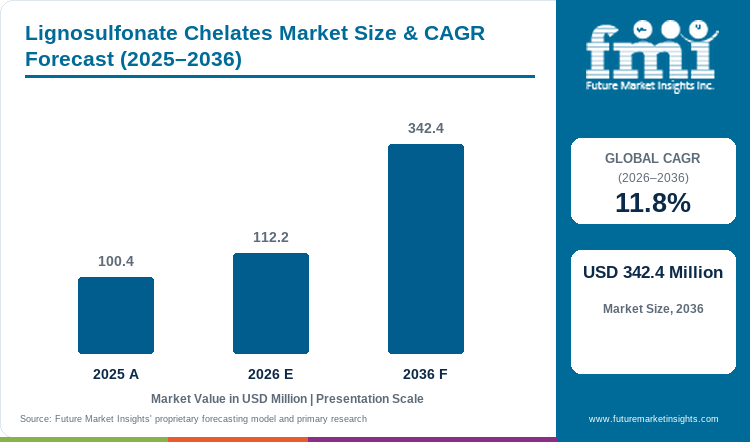
- Market Size (2026)
- USD 112.2 Mn
- Forecast (2036)
- USD 342.4 Mn
- CAGR (2026 to 2036)
- 11.8%
How big is Lignosulfonate Chelates Market in 2026?
USD 112.2 Million in 2026 and USD 342.4 Million by 2036 at an 11.8% CAGR.
Sales of lignosulfonate chelates are estimated to grow at 11.8% from USD 112.2 million in 2026 to USD 342.4 million by 2036, following a market value of USD 100.4 million in 2025. The main reason growers use these products is straightforward. Iron, zinc, manganese, and other cationic micronutrients can become less available when they react with soil components or precipitate out of solution. Lignosulfonate-based complexes help keep more of those nutrients in a usable form. Buyers therefore focus on metal loading, solubility, and how the product behaves at the required pH rather than simply on whether the raw material comes from lignin.
Growth will not look the same in every country. Large US farms can test a micronutrient product on part of their acreage and expand it quickly if the results justify the cost. UK growers increasingly make nutrient decisions through testing and structured farm plans. German suppliers have to work within a large cereal market and detailed European fertilising-product rules. South Korea is expanding smart-farming systems that favor inputs with predictable dosing. Japan places more weight on product consistency and local field performance before growers move away from familiar crop-nutrition products.
Key Takeaways
- Micronutrient availability is the central demand mechanism, particularly where soil chemistry reduces the practical value of uncomplexed trace-element salts.
- Raw / Crude Extract Grades are projected to hold 46.3% of Product Type demand in 2026, reflecting their cost position for formulators with in-house standardization capability.
- Cereals & Grains account for 42.2% of Crop Type demand, supported by broad acreage and the economics of repeatable micronutrient correction.
- Feedstock variability and changes in pH behavior can slow qualification when consistent complexing performance is required across production lots.
- The USA is forecast to expand at 11.5% CAGR through 2036, followed closely by South Korea at 11.2% and Germany at 10.9%.
- BioAtlantis, Hello Nature (Italpollina), Sicit Group, Tessenderlo Group, Algaia, Gelymar, Kimitec, and Seipasa are among the companies profiled across crop nutrition and natural-input competition.
Analyst Perspective
"The margin opportunity is moving away from undifferentiated lignosulfonate supply and toward formulations with controlled metal loading, stable solution behavior, and clear crop-use instructions. Suppliers that can hold those specifications across batches will be better positioned to sell into professional micronutrient programs rather than compete only on raw-material cost."
- Nikhil Kaitwade, Principal Consultant, Future Market Insights
How is the lignosulfonate chelates market segmented?
The lignosulfonate chelates market is segmented by Product Type, Crop Type, Application Method, Farm Type, Sales Channel, and Region.
The market is segmented by Product Type into Raw / Crude Extract Grades, Refined & Standardized Fractions, Formulated End-Use Blends, and Others. Crop Type includes Cereals & Grains, Fruits & Vegetables, Oilseeds & Pulses, Turf & Ornamentals, and Others. Application Method includes Soil Application, Foliar Application, Fertigation / Drip, Seed Application, and Others. Farm Type covers Large Commercial Farms, Mid-Size Farms, Smallholders, Greenhouses & Nurseries, and Others. Sales Channel includes Agri-Input Distributors, Cooperatives, Agri-Retail Chains, Online / Direct-to-Farm, and Others.
Why do Raw / Crude Extract Grades lead demand within the Product Type category?
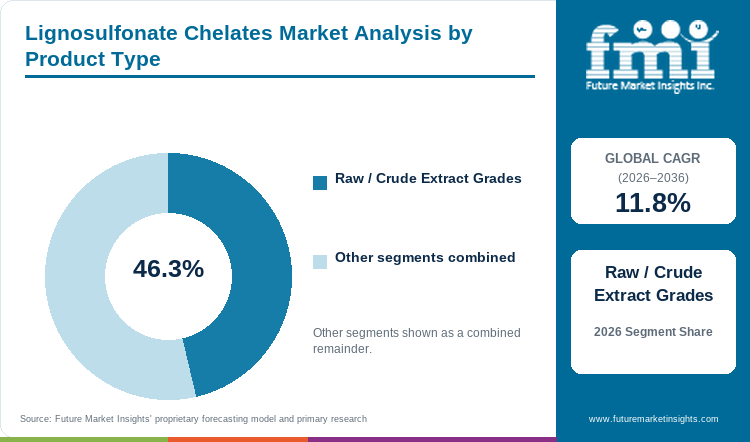
Raw / Crude Extract Grades suit fertilizer blenders and specialty-nutrition formulators that already have their own processing capability. These buyers can adjust concentration, metal loading, and pH themselves, so paying for a highly refined upstream product often adds little value. The real issue is consistency. Lignosulfonate composition can change with feedstock and processing conditions, which means crude grades need tighter incoming specifications when the final formulation must deliver a repeatable amount of complexed micronutrient.
- Raw / Crude Extract Grades are projected to account for 46.3% of Product Type demand in 2026.
- Refined fractions and formulated blends gain value where customers prefer tighter specifications or want to reduce formulation work after purchasing the lignosulfonate base.
Why do Cereals & Grains lead demand within the Crop Type category?
Cereals & Grains lead because even a modest micronutrient treatment can translate into substantial demand when it is applied across large areas. Broad-acre growers usually look closely at cost per hectare, so the product has to solve a clear deficiency without adding unnecessary handling or application cost. Germany shows the scale involved: 5.86 million hectares were expected to be planted with cereals for the 2025 harvest, with winter wheat making up 48% of cereal area.
- Cereals & Grains are estimated to hold 42.2% of Crop Type demand in 2026.
- Broad-acre programs favor formulations that can fit existing fertility passes without adding expensive handling or application steps.
Why does Soil Application lead demand within the Application Method category?
Soil Application leads because many micronutrient problems begin in the root zone. A lignosulfonate complex can help keep selected metal ions available long enough for root uptake, and soil placement fits naturally into established fertilizer programs. Foliar treatment is useful when a fast correction is needed, but it requires careful timing and dose control. Fertigation creates another route for soluble products and links lignosulfonate chelates with the wider use of water-soluble fertilizers in controlled nutrient systems.
- Soil Application is forecast to represent 38.0% of Application Method demand in 2026.
- Fertigation and foliar products require tighter control of solubility, tank compatibility, and solution behavior than many conventional soil-applied programs.
Why do Large Commercial Farms lead demand within the Farm Type category?
Large Commercial Farms can test a specialty nutrient on a limited area before committing to a much larger purchase. That makes it easier to compare treated and untreated fields, judge the return per hectare, and scale the program when the results are clear. Larger operations also tend to use agronomists, formal fertility plans, and centralized purchasing. These conditions favor products that can show a repeatable response rather than rely on a general soil-health message.
- Large Commercial Farms account for 34.7% of Farm Type demand in 2026.
- Scale allows commercial farms to absorb field-testing costs across larger purchasing programs when a formulation shows measurable nutrient-response benefits.
Why do Agri-Input Distributors lead demand within the Sales Channel category?
Agri-Input Distributors lead because most farms do not buy lignosulfonate chelates in isolation. The purchase starts with a nutrient problem, an application method, and a comparison with standard salts or synthetic chelates. Local distributors can help match the formulation to the crop while keeping stock close to the grower during the season. Direct purchasing makes more sense for large buyers or formulators that already know exactly what specification they need.
- Agri-Input Distributors are estimated to hold 42.0% of Sales Channel demand in 2026.
- Distributor value is highest where product selection depends on crop symptoms, soil conditions, and the compatibility of the formulation with an existing nutrient program.
What are the drivers, restraints and opportunities in the Lignosulfonate Chelates Market?
Micronutrient-efficiency requirements support demand, variable complexing performance increases qualification work, and standardized application-specific formulations create the clearest commercial opportunity.
- Driver: Growers and crop advisers need more effective micronutrient delivery where soil chemistry reduces nutrient availability.
- Restraint: Variation in lignosulfonate composition, pH behavior, and metal-complex stability can make one formulation behave differently from another.
- Opportunity: Suppliers can capture more value by selling standardized products designed for defined soil, foliar, or fertigation conditions.
Micronutrient Economics Strengthen the Demand Case
Lignosulfonate chelates solve a problem that sits inside the wider specialty fertilizers market. A micronutrient can be present in the product and still deliver poor results if soil conditions make it unavailable to the crop. Demand is therefore strongest when testing or crop symptoms point to a specific deficiency. In that situation, complexing chemistry has a clear job: keep more of the nutrient available long enough to be useful. This makes demand more dependent on diagnosed micronutrient needs than on overall fertilizer consumption.
Formulation Variability Raises the Qualification Burden
Lignosulfonates are derived from variable feedstocks, so differences in molecular composition can affect how they interact with iron, zinc, manganese, or copper. A product that works well in one formulation may behave differently when water quality, pH, or metal concentration changes. Precipitation or lower soluble-metal content can reduce performance in the field. Buyers that already know how incumbent agricultural chelates perform will only switch when the new product gives them a clear agronomic or cost advantage.
Precision Nutrient Programs Expand the Value of Standardized Grades
Suppliers have a better opportunity when they sell a product designed for a defined application rather than a generic lignosulfonate input. Useful specifications include metal loading, soluble solids, pH range, and dilution guidance for soil, foliar, or fertigation use. This matters more as precision agriculture moves nutrient decisions toward measured field conditions and controlled dosing. Clearer specifications also help distributors recommend the right product for a specific farm situation.
Which country CAGRs are profiled in the Lignosulfonate Chelates Market?
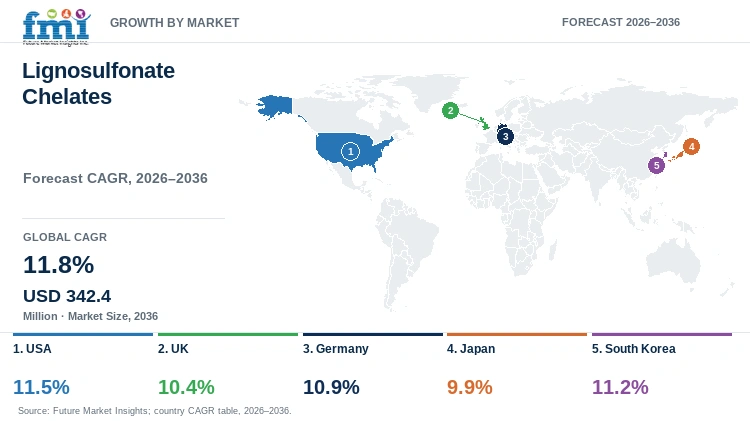
| Country | CAGR |
|---|---|
| USA | 11.5% |
| UK | 10.4% |
| Germany | 10.9% |
| Japan | 9.9% |
| South Korea | 11.2% |
How do country-level CAGRs compare in the Lignosulfonate Chelates Market?
The five profiled countries sit within a fairly narrow 1.6 percentage-point growth range. The USA leads at 11.5%, followed by South Korea at 11.2% and Germany at 10.9%. The UK reaches 10.4%, while Japan is forecast at 9.9%. These rates are close enough that CAGR alone does not tell suppliers where the best commercial opportunity lies. Crop mix, application practice, channel structure, and the cost of proving local performance can matter just as much.
- USA: The 11.5% CAGR reflects a market where large commercial operations can scale a successful micronutrient program over substantial acreage.
- South Korea: At 11.2%, growth is supported by increasing use of controlled and smart-farming systems that reward soluble inputs with predictable dosing behavior.
- Germany: The 10.9% CAGR sits alongside a large cereal production base and detailed European fertilising-product requirements.
- UK: The 10.4% CAGR is shaped by widespread nutrient planning and soil testing, which makes deficiency evidence important to product selection.
- Japan: The 9.9% CAGR reflects a more measured adoption environment where consistency and crop-specific performance are central to switching decisions.
Country-wise Analysis
- USA: At 11.5% CAGR from 2026 to 2036, the USA is the fastest-growing profiled market, with large commercial farms providing a direct route for scaling proven micronutrient programs. Growers can evaluate a treatment on part of the acreage before expanding it through existing dealer networks. The US organic-input framework also recognizes lignin sulfonate under specified agricultural uses, creating a route into selected organic production programs. Pricing still has to be justified against familiar synthetic chelates and uncomplexed micronutrient salts.
- UK: The UK is forecast to grow at 10.4% CAGR through 2036, within a farm system where nutrient planning and soil testing already shape input decisions. That favors products sold against a diagnosed nutrient requirement rather than broad preventive claims. The sales task is consequently agronomic: the formulation has to fit soil pH, crop condition, and an existing nutrient plan before its bio-based chemistry becomes commercially important.
- Germany: Germany combines a 10.9% CAGR with one of Europe’s largest cereal production bases, making per-hectare micronutrient economics particularly important. German farms were expected to cultivate 5.86 million hectares of cereals for the 2025 harvest, with winter wheat accounting for 48% of cereal area. Suppliers serving this market must balance treatment economics with European requirements governing the declaration of complexed micronutrients and complexing agents.
- Japan: Japan’s 9.9% CAGR reflects a more measured adoption environment in which formulation consistency and locally demonstrated crop performance carry greater weight. The market favors tightly specified crop inputs and measured nutrient programs rather than rapid substitution based solely on lower cost. Suppliers able to demonstrate stable product behavior across local crop and water conditions have a stronger path into professional distribution.
- South Korea: South Korea is projected to expand at 11.2% CAGR as smart-greenhouse and precision-farming infrastructure increases the value of predictable soluble nutrient formulations. The country’s 2025 to 2029 smart-farming plan targets smart technologies across 35% of greenhouse area and 20% of major field-crop production areas. Formulations that create sediment or behave unpredictably in water face a much higher practical barrier in these systems.
Who are the notable companies in the Lignosulfonate Chelates Market?
BioAtlantis, Hello Nature (Italpollina), Sicit Group, Tessenderlo Group, Algaia, Gelymar, Kimitec, and Seipasa are among the companies profiled across crop nutrition, bio-based formulation, and natural complexing competition.
Competition comes down to how well a company can turn natural complexing chemistry into a dependable crop-nutrition product. Hello Nature, Seipasa, and Tessenderlo Group are closer to the farm through specialty-nutrition portfolios and agricultural channels. Sicit Group, BioAtlantis, and Kimitec bring formulation and bioactive-input capabilities that overlap with the wider biostimulants market. Algaia and Gelymar bring natural functional-ingredient expertise that matters when formulators compare renewable complexing materials.
At farm level, buyers are less interested in company size than in whether the product works consistently. Soluble nutrient delivery, stability, crop response, and ease of application all affect repeat purchase. A smaller specialist with tight formulation control can therefore compete effectively against a larger crop-input supplier if it gives the buyer a more predictable product.
Competitive Benchmarking: Lignosulfonate Chelates Market
| Company | Micronutrient & Chelate Formulation Relevance | Natural Complexing / Bioactive Ingredient Capability | Agronomic Channel & Field Support | Geographic Reach |
|---|---|---|---|---|
| BioAtlantis | Medium | High | Medium | Europe and export markets across multiple regions |
| Hello Nature (Italpollina) | High | High | High | Europe, North America, and international agricultural markets |
| Sicit Group | Medium | High | High | Europe, Asia, North America, and Latin America |
| Tessenderlo Group | Medium | Medium | High | North America, Europe, and international crop-nutrition markets |
| Algaia | Medium | High | Medium | Europe and international formulator markets |
| Gelymar | Unscored | Medium | Medium | Chile and Indonesia manufacturing with worldwide distribution |
| Kimitec | Medium | High | High | Europe and partner-led international agricultural markets |
| Seipasa | High | Medium | High | Europe and international agricultural markets |
Micronutrient & Chelate Formulation Relevance measures documented proximity to micronutrient deficiency correction or chelated crop nutrition. Natural Complexing / Bioactive Ingredient Capability measures evidence of bio-based complexing materials, extraction, or bioactive formulation. Agronomic Channel & Field Support measures access to agricultural customers through distributors, advisers, technical teams, and major commercialization partners. High indicates broad capability against the criterion, while Medium indicates credible but narrower capability.
Key Developments in the Lignosulfonate Chelates Market
- In June 2025, Hello Nature announced an expansion of its Biandrate facility in Italy, increasing the production base supporting its natural crop-input portfolio. The investment strengthens the manufacturing platform from which specialty nutrition and bio-based products can be supplied to agricultural channels.
- In April 2026, Seipasa secured European registration for Kynetic4 under Regulation (EU) 2019/1009 as a PFC 6(B) non-microbial plant biostimulant. The development demonstrates the growing importance of product-level regulatory execution within advanced plant-nutrition portfolios.
- In June 2025, Kimitec and Bayer introduced Ambition Complete Gen2 and Ambition Secure Gen2 as part of their biological crop-input partnership. The products focus on nutrient assimilation and calcium uptake, increasing competitive pressure on other natural-origin nutrient-efficiency technologies to show clear crop-level performance.
Key Players in the Lignosulfonate Chelates Market
Chelated Crop Nutrition and Agronomic Formulation
- Hello Nature (Italpollina)
- Seipasa
- Tessenderlo Group
Biostimulant Ingredient and Custom Formulation Platforms
- Sicit Group
- BioAtlantis
- Kimitec
Marine-Derived Complexing and Functional Ingredient Platforms
- Algaia
- Gelymar
Lignosulfonate Chelates Market - Report Scope
| Coverage field | Report scope |
|---|---|
| Market breakdown | Product Type; Crop Type; Application Method; Farm Type; Sales Channel; Region |
| Quantitative Units | USD Million |
| Market Definition | Revenue includes Raw / Crude Extract Grades sold specifically for agricultural chelation, refined and standardized lignosulfonate fractions, and formulated lignosulfonate-micronutrient chelates sold within the defined segmentation universe. Standalone lignosulfonates used only as binders or dispersants are excluded, as are synthetic or other substitute chelates and downstream revenue beyond the named market product. |
| Regions Covered | North America; Latin America; Western Europe; Eastern Europe; East Asia; South Asia and Pacific; Middle East and Africa |
| Countries Covered | USA, UK, Germany, Japan, South Korea, and more than twenty-five additional countries in the full report |
| Key Companies Profiled | BioAtlantis; Hello Nature (Italpollina); Sicit Group; Tessenderlo Group; Algaia; Gelymar; Kimitec; Seipasa |
| Forecast Period | 2026 to 2036 |
| Approach | Market sizing uses a hybrid bottom-up and top-down framework that reconciles product-level revenue, channel demand, crop application patterns, and country-level adoption indicators within the defined revenue boundary. |
Lignosulfonate Chelates Market - Research Methodology
| Method | Approach |
|---|---|
| Primary Research | Structured discussions with manufacturers, formulators, distributors, agronomists, farm buyers, and subject-matter experts are used to test product scope, buying criteria, channel behavior, application practices, and adoption constraints. |
| Desk Research | Official fertilizer regulations, agricultural statistics, peer-reviewed technical literature, company filings, company product materials, and trade or industry documentation are reviewed to assess market conditions. |
| Market Sizing and Forecasting | Product revenue indicators are reconciled with crop, application, farm-type, channel, and country adoption patterns. Forecast assumptions consider micronutrient use, formulation substitution, regulatory requirements, agronomic practice, and channel development. |
| Data Validation | Bottom-up and top-down outputs are cross-checked for internal consistency. Revenue boundaries are maintained across products, applications, channels, and substitute chemistries. |
Lignosulfonate Chelates Market by Segments
Lignosulfonate Chelates Market segmented by Product Type:
- Raw / Crude Extract Grades
- Refined & Standardized Fractions
- Formulated End-Use Blends
- Others
Lignosulfonate Chelates Market segmented by Crop Type:
- Cereals & Grains
- Fruits & Vegetables
- Oilseeds & Pulses
- Turf & Ornamentals
- Others
Lignosulfonate Chelates Market segmented by Application Method:
- Soil Application
- Foliar Application
- Fertigation / Drip
- Seed Application
- Others
Lignosulfonate Chelates Market segmented by Farm Type:
- Large Commercial Farms
- Mid-Size Farms
- Smallholders
- Greenhouses & Nurseries
- Others
Lignosulfonate Chelates Market segmented by Sales Channel:
- Agri-Input Distributors
- Cooperatives
- Agri-Retail Chains
- Online / Direct-to-Farm
- Others
Lignosulfonate Chelates Market by Region:
- North America
- United States
- Canada
- Latin America
- Brazil
- Mexico
- Argentina
- Chile
- Western Europe
- Germany
- France
- United Kingdom
- Italy
- Spain
- Benelux
- Nordics
- Eastern Europe
- Poland
- Czech Republic
- Romania
- Hungary
- East Asia
- China
- Japan
- South Korea
- South Asia and Pacific
- India
- ASEAN
- Australia and New Zealand
- Middle East and Africa
- GCC Countries
- South Africa
- Türkiye
- Israel
Research Sources and Bibliography
- U.S. Department of Agriculture, Agricultural Marketing Service (2025, April 2). Lignin Sulfonate.
- National Organic Standards Board (2019, April 24). NOSB April 2019 Meeting Materials: Proposals and Discussion Documents.
- European Union (2026, July 1). Regulation (EU) 2019/1009 on EU fertilising products, consolidated text.
- European Commission (2012, March 14). Commission Regulation (EU) No 223/2012 amending Regulation (EC) No 2003/2003 as regards Annexes I and IV.
- Wurzer, C. and co-authors (2022). Agricultural utilization of lignosulfonates. Holzforschung.
- U.S. Department of Agriculture, National Agricultural Statistics Service (2024, February 13). USDA releases 2022 Census of Agriculture data.
- Department for Environment, Food & Rural Affairs (2026, June 11). Nutrient management: Farm Practices Survey February 2026.
- Statistisches Bundesamt (Destatis) (2025, May 19). Leichter Anstieg der Getreideanbaufläche zur Ernte 2025 nach Tiefststand im Vorjahr.
- Ministry of Agriculture, Forestry and Fisheries of Japan (2024). Promotion of the Green Food System Strategy.
- Ministry of Agriculture, Food and Rural Affairs, Republic of Korea (2025, February 27). S. Korea's First Master Plan for Promotion of the Growth of the Smart-Farming Industry for the Years 2025-2029.
- Hello Nature (n.d.). KEYLAN biochelated micronutrient range.
- New AG International (2025, June). Hello Nature to double biostimulant production at facility in Italy.
- Seipasa (2026, April 28). Seipasa secures new European biostimulant registration for Kynetic4.
- SICIT Group (n.d.). SICIT Group: Who we are and company history.
- Kimitec (2025, June 17). Bayer and Kimitec introduce two new biologicals developed through their partnership.
This bibliography is provided for reader reference and is not exhaustive. The full report contains the complete reference list and detailed citations.
This Report Answers
- What is the Lignosulfonate Chelates Market size in 2026 and what value is forecast for 2036?
- What is driving the 11.8% CAGR projected between 2026 and 2036?
- Why do Raw / Crude Extract Grades hold the leading position within Product Type?
- Why do Cereals & Grains account for the largest share within Crop Type?
- What makes Soil Application the leading Application Method for lignosulfonate chelates?
- How do growth conditions differ across the USA, UK, Germany, Japan, and South Korea?
- Which formulation and application issues can slow adoption of lignosulfonate-based micronutrient systems?
- Which companies participate across crop nutrition, natural-input formulation, and complexing technologies?
Frequently Asked Questions
How big is the Lignosulfonate Chelates Market in 2026?
The Lignosulfonate Chelates Market is valued at USD 112.2 million in 2026 and is projected to reach USD 342.4 million by 2036.
What CAGR is projected for the Lignosulfonate Chelates Market through 2036?
Demand is forecast to increase at an 11.8% CAGR from 2026 to 2036 as micronutrient-management programs increase the value placed on soluble and application-compatible nutrient formulations.
Which Product Type leads the Lignosulfonate Chelates Market?
Raw / Crude Extract Grades are projected to hold 46.3% of Product Type demand in 2026. They fit formulators that can carry out their own metal loading, standardization, and final blending.
Which Application Method accounts for the largest share?
Soil Application is projected to hold 38.0% of Application Method demand in 2026. The route fits micronutrient programs designed to address root-zone nutrient availability.
Which countries show the strongest growth among those profiled?
The USA is forecast at 11.5% CAGR through 2036, followed by South Korea at 11.2% and Germany at 10.9%. The UK and Japan are forecast at 10.4% and 9.9%, respectively.
What should buyers evaluate when selecting lignosulfonate chelates?
Buyers should compare complexed metal content, soluble fraction, operating pH, compatibility with the intended application system, and evidence for the target crop. Treated-hectare economics also matter when comparing lignosulfonate complexes with synthetic chelates or conventional micronutrient salts.
Preview the report firsthand - request a free sample
Get SampleGet the brochure for pricing and purchase details.
Get PDFTable of Content
- Key Takeaways
- Market Size and CAGR
- Top Growth Driver
- Fastest Growing Segment
- Leading Region
- Key Companies
- Emerging Opportunities
- Executive Summary
- Global Market Outlook
- Demand-side Trends
- Supply-side Trends
- Technology Roadmap Analysis
- Analysis and Recommendations
- Analyst Perspective (What is happening? Why now? What should investors know?)
- Key Questions Answered
- How large is the market?
- What is the CAGR?
- What are key trends?
- Which region dominates?
- Who are the leaders?
- Market Overview
- Market Coverage / Taxonomy
- Market Definition / Scope / Limitations
- Research Methodology
- Chapter Orientation
- Analytical Lens and Working Hypotheses
- Market Structure, Signals, and Trend Drivers
- Benchmarking and Cross-market Comparability
- Market Sizing, Forecasting, and Opportunity Mapping
- Research Design and Evidence Framework
- Desk Research Programme (Secondary Evidence)
- Expert Input and Fieldwork (Primary Evidence)
- Tooling, Models, and Reference Databases
- Data Engineering and Model Build
- Quality Assurance and Audit Trail
- Market Background
- Market Dynamics (Drivers, Restraints, Opportunity, Trends)
- Scenario Forecast (Optimistic, Likely, Conservative)
- Impact Analysis
- AI Impact
- Sustainability Impact
- Regulatory Impact
- Technology Impact
- Consumer / Buyer Analysis
- Purchase Drivers
- Adoption Barriers
- Buyer Journey
- Opportunity Map Analysis
- Product Life Cycle Analysis
- Supply Chain Analysis
- Investment Feasibility Matrix
- Value Chain Analysis
- PESTLE and Porter's Analysis
- Regulatory Landscape
- Regional Parent Market Outlook
- Production and Consumption Statistics
- Import and Export Statistics
- Global Market Analysis and Forecast, 2021 to 2036
- Historical Market Size Value (USD Million) Analysis, 2021 to 2025
- Current and Future Market Size Value (USD Million) Projections, 2026 to 2036
- Y-o-Y Growth Trend Analysis
- Absolute $ Opportunity Analysis
- Global Market Pricing Analysis, 2021 to 2036
- Global Market Analysis and Forecast, By Product Type, 2021 to 2036
- Introduction / Key Findings
- Historical Market Size Value (USD Million) Analysis By Product Type, 2021 to 2025
- Current and Future Market Size Value (USD Million) Analysis and Forecast By Product Type, 2026 to 2036
- Raw / Crude Extract Grades
- Refined & Standardized Fractions
- Formulated End-Use Blends
- Others
- Y-o-Y Growth Trend Analysis By Product Type, 2021 to 2025
- Absolute $ Opportunity Analysis By Product Type, 2026 to 2036
- Global Market Analysis and Forecast, By Crop Type, 2021 to 2036
- Introduction / Key Findings
- Historical Market Size Value (USD Million) Analysis By Crop Type, 2021 to 2025
- Current and Future Market Size Value (USD Million) Analysis and Forecast By Crop Type, 2026 to 2036
- Cereals & Grains
- Fruits & Vegetables
- Oilseeds & Pulses
- Turf & Ornamentals
- Others
- Y-o-Y Growth Trend Analysis By Crop Type, 2021 to 2025
- Absolute $ Opportunity Analysis By Crop Type, 2026 to 2036
- Global Market Analysis and Forecast, By Application Method, 2021 to 2036
- Introduction / Key Findings
- Historical Market Size Value (USD Million) Analysis By Application Method, 2021 to 2025
- Current and Future Market Size Value (USD Million) Analysis and Forecast By Application Method, 2026 to 2036
- Soil Application
- Foliar Application
- Fertigation / Drip
- Seed Application
- Others
- Y-o-Y Growth Trend Analysis By Application Method, 2021 to 2025
- Absolute $ Opportunity Analysis By Application Method, 2026 to 2036
- Global Market Analysis and Forecast, By Farm Type, 2021 to 2036
- Introduction / Key Findings
- Historical Market Size Value (USD Million) Analysis By Farm Type, 2021 to 2025
- Current and Future Market Size Value (USD Million) Analysis and Forecast By Farm Type, 2026 to 2036
- Large Commercial Farms
- Mid-Size Farms
- Smallholders
- Greenhouses & Nurseries
- Others
- Y-o-Y Growth Trend Analysis By Farm Type, 2021 to 2025
- Absolute $ Opportunity Analysis By Farm Type, 2026 to 2036
- Global Market Analysis and Forecast, By Sales Channel, 2021 to 2036
- Introduction / Key Findings
- Historical Market Size Value (USD Million) Analysis By Sales Channel, 2021 to 2025
- Current and Future Market Size Value (USD Million) Analysis and Forecast By Sales Channel, 2026 to 2036
- Agri-Input Distributors
- Cooperatives
- Agri-Retail Chains
- Online / Direct-to-Farm
- Others
- Y-o-Y Growth Trend Analysis By Sales Channel, 2021 to 2025
- Absolute $ Opportunity Analysis By Sales Channel, 2026 to 2036
- Global Market Analysis and Forecast, By Region, 2021 to 2036
- Introduction
- Historical Market Size Value (USD Million) Analysis By Region, 2021 to 2025
- Current Market Size Value (USD Million) Analysis and Forecast By Region, 2026 to 2036
- North America
- Latin America
- Western Europe
- Eastern Europe
- East Asia
- South Asia and Pacific
- Middle East and Africa
- Market Attractiveness Analysis By Region
- North America Market Analysis and Forecast, By Country, 2021 to 2036
- Historical Market Size Value (USD Million) Trend Analysis By Market Taxonomy, 2021 to 2025
- Market Size Value (USD Million) Forecast By Market Taxonomy, 2026 to 2036
- By Country
- United States
- Canada
- By Product Type
- By Crop Type
- By Application Method
- By Farm Type
- By Sales Channel
- By Country
- Market Attractiveness Analysis
- By Country
- By Product Type
- By Crop Type
- By Application Method
- By Farm Type
- By Sales Channel
- Key Takeaways
- Latin America Market Analysis and Forecast, By Country
- Historical Market Size Value (USD Million) Trend Analysis By Market Taxonomy, 2021 to 2025
- Market Size Value (USD Million) Forecast By Market Taxonomy, 2026 to 2036
- By Country
- Brazil
- Mexico
- Argentina
- Chile
- By Product Type
- By Crop Type
- By Application Method
- By Farm Type
- By Sales Channel
- By Country
- Market Attractiveness Analysis
- By Country
- By Product Type
- By Crop Type
- By Application Method
- By Farm Type
- By Sales Channel
- Key Takeaways
- Western Europe Market Analysis and Forecast, By Country
- Historical Market Size Value (USD Million) Trend Analysis By Market Taxonomy, 2021 to 2025
- Market Size Value (USD Million) Forecast By Market Taxonomy, 2026 to 2036
- By Country
- Germany
- France
- United Kingdom
- Italy
- Spain
- Benelux
- Nordics
- By Product Type
- By Crop Type
- By Application Method
- By Farm Type
- By Sales Channel
- By Country
- Market Attractiveness Analysis
- By Country
- By Product Type
- By Crop Type
- By Application Method
- By Farm Type
- By Sales Channel
- Key Takeaways
- Eastern Europe Market Analysis and Forecast, By Country
- Historical Market Size Value (USD Million) Trend Analysis By Market Taxonomy, 2021 to 2025
- Market Size Value (USD Million) Forecast By Market Taxonomy, 2026 to 2036
- By Country
- Poland
- Czech Republic
- Romania
- Hungary
- By Product Type
- By Crop Type
- By Application Method
- By Farm Type
- By Sales Channel
- By Country
- Market Attractiveness Analysis
- By Country
- By Product Type
- By Crop Type
- By Application Method
- By Farm Type
- By Sales Channel
- Key Takeaways
- East Asia Market Analysis and Forecast, By Country
- Historical Market Size Value (USD Million) Trend Analysis By Market Taxonomy, 2021 to 2025
- Market Size Value (USD Million) Forecast By Market Taxonomy, 2026 to 2036
- By Country
- China
- Japan
- South Korea
- By Product Type
- By Crop Type
- By Application Method
- By Farm Type
- By Sales Channel
- By Country
- Market Attractiveness Analysis
- By Country
- By Product Type
- By Crop Type
- By Application Method
- By Farm Type
- By Sales Channel
- Key Takeaways
- South Asia and Pacific Market Analysis and Forecast, By Country
- Historical Market Size Value (USD Million) Trend Analysis By Market Taxonomy, 2021 to 2025
- Market Size Value (USD Million) Forecast By Market Taxonomy, 2026 to 2036
- By Country
- India
- ASEAN
- Australia and New Zealand
- By Product Type
- By Crop Type
- By Application Method
- By Farm Type
- By Sales Channel
- By Country
- Market Attractiveness Analysis
- By Country
- By Product Type
- By Crop Type
- By Application Method
- By Farm Type
- By Sales Channel
- Key Takeaways
- Middle East and Africa Market Analysis and Forecast, By Country
- Historical Market Size Value (USD Million) Trend Analysis By Market Taxonomy, 2021 to 2025
- Market Size Value (USD Million) Forecast By Market Taxonomy, 2026 to 2036
- By Country
- GCC Countries
- South Africa
- Türkiye
- Israel
- By Product Type
- By Crop Type
- By Application Method
- By Farm Type
- By Sales Channel
- By Country
- Market Attractiveness Analysis
- By Country
- By Product Type
- By Crop Type
- By Application Method
- By Farm Type
- By Sales Channel
- Key Takeaways
- Key Countries Market Analysis
- United States
- Pricing Analysis
- Market Share Analysis, 2025
- By Product Type
- By Crop Type
- By Application Method
- By Farm Type
- By Sales Channel
- Canada
- Pricing Analysis
- Market Share Analysis, 2025
- By Product Type
- By Crop Type
- By Application Method
- By Farm Type
- By Sales Channel
- Mexico
- Pricing Analysis
- Market Share Analysis, 2025
- By Product Type
- By Crop Type
- By Application Method
- By Farm Type
- By Sales Channel
- Brazil
- Pricing Analysis
- Market Share Analysis, 2025
- By Product Type
- By Crop Type
- By Application Method
- By Farm Type
- By Sales Channel
- Chile
- Pricing Analysis
- Market Share Analysis, 2025
- By Product Type
- By Crop Type
- By Application Method
- By Farm Type
- By Sales Channel
- Germany
- Pricing Analysis
- Market Share Analysis, 2025
- By Product Type
- By Crop Type
- By Application Method
- By Farm Type
- By Sales Channel
- United Kingdom
- Pricing Analysis
- Market Share Analysis, 2025
- By Product Type
- By Crop Type
- By Application Method
- By Farm Type
- By Sales Channel
- Italy
- Pricing Analysis
- Market Share Analysis, 2025
- By Product Type
- By Crop Type
- By Application Method
- By Farm Type
- By Sales Channel
- Spain
- Pricing Analysis
- Market Share Analysis, 2025
- By Product Type
- By Crop Type
- By Application Method
- By Farm Type
- By Sales Channel
- France
- Pricing Analysis
- Market Share Analysis, 2025
- By Product Type
- By Crop Type
- By Application Method
- By Farm Type
- By Sales Channel
- India
- Pricing Analysis
- Market Share Analysis, 2025
- By Product Type
- By Crop Type
- By Application Method
- By Farm Type
- By Sales Channel
- ASEAN
- Pricing Analysis
- Market Share Analysis, 2025
- By Product Type
- By Crop Type
- By Application Method
- By Farm Type
- By Sales Channel
- Australia and New Zealand
- Pricing Analysis
- Market Share Analysis, 2025
- By Product Type
- By Crop Type
- By Application Method
- By Farm Type
- By Sales Channel
- China
- Pricing Analysis
- Market Share Analysis, 2025
- By Product Type
- By Crop Type
- By Application Method
- By Farm Type
- By Sales Channel
- Japan
- Pricing Analysis
- Market Share Analysis, 2025
- By Product Type
- By Crop Type
- By Application Method
- By Farm Type
- By Sales Channel
- South Korea
- Pricing Analysis
- Market Share Analysis, 2025
- By Product Type
- By Crop Type
- By Application Method
- By Farm Type
- By Sales Channel
- Poland
- Pricing Analysis
- Market Share Analysis, 2025
- By Product Type
- By Crop Type
- By Application Method
- By Farm Type
- By Sales Channel
- Hungary
- Pricing Analysis
- Market Share Analysis, 2025
- By Product Type
- By Crop Type
- By Application Method
- By Farm Type
- By Sales Channel
- Türkiye
- Pricing Analysis
- Market Share Analysis, 2025
- By Product Type
- By Crop Type
- By Application Method
- By Farm Type
- By Sales Channel
- South Africa
- Pricing Analysis
- Market Share Analysis, 2025
- By Product Type
- By Crop Type
- By Application Method
- By Farm Type
- By Sales Channel
- United States
- Market Structure Analysis
- Competition Dashboard
- Competition Benchmarking
- Market Share Analysis of Top Players
- By Regional
- By Product Type
- By Crop Type
- By Application Method
- By Farm Type
- By Sales Channel
- Emerging Startups
- Innovation Benchmarking
- Competition Analysis
- Competition Deep Dive
- BioAtlantis
- Overview
- Product Portfolio
- Profitability by Market Segments
- Sales Footprint
- Strategy Overview
- Marketing Strategy
- Product Strategy
- Channel Strategy
- Hello Nature (Italpollina)
- Sicit Group
- Tessenderlo Group
- Algaia
- Gelymar
- Kimitec
- Seipasa
- BioAtlantis
- Case Studies
- Success Stories
- Recent Developments
- Competition Deep Dive
- Assumptions & Acronyms Used


