

- Market Size (2026)
- USD 600.0 Mn
- Forecast (2036)
- USD 1200.0 Mn
- CAGR (2026 to 2036)
- 7.2%
Limited Ingredient Pet Treats Market Size, Market Forecast and Outlook By FMI
USD 600.0 million in 2026 and USD 1,200.0 million by 2036 at a 7.2% CAGR.
The limited ingredient pet treats industry revenue is predicted to scale from USD 559.8 million in 2025 to USD 1,200.0 million by 2036 at 7.2% CAGR, driven by owners screening proteins and filler ingredients before buying daily rewards. Dog treats are anticipated to represent 74.6% share in 2026, influenced by larger reward frequency and wider dog-specific sensitive-diet assortments. Retail households are likely to secure 68.5% share in 2026, led by owner-managed trial packs and repeat online replenishment.
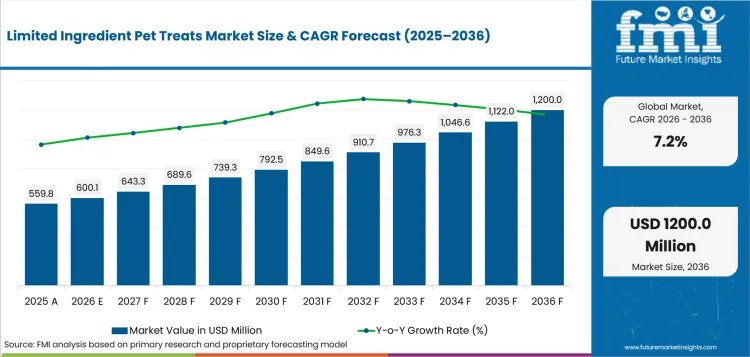
Limited Ingredient Pet Treats Market Overview: Size and Forecast
- 2026 Market Size: USD 600.0 million
- 2036 Market Size: USD 1,200.0 million
- Forecast CAGR: 7.2% from 2026 to 2036
- Leading Pet Type: Dog Treats
- Dog Treats Share in 2026: 74.6%
- Leading End-use Buyer: Retail Households
- Retail Households Share in 2026: 68.5%
- Fastest-growing Country: Saudi Arabia
- Saudi Arabia CAGR: 9.1% by 2036
Summary of the Limited Ingredient Pet Treats Market
- Demand and Growth Drivers
- Ingredient-screening habits give limited ingredient pet treats a clear role in everyday reward feeding.
- Sensitive-stomach routines push owners toward treats with fewer components and clearer protein declarations.
- Retailers can test small pouches near natural dog treats and sensitive-diet foods without changing aisle layout.
- Product and Segment View
- Dog Treats are forecast to represent 74.6% share in 2026, led by higher treat frequency and wider dog-specific limited ingredient shelves.
- Retail Households are projected to hold 68.5% share in 2026, influenced by owner-directed ingredient checks during routine treat purchases.
- Grain-free and Chicken-free Formulas are expected to secure 51.3% share in 2026, reflected by common avoidance claims across sensitive-diet treat lines.
- Geography and Competitive Outlook
- Saudi Arabia is projected to record 9.1% CAGR by 2036, backed by premium pet food imports and specialist pet retail access.
- South Korea is expected to expand at 8.6% CAGR by 2036 through compact urban pet retail and import rule adjustment.
- Natural Balance and Blue Buffalo compete based on North American limited ingredient treat lines.
- United Petfood, VAFO Group, and ADM support private label and pet nutrition ingredient supply.
- Analyst Opinion
- Nandini Roy Choudhury, Principal Consultant for Food and Beverage at FMI, observes, "Limited ingredient treats profit at the shelf when shoppers can understand the pack quickly. Brands need familiar reward formats and proof that dogs accept the texture during repeated use."
Ingredient clarity remains a key pressure point in limited ingredient pet treats. Open Farm September 2025 release showed a stronger sourcing route through a 100% pasture-raised lamb lung treat linked to regenerative farms in New Zealand. Retail buyers can use such sourcing proof to separate verified single-protein products from basic short-panel snacks in the pet snacks and treats sector. Petcurean 2025 Sustainability Impact Report adds another route through Go! Solutions Benefit Chews, which used 10.4 metric tonnes of upcycled food. Formulators can turn documented ingredient recovery into stronger pack value in the pet food ingredients market. Treat manufacturers combining source proof and measured input recovery are likely to gain stronger pet specialty reviews than brands relying only on simple natural or sensitive wording.
What supports value in the limited ingredient pet treats market?
Finished SKU revenue and premium sensitive-diet treat pouches support value across specialty retail and online channels.
- Market value is supported by finished limited ingredient treat revenue before retailer margins add final shelf value.
- Supplier pricing reflects novel protein inputs and small-batch quality checks.
- Revenue improves as owners shift from standard biscuits toward targeted sensitive-diet reward formats.
- Retail confidence rises as labels show protein source and life-stage suitability with less ambiguity.
Why is the limited ingredient pet treats market growing?
- Sensitive-diet treat use is moving closer to everyday reward routines as owners check protein sources before repeat purchase.
- Short-panel products are helping brands reduce shelf confusion in pet specialty stores.
- Clear purpose statements and front-panel wording are becoming more important as treat labels face closer review.
Owner caution is shifting limited ingredient treats from occasional premium snacks into planned reward formats. In March 2026, Pala launched single-ingredient dog treats made from pork and deer. Each product used one defined animal ingredient and 100.0% EU-sourced raw materials, giving retailers a clean way to explain protein control at the shelf. In May 2024, Calysta said Dr Clauder Trainee snack used FeedKind Pet protein in a dog treat sold in Europe. FeedKind Pet is approved for use in EU pet foods and has a complete amino acid profile for dogs. Fermented protein gives formulators another route for sensitive-positioned treats beyond standard animal proteins in the pet food ingredients market. In April 2025, AAFCO small-manufacturer guidance stated, treat labels fall under the new pet and specialty pet food model rules. Purpose Statement language must appear in the lower 30.0% of the principal display panel. Such rules push brands in the pet snacks and treats market toward clearer pack identity and more disciplined label wording.
How is the limited ingredient pet treats market segmented?
Limited ingredient pet treats revenue is segmented by pet type, end-use buyer, ingredient positioning, packaging size, product type, and sales channel.
- Dog treats are projected to secure 74.6% share in 2026, led by daily reward frequency and deeper dog-specific sensitive-diet assortment across specialty retailers.
- Retail households are anticipated to hold 68.5% share in 2026, influenced by owner-led pack checks and small pouch trial before repeat purchase.
- Grain-free and chicken-free formulas are forecast to represent 51.3% share in 2026, guided by common avoidance claims and stronger shelf recognition.
- Standard resealable pouches are expected to capture 46.1% share in 2026, supported by pantry storage and routine home reward use.
- Single-protein soft chews are projected to account for 43.8% share in 2026, reflected by easier chewing and clearer animal protein cues.
Why do Dog Treats lead the limited ingredient pet treats market?
Dog treats hold 74.6% share in 2026 due to frequent reward use and wider dog-specific sensitive-diet shelf space.
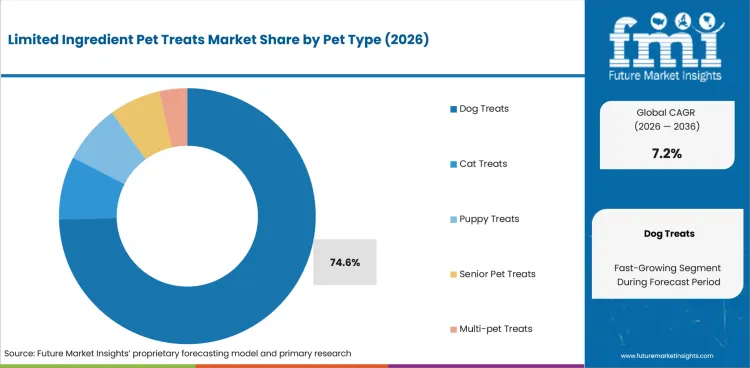
- Dog treats are projected to account for 74.6% share in 2026, influenced by training, daily rewards, and stronger dog treat assortment in pet specialty stores.
- Cat treats gain selective use as owners look for short ingredient snacks suited to indoor cats and texture-sensitive repeat purchase.
Which end-use buyer leads the limited ingredient pet treats market?
Retail households hold 68.5% share in 2026, led by owner-directed ingredient screening and home-based reward feeding.
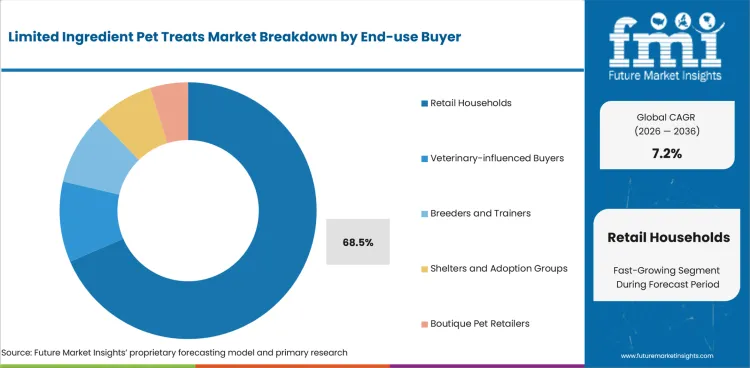
- Retail households are anticipated to hold 68.5% share in 2026 through owner-managed first purchase and repeat online replenishment.
- Veterinary-influenced buyers gain value as clinics and diet discussions make owners more cautious about snacks used during food sensitivity management.
Which ingredient positioning leads the limited ingredient pet treats market?
Grain-free and chicken-free formulas hold 51.3% share in 2026, reflected by common avoidance cues across sensitive-diet treat aisles.
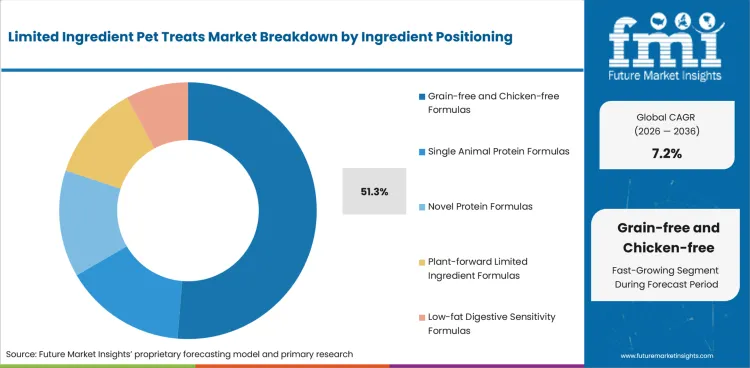
- Grain-free and chicken-free formulas are forecast to secure 51.3% share in 2026, shaped by owner checks for chicken and gluten claims.
- Novel protein formulas gain selective value through salmon and fish-based recipes aimed at pets with known ingredient limits.
Which packaging size leads the limited ingredient pet treats market?
Standard resealable pouches hold 46.1% share in 2026, influenced by home storage and frequent reward handling.
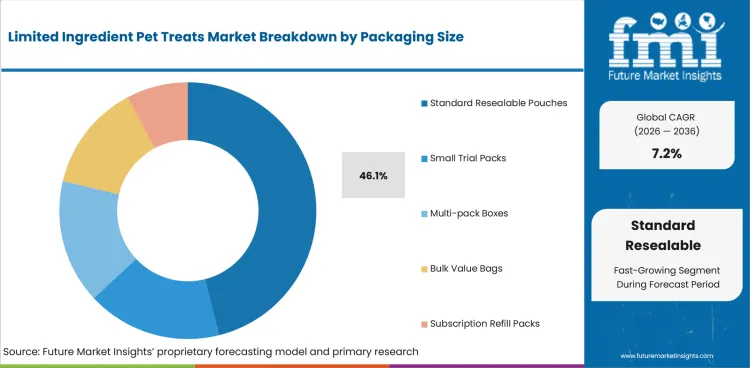
- Standard resealable pouches are expected to capture 46.1% share in 2026, guided by pantry convenience and daily use after opening.
- Small trial packs gain attention among owners who want to test palatability and tolerance before buying larger pouches.
Which product type leads the limited ingredient pet treats market?
Single-protein soft chews lead at 43.8% share in 2026, backed by texture acceptance and simple animal protein cues.
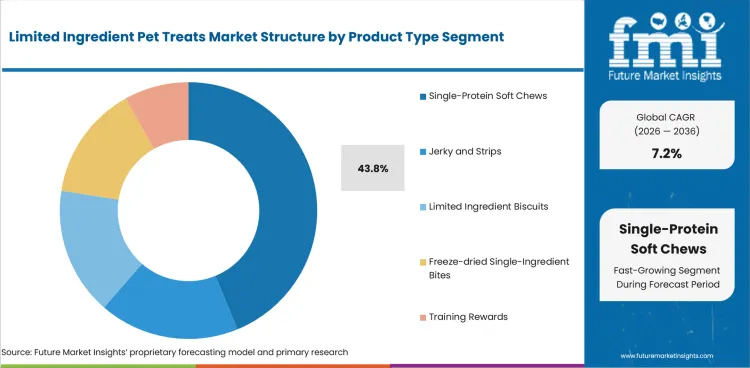
- Single-protein soft chews are projected to hold 43.8% share in 2026, led by higher palatability and easier use for older dogs.
- Freeze-dried single-ingredient bites gain value among buyers seeking minimal ingredient panels and shelf-stable animal protein snacks.
What are the drivers, restraints and opportunities in the limited ingredient pet treats market?
Sensitive-diet snacking supports growth while premium protein costs limit mass uptake, and trial packs create space for better repeat purchase.
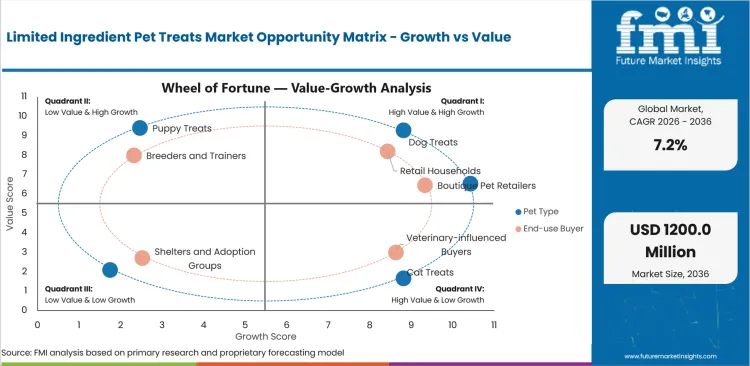
- Driver: Owner screening of proteins, grains, and artificial additives supports repeat purchase for treats with simple ingredient panels.
- Restraint: Premium animal proteins and controlled recipe systems can keep pouch prices above standard biscuit lines.
- Opportunity: Small trial packs and online subscriptions can help owners test palatability before switching into larger replenishment sizes.
Health-linked treat selection is becoming more structured as owners compare ingredients and pet-specific needs before repeat purchase. A 2025 systematic literature review in Animals assessed 40 peer-reviewed studies published from 2006 to 2024 and found that ingredient composition and pet health status consistently shape commercial pet food choices. This supports limited ingredient treat suppliers able to explain protein source and recipe purpose in simple pack language. Buyers in the pet food industry are therefore likely to favor products reducing label uncertainty without moving into unsupported health claims.
Who buys limited ingredient pet treats?
Retail households and boutique pet retailers form the main buyer base.
Repeat buying is becoming more important as owners move sensitive-positioned treats into routine replenishment. Chewy reported in September 2025 that Autoship customer sales reached USD 2,576.9 million in the second quarter of fiscal 2025 and represented 83.0% of net sales. This shows why limited ingredient treat brands need pack sizes and inventory discipline that fit subscription baskets. Suppliers serving the pet care packaging market can support this shift with resealable pouches and trial-to-refill formats reducing first-purchase risk.
What influences limited ingredient pet treat purchase decisions?
Protein source and price per use shape repeat purchase.
Label readability is becoming a commercial filter for sensitive-positioned treats. AAFCO states, pet food labels have 8 required items and the ingredients must be listed in order of predominance by weight on an as-formulated basis. Such requirements make ingredient order and product identity central to buyer trust. Producers aligned with the insect-based pet food market can use precise protein naming to make novel ingredients easier to compare. Brands linked to the dehydrated pet food market can use the same logic for shelf-stable short-panel treats.
Which countries are growing fastest in the limited ingredient pet treats market?
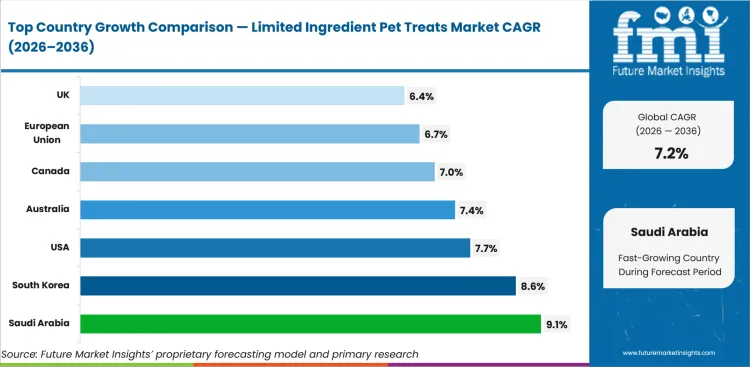
Saudi Arabia reaches 9.1% CAGR followed by South Korea at 8.6% through 2036.
.webp "Top Country Growth Comparison Limited Ingredient Pet Treats Market Cagr (2026 2036)")
| Country | CAGR |
|---|---|
| Saudi Arabia | 9.1% |
| South Korea | 8.6% |
| United States | 7.7% |
| Australia | 7.4% |
| Canada | 7.0% |
| European Union | 6.7% |
| United Kingdom | 6.4% |
| Japan | 5.8% |
Source: Future Market Insights, 2026.
How do country-level CAGRs compare in the limited ingredient pet treats market?
Saudi Arabia leads country growth while Japan records the most measured expansion path among profiled markets.
- Saudi Arabia is projected to record 9.1% CAGR by 2036, driven by premium pet food imports and specialist retail access.
- South Korea is expected to expand at 8.6% CAGR from 2026 to 2036 due to compact urban retail and pet food import rule adjustment.
- United States is forecast to grow at 7.7% CAGR through 2036 since pet household scale supports higher treat rotation.
- Australia is expected to advance at 7.4% CAGR by 2036 through high pet household ownership and premium snack spending.
- Canada is projected to rise at 7.0% CAGR by 2036 through natural pet food stores and domestic premium brands.
- European Union is forecast at 6.7% CAGR through 2036, owing to large pet food production and private label manufacturing depth.
- United Kingdom is expected to post 6.4% CAGR through 2036, backed by dog ownership and specialist pet food retail access.
- Japan is expected to increase at 5.8% CAGR by 2036, guided by small-pack formats and careful ingredient review.
How fast is the limited ingredient pet treats market growing in Saudi Arabia?
Industry in Saudi Arabia is set to record 9.1% CAGR by 2036 as premium pet food imports support sensitive-diet treat placement in specialist stores.
Country Market Snapshot Table
| Parameter | Value |
|---|---|
| Market Size in 2025 (Value) | USD 17.5 million |
| Market Size in 2026 (Value) | USD 19.1 million |
| Market Forecast in 2036 (Value) | USD 45.7 million |
| CAGR (2026 to 2036) | 9.1% |
| Years Considered | 2021 to 2036 |
| Base Year | 2025 |
| Forecast Period | 2026 to 2036 |
| Units Considered | Value (USD million) |
| Leading Sub-Region | Riyadh and Jeddah premium pet retail corridors |
Saudi Arabia Limited Ingredient Pet Treats Market Outlook
Saudi Arabia limited ingredient pet treat sector is influenced by imported premium food and urban specialist pet stores. Riyadh and Jeddah provide the strongest launch base for single-protein soft chews and grain-free trial packs.
Retailers are expected to support products with Arabic labels and halal-ready documentation. Brands with chicken-free recipes and clear animal protein declarations should gain better importer review.
Key Growth Drivers
- Premium pet food imports support wider sensitive-diet treat assortment. USDA FAS reported Saudi pet food sales of USD 275.0 million in 2024.
- Tourism and premium retail corridors help specialist stores test higher-priced pet products. Vision 2030 reported nearly 116.0 million tourists in 2024.
- Specialist pet stores can explain salmon and insect protein claims more effectively than general grocery shelves.
- Arabic pack language and halal-ready documentation can reduce buyer hesitation around animal-origin treat ingredients.
Key Restraints
- Imported treat pricing can limit use beyond premium households. GASTAT reported annual average CPI inflation of 2.0% in 2025, including a 1.1% rise in food and beverage prices.
- Product registration work can slow new flavor entry for smaller brands without local representatives.
- Heat-sensitive product handling can raise landed cost for soft chews and meat-rich pouches.
What makes Saudi Arabia unique
Saudi Arabia differs through imported premium pet food routes and specialist stores in high-income urban corridors before wider grocery expansion.
Key Companies
- Muntajat
- Delicious Food Factory
- Majestic Pet Food
- Soluky Pet Food
- Loqma
- Premium pet food importers
Sales & Marketing Channels
- Specialty pet stores
- E-commerce pet stores
- Hypermarket pet aisles
- Veterinary clinics
- Importer showrooms
- Premium grooming outlets
Country Segment Breakdown Table
| Segment | Sub-Segments |
|---|---|
| By Pet Type | Dog Treats · Cat Treats · Puppy Treats · Senior Pet Treats · Multi-pet Treats |
| By Ingredient Positioning | Grain-free and Chicken-free Formulas · Single Animal Protein Formulas · Novel Protein Formulas · Plant-forward Limited Ingredient Formulas · Low-fat Digestive Sensitivity Formulas |
| By Product Type | Single-Protein Soft Chews · Jerky and Strips · Limited Ingredient Biscuits · Freeze-dried Single-Ingredient Bites · Training Rewards |
| By Sales Channel | Pet Specialty Stores · Online Pet Retailers · Supermarkets and Hypermarkets · Veterinary Clinics · Club and Mass Retailers |
| By Packaging Size | Standard Resealable Pouches · Small Trial Packs · Multi-pack Boxes · Bulk Value Bags · Subscription Refill Packs |
| By End-use Buyer | Retail Households · Veterinary-influenced Buyers · Breeders and Trainers · Shelters and Adoption Groups · Boutique Pet Retailers |
| Key Sub-Regions Covered, Premium Pet Retail Corridors | Riyadh · Jeddah · Dammam · Khobar · Makkah · Madinah |
Frequently Asked Questions
How fast is Saudi Arabia limited ingredient pet treats market growing?
Sales in Saudi Arabia are forecast to scale at 9.1% CAGR from 2026 to 2036, guided by premium pet food imports.
Who leads Saudi Arabia limited ingredient pet treats market?
Muntajat, Delicious Food Factory, Majestic Pet Food, Soluky Pet Food and specialist importers compete due to local access and retailer service.
What is driving adoption in Saudi Arabia limited ingredient pet treats market?
Premium pet food imports and specialist store advice are moving buyers toward single-protein and chicken-free treat pouches.
What is the limited ingredient pet treats market outlook in South Korea?
Sector in South Korea is anticipated to rise at 8.6% CAGR by 2036, supported by urban pet retail and premium small-pack purchasing.
Country Market Snapshot Table
| Parameter | Value |
|---|---|
| Market Size in 2025 (Value) | USD 32.4 million |
| Market Size in 2026 (Value) | USD 35.2 million |
| Market Forecast in 2036 (Value) | USD 80.4 million |
| CAGR (2026 to 2036) | 8.6% |
| Years Considered | 2021 to 2036 |
| Base Year | 2025 |
| Forecast Period | 2026 to 2036 |
| Units Considered | Value (USD million) |
| Leading Sub-Region | Seoul Capital Area and Busan specialty pet corridors |
South Korea Limited Ingredient Pet Treats Market Outlook
Urban apartment living pushes treat buyers toward low-odor pouches and soft bite formats. Ingredient-screening labels can help limited ingredient treats compete beside premium dog and cat foods.
Facility documentation and certificate handling remain important for foreign suppliers. Brands with strong Korean-language pack claims should gain better pet specialty placement.
Key Growth Drivers
- Imported pet food channels support premium sensitive-diet treat placement. USDA FAS reported Korea’s dog and cat food imports reached USD 307.0 million in 2023.
- Convenience retail density helps small pet products reach urban buyers quickly. Korea’s four major convenience chains reached 53,266.0 stores at the end of 2025.
- Small apartment pets support low-mess soft chews and single-protein bites with clear storage cues.
- Online specialty stores can explain ingredient exclusions through search filters and subscription replenishment.
Key Restraints
- Import approval work can slow animal-origin treat launches for smaller brands. Agriculture and Agri-Food Canada reported that mid-priced dry dog food is expected to record only 0.9% CAGR from 2023 to 2028, which signals tighter price tolerance outside premium pet food tiers.
- Local premium food entrants can pressure foreign suppliers on pack price and delivery speed.
- Short shelf trials can end quickly if treat aroma or chew texture fails owner expectations.
What makes South Korea unique
South Korea’s distinction comes from compact urban retail and rapid metro-level product testing.
Key Companies
- Bow Wow Korea
- Our Pet
- ANF Korea
- Korea Pet Food
- CJ Pet
- Premium importers
Sales & Marketing Channels
- Pet specialty chains
- Online pet retailers
- Veterinary clinics
- Convenience commerce apps
- Department store pet corners
- Independent pet boutiques
Country Segment Breakdown Table
| Segment | Sub-Segments |
|---|---|
| By Pet Type | Dog Treats · Cat Treats · Puppy Treats · Senior Pet Treats · Multi-pet Treats |
| By Ingredient Positioning | Grain-free and Chicken-free Formulas · Single Animal Protein Formulas · Novel Protein Formulas · Plant-forward Limited Ingredient Formulas · Low-fat Digestive Sensitivity Formulas |
| By Product Type | Single-Protein Soft Chews · Jerky and Strips · Limited Ingredient Biscuits · Freeze-dried Single-Ingredient Bites · Training Rewards |
| By Sales Channel | Pet Specialty Stores · Online Pet Retailers · Supermarkets and Hypermarkets · Veterinary Clinics · Club and Mass Retailers |
| By Packaging Size | Standard Resealable Pouches · Small Trial Packs · Multi-pack Boxes · Bulk Value Bags · Subscription Refill Packs |
| By End-use Buyer | Retail Households · Veterinary-influenced Buyers · Breeders and Trainers · Shelters and Adoption Groups · Boutique Pet Retailers |
| Key Sub-Regions Covered, Premium Small-pack Pet Retail Areas | Seoul · Incheon · Busan · Daegu · Daejeon · Gwangju |
Frequently Asked Questions
How fast is South Korea limited ingredient pet treats market growing?
South Korea is expected to expand at 8.6% CAGR from 2026 to 2036, supported by urban premium pet retail.
Who leads South Korea limited ingredient pet treats market?
Bow Wow Korea, Our Pet, ANF Korea, Korea Pet Food and premium importers compete based on domestic supply and specialty access.
What is driving adoption in South Korea limited ingredient pet treats market?
Small-pack retailing and certificate clarity are supporting sensitive-diet treat placement in urban stores.
How is the limited ingredient pet treats market performing in the United States?
Market in United States is estimated to rise at 7.7% CAGR by 2036, driven by high pet household reach and developed treat aisle structures.
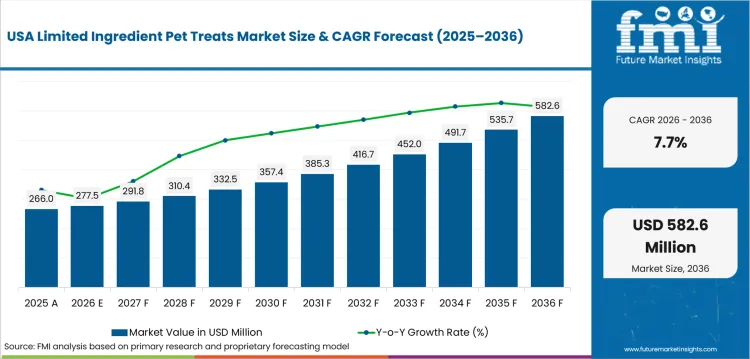
Country Market Snapshot Table
| Parameter | Value |
|---|---|
| Market Size in 2025 (Value) | USD 155.0 million |
| Market Size in 2026 (Value) | USD 166.9 million |
| Market Forecast in 2036 (Value) | USD 350.1 million |
| CAGR (2026 to 2036) | 7.7% |
| Years Considered | 2021 to 2036 |
| Base Year | 2025 |
| Forecast Period | 2026 to 2036 |
| Units Considered | Value (USD million) |
| Leading Sub-Region | California and Northeast pet specialty corridors |
United States Limited Ingredient Pet Treats Market Outlook
Large dog ownership and established pet specialty stores make United States the primary revenue pool. Brand success depends on repeat purchase evidence and pricing discipline across online and mass retail.
Suppliers with short panels and reliable texture should gain better retail reviews. Brands also need careful pack language to avoid veterinary claim risk.
Key Growth Drivers
- Household reach keeps treat trial volumes high across pet specialty and online channels. APPA reported 95.0 million U.S. households owned pets in its 2026 State of the Industry data.
- Dog ownership gives limited ingredient dog treats a large trial base. AVMA reported in 2026 that dogs were present in 42.6% of U.S. households.
- BLUE Basics and Natural Balance demonstrate mainstream limited ingredient treat availability for dogs with food sensitivities.
- Online auto-replenishment can support repeat purchases after owners confirm palatability and tolerance.
Key Restraints
- Pet food and treat price pressure can restrict trade-up into premium limited ingredient pouches. FRED’s BLS-based pet food and treats CPI series reached 194.383 in March 2026, compared with 193.555 in February 2026.
- Premium small pouches can face price comparison against standard biscuits during family budget pressure.
- Treats cannot substitute for veterinary elimination diets, so brands need careful claim boundaries.
What makes the United States unique
United States conditions are distinct for national retail scale and deep dog treat purchasing.
Key Companies
- Natural Balance
- Blue Buffalo
- Go! Solutions
- Open Farm
- PureBites
- Canidae
Sales & Marketing Channels
- Pet specialty stores
- Online pet retailers
- Mass retail chains
- Grocery stores
- Veterinary clinics
- Direct brand websites
Country Segment Breakdown Table
| Segment | Sub-Segments |
|---|---|
| By Pet Type | Dog Treats · Cat Treats · Puppy Treats · Senior Pet Treats · Multi-pet Treats |
| By Ingredient Positioning | Grain-free and Chicken-free Formulas · Single Animal Protein Formulas · Novel Protein Formulas · Plant-forward Limited Ingredient Formulas · Low-fat Digestive Sensitivity Formulas |
| By Product Type | Single-Protein Soft Chews · Jerky and Strips · Limited Ingredient Biscuits · Freeze-dried Single-Ingredient Bites · Training Rewards |
| By Sales Channel | Pet Specialty Stores · Online Pet Retailers · Supermarkets and Hypermarkets · Veterinary Clinics · Club and Mass Retailers |
| By Packaging Size | Standard Resealable Pouches · Small Trial Packs · Multi-pack Boxes · Bulk Value Bags · Subscription Refill Packs |
| By End-use Buyer | Retail Households · Veterinary-influenced Buyers · Breeders and Trainers · Shelters and Adoption Groups · Boutique Pet Retailers |
| Key Sub-Regions Covered, Pet Specialty and Online Retail Networks | California · Northeast Corridor · Pacific Northwest · Texas · Midwest · South Atlantic |
Frequently Asked Questions
How fast is United States limited ingredient pet treats market growing?
Sector in the United States is anticipated to grow at 7.7% CAGR from 2026 to 2036, reflecting high pet household reach.
Who leads United States limited ingredient pet treats market?
Natural Balance, Blue Buffalo, Go! Solutions, Open Farm and PureBites compete with limited ingredient treat ranges and online access.
What is driving adoption in United States limited ingredient pet treats market?
Pet household scale and strong dog ownership are moving owners toward short-panel treat formats.
What is driving limited ingredient pet treats growth in Australia?
Australia is projected to grow at 7.4% CAGR by 2036, backed by high pet ownership and premium treat spending.
Country Market Snapshot Table
| Parameter | Value |
|---|---|
| Market Size in 2025 (Value) | USD 36.5 million |
| Market Size in 2026 (Value) | USD 39.2 million |
| Market Forecast in 2036 (Value) | USD 80.0 million |
| CAGR (2026 to 2036) | 7.4% |
| Years Considered | 2021 to 2036 |
| Base Year | 2025 |
| Forecast Period | 2026 to 2036 |
| Units Considered | Value (USD million) |
| Leading Sub-Region | Sydney and Melbourne pet specialty corridors |
Australia Limited Ingredient Pet Treats Market Outlook
Australia’s high pet household share supports premium treat pouches and short-panel snacks. Buyers scrutinize ingredients as supermarkets and pet specialty stores compete on natural and sensitive-diet ranges.
Smaller packs can help brands address tolerance uncertainty before repeat purchase. Local meat and fish sourcing cues can also improve buyer trust.
Key Growth Drivers
- Pet household penetration supports frequent reward occasions. Animal Medicines Australia reported in September 2025 that 73.0% of Australian households owned pets.
- Pet food sales create room for premium treat extensions. Agriculture and Agri-Food Canada reported Australia pet food retail sales of USD 2.9 billion in 2024.
- Specialty retail staff can explain single-protein and grain-avoidance claims during first purchase.
- Local brand owners can use Australian meat and fish sourcing cues to differentiate limited ingredient recipes.
Key Restraints
- Cost pressure can limit premium treat frequency for some households. Australian Veterinary Association reported in September 2025 that 30.0% of dog owners and 22.0% of cat owners who reduced veterinary visits cited affordability issues.
- Quarantine and animal-origin ingredient rules can slow import assortment changes.
- Remote-area delivery can raise online replenishment cost for meat-rich treat formats.
What makes Australia unique
Australia stands apart through high household pet ownership and strong preference for premium pet food spending.
Key Companies
- Black Hawk
- SavourLife
- Ivory Coat
- Prime100
- Scratch
- Specialty importers
Sales & Marketing Channels
- Petbarn and specialty stores
- Online pet retailers
- Supermarket pet aisles
- Veterinary clinics
- Independent pet shops
- Direct subscription brands
Country Segment Breakdown Table
| Segment | Sub-Segments |
|---|---|
| By Pet Type | Dog Treats · Cat Treats · Puppy Treats · Senior Pet Treats · Multi-pet Treats |
| By Ingredient Positioning | Grain-free and Chicken-free Formulas · Single Animal Protein Formulas · Novel Protein Formulas · Plant-forward Limited Ingredient Formulas · Low-fat Digestive Sensitivity Formulas |
| By Product Type | Single-Protein Soft Chews · Jerky and Strips · Limited Ingredient Biscuits · Freeze-dried Single-Ingredient Bites · Training Rewards |
| By Sales Channel | Pet Specialty Stores · Online Pet Retailers · Supermarkets and Hypermarkets · Veterinary Clinics · Club and Mass Retailers |
| By Packaging Size | Standard Resealable Pouches · Small Trial Packs · Multi-pack Boxes · Bulk Value Bags · Subscription Refill Packs |
| By End-use Buyer | Retail Households · Veterinary-influenced Buyers · Breeders and Trainers · Shelters and Adoption Groups · Boutique Pet Retailers |
| Key Sub-Regions Covered, Premium Pet Retail Corridors | Sydney · Melbourne · Brisbane · Perth · Adelaide · Canberra |
Frequently Asked Questions
How fast is Australia limited ingredient pet treats market growing?
Australia is projected to grow at 7.4% CAGR from 2026 to 2036, guided by pet ownership depth and premium snack spending.
Who leads Australia limited ingredient pet treats market?
Black Hawk, SavourLife, Ivory Coat, Prime100 and Scratch compete through local brand familiarity and specialty retail access.
What is driving adoption in Australia limited ingredient pet treats market?
High pet ownership and pet food spending are supporting single-protein and short-panel treat trial.
What is the limited ingredient pet treats market outlook in Canada?
Industry in Canada is likely to grow at 7.0% CAGR by 2036, helped by domestic premium brands and natural pet specialty channels.
Country Market Snapshot Table
| Parameter | Value |
|---|---|
| Market Size in 2025 (Value) | USD 41.7 million |
| Market Size in 2026 (Value) | USD 44.6 million |
| Market Forecast in 2036 (Value) | USD 87.8 million |
| CAGR (2026 to 2036) | 7.0% |
| Years Considered | 2021 to 2036 |
| Base Year | 2025 |
| Forecast Period | 2026 to 2036 |
| Units Considered | Value (USD million) |
| Leading Sub-Region | Ontario and British Columbia grocery corridors |
Canada Limited Ingredient Pet Treats Market Outlook
Canada combines pet specialty strength with domestic premium brands. Limited ingredient treat demand benefits from dog and cat ownership depth and Canadian-made sensitive-diet recipes.
North American suppliers can serve buyers with bilingual labels and shorter delivery routes. Salmon and duck recipes should remain useful for brands seeking animal protein differentiation.
Key Growth Drivers
- Dog treat sales provide a direct revenue pool for limited ingredient pouches. Agriculture and Agri-Food Canada reported Canadian pet food retail sales of Can$6.7 billion in 2024.
- Pet population depth supports repeat sensitive-diet purchases. Canadian Animal Health Institute reported 7.2 million dogs and 8.2 million cats in Canada during 2024.
- Petcurean and Open Farm give Canadian buyers premium ingredient references across pet specialty and online channels.
- Local production can help private label programs meet retailer requests for fewer ingredients and quicker replenishment.
Key Restraints
- Grocery price pressure can limit premium snack trade-up. Statistics Canada reported food purchased from stores rose 4.7% year over year in November 2025.
- Bilingual packaging and provincial retail requirements can increase setup cost for smaller imported brands.
- Novel animal proteins can face higher input cost during limited supply windows.
What makes Canada unique
Canada’s route is shaped by domestic premium brands and long refrigerated distribution lanes.
Key Companies
- Petcurean
- Open Farm
- Champion Petfoods
- FirstMate
- Crumps’ Naturals
- United Petfood Canada
Sales & Marketing Channels
- Pet specialty chains
- Independent pet stores
- Online pet retailers
- Veterinary clinics
- Mass retail
- Natural grocery stores
Country Segment Breakdown Table
| Segment | Sub-Segments |
|---|---|
| By Pet Type | Dog Treats · Cat Treats · Puppy Treats · Senior Pet Treats · Multi-pet Treats |
| By Ingredient Positioning | Grain-free and Chicken-free Formulas · Single Animal Protein Formulas · Novel Protein Formulas · Plant-forward Limited Ingredient Formulas · Low-fat Digestive Sensitivity Formulas |
| By Product Type | Single-Protein Soft Chews · Jerky and Strips · Limited Ingredient Biscuits · Freeze-dried Single-Ingredient Bites · Training Rewards |
| By Sales Channel | Pet Specialty Stores · Online Pet Retailers · Supermarkets and Hypermarkets · Veterinary Clinics · Club and Mass Retailers |
| By Packaging Size | Standard Resealable Pouches · Small Trial Packs · Multi-pack Boxes · Bulk Value Bags · Subscription Refill Packs |
| By End-use Buyer | Retail Households · Veterinary-influenced Buyers · Breeders and Trainers · Shelters and Adoption Groups · Boutique Pet Retailers |
| Key Sub-Regions Covered, Grocery and Specialty Pet Areas | Ontario · Quebec · British Columbia · Alberta · Manitoba · Saskatchewan |
Frequently Asked Questions
How fast is Canada limited ingredient pet treats market growing?
Sector in Canada is forecast at 7.0% CAGR from 2026 to 2036 with natural pet retail and domestic brand support.
Who leads Canada limited ingredient pet treats market?
Petcurean, Open Farm, Champion Petfoods, FirstMate and United Petfood Canada compete due to premium recipes and channel access.
What is driving adoption in Canada limited ingredient pet treats market?
Pet food sales and large pet populations are moving short-panel snacks into premium pet retail.
What is the limited ingredient pet treats market forecast for the European Union?
Sector in the European Union is expected to scale at 6.7% CAGR by 2036, backed by large pet food production and private label manufacturing depth.
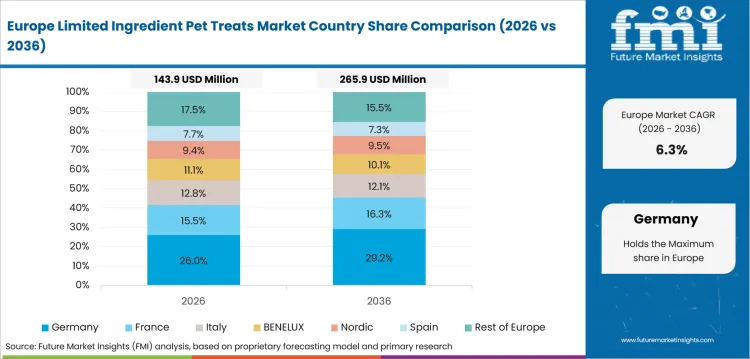
Country Market Snapshot Table
| Parameter | Value |
|---|---|
| Market Size in 2025 (Value) | USD 116.0 million |
| Market Size in 2026 (Value) | USD 123.7 million |
| Market Forecast in 2036 (Value) | USD 236.8 million |
| CAGR (2026 to 2036) | 6.7% |
| Years Considered | 2021 to 2036 |
| Base Year | 2025 |
| Forecast Period | 2026 to 2036 |
| Units Considered | Value (USD million) |
| Leading Sub-Region | Germany and France pet specialty networks |
European Union Limited Ingredient Pet Treats Market Outlook
European Union demand reflects large pet food output and differing national treat preferences. Germany, France, Italy, Netherlands, Poland, and Spain offer stronger scale for sensitive-diet pouches and single-protein biscuits.
Suppliers with EU-compliant labels and repeatable protein sourcing should gain stronger buyer confidence. Retailers are likely to favor brands that can adjust recipes for national taste expectations.
Key Growth Drivers
- Pet food scale supports specialty treat segmentation. FEDIAF reported in June 2026 that Europe had 140.0 million pet-owning households.
- Production volume gives manufacturers room to add limited ingredient treat lines. FEDIAF reported European pet food volume near 8.6 million tonnes in June 2026.
- VAFO Group and United Petfood provide private label and premium manufacturing support for retailers building sensitive-diet ranges.
- E-commerce filters can help owners compare grain-free, chicken-free, and single-protein treat claims.
Key Restraints
- Prepared pet food producer prices can limit retailer willingness to test small premium pouches. Eurostat-based producer price data placed EU manufacture of prepared pet foods at 127.70 index points in April 2026.
- Protein sourcing disruption can affect price stability for lamb and insect-based formulas.
- Retailers may limit shelf tests to proven flavors if repeat purchase evidence is weak.
What makes the European Union unique
European Union conditions differ through multi-country retail scale and strong private label manufacturing depth.
Key Companies
- VAFO Group
- United Petfood
- Fressnapf private label suppliers
- Edgard & Cooper
- bosch Tiernahrung
- Rinti
Sales & Marketing Channels
- Pet specialty chains
- Online pet retailers
- Supermarkets
- Veterinary clinics
- Private label retail programs
- Independent pet stores
Country Segment Breakdown Table
| Segment | Sub-Segments |
|---|---|
| By Pet Type | Dog Treats · Cat Treats · Puppy Treats · Senior Pet Treats · Multi-pet Treats |
| By Ingredient Positioning | Grain-free and Chicken-free Formulas · Single Animal Protein Formulas · Novel Protein Formulas · Plant-forward Limited Ingredient Formulas · Low-fat Digestive Sensitivity Formulas |
| By Product Type | Single-Protein Soft Chews · Jerky and Strips · Limited Ingredient Biscuits · Freeze-dried Single-Ingredient Bites · Training Rewards |
| By Sales Channel | Pet Specialty Stores · Online Pet Retailers · Supermarkets and Hypermarkets · Veterinary Clinics · Club and Mass Retailers |
| By Packaging Size | Standard Resealable Pouches · Small Trial Packs · Multi-pack Boxes · Bulk Value Bags · Subscription Refill Packs |
| By End-use Buyer | Retail Households · Veterinary-influenced Buyers · Breeders and Trainers · Shelters and Adoption Groups · Boutique Pet Retailers |
| Key Sub-Regions Covered, Pet Specialty and Private Label Manufacturing Areas | Germany · France · Netherlands · Spain · Italy · Poland |
Frequently Asked Questions
How fast is European Union limited ingredient pet treats market growing?
Demand in European Union is forecast at 6.7% CAGR from 2026 to 2036 with private label and specialty retail support.
Who leads European Union limited ingredient pet treats market?
VAFO Group, United Petfood, Edgard & Cooper, bosch Tiernahrung and Rinti compete depending on premium pet food and treat access.
What is driving adoption in European Union limited ingredient pet treats market?
Large pet food production and multi-country pet ownership are supporting sensitive-diet treat ranges.
How is the limited ingredient pet treats market performing in the United Kingdom?
Market in United Kingdom is projected to post 6.4% CAGR by 2036, supported by dog ownership and specialist pet food retail.
Country Market Snapshot Table
| Parameter | Value |
|---|---|
| Market Size in 2025 (Value) | USD 50.5 million |
| Market Size in 2026 (Value) | USD 53.7 million |
| Market Forecast in 2036 (Value) | USD 99.9 million |
| CAGR (2026 to 2036) | 6.4% |
| Years Considered | 2021 to 2036 |
| Base Year | 2025 |
| Forecast Period | 2026 to 2036 |
| Units Considered | Value (USD million) |
| Leading Sub-Region | London and Southeast England pet retail corridors |
United Kingdom Limited Ingredient Pet Treats Market Outlook
United Kingdom limited ingredient treat sales are centered on dog ownership, online pet stores, and specialist chains. Supermarkets shape price expectations for sensitive-diet biscuits and small reward pouches.
Brands need crisp labels and small packs to reduce first-purchase risk. Local natural brands can use UK sourcing cues to compete against imported premium pouches.
Key Growth Drivers
- Pet ownership supports treat replenishment across specialty and grocery channels. UK Pet Food reported 17.2 million households owned one of the country’s 36.0 million non-aquatic pets in 2024.
- Dog households give limited ingredient biscuits and chews a large buyer base. UK Pet Food reported 13.5 million dogs and 12.5 million cats in 2024.
- Pets at Home and independent specialists can test sensitive-diet treats through clear aisle segmentation.
- Domestic natural brands can use local meat and fish sourcing to support buyer trust in short-panel recipes.
Key Restraints
- Household pet care cost pressure can reduce premium treat frequency. PDSA reported in November 2025, 51.0% of UK owners were worried about affording veterinary care for their pet.
- Animal-origin paperwork can slow new flavor imports for small overseas brands.
- Small brands face cost pressure from retailer listing fees and promotional support needs.
What makes the United Kingdom unique
United Kingdom stands out through specialist pet food retail and high dog ownership.
Key Companies
- Forthglade
- Pooch & Mutt
- Lily’s Kitchen
- Barker and Barker
- Pets at Home private label
- Scrumbles
Sales & Marketing Channels
- Specialty pet stores
- Online pet retailers
- Grocery pet aisles
- Veterinary clinics
- Direct brand subscriptions
- Independent pet shops
Country Segment Breakdown Table
| Segment | Sub-Segments |
|---|---|
| By Pet Type | Dog Treats · Cat Treats · Puppy Treats · Senior Pet Treats · Multi-pet Treats |
| By Ingredient Positioning | Grain-free and Chicken-free Formulas · Single Animal Protein Formulas · Novel Protein Formulas · Plant-forward Limited Ingredient Formulas · Low-fat Digestive Sensitivity Formulas |
| By Product Type | Single-Protein Soft Chews · Jerky and Strips · Limited Ingredient Biscuits · Freeze-dried Single-Ingredient Bites · Training Rewards |
| By Sales Channel | Pet Specialty Stores · Online Pet Retailers · Supermarkets and Hypermarkets · Veterinary Clinics · Club and Mass Retailers |
| By Packaging Size | Standard Resealable Pouches · Small Trial Packs · Multi-pack Boxes · Bulk Value Bags · Subscription Refill Packs |
| By End-use Buyer | Retail Households · Veterinary-influenced Buyers · Breeders and Trainers · Shelters and Adoption Groups · Boutique Pet Retailers |
| Key Sub-Regions Covered, Pet Retail and Online Grocery Areas | London · Manchester · Birmingham · Leeds · Glasgow · Bristol |
Frequently Asked Questions
How fast is United Kingdom limited ingredient pet treats market growing?
Industry in the United Kingdom is projected to increase at 6.4% CAGR from 2026 to 2036 through specialist pet retail.
Who leads United Kingdom limited ingredient pet treats market?
Forthglade, Pooch & Mutt, Lily’s Kitchen, Barker and Barker and Pets at Home private label compete based on pet specialty access.
What is driving adoption in United Kingdom limited ingredient pet treats market?
Dog ownership and specialist retail curation are supporting short-panel treat purchases.
What is the limited ingredient pet treats market forecast for Japan?
Sector in Japan is expected to rise at 5.8% CAGR by 2036, guided by small-pack formats and careful ingredient review.
Country Market Snapshot Table
| Parameter | Value |
|---|---|
| Market Size in 2025 (Value) | USD 40.4 million |
| Market Size in 2026 (Value) | USD 42.7 million |
| Market Forecast in 2036 (Value) | USD 75.0 million |
| CAGR (2026 to 2036) | 5.8% |
| Years Considered | 2021 to 2036 |
| Base Year | 2025 |
| Forecast Period | 2026 to 2036 |
| Units Considered | Value (USD million) |
| Leading Sub-Region | Kanto and Kansai pet retail corridors |
Japan Limited Ingredient Pet Treats Market Outlook
Demand in Japan is influenced by compact homes and careful product testing. Buyers compare mild flavor and texture against familiar pet snacks before repeat purchase.
Suppliers should prioritize pack size control and clear animal protein declarations. Soft bites and freeze-dried fish formats should remain useful for older dogs and indoor cats.
Key Growth Drivers
- Small pet populations support compact treat packs and portion-controlled snacks. PetfoodIndustry reported in February 2026 that Japan’s 2025 survey counted 8.847 million cats and about 6.82 million dogs.
- Alternative protein recognition can influence premium ingredient discussion. Yano Research reported in May 2024, plant-based meat alternatives had 74.1% recognition among sustainable food groups in Japan.
- Premium importers can position limited ingredient treats for indoor pets and senior companion animals.
- Retailers favor compact shelf-ready packs suiting dense specialty store formats.
Key Restraints
- Low expansion in adjacent protein foods points to cautious trial behavior. Agriculture and Agri-Food Canada reported in July 2025 that Japan’s processed meat and alternatives to meat group grew 0.3% in current terms in 2024.
- Animal-origin treat imports require accurate documentation and product classification.
- Higher pack prices can restrict repeat purchase if palatability tests fail in the first pouch.
What makes Japan unique
Japan’s distinct path comes from small-pack discipline and mild flavor expectations.
Key Companies
- Unicharm
- Inaba Foods
- Petline
- Nisshin Petfood
- Marukan
- Premium importers
Sales & Marketing Channels
- Pet specialty stores
- Online pet platforms
- Home centers
- Veterinary clinics
- Convenience-oriented retail
- Department store grocery halls
Country Segment Breakdown Table
| Segment | Sub-Segments |
|---|---|
| By Pet Type | Dog Treats · Cat Treats · Puppy Treats · Senior Pet Treats · Multi-pet Treats |
| By Ingredient Positioning | Grain-free and Chicken-free Formulas · Single Animal Protein Formulas · Novel Protein Formulas · Plant-forward Limited Ingredient Formulas · Low-fat Digestive Sensitivity Formulas |
| By Product Type | Single-Protein Soft Chews · Jerky and Strips · Limited Ingredient Biscuits · Freeze-dried Single-Ingredient Bites · Training Rewards |
| By Sales Channel | Pet Specialty Stores · Online Pet Retailers · Supermarkets and Hypermarkets · Veterinary Clinics · Club and Mass Retailers |
| By Packaging Size | Standard Resealable Pouches · Small Trial Packs · Multi-pack Boxes · Bulk Value Bags · Subscription Refill Packs |
| By End-use Buyer | Retail Households · Veterinary-influenced Buyers · Breeders and Trainers · Shelters and Adoption Groups · Boutique Pet Retailers |
| Key Sub-Regions Covered, Compact Pack Retail Areas | Tokyo · Osaka · Yokohama · Nagoya · Fukuoka · Sapporo |
Frequently Asked Questions
How fast is Japan limited ingredient pet treats market growing?
Industry in Japan is projected at 5.8% CAGR from 2026 to 2036 as compact packs support careful snack trial.
Who leads Japan limited ingredient pet treats market?
Unicharm, Inaba Foods, Petline, Nisshin Petfood and Marukan compete fueled by domestic pet food scale and retail access.
What is driving adoption in Japan limited ingredient pet treats market?
Small-pack buying and ingredient review are supporting measured limited ingredient treat trial.
Who are the leading companies in the limited ingredient pet treats market?
Natural Balance, Blue Buffalo, Go! Solutions and Open Farm are listed with United Petfood, VAFO Group, ADM, PureBites, Canidae and Champion Petfoods.
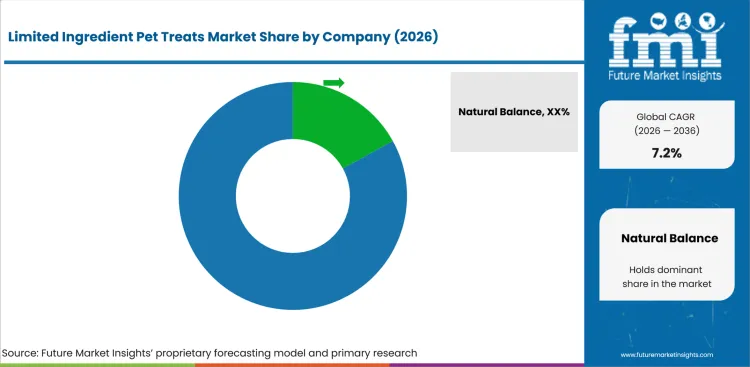
- Deli-style similarity is not required in this market, so competitive strength comes from ingredient discipline and treat acceptance.
- Established pet food brands gain access through sensitive-diet platforms and specialty retail relationships.
- Private label manufacturers build placement based on recipe control and pack flexibility.
- Ingredient suppliers gain acceptance by helping treat makers replace common proteins and simplify carbohydrate systems.
Limited ingredient pet treat companies compete by combining short ingredient panels with familiar reward formats. Retailers assess pouch price and owner understanding before assigning more shelf space. Online buyers review protein source and review history before replenishment. Brands making ingredient review simple are likely to move beyond one-time trial.
Manufacturing depth has become a competitive separator as soft chews and freeze-dried bites require different moisture and protein systems. Natural Balance and Blue Buffalo compete through limited ingredient consumer brands. GO! Solutions and Open Farm compete through sensitive-diet and single-ingredient treat positioning. United Petfood and VAFO Group compete depending on private label manufacturing and European channel access. ADM supports brands through pet nutrition ingredients and formulation support.
Smaller and regional players can profit by independent pet stores and established online platforms. Larger suppliers gain advantage through recipe documentation and multi-format production. Companies with clear protein sourcing and defendable pack pricing should gain stronger listing decisions. Brands relying only on flavor claims are expected to face weaker acceptance in mainstream pet retail.
How do top limited ingredient pet treats companies compare?
Natural Balance and GO! Solutions score strongest on limited ingredient treat fit, while United Petfood and VAFO Group lead private label manufacturing depth.
| Company | Alignment to Market Title | Limited Ingredient Treat Portfolio Depth | Protein and Texture Capability | Clean-label and Allergen Positioning | Channel Reach | Geographic Footprint |
|---|---|---|---|---|---|---|
| Natural Balance | Very High | Very Strong | Strong | Very Strong | Strong | United States and Canada |
| Blue Buffalo | Very High | Strong | Strong | Very Strong | Very Strong | United States |
| Go! Solutions / Petcurean | Very High | Strong | Strong | Very Strong | Strong | Canada and United States |
| Open Farm | Very High | Strong | Strong | Strong | Strong | North America |
| PureBites | Very High | Very Strong | Moderate | Very Strong | Strong | North America |
| United Petfood | High | Strong | Very Strong | Strong | Very Strong | Europe, Canada, and United States |
| VAFO Group | High | Strong | Strong | Strong | Very Strong | Europe |
| ADM | Provider | Ingredient Support | Very Strong | Strong | Very Strong | Global |
| Canidae | Moderate | Selective | Strong | Strong | Moderate | United States |
| Champion Petfoods | Moderate | Selective | Strong | Moderate | Strong | Canada, United States, and selected international markets |
Source: Future Market Insights competitive analysis, 2026.
Who are the key players in the limited ingredient pet treats market?
Natural Balance, Blue Buffalo and Go! Solutions are listed with Open Farm, PureBites, United Petfood and VAFO Group among other suppliers.
Key global companies leading the limited ingredient pet treats market include:
- Natural Balance
- Blue Buffalo
- Go! Solutions / Petcurean
- Open Farm
- PureBites
- United Petfood
- VAFO Group
- ADM
- Canidae
- Champion Petfoods
Key Developments in Limited Ingredient Pet Treats Market
- In February 2025, Meatly launched Chick Bites with THE PACK and Pets at Home.
- In August 2025, VAFO Group introduced Brit Premium by Nature collagen chewable treats in three shapes.
- In March 2026, Pala launched single-ingredient dog treats made from pork and deer.
Key Players in the Limited Ingredient Pet Treats Market
Consumer-Facing Limited Ingredient Brands
- Natural Balance
- Blue Buffalo
- Go! Solutions / Petcurean
- Open Farm
- Canidae
Single-Ingredient and Minimal-Panel Treat Brands
- PureBites
- Champion Petfoods through ORIJEN and ACANA
- Regional freeze-dried treat brands
- Premium fish and meat treat suppliers
Private Label and Ingredient Providers
- United Petfood
- VAFO Group
- ADM
- Contract treat manufacturers
- Specialty protein suppliers
Limited Ingredient Pet Treats Market - Report Scope
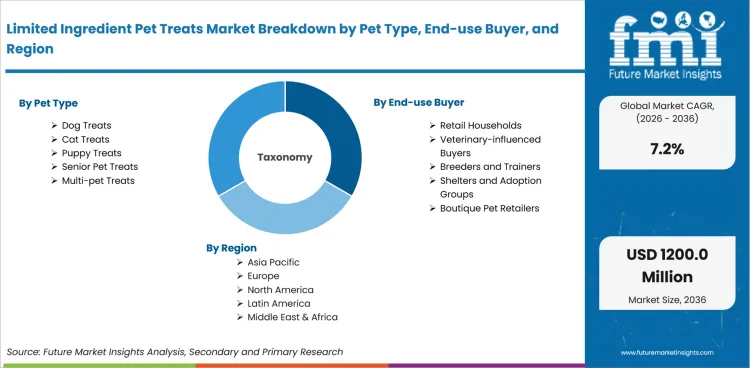
| Parameter | Details |
|---|---|
| Market size by 2036 | USD 1,200.0 million |
| Growth rate | 7.2% CAGR from 2026 to 2036 |
| Forecast period | 2026 to 2036 |
| Base year value (2025) | USD 559.8 million |
| By pet type | Dog treats, cat treats, puppy treats, senior pet treats, multi-pet treats |
| By ingredient positioning | Grain-free and chicken-free formulas, single animal protein formulas, novel protein formulas, plant-forward limited ingredient formulas, low-fat digestive sensitivity formulas |
| By product type | Single-protein soft chews, jerky and strips, limited ingredient biscuits, freeze-dried single-ingredient bites, training rewards |
| By sales channel | Pet specialty stores, online pet retailers, supermarkets and hypermarkets, veterinary clinics, club and mass retailers |
| By end-use buyer | Retail households, veterinary-influenced buyers, breeders and trainers, shelters and adoption groups, boutique pet retailers |
| By packaging size | Standard resealable pouches, small trial packs, multi-pack boxes, bulk value bags, subscription refill packs |
| Regions covered | North America, Europe, GCC, East Asia, South Asia and Pacific, Middle East and Africa |
| Countries covered | United States, Canada, European Union, United Kingdom, Saudi Arabia, South Korea, Japan, Australia |
| Key companies profiled | Natural Balance, Blue Buffalo, Go! Solutions, Open Farm, PureBites, United Petfood, VAFO Group, ADM |
| Approach | Bottom-up product-boundary approach using eligible SKU revenue, channel presence, retail pricing, product positioning, and country-level adoption |
Limited Ingredient Pet Treats Market - Scope & Definition
| Attribute | Detail |
|---|---|
| Market Definition | Finished pet treats using short ingredient panels and sensitive-diet positioning for dogs, cats, and selected companion pets. |
| Functions Covered | Reward feeding, training support, sensitive-diet snacking, portion-controlled treat use, and retail trial packs. |
| Applications Covered | Household rewards, training sessions, veterinary-influenced snack choices, breeder handouts, and specialty retail trial. |
| End-Use Industries | Pet specialty retail, online pet retail, supermarkets, veterinary clinics, breeders, trainers, shelters, and private label programs. |
| Grades Covered | Single-protein soft chews, limited ingredient biscuits, freeze-dried bites, jerky strips, and small training rewards. |
| Inclusions | Few-ingredient treats, chicken-free treats, grain-free sensitive treats, novel-protein treats, and hypoallergenic-style pet rewards. |
| Exclusions | Complete and balanced pet food, prescription veterinary diets, supplements without treat format, standard biscuits without limited ingredient positioning, and non-pet snacks. |
Limited Ingredient Pet Treats Market - Research Methodology
| Method | Description |
|---|---|
| Primary Research | FMI analyst interviews with pet treat brands, private label manufacturers, specialty pet retailers, online pet merchants, ingredient suppliers, and distributors across key markets. |
| Desk Research | Review of company announcements, government statistics, trade association reports, regulatory guidance, veterinary literature, and product pages dated 2024 onward wherever available. |
| Market Sizing & Forecasting | Estimated using a bottom-up product-boundary approach based on eligible SKU revenue, channel presence, retail pricing, product positioning, and country-level adoption. |
| Data Validation | Cross-checks used pet treat baselines, limited ingredient SKU availability, pet population statistics, supplier capacity, and retailer channel activity. |
Limited Ingredient Pet Treats Market Breakdown by Pet Type, Ingredient Positioning, Product Type, Sales Channel, End-use Buyer, Packaging Size, and Region
Limited Ingredient Pet Treats Market Segmented by Pet Type
- Dog Treats
- Cat Treats
- Puppy Treats
- Senior Pet Treats
- Multi-pet Treats
Limited Ingredient Pet Treats Market Segmented by Ingredient Positioning
- Grain-free and Chicken-free Formulas
- Single Animal Protein Formulas
- Novel Protein Formulas
- Plant-forward Limited Ingredient Formulas
- Low-fat Digestive Sensitivity Formulas
Limited Ingredient Pet Treats Market Segmented by Product Type
- Single-Protein Soft Chews
- Jerky and Strips
- Limited Ingredient Biscuits
- Freeze-dried Single-Ingredient Bites
- Training Rewards
Limited Ingredient Pet Treats Market Segmented by Sales Channel
- Pet Specialty Stores
- Online Pet Retailers
- Supermarkets and Hypermarkets
- Veterinary Clinics
- Club and Mass Retailers
Limited Ingredient Pet Treats Market Segmented by End-use Buyer
- Retail Households
- Veterinary-influenced Buyers
- Breeders and Trainers
- Shelters and Adoption Groups
- Boutique Pet Retailers
Limited Ingredient Pet Treats Market Segmented by Packaging Size
- Standard Resealable Pouches
- Small Trial Packs
- Multi-pack Boxes
- Bulk Value Bags
- Subscription Refill Packs
Limited Ingredient Pet Treats Market by Region
- North America
- Latin America
- Europe
- East Asia
- South Asia and Pacific
- Middle East and Africa
Research Sources and Bibliography
- American Pet Products Association. (2026, March 26). USA pet industry reaches $158 billion in 2025, poised for continued growth in 2026. American Pet Products Association.
- Agriculture and Agri-Food Canada. (2025, July 2). Sector trend analysis: Pet food trends in Canada. Government of Canada.
- Animal Medicines Australia. (2025, September 18). Pets in Australia: A national survey of pets and people 2025. Animal Medicines Australia.
- Association of American Feed Control Officials. (2025, April). Pet food and specialty pet food small manufacturer guidance: Purpose statement and nutritional adequacy claims, PF4. AAFCO.
- Association of American Feed Control Officials. (2025, April). Pet food and specialty pet food small manufacturer guidance: Ingredients model regulation PF6 and handling and storage instructions model regulation PF12. AAFCO.
- Calysta. (2024, May 7). World’s first dog treats launched featuring FeedKind Pet protein. Calysta.
- Canadian Animal Health Institute. (2025, March 11). Canadian pet population survey highlights the importance of access to veterinary care. Canadian Animal Health Institute.
- Chewy, Inc. (2025, September 10). Chewy announces second quarter 2025 financial results. Chewy, Inc.
- European Pet Food Industry Federation. (2026, June). Statistics. FEDIAF.
- Food and Drug Administration. (2024, February 15). Pet food. USA Food and Drug Administration.
- Food and Drug Administration. (2026, March 2). Animal food labeling and pet food claims. USA Food and Drug Administration.
- Meatly. (2025, February 6). Meatly launches world’s first cultivated pet food! Meatly.
- MicroHarvest. (2025, November 14). First of its kind UK partnership sees THE PACK and MicroHarvest launch microbial protein dog treats. MicroHarvest.
- Pala. (2026, March 13). Pala launches new single-ingredient organ and meat treats for dogs. Pala.
- Petcurean. (2025). Sustainability impact report 2025. Petcurean.
- USA Bureau of Labor Statistics. (2026). Consumer Price Index for All Urban Consumers: Pet Food and Treats in USA City Average. Federal Reserve Bank of St. Louis.
- USA Department of Agriculture Foreign Agricultural Service. (2024, August 20). South Korea pet food report. USDA Foreign Agricultural Service.
- USA Department of Agriculture Foreign Agricultural Service. (2025, May 7). An overview of the pet food market in Saudi Arabia. USDA Foreign Agricultural Service.
- USA Department of Agriculture Foreign Agricultural Service. (2026, February 2). ROK extends grace period for new pet food import health requirements. USDA Foreign Agricultural Service.
- VAFO Group. (2025, August 19). New collagen chewable treats from Brit Premium by Nature. VAFO Group.
- MicroHarvest. (2025, November 14). First of its kind UK partnership sees THE PACK and MicroHarvest launch microbial protein dog treats. MicroHarvest.
This bibliography is provided for reader reference and is not exhaustive. The full report contains the complete reference list and detailed citations.
This Report Answers
- What is the 2026 value and 2036 forecast for limited ingredient pet treats market?
- What pet type is projected to hold the leading share during the forecast period?
- What end-use buyer is expected to account for the leading 2026 share?
- How do food sensitivity routines and label rules affect buyer choice?
- What companies compete in limited ingredient pet treats?
Frequently Asked Questions
What is the limited ingredient pet treats market size in 2026?
The limited ingredient pet treats market size is predicted to cross USD 600.0 million in 2026.
What is the limited ingredient pet treats market forecast for 2036?
The limited ingredient pet treats industry revenue is anticipated to reach USD 1,200.0 million by 2036 as sensitive-diet reward formats expand.
What is the limited ingredient pet treats market CAGR?
The limited ingredient pet treats sector is projected to expand at 7.2% CAGR from 2026 to 2036.
What segment leads the limited ingredient pet treats market?
Dog Treats are likely to capture 74.6% share in 2026 due to higher reward frequency and stronger dog-specific limited ingredient availability.
What country grows fastest in the limited ingredient pet treats market?
Saudi Arabia is forecast to record 9.1% CAGR by 2036, driven by premium imports and specialist pet retail expansion.
Preview the report firsthand - request a free sample
Get SampleGet the brochure for pricing and purchase details.
Get PDFTable of Content
- Executive Summary
- Global Market Outlook
- Demand to side Trends
- Supply to side Trends
- Technology Roadmap Analysis
- Analysis and Recommendations
- Market Overview
- Market Coverage / Taxonomy
- Market Definition / Scope / Limitations
- Research Methodology
- Chapter Orientation
- Analytical Lens and Working Hypotheses
- Market Structure, Signals, and Trend Drivers
- Benchmarking and Cross-market Comparability
- Market Sizing, Forecasting, and Opportunity Mapping
- Research Design and Evidence Framework
- Desk Research Programme (Secondary Evidence)
- Company Annual and Sustainability Reports
- Peer-reviewed Journals and Academic Literature
- Corporate Websites, Product Literature, and Technical Notes
- Earnings Decks and Investor Briefings
- Statutory Filings and Regulatory Disclosures
- Technical White Papers and Standards Notes
- Trade Journals, Industry Magazines, and Analyst Briefs
- Conference Proceedings, Webinars, and Seminar Materials
- Government Statistics Portals and Public Data Releases
- Press Releases and Reputable Media Coverage
- Specialist Newsletters and Curated Briefings
- Sector Databases and Reference Repositories
- FMI Internal Proprietary Databases and Historical Market Datasets
- Subscription Datasets and Paid Sources
- Social Channels, Communities, and Digital Listening Inputs
- Additional Desk Sources
- Expert Input and Fieldwork (Primary Evidence)
- Primary Modes
- Qualitative Interviews and Expert Elicitation
- Quantitative Surveys and Structured Data Capture
- Blended Approach
- Why Primary Evidence is Used
- Field Techniques
- Interviews
- Surveys
- Focus Groups
- Observational and In-context Research
- Social and Community Interactions
- Stakeholder Universe Engaged
- C-suite Leaders
- Board Members
- Presidents and Vice Presidents
- R&D and Innovation Heads
- Technical Specialists
- Domain Subject-matter Experts
- Scientists
- Physicians and Other Healthcare Professionals
- Governance, Ethics, and Data Stewardship
- Research Ethics
- Data Integrity and Handling
- Primary Modes
- Tooling, Models, and Reference Databases
- Desk Research Programme (Secondary Evidence)
- Data Engineering and Model Build
- Data Acquisition and Ingestion
- Cleaning, Normalisation, and Verification
- Synthesis, Triangulation, and Analysis
- Quality Assurance and Audit Trail
- Market Background
- Market Dynamics
- Drivers
- Restraints
- Opportunity
- Trends
- Scenario Forecast
- Demand in Optimistic Scenario
- Demand in Likely Scenario
- Demand in Conservative Scenario
- Opportunity Map Analysis
- Product Life Cycle Analysis
- Supply Chain Analysis
- Investment Feasibility Matrix
- Value Chain Analysis
- PESTLE and Porter’s Analysis
- Regulatory Landscape
- Regional Parent Market Outlook
- Production and Consumption Statistics
- Import and Export Statistics
- Market Dynamics
- Global Market Analysis 2021 to 2025 and Forecast, 2026 to 2036
- Historical Market Size Value (USD Million) Analysis, 2021 to 2025
- Current and Future Market Size Value (USD Million) Projections, 2026 to 2036
- Y to o to Y Growth Trend Analysis
- Absolute $ Opportunity Analysis
- Global Market Pricing Analysis 2021 to 2025 and Forecast 2026 to 2036
- Global Market Analysis 2021 to 2025 and Forecast 2026 to 2036, By Pet Type
- Introduction / Key Findings
- Historical Market Size Value (USD Million) Analysis By Pet Type , 2021 to 2025
- Current and Future Market Size Value (USD Million) Analysis and Forecast By Pet Type , 2026 to 2036
- Dog Treats
- Cat Treats
- Puppy Treats
- Senior Pet Treats
- Multi-pet Treats
- Dog Treats
- Y to o to Y Growth Trend Analysis By Pet Type , 2021 to 2025
- Absolute $ Opportunity Analysis By Pet Type , 2026 to 2036
- Global Market Analysis 2021 to 2025 and Forecast 2026 to 2036, By End-use Buyer
- Introduction / Key Findings
- Historical Market Size Value (USD Million) Analysis By End-use Buyer, 2021 to 2025
- Current and Future Market Size Value (USD Million) Analysis and Forecast By End-use Buyer, 2026 to 2036
- Retail Households
- Veterinary-influenced Buyers
- Breeders and Trainers
- Shelters and Adoption Groups
- Boutique Pet Retailers
- Retail Households
- Y to o to Y Growth Trend Analysis By End-use Buyer, 2021 to 2025
- Absolute $ Opportunity Analysis By End-use Buyer, 2026 to 2036
- Global Market Analysis 2021 to 2025 and Forecast 2026 to 2036, By Ingredient Positioning
- Introduction / Key Findings
- Historical Market Size Value (USD Million) Analysis By Ingredient Positioning, 2021 to 2025
- Current and Future Market Size Value (USD Million) Analysis and Forecast By Ingredient Positioning, 2026 to 2036
- Grain-free and Chicken-free Formulas
- Single Animal Protein Formulas
- Novel Protein Formulas
- Plant-forward Limited Ingredient Formulas
- Low-fat Digestive Sensitivity Formulas
- Grain-free and Chicken-free Formulas
- Y to o to Y Growth Trend Analysis By Ingredient Positioning, 2021 to 2025
- Absolute $ Opportunity Analysis By Ingredient Positioning, 2026 to 2036
- Global Market Analysis 2021 to 2025 and Forecast 2026 to 2036, By Packaging Size
- Introduction / Key Findings
- Historical Market Size Value (USD Million) Analysis By Packaging Size, 2021 to 2025
- Current and Future Market Size Value (USD Million) Analysis and Forecast By Packaging Size, 2026 to 2036
- Standard Resealable Pouches
- Small Trial Packs
- Multi-pack Boxes
- Bulk Value Bags
- Subscription Refill Packs
- Standard Resealable Pouches
- Y to o to Y Growth Trend Analysis By Packaging Size, 2021 to 2025
- Absolute $ Opportunity Analysis By Packaging Size, 2026 to 2036
- Global Market Analysis 2021 to 2025 and Forecast 2026 to 2036, By Product Type
- Introduction / Key Findings
- Historical Market Size Value (USD Million) Analysis By Product Type, 2021 to 2025
- Current and Future Market Size Value (USD Million) Analysis and Forecast By Product Type, 2026 to 2036
- Single-Protein Soft Chews
- Jerky and Strips
- Limited Ingredient Biscuits
- Freeze-dried Single-Ingredient Bites
- Training Rewards
- Single-Protein Soft Chews
- Y to o to Y Growth Trend Analysis By Product Type, 2021 to 2025
- Absolute $ Opportunity Analysis By Product Type, 2026 to 2036
- Global Market Analysis 2021 to 2025 and Forecast 2026 to 2036, By Region
- Introduction
- Historical Market Size Value (USD Million) Analysis By Region, 2021 to 2025
- Current Market Size Value (USD Million) Analysis and Forecast By Region, 2026 to 2036
- North America
- Latin America
- Western Europe
- Eastern Europe
- East Asia
- South Asia and Pacific
- Middle East & Africa
- Market Attractiveness Analysis By Region
- North America Market Analysis 2021 to 2025 and Forecast 2026 to 2036, By Country
- Historical Market Size Value (USD Million) Trend Analysis By Market Taxonomy, 2021 to 2025
- Market Size Value (USD Million) Forecast By Market Taxonomy, 2026 to 2036
- By Country
- USA
- Canada
- Mexico
- By Pet Type
- By End-use Buyer
- By Ingredient Positioning
- By Packaging Size
- By Product Type
- By Country
- Market Attractiveness Analysis
- By Country
- By Pet Type
- By End-use Buyer
- By Ingredient Positioning
- By Packaging Size
- By Product Type
- Key Takeaways
- Latin America Market Analysis 2021 to 2025 and Forecast 2026 to 2036, By Country
- Historical Market Size Value (USD Million) Trend Analysis By Market Taxonomy, 2021 to 2025
- Market Size Value (USD Million) Forecast By Market Taxonomy, 2026 to 2036
- By Country
- Brazil
- Chile
- Rest of Latin America
- By Pet Type
- By End-use Buyer
- By Ingredient Positioning
- By Packaging Size
- By Product Type
- By Country
- Market Attractiveness Analysis
- By Country
- By Pet Type
- By End-use Buyer
- By Ingredient Positioning
- By Packaging Size
- By Product Type
- Key Takeaways
- Western Europe Market Analysis 2021 to 2025 and Forecast 2026 to 2036, By Country
- Historical Market Size Value (USD Million) Trend Analysis By Market Taxonomy, 2021 to 2025
- Market Size Value (USD Million) Forecast By Market Taxonomy, 2026 to 2036
- By Country
- Germany
- UK
- Italy
- Spain
- France
- Nordic
- BENELUX
- Rest of Western Europe
- By Pet Type
- By End-use Buyer
- By Ingredient Positioning
- By Packaging Size
- By Product Type
- By Country
- Market Attractiveness Analysis
- By Country
- By Pet Type
- By End-use Buyer
- By Ingredient Positioning
- By Packaging Size
- By Product Type
- Key Takeaways
- Eastern Europe Market Analysis 2021 to 2025 and Forecast 2026 to 2036, By Country
- Historical Market Size Value (USD Million) Trend Analysis By Market Taxonomy, 2021 to 2025
- Market Size Value (USD Million) Forecast By Market Taxonomy, 2026 to 2036
- By Country
- Russia
- Poland
- Hungary
- Balkan & Baltic
- Rest of Eastern Europe
- By Pet Type
- By End-use Buyer
- By Ingredient Positioning
- By Packaging Size
- By Product Type
- By Country
- Market Attractiveness Analysis
- By Country
- By Pet Type
- By End-use Buyer
- By Ingredient Positioning
- By Packaging Size
- By Product Type
- Key Takeaways
- East Asia Market Analysis 2021 to 2025 and Forecast 2026 to 2036, By Country
- Historical Market Size Value (USD Million) Trend Analysis By Market Taxonomy, 2021 to 2025
- Market Size Value (USD Million) Forecast By Market Taxonomy, 2026 to 2036
- By Country
- China
- Japan
- South Korea
- By Pet Type
- By End-use Buyer
- By Ingredient Positioning
- By Packaging Size
- By Product Type
- By Country
- Market Attractiveness Analysis
- By Country
- By Pet Type
- By End-use Buyer
- By Ingredient Positioning
- By Packaging Size
- By Product Type
- Key Takeaways
- South Asia and Pacific Market Analysis 2021 to 2025 and Forecast 2026 to 2036, By Country
- Historical Market Size Value (USD Million) Trend Analysis By Market Taxonomy, 2021 to 2025
- Market Size Value (USD Million) Forecast By Market Taxonomy, 2026 to 2036
- By Country
- India
- ASEAN
- Australia & New Zealand
- Rest of South Asia and Pacific
- By Pet Type
- By End-use Buyer
- By Ingredient Positioning
- By Packaging Size
- By Product Type
- By Country
- Market Attractiveness Analysis
- By Country
- By Pet Type
- By End-use Buyer
- By Ingredient Positioning
- By Packaging Size
- By Product Type
- Key Takeaways
- Middle East & Africa Market Analysis 2021 to 2025 and Forecast 2026 to 2036, By Country
- Historical Market Size Value (USD Million) Trend Analysis By Market Taxonomy, 2021 to 2025
- Market Size Value (USD Million) Forecast By Market Taxonomy, 2026 to 2036
- By Country
- Kingdom of Saudi Arabia
- Other GCC Countries
- Turkiye
- South Africa
- Other African Union
- Rest of Middle East & Africa
- By Pet Type
- By End-use Buyer
- By Ingredient Positioning
- By Packaging Size
- By Product Type
- By Country
- Market Attractiveness Analysis
- By Country
- By Pet Type
- By End-use Buyer
- By Ingredient Positioning
- By Packaging Size
- By Product Type
- Key Takeaways
- Key Countries Market Analysis
- USA
- Pricing Analysis
- Market Share Analysis, 2025
- By Pet Type
- By End-use Buyer
- By Ingredient Positioning
- By Packaging Size
- By Product Type
- Canada
- Pricing Analysis
- Market Share Analysis, 2025
- By Pet Type
- By End-use Buyer
- By Ingredient Positioning
- By Packaging Size
- By Product Type
- Mexico
- Pricing Analysis
- Market Share Analysis, 2025
- By Pet Type
- By End-use Buyer
- By Ingredient Positioning
- By Packaging Size
- By Product Type
- Brazil
- Pricing Analysis
- Market Share Analysis, 2025
- By Pet Type
- By End-use Buyer
- By Ingredient Positioning
- By Packaging Size
- By Product Type
- Chile
- Pricing Analysis
- Market Share Analysis, 2025
- By Pet Type
- By End-use Buyer
- By Ingredient Positioning
- By Packaging Size
- By Product Type
- Germany
- Pricing Analysis
- Market Share Analysis, 2025
- By Pet Type
- By End-use Buyer
- By Ingredient Positioning
- By Packaging Size
- By Product Type
- UK
- Pricing Analysis
- Market Share Analysis, 2025
- By Pet Type
- By End-use Buyer
- By Ingredient Positioning
- By Packaging Size
- By Product Type
- Italy
- Pricing Analysis
- Market Share Analysis, 2025
- By Pet Type
- By End-use Buyer
- By Ingredient Positioning
- By Packaging Size
- By Product Type
- Spain
- Pricing Analysis
- Market Share Analysis, 2025
- By Pet Type
- By End-use Buyer
- By Ingredient Positioning
- By Packaging Size
- By Product Type
- France
- Pricing Analysis
- Market Share Analysis, 2025
- By Pet Type
- By End-use Buyer
- By Ingredient Positioning
- By Packaging Size
- By Product Type
- India
- Pricing Analysis
- Market Share Analysis, 2025
- By Pet Type
- By End-use Buyer
- By Ingredient Positioning
- By Packaging Size
- By Product Type
- ASEAN
- Pricing Analysis
- Market Share Analysis, 2025
- By Pet Type
- By End-use Buyer
- By Ingredient Positioning
- By Packaging Size
- By Product Type
- Australia & New Zealand
- Pricing Analysis
- Market Share Analysis, 2025
- By Pet Type
- By End-use Buyer
- By Ingredient Positioning
- By Packaging Size
- By Product Type
- China
- Pricing Analysis
- Market Share Analysis, 2025
- By Pet Type
- By End-use Buyer
- By Ingredient Positioning
- By Packaging Size
- By Product Type
- Japan
- Pricing Analysis
- Market Share Analysis, 2025
- By Pet Type
- By End-use Buyer
- By Ingredient Positioning
- By Packaging Size
- By Product Type
- South Korea
- Pricing Analysis
- Market Share Analysis, 2025
- By Pet Type
- By End-use Buyer
- By Ingredient Positioning
- By Packaging Size
- By Product Type
- Russia
- Pricing Analysis
- Market Share Analysis, 2025
- By Pet Type
- By End-use Buyer
- By Ingredient Positioning
- By Packaging Size
- By Product Type
- Poland
- Pricing Analysis
- Market Share Analysis, 2025
- By Pet Type
- By End-use Buyer
- By Ingredient Positioning
- By Packaging Size
- By Product Type
- Hungary
- Pricing Analysis
- Market Share Analysis, 2025
- By Pet Type
- By End-use Buyer
- By Ingredient Positioning
- By Packaging Size
- By Product Type
- Kingdom of Saudi Arabia
- Pricing Analysis
- Market Share Analysis, 2025
- By Pet Type
- By End-use Buyer
- By Ingredient Positioning
- By Packaging Size
- By Product Type
- Turkiye
- Pricing Analysis
- Market Share Analysis, 2025
- By Pet Type
- By End-use Buyer
- By Ingredient Positioning
- By Packaging Size
- By Product Type
- South Africa
- Pricing Analysis
- Market Share Analysis, 2025
- By Pet Type
- By End-use Buyer
- By Ingredient Positioning
- By Packaging Size
- By Product Type
- USA
- Market Structure Analysis
- Competition Dashboard
- Competition Benchmarking
- Market Share Analysis of Top Players
- By Regional
- By Pet Type
- By End-use Buyer
- By Ingredient Positioning
- By Packaging Size
- By Product Type
- Competition Analysis
- Competition Deep Dive
- Natural Balance
- Overview
- Product Portfolio
- Profitability by Market Segments (Product/Age /Sales Channel/Region)
- Sales Footprint
- Strategy Overview
- Marketing Strategy
- Product Strategy
- Channel Strategy
- Blue Buffalo
- Go! Solutions / Petcurean
- Open Farm
- PureBites
- Value (USD Million)ed Petfood
- VAFO Group
- ADM
- Canidae
- Champion Petfoods
- Natural Balance
- Competition Deep Dive
- Assumptions & Acronyms Used


