
- Market Size (2026)
- USD 20.2 Bn
- Forecast (2036)
- USD 28.3 Bn
- CAGR (2026 to 2036)
- 3.4%
How big is the LNG Carriers Market in 2026?
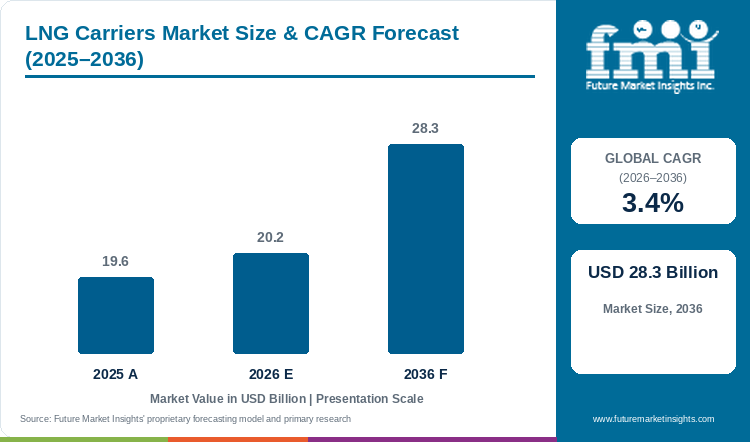
The LNG Carriers Market is projected to reach USD 28.3 billion by 2036, growing at a 3.4% CAGR from 2026 to 2036. The market is estimated at USD 20.2 billion in 2026. The market was valued at USD 19.6 billion in 2025. In its review of 2025, GIIGNL counted a fleet of 899 vessels, up 8%, against global LNG imports of 428 million tonnes, up 5%, and liquefaction capacity of 524 million tonnes a year, of which 16.5 million tonnes was floating [1].
Regulation and voyage economics shape what owners order. Shipping joined the EU Emissions Trading System in January 2024 for ships of 5,000 gross tonnage and above. The surrender obligation covers 40% of 2024 emissions, 70% of 2025 emissions and 100% of reported emissions from 2027, and methane and nitrous oxide are covered only from 2026 [18]. Voyages between EU ports are covered in full, while voyages starting or ending outside the EU are covered at 50% [18]. FuelEU Maritime, Regulation (EU) 2023/1805, has applied in full since 1 January 2025. It requires a 2% cut in the greenhouse gas intensity of onboard energy against 2020 averages, rising to 6% in 2030 and 14.5% in 2035 [19].
Key Market Trends & Insights
- Recent orders cluster between 174,000 and 200,000 m³: GTT announced on 5 October 2026 a tank design order from Samsung Heavy Industries for four carriers of 200,000 m³ each for a European owner, due in 2029 [6], and on 14 October 2026 an order from Hanwha Ocean for two 174,000 m³ ships due by the fourth quarter of 2029 [7].
- Chinese yards appear in several of the large orders: COSCO SHIPPING Energy said on 26 June 2026 that it had signed with Shell and Jiangnan Shipbuilding for four 175,000 m³ carriers [11], and on 25 August 2026 GTT announced a tank design order from Jiangnan for four 175,000 m³ ships for ADNOC Logistics and Services, due in the first half of 2029 [9].
- Second-hand carriers are being converted to floating production: on 7 October 2026 Golar LNG said it had agreed to acquire the 2013-built carrier Grace Dahlia, with 177,427 m³ of storage, from NYK for conversion into its fourth floating LNG unit, with redelivery planned for 2029 [25].
Regional Highlights
- North America: Cheniere reported that it exported 188 cargoes in the third quarter of 2026 and 559 cargoes in the first nine months, and said Midscale Train 7 of its Corpus Christi Stage 3 project reached substantial completion in August 2026 [15].
- Europe: Italy's Adriatic LNG received 41 carriers in the first half of 2026, 28 of them from the United States and 13 from Qatar, and Elengy's three French terminals recorded 242 ship calls in 2025 [23][21].
- Asia: the order book is built mainly in Korean and Chinese yards. GTT announced tank design orders from Samsung Heavy Industries, Hanwha Ocean and HD KSOE in Korea and from Jiangnan and Hudong-Zhonghua in China between 19 August and 14 October 2026 [6][7][8][9][10].
LNG Carriers Market Size and Forecast
Table 1: LNG Carriers Market Size and Forecast
| Market size and forecast | Value |
|---|---|
| Market size in 2025 | USD 19.6 billion |
| Estimated market size in 2026 | USD 20.2 billion |
| Projected market size by 2036 | USD 28.3 billion |
| CAGR from 2026 to 2036 | 3.4% |
Source: Future Market Insights analysis of the LNG carriers market, 2026.
Analyst Perspective
“Carrier orders placed in 2026 deliver in 2028 and 2029, so they are a bet on liquefaction that comes on stream in the late 2020s. The more useful signals for a buyer are delivery slots, because yards are quoting 2029, and the tank system, because it fixes the design basis. Owners who tie an order to a charter before the slot is confirmed carry less risk than owners who order on speculation, and the difference will widen if disruption in the Persian Gulf lasts.”
- Nikhil Kaitwade, Principal Consultant, FMI
How is the LNG Carriers Market segmented?
- By cargo capacity: Below 125,000 m³, 125,000-149,999 m³, 150,000-179,999 m³, 180,000-199,999 m³ and 200,000 m³ and Above
- By application: LNG Transportation, Floating LNG Storage and Floating LNG Regasification
- By region: North America and Europe
Why does Below 125,000 m³ lead by Cargo Capacity in the LNG Carriers Market in 2026?
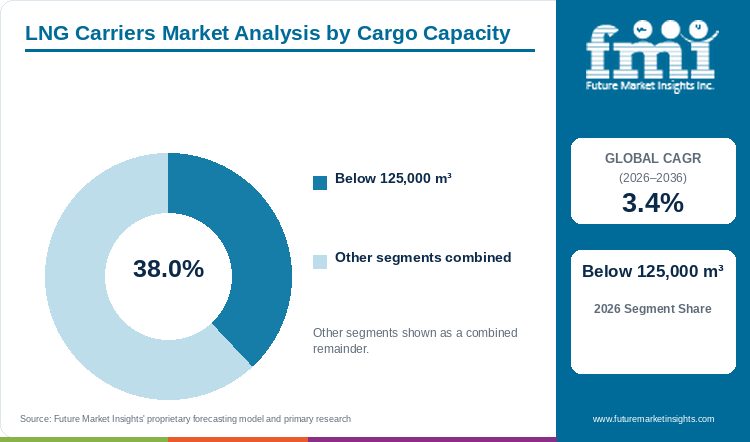
Below 125,000 m³ is estimated to account for 38.0% of the LNG Carriers Market by cargo capacity in 2026. Headlines go to the 174,000 m³ and 200,000 m³ export carriers, but the smaller class is wider than it looks. It covers LNG bunkering vessels and small-scale carriers alongside mid-size ships. GIIGNL counted three new bunkering vessels in 2025, when LNG bunkering volume rose 38% to 4 million tonnes [1]. Elengy lists small-scale LNG carrier loading among the services at its French terminals [21]. The class still draws orders. On 23 September 2026 GTT announced an order from Hudong-Zhonghua Shipbuilding for the tank design of an 18,700 m³ carrier for an Asian owner, due in the fourth quarter of 2028 [10]. Kawasaki's own record lists LNG vessels delivered between 2003 and 2007 that range from 2,513 m³ to 147,684 m³ [13]. Large export carriers arrive in project waves tied to liquefaction start-ups. Meanwhile bunkering vessels and regional ships are bought as fuel and terminal networks grow, which spreads demand over more hulls and more years.
Table 2: Cargo Capacity, 2026 Share
| Leading Share | 2026 market share |
|---|---|
| Below 125,000 m³ | 38.0% |
| All Other Segments Combined Share | 62.0% |
Source: Future Market Insights analysis of the LNG carriers market, 2026.
Why does LNG Transportation lead by Application in the LNG Carriers Market in 2026?
LNG Transportation is estimated to account for 49.0% of the LNG Carriers Market by application in 2026. Trade volumes and the fleet both grew in 2025. GIIGNL reported imports of 428 million tonnes, up 5%, a fleet of 899 vessels, up 8%, and 524 million tonnes a year of liquefaction capacity, including 16.5 million tonnes of floating capacity [1]. Hanwha Ocean says its record covers 226 vessels, of which 214 are LNG carriers, and it delivered its 200th LNG carrier in 2025 [12]. GTT, the designer of membrane cargo tanks for LNG carriers, reported on 23 October 2026 that it had received 80 orders in the first nine months of 2026, 71 of them for new LNG carriers, and that its order book stood at 299 units [3]. New supply keeps the carrier requirement rising. Cheniere declared Midscale Train 7 of Corpus Christi Stage 3 substantially complete in August 2026 and expects its Sabine Pass expansion to add up to about 20 million tonnes a year of peak capacity [15]. LNG Canada took a final investment decision on 28 September 2026 to double its capacity from 14 to 28 million tonnes a year [16]. Sempra Infrastructure's Energia Costa Azul exported its first cargo from Mexico's Pacific coast on 8 July 2026 [17]. Floating storage and regasification are the other two applications. They rest on vessels such as the 12 floating storage and regasification units in Hanwha Ocean's record [12], and they follow terminal programmes, not trade volume, which keeps transportation ahead. The same terminal programmes sit behind LNG storage tank demand.
Table 3: Application, 2026 Share
| Leading Share | 2026 market share |
|---|---|
| LNG Transportation | 49.0% |
| All Other Segments Combined Share | 51.0% |
Source: Future Market Insights analysis of the LNG carriers market, 2026.
What are the key drivers, restraints and opportunities?
Driver
Liquefaction build-out. Every new train needs a fleet to move its output. LNG Canada doubles its capacity to 28 million tonnes a year in Phase 2 after the 28 September 2026 decision, and the phase adds a loading berth [16]. Energia Costa Azul has a 3.25 million tonnes a year single-train first phase and 20-year sale and purchase agreements with TotalEnergies and Mitsui covering 2.5 million tonnes a year [17]. Cheniere raised its 2026 adjusted EBITDA guidance to USD 8.8 billion to USD 9.3 billion on 29 October 2026 [15].
Emissions rules on voyages. The EU ETS and FuelEU Maritime put a price and an intensity limit on fuel used on EU-linked voyages [18][19]. Ship designs respond to these rules. The new COSCO SHIPPING Energy ships use a WinGD XDF 2.2 engine running mainly on LNG, low methane-slip generators and a reliquefaction system, which the company says reduce fuel consumption, carbon emissions and methane slip [11]. The surrender share rises to 100% in 2027, so the cost of a less efficient ship rises with it [18].
Restraint
Long delivery lead times. Delivery dates in the 2026 orders run from the fourth quarter of 2028 to the fourth quarter of 2029 [5][7][8][9][10]. GTT's own 2026 targets assume no significant delays in vessel construction schedules [4]. Buyers who need tonnage for earlier project start-ups must rely on ships that already exist.
Disruption in the Persian Gulf. The IMO verified at least 70 attacks on international shipping and 19 seafarers killed since the conflict began on 28 February 2026 [20]. The IMO said on 28 August 2026 that up to 400 ships and around 6,000 seafarers were unable to leave the Persian Gulf safely [20]. GTT's chief executive said on 28 July 2026 that geopolitical disruptions had had no impact on demand for new LNG carriers [4]. GIIGNL devoted its Global LNG Market Review for the second quarter of 2026 to the effect of the Strait of Hormuz disruption on prices and trade flows [2]. The IMO Council adopted a resolution on protecting shipping lanes in July 2026 [20].
Opportunity
Floating liquefaction and storage. Golar LNG describes four floating LNG units, two on the water and two under construction, and has converted eight LNG carriers [25]. Its fourth unit uses a 177,427 m³ carrier built in 2013, so second-hand ships can find a second use as production assets. Owners of carriers of that size and age have an option besides trading them as carriers.
Digital performance services. GTT Marine said on 23 July 2026 that it will supply vessel performance monitoring, voyage optimisation and cargo monitoring to an LNG carrier fleet chartered by PETRONAS, with scope to extend to future fleet expansion [26]. GTT Marine belongs to the group that designs the cargo tanks, and buyers who track cryogenic tanks will see service offers sit beside the hardware.
LNG Carriers Market by Country (2026 to 2036)
Table 4: LNG Carriers Market Country Growth Forecast
| Country | CAGR, 2026 to 2036 |
|---|---|
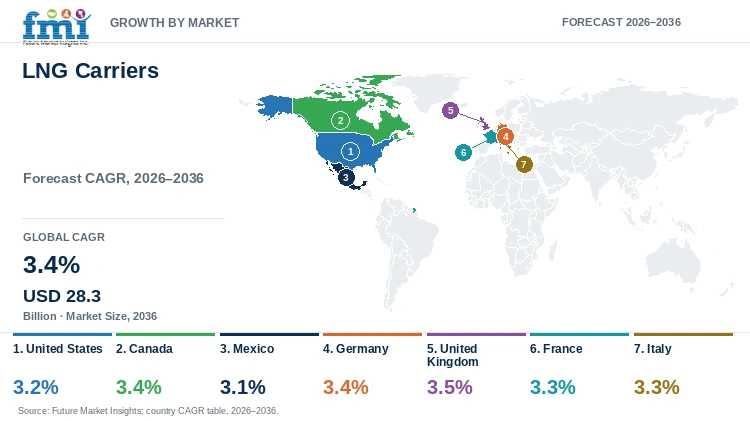
| United States | 3.2% |
| Canada | 3.4% |
| Mexico | 3.1% |
| Germany | 3.4% |
| United Kingdom | 3.5% |
| France | 3.3% |
| Italy | 3.3% |
Source: Future Market Insights analysis of the LNG carriers market, 2026.
United States
Cheniere reported third-quarter 2026 results on 29 October 2026. It exported 188 cargoes in the quarter and 559 in the first nine months, and raised 2026 adjusted EBITDA guidance to USD 8.8 billion to USD 9.3 billion from USD 7.9 billion to USD 8.4 billion [15]. Each cargo is a carrier voyage, so export volume feeds charter demand directly.
Capacity keeps growing. Midscale Train 7 of Corpus Christi Stage 3 reached substantial completion in August 2026, which completes the seven-train project. The Sabine Pass expansion is planned at up to about 20 million tonnes a year of peak capacity, with a lump-sum EPC contract signed with Bechtel in May 2026 and the FERC final environmental impact statement issued in September 2026 [15]. The FERC siting application and the DOE export application remain pending [15].
US volumes reach Europe in quantity. Italy's Adriatic LNG alone received 28 cargoes from the United States in the first half of 2026, against 13 from Qatar [23]. For shipowners the United States is a trade lane first. The 2026 tank design orders in this report were placed with yards in Korea and China, and none names a US yard [5][6][7][8][9][10].
Canada
LNG Canada, in Kitimat, British Columbia, marked one year of operations on 30 June 2026 and said more than 100 cargoes had shipped [16]. Its joint venture participants are Shell, PETRONAS, PetroChina, Mitsubishi Corporation and KOGAS [16].
On 28 September 2026 the participants took a final investment decision on Phase 2, which adds two LNG trains, an additional storage tank and a loading berth and doubles capacity from 14 to 28 million tonnes a year [16]. The release gave no completion or start-up date for Phase 2 [16].
The carrier requirement for Phase 2 cannot be dated yet, because no start-up date has been given. Doubling output to 28 million tonnes a year means roughly twice the cargo volume leaving Kitimat once both phases run, and the added loading berth is part of the scope [16].
Mexico
Sempra Infrastructure announced first LNG production at Energia Costa Azul on 4 June 2026 and exported the first cargo from Mexico's Pacific coast on 8 July 2026. Phase 1 is a single-train liquefaction facility of 3.25 million tonnes a year, built beside the existing receipt, storage and regasification terminal north of Ensenada, Baja California [17].
Definitive 20-year sale and purchase agreements with TotalEnergies and Mitsui cover a combined 2.5 million tonnes a year [17]. Sempra describes the site as positioned to serve Asia, the Pacific Basin and west coast Mexico with gas from the western United States [17].
Scale is modest. A one-train first phase of 3.25 million tonnes a year is small beside LNG Canada's planned 28 million tonnes a year after Phase 2 [16][17]. Mexico's forecast growth of 3.1% is the lowest of the profiled countries. Cargoes bound for Asia mean long voyages, so shipowners will price boil-off handling and fuel use into any charter on the lane.
Germany
Germany is a regulatory market for carriers more than a shipbuilding one. Ships of 5,000 gross tonnage and above that call at EU ports fall under the EU ETS, and the 2026 surrender covers 70% of 2025 emissions [18]. FuelEU Maritime has applied since 1 January 2025 [19].
Hanseatic Energy Hub states that Stade is set to host one of five floating storage and regasification units chartered by the German federal government, and that a land-based terminal for LNG, bio-LNG and SNG is planned in the existing industrial park, with the first expansion phase in 2029 [24]. The company's page also lists the green light for the terminal, the start of construction and a market test for ammonia [24].
On 17 July 2026 the European Commission proposed a targeted revision of the EU ETS, including changes to the maritime rules, with details still to be added [18]. German terminal operators and the owners that serve them should watch that revision, since a change in the surrender share or voyage coverage alters the cost of European calls.
United Kingdom
South Hook Gas says its terminal can meet around 25% of current UK gas demand, subject to available pipeline capacity, and has received more than 1,000 cargoes [22]. It describes a Q-max cargo, the largest LNG vessel in the world, as enough to supply every London household for about two weeks [22].
The terminal is built to receive the largest class of carrier, so it is a regular call for owners of big ships. The UK has the highest forecast growth of the profiled countries at 3.5%, a small margin over Canada and Germany at 3.4% each, and the volume behind it is seaborne gas that arrives by ship, not a single new project.
A single terminal that can meet around a quarter of demand shows how much rides on uninterrupted shipping [22]. The IMO reported at least 70 verified attacks on international shipping since 28 February 2026 [20]. Buyers in that position gain from contracts that name alternative loading ports and from owners that can position ships flexibly.
France
Elengy operates three regulated LNG terminals, Montoir-de-Bretagne on the Atlantic coast and Fos Cavaou and Fos Tonkin on the Mediterranean. In 2025 they unloaded 185 TWh, injected 180 TWh into the network and recorded 242 ship calls [21].
The company plans to invest EUR 220.0 million in Montoir-de-Bretagne to modernise it and reduce its CO2 emissions, and appointed Geraldine Brissiaud as chief executive in January 2026 [21]. It also offers cargo reloading, transshipment and small-scale LNG carrier loading, which ties French terminals to the smaller vessel classes [21].
France is covered by the EU ETS and FuelEU rules on every call [18][19]. With 242 calls a year across three terminals, French ports give carriers a regular set of calls on which those costs apply, and the surrender share reaches 100% in 2027 [18].
Italy
Adriatic LNG, a gravity-based structure with two LNG tanks, reported on 15 July 2026 that it received 41 carriers in the first half of 2026, 28 from the United States and 13 from Qatar. It delivered 4.4 billion cubic metres to the grid, in line with the same period of 2025, which is about 14% of Italian gas demand and over 40% of national LNG imports [23].
Since 2009 the terminal has delivered more than 113 billion cubic metres and received over 1,250 LNG carriers [23]. The 2026 open season has closed, and additional services are offered without a subscription fee for the 2026-2027 thermal year [23].
The split between American and Qatari cargoes shows a terminal supplied from two very different origins. The 13 Qatari cargoes came from a Gulf supplier, so Italian supply is exposed to the disruption the IMO describes [20][23]. Flat volumes against the first half of 2025 mean the terminal's demand for ships held steady and did not grow.
Who are the notable companies in the LNG Carriers Market?
Notable companies in the LNG Carriers Market include Samsung Heavy Industries, Hanwha Group, HD Korea Shipbuilding & Offshore Engineering, Dalian Shipbuilding Industry, Jiangnan Shipyard, Hudong-Zhonghua Shipbuilding, COSCO SHIPPING Energy Transportation and Kawasaki Heavy Industries.
Yard slot and containment system both shape a buyer's choice. Each 2026 order in this report was announced by GTT with a named membrane design: Mark III Flex for Samsung Heavy Industries' K LINE ships and HD KSOE's Tsakos ships, Mark III Flex+ for Samsung's 200,000 m³ order, NO96 Super+ for Hanwha Ocean, and Mark III for the Hudong-Zhonghua 18,700 m³ carrier [5][6][7][8][10]. With membrane designs coming from one licensor, yards differ on delivery date, price and track record. Hanwha Ocean lists 226 vessels in its record, of which 214 are LNG carriers and 12 are floating storage and regasification units [12]. Samsung Heavy Industries is named in two GTT announcements, on 5 October and 4 November 2026, covering six ships [5][6].
Chinese yards compete as capacity grows. Jiangnan has orders for four 175,000 m³ ships for ADNOC Logistics and Services and four for the COSCO SHIPPING Energy and Shell group [9][11], and Hudong-Zhonghua has the 18,700 m³ order [10]. Dalian Shipbuilding Industry lists LNG carriers among its special vessels [14]. COSCO SHIPPING Energy treats LNG as an independent international shipping business, and its new ships carry a WinGD XDF 2.2 engine. Buyers comparing marine engines will see how engine choice drives methane slip [11].
Moss-type tanks are the other containment route. Kawasaki Heavy Industries calls itself a pioneer of Moss-type LNG carrier construction in Japan, and its LNG carrier page lists seven vessels delivered between 2003 and 2007 [13]. Golar LNG shows another route into the market, buying carriers for conversion to floating production instead of ordering new ships [25].
Key Developments in the LNG Carriers Market
- On 25 June 2026, COSCO SHIPPING Energy signed with Shell and Jiangnan Shipbuilding in Shanghai for four 175,000 m³ LNG carriers, which use a twin-skeg hull and a WinGD XDF 2.2 engine [11].
- On 19 August 2026, GTT announced an order from HD KSOE for the tank design of two 174,000 m³ LNG carriers for Tsakos Energy Navigation, with delivery expected by the first quarter of 2029 [8].
- On 5 October 2026, GTT announced an order from Samsung Heavy Industries for the tank design of four 200,000 m³ LNG carriers for a European owner, with delivery in 2029 [6].
- On 7 October 2026, Golar LNG announced that it had agreed to acquire the LNG carrier Grace Dahlia from NYK for conversion at CIMC Raffles' Yantai shipyard into its fourth floating LNG unit, with redelivery scheduled for 2029 [25].
Key Players in the LNG Carriers Market
- Samsung Heavy Industries Co., Ltd.
- Hanwha Group
- HD Korea Shipbuilding & Offshore Engineering Co., Ltd.
- Dalian Shipbuilding Industry Co., Ltd.
- Jiangnan Shipyard
- Hudong-Zhonghua Shipbuilding
- COSCO SHIPPING Energy Transportation Co., Ltd.
- Kawasaki Heavy Industries, Ltd.
LNG Carriers Market Report Scope
Table 5: LNG Carriers Market Report Scope
| Coverage field | Report scope |
|---|---|
| Market definition | Seagoing vessels built to carry liquefied natural gas, together with floating LNG storage and floating LNG regasification vessels, measured by value in USD |
| Cargo Capacity | Below 125,000 m³, 125,000-149,999 m³, 150,000-179,999 m³, 180,000-199,999 m³, 200,000 m³ and Above |
| Application | LNG Transportation, Floating LNG Storage, Floating LNG Regasification |
| Regions and profiled countries | Regions: North America and Europe. Countries: United States, Canada, Mexico, Germany, United Kingdom, France, Italy. |
| Companies covered | Samsung Heavy Industries Co., Ltd., Hanwha Group, HD Korea Shipbuilding & Offshore Engineering Co., Ltd., Dalian Shipbuilding Industry Co., Ltd., Jiangnan Shipyard, Hudong-Zhonghua Shipbuilding, COSCO SHIPPING Energy Transportation Co., Ltd., Kawasaki Heavy Industries, Ltd. |
| Forecast period | 2026 to 2036, with 2025 as the historical base year |
| Quantitative Units | USD billion |
Source: Future Market Insights analysis of the LNG carriers market, 2026.
LNG Carriers Market by Segments
LNG Carriers Market segmented by Cargo Capacity:
- Below 125,000 m³
- 125,000-149,999 m³
- 150,000-179,999 m³
- 180,000-199,999 m³
- 200,000 m³ and Above
LNG Carriers Market segmented by Application:
- LNG Transportation
- Floating LNG Storage
- Floating LNG Regasification
LNG Carriers Market by Region
- North America
- Europe
- United States
- Canada
- Mexico
- Germany
- United Kingdom
- France
- Italy
Research Sources and Bibliography
- [1] GIIGNL. (2026). GIIGNL Annual Report 2026: The LNG Industry in 2025. https://www.giignl.org/annual-report
- [2] GIIGNL. (2026, July 13). Global LNG Market Review Q2 2026. https://www.giignl.org/resources/global-lng-market-review-q2-2026
- [3] GTT. (2026, October 23). Revenues for the first nine months of 2026. https://gtt.fr/news/revenues-first-nine-months-2026-exc%65llent-commercial-performance-objectives-confirmed-2026
- [4] GTT. (2026, July 28). First-half 2026 results: orderbook at high historical levels, strong results, annual objectives confirmed. https://gtt.fr/news/first-half-2026-results-orderbook-high-historical-levels-strong-results-annual-objectives
- [5] GTT. (2026, November 4). GTT Energy receives an order from Samsung Heavy Industries for the tank design of two new LNG carriers. https://gtt.fr/news/gtt-energy-receives-order-samsung-heavy-industries-tank-design-two-new-lng-carriers
- [6] GTT. (2026, October 5). GTT Energy receives an order from Samsung Heavy Industries for the tank design of four new LNG carriers. https://gtt.fr/news/gtt-energy-receives-order-samsung-heavy-industries-tank-design-four-new-lng-carriers
- [7] GTT. (2026, October 14). GTT Energy receives an order from Hanwha Ocean for the tank design of two new LNG carriers. https://gtt.fr/news/gtt-energy-receives-order-hanwha-ocean-tank-design-two-new-lng-carriers
- [8] GTT. (2026, August 19). GTT receives an order from HD KSOE for the tank design of two new LNG carriers. https://gtt.fr/news/gtt-receives-order-hd-ksoe-tank-design-two-new-lng-carriers-2
- [9] GTT. (2026, August 25). GTT receives an order from Jiangnan shipyard for the tank design of four new LNG carriers. https://gtt.fr/news/gtt-receives-order-jiangnan-shipyard-tank-design-four-new-lng-carriers-1
- [10] GTT. (2026, September 23). GTT Energy receives an order from Hudong-Zhonghua Shipbuilding for the tank design of an 18,700 m3 LNG carrier. https://gtt.fr/news/gtt-energy-receives-order-hudong-zhonghua-shipbuilding-tank-design-18700m3-lng-carrier
- [11] COSCO SHIPPING Energy Transportation Co., Ltd. (2026, June 26). COSCO SHIPPING Energy signs with Shell and Jiangnan Shipbuilding to build four 175,000 cubic metre LNG carriers (Chinese-language release). https://energy.coscoshipping.com/col/col19519/art/2026/art_325aa796203f4b60b4fe4bf2b1da3777.html
- [12] Hanwha Ocean Co., Ltd. (n.d.). Commercial Vessels. https://www.hanwhaocean.com/en/whatwedo/cv/
- [13] Kawasaki Heavy Industries, Ltd. (n.d.). LNG carriers. https://global.kawasaki.com/en/mobility/marine/ships/lng.html
- [14] Dalian Shipbuilding Industry Co., Ltd. (n.d.). LNG carriers (special vessels). https://www.dsic.cn/hxyw/mycb/tzc/LNGc/index.htm
- [15] Cheniere Energy, Inc. (2026, October 29). Cheniere Reports Third Quarter 2026 Results (Form 8-K, Exhibit 99.1). https://www.sec.gov/Archives/edgar/data/3570/000000357026000040/cei20263rdqtrerex991.htm
- [16] LNG Canada. (2026, September 28). LNG Canada Announces Phase 2 Final Investment Decision. https://www.lngcanada.ca/news/lng-canada-announces-phase-2-final-investment-decision/
- [17] Sempra Infrastructure. (n.d.). ECA LNG. https://www.semprainfrastructure.com/what-we-do/lng/eca-lng
- [18] European Commission. (n.d.). Reducing emissions from the shipping sector. https://climate.ec.europa.eu/eu-action/transport-decarbonisation/reducing-emissions-shipping-sector_en
- [19] European Commission. (n.d.). FuelEU Maritime. https://transport.ec.europa.eu/transport-modes/maritime/decarbonising-maritime-transport-fueleu-maritime_en
- [20] International Maritime Organization. (2026, August 28). Six months of uncertainty for seafarers in Strait of Hormuz. https://www.imo.org/en/MediaCentre/PressBriefings/pages/Statement-on-the-ongoing-crisis-in-the-Strait-of-Hormuz.aspx
- [21] Elengy. (n.d.). Elengy, LNG terminals in France. https://www.elengy.com/en/
- [22] South Hook Gas. (n.d.). South Hook LNG terminal. https://www.southhookgas.com/
- [23] Adriatic LNG. (2026, July 15). Adriatic LNG supplied 14% of national gas demand. New Sustainability Report published. https://www.adriaticlng.it/en/media/press-releases/corporate/press+rel+-+operational+data+and+2025+esg
- [24] Hanseatic Energy Hub. (n.d.). Hanseatic Energy Hub, Stade. https://www.hanseatic-energy-hub.de/en/
- [25] Golar LNG Limited. (2026, October 7). Golar LNG acquires conversion vessel for 4th FLNG. https://www.golar.com/investors/press-releases/pr-story.aspx?ResultPageURL=https://rss.globenewswire.com/HexMLItem/Content/FullText/Attachments/All/Identifier/3376548/language/en
- [26] GTT. (2026, July 23). GTT Marine to equip a PETRONAS-chartered LNG carrier fleet with its integrated suite of digital vessel performance solutions. https://gtt.fr/news/gtt-marine-equip-petronas-chartered-lng-carrier-fleet-its-integrated-suite-digital-vessel
Table of Content
Table of Content
- Key Takeaways
- Market Size and CAGR
- Top Growth Driver
- Fastest Growing Segment
- Leading Region
- Key Companies
- Emerging Opportunities
- Executive Summary
- Global Market Outlook
- Demand-side Trends
- Supply-side Trends
- Technology Roadmap Analysis
- Analysis and Recommendations
- Analyst Perspective (What is happening? Why now? What should investors know?)
- Key Questions Answered
- How large is the market?
- What is the CAGR?
- What are key trends?
- Which region dominates?
- Who are the leaders?
Read More...
- Market Overview
- Market Coverage / Taxonomy
- Market Definition / Scope / Limitations
- Research Methodology
- Chapter Orientation
- Analytical Lens and Working Hypotheses
- Market Structure, Signals, and Trend Drivers
- Benchmarking and Cross-market Comparability
- Market Sizing, Forecasting, and Opportunity Mapping
- Research Design and Evidence Framework
- Desk Research Programme (Secondary Evidence)
- Expert Input and Fieldwork (Primary Evidence)
- Tooling, Models, and Reference Databases
- Data Engineering and Model Build
- Quality Assurance and Audit Trail
- Market Background
- Market Dynamics (Drivers, Restraints, Opportunity, Trends)
- Scenario Forecast (Optimistic, Likely, Conservative)
- Impact Analysis
- AI Impact
- Sustainability Impact
- Regulatory Impact
- Technology Impact
- Consumer / Buyer Analysis
- Purchase Drivers
- Adoption Barriers
- Buyer Journey
- Opportunity Map Analysis
- Product Life Cycle Analysis
- Supply Chain Analysis
- Investment Feasibility Matrix
- Value Chain Analysis
- PESTLE and Porter's Analysis
- Regulatory Landscape
- Regional Parent Market Outlook
- Production and Consumption Statistics
- Import and Export Statistics
- Global Market Analysis and Forecast, 2021 to 2036
- Historical Market Size Value (USD Billion) Analysis, 2021 to 2025
- Current and Future Market Size Value (USD Billion) Projections, 2026 to 2036
- Y-o-Y Growth Trend Analysis
- Absolute $ Opportunity Analysis
- Global Market Pricing Analysis, 2021 to 2036
- Global Market Analysis and Forecast, By Cargo Capacity, 2021 to 2036
- Introduction / Key Findings
- Historical Market Size Value (USD Billion) Analysis By Cargo Capacity, 2021 to 2025
- Current and Future Market Size Value (USD Billion) Analysis and Forecast By Cargo Capacity, 2026 to 2036
- Below 125,000 m³
- 125,000-149,999 m³
- 150,000-179,999 m³
- 180,000-199,999 m³
- 200,000 m³ and Above
- Y-o-Y Growth Trend Analysis By Cargo Capacity, 2021 to 2025
- Absolute $ Opportunity Analysis By Cargo Capacity, 2026 to 2036
- Global Market Analysis and Forecast, By Application, 2021 to 2036
- Introduction / Key Findings
- Historical Market Size Value (USD Billion) Analysis By Application, 2021 to 2025
- Current and Future Market Size Value (USD Billion) Analysis and Forecast By Application, 2026 to 2036
- LNG Transportation
- Floating LNG Storage
- Floating LNG Regasification
- Y-o-Y Growth Trend Analysis By Application, 2021 to 2025
- Absolute $ Opportunity Analysis By Application, 2026 to 2036
- Global Market Analysis and Forecast, By Region, 2021 to 2036
- Introduction
- Historical Market Size Value (USD Billion) Analysis By Region, 2021 to 2025
- Current Market Size Value (USD Billion) Analysis and Forecast By Region, 2026 to 2036
- North America
- Europe
- Market Attractiveness Analysis By Region
- North America Market Analysis and Forecast, By Country, 2021 to 2036
- Historical Market Size Value (USD Billion) Trend Analysis By Market Taxonomy, 2021 to 2025
- Market Size Value (USD Billion) Forecast By Market Taxonomy, 2026 to 2036
- By Country
- By Cargo Capacity
- By Application
- Market Attractiveness Analysis
- By Country
- By Cargo Capacity
- By Application
- Key Takeaways
- Europe Market Analysis and Forecast, By Country
- Historical Market Size Value (USD Billion) Trend Analysis By Market Taxonomy, 2021 to 2025
- Market Size Value (USD Billion) Forecast By Market Taxonomy, 2026 to 2036
- By Country
- United States
- Canada
- Mexico
- Germany
- United Kingdom
- France
- Italy
- By Cargo Capacity
- By Application
- By Country
- Market Attractiveness Analysis
- By Country
- By Cargo Capacity
- By Application
- Key Takeaways
- Key Countries Market Analysis
- United States
- Pricing Analysis
- Market Share Analysis, 2025
- By Cargo Capacity
- By Application
- Canada
- Pricing Analysis
- Market Share Analysis, 2025
- By Cargo Capacity
- By Application
- Mexico
- Pricing Analysis
- Market Share Analysis, 2025
- By Cargo Capacity
- By Application
- Germany
- Pricing Analysis
- Market Share Analysis, 2025
- By Cargo Capacity
- By Application
- United Kingdom
- Pricing Analysis
- Market Share Analysis, 2025
- By Cargo Capacity
- By Application
- Italy
- Pricing Analysis
- Market Share Analysis, 2025
- By Cargo Capacity
- By Application
- France
- Pricing Analysis
- Market Share Analysis, 2025
- By Cargo Capacity
- By Application
- United States
- Market Structure Analysis
- Competition Dashboard
- Competition Benchmarking
- Market Share Analysis of Top Players
- By Regional
- By Cargo Capacity
- By Application
- Emerging Startups
- Innovation Benchmarking
- Competition Analysis
- Competition Deep Dive
- Samsung Heavy Industries Co., Ltd.
- Overview
- Product Portfolio
- Profitability by Market Segments
- Sales Footprint
- Strategy Overview
- Marketing Strategy
- Product Strategy
- Channel Strategy
- Hanwha Group
- HD Korea Shipbuilding & Offshore Engineering Co., Ltd.
- Dalian Shipbuilding Industry Co., Ltd.
- Jiangnan Shipyard
- Hudong-Zhonghua Shipbuilding
- COSCO SHIPPING Energy Transportation Co., Ltd.
- Kawasaki Heavy Industries, Ltd.
- Samsung Heavy Industries Co., Ltd.
- Case Studies
- Success Stories
- Recent Developments
- Competition Deep Dive
- Assumptions & Acronyms Used
List of Tables
- Table 1: Global Market Value (USD Billion) Forecast by Region, 2021 to 2036
- Table 2: Global Market Value (USD Billion) Forecast by Cargo Capacity, 2021 to 2036
- Table 3: Global Market Value (USD Billion) Forecast by Application, 2021 to 2036
- Table 4: North America Market Value (USD Billion) Forecast by Country, 2021 to 2036
- Table 5: North America Market Value (USD Billion) Forecast by Cargo Capacity, 2021 to 2036
- Table 6: North America Market Value (USD Billion) Forecast by Application, 2021 to 2036
- Table 7: Europe Market Value (USD Billion) Forecast by Country, 2021 to 2036
- Table 8: Europe Market Value (USD Billion) Forecast by Cargo Capacity, 2021 to 2036
- Table 9: Europe Market Value (USD Billion) Forecast by Application, 2021 to 2036
List of Figures
- Figure 1: Global Market Pricing Analysis
- Figure 2: Global Market Value (USD Billion) Forecast 2021-2036
- Figure 3: Global Market Value Share and BPS Analysis by Cargo Capacity, 2026 and 2036
- Figure 4: Global Market Y-o-Y Growth Comparison by Cargo Capacity, 2026-2036
- Figure 5: Global Market Attractiveness Analysis by Cargo Capacity
- Figure 6: Global Market Value Share and BPS Analysis by Application, 2026 and 2036
- Figure 7: Global Market Y-o-Y Growth Comparison by Application, 2026-2036
- Figure 8: Global Market Attractiveness Analysis by Application
- Figure 9: Global Market Value (USD Billion) Share and BPS Analysis by Region, 2026 and 2036
- Figure 10: Global Market Y-o-Y Growth Comparison by Region, 2026-2036
- Figure 11: Global Market Attractiveness Analysis by Region
- Figure 12: North America Market Incremental Dollar Opportunity, 2026-2036
- Figure 13: Europe Market Incremental Dollar Opportunity, 2026-2036
- Figure 14: North America Market Value Share and BPS Analysis by Country, 2026 and 2036
- Figure 15: North America Market Value Share and BPS Analysis by Cargo Capacity, 2026 and 2036
- Figure 16: North America Market Y-o-Y Growth Comparison by Cargo Capacity, 2026-2036
- Figure 17: North America Market Attractiveness Analysis by Cargo Capacity
- Figure 18: North America Market Value Share and BPS Analysis by Application, 2026 and 2036
- Figure 19: North America Market Y-o-Y Growth Comparison by Application, 2026-2036
- Figure 20: North America Market Attractiveness Analysis by Application
- Figure 21: Europe Market Value Share and BPS Analysis by Country, 2026 and 2036
- Figure 22: Europe Market Value Share and BPS Analysis by Cargo Capacity, 2026 and 2036
- Figure 23: Europe Market Y-o-Y Growth Comparison by Cargo Capacity, 2026-2036
- Figure 24: Europe Market Attractiveness Analysis by Cargo Capacity
- Figure 25: Europe Market Value Share and BPS Analysis by Application, 2026 and 2036
- Figure 26: Europe Market Y-o-Y Growth Comparison by Application, 2026-2036
- Figure 27: Europe Market Attractiveness Analysis by Application
- Figure 28: Global Market - Tier Structure Analysis
- Figure 29: Global Market - Company Share Analysis
Frequently Asked Questions
How big is the LNG carriers market in 2026?
The LNG Carriers Market is estimated at USD 20.2 billion in 2026, up from USD 19.6 billion in 2025. It is projected to reach USD 28.3 billion by 2036, a 3.4% CAGR from 2026 to 2036.
Which cargo capacity class and application lead the market?
Below 125,000 m³ leads by cargo capacity with 38.0% in 2026, and LNG Transportation leads by application with 49.0%. GIIGNL reports a fleet of 899 vessels and imports of 428 million tonnes for 2025, and three new bunkering vessels entered service that year [1].
Which other segments matter?
By cargo capacity, 125,000-149,999 m³ holds 22.0%, 150,000-179,999 m³ 16.0%, 180,000-199,999 m³ 13.0% and 200,000 m³ and Above 11.0%. By application, Floating LNG Storage holds 29.0% and Floating LNG Regasification 22.0%. The 174,000 m³ and 175,000 m³ orders fall in the 150,000-179,999 m³ class and the 200,000 m³ order in the top class [5][6][7][9].
Which profiled country is forecast to grow fastest?
The United Kingdom has the highest forecast CAGR of the seven profiled countries at 3.5% from 2026 to 2036, ahead of Canada and Germany at 3.4% each. South Hook Gas says its terminal can meet around 25% of UK gas demand, subject to pipeline capacity [22].
Which rules affect carriers on European routes?
The EU ETS covers ships of 5,000 gross tonnage and above, with 70% of 2025 emissions surrendered in 2026 and 100% from 2027, and methane and nitrous oxide covered from 2026 [18]. FuelEU Maritime, Regulation (EU) 2023/1805, has applied since 1 January 2025, with a 2% greenhouse gas intensity cut rising to 6% in 2030 [19].
What should an owner check when ordering a carrier?
Check the delivery slot, the containment system and the engine. The 2026 tank design orders carry delivery dates from the fourth quarter of 2028 to the fourth quarter of 2029, and the larger ships name Mark III Flex, Mark III Flex+ or NO96 Super+ systems [5][6][7][8][10]. Then confirm the fuel and methane slip profile against EU rules [18][19].
Preview the report firsthand - request a free sample
Get SampleGet the brochure for pricing and purchase details.
Get PDF
