

- Industry Size (2026)
- USD 374 Mn
- Forecast (2036)
- USD 943.9 Mn
- CAGR (2026 to 2036)
- 9.7%
Low-Toxicity Algaecides for Reservoirs Market Forecast and Outlook 2026 to 2036
The Low-Toxicity Algaecides for Reservoirs market is valued at USD 374 million in 2026 and is projected to reach USD 943.9 million by 2036, registering a CAGR of 9.7%. Initial growth breakpoints appear between 2026 and 2028 as hydrogen peroxide-based and biopolymer/enzyme algaecides gain adoption in drinking water and agricultural irrigation reservoirs. Early-stage regulatory incentives and environmental compliance pressures are key drivers. Industrial water storage and recreational water bodies begin to adopt copper-free chelated and natural extract-based algaecides, supporting expansion and establishing the first growth plateau.
A second significant breakpoint occurs between 2030 and 2034, as essential oil and natural extract algaecides penetrate recreational, urban, and aquaculture reservoirs. Growth accelerates due to improved efficacy, low environmental toxicity, and increasing global demand for safe water management solutions. By 2036, aquaculture and fisheries applications become major contributors, with companies like SePRO Corporation, BioSafe Systems, SUEZ Water Technologies, Kemira, and Nufarm driving adoption. Technology improvements, formulation diversification, and sustainability mandates reinforce the market’s long-term expansion trajectory.
Quick Stats for Low Toxicity Algaecides for Reservoirs Market
- Low Toxicity Algaecides for Reservoirs Market Value (2026): USD 374 million
- Low Toxicity Algaecides for Reservoirs Market Forecast Value (2036): USD 943.9 million
- Low Toxicity Algaecides for Reservoirs Market Forecast CAGR: 9.7%
- Leading Type in Low Toxicity Algaecides for Reservoirs Market: Hydrogen Peroxide-Based Algaecides
- Key Growth Regions in Low Toxicity Algaecides for Reservoirs Market: North America, Europe, and Asia Pacific
- Top Players in Low Toxicity Algaecides for Reservoirs Market: SePRO Corporation, BioSafe Systems, SUEZ Water Technologies, Kemira, Nufarm
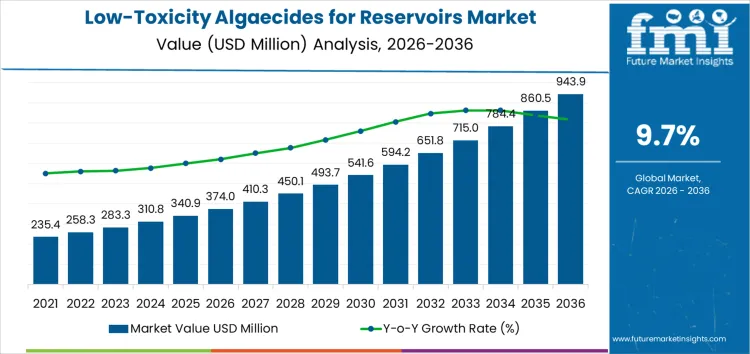
What is the Growth Forecast for the Low-Toxicity Algaecides for Reservoirs Market through 2036?
From 2026 to 2031, the low-toxicity algaecides market grows from USD 374 million to approximately USD 606 million, representing the early adoption phase. Annual increments rise from USD 37 million in 2026 to USD 55 million in 2031. Growth is driven by adoption in municipal and industrial reservoirs, water treatment facilities, and aquaculture systems, where regulatory pressure and environmental standards favor low-toxicity solutions. North America and Europe account for roughly 60% of early adoption, with pilot projects focused on algae control efficacy, minimal ecological impact, and operational integration within reservoir management programs.
Between 2031 and 2036, the market expands from roughly USD 606 million to USD 943.9 million, illustrating the late adoption phase characterized by broader deployment and structural market penetration. Annual increments rise steadily from USD 55 million to USD 118 million, driven by repeat procurement, multi-reservoir implementation, and expansion in Asia Pacific and Latin America. Growth is reinforced by stricter environmental regulations, demand for safe water quality, and portfolio-wide adoption in municipal and industrial water management systems. Early-stage growth relied on selective high-value reservoirs, while later expansion reflects normalized adoption and full-scale integration of low-toxicity algaecides globally.
Low Toxicity Algaecides for Reservoirs Market Key Takeaways
| Metric | Value |
|---|---|
| Market Value (2026) | USD 374 million |
| Forecast Value (2036) | USD 943.9 million |
| Forecast CAGR (2026 to 2036) | 9.7% |
What Is Driving Growth in the Low-Toxicity Algaecides for Reservoirs Market?
Demand for low-toxicity algaecides originally developed from practical limitations of traditional algal control methods in reservoirs used for drinking water and industrial supply. Conventional algaecides based on copper compounds or strong oxidants controlled blooms but often left residual toxicity affecting aquatic life and corrosion of infrastructure. Water managers observed fish kills, biofilter impairment, and regulatory citations tied to persistent toxic residues. Operators adopted alternative chemistries that suppressed algal growth while minimising harmful by-products in treated water. Historical uptake was triggered by acute ecological impacts and community pressure rather than by proactive environmental planning or formalised policy mandates.
Future growth in the low-toxicity algaecides market will be shaped by evolving water quality standards, ecosystem protection frameworks, and reservoir management practices rather than isolated bloom suppression needs alone. Regulatory bodies are tightening criteria for disinfection by-products and non-target organism impacts, requiring control agents that achieve efficacy without exceeding toxicity thresholds. Water utilities are incorporating these agents into integrated management plans that balance algal control with habitat preservation, regulatory compliance, and potable water safety. Advances in biodegradable organics, tailored dosing technologies, and site specific application protocols improve effectiveness while reducing chemical load. Demand will follow documented performance metrics and compliance expectations rather than simple operational trial and error, positioning low-toxicity algaecides as standard tools in reservoir water quality programmes.
What Factors Are Affecting the Demand for Low Toxicity Algaecides for Reservoirs Market in Terms of Algaecide Type and Reservoir Application?
The low toxicity algaecides market for reservoirs is shaped by stricter drinking water standards, public health concerns, and ecological protection requirements. Demand is shifting toward formulations that control algal growth while minimizing residual toxicity, bioaccumulation, and downstream ecosystem impact. Adoption is strongest where reservoirs serve multiple users and regulatory oversight is high. Market leadership reflects risk management priorities, environmental compliance, and long term water quality protection rather than short term algal suppression efficiency alone.
What Is Driving Leadership by Algaecide Type in the Low Toxicity Algaecides for Reservoirs Market?
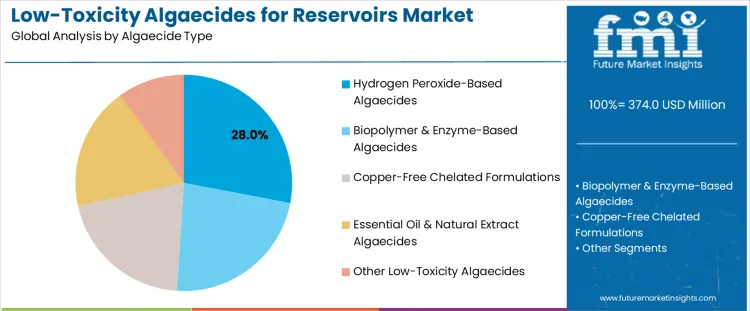
Hydrogen peroxide based algaecides account for about 28% of demand because they decompose into water and oxygen after application, leaving minimal harmful residue. Water authorities favor these formulations for predictable degradation and low risk to aquatic life when properly dosed. Their rapid action supports control of algal blooms without long persistence. Regulatory acceptance is higher compared with metal based alternatives, reinforcing use in sensitive water bodies. These attributes position hydrogen peroxide systems as preferred solutions where safety and compliance outweigh long duration control needs.
Biopolymer and enzyme based algaecides, copper free chelated formulations, and natural extract options broaden the market but remain more application specific. Biopolymer solutions offer targeted action but require precise conditions. Copper free chelates reduce metal accumulation yet face cost constraints. Essential oil based products appeal in niche uses but lack scalability. These alternatives complement peroxide systems rather than replace them, reinforcing leadership driven by predictability, regulatory comfort, and manageable ecological impact across reservoir environments globally today.
What Is Driving Leadership by Reservoir Application in the Low Toxicity Algaecides for Reservoirs Market?
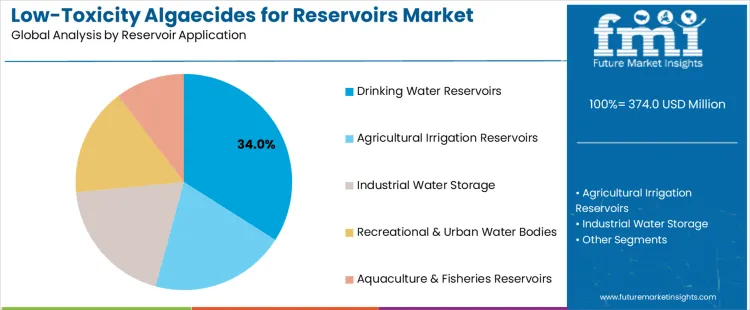
Drinking water reservoirs represent about 34% of demand because algal control directly affects public health, taste, and treatment cost. Operators prioritize low toxicity solutions to avoid secondary contamination and simplify downstream treatment processes. Regulatory scrutiny is highest in potable water systems, accelerating adoption of algaecides with clear degradation pathways. Hydrogen peroxide based products are commonly specified due to their safety profile. Continuous monitoring and recurring treatment needs further reinforce consistent demand from municipal water authorities globally today.
Agricultural irrigation, industrial storage, recreational waters, and aquaculture reservoirs represent secondary applications. Irrigation systems adopt low toxicity products to protect crops and soil. Industrial storage focuses on operational continuity. Recreational and fisheries reservoirs emphasize ecosystem protection. These uses contribute to demand growth but occur at lower volumes or with seasonal variability. Application leadership therefore reflects public health exposure and regulatory intensity rather than total reservoir count or surface area alone.
How Are Low-Toxicity Algaecides Being Applied Across Reservoir and Water Storage Systems?
Use appears in municipal, industrial, and agricultural reservoirs where algae growth affects water quality, taste, and treatment efficiency. Water utilities and facility operators apply low-toxicity algaecides to manage cyanobacteria and green algae without harming non-target aquatic organisms. Reservoirs supplying drinking water, irrigation systems, and industrial process water adopt these chemicals to maintain clarity and reduce filter clogging. These applications reflect operational and environmental priorities rather than purely chemical effectiveness, with adoption driven by water quality, ecosystem safety, and regulatory compliance.
What Operational and Material Conditions Support Adoption of Low-Toxicity Algaecides?
Selection aligns with water bodies that experience seasonal or nutrient-driven algal blooms. Formulations are optimized for efficacy at low concentrations, biodegradability, and minimal residual toxicity. Operators monitor dosage, water flow, and mixing to achieve uniform distribution and sustained control. Water quality teams coordinate algaecide application with pH, temperature, and turbidity conditions to maintain treatment efficiency. These conditions emerge from operational reliability, ecosystem protection, and regulatory adherence priorities in structured water management workflows.
Which Practical Considerations Limit Wider Use of Low-Toxicity Algaecides?
Effectiveness may be reduced under high nutrient loads or extreme bloom conditions, requiring repeated or higher dosing. Cost per hectare or volume can be higher than conventional algaecides. Compatibility with downstream water treatment processes and aquatic species must be ensured. Regulatory approvals vary by region and reservoir use. These factors lead to selective deployment where water quality, environmental protection, and compliance justify incremental cost and operational monitoring.
What is the Demand for Low Toxicity Algaecides for Reservoirs by Country?
| Country | CAGR (%) |
|---|---|
| India | 10.4% |
| China | 10.1% |
| USA | 8.3% |
| Germany | 7.7% |
| Brazil | 7.4% |
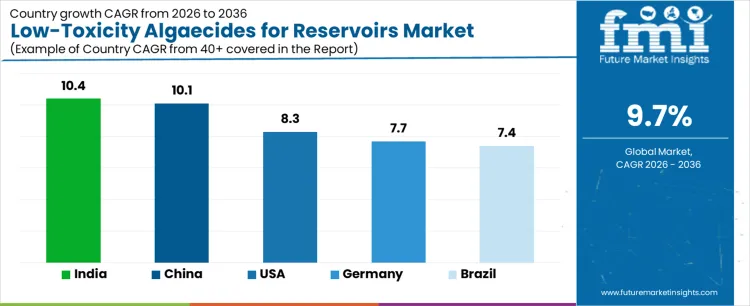
The demand for low toxicity algaecides for reservoirs varies across countries, driven by water quality regulations, environmental sustainability initiatives, and growing freshwater management needs. India leads with a 10.4% CAGR, supported by rising demand for safe water treatment in reservoirs, increasing industrial and municipal water usage, and regulatory focus on eco friendly chemicals. China follows at 10.1%, driven by large scale water management programs and adoption of low toxicity algaecides for environmental protection. The USA grows at 8.3%, reflecting steady use in municipal and industrial water systems. Germany records 7.7%, shaped by stringent environmental regulations and mature water treatment infrastructure. Brazil posts 7.4%, supported by expanding reservoir management and sustainable water treatment adoption.
How Are Low-Toxicity Algaecides Supporting Reservoir Management in India?
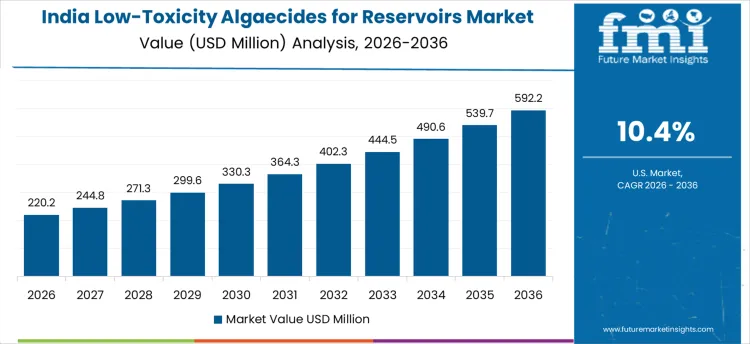
In India, the Low-Toxicity Algaecides for Reservoirs Market is expanding at a CAGR of 10.4% through 2036, driven by rising demand for safe and effective water treatment solutions in municipal and industrial reservoirs. Water utilities and industrial facilities are adopting low-toxicity algaecides to control algal blooms, prevent eutrophication, and maintain water quality. Demand is concentrated in urban reservoirs, thermal power plant water systems, and industrial process water facilities. Domestic suppliers provide high-performance, environmentally compliant algaecides compatible with diverse water treatment infrastructures. Regulatory guidelines, recurring water treatment programs, and growing industrial and municipal water needs are sustaining robust adoption nationwide.
- Urban reservoirs, thermal power plant systems, and industrial facilities drive adoption
- Algaecides prevent algal blooms and maintain water quality
- Domestic suppliers provide environmentally compliant, high-performance products
- Recurring water treatment programs sustain robust adoption
How Is Reservoir Water Quality Driving Adoption in China?
In China, revenue is growing at a CAGR of 10.1% through 2036, supported by strict environmental regulations and increasing industrial and municipal water management requirements. Facilities are integrating low-toxicity algaecides to control algae growth, reduce nutrient accumulation, and prevent water system deterioration. Demand is concentrated in urban reservoirs, industrial water storage, and hydroelectric plant water systems. Domestic suppliers are scaling production of eco-friendly algaecides compatible with local water treatment infrastructures. Expanding water treatment infrastructure, environmental oversight, and recurring maintenance cycles are sustaining rapid adoption nationwide.
- Urban reservoirs, industrial water storage, and hydroelectric plants drive adoption
- Algaecides control algae growth and reduce nutrient accumulation
- Domestic suppliers scale eco-friendly, treatment-compatible products
- Recurring maintenance cycles sustain rapid adoption
How Are Industrial and Municipal Water Programs Supporting Growth in the United States?
In the United States, the market is expanding at a CAGR of 8.3% through 2036, driven by growing adoption of environmentally safe algaecides in municipal and industrial reservoir management. Water utilities and industrial facilities are using low-toxicity algaecides to mitigate algal blooms, maintain water quality, and comply with environmental standards. Demand is concentrated in urban reservoirs, power generation water systems, and industrial storage facilities. Domestic suppliers provide regulatory-compliant, high-performance algaecides compatible with existing water treatment systems. Recurring reservoir maintenance, regulatory compliance, and water quality assurance are sustaining predictable adoption nationwide.
- Urban reservoirs, industrial storage, and power plant systems drive adoption
- Algaecides mitigate algal blooms and maintain water quality
- Domestic suppliers provide high-performance, regulatory-compliant products
- Recurring reservoir maintenance sustains predictable adoption
How Are Regulatory Standards Supporting Algaecide Use in Germany?
In Germany, revenue is growing at a CAGR of 7.7% through 2036, driven by stringent environmental standards and water quality regulations. Water utilities and industrial facilities are adopting low-toxicity algaecides to control algal proliferation, reduce nutrient accumulation, and protect aquatic ecosystems. Demand is concentrated in municipal reservoirs, industrial water systems, and hydroelectric plants. Domestic suppliers provide eco-friendly, treatment-compatible algaecides suitable for long-term reservoir management. Regulatory compliance, recurring water treatment cycles, and water quality monitoring are sustaining steady adoption nationwide.
- Municipal reservoirs, industrial water systems, and hydroelectric plants drive adoption
- Algaecides control algae growth and protect ecosystems
- Domestic suppliers provide eco-friendly, treatment-compatible products
- Recurring treatment cycles sustain steady adoption
How Is Reservoir Maintenance and Water Quality Driving Adoption in Brazil?
In Brazil, the market is expanding at a CAGR of 7.4% through 2036, supported by adoption of low-toxicity algaecides in municipal and industrial reservoirs to prevent algal blooms and maintain water quality. Water utilities and industrial plants are integrating algaecides to reduce nutrient accumulation and support environmental compliance. Demand is concentrated in urban reservoirs, industrial water storage, and hydroelectric facilities. Domestic suppliers provide high-performance, environmentally safe algaecides compatible with local water treatment systems. Increasing water treatment initiatives, recurring maintenance cycles, and environmental monitoring are sustaining steady adoption nationwide.
- Urban reservoirs, industrial storage, and hydroelectric facilities drive adoption
- Algaecides prevent algal blooms and reduce nutrient accumulation
- Domestic suppliers provide environmentally safe, treatment-compatible products
- Recurring maintenance cycles sustain steady adoption
Which Strategic Approaches Are Companies Using to Compete in The Low Toxicity Algaecides for Reservoirs Market?
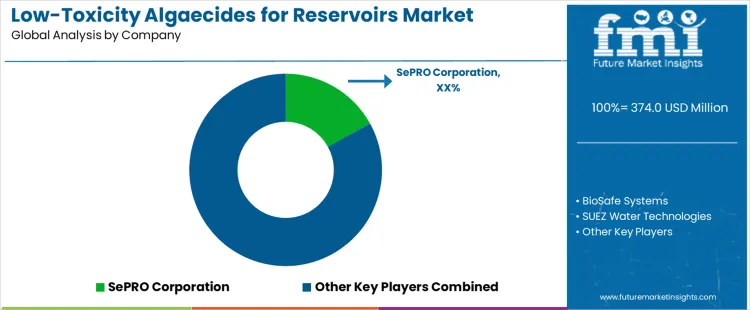
Competition in the Low Toxicity Algaecides for Reservoirs Market is shaped by how suppliers address ecological sensitivity, drinking water protection, and long term algae management rather than rapid kill performance. SePRO Corporation positions its portfolio around selective algal control, emphasizing application timing, dose precision, and compatibility with multiyear reservoir management plans. BioSafe Systems follows a different strategy, focusing on peroxide based and oxidizing chemistries that degrade rapidly, appealing to operators seeking minimal residual impact and short reentry intervals. Kemira participates through chemistry optimization aligned with municipal water treatment requirements, where algaecide performance must coexist with downstream clarification and disinfection processes. Product choice reflects regulatory acceptance, non-target species protection, and predictable behavior under varying temperature and nutrient conditions.
System level integration and stewardship define competitive differentiation. SUEZ Water Technologies approaches algaecide use as part of broader reservoir and intake management strategies, linking chemical control with monitoring, modeling, and operational support rather than standalone product supply. Nufarm competes through selective copper based and alternative formulations positioned for cost sensitive reservoirs, with emphasis on controlled dosing and resistance management. Across the market, suppliers invest in field trials, environmental impact studies, and operator training to reinforce credibility. Competitive advantage depends on regulatory trust, ecological performance under real conditions, and alignment with long term water resource management objectives rather than aggressive treatment cycles or volume driven sales.
Key Players in the Low Toxicity Algaecides for Reservoirs Market
- SePRO Corporation
- BioSafe Systems
- SUEZ Water Technologies
- Kemira
- Nufarm
Scope of the Report
| Items | Values |
|---|---|
| Quantitative Units (2026) | USD million |
| Biocide Type | Hydrogen Peroxide-Based Algaecides, Biopolymer & Enzyme-Based Algaecides, Copper-Free Chelated Formulations, Essential Oil & Natural Extract Algaecides, Other Low-Toxicity Algaecides |
| Reservoir Application | Drinking Water Reservoirs, Agricultural Irrigation Reservoirs, Industrial Water Storage, Recreational & Urban Water Bodies, Aquaculture & Fisheries Reservoirs |
| Delivery Method | Liquid Dosing Systems, Solid Tablet / Powder Formulations, Encapsulated / Time-Release Systems, Bio-Augmentation & Microbial Control, Other Delivery Formats |
| End-Use Industry | Municipal Water Authorities, Industrial Water Facilities, Agricultural Water Management, Aquaculture & Fisheries Operations, Recreational & Urban Water Management |
| Region | Asia Pacific, Europe, North America, Latin America, Middle East & Africa |
| Countries Covered | China, Japan, South Korea, India, Australia & New Zealand, ASEAN, Rest of Asia Pacific, Germany, United Kingdom, France, Italy, Spain, Nordic, BENELUX, Rest of Europe, USA, Canada, Mexico, Brazil, Chile, Rest of Latin America, Kingdom of Saudi Arabia, Other GCC Countries, Turkey, South Africa, Other African Union, Rest of Middle East & Africa |
| Key Companies Profiled | SePRO Corporation, BioSafe Systems, SUEZ Water Technologies, Kemira, Nufarm |
| Additional Attributes | Dollar sales by biocide type, Dollar by sales by reservoir application, Dollar by sales by delivery method, Dollar by sales by region, Annual procurement cycles, Adoption intervals / breakpoints, Regulatory compliance (EPA, REACH, local standards), Operational efficiency metrics, Water treatment system compatibility, Lifecycle impact assessment, Recurring reservoir treatment operations, Performance under varying pH, temperature, and flow conditions, Integration with automated dosing systems, Domestic vs. international supplier distribution |
Low Toxicity Algaecides for Reservoirs Market Segmentation
By Algaecide Type:
- Hydrogen Peroxide-Based Algaecides
- Biopolymer & Enzyme-Based Algaecides
- Copper-Free Chelated Formulations
- Essential Oil & Natural Extract Algaecides
- Other Low-Toxicity Algaecides
By Reservoir Application:
- Drinking Water Reservoirs
- Agricultural Irrigation Reservoirs
- Industrial Water Storage
- Recreational & Urban Water Bodies
- Aquaculture & Fisheries Reservoirs
By Region:
- Asia Pacific
- China
- Japan
- South Korea
- India
- Australia & New Zealand
- ASEAN
- Rest of Asia Pacific
- Europe
- Germany
- United Kingdom
- France
- Italy
- Spain
- Nordic
- BENELUX
- Rest of Europe
- North America
- United States
- Canada
- Mexico
- Latin America
- Brazil
- Chile
- Rest of Latin America
- Middle East & Africa
- Kingdom of Saudi Arabia
- Other GCC Countries
- Turkey
- South Africa
- Other African Union
- Rest of Middle East & Africa
Frequently Asked Questions
How big is the low-toxicity algaecides for reservoirs market in 2026?
The global low-toxicity algaecides for reservoirs market is estimated to be valued at USD 374.0 million in 2026.
What will be the size of low-toxicity algaecides for reservoirs market in 2036?
The market size for the low-toxicity algaecides for reservoirs market is projected to reach USD 943.9 million by 2036.
How much will be the low-toxicity algaecides for reservoirs market growth between 2026 and 2036?
The low-toxicity algaecides for reservoirs market is expected to grow at a 9.7% CAGR between 2026 and 2036.
What are the key algaecide types in the low-toxicity algaecides for reservoirs market?
The key algaecide types in low-toxicity algaecides for reservoirs market are hydrogen peroxide-based algaecides, biopolymer & enzyme-based algaecides, copper-free chelated formulations, essential oil & natural extract algaecides and other low-toxicity algaecides.
Which reservoir application segment to contribute significant share in the low-toxicity algaecides for reservoirs market in 2026?
In terms of reservoir application, drinking water reservoirs segment to command 34.0% share in the low-toxicity algaecides for reservoirs market in 2026.
Preview the report firsthand - request a free sample
Get SampleGet the brochure for pricing and purchase details.
Get PDFTable of Content
- Executive Summary
- Global Market Outlook
- Demand-side Trends
- Supply-side Trends
- Technology Roadmap Analysis
- Analysis and Recommendations
- Market Overview
- Market Coverage / Taxonomy
- Market Definition / Scope / Limitations
- Market Background
- Market Dynamics
- Drivers
- Restraints
- Opportunity
- Trends
- Scenario Forecast
- Demand in Optimistic Scenario
- Demand in Likely Scenario
- Demand in Conservative Scenario
- Opportunity Map Analysis
- Product Life Cycle Analysis
- Supply Chain Analysis
- Investment Feasibility Matrix
- Value Chain Analysis
- PESTLE and Porter’s Analysis
- Regulatory Landscape
- Regional Parent Market Outlook
- Production and Consumption Statistics
- Import and Export Statistics
- Market Dynamics
- Global Market Analysis 2021 to 2025 and Forecast, 2026 to 2036
- Historical Market Size Value (USD Million) Analysis, 2021 to 2025
- Current and Future Market Size Value (USD Million) Projections, 2026 to 2036
- Y-o-Y Growth Trend Analysis
- Absolute $ Opportunity Analysis
- Global Market Pricing Analysis 2021 to 2025 and Forecast 2026 to 2036
- Global Market Analysis 2021 to 2025 and Forecast 2026 to 2036, By Algaecide Type
- Introduction / Key Findings
- Historical Market Size Value (USD Million) Analysis By Algaecide Type , 2021 to 2025
- Current and Future Market Size Value (USD Million) Analysis and Forecast By Algaecide Type , 2026 to 2036
- Hydrogen Peroxide-Based Algaecides
- Biopolymer & Enzyme-Based Algaecides
- Copper-Free Chelated Formulations
- Essential Oil & Natural Extract Algaecides
- Other Low-Toxicity Algaecides
- Hydrogen Peroxide-Based Algaecides
- Y-o-Y Growth Trend Analysis By Algaecide Type , 2021 to 2025
- Absolute $ Opportunity Analysis By Algaecide Type , 2026 to 2036
- Global Market Analysis 2021 to 2025 and Forecast 2026 to 2036, By Reservoir Application
- Introduction / Key Findings
- Historical Market Size Value (USD Million) Analysis By Reservoir Application, 2021 to 2025
- Current and Future Market Size Value (USD Million) Analysis and Forecast By Reservoir Application, 2026 to 2036
- Drinking Water Reservoirs
- Agricultural Irrigation Reservoirs
- Industrial Water Storage
- Recreational & Urban Water Bodies
- Aquaculture & Fisheries Reservoirs
- Drinking Water Reservoirs
- Y-o-Y Growth Trend Analysis By Reservoir Application, 2021 to 2025
- Absolute $ Opportunity Analysis By Reservoir Application, 2026 to 2036
- Global Market Analysis 2021 to 2025 and Forecast 2026 to 2036, By Region
- Introduction
- Historical Market Size Value (USD Million) Analysis By Region, 2021 to 2025
- Current Market Size Value (USD Million) Analysis and Forecast By Region, 2026 to 2036
- North America
- Latin America
- Western Europe
- Eastern Europe
- East Asia
- South Asia and Pacific
- Middle East & Africa
- Market Attractiveness Analysis By Region
- North America Market Analysis 2021 to 2025 and Forecast 2026 to 2036, By Country
- Historical Market Size Value (USD Million) Trend Analysis By Market Taxonomy, 2021 to 2025
- Market Size Value (USD Million) Forecast By Market Taxonomy, 2026 to 2036
- By Country
- USA
- Canada
- Mexico
- By Algaecide Type
- By Reservoir Application
- By Country
- Market Attractiveness Analysis
- By Country
- By Algaecide Type
- By Reservoir Application
- Key Takeaways
- Latin America Market Analysis 2021 to 2025 and Forecast 2026 to 2036, By Country
- Historical Market Size Value (USD Million) Trend Analysis By Market Taxonomy, 2021 to 2025
- Market Size Value (USD Million) Forecast By Market Taxonomy, 2026 to 2036
- By Country
- Brazil
- Chile
- Rest of Latin America
- By Algaecide Type
- By Reservoir Application
- By Country
- Market Attractiveness Analysis
- By Country
- By Algaecide Type
- By Reservoir Application
- Key Takeaways
- Western Europe Market Analysis 2021 to 2025 and Forecast 2026 to 2036, By Country
- Historical Market Size Value (USD Million) Trend Analysis By Market Taxonomy, 2021 to 2025
- Market Size Value (USD Million) Forecast By Market Taxonomy, 2026 to 2036
- By Country
- Germany
- UK
- Italy
- Spain
- France
- Nordic
- BENELUX
- Rest of Western Europe
- By Algaecide Type
- By Reservoir Application
- By Country
- Market Attractiveness Analysis
- By Country
- By Algaecide Type
- By Reservoir Application
- Key Takeaways
- Eastern Europe Market Analysis 2021 to 2025 and Forecast 2026 to 2036, By Country
- Historical Market Size Value (USD Million) Trend Analysis By Market Taxonomy, 2021 to 2025
- Market Size Value (USD Million) Forecast By Market Taxonomy, 2026 to 2036
- By Country
- Russia
- Poland
- Hungary
- Balkan & Baltic
- Rest of Eastern Europe
- By Algaecide Type
- By Reservoir Application
- By Country
- Market Attractiveness Analysis
- By Country
- By Algaecide Type
- By Reservoir Application
- Key Takeaways
- East Asia Market Analysis 2021 to 2025 and Forecast 2026 to 2036, By Country
- Historical Market Size Value (USD Million) Trend Analysis By Market Taxonomy, 2021 to 2025
- Market Size Value (USD Million) Forecast By Market Taxonomy, 2026 to 2036
- By Country
- China
- Japan
- South Korea
- By Algaecide Type
- By Reservoir Application
- By Country
- Market Attractiveness Analysis
- By Country
- By Algaecide Type
- By Reservoir Application
- Key Takeaways
- South Asia and Pacific Market Analysis 2021 to 2025 and Forecast 2026 to 2036, By Country
- Historical Market Size Value (USD Million) Trend Analysis By Market Taxonomy, 2021 to 2025
- Market Size Value (USD Million) Forecast By Market Taxonomy, 2026 to 2036
- By Country
- India
- ASEAN
- Australia & New Zealand
- Rest of South Asia and Pacific
- By Algaecide Type
- By Reservoir Application
- By Country
- Market Attractiveness Analysis
- By Country
- By Algaecide Type
- By Reservoir Application
- Key Takeaways
- Middle East & Africa Market Analysis 2021 to 2025 and Forecast 2026 to 2036, By Country
- Historical Market Size Value (USD Million) Trend Analysis By Market Taxonomy, 2021 to 2025
- Market Size Value (USD Million) Forecast By Market Taxonomy, 2026 to 2036
- By Country
- Kingdom of Saudi Arabia
- Other GCC Countries
- Turkiye
- South Africa
- Other African Union
- Rest of Middle East & Africa
- By Algaecide Type
- By Reservoir Application
- By Country
- Market Attractiveness Analysis
- By Country
- By Algaecide Type
- By Reservoir Application
- Key Takeaways
- Key Countries Market Analysis
- USA
- Pricing Analysis
- Market Share Analysis, 2025
- By Algaecide Type
- By Reservoir Application
- Canada
- Pricing Analysis
- Market Share Analysis, 2025
- By Algaecide Type
- By Reservoir Application
- Mexico
- Pricing Analysis
- Market Share Analysis, 2025
- By Algaecide Type
- By Reservoir Application
- Brazil
- Pricing Analysis
- Market Share Analysis, 2025
- By Algaecide Type
- By Reservoir Application
- Chile
- Pricing Analysis
- Market Share Analysis, 2025
- By Algaecide Type
- By Reservoir Application
- Germany
- Pricing Analysis
- Market Share Analysis, 2025
- By Algaecide Type
- By Reservoir Application
- UK
- Pricing Analysis
- Market Share Analysis, 2025
- By Algaecide Type
- By Reservoir Application
- Italy
- Pricing Analysis
- Market Share Analysis, 2025
- By Algaecide Type
- By Reservoir Application
- Spain
- Pricing Analysis
- Market Share Analysis, 2025
- By Algaecide Type
- By Reservoir Application
- France
- Pricing Analysis
- Market Share Analysis, 2025
- By Algaecide Type
- By Reservoir Application
- India
- Pricing Analysis
- Market Share Analysis, 2025
- By Algaecide Type
- By Reservoir Application
- ASEAN
- Pricing Analysis
- Market Share Analysis, 2025
- By Algaecide Type
- By Reservoir Application
- Australia & New Zealand
- Pricing Analysis
- Market Share Analysis, 2025
- By Algaecide Type
- By Reservoir Application
- China
- Pricing Analysis
- Market Share Analysis, 2025
- By Algaecide Type
- By Reservoir Application
- Japan
- Pricing Analysis
- Market Share Analysis, 2025
- By Algaecide Type
- By Reservoir Application
- South Korea
- Pricing Analysis
- Market Share Analysis, 2025
- By Algaecide Type
- By Reservoir Application
- Russia
- Pricing Analysis
- Market Share Analysis, 2025
- By Algaecide Type
- By Reservoir Application
- Poland
- Pricing Analysis
- Market Share Analysis, 2025
- By Algaecide Type
- By Reservoir Application
- Hungary
- Pricing Analysis
- Market Share Analysis, 2025
- By Algaecide Type
- By Reservoir Application
- Kingdom of Saudi Arabia
- Pricing Analysis
- Market Share Analysis, 2025
- By Algaecide Type
- By Reservoir Application
- Turkiye
- Pricing Analysis
- Market Share Analysis, 2025
- By Algaecide Type
- By Reservoir Application
- South Africa
- Pricing Analysis
- Market Share Analysis, 2025
- By Algaecide Type
- By Reservoir Application
- USA
- Market Structure Analysis
- Competition Dashboard
- Competition Benchmarking
- Market Share Analysis of Top Players
- By Regional
- By Algaecide Type
- By Reservoir Application
- Competition Analysis
- Competition Deep Dive
- SePRO Corporation
- Overview
- Product Portfolio
- Profitability by Market Segments (Product/Age /Sales Channel/Region)
- Sales Footprint
- Strategy Overview
- Marketing Strategy
- Product Strategy
- Channel Strategy
- BioSafe Systems
- SUEZ Water Technologies
- Kemira
- Nufarm
- SePRO Corporation
- Competition Deep Dive
- Assumptions & Acronyms Used
- Research Methodology


