

- Industry Size (2026)
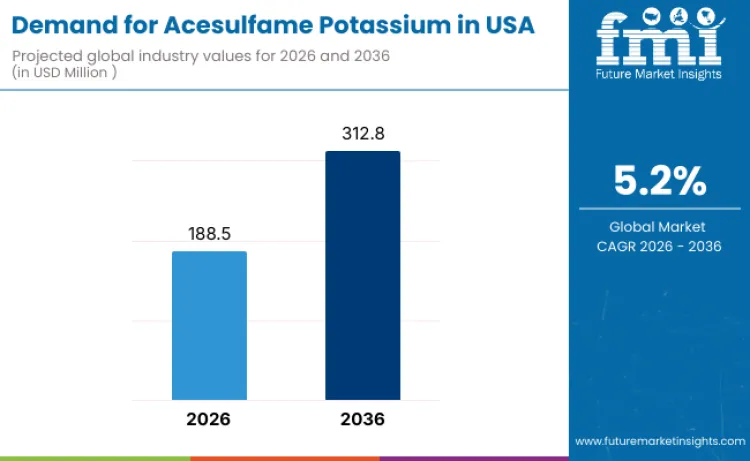
- USD 188.5 Mn
- Forecast (2036)
- USD 312.8 Mn
- CAGR (2026 to 2036)
- 5.2%
Demand for Acesulfame Potassium in USA 2026 to 2036
Demand for Acesulfame Potassium in USA is valued at USD 188.5 million in 2026 and is projected to reach USD 312.8 million by 2036, reflecting a CAGR of 5.2%. Demand grows as food, beverage, and pharmaceutical manufacturers increase use of high-intensity sweeteners to reduce sugar content while maintaining taste stability. Rising incidence of diabetes, obesity management initiatives, and reformulation of low-calorie products support steady consumption across multiple application categories.
Pharmaceutical-grade acesulfame potassium leads grade usage because high purity, tight particle control, and consistent sweetness profile are critical for syrups, chewable tablets, and oral dosage formulations. This grade offers strong thermal stability and compatibility with other sweeteners, enabling precise flavor masking in medicinal products. Reliability in regulatory compliance and batch consistency strengthens preference among pharmaceutical and nutraceutical formulators.
Quick Stats for Demand for Acesulfame Potassium in USA
- USA Acesulfame Potassium Sales Value (2026): USD 188.5 million
- USA Acesulfame Potassium Forecast Value (2036): USD 312.8 million
- USA Acesulfame Potassium Forecast CAGR (2026 to 2036): 5.2%
- Leading Grade in USA Demand: Pharmaceutical-grade acesulfame potassium
- Key Growth Regions in USA Demand: West USA, South USA, Northeast USA, Midwest USA
- Top Players in USA Demand: Celanese, Nutrinova, Anhui Jinhe Industrial, JK Sucralose, HYET Sweet
West USA, South USA, Northeast USA, and Midwest USA represent key growth regions supported by dense food processing activity, beverage manufacturing clusters, and pharmaceutical production hubs. Celanese, Nutrinova, Anhui Jinhe Industrial, JK Sucralose, and HYET Sweet anchor competitive activity through controlled production processes, supply-chain reliability, and application-specific grades aligned with evolving low-sugar formulation requirements across USA end-use sectors.
USA Acesulfame Potassium Key Takeaways
| Metric | Value |
|---|---|
| USA Acesulfame Potassium Sales Value (2026) | USD 188.5 million |
| USA Acesulfame Potassium Forecast Value (2036) | USD 312.8 million |
| USA Acesulfame Potassium Forecast CAGR (2026 to 2036) | 5.2% |
How Are the Segments Classified in the Demand for Acesulfame Potassium in the USA?
Demand for acesulfame potassium in the USA is shaped by sustained sugar-reduction targets, formulation consistency requirements, and regulatory acceptance across multiple consumption categories. Food processors, pharmaceutical formulators, and personal care manufacturers evaluate sweetness intensity, thermal and pH stability, solubility, and long-term shelf stability. Adoption patterns reflect preference for non-caloric sweeteners that maintain taste integrity during processing, storage, and distribution while meeting USA food safety and pharmaceutical compliance standards.
Which Application Accounts for the Largest Share of Demand in the USA?
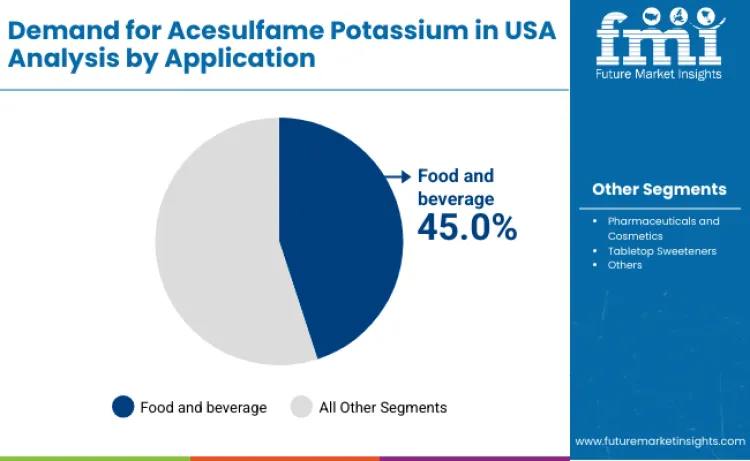
Food and beverage applications hold 45.0%, making them the leading application segment in the USA. Manufacturers use acesulfame potassium in carbonated beverages, flavored waters, dairy alternatives, baked products, and confectionery to achieve sugar reduction without compromising sweetness intensity. High stability under heat and acidic conditions supports use in pasteurized and shelf-stable products. Pharmaceuticals and cosmetics apply acesulfame potassium for taste masking in syrups, chewables, and oral-care formulations. Tabletop sweeteners rely on blends to improve sweetness profile and reduce aftertaste. Application distribution reflects dominant use within large-scale food and beverage processing environments.
Key Points:
- Food and beverage formulations represent the primary consumption base.
- Thermal and acid stability support processed and shelf-stable products.
- Pharmaceuticals use the sweetener for palatability enhancement.
Which Grade Accounts for the Largest Share of Demand in the USA?
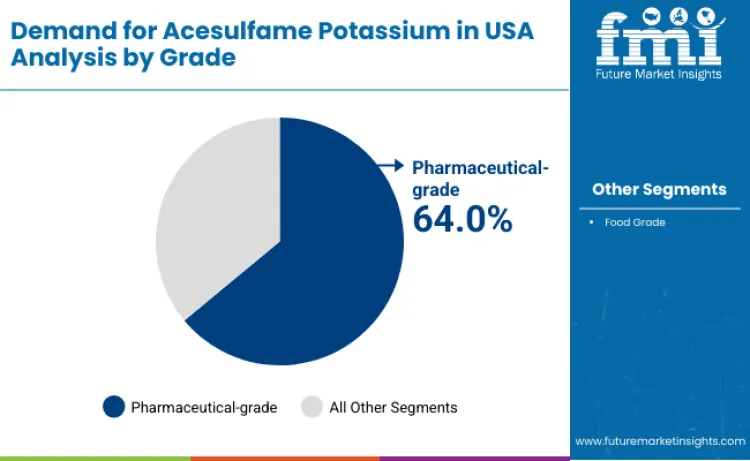
Pharmaceutical-grade acesulfame potassium holds 64.0%, making it the largest grade segment in the USA. This grade meets stringent purity, particle-size, and contaminant limits required across regulated food, drug, and cosmetic formulations. Manufacturers favor pharmaceutical grade to standardize sourcing across multiple product lines and reduce compliance complexity. Food-grade material serves applications with lower purity thresholds and narrower regulatory exposure. Grade distribution reflects preference for high-purity inputs within USA manufacturing systems where cross-category regulatory alignment is operationally important.
Key Points:
- Pharmaceutical grade dominates due to strict purity requirements.
- High-grade material supports multi-industry regulatory compliance.
- Food grade serves cost-sensitive, lower-specification applications.
What are the Key Dynamics in the Acesulfame Potassium Industry in USA?
Demand increases as US food and beverage manufacturers use acesulfame potassium to deliver sweetness without caloric contribution. Applications include carbonated beverages, dairy products, baked goods, tabletop sweeteners, and pharmaceuticals. Stability under heat and wide pH ranges supports usage across processed formulations. Consumption aligns with reduced-sugar product reformulation, diabetic-friendly offerings, and long shelf-life packaged foods within regulated manufacturing environments.
How does sugar-reduction reformulation need and beverage production drive demand in USA?
US beverage producers rely on acesulfame potassium to maintain sweetness intensity in zero-sugar and low-calorie drinks. Combination use with aspartame or sucralose improves flavour profiles and masks aftertaste in reformulated products. Food processors apply the sweetener in baked goods and desserts due to heat stability during processing. Dairy manufacturers use it in flavoured yogurts and frozen desserts requiring consistent sweetness. Pharmaceutical companies incorporate acesulfame potassium into syrups and chewable tablets for palatability. Regulatory approval by FDA supports broad application. Consumer demand for reduced-sugar options sustains steady procurement across national food and beverage brands.
How do consumer perception, competitive sweeteners, and regulatory scrutiny influence demand stability?
Public concern regarding artificial sweeteners influences purchasing decisions in certain consumer segments. Food companies balance acesulfame potassium use against demand for natural alternatives such as stevia. Price competition with other high-intensity sweeteners affects formulation choices. Labelling transparency requirements increase formulation review cycles. Some manufacturers reduce artificial sweetener content to support clean-label positioning. Supply dependence on imported raw materials introduces procurement sensitivity. Ongoing scientific review and regulatory monitoring shape cautious adoption strategies. Demand remains stable in mainstream processed foods and beverages, while growth faces constraints from shifting consumer preferences and competitive sweetener landscapes within the USA.
How Is Demand for Acesulfame Potassium in USA Evolving by Region?
Demand for acesulfame potassium in the USA is increasing due to sustained reformulation of low- and zero-sugar foods, expansion of diet beverages, and wider use in pharmaceutical and nutraceutical formulations. West USA leads with a 6.0% CAGR, supported by strong adoption of reduced-sugar beverages, functional foods, and health-oriented product launches. South USA follows at 5.4%, driven by large-scale beverage bottling, flavored dairy, and tabletop sweetener usage. Northeast USA records a 4.8% CAGR, shaped by processed food reformulation and pharmaceutical applications. Midwest USA posts a 4.2% CAGR, reflecting steady demand from packaged foods, bakery, and institutional food production. Regional variation reflects consumption patterns, manufacturing concentration, and reformulation intensity across the USA.
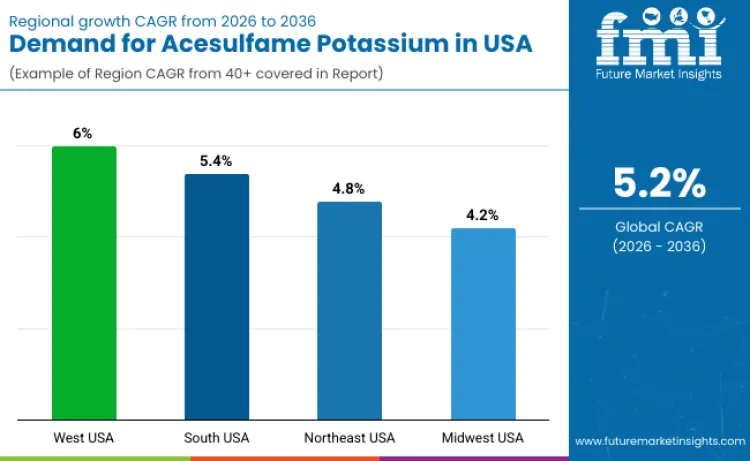
| Region | CAGR (2026-2036) |
|---|---|
| West USA | 6.0% |
| South USA | 5.4% |
| Northeast USA | 4.8% |
| Midwest USA | 4.2% |
How is West USA driving demand for Acesulfame Potassium?
West USA demand is driven by innovation-led food and beverage development and strong consumer preference for reduced-calorie products. The region’s CAGR of 6.0% reflects extensive use of acesulfame potassium in carbonated soft drinks, energy beverages, flavored waters, and plant-based dairy alternatives. Food manufacturers apply the sweetener to maintain taste stability under heat and pH variation in functional foods and sports nutrition products. Pharmaceutical and nutraceutical companies use acesulfame potassium in chewables, syrups, and effervescent formulations. Demand favors high-purity, fine-granule grades supplied in controlled packaging formats to support precise dosing and blending consistency.
- Reduced-sugar beverage and flavored-water formulations
- Functional foods and sports nutrition applications
- Pharmaceutical and nutraceutical sweetening use
- Preference for high-purity, formulation-stable grades
How is South USA driving demand for Acesulfame Potassium?
South USA demand is volume-oriented and closely tied to large-scale beverage and food manufacturing operations. The region’s CAGR of 5.4% reflects high consumption of acesulfame potassium in diet soft drinks, flavored milk, frozen desserts, and tabletop sweeteners. Beverage bottling plants and dairy processors rely on the sweetener for cost-effective sugar reduction with thermal stability during processing. Foodservice and institutional channels support additional usage in bulk-pack formats. Procurement emphasizes consistent supply, price stability, and compatibility with high-throughput production lines. Demand remains resilient due to broad consumer acceptance of low-sugar products.
- Large-scale beverage bottling operations
- Dairy and frozen dessert reformulation usage
- Tabletop sweetener and foodservice demand
- Bulk procurement aligned with continuous production
How is Northeast USA driving demand for Acesulfame Potassium?
Northeast USA demand reflects processed food reformulation, pharmaceutical manufacturing, and regulatory-driven sugar reduction. The region’s CAGR of 4.8% is supported by use of acesulfame potassium in baked goods, confectionery coatings, oral-care products, and pharmaceutical syrups. Food manufacturers apply the sweetener to achieve consistent sweetness without affecting texture or shelf life. Pharmaceutical producers require certified, low-impurity grades with documented compliance. Packaging preference favors mid-size bags and drums suited for controlled manufacturing environments. Demand growth aligns with gradual reformulation cycles rather than rapid volume expansion.
- Processed food and bakery reformulation
- Pharmaceutical syrups and oral formulations
- Demand for certified, compliance-ready grades
- Controlled manufacturing and packaging formats
How is Midwest USA driving demand for Acesulfame Potassium?
Midwest USA demand is stable and manufacturing-focused, driven by packaged foods, bakery products, and institutional food supply chains. The region’s CAGR of 4.2% reflects use of acesulfame potassium in cereals, baked goods, sauces, and reduced-sugar packaged meals. Food processors prioritize sweeteners offering heat stability and long shelf life. Cost efficiency and formulation flexibility influence purchasing decisions. Packaging commonly includes standard bags and reusable containers compatible with predictable production schedules. Growth remains moderate, supported by steady reformulation activity and replacement demand across established food manufacturing facilities.
- Bakery, cereal, and packaged food applications
- Heat-stable sweetening in processed foods
- Cost-focused procurement preferences
- Predictable demand tied to manufacturing output
What is the competitive landscape of demand for acesulfame potassium in the USA?
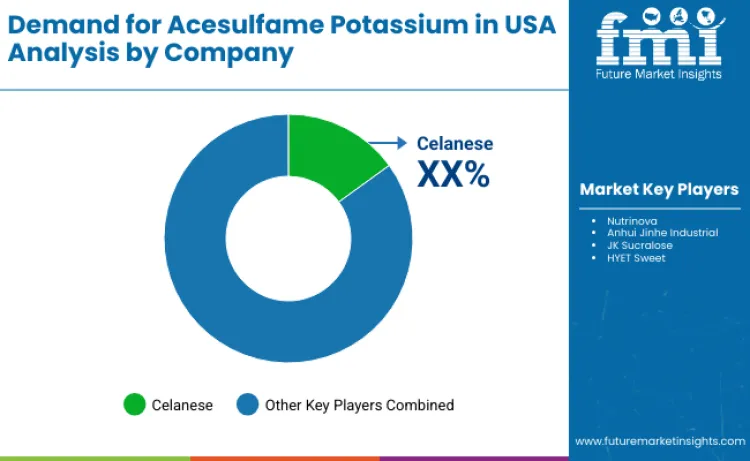
Demand for acesulfame potassium in the USA is driven by reduced-sugar reformulation across beverages, tabletop sweeteners, dairy products, baked goods, and pharmaceutical syrups. Applications require high sweetness intensity, thermal stability, and compatibility with other high-intensity sweeteners such as aspartame and sucralose. Buyers evaluate purity specifications, particle size control, solubility behavior, and regulatory compliance with FDA food additive standards. Procurement teams prioritize consistent domestic availability, food-grade certification, and technical support for formulation optimization. Trend in the USA market reflects sustained demand from carbonated soft drinks, flavored waters, and zero-sugar product lines, alongside stable use in oral care and medicinal products.
Celanese operates USA-based manufacturing and supplies acesulfame potassium to food and beverage formulators requiring large-volume, consistent-quality sweeteners. Nutrinova, part of Celanese, maintains strong commercial presence through established supply contracts and technical formulation support. Anhui Jinhe Industrial distributes acesulfame potassium into the USA through regulated import channels serving food and pharmaceutical customers. JK Sucralose supports USA demand with high-purity acesulfame potassium supplied via long-term distributor relationships. HYET Sweet supplies sweetener blends and individual high-intensity sweeteners to USA food manufacturers and ingredient distributors. Competitive positioning in the USA reflects production reliability, regulatory compliance, formulation expertise, and logistics capability supporting large-scale reduced-sugar product development.
Key Players in USA Acesulfame Potassium Demand
- Celanese
- Nutrinova
- Anhui Jinhe Industrial
- JK Sucralose
- HYET Sweet
Scope of the Report
| Items | Values |
|---|---|
| Quantitative Units | USD million |
| Application | Food and Beverage; Pharmaceuticals and Cosmetics; Tabletop Sweeteners; Others |
| Grade | Pharmaceutical Grade; Food Grade |
| Regions Covered | West USA; South USA; Northeast USA; Midwest USA |
| Key Companies Profiled | Celanese; Nutrinova; Anhui Jinhe Industrial; JK Sucralose; HYET Sweet |
| Additional Attributes | Dollar sales segmented by application and grade; food and beverage accounts for largest usage due to zero-calorie formulations; tabletop sweeteners support steady household demand; pharmaceutical-grade use linked to syrups and chewables; regulatory compliance and clean-label reformulation influence procurement; regional demand varies with beverage manufacturing concentration and processed food consumption patterns. |
USA Acesulfame Potassium Demand by Segments
Application:
- Food and Beverage
- Pharmaceuticals and Cosmetics
- Tabletop Sweeteners
- Others
Grade:
- Pharmaceutical Grade
- Food Grade
Region:
- West USA
- South USA
- Northeast USA
- Midwest USA
Frequently Asked Questions
How big is the demand for acesulfame potassium in USA in 2026?
The demand for acesulfame potassium in USA is estimated to be valued at USD 188.5 million in 2026.
What will be the size of acesulfame potassium demand in USA in 2036?
The demand size for acesulfame potassium in USA is projected to reach USD 312.8 million by 2036.
How much will the demand for acesulfame potassium in USA grow between 2026 and 2036?
The demand for acesulfame potassium in USA is expected to grow at a 5.2% CAGR between 2026 and 2036.
What are the key application areas in the acesulfame potassium demand in USA?
The key application areas in acesulfame potassium demand in USA include food and beverage products, pharmaceuticals, and nutraceutical formulations.
Which grade segment is expected to contribute a significant share in the acesulfame potassium demand in USA in 2026?
In terms of grade, pharmaceutical-grade acesulfame potassium is expected to command 64.0% share in the acesulfame potassium demand in USA in 2026.
Preview the report firsthand - request a free sample
Get SampleGet the brochure for pricing and purchase details.
Get PDFTable of Content
- Executive Summary
- USA Market Outlook
- Demand-side Trends
- Supply-side Trends
- Technology Roadmap Analysis
- Analysis and Recommendations
- Market Overview
- Market Coverage / Taxonomy
- Market Definition / Scope / Limitations
- Market Background
- Market Dynamics
- Drivers
- Restraints
- Opportunity
- Trends
- Scenario Forecast
- Demand in Optimistic Scenario
- Demand in Likely Scenario
- Demand in Conservative Scenario
- Opportunity Map Analysis
- Product Life Cycle Analysis
- Supply Chain Analysis
- Investment Feasibility Matrix
- Value Chain Analysis
- PESTLE and Porter’s Analysis
- Regulatory Landscape
- Regional Parent Market Outlook
- Production and Consumption Statistics
- Import and Export Statistics
- USA Acesulfame Potassium Demand Analysis 2020 to 2024 and Forecast, 2025 to 2035
- Historical Market Size Value (USD Million) Analysis, 2020 to 2024
- Current and Future Market Size Value (USD Million) Projections, 2025 to 2035
- Y-o-Y Growth Trend Analysis
- Absolute $ Opportunity Analysis
- USA Acesulfame Potassium Demand Pricing Analysis 2020 to 2024 and Forecast 2025 to 2035
- USA Acesulfame Potassium Demand Analysis 2020 to 2024 and Forecast 2025 to 2035, By Application
- Introduction / Key Findings
- Historical Market Size Value (USD Million) Analysis By Application, 2020 to 2024
- Current and Future Market Size Value (USD Million) Analysis and Forecast By Application, 2025 to 2035
- Food and Beverage
- Pharmaceuticals and Cosmetics
- Tabletop Sweeteners
- Others
- Y-o-Y Growth Trend Analysis By Application, 2020 to 2024
- Absolute $ Opportunity Analysis By Application, 2025 to 2035
- USA Acesulfame Potassium Demand Analysis 2020 to 2024 and Forecast 2025 to 2035, By Grade
- Introduction / Key Findings
- Historical Market Size Value (USD Million) Analysis By Grade, 2020 to 2024
- Current and Future Market Size Value (USD Million) Analysis and Forecast By Grade, 2025 to 2035
- Pharmaceutical Grade
- Food Grade
- Y-o-Y Growth Trend Analysis By Grade, 2020 to 2024
- Absolute $ Opportunity Analysis By Grade, 2025 to 2035
- Market Structure Analysis
- Competition Dashboard
- Competition Benchmarking
- Market Share Analysis of Top Players
- By Regional
- By Application
- By Grade
- Competition Analysis
- Competition Deep Dive
- Celanese
- Overview
- Product Portfolio
- Profitability by Market Segments (Product / Sales Channel / Region)
- Sales Footprint
- Strategy Overview
- Marketing Strategy
- Product Strategy
- Channel Strategy
- Nutrinova
- Anhui Jinhe Industrial
- JK Sucralose
- HYET Sweet
- Celanese
- Assumptions & Acronyms Used
- Research Methodology


