

- Industry Size (2026)
- USD 459.1 Mn
- Forecast (2036)
- USD 1067.2 Mn
- CAGR (2026 to 2036)
- 8.8%
Low-Toxicity Heat Transfer Fluids for Renewables Market Forecast and Outlook 2026 to 2036
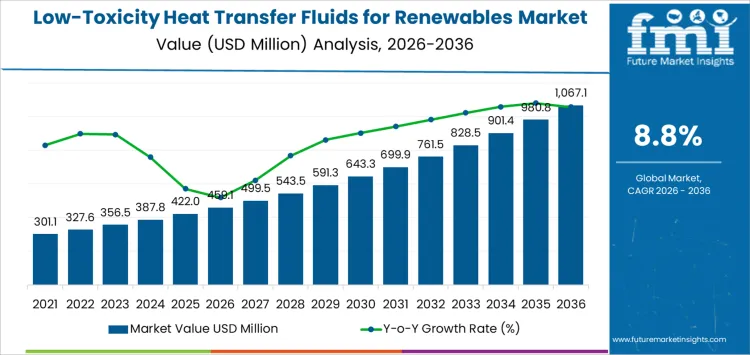
Global low-toxicity heat transfer fluids (HTFs) for renewables market is currently valued at USD 459.1 million in 2026, projected to reach USD 1,067.2 million by 2036, growing at a CAGR of 8.8%. Demand for low-toxicity HTFs is particularly high in systems like concentrated solar power (CSP), geothermal, and biomass, where efficient heat transfer is critical. Bio-based/biodegradable synthetic esters and glycols lead the market with a 28% share due to their environmentally friendly nature and strong thermal transfer capabilities. CSP and thermal storage applications hold the largest share at 34%, as they require highly efficient fluids to store and transport heat in solar energy systems.
Quick Stats for Low-Toxicity Heat Transfer Fluids for Renewables Market
- Low-Toxicity Heat Transfer Fluids for Renewables Market Value (2026): USD 459.1 million
- Low-Toxicity Heat Transfer Fluids for Renewables Market Forecast Value (2036): USD 1,067.2 million
- Low-Toxicity Heat Transfer Fluids for Renewables Market Forecast CAGR: 8.8%
- Leading Fluid Chemistry in Low-Toxicity Heat Transfer Fluids for Renewables Market: Bio-based / biodegradable synthetic esters & glycols
- Key Growth Regions in Low-Toxicity Heat Transfer Fluids for Renewables Market: Asia Pacific, Europe, North America
- Top Players in Low-Toxicity Heat Transfer Fluids for Renewables Market: Therminol / Eastman, Globaltherm, BASF
China leads the market with a 10.5% CAGR, fueled by rapid wind and solar power adoption and a commitment to sustainability. The UK follows with a 9.8% growth rate, driven by offshore wind energy projects and a focus on green technologies. The USA shows steady growth at 8.0%, supported by increasing investments in renewable infrastructure. Germany, with its strong renewable energy focus, grows at 8.5%, benefiting from regulatory support and a robust wind and solar power industry. As renewable energy adoption continues to rise, demand for low-toxicity HTFs is expected to increase, ensuring the longevity and efficiency of renewable energy systems worldwide.
Low‑Toxicity Heat Transfer Fluids for Renewables Market Key Takeaways
| Metric | Value |
|---|---|
| Industry Value (2026) | USD 459.1 million |
| Forecast Value (2036) | USD 1,067.2 million |
| Forecast CAGR (2026–2036) | 8.8% |
How is the Global Low‑Toxicity Heat Transfer Fluids for Renewables Sector Advancing?
The global low‑toxicity heat transfer fluids for renewables market is growing strongly as the renewable energy sector expands and operators prioritize safer, environmentally responsible thermal management solutions. Heat transfer fluids are critical in technologies such as concentrated solar power (CSP), geothermal, and biomass systems where they transport thermal energy between components. Traditional heat transfer fluids often contain hazardous or high‑toxicity chemicals, which can pose environmental and safety risks if spilled or released. Low‑toxicity alternatives are increasingly adopted because they reduce environmental impact, improve worker safety, and align with the sustainability goals of renewable energy projects.
As renewable capacity increases worldwide particularly in solar and geothermal installations the need for efficient and safe thermal fluids is rising. Innovations in low‑toxicity formulations are improving thermal stability, heat transfer efficiency, and fluid longevity, making them competitive with conventional fluids while minimizing health and environmental risks. These advancements are particularly important in regions with strict environmental regulations or where operational safety is a top priority.
The market is expected to continue its robust growth as renewable infrastructure scales up and stakeholders push for greener operational practices. Challenges such as higher upfront costs for specialized fluids and the need for performance validation across diverse renewable applications may influence adoption rates. Continued research and development in formulation technologies, along with supportive regulatory frameworks, will be key to expanding the use of low‑toxicity heat transfer fluids across the renewables landscape.
What Is the Segment-Wise Analysis for the Global Low-Toxicity Heat Transfer Fluids for Renewables Market?
The global low-toxicity heat transfer fluids (HTFs) for renewables market is segmented by fluid chemistry and renewable applications. Bio-based/biodegradable synthetic esters & glycols lead the market with a 28% share due to their environmentally friendly nature and effectiveness in heat transfer. Other significant fluid chemistries include low-toxicity silicone HTFs, low-toxicity mineral-oil replacements, ionic-liquid & deep eutectic solvent HTFs, and water-based heat transfer fluids. In terms of renewable applications, Concentrated Solar Power (CSP) and thermal storage hold the largest share at 34%, followed by solar process heat & district heating systems, geothermal heat transfer loops, and biomass & bioenergy thermal systems, reflecting the growing demand for sustainable energy solutions.
Why Do Bio-Based / Biodegradable Synthetic Esters & Glycols Lead the Global Low-Toxicity Heat Transfer Fluids Market?
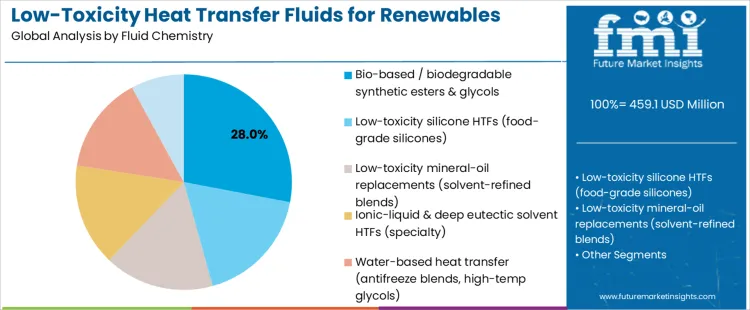
Bio-based / biodegradable synthetic esters & glycols hold a 28% share in the global low-toxicity heat transfer fluids for renewables market due to their environmentally sustainable properties and excellent heat transfer efficiency. These fluids are ideal for renewable energy systems as they are non-toxic and biodegradable, making them safe for both the environment and operators. They are particularly effective in applications such as concentrated solar power (CSP) and thermal storage, where efficient heat transfer is crucial. As the demand for cleaner, renewable energy solutions increases, bio-based esters & glycols are becoming the preferred choice for heat transfer applications in the renewable energy sector.
Why Do CSP & Thermal Storage Hold the Largest Share in the Global Low-Toxicity Heat Transfer Fluids Market?
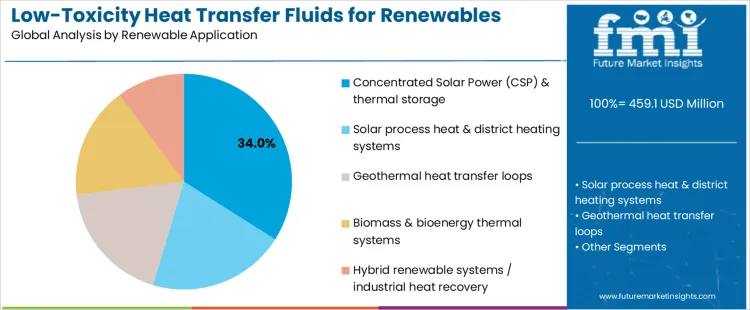
Concentrated Solar Power (CSP) and thermal storage applications hold the largest share of 34% in the global low-toxicity heat transfer fluids for renewables market due to the critical need for efficient and sustainable heat transfer solutions in solar energy systems. CSP plants rely on the ability to store heat for later use, and low-toxicity HTFs, such as bio-based esters and glycols, are ideal for these systems due to their excellent heat retention properties. Thermal storage enhances the flexibility and reliability of solar energy production, making it a key application area for low-toxicity HTFs. As the solar power industry grows, the demand for these specialized fluids continues to rise, driving market growth.
What is Shaping the Low Toxicity Heat Transfer Fluids for Renewables Market?
The low toxicity heat transfer fluids for renewables market is shaped by the rapid growth of renewable energy installations such as solar thermal, geothermal, and concentrated solar power (CSP) systems. These technologies rely on heat transfer fluids (HTFs) to efficiently move thermal energy from capture points to storage or conversion systems. Traditional HTFs can contain hazardous substances that pose environmental and safety risks. Increasing regulatory pressure, sustainability goals, and the emphasis on worker safety are driving adoption of low toxicity, environmentally safer fluid alternatives that maintain thermal performance while reducing ecological impact.
What Challenges Are Limiting the Adoption of Low Toxicity Heat Transfer Fluids for Renewables?
Adoption is constrained by cost considerations and performance perceptions. Low toxicity HTFs can be more expensive upfront than conventional fluids, which may deter cost sensitive developers or retrofit projects. Some renewable system designers and operators may also question whether greener fluids offer equivalent thermal efficiency, stability at high temperatures, and long term reliability, especially in extreme climates. Technical challenges related to compatibility with existing system materials and infrastructure can require engineering adjustments. Limited awareness or availability of certain low toxicity options in some regions may also slow broader uptake.
What Key Trends Are Shaping the Low Toxicity Heat Transfer Fluids for Renewables Market?
Key trends include innovation in bio based and synthetic fluids that offer improved thermal conductivity, low freezing points, and enhanced stability while reducing toxicity and environmental risk. There is rising interest in fluids that are fully biodegradable and compatible with closed loop thermal storage systems. Collaboration between fluid manufacturers and renewable system designers is leading to optimized fluid formulations for specific applications such as solar fields, geothermal loops, and industrial waste heat recovery. Regulatory alignment and sustainability certifications are also encouraging adoption, as developers seek to meet green standards and circular economy goals.
What is the Growth Outlook for the Low-Toxicity Heat Transfer Fluids for Renewables Market by Country?
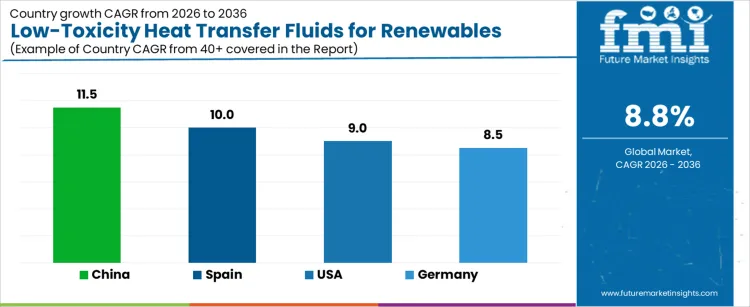
| Country | CAGR (%) |
|---|---|
| China | 11.5% |
| United States | 9.0% |
| Germany | 8.5% |
| Spain | 10.0% |
The low-toxicity heat transfer fluids for renewables market is experiencing strong growth, with China leading at a 11.5% CAGR, driven by its rapid expansion in renewable energy installations, particularly solar and geothermal energy. Spain follows with 10.0%, supported by its significant investments in renewable energy and a growing focus on sustainable technologies. The United States grows at 9.0%, driven by the increasing demand for sustainable energy solutions and the adoption of safer heat transfer fluids in renewable energy systems. Germany’s market grows at 8.5%, fueled by its commitment to clean energy and environmentally responsible solutions.
Why is China Leading in the Low-Toxicity Heat Transfer Fluids for Renewables Market?
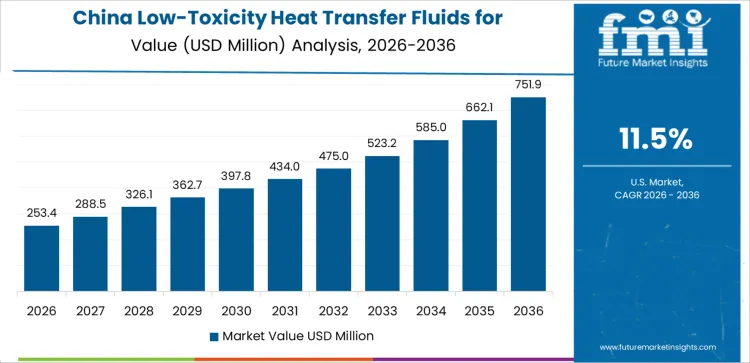
China’s low-toxicity heat transfer fluids for renewables market is growing at 11.5%, driven by the country’s massive investments in renewable energy, particularly in solar and geothermal power. As China accelerates its transition to renewable energy to reduce carbon emissions, the need for safe, efficient, and eco-friendly heat transfer fluids is increasing. Low-toxicity fluids are increasingly being used to ensure the safety of both energy systems and the environment. China’s commitment to sustainability and the growing demand for renewable energy technologies are pushing the market for low-toxicity heat transfer fluids. As the country continues to lead in solar and geothermal energy installations, the adoption of these sustainable fluids will continue to rise, driving market growth.
What is Driving the Growth of the Low-Toxicity Heat Transfer Fluids for Renewables Market in Spain?
Spain’s low-toxicity heat transfer fluids for renewables market is growing at 10.0%, supported by the country’s strong commitment to renewable energy development and sustainability. Spain is one of the leading countries in Europe for solar power generation, and as renewable energy installations expand, the demand for eco-friendly, safe heat transfer fluids is increasing. The use of low-toxicity fluids helps improve the safety and efficiency of renewable energy systems, particularly in solar thermal and geothermal energy production. Spain’s focus on reducing carbon emissions and promoting environmentally friendly technologies is driving the adoption of these fluids. With continued investments in renewable energy, Spain’s market for low-toxicity heat transfer fluids is set to grow further.
How is the Low-Toxicity Heat Transfer Fluids for Renewables Market Expanding in the United States?
The United States’ low-toxicity heat transfer fluids for renewables market is growing at 9.0%, driven by increasing investments in renewable energy projects and the need for safer, sustainable heat transfer fluids. As the US continues to invest in solar, geothermal, and other renewable energy sources, the adoption of low-toxicity heat transfer fluids becomes more important for both environmental and safety concerns. These fluids help enhance the performance and longevity of renewable energy systems while minimizing harmful environmental impacts. Government incentives and policies promoting clean energy adoption are contributing to the growth of the market. As renewable energy technologies continue to gain traction in the US, the demand for low-toxicity heat transfer fluids is expected to increase steadily.
What is Contributing to the Growth of the Low-Toxicity Heat Transfer Fluids for Renewables Market in Germany?
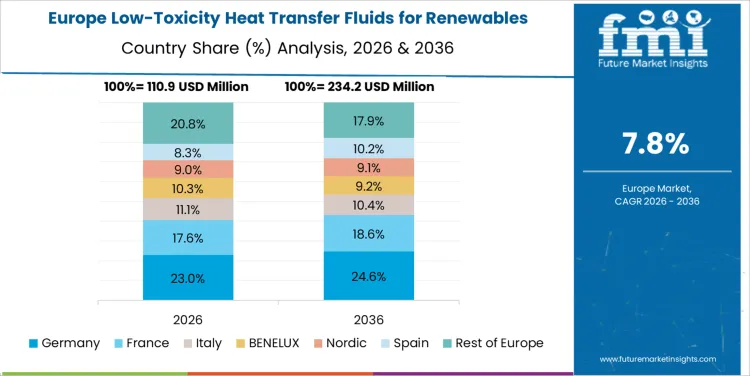
Germany’s low-toxicity heat transfer fluids for renewables market is growing at 8.5%, fueled by the country’s strong commitment to renewable energy and environmental sustainability. Germany is a leader in both solar and geothermal energy production, and as these sectors expand, the need for eco-friendly, low-toxicity heat transfer fluids is increasing. The adoption of these fluids aligns with Germany’s broader goal of reducing carbon emissions and improving the efficiency of renewable energy systems. The country’s stringent environmental regulations and focus on clean technologies further drive the demand for low-toxicity fluids. With continued investment in renewable energy infrastructure and a growing focus on sustainability, Germany’s market for low-toxicity heat transfer fluids is expected to continue expanding.
How Are Companies Competing in the Low‑Toxicity Heat Transfer Fluids for Renewables Market?
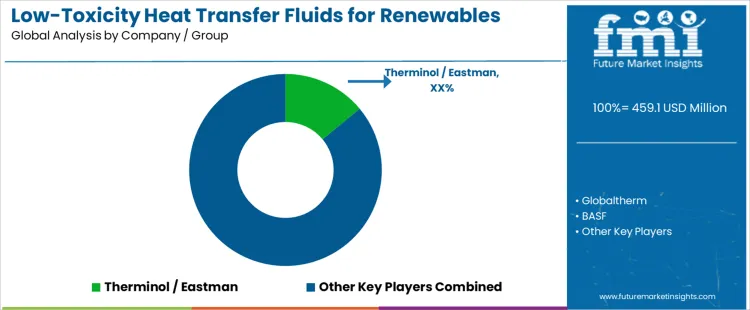
Therminol / Eastman, Globaltherm, and BASF compete with differentiated low‑toxicity heat transfer fluids designed for renewable energy applications such as solar thermal, geothermal, and concentrated solar power. Therminol / Eastman brochures highlight engineered heat transfer fluids with low environmental impact, strong thermal stability, and broad temperature ranges that support efficient energy capture and storage. Collateral focuses on performance metrics, fluid longevity, and compatibility with renewable system metallurgy. Globaltherm positions its products around high‑performance formulations that deliver reliable heat transfer with reduced hazard profiles and clear safety data. Its literature emphasizes ease of handling, lower risk classifications, and support resources for system designers and maintenance teams. BASF presents low‑toxicity heat transfer chemistries that integrate into diverse renewable applications with emphasis on regulatory compliance and reduced environmental footprint. Product brochures detail technical specifications, lifecycle advantages, and test results that demonstrate thermal efficiency and fluid stability under cyclical conditions common in renewable installations.
Across all firms, marketing materials stress sustainability credentials and adherence to evolving environmental standards. Technical data sheets and application guides are crafted to help engineers and procurement professionals evaluate fluid performance, safety classifications, and cost implications. Competitive strategies center on innovation in fluid chemistry, robust global supply, and clear communication of safety and efficiency benefits. Emphasis on low toxicity, reliability in extreme temperatures, and support infrastructure aims to influence adoption in a market growing with renewable energy deployments.
Key Players in Low-Toxicity Heat Transfer Fluids for Renewables Market
- Therminol / Eastman
- Globaltherm
- BASF
Scope of Report
| Items | Values |
|---|---|
| Quantitative Units (2025) | USD million |
| End Use Application | Maintenance Touch-Up Coatings / Repair Lacquers, Corrosion Inhibitor Liquids & Sprays (On-Site), Surface Cleaning & De-Contamination Chemistries, Inhibitor-Laden Greases & Lubricants, Cathodic Protection Consumables & Inhibitor Dosing Reagents, Monitoring & Test Reagents (Coupon, Probe Consumables), Specialty Biodegradable / Low-VOC Maintenance Chemistries |
| Product Type | Maintenance Touch-Up Coatings / Repair Lacquers, Corrosion Inhibitor Liquids & Sprays, Surface Cleaning & De-Contamination Chemistries, Inhibitor-Laden Greases & Lubricants, Cathodic Protection Consumables, Monitoring & Test Reagents, Specialty Biodegradable / Low-VOC Chemistries |
| Delivery Model | O&M Service Provider Supplied (Consumables in Service Contracts), OEM / Turbine Manufacturer Approved Consumables, Direct Purchase by Asset Owner / Site Maintenance Teams |
| Regions Covered | Asia Pacific, Europe, North America, Latin America, Middle East & Africa |
| Countries Covered | USA, China, Japan, South Korea, India, Australia & New Zealand, ASEAN, Germany, UK, France, Italy, Spain, Nordic, BENELUX, Brazil, Chile, Mexico, Saudi Arabia, Other GCC Countries, Turkey, South Africa, Other African Union |
| Key Companies Profiled | Jotun, Hempel, AkzoNobel, Sherwin-Williams, CRC |
| Additional Attributes | Dollar sales by product type, delivery model, and region; regional CAGR and growth outlook; distribution channels including service providers, OEMs, and asset owners; innovation trends in biodegradable and low-VOC chemistries; competitive positioning of global vs regional suppliers. |
Low-Toxicity Heat Transfer Fluids for Renewables Market by Segments
Fluid Chemistry
- Bio-based / biodegradable synthetic esters & glycols
- Low-toxicity silicone HTFs (food-grade silicones)
- Low-toxicity mineral-oil replacements (solvent-refined blends)
- Ionic-liquid & deep eutectic solvent HTFs (specialty)
- Water-based heat transfer (antifreeze blends, high-temp glycols)
- PCM-enhanced / nano-additive low-toxicity fluids
Renewable Application
- Concentrated Solar Power (CSP) & thermal storage
- Solar process heat & district heating systems
- Geothermal heat transfer loops
- Biomass & bioenergy thermal systems
- Hybrid renewable systems / industrial heat recovery
Region:
- Asia Pacific
- China
- Japan
- South Korea
- India
- Australia & New Zealand
- ASEAN
- Rest of Asia Pacific
- Europe
- Germany
- United Kingdom
- France
- Italy
- Spain
- Nordic
- BENELUX
- Rest of Europe
- North America
- United States
- Canada
- Mexico
- Latin America
- Brazil
- Chile
- Rest of Latin America
- Middle East & Africa
- Kingdom of Saudi Arabia
- Other GCC Countries
- Turkey
- South Africa
- Other African Union
- Rest of Middle East & Africa
Frequently Asked Questions
How big is the low-toxicity heat transfer fluids for renewables market in 2026?
The global low-toxicity heat transfer fluids for renewables market is estimated to be valued at USD 459.1 million in 2026.
What will be the size of low-toxicity heat transfer fluids for renewables market in 2036?
The market size for the low-toxicity heat transfer fluids for renewables market is projected to reach USD 1,067.1 million by 2036.
How much will be the low-toxicity heat transfer fluids for renewables market growth between 2026 and 2036?
The low-toxicity heat transfer fluids for renewables market is expected to grow at a 8.8% CAGR between 2026 and 2036.
What are the key product types in the low-toxicity heat transfer fluids for renewables market?
The key product types in low-toxicity heat transfer fluids for renewables market are bio-based / biodegradable synthetic esters & glycols, low-toxicity silicone htfs (food-grade silicones), low-toxicity mineral-oil replacements (solvent-refined blends), ionic-liquid & deep eutectic solvent htfs (specialty), water-based heat transfer (antifreeze blends, high-temp glycols) and pcm-enhanced / nano-additive low-toxicity fluids.
Which renewable application segment to contribute significant share in the low-toxicity heat transfer fluids for renewables market in 2026?
In terms of renewable application, concentrated solar power (csp) & thermal storage segment to command 34.0% share in the low-toxicity heat transfer fluids for renewables market in 2026.
Preview the report firsthand - request a free sample
Get SampleGet the brochure for pricing and purchase details.
Get PDFTable of Content
- Executive Summary
- Global Market Outlook
- Demand-side Trends
- Supply-side Trends
- Technology Roadmap Analysis
- Analysis and Recommendations
- Market Overview
- Market Coverage / Taxonomy
- Market Definition / Scope / Limitations
- Market Background
- Market Dynamics
- Drivers
- Restraints
- Opportunity
- Trends
- Scenario Forecast
- Demand in Optimistic Scenario
- Demand in Likely Scenario
- Demand in Conservative Scenario
- Opportunity Map Analysis
- Product Life Cycle Analysis
- Supply Chain Analysis
- Investment Feasibility Matrix
- Value Chain Analysis
- PESTLE and Porter’s Analysis
- Regulatory Landscape
- Regional Parent Market Outlook
- Production and Consumption Statistics
- Import and Export Statistics
- Market Dynamics
- Global Market Analysis 2021 to 2025 and Forecast, 2026 to 2036
- Historical Market Size Value (USD Million) Analysis, 2021 to 2025
- Current and Future Market Size Value (USD Million) Projections, 2026 to 2036
- Y-o-Y Growth Trend Analysis
- Absolute $ Opportunity Analysis
- Global Market Pricing Analysis 2021 to 2025 and Forecast 2026 to 2036
- Global Market Analysis 2021 to 2025 and Forecast 2026 to 2036, By Fluid Chemistry
- Introduction / Key Findings
- Historical Market Size Value (USD Million) Analysis By Fluid Chemistry , 2021 to 2025
- Current and Future Market Size Value (USD Million) Analysis and Forecast By Fluid Chemistry , 2026 to 2036
- Bio-based / biodegradable synthetic esters & glycols
- Low-toxicity silicone HTFs (food-grade silicones)
- Low-toxicity mineral-oil replacements (solvent-refined blends)
- Ionic-liquid & deep eutectic solvent HTFs (specialty)
- Water-based heat transfer (antifreeze blends, high-temp glycols)
- PCM-enhanced / nano-additive low-toxicity fluids
- Y-o-Y Growth Trend Analysis By Fluid Chemistry , 2021 to 2025
- Absolute $ Opportunity Analysis By Fluid Chemistry , 2026 to 2036
- Global Market Analysis 2021 to 2025 and Forecast 2026 to 2036, By Renewable Application
- Introduction / Key Findings
- Historical Market Size Value (USD Million) Analysis By Renewable Application, 2021 to 2025
- Current and Future Market Size Value (USD Million) Analysis and Forecast By Renewable Application, 2026 to 2036
- Concentrated Solar Power (CSP) & thermal storage
- Solar process heat & district heating systems
- Geothermal heat transfer loops
- Biomass & bioenergy thermal systems
- Hybrid renewable systems / industrial heat recovery
- Y-o-Y Growth Trend Analysis By Renewable Application, 2021 to 2025
- Absolute $ Opportunity Analysis By Renewable Application, 2026 to 2036
- Global Market Analysis 2021 to 2025 and Forecast 2026 to 2036, By Region
- Introduction
- Historical Market Size Value (USD Million) Analysis By Region, 2021 to 2025
- Current Market Size Value (USD Million) Analysis and Forecast By Region, 2026 to 2036
- North America
- Latin America
- Western Europe
- Eastern Europe
- East Asia
- South Asia and Pacific
- Middle East & Africa
- Market Attractiveness Analysis By Region
- North America Market Analysis 2021 to 2025 and Forecast 2026 to 2036, By Country
- Historical Market Size Value (USD Million) Trend Analysis By Market Taxonomy, 2021 to 2025
- Market Size Value (USD Million) Forecast By Market Taxonomy, 2026 to 2036
- By Country
- USA
- Canada
- Mexico
- By Fluid Chemistry
- By Renewable Application
- By Country
- Market Attractiveness Analysis
- By Country
- By Fluid Chemistry
- By Renewable Application
- Key Takeaways
- Latin America Market Analysis 2021 to 2025 and Forecast 2026 to 2036, By Country
- Historical Market Size Value (USD Million) Trend Analysis By Market Taxonomy, 2021 to 2025
- Market Size Value (USD Million) Forecast By Market Taxonomy, 2026 to 2036
- By Country
- Brazil
- Chile
- Rest of Latin America
- By Fluid Chemistry
- By Renewable Application
- By Country
- Market Attractiveness Analysis
- By Country
- By Fluid Chemistry
- By Renewable Application
- Key Takeaways
- Western Europe Market Analysis 2021 to 2025 and Forecast 2026 to 2036, By Country
- Historical Market Size Value (USD Million) Trend Analysis By Market Taxonomy, 2021 to 2025
- Market Size Value (USD Million) Forecast By Market Taxonomy, 2026 to 2036
- By Country
- Germany
- UK
- Italy
- Spain
- France
- Nordic
- BENELUX
- Rest of Western Europe
- By Fluid Chemistry
- By Renewable Application
- By Country
- Market Attractiveness Analysis
- By Country
- By Fluid Chemistry
- By Renewable Application
- Key Takeaways
- Eastern Europe Market Analysis 2021 to 2025 and Forecast 2026 to 2036, By Country
- Historical Market Size Value (USD Million) Trend Analysis By Market Taxonomy, 2021 to 2025
- Market Size Value (USD Million) Forecast By Market Taxonomy, 2026 to 2036
- By Country
- Russia
- Poland
- Hungary
- Balkan & Baltic
- Rest of Eastern Europe
- By Fluid Chemistry
- By Renewable Application
- By Country
- Market Attractiveness Analysis
- By Country
- By Fluid Chemistry
- By Renewable Application
- Key Takeaways
- East Asia Market Analysis 2021 to 2025 and Forecast 2026 to 2036, By Country
- Historical Market Size Value (USD Million) Trend Analysis By Market Taxonomy, 2021 to 2025
- Market Size Value (USD Million) Forecast By Market Taxonomy, 2026 to 2036
- By Country
- China
- Japan
- South Korea
- By Fluid Chemistry
- By Renewable Application
- By Country
- Market Attractiveness Analysis
- By Country
- By Fluid Chemistry
- By Renewable Application
- Key Takeaways
- South Asia and Pacific Market Analysis 2021 to 2025 and Forecast 2026 to 2036, By Country
- Historical Market Size Value (USD Million) Trend Analysis By Market Taxonomy, 2021 to 2025
- Market Size Value (USD Million) Forecast By Market Taxonomy, 2026 to 2036
- By Country
- India
- ASEAN
- Australia & New Zealand
- Rest of South Asia and Pacific
- By Fluid Chemistry
- By Renewable Application
- By Country
- Market Attractiveness Analysis
- By Country
- By Fluid Chemistry
- By Renewable Application
- Key Takeaways
- Middle East & Africa Market Analysis 2021 to 2025 and Forecast 2026 to 2036, By Country
- Historical Market Size Value (USD Million) Trend Analysis By Market Taxonomy, 2021 to 2025
- Market Size Value (USD Million) Forecast By Market Taxonomy, 2026 to 2036
- By Country
- Kingdom of Saudi Arabia
- Other GCC Countries
- Turkiye
- South Africa
- Other African Union
- Rest of Middle East & Africa
- By Fluid Chemistry
- By Renewable Application
- By Country
- Market Attractiveness Analysis
- By Country
- By Fluid Chemistry
- By Renewable Application
- Key Takeaways
- Key Countries Market Analysis
- USA
- Pricing Analysis
- Market Share Analysis, 2025
- By Fluid Chemistry
- By Renewable Application
- Canada
- Pricing Analysis
- Market Share Analysis, 2025
- By Fluid Chemistry
- By Renewable Application
- Mexico
- Pricing Analysis
- Market Share Analysis, 2025
- By Fluid Chemistry
- By Renewable Application
- Brazil
- Pricing Analysis
- Market Share Analysis, 2025
- By Fluid Chemistry
- By Renewable Application
- Chile
- Pricing Analysis
- Market Share Analysis, 2025
- By Fluid Chemistry
- By Renewable Application
- Germany
- Pricing Analysis
- Market Share Analysis, 2025
- By Fluid Chemistry
- By Renewable Application
- UK
- Pricing Analysis
- Market Share Analysis, 2025
- By Fluid Chemistry
- By Renewable Application
- Italy
- Pricing Analysis
- Market Share Analysis, 2025
- By Fluid Chemistry
- By Renewable Application
- Spain
- Pricing Analysis
- Market Share Analysis, 2025
- By Fluid Chemistry
- By Renewable Application
- France
- Pricing Analysis
- Market Share Analysis, 2025
- By Fluid Chemistry
- By Renewable Application
- India
- Pricing Analysis
- Market Share Analysis, 2025
- By Fluid Chemistry
- By Renewable Application
- ASEAN
- Pricing Analysis
- Market Share Analysis, 2025
- By Fluid Chemistry
- By Renewable Application
- Australia & New Zealand
- Pricing Analysis
- Market Share Analysis, 2025
- By Fluid Chemistry
- By Renewable Application
- China
- Pricing Analysis
- Market Share Analysis, 2025
- By Fluid Chemistry
- By Renewable Application
- Japan
- Pricing Analysis
- Market Share Analysis, 2025
- By Fluid Chemistry
- By Renewable Application
- South Korea
- Pricing Analysis
- Market Share Analysis, 2025
- By Fluid Chemistry
- By Renewable Application
- Russia
- Pricing Analysis
- Market Share Analysis, 2025
- By Fluid Chemistry
- By Renewable Application
- Poland
- Pricing Analysis
- Market Share Analysis, 2025
- By Fluid Chemistry
- By Renewable Application
- Hungary
- Pricing Analysis
- Market Share Analysis, 2025
- By Fluid Chemistry
- By Renewable Application
- Kingdom of Saudi Arabia
- Pricing Analysis
- Market Share Analysis, 2025
- By Fluid Chemistry
- By Renewable Application
- Turkiye
- Pricing Analysis
- Market Share Analysis, 2025
- By Fluid Chemistry
- By Renewable Application
- South Africa
- Pricing Analysis
- Market Share Analysis, 2025
- By Fluid Chemistry
- By Renewable Application
- USA
- Market Structure Analysis
- Competition Dashboard
- Competition Benchmarking
- Market Share Analysis of Top Players
- By Regional
- By Fluid Chemistry
- By Renewable Application
- Competition Analysis
- Competition Deep Dive
- Therminol / Eastman
- Overview
- Product Portfolio
- Profitability by Market Segments (Product/Age /Sales Channel/Region)
- Sales Footprint
- Strategy Overview
- Marketing Strategy
- Product Strategy
- Channel Strategy
- Globaltherm
- BASF
- Therminol / Eastman
- Competition Deep Dive
- Assumptions & Acronyms Used
- Research Methodology


