

- Market Size (2026)
- USD 9.7 Bn
- Forecast (2036)
- USD 17.5 Bn
- CAGR (2026 to 2036)
- 6.1%
How Big is the Heat Pipe Market in 2026?
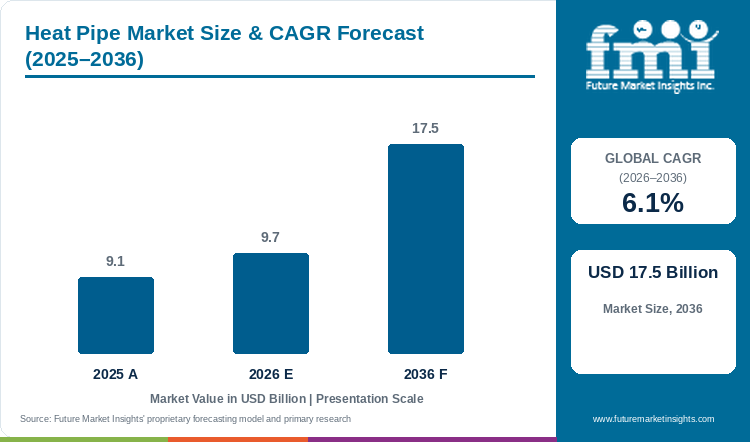
Heat pipe sales are projected to grow from USD 9.7 Billion in 2026 to USD 17.5 Billion by 2036 at 6.1% CAGR, up from USD 9.1 Billion in 2025.
The heat pipe market stands at USD 9.7 Billion in 2026 and, according to FMI, is projected to reach USD 17.5 Billion by 2036 at a 6.1% CAGR. Sales came to USD 9.1 Billion in 2025, and the gap between that bar and the 2036 bar on the market size chart includes USD 7.8 Billion of value added from 2026.
Asia Vital Components, a Taiwanese thermal module maker, drew 52% of 2025 revenue from AI servers as total sales rose 94.59% [1]. Foxconn, which calls itself the world's largest AI server provider, reported that cloud and networking products passed smart consumer electronics in revenue for the first time in the fourth quarter of 2025 [2]. Consumer electronics still holds 32% of demand for heat pipes by end use in 2026, built on repeat phone, laptop and gaming PC design cycles. Data centers are expected to add the largest block of new heat pipe volume through 2036, led by air-cooled and hybrid AI racks. Liquid cooling in the densest racks will keep part of that server spending away from heat pipes, so device programs remain the steadier base.
Key Takeaways
- Key players operating in the heat pipe market include Aavid (Eaton), Thermacore (Eaton), Advanced Cooling Technologies, Fujikura, Delta Electronics, Wakefield Thermal and Cooler Master.
- Standard heat pipes hold 35% of product type sales in 2026. Laptop and desktop cooler designers keep choosing the tubular format for low integration cost.
- Copper is set to account for 58% of demand by material in 2026, as copper-water pipes match the operating temperatures of most electronics.
- South Korea is projected to grow fastest at 7% CAGR through 2036. Mexico follows at 6.7% by 2036 as electronics assembly moves closer to US buyers.
Analyst Perspective
“Data centers are the end use I would watch, because AI racks staying on air or hybrid cooling are set to add the largest block of new heat pipe volume through 2036. Consumer electronics still holds 32% of demand in 2026, yet server programs will carry a growing part of the USD 7.8 Billion the market adds by 2036.”
- Nikhil Kaitwade, Principal Consultant, Future Market Insights
How is the Heat Pipe Market Segmented?
The heat pipe market is split into product type, material, end use, wick structure, sales channel and region.
As per FMI, product types are divided into standard heat pipes, vapor chambers, loop heat pipes, pulsating heat pipes and flexible heat pipes. Materials span copper, aluminum, stainless steel, titanium, and composite or graphite-assisted designs. End use is split across consumer electronics, data centers, automotive and EV, aerospace and defense, and industrial power electronics. Wick structures covered are sintered powder, grooved, mesh, composite and wickless thermosyphon designs, and sales are tracked across thermal module OEMs, electronics OEMs, industrial distributors and custom engineering suppliers. Seven regions and more than 30 countries form the geographic scope of the study.
Why Do Standard Heat Pipes Lead the Heat Pipe Market by Product Type?
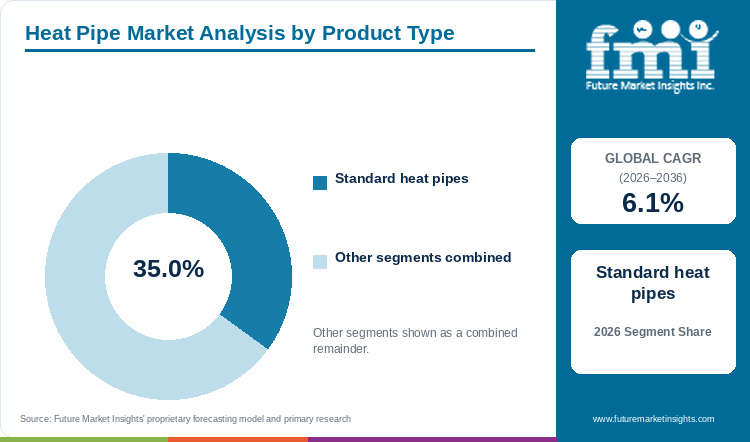
Standard heat pipes lead product type with 35% of market share in 2026.
Standard heat pipes hold 35% of demand by product type in 2026, with vapor chambers the next-largest format. Laptop and desktop cooler designers bend and flatten tubes into fin stacks already in use, so each new model adds little tooling cost. Vapor chambers need new tooling for every device outline, which limits volume to premium phones, gaming laptops and high-power server plates. Loop, pulsating and flexible designs stay in small aerospace and hinged-assembly lots with long validation.
- Notebook and desktop cooler programs are expected to keep reordering tubular pipes through 2036, as each model refresh reuses proven fin-stack layouts.
- The Taiwan Stock Exchange noted in November 2025 that Taiwan Microloops, a maker of heat pipes and vapor chambers, is setting up sites in Vietnam [3].
Why Does Copper Lead the Heat Pipe Market by Material?
Copper takes 58% of market share by material in 2026.
Copper takes 58% of demand by material in 2026. OEM qualification rules tie each approved design to one envelope metal and working fluid, so a switch away from copper-water pipes means a new round of heat-load and life testing. Aluminum and stainless steel sell in smaller volumes, as working-fluid compatibility and lower conductivity limit them to specific programs, and titanium and graphite-assisted designs carry a higher unit cost.
- Phone and laptop buyers are expected to stay with copper through 2036, as each material change restarts supplier qualification.
- Apple's iPhone 17 Pro series, launched in September 2025, carries a copper vapor chamber that reaches past the processor to the camera module [4].
Why Does Consumer Electronics Lead the Heat Pipe Market by End Use?
Consumer electronics is the largest end use in 2026, at 32% of market share.
Consumer electronics accounts for 32% of demand by end use in 2026, as phones, laptops and gaming PCs refresh thermal designs every product cycle. Foxconn reported in March 2026 that cloud and networking products passed smart consumer electronics in revenue for the first time in the fourth quarter of 2025 [2]. Data center orders are growing faster from a smaller base, and liquid cooling is taking the densest AI racks. Automotive, aerospace and industrial buyers order smaller lots after long vibration and life testing.
- Phone makers adding vapor chambers to premium models are expected to keep device volume steady through 2036.
- AI servers made up 52% of Asia Vital Components revenue in 2025, as reported by China Times in March 2026 [1].
Why Does Sintered Powder Wick Lead the Heat Pipe Market by Wick Structure?
A 34% share of the 2026 market by wick structure goes to sintered powder wick.
Sintered powder wick accounts for 34% of demand by wick structure in 2026, as bent and flattened pipes in laptops and phones need condensate return against gravity. Grooved and mesh wicks cost less and suit level or thin designs, and wickless thermosyphons stay limited to fixed installations relying on gravity.
- Makers with automated sintering lines are expected to gain volume as high-power processors push more programs toward composite wicks by 2036.
- In June 2026, Cooler Master presented the V8 Ace 3DHP air cooler, built with 3D heat pipes, at Computex 2026 [5].
Why Do Thermal Module OEMs Lead the Heat Pipe Market by Sales Channel?
Thermal module OEMs control 41% of market share by sales channel in 2026.
Because electronics OEMs prefer one source for fans, fins, base plates and two-phase parts, thermal module OEMs take 41% of demand by sales channel in 2026. One module supplier then owns the heat-load result for the full assembly. Direct component buying by electronics OEMs stays limited to large programs with in-house thermal teams, and distributors mainly serve prototypes and standard parts.
- Module makers adding liquid cooling hardware are expected to bundle vapor chambers into server cooling packages through 2036.
- In May 2025, Cooler Master presented 3D vapor-chamber cold plates and liquid coolant-distribution units for AI workloads at Computex 2025 [6].
What are the Drivers, Restraints, and Opportunities in the Heat Pipe Market?
According to FMI, hotter chips in compact devices and AI servers are pushing sales of heat pipes through 2036. Per-design testing and liquid cooling in the densest racks hold back growth, and air-cooled and hybrid servers open the largest new revenue pool.
- Driver: Processors and power electronics run hotter in compact devices, so more designs specify heat pipes or vapor chambers.
- Restraint: Each heat pipe needs testing inside the final assembly, and the densest AI racks are moving to liquid cooling.
- Opportunity: Operators keeping air or hybrid cooling need higher-capacity vapor chambers and compact modules for AI servers.
Chips and power devices are running hotter in smaller spaces, and data center construction adds new server cooling programs. Germany adopted a national data center strategy on March 18, 2026, aiming to at least double national data center capacity by 2030 against 2025 levels [7]. The same plan targets four times the AI and high-performance computing capacity, pointing server builders toward higher-capacity vapor chambers covered in the AI data center localized hotspot cooling systems market. Tube supply comes from the copper pipes and tubes market, and sales of thermal interface materials are projected to rise from USD 3.8 Billion in 2026 to USD 6.2 Billion by 2036.
Qualification slows every supplier change, since each heat pipe is tested for heat load, orientation and life inside the final assembly. Liquid cooling is taking the hottest AI racks, and sales in the AI datacenter liquid cooling market are projected to rise from USD 3.7 Billion in 2026 to USD 17.8 Billion by 2036. Module makers are adding liquid hardware from the cold plates market, and heat pipe suppliers are expected to focus on air-cooled and hybrid designs with clear operating data.
Which Country CAGRs are Profiled in the Heat Pipe Market?
| Country | CAGR, 2026 to 2036 |
|---|---|
| South Korea | 7% |
| Mexico | 6.7% |
| USA | 6.3% |
| Canada | 6% |
| Germany | 5.6% |
| France | 5.3% |
| Japan | 5% |
How do Country-level CAGRs Compare in the Heat Pipe Market?
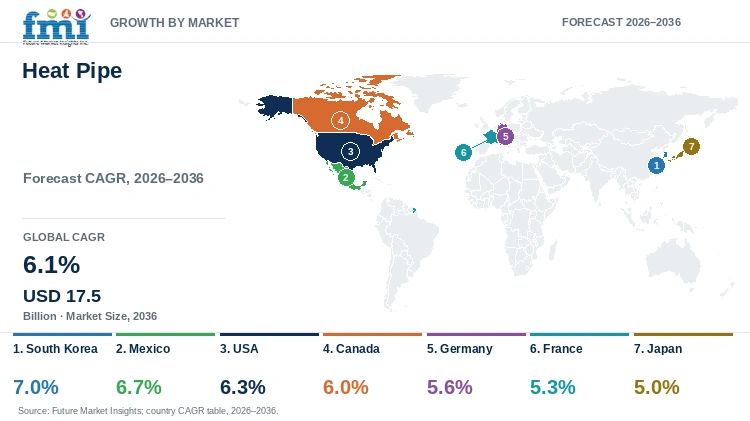
South Korea, Mexico and the USA form the faster group, with FMI projecting rates from 6.3% to 7% through 2036 on device output, nearshoring and AI server builds. Germany, France and Japan are expected to grow between 5% and 5.6% by 2036, as data center projects in these countries move under energy and siting rules. Canada is projected at 6% during the forecast period on publicly funded AI compute. On the country CAGR chart, South Korea at 7% and Japan at 5% mark the two ends of the profiled range. Suppliers in all seven countries draw on the wider thermal management technologies market.
- South Korea is projected to grow at 7% CAGR through 2036. Chip and device output keeps local design-in cycles short.
- Electronics assembly moving closer to North American buyers puts Mexico at 6.7% CAGR by 2036.
- Demand for heat pipes in the USA is set to rise at 6.3% CAGR during the forecast period on AI server builds.
- Public funding for AI compute supports a 6% CAGR in Canada through 2036.
- Germany is expected to grow at 5.6% CAGR by 2036. A national strategy adopted in 2026 is expanding data center capacity.
- AI infrastructure projects carry France to 5.3% CAGR during the forecast period.
- Long reliability testing keeps Japan at 5% CAGR through 2036, the lowest rate among the seven countries.
Separate CAGR estimates for more than 30 countries across seven regions appear in the full report.
Country Outlook
- Semiconductor exports from South Korea reached a record USD 173.4 Billion in 2025 on demand for AI memory chips [8]. Dense chip and device production keeps design-in cycles short, and South Korea is projected at 7% CAGR through 2036.
- Mexico's Ministry of Economy reported in May 2025 that 16 of the 30 goals in the Semiconductor Master Plan 2024-2030 had been met [9]. New electronics and automotive lines create local cooling programs, supporting 6.7% CAGR by 2036. Module suppliers with North American assembly are expected to gain these programs.
- AI server builds, aerospace programs and industrial power systems shape demand for heat pipes in the USA. The densest racks are moving to direct liquid cooling, so heat pipe content stays highest in air-cooled and hybrid servers. The USA is projected at 6.3% CAGR during the forecast period.
- The government of Canada opened applications for the AI Sovereign Compute Infrastructure Program in April 2026 [10]. Each funded compute site adds server builds needing cooling modules, and Canada is projected at 6% CAGR through 2036.
- Germany's federal government adopted a national data center strategy in March 2026 targeting four times the AI and high-performance computing capacity by 2030 [7]. Vehicle electrification and industrial power electronics add a second base of orders, and Germany is set to grow at 5.6% CAGR by 2036. Suppliers holding automotive and industrial qualification records are expected to gain.
- AI infrastructure investment in France adds to steady aerospace and industrial electronics orders. Large AI sites are expected to weigh liquid against air cooling, so heat pipes will compete mainly in edge and hybrid servers. France is projected at 5.3% CAGR during the forecast period.
- Japanese buyers run long reliability tests before approving a new heat pipe supplier, and these tests favor incumbents with proven field records. Japan is projected at 5% CAGR through 2036, the lowest rate in the profiled set.
Who are the Notable Companies in the Heat Pipe Market?
Heat pipe suppliers profiled by FMI, such as Aavid, Advanced Cooling Technologies, Fujikura, Delta Electronics and Cooler Master, compete on two-phase design range, module integration and proven results at high heat loads.
Eaton took control of the Aavid and Thermacore brands in March 2026, when Boyd completed the sale of the Boyd Thermal business for USD 9.5 Billion [11]. Buyers compare maximum heat load at the intended geometry, orientation tolerance, life data and module integration before approving a source. Cooler Master showed 3D heat pipe air coolers next to pumped two-phase rack cooling at Computex 2026 [5]. OEMs rarely change a qualified supplier in mid-program, as each new heat pipe is tested inside the final assembly. FMI sees in-house sintering, vapor chamber and fin assembly lines separating module suppliers ready for recurring orders from component sellers. New vapor chamber capacity for AI servers will give buyers more qualified sources through 2036, and device makers draw on the same supplier base serving the wider thermal management market.
- Broad Two-Phase and Engineered System Suppliers: Aavid (Eaton), Thermacore (Eaton), Advanced Cooling Technologies and Fujikura combine heat pipe technologies with deep thermal engineering or module integration.
- Electronics and Thermal-Module Scale Integrators: Delta Electronics, Wakefield Thermal and Cooler Master connect heat pipes or vapor chambers with fans, heat sinks and electronics cooling modules.
- Custom Industrial Heat-Pipe Specialists: DAU Thermal Solutions, Celsia and Noren Thermal focus on tailored geometry, heat sink integration and engineering support for industrial applications.
Competitive Benchmarking
| Company | Two-Phase Breadth | Module Integration | High-Heat Coverage | Geographic Reach |
|---|---|---|---|---|
| Aavid (Eaton) | High | High | High | North America, Europe and Asia |
| Thermacore (Eaton) | High | High | High | North America, Europe and Asia |
| Advanced Cooling Technologies | High | High | High | North America with European and international access |
| Fujikura | Medium | High | High | Japan, Asia and global electronics markets |
| Delta Electronics | Medium | High | High | Global electronics and data center markets |
| Wakefield Thermal | Medium | High | Medium | North America with global distribution |
| Cooler Master | Medium | High | High | Global consumer and enterprise electronics markets |
| DAU Thermal Solutions | Medium | High | Medium | Europe, North America and Asia |
| Celsia | Medium | High | Medium | North America with international project support |
| Noren Thermal | Medium | High | Medium | United States with specialized international projects |
Scoring basis: Two-Phase Breadth rates documented coverage of standard heat pipes, vapor chambers, loop or pulsating designs and thermosyphons. Module Integration rates documented ability to combine two-phase parts with fins, base plates, fans or engineered assemblies. High-Heat Coverage rates evidence in AI servers, power electronics, aerospace or other high-flux systems. High marks broad documented capability, Medium a narrower proven range, and Low limited public documentation.
Key Developments
- In September 2025, Apple launched the iPhone 17 Pro series with a self-developed copper vapor chamber that extends cooling to the camera module [4].
- In March 2026, Eaton completed the purchase of the Boyd Thermal business from Boyd for USD 9.5 Billion, adding the Aavid and Thermacore brands [11].
- In June 2026, Cooler Master unveiled the V8 Ace 3DHP air cooler and pumped two-phase cooling hardware for data center racks at Computex 2026 [5].
Key Players
Broad Two-Phase and Engineered System Suppliers
- Aavid (Eaton)
- Thermacore (Eaton)
- Advanced Cooling Technologies
- Fujikura
Electronics and Thermal-Module Scale Integrators
- Delta Electronics
- Wakefield Thermal
- Cooler Master
Custom Industrial Heat-Pipe Specialists
- DAU Thermal Solutions
- Celsia
- Noren Thermal
Report Scope and Methodology
| Coverage field | Report scope |
|---|---|
| Market breakdown | 5 categories plus region: Product Type (Standard heat pipes, Vapor chambers, Loop heat pipes, Pulsating heat pipes, Flexible heat pipes), Material (Copper, Aluminum, Stainless steel, Titanium, Composite/graphite assisted), End Use (Consumer electronics, Data centers, Automotive/EV, Aerospace and defense, Industrial power electronics), Wick Structure (Sintered powder wick, Grooved wick, Mesh wick, Composite wick, Wickless thermosyphon), Sales Channel (Thermal module OEMs, Electronics OEMs, Industrial distributors, Custom engineering suppliers), and Region |
| Quantitative units | USD Billion |
| Market definition | Revenue from heat pipes and heat-pipe-based two-phase thermal components or assemblies sold within the report segments. Downstream finished-product revenue and adjacent or substitute thermal-management product revenue are excluded. |
| Regions covered | North America, Latin America, Western Europe, Eastern Europe, East Asia, South Asia and Pacific, Middle East and Africa |
| Countries covered | More than 30 countries, with South Korea, the USA, Japan, Germany, Mexico, France and Canada profiled in detail |
| Key companies profiled | Aavid (Eaton), Thermacore (Eaton), Advanced Cooling Technologies, Fujikura, Delta Electronics, Wakefield Thermal, Cooler Master, DAU Thermal Solutions, Celsia and Noren Thermal, selected from a wider field of two-phase component and thermal module suppliers |
| Forecast period | 2026 to 2036 |
| Approach | Product-level demand, end-use adoption, supplier activity and regional demand indicators reconciled by FMI through a hybrid bottom-up and top-down model. |
Research Methodology
| Method | Approach |
|---|---|
| Primary research | Interviews with heat pipe manufacturers, thermal module suppliers, electronics OEMs, distributors, engineering specifiers and procurement teams test purchase criteria, thermal qualification, channel roles and pricing, plus the switch between passive air cooling and liquid cooling. |
| Desk research | The analysis reviews government statistics, digital-infrastructure and industrial policy, company disclosures, product documentation, technical literature and trade indicators. Sources are kept for relevance to heat pipe demand, operating conditions, competitive position or dated company actions. |
| Market sizing and forecasting | Market sizing combines product-level and supplier-level analysis with end-use adoption. The forecast reflects electronics heat density, compute and power-electronics investment, thermal architecture shifts, price and mix, manufacturing capacity and qualification cycles for new designs. |
| Data validation | Outputs are cross-checked against several demand and supply indicators. Downstream finished-product revenue and adjacent cooling categories are excluded, and components and assemblies are separated so no revenue is counted twice. |
Heat Pipe Market by Segments
Heat Pipe Market Segmented by Product Type
- Standard heat pipes
- Vapor chambers
- Loop heat pipes
- Pulsating heat pipes
- Flexible heat pipes
Heat Pipe Market Segmented by Material
- Copper
- Aluminum
- Stainless steel
- Titanium
- Composite/graphite assisted
Heat Pipe Market Segmented by End Use
- Consumer electronics
- Data centers
- Automotive/EV
- Aerospace and defense
- Industrial power electronics
Heat Pipe Market Segmented by Wick Structure
- Sintered powder wick
- Grooved wick
- Mesh wick
- Composite wick
- Wickless thermosyphon
Heat Pipe Market Segmented by Sales Channel
- Thermal module OEMs
- Electronics OEMs
- Industrial distributors
- Custom engineering suppliers
Heat Pipe Market Segmented by Region
- North America
- Latin America
- Western Europe
- Eastern Europe
- East Asia
- South Asia and Pacific
- Middle East and Africa
Research Sources and Bibliography
- [1] China Times Wantrich (2026, March 11).
- [2] I-Connect007 (2026, March 16). Foxconn Reports Record FY2025 Revenue, Strong AI Growth and Historic Dividend.
- [3] Taiwan Stock Exchange (2025, November 25). New Listed Company: Taiwan Microloops (6831).
- [4] Digitimes (2025, September 11). Apple introduces self-developed vapor chamber cooling in iPhone 17 Pro series.
- [5] KitGuru (2026, June 3). Computex 2026: Cooler Master unveils next-gen cooling tech.
- [6] Cooler Master (2025, May 19). Cooler Master Unveils the Future of Cooling During Computex 2025.
- [7] Federal Government of Germany (2026, March 18). Mehr Rechenpower für Deutschland.
- [8] Malay Mail (2026, January 1). AI boom drives South Korea exports to record US$700b in 2025.
- [9] Secretaría de Economía, Gobierno de México (2025, May 14). Preside Marcelo Ebrard reunión de seguimiento del Plan Maestro de Semiconductores 2024-2030.
- [10] Innovation, Science and Economic Development Canada (2026, April 15). Canada launches national initiative to build large-scale AI supercomputing capacity.
- [11] Boyd Corporation (2026, March 12). Boyd Completes the Sale of its Thermal Business to Eaton for $9.5 Billion.
This bibliography is provided for reader reference and is not exhaustive. The full report contains the complete reference list and detailed citations.
This Report Answers
- What revenue will heat pipes generate in 2026, and what market value is expected by 2036?
- Which device, server and power-electronics trends will support sales of heat pipes and vapor chambers?
- Why will standard heat pipes hold the largest product type share in 2026?
- Why will copper remain the leading envelope material for electronics heat pipes?
- Which growth rates will South Korea, Mexico, the USA, Canada, Germany, France and Japan post through 2036?
- What effect will liquid cooling in dense AI racks have on heat pipe content per server?
- Why will thermal module OEMs keep the largest share of heat pipe sales by channel?
- Which test data will OEM buyers request before qualifying a new heat pipe supplier?
Frequently Asked Questions
How Big Is the Heat Pipe Market Expected to Be in 2026?
Heat pipe sales will reach USD 9.7 Billion in 2026, up from USD 9.1 Billion in 2025, as FMI estimates show. Revenue will rise to USD 17.5 Billion by 2036 as phones, PCs and servers carry more processor heat.
What Is the CAGR of the Heat Pipe Market from 2026 to 2036?
The market will grow at a 6.1% CAGR from 2026 to 2036. Air-cooled and hybrid server designs will add new volume, and consumer devices will keep the base of repeat orders.
Which Product Type Holds the Largest Share of the Heat Pipe Market?
Standard heat pipes will lead with 35% of market share by product type in 2026. Easy bending, flattening and fin-stack assembly will keep integration cost low for new designs.
Which Material Leads the Heat Pipe Market?
Copper will account for 58% of market share by material in 2026. High thermal conductivity and mature copper-water production will support the lead.
Which Country Is Expected to Grow Fastest in the Heat Pipe Market?
South Korea will grow fastest at a 7% CAGR till 2036, followed by Mexico at 6.7% and the USA at 6.3%. Japan will post the slowest rate of the seven profiled countries at 5%.
What Notable Restraint Affects the Heat Pipe Market?
Key challenges will come from application-specific testing, since each heat pipe will need to pass heat-load, orientation and life checks inside the final assembly. Liquid cooling will also take content from the densest AI racks.
Which Are the Key Companies in the Heat Pipe Market?
Aavid, Thermacore, Advanced Cooling Technologies, Fujikura, Delta Electronics, Wakefield Thermal, Cooler Master, DAU Thermal Solutions, Celsia and Noren Thermal rank among the leading companies covered by FMI. Each company will appear in one of three supplier groups across the report.
Preview the report firsthand - request a free sample
Get SampleGet the brochure for pricing and purchase details.
Get PDFTable of Content
- Key Takeaways
- Market Size and CAGR
- Top Growth Driver
- Fastest Growing Segment
- Leading Region
- Key Companies
- Emerging Opportunities
- Executive Summary
- Global Market Outlook
- Demand-side Trends
- Supply-side Trends
- Technology Roadmap Analysis
- Analysis and Recommendations
- Analyst Perspective (What is happening? Why now? What should investors know?)
- Key Questions Answered
- How large is the market?
- What is the CAGR?
- What are key trends?
- Which region dominates?
- Who are the leaders?
- Market Overview
- Market Coverage / Taxonomy
- Market Definition / Scope / Limitations
- Research Methodology
- Chapter Orientation
- Analytical Lens and Working Hypotheses
- Market Structure, Signals, and Trend Drivers
- Benchmarking and Cross-market Comparability
- Market Sizing, Forecasting, and Opportunity Mapping
- Research Design and Evidence Framework
- Desk Research Programme (Secondary Evidence)
- Expert Input and Fieldwork (Primary Evidence)
- Tooling, Models, and Reference Databases
- Data Engineering and Model Build
- Quality Assurance and Audit Trail
- Market Background
- Market Dynamics (Drivers, Restraints, Opportunity, Trends)
- Scenario Forecast (Optimistic, Likely, Conservative)
- Impact Analysis
- AI Impact
- Sustainability Impact
- Regulatory Impact
- Technology Impact
- Consumer / Buyer Analysis
- Purchase Drivers
- Adoption Barriers
- Buyer Journey
- Opportunity Map Analysis
- Product Life Cycle Analysis
- Supply Chain Analysis
- Investment Feasibility Matrix
- Value Chain Analysis
- PESTLE and Porter's Analysis
- Regulatory Landscape
- Regional Parent Market Outlook
- Production and Consumption Statistics
- Import and Export Statistics
- Global Market Analysis and Forecast, 2021 to 2036
- Historical Market Size Value (USD Billion) Analysis, 2021 to 2025
- Current and Future Market Size Value (USD Billion) Projections, 2026 to 2036
- Y-o-Y Growth Trend Analysis
- Absolute $ Opportunity Analysis
- Global Market Pricing Analysis, 2021 to 2036
- Global Market Analysis and Forecast, By Product Type, 2021 to 2036
- Introduction / Key Findings
- Historical Market Size Value (USD Billion) Analysis By Product Type, 2021 to 2025
- Current and Future Market Size Value (USD Billion) Analysis and Forecast By Product Type, 2026 to 2036
- Standard heat pipes
- Vapor chambers
- Loop heat pipes
- Pulsating heat pipes
- Flexible heat pipes
- Y-o-Y Growth Trend Analysis By Product Type, 2021 to 2025
- Absolute $ Opportunity Analysis By Product Type, 2026 to 2036
- Global Market Analysis and Forecast, By Material, 2021 to 2036
- Introduction / Key Findings
- Historical Market Size Value (USD Billion) Analysis By Material, 2021 to 2025
- Current and Future Market Size Value (USD Billion) Analysis and Forecast By Material, 2026 to 2036
- Copper
- Aluminum
- Stainless steel
- Titanium
- Composite/graphite assisted
- Y-o-Y Growth Trend Analysis By Material, 2021 to 2025
- Absolute $ Opportunity Analysis By Material, 2026 to 2036
- Global Market Analysis and Forecast, By End Use, 2021 to 2036
- Introduction / Key Findings
- Historical Market Size Value (USD Billion) Analysis By End Use, 2021 to 2025
- Current and Future Market Size Value (USD Billion) Analysis and Forecast By End Use, 2026 to 2036
- Consumer electronics
- Data centers
- Automotive/EV
- Aerospace and defense
- Industrial power electronics
- Y-o-Y Growth Trend Analysis By End Use, 2021 to 2025
- Absolute $ Opportunity Analysis By End Use, 2026 to 2036
- Global Market Analysis and Forecast, By Wick Structure, 2021 to 2036
- Introduction / Key Findings
- Historical Market Size Value (USD Billion) Analysis By Wick Structure, 2021 to 2025
- Current and Future Market Size Value (USD Billion) Analysis and Forecast By Wick Structure, 2026 to 2036
- Sintered powder wick
- Grooved wick
- Mesh wick
- Composite wick
- Wickless thermosyphon
- Y-o-Y Growth Trend Analysis By Wick Structure, 2021 to 2025
- Absolute $ Opportunity Analysis By Wick Structure, 2026 to 2036
- Global Market Analysis and Forecast, By Sales Channel, 2021 to 2036
- Introduction / Key Findings
- Historical Market Size Value (USD Billion) Analysis By Sales Channel, 2021 to 2025
- Current and Future Market Size Value (USD Billion) Analysis and Forecast By Sales Channel, 2026 to 2036
- Thermal module OEMs
- Electronics OEMs
- Industrial distributors
- Custom engineering suppliers
- Y-o-Y Growth Trend Analysis By Sales Channel, 2021 to 2025
- Absolute $ Opportunity Analysis By Sales Channel, 2026 to 2036
- Global Market Analysis and Forecast, By Region, 2021 to 2036
- Introduction
- Historical Market Size Value (USD Billion) Analysis By Region, 2021 to 2025
- Current Market Size Value (USD Billion) Analysis and Forecast By Region, 2026 to 2036
- North America
- Latin America
- Western Europe
- Eastern Europe
- East Asia
- South Asia and Pacific
- Middle East and Africa
- Market Attractiveness Analysis By Region
- North America Market Analysis and Forecast, By Country, 2021 to 2036
- Historical Market Size Value (USD Billion) Trend Analysis By Market Taxonomy, 2021 to 2025
- Market Size Value (USD Billion) Forecast By Market Taxonomy, 2026 to 2036
- By Country
- By Product Type
- By Material
- By End Use
- By Wick Structure
- By Sales Channel
- Market Attractiveness Analysis
- By Country
- By Product Type
- By Material
- By End Use
- By Wick Structure
- By Sales Channel
- Key Takeaways
- Latin America Market Analysis and Forecast, By Country
- Historical Market Size Value (USD Billion) Trend Analysis By Market Taxonomy, 2021 to 2025
- Market Size Value (USD Billion) Forecast By Market Taxonomy, 2026 to 2036
- By Country
- By Product Type
- By Material
- By End Use
- By Wick Structure
- By Sales Channel
- Market Attractiveness Analysis
- By Country
- By Product Type
- By Material
- By End Use
- By Wick Structure
- By Sales Channel
- Key Takeaways
- Western Europe Market Analysis and Forecast, By Country
- Historical Market Size Value (USD Billion) Trend Analysis By Market Taxonomy, 2021 to 2025
- Market Size Value (USD Billion) Forecast By Market Taxonomy, 2026 to 2036
- By Country
- By Product Type
- By Material
- By End Use
- By Wick Structure
- By Sales Channel
- Market Attractiveness Analysis
- By Country
- By Product Type
- By Material
- By End Use
- By Wick Structure
- By Sales Channel
- Key Takeaways
- Eastern Europe Market Analysis and Forecast, By Country
- Historical Market Size Value (USD Billion) Trend Analysis By Market Taxonomy, 2021 to 2025
- Market Size Value (USD Billion) Forecast By Market Taxonomy, 2026 to 2036
- By Country
- By Product Type
- By Material
- By End Use
- By Wick Structure
- By Sales Channel
- Market Attractiveness Analysis
- By Country
- By Product Type
- By Material
- By End Use
- By Wick Structure
- By Sales Channel
- Key Takeaways
- East Asia Market Analysis and Forecast, By Country
- Historical Market Size Value (USD Billion) Trend Analysis By Market Taxonomy, 2021 to 2025
- Market Size Value (USD Billion) Forecast By Market Taxonomy, 2026 to 2036
- By Country
- By Product Type
- By Material
- By End Use
- By Wick Structure
- By Sales Channel
- Market Attractiveness Analysis
- By Country
- By Product Type
- By Material
- By End Use
- By Wick Structure
- By Sales Channel
- Key Takeaways
- South Asia and Pacific Market Analysis and Forecast, By Country
- Historical Market Size Value (USD Billion) Trend Analysis By Market Taxonomy, 2021 to 2025
- Market Size Value (USD Billion) Forecast By Market Taxonomy, 2026 to 2036
- By Country
- By Product Type
- By Material
- By End Use
- By Wick Structure
- By Sales Channel
- Market Attractiveness Analysis
- By Country
- By Product Type
- By Material
- By End Use
- By Wick Structure
- By Sales Channel
- Key Takeaways
- Middle East and Africa Market Analysis and Forecast, By Country
- Historical Market Size Value (USD Billion) Trend Analysis By Market Taxonomy, 2021 to 2025
- Market Size Value (USD Billion) Forecast By Market Taxonomy, 2026 to 2036
- By Country
- By Product Type
- By Material
- By End Use
- By Wick Structure
- By Sales Channel
- Market Attractiveness Analysis
- By Country
- By Product Type
- By Material
- By End Use
- By Wick Structure
- By Sales Channel
- Key Takeaways
- Key Countries Market Analysis
- South Korea
- Pricing Analysis
- Market Share Analysis, 2025
- By Product Type
- By Material
- By End Use
- By Wick Structure
- By Sales Channel
- Mexico
- Pricing Analysis
- Market Share Analysis, 2025
- By Product Type
- By Material
- By End Use
- By Wick Structure
- By Sales Channel
- USA
- Pricing Analysis
- Market Share Analysis, 2025
- By Product Type
- By Material
- By End Use
- By Wick Structure
- By Sales Channel
- Canada
- Pricing Analysis
- Market Share Analysis, 2025
- By Product Type
- By Material
- By End Use
- By Wick Structure
- By Sales Channel
- Germany
- Pricing Analysis
- Market Share Analysis, 2025
- By Product Type
- By Material
- By End Use
- By Wick Structure
- By Sales Channel
- France
- Pricing Analysis
- Market Share Analysis, 2025
- By Product Type
- By Material
- By End Use
- By Wick Structure
- By Sales Channel
- Japan
- Pricing Analysis
- Market Share Analysis, 2025
- By Product Type
- By Material
- By End Use
- By Wick Structure
- By Sales Channel
- South Korea
- Market Structure Analysis
- Competition Dashboard
- Competition Benchmarking
- Market Share Analysis of Top Players
- By Regional
- By Product Type
- By Material
- By End Use
- By Wick Structure
- By Sales Channel
- Emerging Startups
- Innovation Benchmarking
- Competition Analysis
- Competition Deep Dive
- Aavid (Eaton)
- Overview
- Product Portfolio
- Profitability by Market Segments
- Sales Footprint
- Strategy Overview
- Marketing Strategy
- Product Strategy
- Channel Strategy
- Thermacore (Eaton)
- Advanced Cooling Technologies
- Fujikura
- Delta Electronics
- Wakefield Thermal
- Cooler Master
- DAU Thermal Solutions
- Celsia
- Noren Thermal
- Aavid (Eaton)
- Case Studies
- Success Stories
- Recent Developments
- Competition Deep Dive
- Assumptions & Acronyms Used


