

- Industry Size (2026)
- USD 1.16 Bn
- Forecast (2036)
- USD 2.02 Bn
- CAGR (2026 to 2036)
- 5.70%
Magnetic Resonance Analyzer Market Size, Market Forecast and Outlook By FMI
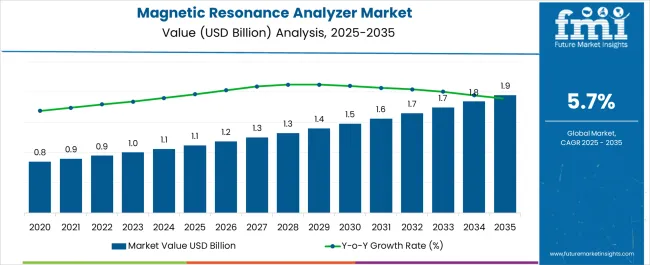
The magnetic resonance analyzer market was valued at USD 1.10 billion in 2025, is projected to reach USD 1.16 billion in 2026, and is forecast to expand to USD 2.02 billion by 2036 at a 5.7% CAGR. FMI is of the opinion that the growth trajectory reflects widening adoption of compact MR-based analytical platforms across clinical diagnostics, pharmaceutical quality assurance, and point-of-care body composition assessment, driven by miniaturization advances that have reduced both instrument footprint and acquisition cost.
Summary of Magnetic Resonance Analyzer Market
- Market Snapshot
- The magnetic resonance analyzer market is valued at USD 1.10 billion in 2025 and is projected to reach USD 2.02 billion by 2036.
- The industry is expected to grow at a 5.70% CAGR from 2026 to 2036, creating an incremental opportunity of USD 0.86 billion.
- The market is a diagnostics-driven analytical instrumentation category where miniaturization, clinical accessibility, and pharmaceutical quality control needs are expanding the installed base beyond traditional research settings.
- Demand and Growth Drivers
- Hospital procurement of compact MR analyzers is accelerating as clinical nutrition and metabolic disorder programs require non-invasive body composition measurement.
- Pharmaceutical manufacturers are deploying tabletop NMR systems for in-process quality control, replacing slower chromatographic methods.
- Miniaturization advances have reduced instrument footprint and acquisition cost, enabling deployment in ambulatory clinics and smaller healthcare facilities.
- Among key countries: China at 7.7%, India at 7.1%, Germany at 6.6%, Brazil at 6.0%, USA at 5.4%, UK at 4.8%, Japan at 4.3% CAGR through 2036.
- Product and Segment View
- Magnetic resonance analyzers are diagnostic and analytical instruments that use nuclear magnetic resonance (NMR) principles to characterize molecular structures, measure tissue properties, and analyze chemical compositions in clinical and laboratory settings.
- Primary applications include Hospitals, Gynecology Clinics, Healthcare Centers, Household.
- Bench Top leads by Modularity with 55.0% share in 2026.
- Hospitals leads by End Use with 40.0% share in 2026.
- Scope includes market scope covers benchtop magnetic resonance analyzers, handheld nmr devices, clinical body composition analyzers using mr principles, and associated calibration and consumable components. The scope excludes full-body MRI scanners, interventional MRI systems, MRI contrast agents, and superconducting magnet systems for MRI.
- Geography and Competitive Outlook
- China and India are the fastest-growing markets, while mature economies sustain replacement and upgrade demand.
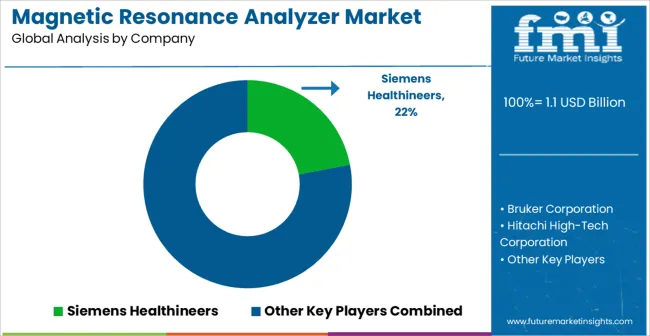
- Competition is shaped by Siemens Healthineers holding approximately 22.0% share, followed by Bruker Corporation, Hitachi High-Tech Corporation, Thermo Fisher Scientific.
- Key players include Siemens Healthineers, Bruker Corporation, Hitachi High-Tech Corporation, Thermo Fisher Scientific, Oxford Instruments, Shimadzu Corporation, JEOL Ltd., Aspect Imaging.
- Analyst Opinion at FMI
- Nikhil Kaitwade, Principal Consultant for Testing Equipment Diagnostics, opines: 'In my analysis, I have observed that the magnetic resonance analyzer market is at an inflection point where benchtop instruments are moving from research laboratories to clinical floors. Hospital administrators are recognizing that compact MR analyzers can deliver body composition data, metabolic assessments, and tissue characterization without the capital cost, siting requirements, or helium dependency of full-body MRI systems. The competitive differentiator in this market is not magnetic field strength but usability: the instruments that can be operated by clinical staff without specialized physics training will capture the largest share of hospital procurement budgets.'
- Strategic Implications / Executive Takeaways
- Medical device procurement teams should evaluate benchtop MR analyzers as cost-effective alternatives to full-scale MRI for specific clinical applications including body composition analysis and metabolic screening.
- Instrument manufacturers must prioritize software interface simplicity and automated calibration to enable clinical staff operation without dedicated MR physics support.
- Pharmaceutical quality directors should assess tabletop NMR platforms for in-process API characterization to reduce reliance on slower chromatographic testing methods in production environments.
Future Market Insights analysis indicates that hospital procurement of benchtop magnetic resonance analyzers is accelerating as clinical nutrition and metabolic disorder programs require non-invasive body composition measurement. Pharmaceutical manufacturers are deploying tabletop NMR systems for in-process quality control of active pharmaceutical ingredients, replacing slower chromatographic methods. Gynecology clinics and maternal health programs are adopting compact MR analyzers for prenatal bone density screening. The household segment, while small, is emerging through consumer-grade body composition devices sold via telehealth platforms.
China leads growth at 7.7% CAGR, where hospital modernization programs and expanding pharmaceutical manufacturing are creating dual demand channels for compact MR analytical platforms. India follows at 7.1%, driven by national health program investments in diagnostic infrastructure and the growth of pharmaceutical export quality testing. Germany registers 6.6% growth, reflecting its position as a precision instrument manufacturing hub and its concentration of pharmaceutical R&D laboratories. Brazil tracks at 6.0%, supported by public hospital procurement modernization. United States operations advance at 5.4%, anchored by clinical research adoption and pharmaceutical in-process testing. United Kingdom networks grow at 4.8%, and Japan registers 4.3%, reflecting mature but steady demand from its advanced healthcare and analytical instrument sectors.
Magnetic Resonance Analyzer Market Key Takeaways
| Metric | Details |
|---|---|
| Industry Size (2026) | USD 1.16 billion |
| Industry Value (2036) | USD 2.02 billion |
| CAGR (2026-2036) | 5.70% |
Source: Future Market Insights, 2026
Magnetic Resonance Analyzer Market Definition
Magnetic resonance analyzers are diagnostic and analytical instruments that use nuclear magnetic resonance (NMR) principles to characterize molecular structures, measure tissue properties, and analyze chemical compositions in clinical and laboratory settings. These devices range from benchtop NMR spectrometers used in pharmaceutical quality control to compact MR-based body composition analyzers deployed in hospitals and healthcare centers.
Magnetic Resonance Analyzer Market Inclusions
Market scope covers benchtop magnetic resonance analyzers, handheld NMR devices, clinical body composition analyzers using MR principles, and associated calibration and consumable components. Regional and country-level analysis spans 2026 to 2036.
Magnetic Resonance Analyzer Market Exclusions
The scope excludes full-body MRI scanners, interventional MRI systems, MRI contrast agents, and superconducting magnet systems for MRI. Standalone NMR spectroscopy instruments used exclusively in academic research chemistry departments fall outside the analytical parameters.
Magnetic Resonance Analyzer Market Research Methodology
- Primary Research: Analysts engaged with procurement managers, plant engineers, and technical directors across key end-use industries to map purchasing decision triggers and specification requirements.
- Desk Research: Data collection phases aggregated regulatory filings, industry standards publications, trade association reports, and company annual disclosures relevant to this market.
- Market-Sizing and Forecasting: Baseline values derive from a bottom-up aggregation of product shipment volumes and average selling prices, applying region-specific adoption curves to project future demand.
- Data Validation and Update Cycle: Projections are tested against publicly reported financial guidance and production capacity data from leading manufacturers, with annual refresh cycles.
Why is the Magnetic Resonance Analyzer Market Growing?
The Magnetic Resonance Analyzer market is experiencing significant growth driven by the rising demand for advanced diagnostic and analytical solutions across healthcare and research sectors. The future outlook for this market is shaped by continuous technological advancements in magnetic resonance technologies, enabling higher precision, faster analysis, and non-invasive measurement capabilities. Increasing investments in healthcare infrastructure, particularly in hospitals and diagnostic centers, are fueling the adoption of these analyzers.
The demand for efficient and accurate analytical tools in clinical diagnostics and research applications is further supporting market expansion. Additionally, the emphasis on early disease detection and preventive healthcare is driving the need for high-performance analyzers capable of detailed molecular and cellular analysis.
The market is also benefiting from the growing preference for modular and scalable solutions that can be customized based on specific laboratory or clinical requirements As healthcare providers and research institutions continue to prioritize innovation, efficiency, and data-driven insights, the Magnetic Resonance Analyzer market is expected to maintain steady growth across both established and emerging regions.
Segmental Analysis
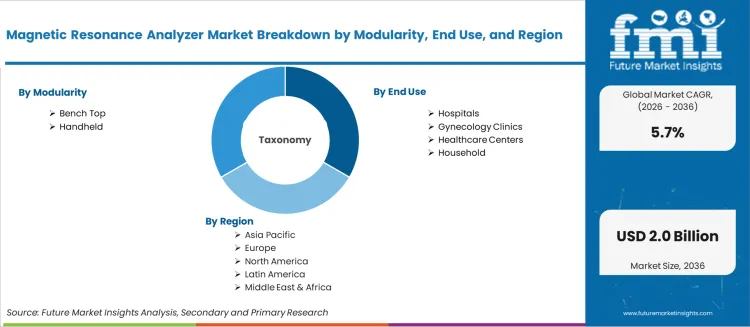
The magnetic resonance analyzer market is segmented by modularity, end use, and geographic regions. By modularity, magnetic resonance analyzer market is divided into Bench Top and Handheld. In terms of end use, magnetic resonance analyzer market is classified into Hospitals, Gynecology Clinics, Healthcare Centers, and Household. Regionally, the magnetic resonance analyzer industry is classified into North America, Latin America, Western Europe, Eastern Europe, Balkan & Baltic Countries, Russia & Belarus, Central Asia, East Asia, South Asia & Pacific, and the Middle East & Africa.
Insights into the Bench Top Segment

The bench top segment is projected to hold 55.0% of the Magnetic Resonance Analyzer market revenue share in 2026, making it the leading product type. This dominance is primarily driven by the compact size, ease of installation, and operational flexibility offered by bench top analyzers.
Their modular design allows laboratories and hospitals to integrate these analyzers without major infrastructural changes, making them suitable for a wide range of diagnostic and research applications. The segment has benefited from advances in software and automation, which enhance analytical accuracy, reduce human intervention, and improve workflow efficiency.
Additionally, bench top analyzers provide cost-effective solutions while maintaining high precision, supporting adoption in hospitals and small laboratories The growing demand for rapid and reliable testing, along with the need for space-efficient instrumentation in clinical and research settings, further reinforces the segment’s leading position in the market.
Insights into the Hospitals End-Use Segment
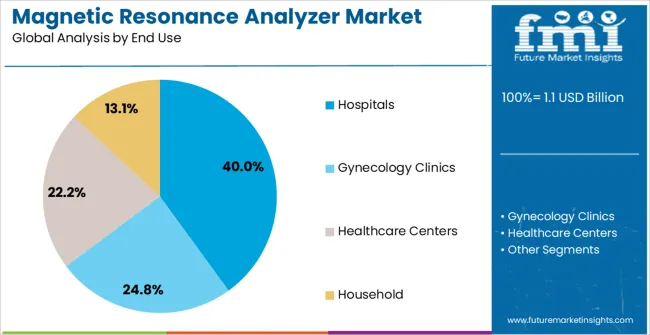
The hospitals end-use segment is expected to account for 40.0% of the Magnetic Resonance Analyzer market revenue share in 2026, establishing it as the leading end-use category. The growth of this segment is driven by the increasing deployment of advanced diagnostic technologies in hospitals to improve patient care, enable early disease detection, and streamline clinical workflows.
Hospitals are increasingly adopting magnetic resonance analyzers due to their non-invasive nature, high precision, and ability to perform rapid and comprehensive analyses across various medical conditions. The integration of modular analyzers with hospital information systems and electronic medical records has further enhanced operational efficiency.
Additionally, the rising emphasis on preventive healthcare and diagnostic accuracy has accelerated the procurement of magnetic resonance analyzers in hospitals As healthcare facilities continue to prioritize patient safety, diagnostic excellence, and operational efficiency, the hospitals segment is expected to maintain its dominant position in the Magnetic Resonance Analyzer market.
Market Overview
Magnetic Resonance Analyzer Market Introduction
The Magnetic Resonance Analyzer is an electronic equipment used to determine the illness/health of the patient. The magnetic resonance analyzer reads the energy level of the body to test the health status and suggests the recommendations for cure.
This magnetic resonance analyzer is particularly suitable for determining sub health conditions. The magnetic resonance analyzer is the combination of biophysics, science, electrical engineering, which is based on the theory of scalar-physics.
Moreover, the data base of the magnetic resonance analyzer is stored with the scientific parameters, such as demonstration of a large number of clinical cases and strict health statistic treatment. Owing to these features and up gradations in the magnetic resonance analyzer are significantly fuelling the growth of magnetic resonance analyzer market.
Analysis of Magnetic Resonance Analyzer Market By Key Countries
.webp "Top Country Growth Comparison Magnetic Resonance Analyzer Market Cagr (2026 2036)")
| Country | CAGR |
|---|---|
| China | 7.7% |
| India | 7.1% |
| Germany | 6.6% |
| Brazil | 6.0% |
| USA | 5.4% |
| UK | 4.8% |
| Japan | 4.3% |
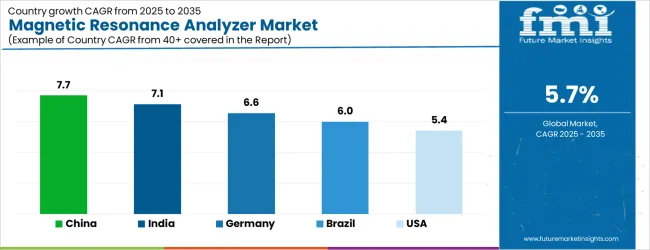
The Magnetic Resonance Analyzer Market is expected to register a CAGR of 5.7% during the forecast period, exhibiting varied country level momentum. China leads with the highest CAGR of 7.7%, followed by India at 7.1%. Developed markets such as Germany, France, and the UK continue to expand steadily, while the USA is likely to grow at consistent rates. Japan posts the lowest CAGR at 4.3%, yet still underscores a broadly positive trajectory for the global Magnetic Resonance Analyzer Market. In 2024, Germany held a dominant revenue in the Western Europe market and is expected to grow with a CAGR of 6.6%. The USA Magnetic Resonance Analyzer Market is estimated to be valued at USD 383.8 million in 2026 and is anticipated to reach a valuation of USD 383.8 million by 2036. Sales are projected to rise at a CAGR of 0.0% over the forecast period between 2026 and 2036. While Japan and South Korea markets are estimated to be valued at USD 53.6 million and USD 36.4 million respectively in 2026.
Key Players in the Magnetic Resonance Analyzer Market
- Siemens Healthineers
- Bruker Corporation
- Hitachi High-Tech Corporation
- Thermo Fisher Scientific
- Oxford Instruments
- Shimadzu Corporation
- JEOL Ltd.
- Aspect Imaging
Scope of the Report
| Metric | Value |
|---|---|
| Quantitative Units | USD 1.16 billion to USD 2.02 billion, at a CAGR of 5.70% |
| Market Definition | Magnetic resonance analyzers are diagnostic and analytical instruments that use nuclear magnetic resonance (NMR) principles to characterize molecular structures, measure tissue properties, and analyze chemical compositions in clinical and laboratory settings. These devices range from benchtop NMR spectrometers used in pharmaceutical quality control to compact MR-based body composition analyzers deployed in hospitals and healthcare centers. |
| Segmentation | Modularity: Bench Top, Handheld; End Use: Hospitals, Gynecology Clinics, Healthcare Centers, Household |
| Regions Covered | North America, Latin America, Europe, East Asia, South Asia, Oceania, Middle East & Africa |
| Countries Covered | China, India, Germany, Brazil, USA, UK, Japan, and 40 plus countries |
| Key Companies Profiled | Siemens Healthineers, Bruker Corporation, Hitachi High-Tech Corporation, Thermo Fisher Scientific, Oxford Instruments, Shimadzu Corporation, JEOL Ltd., Aspect Imaging |
| Forecast Period | 2026 to 2036 |
| Approach | Forecasting models apply a bottom-up methodology starting with global installed base and shipment metrics, cross-validated against manufacturer financial disclosures and industry procurement records. |
Magnetic Resonance Analyzer Market by Segments
Modularity:
- Bench Top
- Handheld
End Use:
- Hospitals
- Gynecology Clinics
- Healthcare Centers
- Household
Region:
- North America
- USA
- Canada
- Mexico
- Latin America
- Brazil
- Chile
- Rest of Latin America
- Western Europe
- Germany
- UK
- Italy
- Spain
- France
- Nordic
- BENELUX
- Rest of Western Europe
- Eastern Europe
- Russia
- Poland
- Hungary
- Balkan & Baltic
- Rest of Eastern Europe
- East Asia
- China
- Japan
- South Korea
- South Asia and Pacific
- India
- ASEAN
- Australia & New Zealand
- Rest of South Asia and Pacific
- Middle East & Africa
- Kingdom of Saudi Arabia
- Other GCC Countries
- Turkiye
- South Africa
- Other African Union
- Rest of Middle East & Africa
Bibliography
- 1. World Health Organization. (2024). WHO compendium of innovative health technologies for low-resource settings. WHO.
- 2. USA Food and Drug Administration. (2024). Guidance for industry: Analytical procedures and methods validation for drugs and biologics. FDA.
- 3. European Medicines Agency. (2024). ICH Q2(R2): Validation of analytical procedures. EMA.
- 4. International Organization for Standardization. (2024). ISO 13485: Medical devices quality management systems. ISO.
- 5. National Health Service England. (2024). NHS Long Term Plan: Diagnostic capacity expansion programme. NHS.
- 6. Organisation for Economic Co-operation and Development. (2024). Health at a glance: Diagnostic imaging equipment deployment. OECD.
This bibliography is provided for reader reference. The full Future Market Insights report contains the complete reference list with primary research documentation.
Frequently Asked Questions
How large is the demand for Magnetic Resonance Analyzer in the global market in 2026?
Demand for Magnetic Resonance Analyzer in the global market is estimated to be valued at USD 1.16 billion in 2026.
What will be the market size of Magnetic Resonance Analyzer in the global market by 2036?
Market size for Magnetic Resonance Analyzer is projected to reach USD 2.02 billion by 2036.
What is the expected demand growth for Magnetic Resonance Analyzer between 2026 and 2036?
Demand for Magnetic Resonance Analyzer is expected to grow at a CAGR of 5.70% between 2026 and 2036.
Which Modularity segment is poised to lead global sales by 2026?
Bench Top accounts for 55.0% share in 2026.
What is driving demand in China?
China leads growth at 7.7% CAGR through 2036.
What is Magnetic Resonance Analyzer and what is it mainly used for?
Magnetic resonance analyzers are diagnostic and analytical instruments that use nuclear magnetic resonance (NMR) principles to characterize molecular structures, measure tissue properties, and analyze chemical compositions in clinical and laboratory settings. These devices range from benchtop NMR spectrometers used in pharmaceutical quality control to compact MR-based body composition analyzers deployed in hospitals and healthcare centers.
What is included in the scope of this Magnetic Resonance Analyzer report?
Market scope covers benchtop magnetic resonance analyzers, handheld NMR devices, clinical body composition analyzers using MR principles, and associated calibration and consumable components. Regional and country-level analysis spans 2026 to 2036.
How does FMI build and validate the Magnetic Resonance Analyzer forecast?
Forecasting models apply a bottom-up methodology starting with global installed base metrics and cross-validate projections against manufacturer financial disclosures and industry procurement data.
Preview the report firsthand - request a free sample
Get SampleGet the brochure for pricing and purchase details.
Get PDFTable of Content
- Executive Summary
- Global Market Outlook
- Demand-side Trends
- Supply-side Trends
- Technology Roadmap Analysis
- Analysis and Recommendations
- Market Overview
- Market Coverage / Taxonomy
- Market Definition / Scope / Limitations
- Research Methodology
- Chapter Orientation
- Analytical Lens and Working Hypotheses
- Market Structure, Signals, and Trend Drivers
- Benchmarking and Cross-market Comparability
- Market Sizing, Forecasting, and Opportunity Mapping
- Research Design and Evidence Framework
- Desk Research Programme (Secondary Evidence)
- Company Annual and Sustainability Reports
- Peer-reviewed Journals and Academic Literature
- Corporate Websites, Product Literature, and Technical Notes
- Earnings Decks and Investor Briefings
- Statutory Filings and Regulatory Disclosures
- Technical White Papers and Standards Notes
- Trade Journals, Industry Magazines, and Analyst Briefs
- Conference Proceedings, Webinars, and Seminar Materials
- Government Statistics Portals and Public Data Releases
- Press Releases and Reputable Media Coverage
- Specialist Newsletters and Curated Briefings
- Sector Databases and Reference Repositories
- FMI Internal Proprietary Databases and Historical Market Datasets
- Subscription Datasets and Paid Sources
- Social Channels, Communities, and Digital Listening Inputs
- Additional Desk Sources
- Expert Input and Fieldwork (Primary Evidence)
- Physicians and Other Healthcare Professionals
- Governance, Ethics, and Data Stewardship
- Research Ethics
- Data Integrity and Handling
- Desk Research Programme (Secondary Evidence)
- Tooling, Models, and Reference Databases
- Data Engineering and Model Build
- Data Acquisition and Ingestion
- Cleaning, Normalisation, and Verification
- Synthesis, Triangulation, and Analysis
- Quality Assurance and Audit Trail
- Market Background
- Market Dynamics
- Drivers
- Restraints
- Opportunity
- Trends
- Scenario Forecast
- Demand in Optimistic Scenario
- Demand in Likely Scenario
- Demand in Conservative Scenario
- Opportunity Map Analysis
- Product Life Cycle Analysis
- Supply Chain Analysis
- Investment Feasibility Matrix
- Value Chain Analysis
- PESTLE and Porter’s Analysis
- Regulatory Landscape
- Regional Parent Market Outlook
- Production and Consumption Statistics
- Import and Export Statistics
- Market Dynamics
- Global Market Analysis 2021 to 2025 and Forecast, 2026 to 2036
- Historical Market Size Value (USD Million) Analysis, 2021 to 2025
- Current and Future Market Size Value (USD Million) Projections, 2026 to 2036
- Y-o-Y Growth Trend Analysis
- Absolute $ Opportunity Analysis
- Global Market Pricing Analysis 2021 to 2025 and Forecast 2026 to 2036
- Global Market Analysis 2021 to 2025 and Forecast 2026 to 2036, By Modularity
- Introduction / Key Findings
- Historical Market Size Value (USD Million) Analysis By Modularity , 2021 to 2025
- Current and Future Market Size Value (USD Million) Analysis and Forecast By Modularity , 2026 to 2036
- Bench Top
- Handheld
- Bench Top
- Y-o-Y Growth Trend Analysis By Modularity , 2021 to 2025
- Absolute $ Opportunity Analysis By Modularity , 2026 to 2036
- Global Market Analysis 2021 to 2025 and Forecast 2026 to 2036, By End Use
- Introduction / Key Findings
- Historical Market Size Value (USD Million) Analysis By End Use, 2021 to 2025
- Current and Future Market Size Value (USD Million) Analysis and Forecast By End Use, 2026 to 2036
- Hospitals
- Gynecology Clinics
- Healthcare Centers
- Household
- Hospitals
- Y-o-Y Growth Trend Analysis By End Use, 2021 to 2025
- Absolute $ Opportunity Analysis By End Use, 2026 to 2036
- Global Market Analysis 2021 to 2025 and Forecast 2026 to 2036, By Region
- Introduction
- Historical Market Size Value (USD Million) Analysis By Region, 2021 to 2025
- Current Market Size Value (USD Million) Analysis and Forecast By Region, 2026 to 2036
- North America
- Latin America
- Western Europe
- Eastern Europe
- East Asia
- South Asia and Pacific
- Middle East & Africa
- Market Attractiveness Analysis By Region
- North America Market Analysis 2021 to 2025 and Forecast 2026 to 2036, By Country
- Historical Market Size Value (USD Million) Trend Analysis By Market Taxonomy, 2021 to 2025
- Market Size Value (USD Million) Forecast By Market Taxonomy, 2026 to 2036
- By Country
- USA
- Canada
- Mexico
- By Modularity
- By End Use
- By Country
- Market Attractiveness Analysis
- By Country
- By Modularity
- By End Use
- Key Takeaways
- Latin America Market Analysis 2021 to 2025 and Forecast 2026 to 2036, By Country
- Historical Market Size Value (USD Million) Trend Analysis By Market Taxonomy, 2021 to 2025
- Market Size Value (USD Million) Forecast By Market Taxonomy, 2026 to 2036
- By Country
- Brazil
- Chile
- Rest of Latin America
- By Modularity
- By End Use
- By Country
- Market Attractiveness Analysis
- By Country
- By Modularity
- By End Use
- Key Takeaways
- Western Europe Market Analysis 2021 to 2025 and Forecast 2026 to 2036, By Country
- Historical Market Size Value (USD Million) Trend Analysis By Market Taxonomy, 2021 to 2025
- Market Size Value (USD Million) Forecast By Market Taxonomy, 2026 to 2036
- By Country
- Germany
- UK
- Italy
- Spain
- France
- Nordic
- BENELUX
- Rest of Western Europe
- By Modularity
- By End Use
- By Country
- Market Attractiveness Analysis
- By Country
- By Modularity
- By End Use
- Key Takeaways
- Eastern Europe Market Analysis 2021 to 2025 and Forecast 2026 to 2036, By Country
- Historical Market Size Value (USD Million) Trend Analysis By Market Taxonomy, 2021 to 2025
- Market Size Value (USD Million) Forecast By Market Taxonomy, 2026 to 2036
- By Country
- Russia
- Poland
- Hungary
- Balkan & Baltic
- Rest of Eastern Europe
- By Modularity
- By End Use
- By Country
- Market Attractiveness Analysis
- By Country
- By Modularity
- By End Use
- Key Takeaways
- East Asia Market Analysis 2021 to 2025 and Forecast 2026 to 2036, By Country
- Historical Market Size Value (USD Million) Trend Analysis By Market Taxonomy, 2021 to 2025
- Market Size Value (USD Million) Forecast By Market Taxonomy, 2026 to 2036
- By Country
- China
- Japan
- South Korea
- By Modularity
- By End Use
- By Country
- Market Attractiveness Analysis
- By Country
- By Modularity
- By End Use
- Key Takeaways
- South Asia and Pacific Market Analysis 2021 to 2025 and Forecast 2026 to 2036, By Country
- Historical Market Size Value (USD Million) Trend Analysis By Market Taxonomy, 2021 to 2025
- Market Size Value (USD Million) Forecast By Market Taxonomy, 2026 to 2036
- By Country
- India
- ASEAN
- Australia & New Zealand
- Rest of South Asia and Pacific
- By Modularity
- By End Use
- By Country
- Market Attractiveness Analysis
- By Country
- By Modularity
- By End Use
- Key Takeaways
- Middle East & Africa Market Analysis 2021 to 2025 and Forecast 2026 to 2036, By Country
- Historical Market Size Value (USD Million) Trend Analysis By Market Taxonomy, 2021 to 2025
- Market Size Value (USD Million) Forecast By Market Taxonomy, 2026 to 2036
- By Country
- Kingdom of Saudi Arabia
- Other GCC Countries
- Turkiye
- South Africa
- Other African Union
- Rest of Middle East & Africa
- By Modularity
- By End Use
- By Country
- Market Attractiveness Analysis
- By Country
- By Modularity
- By End Use
- Key Takeaways
- Key Countries Market Analysis
- USA
- Pricing Analysis
- Market Share Analysis, 2025
- By Modularity
- By End Use
- Canada
- Pricing Analysis
- Market Share Analysis, 2025
- By Modularity
- By End Use
- Mexico
- Pricing Analysis
- Market Share Analysis, 2025
- By Modularity
- By End Use
- Brazil
- Pricing Analysis
- Market Share Analysis, 2025
- By Modularity
- By End Use
- Chile
- Pricing Analysis
- Market Share Analysis, 2025
- By Modularity
- By End Use
- Germany
- Pricing Analysis
- Market Share Analysis, 2025
- By Modularity
- By End Use
- UK
- Pricing Analysis
- Market Share Analysis, 2025
- By Modularity
- By End Use
- Italy
- Pricing Analysis
- Market Share Analysis, 2025
- By Modularity
- By End Use
- Spain
- Pricing Analysis
- Market Share Analysis, 2025
- By Modularity
- By End Use
- France
- Pricing Analysis
- Market Share Analysis, 2025
- By Modularity
- By End Use
- India
- Pricing Analysis
- Market Share Analysis, 2025
- By Modularity
- By End Use
- ASEAN
- Pricing Analysis
- Market Share Analysis, 2025
- By Modularity
- By End Use
- Australia & New Zealand
- Pricing Analysis
- Market Share Analysis, 2025
- By Modularity
- By End Use
- China
- Pricing Analysis
- Market Share Analysis, 2025
- By Modularity
- By End Use
- Japan
- Pricing Analysis
- Market Share Analysis, 2025
- By Modularity
- By End Use
- South Korea
- Pricing Analysis
- Market Share Analysis, 2025
- By Modularity
- By End Use
- Russia
- Pricing Analysis
- Market Share Analysis, 2025
- By Modularity
- By End Use
- Poland
- Pricing Analysis
- Market Share Analysis, 2025
- By Modularity
- By End Use
- Hungary
- Pricing Analysis
- Market Share Analysis, 2025
- By Modularity
- By End Use
- Kingdom of Saudi Arabia
- Pricing Analysis
- Market Share Analysis, 2025
- By Modularity
- By End Use
- Turkiye
- Pricing Analysis
- Market Share Analysis, 2025
- By Modularity
- By End Use
- South Africa
- Pricing Analysis
- Market Share Analysis, 2025
- By Modularity
- By End Use
- USA
- Market Structure Analysis
- Competition Dashboard
- Competition Benchmarking
- Market Share Analysis of Top Players
- By Regional
- By Modularity
- By End Use
- Competition Analysis
- Competition Deep Dive
- Siemens Healthineers
- Overview
- Product Portfolio
- Profitability by Market Segments (Product/Age /Sales Channel/Region)
- Sales Footprint
- Strategy Overview
- Marketing Strategy
- Product Strategy
- Channel Strategy
- Bruker Corporation
- Hitachi High-Tech Corporation
- Thermo Fisher Scientific
- Oxford Instruments
- Shimadzu Corporation
- JEOL Ltd.
- Aspect Imaging
- Siemens Healthineers
- Competition Deep Dive
- Assumptions & Acronyms Used


