

- Industry Size (2026)
- USD 23.2 Bn
- Forecast (2036)
- USD 47.9 Bn
- CAGR (2026 to 2036)
- 7.5%
Male Sex Toys Market Size, Market Forecast and Outlook By FMI
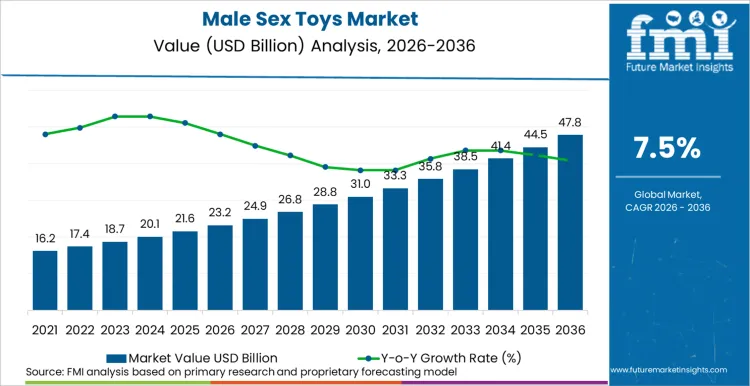
The male sex toys market is expected to expand from USD 23.2 billion in 2026 to USD 47.9 billion by 2036. The market is anticipated to register a 7.5% CAGR during the forecast period. Male masturbators are likely to lead product type with a 38.7% share in 2026. Online channels are projected to account for 72.5% of sales channel revenue in 2026.
Summary of the Male Sex Toys Market
- Demand and Growth Drivers
- Discreet e-commerce access is reducing hesitation among first-time buyers.
- Intimate wellness acceptance is helping the category move into mainstream retail.
- Body-safe materials are increasing trust in premium product formats.
- Product and Segment View
- Male masturbators lead due to realism and stronger technology upgrades.
- Premium products gain traction as buyers prioritize safety and comfort.
- Online channels dominate as privacy remains central to purchase behavior.
- Geography and Competitive Outlook
- Asia Pacific is likely to lead growth due to mobile commerce expansion.
- North America shows steady demand through premium trading-up and brand-led retail.
- Europe gains from product safety rules and stronger compliance expectations.
- Analyst Opinion
- Ronak Shah, Senior Analyst at FMI, suggests “The male sex toys market is moving toward privacy-led wellness buying. Brands with safer materials and discreet digital commerce are likely to gain advantage as consumers look for trusted products and reliable post-purchase support.”
- Male Sex Toys Market Value Analysis
- The male sex toys market is moving from novelty buying into intimate wellness retail.
- Demand is likely to grow as privacy-focused online channels reduce purchase friction.
- Product uptake is improving through premium materials and app-connected features.
- Spending is set to gain from discreet delivery and stronger product safety assurance.
Key Takeaways, Market Size, and Forecast
- The male sex toys market was valued at USD 21.6 billion in 2025.
- The market is projected to be valued at USD 23.2 billion in 2026.
- By 2036, the market is forecast to be valued at USD 47.9 billion.
- From 2026 to 2036, the market is anticipated to expand at a 7.5% CAGR.
- Male masturbators are likely to lead product type with 38.7% share in 2026.
- Online channels are projected to hold 72.5% of sales channel share in 2026.
As Ben Wilson, Intimate Wellness Global Category Director at Reckitt, noted regarding the link between intimate wellness and overall health, ‘It’s encouraging to see that so many people are enjoying a satisfying, fulfilling sex life in many of the countries who took part in this year’s survey. We know that intimate wellness can be a significant contributor to overall health, and we’re committed to ensuring everyone has a sex life they feel positive about.’ [1]
India (15.9% CAGR) and China (13.4% CAGR) lead growth as first-time buyers enter via mobile commerce and discreet fulfillment, while Japan (10.3%) and Singapore (9.8%) expand through premium device adoption and high digital retail usage. The United States (4.8% CAGR) grows through trading-up and subscription-style replenishment of accessories and lubricants tied to devices, while Germany (4.2% CAGR) advances through compliance-driven product assurance and cross-border e-commerce within the EU, with the mature group constrained by ad-platform limits and marketplace policy variability.
Market definition
The male sex toys market covers products designed for male sexual stimulation and intimate wellness, sold through online and offline retail. It includes devices such as male masturbators, cock rings, sleeves, sex doll toys, and penis enhancement products, made using body-safe materials and designed for hygiene, comfort, and controlled stimulation. The market tracks how consumers purchase these products, the shift toward premium materials and app-connected features, and how brands use discreet packaging, privacy protections, and compliance to build repeat demand.
Market inclusions
This report covers global and regional market sizing for 2026 to 2036, with historical context from 2020 to 2025. It includes segmentation by product type, price range, sales channel, and region, plus country-level forecasts and growth rates. The analysis includes adoption drivers such as e-commerce penetration, privacy expectations, product safety compliance, and technology feature sets such as app control and connected use cases.
Market exclusions
The scope excludes pornography content, adult entertainment services, and dating platforms. It excludes medical treatment products for diagnosed sexual dysfunction that are regulated and marketed as pharmaceuticals, as well as clinical devices sold strictly through healthcare channels. It also excludes non-device consumables such as condoms and lubricants unless they are bundled as accessories that directly support device usage and are part of the commercial offering being analysed.
Research methodology
- Primary research: FMI conducts interviews with brand owners, e-commerce category managers, distributors, and compliance and product engineering stakeholders involved in materials selection, QA, and packaging.
- Desk research: Desk research uses company press releases, product and compliance statements, public policy documents on product safety and data protection, and reputable media coverage of channel access and platform restrictions.
- Market-sizing and forecasting: FMI uses a hybrid approach combining bottom-up channel sizing with top-down calibration to consumer goods spending patterns, then models segment shares by product type, price range, and sales channel.
- Data validation and update cycle: Forecasts are validated through triangulation across company disclosures, policy timelines, and channel signals such as marketplace access and regulatory enforcement dates, with periodic updates as product standards and data rules evolve.
Segmental Analysis
Male Sex Toys Market analysis by product type
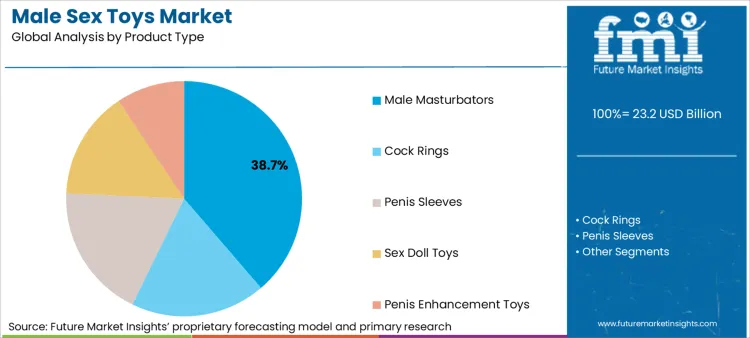
Based on FMI’s male sex toys market report, consumption of Male Masturbators is estimated to hold 38.7% share in 2026. This category dominates because it meets the core buyer requirement, private solo use with high perceived realism, and it supports premiumisation through material quality, hygiene design, and feature upgrades such as app control or responsive modes. Product innovation also concentrates here, so brands can refresh line-ups and defend pricing through differentiated user experience rather than discounting.
- Product launches: LELO’s April 2024 launch communications around its F1S V3 positioned the device around next-generation stimulation and connected capability, signalling continued R&D spend in premium male devices. [2]
- Design and compliance cues: Doc Johnson’s October 2024 packaging and branding update for a major product line shows how established brands invest in retail-ready presentation and trust signals that reduce buyer hesitation, which supports category conversion. [3]
- Channel bundling: Product pages and listings from large retailers increasingly pair male masturbators with accessories and guidance content, which raises basket size and supports repeat purchase patterns driven by maintenance, replacement sleeves, and add-ons. [5]
Male Sex Toys Market analysis by sales channel
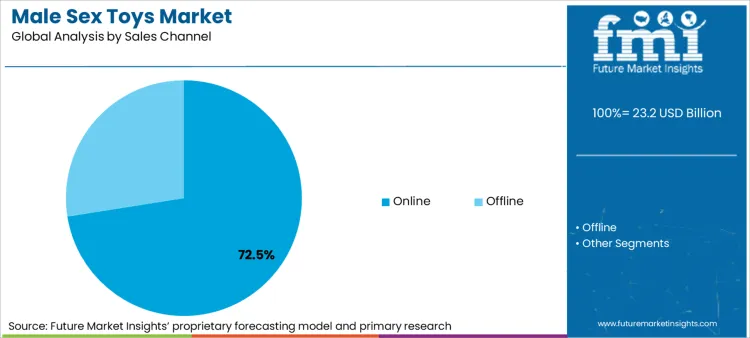
Based on FMI’s male sex toys market report, consumption through the Online channel is estimated to hold 72.5% share in 2026. Online dominates because discretion is built into the transaction, with private browsing, discreet shipping, and broad assortment that offline retail rarely matches. Online also functions as the education layer, with reviews, FAQs, and use guidance reducing the confidence barrier for first-time buyers, while enabling direct-to-consumer brands to retain margin and run loyalty programmes.
- Policy and platform access: Reuters reporting on intimate wellness selling dynamics in China shows that platforms initially resisted category participation, then opened up over time as acceptance increased, which is material because platform policy shifts directly affect growth rates. [4]
- Data protection trust: India’s Digital Personal Data Protection Act and related compliance framing strengthens consumer expectations around consent and data processing, pushing brands to treat privacy and disclosure as conversion levers, not back-office tasks. [6]
- Marketplace obligations: EU product safety rules strengthen requirements for online marketplaces and economic operators, supporting tighter compliance, faster recall pathways, and more visible product traceability signals, which can advantage larger brands with stronger QA and documentation. [7]
Male Sex Toys Market drivers, restraints, and opportunities
Future Market Insights analysis indicates the category’s baseline demand is now anchored in sexual wellness normalisation and the shift to private, online purchasing. The market exists at its current scale because online retail solves two historic adoption blockers: purchase embarrassment and limited assortment. As a result, brands can reach consumers outside major metros and offer education-led discovery at the point of sale, lifting conversion for first-time buyers and supporting repeat purchasing through accessories and upgrade cycles.
FMI analysts observe a clear transition from volume-led growth in entry products to value-led growth in premium devices. Entry offerings expand the funnel, but margins and brand resilience increasingly depend on premium materials, hygiene features, and connected capability. At the same time, the market faces friction from platform policy changes, payment processor scrutiny, and tightening consumer product safety enforcement, which can raise compliance cost and restrict marketing reach. The net result is a category where supply-side execution, not just consumer openness, determines who captures the decade’s USD 24.6 billion incremental value.
- Privacy-led commerce: Data protection expectations shape conversion and retention, because buyers avoid brands and marketplaces that feel risky. Regulatory direction on data handling is moving toward stronger consent and accountability, which increases the need for compliant customer data operations. [6]
- Product safety governance: Safety and traceability move from optional to required as consumer product standards tighten, with online marketplaces facing clearer obligations and faster recall pathways under EU product safety rules. [7]
- Platform access in Asia: Marketplace and social commerce rules around intimate wellness can change quickly, which affects paid marketing and livestream selling. In China, category access has expanded on some platforms, but brands still manage policy sensitivity through careful positioning and channel selection. [4]
Regional analysis
The market is analysed across North America, Latin America, Western Europe, Eastern Europe, Balkan & Baltic Countries, Russia & Belarus, Central Asia, East Asia, South Asia & Pacific, and the Middle East & Africa. The full report provides market attractiveness analysis by region and country, mapping where premiumisation, e-commerce access, and compliance pressure most strongly influence buying behaviour.
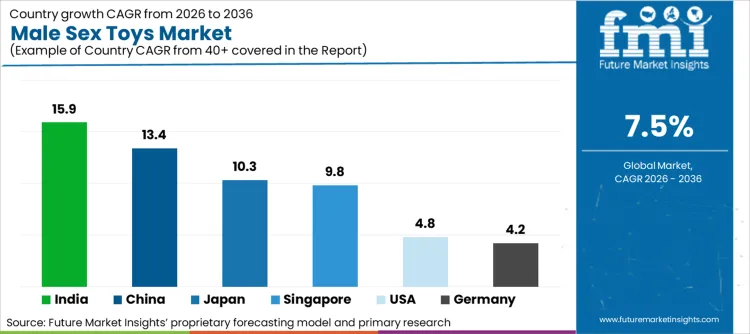
| Country | CAGR (2026 to 2036) |
|---|---|
| India | 15.9% |
| China | 13.4% |
| Japan | 10.3% |
| Singapore | 9.8% |
| United States | 4.8% |
| Germany | 4.2% |
Source: Future Market Insights (FMI) analysis, based on proprietary forecasting model and primary research
North America market analysis
North America is the high-value, brand-led market where premium materials, strict consumer trust requirements, and DTC performance marketing shape competition. The region benefits from broad e-commerce adoption and mature logistics for discreet delivery, supporting recurring purchase behaviour. Key players active through retail, licensing, or brand influence include Lovehoney and Adam & Eve, alongside global consumer health brands that shape sexual wellbeing narratives.
- United States: Demand for male sex toys in the United States is projected to rise at 4.8% CAGR through 2036. Growth is anchored in premium trading-up and ecosystem buying, where consumers purchase a device and then add accessories over time. Category demand is supported by increasing mainstream coverage of intimate wellness and the role it plays in wellbeing, which makes lifestyle positioning more acceptable for retailers and payment partners. A practical enabler is the expansion of branded educational content that reduces hesitation for first-time buyers, which improves conversion without relying on explicit advertising. On the supply side, brand portfolios tied to recognised consumer health houses influence category trust by aligning intimate wellness with safety and positive outcomes.
FMI’s analysis of male sex toys market in North America consists of country-wise assessment that includes the United States and Canada. Readers can find channel mix shifts, premium adoption indicators, and competition benchmarking across DTC and large-format e-commerce.
Western Europe market analysis
Western Europe functions as the compliance and product assurance anchor, where regulation-led safety obligations and data protection expectations influence purchase confidence. Competition places weight on documentation, materials governance, and the ability to sell through online marketplaces that apply strict listing standards. The region includes strong cross-border e-commerce, which supports scale for brands that can manage language localisation and compliance across markets.
- Germany: Demand for male sex toys in Germany is projected to rise at 4.2% CAGR through 2036. Growth is driven by premiumisation and trust-based buying, with consumers expecting clear product information, safe materials, and reliable fulfilment. The EU’s General Product Safety Regulation strengthens obligations across supply chains and clarifies duties for online marketplaces, which raises the minimum compliance bar for brands selling across the region. [7] This supports demand for established manufacturers that can provide documentation, traceability, and recall readiness without disrupting retail availability. A second driver is the strong online retail footprint and cross-border parcel flows that make discreet ordering routine, improving adoption for buyers who avoid in-store purchase.
FMI’s analysis of male sex toys market in Western Europe consists of country-wise assessment that includes Germany, France, and the United Kingdom. Readers can find compliance-driven competitive dynamics and premium pricing bands by channel.
East Asia market analysis
East Asia is the manufacturing and technology feature engine for the category, with rapid product iteration and strong e-commerce behaviour. The region’s growth reflects both domestic demand expansion and the role of Asian suppliers and brands in global product flow. Competitive advantage often comes from fast design cycles, platform-native marketing, and the ability to navigate category sensitivity while keeping fulfilment discreet and reliable.
- China: Demand for male sex toys in China is projected to rise at 13.4% CAGR through 2036. Growth is linked to mobile commerce, evolving attitudes toward intimate wellness, and the ability of brands to sell through social and livestream channels when policies allow. Reuters reporting on Reckitt’s China selling approach notes that intimate wellness acceptance can take time because platforms worry about complaints, and that access has been opening up, which signals a real channel unlock effect rather than only a consumer preference shift. [4] This matters because livestream retail can compress discovery-to-purchase time and accelerate adoption for new users. China also links to broader data governance expectations, with state focus on data security, pushing firms to treat customer data handling as a controlled operational function rather than a marketing afterthought. [8]
FMI’s analysis of male sex toys market in East Asia consists of country-wise assessment that includes China, Japan, and South Korea. Readers can find channel availability tracking and feature-led premium adoption patterns by country.
Competitive aligners for market players
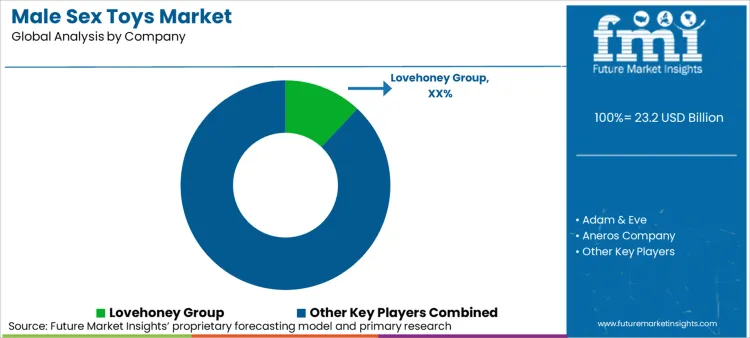
Competition in the male sex toys market sits between a premium innovation tier and a long tail of price-led products. The market behaves as semi-fragmented: high brand visibility concentrates around a group of recognisable names, while online marketplaces host extensive private label and unbranded supply. The primary competitive variable is trust, expressed through body-safe materials, hygiene engineering, discreet fulfilment, and reliable customer support. In premium, feature differentiation such as connected modes, device realism, and durability protects pricing, while the mid-range competes on value bundles and fast shipping.
Brands with structural advantages tend to control product design and quality systems end-to-end, because those capabilities reduce returns and protect reputation. Premium suppliers benefit from tighter materials governance and consistent manufacturing, which allows them to pass marketplace checks, maintain listings, and expand cross-border. Firms tied to large consumer health organisations gain credibility through broader wellness narratives and established compliance culture, which helps with retail access and payment partnerships.
Buyer behaviour is shaped by privacy and risk management. Consumers seek anonymity in discovery and purchase, then demand reliability after delivery, because returns and customer support interactions are sensitive. This pushes brands to invest in discreet packaging, clear usage guidance, and data handling that feels safe. Where data protection rules strengthen, companies must minimise unnecessary data collection and improve transparency, because trust is a conversion driver for intimate products. [6] In Europe, product safety obligations for online marketplaces and operators raise compliance expectations further, shifting leverage toward suppliers that can document safety and act quickly in recall scenarios. [7]
Recent developments:
- May 2024: Reckitt published updated global survey-based insights tying sexual wellbeing to broader wellbeing outcomes, reinforcing mainstream positioning for intimate wellness categories. [1]
- Oct 2024: Doc Johnson announced new packaging and branding for a best-selling product line, focusing on retail presentation and clearer consumer cues. [3]
- Apr 2024: LELO issued launch communications for an upgraded male device positioned around advanced stimulation and connected use, signalling ongoing premium R&D cadence. [2]
Key players in Male Sex Toys Market
- Lovehoney Group
- Adam & Eve
- Aneros Company
- Bad Dragon
- Beate Uhse AG
- California Exotic Novelties, LLC
- Crystal Delights
- Doc Johnson Enterprises
- Jimmyjane
- Leten
- LifeStyles Healthcare
Scope of the Report
| Metric | Value |
|---|---|
| Quantitative Units | USD 23.2 billion (2026) to USD 47.9 billion (2036), at a CAGR of 7.5% |
| Market Definition | The male sex toys market covers products designed for male sexual stimulation and intimate wellness, sold through online and offline retail, including male masturbators, cock rings, penis sleeves, sex doll toys, penis enhancement toys, and related devices made with body-safe materials and designed for hygiene, comfort, and controlled stimulation. |
| Product Type Segmentation | Male Masturbators, Cock Rings, Penis Sleeves, Sex Doll Toys, Penis Enhancement Toys, Others |
| Price Range Segmentation | Premium/ Luxury, Mid-Range/ Economy |
| Sales Channel Segmentation | Online, Offline |
| Regions Covered | North America, Latin America, Western Europe, Eastern Europe, Balkan & Baltic Countries, Russia & Belarus, Central Asia, East Asia, South Asia & Pacific, Middle East & Africa |
| Countries Covered | United States, Canada, Mexico, Brazil, Argentina, Germany, France, United Kingdom, Italy, Spain, China, India, Japan, South Korea, Singapore, Indonesia, Australia, Saudi Arabia, UAE, South Africa and 40 plus countries |
| Key Companies Profiled | Lovehoney Group, Adam & Eve, Aneros Company, Bad Dragon, Beate Uhse AG, California Exotic Novelties, LLC, Crystal Delights, Doc Johnson Enterprises, Jimmyjane, Leten, LifeStyles Healthcare |
| Forecast Period | 2026 to 2036 |
| Approach | Hybrid top down and bottom up market modeling validated through primary interviews with resin producers and panel manufacturers, supported by trade data benchmarking and plant level capacity verification |
Male Sex Toys Market analysis by segments
By Product Type:
- Male Masturbators
- Cock Rings
- Penis Sleeves
- Sex Doll Toys
- Penis Enhancement Toys
- Others
By Price Range:
- Premium/ Luxury
- Mid-Range/ Economy
By Sales Channel:
- Online
- Offline
By Region:
- North America
- Latin America
- Western Europe
- Eastern Europe
- Balkan & Baltic Countries
- Russia & Belarus
- Central Asia
- East Asia
- South Asia & Pacific
- Middle East & Africa
Bibliography
- [1] Reckitt. (2024, June). Global Satisfaction: Increased sexual wellbeing.
- [2] PR Newswire. (2024, April). Be the main character in your own life: Meet the LELO F1S V3 pleasure console.
- [3] Doc Johnson. (2024, October). The Realistic Cock debuts new packaging (press release).
- [4] Reuters. (2024, February). In delicate China play, Reckitt turns to livestreaming to sell condoms.
- [5] Future Market Insights. (2025, October). Male sex toys market: Global market analysis report-2035.
- [6] Ministry of Electronics and Information Technology, Government of India. (2023, August). The Digital Personal Data Protection Act, 2023 (No. 22 of 2023).
- [7] European Union. (2023, May). Regulation (EU) 2023/988 on general product safety.
- [8] National People’s Congress of the People’s Republic of China. (2021, June). Data Security Law of the People’s Republic of China (English text).
This report addresses
- Global market size and 2026 to 2036 forecast with CAGR tracking and absolute dollar growth context
- Segment-level forecasting by product type, price range, and sales channel, with leading share positions
- Country-level growth outlook and market attractiveness mapping for priority economies
- Channel analysis focused on privacy-led commerce, marketplace access, and DTC strategy levers
- Competitive benchmarking across premium innovation players and price-led long-tail suppliers
- Regulatory and compliance lens covering product safety obligations and data protection impact on conversion
- Evidence-led assessment using company releases, policy documents, and reputable media reporting
- Deliverables suitable for strategy planning, go-to-market prioritisation, and portfolio positioning decisions
Frequently Asked Questions
How large is the demand for Male Sex Toys in the global market in 2026?
Demand for Male Sex Toys in the global market is estimated to be valued at USD 23.2 billion in 2026.
What will be the market size of Male Sex Toys in the global market by 2036?
Market size for Male Sex Toys is projected to reach USD 47.9 billion by 2036.
What is the expected demand growth for Male Sex Toys in the global market between 2026 and 2036?
Demand for Male Sex Toys in the global market is expected to grow at a CAGR of 7.5% between 2026 and 2036.
Which Product Type is poised to lead global sales by 2026?
Male Masturbators are expected to be the dominant product type, capturing approximately 38.7% of global market share in 2026 due to high perceived realism and technology upgrade potential.
How significant is the role of Premium/Luxury Price Range in driving Male Sex Toys adoption in 2026?
Premium/Luxury represents the critical price range segment, projected to hold substantial 54.2% share of total market in 2026 as buyers prioritize body-safe materials and advanced features.
What is Driving Male Sex Toys Demand in the United States?
Premium trading-up and ecosystem buying where consumers purchase devices and add accessories over time, supported by mainstream intimate wellness coverage and branded educational content reducing first-time buyer hesitation are driving growth.
What Compliance Standards are Referenced for the United States?
Consumer product safety standards and data privacy best practices governing discreet commerce and customer data handling are referenced as key compliance benchmarks.
What is the United States Growth Outlook in this Report?
The United States is projected to grow at a CAGR of 4.8% during 2026 to 2036.
Why is Western Europe described as Compliance and Product Assurance Region in this Report?
Growth is shaped by regulation-led safety obligations and data protection expectations influencing purchase confidence with EU General Product Safety Regulation strengthening supply chain obligations.
What Type of Demand Dominates in Western Europe?
Premiumisation and trust-based buying with consumers expecting clear product information, safe materials, and reliable fulfilment dominates regional consumption.
What is Germany Growth Outlook in this Report?
Germany is projected to expand at a CAGR of 4.2% during 2026 to 2036.
Does the Report Cover China in its Regional Analysis?
China is included within East Asia under the regional scope of analysis as second-fastest growing major market.
What are the Sources referred to for analyzing the Market in China?
Platform policy evolution for intimate wellness categories, mobile commerce penetration data, and data governance compliance frameworks are cited as primary reference sources.
What is the Main Demand Theme Linked to China in East Asia Coverage?
East Asia mobile commerce expansion, evolving platform policies around intimate wellness category access, and livestream retail adoption compressing discovery-to-purchase time are emphasized.
Does the Report Cover India in its Regional Analysis?
India is included within South Asia & Pacific under the regional coverage framework as fastest-growing major market.
What is the Main India Related Demand Theme in Asia Coverage?
First-time buyer entry via mobile commerce and discreet fulfillment, combined with Digital Personal Data Protection Act strengthening consumer expectations around data handling, are emphasized.
Which Sales Channels are Strategically Important for Male Sex Toys?
Online channels are prioritized due to discretion built into transactions through private browsing, discreet shipping, and educational content reducing confidence barriers for first-time buyers.
What are Male Sex Toys and What are They Mainly Used For?
Male sex toys are products designed for male sexual stimulation and intimate wellness including male masturbators, cock rings, penis sleeves, and enhancement devices made with body-safe materials for hygiene and comfort.
What does Male Sex Toys Market Mean in this Report?
Male sex toys market refers to global sales of male-focused sexual wellness devices and accessories through online and offline channels where discretion, safety compliance, and repeat purchase determine value.
What is Included in the Scope of this Male Sex Toys Market Report?
Scope covers product type segmentation, price range analysis spanning premium to economy, and sales channel distribution across online and offline retail with country-level forecasts.
What is Excluded from the Scope of this Report?
Pornography content, adult entertainment services, dating platforms, pharmaceutical treatments for sexual dysfunction, clinical devices sold through healthcare channels, and standalone consumables like condoms are excluded.
Preview the report firsthand - request a free sample
Get SampleGet the brochure for pricing and purchase details.
Get PDFTable of Content
- Executive Summary
- Global Market Outlook
- Demand-side Trends
- Supply-side Trends
- Technology Roadmap Analysis
- Analysis and Recommendations
- Market Overview
- Market Coverage / Taxonomy
- Market Definition / Scope / Limitations
- Research Methodology
- Chapter Orientation
- Analytical Lens and Working Hypotheses
- Market Structure, Signals, and Trend Drivers
- Benchmarking and Cross-market Comparability
- Market Sizing, Forecasting, and Opportunity Mapping
- Research Design and Evidence Framework
- Desk Research Programme (Secondary Evidence)
- Company Annual and Sustainability Reports
- Peer-reviewed Journals and Academic Literature
- Corporate Websites, Product Literature, and Technical Notes
- Earnings Decks and Investor Briefings
- Statutory Filings and Regulatory Disclosures
- Technical White Papers and Standards Notes
- Trade Journals, Industry Magazines, and Analyst Briefs
- Conference Proceedings, Webinars, and Seminar Materials
- Government Statistics Portals and Public Data Releases
- Press Releases and Reputable Media Coverage
- Specialist Newsletters and Curated Briefings
- Sector Databases and Reference Repositories
- FMI Internal Proprietary Databases and Historical Market Datasets
- Subscription Datasets and Paid Sources
- Social Channels, Communities, and Digital Listening Inputs
- Additional Desk Sources
- Expert Input and Fieldwork (Primary Evidence)
- Primary Modes
- Qualitative Interviews and Expert Elicitation
- Quantitative Surveys and Structured Data Capture
- Blended Approach
- Why Primary Evidence is Used
- Field Techniques
- Interviews
- Surveys
- Focus Groups
- Observational and In-context Research
- Social and Community Interactions
- Stakeholder Universe Engaged
- C-suite Leaders
- Board Members
- Presidents and Vice Presidents
- R&D and Innovation Heads
- Technical Specialists
- Domain Subject-matter Experts
- Scientists
- Physicians and Other Healthcare Professionals
- Governance, Ethics, and Data Stewardship
- Research Ethics
- Data Integrity and Handling
- Primary Modes
- Tooling, Models, and Reference Databases
- Desk Research Programme (Secondary Evidence)
- Data Engineering and Model Build
- Data Acquisition and Ingestion
- Cleaning, Normalisation, and Verification
- Synthesis, Triangulation, and Analysis
- Quality Assurance and Audit Trail
- Market Background
- Market Dynamics
- Drivers
- Restraints
- Opportunity
- Trends
- Scenario Forecast
- Demand in Optimistic Scenario
- Demand in Likely Scenario
- Demand in Conservative Scenario
- Opportunity Map Analysis
- Product Life Cycle Analysis
- Supply Chain Analysis
- Investment Feasibility Matrix
- Value Chain Analysis
- PESTLE and Porter’s Analysis
- Regulatory Landscape
- Regional Parent Market Outlook
- Production and Consumption Statistics
- Import and Export Statistics
- Market Dynamics
- Global Market Analysis 2021 to 2025 and Forecast, 2026 to 2036
- Historical Market Size Value (USD Billion) Analysis, 2021 to 2025
- Current and Future Market Size Value (USD Billion) Projections, 2026 to 2036
- Y-o-Y Growth Trend Analysis
- Absolute $ Opportunity Analysis
- Global Market Pricing Analysis 2021 to 2025 and Forecast 2026 to 2036
- Global Market Analysis 2021 to 2025 and Forecast 2026 to 2036, By Product Type
- Introduction / Key Findings
- Historical Market Size Value (USD Billion) Analysis By Product Type , 2021 to 2025
- Current and Future Market Size Value (USD Billion) Analysis and Forecast By Product Type , 2026 to 2036
- Male Masturbators
- Cock Rings
- Penis Sleeves
- Sex Doll Toys
- Penis Enhancement Toys
- Male Masturbators
- Y-o-Y Growth Trend Analysis By Product Type , 2021 to 2025
- Absolute $ Opportunity Analysis By Product Type , 2026 to 2036
- Global Market Analysis 2021 to 2025 and Forecast 2026 to 2036, By Sales Channel
- Introduction / Key Findings
- Historical Market Size Value (USD Billion) Analysis By Sales Channel, 2021 to 2025
- Current and Future Market Size Value (USD Billion) Analysis and Forecast By Sales Channel, 2026 to 2036
- Online
- Offline
- Online
- Y-o-Y Growth Trend Analysis By Sales Channel, 2021 to 2025
- Absolute $ Opportunity Analysis By Sales Channel, 2026 to 2036
- Global Market Analysis 2021 to 2025 and Forecast 2026 to 2036, By Region
- Introduction
- Historical Market Size Value (USD Billion) Analysis By Region, 2021 to 2025
- Current Market Size Value (USD Billion) Analysis and Forecast By Region, 2026 to 2036
- North America
- Latin America
- Western Europe
- Eastern Europe
- East Asia
- South Asia and Pacific
- Middle East & Africa
- Market Attractiveness Analysis By Region
- North America Market Analysis 2021 to 2025 and Forecast 2026 to 2036, By Country
- Historical Market Size Value (USD Billion) Trend Analysis By Market Taxonomy, 2021 to 2025
- Market Size Value (USD Billion) Forecast By Market Taxonomy, 2026 to 2036
- By Country
- USA
- Canada
- Mexico
- By Product Type
- By Sales Channel
- By Country
- Market Attractiveness Analysis
- By Country
- By Product Type
- By Sales Channel
- Key Takeaways
- Latin America Market Analysis 2021 to 2025 and Forecast 2026 to 2036, By Country
- Historical Market Size Value (USD Billion) Trend Analysis By Market Taxonomy, 2021 to 2025
- Market Size Value (USD Billion) Forecast By Market Taxonomy, 2026 to 2036
- By Country
- Brazil
- Chile
- Rest of Latin America
- By Product Type
- By Sales Channel
- By Country
- Market Attractiveness Analysis
- By Country
- By Product Type
- By Sales Channel
- Key Takeaways
- Western Europe Market Analysis 2021 to 2025 and Forecast 2026 to 2036, By Country
- Historical Market Size Value (USD Billion) Trend Analysis By Market Taxonomy, 2021 to 2025
- Market Size Value (USD Billion) Forecast By Market Taxonomy, 2026 to 2036
- By Country
- Germany
- UK
- Italy
- Spain
- France
- Nordic
- BENELUX
- Rest of Western Europe
- By Product Type
- By Sales Channel
- By Country
- Market Attractiveness Analysis
- By Country
- By Product Type
- By Sales Channel
- Key Takeaways
- Eastern Europe Market Analysis 2021 to 2025 and Forecast 2026 to 2036, By Country
- Historical Market Size Value (USD Billion) Trend Analysis By Market Taxonomy, 2021 to 2025
- Market Size Value (USD Billion) Forecast By Market Taxonomy, 2026 to 2036
- By Country
- Russia
- Poland
- Hungary
- Balkan & Baltic
- Rest of Eastern Europe
- By Product Type
- By Sales Channel
- By Country
- Market Attractiveness Analysis
- By Country
- By Product Type
- By Sales Channel
- Key Takeaways
- East Asia Market Analysis 2021 to 2025 and Forecast 2026 to 2036, By Country
- Historical Market Size Value (USD Billion) Trend Analysis By Market Taxonomy, 2021 to 2025
- Market Size Value (USD Billion) Forecast By Market Taxonomy, 2026 to 2036
- By Country
- China
- Japan
- South Korea
- By Product Type
- By Sales Channel
- By Country
- Market Attractiveness Analysis
- By Country
- By Product Type
- By Sales Channel
- Key Takeaways
- South Asia and Pacific Market Analysis 2021 to 2025 and Forecast 2026 to 2036, By Country
- Historical Market Size Value (USD Billion) Trend Analysis By Market Taxonomy, 2021 to 2025
- Market Size Value (USD Billion) Forecast By Market Taxonomy, 2026 to 2036
- By Country
- India
- ASEAN
- Australia & New Zealand
- Rest of South Asia and Pacific
- By Product Type
- By Sales Channel
- By Country
- Market Attractiveness Analysis
- By Country
- By Product Type
- By Sales Channel
- Key Takeaways
- Middle East & Africa Market Analysis 2021 to 2025 and Forecast 2026 to 2036, By Country
- Historical Market Size Value (USD Billion) Trend Analysis By Market Taxonomy, 2021 to 2025
- Market Size Value (USD Billion) Forecast By Market Taxonomy, 2026 to 2036
- By Country
- Kingdom of Saudi Arabia
- Other GCC Countries
- Turkiye
- South Africa
- Other African Union
- Rest of Middle East & Africa
- By Product Type
- By Sales Channel
- By Country
- Market Attractiveness Analysis
- By Country
- By Product Type
- By Sales Channel
- Key Takeaways
- Key Countries Market Analysis
- USA
- Pricing Analysis
- Market Share Analysis, 2025
- By Product Type
- By Sales Channel
- Canada
- Pricing Analysis
- Market Share Analysis, 2025
- By Product Type
- By Sales Channel
- Mexico
- Pricing Analysis
- Market Share Analysis, 2025
- By Product Type
- By Sales Channel
- Brazil
- Pricing Analysis
- Market Share Analysis, 2025
- By Product Type
- By Sales Channel
- Chile
- Pricing Analysis
- Market Share Analysis, 2025
- By Product Type
- By Sales Channel
- Germany
- Pricing Analysis
- Market Share Analysis, 2025
- By Product Type
- By Sales Channel
- UK
- Pricing Analysis
- Market Share Analysis, 2025
- By Product Type
- By Sales Channel
- Italy
- Pricing Analysis
- Market Share Analysis, 2025
- By Product Type
- By Sales Channel
- Spain
- Pricing Analysis
- Market Share Analysis, 2025
- By Product Type
- By Sales Channel
- France
- Pricing Analysis
- Market Share Analysis, 2025
- By Product Type
- By Sales Channel
- India
- Pricing Analysis
- Market Share Analysis, 2025
- By Product Type
- By Sales Channel
- ASEAN
- Pricing Analysis
- Market Share Analysis, 2025
- By Product Type
- By Sales Channel
- Australia & New Zealand
- Pricing Analysis
- Market Share Analysis, 2025
- By Product Type
- By Sales Channel
- China
- Pricing Analysis
- Market Share Analysis, 2025
- By Product Type
- By Sales Channel
- Japan
- Pricing Analysis
- Market Share Analysis, 2025
- By Product Type
- By Sales Channel
- South Korea
- Pricing Analysis
- Market Share Analysis, 2025
- By Product Type
- By Sales Channel
- Russia
- Pricing Analysis
- Market Share Analysis, 2025
- By Product Type
- By Sales Channel
- Poland
- Pricing Analysis
- Market Share Analysis, 2025
- By Product Type
- By Sales Channel
- Hungary
- Pricing Analysis
- Market Share Analysis, 2025
- By Product Type
- By Sales Channel
- Kingdom of Saudi Arabia
- Pricing Analysis
- Market Share Analysis, 2025
- By Product Type
- By Sales Channel
- Turkiye
- Pricing Analysis
- Market Share Analysis, 2025
- By Product Type
- By Sales Channel
- South Africa
- Pricing Analysis
- Market Share Analysis, 2025
- By Product Type
- By Sales Channel
- USA
- Market Structure Analysis
- Competition Dashboard
- Competition Benchmarking
- Market Share Analysis of Top Players
- By Regional
- By Product Type
- By Sales Channel
- Competition Analysis
- Competition Deep Dive
- Lovehoney Group
- Overview
- Product Portfolio
- Profitability by Market Segments (Product/Age /Sales Channel/Region)
- Sales Footprint
- Strategy Overview
- Marketing Strategy
- Product Strategy
- Channel Strategy
- Adam & Eve
- Aneros Company
- Bad Dragon
- Beate Uhse AG
- California Exotic Novelties, LLC
- Crystal Delights
- Doc Johnson Enterprises
- Jimmyjane
- Lovehoney Group
- Competition Deep Dive
- Assumptions & Acronyms Used


