

- Market Size (2026)
- USD 161.2 Mn
- Forecast (2036)
- USD 385.1 Mn
- CAGR (2026 to 2036)
- 9.1%
How big is Maple Sugar Market in 2026?
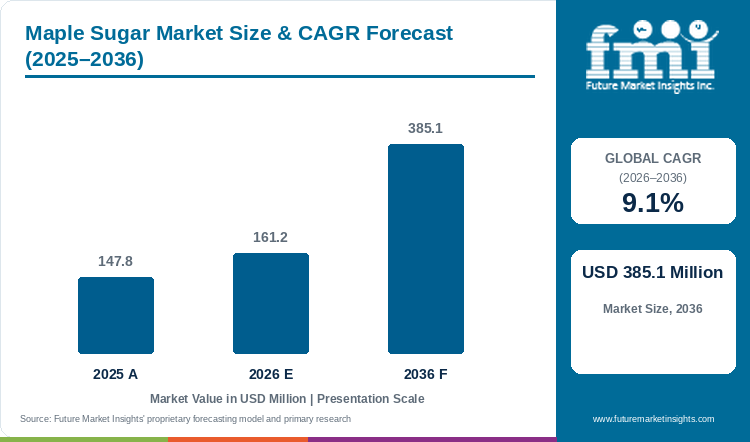
The maple sugar market is estimated at USD 147.8 million in 2025 and is projected to reach USD 161.2 million in 2026. Demand for maple sugar is forecast to grow at a 9.1% CAGR and reach USD 385.1 million by 2036.
Sales of maple sugar are highest in bakery and confectionery kitchens, and the maple sugar market, estimated at USD 147.8 million in 2025, is expected to reach USD 161.2 million in 2026 and USD 385.1 million by 2036 at a 9.1% CAGR. Within this growth, syrup supply has become the deciding trend for crystal makers. In particular, Luc Goulet of the Québec Maple Syrup Producers said the strategic syrup reserve had been reduced to zero, The Canadian Press reported on 19 October 2026.[1] With no reserve barrels to draw on, every pound of sugar competes with bottled syrup for the same sap, so food buyers value contracted crystal over spot lots.
Across buyers, industrial bakers and snack makers who dose fine granulated crystals into every batch buy the most maple sugar. Among product types, fine granulated grades will hold 36% of the 2026 product mix, and direct contracts with food manufacturers are likely to carry 55% of channel volume, so a small group of recipe owners absorbs most of the crystal. By comparison, gift confectioners and home cooks buy in smaller packs and at higher unit prices, keeping retail demand steady through holiday peaks. In FMI's estimate, the heaviest users will tie supply to syrup crop contracts, and sugar makers able to dry and mill on site will gain the longest agreements.
Key Market Trends & Insights
- Bakers on automatic dosing lines favour fine granulated crystals, which are likely to hold 36% in 2026 against 28.5% for coarse grades.
- Food manufacturers ask for traceable Canadian or Vermont origin, and conventional maple sugar is projected to hold 58% of nature sales in 2026 with organic at an estimated 42%. Origin labels are also reaching more overseas buyers each season. At the same time, Canada exported maple products to 69 countries in 2025, Agriculture and Agri-Food Canada reported.[2] That spread of export routes lets overseas bakers specify Canadian crystal by origin, which supports contract volume outside North America.
- Within application, bakery and confectionery lines are likely to account for 34% in 2026, followed by beverages near 17% and breakfast cereals and snacks at about 15%.
- Sales through direct manufacturer contracts are estimated at 55% of channel sales in 2026, and retail and online stores near 26%. Large packers now plan volume around those contract buyers. Among packers, Rogers Sugar expects maple sales volume of 53.8 million pounds for fiscal 2026.[3] A volume plan of that size can cover twelve-month crystal contracts, so contract business is likely to concentrate with the largest packers.
Regional Highlights
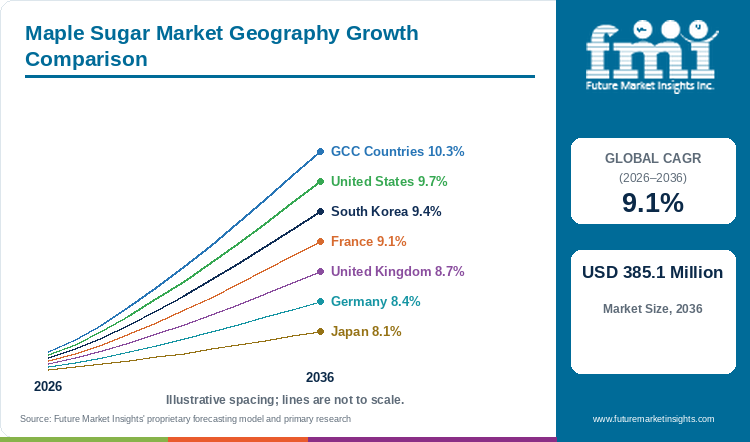
- GCC Countries grow fastest at 10.3% on FMI's forecast, 1.2 points over the market rate of 9.1%, as hotel pastry kitchens and importers add Canadian maple lines.
- The United States, at 9.7%, and South Korea, at 9.4%, come next, as bakery chains and cafés add seasonal maple ranges. France keeps pace with the 9.1% global rate, and growth in the United Kingdom (8.7%) and Germany (8.4%) is predicted to run below the global rate. Japan, at 8.1%, is likely to grow the slowest.
- European buyers take large maple volumes, mostly as syrup. In Europe, Canada shipped 5.6 million kg of maple products to Germany and 4.2 million kg to the United Kingdom in 2025, Agriculture and Agri-Food Canada reported on 17 April 2026.[2] Import lanes of that size already reach European wholesalers, so growth in crystal there rests more on bakers changing recipes than on new logistics.
Market Size & Forecast
Table 1: Market Size and Forecast for the Maple Sugar Market (USD million and percentage), 2025 to 2036
| Metric | Value |
|---|---|
| 2025 Market Size | USD 147.8 million |
| Estimated Market Size in 2026 | USD 161.2 million |
| Projected Market Size by 2036 | USD 385.1 million |
| CAGR, 2026 to 2036 | 9.1% |
| Added Revenue, 2026 to 2036 | USD 223.9 million |
| Market Expansion Multiple | 2.4x |
Syrup supply is tightening in Canada even as export orders grow, which raises the value of every barrel set aside for crystal. Canadian maple output fell 5.1% to 113.4 million kg in 2025, and export volume rose 15.7% to 82.4 million kg, according to Agriculture and Agri-Food Canada.[2] Smaller output against larger shipments leaves less syrup for drying into sugar, which keeps crystal prices firm for spot buyers. Québec producers then harvested 229.5 million pounds of syrup in 2026, The Maple News reported.[4] A larger 2026 harvest eases that pressure for contract buyers and gives packers more syrup to convert into granulated grades. Alongside crystal, liquid extracts draw on the same sap, and the maple extracts market is predicted to grow at a 6% CAGR, slower than crystal formats. FMI analysis shows the maple sugar market adding about USD 223.9 million in sales over 2026 to 2036 and ending 2.4 times larger than the 2026 base. Even so, a short crop in Québec or Vermont remains the main near-term risk for buyers on spot terms.
Syrup Supply, Processor Volumes and Export Routes
Processor volumes show a tight but stable supply year. Rogers Sugar reported Maple segment revenues of CAD 64.1 million for the third quarter of fiscal 2026, down from CAD 67.5 million, on lower sales volume.[3] Lower Maple sales at the largest packer show how limited syrup caps shipments, even when buyer orders hold up. The same release said the 2026 Québec crop gave 3.9 pounds of syrup per tap, an average yield, and that Rogers Sugar had secured enough syrup for customer demand through the first half of fiscal 2027.[3] With syrup covered into 2027, contract buyers face little risk of short supply, though spot lots stay scarce. In addition, the Québec Maple Syrup Producers issued permits for 7 million new taps, The Maple News reported in June 2026.[4] New taps on that scale add sap capacity over the next few seasons, which supports more crystal output by the end of the decade.
United States supply is growing more slowly. The 2026 US crop reached 5.877 million gallons, up 3%, from 16.47 million taps, The Maple News reported on 11 June 2026.[5] A 3% gain gives US processors only a modest increase in syrup, so most new crystal capacity will still draw on Canadian supply. Within that crop, Vermont sugarmakers sold 31 thousand gallons as value-added products in 2025, against 2,660 thousand gallons sold in bulk, the Vermont Maple Sugar Makers' Association reported.[6] Crystal and candy output in Vermont therefore draws on a small slice of the state crop, and most US maple sugar for food plants comes from Canadian syrup.
Table 2: Supply, Processor and Trade Indicators for the Maple Sugar Market (volume, sales and capacity), 2025 to 2026
| Indicator | Data Point | Relevance | Source |
|---|---|---|---|
| Canadian maple production, 2025 | 113.4 million kg; down 5.1% | Raw syrup available for crystal making | [2] |
| Canadian maple exports, 2025 | 82.4 million kg; up 15.7%; 69 countries | Reach of Canadian maple sugar and syrup | [2] |
| Québec syrup harvest, 2026 | 229.5 million pounds | Sap base for Québec sugar makers | [4] |
| Québec strategic reserve, October 2026 | Reduced to zero | Spot supply risk for crystal buyers | [1] |
| US maple crop, 2026 | 5.877 million gallons; up 3% | Domestic supply for US processors | [5] |
| Vermont value-added sales, 2025 | 31 thousand gallons | Small crystal and candy base in Vermont | [6] |
| Rogers Sugar maple volume outlook, fiscal 2026 | 53.8 million pounds | Packer throughput in Canada | [3] |
Analyst Perspective
“Maple sugar buyers now face a syrup-first industry, and I see crystal volume going to the processors who sign multi-season sap contracts and dry the sugar on site. Food manufacturers who lock in fine granulated lots for two or three seasons will hold steady recipes, opening a premium lane for crystal maple in Japanese gift confectionery and European craft bakeries. Spot buyers will keep paying the swing price each time Québec has a short spring.”
- Nandini Roy Choudhury, Principal Consultant, Future Market Insights.
How is the maple sugar market segmented?
The market is segmented into product type, nature, application, sales channel, and region. Fine granulated crystals are expected to lead product type with 36% share in 2026, and direct manufacturer contracts lead sales channel with 55%.
By product type: fine granulated, coarse granulated, moulded candy and blocks, and flakes and blends.
By nature: conventional and organic.
By application: bakery and confectionery, beverages, breakfast cereals and snacks, home cooking and tabletop, dairy and frozen desserts, and sauces and seasonings.
By sales channel: direct to food manufacturers, retail and online, ingredient distributors, and foodservice suppliers.
By region: food plants, bakeries, cafés and households in North America, Latin America, Western Europe, Eastern Europe, East Asia, South Asia and Pacific, and Middle East and Africa.
Why does fine granulated maple sugar lead sales by product type?
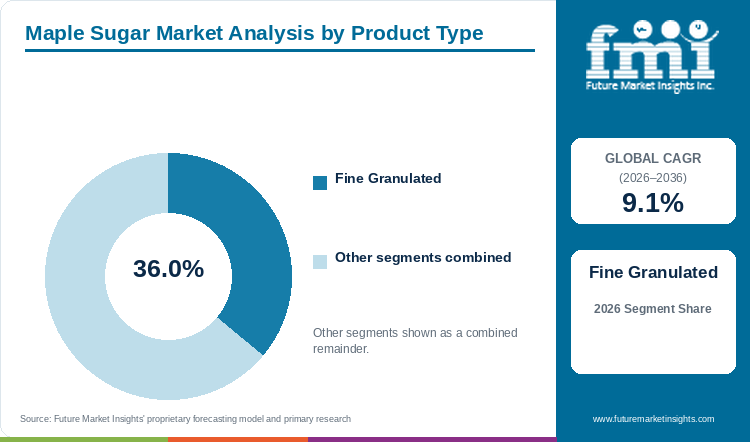
Fine granulated crystals are expected to lead product type sales with 36% share in 2026, ahead of coarse granulated grades at about 28.5% and moulded candy and blocks at an estimated 18%.
Table 3: Product Type Share for the Maple Sugar Market (percentage share), 2026
| Product Type | Estimated Share (2026) |
|---|---|
| Fine Granulated | 36% |
| Coarse Granulated | 28.5% |
| Moulded Candy and Blocks | 18% |
| Flakes and Blends | 17.5% |
| Total | 100.0% |
Table 4: Product Type Leadership and Market Growth for the Maple Sugar Market (segment and CAGR percentage), 2026 to 2036
| Metric | Value |
|---|---|
| Global CAGR (2026 to 2036) | 9.1% |
| Leading Segment | Fine Granulated |
Fine granulated maple sugar is predicted to keep first place at 36% in 2026, as industrial bakers weigh sweeteners by the kilogram on automatic dosing lines and a fine crystal flows and dissolves like cane sugar. Coarse granulated grades, about 28.5%, suit toppings, coffee service and rubs, though the larger crystal blends unevenly into batters. Moulded candy and blocks are likely to hold near 18%, with sales peaking around holidays. Flakes and blends, an estimated 17.5%, carry less maple per pack and compete with brown sugar on price, and the brown sugar market is predicted to expand at a 10.9% CAGR, so blenders face a fast-growing rival. Every grade competes for the same limited syrup. At the same time, each pound of crystal needs a full measure of syrup, and Canadian syrup output fell 5.1% in 2025.[2] Tighter syrup favours the grades with the steadiest contract buyers, so packers reserve fine crystal for recipe owners who replace cane sugar without changing the mixing line.
- Fine crystals for dough and batter, powdered maple sugar for icings, and sieved bakery grades form the fine granulated group.
- Household use of maple sugar is widening in the producing country as well. Maple sugar available for consumption in Canada rose to 0.52 kg per person in 2025 from 0.42 kg in 2024, Agriculture and Agri-Food Canada reported.[2] Higher use at home keeps more Canadian crystal in the domestic market, which tightens export supply of fine granulated grades.
Why does conventional maple sugar lead sales by nature?
Conventional maple sugar is likely to lead nature sales with 58% share in 2026, and organic certified maple sugar holds an estimated 42%.
Table 5: Nature Share for the Maple Sugar Market (percentage share), 2026
| Nature | Estimated Share (2026) |
|---|---|
| Conventional | 58% |
| Organic | 42% |
| Total | 100.0% |
Conventional maple sugar will hold the lead at 58% in 2026, as large food plants buy against a cost sheet and conventional crystal from pooled Québec syrup carries no certification premium. Organic maple sugar, an estimated 42%, sells to natural food brands, baby food makers and European retailers who need a certified chain from sugarbush to pack. However, organic sugarbushes cannot use certain defoamers or tapping practices, and the certified syrup pool is smaller each spring. Brand owners are still moving toward certified ranges for European shelves. On the buyer side, Pure Maple, a British Canadian brand, moved the syrup range to organic certification and flagged maple sugar as a growing trend ahead of the Speciality & Fine Food Fair in London in September 2025.[7] A brand switching a full range to organic signals that European retailers reward the claim, which supports a price premium for certified crystal. In practice, buyers who print an organic claim on pack choose the certified grade, and every other buyer chooses conventional.
- Conventional maple sugar covers bulk crystals for food plants and private label packs in North America and Asia.
- Trade fairs give organic maple brands direct access to European buyers. Pure Maple showed organic syrups at Olympia, London, on 9 to 10 September 2025.[7] Listings gained at such events open a route for organic crystal into British fine food retail.
Why do bakery and confectionery uses lead sales by application?
Bakery and confectionery uses are expected to lead application sales with 34% share in 2026, ahead of beverages at about 17% and breakfast cereals and snacks at an estimated 15%.
Table 6: Application Share for the Maple Sugar Market (percentage share), 2026
| Application | Estimated Share (2026) |
|---|---|
| Bakery and Confectionery | 34% |
| Beverages | 17% |
| Breakfast Cereals and Snacks | 15% |
| Home Cooking and Tabletop | 13% |
| Dairy and Frozen Desserts | 12% |
| Sauces and Seasonings | 9% |
| Total | 100.0% |
Bakery and confectionery uses are likely to stay on top with 34% in 2026, as cookies, financiers and glazed pastries carry maple flavour best in a dry crystal. Premium gift bakers now build whole product lines around maple crystal. For example, Shucrei, the Tokyo company behind The MAPLE MANIA, sells Maple Butter Cookies made with maple sugar in the dough and ran Valentine pop-up stores at Sogo, Tokyu and Takashimaya department stores from 16 January to 15 February 2026.[8] Department store launches of that kind make maple sugar a named selling point, which supports higher-priced fine crystal orders from confectioners. Beverages, about 17%, use maple sugar in coffee shop syrups, teas and cocktails, though many drink makers still prefer liquid syrup. Likewise, granola and nut snack makers coat clusters with crystal, and breakfast cereals and snacks account for about 15%. Home cooking and tabletop use is estimated at 13% and dairy and frozen desserts at 12%, and both buy small volumes per recipe. Sauces and seasonings, an estimated 9%, use maple sugar in barbecue rubs and bacon cures. Overall, bakers buy the most crystal per product launch, which keeps the application lead with bakery and confectionery.
- Cookies, financiers, glazed doughnuts, maple candy and chocolate fillings make up most bakery and confectionery use.
- Gift pricing shows how much buyers pay for maple-led baked goods. The MAPLE MANIA Maple Butter Cookies sold at JPY 1,131 for nine pieces in the 2026 Valentine pop-ups.[8] At about JPY 126 per cookie, confectioners have room to pay a premium for fine crystal.
Why do direct contracts with food manufacturers lead sales by sales channel?
Direct supply to food manufacturers is projected to lead sales channel with 55% share in 2026, ahead of retail and online at about 26% and ingredient distributors at an estimated 11%.
Table 7: Sales Channel Share for the Maple Sugar Market (percentage share), 2026
| Sales Channel | Estimated Share (2026) |
|---|---|
| Direct to Food Manufacturers | 55% |
| Retail and Online | 26% |
| Ingredient Distributors | 11% |
| Foodservice Suppliers | 8% |
| Total | 100.0% |
Direct supply to food manufacturers is forecast to carry 55% of 2026 channel volume, the largest slice, as food plants sign annual or multi-season agreements with Québec and Vermont packers to secure crystal before the spring crop is known. For instance, Rogers Sugar said enough syrup was secured to meet expected customer demand through the first two quarters of fiscal 2027.[3] Cover of that length lets packers offer fixed-grade contracts, which pulls more bakery volume away from spot lots. By comparison, households and gift buyers pay a higher price per kilogram for jars, pouches and candy, and retail and online stores are likely to hold 26%. Ingredient distributors, near 11%, break bulk bags for smaller bakeries and importers in Europe and Asia. Foodservice suppliers, an estimated 8%, serve cafés and hotel pastry kitchens. In the end, volume buyers stay with direct contracts, since a packer that holds syrup inventory can promise the same crystal grade each month.
- Bakery chains, snack makers, cereal brands and confectioners buy most direct contract volume.
- Packers are investing to handle larger contract volumes at a steady grade. Rogers Sugar plans CAD 2.0 million of Maple capital projects in fiscal 2026, focused on automation.[3] Automated lines lower handling cost per pound, which helps the packer hold contract prices for food plants.
What are the drivers, restraints, and opportunities in the maple sugar market?
Clean-label baking and gift confectionery are pulling more maple crystal into recipes. Thin syrup reserves and high prices against cane sugar hold back volume, and organic and Asian bakery buyers open new contracts.
- Driver: Food brands replacing refined cane sugar with a single-origin sweetener choose maple crystals that carry flavour and a recognisable label claim in one ingredient.
- Restraint: Maple sugar sells at a steep premium to cane sugar per kilogram, and a short spring crop leaves sugar makers bidding against syrup packers for the same barrels.
- Opportunity: Japanese gift confectioners, Gulf hotel kitchens and organic baby food brands want small, traceable lots of fine crystal that few processors can mill to a steady grade.
Single-Origin Sweeteners Pull Maple Crystal into Recipes
Consumer preference for sweeteners with a clear farm origin is moving maple sugar from gift shops into everyday bakery lines. Canadian maple exports reached 69 countries in 2025, with volume up 15.7%, Agriculture and Agri-Food Canada reported.[2] More destinations mean more bakers testing maple crystal in local recipes. Besides this, exports rose 15.8% in 2025 and another 2.48% from January to August 2026, Louis Turenne of the Maple Industry Council told The Canadian Press.[1] In turn, wider export routes give foreign bakers easier access to crystal lots, and recipe trials then turn into repeat orders.
Thin Syrup Reserves Keep Crystal Prices High
Producers of maple sugar face a syrup market with no buffer stock. For instance, the Québec strategic reserve was reduced to zero in 2026 after US buyers stocked up the year before over tariff concerns, The Canadian Press reported.[1] Without reserve barrels, any short spring now feeds directly into spot prices for syrup and crystal alike. Alongside this, Rogers Sugar expects lower Maple segment results in fiscal 2026 due to higher production costs.[3] Those higher syrup costs pass straight into crystal prices, so price-sensitive buyers switch to coconut or brown sugar for part of the blend.
Gift Confectionery and Organic Brands Open New Contracts
Growth of the maple sugar market will come from buyers who pay for origin and certification. Japanese gift confectioners are among the first of these buyers. Shucrei sold maple sugar cookies and financiers through department store pop-ups across five Japanese locations in early 2026.[8] A five-store run shows that premium retail can absorb maple-led products at gift prices. Likewise, Pure Maple brought organic certified syrups to the London fine food trade in 2025.[7] Consequently, processors with organic sugarbush contracts and small-lot milling will gain these higher-margin accounts first.
Which country CAGRs are profiled in the maple sugar market?
Table 8: Country CAGR Comparison for the Maple Sugar Market (CAGR percentage), 2026 to 2036
| Country | CAGR (2026 to 2036) |
|---|---|
| GCC Countries | 10.3% |
| United States | 9.7% |
| South Korea | 9.4% |
| France | 9.1% |
| United Kingdom | 8.7% |
| Germany | 8.4% |
| Japan | 8.1% |
How do country-level CAGRs compare in the maple sugar market?
GCC Countries lead the seven countries at 10.3% on FMI's forecast, with Dubai and Riyadh hotel pastry kitchens importing every gram of crystal from a small starting volume. The United States, at 9.7%, gains from bakery chains that blend Vermont and Canadian crystal into seasonal ranges. South Korea follows near 9.4% as café chains add maple drinks and baked goods. In France, steady pâtisserie use matches the 9.1% global figure. By comparison, the United Kingdom (8.7%) and Germany (8.4%) import large syrup volumes, but crystal remains a niche line in both. Finally, Japan, at 8.1%, has a mature gift confectionery base and grows the slowest.
- Gulf hotel groups serve maple sugar mainly at breakfast and in pastry, so demand centres on small, moisture-tight packs, and exporters with Gulf distributors and Arabic labelling gain the first listings.
- With Vermont syrup at home and Canadian imports next door, US bakery chains can run maple ranges all year. Packers able to blend both origins promise steadier grade and price to national accounts.
- Café menus in South Korea change several times a year, which favours fine crystal sold in smaller bulk bags; distributors holding local stock gain the repeat menu orders.
- French pâtissiers prize maple for glazes and viennoiserie fillings, pushing orders toward fine and powdered grades and toward suppliers that can ship certified small lots to artisan bakeries.
- Premium jars and pouches in fine food shops and organic grocers make up most British crystal sales. Brands with UK retail packaging are likely to gain more there than bulk ingredient sellers.
- Germany remains mostly a syrup buyer, and organic stores stock crystal only in small packs. Suppliers can build volume by adding crystal next to existing syrup listings in organic chains.
- Japanese gift cookie brands already use maple crystal at scale, so new volume comes from fresh product launches more than new buyers, and suppliers who hold colour grade steady across seasonal launches keep the accounts.
Full report country CAGRs cover: all 27 standard countries by region. Among seven key markets, rates run from GCC Countries on 10.3% down to Japan on 8.1%, and France matches the 9.1% world figure.
Country-wise Analysis
GCC Countries Maple Sugar Market Outlook (2026 to 2036)
Demand for maple sugar in GCC Countries starts from a small import base, and FMI projects a 10.3% CAGR through 2036. In particular, hotel groups in Dubai, Abu Dhabi and Riyadh run large pastry kitchens for international guests, and maple crystals suit pancakes, financiers and coffee service. Importers bring in Canadian crystal in sealed bags and jars, as the region grows no maple. At the same time, hot and humid storage calls for moisture-tight packs, and suppliers who ship in lined cartons will hold the hotel accounts.
Key takeaway: Hotel pastry kitchens set the pace for maple sugar in the Gulf.
United States Maple Sugar Market Outlook (2026 to 2036)
US supply is growing at home and arriving from Canada at the same time. The 2026 US maple crop reached 5.877 million gallons, up 3%, and Vermont made about 53% of the total, The Maple News reported.[5] A larger Vermont crop gives domestic processors more syrup for crystal, though still not enough for national bakery accounts. Alongside that domestic crop, Canada shipped 53.3 million kg of maple products to the United States in 2025, 64.2% of export value.[2] US bakery and snack brands therefore buy crystal milled from both Vermont and Québec syrup. The United States is predicted to hold a 9.7% CAGR for maple sugar, supported by bakery chains and two supply bases.
Key takeaway: Two supply bases and large bakery chains keep the United States above the global rate.
South Korea Maple Sugar Market Outlook (2026 to 2036)
Korean café chains sell maple lattes, scones and croffles, and franchise kitchens buy crystal in bulk bags for those menus. Those menus rely on imports, which arrive through Canadian exporters and Korean ingredient distributors, as the country produces no maple syrup. On this basis, FMI forecasts a 9.4% CAGR for South Korea, with growth tied to new dessert menus each season. Even so, Korean-language labels and food import checks add a step for new suppliers.
Key takeaway: Each new café dessert menu in South Korea adds maple sugar orders.
France Maple Sugar Market Outlook (2026 to 2036)
France has no maple production, so every kilogram of crystal arrives as an import, mostly from Canada. France received 3.48 million kg of Canadian maple products in 2025, Agriculture and Agri-Food Canada reported.[2] Import volume of that size gives French buyers steady access to crystal, so growth rests on pastry use. On the demand side, French pâtissiers and organic bakeries use maple sugar in viennoiserie glazes, tarts and breakfast cakes. Alongside them, organic retailers stock crystal jars beside coconut and rapadura sugars. As a result, maple sugar sales in France are set to rise in line with the 9.1% global CAGR.
Key takeaway: French pastry and organic retail keep demand for maple sugar in line with the global rate.
United Kingdom Maple Sugar Market Outlook (2026 to 2036)
British demand for maple sugar rests on imported product and specialty retail. Canada shipped 4.19 million kg of maple products to the United Kingdom in 2025.[2] Most of that volume is syrup, which leaves crystal as a small add-on in fine food shops. In the same year, Pure Maple, a British Canadian brand, flagged maple sugar as a growing trend at the Speciality & Fine Food Fair in London in September 2025.[7] Brand promotion of that kind gives maple crystal more shelf exposure. However, British bakers and fine food buyers still treat maple crystal as a specialty item, and the United Kingdom is expected to grow at an 8.7% CAGR, below the global rate.
Key takeaway: Fine food retail leads maple sugar in the United Kingdom.
Germany Maple Sugar Market Outlook (2026 to 2036)
German buyers import more Canadian maple than any other European country, mostly as syrup. Germany imported 5.6 million kg of Canadian maple products in 2025, the largest volume after the United States, Agriculture and Agri-Food Canada reported.[2] Most of that volume is syrup sold through organic stores and discounters, which limits crystal to a small part of imports. German bakers use maple crystal only in seasonal ranges, so demand for maple sugar in Germany is likely to rise at an 8.4% CAGR, slower than the global rate.
Key takeaway: Syrup imports in Germany are large, and crystal volume remains small.
Japan Maple Sugar Market Outlook (2026 to 2036)
Japan already uses maple crystal widely in gift confectionery, so growth builds on an established base. Japan received 2.46 million kg of Canadian maple products in 2025.[2] Most of these shipments go to confectioners with long-running gift ranges, so few new buyers enter each year. There, Shucrei sells The MAPLE MANIA cookies and financiers made with maple sugar, and ran Valentine pop-ups at five department store sites from January to February 2026.[8] Seasonal launches of this kind refresh demand, though Japan is expected to grow at 8.1%, the slowest of the seven countries on FMI's forecast.
Key takeaway: Japanese gift boxes already use maple crystal, so new volume comes slowly.
Who are the notable companies in the maple sugar market?
Rogers Sugar, Citadelle, Decacer, Industries Bernard et Fils, Butternut Mountain Farm, Bascom Maple Farms, Coombs Family Farms and Maple Grove Farms are the profiled companies.
Syrup control decides who supplies crystal, so Québec packers and cooperatives compete with US processors that mill crystal and candy for bakery and retail brands. Rogers Sugar reported fiscal 2026 year-to-date Maple segment revenues of CAD 200.1 million and expects 53.8 million pounds of maple volume for the year.[3] A packer of that size sets contract terms for food plants, so smaller rivals compete on origin, organic lines and candy. FMI analysis shows Citadelle, Decacer, Industries Bernard et Fils, Butternut Mountain Farm, Bascom Maple Farms, Coombs Family Farms and Maple Grove Farms competing for the same buyer accounts, each with granulated or candy lines.
- Québec packers and cooperatives: Rogers Sugar, Citadelle, Decacer and Industries Bernard et Fils.
- US maple processors: Butternut Mountain Farm, Bascom Maple Farms, Coombs Family Farms and Maple Grove Farms.
Competitive Benchmarking: Maple Sugar Market
Table 9: Competitive Benchmarking for the Maple Sugar Market (qualitative ratings), 2026
| Company | Granulated Range | Bulk Ingredient Supply | Organic Range | Recent Activity |
|---|---|---|---|---|
| Rogers Sugar | Medium | High | Medium | High |
| Citadelle | High | High | Medium | Medium |
| Butternut Mountain Farm | High | High | Medium | Medium |
| Coombs Family Farms | High | Medium | High | Medium |
| Bascom Maple Farms | High | High | Medium | Medium |
Ratings compare the companies on granulated range, bulk ingredient supply and organic range.
Key Developments in the Maple Sugar Market
- The Québec Maple Syrup Producers said on 19 October 2026 that the strategic syrup reserve had been reduced to zero, which leaves spot crystal buyers exposed to the next spring crop.[1]
- Rogers Sugar's third quarter results of 6 August 2026 showed Maple segment revenues of CAD 64.1 million and a fiscal 2026 volume outlook of 53.8 million pounds; for contract buyers, this confirms steady supply from the largest packer.[3]
- Québec producers harvested 229.5 million pounds of syrup in 2026 and received permits for 7 million new taps, as published on 23 June 2026, pointing to more sap for crystal makers in later seasons.[4]
- On 11 June 2026, the Vermont Maple Sugar Makers' Association reported a 2026 Vermont crop of 3.091 million gallons, giving US processors a larger domestic syrup pool.[6]
- Agriculture and Agri-Food Canada's overview of 17 April 2026 put 2025 maple exports at 82.4 million kg to 69 countries, a sign that overseas buyers are widening the customer pool for crystal.[2]
- Shucrei announced Valentine pop-up stores for The MAPLE MANIA maple sugar cookies on 17 January 2026, showing maple crystal at the centre of a premium gift range.[8]
- On 11 August 2025, Pure Maple announced organic certified syrups for the Speciality & Fine Food Fair in London, which signals firmer retailer demand for certified maple lines.[7]
Key Players in the Maple Sugar Market
Québec Packers and Cooperatives
- Rogers Sugar
- Citadelle
- Decacer
- Industries Bernard et Fils
US Maple Processors
- Butternut Mountain Farm
- Bascom Maple Farms
- Coombs Family Farms
- Maple Grove Farms
Maple Sugar Market - Report Scope
Table 10: Report Scope for the Maple Sugar Market (coverage fields and definitions), 2026 to 2036
| Coverage field | Report scope |
|---|---|
| Market breakdown | Product type; nature; application; sales channel; region |
| Quantitative units | USD million |
| Market definition | Pure maple sugar made by boiling maple sap or syrup to crystallisation, then drying, milling or moulding, sold as granulated sugar, candy, blocks, flakes or blends to food manufacturers, foodservice and households. Maple syrup, maple water, maple extracts and artificial maple flavour are excluded. |
| Regions covered | North America; Latin America; Western Europe; Eastern Europe; East Asia; South Asia and Pacific; Middle East and Africa |
| Countries covered | United States; Canada; Brazil; Mexico; Argentina; Chile; Germany; France; United Kingdom; Italy; Spain; Benelux; Nordics; Poland; Czech Republic; Romania; Hungary; China; Japan; South Korea; India; ASEAN; Australia and New Zealand; GCC Countries; South Africa; Türkiye; Israel |
| Key companies profiled | Rogers Sugar, Citadelle, Decacer, Industries Bernard et Fils, Butternut Mountain Farm, Bascom Maple Farms, Coombs Family Farms, Maple Grove Farms |
| Forecast period | 2026 to 2036 |
Maple Sugar Market - Research Methodology
Table 11: Research Methodology for the Maple Sugar Market (research methods and approach), 2026 edition
| Method | Approach |
|---|---|
| Data Sources | Government statistics, producer federations, company results, industry associations and trade publications. |
| Desk Research | Desk research covers syrup crops, reserves, export routes, crystal grades and buyer launches in bakery and confectionery. |
| Market Sizing and Forecasting | Sizing starts from the 2026 base of USD 161.2 million and the 9.1% CAGR for 2026 to 2036. |
| Data Validation | Figures are cross-checked across company, industry and government sources. |
Maple Sugar Market by Segments
Maple Sugar Market segmented by Product Type:
- Fine Granulated
- Coarse Granulated
- Moulded Candy and Blocks
- Flakes and Blends
Maple Sugar Market segmented by Nature:
- Conventional
- Organic
Maple Sugar Market segmented by Application:
- Bakery and Confectionery
- Beverages
- Breakfast Cereals and Snacks
- Home Cooking and Tabletop
- Dairy and Frozen Desserts
- Sauces and Seasonings
Maple Sugar Market segmented by Sales Channel:
- Direct to Food Manufacturers
- Retail and Online
- Ingredient Distributors
- Foodservice Suppliers
Maple Sugar Market by Region
- North America
- United States
- Canada
- Latin America
- Brazil
- Mexico
- Argentina
- Chile
- Western Europe
- Germany
- France
- United Kingdom
- Italy
- Spain
- Benelux
- Nordics
- Eastern Europe
- Poland
- Czech Republic
- Romania
- Hungary
- East Asia
- China
- Japan
- South Korea
- South Asia and Pacific
- India
- ASEAN
- Australia and New Zealand
- Middle East and Africa
- GCC Countries
- South Africa
- Türkiye
- Israel
Research Sources and Bibliography
- [1] MTL Blog (The Canadian Press). (2026, October 19). Quebec's strategic maple syrup reserve running dry amid high demand. https://www.mtlblog.com/quebecs-strategic-maple-syrup-reserve-running-dry
- [2] Agriculture and Agri-Food Canada. (2026, April 17). Statistical overview of the Canadian maple industry, 2025. https://agriculture.canada.ca/en/sector/horticulture/reports/statistical-overview-canadian-maple-industry-2025
- [3] Rogers Sugar Inc. (2026, August 6). Rogers Sugar Delivers Robust Third Quarter Results, Driven by Solid Sugar Segment Performance. https://www.globenewswire.com/news-release/2026/08/06/3340115/0/en/rogers-sugar-delivers-robust-third-quarter-results-driven-by-solid-sugar-segment-performance.html
- [4] The Maple News. (2026, June 23). Quebec looks at a near record harvest and record sales. https://www.themaplenews.com/story/quebec-looks-at-a-near-record-harvest-and-record-sales/567/
- [5] The Maple News. (2026, June 11). U.S. crop a near record 5.9 million gallons. https://www.themaplenews.com/story/us-crop-a-near-record-59-million-gallons/566/
- [6] Vermont Maple Sugar Makers' Association. (2026, June 11). USDA Reports Strong Vermont Maple Crop. https://vermontmaple.org/sites/default/files/2026-06/VMSMA%202026%20USDA%20Maple%20Crop%20Data%20_Press%20Release_June%202026.pdf
- [7] Speciality & Fine Food Fair. (2025, August 11). Pure Maple to showcase organic maple butter and syrups at Speciality & Fine Food Fair 2025. https://www.specialityandfinefoodfairs.co.uk/news/pure-maple-showcase-organic-maple-butter-syrups-speciality-fine-food-fair-2025
- [8] Have a Good Holiday. (2026, January 17). The MAPLE MANIA Opens Limited-Time Valentine's Pop-Up Stores at Department Stores Nationwide. https://www.haveagood-holiday.com/en/articles/the-maple-mania-valentines-pop-up-stores-2026
This bibliography is provided for reader reference. The full report contains the complete reference list and detailed citations.
This Report Answers
- How big is the maple sugar market during 2026?
- What market size is projected by 2036?
- Which product type holds notable share?
- Which nature holds notable share?
- Which countries have notable growth?
- Which companies are notable in the market?
Frequently Asked Questions
How large is the maple sugar market expected in 2026?
On FMI's estimate, the maple sugar market is expected to reach USD 161.2 million in 2026, from USD 147.8 million in 2025. Sales of maple sugar are projected to reach USD 385.1 million by 2036.
What CAGR is projected for the maple sugar market through 2036?
Demand for maple sugar is forecast to grow at a 9.1% CAGR through 2036. Bakery and confectionery brands that replace cane sugar with a single-origin sweetener carry most of that growth.
Which product type holds a notable market share in 2026?
Fine granulated crystals are expected to lead with 36% share in 2026. Coarse granulated grades follow at an estimated 28.5%.
Which nature holds a notable market share in 2026?
Conventional maple sugar is likely to lead with 58% share in 2026. Organic maple sugar holds an estimated 42%.
Which country has a notable expansion outlook through 2036?
FMI projects the fastest growth for GCC Countries, at a 10.3% CAGR. The United States follows at 9.7%.
Who are the key companies in the maple sugar market?
Rogers Sugar, Citadelle, Decacer and Industries Bernard et Fils lead the Québec packers and cooperatives. Butternut Mountain Farm, Bascom Maple Farms, Coombs Family Farms and Maple Grove Farms make up the US processor group.
Preview the report firsthand - request a free sample
Get SampleGet the brochure for pricing and purchase details.
Get PDFTable of Content
- Key Takeaways
- Market Size and CAGR
- Top Growth Driver
- Fastest Growing Segment
- Leading Region
- Key Companies
- Emerging Opportunities
- Executive Summary
- Global Market Outlook
- Demand-side Trends
- Supply-side Trends
- Technology Roadmap Analysis
- Analysis and Recommendations
- Analyst Perspective (What is happening? Why now? What should investors know?)
- Key Questions Answered
- How large is the market?
- What is the CAGR?
- What are key trends?
- Which region dominates?
- Who are the leaders?
- Market Overview
- Market Coverage / Taxonomy
- Market Definition / Scope / Limitations
- Research Methodology
- Chapter Orientation
- Analytical Lens and Working Hypotheses
- Market Structure, Signals, and Trend Drivers
- Benchmarking and Cross-market Comparability
- Market Sizing, Forecasting, and Opportunity Mapping
- Research Design and Evidence Framework
- Desk Research Programme (Secondary Evidence)
- Expert Input and Fieldwork (Primary Evidence)
- Tooling, Models, and Reference Databases
- Data Engineering and Model Build
- Quality Assurance and Audit Trail
- Market Background
- Market Dynamics (Drivers, Restraints, Opportunity, Trends)
- Scenario Forecast (Optimistic, Likely, Conservative)
- Impact Analysis
- AI Impact
- Sustainability Impact
- Regulatory Impact
- Technology Impact
- Consumer / Buyer Analysis
- Purchase Drivers
- Adoption Barriers
- Buyer Journey
- Opportunity Map Analysis
- Product Life Cycle Analysis
- Supply Chain Analysis
- Investment Feasibility Matrix
- Value Chain Analysis
- PESTLE and Porter's Analysis
- Regulatory Landscape
- Regional Parent Market Outlook
- Production and Consumption Statistics
- Import and Export Statistics
- Global Market Analysis and Forecast, 2021 to 2036
- Historical Market Size Value (USD Million) Analysis, 2021 to 2025
- Current and Future Market Size Value (USD Million) Projections, 2026 to 2036
- Y-o-Y Growth Trend Analysis
- Absolute $ Opportunity Analysis
- Global Market Pricing Analysis, 2021 to 2036
- Global Market Analysis and Forecast, By Product Type, 2021 to 2036
- Introduction / Key Findings
- Historical Market Size Value (USD Million) Analysis By Product Type, 2021 to 2025
- Current and Future Market Size Value (USD Million) Analysis and Forecast By Product Type, 2026 to 2036
- Fine Granulated
- Coarse Granulated
- Moulded Candy and Blocks
- Flakes and Blends
- Y-o-Y Growth Trend Analysis By Product Type, 2021 to 2025
- Absolute $ Opportunity Analysis By Product Type, 2026 to 2036
- Global Market Analysis and Forecast, By Nature, 2021 to 2036
- Introduction / Key Findings
- Historical Market Size Value (USD Million) Analysis By Nature, 2021 to 2025
- Current and Future Market Size Value (USD Million) Analysis and Forecast By Nature, 2026 to 2036
- Conventional
- Organic
- Y-o-Y Growth Trend Analysis By Nature, 2021 to 2025
- Absolute $ Opportunity Analysis By Nature, 2026 to 2036
- Global Market Analysis and Forecast, By Application, 2021 to 2036
- Introduction / Key Findings
- Historical Market Size Value (USD Million) Analysis By Application, 2021 to 2025
- Current and Future Market Size Value (USD Million) Analysis and Forecast By Application, 2026 to 2036
- Bakery and Confectionery
- Beverages
- Breakfast Cereals and Snacks
- Home Cooking and Tabletop
- Dairy and Frozen Desserts
- Sauces and Seasonings
- Y-o-Y Growth Trend Analysis By Application, 2021 to 2025
- Absolute $ Opportunity Analysis By Application, 2026 to 2036
- Global Market Analysis and Forecast, By Sales Channel, 2021 to 2036
- Introduction / Key Findings
- Historical Market Size Value (USD Million) Analysis By Sales Channel, 2021 to 2025
- Current and Future Market Size Value (USD Million) Analysis and Forecast By Sales Channel, 2026 to 2036
- Direct to Food Manufacturers
- Retail and Online
- Ingredient Distributors
- Foodservice Suppliers
- Y-o-Y Growth Trend Analysis By Sales Channel, 2021 to 2025
- Absolute $ Opportunity Analysis By Sales Channel, 2026 to 2036
- Global Market Analysis and Forecast, By Region, 2021 to 2036
- Introduction
- Historical Market Size Value (USD Million) Analysis By Region, 2021 to 2025
- Current Market Size Value (USD Million) Analysis and Forecast By Region, 2026 to 2036
- North America
- Latin America
- Western Europe
- Eastern Europe
- East Asia
- South Asia and Pacific
- Middle East and Africa
- Market Attractiveness Analysis By Region
- North America Market Analysis and Forecast, By Country, 2021 to 2036
- Historical Market Size Value (USD Million) Trend Analysis By Market Taxonomy, 2021 to 2025
- Market Size Value (USD Million) Forecast By Market Taxonomy, 2026 to 2036
- By Country
- United States
- Canada
- By Product Type
- By Nature
- By Application
- By Sales Channel
- By Country
- Market Attractiveness Analysis
- By Country
- By Product Type
- By Nature
- By Application
- By Sales Channel
- Key Takeaways
- Latin America Market Analysis and Forecast, By Country
- Historical Market Size Value (USD Million) Trend Analysis By Market Taxonomy, 2021 to 2025
- Market Size Value (USD Million) Forecast By Market Taxonomy, 2026 to 2036
- By Country
- Brazil
- Mexico
- Argentina
- Chile
- By Product Type
- By Nature
- By Application
- By Sales Channel
- By Country
- Market Attractiveness Analysis
- By Country
- By Product Type
- By Nature
- By Application
- By Sales Channel
- Key Takeaways
- Western Europe Market Analysis and Forecast, By Country
- Historical Market Size Value (USD Million) Trend Analysis By Market Taxonomy, 2021 to 2025
- Market Size Value (USD Million) Forecast By Market Taxonomy, 2026 to 2036
- By Country
- Germany
- France
- United Kingdom
- Italy
- Spain
- Benelux
- Nordics
- By Product Type
- By Nature
- By Application
- By Sales Channel
- By Country
- Market Attractiveness Analysis
- By Country
- By Product Type
- By Nature
- By Application
- By Sales Channel
- Key Takeaways
- Eastern Europe Market Analysis and Forecast, By Country
- Historical Market Size Value (USD Million) Trend Analysis By Market Taxonomy, 2021 to 2025
- Market Size Value (USD Million) Forecast By Market Taxonomy, 2026 to 2036
- By Country
- Poland
- Czech Republic
- Romania
- Hungary
- By Product Type
- By Nature
- By Application
- By Sales Channel
- By Country
- Market Attractiveness Analysis
- By Country
- By Product Type
- By Nature
- By Application
- By Sales Channel
- Key Takeaways
- East Asia Market Analysis and Forecast, By Country
- Historical Market Size Value (USD Million) Trend Analysis By Market Taxonomy, 2021 to 2025
- Market Size Value (USD Million) Forecast By Market Taxonomy, 2026 to 2036
- By Country
- China
- Japan
- South Korea
- By Product Type
- By Nature
- By Application
- By Sales Channel
- By Country
- Market Attractiveness Analysis
- By Country
- By Product Type
- By Nature
- By Application
- By Sales Channel
- Key Takeaways
- South Asia and Pacific Market Analysis and Forecast, By Country
- Historical Market Size Value (USD Million) Trend Analysis By Market Taxonomy, 2021 to 2025
- Market Size Value (USD Million) Forecast By Market Taxonomy, 2026 to 2036
- By Country
- India
- ASEAN
- Australia and New Zealand
- By Product Type
- By Nature
- By Application
- By Sales Channel
- By Country
- Market Attractiveness Analysis
- By Country
- By Product Type
- By Nature
- By Application
- By Sales Channel
- Key Takeaways
- Middle East and Africa Market Analysis and Forecast, By Country
- Historical Market Size Value (USD Million) Trend Analysis By Market Taxonomy, 2021 to 2025
- Market Size Value (USD Million) Forecast By Market Taxonomy, 2026 to 2036
- By Country
- GCC Countries
- South Africa
- Türkiye
- Israel
- By Product Type
- By Nature
- By Application
- By Sales Channel
- By Country
- Market Attractiveness Analysis
- By Country
- By Product Type
- By Nature
- By Application
- By Sales Channel
- Key Takeaways
- Key Countries Market Analysis
- United States
- Pricing Analysis
- Market Share Analysis, 2025
- By Product Type
- By Nature
- By Application
- By Sales Channel
- Canada
- Pricing Analysis
- Market Share Analysis, 2025
- By Product Type
- By Nature
- By Application
- By Sales Channel
- Mexico
- Pricing Analysis
- Market Share Analysis, 2025
- By Product Type
- By Nature
- By Application
- By Sales Channel
- Brazil
- Pricing Analysis
- Market Share Analysis, 2025
- By Product Type
- By Nature
- By Application
- By Sales Channel
- Chile
- Pricing Analysis
- Market Share Analysis, 2025
- By Product Type
- By Nature
- By Application
- By Sales Channel
- Germany
- Pricing Analysis
- Market Share Analysis, 2025
- By Product Type
- By Nature
- By Application
- By Sales Channel
- United Kingdom
- Pricing Analysis
- Market Share Analysis, 2025
- By Product Type
- By Nature
- By Application
- By Sales Channel
- Italy
- Pricing Analysis
- Market Share Analysis, 2025
- By Product Type
- By Nature
- By Application
- By Sales Channel
- Spain
- Pricing Analysis
- Market Share Analysis, 2025
- By Product Type
- By Nature
- By Application
- By Sales Channel
- France
- Pricing Analysis
- Market Share Analysis, 2025
- By Product Type
- By Nature
- By Application
- By Sales Channel
- India
- Pricing Analysis
- Market Share Analysis, 2025
- By Product Type
- By Nature
- By Application
- By Sales Channel
- ASEAN
- Pricing Analysis
- Market Share Analysis, 2025
- By Product Type
- By Nature
- By Application
- By Sales Channel
- Australia and New Zealand
- Pricing Analysis
- Market Share Analysis, 2025
- By Product Type
- By Nature
- By Application
- By Sales Channel
- China
- Pricing Analysis
- Market Share Analysis, 2025
- By Product Type
- By Nature
- By Application
- By Sales Channel
- Japan
- Pricing Analysis
- Market Share Analysis, 2025
- By Product Type
- By Nature
- By Application
- By Sales Channel
- South Korea
- Pricing Analysis
- Market Share Analysis, 2025
- By Product Type
- By Nature
- By Application
- By Sales Channel
- Poland
- Pricing Analysis
- Market Share Analysis, 2025
- By Product Type
- By Nature
- By Application
- By Sales Channel
- Hungary
- Pricing Analysis
- Market Share Analysis, 2025
- By Product Type
- By Nature
- By Application
- By Sales Channel
- Türkiye
- Pricing Analysis
- Market Share Analysis, 2025
- By Product Type
- By Nature
- By Application
- By Sales Channel
- South Africa
- Pricing Analysis
- Market Share Analysis, 2025
- By Product Type
- By Nature
- By Application
- By Sales Channel
- GCC Countries
- Pricing Analysis
- Market Share Analysis, 2025
- By Product Type
- By Nature
- By Application
- By Sales Channel
- United States
- Market Structure Analysis
- Competition Dashboard
- Competition Benchmarking
- Market Share Analysis of Top Players
- By Regional
- By Product Type
- By Nature
- By Application
- By Sales Channel
- Emerging Startups
- Innovation Benchmarking
- Competition Analysis
- Competition Deep Dive
- Rogers Sugar
- Overview
- Product Portfolio
- Profitability by Market Segments
- Sales Footprint
- Strategy Overview
- Marketing Strategy
- Product Strategy
- Channel Strategy
- Citadelle
- Butternut Mountain Farm
- Coombs Family Farms
- Bascom Maple Farms
- Decacer
- Industries Bernard et Fils
- Maple Grove Farms
- Rogers Sugar
- Case Studies
- Success Stories
- Recent Developments
- Competition Deep Dive
- Assumptions & Acronyms Used


