

- Market Size (2026)
- USD 493.3 Mn
- Forecast (2036)
- USD 1388.1 Mn
- CAGR (2026 to 2036)
- 10.9%
How big is Brown Sugar Market in 2026?
Brown sugar market size reached USD 444.8 million in 2025 and is estimated at USD 493.3 million in 2026, on course for USD 1,388.1 million by 2036. According to FMI, revenue from brown sugar is set to expand at a 10.9% CAGR from 2026 to 2036, a 2.8-fold rise worth USD 894.8 million.
Demand for brown sugar is holding firm in industrial baking, owing to color, moisture and molasses flavor that white sugar cannot copy. In August 2024, Ragus Sugars reported that dark soft brown sugar retains more moisture than white granulated sugar [1]. Ingredion noted in November 2025 that sugar supplies bulk, browning and moisture through shelf life, so bakers find sugar hard to replace [2]. USDA put 2025/26 U.S. sugar deliveries for food at 12,441 thousand short tons, raw value, in the September 2026 outlook [3]. Due to this, bread, cake and cookie makers are expected to hold approved brown sugar grades, supporting repeat bulk orders through 2036.
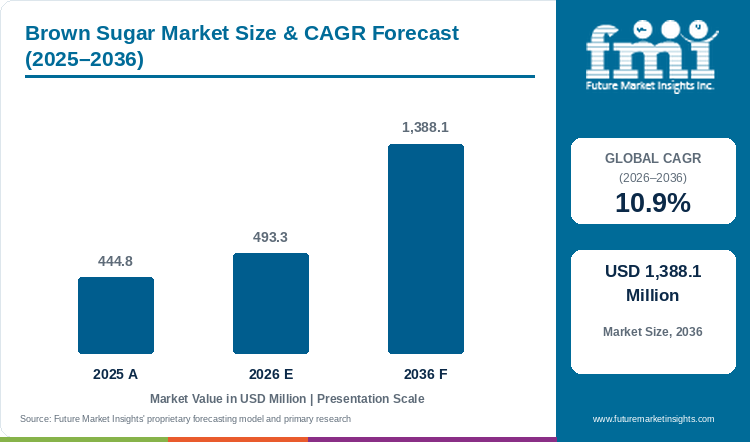
Key Market Trends & Insights
- By type, fine grades led the market with a 40% share in 2026, as bakeries want crystals that dissolve quickly in dough and batter.
- By form, powder and dry formats account for 51% of sales in 2026, owing to bag and silo handling already common in bakeries. Ragus said in March 2025 that bulk sugar at the Slough factory runs on custom machinery for batch production of set formulations [4].
- By application, bread and rolls take 29% in 2026 and are expected to stay first through 2036, as bread plants reorder brown sugar on fixed recipes every day.
- By claim, conventional brown sugar leads with 49% in 2026, as most bakery buyers choose on grade and delivered price before label claims.
- By sales channel, direct supply to industrial bakeries holds 50% in 2026. Large plants sign annual volume contracts with one refiner for agreed grades and delivery slots.
Regional Highlights
- Fastest-growing profiled country: Saudi Arabia (12.2% CAGR, 2026 to 2036).
- By country: USA (11.2%) and UK (10.9%) follow, and Japan records the lowest profiled CAGR at 10% through 2036.
- Sales of brown sugar syrups in Saudi Arabia are rising with café openings, as the Ministry of Commerce had issued more than 61,000 café business licences by August 2025 [5].
Market Size & Forecast
Table 1: Market Size and Forecast for the Brown Sugar Market (USD million and percentage), 2025 to 2036
| Metric | Value |
|---|---|
| 2025 Market Size | USD 444.8 million |
| Estimated Market Size in 2026 | USD 493.3 million |
| Projected Market Size by 2036 | USD 1,388.1 million |
| CAGR, 2026 to 2036 | 10.9% |
| Added Revenue, 2026 to 2036 | USD 894.8 million |
| Market Expansion Multiple | 2.8x |
Industrial bread, cake and cookie plants buy most brown sugar today, ordering fixed grades under annual contracts. Supply of these grades follows the flow of raw cane sugar into refineries and the size of each beet sugar crop. In September 2026, USDA put 2025/26 U.S. sugar imports at 2,964 thousand short tons, raw value [3]. Defra recorded a 7.1% fall in the 2025 UK beet crop to 7.3 million tonnes in July 2026 [6]. However, tiered drinks taxes and limits on promoting high-sugar foods are pushing food and drink makers to cut grams per serving [7] [8]. Refiners with secure raw sugar supply are expected to keep most bakery contracts, as recipes get trimmed and brown sugar stays in place.
Raw Sugar Supply and Bakery Recipe Readiness
Brown sugar refiners in the largest profiled markets lean heavily on imported raw sugar. U.S. beet and cane output came to 5,076 and 4,189 thousand short tons in 2025/26, well short of the 12,441 thousand delivered for food [3]. USDA expects raw sugar imports to reach 3,396 thousand short tons in 2026/27, up from 2,964 thousand [3]. ASR Group now runs the Chalmette and Baltimore cane refineries around the clock and planned to close the Yonkers site by the end of 2025 [9]. Japan imported 1,144,000 tonnes of sugar in sugar year 2025, against home output of 648,000 tonnes [10]. Non-centrifugal sugar, the dark unrefined type closest to brown grades, came to only 37,000 tonnes [10]. In the UK, refined sugar output fell 8.2% to about 997 thousand tonnes in 2025 [6]. European beet refiners are cutting plant costs, and Nordzucker's new Schladen tower handles about 10,500 tonnes of beet a day [11]. Südzucker's Zeitz hub will run on beet pulp from autumn 2027, backed by a climate contract worth up to EUR 227.5 million [12]. FranceAgriMer put the October 2025 sugar price for the EU region covering Germany at EUR 521 per tonne [13]. Refiners holding secure raw sugar and lower plant costs are set to quote sharper prices on soft brown grades through 2036.
Demand for brown sugar in bakery holds firm, as molasses acid in the sugar reacts with baking soda for a higher rise and a lighter crumb [1]. Sugar rules are trimming grams per serving, yet most recipes still keep brown sugar. From 1 January 2026, Saudi drinks with 5 to 7.99 grams of sugar per 100 ml pay SAR 0.79 a litre, and those at 8 grams or more pay SAR 1.09 [7]. England banned multi-buy deals on foods high in fat, salt or sugar from 1 October 2025 for businesses with 50 or more employees [8]. Coffee is now opening a second buyer group next to bakery. Starbucks put the Iced Brown Sugar Oatmilk Shaken Espresso on the U.S. spring menu in March 2021 [14]. Saudi coffee drinkers get through an estimated 36 million cups a day [5]. FMI expects foodservice and artisan supply to take a larger part of channel revenue by 2036. Suppliers with secure raw sugar contracts and owned melt plants are likely to capture most of the USD 894.8 million added over the decade.
Table 2: Raw Sugar Supply and Bakery Recipe Indicators for the Brown Sugar Market (thousand short tons, tonnes, percent, EUR per tonne and SAR per litre), mixed reporting years from 2015 to 2026
| Indicator | Data Point | Why This Matters | Source |
|---|---|---|---|
| U.S. brown sugar purchase specification | Light and dark styles, maximum moisture 4.50%, minimum sucrose 86%, organic option allowed | Institutional buyers tender brown sugar against one fixed grade. | [15] |
| U.S. sugar deliveries for food, 2025/26 | 12,441 thousand short tons, raw value; imports of 2,964 thousand | U.S. refiners melt more imported raw cane to supply light and dark brown sugar to bakeries. | [3] |
| Dark soft brown sugar in baking | Higher moisture than white sugar; molasses acid gives a higher rise and a lighter crumb | Bakeries reorder dark soft brown sugar once a recipe gets approval. | [1] |
| Sugar in baked goods | Supplies bulk, browning and moisture through shelf life | Bakeries keep brown sugar in approved recipes and reorder the same grade. | [2] |
| Saudi sweetened drinks excise | Tiered from 1 January 2026, SAR 0.79 per litre at 5 to 7.99 g and SAR 1.09 at 8 g or more per 100 ml | Drink makers are cutting grams of sugar per serving to stay in lower tiers. | [7] |
| Saudi café licences | More than 61,000 café business licences by August 2025 | New cafés add outlets for brown sugar syrups and bakes. | [5] |
| UK sugar beet crop, 2025 | 7.3 million tonnes, down 7.1%; refined sugar about 997 thousand tonnes, down 8.2% | UK bakeries are buying more imported cane and beet sugar. | [6] |
| Japan sugar supply, sugar year 2025 | Imports of 1,144,000 tonnes; home output of 648,000 tonnes; non-centrifugal sugar of 37,000 tonnes | Japanese buyers plan brown sugar purchases around import contracts. | [10] |
| Nordzucker Schladen extraction tower | About 10,500 tonnes of beet a day; up to 22 tonnes of CO2 saved a day | Beet refiners are lowering cost per tonne at a major German site. | [11] |
| EU Region 2 sugar price | EUR 521 per tonne in October 2025 | EU beet sugar prices set the cost base for brown grades sold to German bakeries. | [13] |
Table 3: Raw Sugar Supply Balance Indicators for the Brown Sugar Market (thousand short tons, tonnes and USD million), sugar years 2024 to 2027 and forecast years 2026 to 2036
| Indicator | Reported Value | Comparison | Source |
|---|---|---|---|
| U.S. beet plus cane sugar output, 2025/26 | 9,265 thousand short tons, raw value | Against 12,441 thousand short tons of food deliveries | [3] |
| U.S. sugar imports, 2026/27 projection | 3,396 thousand short tons, raw value | Up from 2,964 thousand short tons in 2025/26 | [3] |
| U.S. stocks-to-use ratio | 16.2% (2025/26), 13.5% (2026/27) | Tighter stock cover projected for 2026/27 | [3] |
| Japan imported sugar, sugar year 2025 | 1,144,000 tonnes | Against centrifugal sugar consumption of 1,734,000 tonnes | [10] |
| Japan non-centrifugal sugar, sugar year 2025 | 37,000 tonnes (down 5.1%) | Down 2,000 tonnes on the previous sugar year | [10] |
| UK refined sugar output, 2025 | About 997 thousand tonnes (down 8.2%) | 1,086 thousand tonnes in 2024 | [6] |
| Brown sugar market forecast | USD 493.3 million (2026), USD 1,388.1 million (2036) | USD 894.8 million added, about 2.8 times | Future Market Insights |
Analyst Perspective
“Bakeries will keep buying brown sugar from refiners that deliver the same color and moisture in every load. Over the next ten years, suppliers serving both bread plants and café syrup makers from secure raw sugar will take most of the new bakery and café contracts.”
- Nandini Roy Choudhury, Principal Consultant, Future Market Insights.
How is the brown sugar market segmented?
The brown sugar market is segmented by type, form, application, claim and sales channel, with a separate regional view across seven regions. In 2026, fine grades lead at 40%, powder and dry formats at 51%, and bread and rolls at 29%. Conventional brown sugar holds 49% by claim, and direct supply to industrial bakeries holds 50% by channel.
By type: fine grades, coarse & decorative, organic, and blends.
By form: powder / dry, liquid, paste / semi-solid, and granules / pieces.
By application: bread & rolls, cakes & muffins, biscuits & cookies, viennoiserie & pastry, and other bakery & snacks.
By claim: conventional, clean label, organic, and non-GMO / identity preserved.
By sales channel: direct to industrial bakeries, ingredient distributors, foodservice & artisan supply, and online B2B.
By region: North America, Latin America, Western Europe, Eastern Europe, East Asia, South Asia and Pacific, and Middle East and Africa.
Why do fine grades hold the top type share?
Fine grades are expected to capture 40% of brown sugar sales by type in 2026, as bakeries want even mixing in dough and batter.
Table 4: Type Share for the Brown Sugar Market (percentage share), 2026
| Type | Share (2026) |
|---|---|
| Fine grades | 40% |
| Other Segments Combined | 60% |
| Total | 100% |
Table 5: Type Leadership and Market Growth for the Brown Sugar Market (segment and CAGR percentage), 2026 to 2036
| Metric | Value |
|---|---|
| Global CAGR (2026 to 2036) | 10.9% |
| Leading Segment | Fine grades |
Fine grades lead brown sugar type sales with a 40% share in 2026, ahead of coarse and decorative, organic and blended grades. Demand for fine brown sugar grades is tied to dough and batter lines, as small crystals dissolve quickly and give an even color. In August 2024, Ragus Sugars listed fine grain and a moist texture among the features of dark soft brown sugar [1]. Coarse crystals such as demerara sugar stay smaller, selling mainly as crunchy toppings on premium bakes. Fine grades are expected to remain the largest type through 2036, as bakery plants seldom change a working recipe.
- Fast dissolving in dough and batter gives fine grades a 40% type share in 2026.
- Buyers ordering fine grades can write moisture and sucrose limits into contracts, as the USDA purchase description caps brown sugar moisture at 4.50% [15].
What makes powder and dry formats the leading form?
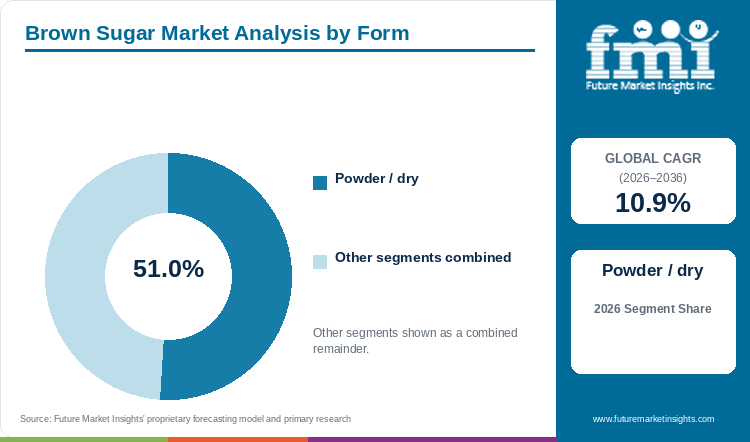
Powder and dry brown sugar is set to hold 51% of form revenue in 2026, as most bakeries already handle sugar in bags and silos.
Powder and dry formats account for 51% of form revenue in 2026, as per FMI, ahead of liquid, paste and granule formats. Sales of dry brown sugar are linked to bakery plants storing sugar in bags or silos and weighing the sugar with the flour. Plants buying liquid sugar and brown syrups need tanks and pumps that many bakeries lack, keeping these formats smaller. In March 2025, Ragus said bulk sugar at the Slough factory is processed on custom machinery for batch production of set formulations [4]. Dry formats are set to stay near half of form sales through 2036, and liquid grades will gain with large plants adding melt stations.
- Powder and dry formats hold 51% in 2026, as most bakeries already handle sugar in bags and silos.
- In June 2025, ASR Group said a new bulk transfer and liquid melt station was under construction in the U.S. Northeast, giving bakeries a liquid option [9].
Why do bread and rolls take first place among applications?
Bread and rolls are projected to account for 29% of brown sugar application revenue in 2026, backed by daily bread lines.
FMI finds that bread and rolls take 29% of brown sugar application revenue in 2026, the largest share among bakery uses. Demand for brown sugar in bread and rolls comes from bakers seeking a darker crumb and a soft, moist bite on daily production runs. Ragus noted in August 2024 that molasses acid in dark soft brown sugar reacts with baking soda for a higher rise and a lighter crumb [1]. Bread bakers list brown sugar with other bakery ingredients on one approved specification and reorder against that sheet. Cakes, muffins, biscuits and cookies follow, and bread and rolls are expected to stay first through 2036.
- Bread and rolls take 29% in 2026 on daily production, and this lead is expected to hold through 2036.
- Bread bakers switching supplier should repeat the rise and crumb trials from the current grade, since molasses content changes each bake.
Why does conventional brown sugar outsell certified grades?
Conventional brown sugar is set to hold 49% of claim sales in 2026, as bakery buyers choose mainly on grade and delivered price.
FMI notes that conventional brown sugar holds 49% of claim sales in 2026, ahead of organic, clean label and non-GMO grades. Sales of conventional brown sugar come from bakery buyers who compare grade, food safety and delivered price before any label claim. In March 2025, Ragus said the company holds Fairtrade, Organic Food Federation and Bonsucro certifications for buyers needing certified supply [4]. USDA's purchase description also lets institutional buyers choose conventional or organic farming [15]. Certified grades are likely to add share slowly, as premium bakery and café brands put organic claims on packs.
- Conventional brown sugar keeps a 49% share in 2026 owing to a lower delivered cost per tonne.
- Organic brown sugar needs certified sourcing records for each delivery, so buyers switching grades should allow extra lead time for supplier approval.
Why do industrial bakeries buy most brown sugar directly from refiners?
Industrial bakeries buying direct from refiners make up 50% of brown sugar channel sales in 2026, held by annual volume contracts.
FMI estimates put direct supply to industrial bakeries at 50% of 2026 channel sales, the largest route for brown sugar. Large bakery plants prefer direct refiner contracts for agreed specifications, fixed delivery slots and one contact for quality issues. Ragus states that on-time, in-full delivery is central to service and that products are checked for taste, texture, consistency and appearance at every stage [4]. In June 2025, ASR Group moved the Chalmette and Baltimore refineries to continuous operations [9]. Ingredient distributors and foodservice suppliers start smaller but are likely to grow faster, serving cafés and small bakeries buying in smaller lots.
- Bulk volumes cover the cost of dedicated account teams, keeping direct supply at a 50% share in 2026.
- Bakeries signing direct contracts should agree on backup supply sites, as ASR Group set the Yonkers refinery closure for the end of 2025 [9].
What are the drivers, restraints, and opportunities in the brown sugar market?
Recipe needs for color and moisture keep bakeries buying brown sugar, sugar taxes and promotion limits cut grams per serving, and café syrups and certified grades open new sales.
- Driver: Industrial bakers keep ordering brown sugar for the color, moisture and molasses taste that white sugar cannot give a dough or batter.
- Restraint: Tiered drinks taxes and promotion bans are cutting grams of sugar per serving across food and drink. Saudi Arabia began taxing sweetened drinks by grams of sugar per 100 ml on 1 January 2026 [7].
- Opportunity: Key trends in the brown sugar market point to café syrups, organic grades and ready-to-use liquid formats as coffee chains and tea shops add brown sugar drinks.
Recipe Performance Keeps Bakeries Buying
Brown sugar earns a place in baking because one ingredient supplies color, moisture, rise and molasses flavor. In November 2025, Ingredion noted that sugar gives baked goods bulk, browning and moisture through shelf life [2]. Bakeries removing brown sugar need to retest texture and shelf life, adding cost and delay. Recipe performance is expected to keep brown sugar in approved bakery specifications through 2036.
Sugar Rules Cut Grams per Serving
Sugar rules in several profiled countries are pushing food and drink makers to use less brown sugar per product. From 1 January 2026, Saudi Arabia replaced the flat 50% excise on sweetened drinks with tiers based on grams of sugar per 100 ml [7]. England banned volume promotions on foods high in fat, salt or sugar from 1 October 2025 for businesses employing 50 or more people [8]. In November 2025, Saudi Arabia's food regulator reported technical rules to reduce added sugars under the Healthy Food Strategy [16]. Bakeries and drink makers are expected to trim grams per serving and keep brown sugar, which may slow volume growth in sweet bakery lines.
Café Syrups Widen the Buyer Base
Sales of brown sugar syrup for coffee and brown sugar syrup for boba are opening a buyer group outside bakery. Starbucks added the Iced Brown Sugar Oatmilk Shaken Espresso to the U.S. spring menu in March 2021 [14]. Coffee chains and tea shops buy ready-to-use syrups in small packs, suiting distributors that already carry soft brown sugar. Brown sugar distributors with café-sized liquid packs are likely to gain café accounts as coffee outlets multiply through 2036.
Which country CAGRs are profiled in the brown sugar market?
Among the five profiled brown sugar markets, Saudi Arabia grows fastest at a 12.2% CAGR over 2026 to 2036, and Japan is slowest at 10%. Across the five, suppliers gain volume with secure raw cane or beet supply and lose volume as sugar rules push bakeries and drink makers to cut grams per serving.
Table 6: Country CAGRs and Primary Growth Levers for the Brown Sugar Market (CAGR percentage), 2026 to 2036
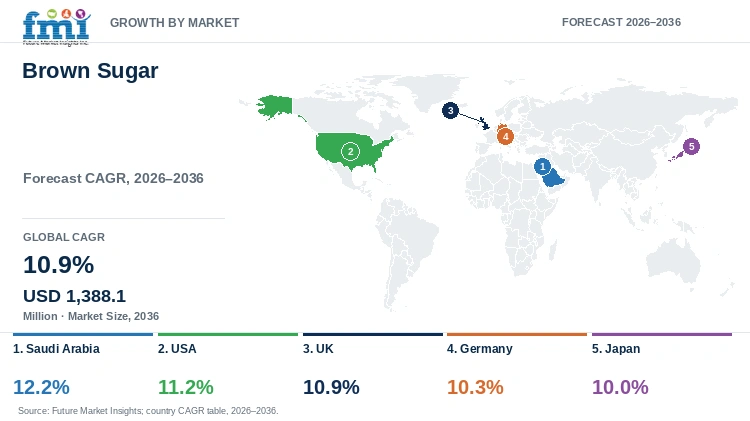
| Country | CAGR (2026-2036) | Primary Growth Lever |
|---|---|---|
| Saudi Arabia | 12.2% | Café openings and coffee syrup orders |
| USA | 11.2% | Cane refinery supply to large bakery groups |
| UK | 10.9% | Imported cane to cover a smaller beet crop |
| Germany | 10.3% | Craft bakery orders and lower beet plant costs |
| Japan | 10% | Steady raw sugar imports from Australia |
Source: Future Market Insights
Saudi Arabia Brown Sugar Market Outlook (2026-2036)
Café openings are the main source of new brown sugar orders in Saudi Arabia. Gulf News reported in August 2025 that the Ministry of Commerce had issued more than 61,000 café business licences [5]. Saudi Arabia drinks an estimated 36 million cups of coffee a day, giving these cafés a large daily customer base [5]. Demand for brown sugar syrup for coffee is rising with these outlets, and Saudi sales are projected to advance at a 12.2% CAGR through 2036. A tiered excise on sweetened drinks, charged by grams of sugar per 100 ml from 1 January 2026, is making drink makers use less sugar per serving [7]. Small-pack syrups for café counters give suppliers a way to hold volume as bottled drinks cut sugar.
Key takeaway: Café chain orders for brown sugar syrup will set the pace of Saudi growth through 2036.
USA Brown Sugar Market Outlook (2026-2036)
Large U.S. bakery groups buy light brown sugar and dark brown sugar mainly from cane refiners. ASR Group, owner of Domino Sugar, now runs the Chalmette and Baltimore refineries around the clock [9]. USDA projects 2026/27 raw sugar imports of 3,396 thousand short tons to feed this capacity [3]. FDA's new healthy claim rule caps added sugars in grain products at 10% of the Daily Value, with compliance due by 25 February 2028 [17]. Cereal and bakery brands seeking the claim are expected to trim brown sugar per serving. Even so, FMI projects an 11.2% CAGR for U.S. sales of brown sugar through 2036, second only to Saudi Arabia.
Key takeaway: Steady raw cane imports keep U.S. refiners supplying bakery groups, even as the healthy claim trims grams per serving.
UK Brown Sugar Market Outlook (2026-2036)
Since 1 October 2025, English firms employing 50 people or more cannot run multi-buy deals on foods high in fat, salt or sugar [8]. Paid online adverts and pre-9pm TV adverts for these foods followed on 5 January 2026, with firms under 250 staff exempt [18]. Large bakery brands are therefore expected to sell fewer promoted packs. Brown sugar sales in the UK are forecast to rise at a 10.9% CAGR through 2036, matching the global rate. Defra put the 2025 UK beet crop at 7.3 million tonnes, down 7.1% [6]. Refiners such as Ragus already source bulk sugar from suppliers on five continents [4].
Key takeaway: Imported cane sugar fills the UK supply gap left by a smaller domestic beet crop.
Germany Brown Sugar Market Outlook (2026-2036)
Demand for brown sugar in Germany will expand at a 10.3% CAGR through 2036, with only Japan growing slower. Craft bakeries remain a large buyer group, with 8,659 businesses earning EUR 18.14 billion in 2025, according to the Zentralverband des Deutschen Bäckerhandwerks [19]. Bakery numbers fell 2.8% that year, though 448 new bakeries opened, the most since 2018 [19]. Beet refiners are cutting costs to gain these orders, and Nordzucker's new Schladen tower handles around 10,500 tonnes of beet daily [11].
Key takeaway: Lower beet processing costs help German refiners gain orders from the country's craft bakeries.
Japan Brown Sugar Market Outlook (2026-2036)
Australia supplied 90.2% of Japan's raw sugar imports in 2024 and Thailand 9.7%, based on Ministry of Finance trade data compiled by ALIC [20]. Imports of 1,144,000 tonnes outweighed home output of 648,000 tonnes in sugar year 2025 [10]. Non-centrifugal sugar, the dark unrefined type, fell 5.1% to 37,000 tonnes in the same year [10]. FMI places Japan last on the table with a 10% CAGR through 2036. Brown sugar suppliers holding long Australian cane contracts are set to keep most remaining bakery orders.
Key takeaway: Secure Australian raw sugar supply matters most for Japanese sales of brown sugar.
Who are the notable companies in the brown sugar market?
Südzucker, Nordzucker, ASR Group, Ragus, Cargill, ADM, Tate & Lyle, Ingredion, Roquette, and BENEO are key companies profiled in this market.
Brown sugar supply is split among sugar refiners, broad sweetener houses and reformulation specialists, differing in raw sugar access, grade range and bakery service. Südzucker, Nordzucker, ASR Group and Ragus refine or pack brown grades directly. Cargill, ADM and Tate & Lyle sell brown sugar within wider sweetener ranges. Ingredion, Roquette and BENEO affect the amount of brown sugar left in a recipe when bakeries reduce sugar. In February 2025, Cargill agreed to buy the remaining 50% of SJC Bioenergia, a raw sugar producer in Goiás, Brazil [21]. ASR Group is adding a liquid melt station and round-the-clock refinery shifts to serve larger bakery contracts [9].
- Direct sugar and brown sugar refiners: Südzucker, Nordzucker, ASR Group, and Ragus compete on refining, grade control and bulk bakery delivery.
- Broad sweetener and bakery ingredient suppliers: Cargill, ADM, and Tate & Lyle sell brown sugar inside wider sweetener portfolios and long-standing bakery accounts.
- Reformulation and specialty carbohydrate providers: Ingredion, Roquette, and BENEO supply sugar reduction ingredients to bakeries trimming grams per serving.
Competitive Benchmarking: Brown Sugar Market
Table 7: Competitive Benchmarking for the Brown Sugar Market (qualitative capability ratings), 2026
| Company | Brown Grades | Bakery Supply | Sweetener Range | Reach |
|---|---|---|---|---|
| Südzucker | Medium | High | Medium | Medium |
| Nordzucker | Medium | High | High | Medium |
| ASR Group | High | High | High | Medium |
| Ragus | High | High | High | Medium |
| Cargill | High | High | High | High |
| ADM | Low | High | High | High |
| Tate & Lyle | Low | Medium | High | High |
| Ingredion | Low | Medium | High | High |
| Roquette | Low | Medium | High | High |
| BENEO | Low | Medium | High | High |
High marks broad capability on a criterion, Medium marks narrower capability, and Low marks limited public documentation. Ratings cover brown grades, bakery supply, sweetener range and reach.
Key Developments in the Brown Sugar Market
- In August 2026, Nordzucker opened a new extraction tower at the Schladen factory in Germany, handling about 10,500 tonnes of beet a day [11].
- In October 2025, Südzucker broke ground on a Bio Energy Hub at Zeitz, planned to run on beet pulp from autumn 2027 [12].
- In June 2025, ASR Group began continuous operations at the Chalmette and Baltimore refineries and set the Yonkers refinery closure for the end of 2025 [9].
- In February 2025, Cargill agreed to acquire the remaining 50% of SJC Bioenergia, a raw sugar producer in Brazil [21]. The deal was subject to CADE approval and gives Cargill an owned raw sugar supply.
Key Players in the Brown Sugar Market
Direct Sugar and Brown Sugar Specialists
- Südzucker AG
- Nordzucker AG
- ASR Group (American Sugar Refining, Inc.)
- Ragus Sugars
Broad Sweetener and Bakery Ingredient Suppliers
- Cargill, Incorporated
- Archer Daniels Midland Company
- Tate & Lyle PLC
Reformulation and Specialty Carbohydrate Providers
- Ingredion Incorporated
- Roquette Frères
- BENEO GmbH
Brown Sugar Market - Report Scope
Table 8: Report Scope for the Brown Sugar Market (coverage fields and definitions), 2026 to 2036
| Coverage field | Report scope |
|---|---|
| Market breakdown | Type; form; application; claim; sales channel; region |
| Quantitative units | USD million |
| Market definition | First-sale revenue from brown sugar sold as fine, coarse, organic or blended grades in dry, liquid, paste and piece formats for bakery and snack use. Finished bakery products, alternative sweeteners and white sugar sold as a substitute are excluded. |
| Regions covered | North America; Latin America; Western Europe; Eastern Europe; East Asia; South Asia and Pacific; Middle East and Africa |
| Countries covered | Saudi Arabia; USA; UK; Germany; Japan |
| Key companies profiled | Südzucker, Nordzucker, ASR Group, Ragus, Cargill, ADM, Tate & Lyle, Ingredion, Roquette, BENEO |
| Forecast period | 2026 to 2036 |
| Approach | Grade, form, application and channel estimates are built up from bakery use and cross-checked against raw sugar supply, refinery activity and country sugar rules. |
Brown Sugar Market - Research Methodology
Table 9: Research Methodology for the Brown Sugar Market (research methods and approach), 2026 edition
| Method | Approach |
|---|---|
| Primary Research | Primary research includes interviews with industrial bakery buyers, sugar refiners, café chain purchasing teams, brown sugar distributors and product developers. Interviews cover grade specifications, delivery terms, prices and switching barriers. |
| Desk Research | Desk research draws on government sugar balances, crop statistics, sugar tax and labelling rules, company releases, refiner technical notes and food trade journals. |
| Market Sizing and Forecasting | Market sizing takes refiner and distributor sales of brown sugar in 2025 as the base, splits them by grade, form and bakery use, and then applies delivered prices per tonne, bakery output, café syrup growth and country supply conditions. |
| Data Validation | Brown sugar estimates are tested against government sugar balances, company disclosures and interview findings. White sugar, substitute sweeteners and finished bakery revenue are kept out to prevent double counting. |
Brown Sugar Market by Segments
Brown Sugar Market segmented by Type:
- Fine grades
- Coarse & decorative
- Organic
- Blends
Brown Sugar Market segmented by Form:
- Powder / dry
- Liquid
- Paste / semi-solid
- Granules / pieces
Brown Sugar Market segmented by Application:
- Bread & rolls
- Cakes & muffins
- Biscuits & cookies
- Viennoiserie & pastry
- Other bakery & snacks
Brown Sugar Market segmented by Claim:
- Conventional
- Clean label
- Organic
- Non-GMO / identity preserved
Brown Sugar Market segmented by Sales Channel:
- Direct to industrial bakeries
- Ingredient distributors
- Foodservice & artisan supply
- Online B2B
Brown Sugar Market by Region
- North America
- United States
- Canada
- Latin America
- Brazil
- Mexico
- Argentina
- Chile
- Western Europe
- Germany
- France
- United Kingdom
- Italy
- Spain
- Benelux
- Nordics
- Eastern Europe
- Poland
- Czech Republic
- Romania
- Hungary
- East Asia
- Japan
- South Korea
- South Asia and Pacific
- ASEAN
- Australia and New Zealand
- Middle East and Africa
- GCC Countries
- South Africa
- Türkiye
- Israel
Research Sources and Bibliography
- [1] Ragus Sugars. (2024, August 22). How is dark soft brown sugar used in baking?.https://www.ragus.co.uk/how-is-dark-soft-brown-sugar-used-in-baking/
- [2] Ingredion Incorporated. (2025, November 10). What you should know before using a sugar substitute for baking.https://www.ingredion.com/na/en-us/be-whats-next/sugar-substitutes-for-baking-guide
- [3] U.S. Department of Agriculture, World Agricultural Outlook Board. (2026, September 11). World Agricultural Supply and Demand Estimates, WASDE-675.https://www.usda.gov/oce/commodity/wasde/wasde0926.pdf
- [4] Ragus Sugars. (2025, March 13). A crystalline sugar supplier's supply chain, how Ragus ensures continuity of supply.https://www.ragus.co.uk/a-crystalline-sugar-suppliers-supply-chain-how-ragus-ensures-continuity-of-supply/
- [5] Gulf News. (2025, August 19). Saudi Arabia drinks 36 million cups of coffee daily, $320 million push to boost production.https://gulfnews.com/world/gulf/saudi/saudi-arabia-drinks-36-million-cups-of-coffee-daily-320-million-push-to-boost-production-1.500237136
- [6] Department for Environment, Food & Rural Affairs. (2026, July 9 (updated 3 September 2026)). Agriculture in the United Kingdom 2025, Chapter 7, Crops.https://www.gov.uk/government/statistics/agriculture-in-the-united-kingdom-2025/chapter-7-crops
- [7] Argaam (reporting Zakat, Tax and Customs Authority decision). (2025, December 30). New exec regs for sugar-based excise tax to take effect on Jan. 1.https://www.argaam.com/en/article/articledetail/id/1869235
- [8] Association of Convenience Stores. (2025, October 1). HFSS Promotional Restrictions Come into Force Today.https://www.acs.org.uk/news/hfss-promotional-restrictions-come-force-today
- [9] ASR Group. (2025, June 20). ASR Group Announces Optimizations of U.S. Operational Network.https://asr-group.com/news/ASR-Group-Announces-Optimizations-of-US-Operational-Network
- [10] Ministry of Agriculture, Forestry and Fisheries, Japan. (2026, June 24). Sugar and isomerized sugar supply and demand outlook for sugar year 2025 [translated title].https://www.maff.go.jp/j/press/nousan/chiiki/260624.html
- [11] Nordzucker AG. (2026, August 14). New extraction tower at Nordzucker's Schladen factory increases efficiency in sugar production.https://www.nordzucker.com/en/news/new-extraction-tower-at-nordzuckers-schladen-factory-increases-efficiency-in-sugar-production/
- [12] Südzucker AG. (2025, October 27). Feierlicher Spatenstich für den neuen Südzucker Bio Energy Hub in Tröglitz bei Zeitz.https://www.suedzuckergroup.com/sites/default/files/2025-10/2025-10-27_Pressemitteilung-Spatenstich%20Bio%20Energy%20Hub.pdf
- [13] FranceAgriMer. (2025, December). Sucre, bulletin mensuel de conjoncture n° 613 (campagne 2024/25).https://www.franceagrimer.fr/sites/default/files/2025-12/nco-suc-2425-bulmensconjoncture-a25m12n613.pdf
- [14] Tea & Coffee Trade Journal. (2021, March 3). Starbucks launches new Spring products, offers Oatly oatmilk across the US.https://www.teaandcoffee.net/news/26546/starbucks-launches-new-spring-products-offers-oatly-oatmilk-across-the-us/
- [15] USDA Agricultural Marketing Service. (2015, June 3). Commercial Item Description A-A-20135E, Sugar, White, Refined, and Sugar, Brown.https://www.ams.usda.gov/sites/default/files/media/CID%20Sugar%20Refined%20White%20and%20Sugar%20Brown.pdf
- [16] Saudi Food and Drug Authority. (2025, November 9). SFDA Achievements and Initiatives in Enhancing Quality of Life to Empower Saudi Arabia's Vision 2030.https://sfda.gov.sa/en/news/18761
- [17] U.S. Food and Drug Administration (Federal Register). (2024, December 27). Food Labeling: Nutrient Content Claims; Definition of Term 'Healthy'.https://www.federalregister.gov/documents/2024/12/27/2024-29957/food-labeling-nutrient-content-claims-definition-of-term-healthy
- [18] Mishcon de Reya. (2026, February 2). UK advertising rules on less healthy foods enter into force.https://www.mishcon.com/news/uk-advertising-rules-on-less-healthy-foods-enter-into-force
- [19] Deutsches Handwerksblatt (reporting Zentralverband des Deutschen Bäckerhandwerks). (2026, June 17). Mehr Umsatz und Gründungen im Bäckerhandwerk.https://www.handwerksblatt.de/handwerkspolitik/mehr-umsatz-und-gruendungen-im-baeckerhandwerk
- [20] Agriculture & Livestock Industries Corporation (ALIC). (2025, December 10). Trends in Japan's main sugar import sources, forecast as of November 2025 [translated title].https://alic.go.jp/joho-s/joho07_003445.html
- [21] Cargill. (2025, February 6). Cargill moves to take full control of SJC Bioenergia.https://www.cargill.com/2025/cargill-moves-to-take-full-control-of-sjc-bionergia
This bibliography is provided for reader reference. The full report contains the complete reference list and detailed citations.
This Report Answers
- What will the brown sugar market be worth in 2026?
- By 2036, what value are brown sugar sales projected to reach?
- Which brown sugar grade leads type sales, and why do bakeries prefer fine crystals?
- Which shares do powder formats and bread and rolls hold in brown sugar use by form and application?
- Which profiled country grows fastest in brown sugar sales?
- Among refiners and ingredient groups, who competes for bakery contracts?
Frequently Asked Questions
What will the brown sugar market be worth in 2026?
Brown sugar sales will reach USD 493.3 million in 2026, up from USD 444.8 million in 2025. Revenue is projected to total USD 1,388.1 million by 2036, as per FMI.
What CAGR is forecast for the brown sugar market through 2036?
Sales of brown sugar are set to grow at a 10.9% CAGR from 2026 to 2036. Repeat bakery contracts and new café syrup orders will supply most of this growth.
Which brown sugar grade leads sales by type in 2026?
Fine grades will take 40% of type sales in 2026. Bakeries prefer small crystals that dissolve quickly and spread evenly through dough and batter.
Which application leads brown sugar use in 2026?
Bread and rolls will account for 29% of application revenue in 2026. Bread lines run every day and reorder brown sugar against approved recipes.
Which country has the fastest growth outlook through 2036?
Saudi Arabia will lead the profiled countries at a 12.2% CAGR from 2026 to 2036, according to FMI. New cafés and bakeries will keep adding orders for brown sugar syrups and baked goods.
Who are the key companies in the brown sugar market?
Key companies include Südzucker, Nordzucker, ASR Group, Ragus, Cargill, ADM, Tate & Lyle, Ingredion, Roquette, and BENEO. Refiners will compete on grade control and bulk delivery, and ingredient groups on wider sweetener ranges.
Preview the report firsthand - request a free sample
Get SampleGet the brochure for pricing and purchase details.
Get PDFTable of Content
- Key Takeaways
- Market Size and CAGR
- Top Growth Driver
- Fastest Growing Segment
- Leading Region
- Key Companies
- Emerging Opportunities
- Executive Summary
- Global Market Outlook
- Demand-side Trends
- Supply-side Trends
- Technology Roadmap Analysis
- Analysis and Recommendations
- Analyst Perspective (What is happening? Why now? What should investors know?)
- Key Questions Answered
- How large is the market?
- What is the CAGR?
- What are key trends?
- Which region dominates?
- Who are the leaders?
- Market Overview
- Market Coverage / Taxonomy
- Market Definition / Scope / Limitations
- Research Methodology
- Chapter Orientation
- Analytical Lens and Working Hypotheses
- Market Structure, Signals, and Trend Drivers
- Benchmarking and Cross-market Comparability
- Market Sizing, Forecasting, and Opportunity Mapping
- Research Design and Evidence Framework
- Desk Research Programme (Secondary Evidence)
- Expert Input and Fieldwork (Primary Evidence)
- Tooling, Models, and Reference Databases
- Data Engineering and Model Build
- Quality Assurance and Audit Trail
- Market Background
- Market Dynamics (Drivers, Restraints, Opportunity, Trends)
- Scenario Forecast (Optimistic, Likely, Conservative)
- Impact Analysis
- AI Impact
- Sustainability Impact
- Regulatory Impact
- Technology Impact
- Consumer / Buyer Analysis
- Purchase Drivers
- Adoption Barriers
- Buyer Journey
- Opportunity Map Analysis
- Product Life Cycle Analysis
- Supply Chain Analysis
- Investment Feasibility Matrix
- Value Chain Analysis
- PESTLE and Porter's Analysis
- Regulatory Landscape
- Regional Parent Market Outlook
- Production and Consumption Statistics
- Import and Export Statistics
- Global Market Analysis and Forecast, 2021 to 2036
- Historical Market Size Value (USD Million) Analysis, 2021 to 2025
- Current and Future Market Size Value (USD Million) Projections, 2026 to 2036
- Y-o-Y Growth Trend Analysis
- Absolute $ Opportunity Analysis
- Global Market Pricing Analysis, 2021 to 2036
- Global Market Analysis and Forecast, By Type, 2021 to 2036
- Introduction / Key Findings
- Historical Market Size Value (USD Million) Analysis By Type, 2021 to 2025
- Current and Future Market Size Value (USD Million) Analysis and Forecast By Type, 2026 to 2036
- Fine grades
- Coarse & decorative
- Organic
- Blends
- Y-o-Y Growth Trend Analysis By Type, 2021 to 2025
- Absolute $ Opportunity Analysis By Type, 2026 to 2036
- Global Market Analysis and Forecast, By Form, 2021 to 2036
- Introduction / Key Findings
- Historical Market Size Value (USD Million) Analysis By Form, 2021 to 2025
- Current and Future Market Size Value (USD Million) Analysis and Forecast By Form, 2026 to 2036
- Powder / dry
- Liquid
- Paste / semi-solid
- Granules / pieces
- Y-o-Y Growth Trend Analysis By Form, 2021 to 2025
- Absolute $ Opportunity Analysis By Form, 2026 to 2036
- Global Market Analysis and Forecast, By Application, 2021 to 2036
- Introduction / Key Findings
- Historical Market Size Value (USD Million) Analysis By Application, 2021 to 2025
- Current and Future Market Size Value (USD Million) Analysis and Forecast By Application, 2026 to 2036
- Bread & rolls
- Cakes & muffins
- Biscuits & cookies
- Viennoiserie & pastry
- Other bakery & snacks
- Y-o-Y Growth Trend Analysis By Application, 2021 to 2025
- Absolute $ Opportunity Analysis By Application, 2026 to 2036
- Global Market Analysis and Forecast, By Claim, 2021 to 2036
- Introduction / Key Findings
- Historical Market Size Value (USD Million) Analysis By Claim, 2021 to 2025
- Current and Future Market Size Value (USD Million) Analysis and Forecast By Claim, 2026 to 2036
- Conventional
- Clean label
- Organic
- Non-GMO / identity preserved
- Y-o-Y Growth Trend Analysis By Claim, 2021 to 2025
- Absolute $ Opportunity Analysis By Claim, 2026 to 2036
- Global Market Analysis and Forecast, By Sales Channel, 2021 to 2036
- Introduction / Key Findings
- Historical Market Size Value (USD Million) Analysis By Sales Channel, 2021 to 2025
- Current and Future Market Size Value (USD Million) Analysis and Forecast By Sales Channel, 2026 to 2036
- Direct to industrial bakeries
- Ingredient distributors
- Foodservice & artisan supply
- Online B2B
- Y-o-Y Growth Trend Analysis By Sales Channel, 2021 to 2025
- Absolute $ Opportunity Analysis By Sales Channel, 2026 to 2036
- Global Market Analysis and Forecast, By Region, 2021 to 2036
- Introduction
- Historical Market Size Value (USD Million) Analysis By Region, 2021 to 2025
- Current Market Size Value (USD Million) Analysis and Forecast By Region, 2026 to 2036
- North America
- Latin America
- Western Europe
- Eastern Europe
- East Asia
- South Asia and Pacific
- Middle East and Africa
- Market Attractiveness Analysis By Region
- North America Market Analysis and Forecast, By Country, 2021 to 2036
- Historical Market Size Value (USD Million) Trend Analysis By Market Taxonomy, 2021 to 2025
- Market Size Value (USD Million) Forecast By Market Taxonomy, 2026 to 2036
- By Country
- United States
- Canada
- By Type
- By Form
- By Application
- By Claim
- By Sales Channel
- By Country
- Market Attractiveness Analysis
- By Country
- By Type
- By Form
- By Application
- By Claim
- By Sales Channel
- Key Takeaways
- Latin America Market Analysis and Forecast, By Country
- Historical Market Size Value (USD Million) Trend Analysis By Market Taxonomy, 2021 to 2025
- Market Size Value (USD Million) Forecast By Market Taxonomy, 2026 to 2036
- By Country
- Brazil
- Mexico
- Argentina
- Chile
- By Type
- By Form
- By Application
- By Claim
- By Sales Channel
- By Country
- Market Attractiveness Analysis
- By Country
- By Type
- By Form
- By Application
- By Claim
- By Sales Channel
- Key Takeaways
- Western Europe Market Analysis and Forecast, By Country
- Historical Market Size Value (USD Million) Trend Analysis By Market Taxonomy, 2021 to 2025
- Market Size Value (USD Million) Forecast By Market Taxonomy, 2026 to 2036
- By Country
- Germany
- France
- United Kingdom
- Italy
- Spain
- Benelux
- Nordics
- By Type
- By Form
- By Application
- By Claim
- By Sales Channel
- By Country
- Market Attractiveness Analysis
- By Country
- By Type
- By Form
- By Application
- By Claim
- By Sales Channel
- Key Takeaways
- Eastern Europe Market Analysis and Forecast, By Country
- Historical Market Size Value (USD Million) Trend Analysis By Market Taxonomy, 2021 to 2025
- Market Size Value (USD Million) Forecast By Market Taxonomy, 2026 to 2036
- By Country
- Poland
- Czech Republic
- Romania
- Hungary
- By Type
- By Form
- By Application
- By Claim
- By Sales Channel
- By Country
- Market Attractiveness Analysis
- By Country
- By Type
- By Form
- By Application
- By Claim
- By Sales Channel
- Key Takeaways
- East Asia Market Analysis and Forecast, By Country
- Historical Market Size Value (USD Million) Trend Analysis By Market Taxonomy, 2021 to 2025
- Market Size Value (USD Million) Forecast By Market Taxonomy, 2026 to 2036
- By Country
- Japan
- South Korea
- By Type
- By Form
- By Application
- By Claim
- By Sales Channel
- By Country
- Market Attractiveness Analysis
- By Country
- By Type
- By Form
- By Application
- By Claim
- By Sales Channel
- Key Takeaways
- South Asia and Pacific Market Analysis and Forecast, By Country
- Historical Market Size Value (USD Million) Trend Analysis By Market Taxonomy, 2021 to 2025
- Market Size Value (USD Million) Forecast By Market Taxonomy, 2026 to 2036
- By Country
- ASEAN
- Australia and New Zealand
- By Type
- By Form
- By Application
- By Claim
- By Sales Channel
- By Country
- Market Attractiveness Analysis
- By Country
- By Type
- By Form
- By Application
- By Claim
- By Sales Channel
- Key Takeaways
- Middle East and Africa Market Analysis and Forecast, By Country
- Historical Market Size Value (USD Million) Trend Analysis By Market Taxonomy, 2021 to 2025
- Market Size Value (USD Million) Forecast By Market Taxonomy, 2026 to 2036
- By Country
- GCC Countries
- South Africa
- Türkiye
- Israel
- By Type
- By Form
- By Application
- By Claim
- By Sales Channel
- By Country
- Market Attractiveness Analysis
- By Country
- By Type
- By Form
- By Application
- By Claim
- By Sales Channel
- Key Takeaways
- Key Countries Market Analysis
- United States
- Pricing Analysis
- Market Share Analysis, 2025
- By Type
- By Form
- By Application
- By Claim
- By Sales Channel
- Canada
- Pricing Analysis
- Market Share Analysis, 2025
- By Type
- By Form
- By Application
- By Claim
- By Sales Channel
- Mexico
- Pricing Analysis
- Market Share Analysis, 2025
- By Type
- By Form
- By Application
- By Claim
- By Sales Channel
- Brazil
- Pricing Analysis
- Market Share Analysis, 2025
- By Type
- By Form
- By Application
- By Claim
- By Sales Channel
- Chile
- Pricing Analysis
- Market Share Analysis, 2025
- By Type
- By Form
- By Application
- By Claim
- By Sales Channel
- Germany
- Pricing Analysis
- Market Share Analysis, 2025
- By Type
- By Form
- By Application
- By Claim
- By Sales Channel
- United Kingdom
- Pricing Analysis
- Market Share Analysis, 2025
- By Type
- By Form
- By Application
- By Claim
- By Sales Channel
- Italy
- Pricing Analysis
- Market Share Analysis, 2025
- By Type
- By Form
- By Application
- By Claim
- By Sales Channel
- Spain
- Pricing Analysis
- Market Share Analysis, 2025
- By Type
- By Form
- By Application
- By Claim
- By Sales Channel
- France
- Pricing Analysis
- Market Share Analysis, 2025
- By Type
- By Form
- By Application
- By Claim
- By Sales Channel
- ASEAN
- Pricing Analysis
- Market Share Analysis, 2025
- By Type
- By Form
- By Application
- By Claim
- By Sales Channel
- Australia and New Zealand
- Pricing Analysis
- Market Share Analysis, 2025
- By Type
- By Form
- By Application
- By Claim
- By Sales Channel
- Japan
- Pricing Analysis
- Market Share Analysis, 2025
- By Type
- By Form
- By Application
- By Claim
- By Sales Channel
- South Korea
- Pricing Analysis
- Market Share Analysis, 2025
- By Type
- By Form
- By Application
- By Claim
- By Sales Channel
- Poland
- Pricing Analysis
- Market Share Analysis, 2025
- By Type
- By Form
- By Application
- By Claim
- By Sales Channel
- Hungary
- Pricing Analysis
- Market Share Analysis, 2025
- By Type
- By Form
- By Application
- By Claim
- By Sales Channel
- Türkiye
- Pricing Analysis
- Market Share Analysis, 2025
- By Type
- By Form
- By Application
- By Claim
- By Sales Channel
- South Africa
- Pricing Analysis
- Market Share Analysis, 2025
- By Type
- By Form
- By Application
- By Claim
- By Sales Channel
- Saudi Arabia
- Pricing Analysis
- Market Share Analysis, 2025
- By Type
- By Form
- By Application
- By Claim
- By Sales Channel
- United States
- Market Structure Analysis
- Competition Dashboard
- Competition Benchmarking
- Market Share Analysis of Top Players
- By Regional
- By Type
- By Form
- By Application
- By Claim
- By Sales Channel
- Emerging Startups
- Innovation Benchmarking
- Competition Analysis
- Competition Deep Dive
- Südzucker
- Overview
- Product Portfolio
- Profitability by Market Segments
- Sales Footprint
- Strategy Overview
- Marketing Strategy
- Product Strategy
- Channel Strategy
- Nordzucker
- ASR Group
- Ragus
- Cargill
- ADM
- Tate & Lyle
- Ingredion
- Roquette
- BENEO
- Südzucker AG
- Nordzucker AG
- ASR Group (American Sugar Refining, Inc.)
- Ragus Sugars
- Cargill, Incorporated
- Archer Daniels Midland Company
- Tate & Lyle PLC
- Ingredion Incorporated
- Roquette Frères
- BENEO GmbH
- Südzucker
- Case Studies
- Success Stories
- Recent Developments
- Competition Deep Dive
- Assumptions & Acronyms Used


