

- Market Size (2026)
- USD 136.4 Mn
- Forecast (2036)
- USD 283.8 Mn
- CAGR (2026 to 2036)
- 7.6%
How Big is the Marshmallow Creme Market in 2026?
The marshmallow creme market is estimated at USD 136.4 million in 2026.
The global marshmallow creme market was valued at USD 126.8 million in 2025 and is estimated to reach USD 136.4 million in 2026. The market is projected to reach USD 283.8 million by 2036, expanding at a compound annual growth rate (CAGR) of 7.6% between 2026 and 2036. Standard grade accounted for the largest share of the market, contributing 40.0% of total revenue in 2026. Demand is supported by filled buns, sandwich biscuits and desserts that use an aerated marshmallow filling. Sugar is the main ingredient in marshmallow creme, and its cost is rising. According to the Food and Agriculture Organization of the United Nations (FAO), its Sugar Price Index stood 14.7% above its year-earlier level in September 2026, its highest level since April 2025[7]. In the United States, prices for sugar and sweets are forecast to rise by 6.6% in 2026, while egg prices, which affect the cost of egg-white formulations, are forecast to fall by 29.4% after rising by 21.9% in 2025[6]. The leading brand owner is also changing. Kraft Heinz, which markets Jet-Puffed Marshmallow Creme[3], announced plans in September 2025 to split into two public companies, with completion expected in the second half of 2026[5].
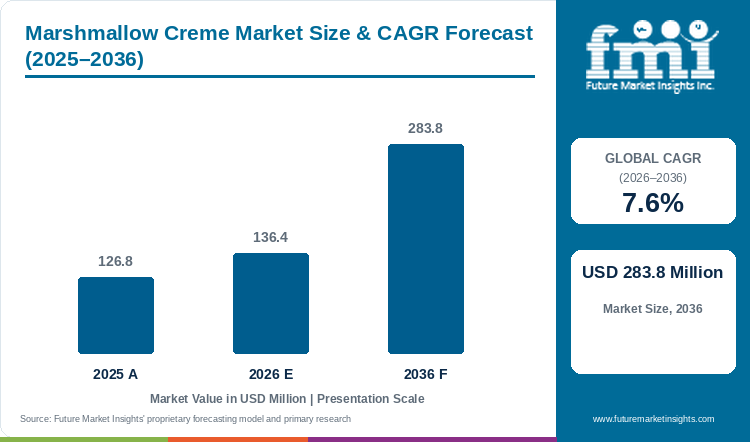
Table 1: Marshmallow Creme Market Size and Forecast (USD million), 2025 to 2036
| Market size and forecast | Value |
|---|---|
| 2025 market size | USD 126.8 million |
| Estimated market size in 2026 | USD 136.4 million |
| Projected market size by 2036 | USD 283.8 million |
| CAGR (2026-2036) | 7.6% |
| Added revenue, 2026 to 2036 | USD 147.4 million |
Key Market Trends & Insights
- By Product Type: The Standard grade segment accounted for the largest share of the marshmallow creme market in 2026, representing 40.0% of total market revenue.
- By Form: Powder / dry preparations held the leading market position with a share of 37.0% in 2026, with hydration and whipping carried out at the bakery.
- By Application: Bread & rolls remained the largest application segment, accounting for 40.0% of the market in 2026.
Regional Highlights
- Fastest-growing country: The UAE is expected to record the highest growth rate among the eight profiled countries, with a projected CAGR of 8.9% between 2026 and 2036.
- Growth across other countries: Saudi Arabia is projected to expand at a CAGR of 8.6%, followed by South Korea at 8.3% and the USA at 8.0%. Japan is expected to register comparatively slower growth, with a CAGR of 6.7% during the forecast period.
Ingredient costs remain an important factor influencing creme prices. The FAO attributed the rise in sugar prices to expectations of tighter global supply in the 2026/27 season, including a smaller EU sugar beet crop, lower production in Thailand and concerns over India's crop amid strengthening El Niño conditions[7]. In contrast, falling US egg prices[6] reduce the cost of egg-white aeration. Product formats also differ. Jet-Puffed Marshmallow Creme provides a ready-to-use spreadable format, while Bakels' Mallowhip Dry requires preparation at the bakery[3][4]. In either route, a useful confectionery filling is the material that keeps its portion and appearance after transfer and holding.
Corporate change may affect the leading branded supplier. According to Financier Worldwide, Kraft Heinz plans to separate a company focused on Heinz condiments and other fast-growing global brands, with annual sales of USD 15.4 billion, from a grocery company with revenue of USD 10.4 billion[5]. The separation is expected to close in the second half of 2026[5]. For bakery buyers, such changes can affect account management and product continuity, although the creme specification itself is unchanged. Bakels' Mallowhip Dry places water addition and whipping within the bakery[4], so a specified batch method connects the powder with the density and texture required at filling.
Regulation also shapes formulation. The US Food and Drug Administration (FDA) finalised its fifth-edition food allergen labelling guidance in January 2025, and a separate announcement that month proposed front-of-package information for saturated fat, sodium and added sugars[1][2]. The latter was a proposal rather than an adopted requirement. Egg-containing creme formulations bring their own ingredient information considerations, so sweetness, portion design and foam performance influence different parts of the specification, and formulation changes require attention to both the physical product and its declared composition.
Table 2: Supporting Industry Indicators for the Marshmallow Creme Market, 2025 to 2026
| Indicator | Data point | Why it matters | Source |
|---|---|---|---|
| Sugar prices | The FAO Sugar Price Index stood 14.7% above its year-earlier level in September 2026, its highest since April 2025. | Sugar is the main ingredient in marshmallow creme. | [7] |
| Sugar outlook | The FAO linked higher sugar prices to tighter expected supply in 2026/27. | Tighter sugar supply may keep creme costs elevated. | [7] |
| US sugar and sweets | US prices for sugar and sweets are forecast to rise by 6.6% in 2026. | Retail sweet prices reflect higher sugar costs. | [6] |
| Egg prices | US egg prices rose by 21.9% in 2025 and are forecast to fall by 29.4% in 2026. | Egg whites are used to aerate many creme formulations. | [6] |
| Brand owner restructuring | Kraft Heinz plans to split into two public companies, with completion expected in the second half of 2026. | The split affects the owner of the Jet-Puffed brand. | [5] |
| Company size | The two planned companies have annual sales of USD 15.4 billion and USD 10.4 billion. | The figures show the scale of the brand owner. | [5] |
| Allergen guidance | FDA finalised the fifth edition of its food allergen labelling guidance in January 2025. | Egg-containing creme requires accurate ingredient information. | [1] |
| Nutrition proposal | FDA proposed front-of-package information for saturated fat, sodium and added sugars on January 14, 2025. | The proposal is relevant to sugar-rich products. | [2] |
| Finished creme | Kraft Heinz offers Jet-Puffed as a ready-to-use spreadable marshmallow creme. | Finished foam reduces preparation at the bakery. | [3] |
| Dry preparation | Bakels describes Mallowhip Dry as a powder preparation for bakery use. | Hydration and whipping make the bakery's mixer part of performance. | [4] |
Demand Intensity Analysis
A comparison of FMI's market estimate with input cost trends provides an indication of how value growth may develop. FMI expects the marshmallow creme market to grow at a CAGR of 7.6% between 2026 and 2036. In comparison, US prices for sugar and sweets are forecast to rise by 6.6% in 2026[6], and the FAO Sugar Price Index rose by 14.7% in the year to September 2026[7]. If these increases are passed through, a large part of the market's near-term value growth may reflect higher prices rather than higher volumes.
Egg prices provide a contrasting reference point. US egg prices rose by 21.9% in 2025 but are forecast to fall by 29.4% in 2026[6]. For egg-white formulations, lower egg costs partly offset higher sugar costs. The net effect varies by recipe, as dry preparations and ready-to-use cremes contain different proportions of sugar, syrup and aerating proteins.
A comparison with the scale of the leading brand owner provides a further reference. Kraft Heinz's two planned companies have combined annual sales of approximately USD 25.8 billion[5]. FMI's market estimate of USD 126.8 million in 2025 is equivalent to approximately 0.5% of that total, which shows that marshmallow creme is a small specialty category even for its best-known supplier.
Segment values show where demand is concentrated. Powder / dry accounted for USD 50.5 million of Form revenue in 2026, while Standard grade represented USD 54.6 million within Product Type. Bread & rolls accounted for USD 54.6 million on the Application axis, and Direct to industrial bakeries represented USD 69.6 million within Sales Channel. FMI projects added market revenue of USD 147.4 million between 2026 and 2036, with the market reaching 2.1 times its 2026 value.
Table 3: Demand Intensity Metrics for the Marshmallow Creme Market, 2025 and 2026 Input Cost Data Against Market Values
| Demand intensity metric | Value | Basis |
|---|---|---|
| FMI market value, 2025 | USD 126.8 million | FMI estimate of marshmallow creme revenue. |
| FAO Sugar Price Index, year-on-year change | +14.7% | September 2026. |
| US sugar and sweets price forecast, 2026 | +6.6% | USDA ERS. |
| US egg price change, 2025 | +21.9% | USDA ERS. |
| US egg price forecast, 2026 | -29.4% | USDA ERS. |
| Kraft Heinz combined annual sales | Approximately USD 25.8 billion | USD 15.4 billion plus USD 10.4 billion. |
| FMI value as a share of Kraft Heinz sales | Approximately 0.5% | USD 126.8 million divided by USD 25.8 billion. |
| FMI value CAGR, 2026 to 2036 | 7.6% | FMI market forecast. |
| Powder / dry revenue, 2026 | USD 50.5 million | 37.0% of the market. |
| Direct industrial bakery revenue, 2026 | USD 69.6 million | 51.0% of the market. |
| Market expansion multiple | 2.1 times | Projected 2036 market value relative to 2026. |
Analyst Perspective
"With sugar costs at their highest since early 2025, the cremes that win repeat orders will be those that hold their volume through filling and packing, so bakeries get more portions from every kilogram."
- Nandini Roy Choudhury, Principal Analyst at Future Market Insights
How is the marshmallow creme market segmented?
The marshmallow creme market is segmented by product type, form, application, claim and sales channel. Product Type comprises Standard grade, Premium / specialty grade, Organic certified and Clean label grade. Form comprises Powder / dry, Liquid, Paste / semi-solid and Granules / pieces. Application comprises Bread & rolls, Cakes & muffins, Biscuits & cookies, Viennoiserie & pastry and Other bakery & snacks. Claim comprises Conventional, Clean label, Organic and Non-GMO / identity preserved. Sales Channel comprises Direct to industrial bakeries, Ingredient distributors, Foodservice & artisan supply and Online B2B.
Why does Standard grade anchor Product Type purchasing?
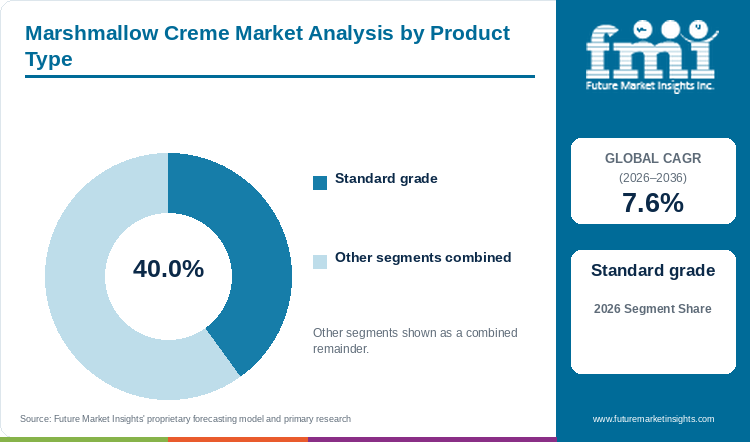
Standard grade accounts for 40.0% of Product Type in 2026.
A standard marshmallow creme is defined by its density, sweetness and colour, which give production teams a working reference, and Standard grade generated approximately USD 54.6 million in 2026. Whipping settings and depositor conditions can be set against that specification and repeated across shifts. Specialty grades add flavour or sensory distinctions, while organic and clean label versions may require different ingredients and records. Variable foam density alters portioning and may slow application, so a standard grade retains value when its operating properties remain stable.
- Standard grade accounts for 40.0% of Product Type in 2026.
- Density and sweetness need to remain familiar across shifts so that fill weight and appearance stay consistent.
What explains the purchasing advantage of Powder / dry formats?
Powder / dry represents 37.0% of Form in 2026.
When marshmallow is prepared from a dry mix, the bakery's mixer and batch method become part of ingredient performance, and dry formats generated approximately USD 50.5 million in 2026. Water addition and whipping establish the foam that will later be transferred and applied, as with Bakels' Mallowhip Dry[4]. Making volume close to application suits a controlled production schedule, while a kitchen with limited mixing capacity or frequent small orders may prefer finished creme. Comparing prepared yield and working time shows which route fits the operation.
- Powder / dry represents 37.0% of Form in 2026.
- Prepared yield and working time connect the powder specification with the bakery's actual mixing routine.
How do Bread & rolls generate creme ingredient throughput?
Bread & rolls capture 40.0% of Application in 2026.
Filled buns and sweet rolls are the largest application, accounting for approximately USD 54.6 million in 2026, and give marshmallow creme a recurring point of use after baking. The bread's cooling sequence matters, as residual heat can change the filling's consistency before packing. The foam must also resist collapse, liquid separation and flavour change between application and sale. Sandwich biscuits use thinner layers, while cakes and pastries introduce other decorative requirements. Establishing the order of cooling, filling and packing makes the desired texture easier to preserve.
- Bread & rolls capture 40.0% of Application in 2026.
- The cooling and filling sequence affects how well the aerated centre survives packing.
Why does Conventional remain the principal Claim category?
Conventional holds 51.0% of Claim in 2026.
Conventional recipes held 51.0% of the Claim segment in 2026, as they keep the sugar systems and aerating ingredients associated with a familiar marshmallow texture. A clean label or organic brief can alter the stabilisers or flavor preparations available, which creates more formulation work. The FDA's January 2025 proposal on front-of-package added sugar information[2] may also encourage some customers to review sweetness. Keeping a dependable conventional creme and a separate specialty preparation can accommodate this range, provided each has a clear recipe and application method.
- Conventional holds 51.0% of Claim in 2026.
- A revised declaration and the foam it produces need to be assessed as one formulation change.
What keeps Direct to industrial bakeries ahead of other channels?
Direct to industrial bakeries accounts for 51.0% of Sales Channel in 2026.
For industrial bakeries, density, transfer pressure and the usable life of a prepared batch link the creme specification with handling equipment, and direct supply accounted for approximately USD 69.6 million in 2026. Direct supply gives the bakery access to technical discussion on these details and agreement on documentation and pack format before volumes increase. A change in mixer size or transfer system may reopen that work. Distributors combine smaller quantities with other decorating ingredients.
- Direct to industrial bakeries accounts for 51.0% of Sales Channel in 2026.
- Equipment changes can require renewed work on whipping, transfer pressure and batch holding.
What are the drivers, restraints and opportunities in the marshmallow creme market?
Repeatable aeration supports regular bakery purchasing, while rising sugar costs and allergen requirements complicate substitution and different preparation formats can match different kitchen capacities.
Repeatable aeration supports regular bakery purchasing
Aeration consistency affects the amount of marshmallow filling available for scheduled production, as differences in whipping and transfer can change the apparent portion even when the same ingredient quantity is used. A finished creme or specified dry system establishes a method around which batch timing and application can be organised. With sugar costs rising[7], the volume obtained from each kilogram becomes more valuable, as a stable foam supplies the required appearance with less material. The commercial contribution is most visible across shifts or several outlets making the same item.
Rising sugar costs and allergen requirements complicate substitution
Sugar costs are rising, with the FAO Sugar Price Index up 14.7% year on year in September 2026[7], which puts pressure on creme prices. Changing to a cheaper creme can also involve the bakery's allergen arrangements. An egg-containing recipe may need a different production schedule from a formulation intended for customers avoiding egg, and FDA guidance addresses major allergen identification[1]. The foam then faces transfer and holding, as pumping or a long wait can reduce volume. A lower container price does not settle the comparison unless the replacement delivers enough usable filling through the normal process.
Preparation formats can match different kitchen capacities
Ready-to-use creme and dry systems divide preparation effort differently between supplier and customer. A central bakery with controlled mixing capacity can use a dry bakery mix and prepare foam close to application, as with Bakels' Mallowhip Dry[4]. Finished creme removes that whipping operation, which makes immediate working consistency and pack recovery more important. Both formats need a defined period during which the material remains suitable for filling, and a format matched to batch capacity and application rate limits unused material.
Which country CAGRs are profiled in the marshmallow creme market?
Table 4: Country growth outlook for the marshmallow creme market
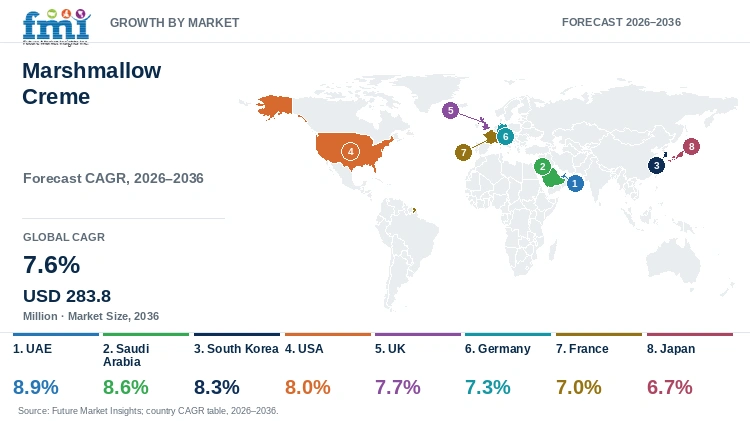
| Country | CAGR |
|---|---|
| UAE | 8.9% |
| Saudi Arabia | 8.6% |
| South Korea | 8.3% |
| USA | 8.0% |
| UK | 7.7% |
| Germany | 7.3% |
| France | 7.0% |
| Japan | 6.7% |
UAE
- The UAE is the fastest-growing market among the profiled countries, with a forecast CAGR of 8.9% from 2026 to 2036. UAE dessert operations differ in mixing capacity, which shapes their choice of marshmallow creme. Dry systems place whipping within planned kitchen batches, while ready-to-use products remove that work. Both routes depend on the texture retained through holding and service, and manageable packs and accurate ingredient-origin information support qualification.
Saudi Arabia
- For Saudi buyers, where the creme is aerated determines preparation, freight and technical-support requirements. Dry systems keep whipping in the receiving kitchen, while finished creme arrives already aerated. Saudi Arabia is forecast to grow at a CAGR of 8.6% from 2026 to 2036. An exact product description and ingredient information connect these alternatives with the intended use, and consistency between orders preserves the selected specification as demand develops.
South Korea
- With a forecast CAGR of 8.3% for 2026 to 2036, South Korea ranks third among the profiled countries. Soft buns and sandwich biscuits require different working body from a marshmallow filling, so South Korean development includes the assembly and holding sequence when selecting a creme. A preparation can serve several compatible shapes where deposition remains consistent, and its value grows with the number of products it supports.
USA
- US buyers know Jet-Puffed as the familiar reference for spreadable marshmallow creme[3], although an industrial specification must still fit the item being made. The USA is forecast to grow at a CAGR of 8.0% from 2026 to 2036. US sugar and sweets prices are forecast to rise by 6.6% in 2026, while egg prices are forecast to fall by 29.4%[6]. The FDA's January 2025 front-of-package nutrition proposal included added sugars among the nutrients it proposed to highlight[2], which provides context for sweetness and portion design when an indulgent range is refreshed.
UK
- In UK decorated treats, usable filling yield depends on how long marshmallow creme remains workable. Finished creme reduces mixing time, while dry systems place foam preparation within the bakery's batch plan. The UK is forecast to grow at a CAGR of 7.7% for 2026 to 2036. Pack size is particularly relevant during shorter seasonal runs, when a large container can leave more opened material than the next batch needs.
Germany
- Germany is projected to grow at a CAGR of 7.3% from 2026 to 2036. On German filled-bun lines, uniform density and transfer behaviour shape creme selection, while specialist pastry production places more emphasis on container size and finishing flexibility. Performance within the actual sequence provides the commercial comparison, including the quantity that remains usable after preparation and holding. Consistent supply preserves the selected density as new recipes are explored.
France
- In a French pastry kitchen, clean assembly depends on a creme with the right working body. A foam that spreads too readily can lose its shape beside other components, while too much firmness disturbs the eating texture. France is projected to grow at a CAGR of 7.0% from 2026 to 2036. Container size needs to fit the interval between preparation and application, and for industrial production the assessment extends through pumping and packing.
Japan
- Japan is expected to register the slowest growth among the profiled countries, with a CAGR of 6.7% for 2026 to 2036. In a carefully portioned Japanese dessert, a small shift in foam density can alter the visual balance, so the volume of creme must stay proportionate after depositing, transport and holding. Imported preparations are therefore evaluated through detailed application trials before an initial order is increased.
Who are the notable companies in the marshmallow creme market?
Kraft Heinz; Durkee-Mower; Bakels; Gilster-Mary Lee; Dutch Valley Food Distributors
The competitive field divides between ready-to-use creme and preparations whipped at the bakery. Kraft Heinz, owner of Jet-Puffed, and Durkee-Mower, producer of Marshmallow Fluff, offer established spreads. Kraft Heinz is preparing to separate into two companies by the second half of 2026[5]. Bakels serves the preparation stage, while Gilster-Mary Lee and Dutch Valley supply foodservice or bulk purchasing requirements. These roles leave different amounts of processing with the customer.
Application requirements distinguish these supplier roles. Pump tolerance matters on a sweet-roll line, while piping and working time influence pastry assembly, and the pack and preparation method connect these requirements with a defined place for marshmallow creme among the operation's other bakery ingredients.
Competitive Benchmarking: Marshmallow Creme Market
Table 5: Company capabilities in the marshmallow creme market
| Company | Product capability | Application emphasis |
|---|---|---|
| Kraft Heinz | Jet-Puffed Marshmallow Creme | Ready-to-use spreadable creme |
| Durkee-Mower | Marshmallow Fluff | Aerated sugar spread |
| Bakels | Mallowhip Dry | Marshmallow preparation for bakery use |
| Gilster-Mary Lee | Hospitality Marshmallow Crème | Foodservice supply |
| Dutch Valley Food Distributors | Bulk marshmallow creme distribution | Ingredient procurement |
Key Developments in the Marshmallow Creme Market
- In January 2025, FDA finalised the fifth edition of its food allergen labelling guidance, which requires accurate allergen records for egg-containing marshmallow creme[1].
- In January 2025, FDA proposed front-of-package information for saturated fat, sodium and added sugars[2].
- In September 2025, Kraft Heinz announced plans to split into two public companies, with completion expected in the second half of 2026[5].
- In September 2026, USDA forecast that US egg prices would fall by 29.4% in 2026, while sugar and sweets prices would rise by 6.6%[6].
- In October 2026, the FAO reported that its Sugar Price Index had reached its highest level since April 2025[7].
Key Players in the Marshmallow Creme Market
- Kraft Heinz
- Durkee-Mower
- Bakels
- Gilster-Mary Lee
- Dutch Valley Food Distributors
Marshmallow Creme Market - Report Scope
Table 6: Report scope for the marshmallow creme market
| Coverage field | Report scope |
|---|---|
| Market breakdown | Product Type; Form; Application; Claim; Sales Channel |
| Quantitative Units | USD Million |
| Market Definition | Includes revenue from finished marshmallow creme and purpose-formulated dry, liquid or semi-solid preparations specifically intended to produce or deliver marshmallow creme within the listed applications. Excludes downstream finished bakery revenue, generic non-marshmallow creams, ordinary marshmallow candies, unassigned ingredient bases and substitute toppings; mixed-product supplier sales are included only to the extent attributable to qualifying creme preparations. |
| Regions Covered | North America; Latin America; Western Europe; Eastern Europe; East Asia; South Asia and Pacific; Middle East and Africa |
| Countries Covered | UAE; Saudi Arabia; South Korea; USA; UK; Germany; France; Japan |
| Key Companies Profiled | Kraft Heinz; Durkee-Mower; Bakels; Gilster-Mary Lee; Dutch Valley Food Distributors |
| Forecast Period | 2026 to 2036 |
| Approach | Market assessment supported by official technical and regulatory publications, company product information and country operating conditions. |
Marshmallow Creme Market - Research Methodology
Table 7: Research approach for the marshmallow creme market
| Method | Approach |
|---|---|
| Market definition | The market covers finished marshmallow creme and preparations specifically sold to produce that aerated ingredient for the stated bakery applications. |
| Desk research | Government and regulatory publications, technical literature and official product information establish the application and supply context. |
| Commercial assessment | Assessment focuses on density, handling, batch preparation and the customer choice between ready-to-use and reconstituted formats. |
| Comparability | Market values, segment allocations and country growth rates use consistent units and the stated 2026 to 2036 forecast period. Company comparisons describe product roles and purchasing relevance. |
Marshmallow Creme Market by Segments
Product Type
- Standard grade
- Premium / specialty grade
- Organic certified
- Clean label grade
Form
- Powder / dry
- Liquid
- Paste / semi-solid
- Granules / pieces
Application
- Bread & rolls
- Cakes & muffins
- Biscuits & cookies
- Viennoiserie & pastry
- Other bakery & snacks
Claim
- Conventional
- Clean label
- Organic
- Non-GMO / identity preserved
Sales Channel
- Direct to industrial bakeries
- Ingredient distributors
- Foodservice & artisan supply
- Online B2B
Marshmallow Creme Market by Region
- North America
- United States
- Canada
- Latin America
- Brazil
- Mexico
- Argentina
- Chile
- Western Europe
- Germany
- France
- United Kingdom
- Italy
- Spain
- Benelux
- Nordics
- Eastern Europe
- Poland
- Czech Republic
- Romania
- Hungary
- East Asia
- China
- Japan
- South Korea
- South Asia and Pacific
- India
- ASEAN
- Australia and New Zealand
- Middle East and Africa
- GCC Countries
- South Africa
- Türkiye
- Israel
Research Sources and Bibliography
- [1] U.S. Food and Drug Administration. (2025, January). Guidance for industry: Questions and answers regarding food allergen labeling (Edition 5).
- [2] U.S. Food and Drug Administration. (2025, January 14). FDA Proposes Requiring At-a-Glance Nutrition Information on the Front of Packaged Foods.
- [3] Kraft Heinz. (n.d.). Jet-Puffed Marshmallow Creme.
- [4] New Zealand Bakels. (n.d.). Mallowhip Dry.
- [5] Summerfield, R. (2025, September 4). Financier Worldwide. Kraft Heinz to split into two public companies.
- [6] USDA Economic Research Service. (2026, September 25). Food price outlook: Summary findings.
- [7] Food and Agriculture Organization of the United Nations. (2026, October 2). FAO Food Price Index.
Future Market Insights. (2026). Marshmallow Creme Market: Global Industry Analysis and Opportunity Assessment 2036.
This Report Answers
- How large is the marshmallow creme market in 2026 and what value is forecast for 2036?
- Which industrial bakery requirements support demand for aerated creme preparations?
- Why does Standard grade retain the largest Product Type position?
- Why is Powder / dry the leading Form for 2026?
- How do the profiled country growth rates differ from 2026 to 2036?
- Which suppliers offer marshmallow creme and purpose-formulated preparations?
Frequently Asked Questions
How big is the marshmallow creme market in 2026, and what is forecast for 2036?
The market is valued at USD 136.4 million in 2026 and is forecast to reach USD 283.8 million by 2036.
What is the marshmallow creme market CAGR from 2026 to 2036?
The market is forecast to grow at a CAGR of 7.6% from 2026 to 2036.
Which Product Type segment leads the marshmallow creme market?
Standard grade leads Product Type with 40.0% in 2026.
Which Form segment has the highest 2026 share?
Powder / dry leads Form with 37.0% in 2026.
Which profiled countries have the highest growth rates?
The UAE leads at 8.9%, followed by Saudi Arabia at 8.6% and South Korea at 8.3% from 2026 to 2036.
Which companies participate in the marshmallow creme market?
The report profiles Kraft Heinz, Durkee-Mower, Bakels, Gilster-Mary Lee and Dutch Valley Food Distributors, covering finished creme, dry preparation and professional distribution.
Preview the report firsthand - request a free sample
Get SampleGet the brochure for pricing and purchase details.
Get PDFTable of Content
- Key Takeaways
- Market Size and CAGR
- Top Growth Driver
- Fastest Growing Segment
- Leading Region
- Key Companies
- Emerging Opportunities
- Executive Summary
- Global Market Outlook
- Demand-side Trends
- Supply-side Trends
- Technology Roadmap Analysis
- Analysis and Recommendations
- Analyst Perspective (What is happening? Why now? What should investors know?)
- Key Questions Answered
- How large is the market?
- What is the CAGR?
- What are key trends?
- Which region dominates?
- Who are the leaders?
- Market Overview
- Market Coverage / Taxonomy
- Market Definition / Scope / Limitations
- Research Methodology
- Chapter Orientation
- Analytical Lens and Working Hypotheses
- Market Structure, Signals, and Trend Drivers
- Benchmarking and Cross-market Comparability
- Market Sizing, Forecasting, and Opportunity Mapping
- Research Design and Evidence Framework
- Desk Research Programme (Secondary Evidence)
- Expert Input and Fieldwork (Primary Evidence)
- Tooling, Models, and Reference Databases
- Data Engineering and Model Build
- Quality Assurance and Audit Trail
- Market Background
- Market Dynamics (Drivers, Restraints, Opportunity, Trends)
- Scenario Forecast (Optimistic, Likely, Conservative)
- Impact Analysis
- AI Impact
- Sustainability Impact
- Regulatory Impact
- Technology Impact
- Consumer / Buyer Analysis
- Purchase Drivers
- Adoption Barriers
- Buyer Journey
- Opportunity Map Analysis
- Product Life Cycle Analysis
- Supply Chain Analysis
- Investment Feasibility Matrix
- Value Chain Analysis
- PESTLE and Porter's Analysis
- Regulatory Landscape
- Regional Parent Market Outlook
- Production and Consumption Statistics
- Import and Export Statistics
- Global Market Analysis and Forecast, 2021 to 2036
- Historical Market Size Value (USD Million) Analysis, 2021 to 2025
- Current and Future Market Size Value (USD Million) Projections, 2026 to 2036
- Y-o-Y Growth Trend Analysis
- Absolute $ Opportunity Analysis
- Global Market Pricing Analysis, 2021 to 2036
- Global Market Analysis and Forecast, By Product Type, 2021 to 2036
- Introduction / Key Findings
- Historical Market Size Value (USD Million) Analysis By Product Type, 2021 to 2025
- Current and Future Market Size Value (USD Million) Analysis and Forecast By Product Type, 2026 to 2036
- Standard grade
- Premium / specialty grade
- Organic certified
- Clean label grade
- Y-o-Y Growth Trend Analysis By Product Type, 2021 to 2025
- Absolute $ Opportunity Analysis By Product Type, 2026 to 2036
- Global Market Analysis and Forecast, By Form, 2021 to 2036
- Introduction / Key Findings
- Historical Market Size Value (USD Million) Analysis By Form, 2021 to 2025
- Current and Future Market Size Value (USD Million) Analysis and Forecast By Form, 2026 to 2036
- Powder / dry
- Liquid
- Paste / semi-solid
- Granules / pieces
- Y-o-Y Growth Trend Analysis By Form, 2021 to 2025
- Absolute $ Opportunity Analysis By Form, 2026 to 2036
- Global Market Analysis and Forecast, By Application, 2021 to 2036
- Introduction / Key Findings
- Historical Market Size Value (USD Million) Analysis By Application, 2021 to 2025
- Current and Future Market Size Value (USD Million) Analysis and Forecast By Application, 2026 to 2036
- Bread & rolls
- Cakes & muffins
- Biscuits & cookies
- Viennoiserie & pastry
- Other bakery & snacks
- Y-o-Y Growth Trend Analysis By Application, 2021 to 2025
- Absolute $ Opportunity Analysis By Application, 2026 to 2036
- Global Market Analysis and Forecast, By Claim, 2021 to 2036
- Introduction / Key Findings
- Historical Market Size Value (USD Million) Analysis By Claim, 2021 to 2025
- Current and Future Market Size Value (USD Million) Analysis and Forecast By Claim, 2026 to 2036
- Conventional
- Clean label
- Organic
- Non-GMO / identity preserved
- Y-o-Y Growth Trend Analysis By Claim, 2021 to 2025
- Absolute $ Opportunity Analysis By Claim, 2026 to 2036
- Global Market Analysis and Forecast, By Sales Channel, 2021 to 2036
- Introduction / Key Findings
- Historical Market Size Value (USD Million) Analysis By Sales Channel, 2021 to 2025
- Current and Future Market Size Value (USD Million) Analysis and Forecast By Sales Channel, 2026 to 2036
- Direct to industrial bakeries
- Ingredient distributors
- Foodservice & artisan supply
- Online B2B
- Y-o-Y Growth Trend Analysis By Sales Channel, 2021 to 2025
- Absolute $ Opportunity Analysis By Sales Channel, 2026 to 2036
- Global Market Analysis and Forecast, By Region, 2021 to 2036
- Introduction
- Historical Market Size Value (USD Million) Analysis By Region, 2021 to 2025
- Current Market Size Value (USD Million) Analysis and Forecast By Region, 2026 to 2036
- North America
- Latin America
- Western Europe
- Eastern Europe
- East Asia
- South Asia and Pacific
- Middle East and Africa
- Market Attractiveness Analysis By Region
- North America Market Analysis and Forecast, By Country, 2021 to 2036
- Historical Market Size Value (USD Million) Trend Analysis By Market Taxonomy, 2021 to 2025
- Market Size Value (USD Million) Forecast By Market Taxonomy, 2026 to 2036
- By Country
- United States
- Canada
- By Product Type
- By Form
- By Application
- By Claim
- By Sales Channel
- By Country
- Market Attractiveness Analysis
- By Country
- By Product Type
- By Form
- By Application
- By Claim
- By Sales Channel
- Key Takeaways
- Latin America Market Analysis and Forecast, By Country
- Historical Market Size Value (USD Million) Trend Analysis By Market Taxonomy, 2021 to 2025
- Market Size Value (USD Million) Forecast By Market Taxonomy, 2026 to 2036
- By Country
- Brazil
- Mexico
- Argentina
- Chile
- By Product Type
- By Form
- By Application
- By Claim
- By Sales Channel
- By Country
- Market Attractiveness Analysis
- By Country
- By Product Type
- By Form
- By Application
- By Claim
- By Sales Channel
- Key Takeaways
- Western Europe Market Analysis and Forecast, By Country
- Historical Market Size Value (USD Million) Trend Analysis By Market Taxonomy, 2021 to 2025
- Market Size Value (USD Million) Forecast By Market Taxonomy, 2026 to 2036
- By Country
- Germany
- France
- United Kingdom
- Italy
- Spain
- Benelux
- Nordics
- By Product Type
- By Form
- By Application
- By Claim
- By Sales Channel
- By Country
- Market Attractiveness Analysis
- By Country
- By Product Type
- By Form
- By Application
- By Claim
- By Sales Channel
- Key Takeaways
- Eastern Europe Market Analysis and Forecast, By Country
- Historical Market Size Value (USD Million) Trend Analysis By Market Taxonomy, 2021 to 2025
- Market Size Value (USD Million) Forecast By Market Taxonomy, 2026 to 2036
- By Country
- Poland
- Czech Republic
- Romania
- Hungary
- By Product Type
- By Form
- By Application
- By Claim
- By Sales Channel
- By Country
- Market Attractiveness Analysis
- By Country
- By Product Type
- By Form
- By Application
- By Claim
- By Sales Channel
- Key Takeaways
- East Asia Market Analysis and Forecast, By Country
- Historical Market Size Value (USD Million) Trend Analysis By Market Taxonomy, 2021 to 2025
- Market Size Value (USD Million) Forecast By Market Taxonomy, 2026 to 2036
- By Country
- China
- Japan
- South Korea
- By Product Type
- By Form
- By Application
- By Claim
- By Sales Channel
- By Country
- Market Attractiveness Analysis
- By Country
- By Product Type
- By Form
- By Application
- By Claim
- By Sales Channel
- Key Takeaways
- South Asia and Pacific Market Analysis and Forecast, By Country
- Historical Market Size Value (USD Million) Trend Analysis By Market Taxonomy, 2021 to 2025
- Market Size Value (USD Million) Forecast By Market Taxonomy, 2026 to 2036
- By Country
- India
- ASEAN
- Australia and New Zealand
- By Product Type
- By Form
- By Application
- By Claim
- By Sales Channel
- By Country
- Market Attractiveness Analysis
- By Country
- By Product Type
- By Form
- By Application
- By Claim
- By Sales Channel
- Key Takeaways
- Middle East and Africa Market Analysis and Forecast, By Country
- Historical Market Size Value (USD Million) Trend Analysis By Market Taxonomy, 2021 to 2025
- Market Size Value (USD Million) Forecast By Market Taxonomy, 2026 to 2036
- By Country
- GCC Countries
- South Africa
- Türkiye
- Israel
- By Product Type
- By Form
- By Application
- By Claim
- By Sales Channel
- By Country
- Market Attractiveness Analysis
- By Country
- By Product Type
- By Form
- By Application
- By Claim
- By Sales Channel
- Key Takeaways
- Key Countries Market Analysis
- United States
- Pricing Analysis
- Market Share Analysis, 2025
- By Product Type
- By Form
- By Application
- By Claim
- By Sales Channel
- Canada
- Pricing Analysis
- Market Share Analysis, 2025
- By Product Type
- By Form
- By Application
- By Claim
- By Sales Channel
- Mexico
- Pricing Analysis
- Market Share Analysis, 2025
- By Product Type
- By Form
- By Application
- By Claim
- By Sales Channel
- Brazil
- Pricing Analysis
- Market Share Analysis, 2025
- By Product Type
- By Form
- By Application
- By Claim
- By Sales Channel
- Chile
- Pricing Analysis
- Market Share Analysis, 2025
- By Product Type
- By Form
- By Application
- By Claim
- By Sales Channel
- Germany
- Pricing Analysis
- Market Share Analysis, 2025
- By Product Type
- By Form
- By Application
- By Claim
- By Sales Channel
- United Kingdom
- Pricing Analysis
- Market Share Analysis, 2025
- By Product Type
- By Form
- By Application
- By Claim
- By Sales Channel
- Italy
- Pricing Analysis
- Market Share Analysis, 2025
- By Product Type
- By Form
- By Application
- By Claim
- By Sales Channel
- Spain
- Pricing Analysis
- Market Share Analysis, 2025
- By Product Type
- By Form
- By Application
- By Claim
- By Sales Channel
- France
- Pricing Analysis
- Market Share Analysis, 2025
- By Product Type
- By Form
- By Application
- By Claim
- By Sales Channel
- India
- Pricing Analysis
- Market Share Analysis, 2025
- By Product Type
- By Form
- By Application
- By Claim
- By Sales Channel
- ASEAN
- Pricing Analysis
- Market Share Analysis, 2025
- By Product Type
- By Form
- By Application
- By Claim
- By Sales Channel
- Australia and New Zealand
- Pricing Analysis
- Market Share Analysis, 2025
- By Product Type
- By Form
- By Application
- By Claim
- By Sales Channel
- China
- Pricing Analysis
- Market Share Analysis, 2025
- By Product Type
- By Form
- By Application
- By Claim
- By Sales Channel
- Japan
- Pricing Analysis
- Market Share Analysis, 2025
- By Product Type
- By Form
- By Application
- By Claim
- By Sales Channel
- South Korea
- Pricing Analysis
- Market Share Analysis, 2025
- By Product Type
- By Form
- By Application
- By Claim
- By Sales Channel
- Poland
- Pricing Analysis
- Market Share Analysis, 2025
- By Product Type
- By Form
- By Application
- By Claim
- By Sales Channel
- Hungary
- Pricing Analysis
- Market Share Analysis, 2025
- By Product Type
- By Form
- By Application
- By Claim
- By Sales Channel
- Türkiye
- Pricing Analysis
- Market Share Analysis, 2025
- By Product Type
- By Form
- By Application
- By Claim
- By Sales Channel
- South Africa
- Pricing Analysis
- Market Share Analysis, 2025
- By Product Type
- By Form
- By Application
- By Claim
- By Sales Channel
- UAE
- Pricing Analysis
- Market Share Analysis, 2025
- By Product Type
- By Form
- By Application
- By Claim
- By Sales Channel
- Saudi Arabia
- Pricing Analysis
- Market Share Analysis, 2025
- By Product Type
- By Form
- By Application
- By Claim
- By Sales Channel
- United States
- Market Structure Analysis
- Competition Dashboard
- Competition Benchmarking
- Market Share Analysis of Top Players
- By Regional
- By Product Type
- By Form
- By Application
- By Claim
- By Sales Channel
- Emerging Startups
- Innovation Benchmarking
- Competition Analysis
- Competition Deep Dive
- Kraft Heinz
- Overview
- Product Portfolio
- Profitability by Market Segments
- Sales Footprint
- Strategy Overview
- Marketing Strategy
- Product Strategy
- Channel Strategy
- Durkee-Mower
- Bakels
- Gilster-Mary Lee
- Dutch Valley Food Distributors
- Kraft Heinz
- Case Studies
- Success Stories
- Recent Developments
- Competition Deep Dive
- Assumptions & Acronyms Used


