

- Market Size (2026)
- USD 192.5 Mn
- Forecast (2036)
- USD 287.7 Mn
- CAGR (2026 to 2036)
- 4.1%
How Big is the Mascara Wands & Brushes Market in 2026?
Sales of mascara wands and brushes will grow at a 4.1% CAGR from 2026 to 2036. Market value is estimated at USD 192.5 Million in 2026 and will reach USD 287.7 Million by 2036.
Mascara wands & brushes market size is estimated at USD 192.5 Million in 2026 and will reach USD 287.7 Million by 2036 at a 4.1% CAGR, as per FMI. A brand selects mascara applicators to produce the intended volume, separation or definition with its formula. Quadpack links applicator choice to the application area and amount delivered, while HCP tests formula and brush pairings before settling the pack [11] [13]. The brush is therefore part of product development rather than a final accessory choice. Repeat orders depend on the approved combination reproducing its result during filling and consumer use. Applying the forecast CAGR to the prior year gives an estimated 2025 market value of USD 184.9 Million.
A material redesign has to retain the application result and the component records a brand needs for launch. FDA reported more than 16,000 active cosmetic facility registrations and more than 1.29 million active product listings as of June 30, 2026 [1]. Europe's Packaging and Packaging Waste Regulation began applying on August 12, 2026, with provisions introduced in phases [2] [3]. Stable specifications help suppliers support these product files while offering new materials. Customers must be able to trace what changed and test its effect on the pack.
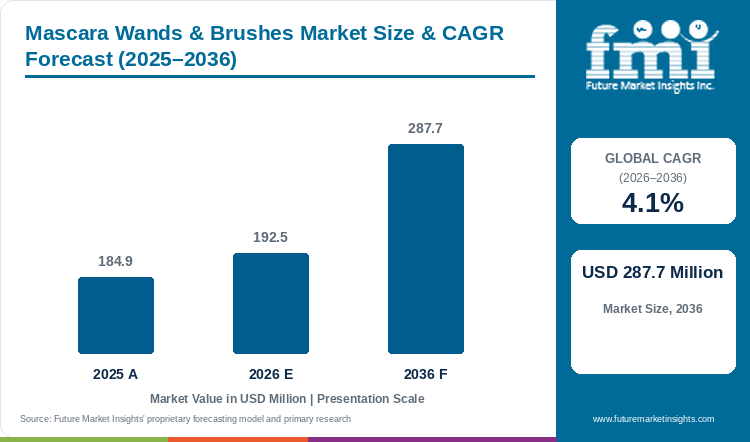
Key Takeaways
- Brands will match brush geometry and wiping behavior to the formula before approving production. Suppliers that support sampling and validation can help shorten development.
- Nylon-fiber wands will lead Product Type revenue with a 34.0% share in 2026. Fibre density, trim and profile give brands several ways to adjust application.
- Plastics & PCR resins will account for 29.0% of Material revenue in 2026. Molded components support dimensional control and recycled-content choices.
- 15-50 ml will hold 33.0% of Capacity revenue in 2026. Stock packs in the mid-teens and larger treatment formats support this band within the study's segmentation.
- A change to the brush, wiper or resin can alter formula pickup, dosing or filling behavior. Renewed qualification can extend the purchasing cycle.
- Companies profiled include Amcor, Silgan Holdings, Quadpack, Aptar, HCP Packaging, Baralan, Gerresheimer, Berry Global, APC Packaging and Albea. Their roles span direct mascara systems and broader beauty packaging.
Analyst Perspective
Demand becomes realizable revenue when a supplier can prove that the applicator, wiper and pack work as one controlled system with the buyer’s formula and filling line. Sustainability claims add value only after that performance threshold is preserved.
- Rahul Pandita, Principal Analyst at Future Market Insights
How is the Mascara Wands & Brushes Market Segmented?
According to FMI, the market is segmented by Product Type, Material, Capacity, Decoration, End Use and Region.
Based on Product Type, the market covers Nylon-fiber wands, Molded silicone wands, Specialty-shape wands and Custom-engineered. By Material, it includes Plastics & PCR resins, Glass, Paper & board and Aluminium & specialty. Capacity comprises 15-50 ml, Below 15 ml, 50-150 ml and Above 150 ml. The study covers Standard, Printed & decorated, Premium finishes and Smart / connected by Decoration, and Skincare brands, Color cosmetics, Hair & body and Fragrance by End Use. Regional coverage spans North America, Latin America, Western Europe, Eastern Europe, East Asia, South Asia and Pacific, and Middle East and Africa.
Why Do Nylon-fiber Wands Lead Product Type Revenue?
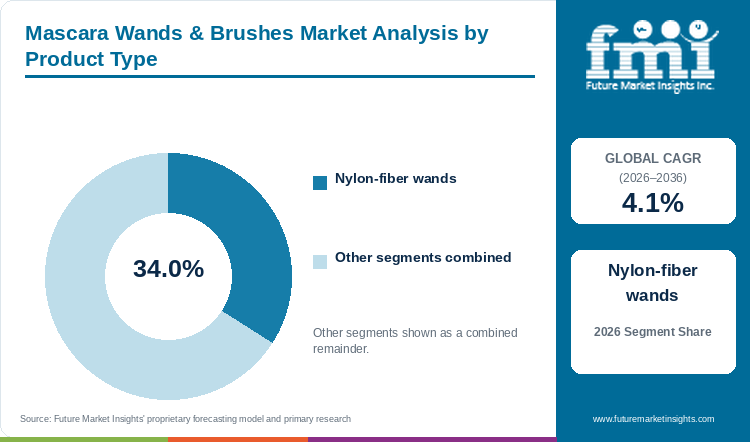
FMI finds that Nylon-fiber wands will hold 34.0% of Product Type revenue in 2026.
Twisted-wire construction lets a developer adjust fibre density and trim within an established pack system. HCP describes grooves, twists and cut profiles that change combing and formula payoff [10]. Brands can start with a brush family, then alter its profile for a volume or definition brief. The wiper and formula determine how that choice performs in use. Repeatable brush production gives suppliers room to customize without replacing the complete delivery system, supporting Nylon-fiber wands' leading share.
- Nylon-fiber wands will account for 34.0% of Product Type revenue in 2026. Adjustable fibre and trim specifications support a range of lash effects.
- In April 2024, Quadpack described mascara and brow brushes in its applicator-selection guidance [13]. The guidance links applicator choice to the formula, application area and amount delivered.
Why Do Plastics & PCR Resins Lead by Material?
Plastics & PCR resins will account for 29.0% of Material revenue in 2026.
Molding supports the dimensional control needed for rods, caps, wipers and brush components at scale. PCR cosmetic packaging adds recycled-content options to these familiar constructions. A different resin can affect stiffness, sealing or interaction with the formula, so buyers need test results alongside a traceable material declaration. Qualifying those properties allows a brand to retain its pack design while reducing virgin-resin use. This combination of production control and material choice supports Plastics & PCR resins' 29.0% share in 2026.
- Plastics & PCR resins will hold 29.0% of Material revenue in 2026. Moldability supports functional components, with PCR providing additional material choices.
- The EU PPWR began applying in August 2026, with future recyclability and recycled-content provisions introduced on their specified dates [2] [3]. This increases the value of qualified materials and accurate construction records.
What Supports 15-50 ml as the Leading Capacity Segment?
15-50 ml will hold 33.0% of Capacity revenue in 2026.
Common neck and closure designs let brands vary applicators or decoration with fewer custom components in eye cosmetic packaging. HCP's Smart Volume stock-pack recommendations illustrate this approach [12]. Its stated ml figures describe overflow capacity, with nominal product fill requiring a separate specification. The study's 15-50 ml band includes mid-teen stock packs and larger application-led formats, and will hold 33.0% of Capacity revenue in 2026. A buyer still needs to confirm the usable geometry and actual fill of the selected system.
- 15-50 ml will account for 33.0% of Capacity revenue in 2026. Portable pack proportions and reusable stock designs support its position.
- In April 2021, HCP presented Smart Volume with stock packs rated at 13.5 ml, 16.9 ml and 18.3 ml overflow capacity [12]. The latter two lie within 15-50 ml; these examples illustrate pack options rather than establish the segment share.
Why Does Standard Decoration Retain the Leading Share?
Standard will account for 40.0% of Decoration revenue in 2026.
Once a formula and applicator are approved, a core make-up packaging range needs finishes it can reproduce on schedule. Standard decoration adds fewer controls than extensive printing, metallization or tactile treatments. A brand can keep the same pack and vary its brush or formula for another product. Premium finishes remain an option when the budget and processing requirements fit the program. Baralan documents finish choices around its functional components [24], illustrating this flexibility. Standard will hold 40.0% of Decoration revenue in 2026.
- Standard will hold 40.0% of Decoration revenue in 2026. Limited finishing complexity helps brands reuse qualified pack designs.
- In January 2024, Baralan presented lip and eye-makeup applicators, wipers and finish options at Cosmoprof North America Miami [24]. These choices let brands configure appearance around functional components.
Why Do Skincare Brands Lead End Use Revenue?
Skincare brands will hold 32.0% of End Use revenue in 2026.
Lash-care serums, primers and treatment products use mascara-style systems to control pickup and target application beyond color payoff. Their formulas require their own brush and wiper checks. HCP lists configurations suitable for treatment-oriented products [25], giving suppliers a starting point for these briefs. Familiar engineering can reduce development work when it is compatible with the selected formula. Skincare brands will hold 32.0% of End Use revenue in 2026 within the defined wand-and-pack market; the share excludes unrelated skincare applicators.
- Skincare brands will account for 32.0% of End Use revenue in 2026. Lash-care and treatment briefs support demand for controlled wand application.
- In March 2026, Quadpack introduced Lotus Pod for skincare and makeup [14]. The metal-tipped applicator is an adjacent delivery example; it is not a mascara brush or evidence of the segment share.
What are the Drivers Restraints and Opportunities in the Mascara Wands & Brushes Market?
As per FMI, performance-specific application will support demand, qualification can slow supplier changes, and validated material redesign will create opportunities through 2036.
- Driver: Brands specify brush geometry and wiping behavior to reproduce a defined lash effect with the selected formula.
- Restraint: Changes to the brush, wiper, resin or pack can require repeated compatibility and filling checks.
- Opportunity: Packaging redesign gives suppliers room to offer qualified PCR and simpler material systems.
A volume or definition brief gives the applicator developer a result to work toward. Quadpack's guidance connects that result with formula pickup and delivery, and HCP tests candidate pairings before approval [11] [13]. Fibre and molded designs offer ways to adjust the application. A brush library helps when it gives the customer suitable prototypes to compare, supported by timely sampling and technical work. Reaching the required result with fewer iterations can be as valuable to the buyer as a lower component price.
An available replacement brush is not necessarily ready for the customer's formula. A new profile changes pickup and payoff, while a different wiper alters the amount left on the applicator. Resin changes can affect fit, sealing and extraction behavior as well. HCP's pairing, testing and optimization process illustrates how suppliers resolve these interactions [11]. Filling trials follow the application assessment. Development can take longer when a launch requires both a new lash effect and new materials within the same schedule.
European brands have a reason to review pack construction as PPWR provisions take effect. The regulation began applying in August 2026, with later recyclability and recycled-content duties following phased deadlines [2] [3]. Albea, Baralan and Gerresheimer document material choices within broader beauty packaging [15] [18] [24]. Suppliers can offer PCR or simpler constructions for mascara programs, then verify filling and application performance. A successful redesign allows an existing supplier relationship to continue under a new material specification.
Country-wise Analysis
The table compares country CAGRs for Mascara Wands & Brushes from 2026 to 2036, as per FMI.
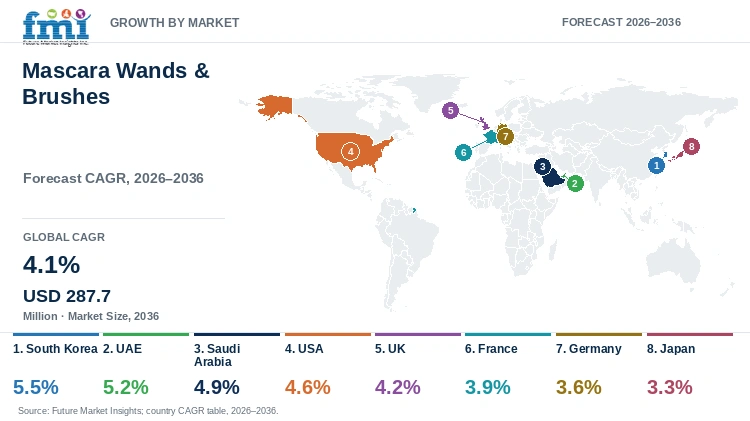
| Country | CAGR |
|---|---|
| South Korea | 5.5% |
| UAE | 5.2% |
| Saudi Arabia | 4.9% |
| USA | 4.6% |
| UK | 4.2% |
| France | 3.9% |
| Germany | 3.6% |
| Japan | 3.3% |
How Do Country Growth Rates Compare in the Mascara Wands & Brushes Market?
South Korea will lead the profiled countries at 5.5%, followed by the UAE at 5.2% and Saudi Arabia at 4.9%. The USA's 4.6% and UK's 4.2% will also exceed the global 4.1% CAGR. France, Germany and Japan will grow more moderately. The 3.3% to 5.5% range gives a 2.2 percentage-point spread. Suppliers planning capacity and regional support must consider local launch cycles and customer requirements alongside these rates, which describe growth from different starting market values.
- South Korea: Export-oriented beauty production gives applicator suppliers opportunities to support repeated sampling and product refreshes [9].
- UAE: Montaji records make stable product identity and component specifications relevant to brands entering Dubai [7].
- Saudi Arabia: Cosmetic notification gives brands a reason to settle material and pack details before launch [6].
- USA: MoCRA facility and product records make traceability and controlled component changes useful to eye-area cosmetic programs [1].
- UK: GB notification and a UK-established Responsible Person add a separate launch workflow for beauty brands [5].
- France: Cosmetics exports and premium brand programs support demand for dependable finishes and material records [4].
- Germany: Europe's largest national cosmetics retail market provides a broad buyer base, with material changes still subject to qualification [4].
- Japan: Formula classification and established quality requirements favor proven systems for cosmetic and lash-treatment briefs [8].
Country Outlook
- South Korea: South Korean export programs give applicator suppliers repeated product-development briefs. MFDS reported in May 2026 that 2025 cosmetics exports reached USD 11.4 billion, up 11.8% from 2024, placing Korea second globally [9]. These wider cosmetics figures provide context for the customer base. Brush libraries and rapid samples help brands compare designs for new launches; consistent production then supports use across fillers and destination markets. FMI forecasts a 5.5% CAGR from 2026 to 2036, the highest among the profiled countries.
- UAE: Dubai's product records give brands a reason to settle component identity before arranging regular supply. The municipality's Montaji platform covers registered consumer products, including cosmetics, and lets users verify identity and specifications [7]. Stable material descriptions and controlled variants help suppliers support those records. FMI forecasts a 5.2% CAGR for the UAE through 2036. Working with fillers and distributors early can reduce late artwork or file changes as an approved applicator moves into production.
- Saudi Arabia: Saudi Arabian brands need submitted cosmetic information to remain aligned with the product on sale. SFDA's notification guidance was updated on March 11, 2025 [6]. Wand and pack suppliers can support it by settling component identification and material declarations before production. A late decoration change may add validation or file work even when the application system is retained. FMI forecasts a 4.9% CAGR from 2026 to 2036. Reproducing the approved configuration helps customers plan launches and subsequent replenishment.
- USA: USA eye-area programs need product-specific review of the applicable MoCRA obligations. Certain small-business exemptions do not cover products regularly contacting the eye's mucous membrane under customary use [1]. FDA reported more than 16,000 active facility registrations and more than 1.29 million active product listings as of June 30, 2026, covering cosmetics broadly. Registration and listing do not constitute approval. FMI projects a 4.6% CAGR through 2036. Traceable materials and controlled brush, wiper and pack changes help suppliers support the brand's records alongside application performance.
- UK: A UK brand selling in Great Britain and the EU has separate launch files to coordinate. GB cosmetics need notification and a Responsible Person established in the UK [5]. Keeping common component specifications while localizing artwork or claims can reduce structural changes, validation work and inventory complexity. Cosmetics Europe valued the wider UK cosmetics and personal-care retail market at EUR 14.7 billion in 2025 [4]. This gives context to the buyer base for FMI's 4.2% CAGR forecast from 2026 to 2036.
- France: French export programs need finishes and component supply that remain dependable across orders. Cosmetics Europe reported French cosmetics and personal-care retail sales of EUR 14.5 billion in 2025, with France and Spain together accounting for nearly half of European cosmetics exports to global destinations [4]. These wider industry figures provide context for FMI's 3.9% CAGR forecast through 2036. PPWR's phased requirements also prompt material review [2] [3]. Suppliers must keep finish quality and application results consistent while documenting the redesigned construction.
- Germany: Germany's established beauty customer base can support replacement programs even with moderate forecast growth. Cosmetics Europe recorded EUR 18.0 billion in cosmetics and personal-care retail sales in 2025, its largest national total [4]. FMI forecasts wand-and-brush sales to grow at a 3.6% CAGR from 2026 to 2036. Standard pack platforms give brands a way to reuse approved components and control development costs. Suppliers proposing PCR or other material alternatives still need to demonstrate filling and application performance for the actual system.
- Japan: Japanese lash-treatment developers need to resolve classification before settling the launch route. PMDA states that cosmetics meeting the Standards for Cosmetics generally do not require marketing approval, while products with active ingredients are generally treated as quasi-drugs requiring approval [8]. The applicable route depends on the product. Suppliers can help customers assess the formula and intended claims with the applicator. FMI forecasts a 3.3% CAGR through 2036, the lowest profiled rate. Proven brush and pack designs can reduce development work within the local classification and quality requirements.
Who are the Notable Companies in the Mascara Wands & Brushes Market?
Amcor, Silgan Holdings, Quadpack, Aptar, HCP Packaging, Baralan, Gerresheimer, Berry Global, APC Packaging and Albea are the notable companies profiled in this market.
HCP Packaging and Albea document direct brush design and integrated mascara packs, while APC offers mascara formats with nylon applicators [10] [15] [16] [17]. Quadpack and Baralan supply broader dip-in or eye-makeup systems. Gerresheimer documents tubular packs suitable for mascara [13] [18] [19] [24]. Amcor, Silgan Holdings, Aptar and Berry Global contribute wider material, manufacturing or dispensing resources [20] [22] [23]. These roles help buyers identify a supplier for the component and development service their program actually needs.
- Direct mascara applicators and packs: HCP Packaging, APC Packaging and Albea.
- Broader integrated beauty packaging: Quadpack, Baralan and Gerresheimer, with specialist brush capability assessed separately.
- Diversified materials and dispensing: Amcor, Silgan Holdings, Aptar and Berry Global. Berry joined Amcor on April 30, 2025; their present-day operations are connected [22].
Competitive Benchmarking
| Company | Mascara Brush Engineering | Integrated Applicator-Pack Engineering | Circular Material Readiness | Geographic Reach |
|---|---|---|---|---|
| Amcor | Unscored | Unscored | Medium | Global packaging network after the Berry combination |
| Silgan Holdings | Unscored | Medium | Medium | North and South America, Europe and Asia |
| Quadpack | Unscored | High | Medium | Europe, United States and Asia-Pacific |
| Aptar | Unscored | High | Unscored | Global beauty packaging operations |
| HCP Packaging | High | High | Unscored | China, Germany, United States, Mexico and France |
| Baralan | Unscored | Medium | High | Europe with active North American beauty-market coverage |
| Gerresheimer | Unscored | Medium | High | International cosmetics packaging network |
| Berry Global | Unscored | Unscored | Medium | Global footprint; part of Amcor since April 2025 |
| APC Packaging | Medium | Medium | Unscored | United States commercial presence; wider mascara reach not separately verified |
| Albea | High | High | High | Europe and North America with broader global beauty coverage |
Scoring basis: Mascara Brush Engineering covers documented fibre or molded designs for mascara. Integrated Applicator-Pack Engineering assesses the applicator, container, rod and wiper as a functional beauty system. Circular Material Readiness covers relevant PCR, recycling or material-reduction capability. High indicates broad direct evidence, Medium narrower documented capability, and Low a documented limitation. Missing public evidence remains Unscored. Wider packaging operations do not establish the same specialist brush capability.
Key Developments in the Mascara Wands & Brushes Market
- Albea's North America collection was reported in November 2024 with the Mesmerize mascara and Impact brush [15]. Production at its Matamoros hub in Mexico gives regional beauty brands a sourcing option closer to their market. Each customer still needs to qualify the brush with its own formula before relying on the shorter route for replenishment.
- Silgan agreed to acquire Weener Packaging in July 2024 for an enterprise value of EUR 838 million. Weener operated 19 facilities, mainly in Europe and the Americas [20]. Completion in October 2024 expanded Silgan's personal-care dispensing resources [21]. The company is assessed for this broader capability, with specialist mascara-brush engineering requiring separate evidence.
- HCP presented Smart Volume in April 2021, pairing a precision-molded applicator with stock packs rated at 13.5 ml, 16.9 ml and 18.3 ml overflow capacity [12]. These container choices can reduce custom development for a targeted lash result. Brands need to specify actual product fill separately when selecting the system.
Key Players in the Mascara Wands & Brushes Market
Specialist Mascara Applicator and Pack Platforms
- HCP Packaging
- APC Packaging
- Albea
Integrated Beauty Packaging and Application Systems
- Quadpack
- Baralan
- Gerresheimer
Broad Beauty Packaging and Dispensing Platforms
- Amcor
- Silgan Holdings
- Aptar
- Berry Global
Report Scope and Methodology
| Coverage field | Report scope |
|---|---|
| Market breakdown | Product Type; Material; Capacity; Decoration; End Use |
| Quantitative Units | USD Million |
| Market Definition | Revenue includes mascara wand-and-brush applicators and directly integrated primary-pack components sold within the defined segmentation universe. Finished mascara formulation revenue, downstream retail value and adjacent or substitute packaging outside the defined market are excluded. |
| Regions Covered | North America; Latin America; Western Europe; Eastern Europe; East Asia; South Asia and Pacific; Middle East and Africa |
| Countries Covered | USA; Germany; France; UK; Saudi Arabia; UAE; Japan; South Korea |
| Key Companies Profiled | Amcor; Silgan Holdings; Quadpack; Aptar; HCP Packaging; Baralan; Gerresheimer; Berry Global; APC Packaging; Albea |
| Forecast Period | 2026 to 2036 |
| Approach | Primary and secondary research with market triangulation. |
Research Methodology
| Method | Approach |
|---|---|
| Primary Research | FMI analysts gathered input from manufacturers, developers, distributors, beauty brands, procurement teams and subject-matter experts. Discussions covered formula and applicator selection, qualification, filling compatibility, pricing and the conditions supporting repeat purchases. |
| Desk Research | Government data, regulatory publications, technical literature, company products, filings and announcements informed the assessment. Sources were reviewed for date, geography and direct relevance to mascara wands, brushes and integrated components. |
| Market Sizing and Forecasting | The model combined the baseline value with segment mix, pricing and volume indicators, adoption and country demand conditions. Formula launches, material redesign, qualification and supply availability informed the forecast. Segment and regional estimates were reconciled with the total. |
| Data Validation | Estimates were checked against public data, company activity and research inputs. Direct mascara systems were distinguished from broader packaging. Finished-formula sales, downstream retail value, adjacent categories and overlapping revenues were excluded. |
Market Segmentation
By Product Type
- Nylon-fiber wands
- Molded silicone wands
- Specialty-shape wands
- Custom-engineered
By Material
- Plastics & PCR resins
- Glass
- Paper & board
- Aluminium & specialty
By Capacity
- 15-50 ml
- Below 15 ml
- 50-150 ml
- Above 150 ml
By Decoration
- Standard
- Printed & decorated
- Premium finishes
- Smart / connected
By End Use
- Skincare brands
- Color cosmetics
- Hair & body
- Fragrance
By Region
- North America
- United States
- Canada
- Latin America
- Brazil
- Mexico
- Argentina
- Chile
- Western Europe
- Germany
- France
- United Kingdom
- Italy
- Spain
- Benelux
- Nordics
- Eastern Europe
- Poland
- Czech Republic
- Romania
- Hungary
- East Asia
- China
- Japan
- South Korea
- South Asia and Pacific
- India
- ASEAN
- Australia and New Zealand
- Middle East and Africa
- GCC Countries
- South Africa
- Türkiye
- Israel
Research Sources and Bibliography
- [1] U.S. Food and Drug Administration (2026, September 9). Registration & Listing of Cosmetic Product Facilities and Products.
- [2] European Commission (2026, August 11). New EU rules on packaging enter into application.
- [3] European Union (2025). Regulation (EU) 2025/40 on packaging and packaging waste.
- [4] Cosmetics Europe (n.d.). Our Industry.
- [5] Office for Product Safety and Standards (2020, December 18). Submit a cosmetic product notification.
- [6] Saudi Food and Drug Authority (2020, August 20; updated 2025, March 11). Guidance and Requirements of Cosmetic product Notification.
- [7] Dubai Municipality (2020, April 28). Dubai Municipality’s Montaji App.
- [8] Pharmaceuticals and Medical Devices Agency (n.d.). Frequently Asked Questions.
- [9] Ministry of Food and Drug Safety, Republic of Korea (2026, May 22). 2025 cosmetics trade surplus exceeds USD 10 billion and Korea becomes the world’s second-largest cosmetics exporter.
- [10] HCP Packaging (n.d.). Mascara Cosmetic Packaging.
- [11] HCP Packaging (n.d.). HCP’s Lash Studio.
- [12] Cosmetics Business (2021, April 7). Fast-track your next mascara launch with HCP Packaging.
- [13] Quadpack (2024, April 30). 5 steps to choosing an applicator.
- [14] Quadpack (2026, March 31). Keep it cool with Lotus Pod metal applicator.
- [15] Global Cosmetic Industry (2024, November 12). Albéa Cosmetics & Fragrance Launches the North America Collection.
- [16] Industries Cosmétiques (2025, January 28). At Paris Packaging Week, Albéa unveils a range of innovations combining durability, functionality and aesthetics.
- [17] APC Packaging (n.d.). YYDL7151 | Lipgloss, Eyeliner or Mascara.
- [18] Gerresheimer (2021, October 18). Gerresheimer presents sustainable and innovative product solutions at Cosmetic Business in Munich.
- [19] Gerresheimer (2021, September). g Update Cosmetics: Tubular glass packaging solutions for cosmetics.
- [20] Silgan Holdings (2024, July 24). Silgan Announces Agreement to Acquire Weener Packaging.
- [21] Silgan Holdings (2024, October 15). Silgan Completes Acquisition of Weener Packaging.
- [22] Amcor (2025, April 30). Amcor completes combination with Berry Global.
- [23] Aptar (2024, May 22). Aptar Beauty Presents NeoDropper: The Dropper Experience, Reinvented.
- [24] Baralan (n.d.). Baralan at Cosmoprof Miami.
- [25] HCP Packaging (n.d.). 13mm Standard/Trade Size Mascara.
This bibliography is provided for reader reference and is not exhaustive. The full report contains the complete reference list and detailed citations.
This Report Answers
- How large is the Mascara Wands & Brushes Market in 2026 and what value is forecast for 2036?
- Which industry pressures support demand for mascara wands and brushes?
- Why do Nylon-fiber wands hold the leading Product Type position?
- Why do Plastics & PCR resins lead the Material category?
- How do profiled country growth rates differ from South Korea to Japan?
- Which companies supply relevant mascara applicators, integrated packs or adjacent beauty-delivery capabilities?
- What limits adoption or switching between mascara wand and brush suppliers?
- What should buyers evaluate before purchasing a new mascara applicator system?
Frequently Asked Questions
How big is the Mascara Wands & Brushes Market in 2026, and what is forecast for 2036?
The market is estimated at USD 192.5 Million in 2026 and will reach USD 287.7 Million by 2036, as per FMI. Performance-specific applicators and integrated packs will support sales.
What is the CAGR for the Mascara Wands & Brushes Market from 2026 to 2036?
FMI forecasts a 4.1% CAGR from 2026 to 2036. Growth depends on converting formula and material briefs into qualified component programs.
Which Product Type segment leads the Mascara Wands & Brushes Market?
Nylon-fiber wands will lead Product Type revenue with a 34.0% share in 2026. Twisted-wire construction allows changes to fibre density, trim and profile for different lash effects.
Which Material segment leads the Mascara Wands & Brushes Market?
Plastics & PCR resins will account for 29.0% of Material revenue in 2026. Moldability and material choices support rods, caps, wipers and other components.
Which profiled countries have the highest growth rates in the Mascara Wands & Brushes Market?
South Korea will grow at 5.5%, followed by the UAE at 5.2% and Saudi Arabia at 4.9% from 2026 to 2036. These rates compare percentage growth rather than absolute country values.
Which companies are active in the Mascara Wands & Brushes Market?
The study profiles Amcor, Silgan Holdings, Quadpack, Aptar, HCP Packaging, Baralan, Gerresheimer, Berry Global, APC Packaging and Albea. Their roles differ across direct mascara systems, integrated beauty packs and broader packaging operations.
Preview the report firsthand - request a free sample
Get SampleGet the brochure for pricing and purchase details.
Get PDFTable of Content
- Key Takeaways
- Market Size and CAGR
- Top Growth Driver
- Fastest Growing Segment
- Leading Region
- Key Companies
- Emerging Opportunities
- Executive Summary
- Global Market Outlook
- Demand-side Trends
- Supply-side Trends
- Technology Roadmap Analysis
- Analysis and Recommendations
- Analyst Perspective (What is happening? Why now? What should investors know?)
- Key Questions Answered
- How large is the market?
- What is the CAGR?
- What are key trends?
- Which region dominates?
- Who are the leaders?
- Market Overview
- Market Coverage / Taxonomy
- Market Definition / Scope / Limitations
- Research Methodology
- Chapter Orientation
- Analytical Lens and Working Hypotheses
- Market Structure, Signals, and Trend Drivers
- Benchmarking and Cross-market Comparability
- Market Sizing, Forecasting, and Opportunity Mapping
- Research Design and Evidence Framework
- Desk Research Programme (Secondary Evidence)
- Expert Input and Fieldwork (Primary Evidence)
- Tooling, Models, and Reference Databases
- Data Engineering and Model Build
- Quality Assurance and Audit Trail
- Market Background
- Market Dynamics (Drivers, Restraints, Opportunity, Trends)
- Scenario Forecast (Optimistic, Likely, Conservative)
- Impact Analysis
- AI Impact
- Sustainability Impact
- Regulatory Impact
- Technology Impact
- Consumer / Buyer Analysis
- Purchase Drivers
- Adoption Barriers
- Buyer Journey
- Opportunity Map Analysis
- Product Life Cycle Analysis
- Supply Chain Analysis
- Investment Feasibility Matrix
- Value Chain Analysis
- PESTLE and Porter's Analysis
- Regulatory Landscape
- Regional Parent Market Outlook
- Production and Consumption Statistics
- Import and Export Statistics
- Global Market Analysis and Forecast, 2021 to 2036
- Historical Market Size Value (USD Million) Analysis, 2021 to 2025
- Current and Future Market Size Value (USD Million) Projections, 2026 to 2036
- Y-o-Y Growth Trend Analysis
- Absolute $ Opportunity Analysis
- Global Market Pricing Analysis, 2021 to 2036
- Global Market Analysis and Forecast, By Product Type, 2021 to 2036
- Introduction / Key Findings
- Historical Market Size Value (USD Million) Analysis By Product Type, 2021 to 2025
- Current and Future Market Size Value (USD Million) Analysis and Forecast By Product Type, 2026 to 2036
- Nylon-fiber wands
- Molded silicone wands
- Specialty-shape wands
- Custom-engineered
- Y-o-Y Growth Trend Analysis By Product Type, 2021 to 2025
- Absolute $ Opportunity Analysis By Product Type, 2026 to 2036
- Global Market Analysis and Forecast, By Material, 2021 to 2036
- Introduction / Key Findings
- Historical Market Size Value (USD Million) Analysis By Material, 2021 to 2025
- Current and Future Market Size Value (USD Million) Analysis and Forecast By Material, 2026 to 2036
- Plastics & PCR resins
- Glass
- Paper & board
- Aluminium & specialty
- Y-o-Y Growth Trend Analysis By Material, 2021 to 2025
- Absolute $ Opportunity Analysis By Material, 2026 to 2036
- Global Market Analysis and Forecast, By Capacity, 2021 to 2036
- Introduction / Key Findings
- Historical Market Size Value (USD Million) Analysis By Capacity, 2021 to 2025
- Current and Future Market Size Value (USD Million) Analysis and Forecast By Capacity, 2026 to 2036
- 15-50 ml
- Below 15 ml
- 50-150 ml
- Above 150 ml
- Y-o-Y Growth Trend Analysis By Capacity, 2021 to 2025
- Absolute $ Opportunity Analysis By Capacity, 2026 to 2036
- Global Market Analysis and Forecast, By Decoration, 2021 to 2036
- Introduction / Key Findings
- Historical Market Size Value (USD Million) Analysis By Decoration, 2021 to 2025
- Current and Future Market Size Value (USD Million) Analysis and Forecast By Decoration, 2026 to 2036
- Standard
- Printed & decorated
- Premium finishes
- Smart / connected
- Y-o-Y Growth Trend Analysis By Decoration, 2021 to 2025
- Absolute $ Opportunity Analysis By Decoration, 2026 to 2036
- Global Market Analysis and Forecast, By End Use, 2021 to 2036
- Introduction / Key Findings
- Historical Market Size Value (USD Million) Analysis By End Use, 2021 to 2025
- Current and Future Market Size Value (USD Million) Analysis and Forecast By End Use, 2026 to 2036
- Skincare brands
- Color cosmetics
- Hair & body
- Fragrance
- Y-o-Y Growth Trend Analysis By End Use, 2021 to 2025
- Absolute $ Opportunity Analysis By End Use, 2026 to 2036
- Global Market Analysis and Forecast, By Region, 2021 to 2036
- Introduction
- Historical Market Size Value (USD Million) Analysis By Region, 2021 to 2025
- Current Market Size Value (USD Million) Analysis and Forecast By Region, 2026 to 2036
- North America
- Latin America
- Western Europe
- Eastern Europe
- East Asia
- South Asia and Pacific
- Middle East and Africa
- Market Attractiveness Analysis By Region
- North America Market Analysis and Forecast, By Country, 2021 to 2036
- Historical Market Size Value (USD Million) Trend Analysis By Market Taxonomy, 2021 to 2025
- Market Size Value (USD Million) Forecast By Market Taxonomy, 2026 to 2036
- By Country
- United States
- Canada
- By Product Type
- By Material
- By Capacity
- By Decoration
- By End Use
- By Country
- Market Attractiveness Analysis
- By Country
- By Product Type
- By Material
- By Capacity
- By Decoration
- By End Use
- Key Takeaways
- Latin America Market Analysis and Forecast, By Country
- Historical Market Size Value (USD Million) Trend Analysis By Market Taxonomy, 2021 to 2025
- Market Size Value (USD Million) Forecast By Market Taxonomy, 2026 to 2036
- By Country
- Brazil
- Mexico
- Argentina
- Chile
- By Product Type
- By Material
- By Capacity
- By Decoration
- By End Use
- By Country
- Market Attractiveness Analysis
- By Country
- By Product Type
- By Material
- By Capacity
- By Decoration
- By End Use
- Key Takeaways
- Western Europe Market Analysis and Forecast, By Country
- Historical Market Size Value (USD Million) Trend Analysis By Market Taxonomy, 2021 to 2025
- Market Size Value (USD Million) Forecast By Market Taxonomy, 2026 to 2036
- By Country
- Germany
- France
- United Kingdom
- Italy
- Spain
- Benelux
- Nordics
- By Product Type
- By Material
- By Capacity
- By Decoration
- By End Use
- By Country
- Market Attractiveness Analysis
- By Country
- By Product Type
- By Material
- By Capacity
- By Decoration
- By End Use
- Key Takeaways
- Eastern Europe Market Analysis and Forecast, By Country
- Historical Market Size Value (USD Million) Trend Analysis By Market Taxonomy, 2021 to 2025
- Market Size Value (USD Million) Forecast By Market Taxonomy, 2026 to 2036
- By Country
- Poland
- Czech Republic
- Romania
- Hungary
- By Product Type
- By Material
- By Capacity
- By Decoration
- By End Use
- By Country
- Market Attractiveness Analysis
- By Country
- By Product Type
- By Material
- By Capacity
- By Decoration
- By End Use
- Key Takeaways
- East Asia Market Analysis and Forecast, By Country
- Historical Market Size Value (USD Million) Trend Analysis By Market Taxonomy, 2021 to 2025
- Market Size Value (USD Million) Forecast By Market Taxonomy, 2026 to 2036
- By Country
- China
- Japan
- South Korea
- By Product Type
- By Material
- By Capacity
- By Decoration
- By End Use
- By Country
- Market Attractiveness Analysis
- By Country
- By Product Type
- By Material
- By Capacity
- By Decoration
- By End Use
- Key Takeaways
- South Asia and Pacific Market Analysis and Forecast, By Country
- Historical Market Size Value (USD Million) Trend Analysis By Market Taxonomy, 2021 to 2025
- Market Size Value (USD Million) Forecast By Market Taxonomy, 2026 to 2036
- By Country
- India
- ASEAN
- Australia and New Zealand
- By Product Type
- By Material
- By Capacity
- By Decoration
- By End Use
- By Country
- Market Attractiveness Analysis
- By Country
- By Product Type
- By Material
- By Capacity
- By Decoration
- By End Use
- Key Takeaways
- Middle East and Africa Market Analysis and Forecast, By Country
- Historical Market Size Value (USD Million) Trend Analysis By Market Taxonomy, 2021 to 2025
- Market Size Value (USD Million) Forecast By Market Taxonomy, 2026 to 2036
- By Country
- GCC Countries
- South Africa
- Türkiye
- Israel
- By Product Type
- By Material
- By Capacity
- By Decoration
- By End Use
- By Country
- Market Attractiveness Analysis
- By Country
- By Product Type
- By Material
- By Capacity
- By Decoration
- By End Use
- Key Takeaways
- Key Countries Market Analysis
- United States
- Pricing Analysis
- Market Share Analysis, 2025
- By Product Type
- By Material
- By Capacity
- By Decoration
- By End Use
- Canada
- Pricing Analysis
- Market Share Analysis, 2025
- By Product Type
- By Material
- By Capacity
- By Decoration
- By End Use
- Mexico
- Pricing Analysis
- Market Share Analysis, 2025
- By Product Type
- By Material
- By Capacity
- By Decoration
- By End Use
- Brazil
- Pricing Analysis
- Market Share Analysis, 2025
- By Product Type
- By Material
- By Capacity
- By Decoration
- By End Use
- Chile
- Pricing Analysis
- Market Share Analysis, 2025
- By Product Type
- By Material
- By Capacity
- By Decoration
- By End Use
- Germany
- Pricing Analysis
- Market Share Analysis, 2025
- By Product Type
- By Material
- By Capacity
- By Decoration
- By End Use
- United Kingdom
- Pricing Analysis
- Market Share Analysis, 2025
- By Product Type
- By Material
- By Capacity
- By Decoration
- By End Use
- Italy
- Pricing Analysis
- Market Share Analysis, 2025
- By Product Type
- By Material
- By Capacity
- By Decoration
- By End Use
- Spain
- Pricing Analysis
- Market Share Analysis, 2025
- By Product Type
- By Material
- By Capacity
- By Decoration
- By End Use
- France
- Pricing Analysis
- Market Share Analysis, 2025
- By Product Type
- By Material
- By Capacity
- By Decoration
- By End Use
- India
- Pricing Analysis
- Market Share Analysis, 2025
- By Product Type
- By Material
- By Capacity
- By Decoration
- By End Use
- ASEAN
- Pricing Analysis
- Market Share Analysis, 2025
- By Product Type
- By Material
- By Capacity
- By Decoration
- By End Use
- Australia and New Zealand
- Pricing Analysis
- Market Share Analysis, 2025
- By Product Type
- By Material
- By Capacity
- By Decoration
- By End Use
- China
- Pricing Analysis
- Market Share Analysis, 2025
- By Product Type
- By Material
- By Capacity
- By Decoration
- By End Use
- Japan
- Pricing Analysis
- Market Share Analysis, 2025
- By Product Type
- By Material
- By Capacity
- By Decoration
- By End Use
- South Korea
- Pricing Analysis
- Market Share Analysis, 2025
- By Product Type
- By Material
- By Capacity
- By Decoration
- By End Use
- Poland
- Pricing Analysis
- Market Share Analysis, 2025
- By Product Type
- By Material
- By Capacity
- By Decoration
- By End Use
- Hungary
- Pricing Analysis
- Market Share Analysis, 2025
- By Product Type
- By Material
- By Capacity
- By Decoration
- By End Use
- Türkiye
- Pricing Analysis
- Market Share Analysis, 2025
- By Product Type
- By Material
- By Capacity
- By Decoration
- By End Use
- South Africa
- Pricing Analysis
- Market Share Analysis, 2025
- By Product Type
- By Material
- By Capacity
- By Decoration
- By End Use
- UAE
- Pricing Analysis
- Market Share Analysis, 2025
- By Product Type
- By Material
- By Capacity
- By Decoration
- By End Use
- Saudi Arabia
- Pricing Analysis
- Market Share Analysis, 2025
- By Product Type
- By Material
- By Capacity
- By Decoration
- By End Use
- United States
- Market Structure Analysis
- Competition Dashboard
- Competition Benchmarking
- Market Share Analysis of Top Players
- By Regional
- By Product Type
- By Material
- By Capacity
- By Decoration
- By End Use
- Emerging Startups
- Innovation Benchmarking
- Competition Analysis
- Competition Deep Dive
- Amcor
- Overview
- Product Portfolio
- Profitability by Market Segments
- Sales Footprint
- Strategy Overview
- Marketing Strategy
- Product Strategy
- Channel Strategy
- Silgan Holdings
- Quadpack
- Aptar
- HCP Packaging
- Baralan
- Gerresheimer
- Berry Global
- APC Packaging
- Albea
- Amcor
- Case Studies
- Success Stories
- Recent Developments
- Competition Deep Dive
- Assumptions & Acronyms Used


