

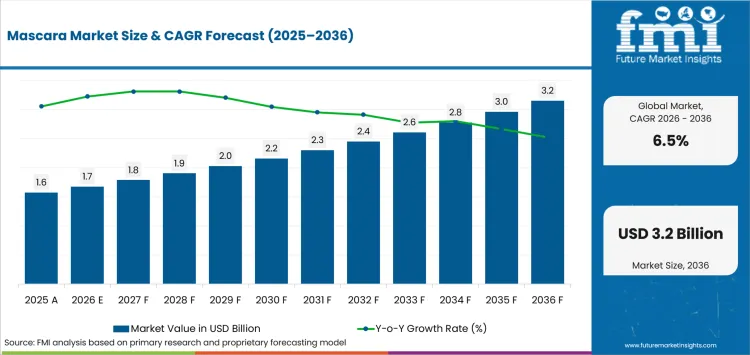
- Market Size (2026)
- USD 1.7 Bn
- Forecast (2036)
- USD 3.2 Bn
- CAGR (2026 to 2036)
- 6.5%
How big is Mascara Market in 2026?
USD 1.7 billion in 2026 and USD 3.2 billion by 2036 at a 6.5% CAGR.
The mascara market is projected to rise from USD 1.7 billion in 2026 to USD 3.2 billion by 2036 at a 6.5% CAGR. Growth depends on product refreshes that produce an obvious lash result without forcing consumers to accept weaker wear or difficult removal. L'Oreal's April 2026 first-quarter release named L'Oreal Paris Extensionist Mascara among launches supporting makeup growth, tying the forecast to an active product cycle.
National growth rates separate markets with routine digital trial from markets in which retail or compliance work limits conversion. Eurostat reported in February 2025 that 20% of EU internet users bought cosmetics or wellness products online during the prior three months. Channel maturity therefore changes customer-acquisition cost and the ease of converting a successful first purchase into repeat online orders.
Key Takeaways of Mascara Market
- Mascara demand rises if a visible lash effect survives daily wear and is easy to remove without undermining repeat purchase.
- By product type, volumizing is estimated to hold 30.0% in 2026 owing to an adjustable density effect that shoppers can judge immediately.
- In 2026, liquid & serum is expected to lead format with 27.0% share as wand-controlled deposition supports layering within familiar application routines.
- E-commerce & DTC is set to lead sales channel with 34.0% share in 2026 due to video demonstrations that pair visible comparison with reviews and easy replenishment.
- Eye-area compliance and difficult removal can weaken repeat purchase even when the first application produces a strong cosmetic result.
- Some of the key players in this market include L'Oreal, Shiseido, Coty, Estee Lauder Companies, Amorepacific, Kao Corporation, e.l.f. Beauty, and Benefit Cosmetics.
Analyst Perspective
"Mascara margins depend on the brush and film working as one system during wear and removal. Category teams should compare clump control, curl retention and removal behavior instead of treating a lower unit price as the stronger commercial offer."
- Rahul Pandita, Principal Consultant, Future Market Insights
How is the Mascara Market segmented?
The mascara market is segmented by product type, nature, format, price positioning, sales channel and region.
Product types include volumizing, lengthening, tubing and waterproof. Nature includes conventional, vegan & cruelty-free, natural & organic, dermocosmetic / clinical and fragrance-free & sensitive. Formats include liquid & serum, cream & balm, stick & solid, spray & mist, sheet & patch and powder. Price positioning covers mass, masstige, premium and professional. Sales channels include e-commerce & DTC, specialty beauty retail, pharmacies & drugstores, supermarkets & hypermarkets and salons & spas.
Why does Volumizing lead demand within the Product type category?
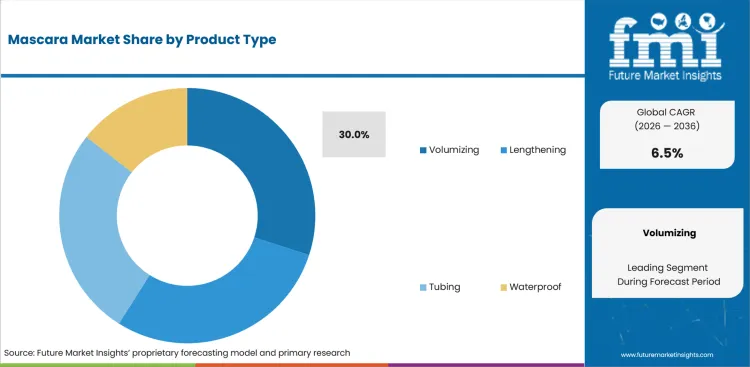
Volumizing mascara competes on a result shoppers can judge immediately, although brush loading must avoid excess product and clumping during repeated coats and routine touch-ups. L'Oreal reported in October 2025 that makeup accelerated with a broader makeup innovation pipeline including Maybelline Colossal Bubble Mascara.
- By product type, volumizing is estimated to hold 30.0% in 2026 owing to an adjustable density effect that shoppers can see within a few controlled strokes.
- Brands test mascara applicators against each volume formula since brush geometry controls product pickup and how evenly users build density during later coats and touch-ups.
How does Liquid & Serum shape demand within the Format category?
Liquid & serum formats let formulators change film behavior while consumers retain the familiar tube-and-wand routine used for everyday application and repeat layering during daily touch-ups. In May 2025 L'Oreal said its North Little Rock plant specializes in high-volume mascara and liquid makeup production.
- In 2026, liquid & serum is expected to lead format with 27.0% share as controlled fluid deposition supports coat-by-coat buildability and precise lash separation.
- The wiper and closure used in eye cosmetic packaging must meter fluid pickup consistently since excess loading changes application control and distorts the claimed lash effect during daily use.
What supports Mass demand within the Price positioning category?
Mass mascara lowers the cost of testing a new brush or lash effect during a replacement cycle without requiring a premium commitment. Coty disclosed in October 2025 that Max Factor introduced the company's first refillable mascara during fiscal 2025.
- Mass is set to lead price positioning with 36.0% share in 2026 due to accessible pricing that lets shoppers change performance claims without a premium price step.
- Mass brands compete below premium cosmetics on replacement spending, so accessible shelf pricing determines how easily shoppers switch formulas. Refill design and make-up product packaging must preserve convenience without complicating refills.
What drives E-commerce & DTC within the sales channel category?
Digital channels suit mascara as shoppers can compare brush shape and visible lash results during order selection without committing to a new formula. Amorepacific reported in August 2025 that ETUDE's Curl Fix Mascara supported strong performance in online and multi-brand-shop channels.
- E-commerce & DTC is projected to hold 34.0% of sales channel in 2026 owing to product demonstration and replenishment occurring within the same purchasing route during trial and repeat ordering.
- Shopping habits used for adjacent eyebrow makeup let beauty retailers place shade information and reviews beside close-up application content without relying on a physical tester.
What are the drivers, restraints and opportunities in the Mascara Market?
Visible product results support trial while eye-area compliance limits weak offers, creating room for long-wear formulas that remove with less friction.
- Driver: Clear volume and length effects let brands demonstrate a product difference quickly enough to encourage switching before a normal replacement cycle ends.
- Restraint: Eye-area compliance and poor removal performance raise the cost of a weak launch since irritation or difficult cleansing can stop repurchase.
- Opportunity: Long-wear formulas with simpler removal give brands a route to reduce the performance compromise that separates durable wear from everyday convenience.
Visible Product Results Sustain Trial
Mascara trial rises once a new lash effect is obvious enough for shoppers to judge from one demonstration. In February 2025, e.l.f. Beauty placed Lash XTNDR Mascara inside a Big Game activation that linked review content to shoppable media. The campaign shortened the path from visible result to purchase so viewers could assess separation and length ahead of a full wear cycle using cosmetic pigments and brush deposition cues.
Compliance Failures Raise Online-Sale Risk
Cross-border e-commerce broadens mascara access but exposes brands to non-compliant imports that can damage trust in eye-area products. A European Commission customs control published in March 2026 checked 5,772 cosmetic items from direct-to-consumer consignments and found 65% non-compliant. Brands need accurate labels and documentation at import as anti-counterfeit cosmetic packaging cannot replace the product rules enforced by customs.
Simpler Removal Extends Long-Wear Choice
Tubing mascara gives long-wear brands a route to improve removal without abandoning the durability claim that attracts trial. In March 2025, the Estée Lauder Companies newsroom highlighted Too Faced Ribbon Wrapped Lash with tubing technology and up to 24-hour wear. Formulas that hold during the day and release more easily at removal can broaden waterproof makeup use among consumers who also buy eyelash serums but reject difficult cleansing.
Which country CAGRs are profiled in the Mascara Market?
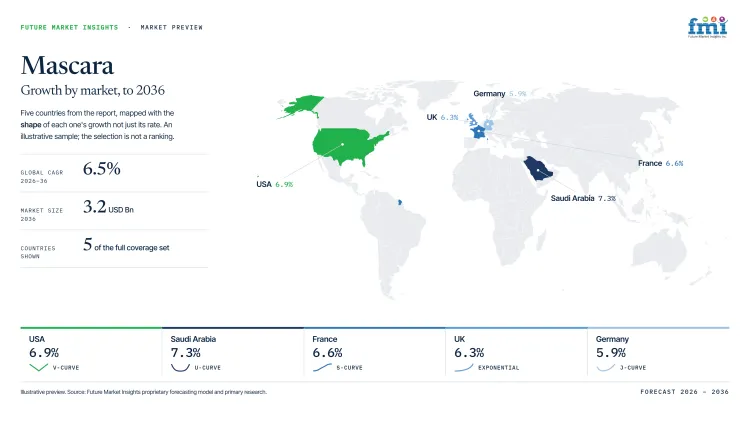
| Country | CAGR |
|---|---|
| Saudi Arabia | 7.3% |
| USA | 6.9% |
| France | 6.6% |
| UK | 6.3% |
| Germany | 5.9% |
How do country-level CAGRs compare in the Mascara Market?
The five profiled country CAGRs span 1.4 percentage points, from 7.3% in Saudi Arabia to 5.9% in Germany. Saudi Arabia and the USA form the faster-growth pair, while France and the UK occupy the middle range. Germany records the lowest CAGR, reflecting a more mature retail environment and established beauty-product competition.
- Saudi Arabia's prestige mall expansion gives distributors room for imported color-cosmetic launches.
- USA retail calendars make reset timing a material part of launch economics.
- France uses pharmacy and department-store authority to distinguish trusted products from novelty.
- The UK's established beauty retail network supports new product launches.
- Germany's mature market favors strong brands and clear product differentiation.
Similar growth rates can therefore mask very different launch costs and routes to repeat purchase. The full report provides country-level CAGR analysis across North America, Latin America, Europe, East Asia, South Asia, Oceania and the Middle East and Africa.
Country-wise Analysis
- Saudi mascara launches usually depend on an importer-distributor that coordinates product files, Arabic labels and retailer delivery dates so stock reaches major modern beauty stores on schedule. Saudi Arabia is projected to grow at 7.3% CAGR through 2036 helped by wider prestige retail and digital discovery. SFDA's cosmetic product notification guidance shows a March 11, 2025 update and keeps notification central to legal market entry. Experienced distributors reduce launch friction by sequencing notification with inventory arrival and retailer assortment decisions. Late label corrections can push stock behind the retail calendar, which makes local regulatory execution a practical limit on otherwise attractive growth.
- USA mascara brands enter mass retail plus specialty beauty and e-commerce, while shelf resets decide how long a new launch receives attention. FDA data published in July 2026 counted 16,398 active cosmetic facility registrations and 1,298,361 active product listings under MoCRA as of June 30. USA demand is forecast to rise at 6.9% CAGR through 2036 because broad channel access makes replacement buying easy. Retail depth gives successful formulas several replenishment routes once the first trial converts. Heavy promotion and review comparison can erase weak differentiation quickly, leaving claim clarity and consistent wear as stronger defenses than distribution alone.
- French mascara competes in prestige and mass channels, and established brand authority can win attention without relaxing eye-area safety documentation. France is anticipated to grow at 6.6% CAGR through 2036 reflecting mature retail depth and strong beauty-house recognition. ANSES reported in February 2025 that it received 378 cosmetic vigilance reports during 2024, including 129 serious cases. Established beauty houses can convert trust into trial more efficiently than unfamiliar entrants entering selective prestige distribution for the first time. Vigilance exposure raises the cost of weak safety files, so new brands need defensible claims to translate prestige storytelling into repeat mascara purchase.
- UK mascara brands benefit from established department stores, specialty beauty retailers, and e-commerce platforms. The UK is projected to grow at 6.3% CAGR through 2036, supported by broad retail access and strong beauty-product availability. Competition across established and emerging brands makes product positioning important. Brands with clear performance claims and strong digital visibility can improve trial and repeat purchases.
- German mascara brands operate in a mature beauty market with strong pharmacy, drugstore, and specialty retail channels. Germany is projected to grow at 5.9% CAGR through 2036, reflecting established retail penetration and strong brand competition. Consumers place importance on product quality, safety, and reliable performance. Clear differentiation and efficient distribution can help new mascara brands gain shelf presence.
Who are the notable companies in the Mascara Market?
L'Oreal, Shiseido, Coty, Estee Lauder Companies, Amorepacific, Kao Corporation, e.l.f. Beauty and Benefit Cosmetics are the notable companies serving this market.
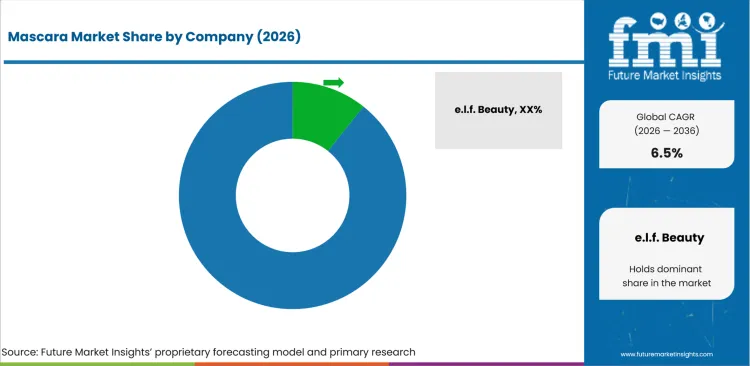
Competition separates global makeup portfolios from brands whose advantage comes from mascara technology or a narrower channel position. Formula evidence and retail activation raise entry barriers for lash claims that must survive wear testing and fast visual comparison. Special-effect work can borrow from multichrome eye pigments, but mascara requires stable deposition on a moving lash surface.
- L'Oreal, Shiseido, Coty and Estee Lauder Companies compete with broad makeup portfolios and multi-region retail systems that can scale new mascara claims quickly.
- Amorepacific and Kao Corporation bring Asia-led makeup brands with documented mascara activity, giving each company a strong route into digitally influenced eye-makeup demand.
- e.l.f. Beauty and Benefit Cosmetics compete through accessible digital activation and specialist prestige recognition, with different price positions but clear mascara-specific brand visibility.
Competitive Benchmarking: Mascara Market
| Company | Lash-Effect Breadth | Documented Product Activity | Channel Activation | Geographic Reach |
|---|---|---|---|---|
| L'Oreal | High | High | High | Global |
| Shiseido | Medium | High | Medium | Global |
| Coty | Medium | High | High | 120+ countries and territories |
| Estee Lauder Companies | Medium | High | High | Global prestige channels |
| Amorepacific | Medium | High | High | Asia, North America and EMEA |
| Kao Corporation | Medium | High | High | Japan and selected Asian markets |
| e.l.f. Beauty | Medium | High | High | North America, Europe, Mexico and GCC |
| Benefit Cosmetics | Medium | Medium | High | 50+ countries |
Scoring basis: High lash-effect breadth requires three documented mascara outcome routes while Medium requires two and Low identifies one verified route. High documented product activity requires multiple 2025-2026 mascara launches or technology actions while Medium reflects one dated action or multiple named current franchises and Low identifies one current reference. High channel activation requires physical and digital execution in several markets while Medium reflects two channels or a narrower international program and Low identifies one verified route.
Key Developments in the Mascara Market
- In March 2026, Kao Corporation launched KATE's new durable eye-makeup line in Asian markets with long and volume mascaras offering waterproof wear and curl retention.
- In January 2026, Coty launched Rimmel Thrill Seeker Mega Lift Mascara with Red Bull and a global digital campaign built around an extreme performance demonstration.
- In January 2025, e.l.f. Beauty launched its e.l.f. von zehn campaign in Germany with Lash XTNDR Mascara and coordinated retailer plus digital-media activation.
Key Players in the Mascara Market
Global Makeup Platforms
- L'Oreal
- Shiseido
- Coty
- Estee Lauder Companies
Asia-Led Makeup Platforms
- Amorepacific
- Kao Corporation
Digitally Focused and Specialist Brands
- e.l.f. Beauty
- Benefit Cosmetics
Mascara Market - Report Scope
| Coverage field | Report scope |
|---|---|
| Market breakdown | By product type, nature, format, price positioning, sales channel and region. |
| Quantitative Units | USD Billion. |
| Market Definition | Commercial revenue from mascara products used to color, lengthen, volumize, curl or coat eyelashes. Excludes lash serums, false eyelashes, lash extensions, removers and other eye makeup. |
| Regions Covered | North America, Latin America, Europe, East Asia, South Asia and Pacific and Middle East and Africa. |
| Countries Covered | UAE, South Korea, Saudi Arabia, USA, France, and 20+ countries included in the full report. |
| Key Companies Profiled | L'Oreal, Shiseido, Coty, Estee Lauder Companies, Amorepacific, Kao Corporation, e.l.f. Beauty, Benefit Cosmetics. |
| Forecast Period | 2026 to 2036. |
| Approach | Primary and secondary research with market triangulation. |
Mascara Market - Research Methodology
| Method | Approach |
|---|---|
| Primary Research | FMI analysts gathered input from manufacturers, service providers, technology developers, distributors, end users, procurement teams, and subject-matter experts. Interviews examined purchasing decisions, product or service evaluation, adoption barriers, approval requirements, pricing considerations, and expectations for technical or commercial support. Respondents were also asked what evidence is required before a trial, pilot, or initial order develops into regular purchasing. |
| Desk Research | Desk research covered government statistics, regulatory publications, trade data, industry associations, technical literature, standards, company filings, product information, and official corporate announcements. Sources were reviewed for relevance, publication date, geographic coverage, and consistency with the defined market scope. Claims relating to performance, applications, approvals, capacity, investment, and commercial activity were retained only when supported by credible public evidence. |
| Market Sizing and Forecasting | The market model combined the baseline value with historical performance, segment structure, pricing and volume indicators, adoption levels, company participation, and country-level demand conditions. Forecast assumptions considered economic activity, investment trends, regulatory developments, technology adoption, purchasing cycles, supply availability, and barriers to wider market use. Segment and regional estimates were reconciled before the final market total was calculated. |
| Data Validation | Estimates were checked against multiple independent indicators, including public data, company activity, trade patterns, industry developments, and findings from primary interviews. Validation also tested whether products, services, applications, and company revenues fell within the defined market boundaries. Adjacent categories, unsupported claims, overlapping revenues, and activities without direct market relevance were excluded to reduce double counting and maintain consistency across segments and countries. |
Mascara Market by Segments
Mascara Market segmented by Product Type:
- Volumizing
- Lengthening
- Tubing
- Waterproof
Mascara Market segmented by Nature:
- Conventional
- Vegan & cruelty-free
- Natural & organic
- Dermocosmetic / clinical
- Fragrance-free & sensitive
Mascara Market segmented by Format:
- Liquid & serum
- Cream & balm
- Stick & solid
- Spray & mist
- Sheet & patch
- Powder
Mascara Market segmented by Price Positioning:
- Mass
- Masstige
- Premium
- Professional
Mascara Market segmented by Sales Channel:
- E-commerce & DTC
- Specialty beauty retail
- Pharmacies & drugstores
- Supermarkets & hypermarkets
- Salons & spas
Mascara Market by Region:
- North America
- United States
- Canada
- Latin America
- Brazil
- Mexico
- Chile
- Rest of Latin America
- Western Europe
- Germany
- United Kingdom
- Italy
- Spain
- France
- Nordics
- Benelux
- Rest of Western Europe
- Eastern Europe
- Russia
- Poland
- Hungary
- Balkan and Baltic States
- Rest of Eastern Europe
- East Asia
- China
- Japan
- South Korea
- South Asia and Pacific
- India
- ASEAN
- Australia and New Zealand
- Rest of South Asia and Pacific
- Middle East and Africa
- Kingdom of Saudi Arabia
- Other GCC Countries
- Türkiye
- South Africa
- Other African Union Countries
- Rest of Middle East and Africa
Research Sources and Bibliography
- L’Oréal. (2026, April 22). First quarter 2026 sales.
- Eurostat. (2025, February 20). Online shopping in the EU keeps growing.
- L’Oréal Groupe. (2025, October 21). Sales at September 30, 2025.
- L’Oréal Groupe. (2025, May 28). L'Oréal Groupe commemorates 50 years of American manufacturing excellence at its North Little Rock, Arkansas plant - the beauty leader's worldwide flagship makeup facility.
- Coty Inc. (2025, October 31). Coty Champions Eco-Desirability and Transparency in FY25 Sustainability Report.
- Amorepacific Group. (2025, August 5). Amorepacific Group Announces Q2 2025 Business Performance.
- e.l.f. Beauty. (2025, February 7). e.l.f. Makes a New Play on Big Game Viewing to Throw the Ultimate Watch Party for the Community.
- European Commission, Taxation and Customs Union. (2026, March 3). Protein powder, sunglasses, moisturiser: what do these products have in common? If you buy them online, they most likely violate EU product standards.
- The Estée Lauder Companies Inc. (2025, March 20). Too Faced Launching New Tubing Mascara, Ribbon Wrapped Lash.
- Dubai Municipality. (2025, October 27). Product safety at Beautyworld Middle East 2025.
- Ministry of Food and Drug Safety, Republic of Korea. (2026, March 18). 「화장품 안전기준 등에 관한 규정」 전문 (식품의약품안전처 고시 제2026-19호).
- Saudi Food and Drug Authority. (2025, March 11). Guidance and Requirements of Cosmetic product Notification.
- USA Food and Drug Administration. (2026, July 2). Registration & Listing of Cosmetic Product Facilities and Products.
- ANSES. (2025, February 14). Cosmetics: how can we better protect consumer health?
- LVMH. (2026). Benefit Cosmetics. Retrieved August 23, 2026.
- Kao Corporation. (2026, January 20). 「KATE(ケイト)」から、新耐久アイメイクライン「号泣の涙神(るいしん)」を発売.
- Coty Inc. (2026, January 15). Gravity Doesn’t Stand a Chance Rimmel London & Red Bull Deliver Gravity Defying Lashes & Thrilling Beam Routine Stunt.
- e.l.f. Beauty. (2025, January 21). e.l.f. Beauty Launches “e.l.f. von zehn” in Germany: A Celebration of Quality Fueled by Community.
- Coty Inc. (2026, May 20). Coty Launches Marc Jacobs Beauty: One Of The Most-requested Luxury Comebacks.
- Amorepacific Group. (2026, July 6). Amorepacific Group Achieves Highest-Ever Revenue on Amazon Prime Day.
- Shiseido Company, Limited. (2026, January). Shiseido Develops Next-generation Mascara Technology “WASHABLE LOCK TECHNOLOGY™”: New Film Development Leads to Combine Two Functions, Excellent Curl Retention and Easily Washable.
- The Estée Lauder Companies Inc. (2025, August 11). Clinique Launches in the Amazon.com.mx Premium Beauty Store.
- e.l.f. Beauty. (2025, August 11). e.l.f. Cosmetics Launches Legal-themed “e.l.f.ino & schmarnes” Defending the Best of Beauty at Accessible Prices.
- L’Oréal Groupe. (2025, April 18). L’Oréal First Quarter 2025 Sales.
- Kao Corporation. (2025, July 14). KATE Kicks off International Campaign “LIGHTS ON SHADOW.”
- UKLASH. (2025, October 16). We Went Viral! Looking Back At September with UKLASH, From Launching Tubing Mascara To Hosting Global Beauty Events.
This bibliography is provided for reader reference and is not exhaustive. The full report contains the complete reference list and detailed citations.
This Report Answers
- How large is the mascara market in 2026 and what value is projected for 2036?
- Which product-performance conditions support repeat mascara purchase during the forecast period?
- Why does volumizing account for 30.0% of product type in 2026?
- How do liquid & serum formats preserve familiar application while supporting formula innovation?
- Why does e-commerce & DTC account for 34.0% of sales channel in 2026?
- How do the five profiled country CAGRs differ between UAE and France?
- Which compliance and removal frictions can interrupt mascara repurchase after initial use?
- How do the eight companies differ by lash-effect breadth and channel activation?
- How much incremental value is projected between the 2026 and 2036 market sizes?
Frequently Asked Questions
How big is the mascara market in 2026?
The mascara market is valued at USD 1.7 billion in 2026 and is projected to reach USD 3.2 billion by 2036. Growth is driven by replacement demand and product refreshes that give shoppers a visible reason to switch without sacrificing repeat wear.
What is the CAGR of the mascara market from 2026 to 2036?
The mascara market is projected to grow at a CAGR of 6.5% between 2026 and 2036. Expansion is supported by regular replacement cycles and launches that make volume, length or removal benefits easy to judge during product comparison.
Which product type leads the mascara market?
The volumizing segment is expected to hold 30.0% of the mascara market's product type category in 2026, driven by an adjustable density effect that shoppers can judge immediately. Controlled brush loading also lets users build intensity without changing the application routine.
Which format leads the mascara market?
The liquid & serum segment is expected to hold 27.0% of the mascara market's format category in 2026, supported by controlled fluid deposition during familiar tube-and-wand use. The format also supports coat-by-coat buildability without requiring shoppers to learn a different application method.
How much value will the mascara market add between 2026 and 2036?
The mascara market is expected to add USD 1.5 billion in value between 2026 and 2036. Growth comes from replacement demand and product refreshes that give users a visible reason to switch while protecting repeat wear and removal convenience.
Which countries are projected to record the highest growth in the mascara market?
UAE is projected to grow at 7.9% CAGR followed by South Korea at 7.6% and Saudi Arabia at 7.3% through 2036 in the mascara market. Faster growth is associated with active beauty discovery and wider modern retail access.
Which companies are active in the mascara market?
Key companies in the mascara market include L'Oreal, Shiseido, Coty, Estee Lauder Companies, Amorepacific, Kao Corporation, e.l.f. Beauty, and Benefit Cosmetics. Their positions differ by mascara technology, price tier and the channels used to turn product trial into repeat orders.
Preview the report firsthand - request a free sample
Get SampleGet the brochure for pricing and purchase details.
Get PDFTable of Content
- Key Takeaways
- Market Size and CAGR
- Top Growth Driver
- Fastest Growing Segment
- Leading Region
- Key Companies
- Emerging Opportunities
- Executive Summary
- Global Market Outlook
- Demand-side Trends
- Supply-side Trends
- Technology Roadmap Analysis
- Analysis and Recommendations
- Analyst Perspective (What is happening? Why now? What should investors know?)
- Key Questions Answered
- How large is the market?
- What is the CAGR?
- What are key trends?
- Which region dominates?
- Who are the leaders?
- Market Overview
- Market Coverage / Taxonomy
- Market Definition / Scope / Limitations
- Research Methodology
- Chapter Orientation
- Analytical Lens and Working Hypotheses
- Market Structure, Signals, and Trend Drivers
- Benchmarking and Cross-market Comparability
- Market Sizing, Forecasting, and Opportunity Mapping
- Research Design and Evidence Framework
- Desk Research Programme (Secondary Evidence)
- Expert Input and Fieldwork (Primary Evidence)
- Tooling, Models, and Reference Databases
- Data Engineering and Model Build
- Quality Assurance and Audit Trail
- Market Background
- Market Dynamics (Drivers, Restraints, Opportunity, Trends)
- Scenario Forecast (Optimistic, Likely, Conservative)
- Impact Analysis
- AI Impact
- Sustainability Impact
- Regulatory Impact
- Technology Impact
- Consumer / Buyer Analysis
- Purchase Drivers
- Adoption Barriers
- Buyer Journey
- Opportunity Map Analysis
- Product Life Cycle Analysis
- Supply Chain Analysis
- Investment Feasibility Matrix
- Value Chain Analysis
- PESTLE and Porter's Analysis
- Regulatory Landscape
- Regional Parent Market Outlook
- Production and Consumption Statistics
- Import and Export Statistics
- Global Market Analysis and Forecast, 2021 to 2036
- Historical Market Size Value (USD Billion) Analysis, 2021 to 2025
- Current and Future Market Size Value (USD Billion) Projections, 2026 to 2036
- Y-o-Y Growth Trend Analysis
- Absolute $ Opportunity Analysis
- Global Market Pricing Analysis, 2021 to 2036
- Global Market Analysis and Forecast, By Product Type, 2021 to 2036
- Introduction / Key Findings
- Historical Market Size Value (USD Billion) Analysis By Product Type, 2021 to 2025
- Current and Future Market Size Value (USD Billion) Analysis and Forecast By Product Type, 2026 to 2036
- Volumizing
- Lengthening
- Tubing
- Waterproof
- Volumizing
- Y-o-Y Growth Trend Analysis By Product Type, 2021 to 2025
- Absolute $ Opportunity Analysis By Product Type, 2026 to 2036
- Global Market Analysis and Forecast, By Nature, 2021 to 2036
- Introduction / Key Findings
- Historical Market Size Value (USD Billion) Analysis By Nature, 2021 to 2025
- Current and Future Market Size Value (USD Billion) Analysis and Forecast By Nature, 2026 to 2036
- Conventional
- Vegan & cruelty-free
- Natural & organic
- Dermocosmetic / clinical
- Fragrance-free & sensitive
- Conventional
- Y-o-Y Growth Trend Analysis By Nature, 2021 to 2025
- Absolute $ Opportunity Analysis By Nature, 2026 to 2036
- Global Market Analysis and Forecast, By Format, 2021 to 2036
- Introduction / Key Findings
- Historical Market Size Value (USD Billion) Analysis By Format, 2021 to 2025
- Current and Future Market Size Value (USD Billion) Analysis and Forecast By Format, 2026 to 2036
- Liquid & serum
- Cream & balm
- Stick & solid
- Spray & mist
- Sheet & patch
- Powder
- Liquid & serum
- Y-o-Y Growth Trend Analysis By Format, 2021 to 2025
- Absolute $ Opportunity Analysis By Format, 2026 to 2036
- Global Market Analysis and Forecast, By Price Positioning, 2021 to 2036
- Introduction / Key Findings
- Historical Market Size Value (USD Billion) Analysis By Price Positioning, 2021 to 2025
- Current and Future Market Size Value (USD Billion) Analysis and Forecast By Price Positioning, 2026 to 2036
- Mass
- Masstige
- Premium
- Professional
- Mass
- Y-o-Y Growth Trend Analysis By Price Positioning, 2021 to 2025
- Absolute $ Opportunity Analysis By Price Positioning, 2026 to 2036
- Global Market Analysis and Forecast, By Sales Channel, 2021 to 2036
- Introduction / Key Findings
- Historical Market Size Value (USD Billion) Analysis By Sales Channel, 2021 to 2025
- Current and Future Market Size Value (USD Billion) Analysis and Forecast By Sales Channel, 2026 to 2036
- E-commerce & DTC
- Specialty beauty retail
- Pharmacies & drugstores
- Supermarkets & hypermarkets
- Salons & spas
- E-commerce & DTC
- Y-o-Y Growth Trend Analysis By Sales Channel, 2021 to 2025
- Absolute $ Opportunity Analysis By Sales Channel, 2026 to 2036
- Global Market Analysis and Forecast, By Region, 2021 to 2036
- Introduction
- Historical Market Size Value (USD Billion) Analysis By Region, 2021 to 2025
- Current Market Size Value (USD Billion) Analysis and Forecast By Region, 2026 to 2036
- North America
- Latin America
- Western Europe
- Eastern Europe
- East Asia
- South Asia and Pacific
- Middle East & Africa
- Market Attractiveness Analysis By Region
- North America Market Analysis and Forecast, By Country, 2021 to 2036
- Historical Market Size Value (USD Billion) Trend Analysis By Market Taxonomy, 2021 to 2025
- Market Size Value (USD Billion) Forecast By Market Taxonomy, 2026 to 2036
- By Country
- USA
- Canada
- By Product Type
- By Nature
- By Format
- By Price Positioning
- By Sales Channel
- By Country
- Market Attractiveness Analysis
- By Country
- By Product Type
- By Nature
- By Format
- By Price Positioning
- By Sales Channel
- Key Takeaways
- Latin America Market Analysis and Forecast, By Country
- Historical Market Size Value (USD Billion) Trend Analysis By Market Taxonomy, 2021 to 2025
- Market Size Value (USD Billion) Forecast By Market Taxonomy, 2026 to 2036
- By Country
- Brazil
- Mexico
- Chile
- Rest of Latin America
- By Product Type
- By Nature
- By Format
- By Price Positioning
- By Sales Channel
- By Country
- Market Attractiveness Analysis
- By Country
- By Product Type
- By Nature
- By Format
- By Price Positioning
- By Sales Channel
- Key Takeaways
- Western Europe Market Analysis and Forecast, By Country
- Historical Market Size Value (USD Billion) Trend Analysis By Market Taxonomy, 2021 to 2025
- Market Size Value (USD Billion) Forecast By Market Taxonomy, 2026 to 2036
- By Country
- Germany
- UK
- Italy
- Spain
- France
- Nordic
- BENELUX
- Rest of Western Europe
- By Product Type
- By Nature
- By Format
- By Price Positioning
- By Sales Channel
- By Country
- Market Attractiveness Analysis
- By Country
- By Product Type
- By Nature
- By Format
- By Price Positioning
- By Sales Channel
- Key Takeaways
- Eastern Europe Market Analysis and Forecast, By Country
- Historical Market Size Value (USD Billion) Trend Analysis By Market Taxonomy, 2021 to 2025
- Market Size Value (USD Billion) Forecast By Market Taxonomy, 2026 to 2036
- By Country
- Russia
- Poland
- Hungary
- Balkan & Baltic
- Rest of Eastern Europe
- By Product Type
- By Nature
- By Format
- By Price Positioning
- By Sales Channel
- By Country
- Market Attractiveness Analysis
- By Country
- By Product Type
- By Nature
- By Format
- By Price Positioning
- By Sales Channel
- Key Takeaways
- East Asia Market Analysis and Forecast, By Country
- Historical Market Size Value (USD Billion) Trend Analysis By Market Taxonomy, 2021 to 2025
- Market Size Value (USD Billion) Forecast By Market Taxonomy, 2026 to 2036
- By Country
- China
- Japan
- South Korea
- By Product Type
- By Nature
- By Format
- By Price Positioning
- By Sales Channel
- By Country
- Market Attractiveness Analysis
- By Country
- By Product Type
- By Nature
- By Format
- By Price Positioning
- By Sales Channel
- Key Takeaways
- South Asia and Pacific Market Analysis and Forecast, By Country
- Historical Market Size Value (USD Billion) Trend Analysis By Market Taxonomy, 2021 to 2025
- Market Size Value (USD Billion) Forecast By Market Taxonomy, 2026 to 2036
- By Country
- India
- ASEAN
- Australia & New Zealand
- Rest of South Asia and Pacific
- By Product Type
- By Nature
- By Format
- By Price Positioning
- By Sales Channel
- By Country
- Market Attractiveness Analysis
- By Country
- By Product Type
- By Nature
- By Format
- By Price Positioning
- By Sales Channel
- Key Takeaways
- Middle East & Africa Market Analysis and Forecast, By Country
- Historical Market Size Value (USD Billion) Trend Analysis By Market Taxonomy, 2021 to 2025
- Market Size Value (USD Billion) Forecast By Market Taxonomy, 2026 to 2036
- By Country
- Kingdom of Saudi Arabia
- Other GCC Countries
- Türkiye
- South Africa
- Other African Union
- Rest of Middle East & Africa
- By Product Type
- By Nature
- By Format
- By Price Positioning
- By Sales Channel
- By Country
- Market Attractiveness Analysis
- By Country
- By Product Type
- By Nature
- By Format
- By Price Positioning
- By Sales Channel
- Key Takeaways
- Key Countries Market Analysis
- USA
- Pricing Analysis
- Market Share Analysis, 2025
- By Product Type
- By Nature
- By Format
- By Price Positioning
- By Sales Channel
- Canada
- Pricing Analysis
- Market Share Analysis, 2025
- By Product Type
- By Nature
- By Format
- By Price Positioning
- By Sales Channel
- Mexico
- Pricing Analysis
- Market Share Analysis, 2025
- By Product Type
- By Nature
- By Format
- By Price Positioning
- By Sales Channel
- Brazil
- Pricing Analysis
- Market Share Analysis, 2025
- By Product Type
- By Nature
- By Format
- By Price Positioning
- By Sales Channel
- Chile
- Pricing Analysis
- Market Share Analysis, 2025
- By Product Type
- By Nature
- By Format
- By Price Positioning
- By Sales Channel
- Germany
- Pricing Analysis
- Market Share Analysis, 2025
- By Product Type
- By Nature
- By Format
- By Price Positioning
- By Sales Channel
- UK
- Pricing Analysis
- Market Share Analysis, 2025
- By Product Type
- By Nature
- By Format
- By Price Positioning
- By Sales Channel
- Italy
- Pricing Analysis
- Market Share Analysis, 2025
- By Product Type
- By Nature
- By Format
- By Price Positioning
- By Sales Channel
- Spain
- Pricing Analysis
- Market Share Analysis, 2025
- By Product Type
- By Nature
- By Format
- By Price Positioning
- By Sales Channel
- France
- Pricing Analysis
- Market Share Analysis, 2025
- By Product Type
- By Nature
- By Format
- By Price Positioning
- By Sales Channel
- India
- Pricing Analysis
- Market Share Analysis, 2025
- By Product Type
- By Nature
- By Format
- By Price Positioning
- By Sales Channel
- ASEAN
- Pricing Analysis
- Market Share Analysis, 2025
- By Product Type
- By Nature
- By Format
- By Price Positioning
- By Sales Channel
- Australia & New Zealand
- Pricing Analysis
- Market Share Analysis, 2025
- By Product Type
- By Nature
- By Format
- By Price Positioning
- By Sales Channel
- China
- Pricing Analysis
- Market Share Analysis, 2025
- By Product Type
- By Nature
- By Format
- By Price Positioning
- By Sales Channel
- Japan
- Pricing Analysis
- Market Share Analysis, 2025
- By Product Type
- By Nature
- By Format
- By Price Positioning
- By Sales Channel
- South Korea
- Pricing Analysis
- Market Share Analysis, 2025
- By Product Type
- By Nature
- By Format
- By Price Positioning
- By Sales Channel
- Russia
- Pricing Analysis
- Market Share Analysis, 2025
- By Product Type
- By Nature
- By Format
- By Price Positioning
- By Sales Channel
- Poland
- Pricing Analysis
- Market Share Analysis, 2025
- By Product Type
- By Nature
- By Format
- By Price Positioning
- By Sales Channel
- Hungary
- Pricing Analysis
- Market Share Analysis, 2025
- By Product Type
- By Nature
- By Format
- By Price Positioning
- By Sales Channel
- Kingdom of Saudi Arabia
- Pricing Analysis
- Market Share Analysis, 2025
- By Product Type
- By Nature
- By Format
- By Price Positioning
- By Sales Channel
- Türkiye
- Pricing Analysis
- Market Share Analysis, 2025
- By Product Type
- By Nature
- By Format
- By Price Positioning
- By Sales Channel
- South Africa
- Pricing Analysis
- Market Share Analysis, 2025
- By Product Type
- By Nature
- By Format
- By Price Positioning
- By Sales Channel
- USA
- Market Structure Analysis
- Competition Dashboard
- Competition Benchmarking
- Market Share Analysis of Top Players
- By Regional
- By Product Type
- By Nature
- By Format
- By Price Positioning
- By Sales Channel
- Emerging Startups
- Innovation Benchmarking
- Competition Analysis
- Competition Deep Dive
- e.l.f. Beauty
- Overview
- Product Portfolio
- Profitability by Market Segments
- Sales Footprint
- Strategy Overview
- Marketing Strategy
- Product Strategy
- Channel Strategy
- Kao Corporation
- Unilever
- L'Oreal
- Amorepacific
- Shiseido
- Coty
- Procter & Gamble
- Beiersdorf
- Estee Lauder Companies
- e.l.f. Beauty
- Case Studies
- Success Stories
- Recent Developments
- Competition Deep Dive
- Assumptions & Acronyms Used


