

- Market Size (2026)
- USD 2.5 Bn
- Forecast (2036)
- USD 4.0 Bn
- CAGR (2026 to 2036)
- 4.9%
How big is Masonry Hand Tools Market in 2026?
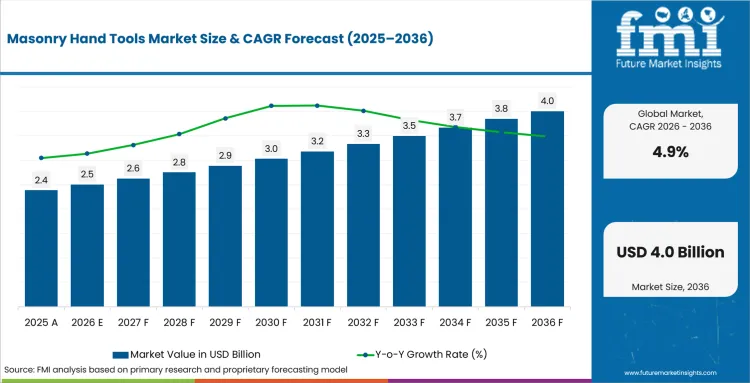
USD 2.5 billion in 2026 and USD 4.0 billion by 2036 at a 4.9% CAGR.
Demand for Masonry Hand Tools is valued at USD 2.5 billion in 2026 and is projected to reach USD 4.0 billion by 2036, expanding at a CAGR of 4.9% over the forecast period. Growth rests on the physical nature of masonry work itself: mortar placement, alignment, joint formation, trimming, cleaning and repair are tasks that still depend on trowels, jointers, brick hammers and levels rather than powered equipment, keeping hand tools central to every bricklaying and stonework job site.
The market's momentum is tied closely to construction activity and building repair cycles, with residential and commercial construction driving new demand while renovation and restoration work sustains steady replacement purchases. A skilled trade workforce that regularly wears down and replaces its tools, rather than one that owns equipment for occasional use, gives the category a recurring purchase pattern that shields it from some of the volatility seen in one time capital equipment. At the same time, the market faces restraints from slow adoption of ergonomic or upgraded tool designs among cost conscious tradespeople and from competition among low cost unbranded imports that compress margins for established manufacturers.
Opportunities are emerging around ergonomic handle design, corrosion resistant materials and tool kits bundled for apprentice training programs, which could open new purchasing channels beyond individual replacement. Segment level activity spans product type, material, end use and distribution channel, each shaping how manufacturers position their offerings. Regionally, construction heavy economies with large skilled trade populations are expected to anchor the bulk of global consumption.
Key Takeaways of Masonry Hand Tools Market
- Bricklaying, blockwork and repair use several hand tools through every work sequence, creating recurring demand from wear, loss and accidental damage.
- Trowels lead Tool Type with 24.0% of market sales in 2026 because they are used during almost every brick or block course.
- Professional Masons lead User Type with 42.0% of demand in 2026 because full-shift use makes balance, handle comfort and output control commercially important.
- Carbon Steel leads Material with 31.0% of market sales in 2026 because it provides the stiffness required for mortar work and supports practical forming, hardening and sharpening.
- Repetitive hand work can create fatigue, while shortages of skilled masons limit the professional user base able to justify specialist tools.
- Notable companies include Marshalltown, Stanley Black & Decker, Kraft Tool, Bon Tool, OX Tools, Rubi, Ragni, Faithfull Tools, Silverline Tools and Spear & Jackson.
Analyst Perspective
“Approve tools over a full shift rather than through a short handling test. Compare blade stiffness and balance, then check mortar release, handle comfort and joint-profile fit. Local availability also matters because one missing hand tool can stop a small crew.”
- Nikhil Kaitwade, Principal Analyst, Future Market Insights
Source: Future Market Insights' proprietary forecasting model and primary research
How is the Masonry Hand Tools Market segmented?
The market is segmented by tool type, user type, material, application, sales channel and region.
The masonry hand tools market is segmented by Tool Type into Trowels, Brick Hammers, Jointers, Levels / Squares, Floats, Chisels and Bolsters, and Masonry Brushes. By User Type, the market includes Professional Masons, Construction Contractors, DIY / Retail Users, and Restoration Specialists. Material covers Carbon Steel, Stainless Steel, Forged Steel, and Wood or Composite Handle Tools. By Application, the market is divided into Bricklaying, Blockwork, Stone Masonry, Plaster / Render, and Repair and Restoration. Sales Channel includes Hardware Retail, Construction Tool Distributors, E-commerce and Professional Supply Houses.
Why does bricklaying lead the application category?
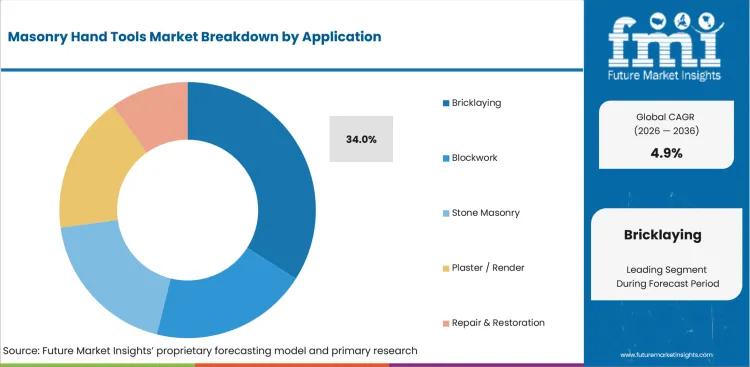
A single wall uses trowels, levels, brick hammers and jointers repeatedly through each course. The joint profile affects the visible finish and how water is shed, so tool choice has a direct effect on completed work.
- Bricklaying is projected to account for 34.0% of market demand in 2026 because new wall construction creates initial tool demand and repointing extends replacement across the installed building base.
- Jointing tools should be matched to the specified mortar profile, joint width and masonry-unit dimensions; repair and heritage work continues to support narrower, more controlled hand tools.
Why do trowels lead the tool type category?
Trowels are used during almost every brick or block course to pick up, spread and shape mortar. Philadelphia, London and narrow-London patterns change blade width, balance and the amount of mortar carried, so one design does not suit every mason or unit size.
- By Tool Type, Trowels are forecast to represent 24.0% of market sales in 2026 because their high use frequency creates steady replacement demand when blades bend, wear or stop releasing mortar cleanly.
- Kraft Tool's W. Rose range documents Philadelphia, narrow-London and wide-London trowel patterns, showing how blade shape, size and handle choice are matched to the task.
Why do professional masons lead the user type category?
Professional masons use several hand tools through complete shifts and are directly responsible for line, level, joint profile and visible finish. Small differences in balance or handle shape become meaningful after hundreds of repeated movements.
- Professional Masons are projected to generate 42.0% of demand in 2026 because daily use leads them to replace bent, worn or uncomfortable tools before output and finish quality deteriorate.
- Contractors often standardise several trowel and jointer patterns across crews while allowing experienced masons to retain preferred sizes and handles.
Why does carbon steel lead the material category?
Carbon steel is used across forged trowel blades, jointers, brushes and related trade tools because it can provide the stiffness needed for mortar work while remaining practical to form, harden and sharpen. Forging and heat treatment affect blade shape, edge retention and resistance to distortion.
- By Material, Carbon Steel is expected to represent 31.0% of market sales in 2026 because it combines familiar production methods with the stiffness required for daily masonry work.
- Marshalltown documents a one-piece forged high-carbon-steel blade for brick, block and stone, while stainless steel remains a premium alternative where corrosion resistance and easier cleaning justify the higher purchase price.
Why does hardware retail lead the sales channel category?
Common trowels, hammers, levels and brushes are frequently replaced at short notice, and small crews cannot always wait for a specialist order. Local stores remain important to professionals, occasional contractors and DIY repair users.
- Hardware Retail is expected to handle 37.0% of market sales in 2026 because immediate availability prevents a lost or damaged hand tool from stopping a crew's work.
- Professional supply houses remain stronger for premium forged products, unusual trowel patterns, crew orders and narrow restoration tools, while e-commerce is most effective when the buyer already knows the required specification.
What are the drivers, restraints and opportunities in the Masonry Hand Tools Market?
Daily trade use and repair support demand. Repetitive strain and skilled-labour limits create friction. Better-balanced forged tools and repair-specific sets provide the clearest premium route.
- New construction and ongoing repair work sustain steady tool replacement across the trade.
- Restraint: Repetitive hand work can cause fatigue, while a shortage of skilled masons limits the active professional user base.
- Opportunity: Better-balanced forged tools and task-specific repair kits can support premium pricing.
The demand base is broad because hand tools are used in new construction, routine repair and heritage work. Trowels and jointers wear through daily mortar contact, brushes and chisels lose performance, and tools are also replaced after loss or accidental damage. Repair activity creates continuing demand even when new construction slows.
The main operating restraint is physical strain. Repeated gripping, wrist movement and force can reduce output over a full shift, particularly when the blade, handle or task is poorly matched. UK Health and Safety Executive guidance identifies manual-handling and musculoskeletal risk in construction hand-tool work. Skilled-labour shortages create a second constraint because specialist patterns depend on users who know how to control mortar, line and joint finish.
Premium products have the strongest case when they improve control or reduce fatigue during repeated work. Forged blades, lighter handles, several trowel patterns and multiple jointer sizes allow a closer match to the task. Suppliers can also package tuck pointers, narrow tools and brushes for repair and heritage work, where precision matters more than removal speed.
Which country CAGRs are profiled in the Masonry Hand Tools Market?
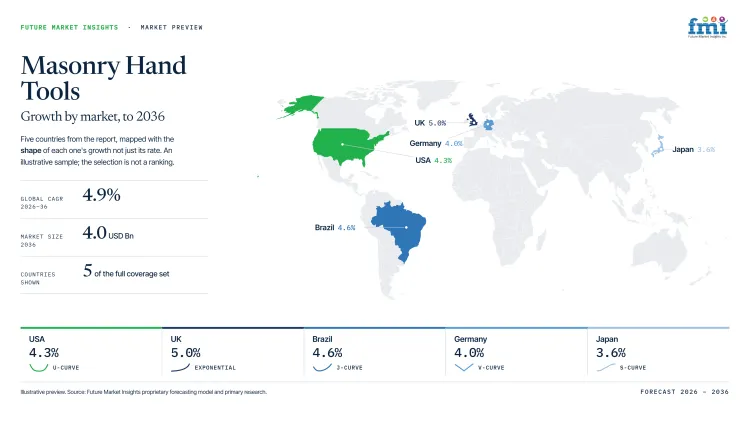
| Country | CAGR |
|---|---|
| USA | 4.3% |
| Germany | 4.0% |
| Japan | 3.6% |
| UK | 5.0% |
| Brazil | 4.6% |
How do country-level CAGRs compare in the Masonry Hand Tools Market?
The five profiled CAGRs span 1.4 percentage points, from 3.6% in Japan to 5.0% in the UK. These rates describe forecast pace rather than current market size, installed tool volume or channel depth.
- The UK leads at 5.0% as repair, maintenance and heritage work support specialist tuck-pointing, jointer and hand-removal tools.
- Brazil's 4.6% outlook reflects a large construction workforce, broad hardware demand and room for professional forged-tool tiers.
- The USA is forecast at 4.3%, supported by a sizeable professional masonry workforce and separate channels for professional forged tools and value-priced hardware products.
- Germany is projected at 4.0% as mature construction and repair activity sustain replacement through established professional distribution.
- Japan is forecast at 3.6%, with demand centred on precise, well-balanced tools and dependable specialist supply in a mature market.
Comparable growth rates can produce different market-entry conditions. Heritage repair can support narrow premium tools even where national construction volumes are modest, while a larger workforce may favour broad hardware access and tiered professional ranges.
Country-wise Analysis
- USA: The US market is projected to grow at a 4.3% CAGR from 2026 to 2036. In 2025, the U.S. Bureau of Labor Statistics projected roughly 20,700 annual openings for brickmasons, blockmasons and stonemasons during 2024-2034. Brands can separate professional forged ranges from value-priced hardware products rather than serve every buyer with one specification.
- Germany: Germany is forecast to expand at a 4.0% CAGR through 2036. Destatis provides official construction activity indicators that support a continuing replacement base across construction and repair. Durability, handle comfort and dependable professional distribution provide a stronger sales case than broad volume claims.
- Japan: Japan is expected to record a 3.6% CAGR from 2026 to 2036. Controlled workmanship and compact trade channels favour precise, well-balanced tools and consistent specialist supply. Product positioning should focus on fit and finish rather than an oversized universal range.
- UK: The UK is projected to lead the group at a 5.0% CAGR. In May 2026, the Office for National Statistics continued to identify repair and maintenance as a major measured component of construction output. Suppliers should treat traditional repair and heritage work as a separate buying case from high-volume new construction.
- Brazil: Brazil is forecast to grow at a 4.6% CAGR through 2036. IBGE published 2024 construction data in 2026 covering roughly 191,000 firms and 2.5 million workers. Broad hardware access serves the volume base, while professional supply channels can introduce forged and ergonomic tools to higher-use crews.
Who are the notable companies in the Masonry Hand Tools Market?
Marshalltown, Stanley Black & Decker, Kraft Tool, Bon Tool, OX Tools, Rubi, Ragni, Faithfull Tools, Silverline Tools and Spear & Jackson are notable providers.
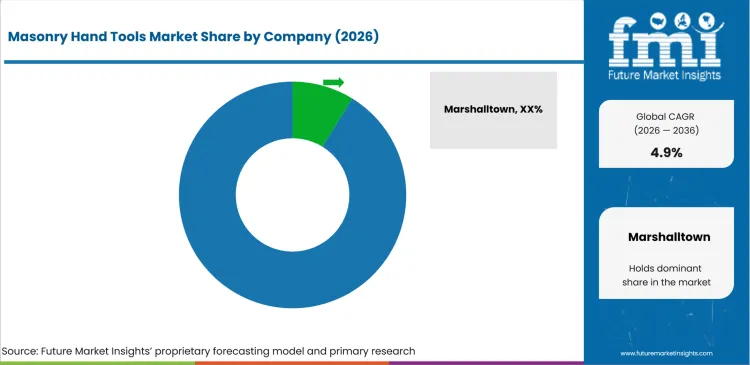
Competition is divided between masonry specialists, global hand-tool groups and professional trade brands. Masons compare blade pattern and forging, then assess balance, handle choice, joint-profile range and local availability. A broad brand name does not replace a complete masonry range.
- Marshalltown, Kraft Tool and Bon Tool compete through masonry-specific depth. Marshalltown offers forged high-carbon brick trowels, several jointer widths and tuck pointers. Kraft Tool's W. Rose range includes Philadelphia, London and narrow-London trowel patterns, while Bon Tool covers trowels, jointers, hammers, levels, brushes and chisels.
- Stanley Black & Decker, Spear & Jackson, Faithfull Tools and Silverline Tools compete through broad retail distribution and general trade-tool availability. Their strength is access across many outlets, although specialist pattern depth can vary by market.
- OX Tools, Rubi and Ragni focus more heavily on professional trade users and application-led ranges. Their commercial position is strongest where dealers can provide the exact pattern, width or finish tool required without forcing the buyer into a general-purpose substitute.
What does competitive benchmarking show in the masonry hand tools market?
| Company | Trowel Breadth | Joint and Finish Tools | Heritage and Repair Fit | Geographic Reach |
|---|---|---|---|---|
| Marshalltown | High | High | High | Global |
| Stanley Black & Decker | High | Medium | Medium | Global |
| Kraft Tool | High | High | High | North America and Export |
| Bon Tool | High | High | High | North America |
| OX Tools | High | High | Medium | Global |
| Rubi | Medium | High | Medium | Global |
| Ragni | High | High | High | Europe and Export |
| Faithfull Tools | High | High | High | United Kingdom and Europe |
What key developments are shaping the masonry hand tools market?
- In 2025, the U.S. Bureau of Labor Statistics projected roughly 20,700 annual openings for brickmasons, blockmasons and stonemasons during 2024-2034, confirming a continuing professional user base for masonry hand tools.
- In May 2026, the UK Office for National Statistics continued to report repair and maintenance as a major measured component of construction output, supporting demand for repointing and masonry-repair tools.
- In 2026, IBGE published 2024 Brazilian construction data covering roughly 191,000 firms and 2.5 million workers, reinforcing the demand case for broad hardware access and professional tool distribution.
What does the Masonry Hand Tools Market report cover?
| Coverage field | Report scope |
|---|---|
| Market breakdown | By tool type, user type, material, application, sales channel and region. |
| Quantitative Units | Revenue in USD Billion, CAGR in %. |
| Market Definition | Trowels, brick hammers, jointers, levels/squares, floats, chisels & bolsters and masonry brushes used in bricklaying, blockwork, stone masonry, plaster/render, and repair & restoration. |
| Regions Covered | North America, Latin America, Western Europe, Eastern Europe, South Asia & Pacific, East Asia, Central Asia, Russia & Belarus, and Middle East & Africa. |
| Countries Covered | USA, Germany, Japan, UK and Brazil, with more than 30 markets covered in the full report. |
| Key Companies Profiled | Marshalltown, Stanley Black & Decker, Kraft Tool, Bon Tool, OX Tools, Rubi, Ragni, Faithfull Tools, Silverline Tools, Spear & Jackson |
| Forecast Period | 2026 to 2036. |
| Approach | Hybrid bottom-up and top-down market sizing supported by primary interviews and official desk research. |
How was the Masonry Hand Tools Market assessed?
| Method | Approach |
|---|---|
| Primary Research | FMI analysts gathered input from manufacturers, service providers, technology developers, distributors, end users, procurement teams and subject-matter experts. Interviews examined purchasing decisions, product or service evaluation, adoption barriers, approval requirements, pricing considerations and expectations for technical or commercial support. Respondents were also asked what evidence is required before a trial, pilot or initial order develops into regular purchasing. |
| Desk Research | Desk research covered government statistics, regulatory publications, trade data, industry associations, technical literature, standards, company filings, product information and official corporate announcements. Sources were reviewed for relevance, publication date, geographic coverage and consistency with the defined market scope. Claims relating to performance, applications, approvals, capacity, investment and commercial activity were retained only when supported by credible public evidence. |
| Market Sizing and Forecasting | The market model combined the baseline value with historical performance, segment structure, pricing and volume indicators, adoption levels, company participation and country-level demand conditions. Forecast assumptions considered economic activity, investment trends, regulatory developments, technology adoption, purchasing cycles, supply availability and barriers to wider market use. Segment and regional estimates were reconciled before the final market total was calculated. |
| Data Validation | Estimates were checked against multiple independent indicators, including public data, company activity, trade patterns, industry developments and findings from primary interviews. Validation also tested whether products, services, applications and company revenues fell within the defined market boundaries. Adjacent categories, unsupported claims, overlapping revenues and activities without direct market relevance were excluded to reduce double counting and maintain consistency across segments and countries. |
What is the Masonry Hand Tools Market segmentation taxonomy?
Masonry Hand Tools Market segmented by Tool Type:
- Trowels
- Brick Hammers
- Jointers
- Levels / Squares
- Floats
- Chisels & Bolsters
- Masonry Brushes
Masonry Hand Tools Market segmented by User Type:
- Professional Masons
- Construction Contractors
- DIY / Retail Users
- Restoration Specialists
Masonry Hand Tools Market segmented by Material:
- Carbon Steel
- Stainless Steel
- Forged Steel
- Wood / Composite Handle Tools
Masonry Hand Tools Market segmented by Application:
- Bricklaying
- Blockwork
- Stone Masonry
- Plaster / Render
- Repair & Restoration
Masonry Hand Tools Market segmented by Sales Channel:
- Hardware Retail
- Construction Tool Distributors
- E-commerce
- Professional Supply Houses
Which sources support the Masonry Hand Tools Market analysis?
- Kraft Tool. (Accessed 2026). Specialist manufacturers maintain dedicated masonry portfolios spanning trowels, jointers, floats and related hand tools.
- Kraft Tool/W. Rose. (Accessed 2026). Brick trowels are differentiated by Philadelphia, narrow-London and wide-London patterns as well as blade size and handle type.
- Kraft Tool/W. Rose. (Accessed 2026). Professional catalogues offer multiple jointer profiles and sizes for controlling mortar-joint shape.
- Bon Tool. (Accessed 2026). Masonry catalogues cover brushes, chisels, hammers, jointers, trowels and levels.
- Bon Tool. (Accessed 2026). Carbon-steel wire brushes are sold for heavy scraping and cleaning in construction finishing.
- Marshalltown. (Accessed 2026). Professional brick trowels use a one-piece forged high-carbon-steel blade and are specified for brick, block and stone.
- Marshalltown. (Accessed 2026). Concave and convex brick jointers use high-carbon steel and multiple joint-width options.
- Marshalltown. (Accessed 2026). Tuck pointers are sold to repair and maintain mortar joints for professional and DIY users.
- U.S. National Park Service. Preservation Brief 2. Hand chisels and mash hammers are preferred for removing mortar from historic masonry when power tools risk damaging units.
- U.S. National Park Service. Preservation Brief 48. Loose mortar around grave markers should preferably be removed with hand tools and replaced using narrow tuck-pointing trowels.
- Historic England. Advice Note 16. UK conservation guidance treats hand repointing and hand-tool mortar removal as material interventions that can affect listed buildings.
- Historic England. (Current). Historic masonry repair depends on traditional materials and craft skills rather than interchangeable modern methods.
- UK Health and Safety Executive. (Current). Construction hand-tool work creates manual-handling and musculoskeletal risk that should be reduced through task design and tool selection.
- U.S. Bureau of Labor Statistics. (2025). The United States expects roughly 20,700 annual openings for brickmasons, blockmasons and stonemasons during 2024-2034.
- U.S. Bureau of Labor Statistics. (2023). NAICS 238140 provides employment and wage data for masonry contractors.
- Office for National Statistics. (May 2026). Repair and maintenance is a major measured component of construction output, directly relevant to repointing and masonry repair.
- IBGE. (2024 data published 2026). Brazilian construction comprised roughly 191,000 firms and 2.5 million workers in 2024.
This bibliography is provided for reader reference and is not exhaustive. The full report contains the complete reference list and detailed citations.
What questions does this report answer?
- How large is the masonry hand tools market in 2026 and 2036?
- Which construction and repair activities create repeat demand?
- Why do Trowels hold 24.0% share in 2026?
- Why do Professional Masons account for 42.0% share?
- What makes Carbon Steel the leading material?
- How do the USA, Germany, Japan, the UK and Brazil compare?
- Which companies provide deep masonry tool ranges?
- How do ergonomics and skill shortages limit demand?
- Where can forged and repair-focused products earn a premium?
Frequently Asked Questions
How big is the Masonry Hand Tools Market in 2026?
The masonry hand tools market is valued at USD 2.5 billion in 2026 and is forecast to reach USD 4.0 billion by 2036. Growth is supported by repeated tool use across mortar placement, alignment, joint formation, trimming and repair among a continuing professional mason workforce.
What is the CAGR of the Masonry Hand Tools Market from 2026 to 2036?
The masonry hand tools market grows at a CAGR of 4.9% between 2026 and 2036, supported by recurring replacement of trowels, jointers, brick hammers and repair tools driven by bricklaying, blockwork and restoration work across a continuing professional user base.
Which tool type leads the Masonry Hand Tools Market?
Trowels account for 24.0% of the masonry hand tools market by tool type in 2026, driven by use during almost every brick or block course that creates steady replacement demand when blades bend, wear or stop releasing mortar cleanly.
How much will the Masonry Hand Tools Market add between 2026 and 2036?
The masonry hand tools market is set to add USD 1.5 billion between 2026 and 2036, growing from USD 2.5 billion to USD 4.0 billion as recurring tool replacement extends across bricklaying, blockwork, repair and restoration work worldwide.
Who are the leading companies in the Masonry Hand Tools Market?
Ten companies lead the masonry hand tools market consistently, including Marshalltown, Stanley Black & Decker, Kraft Tool, Bon Tool, OX Tools, Rubi, Ragni, Faithfull Tools, Silverline Tools and Spear & Jackson, competing through trowel breadth, joint and finish tools, and heritage and repair fit worldwide.
Preview the report firsthand - request a free sample
Get SampleGet the brochure for pricing and purchase details.
Get PDFTable of Content
- Key Takeaways
- Market Size and CAGR
- Top Growth Driver
- Fastest Growing Segment
- Leading Region
- Key Companies
- Emerging Opportunities
- Executive Summary
- Global Market Outlook
- Demand-side Trends
- Supply-side Trends
- Technology Roadmap Analysis
- Analysis and Recommendations
- Analyst Perspective (What is happening? Why now? What should investors know?)
- Key Questions Answered
- How large is the market?
- What is the CAGR?
- What are key trends?
- Which region dominates?
- Who are the leaders?
- Market Overview
- Market Coverage / Taxonomy
- Market Definition / Scope / Limitations
- Research Methodology
- Chapter Orientation
- Analytical Lens and Working Hypotheses
- Market Structure, Signals, and Trend Drivers
- Benchmarking and Cross-market Comparability
- Market Sizing, Forecasting, and Opportunity Mapping
- Research Design and Evidence Framework
- Desk Research Programme (Secondary Evidence)
- Expert Input and Fieldwork (Primary Evidence)
- Tooling, Models, and Reference Databases
- Data Engineering and Model Build
- Quality Assurance and Audit Trail
- Market Background
- Market Dynamics (Drivers, Restraints, Opportunity, Trends)
- Scenario Forecast (Optimistic, Likely, Conservative)
- Impact Analysis
- AI Impact
- Sustainability Impact
- Regulatory Impact
- Technology Impact
- Consumer / Buyer Analysis
- Purchase Drivers
- Adoption Barriers
- Buyer Journey
- Opportunity Map Analysis
- Product Life Cycle Analysis
- Supply Chain Analysis
- Investment Feasibility Matrix
- Value Chain Analysis
- PESTLE and Porter's Analysis
- Regulatory Landscape
- Regional Parent Market Outlook
- Production and Consumption Statistics
- Import and Export Statistics
- Global Market Analysis and Forecast, 2021 to 2036
- Historical Market Size Value (USD Billion) Analysis, 2021 to 2025
- Current and Future Market Size Value (USD Billion) Projections, 2026 to 2036
- Y-o-Y Growth Trend Analysis
- Absolute $ Opportunity Analysis
- Global Market Pricing Analysis, 2021 to 2036
- Global Market Analysis and Forecast, By Tool Type, 2021 to 2036
- Introduction / Key Findings
- Historical Market Size Value (USD Billion) Analysis By Tool Type, 2021 to 2025
- Current and Future Market Size Value (USD Billion) Analysis and Forecast By Tool Type, 2026 to 2036
- Trowels
- Brick Hammers
- Jointers
- Levels / Squares
- Floats
- Chisels & Bolsters
- Masonry Brushes
- Trowels
- Y-o-Y Growth Trend Analysis By Tool Type, 2021 to 2025
- Absolute $ Opportunity Analysis By Tool Type, 2026 to 2036
- Global Market Analysis and Forecast, By User Type, 2021 to 2036
- Introduction / Key Findings
- Historical Market Size Value (USD Billion) Analysis By User Type, 2021 to 2025
- Current and Future Market Size Value (USD Billion) Analysis and Forecast By User Type, 2026 to 2036
- Professional Masons
- Construction Contractors
- DIY / Retail Users
- Restoration Specialists
- Professional Masons
- Y-o-Y Growth Trend Analysis By User Type, 2021 to 2025
- Absolute $ Opportunity Analysis By User Type, 2026 to 2036
- Global Market Analysis and Forecast, By Material, 2021 to 2036
- Introduction / Key Findings
- Historical Market Size Value (USD Billion) Analysis By Material, 2021 to 2025
- Current and Future Market Size Value (USD Billion) Analysis and Forecast By Material, 2026 to 2036
- Carbon Steel
- Stainless Steel
- Forged Steel
- Wood / Composite Handle Tools
- Carbon Steel
- Y-o-Y Growth Trend Analysis By Material, 2021 to 2025
- Absolute $ Opportunity Analysis By Material, 2026 to 2036
- Global Market Analysis and Forecast, By Application, 2021 to 2036
- Introduction / Key Findings
- Historical Market Size Value (USD Billion) Analysis By Application, 2021 to 2025
- Current and Future Market Size Value (USD Billion) Analysis and Forecast By Application, 2026 to 2036
- Bricklaying
- Blockwork
- Stone Masonry
- Plaster / Render
- Repair & Restoration
- Bricklaying
- Y-o-Y Growth Trend Analysis By Application, 2021 to 2025
- Absolute $ Opportunity Analysis By Application, 2026 to 2036
- Global Market Analysis and Forecast, By Sales Channel, 2021 to 2036
- Introduction / Key Findings
- Historical Market Size Value (USD Billion) Analysis By Sales Channel, 2021 to 2025
- Current and Future Market Size Value (USD Billion) Analysis and Forecast By Sales Channel, 2026 to 2036
- Hardware Retail
- Construction Tool Distributors
- E-commerce
- Professional Supply Houses
- Hardware Retail
- Y-o-Y Growth Trend Analysis By Sales Channel, 2021 to 2025
- Absolute $ Opportunity Analysis By Sales Channel, 2026 to 2036
- Global Market Analysis and Forecast, By Region, 2021 to 2036
- Introduction
- Historical Market Size Value (USD Billion) Analysis By Region, 2021 to 2025
- Current Market Size Value (USD Billion) Analysis and Forecast By Region, 2026 to 2036
- North America
- Latin America
- Western Europe
- Eastern Europe
- East Asia
- South Asia and Pacific
- Middle East & Africa
- Market Attractiveness Analysis By Region
- North America Market Analysis and Forecast, By Country, 2021 to 2036
- Historical Market Size Value (USD Billion) Trend Analysis By Market Taxonomy, 2021 to 2025
- Market Size Value (USD Billion) Forecast By Market Taxonomy, 2026 to 2036
- By Country
- USA
- Canada
- By Tool Type
- By User Type
- By Material
- By Application
- By Sales Channel
- By Country
- Market Attractiveness Analysis
- By Country
- By Tool Type
- By User Type
- By Material
- By Application
- By Sales Channel
- Key Takeaways
- Latin America Market Analysis and Forecast, By Country
- Historical Market Size Value (USD Billion) Trend Analysis By Market Taxonomy, 2021 to 2025
- Market Size Value (USD Billion) Forecast By Market Taxonomy, 2026 to 2036
- By Country
- Brazil
- Mexico
- Chile
- Rest of Latin America
- By Tool Type
- By User Type
- By Material
- By Application
- By Sales Channel
- By Country
- Market Attractiveness Analysis
- By Country
- By Tool Type
- By User Type
- By Material
- By Application
- By Sales Channel
- Key Takeaways
- Western Europe Market Analysis and Forecast, By Country
- Historical Market Size Value (USD Billion) Trend Analysis By Market Taxonomy, 2021 to 2025
- Market Size Value (USD Billion) Forecast By Market Taxonomy, 2026 to 2036
- By Country
- Germany
- UK
- Italy
- Spain
- France
- Nordic
- BENELUX
- Rest of Western Europe
- By Tool Type
- By User Type
- By Material
- By Application
- By Sales Channel
- By Country
- Market Attractiveness Analysis
- By Country
- By Tool Type
- By User Type
- By Material
- By Application
- By Sales Channel
- Key Takeaways
- Eastern Europe Market Analysis and Forecast, By Country
- Historical Market Size Value (USD Billion) Trend Analysis By Market Taxonomy, 2021 to 2025
- Market Size Value (USD Billion) Forecast By Market Taxonomy, 2026 to 2036
- By Country
- Russia
- Poland
- Hungary
- Balkan & Baltic
- Rest of Eastern Europe
- By Tool Type
- By User Type
- By Material
- By Application
- By Sales Channel
- By Country
- Market Attractiveness Analysis
- By Country
- By Tool Type
- By User Type
- By Material
- By Application
- By Sales Channel
- Key Takeaways
- East Asia Market Analysis and Forecast, By Country
- Historical Market Size Value (USD Billion) Trend Analysis By Market Taxonomy, 2021 to 2025
- Market Size Value (USD Billion) Forecast By Market Taxonomy, 2026 to 2036
- By Country
- China
- Japan
- South Korea
- By Tool Type
- By User Type
- By Material
- By Application
- By Sales Channel
- By Country
- Market Attractiveness Analysis
- By Country
- By Tool Type
- By User Type
- By Material
- By Application
- By Sales Channel
- Key Takeaways
- South Asia and Pacific Market Analysis and Forecast, By Country
- Historical Market Size Value (USD Billion) Trend Analysis By Market Taxonomy, 2021 to 2025
- Market Size Value (USD Billion) Forecast By Market Taxonomy, 2026 to 2036
- By Country
- India
- ASEAN
- Australia & New Zealand
- Rest of South Asia and Pacific
- By Tool Type
- By User Type
- By Material
- By Application
- By Sales Channel
- By Country
- Market Attractiveness Analysis
- By Country
- By Tool Type
- By User Type
- By Material
- By Application
- By Sales Channel
- Key Takeaways
- Middle East & Africa Market Analysis and Forecast, By Country
- Historical Market Size Value (USD Billion) Trend Analysis By Market Taxonomy, 2021 to 2025
- Market Size Value (USD Billion) Forecast By Market Taxonomy, 2026 to 2036
- By Country
- Kingdom of Saudi Arabia
- Other GCC Countries
- Türkiye
- South Africa
- Other African Union
- Rest of Middle East & Africa
- By Tool Type
- By User Type
- By Material
- By Application
- By Sales Channel
- By Country
- Market Attractiveness Analysis
- By Country
- By Tool Type
- By User Type
- By Material
- By Application
- By Sales Channel
- Key Takeaways
- Key Countries Market Analysis
- USA
- Pricing Analysis
- Market Share Analysis, 2025
- By Tool Type
- By User Type
- By Material
- By Application
- By Sales Channel
- Canada
- Pricing Analysis
- Market Share Analysis, 2025
- By Tool Type
- By User Type
- By Material
- By Application
- By Sales Channel
- Mexico
- Pricing Analysis
- Market Share Analysis, 2025
- By Tool Type
- By User Type
- By Material
- By Application
- By Sales Channel
- Brazil
- Pricing Analysis
- Market Share Analysis, 2025
- By Tool Type
- By User Type
- By Material
- By Application
- By Sales Channel
- Chile
- Pricing Analysis
- Market Share Analysis, 2025
- By Tool Type
- By User Type
- By Material
- By Application
- By Sales Channel
- Germany
- Pricing Analysis
- Market Share Analysis, 2025
- By Tool Type
- By User Type
- By Material
- By Application
- By Sales Channel
- UK
- Pricing Analysis
- Market Share Analysis, 2025
- By Tool Type
- By User Type
- By Material
- By Application
- By Sales Channel
- Italy
- Pricing Analysis
- Market Share Analysis, 2025
- By Tool Type
- By User Type
- By Material
- By Application
- By Sales Channel
- Spain
- Pricing Analysis
- Market Share Analysis, 2025
- By Tool Type
- By User Type
- By Material
- By Application
- By Sales Channel
- France
- Pricing Analysis
- Market Share Analysis, 2025
- By Tool Type
- By User Type
- By Material
- By Application
- By Sales Channel
- India
- Pricing Analysis
- Market Share Analysis, 2025
- By Tool Type
- By User Type
- By Material
- By Application
- By Sales Channel
- ASEAN
- Pricing Analysis
- Market Share Analysis, 2025
- By Tool Type
- By User Type
- By Material
- By Application
- By Sales Channel
- Australia & New Zealand
- Pricing Analysis
- Market Share Analysis, 2025
- By Tool Type
- By User Type
- By Material
- By Application
- By Sales Channel
- China
- Pricing Analysis
- Market Share Analysis, 2025
- By Tool Type
- By User Type
- By Material
- By Application
- By Sales Channel
- Japan
- Pricing Analysis
- Market Share Analysis, 2025
- By Tool Type
- By User Type
- By Material
- By Application
- By Sales Channel
- South Korea
- Pricing Analysis
- Market Share Analysis, 2025
- By Tool Type
- By User Type
- By Material
- By Application
- By Sales Channel
- Russia
- Pricing Analysis
- Market Share Analysis, 2025
- By Tool Type
- By User Type
- By Material
- By Application
- By Sales Channel
- Poland
- Pricing Analysis
- Market Share Analysis, 2025
- By Tool Type
- By User Type
- By Material
- By Application
- By Sales Channel
- Hungary
- Pricing Analysis
- Market Share Analysis, 2025
- By Tool Type
- By User Type
- By Material
- By Application
- By Sales Channel
- Kingdom of Saudi Arabia
- Pricing Analysis
- Market Share Analysis, 2025
- By Tool Type
- By User Type
- By Material
- By Application
- By Sales Channel
- Türkiye
- Pricing Analysis
- Market Share Analysis, 2025
- By Tool Type
- By User Type
- By Material
- By Application
- By Sales Channel
- South Africa
- Pricing Analysis
- Market Share Analysis, 2025
- By Tool Type
- By User Type
- By Material
- By Application
- By Sales Channel
- USA
- Market Structure Analysis
- Competition Dashboard
- Competition Benchmarking
- Market Share Analysis of Top Players
- By Regional
- By Tool Type
- By User Type
- By Material
- By Application
- By Sales Channel
- Emerging Startups
- Innovation Benchmarking
- Competition Analysis
- Competition Deep Dive
- Marshalltown
- Overview
- Product Portfolio
- Profitability by Market Segments
- Sales Footprint
- Strategy Overview
- Marketing Strategy
- Product Strategy
- Channel Strategy
- Stanley Black & Decker
- Kraft Tool
- Bon Tool
- OX Tools
- Rubi
- Ragni
- Faithfull Tools
- Silverline Tools
- Spear & Jackson
- Marshalltown
- Case Studies
- Success Stories
- Recent Developments
- Competition Deep Dive
- Assumptions & Acronyms Used


